05/04/2026 -- In commeration of Erik W. Gardner (1965-2025). His father and mother attended the Magna Carta event.
Monday, May 4, 2026
Attainder grudge
Thursday, October 23, 2025
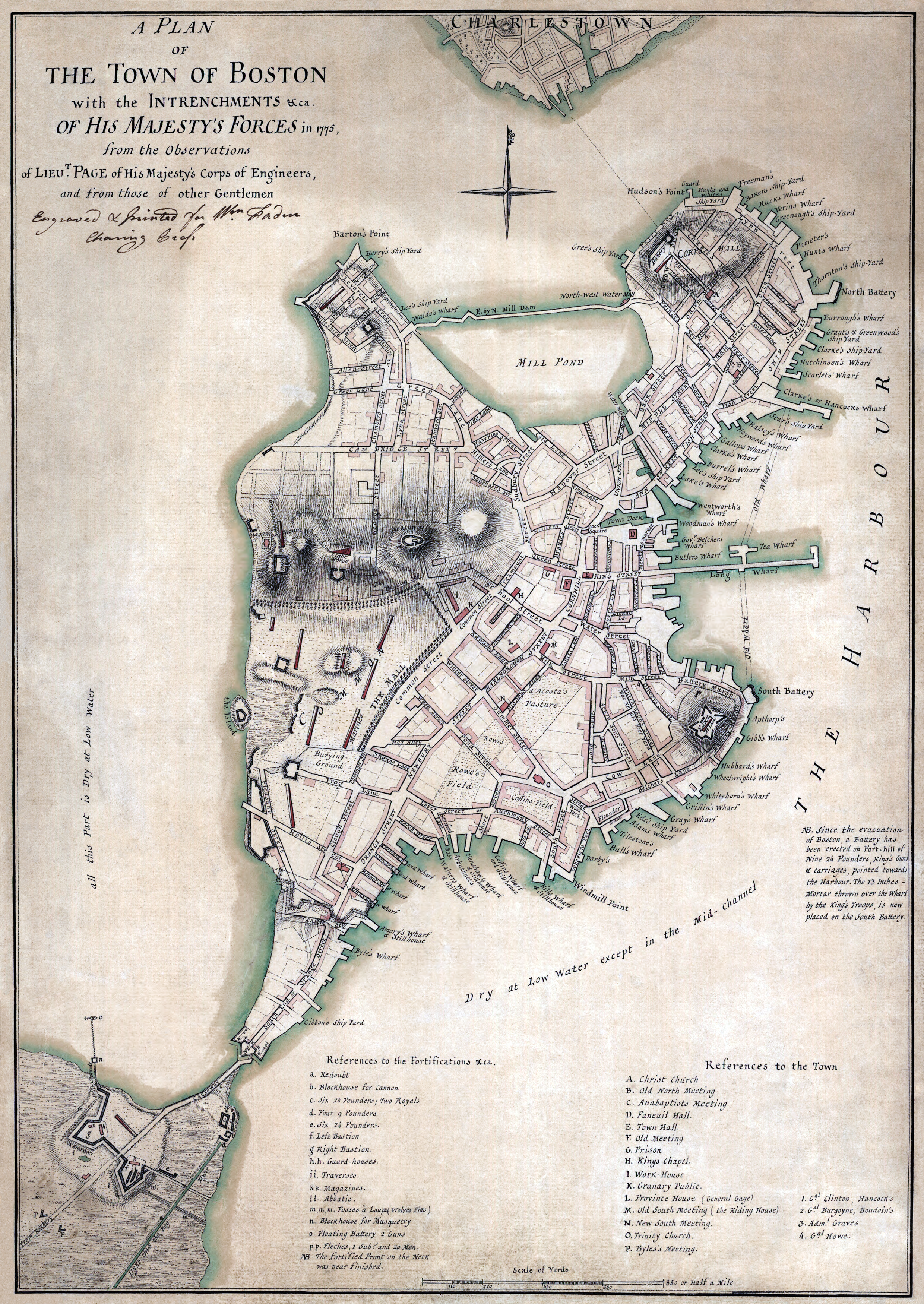
Siege of Boston, I
TL;DR -- We will do a series on the Siege in the next few months. It dragged on for almost a year.
- Regimental History, Seige of Boston (2015) -- Last Issue, Massassachusetts Magazine (2018) -- the first and last of 4 articles per year for over a decade.
- Elizabeth (Gardner) Blanchard (2019) - look at families and their contribution.
- Boston first (2024) - on the evacuation that ended the Siege of Boston.
- George Washington in Boston (2025) - he was up there for several months, long enough for Martha to visit.
- Southern Campaign (2025) - after the British left Boston, they were in PA and NY. At some point, there was a choice to get the southern colonies on their side.
- General Nathanael Greene (2025) - he was at Boston, under Washington. More on him later.
- ...
- Bunker Hill West, 1873 (2025) - we have had a lot of posts on this hill in DTLA which can be used to watch the changes in the U.S. over the time of the area post New Spain's rule.
Remarks: Modified: 10/23/2025
10/23/2025 -
Monday, April 15, 2024
Bluebells in Dorset
![]() |
| Bluebells in the countryside, Minterne Magna, Dorset, England, UK |
Saturday, July 1, 2023
247th of U.S.
TL;DR -- With the approaching 250th of the United States and the time of the year, the focus is on Patriots and their times as well as their progeny since then to now. This year is the 247th of the start of the revolutionary activity that was public. There had been prior activity that was taken by the ardent though at considerable risk to themselves and their families.
---
In the colonies, here, there were stirrings earlier, but it was in July of 1776 when those there got to the notion of independence, what it might mean, and started the process. This was the time of the remaining of the 4th generation, the majority of the 5th generation, and the starting of the 6th generation.As we have noted, it was the 5th that bore the responsibility of establishing the United States.
Today, we gather research material, such as Dr. Frank's writings to support future research work with regard to the three generations. Below, we provide information from the 1907 edition. The 1933 edition is about the family of George Gardner, who as a 2nd generation son of Thomas Gardner and Margaret Fryer.
We point to The Massachusetts Magazine in which Dr. Frank wrote, for each issue, about the regiments that served at Bunker Hill. Works of Dr. Frank include the following:
In the 1907 book of Dr. Frank, the 5th generation starts with #87 Habakkuk Gardner (1707-1763) who died before the start of the Revolution. Next was #90 Capt. John Gardner (1706-1784) who served both in the French-Indian conflict as well as supported the Revolution. The last person in this generation in the book was #137 Samuel Gardner (1763-1796).First, though, let's point to two other resources. The Daughters of the American Revolution (D.A.R.) and the Sons of the American Revolution (S.A.R.) both accept applications from descendants of Patriots. One of the contributions of these groups is that they help verify lineage. Right now, we are talking over 12 generations for many of the older folks up to 17 generations for the younger set. For the latter, D.A.R. has an organization called Children of the American Revolution.
These are the research facilities offered by both groups which we will use below.
- https://services.dar.org/public/dar_research/Search/ - one can search for Ancestors or Members. A Descendants search allows one to query intervening generations about their pedigree information.
- https://sarpatriots.sar.org/patriot/search/ - S.A.R. has a similar search strategy. For those Patriots in both databases, the S.A.R. report has a link to the D.A.R. record.
- #121 Lt. Thomas Gardner (1731-1788) - pg. 189; MS&S Vol 6, pg. 281; DAR - A043895; SAR - none.
- #123 Ebenezer Gardner (1737-1832 - pg. 191; MS&S Vol 6, pg. 264; DAR - A043683; SAR - P-164034. We wrote of Ebenezer earlier.
- #129 Simon Stacey Gardner (1743-1787) - pg. 195; MS&S Vol 6, pg. 278; DAR - A043882; SAR - P-164145.
- #26 Elizabeth Gardner - her son, Jonathan Gardner (1728-1791), pg. 76; MS&S Vol 6, pg 272; DAR - ; SAR - . We wrote of Elizabeth (Gardner) Gardner earlier.
- #26 Elizabeth Gardner - her son, John Gardner (1736-1816), pg. 77; MS&S Vol 6, pg 270; DAR -__ ; SAR- P-164077.
- #30 Hannah Gardner - her son, Samuel Holton, pg. 78; MS&S Vol 7, pg. __; DAR - A057441; SAR - P-184238.
Too, we will be looking at earlier incidents. We already have looked at the Crown's training of the officers via their involvement in the French-Indian conflict. But, some events like the Boston Tea Party are of interest. There is now an effort by the NEHGS to find descendants of the participants.
08/26/2023 --
Sunday, September 11, 2022
England and US
TL;DR -- The transition of the U.K. from the reign of Queen Elizabeth II to that of Charles III allows us an opportunity to stop and consider the long-time relationships between them and us. We can track the 400 or more years of involvement; there is a 250th coming up of the resolution of our conflict; we are family, many ways, and therefore more for being allies than not; our cultural themes match up deeply; and more. The next few years will allow lots of discussion to come to fore. Too, it will be interesting to look at all aspects of our relationships.
--
| Coronation 2 June 1953 |
From our start with the work of the Thomas Gardner Society, Inc, we followed the adage of letting those over there worry about the details on their side of the great waters while we looked at the American side. That limiting choice helped us in the early years to keep a focus, but we always had questions come up from our readers. Origins was a common theme for query. Questions of origins are for the most part associated with motivations.
Too, as we got toward 2015, the focus on the Magna Charta ramped up. It was in this context that we got familiar with the scope of research being supported by the internet so that a major author could mostly work out of Salt Lake City but publish details about records that were in England. Of course, there has to be local work, as well, which we will be looking into.
As an example, it was in 2014 that we saw that Sherborn records were being digitized which led to more information about Margaret Friar's life and her marriage to Thomas Gardner. At that time, we started the WikiTree effort, mainly due to the quality of genealogists working there.
As we know, the 250th of the Revolution is coming up which marks the violent split of our two worlds. After that, there was a slow reconciliation, post the 1812 deal, which got us back to being strong allies as one would expect within families. For instance, the Cornwall Duchy is where one finds Dartmoor Prison which held Americans. So, we can look at many events in our research. The story of the HMS Resolute is an example.
Below are two graphs. One shows the Monarchs from the time of Alfred the Great (lower graph) to Anne. This graph has Charles II who was the son of Charles I who was beheaded. There are two Cromwell terms on the lower graph. We have barely touched upon the subject of the English Civil War which played out here, too. Part of this graph, too, covers the colonial period.
The upper graph goes from Queen Anne to Charles III. Her son died leaving George I as the main choice for King. From that time, we can track down to the turmoil of the split in two generations. Anne is a good place to start this graph. Her conflicts bled over here and motivated a Pamphlet War. It was this conflict plus the French-Indian affair that trained the colonials in military matters sufficiently to pull off a revolution.
![]() |
| Monarchs, from 1707 |
09/11/2022 --
Monday, March 21, 2022
John Tilley (Tylly, Tilly)
TL;DR -- John Tilley has been of interest from day one, as we learned about Cape Ann and its history. As with the others, what happened to John after Conant got the group to move to the to-be Salem area? Finally, we have a research report. It confirms that John was at Cape Ann. His father was an investor in the Dorchester Company. He went back. Then, he married in England. The couple returned not long after Winthrop's arrival. The couple was in Dorchester, MA and Saybrook/Windsor, CT. John may have had a daughter. And, he was tortured and died in sight of his peers.
--
According to Dr. Frank who was quoting Rev. Hubbard and Rev. Joseph B. Felt, John Tilley came with Thomas Gardner into the Cape Ann area to establish a colony. The former was the head of fishing endeavors; the latter was in charge of the planting aspects. The intent, by the way of the Dorchester Company, was to begin regular shipment of feedstuff back to the jolly old country. So, as a peer of Thomas, John Tilley got our attention early. And, we didn't know about any offspring. So, we added him to our not-to-be-forgotten list which included Joseph Gardner.
But, the capitalists had expectations that were too high. And, they sent in Roger Conant to try to improve on matters which did not work due to the poor conditions at the chosen location among other things. Then, things went south. Conant move the colony to what was to become Salem. Some followed. Others had unknown fates. One of these was John Tilley. And, Thomas Gardner was not of the mix as he received no recognition with respect to what became the focus of the Old Planters of Beverly society.
Conant was well documented by his family. We have lots of information about Thomas, some of it might be fictive (See the "What we know" post that needs to be updated). On the other hand, we did find their marriage. That is, Thomas and Margaret Fryer are noted to have married in Dorset. Also, after much digging, we think that Thomas and Margaret stayed in Cape Ann with their kids in the house until John Endicott arrived. There were other families at Cape Ann which we intend to research.
This post is about the family of John Tilley which was featured in an article in the recent NEHGR by one of the consulting editors. His father was William Tilley.
| William Tilley father of John Tilley, Cape Ann The Original 119 Members |
John Tilley's father was an investor in the Dorchester Co. Investors (our post). Roger Conant's brother was an investor, as well. (We know that a Gardner was married to a sister of Rev. John White MA (1574/5 - 1648) (our post). Frances Rose-Troup noted that he came over and went back and was buried there. So, some connection to an investor would not be out of the question.)
John went back after the Conant move. And married. (see Paine sisters on people going back.) Then, the couple returned. Went to Dorchester. Later, they were in Windsor, CT.
John was stated to have harsh words with Lion Gardiner. (Great) John went north as he stated that he would. On the way back, he was captured by the American Indians and tortured. That included having both of his hands and feet cut off, and other atrocities. The Indians said that John performed well (when men were men - BTW, this all happened within sight of his fort'd peers. How's that for leaving men behind?)
There was no known connection established with John Tilley of the Mayflower.
Tilley-954 has a good start on a Profile for John at WikiTree. He married Edith (Moorecock) Garland, a widow. In England. There is a probable daughter, Elizabeth Tilley who married Thomas Merrick. After John died, Edith married Nicholas Camp.
The article provides information about the two brothers who came over.
Several of the families of Cape Ann have been researched, such as the Woodbury family. But, do we have a good list of the families. Many lists are based upon families that went with Conant (see Families at Cape Ann) or are mentioned in work by the Old Planters Society started by Dr. Gardner and Col. Higginson. We attempt a survey to find out where there are missing pieces to look for.
Remarks: Modified: 04/07/2022
Sunday, February 27, 2022
Hearty Canadians
TL;DR -- An oversight became apparent, recently, as we were researching. Quora had a discussion where we saw mention of the York Factory Express which started on the Columbia River, near the Pacific, and ended up at Hudson's Bay. Now, that's a feat. We looked for particulars and have generated some notes for future work which overlaps our interest in the specifics of moving to new areas as well as keeping lines of communication open. We have the diary of a person who did the trek plus well as modern overviews on the subject.
--
This post lifts to awareness something that has been on the back burner and needs more attention. Our focus early on was New England plus issues related to whence. Then, we had to learn specifics about Massachusetts' early times, in particular Essex County and Cape Ann. Following that, the attention was on the 400 years of generations in a mode that covered the whole of the threads which one might call being interested in the influence of collateral families. Not only have we done this for the major thread, we have worked with dozens of other families. Too, we have noted specifics related to events connected with frames of time, mainly (years ago) 100, 200, 250, 300, and 400. The 250th has to do with the coming lookback at the conflict with the Crown. The closer years deal with the wild west (think, internet) and the frontier which are still with us. Then, the 300th is the time of the witches, after all, we are dealing with Salem, MA. And, the 400th is right around the corner.
The past few years have dealt with a variety of subjects that are related where we have seen reference to Canada but tabled a closer look. Now, we can venture down that path as the information is there for scrutiny. From time to time, we run into a topic which overlaps what we have run across. The past year or so, we have traversed the west in the U.S. within the framework of the 200th anniversary of the expansion of the U.S. through the Louisiana property and other deals. We started out looking at early explorers and the whole of the frontier as civilization moved. That included studying rivers as a means to move as well as a barrier to doing so. And, the whole of the land management concerns a lot of which centered upon activity in St. Louis, MO (Carving the land). We considered various types of transportation.
![]() |
| The York Factory Express |
One could do that up there, similarly to the traffic from New Orleans to Los Angles very early? Got to see that.
So, let's consider a few pointers to set up a bit of research. We had known that the northern boundaries in the west were settled late. We also have followed the explorers and the trade people and the ranchers across the northern and southern routes of the U.S. We knew of the fluid flow from the north with regard to immigrants.
This topic allows us to now connect more dots and, also, to study the History of Washington State and related areas. In doing so, we can get a better hold on our Canadian cousins, many of whom had been Loyalists during the conflict with the Crown. Some Patriots were forced down south (Maine Gardners, say Ebenezer, descendant of Samuel).
- On the express, itself: Wikipedia - York Factory Express; FamilySearch - York Factory Express
- Diarist who did the trek - Edward Ermatinger (111 pages). -- We have had several diaries mentioned -- Nathaniel Knapp (French Indian affair), Caleb Haskell (Revolutionary war), Rev. William Bentley (Salem's going-ons), Richard Crowninshield Derby (Civil War), Elizabeth (Gardner) Blanchard (Revolutionary war), John Winthrop (Colonial).
- Canadians in Washington/Oregon - we heard of this with the movie Revenant's mention of Gardners in the area, as was Jedediah Strong Smith.
- Wikipedia - John Franklin. We had a post on the HMS Resolute last year which also mentioned Greeley's crew getting trapped in the Artic.
- Author studying the subject, who has published books -- Nancy Marguerite Anderson,
Thursday, February 17, 2022
Magna Carta, technical
TL;DR -- We saw the 800th of the Magna Carta a few years ago. Another event looking back comes in 2025, two years before the 250th of the U.S. Revolution. In any case, technology has created new Lords and such that are outside of any constraint. Or so, some of them might think. One gross case was observing an auto-truck with attitude on a public highway. This was not the first time nor was it the only location where we have watched such shenanigans, of which there are several other cases. Whatever, technology seems to have gone wild as do the youngsters every spring break. That, folks, is not a sustainable state of affairs.
--
We were involved with the Magna Carta celebration in 2015 several ways. Jon Gardner attended the ceremony at Runnymede and wrote a report for The Gardner Annals, Vol. III, No. 1. We helped edit generational material in the bios of the Sureties found on Wikipedia. Along that line, Wikipedia started its Magna Carta study.
The Magna Carta was an early English document which specified constraints for the King that were expected to be followed. The authors were Lords who were dissatisfied with the notion of unlimited powers for the King. After some conflict, the Magna Carta was drawn up and sealed by King John in 1215; this was celebrated, after much planning, in 2015 under the auspices of Queen Elizabeth II and the American Bar Association. Another historic reflection will be done in 2025 to celebrate King Henry III declaring his support for the document and its intent.
Not only were restraints specified for royalty, there were conditions set for the aristocracy. This brings us to the topic.
The other day, we followed an auto-truck (to be autonomous, at some point) on an Interstate highway. How this entity was identified can be explained, but there was more than one. But, with regard to one that got our attention, the thought was "auto-truck with attitude" for several reasons. In a technical sense, a data-driven process under the name of machine learning looks at data and obtains useful information that is actionable. An example? The technique is applied quite generally, of late, and was behind the first computer's winning of the Chinese game of Go.
That win got a lot of attention and spawned lots of copy-cat efforts which led to new definitions and approaches for what we call AIn't. We have had several posts on the subject, but the one dealing with "How dumb is AI?" is a good start on looking at the matter. Just let us say that there is little science in this effort which has been marketed with glee and mischief (when one considers constraints that apply to truth in advertising). In short, technology has gone wild, of late.
AIn't is only one of several examples. The Internet, in general, is a mess of gigantic proportions. Does one even have time to do a litany of the issues? Well, one inhibitor? The effort and time needed to try to establish a stable basis is a huge detractor with costs that seem unbounded in a few of the cases that have been studied. Our response, in the workings, will be to assume that technology and its sustainable use is a worthy subject for attention and with enough purpose for establishing a mission focus.
Back to the truck event that we watched unfold, briefly. The thing would not have passed a driver's test. That is, no truck being driven by a human in such a manner would be seen as desirable. And, given that the human doing the driving is the responsible party, a license would not be forthcoming based upon what we saw. Too, though, this is only one example. There were other trucks. Two of them played a tandem chase, blocking two lanes of traffic, for miles.
Was there any indication that the road was a test site? As in? Student drivers go around in a marked car. Testing is usually done in a private area. Test tracks and sites support the need. When we say that this is not isolated? We mean that we have seen it in several states. Are these types of test runs made public?
There are many motivations for auto-trucks being sought as something beneficial. For one, we have a shortage of drivers. Too, supposedly, the auto-truck would have a better driving record. Oh yes, have you read of accidents? One thing is certain, the modes for the accidents of these types of vehicles is different. And, deadly, as such occurrences can be for human drivers.
One thing needs to be added, these were not loaded. The out-of-control modes observed would be very problematic with a loaded trailer bringing in potential instability. Lots of effort has gone into training humans to be safe with their truck driving. Of course, we did have an incursion of untrained drivers due to circumstances that were associated, in part, with a new class of accidents.
Okay, an artificial vehicle with attitude? Like a Lord of old? We have a whole new class of Lords which are the big-pocketed lords of industry. Are they amenable to looking at restraints that would make sense and produce mature behavior?
auto-trucks are only one example. There are many more approaches pending, as no restraint seems to be taken in determining the future. It's wide-open. In fact, there is this moral: go fast and break things.
Oh, Lord (proper use), deliver us. The whole of social media can be a mess beyond salvation, sometimes. Choices by Lords are hugely responsible for the problems.One might say that the virtual appeals to the reptilian brain and gets responses thus. Stimulus-response, with little judgment applied. The modes do not augment the abilities attained with any type of cognitive oversight. Actually, it's more functional with input matching up with an output, with the pairing having been determined by prior training based upon data. And data? Suspect, for many reasons.
So, we have a multitude of issues that need attention on a continual basis without any existing paradigm being there that will not work without serious adjustments. And, judgment to do this modification? Whence might come this?
If one looks at the problems, we have seen lots of examples of progress being effective as well as efficacious for everyone. In fact, a notion of the every human as King/Queen is not counter to how we might think about the future. Turning this to technology, the user seemingly has been given great ability and authority. But, not really, as the chains that bind given the situation are onerous, indeed.
Remarks: Modified: 02/17/2022
Wednesday, November 3, 2021
Lucy Foster (Wilson) Gardner
TL;DR -- As we look at generations, we will split them by the 250th which is an important event. Lucy Foster Wilson Gardner, and her husband, are of the seventh generation. We have written of Lucy as her family involves all sides of the Witch ordeal. Too, they have interesting stories with respect to the War of Independence. Then, we have updated her WikiTree profile.
--
Recently, while sorting old material, Ann's brother, Jonathan B. Gardner, found a portrait of Lucy Foster Wilson. The dimensions are 12 1/4 by 10 inches without the framing which had deteriorated. Lucy was two generations post the U.S. Revolution whose 250th celebration is coming up soon.
This is a photo of the portrait; the rest of this post is about Lucy and her generation.
![]() |
| Lucy F. Wilson ca. 1840s |
Thursday, July 22, 2021
Grave abuse
TL;DR -- For a decade, we looked into the question of Where is Thomas? That query was with respect to the location of his remains. After reading about and listening to lots of comments and ideas, we decided to dig deeper. Lo and behold, we find that the place where Thomas was buried was torn apart 190 years ago or so. Stones were moved without regard to bodies which were left. Then, the land was contoured for traffic dragging the bones about. Or, they were thrown in the river bed that was being filled. Some remains and stones may have moved to two areas. Harmony Grove Cemetery is close; but, the Trask plot is closer. God only knows.
--
A decade ago, we first asked the question of "Where is Thomas?" after visiting the cemetery in Salem, MA and coming away disturbed. Then, we slowly gathered data and kept asking. Where is Thomas? Finally, we heard on a phone call (Maine Gardner) about tales of missing graves. Okay, what does that mean? Well, we kept gathering related material. Too, we got familiar with the area. Actually, Ann's childhood house is within a stone's throw of where the Gardner Burial plot was. Let's say, using a hefty arm. However, it was almost as high on the side of the hill as was Thomas when he sat by his tree and said that he liked the view of the water (7 Oct 2019, Gallows Hill - look at the painting in this post).
Later, we noticed that Dr. Frank had mentioned the issue in his books quoting Samuel Pickering Gardner's comments about the problem. A summary post (28 Feb 2019, Another twist) tied things up. And we took our attention out to the wild west.
![]() |
| Showing Google view, with annotations, mapped to Sidney Perley's sketch of the area around Gardner Burial Plot |
But, it is time to re-address this theme due to the hard sleuthing of Melissa Davenport Berry. She runs a FB group titled Early Quaker History and Genealogy as well as the New England Family Genealogy and History group.
Recently, we were looking at FB as there is a lot of activity there related to New England. Melissa who writes for several publications has just reported on some research. The following four bullets are her blog reports with comment. We need to thank Melissa. Also, it is time to clear the air on this. We'll handled the Gardner part.
- Salem Uproar over Dilapidated Tombs - This is about the same time as the turmoil related to Gardner Hill. Names involved are "Derby, Bowditch, and Sargent." It was said that people were horrified.
- Salem Uproar over Dilapidated Tombs, Part II - "Lindall, Browne, Kitchen, and Turner families" are mentioned.
- Salem Uproar over Dilapidated Tombs, Part III - Just naming additional families opens up the area to look at: Weld, Boardman, Wolcott. Wait, John and Elizabeth Gardner are mentioned, as is Putnam, to boot.
- Salem Uproar over Dilapidated Tombs, Part IV - Nathaniel Bowditch got involved and raised public interest.
That Nathaniel Bowditch's name was mentioned and got our attention. Okay, we'll get back to this theme. Somehow, we need to get the message across about the incidents as well as figure some way to get Thomas (and Margaret) Gardner recognized when the 400th comes up (or before).
Remarks: Modified: 07/23/2021
07/22/2021 --
Friday, April 30, 2021
Two different times
TL;DR - The 400th can be split into the 250th plus others on both sides of that divide. There are many categorizations for analysis that do not get much attention in prior times. For one reason, we did not have the data nor the technology. That has changed this time around. Essentially, Gardner Research is setting itself up to follow the series of 400ths that we will be seeing in New England as each of the towns takes a pause to look back at their history. At the same time, we can look from the 250th onward with respect to these families.
--
The overarching theme of 400 years of history is and will be our focus. Extensions? Well, there are various areas that we can learn more about. But, our first area was Massachusetts. All matters considered were from that focus with Essex County as core for several reasons. And, unless some conceptual modification comes into play, extending the boundaries of our views will be from the area of New England including both the north and the south.
One impact of that will be always looking at how the long reach of New England came into play in any situation across the country. Actually, given our use of both north and south, we pretty much cover the basis. New England south had its 400th in 2007 with Elizabeth II visiting. At the same time, Maine was on the agenda, albeit without much fanfare. They endured much better up there; the decision to not continue had to do with a death in the family of the leader that required him returning to England.
There are several points in time that could attract our attention, so as to make things seem disjoint. However we will use an event whose 250th is coming up. Namely, nodding to SAR/DAR, we will use the fifth generation's involvement with the Revolution where aspects before and after will be part of additional research. Partly, the necessity for this comes from our personal orientation with respect to history. That is, dealing with families can throw light back into situations and allow us to relook at what might have been thrown out through the desiccation process of history that removes the juices of truth.
Some have done this type of thing. For instance, the 300th lookback from 100 years ago had lots of activity of this nature. These were local in scope, due to many reasons, such as technology. Too, the flu pandemic had influence. But, we, as a whole, are also more knowledgeable now than ever, with communication schemes that have lots more potential than we have seen come to fore. Technology, then, will be a part of our focus, too.
Now, this post looks at two different times. Both are post the Revolution and are separated by a couple of hundred years. Why these? We can show that the parties have ties back before the turmoil. That will be part of the 'long reach of New England' study. Too, though, they are only examples that can be quickly done. We have lots and lots of other types of categorizing to do and which make sense.
Now, the first time extends our look at the early times of the U. S., especially those things dealing with the west which was where the three major groups (New England, New France, and New Spain) interacted. The post titled Frontier century gives a little bit of a background. Here we point to a few incidents and people during the time when the northern borders were fluid so that restrictions were loose. And, we need to look at New France's contribution which was earlier; the American spread across the wide expanse was not until after the conflicts with Great Britain were settled.
Reminder: this is work being done by Gardner Research. Too, we will address all types of media. We did not see the movie nor read the book (yet), but the film Revenant dealt with the area of MT and SD and surrounds in the 1820s. People there were from New England (north and south) and New France. It is that latter that caught our attention with respect to this posts. Who were the people? Why were they there? And more. Too, though, we argue that the 'frontier' experience is not getting proper attention by those of the east coast. So, let's let descendants of early arrivers here tell their tale, so to speak. At the same time, we'll do the proper generalizations to get the knowledge respected.
Small steps being proposed? Yes. But, things are screwed up. Lessons to be learned have not be grasped. The 400 years as pertinent? Well, we have not seen a proper look at the preceding 150 years. Yet, there are a slew of families with that whole bit of years as part of their legacy.
--- So, to the times.
A. We have looked at several periods where the early players were the trappers and where the eastern link was via St. Louis (MO). New France was in the MO area concurrently with Thomas' later years in the 1670s and further west. We have seen much later activity, such as Judge Thompson's trek, which was mid-1800. But, we really need to back up. For now, here are links to material with some comment. Plus, we can say that seeing a painting by Paul Kane got the query started that resulted in this post.
Alexander Mackenzie (1764 - 1820) - born and died in Scotland. He was on this continent several times. He came into New York with his father prior to the Revolution. However, his father had already served in the Brit military so was a Loyalist. He shipped Alexander north where the young guy got bit by the fur fever (what else was there to do?). Jumping ahead, his treks went north (to the Artic Ocean) and west (almost the Pacific where he had wanted to go before wandering north). Being persistent he was and is known to have been the first European to cross to the Pacific (close enough to see) from the east. This was 1793. The U.S. was twixt the Revolution and the War of 1812.
David Thompson (1770 1857) - born in England; his entry was into Manitoba. But, he too headed west. David mapped the headwaters of the Mississippi which goes south. In the same area, many rivers go toward the Lakes. Later, David navigated the entire length of the Columbia River (see image) which is what got our interest as most of the river is in the U.S. This party established a fort in what is now the State of WA.
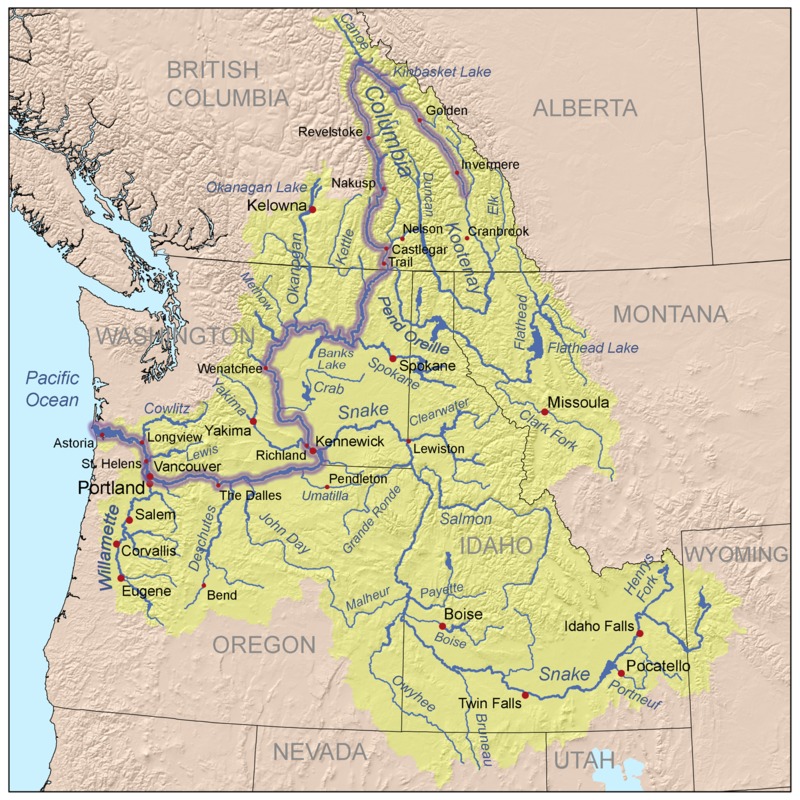
| Thompson navigated the entire Columbia River |
Simon McGillivray, Jr () - was one of the managers of the Fort near Walla Walla (WA), serving in this capacity in 1831-1832. This was an early time when the Hudson Bay Company was still prominent in the area. Until the resolution of the boundaries in the 1840s, there were parties from both New England (and the U.S.) and Canada operating. A relation of his was Duncan McGillivray.
Paul Kane (1810 - 1871) - he came into Canada from Ireland but did extensive travel here and abroad. Paul crossed the Rockies a few times. He did a lot of painting (sketching on site and doing the painting later). His painting of a buffalo hunt in SD which was done in 1846 got our attention for several reasons.
B. Now, jumping ahead to the 20th century, we have several families that we can focus on in this regard. For now, this is a short list which would include William Coffin Coleman whose ancestry we are studying as it looks to be New England in general with particularities related to Essex Co, MA. William was in the north and the south before getting into the central plains.
A recent discussion got us thinking of the various threads that we can follow which would be families in the central areas from the beginning. Many of these have parts of their family that came in along the timeline, to now. We want to see that whole balance.
So, these two gents are such where one side of their family is old New England while the other side is a recent import. This was a common occurrence. If we look at SAR/DAR, many patriots (and loyalists) were of one or two generations from the entry of their family. On the other hand, old New England (north and south) saw the fifth generation bear the brunt of the conflict with the fourth generation involved as leaders of various sorts. Too, though, some early members of the sixth generation were of sufficient age to contribute.
This below pairing is of interest due to times that we are in. Too, one of the gents is of a family that stayed on the east coast. The ancestors of the other came to the wild west. And, for each, we have a much larger bucket of families to throw in. After all, when one takes the 400 years and considers what might be a generation, we can have 1000s of parental nodes, many of which can be known (see Numbers, again).
John F. Kerry (1943 - ) - John is a descendant of Thomas Gardner, via son, George and is a representative of Winthrop-Dudley clan that has excelled in public service for the U. S. The ancestors of John's father, Richard John Kerry, were newbies. It was through his mother's (Rosemary Isabella Forbes') mother that John got his New England pedigree (WikiTree profile for Rosemary). John is still alive, however he is a public figure with documented histories available on the web.
David Koch (1940 - 2010) - David's mother provides him the old New England heritage. His father, again, was of a newbie family (WikiTree profile for Mary Clementine Robinson).
A quick glance at these two gentlemen and their families would bring out lots of differences some of which seem to generate a permanent bifurcation. That is one problem that Gardner Research is helping to work on. Similarities abound, of course. And, many of the seeming differences can be seen as 'spectral' in scope which points to one of our interests: the 400-year focus across families can now cover much more than was possible before. And, it's fortuitous that the capability of technology might just be ready for the work that is needed.
Remarks: Modified: 08/15/2022
08/17/2021 -- We could do different scopes and themes. One constant will be showing related profiles from WikiTree.
08/15/2022 -- Almost a year later. Haven't looked at this, however a new theme was the tying of earlier immigrant families to the time of the Revolution. Say, the Passenger to Patriot of the Mayflower focus where we have the Cape Ann to Patriot.
Tuesday, February 23, 2021
Dorchester Company, further
TL;DR -- Need to look further at the Dorchester Company and what it meant to Thomas Gardner. Part of that will be getting familiar with Rev. John and his investors.
---
It is time to spend more energy and time looking at specifics related to the commercial venture that was sponsored by The Dorchester Company. This will take several directions. While Rev. John White will be one focus, we will also take a closer look at the investors. For now, here are a few posts that we have done, to date, on the subject.
- The Dorchester Company (2013) - and Rev. John White (2013) One task will be to update this chart with a little more information on the Company and the investors, plus a more full look at the American experiment.
- Two Thomas Gardners (2019) - Definitely, we need to look at Thomas Gardner who was married to Margaret Fryer and who stayed here. The other Thomas Gardner is mentioned by Frances Rose-Troup (2020) as having been married to Elizabeth, sister of the Reverend.
- John Tylly (2011) - As we mentioned long ago, we need to know more about John. Did he relate to any of the investors (The Original 119 Members)?
- Sir Christopher Gardiner (mentioned in several posts) - He is the cousin of one of the investors. We want to look at him further with respect to the different tales that one might run across.
- ...
This is to fill in the whole picture as we look at New Spain and New France as well as New England. Of course, that brings in the whole scope of the continental U.S. early on, though we will still have a special interest in the western expansion after the Revolution. Again, USDAR will be a basis looking back 250 years, that is, both their database and their existence for the past century and a quarter plus. There is a lot to research with respect to the earlier 150 years, especially since Cape Ann has more of a significance than has been assumed, to date.
02/27/2021 -- Looked at the rivers of Yellowstone and New Spain. Added the TL;DR line.
08/09/2021 -- Gloucester's clock has 509 days to 2023.
01/14/2022 -- Weymouth, MA's time has arrived.
Thursday, October 15, 2020
How to handle the frontiers
TL;DR -- A cousin went west, during the wild times, and returned only to become a causality at Antietam.
---
As we work to fill in family information from Thomas and Margaret until around 1900, we will be using WikiTree to map out genealogical relationships with supporting material coming from various web sources that can be trusted. That will be a many-pronged task, as we need to have some guidelines to follow which will differ by context. For now, as an example of the good work of DAR, we can point to some public information that would be pertinent, such as their guidelines, their effort at having a database, and such. A good place to start would be this document (Genealogy Guidelines, Part Two) starting at Page 24 where there is a discussion of forms of documentation. Then, we have the job of looking at all the persons of every generation.
Let's take an example. On WikiTree's Profile for Samuel Gardner, earlier this week, we saw that Neville Chamberlain was a descendant of Thomas and Margaret. Now, earlier items on the list in this post (Descendants of Samuel) had been looked at years ago (we're finally getting to this work). However, this new one looked interesting and was added to the list without any attribution. That is how work happens, in an incremental fashion, hopefully with notes to do traces and such. We didn't bother as we knew that this post was coming along. As well, we added the name since the list is smaller than for Samuel's siblings. But, we're of Samuel and thought that we would do the others first. Only two more to go (Miriam and Seeth) before getting into details. Which this post is about.
Well, after a quick look in order to prove that line from Thomas to Neville, we could not. BTW, Neville was the Prime Minster of England prior to Winston Churchill. Not too fantastic, as we can show several modern lines in England that map back to colonial families. We'll have a post on that later.
Fortunately, we do have Dr. Frank's works. So, we started down through Samuel's (which goes #6 to #59 to ...). And, we saw Elizabeth (Gardner) Gardner. She is of George, and her husband was of Samuel (both generation 2). That post on her was done in December 2019. One of her sons was mentioned by Rev. Bentley. But, let's take it a little forward. Her daughter married a Barton. Then, their daughter married a Derby who was a Crowninshield, too. His mother was an Elizabeth, too (look at December 2019 and see a few Elizabeths in focus - but, early this year, remember, the virus happened - besides, we got off on this work of supporting the organization which took a lot of time and energy - from which we learned a few things about how to argue on these issues - which we first brought up in the context of the Hereditary Society Community - so, lots of pending things to do).
So, we get to a great-grandson of Elizabeth (through her daughter, Margaret, and granddaughter, Sally). His name is Richard Crowninshield Derby who died young at Antietam. Here is his findagrave profile. And, this is a snap of his WikiTree profile.
Richard is seven generations from Thomas, so that is right along with the partitioning that we were talking about with the 5th generation bearing the brunt of the Revolution. As an aside, doing this work, we were heavy into the movements south and west where documentation lagged the people's lives. Lots and lots of times. We'll go on about this until we see better handling. That is, the wilderness of those areas just west of the coast had a whole different dynamic than the frontier (of several sorts) experience which went on for decades (and decades). Yes, that'll be our little focus (people's essence is not necessitated on their having papers - sheesh).Now, in this case, given that Dr. Frank was of Samuel, we can somewhat take his work as given. Except not, we're on the record as noting that we need to verify Dr. Frank's work. I have already done this with his direct line and that of his mother (1907 Chart, from May of 2018 - we might be slow, but we are thorough - hence, in a few months, we did (as in, got okayed) a handful of new applications plus ten supplementals - there will be more on this later).
As said, we'll use WikiTree until we find a better approach. One truth of the matter? This stuff takes work which we have been doing for a decade now. To date, the thrust has been the overview and discovering what has been done for a century and one half. We are in the process of closing up that work and starting to get into more detail in a mode that will be sustainable (as much as we see with the organization and their 125 years or the NEHGS with their 175). Does ten years make us newbies? Not really, as research has been my career focus, so we're talking 1/2 a century (John's gift to the Gardners).
BTW, John has been digging into the theory of computing (and other things considered theoretical) and will be doing little experiments using our portal. Anyone interested in technology who can adopt and keep independent viewpoints is welcomed to help. Or, just doing drudge work. Computing has that at its core (nothing sexy at all - that's all hype).
Going back to Richard, he was born in MA in 1834. That 30 years after Lewis and Clark and a few years post Daniel Boone getting to eastern MO. Then, Richard was out in WI and MN. So, that's above IL and MO. You see the timing. At the same time, though, we saw the frontier line going west (KS, NE, OK, and TX - can't forget the upper people, DKs).
In our little case against the GSMD, Chloe is of the latter part of this generation.