Showing posts sorted by relevance for query where is thomas. Sort by date Show all posts

Sunday, August 12, 2018

The remains of Thomas

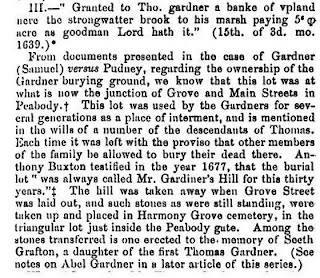
Yesterday, finally, I learned the real state of the remains of Thomas. Or, let's say, we can use the observation of Samuel Pickering Gardner to establish some notion prior to the road work of the 1840s. Then, what might have happened post that bears some attention. To me, the least that we can do is build some type of 'virtual' view of Gardner Hill with its grave sites. To that, then, can be attached the large set of data points that will accrue to analysis.

For starters, we need to see overlays of old and new maps so that we can point out what might have happened over the period of the first raking off of the gravestones until now. Essentially, it is unclear how many gravestone were moved, whose bodies may have been re-interned, or just how many graves were left to be scraped by the road work or to be covered over by the progress of building. More research is to be done. Dr. Frank talked to George Augustus Gardner about, and read the, notes that George had that had been written by Samuel Pickering Gardner who had visited Gardner's Burial Ground sometime prior to the period of the road work and reported his observations.

You see, and I verified this yesterday, lots of references on-line mention words like 'graves moved' or 're-interned' or any other of the number of things that a civilized society does to its cemeteries (from my perspective which can be explained, as needed). On the other hand, after yesterday, I thought of the Salem Fire (retribution - after all, we're talking Salem) which came out of an industrial area related to shoes. The first desecration of the grave sites relate to the push for commerce in that industry. As such, by the time the roadwork was done in the 1840s, graves had already been disturbed with stones scattered about. 

Dr. Frank did see Samuel's notes and made a brief comment (see pages 17 and 18 of Gardner Memorial - 1933). That is a good place to start. In the meantime, here is a history of posts of the Thomas Gardner Society, Inc. devoted to the subject. 
  • Where is Thomas? - (Oct, 2010) On a visit to Harmony Grove, we got familiar with the layout and found the graves of Ann's Gardner ancestors. Dr. Frank is buried in the same plot as her grandfather and great-grandfather. Also, we saw the area where people are directed. It didn't make sense. Later I called and heard 'graves were moved' (but there was no clear indication where Thomas' remains were). 
  • Where is Thomas? II  - (May, 2011) Not hearing from anyone any story that made sense, I continued to search. Notice that there is an aerial view of the area where the stones were, supposedly. I did not see that myself. Too, in 2015, I noticed that Dr. Frank, in the 1933 book, does not mention 'move.'
  • Where is Thomas? III - (Aug, 2015) Motivated by a Wikipedia edit, I did further looking. One addition was a map by Perley put next to a modern aerial view where landmarks can be identified. I noted that the 'burial issue' was open and needs to be resolved. In my mind, that involved, mainly, finding where bones may have been thrown in Harmony Grove and identifying this. 
But, now I see that it is going to be more involved. Yes, bones were cast to the wind, if you would. There are many things that could be done, so expect that we will continue this discussion. Today's purpose was merely to set the record straight.

We do not know the status of the remains of a whole lot of people. Too, stones were thrown about. Well, the argument is that they broke. Okay. At least, Seeth was given some notice. Also, Buffum is noted as having the earliest stone over grounds that do not contain his remains. 

Remarks: Modified: 02/22/2019

08/28/2018 -- After some research, the fact that the stones were moved arose. So, we added a page for this cemetery, now defunct, on findagrave. Also, we can plan several tasks related to important issues, such as who was buried there, what stones stand, how many were broken, etc. As well, we can model the area as of 1640s, to get an idea of the size.

01/04/2019 -- This topic will be followed more regularly this year (344th of 29 December 1674). We will initiate a discussion on WikiTree (see link in sidebar) in support of the research.

02/22/2019 -- Gardner's Beacon, Volume IX, Number 1 addresses the problem of "Where is Thomas?" that has been needing attention, now, for a couple of hundred years, almost. 

Saturday, September 25, 2010

Welcome

This blog of the Thomas Gardner Society, Inc. will deal with genealogical, and historical, material with a prime focus on Thomas and Margaret (Fryer) Gardner of Salem, MA. Too, it can serve many other purposes, such as to facilitate collection of material, to help organize information from disparate sources, and to promote discussion about these matters.

Here are some opening questions that are good examples.

  • Who was Thomas, and Margaret, and what is their ancestry prior to the arrival on the Zouch Phenix (Great Migration Ships, via WikiTree)?
  • Where was Thomas, and Margaret, between the period of 1626, when the move from Cape Ann occurred, to 1636 when he was added to the Freeman list of Salem?
  • Where is Thomas? His burial was paved over. Some stones that were in the area at the time were moved to a nearby cemetery. Where are these?
There will be a running list of questions that will be maintained and researched. Blog posts will deal with the related work (see Section of process, below).

Now, we know a lot about Thomas from the work of Frank A. Gardner, MD (see TGS.org) and his progeny (see the descendants list on the Wiki page). However, this work covered the period until the early 20th century. Evidently, there needs to be work done to bring that information up to date. One of our goal is to get that accomplished.

We need to learn more about Margaret. Some even have Thomas as married to unknown. We are presuming, as did Dr Frank, that Margaret was the mother of the Gardner kids.

----

The Secretary/Treasurer of the Society is a direct Thomas descendant through Samuel as was Dr Frank. I only have an in-law association with the Gardner family. As well, I am not a genealogist but have done a lot of research in my years. My experience is applied mathematics and computing. The past year of researching my wife's tree has piqued my interest. That the NEHGS weds 'historic' and 'genealogical' really describes the proper viewpoint, in my mind. So, the blog will be wide-ranging but will keep coherency.

There are many topics that will deal with other family trees. One estimate that I saw was from a researcher who had collected 180,000+ ancestors in his work. In the case of my wife's tree, there are 200+ early entrants (pre-1670) just into the New England area with all of these families coming forward in time. That is a whole lot of people to consider. Bringing in folks from before the migration period really explodes that number.

---

Of interest to me is the whole notion of royal descent (RD). In the past, this status (for want of a better word, for now) was claimed by only a few and was used as a means to stand out. However, some estimates of those who have RD is very large indeed. But, it really does have historical significance. For one, knowing of this may really increase appreciation for those who ventured over here from a known situation to one that was unknown. Yet, things were pretty bad over there for many. Hence, the flux occurred across the waters.

There are many topics here to discuss in regard to RD (Ole's blog, example).

----

Thomas Gardner represents several things, such as the backbone of the country and economy, for various reasons. This will be a continuing topic since his life can be used to discuss current topics, themes, problems and what have you. There was not much written about Thomas and Margaret, but their offspring all lived to be contributing adults. And, some of the Gardners helped found tremendous families, such as is the case with Sarah and the Balch folks.

Too, Thomas had to be a guy who was comfortable with himself and who was very effective as he showed with his successful traversal of troubled, and hard, times such that he and his kids thrived. That is a real brief look which will be expanded upon. To look at Thomas' kids, one could not but think that the guy was a terrific human though he did not flash across the sky.

Now, having said that, not being in the radar does have its benefits. There are no records like this one (Boston martyrs) which we see related to John Endecott.

Too, for a long while, Thomas was dropped from the list of 'old planters' despite being in the early group. That is, we'll show several lists in which Gardner is not mentioned. One family of those who seemed to have pushed him out has a cemetery not far from where Thomas was buried. That cemetery is still there, prominently besides the road. Thomas is under pavement, somewhere. To me, an outsider, that little bit of reality represents a whole lot of stuff that we'll go into more deeply.

So, we'll use the cyber realm to document, permanently, where Thomas lies, or as close to it as we can identify.

----

If it was not obvious, let me state the following: the 400th anniversary of the Cape Ann landing ought to be the time for descendants of Thomas Gardner (Salem) to make sure that his name is known throughout the rest of history.

Our hope is that this little start gives a push in that direction. Some say that Conant was forgotten. The forgotten ones were actually Thomas and Margaret Gardner (and John Tilly who died in 1636 - Pequot War).

----

About process: blog posts will be labelled into groups. Too, posts will be updated with modification dates. In many cases, additional material will be included at the foot of a post as a dated remark. An example is the Fedaerated blog.

Posts are done real-time, generally without using any fancy editor. That is old-fashioned, but, hey, Joyce, Tolstoy, and many more worked similarly. What is this that people have learned to depend upon a mindless artifact in order to express thoughts in a natural language?

Hence, I usually put an ellipsis (...) at the end of a post to denote an 'in work' status which will be taken away once the first cut of the post is done. Subsequent updates will be marked with date.

The Remarks have several purposes. For one, it is a place for additional information and commentary. Too, there may be forward links to future posts that are related.

---

Comments are open, for now, without any moderation. The hope is that we can collect information that way. Pointers to material at other sights will always be of interest.

---

We are using two URLs: ThomasGardnerSociety.org, and TGSoc.org. The below image is from the later which will have a particular focus as portal. The former will be our workhorse, handling specifics related to research and findings.


Our major theme is culture, history, and technology. The first, of course, implies human society. History is a puzzle since, generally, it deals with an abstracted view of events, whereas we live with the details as individuals. Finally, technology is a thread that has been around for a long while; albeit, now we see acceleration of this phenomenon becoming problematic. In genealogy, we have all sorts of issues, including software, systems, and biology (DNA, for one example). The scope has a major thread of the 400 years from Cape Ann to now, however it have a broad theme covering the American dream is all that it might entail.

We are coordinating our work through Gardner Research which will publish, regularly. 

Remarks: Modified: 11/13/2018

09/26/2010 -- Added in Margaret. If you look at royal descents (such as the Maverick/Gye royal gateway, WA -- see above), it was the wife (Mary Gye) who brought in the royal history. So, expect that all trees developed and shown here will be balanced as much as is possible with both parents. Having said that, it's obvious that information is missing for many ancestors. But, things can show up from time to time as people keep digging.

09/27/2010 -- On the process for posts, the basic gist of a post remains the same, generally. Through a window of time, though, there may be changes to grammar and some phrasing to remove awkwardness as well as to improve the overall flow. The post will be marked with the date of modification.

09/28/2010 -- Expect that there will be a post on the old burial ground which needs to be re-recognized. From what I've read, Thomas, Seeth, and Samuel's Abel, and his wife Sarah, are there. The stones were, supposedly, moved to Harmony Grove, near the Peabody Gate, when the ground was cut through, and leveled, for the road (Grove). Has anyone seen these lately? As well, we can collect burial places, to wit the Charter Street cemetery has several Gardners. This article mentions the old burial ground (we need to locate it, setup a Google map, etc.).

09/28/2010 -- About old planters. As used above, it refers to the Cape Ann & Salem group. It can also be applied to close-by Boston (note, William Jeffrey, ostensibly of the Cape Ann group, seems to be mentioned here as being in Shawmut and Weymouth) as that is where Winthrop went on rebound from his dislike of Salem. No doubt, this subject needs some looking at. Note that John Lyford (WA, following Gary Boyd Roberts, this means wife's ancestor), who went with Conant to Cape Ann, is mentioned.

10/01/2010 -- See Where is Thomas?

10/02/2010 -- A cousin of Dr. Frank. The line is Thomas/Samuel/Abel/Abel/Simon Stacy/Jonathan/Benjamin B/Joseph D/...

10/31/2010 -- For RD example, switched from the excellent example of Ole Larson (his blog has disappeared -- evidently he died in August, 2010) to the blog of the Slovak Yankee, for now.

11/10/2010 -- Ole Larson is back. His genealogy site.

12/06/2010 -- See progeny I and progeny II.

12/21/2010 -- For completion, started a Henry Lunt of Newbury blog today to cover matrilineal ancestors.

01/10/2011 -- Added his signature. What was Thomas' background, his education, ...?

01/14/2011 -- Follow Salem on Twitter.

07/21/2011 -- From whence? Coffin, from Nantucket, said Dorset (Sherborne).

02/22/2011 -- We'll be using the Great Migration material a lot.

09/13/2012 -- About Margaret. We'll honor her as the ancestor, with Thomas, of the Gardner family.

11/13/2013 --  Phippen would be part of the slate fill.

09/28/2014 -- A week ago, the record for the marriage of Thomas Gardner and Margaret Friar was discovered in Sherborne by John Cook of Minneapolis, Dorset files. This sets a type of focus. Looks as if some transcription work might be in order.

10/11/2018 -- Changed Remarks list to be in order by time. Updated a few stale pointers.

11/13/2018 -- With a new twist, as bodies and stones were also moved to the Trask site. Add in Sidney Perley's map of Gardner Hill.

Monday, August 17, 2015

Where isThomas? III

Context is:
Where was he and is he?
    -- Where is Thomas?: Initial question with material from Dr. Frank and from Harmony Grove Cemetery. The brochure of the HGC mentions the land modifications caused by the road work and gives some indication of who was moved (put image from their brochure).
    -- Where is Thomas? II: Follow-on post with a Bing map of the area. In there, where?
    -- Where was he and is he?: Finally, I used a Perley (did good work, knew Dr. Frank) map along side Google (properly aligned). Partly, it was to show that these sketches were done well given that people were not yet able to have a neighborhood view. Aside: John Gardner's work with the Merrimack mapping crew still stands.      
Saturday, last, someone, on Wikipedia (see Status of page), changed the Burial section on the Thomas Gardner page as follows ("Before edit" was the original status; "Change" was the modification that had no source added; "Correction" is the current state until edited):
    Before edit: Thomas was buried on Gardner Hill near present-day Boston Street and Grove in Salem. His daughter Seeth and his grandson Abel are also buried there.[16] Abel's wife, Sarah Porter Gardner, whose mother was the sister of John Hathorne, was buried with her husband. The remains of Thomas and many others were moved from the old burial ground to Harmony Grove Cemetery in the 1840s. 

    Change (in italics): Thomas was buried on Gardner Hill aka Gardner Burying Ground near present-day Boston Street and Grove in Salem. His daughter Seeth and his grandson Abel are also buried there.[16] Abel's wife, Sarah Porter Gardner, whose mother was the sister of John Hathorne, was buried with her husband. A 1692 map of the area shows that the Gardner Burying Ground was in the same location as present day Harmony Grove Cemetery, which was incorporated in the 1840s.

    Correction: Thomas was buried on Gardner Hill aka Gardner Burying Ground near present-day Boston Street and Grove in Salem. His daughter Seeth and his grandson Abel are also buried there.[16] Abel's wife, Sarah Porter Gardner, whose mother was the sister of John Hathorne, was buried with her husband. The remains of Thomas and many others were moved from the old burial ground to Harmony Grove Cemetery in the 1840s.[55] A 1692 map of the area shows that the Gardner Burying Ground was in close proximity to Harmony Grove which was incorporated in the 1840s.   
One of my remarks to the "Change" was that "same" is not congruent. Of course, we are talking the same area. The bodies were not moved very far (we can have a contest to determine the actual distance).

Let's get serious. As well, this change had no supporting material. That is a no-no on Wiki. See status of the Thomas Gardner page. Someone put tags (ignore unless you want to help). After that, I did some changes (such as not reference pages done by families, etc.). Also, some "politically incorrect" sections (I know, I was spouting off as a newbie) were removed. The page now is good. I'm waiting for someone else to remove the tags.

To us, this burial issue is open and needs to be resolved before the 400th, if not sooner.

Remarks:  Modified: 05/16/2019

08/17/2015 -- We will put an image of the HGC brochure on the blog.

08/12/2018 -- Thomas, with others on Gardner Hill, was left where he was. Stones were moved over to Harmony Grove Cemetery. A few of those withstood the move, say that for Seeth. Most did not and are piled somewhere. At the burial site, though, the road was cut through. So, the remains? Well, moved to God only knows. Or, if the burial was away from the road, it is beneath some structure. Lots to think about. Reflect on. How to proceed into this mire?

11/13/2018 -- With a new twist, as bodies and stones were also moved to the Trask site. Add in Sidney Perley's map of Gardner Hill.

01/04/2019 -- This topic will be followed more regularly this year (344th of 29 December 1674). We will initiate a discussion on WikiTree (see link in sidebar) in support of the research.

02/28/2019 -- Gardner's Beacon, Vol. IX, No. 1 gives an overview of what we know after looking at the issue of missing graves. Then, there are more missing graves, we see.

05/16/2019 -- The map that compares Sidney's walk-about with Google is way off. That is because I was looking at landmarks and not paying attention to details, like distance. So, see this update: How close is close ? II. Here is the updated graphics.
Oh yes, we are now honing into the area. 

Friday, October 1, 2010

Where is Thomas?

The problem of 'Where is Thomas?' was asked earlier. Answering that question seemed to be a reasonable task to attempt to accomplish.

Dr. Frank mentioned a 'Gardner burying ground' (pg 11) that had passed through several hands over the years. One thing of interest might have been following all those transactions using the maps from several points in time.

Dr. Frank said that Thomas was buried on these grounds as was Seeth, his daughter. Too, grandson Abel, and his wife Sarah Porter, were there. It might be of interest to collect other names.

I spoke today, by phone, to the Harmony Grove Cemetery and learned a little about the graves that were in the area of Boston and Grove (in Salem). Dr Frank said Main and Grove, but we know that these types of boundaries move about.

According to Harmony Grove records, the graves were moved, sometime in the 1840s. According to Dr. Frank, this was to allow for Grove to be put in.

After the phone discussion, I remembered that there is an ongoing effort to document grave information to allow internet search. Sure, enough, Thomas is on the list along with Abel and Sarah. Gosh, isn't the Internet great? This seems to be an effort, like Wikipedia, where volunteers put in the information.
We need to find out about Seeth and others who may have been there.

Remarks:

01/04/2019 -- This topic will be followed more regularly this year (344th of 29 December 1674). We will initiate a discussion on WikiTree (see link in sidebar) in support of the research.

10/25-26/2018 -- With a new twist, as bodies and stones were also moved to the Trask site. Add in Sidney Perley's map of Gardner Hill.
Perley on Gardner Hill

08/12/2018 -- Thomas, with others on Gardner Hill, was left where he was. Stones were moved over to Harmony Grove Cemetery. A few of those withstood the move, say that for Seeth. Most did not and are piled somewhere. At the burial site, though, the road was cut through. So, the remains? Well, moved to God only knows. Or, if the burial was away from the road, it is beneath some structure. Lots to think about. Reflect on. How to proceed into this mire?

08/17/2015 -- Response to Wikipedia change that questions the move(?).

06/26/2015 -- Where was and is he?

03/12/2015 -- Dr. Frank's 1933 book (pg. 22) does not mention the move.

11/16/2012 -- In preparation for the upcoming 400th, we ought to find Thomas' stone (Able's and Sarah's, too) and get it set back up in an accessible manner.

02/13/2012 -- Thomas was around here, in 1641. 

05/22/2011 -- Thomas is somewhere in this area.

10/01/2010 -- Too, where is Margaret? Also, we need to pinpoint the exact location within the cemetery for these graves, and stones.

Modified: 01/04/2019

Thursday, July 22, 2021

Grave abuse

TL;DR -- For a decade, we looked into the question of Where is Thomas? That query was with respect to the location of his remains. After reading about and listening to lots of comments and ideas, we decided to dig deeper. Lo and behold, we find that the place where Thomas was buried was torn apart 190 years ago or so. Stones were moved without regard to bodies which were left. Then, the land was contoured for traffic dragging the bones about. Or, they were thrown in the river bed that was being filled. Some remains and stones may have moved to two areas. Harmony Grove Cemetery is close; but, the Trask plot is closer. God only knows. 

--

A decade ago, we first asked the question of "Where is Thomas?" after visiting the cemetery in Salem, MA and coming away disturbed. Then, we slowly gathered data and kept asking. Where is Thomas? Finally, we heard on a phone call (Maine Gardner) about tales of missing graves. Okay, what does that mean? Well, we kept gathering related material. Too, we got familiar with the area. Actually, Ann's childhood house is within a stone's throw of where the Gardner Burial plot was. Let's say, using a hefty arm. However, it was almost as high on the side of the hill as was Thomas when he sat by his tree and said that he liked the view of the water (7 Oct 2019, Gallows Hill - look at the painting in this post). 

Later, we noticed that Dr. Frank had mentioned the issue in his books quoting Samuel Pickering Gardner's comments about the problem. A summary post (28 Feb 2019, Another twist) tied things up. And we took our attention out to the wild west. 

 Showing Google view, with annotations, 
mapped to Sidney Perley's sketch of the
area around Gardner Burial Plot

But, it is time to re-address this theme due to the hard sleuthing of Melissa Davenport Berry. She runs a FB group titled Early Quaker History and Genealogy as well as the New England Family Genealogy and History group.  

Recently, we were looking at FB as there is a lot of activity there related to New England. Melissa who writes for several publications has just reported on some research. The following four bullets are her blog reports with comment. We need to thank Melissa. Also, it is time to clear the air on this. We'll handled the Gardner part.  

That Nathaniel Bowditch's name was mentioned and got our attention. Okay, we'll get back to this theme. Somehow, we need to get the message across about the incidents as well as figure some way to get Thomas (and Margaret) Gardner recognized when the 400th comes up (or before). 

Remarks: Modified: 07/23/2021

07/22/2021 -- 

Wednesday, August 21, 2013

A Thomas here and a Thomas there

This post continues our look at Gardner families and considers only the Thomas Gardners who arrived early.

---

But, first, here are four posts dealing with the subject of Thomas of Salem. They are in order with the latest post first. However, the book that is the principle focus of each post has an inverse order (somewhat, this is the result of taking data items back to their source; if we can grab the complete view, then the correct telling of the story will come to fore).
  • Thomas and Thomas (Jun 2013) - Felt suggests, from his review of the materials, that the Thomas of Salem came over with his father, who was also named Thomas.  Felt also notes that the older Thomas came from Scotland. 
  • John Farmer (May 2013) - Farmer has two Thomas Gardners in Salem. The older one was the lead at Cape Ann, Farmer says. And, the son who was the husband of Damaris died in 1674. 
  • Stories and Unwindings (Oct 2010) - One expects to find misinformation on the web; it's a different thing when such is published. But, first, one has to establish what is misinformation and what is not. Mention is made of Dr. Frank's books and one by William Folger about Nantucket settlers. Too, though, a 1999 article by the Jamaica Plain Historical Society mixes the Thomas Gardners. 
  • Gardners and Gardners (Sep 2010) - Dr. Frank's book had a list of the early Gardner families in which there were two Thomas Gardners: Salem (1624), Roxbury (died 1638). Dr. Frank also mentions what he considers an error: that there were two Thomas Gardners (of Salem), the earlier of whom died in 1635 (see image on post from Dr. Frank's book; elsewhere, he used 1638, but are people talking two old Thomas Gardners?). 
Note: Statements, by earlier writers, that turn out to be less than correct ought not be suppressed. Rather, we need to bring these to fore so that the reasons for their incorrectness is accessible. The cloud/web seems to allow such methods with its large storage capacity. The problem? Given that the proper view is established, where does one put it? Where does a researcher go to find the most-supported view?

---

Roxbury to Salem
Massachusetts
Now that we have reviewed what has been gathered so far, let's look at the early arrivals, and we can point to the two Thomas Gardners who are mentioned in Dr. Frank's list (Salem and Roxbury). Some researchers have suggested a relationship between these two families. Others seem to have their descendants mixed up. The map is included for those who may not be familiar with the area.

Note: The crow distance must be about 14 miles or so. Yet, the terrain would have slowed any movement. Perhaps, the fastest way would be to get down to Dorchester and take a boat to Salem. Nowadays, these two are on an arc, somewhat; one can take a highway in an almost circular path around Boston. That distance is 50 miles or so.

---

What is the true picture? How can we find out? Well, data gathering, analysis, and discussion is one mode that we will continue to pursue.

For now, let's use the NEHGS-published Great Migration books. The format of this material that has been followed for all of the principle arrivers is Origin, Migration, First Residence, Return Trips, Occupation, Church Membership, Freeman, Offices, Education, Estate, Birth, Death, Marriage, Children, Associations, and Comments. People who are not handled separately are still mentioned along with a reference to source of the material. As we have said, this series' look at hundreds of people is exemplary in presenting only items that can be supported. That being said, there are other sources that might have enough weight to make a reasonable stab at filling in gaps (as long as they are not too big - formally, interpolation).
  • Thomas Gardner of Salem (died 1674) is covered in the early volumes: 1620-1633, Vols. I-III, pg. 731 (6 pages). His children are as noted by Dr. Frank, albeit with a different placement for Richard. 
  • Thomas Gardner of Roxbury (died 1638) is mentioned several places. He is noted as the father of Peter Gardner (died 1698): 1634-1635, Volume III, G-H, pg. 14 (4 pages). (Note: Thomas had several children, including Thomas Gardner of Muddy River who married Lucy Smith). 
---

The next thing to look at will be all of the Thomas Gardners that were in the area up to about 1700. To get an idea of how many there were, we can look at Savage: Before 1692, Volume #2, Gardner-Garven. Just in this section, Savage mentions seven Thomas Gardners.

Of course, there are other works to consider.

Remarks:

01/18/2019 -- Added to the index at TGSoc.org.

03/11/2015 -- Sourced ahnentafels (published in TEG and The Gardner Annals): Thomas Gardner of Salem descendant (Benjamin Brown Gardner - grandfather of Dr. Frank) and Thomas Gardner of Roxbury descendant (Susan Charlotte Graves Gardner - aunt of Dr. Frank).

10/13/2014 -- Tabula raza, and more, will be of concern.

08/25/2013 -- On a site dealing with descendants of Alice Freeman, Abigail Gardner is on the list due to marrying John Wise. Hence, her father and grandfather are there, too. Thomas (before 1595 to 1638), father of Thomas and Peter. The site, by Chris Chester, is wonderful in its use of sources; too, I really like the format. We need to do something similar for the Thomas Gardners.

08/22/2013 -- Forgot to mention: nothing new under the sun.

08/21/2013 -- Other works would include contributions by researchers, such as we find from Heather Rojo: Nutfield Genealogy: Amanuensis Monday - A mystery from Rev. Bentley's diary. On-line is not bad, by definition, old genealogists (gosh, I'm 71 and know better than that).

Modified: 01/18/2019


Monday, October 7, 2019

Gallows Hill

It would be nice if we could resurrect a 'google' map of Salem of old. Of course, that's sheer laziness.

What we can do is appreciate Sidney's work (walkabouts). Too, we can look for paintings that were of the period before the modern. When, I might add, progress caused lots of changes.

One that I am tracking down? The missing graves of Gardner's Hill. The search has involved Sidney's work: How close is close? II As well, there were several paintings of an area upstream that allow some notion of how things were, somewhat, at the time of the elders: Gardner's Bridge.

Of late, we have seen discussion about where the hangings were. Well, Ann's family had a house on Gallows Hill so they know the area. Myself, only 20th and 21st century experience, way after the fact. But, Sidney knew: Gallows and more.

The gist? Somewhere I read that Thomas Gardner liked the place where he was buried since he could sit there and see the water. Mind you, this area was between Gallows Hill and Harmony Grove Cemetery. We'll be mapping this out. I could not get some notion of the elevation. No doubt, there are records at the State level about the work involved with the road adjustment in the 1840s. Too, there was a lawsuit.

But, why pursue this 'dead' horse? Samuel Pickering Gardner who had left Salem for Boston visited the area in the 1830s and was upset by the situation: How close is close? And, it's a family matter as the seller of the property was of the Samuel (son of Thomas) line as is Dr. Frank, Ann, and others. In fact, Samuel owned this land after Thomas died. So, there are lots of reasons. However, a motivational event happened, today (below).

Okay, was reading Streets of Salem: A County in Crisis, 1692. Great post, per usual. On the page was a link to a post about the Salem Heritage Trail. And, that post contained an image of a painting from 1818 by Alvin Fisher. What? First, the image.


From Gallows hill, a view of Salem. Will have to map this out, but it does give some indication of elevation. Gardner's Hill would have been to the left following a 'U' (dimensions to be defined).

Landmarks? Anyone know of some analysis that has been done of this painting? Of course, we'll keep looking for other paintings of this type.

But, in terms of research, yes, there are more questions than answers. So, today there was a 'shot in the arm' type of thing. I feel that I have gotten a run around by those who ought to know, since I first started poking around this issue.

'Where is Thomas?' seems like a reasonable question. Notice that I first asked that question in October of 2010. Never heard an answer that stood up to query. It has taken a while for me to piece things together. And, Sidney was very instructive once I got to know his work.

BTW, Harmony Grove? Yes, I have been there. Dr. Frank's grandmother is buried there.

Aside, Dr. Frank remains are in Greenlawn Cemetery, Salem, MA.

This might be a good place for the good Gardners (and their friends) who are descendants of Thomas to think about having some little memorial to Thomas and Margaret. We can measure how far this is from where Thomas' grave was in the Gardner Burial Plot.

Note: Went looking for maps of Salem. Of course, Sidney's came up. Plus, I found a site that had collected many views: The Mystery of Gallows Hill (references this work - Gallows Hill: Where Were the Witches hung?). The pages have the photo of Sidney at the Crevice and more. Also, in the painting, one can see North River (below) and Ledge Hill (to the left) which is south(east) of where Harmony Grove Cemetery is now. ... All we have to do is figure the dimensions from this in order to place Garner's Hill appropriately.

Reminder: The Trask view. One of their plots is still on Boston Street. It was near the Gardner Burial Plot. Too, History of Mass blog.

Remarks: Modified: 11/10/2019

11/10/2019 -- Changed Dr. Frank's record to read Greenlawn Cemetery rather than Harmony Grove Cemetery. His remains are in the Gardner/Dennett plot established in 1880.


Sunday, November 29, 2020

Rachel, again

TL;DR -- Looked at the data related to Rachel (Gardner) Noble and considered how she might relate to Thomas Gardner. More questions than answers.  

---

This post will pull together some posts from the past, beginning real early. We were asked if Thomas has a sister, Rachel. Had not hear that, at the time, so went looking. There was no real resolution, however lots of material was covered which is scattered through these posts. There was a recent notice received that there was research backing this up. So, we have to follow that hint like fish after bait. 

Now, we are in the process of updating Thomas' Profile on WikiTree. The idea now is to make it a solid piece which references proper sources, starting with Anderson's work (Great Migration Project). Then, we will add in research details, some of which was contributed by Gardner Research. However, with respect to Rachel, do we know any more than about Margaret's proposed brother, Thomas Friar, who came over to Gloucester?

It has been a couple hundred of years since the Revolution and of Americans wandering the world. Someone came back with a tip that Sherborn records mention Thomas and Margaret. Felt heard this and printed the tip (without source - by the time he heard it, how many mouths would it have gone through?). We used that as a clue. Too, old man Folger was noted for telling people that John Gardner had said that his father told him that they were from Sherborn. We like their coffee and took that as a clue. 

Well, we will be doing this in a more formal manner to meet NEHGR requirements. That'll take time. In the meantime, stay tuned. So, back to Rachel. There are only three bullets here. The last one is to a search that has all of the posts that mention Rachel. This is an example of hoping that looking at some related pedigrees might help with another. It can work. Usually? Probably not. But, the attempt needs to be documented.  

  • Just Answer
    from the Presidio of
    San Francisco

    LDS and Thomas Noble -- Gosh, all of those Thomases. We first ran into this while looking at the Rachel issue and thought that it ought to be brought forward. It is interesting since it has persisted, pay and get some bit of information, and on a quick look the stuff is appealing. That Thomas Nobel had Rachel Gardner as a wife is known; who she is is not; nor, is he known as well as some proclaim, evidently. You see the issues. Truth engineering, folks, with our 'portal to truth' as an offering as a stable source of good information. Now, in this case, the person paid to find out that stuff on family search (et al) may be bogus. Too, the notion is that someone needs to search actual records (assuming that they can get hold of them). We're fortunate that Sherborn did digitize some records. 
  • Rachel (Nobel) Gardner -- This is from five years ago when we were trying to pull together some loose strings. After all, we had seen the marriage of Thomas Gardner and Margaret Friar. Too, we saw the boys being born in the right order with years agreeing. Then, that family disappeared from Sherborn records. But, more records are available now. We have lots of people interested. And, some are on the ground in the UK, so that might help. 
  • Search on 'Rachel' -- When scrolling through this list, look for a yellow box. In there, we tried to follow a suggested ancestry for Thomas, as proposed by the Noble family. At the time, we didn't get far. But, then, we are not saying no either. Case in point is George Gardiner of Rhode Island. They published their book before Dr. Frank did his. Too, they have published books about their meetings over the years. Yet, on WikiTree, there is controversy where the notion is to set his Profile up similar to Thomas' where it's clear about sources and what's still in the air. 

This is one of many avenues of research that are on-going. Based upon our experience, we like the WikiTree approach and the genealogical views being upheld there. 

Too, for those who wonder about technology. WikiTree is a 'wiki' thing where one can edit the code or by menu. They have brought in more menu support, but the code view is still there. Too, they have standards. A method, named G2G (genealogist to genealogist), can be used for coordinating work where comments/updates keep everyone abreast of status. We have some G2Gs related to our WikiTree work. Some like menus; some like code; there are other ways (say, AI); however, common standards can apply but require definition and monitoring. What we have is more stuff stacked on the back of people doing thankless work (thank the Registrar of whatever group you might belong to for their service).  

Gosh, think back to before the camera and the copier and, even, the mimeo machine. Looking at the handwritten notes from 100+ years ago makes one marvel that some progress did occur. 

Remarks: Modified: 02/24/2021

02/24/2021 -- Put link to George Gardiner's profile on WikiTree. We have lots of people with unresolved ancestry. The group on WikiTree is doing a good job providing sources for choices. Not like the shaky tree thingee on ancestry[dot]com. 

Thursday, February 2, 2023

ChatGPT

TL;DR -- As promised, we are getting technical. And, given our long time and wide expanse related to life on these shores (and beyond), that covers a whole lot of territory. We have started to look at ChatGPT as a representative of the most modern of approaches (take that with a grain of salt). Actually, we see lots of weaknesses which have been brought up before. Was this a waste? Not really, as we need failures to learn. This is not a failure so much as a work in progress that has further to go than they thought would be the case. Except, their mission statement now mentions the uncertainty. ... See Remarks on 02/11/2023, for an opinion on the matter. 

---

Note (04/06/2026): Lots of water under the bridge. Of late, we are seeing lots of newer mathematical ideas being discussed with regard to what went wrong and how to correct the situation. Right now, that is anyone's guess. We are stressing that the "knowledge" era never got recognize for many reasons, some related to dynamics that apply to the current problems. Post (Truth, what is it?) touches a little upon the subject. 

Note (04/24/2025): Follow our series as we expand concurrently along the themes of meaning in the senses of man/machine and of being: Taming GenAI/LLM. 

Note (11/28/2024): This was my first touch of GenAI and has several features that will be of interest. See Review, restart. 

---- Original post - later, I settled into Gemini as the preferred GenAI. However, all of this is under review as we're two years into GenAI and its influences. -----

We are focusing on technology as the major theme for research. Roots Tech is an example of an application of technology. We haven't attended, as our interest are with the deeper issues. Say, with DNA, the whole of the technological basis plus the computational lens required to support all of the various ways of making interpretations. Computing in general? The whole of the framework that provided support for development as we have seen that ubiquity is more than mere presence. No science is done without some type of artificial routine kicking to action. 

Our daily lives? About the same thing. For good or bad, that's our world. 

I have been listening to discussions about OpenAI. Other than noting that Musk provided some of the funding and that Microsoft just put their dollars on the line, I have merely touched upon the foundational aspects. NNs go back a long way. The mathematics involved in these new approaches goes back even further. What's new? Hardware is one thing and is far beyond what was thought possible. Software and those in-between modes has a very interesting history, too. 

ChatGPT is from OpenAI and will tell you that when it uses 'I' to express itself and try to explain its ways. Don't expect depth, yet. As an article in The Atlantic noted, it's a toy now. But, some are trying to use it as a tool (several APIs are provided). That raises hackles for good reasons. For a few years now, even the brainy have weighed in with their dread of these approaches. On the other hand, the marketing view has grown to be worse than unsustainable, as hype eventually eats up all of the oxygen in a room. But, how long that will play out is, per usual, unknown. But, it gives us two sides to watch as things evolve. 

---

Except, technology needs the middle way which we are up to. Lots to explain there, but systems development is a good example. From the top, we have various demands that get studied, and decisions can be made as to coming up with a product (applies across the board). This is a top-down position that is always the one of power, not necessarily of truth. Make it happen, we see the Star Trek captain saying; or, he uses something of that ilk. 

BTW, expectations come this way and are very hard to control, let alone try to manage rationally. It's apparent always, especially given the news ability to harp. On the other hand, it is from this side of things that we get the systems management and all of those creative things dealing with function and form. We will go into examples of this as we go along. 

But, at some point, things have to happen. Arm-chair quarterbacking will not get a game won. Thank God for the industry of engineering which gets thing done. But, before that, we need the basic knowledge that comes into play (science is both top-down and bottom-up). At the same time, we need the ones with the abilities to actually do something with their hands, with or without tools. 

Getting a system done requires lots of abilities. And, a system will get (usually or hopefully) to the state where it does what and how as is realizable. Does that state necessarily agree with the earlier thoughts coming from the top-down crowd? If you think yes, well, that is not the usual case. The middle is where adjustments get made for the bottom-up to be driven by management while those above figure how to get their views allowed (aligned) with actual potentials and not marketing dreams. 

One might say that this is old-time management science. Well, yes, in a sense. The new perturbator? The computer brings whole new classes of issues that need attention. As it becomes more capable, so too does the computer's problems rise. That's our current situation where we see, on the horizon, looming changes which may or may not have desirable results. 

---

ChatGPT was released for public use and comment back in November of 2022. We watched, mainly, but knew that we had to get involved so as to make our own assessments. Yesterday was the first exposure which started analysis with respect to the work involved, past, current and future. We found it shallow, to the extreme. That comes from the approach which we can discuss. The interface is polite in its verbiage and strives for a 'neutral' position in its responses. 

A huge reminder is there: this is an AI system created by OpenAI and has known limits. We will get into that, but they say that all of the training data comes from before 2021. Okay. There is more that they ought to acknowledge; the input data is a hodgepodge. How will such formulate into a coherent view seemingly willy-nilly? Oh, patterns. We can immediately show that mathematics is not just about patterns; nor, is science of that ilk when done at its core. 

Don't expect creative output, of a valuable nature. Though, I might add, ChatGPT can feed into the graphic generator which comes up with pretty pictures. In case this is not known, the training results in a composited model(s) from which one can obtain what is a photo. Say, of people, and it gives one a 'fake' person. What is the accomplishment? There is no reality behind that. 

Wait, there could be which we will explain, at some point. Actually, what we are suggesting would be a type of analytic stance of benefit. One thing that alarms people is that we can get 'fake' video which is a series of photos. As noted by the discerning eye, the morphs needed are not very sophisticated. That is, one can see the effects of mods that generate behavior through incremental changes to the underlying structure, say a face getting its lips moved to look as if speaking. 

---
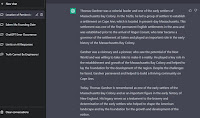
ChatGPT, 2 Feb 2023
Our first attempt ended in some errors, as did today's. Yesterday, we were testing its knowledge of itself which it handled very well, in most cases: I am ChatGPT created by OpenAI and only know what the trained data allows me to know. Nothing more; I do not reason (yet). 

I pulled some of the log from queries related to Thomas Gardner. Before this, there had been queries related to similar themes. 'Query' is my question; the response follows. Notice that it was in a 'terse' mode which is nice. Then, I asked for a 'verbose' answer to the prior question. 

Query: Who is Thomas Gardner of Salem MA?

The specific Thomas Gardner of Salem, Massachusetts you are referring to is unclear. "Thomas Gardner" is a common name and there may have been multiple individuals with that name living in Salem, Massachusetts. Could you please provide additional context or information to help identify the Thomas Gardner you are inquiring about?

Query: Thomas Gardner married to Margaret Fryer. He died in 1674. 

I apologize, but with only this limited information, it is difficult to determine the specific Thomas Gardner you are referring to. The name "Thomas Gardner" and "Margaret Fryer" were both common during that time period and there may have been multiple individuals with those names in Salem, Massachusetts. If you have access to any additional details, such as birth dates or occupation, it would be helpful in identifying the Thomas Gardner in question.

Query: Did you read about Roger Conant?

Yes, I have knowledge of Roger Conant. Roger Conant was a colonial leader and one of the founding fathers of the Massachusetts Bay Colony. Born in England in 1592, he immigrated to the Massachusetts Bay Colony in 1623 and was an early leader in the colony, serving as governor of the settlement at Salem. Conant was a key figure in the establishment and growth of the Massachusetts Bay Colony and played an important role in the early history of the colony and the development of New England. He died in 1679 at the age of 87.

Query: Thomas Gardner was the lead before Roger Conant of the expedition that settled Cape Ann in Massachusetts in the 1623/24 timeframe? 

Yes, that is correct. Thomas Gardner was the leader of the expedition that established a settlement on Cape Ann in Massachusetts in the 1620s, prior to the arrival of Roger Conant. Gardner led a group of settlers to Cape Ann in the early years of the Massachusetts Bay Colony, and the settlement he established there was one of the first permanent English settlements in the area. Roger Conant later became governor of the settlement at Salem, which was located near Cape Ann, and played a prominent role in the early history of the Massachusetts Bay Colony.

Query: Verbosely, please.

Thomas Gardner was a colonial leader and one of the early settlers of Massachusetts Bay Colony. In the 1620s, he led a group of settlers to establish a settlement on Cape Ann, which is located in present-day Massachusetts. This settlement was one of the first permanent English settlements in the area and was established prior to the arrival of Roger Conant, who later became a governor of the settlement at Salem and played an important role in the early history of the Massachusetts Bay Colony.

Gardner was a visionary and a pioneer, who saw the potential of the New World and was willing to take risks to make it a reality. He played a key role in the establishment and growth of the Massachusetts Bay Colony and helped to lay the foundation for the development of the region. Despite the challenges he faced, Gardner persevered and helped to build a thriving community on Cape Ann.

Today, Thomas Gardner is remembered as one of the early settlers of the Massachusetts Bay Colony and as an important figure in the early history of New England. His legacy serves as a testament to the bravery and determination of the early settlers who helped to shape the American landscape and lay the foundation for the growth and development of the nation.

On the last? It's not quite right, but then it is a composite from several sources. This type of approach might appear to be of interest but is not. Debatable, of course. 

Now, we will get to the specifics, but the training data set was large and came from the internet: pages, sites, books, and such. What a heap! Right? That would confuse anyone. 

There is so much to discuss. We got it to say that the training set was a subset and not just the whole mess. After all, the internet is a mess, for several reasons and of various types. One thing that sticks out is that the 'domain' aspect of life has been ignored. That is, architecture with respect to this type of technology is very weakly evident, perhaps nonexistent. 

One failure, last night? I suggested to the thing that we and it make errors. Right. But, to know how to assess its errors, we need details related to 'provenance' in the proper sense. And, ChatGPT admited that it cannot specifically respond to anything that would be like a 'footnote' request. Alas. ... On trying to respond to that, the system crashed (red text, emphasized - several times). On getting things going again, I was told that I had exceeded the number of queries per hour. Oh well, it and I were in sync ;>). 

So, I was thrown out and the party ended. 

Remarks: Modified: 04/24/2025

02/05/2023 -- There is a lot to this. We will focus on GPT3 which is that which ChatGPT invokes for its content. Too, Google has a player, too: LaMDA (remember fall 2022 and claims of sentience?). 

02/11/2023 -- This is not an official TGS opinion, it is mine. And, I (JMS, starter, with Ann, of the TGS, Inc.) need to give some overview. Why? I have been decades doing advanced work with computers where the focus was involved in 'real' issues related to application of these things. It has been a long road that these types of programs (meaning systems-level focus) and projects have hoed. Some results have been remarkable, say MRIs and other imaging, or CAT/CAE/CAM (advance mathematics applied to design and engineering), communications (look at the 'cloud' for instance - but with rose-colored glasses as that place is a mess), scientific experiments (but the issue of non-repeatability is there; and, other issues; be aware that the framework's strength will keep problems from being obvious), medicine (too many to note, however I will say that I was in top-notch surgical environments back in the '60s in the U.S. Army and saw the state of the art then; to me, robotic surgery is far from something that we ought to trust), and much more. Essentially, computing is everywhere. That is why immature and irresponsible acts are and ought to be concerning to anyone thinking of the future and their progeny of that time. Pollution is one analog such as we got the EPA for. There are other descriptions that I will do later. ... Truth engineering is what the TGS is trying to raise to focus. ... Disclosure: my focus is not Comp Sci. No, it comes from the underlying mathematical frameworks that are being used. Necessary care does not seem evident since a product ought not be released until fully analyzed with respect to several factors, one of which is safety. The main issue? Allowing API access which is hidden from view for something that is not really a product, nor has it any ability as expected by most. Cute, but poisonous to our mental health, might be one depiction of the state of the thing. 


Wednesday, November 13, 2013

Thomas and the Quakers

Having been deep into research the past couple of months, I have had more than ample opportunity to get more familiar with Anderson's work (one example). In a sense, the Great Migration work is a nice compilation [strike that, it's a condensation] and index. Serious lookers still need to follow sources back to the origin, or one might say, the first principle.

Unfortunately, this need seems to be true for genealogical work, in general. It would be as if every theorem that one looks at needs to have its proof lineage known ad infinitum. But, we know that is not true, as we can take proofs at face value due to the process, and its verification style. Of course, people are working on ways to bolster the genealogy discipline (I heard a biologist argue that a lot of it is like gossip: this one said that about the other one and so forth). Going totally Gutenberg (as in a recoil from the Internet and technology) is not a step forward either. We'll get back to all of that later, as this post is not about genealogy. Rather, it's about interpretations and world views.

The NEHGS has both history and genealogy in its name.

---

Methinks that the genealogists have a larger problem with viewpoints than do those working with the minute things (consider, if you would, the abundance of quantum interpretations). And, it has been shown by some research that conflict (which can escalate to warfare at the extreme - added here to nod to the Quaker tradition) is due to differences in interpretation. The main issue? Whose worldview is sufficient for the rest? The corollary: can there be peace in the valley when multiple viewpoints are allowed?

Aside: group versus the individual - ah, so much to discuss.

---

Now, in regard to Thomas' relationships with the Quakers, there seems to be a pot boiling. I've read one talk (are there others?) in which a Friend include[d] Thomas in their Quaker ancestry. On the other hand, Lloyd de Witt Bockstruck, quoting Anderson, says that there is no evidence that Thomas was a Quaker (in actuality, Anderson says that history is silent - ah, a tabula raza situation - in which we have the duty and opportunity to fill in the pieces) .

Perhaps, Anderson ought to have said that there is mostly circumstantial evidence (which can be strong enough to get fingers pointed in the context of crimes) which would imply the need to get more information. The Great Migration book did not say that "no evidence" exists and mentioned the silence of history. Ah, we know that Thomas has been written out, so to speak. What we might be trying to do is speak for the guy, in our own words (tongues).

Let's look at a few things. Thomas married a Quaker. In fact, they got along quite well it seems. Several of his children were Quakers. George being driven off to CT left poor Ruth so that she could be grabbed by Hathorne (great-uncle, so it's a family thing). Thomas was peaceful, though no pipsqueak. He definitely did not follow the Puritan's dogmatic view.

In essence (not to Hofstadter's use of surface and essence), did Thomas exemplify the Quaker ideal? Mind you, before you answer, consider this: is Quakerism a way of life founded upon a certain viewpoint or is it being enclosed within some groupal framework that subsumes the self?

Remarks:      Modified: 07/12/2015

11/13/2013 -- Tabula raza? Well, let's say, blank slate. That was my first reaction four years ago when I saw two things: a dearth of material and controversy about what was there. Neither of those are bad things, but the void was obvious. And, the 400th ought to be the time to fill in some of the pieces. We can say the 300th belonged to Roger Conant. Next up will be Thomas and the others. But, for Thomas, the blank slate is multiple. Think of adding pieces of what is known (see 27 Nov 2012), for starters. What would go on different slates could be determined by strength, source, or what have you. Then, easily filled holes would be next. And, so forth, incrementally looking at the stuff. The fluidity, flexibility of cloud-oriented approaches would be great for this. ... Now, this type of thing just might suggest where to look for information. Funding? That is one factor of importance. Verification? Again, part of the solution mix. ... Did anyone say that it would be easy? The big difference now, versus when Dr. Frank was working (who, by the way, will be the backbone of the research work - as in, things would delta off of that - not Anderson), is that there is more material available (after all, 100+ years of people digging in), there are means for collaboration (again, after all, that was the motivation (primarily) for the Internet), there are fewer physical limitations (as in, research can be done against the large, and every growing, cloud'd source - as opposed to sink ;-), and more.

11/14/2013 - A collection of related material: Quaker DNA, NSDEQ (is that Thomas I (d 1674) or Thomas II (d 1682)?), Quakers: the Quiet Revolutionaries, ... William & Mary Barrett Dyer (blog),

11/21/2013 -- It may be that Anderson's work is a compilation, when not much is known about a person. Otherwise, a few pages cannot hold what we know of many (not without converting to some condensed type of language - to wit, English-Mathematics and other examples). ..., For heritage societies, in general, one might remind them of the 5th (4th, in some cases) Commandment. Genealogy is, in part, honoring the parents, transitively through generations. Some seem to have an exclusivity notion. Of course, one either is or is not descended from someone. However, the mere fact of the documentation (or that the documentation is possible) does not make the reality. People, in their own being, know their heritage (this, yes, has to do with memes as well as genes - open to discussion as required). ... Mind you, there have been pretenders in the past, after all, that is a human trait which has not been rooted out. Too, genealogists have been led astray many times, for various reasons. But, the fact of the matter is that strictly-supportable lines are the exception (for most people, Prince William does not have any holes show up until many generations out). Then, there are those with no documentation. The in-between is where the action is (and where genealogist make their money). However, given any line, one can generate strong conjectures (yes, even with DNA, we'll have to appeal to various interpolative schemes) such that someone can know themselves better. Now, does that mean that they can join a society? No, in some cases, perhaps, in others. Can such allow insights so that one can continue looking in other than the mode of complete enumeration or, worse, random casting about (though, serendipity, and being cognizant of patterns, can bring out useful information from such)?
Puritan entertainment

01/05/2014 -- anceSTORY Archives has a recent article on treatment of the Quakers. The image comes from an article written by Melissa Berry for the Newburyport News. One might title this, Puritan entertainment. No, they did not allow the usual pleasures; rather, inhuman (and inhumane) activities seemed to be their attraction. ... One thing that we can be strongly assured of [is this]: Thomas and his kin were not of those who tied women (in an unclad state or otherwise) to carts and dragged them through the streets (er, muddy cowpaths).

01/06/2014 -- The Beacon issue Vol. III, No. 4 deals with the subject and reminds us that the son of Damaris, step-son of Thomas, brought the writ from Charles II to Endicott (too late for Mary Dyer) telling him to lay off, so to speak. Much more can, and will be, said.

01/08/2014 -- We added Earlier Settlers of Nantucket to our Bibliography. It's interesting to see the Folger stories of the early Gardners. ... In another place, we saw both Richard and John being described as well-educated. From whence that education? The parents? If you say no, you're not very much insightful about human nature. A child's first teacher is the mother, then the father. So, if Richard and John were Quaker, well-educated, and good citizens of their community, the mother deserves a lot of credit. Now, who was she? In Hinchman's book, Margaret is noted as the mother. We'll have to look to see the source for that. If it does come down as family history, then one would think that the children would have known their mothers. In any case, Margaret, or whomever it was, needs to have recognition as being early-Quaker (definitely, before Fox made his splash upon history).

02/15/2014 -- Another thing to consider is that George Fox was born when Thomas was over here trying to adapt to the new world's requirements, as in helping his family and himself survive the elements (plus the machinations of the ilk that were their compatriots). So, later, even if the message of George may have resonated with Thomas (as it did with those around him), why would the old guy who had not succumbed to the pressures of the likes of Conant, Endicott, Winthrop, et al, want to bow to some young whippersnapper? Then, again, what is a Quaker? Given that George didn't suffer the same fate as Mary (think Endicott's madness), does that make him lessor of a Quaker? ... Bordering on silly? Yes.

09/01/2014 -- Gardner Research announced. "The Trials of the Wilson Family" published (TEG (2014) 34:155).

07/12/2015 -- Okay, turtle speed. But, we get there. Announcing a new project: Sherborne, Dorset. No doubt, it is about time. When finished with the data collection and analysis, we will present the strongest story (the prerogative of the family) that the facts, and abductive reasoning, will support. As such, we hope to demonstrate some very much needed research viewpoints.


Wednesday, June 5, 2019

Out of sight

These are images used in the various posts related to Thomas' burial. This list serves a couple of purposes, at least. For one, it gets them into one place. Probably, a pseudo-montage might be in order. Another thing is that gathering these got me to readdress the posts. I have been doing this to build the image index at our 'portal to truth' that will be extended as we go along.  
  • The first post was in October of 2010. In it, we asked: Where is Thomas? Note, this was after being in the Salem area and traipsing around Harmony Grove Cemetery. I came away with more questions than answers, however the WikiTree Profile of Dr. Frank has a photo of the plot where he is as are several other close family members.
  •  Next up was a post in May of 2011: Where is Thomas, II? We were still running along with the general view of grave movements. However, someone who had visited the Cemetery sent me a picture of where Thomas' remains were (in a crypt). Not. As, the desk person told me another story. And, the reports that I saw (including what Dr. Frank wrote) mentioned the Peabody Gate area. However, at the time, there was still the notion of things having been done right. 
  • ... <skipping>
  • Coming forward, there was the side trip of determining how far was Gardner Hill from Harmony Grove. One joker said that they were congruent. Not. Sidney had a better grasp. Except, we need to puzzle out what Dr. Frank wrote, too. There is some disagreement. What is clear (confirmed by Dr. Frank) is that some stone were moved due to commercial reasons. And, there had been an unnecessary sale. We have written of this. By the 1933 book, Dr. Frank had dropped the issue of the sale. I wondered about that in March of 2015. It was not until August of 2018 that I made the connection (The remains of Thomas) as I reread the 1933 book. Finally, after talking to some Gardner families (two of them, from Maine), I got informed that people knew of lost bodies. What? On peeking further, I see one researcher (now deceased) had identified lots of graves that were just left after the stones were moved. Do we not have the responsibility to follow up on this.  

Why this? Salem makes hay with its witch connection. But, look, people, hundreds of graves were trashed. Is that not a more gross story? This was done during the commercial mania of the early 1800s. Yes, we have the period in focus and will be providing more commentary as we go along. 

Remarks: Modified: 06/05/2019

06/05/2019 -


------------
Note: This mapping is incorrect, done by a newbie. See the last image which is a correction.


-----
Note: The next two are not Sidney's maps.


-----


Remarks: Modified: 06/07/2019


06/07/2019 - Maps relate to the burial study. Some of these are not from Sidney Perley. I'll put in a link to the specific post where the map was used.