Showing posts sorted by relevance for query essex county. Sort by date Show all posts

Tuesday, October 31, 2023

Little Essex, town and county

TL;DR -- One might say, Halloween thoughts. But, no, we're talking the eve of All Saints Day. Nutfield Genealogy mentioned, as will be eternal, Essex of Essex County, that little place. And, the theme was of the time. So, we looked at Essex and what we have researched, with lots more to do. Then, there is a comment that brings things forward to now. As in, the 400 years of progress has not been in vain. 

--

Per usual, we ran across a post that was relevant to today, the eve of the All Saints Day as well as containing seeds for future research. Let's recap a few things and follow that up with a few things that need more attention. 

"Little Essex" refers both to a town and a county. Essex County contains Salem and surrounds. Also in Essex County, one finds Essex the town. We have written a little about both. Here are a few examples. 

  • Essex County, then and now (Aug 2022) - Shows a graphic (map) of the area as it was in 1692 and as it is now. 
  • Shipbuilding in Essex (Sep 2022) - This was an interesting find. We had not thought of that sized vehicle being made in that area.
  • Newbury Essex County MA (Oct 2022) - Later, we went back and looked at this area which handled much larger vessels. 
  • USS Merrimack (1798) (Jun 2012) - This may have been the ultimate find which pertainted to a gift from the folks of Newburyport to the new country.  
  • Shipwrighting (Jun 2021) - Interesting technology. We were impressed by the capability of the group that came very early, into Popham, established a colony, and built a boat (Virginia) that was seaworthy sufficiently to cross the Atlantic several times. Maine has been featured in a post.
As an aside, we have been fascinated by the big iron ship work in Bath, ME and almost went that way. However, it was the ships of the sky that was our lives where weight is a major concern. We will get back to these topics from a technology perspective

--

With respect to the times, we point to a post that was at the Nutfield Genealogy site in Apr 2010: Body Snatchers 1819. Our first post was in Sep of 2010. Several things caught out attention. For one, John Wise was of Essex (Chebacco Parish of Ipswich - see image). We have featured Ipswich quite a lot (Ann's heritage is full of families in Essex (all over the place). More below on Rev. John.

But, it's of interest to dive into the details which we will gloss over except for this. The person involved was banned and went to DC. Oh, how timely? That's not political. Then, his efforts led to what is now the George Washington University down there by the Foggy Bottom and other stations of the Metro of the area. 

BTW, notice that some places have gotten more attention, like LA of late and San Francisco and the large interior of the US, as these are where we lived or spent working time. Ann grew up in Essex County (Salem, of the day, too, to many - we think Andover) and went west. John grew up in the middle of the country and lived mostly in the west with some east coast times thrown in. We would like to feature more about places with Gardner descendants (or those of Essex County or MA or New England) live now and how they (or their families) got there. Ann's work with D.A.R. has helped us fill in some pieces of the puzzle. And, mentioning D.A.R? The 250th of the US is coming up; so too, Gloucester (little site of great expanse) of little Essex County MA looked at its 400th this year. 

---

Rev. John Wise was an Indian wrestler. There is, at least, one story of his prowess. But, he was also a farmer and a Harvard graduate and a minister. Too, he was the inspiration for the Declaration of Independence. This influence came though he lived over 150 years prior. Technology would come into the discussion. In the time of the turmoil (say of Samuel Adams), Rev. John's books were republished. Our final bullets relate to this. One is from this blog. The other comes from the Ipswich MA site. 

Remarks: Modified: 10/31/2023

10/31/2023 -- 

Thursday, August 25, 2022

Essex County, then and now

TL;DR -- Little Essex gives unending reason for research. It was used for the purpose of discussing the gerry-mander phenomenon. This post looks at views of the county in terms of maps of its internal boundaries. There was a lot of shuffling in place, with lots of the changes happening early. We will be looking at that further. 

---

We have had a few posts about the subject, Essex County; two of the posts mentioned the Essex National Heritage Area. The latter has been sponsoring events related to the upcoming 400th, such as a photography contest which resulted in tremendous photos of the little county that nestles in the northeast part of Massachusetts. 

Expect that we will always include Essex County in our work as Thomas and Margaret started their American lives in Gloucester which celebrates its 400th next  year. So, there will no ending to tales of the county even when we look at the western part of the U.S. in all of its grandeur. Our work has shown us the long reach of Essex County, Massachusetts, and New England. 

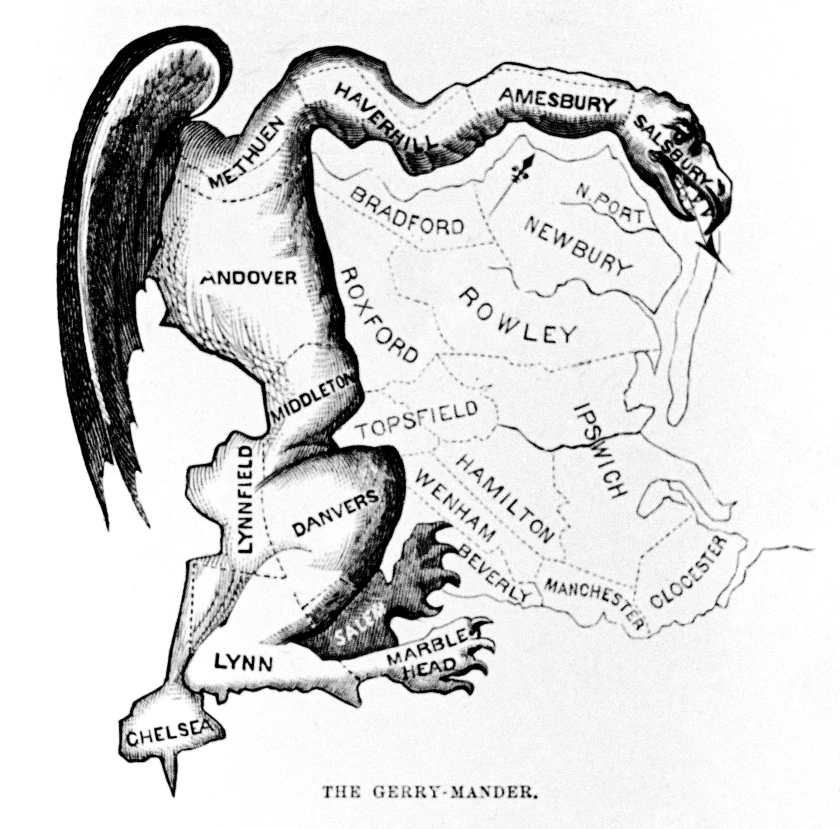
Of late, we relooked, in a post, at the Gerrymanding theme which comes and goes from time to time, usually around election events. We had seen the graphic before and enjoyed knowing more about the subject. 

Today's theme is just that. Let's look at a graphic from FB. 

 For more detail on the map, see the FB images: then (1692) and now. When we were first researching the topic of Thomas Gardner (Salem Planter), we noted that the cities/towns of Essex County cover the whole thing. Out west? Many places have huge counties with cities/town sparsely around and about. So, one finds many lonely places (long roads to nowhere, some say). But, even back east, one can find the unpopulated areas. 

Back in the day, people went to the wilderness to pioneer. We have lots of examples of that, as western movement was there from the beginning: let's look at Virginia. Up north, we had Ipswich Canada fairly early. BTW, the theme of America's Lost Generation will be considered more thoroughly. It's related to the frontier and is seriously misunderstood. 

Now, back to Essex county. Notice how almost all of the larger areas were split. Salem grew into Peabody, Danvers, and Middleton. Lynn split into three. Ipswich, Andover, and Newbury were trimmed. Only Gloucester remained somewhat intact, though it lost Rockport. 

Salem suffered more loss in this sense? Not really, as the place still shines in the American imagination. Too, That was the 2nd place for Thomas and Margaret. So, many more things to look at and consider are there, awaiting attention. 

Some of the changes happened early enough that the resulting entity can celebrate their 400th no long after others. Some changes were done much later. Lots to look at.  

Remarks: Modified: 08/27/2022

08/26/2022 -- We need to mention the 400ths that are coming up, some of these have already started, such as Weymouth (Norfolk County) this year as the first one post Plymouth's celebration. Gloucester's starts in January of 2023. 

08/27/2022 -- Put link to the Lost Generation post related to the frontier. 


Wednesday, July 6, 2022

Gerry-mander

TL;DR -- Gerry was the Governor of Massachusetts. The image associated with the topic is of Essex County. There has been much discussion about the topic. We want to bring awareness to the origins, plus the milieu. For one thing, we are talking post Revolution and during the time of the 1812 conflict. Concerns then are familiar to what we see now. This is a common theme.

---

This topic has been on the table for a few years. Turns out that Massachusetts was the first site of the controversial method being applied. It got its name from the Governor of the time. But, the image that has come down from that time was of Essex County. We got reminded of image through a book review in a recent weekend edition of the WSJ. 

The following links pertain to the subject matter.
    -- South (east and central) Essex County (9 Jan 2011) -- At this time, we were getting acquainted with the layout of Essex County. From a western view, we expect large counties with a few towns. Except, of course, LA with it wide expanse differs. We had learned about Sidney's work. In short, though, little Essex County is interesting from several viewpoints. 

    -- Essex County (3 May 2019) -- Sidney Perley was the chief antiquarian for the County and did a lot of work. This post shows an announcement of his final bit of work. We wrote of this in a post titled "Sidney, his discontinuance." Sidney talked of how hard the work was. He traipsed through Essex County and other areas, researched records, drew up maps, and more. Dr. Frank's sister, Lucie, picked up some of Sidney's work (see TMM, below).  

    -- Sidney's Antiquarian (8 May 2019) -- We had pointed to a site that had Sidney's work available which disappeared. So this post provides links to Hathi Trust's copies. 

    -- TMM (Page), The Massachusetts Magazine (25 May 2015) -- Sidney mentioned this effort by Dr. Frank and friends and noted its relationship with the Old Planters' Society. We had gone through all of the issues and written some summaries. Lots more needs to be done, such as republishing parts of the work. We saw one example done with regard to Judge Thompson (Tenderfoot in Montana). 


    -- Where did the term come from? (Smithsonian, 2017) -- Given the upcoming 250th, we need to learn about Gerry and the times. 

    -- One person, one vote (L.A. Times, review, June 2022) -- This recent book looks at the topic, albeit without much notice about its origins. We, of course, want to preserve information about how all of this came about. The WSJ review provides another viewpoint. 

The Gerry-mander

Remarks: Modified: 07/06/2022

07/06/2022 --  

Thursday, March 12, 2020

The Commonwealth

The last post touched briefly upon Essex County and preservation. We have had several other looks at Essex. After all, that is where Thomas and Margaret came into the New World. Plus, Salem is still within the boundaries. So, we'll feature this little county lots and lots of times.
  • South (east and central) Essex County - This is from 2011. What did we know having just started our research in 2009? Not much. But, we were collecting source material like mad (still are) with the intent of having a good bibliography. Also, we had to get used to a County where the little towns covered the whole shebang. This is not like out west where some areas a lots and lots of empty spaces (Rt 66 comes to mind). 
  • Essex Institute - their Historical Collections was a great asset. Too, Sidney's work was central to a lot of research. 
  • Essex County -- Dr. Frank's The Massachusetts Magazine was based in the county. 
We have a lot more. Buy, let's switch gears a little. As, there was the Commonwealth in which Essex County was embedded. Rather, which grew around the county. We focus on Essex; several sites look at Massachusetts, New England, and the U.S. One example is 'Mass Moments' which we look at today.

On March 12, 1857, John Brown spoke in Concord. John was featured in several of our posts, such as the one on Col. T. W. Higginson who worked with Dr. Frank on The Massachusetts Magazine. In his talk, John mentioned Kansas which we have featured in our series on the western movement.


As we look at the American 100s (400th, 250th, 100th - as in Cape Ann, the Revolution, and the western swing), we will juxtapose views with Essex County being perpetually there. And, we have a huge collection of supporting material. On the broader scope, we will begin to collect similar support. Turns out that the 'Mass Moments' comes from the 'Mass Humanities' project. We will pay closer attention to this effort.

Remarks: Modified: 03/12/2020

03/12/2020 --

Wednesday, October 19, 2022

Newbury Essex County MA

TL;DR -- Ships made and used. New England. We're back to that after our jaunts through the interior. But, we'll keep both in mind going forward. In Massachusetts, we focus on little Essex County. Even there, the shipbuilding efforts have continued over the 400 years. Maine will be in the scope, too; after all, they endured the onus of Massachusetts for a long while.  

--- 

New England and its nautical modes is a no-brainer, that is, when one considers the coastal area. Same goes for our Essex County, the primary entity in Massachusetts. That is, again, until Winthrop arrived in 1630. There was Plymouth, of course. And, people had scattered around the region, like Weymouth which commemorates its 400 this year (2022). Per usual, we will be looking at Weymouth, again, due to the associations/relationships with those there in the context of the 400ths which will cover several decades. 

Folks in Essex County helped fill in the interior of the U.S. over time. To consider that entails covering a very large area. Two memes apply: long reach of New England; frontier century. Both by land and by sea pertain to the two memes over time. Thomas Gardner Research has noted by the seafaring ones have lots of press. Where there are deficits of information is in the large interior. To the extent that we can claim to have discovered a lost generation or two where our work has merely touched the tip of an iceberg. Fortunately, technology is moving to where we can handle the work to fill in the missing pieces. The interior is not just "flyover country" as was a meme several years ago. 

But, back to the sea and its charms. Before getting back to Essex County, there was a documented building of a vessel in Maine in 1607: Virginia, a pinnace (Gardner's Beacon, Vol. III, No. 1); Popham Colony (Wikipedia -- first English ocean-going vessel built "in the Americas."). The Wikipedia article gives an off-handed review. This vessel actually sailed from Maine to Virginia, to London, and elsewhere. This accomplishment needs more attention. 

That's New England, north as we call it. Coming back to Massachusetts and Essex County, we can look at the northern end, namely Newbury. We have mentioned it a few times. For instance, Dr. Frank and Ann have lots of ancestors from there. Nathaniel Knapp is an example. We wrote of Caleb Haskell who is from Newburyport (close enough). 

Newbury will have its commemoration is 2035. Being up top, we can jump over to New Hampshire to add in more goings-on over time, say like this post, Two Houses. But, let's give Newbury some attention, finally. 

Today, we saw an article by Melissa D. Berry: Tales of Infant Boat Industry in Massachusetts. The article looks at Newbury's  involvement, in a big way, with the creation of vessels for water transportation. By 1749, the region had produced "over 600 vessels." The Merrimack (1798) came from the folks up there in northern Essex County as a gift to the cause for which we'll have a 250th very soon.  

Recently, we had a brief look at the smaller work of cousins a little further south: Shipbuilding in Essex. Where Essex, in this case, is the former Chebacco where Rev. John Wise preached and rebelled. That latter had to do with tax impositions almost 100 years before the little tea party in Boston. John's pamphlet (see The Rev. John Wise of Ipswich) was republished to inform the later folks of what happened before, as well as to inspire Thomas Jefferson. 

We will step back to the beginning to look at the types of efforts. Housing was a huge emphasis, for a while. There was regular traffic bringing in goods of various types. Some artifacts had to be done locally. Too, exporting happened fairly quickly. Of course, we will continue the overviews of the 400 years of interest. 

Getting back to New England, in the context of Maine, we need to specifically point to Bath (John almost went there - to deal with the heavy stuff as compared to the lightness of aero ways). This little brochure is about the First ship of Maine (of course, Popham's). Their claim s that 4,000 ships have been built over the 400 years. Astounding.    

Remarks: Modified: 10/19/2022

10/19/2022 -- 

Saturday, September 10, 2022

Shipbuilding in Essex

TL;DR -- The Smithsonian Museum on Main Street will be in Essex of Essex County to document the shipbuilding activities of the area. The former Chebacco was part of an effort that produced 4,000 vessels since the Cape Ann venture got that area going. 

--

Last year, we had a post on shipbuilding which was motivated by reading that had been done after taking a break from researching the huge interior for such a long time: Frontier century. We know that we need to balance sea and land, going forward. 

We looked at some New England (northern Essex County) efforts in this regard that might seem to pale, in a few regards, when compared with Boston's prowess. But, there was southern Essex County involvement, too. That expertise was applied to building a meeting house in Chebacco by the women in the area. 

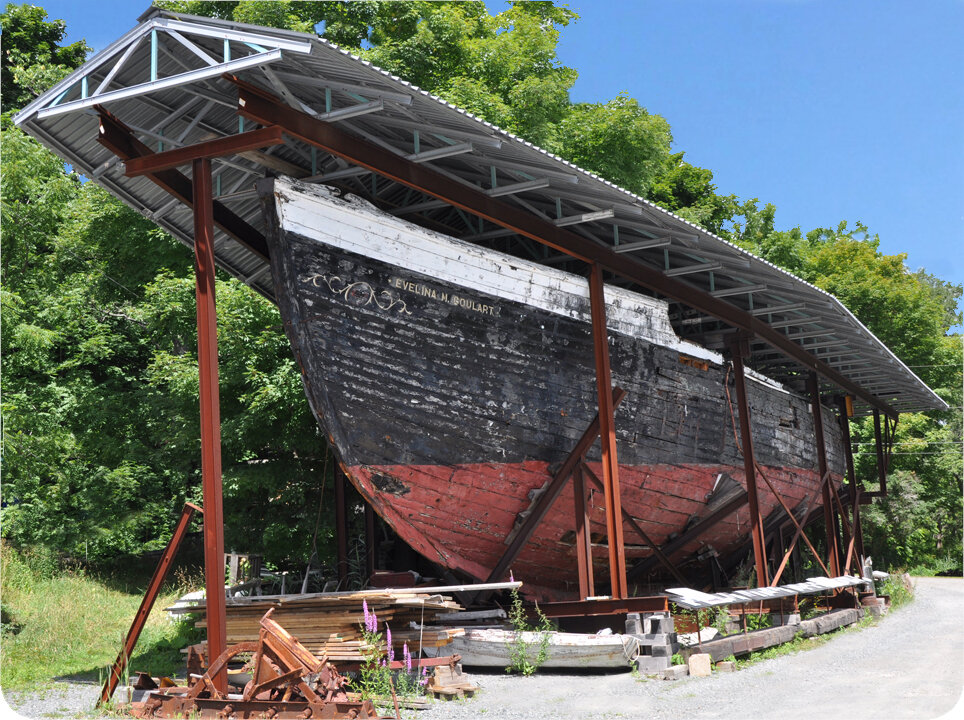
82-ton Evelina M. Goulart
built 1927
Today, we return to that location, referencing it with another name: Essex MA of little Essex County which is (and will be) one of our main themes. Thanks to a Mass Humanities notice, we got informed of an effort by the Smithsonian Institutes to help document shipbuilding there through the facilities of the Museum on Main Street that is part of the Crossroads program. 

The website for the Essex Shipbuilding Museum has more information on the collaboration. Many photos might suggest that only the smaller craft were built at Essex, but the photo at Mass Humanities (image, at right) indicates that larger vessels were constructed, such as the Schooner Thomas E. Lannon

Big sister town, Ipswitch, has a post on shipbuilding in Essex. The Burnham family built ships for years (still do). One estimate was that the area produced 4,000 vessels since its founding. 

Essex was part of Ipswich, which is one of the original towns in Essex County with a 400th celebration year of 2033. 

Remarks: Modified: 09/10/2022

09/10/2022 -- Essex County

Friday, August 26, 2022

Essex County timeline

TL;DR -- Starting with the Plymouth colony (2020), there will be celebrations until 2073 for settlements across Massachusetts. Weymouth followed that this year (2022); Gloucester will be next (2023) with a special focus since that was the location of the Dorchester attempt. Then, we will have Salem (2026) and more. Those last two are of Essex County; hence, we will use this focus to explore more closely the site of the start of the U.S. as this effort was a lead in to the Massachusetts Bay Colony which then formed the core of New England (arguable assertion, of course). Let's put it this way, lots of the other colonies were the result of friction with the Massachusetts way, even to the extent of what is now Maine being under the thumb of Boston. 

---

We posted last time about the Essex National Heritage Order and their Facebook page which shows two maps of Essex County, 1692 and now. This got us to thinking of the 400ths that are coming up. That 400ths post shows a timeline for Massachusetts (from Wikipedia) which covers all of the settlement's towns prior to 1673. We mentioned that Weymouth (Norfolk County) had their look back this year, 2022. Next up is Gloucester (Essex County) which has picked 1623 (some argue 1624) with respect to the arrival of Thomas Gardner's crew. The arrival particulars are still being researched as we continue to study information as it becomes available with digitization efforts. 

The 400ths list is fairly long, so this post pulls out Essex County locations so that we can track events specific to the County. This list is in process and will continue after the 1673 cutoff of the Wikipedia listing. 

That list indicates that there could be sixteen celebrations from next year until thirty years hence. Some will be in the same year, such as Lynn, Saugus, Manchester-by-the-Sea, and Marblehead in 1629. There were latter starts of towns which split from those on the list. We will look at those, too. 

We are talking the context of early New England, in particular, the Cape Ann Settlement (Wikipedia) related to the establishment of the Massachusetts Bay Colony which was the Dorchester Company venture lead by Thomas Gardner. 

 As this graphic shows, there were settlements prior to 1640 along the east coast. The English colonies are colored. Other colonies were of Swedish, France, and Dutch origins. Those of Spain are south of this area and not shown.  

Remarks: Modified: 08/26/2022

08/26/2022 -- We will compare New England north with the south, in several ways. Expect some look at population counts and such through these first few decades. The focus for this is the inception of the effort with discussion of pros and cons, successes and failures. Too, we need to bring in what was going on back in England and Europe. Then, expect a whole different look when DAR/SAR kick in for their 250th events in 2026. You know, before that, we'll have 2025 and Henry III of England's support of the Magna Carta. It all goes together with respect to talking intelligently about the American dream. 

Sunday, January 9, 2011

South (east and central) Essex County

How can we look at Thomas and Margaret and not include something about the area? A whole lot went on in Essex County (note the dragon -- ca 1812), so we'll separate it further. The sister blog centers itself on Newbury.


The original point of entry was on Cape Ann, namely Gloucester. Then, the group moved close to the mouth of the Naumkeag river and started a settlement that would become Salem.

---

By the way, the Massachusetts Bay Colony page has a timeline for the settlements. As we look at the Gardner family, and its related families, we'll cover about all of these.

---

The following is a list of web-accessible information about Salem and the 'Old Planters' of whom Thomas was a member.
We will update this list with new information from time to time.

Remarks:

06/02/2019 - Profile of Sidney on WikiTree.


01/18/2011 -- We'll be looking at the northern and the middle parts of Essex County.

01/14/2011 -- Should have known. Follow Salem on Twitter.

08/20/2020 -- Recently, wrote on little Essex County's involvement with the evolution of Gerrymandering

Modified: 08/20/2022

Wednesday, August 11, 2021

Context, New England

TL;DR -- 2020 was for Plymouth; 2023/4 was for Cape Ann (Salem). For the latter, Gloucester 400 became the focus which chose 2023. Before that, Weymouth (Wessagusset Colony) will come into sight as their time will be 2022. After that, lots and lots of towns will celebrating. Starting with Weymouth, we will highlight the area and its people with the intent of lifting personal tales into the public awareness from the long histories of families here from the beginning. 

--

Earlier, we looked at the 400th planning for Gloucester. That is the Cape Ann area which is part of Essex county. There will be a lot of attention on that county as we look at the decade of entries. We had a post that showed a graphic (early post, Jan 9, 2011) which can be used to remember the towns of Essex county. 

Essex County

The year for Gloucester was 2023. We knew that there was another which turns out to be Weymouth which is in Norfolk County and has 2022 as its year. We will be looking further at Weymouth which is 11 months away from their celebration, as Wessagusset Colony which had been a commercial venture. 

For now, we wanted to start to relook at New England, as a whole, continuing the theme of this post (Inflow and then ebb). By 1630, when Winthrop arrived, the inflow was ready to, and did, increase. After about a decade, there was a tightening of the inflow. That cut the dynamics and reduced the marrying pool for several generations. 

Of note will the the 250th related to SAR/DAR which was handled by the sixth generation


Remarks: Modified: 08/14/2021

08/11/2021 --


Sunday, July 26, 2020

6th generation

TL;DR -- The 5th accomplished the split from England; the 6th workhorse'd the 1812 ordeal; the 7th enjoyed the fruits of the labor of the prior two. Essentially.

---

We can note that the fifth generation was involved with the start of the U.S. Too, there can be a focus on the seventh generation as the first to truly enjoy the benefits. International trade boomed after the 1812 conflict was resolved. Lots of families became quite prominent from various commercial activities.

So, what of the sixth, the sandwich generation? Well, we are doing this exercise to start collecting some notion of the descendants of Thomas and Margaret. The GSMD based their silver books on the fifth generation. We used a George descendant to look at the GSMD (Deeper dive - we'll have much more to write) and its relation to our goals. There were many intermarriages twixt people in Essex County and those in the lower set of counties.  

Also, we wanted to come further toward 1900, as that would include Dr. Frank's generation. However starting with the seventh has some appeal as they experienced the U.S. Civil War.  

first issue 
A cousin of Dr. Frank's was mentioned in a book review (WSJ, May 30-31). The book was about Colt (pistol king), but the reviewer took a look at some of his cohorts. One was Rufus Porter. That got our attention. As the George descendant is also a Porter descendant, through Hathorne as is Dr. Frank. There were two major Porter families (one of Essex County and another of Connecticut). John Porter of Essex County was neighbor of Thomas Gardner. Two of John's daughters married Hathorne. The daughter of one of these couples married the grandson of Thomas. This couple was buried near Thomas on Gardner's Hill, and their grave is one of those that needs further research. Though, their stone is in Harmony Grove Cemetery (see 29 December 1674 and several related posts). 

Rufus Porter via Wikitree

The book reviewer was noting that there had been a upsurge of industry with Rufus Porter's generation with lots of invention going on, the western movement, and wealth creation. Rufus, himself, went to California. What caught the eye, initially, was that he started Scientific American in 1845. He sold it, but the magazine made note of his passing. 

Having been born in 1792, Rufus was on the late side of the sixth generation.  We have not established a start year or end year, yet, but will be researching a reasonable selection. Perhaps, one approach might be to pick some example of the 5th (First five), 6th, and 7th generations for each of the children. And, picking both a son and a daughter, not necessarily the same couple, might interesting.

Remarks: Modified: 07/29/2020

07/28/2020 -- Have done several posts related to generations: 5th generation6th generation7th generation1900 backAmerican 100sFirst five, and About generations.

07/29/2020 -- Have started to follow the generational lines, first using Dr. Frank's demarcations.


Saturday, May 8, 2021

Caleb Haskell's diary

TL;DR -- Cuz Caleb out of Newburyport was an early responder having heard a preacher talk hell and firestone (whatever). Several volunteers were out of Essex County MA, but other regions contributed, to boot. The group, lead by Benedict Arnold, went up the Kennebec (in late fall, for God's sake) to Quebec. Caleb diary'ed during the events which encompassed about a year of time. So, we look at that and related material as we continue on setting the basis for the U.S. emergence and its voluminous enveloping of land from the Atlantic to the Pacific. All along, people and their families were involved.  

--

What got our attention was a tweet on a history page saying that, on 5 May 1775, Caleb Haskell started his diary which ran for a year. He was under the command of Ezra Lunt who is related. Also, Benedict Arnold was the main lead. So, before going into that, we'll look at some of the context of our recent work which deals with New England families within the timeline of the U.S. and allows us to look at related subjects that have been of interest while at the same time keeping Essex County MA in the picture. Of late, we have been looking at the movements to the west as they pertain to the long reach of New England. Too, though, we need to consider the influence of Europe on the early U.S. especially those folks who came from England. That is much later in the 19th century where money needed for investment came in  (with the usual perils of capitalists losing). One consequence was that the population ran up by millions per year for a while as we can see with the U.S. Census. 

Backing up, though, let's look  to the Revolution. Dr. Frank mentioned that the French-Indian affair helped train the local folks sufficiently to pull off the rebellion against the King and his Crown. That affair dealt with a conflict with the neighbors. To give an idea of the scope, we can use this map to show the relative sizes of New France (blue), the principal belligerent, and New Spain. 

French-Indian War era

It was in this conflict where Nathaniel Knapp (ancestor of Dr. Frank) wrote his diary while engaged in the Louisbourg Expedition. We have to mention that Nathaniel was from Newbury while Caleb was of Newburyport. Both of these areas are full of relatives which is another recurrent theme.  

Other parallels abound. For instance, we have looked at rivers, such as the Ohio River, which serve as waterways but are huge barriers, too. In regard to the waterway, traveling either direction can be a problem. It's interesting that the group that Caleb was with tried to navigate up the Kennebec River from Maine up to Quebec. 

Caleb's diary - A REVOLUTIONARY SOLDIER'S RECORD BEFORE BOSTON
AND WITH ARNOLD's QUEBEC EXPEDITION

One wonders of the timing as they did this in late fall. One goal was to attack Quebec City which was tried on New Year's eve. This map shows the route of the group. The caption from Wikipedia is as follows -- Detail of a 1795 map, overlaid with Arnold's expedition route: *A: Cambridge *B: Newburyport *C: Fort Western *D: Fort Halifax *E: Great Carrying Place *F: Height of land *G: Lake Mégantic. 

Arnold's route

The expedition did not work as planned. However, Caleb made it back to Essex County and is buried there. One wonders if he wrote this after the fact given all of the troubles encountered. We know how difficult it was to record anything, especially in the uncertain conditions such as Arnold's group faced. And, such material being preserved for later publication would have been somewhat remarkable, even miraculous.

MS&S: Caleb Haskell vol 7, pg 433

Where Caleb is buried, there is a plaque with lots  of names of relatives: Caleb Haskell, Jr. We need to look more closely at how Caleb relates; too, Ezra Lunt (MS&S, vol 10, pg 46) needs a little study. 

One hundred years later, we will see the U.S. being invaded, somewhat, by multitudes. Lots to look at. 

Remarks: Modified: 05/10/2021

05/08/2021 -- Caleb was in Ezra's unit at the Siege of Boston. Their chaplain was Rev. Samuel Spring. Evidently, Ezra did not go north but stayed in the MA area.  


Tuesday, July 1, 2025

Rev. John Wise

TL;DR -- Everyone talks of the 250th. Wait a moment. That's a year away. And so, let's use the coming days to look at the Revolution in new ways that represent the marvels of the modern times.While, at the same time, look to the idiciocies that potentially loom and recognize them for what they are. We suggests a focal of the human variety. Aside: in 2026, we have the 400th of what became Salem. 

--

Now, we are a few days prior to the commeration of the signing of the Declaration of Independence. Lots has been written and said about that event. Some people have been mentioned (too many to list). Many (most) were not. Even Dr. Frank's look at the Siege of Boston only mentions the officers. 

And, at the same time, we are approaching one year to the 1776 event's celebration. Meanwhile, we can use this year to dig in. Sometimes, we'll dive deeply. Mostly, we expect to mention pending research items that would keep us busy for a very long time. 

So, this week's look back is from the timeframe of 249 years having elapsed. The 250th, then, is next year. What else is associated with 2026? Well, 100 years ago, Salem celebrated its 300th. You see, the country was too new to do the 200th. Besides, the War of 1812 had just ended. "Manifest destiny" was beginning to bloom. All of that is already on the list. The next year, we will specifically deal with the Revolution and the 365 days leading up to the big split on paper. 

Given the times, Salem MA sponsored a pageant which was a play about the early days leading up to the establishment of the Naumkeag settlement. Cape Ann has been mentioned a lot here; since last year, we are in a new era there as digital records indicate that some of the information might have been other than correct. Typical. 

Anyway, the Pageant of Salem was performed in the towns of Essex County and elsewhere. Of note, most of the characters were played by descendants. We can look at that closer. Too, many of those of the time of the 300th were descendants, too, of participants in the Revolution (both sides - warning, we also look at Loyalists - say, Count Rumford who gave money to Harvard so that that provincial institute could modernize - needless to say, Rumford and later Gibbs will again get time in the spotlight this year). 

Recently, we looked at a Roxbury (muddy waters, whatever, Suffolk County) family who married into a family at Ipswich (Essex County) or was it the other way: Gardner married Wise. In this case, Abigail Gardner was the sister of Mary Gardner Boylston. They were both grand aunts of a causalty (Col. Thomas Gardner) of Bunker Hill which we just looked at. 

---

Abigail married Rev. John Wise. Who is this guy? Well, large male. Harvard graduate. As we see, Reverend. Was in an area of what was/is known as Ipswich. That little place on the waters even produced seagoing vessels. The American spirit, so to speak. 

But, this is about John. He has lots of tales about him. One dealt with his early years when he was out with a hunting party. They ran into some Native Americans so as the potential for violence rose. But, John's party negotiated a wrestling match with John being chosen. The tale notes that the Reverend-to-be won and did so by throwing his opponent several feet in a remarkable feat of strength. 

Ipswich MA
One can just imagine this guy. Not like John Adams who fled the farm to be a lawyer. Nope, Rev John was involved with physical labor all of this life. And, he was noted to be an inspiration of the Declaration of Independence. The image is about the 1689 event where the colonials rebelled against taxes. Mind you, from 1620 until later in the 1640s, the colonials were more or less here and living freely. We will look at what led up to this event. Why? When the Patriots were getting hot-headed (again, a cousin, Samuel of the beer), someone published a pamphlet written by Rev. John decades prior.  

We need more types like Rev. Wise, especially in the age with the digital illusions grasp people psychologically and wreck havocs on lives that way. And, let's count the other ways of mischief. Don't doubt that we can do this. Well, that needs to be our technology focus which will go forward with our arguing the importance of psychology and other studies that deal with humans. 

---

Aside: We have waited a whole for this: in 2026, we have the 400th of Conant's moving from Cape Ann to Naumkeag which became Salem: Massey's Cove

Remarks: Modified: 07/01/2025

07/01/2025 -  


Thursday, December 1, 2022

Perspective, a necessity

TL;DR -- Ipswich has been a topic from time to time. It had shipwrights. Of course, different size of vessels were handled. There were no biggies like Boston (MA) or Bath (ME) or Norfolk (VA). Other examples of industry and technology can be used. But, Ipswich led the way to the expansion across the interior that we saw for over a century. We will be looking at that, as after all, New England has a long reach. Ipswich has done well for itself. 

---

As technology runs toward the future, we always get to states where we get locked in. We cannot go back. Technology is great, except for when it doesn't work. If the problem is solvable, then we have a glitch and a correction. If the problem is systemic or not resolvable within a reasonable timeframe and costs, we have adjustments rise as imperatives. Learning drives technology; unlearning drives recovery from technology's failures. 

The U.S. is about the best example that we have for several reasons. We have already addressed technology as being our main focus. We have 400 years of data to ponder, in this regard. But, just those pieces of evidence from the past 250 years is worthy of study, too. And, commemorative moments, such as we are having now which will last decades are a time to reflect and learn from the past. We are surely in a different mode than the generation of the recognition of the 300ths. 

Today, we are featuring Ipswich which does not come to bear until later, but it does involve Essex County. Reminder, Cape Ann (Gloucester) has their moments in 2023.  It was from Ipswich that a group went west. Gen. Rufus Putnam (Wikipedia, WikiTree) was one of the leaders of the effort. Let's look at some particulars. 

Historic Ipswich is a website that has been quite a motherlode of information. Of course, we are interested due to the many families in the heritage who had Ipswich connections. For one, Rev John Wise has an interesting bunch of  events in his life that we can learn from. We have been looking at shipbuilding in little Ipswich as well as similar work in the County (see Newbury Essex County MA).

The website has looked at Putnam's effort: Ipswich to Marietta, December 1787. First, they show the result of contention between the States with regard to this unsettled land to the west. We mentioned that in the last post about Family Search and their great support for research. Then, the post has the photo of a plaque that notes the endeavor. What? That got our attention, as we have been looking at the western expansion and its frontier century, including lost generations that plague genealogists who have no imagination. Why say that? These people were. Some were newcomers, true. Many were representative of the long reach of New England. Along with technology (and its specifics), our interest deals with identifying the examples of that reach plus the evidence now of its continuing existence. 

Then, the post looks at an effort in 1937 to redo the trek while documenting the effort. For one thing, they provide the map that gives details of the geography. That was great to see as we have looked at the west and its rivers and its great expanse and the carving that was inevitable. Lots of this was with a focus on St. Louis, the gateway. Putnam kept a journal. There were other reports written. In short, it was a great find that was more special since it involves little Ipswich (influence a huge multiple of its size). 

Now, let's look at perspective. Technology makes people lazy; oh, managers will say that it increases productivity. In terms of the former, heard of AI? It's a huge scam which we will show as we go along. Yes, balancing mathematics with knowledge with respect to culture that the broad history of U.S. allows. After all, we are a nation of immigrants. Luckily, we have two broad scopes, related to the colonial times versus later. Too, we have cultural associations with the old countries, for the most part. The list goes on and on. So, expect this theme to be recurrent. BTW, that which is being touted as AI is merely fancy math being exploited by computational prowess that came via modeling founded on (guess what?) mathematical modeling and the detailed work over the centuries. Yes, we will to touch upon all of that. 

For the time being, we will present the following map with some commentary afterwards. 


This graphic shows a map from the prior post which has one view of the partitioning before the carving that was involved in establishing the States. 

1) deals with the Michigan Territory (again, the prior post) that we just offhandedly dismissed as practice for the carving. Our only excuse was that we were dealing with the broad expanses beyond the Mississippi River, but that was not correctly assumed. We have to step back given that the focus of DAR/SAR is the upcoming 250th of the U.S. Besides, we have to give generations credit. This deals with the fifth and the sixth where the latter is the first of those that were heavily in the lost side of things. 

After all, people moved and did so quickly, once the way was set. Say, thanks to the likes of Daniel Boone and Jedediah Strong Smith. The former was doing his exploration prior to the Revolution. The latter was directly connected with St. Louis and its influence. We will go into that deeply. 

A point to make is this: that trek from Ipswich was difficult. Hence, there were real reasons why it took months. In fact, it was practice for the challenges of going even further which was all the way across the continent. On the right is a modern image with routes and times. Even today, travel is difficult. Try driving diagonally across West Virginia. It's fun; but, don't expect to make record time (except, perhaps, max time which is open). Those mountains run further north. By the time that they would use the Ohio, they had already trekked some distance. 

We will take the time to go into this further, since it does set the stage for later developments out west. 

2)  This view trails the other by only a couple of decades. Missouri, the starting point, was a State in 1821. By then, most of the issues related to the green area had been resolved. But, it was 1804 when Lewis & Clark did their venture from D.C. through St. Louis to the west coast. At that time, mountain men (trappers, explorers) and American Indians were mostly in the area. Except, that had been activity from the west coast in (New Spain), some of which got away from the coast. Too, the northern explorers had been more adventurous than those of New England. Boone in the south went further west than did those up north. Lots to discuss. 

Taking the same approach, notice that we are now in the middle of the country covering only a fraction of the area. Here, the issue is that folks would have followed a similar path down the Ohio River to the Mississippi River and then St. Louis and finally the Missouri River west. But, that was on to a starting point. There were several trails. This example uses that which went to Santa Fe in New Spain. One thing to note is that Santa Fe was the terminus of another trail that came up from the south. Too, there were trails out of the east through Texas to consider. 

But, taking that one small portion which involved about four hours of driving now, it took three weeks for a wagon train to cover that area with a daily grind of a few miles. Notice, too, that we are talking the plains portion which is supposedly flat. It isn't. You can still hurt yourself by falling off of a cliff at various places.  

In all of this travelling, rivers were both a barrier and a boon. In these graphics, they are not shown with any clarity, but, even recently, we have seen examples of traffic snarl ups due to bridge damage. One time, we were across the river from where we wanted to go. Okay. There was no ferry. This is a form of technology to note. So, the solution, since we didn't have a helicopter that would pick up the car and deliver us to our destination, was to backtrack to where we could follow a road that went over the river and then get back to where we needed to go which was a stone's throw (well now, as it was broad). 

During the times before bridge technology really advanced, one waited out water. Incidentally, here in the west, there are uncountable number of places where high water will stop traffic. And, in many others, the water comes up to the edge of the road. One hopes that the road engineers did a good job with the base. And, that's not mentioning storms such as we will be seeing with winter setting in. It does not even have to be like the recent dump on Buffalo, NY. A few inches can be catastrophic. 

 Oh yes, real examples. There is a method to that madness. AI and other computer has gone off the rail since a proper basis was lost. Yes indeed. We have seen so many examples of modeling gone wild (like the kids at spring break) due to a lack of grounding which comes about for several reasons. One of these is a lack of respect for the need. Some of that might be generational; a lot of it has to due with the computer being too new for us to really have a grasp of how truth engineering is necessary. Too, what John von Neumann wrought will bitt us until we learn several lessons that have been pending for a long time. 

You know, we are looking at the U.S. and its growth. But, at the same time, the world of thought was changing. There and here. Say, for the latter, Charles Sanders Peirce. But, parallel to the U.S. and its experiences, the world was changing, too. There is not end to that type of analysis. 

Remarks: Modified: 06/08/2023

12/16/2022 -- Rutland VT is hosting the Smithsonian's roving display:  The Smithsonian comes to Rutland. They are reading and discussing McCoullough's book The Pioneers as Rutland is on the pathway west. 

06/08/2023 -- Updated the URL for the Historic Ipswich post. It was originally dated in 2019. The 2022 update removed the older post. One of the technical concerns is that source linked by an URL can disappear or have some other issue, like the information changing drastically. Or, as we might wish not happen, contain undesirable information. In this case, an easy fix. 


Wednesday, June 9, 2021

State Of Missouri, 1821

TL;DR -- While researching we saw a pamphlet from the State of Missouri with respect to their history and to availability of records. The history included several maps at different times which show the carving up of Missouri Territory into counties. By the time that Missouri became a State in 1821 there were only a few counties. Others were defined over several decades. St. Louis hosted a World's Fair in 1904 which was the theme for a Judy Garland movie. 

--

This is a brief post with a few maps which are to show just how quickly things were changing out in the west where we can use St. Louis for a focus for a while. Before jumping ahead, here are a few pointers to related information that pertains to what the first map (below) shows.  

  • Northwest Territory -- this was being defined in the early stages of the U.S. as things were being settled. By 1805, Ohio, Kentucky and Tennessee had been established. 
  • New Madrid -- indicates that New Spain was there. Too, the Louisiana Purchase covered a lot of territory; however, notice that the surrounding pieces of New Spain and unclaimed are as large. 
  • Trapper, trader, rancher -- we have mentioned several of the trappers who were early out west. William Bent is an example of a family that had already moved. His father, Silas, was involved with the continual surveying necessary during the period shown below by maps by years. 

So, we start with an overview. There were three areas still to be handled in the northwest, name Michigan, Indiana, and Mississippi. These, btw, are east of the Mississippi that sets the eastern border of the Louisiana Territory.  


The next maps are local to the central/right region dealing with the area around St. Louis. We start with a 1804 look with names from New France and New Spain. The culture there of St. Louis is as aged as is Essex County of MA, for example. All of these maps come from a little book titled Missouri's Public Domain: United States Land Sales 1818-1922. We were thumbing through a copy of this today and are happy to find it online. In several other publications, we have seen a history of the area from several sides, such as Missouri or Arkansas or other. Some of these were quite detailed. This is quite direct and oriented toward sales. 

By 1812, what Louisiana brought was under siege by newcomers. By the next year, Arkansas was under consideration as it was being carved out of New Madrid. In 1799, Boone, himself, was in the St Charles area. He was involved in the local area. There is a tale that he went up the Missouri River, as far as Yellowstone which is remarkable for someone in their 70s.

                         1804                    1812                            1813                     
 
1816
In all of those maps (1804 thru 1813), one can see the Missouri River cutting across the top. In the middle two images, it is the top boundary of the St. Louis County which extends from the Mississippi River on the east to the left border. What is there? The next map from 1816 brings in the west and the north. A Howard County picks up the Missouri and extends the northern border above which will be Iowa. 

Then, in 1821, we see the initial look of the State of Missouri. Howard is cut down in size quite severely. Boone gets a county named for him in middle of the state along the Missouri River. 

Anticipating the movement further west, the activities of the Trails which flowed through the Kansas City area will be in Ray County. That is, as we will see, lots of traffic came down the Ohio to the Mississippi and then went north to St. Louis and west on the Missouri. It was at Kansas City where the focus changed from water to the toils of laboring across the landscape. 

All along these ways, we had families seeing something they liked and staying. Or their decision was the result of any number of issues that could have arrived. The net effect is our Frontier Century

1821

With a nod to culture, St. Louis hosted a World's Fair in 1904. It's theme was the Louisiana Purchase. We have a lot more to look at with respect to the century and what it entailed. 

In 1944, there was a movie titled Meet me in St. Louis. We can look further for New England references, but one of the stars has plenty. Namely, Judy Garland (Famous Kin). 

Remarks: Modified: 03/17/2025

06/17/2021 -- Add the TL;DR. 

03/17/2025 -- Independence and Kansas City. Stopovers for people going several ways. 

Sunday, December 25, 2022

New Hampshire

TL;DR -- ME has been in sight since the beginning. NH only has had passing reference as we studied Cape Ann in relation to 400 years. They have 2023 for their commemoration, as does Gloucester. We look at a few of the posts over the years that mentioned our scope. In our future research, we will balance the view across the local territory and further, in this context: the long reach of New England.  

--

We have had a 400th focus for a while as we watched other celebrations (Plymouth - 2020, Weymouth - 2022). Gloucester comes up in a few days. Our start was with a focus on Cape Ann and Essex County

Then we extended our view to MA and New England. Incidentally, ME was involved due to its association with MA. After looking at the long reach of New England in the interior and the west of the U.S. and around the world, we now have a U.S. focus through the 400 years where we consider details through time of the other colonies (like New Spain) as well as the events related to populating the interior (Frontier century).  

Recently, while looking at the Northwest (as seen in the time of the Revolution), we saw Rhode Island being represented out west, in the form of a Governor of the Territory of Michigan. Having looked at the family involved and tying things back to Massachusetts, we thought to fill in the gap by looking at a family that had long been in RI (see H.P. Lovecraft). We had mentioned that we needed to bring in the surrounding States, such as CT (a little later), NH (which we had already touched upon), ME (which we have covered many times) and VT (already noted in looking at western movement). We will get these posts better categorized and related as we work the 400s going forward. RI and CT do not come up on the 400th list yet, that we know of. We should have looked north, again. 

Today, we saw (on FB) that the northern neighbor whom we associate with Rev. Bachiler is on the 2023 list. That was good to find out. We will spend more time researching the Rev. and his cohorts, but he was mentioned recently in this post (see Two Houses) which was motivated by research on New Hampshire families where it was noted the Gilman family was of interest with regard to the Revolution (both sides, plus the Society of Cincinnati). Nathaniel Ladd was one of the builders. We also had looked at the Dudley family who hung out there. 

Rev. Hubbard, friend of the family, weighed in on the controversy of when did NH start. John B. Sanborn (several posts) was born in NH. Sam Webber, Head of Harvard, was born in Essex Co, MA, but his family moved up north. Lots of Ann's folks did the same. 

Hence, in a few days, we'll have another commemoration to add to the list. As well, we need to find a time line for NH similar to the one for MA. 


This was a great reminder as it expands the scope at a good time, that is, when Essex County starts its long-awaited commemorations. 

Remarks: Modified: 12/25/2022

12/25/2022 --


Sunday, February 20, 2011

Dr Frank A Gardner


A few notes (see Remarks, below, for log):

Finally got around to filling in Dr. Frank's tree, using WikiTree. His Gardner line is fairly complete, in terms of data entry. Starting to fill in his Woods (maternal) line using Dr. Frank's handwritten notes. The focus now for this work is having nodes (profiles) in place and linked (pick the Ancestors button). Then, we'll be adding bios, etc., plus verifying sources, as in, this will be the 'bible' of his lineage. We fill in sources as we go along adding profiles - to be extended later with further research by Gardner Research. However, we don't own all of the profiles, so we need to double check those. So far, finding interesting stuff, like - Dr. Frank is a descendant of Demaris, too, the last wife of Thomas.

Link to on-line versions of Dr. Frank's books and some of his publications:
                              1907 edition, 1933 edition
                          The Massachusetts Magazine

Gardner pedigree for Dr. Frank and his sister, Lucie M. (with ahnentafels of their grandfather, Benjamin Brown Gardner, and grandmother, Lucy FosterWilson).

--- original post ----

Several posts have mentioned Dr Frank A. We will use his line quite often as we fill in the tree.

Dr Frank's book is now available via the Internet Archive in several readable forms, including PDF. Here is the link:
The 'Read online' option provides a nice interface that has a fast search; the results are given with easy to use bookmarks. See next, for an example.

Dr Frank's book gives descendants for Essex County and New England "lines to the eighth generation and Nantucket lines through the fourth generation" and includes his father's siblings (page 286 has information about Dr Frank's father, Stephen Wilson Gardner, and his mother, Marion Wallace Woods).

Fortunately for us, this book provides sources which is important for resolution of questions. In many cases, records are missing for a variety of reasons in many areas. Essex County seems to have been able to preserve a lot of their records.

The Gardner families were spread widely, according to the book. It will be interesting to see the locations mapped out as they were at the time of the book and at this later time.

Remarks:

12/28/2024 -- See "Restart, somewhat" from September of 2024 for a summary of the issues about early information and about technology which is our focus. 

11/11/2019 -- Got Dr. Frank's FindAGrave profile updated: Frank Augustine GardnerVeteran's Day. Early, we had pointed to Harmony Grove Cemetery, but the Gardner / Dennett plot in which Dr. Frank's ashes were interned in in Greenlawn.

05/01/2019 -- Saw notes by Stephen Wilson Gardner in his personally signed copy of the 1907 book. SWG was the father of Dr. Frank. For the first time, saw the plate that had been reproduced. On further research, found a color copy. The area is significant in that it's near Gardner Hill. Looking for other material that has something to offer about the area.

09/15/2018 -- Gardner Research published four articles in The Essex Genealogist. These were republished in The Gardner Annals which just released Vol. IV. Last fall, we printed TGA Vols I and II. Soon, we will print Vols III and IV. Included with the TGA were Gardner's Beacon issues. Of late, we have experimented with one approach to a database, namely WikiTree using Dr. Frank's information. As mentioned in that post, we have established that Thomas had two wives as we found information about the marriage of Thomas and Margaret in Sherborne, Dorset, UK.

09/07/2018 -- Added note at the top about the WikiTree work.

09/08/2016 -- People in Dr. Frank's book.

12/17/2015 -- Life of Dr. Frank is featured in The Gardner Annals, Vol. II, No. 2.

12/13/2015 -- Find A Grave - Gardner.

05/21/2105 -- We will feature Dr. Frank in our research. For now, we have the ahnentafels (fully sourced) for his paternal grandparents. One of his activities was editing and promoting The Massachusetts Magazine.

03/20/2015 -- Add links to the on-line copy of the books (1907, 1933). Fix a stale pointer.

03/12/2015 -- Image from 1933 book (7 pages) on Gardners.

03/11/2015 -- Sourced ahnentafels (published in TEG and The Gardner Annals): Thomas Gardner of Salem descendant (Benjamin Brown Gardner - grandfather of Dr. Frank) and Thomas Gardner of Roxbury descendant (Susan Charlotte Graves Gardner - aunt of Dr. Frank).

02/27/2015 -- Dr. Frank's paternal ancestry completed. Turns out that Dr. Frank is a descendant of Nathaniel Eaton. Being degreed in the theological framework, as well as having the M.D. and a general Ph.D., puts him in a different light, one might think.

01/03/2015 - Note, Dr. Frank A.'s Gardner Memorial book is digitized and on-line (Hathi Trust).

10/03/2014 -- Dr. Frank A. will feature in the future. Was he right about Thomas and Margaret (their marriage record found, recently)? Why did the Great Migration Project ignore him?

08/29/2014 -- Dr. Frank's grandmother's ahnentafel (six generations, fully sources for births and deaths).

04/29/2014 -- Dr. Frank's grandmother, Lucy Foster Wilson.

11/13/2013 --  Phippen would be part of the slate fill.

06/15/2013 -- John Farmer wrote that Thomas was from Scotland. Origins are, and will be, a focus.

12/25/2012 -- Added Google Docs version.

12/24/2012 -- Thomas, unlike Conant, was not overshadowed in the world of being. We'll spend some time characterizing this fact and what it means to reasonable folks.

08/07/2011 -- At a later time, we'll look more fully at Dr. Frank's tree, such as this one of his grandmother, Lucy Foster Wilson (Goldthwait, Adams, Conant, ...).

05/08/2011 -- The image is from page 74 of Dr Frank's book where he mentions notes for a future book. It would be interesting to see these notes. Where might they be?

Modified: 12/28/2024