Showing posts sorted by relevance for query old planters society. Sort by date Show all posts

Thursday, June 1, 2017

The Old Planters Society

Thomas Wentworth Higginson was the first President of The Old Planters Society (TOPS) that instituted in 1899. Frank A. Gardner, M.D. was Vice-President. The members list consists of illustrious descendants of the early colonists (see below).

The following documents are found at archive.org.
In the pamphlet, published June 19, 1900, there is an overview of the society (page 11) and its motivations. We have seen this mentioned elsewhere, but one purpose was educational. And, one focus was to get those here before 1630 included in historical looks, excluding the "Mayflower people." 

The Thomas Gardner Society, Inc. agrees with this view and will carry this forward using The Gardner Annals. The issue for Vol. IV, No. 1 is in preparation.  


In that same section, we find the reading list of the Society. These are on our bibliography, but we will be looking at them again. 


Finally, the pamphlet starts out with a talk by Col. Higginson. It was titled "The Alliance between Pilgrim and Puritan in Massachusetts." The TOPS published many talks which we will document. 

Of note, briefly, though, is that in 1900, Col. Higginson was 77 years of age. Many other members were elderly.

Dr. Frank and his sister were much younger. Too, later, Lucie M. Gardner was Secretary of the TOPS. TOPS published via The Massachusetts Magazine (started printing in 1908) while it was published. Lucie edited a section that was titled "Pilgrims and Planters" that reported on meetings of the TOPS, offered commentary, and gave notice of the activity of other organizations, such as the Balch Family Association and The Gardner Family Association. The TMM ceased publishing in 1918. 

--

Earlier, we wrote of this group in a post (December 2012): Old Planters, Massachusetts. A corresponding post covered another group (May 2011): Old Planters, Beverly.  

Remarks: Modified: 11/20/2019 

06/14/2017 -- Thomas Wentworth Higginson and Bleeding Kansas. The Massachusetts Magazine (Vol. II, No. 2, pg 117)  reported that it was an official arm of the Old Planters Society.


06/04/2019 -- Sidney on the Old Planters Society via The Massachusetts Magazine

11/20/2019 -- Sidney on the Old Planters in his History of Salem (page 60).  Starting at page 68, Sidney publishes Dr. Frank's look at the early times of the Gardners.


Friday, December 21, 2012

Old Planters, Massachusetts

As suggested in the Wikipedia article, Old Planters (Massachusetts), there are many types of old planters. In the case of New England, this Wikipedia article needs to be expanded to include many other places, such as Boston.

Earlier, we mentioned Old Planters with the context of a reunion at Beverly. Too, we broached the subject while asking about the history of the area, essentially Essex county. Research, to date, seems to indicate that a recap of mentions of Thomas from early times on might be an appropriate undertaking.

---

For this post, we'll make use of what might be the first publication of the Old Planters Society that was active during the early part of the 20th century. The book is on-line (archive.orgGoogle Docs): The Alliance between Pilgrim and Puritan in Massachusetts, 1900, Thomas Wentworth Higginson, Salem, MA.

The book contains an address by Thomas, the President, to the Society in which he looks at cooperative efforts, and the influence thereof, between parties who ventured over. These parties would not have been so inclined to such behavior across the pond. In essence, the coming over brought forth means to establish a new society, albeit troubled in many ways. The topic will arise again, in regard to Thomas' and Margaret's lives, so we'll leave it at those few words.

---

The real interest, at this point, is the summary of the Society which was instituted in 1899 (our task will be to pull together a more full history). Evidently written by Dr. Frank, the summary explicitly mentions Thomas. One thing in vogue then (many references which will be collected) was to cure the oversight of many people who were in the parties. That is, the historically covered people shadow the reality of the others (always has been the case - but, changes, such as we see with technology, indicate that this will not be so much so in the future).

See page 13; it says that "injustice" was done to some planters. It also uses sympathy which is not the intent here; rather, the focus is to establish a more full interpretation that removes the oversights, or, at least, explains their longevity.

---

The book has the Constitution of the Society. Article III, Sect. 1. defines an old planter as follows: lineally descended from, in the male or female line, a proprietor, a planter, or other settler in New England prior to the transfer of the Charter of the Massachusetts Bay Company from England to New England, in 1630.

---

The book lists the Officers and Members of the Society. Higginson was President. The VP was Dr. Frank. The following list is taken from the members' list and includes those who have Thomas on their application.
Some of the others may also be descendants (marked as **, we'll scrutinize the list, at some point) as they may only be listing a primary ancestor and not considering supplemental applications via other ancestors.

Remarks:

01/18/2025 --  Pageant of Salem is an exmple of the events from 1924. It provides a good view of the thinking at that time. Now, 100 years later, we know more since we have digitized copies of old documents coming on line. See this post: 250th and more

03/13/2023 -- See "New not old planter" post with regard to research findings. Thomas and Margaret have children registered in England until 1633. 

01/12/2019 -- Col. Higginson supported Kansas as a free state.

01/06/2019 -- At the 300th, there was a Pageant of Salem represented. In Volumes III and IV of The Gardner Annals, we printed the Table of Contents for all issues of The Massachusetts Magazine which last printed in January of 1918.

11/26/2016 -- In the next issue of The Gardner Annals, we will look at the editors, such as Lucie. M. Gardner. She was the sister of Dr. Frank.


04/02/2016 -- Last summer, we went through The Massachusetts Magazine (Vols I thru XI) versions that are available on-line. "Old Planters" was a regular section.

01/08/2013 -- Added a forum to facilitate discussion, etc.

01/01/2013 -- David Goss' talk at the 1999 Essex Society of Genealogists gives a perspective that also motivates. See the TGS bibliography.

12/25/2012 -- John Endicott knew Thomas to be exemplary (though, not military).

12/24/2012 -- Thomas, unlike Conant, was not overshadowed in the world of being. We'll spend some time characterizing this fact and what it means to reasonable folks. 

Modified: 01/18/2025

Sunday, May 15, 2011

Old Planters, Beverly

Note: See this post: In summary. We have new information about the baptisms of the children and are in the process of researching to establish a proper narrative. For now, see comments at the WikiTree profile for Thomas Gardner. We will start with Rev. Hubbard who was there (1680 manuscript). 

--

As mentioned in this Wiki article, there are many types of 'old planters' that are worthy of attention. In New England, an early Maine group was particularly effective: came very early (into Popham), established a colony, and built a boat (Virginia) that was seaworthy sufficiently to cross the Atlantic several times. There are more examples. Time lines (Wiki article) show several settlements in the Massachusetts area prior to 1630.

In particular, we might ask about the Dorchester group that came in under Thomas Gardner and John Tilly, in 1623/24. For this, we can collect, and comment on, reports related to the topic. As a reminder, let's use The Winthrop Society's list of names (1623-27, where is Tylly?).
  • Allen, Balch, Conant, Cushman, Gardner, Gray, Jeffrey, Knight, Lyford, Norman, Oldham, Palfrey, Patch, Pickryn, Winslow, Woodbury
We can find some reports that do not reference Thomas Gardner, such as this one -- Woodbury family's book (in the context of old planters, four are named): Hubbard is precise that Mr. White solicited Conant, Woodbury, Balch and Palfrey because of their character, to undertake a new settlement at Nahumkeag, promising them men, goods and supplies, a commendation sustained by his associates. Neither did Mr. White reference Thomas in his Plea.

Now, we do find later references to Thomas, such as that of Rev. Hubbard who had talked, it is believed, to all of the principals and such as this 1869 Bulletin (George D. Phippen) of the Essex Institute. Felt's look at Salem has many references.

There was an Old Planters Society concurrent with the attention brought by the 300th celebration. The group seemed to have met regularly (meeting notice June 28, 1905 -- Dr Frank A. in attendance). Lucie M. Gardner (Dr Frank A's sister) wrote this report (notice the mention of pre-1630 for membership) for the Massachusetts Magazine.

Aside: A Balch family reunion (see Sarah) was recently hosted by Beverly Historical Society.

Remarks:

04/06/2026 -- We added "Oped" to this post and will be updating it. 

03/13/2023 -- See "New not old planter" post with regard to research findings. Thomas and Margaret have children registered in England until 1633. 

03/19/2022 -- Nice to see research on the family of John Tilly. NEHGR, Winter, 2022 has an article on John and his family by Clifford L. Stott. The title is "Rev. William Tilley of Broadwindsor, Dorset, and His Sons in New England: John, Nathaniel, and William." Identifies his child and more. 

01/12/2019 -- Dr. Frank (and Ann) are descendants of  Roger, to boot, through Lucy F. (Wilson) Gardner who had lots of Salem madness connections.

10/13/2014 -- Tabula raza, and more, will be of concern.

06/15/2013 -- John Farmer wrote that Thomas was from Scotland. Origins are, and will be, a focus. ... As of today, Historical genealogy is the all-time, most-read post. Coming in second is Old Planters, Beverly.

12/22/2012-- We need to differentiate between Old Planters of Beverly (see The Old Planters of Beverly in Massachusetts, 1930, Alice Gertrude Lapham, The Riverside Press) and the Old Planters of Massachusetts. One could even talk, Old Planters of New England.

05/01/2012 -- We'll need to talk singularity in the context of Alan. The computer has as many holes as do we; however, we can cut out of the fog. Genealogy (historic, biologic, and more) will be a basis for looking at this concept and its importance. That is a forward look. Going backward, we'll find a way to adopt memes, as a necessity. We are, one might say, meme readers. Too, we express what they convey. That is supposed to suggest something that we need to understand: parallel to we being expressions of our genes. Now, within that framework, our look back at Thomas is apropos.

05/01/2012 -- Will pull together sketches for those on the list. John Tylly has been mentioned, in brief. We'll try to find more about John (no offspring?). There is a lot of material about Woodbury, Conant, and Balch. I have seen some things about Norman and Allen, who both had offspring. It'll be interesting to read about the rest. Of course, verifying this list (or, at least, justifying it) is one necessary task.

05/01/2012 -- Backbone, in particular, this overview. Two things to be thankful for: Rev Hubbard's look back (his brief mention is sufficient) and the fact that the manuscript was not lost (otherwise, would Thomas had been even more unknown?).

04/30/2012 -- Major update to the post. Is the topic of interest in the context of the HSC?

04/26/2012 -- The sketches from the Great Migration data will be an interesting collection.

11/30/2011 -- Good description of the early voyages, including Popham's.

08/22/2011 -- John Tylly.

08/15/2011 -- Balch News link at the Beverly Historical Society has been removed. Added link to published minutes at Internet Archive.

05/24/2011-- capecodtoday (in The 'other' cape)  mentions Thomas Gardner.

05/15/2011 -- We will collect a representative example that will support future discussions.

Modified: 04/06/2026

Wednesday, June 5, 2019

Call for articles, membership news

This is a call for articles for the upcoming issue of Gardner's Beacon, Vol. IX, No. 2 which we would like to have out before the 4th of July. One theme will be the Old Planters Society for which we will start a membership drive (snail mail, in the beginning) plus initiate a regular research focus under auspices of the Thomas Gardner Society, Inc. and Gardner Research. Too, we are in the process of planning a meeting.
  • Post on the Old Planters Society which included a link to the Constitution, the By-laws, and a listing of Officers and Early Members. 
These are thoughts expressed at the first meeting of the Old Planters Society (see page 11 in the above post) with which we concur. 


At the same time, The Gardner Annals, Vol. V, No. 1, is being put together, and articles would be appreciated. Print copies are available for Volumes I & II and III & IV.
With regard to membership, we will publish details at our website: https://TGSoc.org as they are settled.  

Please write to John M. Switlik, President / Researcher, TGS, Inc. at inquiries@tgsoc.org.

Remarks: Modified: 06/05/2019

06/05/2019 -

Thursday, April 26, 2012

Great Migration sketches

We already have been using the six-pages about Thomas in the Great Migration books (NEHGS copy). There has been additional material published by the project.

Yesterday, I ran across this web site that is using Wiki technology to provide information about early entrants. Below is a link to the page dealing with Thomas. One of our goals will be to contribute to this site, especially on the Old Planters of Cape Ann. Notice the people who haven't been written up yet (Great Migration Study Project Sketches). This type of work represents how to apply technology to support genealogy via the web (On blogs and other modern means).

       http://www.werelate.org/wiki/Person:Thomas_Gardner_%2818%29

We know that some old-world-based research will be required. For starters, we ought to look at work that has already been done (including mentioning that Frank left some notes -- where are those?). So, expect those findings to show up here.

---

Not exactly an aside: Thomas' son, Richard, was said to have been considerably educated, and Thomas did do work that required literacy, etc. Richard must have gotten his learning from association with his parents. In fact, Thomas' son, Joseph, worked as a lawyer. There was no 'law' school here. No doubt, Thomas received some type of schooling. Where? But, the thing that looms largest is that Thomas was in an authority position in an endeavor that involved many families (about the investors). That type of responsibility being conveyed would not have happened with an unknown. Of course, Thomas was effective; there is more evidence for that than his descendants.

Remarks:

11/21/2019 -- We have used Dr. Frank as the focal for Gardner Research. There have been lots of updates on Dr. Frank1907 chartWikiTreeFrank signed his father's copy of the 1907 book, and Dr. Frank's remains.

10/03/2014 -- Dr. Frank A. will feature in the future. Was he right about Thomas and Margaret (their marriage record found, recently)? Why did the Great Migration Project ignore him?

12/22/2012-- We need to differentiate between Old Planters of Beverly (see The Old Planters of Beverly in Massachusetts, 1930, Alice Gertrude Lapham, The Riverside Press) and the Old Planters of Massachusetts. One could even talk, Old Planters of New England.

11/28/2012 -- The above 'werelate' page has more information than that of Dr. Frank and the Great Migration Study which we'll have to scrutinize. The Wikipedia page, of course, is being edited by TGS, for the most part.

11/27/2012 -- Let's itemize what we know, re-iterate some basics, and the proceed constructively.

05/01/2012 -- We'll need to talk singularity in the context of Alan. The computer has as many holes as do we; however, we can cut out of the fog. Genealogy (historic, biologic, and more) will be a basis for looking at this concept and its importance. That is a forward look. Going backward, we'll find a way to adopt memes, as a necessity. We are, one might say, meme readers. Too, we express what they convey. That is supposed to suggest something that we need to understand: parallel to we being expressions of our genes. Now, within that framework, our look back at Thomas is apropos.

04/30/2012 -- Old Planters (seems to be one of the more popular posts) updated to use the list from the Winthrop Society.

Modified: 11/21/2019

Sunday, March 1, 2020

Families at Cape Ann

Note (03/14/2023) -- See this post: New not old planter

---

The post "Families at HSBG" looks at one of the cemeteries in Salem, MA and considers the burials in the perspective of family internments being scattered across several cemeteries. The idea is to bring these folks together into modern-media modes so that we can see the story. After a few of these studies have been done, we can discuss how to continue.

But, something comes to mind? Is there some comprehensive, coherent look at the families that were at Cape Ann? In particular, who was there early on? We have had some general looks so far: Cape Ann, Retrospective, et al. These were brief themes, dealing with specifics such as the living conditions, the house, the first year, and such.

At our portal, we have started little snippets related to this: https://www.tgsoc.org. There was one attempt at listing who was there when Roger Conant led some over to the area that became Salem (Old Planters):
  • Allen, Balch, Conant, Cushman, Gardner, Gray, Jeffrey, Knight, Lyford, Norman, Oldham, Palfrey, Patch, Pickryn, Winslow, Woodbury. 
We looked at the Old Planters Society that was started by Col. T.W. Higginson and Frank A. Gardner, MD.

But, our interest here would be families. And, we might use Endicott's arrival as the cut point, for instance.  The Old Planters Society used the time before Winthrop and the area outside of Plymouth. Besides those from Plymouth, how many families were at Cape Ann, early? It looks like Margaret was with Thomas. Frances Rose-Troup also mentioned that there were two Thomas (father and son). The elder one returned to England. How many wives came? We know that Agnes Balch came with her husband.

And the view would be other than this -- The Making of an American Thinking Class: Intellectuals and Intelligentsia. No, we are looking at the doers. Early on, my thought would have been "backbone" which is an important contributing factor to any endeavor.

This look is another iteration however with more of a focus. It seemed like a good time to relook at what's available to see what we might have missed before. We found two books that we not noticed before. Each has a little about the early time before the Naumkeag move.
Both mention Thomas Fryer (1860 -- pgs 69, 110, 203; 1892 -- pgs 26, 44, 90) who is thought to be the brother of Margaret. Of course, it has only been recently where we established good grounds for matching up Thomas and Margaret. That is, we started in 2010; we resolved the Margaret issues for ourselves in 2018 (actually 2014, but it took a while to settle in).

Besides books, there are many sites with information that needs to be considered. One example is a look at Roger Conant's contribution through street names in Beverly, MA. Then, we ran into a write up about Rev. John White who is not an uncle: John White, Patriarch of Dorchester. This post provided a good overview of the Cape Ann effort.

Again, we will be identify families and what happened. Example: John Tilly. But, too, we will summarize information for families such as that of Sarah (Gardner) Balch (February of 2011).

Remarks: Modified: 03/14/2023

03/01/2020 -- Image for the index added.

03/19/2022 -- Nice to see research on the family of John Tilly. NEHGR, Winter, 2022 has an article on John and his family by Clifford L. Stott. The title is "Rev. William Tilley of Broadwindsor, Dorset, and His Sons in New England: John, Nathaniel, and William." Identifies his child and more. 

03/04/2023 -- Thomas Gardner and Margaret Fryer and kids got here after 1630. So, not at Cape Ann. That is, the early sons. However, we can still do Cape Ann families as two of the daughters married sons of Cape Ann families, Conant and Balch. Plus, Ann as several of these families in her lineage. 

Thursday, December 8, 2022

1623 to 2023

TL;DR -- It has been twelve years since we began our effort. The 400th is now showing on the horizon. It's time to stop, reassess, and prepare for the future. Definitely, we can compare what we know and how versus the comparable periods in the past. At the same time, the 500th and its requirements can be considered. As, a 100-years focus for a project has come forth as necessary for us to do technology correctly. That is one focus that we adopted. 

---   

In Massachusetts, Gloucester is starting their 400th in a mere 22 days. Can you believe it? Here is a link to the stories that they have been collecting at their site (www.gloucesterma400.org). 

When we started this work a decade ago, we had a lot to learn which entailed reading, on-line, in libraries, general books and articles, plus visiting places to get acquainted. Along the line, we have posted here plus put out the Gardner's Beacon and The Gardner Annals. And, we have corresponded with lots of people. We have two websites and several blogs. We wrote on existing topics (Charles Olson, Worcester born and of Gloucester by choice) and ventured into other areas, such as technology

Back then, our timeline started with 1624 as that is what Dr. Frank used in his books following work being done in England. Since then, there has been other work done that added more flavor. A crew stayed over for the winter of 1623/24 with an arrival the next spring of another group of ships (one of which was the Zouch Phenix). Thomas Gardner is mentioned as being on a passenger list, however there are arguments that claim no such list existed. Margaret Gardner was noted for not being the mother of the children mentioned by Dr. Frank. That was clarified further. 

We have more tools now, such as WikiTree's support for genealogy. But, we saw lots of other work and must gather these to create a view of the knowns as of this time, the 400th. We can remind ourselves that the 200th was coincident with the start of the new country, U.S. In that regard, we have been setting up means to know how New England's influence has evolved over the whole period since the colony started and from the beginning of the country that we know. That involves knowing more about the interior and its history. 

But, as we came through the years, things stood out so as to allow us to categorize. We will get into that further. But, let's mention some that will have continuing attention with a little commentary. 

  • What we know -- We wrote on this, first, in 2012. It precipitated the creation of a FAQ.  We will continue that effort and keep this collection up to date. 
  • What's new - This was an early effort and has been through several changes. One aspect that will be continued is the Recent finds overview. 
  • Gardner's Beacon - We started with a PDF and a web page and have started to convert over to a database driven by one of the known platforms while keeping control via our own rented virtual server. The Gardner Annals has incorporated issues of Gardner's Beacon in a printed format. But, other approaches are being explored as we look for a good way to go toward the future. In any case, we will balance various media yet keep the printed variety present for several reason, such as support for research and its necessity for handling provenance. 
  • Long reach of New England - This entails keeping aware of the many ways that life and changed over the periods since Cape Ann and the later Revolution. Not only must we consider the vast interior and its lure, but the scope is international as well. 
  • But, Cape Ann and specifics - From details of Rev. John White to the families and their descendants (John Goff), there will be research to be done. Our interest runs from providing funding to coordinating presentation and analysis of results. 
  • The Massachusetts Magazine -- Dr. Frank and friends published this periodical for over a decade which was to be the official voice of the Old Planters Society. Here are a few links to posts related to the Old Planters: Old Planters, Beverly (2011); Old Planters, Massachusetts (2012); "Old" in New England (2021). 
Needless to say, for the 300th, there was a lot of effort put into genealogical research and publication. As said, the 200th was overshadowed by concerns for getting the U.S. going properly. The 400th will be about history and bringing information into a better mode for continued work down the pike, which implies 100 years plus (we will cover this under technology, in contexts such as discussing content versus configuration). 

We are using 1624 as our date while being cognizant of the overwintering party. But, we have other commemorations that will ensue, such as the arrival of Roger Conant (1625) and the movement to Naumkeag/Salem (1626) with parallel efforts applied to the other locations where collateral families were involved early on (say, Ipswich).  

Remarks: Modified: 12/20/2022

12/20/2022 -- Gloucester is preparing for the kickoff of 2023. 

Theirs is the first commemoration in Essex County, MA. Which is our original focus, like this: Cape Ann (Glouceser), Salem, Essex County, Massachusetts, New England. 


Monday, March 13, 2023

New not old planter

TL;DR -- When we found the marriage record of Thomas and Margaret back in 2014, we also noted that records were being digitized. Of late, a researcher has gone through these records and found out that most of the children of Thomas and Margaret were registered in the records of the parish in Sherborne, Dorset, UK. There last child born that was in 1633. Seeth was born here in 1636. Shocker that this is, there are lots of open questions. So, we have research pending with regard to these. 

---

The title catches the eye. Consider, it might (ought to) read: Old, and new, planter. The below sets the stage for discussing the future work .

---

In 2014, researchers found a marriage record of Thomas Gardner and Margaret Fryer, in church records in a parish in Sherborne, Dorset, UK. At the same time, there were birth records found for the first three sons plus. Too, Margaret's family seemed to have been found. 

After letting the information sit in, we finally updated the profiles for Thomas (Gardner-159) and Margaret (Fryer-892) on WikiTree. That was prompted, too, with discussions about removing Margaret as the mother of the children. 

This is a list of what are known as G2G studies where people discuss issues and make determinations about how to update WikiTree. Then, they do the edit. These can be accessed from the WikiTree Profile of Thomas Gardner. 


Now, coming forward, this year a study was finished that went through the parish records. What was noted was that most of the children of Thomas and Margaret are listed in the parish records. How could that been if the family was in New England? The last child in England was 1633. Seeth was born here.
 
After some discussion, the Profile was rewritten in Feb of 2023 to remove associations of Thomas with the Dorchester Company. Too, it is assumed that the family came over around 1635 so that puts them in the Great Migration. 

So, look at Thomas' Profile to see what has been accepted as the genealogical record until we know otherwise. There are questions to answer. A main one is who was the Thomas Gardner who was here, before Roger Conant arrived at Cape Ann? 

We will get back to that. In the meantime, we will update material after we figure out a good approach to handling the change. His Profile is Gardner-924


Note: Bob Dunlap did the digging and reported on WikiTree. Joe Cochoit edited the profiles. 

Now, we titled this post "New not old planter" to point to continued work and discussion. We had two types of "old planters" with respect to Essex county. 
  • Old Planters, Beverly -- were the group with Roger Conant when he moved from Cape Ann to Naumkeag. Gardner's name was not on that list. They got land. That always raised questions, some of which we will discuss, later. 
  • Old Planters Society -- this group was started by Dr. Frank and Col. T.W. Higginson. They had regular meetings and reported via The Massachusetts Magazine. One way to characterize them to differentiate from the other group was by using Old Planters Of Massachusetts. This group was of those who were here prior to Winthrop's arrival in 1630 while not being associated with the Plymouth colony. 
One task will be to reorganize our information in order to ask the right questions for research. Some things will be known. Seeth was born here to Thomas Gardner and Margaret Fryer. Her record in in the Salem VR. 

Recently, we wrote of Margaret as a focus for research. That is still the case. Along with questions about Thomas, we have plenty to ask about Margaret and her family, too. For instance, was her brother in Gloucester? 

We have asked the question: Were there two Thomas Gardners

Remarks: Modified: 04/02/2023

03/14/2023 -- Pushed this to FB: TGS, Inc. page and the New England Family Genealogical and Historical group. ... Too, we will be updating, and redoing, the research topics and the rest. Cape Ann families still apply as a theme due to 2nd generation marriage of daughters of Thomas and Margaret to sons of these families. Too, some lineages will have these families. 

03/15/2023 -- We need to let this new information sink in. There are many more questions to replace those that might be answered. The FAQ will be updated. Does the gap (three years) between the birth of John and Samuel allow time for participation in the activity of the Dorchester effort at Cape Ann? Too, could Thomas Gardner not being in the "old planter" list indicate his status of having left after being at Cape Ann? Associated with this would be: what was the status of Margaret and the kids (Thomas, George, Richard, and John) while Thomas was away from Sherborne? Did the bap record for John indicate a delayed report by Thomas after he (or even they) got back? ... There will be more questions.

03/26/2023 -- See not Square one? We will rearrange the knowns and the discussion of the unknowns and what to do. Then, proceed from that place. We' ll put more effort into the 1st generation and the connection to the families of the time. 

Thursday, April 14, 2016

Cape Ann, Retrospective

Note (03/15/2023 -- See Old, and new, planter
---
Cape Ann ought to get special consideration, in our view. The following is a brief summary that is meant to summarize some of the work done to date and to suggest further research and discussion.

Introduction
Europeans were early in the visitation of New England, including Cape Ann. John Cabot reported in 1497 about his journey along the North American coast. By 1517, dozens of ships were fishing along the Newfoundland banks. Later, England, Spain, Portugal and France accounted for over three hundred boats that were fishing in the area.
During the 1580s, Sir Walter Raleigh made his attempt to establish a colony at Roanoke in the area now known as North Carolina. John White, the governor, went to England for supplies. On his return in October of 1590, he found his colony deserted. The fate of those early colonists remains a mystery.
By 1600, thousands of English boats were fishing the bays and coves of New England. Captain Bartholomew Gosnold had the honor of naming Cape Code and Martha’s Vineyard. Gosnold found that the area was pleasant enough during the summer of 1602, with an abundance of fish, to attempt a colony that did not take hold due to several problems such as conflict with the American Indian population. 
Captain John Smith explored Maine in 1614 and suggested that the excellent fishing could be exploited by having stations. Also, he mapped out the area of Cape Ann (named by Prince Charles). 
The Plymouth experience was at a location not far from Cape Ann. Fishing crews from Plymouth did use the area for processing fish.
Cape Ann experience
In 1623/24, the Dorchester Company made an attempt to found a commercial venture in New England at Cape Ann. Thomas Gardner was in charge of the planting, according to Hubbard. A year later, Roger Conant came to the area as supervisor on the direction of the merchants in England. At that time, there had been growing conflict with the Cape Ann crew and those of Plymouth due to differences in opinion concerning who had authority in the area. Conant is noted as arriving in time to play peacemaker. Too, the venture never found commercial success.
The Cape Ann crew did succeed in establishing themselves, by the time of Conant’s arrival, by overwintering twice. A group had spent the summer of 1623 fishing in the area. Part of this group remained and awaited the coming of the party the next year. In 1624, a house was erected using, in part, material brought from England. Too, they planted crops which were sufficient to support the group given that we have no record of the deaths that occurred later when the influx swamped the local capacity to support the population.
This house, later, was seen by Higginson in Salem and termed the great house. Conant got access to the house upon his arrival. Prior to that, the occupants may have been Gardner and family. With Conant coming in to take charge, there was the first of several transitions in power that were to come.
Salem move (where was Thomas and his family?)
By 1626, Conant had determined that Cape Ann was not suitable for supporting the commercial expectations of the company. Hence, he asked for and got permission to move the Cape Ann crew to the area that became Salem. He and those who went with him were later to be called “old planters” to distinguish them from those newcomers who came after the arrival of John Endicott in 1628.  
Many have asked questions pertaining to the short list of “old planters” since many of the Cape Ann crew are not on the list. The Paine sisters, for instance, suggested that Thomas Gardner may have returned to the old country.  Other stories abound.
When John Winthrop showed up on 1630, his party stopped on Salem. They were welcomed with a feast, in the Great House. Too, the party went over to Cape Ann for strawberries.
A proper retrospective would have Thomas staying in Cape Ann, using the house, and keeping the plantings properly maintained. 
Old planters (Thomas not in the group)
Craddock wrote to Endicott that he ought to soothe the feathers of Conant and friends who had worried that they would lose their privileges of being free men. Each got a grant of a thousand acres. Thomas Gardner was not of that group of worriers.
When Endicott came over, he visited Cape Ann and saw the house which was occupied by Thomas and family. After the house was moved to Salem, Thomas would have moved with his family. In 1629, Endicott mentions Mr. Gardner in a letter to London.
Old Planter Society
In the latter part of the 19th century, as the 300 anniversary of the arrival loomed, there was much interest in the colonial ancestors around and about the country. Many families got acquainted with their family history and wrote books.
Frank A. Gardner, M.D. authored a book on his genealogy. Too, he, and several illustrious colleagues were instrumental in establishing an Old PlanterSociety. Dr. Gardner also established the second try of the MassachusettsMagazine which published for ten-years. One section dealt with history and genealogy, including meetings of Societies. One discussion brought up during this time was that the Cape Ann crew had been forgotten in history and had not been given the proper credit. Also, Dr. Gardner tried to get Thomas Gardner and others on the old planter list.
The Old Planter Society became associated with the Balch family which has had regular meetings in Beverly over the years.
Retrospective
In review, we can describe how Thomas Gardner, with his family, remained in Cape Ann after Conant left with the “old planters” crew. There were plantings to attend. Too, the house which was the first two-story structure in New England would have been available.
One might consider that this “solitary” time on Cape Ann was the first example of an idyllic life experience. Essentially, there would have been no church and no preacher. There were peaceful relationships with the American Indians. Too, the area was still supporting fishing.
Hence, Cape Ann would have given us the first experience of the American Dream. That is, an effective pair of a man and his spouse in a non-turbulent environment would have been free to pursue those ideals we later see in writing.
The upcoming 400th anniversaries ought to encourage re-looks such as this which represents the start of a series that will argue the importance of Cape Ann. 

Remarks: Modified: 03/25/2023

08/29/2016 -- More on Cape Ann, 1623.

06/06/2018 -- Need to prepare for 2023/4. Some, of literary inclinations, have looked back 200 years: American Jeremiad. But, we need to go back to the Cape Ann times and before.

01/05/2019 -- Enduring Gloucester. How did I miss this? Commented. I guess, the focus on the western expansion that still has tales needing telling. Wait, I did a post on a story about the beginnings

Monday, June 5, 2017

Franklin Benjamin Sanborn

Earlier, we looked at an author that helped Dr. Frank with his magazine, namely R.A. Douglas-Litghow, MD, LLD. RA was quite prolific.

There are many more, but let's look at F.B. Sanborn (updated the Wiki page with a pointer to the Massachusetts Magazine - See Remarks, 10/09/2022) who popped up as we were looking at, and digging into, the minutes of The Old Planters Society of Salem. In 1916, F.B. gave a talk about Hector St. John, calling him an evasive planter. The story is interesting.
It is interesting that Hector was the namesake of St. Johnsbury, VT through his friend, Ethan Allen.

There will be more in the upcoming issue of The Gardner Annals.

Too, we will bring forward all of the Old Planter Society minutes that we can find.

---

F.B. was remembered in TMM, Vol. X, No. 4.


---

The Wikipedia page has been extensively updated so show the huge amount of work accomplished by F.B. Sanborn. We ran into him through his remembrance of Col. TW Higginson. Too, as a graduate of Harvard, we have seen reference to F.B. during our look at the institution, so we will get back to him. For now, we can add a link to his WikiTree information: Sanborn-1542

Remarks: Modified: 11/16/2022

06/14/2017 -- F.B. corresponded with Thomas Wentworth Higginson.

07/12/2017 -- The Significance of Being Frank. ... Sanborn and Higginson were in the Secret Six.

06/04/2018 -- Added the snap from The Massachusetts Magazine Vol. X, No. 4.

03/07/2019 -- Added image from this post to the index on our portal to truth.

10/09/2022 -- Got to love Wikipedia's technology. Mentioned that  F.B.'s page had been updated with information about his writing about Hector St. John plus the talk at the Old Planters Society which has been published in The Massachusetts Magazine. This entry was there from 2017 until 2021 when it was removed via this edit. 
Had thought today to look at this since F.B. was mentioned on the Col. TW Higginson page. The Col and his family were covered in the recent issues of Gardner's Beacon, Vol. XII. No. 2

11/16/2022 -- Research continues; papers arise to awareness. One, of late, that appeared in The American Genealogist, had to do with the family of F. B. It is of interest to us for several reasons. He's a cuz. Too, there were several New Hampshire families involved with the Sanborn family. Then, a link was made from the immigrants to their grandmother. Our first intimation was a reference on WikiTree in a G2G context. We looked then and were intrigued. Then, Gary Boyd Roberts wrote of Sanborn, yesterday, in the context of his Royal Descent book (three vols) which just went to the printer. The post by GBR: Royal News Since the Release of Royal Descents of 900 Immigrants to the American Colonies, Quebec, and the United States. Second Edition. As well, today, I put a link to this post on the F.B. Sanborn page on Wikipedia (the Talk page). As an aside, this list of posts references F.B. and his work and life. 


Friday, July 7, 2023

Intro to Bard

TL;DR -- ChatGPT has been on our radar since February of 2023. Bard has been a recent interest. We will be comparing these two. In this post, we provide the trace of our interchange with Bard. Future post will carry the discussion further. 

-- 

We have looked at ChatGPT of OpenAI, a few times, starting in February of this year. In our first interchange, we had to tell ChatGPT about Thomas Gardner of Salem MA. Since then, we have used it for a few other subjects, including some arithmetic/algebraic problems. 

Of late, Google has been allowing testing with Bard, its generative large language model. We have compared the two approaches.  

Turns out that ChatGPT is problematic but has the personality (adopted by choice of the designers) of someone who knows it all. It can even be argumentative. 

Bard, on the other hand, is more circumspect as one would expect. It says that it can, and does. fail. And, has other warnings about its use. 


Today, we asked Bard some questions with respect to Thomas Gardner. The trace is below with the questions and answers marked. 

----------------------   Bard interchange ------------------------------

In your training, did you run across Thomas Gardner of Salem?

Yes, I did. Thomas Gardner of Salem was a prominent figure in the early history of Massachusetts. He was one of the "old planters" who founded the colony at Naumkeag (now Salem) in 1626. He served as a deputy to the Massachusetts Bay General Court and was a member of the Salem church. He was also the father of nine children, including Samuel Gardner, who was a prominent merchant and landowner in Salem.

Thomas Gardner was born in Sherborne, Dorset, England, in 1592. He came to America in 1624 as part of the Dorchester Company, which was granted a charter to colonize Cape Ann. The company's first settlement was at Wessagassett (now Gloucester), but it was abandoned in 1626 due to poor soil conditions. Gardner and the other planters then moved to Naumkeag, which was renamed Salem in 1629.

Gardner was a successful merchant and landowner in Salem. He owned a large farm and several buildings in the town. He also served as a deputy to the Massachusetts Bay General Court from 1637 to 1658. In 1644, he was one of the founders of the Salem church.

Gardner died in Salem in 1674. He was buried in the Gardner Burying Ground, which is now part of Harmony Grove Cemetery. His gravestone is no longer extant, but his name is listed on a memorial plaque in the cemetery.

I am glad that I was able to learn about Thomas Gardner of Salem in my training. He was a significant figure in the early history of Massachusetts, and his story is an important part of the state's heritage.

What about the Thomas Gardner Society, Inc.?

The Thomas Gardner Society, Inc. is a non-profit organization that was founded in 1999 to promote the study of the Gardner family and its history. The society publishes a quarterly newsletter, Gardner's Beacon, and organizes genealogical conferences and workshops. It also maintains a website with a wealth of information on the Gardner family, including biographies, family trees, and historical documents.

The society's mission is to "foster interest in the Gardner family, to promote the study of its history, and to preserve its records." It does this through a variety of activities, including:
  • Publishing a quarterly newsletter, Gardner's Beacon
  • Organizing genealogical conferences and workshops
  • Maintaining a website with a wealth of information on the Gardner family
  • Providing grants to researchers studying the Gardner family
  • Promoting the preservation of Gardner family records
The Thomas Gardner Society is a valuable resource for anyone interested in the Gardner family. Its website is a great place to start your research, and its newsletter and conferences are a great way to connect with other Gardner researchers. If you are interested in learning more about the society, you can visit its website at https://thomasgardnersociety.org/.

Here are some of the specific things that the Thomas Gardner Society does:
  • Publishes a quarterly newsletter, Gardner's Beacon. The newsletter contains articles on the Gardner family, book reviews, and news about the society's activities.
  • Organizes genealogical conferences and workshops. These events provide opportunities for Gardner researchers to share their findings and learn from each other.
  • Maintains a website with a wealth of information on the Gardner family. The website includes biographies, family trees, historical documents, and links to other resources.
  • Provides grants to researchers studying the Gardner family. The society offers grants to help researchers with the cost of travel, research materials, and publication.
  • Promotes the preservation of Gardner family records. The society works to ensure that Gardner family records are properly preserved and made available to researchers.
The Thomas Gardner Society is a valuable resource for anyone interested in the Gardner family. Its website is a great place to start your research, and its newsletter and conferences are a great way to connect with other Gardner researchers. If you are interested in learning more about the society, you can visit its website at https://thomasgardnersociety.org/.

Again, more subtle in expression?

Sure, here is a more subtle description of the Thomas Gardner Society:

The Thomas Gardner Society is a non-profit organization that aims to promote the study of the Gardner family and its history. It does this through a variety of activities, including publishing a quarterly newsletter, organizing genealogical conferences and workshops, and maintaining a website with a wealth of information on the Gardner family.

The society's website is a valuable resource for anyone interested in the Gardner family, as it provides access to a wide range of information, including biographies, family trees, and historical documents. The society also organizes events that allow Gardner researchers to connect with each other and share their findings.

The Thomas Gardner Society is a valuable resource for anyone interested in learning more about the Gardner family. Its website and events are a great way to connect with other Gardner researchers and to learn more about the history of this important family.

Here are some of the specific things that the Thomas Gardner Society does, expressed in a more subtle way:
  • Publishes a quarterly newsletter, Gardner's Beacon. The newsletter provides updates on the society's activities and features articles on the Gardner family.
  • Organizes genealogical conferences and workshops. These events offer opportunities for Gardner researchers to share their findings and learn from each other.
  • Maintains a website with a wealth of information on the Gardner family. The website includes biographies, family trees, historical documents, and links to other resources.
I hope this is more subtle. Let me know if you have any other questions.
----------------------------------------------------------------------

As to the veracity of these responses, we will be looking at that. The next post looks at this activity plus research findings that will be use for testing these approaches. In this case, we will need to get Bard updated. Getting that done will be an interesting exercise. 

Remarks: Modified: 08/26/2023

08/08/2023 -- Several articles in the Communications of the ACM give some good insights. For one, these things are terribly expensive to train, using lots of bucks and kilo-watts of power plus adding gobs and gobs of CO2 to the environment. Then, they "hallucinate" and approach success of truthful response about 80% of the time. Or did. As there is a concept called "drift" that indicates that further training which would improve matters actually make them worse. 


Tuesday, December 28, 2021

"Old" in New England

TL;DR -- American Ancestor has proven to be a wonderful resource with regard to New England and beyond. As plans for the Plymouth 400th ensued and the time approach, more and more articles dealt with interesting details some of which motivated more research. One addition has been a look at the experiences year by year by R.C. Anderson of Great Migration fame. But, James W. Baker of long association with Plymouth wrote in the current issue about "popular culture" and mentioned a myth and included a reference for further information. That link went to the Nutfield genealogy blog. We have been noting more and more research articles providing URLs (or editors allow them). This indicates the potential for internet resources, when used right. We look at three organizations, two of which have a web presence. The third is of interest to us for many reasons and will be getting more attention. 

---

One benefit of belonging to the NEHGS is having access to "American Ancestors back to 2010. That would be about the time that we got started with this work. We have gotten the print version since we joined, but it is nice to review the contents in a digital mode. 

You know, as a reminder, the web was thought to be conducive to information sharing and more. That is, supporting research across time and space (disparately). And, it has done that, some what, as well as spawn a bunch of other things that will need ongoing attention. As with anything, it's good to see work from the past get attention in the present. That is scholarship, in part. But, too, there has been such an explosion that making sense of the whole deal (in about any context) is daunting, at the least, and virtually impossible, in the large. 

BTW, the yearnings for things that might help control, such as we see with AI/ML/DL, is more hopeless than one might imagine and opens up many areas for unwarranted gaming. Actually, that phenomenon of mischief unbounded could have been foreseen. Was, in fact. We have mentioned this theme and will continue to do so. 

Okay, after that prolog, what is this all about? James W. Baker, of the Plimoth Plantation and the Alden House, had an article in the Fall 2021 issue that was titled "The Pilgrim Story in Popular Culture." To us, it was instructive and represented a type of article that will be increasingly useful. That is, fleshing out history with information about people, their families and the local affairs. Usually, history squashes out such detail. The web will allow it to be brought back to attention. It's our choice as to whether this is a good thing or not. 

Two things motivated this post and are mentioned in the second bullet. We add an older group in the first bullet since the organizations doesn't get much attention outside of New England. And, there are members all over. Then, while there are more to consider for each group, the second bullet is the focus of the post. Finally, we add one that has direct interest to TGS, Inc. 

These bullets look at a group from the 17th, then another from the 18th, and finally, one from the 19th century. 

  • Ancient and Honorable Artillery Company - usually, with "of Massachusetts" appended. We ran into this very early on and have used some of their research. Over here, the organization dates from 1638, so that is old. Over there, the lineage goes back and century or so. Here, it is still active. There, they are active. It's nice to see that continuity. 
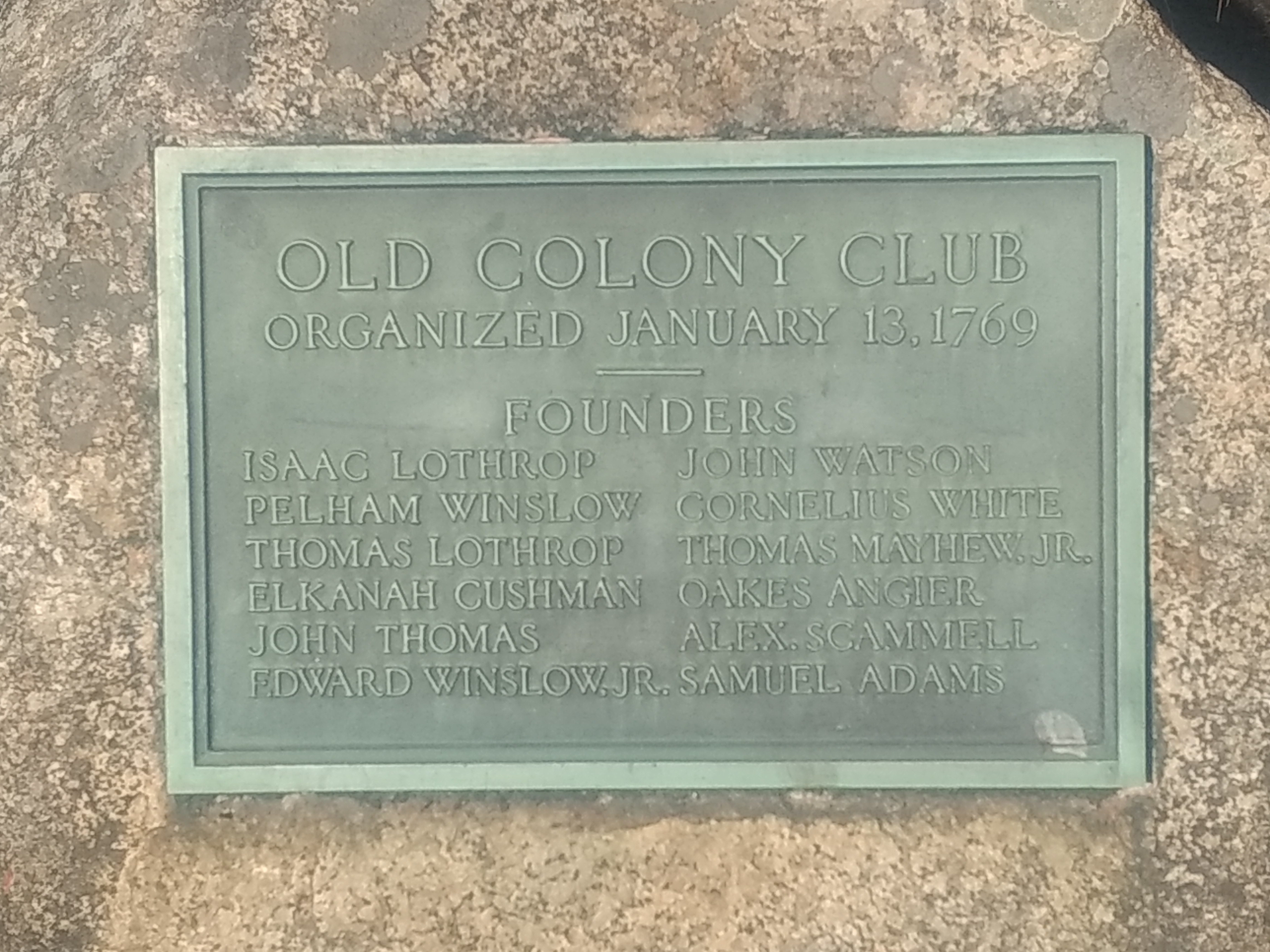
  • Old Colony Club - which, according to Baker, was formed in 1769 by a "group of elite young Plymouth men" to honor "their Mayflower ancestors." As an aside, they beat the Hasty Pudding group by a year. Baker provides lots of material that will be interesting to study. The early times and troubles have gotten lots of press, whether myth or story. He mentioned 'five kernels of parched corn' with a reference. Looked familiar so went to look. The reference came from a post at the Nutfield Genealogy blog (using one from 2020 - "The Five Kernels of Corn Myth at Thanksgiving"). Of late, we have noticed technical papers being allowed to use URLs as reference. These are being published by professional organizations, such as the IEEE.org. We have not paid attention to this with regard to NEHGS work but will do so henceforth. We have used Nutfield Genealogy a lot in our research. Heather Wilkinson Rojo is a descendant of Thomas and Margaret via daughter, Sarah Balch. 
  • The Old Planters Society -- was instituted in 1899, so made the 19th century by a nose. There were many groups formed during this time of the approaching 300th. SAR (1889) and DAR (1890) are examples. For the TOP Society, Col. Thomas W. Higginson was the first President. The Massachusetts Magazine was to be the official organ and provided information and meeting minutes during its brief existence. The City of Beverly has been sponsored several meetings related to the theme of old planters over the years.   
Old Colony Club

With respect to 'firsts' such as winters, we have looked at the early time (The First Year) and the later move of Conant (Massey's Cove). Of special note would be juxtaposing the English Wigwam with the Governor's House and thinking of the winter months. But, there are many 'firsts' for us to look at, especially when we expand to include the nation's wide interior and the left coast.   

Remarks: Modified: 12/20/2022

12/20/2022 -- Changed image for the Old Colony Club. 


Tuesday, December 25, 2012

Gardner's Beacon, Vol. II, No. 6


See Vol. II, No. 6 of Gardner's Beacon for a look at the legacy of Thomas and Margaret () Gardner using an Annals format and being accompanied by a bibliography (with links to digitized versions of references).

---


In 1995, the Great Migration series had its first publication. Over the next few years, the early settlers (1620-1633) were covered in three volumes. If we take the first three "governors" and their coverage, we have this: Thomas Gardner (six pages), Roger Conant (eight pages), John Endicott (seven pages). This publication covers what is known about the settlers at this time.

As such, though, there is a lot of material that is not referenced. Too, a look back, such as the Great Migration one, can cover 1000s of people and cannot get into as much detail as we might want. We have to go elsewhere, and, frankly, the sum total of information that I have seen can be less than clear, for many reasons. One such controversy is how many wives that Thomas had. There are others.

For instance, on March 20, 1999, a talk at the ESOG (Essex Society of Genealogists) by David Goss looked at the Old Planters of Beverly (TEG, Vol. 19, pg. 123 -- our earlier take on the subject in 2011). He described how the term came about and to whom it applied. From the Beverly-group's perspective, the names are familiar as they've been used in many papers and books (Conant, Balch, Trask, Woodbury, Palfray). These were, in other words, the stalwarts of John White or the group led by Roger Conant (Reminder: the Beverly group did not get their land until 1635 - we need to talk about the time from 1624 up til then, more or less).

Along this same theme, we saw, in 1899, the founding of an Old Planters Society whose membership included those who had ancestors who came before 1630. That effort was led, in part, by Dr. Frank. A. Gardner. Dr. Frank A. is noted for his books on Thomas Gardner and his descendants using material that he had gleaned through a lifetime of research. It is of interest, that in the early 1900s, the group seemed to be a Balch/Gardner reunion (Benjamin Balch's/Sarah Gardner's descendants). The latest events have a flavor of the History of Beverly. The 1899 group talked about the injustice of history overlooking these early planters and wanted to correct the matter, ostensibly before the 300th anniversary. We're preparing now for the 400th.

---

David's paper, which I ran across recently, was the latest find during a three-year search and review, by the blogger, of all material related to the Cape Ann group. This long effort, essentially, looked in all corners and created a huge pile of material (searched with a very-wide net). Now, the task is sifting through the huge pile, developing a bibliography, laying out a timeline, and building a view that can go further as support for future research. That motive of this work is to honor Dr. Frank's work and to present a coherent, and as complete as we can, view of Thomas.

Too, many conjectures have been presented which do not fit the bill, otherwise there would not be the controversy (unless one expects that these types of things are not resolvable).

---

The current issue presents the material in a timeline by year, up until the present. In doing so, it hopes to show a view that makes sense. The timeline is not complete; rather, think of it as an outline from which we can define research projects that will clarify, fill in, information. If done correctly, this type of timeline would become more and more strong such that future people with interests in Thomas and Margaret can use it as a launch point.

That brings up a new view though. Thomas' crew put together a house their first year. Too, they did come prepared and were successful in establishing themselves. The only failure was not having sufficient output to send back to the capitalists in England. What White may have wanted was for them to send what they needed to sustain themselves, but reasonable folks do not do that without the threats of the taxman or strong arm (those who came here were not serfs, in other words).

When Conant showed up, he didn't find starving people. He found a boisterous group. The use of insubordinate shows White's failure (hey, the descendant of Thomas has White on the tree more than once). The effort was not a military expedition. It was a plantation building effort.

Here is the thing, though. When Conant and his group went down to Naumkeag, it was not an all-in-one trip. Whoever thought that has not had to deal with the real world. We're talking a trip that could be taken by a good man in a day. By water, the trip could be less in the right conditions (look at the image which shows an entry from Winthrop's diary - courtesy of Judy Jacobson - in which he talks of going to Salem, eating, then going to Cape Ann, for dessert, so to speak). Too, Thomas' group had established themselves at Cape Ann (which is a real nice place, by the way). There was the house and other dwellings. They had gardens. They had cattle. They could fish. There was game. Who the heck sees this as failure?
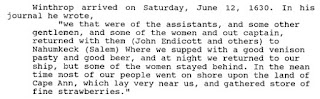
The movement over to Naumkeag took time and many trips. What ought to be considered is that Thomas had a presence at both places, but he was principally in Cape Ann. He could take care of (and feed) himself and his family very well. Now, when Endicott showed up and pushed Conant aside, he saw Thomas in the Cape Ann house. He liked the house and had it moved to Naumkeag.

Too, though, Endicott knew that Thomas was of the "Mr" variety. Hence, Endicott wrote about him (the 1629 meeting mention). Due to the lack of "press coverage" as we expect nowadays, Thomas might be considered peripheral by some, but so what? He was taking care of his own. Most likely, he helped other people, too. And, why would he follow Conant? Too, as said before, Thomas' proof of being is his progeny. And, being, folks, is still the reality (we have seen plenty examples, of late, of effective people who do not announce their deeds prior, or even ex post facto, to accomplishment).

Thomas was not a freeman (as if he needed someone to set him free) until 1637. He joined the Church the year before. But, he was signing things, like land grants, before this. In other words, he and Endicott got along, so Endicott gave him some responsibility. But, as we know how people are, the Church people noted that Thomas hadn't shown up (in modern parlance, took a boondoggle to Cape Ann to look at the crops when service time came around - okay?) so they had to rope him in. Also, Thomas knew that his kids would have to be of the social element in order to have any success. So, he deigned to join.

Not long afterwards, though, he married a Quaker. Do we hear of anyone threatening Thomas (Endicott would know better!) on this? We have not seen such documented. And, this type of thing would have been recorded. Also, it was not that Thomas was a bully causing people to fear him. Rather, his stature (I would presume from what I know of Gardners) was above normal; he have a solid, and large, character; and he was a man's man of the peaceful type (the American Indians loved him).

In other words, the preeminent individual so loved by Emerson (in his mind - by the time of Ralph Waldo, too many of the elite had ruined things for the rest - that is part of the Thomas story) was here within the first generation (actually was the first generation).

---

That first group, all of them, had remarkable characters. They did not fail at Cape Ann. When Endicott got here, he did not find starving, helpless people. But, guess what? Not long after Endicott arrived, here came boats of people (too many) who swamped resources. At this time, Thomas would still have been house-sitting where they were well-provisioned. He probably helped move the great house (1628/1629) from Cape Ann to Naumkeag (at least, he probably was able to do this - of the many that we read about, they would be about as effective as a slug for any useful purpose -- unfortunately, history's details are about such and not those who can get, know how to get, things done).

The winters of 1628 and 1629 were dire due to the influx of the unprepared, and the results were catastrophic. We'll have to touch on this in our research. By the time Winthrop arrived, though, things were going great again, though, due to efforts of people like Thomas.

---

Aside: Salem, the wallflower? This little city ought to be as beloved as is San Francisco, for many reasons. Why is it not?

References:  see Sources and Bibliography (further delineation, soon)  

Remarks:

03/27/2019 -- Image added to the index on our portal to truth.

06/15/2013 -- John Farmer wrote that Thomas was from Scotland. Origins are, and will be, a focus.

01/25/2013 -- By the way, we're going to document this more thoroughly on Wikipedia - Great House (Cape Ann). We have John Goff's expertise available to assist us. This house was the first of its kind in New England.

.01/08/2013 -- Added a forum to facilitate discussion, etc.

12/30/2012 -- 2nd edition, with changes, published today (see Afterthoughts & Modifications for this volume).

12/29/2012 -- In Afterthoughts & Modifications, mentioned the David Goss talk in 1999.

12/29/2012 -- Beacon issue uploaded with the start of a Bibliography with links to digitized versions of reference material.

12/26/2012 -- Someone else had the same idea: Balch Leaflets (1896): That Cape Ann was left utterly deserted at this time is very improbable; it could be plainly seen from their new abode and was distant but a few hours coast-wise by boat or canoe. ... There was a frame building there of considerable size and other property that demanded care. (This particular leaflet is dated 1877)

12/25/2012 -- The issue will be completed this week; this advance notice is a Christmas gift to Thomas descendants, and friends, who wondered about the times after Cape Ann.

Modified: 04/23/2021