Showing posts sorted by relevance for query no shadow. Sort by date Show all posts

Monday, December 24, 2012

No shadow over Thomas

I'm researching for the next Beacon issue which will have a brief timeline of the lives of Thomas and Margaret (it does a grand sweep of their times and after all the way to today). Hopefully, it'll point to areas where we'll focus effort in the future in order to expand upon the theme so as to leave the proper legacy.

I can thank Rev. Felt for phrasing some thought (read today) that I've had for three years in regard to Thomas (see Backbone series). That is, Felt gave me the proper concept to use. You see, how is it that there is such a lack of information? How can all of the written literature be so sparse in regard to his life over all of this time (from the beginning down to recent publications)? Even Anderson, et al, (Great Migrations) seems to write begrudgingly.

The below image is taken from Thornton's (1854) The Landing at Cape which tries to document the experience at Cape Ann (which has a bunch of unknowns). This book references Thomas only once as the plantation overseer, with Tylly, at Cape Ann. And, it is in the beginning, as in, pre-Conant. Other than that, there is nothing (based upon quick scan - so I may have missed something - the issue would remain, even so).

---

Aside and disclosure: The wife of the blogger is a direct descendant of Thomas and Margaret, however she is also descendant of Conant and others of the old and new planters. One might say that I'm continuing Dr. Frank A.'s argument about the injustice, in general. We'll get to that in the Beacon issue.

---

Felt writing
about Conant
Felt is talking about Roger's continuing displeasure at his treatment. But, the dear guy ought to have considered his treatment of Thomas and Margaret (he got the house!). The image quotes that Roger "retained a conviction of the great injustice done to him, even in his old age, and he could not refrain from reference to the neglect and ingratitude" referring to Endicott's arrival.

Notice that Felt says that "the new charter cast a shade upon Conant" which implies his followers (Balch, Palfray, Woodbury, Trask). A 1999 talk on the old planters of Beverly (we'll use this in the Beacon issue) said just that: Conant and his followers. These people worried that they might have been enslaved with the change in the power structure. It was so troublesome that Craddock had to address their worries, explicitly. Too, they were given the land in Beverly in order to bolster their spirits, so to speak.

And, old Thomas? Cool as a cucumber (as I've said, a guy who was effective, knew himself, and was the chief manifest'er of what was to become the American -- you think that London, et al, liked this?).

Now, none, nor any incident, that I can see, cast a shadow over Thomas. References to him imply dignity, respect, and more. On the other hand, he was ignored in writings, perhaps to put him in his place, as if that could happen.

Too, Thomas' stance was of the true American that we were to see develop over the succeeding centuries. One attribute of that stance was to be distant from the Churches (yes, plural -- ah, we can go on about that ad infinitum, but won't). Thomas was no follower; his blood and pedigree prevented that.

Now, too, his sympathy toward the Quaker thought, and the fact that his last wife was of that faith and that some of his sons were, to boot, talk of a mind that encompasses the shebang (put it this way: the every man view with both breadth and depth -- the latter, of course, meaning all classes -- those higher casting a shadow over the lower - hey, only those that you allow can cast a shadow over you). Yes, the Quakers were forward thinking and exhibited more than any a spirit of inclusiveness and peace (we'll have to get back to John Goff's take on King Philip -- we overlook, too much, our mistreatment of the American Indians - starting with whom? Endicott?).

However, we do not to want steal thunder from Gardner's Beacon. These topics all deserve careful study so that going forward we can have the proper view and respect for this UNKNOWN couple. As it says: honor thy father and thy mother (albeit transitively if necessary).

Remarks:

10/13/2014 -- Tabula raza, and more, will be of concern.

03/28/2014 -- See Vol. IV, No. 1 for a discussion of the movement from Cape Ann to Salem.

11/06/2013 -- While working on the next Beacon issue, I ran across some books. The one by Staloff was timely; imagine, I was wondering why the backbone series? Has the talented set ever allowed the lessors to have some semblance of a good life? Oh, you say yes? Winthrop, et al, were against this from the beginning. The stalwart of what could be (or could have been)? Thomas Gardner, of course.

09/09/2013 -- Forgot to update this earlier. But, the post related to Gardner's Beacon, Vol. II, No. 6, discusses that Thomas had no shadow over him as was feared by some old planters (would Dr. Frank, today, still want to include Thomas in the group?).

06/15/2013 -- John Farmer wrote that Thomas was from Scotland. Origins are, and will be, a focus.

03/02/2013 -- This may have appeared in another post, or Beacon. However, we'll repeat the thing here. When Thomas took the freeman oath, that is, that year, he was voted to the General Court with Hathorne (see above, another great-grandfather) who was a swashbuckler. It is interesting that Thomas, after that, kept a more local focus. There may be many reasons. But, getting up close with the clamorous ones may not have fit his mindset. You see. Throughout history, certain people get written about. Yet, in any situation, there are teeming amounts of more people who are not in the spotlight. Now, do you think that not having attention diminishes your being? If you say yes, let's have a little discussion. Of course, we would have to define, up front, whose attention. Social media comes to mind; frivolous content that invokes brain altering reactions (say what? -- I'm happy that I'm not susceptible, being too many decades old, long-in-tooth, if you would) to those who participate. So, back to Thomas and William. You see. John Endicott knew Thomas. John picked on poor Mary Dyer and others. William probably did similar deeds. Thomas? There are not bad tales. Too, and this is a big too, he deigned to be involved with people who were outcasts, namely the Quakers, as were his sons. Now, the sons left. Thomas was right there in Salem, of major stature in the phenomenal sense. Actually, his recoil (my take which can be explained) from the politicking tells a lot; it has a lot of meaning, not unlike George (the first Prez) stepping down even though he was adulated sufficiently for people to want him to be sovereign (thank you, George - for showing us that term limits ought to be part of the deal - professional politicians? say again?).

02/10/2013 -- Having finished a book on the 1692 events and doing a post on the subject, I can add to this look at Thomas. I've mentioned that he didn't queue right up to join the church and that he was recognized by Endicott. As well, he married a Quaker without any repercussions that we know of. Of course, his sons left the area due to the Puritanical (hypocritical) mindset.

01/01/2013 -- David Goss' talk at the 1999 Essex Society of Genealogists gives a perspective that also motivates. See the TGS bibliography.

12/25/2012 -- John Endicott knew Thomas to be exemplary (though, not military).

12/24/2012 -- We'll also point to academic studies, such as that shown in the image (Essex Institute and Johns Hopkins University). It says, don't look at the character (ah, John White? uncle? who needs enemies with family like that?) but consider the place as not appropriate (no aspersions meant for the lovely Cape and its environs).

Modified: 04/23/2021

Tuesday, July 22, 2014

1st Governor?

This post goes along with our efforts at organizing all of the material that has been collected. For one thing, we expect to have the bibliography documented more extensively than what we have done so far. For many topics, we want to have an annals unfolding of the discussion. Gardner's Beacon, Vol. II, No. 6 - Issue, Post, is an example.

Today, I got to reading Hutchinson's work (Vol. I, Vol. II) that he finished after going back to England (as a Loyalist). He, of course, had Hubbard's manuscript which we almost lost due to fire (and riot). That would have been a real disaster for the Gardner viewpoint, as Rev. William Hubbard was the first to write (we will check this - was Cpt. Johnson, first?); and he had talked to all of the principals (Rev. William's work was published in the early 1800s over 160 years after he did his work). And, we can see how extensively Rev. William talks about the early years (as in, pre-1620 - see Gardner's Beacon, Vol. III, No. 1 - Issue, Post).

Let's look at one little item.

---

If one asks the question (Who was the first Governor of Massachusetts?), the most general answer will be John Winthrop who came over in 1630. Others, who might be more considerate of specifics, will answer John Endecott since he had a Royal charter in 1629. For more information, look at Wikipedia which has a nice list of colonial governors of Massachusetts.

Now, considering Plymouth, one can add John Carver at the top. However, what about George Popham? The Popham effort was successful in many ways and was thirteen years prior to the advent of the Mayflower Compact.

Then, we get to Ferdinando Gorges who supported Popham. He, and his son, Robert, were involved with several attempts.

We must not hold that they moved locations against them. That was the reality in Virginia, too. And, the Cape Ann crew moved.

Now, speaking of which, some might say, Roger Conant. This is mentioned in the family book (note that this link goes to their discussion of what we called Margaret's house - Gardner's Beacon, Vol. II, No. 4 - Issue, Post - Note: there is no mention of Thomas Gardner). Rev. William talked about Roger's lament of being ignored (-- future post -- this quote plus the late 1800s meeting that included the noted descendants, such as William Crowinshield Endicott, Jr, Henry Cabot Lodge, and others).

---

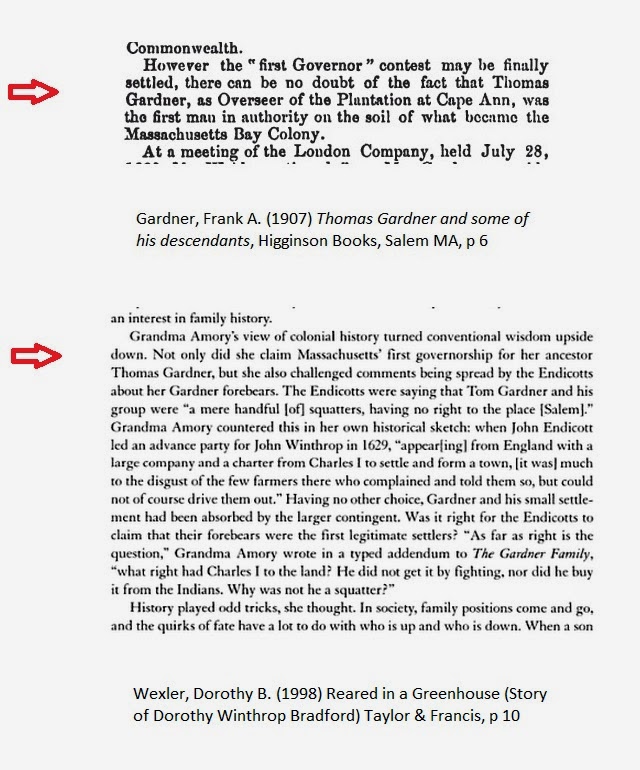
Now, in his book, Dr. Frank touches upon this, very briefly. But, in a section of Vol. II, No. 6, there is a look at the original source: Elizabeth Gardner Amory. Elizabeth's granddaughter, Dorothy Winthrop Bradford, writes about discussions with her. The image is from the book, Reared in a Greenhouse (preview mode at Google books) by Dorothy B. Wexler.

The time frame to which Elizabeth refers would be (say) post-US-Civil War. Elizabeth claims to have been the first to make this statement about the first governor. Her discussion about the matter is on page 10 (see image).

---

This little example is one of many. The recent book about how "invisibles" hold the world together offers a few modern concepts that can be useful as we proceed with further analysis (more later - but, there is no shadow nor is there any lament).

Remarks: Modified: 03/02/2019

07/22/2014 - Captain Edward Johnson published, in London, in 1654. His book was redone, in Andover, MA, in 1867 (this is in the collection for the bibliography). ... How could I not mention Higginson whose comment about Endecott's house lives on?

07/23/2014 - Read a little more of the book. Interesting. Added Elizabeth to the descendants list (Wikipedia, which has a page for the Dudley-Winthrop family). This list will be getting more attention; the last exercise got rid of stale and suspect links. We will reorganize (with the intent to foster analysis and discussion) and add more descendants (we need more of Miriam's progeny, for example).

01/19/2015 -- Maine History Online: Popham and Gorges.

03/02/2019 -- We are building an index of images at our portal to truth

Thursday, June 27, 2019

True stories

We are reviewing our material and looking at common themes, such as houses. While researching for Gardner's Beacon, Vol. IV, No. 1, we wrote this post: No shadow over Thomas. The gist of the matter was that a researcher was talking about the motivation for the land grant to the Beverly group, Conant, Balch, Woodbury, and Palfrey. It was noted that the gents were worried of losing privileges.

Thomas isn't recorded as having any reservations. So, we need to discuss that. Endicott called him Mr. Gardner. Whether we're talking strength of character, being knowledgeable, pedigree, or some combination of those and other factors, we have found no bad mouthing of Thomas. Well, Anderson noted the thing of some grave conflict. But, that was son Samuel's doing. Thomas was dead at that point.

So, what is this all about? Well, a recent comment, in a blog, says that Roger found a mess when he appeared at Cape Ann. What? They were quite well and taking care of themselves. From notes for Gardner's Beacon, Vol. II, No. 6.
    That brings up a new view though. Thomas' crew put together a house their first year. Too, they did come prepared and were successful in establishing themselves. The only failure was not having sufficient output to send back to the capitalists in England. What White may have wanted was for them to send what they needed to sustain themselves, but reasonable folks do not do that without the threats of the taxman or strong arm (those who came here were not serfs, in other words).

    When Conant showed up, he didn't find starving people. He found a boisterous group. The use of insubordinate shows White's failure (hey, some descendants of Thomas, such as Dr. Frank, have White on the tree more than once). The effort was not a military expedition. It was a plantation building effort.
We also addressed that, here Cape Ann, Retrospective and elsewhere. We need to focus on the events prior to 1623/24 plus a few years after. And, that means looking at the whole of the affairs.

Take Thomas Weston. Briefly, he is run up the mast several ways. The Maypole affair is associated with his group. But, this was a legit attempt at establishing a colony. We'll get back to this below.

First, there are several motivations, but we know of two that need to be re-addressed. Take Sir Christopher Gardiner. When we first read of him, we only saw the Winthrop-influenced take on the matter. Then, we ran into a re-write that is not generally used. And, found another. That is, the story that is told is not the right one. Propaganda?

Then, after we found out that Dr. Frank was a descendant of Nathaniel Eaton, we saw that he had not raised that to general awareness. Why would he? It's a mess, Harvard (and, we'll retell this story from the perspective of descendants). We have written several posts about this plus one summary overview of Nathaniel's life.

Okay, there had been several attempts prior to the Dorchester effort: Sagadahoc (1607-1608), Plymouth, and Wessagusset (1622-1624). Some minor ones will be added as we continue. And, we want to address these as well as other motivations. For instance, we have these notes for Gardner's Beacon, Vol. III. No. 3:
    Every March small ships of between thirty and eight tons, manned by crews of twenty to forty men and boys ... carried salt, provisions, equipment. Brought material for their boats. Took two months to get here. Put their boats together and fished.

    Split the work between fishing and salting. Fill the hold and return in autumn.

    Crews were gathered yearly by the master. Principally young, fifteen to twenty-five years old. Many were trying to get money to get established in their home area.

    At first, Newfoundland. Then, Gulf of Maine.
There were lots of reasons for people coming over. Whence, origins, and motivations will be a theme for further research for a long while.

Remarks: Modified: 12/29/2020

06/28/2019 -- Added image so that we can index.

12/29/2020 -- A few edits as this is on the image at FB with respect to this date in 1674 (death of Thomas Gardner in Salem, MA). 

Sunday, July 12, 2015

WDTT?

Or, we could have WWTT? And, then, closer to the modern theme, WWJD?

Say what? In other words, What did (would) Thomas think? What would John (or Joseph) do? As in, Gardners coming forward to fill in a meme.


Who are the Gardners? They have many threads, a lot of which have been touched upon, briefly, in this blog. In particular, we are talking two generations. That is, there is the gentleman who was the patriarch of the family and his wife, Margaret. Then, there are the kids who numbered nine in total.

Of those, we pick two in the order of birth. John is the first (Quaker and more); his brother, Joseph, was military and was a casualty of an early conflict with the American Indians. Which, by the way, no Gardner was responsible for seeing it come about.

---

So, let's get anecdotal a minute, using Thomas as an example, first. See Written out of history. Thomas was here in the 1623/24 time frame. Then, there were all of these machinations, here and abroad. For the Gardners, they ought to be happy that Thomas and Margaret and their kids made it through all of that. We have to realize that Thomas was effective (physically, he would have been large, strong and very much capable; mentally, he was no slouch, as we have seen people argue when talking about his home-schooled sons, John and Richard).

So, we used "deign" to characterize Thomas taking the oath in 1637. That is thirteen years later. Of course, he did this for his kids. That same year, the ruling folks in Salem voted that he would go with Hathorne (ggp) to see the mucky-itty-mucks in Boston (or, wherever they were meeting at the time). Well, doing this gig got Thomas the temporary label of Deputy to the General Court. But, what happened next?

Was one time enough? Thomas saw that such was not for him (great decision). After that, he was very much involved in affairs in Salem and elsewhere. BTW, he was there when Endicott pulled his power trip on Mary Dyer and others. What Did Thomas Think?

Too, Thomas had no shadow over him; rather, he and Margaret enjoyed, until JE came along, a blissful life on Cape Ann.

---

Now, we'll look at John and Joseph. John was another big guy who was involved in a lot of activities that supported the new society. He may have been young, and providing the muscle, but he was with the crew that mapped the Merrimack. No doubt, he learned a lot. ... Later, we see he and his brother going to see Gov. Lovelace in New York. The name of Sherborne on Nantucket came about from this visit. Lots to look at there.

And, Joseph? He married Ann Downing and has the house, that came to have Bradstreet's name, associated with him and his bride. Ann got Simon to sign a pre-nup after she lost her husband. Joseph was killed during the King Philip war. He, again, is an example of being taught well by his father and his mother.

---

Again, we are looking at only two generations, here. The American experience, though, is the sum total across all of the years and the accumulation of experiences by the generations, thereof. In a spiritual sense, genealogy is missing several boats. And, the problem is worse than just running after DNA and encouraging some bad practices (as money, not truth and knowledge, is the focus).

Remarks:  Modified: 04/05/2025

06/27/2020 -- What would Thomas think? This will come into play more.

04/05/2025 -- Add "OpEd" label. Will explain. 

Friday, January 27, 2012

Where was Thomas?

The book on Paine Ancestry (published 1912) has a Chapter on Thomas whose grandson, Samuel, son of George, married Elizabeth (Brown) Grafton, as her second husband; Thomas is, then, an ancestor of the author. We earlier showed descendants of Samuel (Hardin & Hall) when we started to look at the generations.

The book has a nice arrangement. It covers the Paine genealogy up to one person; as well, the collateral families are handled. For each, there is a lineage chart and some text. The book has nice words about Thomas, calling him "practically, a governor" as an example.

Paine sisters
conjecture
It brings up an interesting point, too. Where was Thomas, and Margaret, from 1626 (when Conant and the old planters - mind you, Thomas is not on that list -- went over to Naumkeag) to his 1636 entry into the church? The next year, Thomas became a freeman.

The book suggests that perhaps the Gardners went back to England and then returned later. If that were the case, there would have been ship records, perhaps. We're talking about a ten year gap.

Earlier, we proposed that Thomas deigned to join the church and register with the state when it was of benefit to his kids. When Conant, and crew, went over to Naumkeag, they left the house. Someone had to keep it up, as later Endicott had it moved over to the Salem area.

Cape Ann and Salem are close enough that regular trips back and forth are a great possibility. There were plantings sufficient in Cape Ann to sustain the group. It was [not] producing enough to ship back to England that was the problem. So, one could figure that farming work continued in the Cape Ann area.

As said before. Thomas was self-sufficient long before Emerson characterized the trait. And, he was educated. And, as mentioned in the Mary (Gardner) Coffin post, Richard, son of Thomas and Margaret, was said to be of considerable education. That, no doubt, came via his parents.

Another thing that happened in 1636 was John Tylly being killed in a conflict with the Pequot. Was that a factor? People gather in times of trouble. In 1637, after becoming a freeman, Thomas was on the General Court (Felt, pg 110) with William Hathorne.

There are many scenarios that we could offer with regard to Thomas' absence from the records for that ten year period. We could also search out anything that has already been written.

I think that this type of inquiry is legitimate for Thomas' descendants to look into. Even if it turns out to be a puzzlement, gathering all of the stories, categorized like this, would be of interest to future generations. As well, it would further Dr. Frank A.'s work which doesn't explicitly talk about the moving to Naumkeag. However, Dr. Frank does say that Thomas was mentioned in a London meeting in 1629 (Felt, pg 126).

Remarks:

03/21/2022 -- Article on John Tilley shows that he returned to England, married, and came back. As said (see 07/12/2015 below) earlier, why would Thomas and Margaret leave lovely Cape Ann?

01/12/2019 -- Add image from the book of the Paine sisters. Also, that allows a thumbnail.

01/04/2019 -- This topic will be followed more regularly this year (344th of 29 December 1674). We will initiate a discussion on WikiTree (see link in sidebar) in support of the research.

08/12/2018 -- Thomas, with others on Gardner Hill, was left where he was. Stones were moved over to Harmony Grove Cemetery. A few of those withstood the move, say that for Seeth. Most did not and are piled somewhere. At the burial site, though, the road was cut through. So, the remains? Well, moved to God only knows. Or, if the burial was away from the road, it is beneath some structure. Lots to think about. Reflect on. How to proceed into this mire?

07/12/2015 -- Of course, when Roger brought his people to Salem, Thomas was not there. Why? He and Margaret kept the Cape Ann house. Of course, when John Endicott came over, he saw Mr. Gardner in his nice house. John said, that is mine. Take it over to Salem. So, by splitting his time (Salem is not that far), Thomas had an idyllic time with his wife and kids; too, he had time to get himself and his family settled in the new realm.

03/28/2014 -- See Vol. IV, No. 1 for a discussion of the movement from Cape Ann to Salem.

09/09/2013 -- Forgot to update this earlier. But, the post related to Gardner's Beacon, Vol. II, No. 6, discusses that Thomas had no shadow over him as was feared by some old planters (would Dr. Frank, today, still want to include Thomas in the group?).

05/01/2012 -- If Thomas and Margaret had gone back to England, son John would have told the tale. Methinks that they might have shuffled back and forth, perhaps keeping the Cape Ann house in order until Endicott had it moved.

02/13/2012 -- Thomas was around here, in 1641.

02/03/2012 -- The period in question here is from the Cape Ann time to 1637 Salem. After 1656, we could answer this way, in part: Thomas was visiting Joseph and Ann in their house.

01/28/2011 -- There are several things to figure out. Dr. Frank mentions that a Margaret Gardner joined the church in Salem in 1639 (see Felt). Pope says that this Margaret was of Ipswich and married to Edmund Gardner. The Great Migration write-up says that Thomas' first wife may have died at the birth of Seeth in 1636.

01/27/2012 -- In reporting the death of Thomas' son, Thomas, the Annals (Felt, pg 246) seem to have some dates mixed up, though it does mention Margaret as the first wife. The Great Migration does not. 

Modified: 03/21/2022

Saturday, October 13, 2018

Gentleman, every man, and much more

Right now, this post has links to posts from several different points in time. We are reviewing the posts as a means to assess the research done so far, to see where we need to put more attention, and to lay out future research.

This is one theme of many that will be of continual interest. It has to do with Thomas. But, we will focus on Margaret, too. For the kids? We need to get the first five generations identified. Then, there are a slew of topics that are general, such as The Massachusetts Magazine, collateral families, WikiTree (technology, in general), and such.

These posts are all from the TGS blog except for the last one. As well, there will be things pulled from work being done on Quora.

This blog shows a recurring theme (or op-eds, if you would):
  • True Gentleman (23 Aug 2011) -- Obviously, Thomas had talents and abilities and power (personal); in the longer course of history, the reality is not of those whose stories get told. Hence, our focus will be the rewrite that is necessary as an example of what will become the norm, in the future. 
  • Written out of history (31 Aug 2011) -- My first impression was that the whole Cape Ann thing was cut off to be forgotten, after, of course, Rev John (White) raked the reputation of those daring souls through the mud. Pox on him. 
  • Backbone and more (2 Dec 2011) -- Many (like Harvard) look to the brain; a human would not be without the substantial backbone. Some now still demonstrate this. 
  • No shadow over Thomas (4 Dec 2011) -- Thomas and Margaret needed no sponsor nor special treatment. That story has to be told. 
  • Remembering Thomas (28 Dec 2012) -- 29th of December, we remember Thomas; now, we'll have to have some type of recognition of his grave being trashed. 
  • Cape Ann, of course (17 Mar 2014) -- In a pioneering sense, Cape Ann was thriving. What it did not do was measure up to the rapacious demands of capitalism.  
  • Thomas and Margaret, archetypal pair (22 Jan 2016) -- We know so little of this couple, but for their offspring we would know less. 
  • American manhood (3 Dec 2017) -- Virginian used as an example of manliness; New England has representatives. 
FEDaerated blog:
A related theme deals with Rev. Hubbard who talked to people of the time. And, wrote then, too. He gets no respect (we'll look at that). Yes, the Roger Dangerfield of that era.

Note about genealogy: Old-time subject, basically a service (if one gets away from the enthrallment with one's own ancestors and looks broader as we ought to with collateral families - perhaps, even friends of the family). We have started to use WikiTree (hopefully to pull all of the first few (three or so) generations together.

Remarks: Modified: 01/04/2019

12/08/2018 -- Basically, this post was to lead into the topic of Thomas being lost with dozens (and dozens) of others. As in? Graves disturbed and lost with unknown conditions. See "A new twist" for a start of the necessary discussion. It is about time, Salem and Peabody.

01/04/2019 -- This topic will be followed more regularly this year (344th of 29 December 1674). We will initiate a discussion on WikiTree (see link in sidebar) in support of the research.

Monday, March 17, 2014

Cape Ann, of course

First example of the American way of life?

---

While researching Cape Ann for an upcoming Gardner's Beacon, I find that my mind keeps wandering back to my first days of research about five years ago. Firstly, there was not much written about Thomas that was definitive, almost as if he had been written out of history. Oh yes, there were the Dr. Frank books. There were many family sites that quoted from different sources.

A little later, I would run into Anderson's work. He gives about Thomas six pages. Then, someone had a site based upon the Great Migration project. In essence, disparate views on the guy abound.

We only know a little about him. But, we can infer a whole lot more: no shadow, effective (raised nine kids), peaceful (married a Quaker), etc.

---

But, let's outline a look at Thomas and Margaret that will be sketched further (to answer, for one, where was Thomas?).
  • They got to Cape Ann. Thomas was lead for the plantation. They built (the "Great House" is one piece of evidence), planted (Winthrop had their strawberries six years later after dining in the house that had been moved by Endicott to Salem), and lots more.
  • They thrived. There was no failure. Those who look back may need to place the Dorchester Company's (from Rev John on down) unrealistic expectations in a vein like the Spaniards look for the city of gold (I am not far from where the conquistadors had the northernmost thrust - heads rolled later due to the wastes of looking after this myth). We expect to get into that backbone thing more (as the lessons still apply - offshoring, for example). 
  • Thomas yielded peacefully to Conant's tramping in with his entourage. 
  • When Conant figured out the problems at Cape Ann, he decided to leave. Thomas assisted in that move but also kept a footprint at Cape Ann. 
  • ...
  • The list can be extended but not now. 
What we want to do now is describe how Thomas and Margaret lived when the other planters (Roger, etc.) left the glories of Cape Ann (note: we're talking the period from the exodus of Conant's crew and the order by Endicott to bring the house to Salem). Also, the "they" here refers to Thomas and Margaret
  • They lived in and kept up the house. Endicott knew Thomas from the house, for one thing. 
  • They tended the plantings. No doubt, cuttings and seedlings were moved to Naumkeag. But, the mature plants continued to thrive and to produce. So, produce would have been consumed at Cape Ann and brought to Naumkeag/Salem. 
  • They had game, fish, and a very pleasant environment. The Indians were friendly. 
  • They raised their children. Thomas, Jr. was educated enough to lawyer. Richard and John were both noted for their knowledge. George and Samuel excelled in several areas. Joseph was of sufficient capability to do legal work and to be a military officer. The girls all married well and had admirable offspring. From when this? This? Yes, where did the kids get their knowledge, good character, and civilized mien? From their parents, of course. We know that Thomas was referred to respectfully by Endicott. As well, Margaret must have had good learning (like her daughter-in-law, Ann Downing). 
In short, that just above describes an idyllic life. Think of it. The church people went off with Conant. Thomas was not puritannical (we'll go on about that). Those who were still in the Cape Ann area respected Thomas. There would have been communications with the Salem people. Back and forth they would have gone.

Remember, the troubles (famine - we're not talking Plymouth or Virginia - the New England early folks under Thomas thrived - what they did not do was return an abundance back to the old country - false expectations, remember?) did not start until after Endicott brought in more people than the resources could handle. But, Thomas and Margaret got their kids through that, too.

And, the Cape Cod folks would have come around now and then. Too, John Tylly would have visited now and then.

---

The real question is why the lingering puritannical mindset could not see Thomas for what he was?

Good question. Thomas went to the General Court once, 1637. This was after he took the oath (notice the gap - as said, he didn't need it - he did it for his kids' sake). Methinks that he would rather not interface with such. We see this same sort of dynamic now. In fact, Thomas stands out in several discussions about what happened to the American dream. 

Remarks:  Modified: 09/28/2014

03/18/2014 - Lucy Larcom wrote about the wild roses and strawberries of Cape Ann. Strawberries were plentiful in some areas, however they were cultivated, too, prior to the arrival of the Europeans (Russell's Indian New England before the Mayflower). John Smith included strawberries in the list of plants that were managed by the Indians. That is, wild plants would have been organized into a fashion more easily cared for and harvested. Hybridization that resulted in what we now call strawberries was not accomplished for another century. Anne Bradstreet (see D.B. Kellogg) wrote of the strawberries that they feasted on after the long voyage. She also wrote of the illness brought with the folks as well as the lack of resources (such as food) to support the influx. ... The fact is that not only did Thomas' crew come prepared to "plant" and thrive, they had the wherewithal to accomplish the feat. ... What they were not properly prepared to do: become an exporter of excess product from the get-go (notwithstanding our advantage at looking back from a more enlightened - supposedly - framework, going off unprepared remains the experience of a whole lot of humans). What did Thomas think of all of those new entrants who created more demand than could anyone hope to supply, with what they were capable of then? Higginson, at least, stressed people coming prepared to support themselves for a year.

03/20/2014 -- Perhaps not idyllic, yet successful in most reasonable senses.

03/23/2014 - Cape Ann featured in Beacon Vol. IV, No. 1.

09/28/2014 -- A week ago, the record for the marriage of Thomas Gardner and Margaret Friar was discovered in Sherborne by John Cook of Minneapolis, Dorset files. This sets a type of focus. Looks as if some transcription work might be in order.  


Friday, August 31, 2012

Written out of history

Foreword (or forewarn): This is one of the backbone series. The post is motivated by thoughts related to material used for the coming Gardner's Beacon issue, which will be on houses from the early start.

---

The effort at learning about Thomas and Margaret is about three years old. The main issue seemed to be that not much was known in the sense of mentions, in the writings, being sketchy, at best. That is, even though Thomas led the group into Cape Ann, not much was recorded. Mention of his effort came later with an early 18th century publication by Rev. Hubbard (saved from a fire, thank God for that!). John White mostly denigrated the crew (ah, we can write a bunch about that). What we hear about is the arrival of Conant (and Lyford), the move to what became Salem, and then post-Endicott times.

This message was apparent in retrospectives by several families, such as Woodbury, Trask, and more. The site for the John Balch house was a reminder. That is, on the write-up of this house, nothing is mentioned of Sarah, Thomas' and Margaret's oldest daughter. John's son came to Cape Ann with the party. As well, Sarah was born at Cape Ann (pre-Endicott Massachusetts). Sarah married Benjamin Balch. John Sr. gave the couple the house. Hence, I'll refer to it as Sarah's house.

Actually, the Beverly oversight (wake up!) is more appalling when you consider that John's wife came with him to Cape Ann. She and Margaret represented the females. And, they went through all of the same crap (perhaps more than) as did the men.

Also, we find this: When the company was recalled to England, the Balches, Roger Conant, John Woodbury, Peter Palfry, and others stayed in Massachusetts and moved south to Naumkeg, now Salem, in 1626.

Four families are mentioned here. Trask was left out. The 'others' would have included the Gardners. That story needs to be told; it's part of our task list. The Paine sisters, Thomas descendants, wondered if the family had gone back to England for some period of time. Had that been so, Woodbury, who did go back and forth, might have mentioned this. However, the Woodbury lookback doesn't mention Gardner, at all.

Too, Thomas' kids would have said something about going back. John, the Magistrate, would have known. So, too, would have his older siblings.

We ought to try to document the fact that, after the group moved, someone would have gone back and forth between Cape Ann and Salem. What is it? 17 miles or so? Look, the house was nice enough for Endicott to want it moved.

Too, and this is a big TOO, the group was NOT unsuccessful. Did Conant report that he found starving people? On the contrary, they were bolsterous enough to want to tangle with Standish and his crew. They had their food sources, dwellings (however meager), and themselves (true independent souls of the American which was to be).

What the group did not achieve was the capitalistic dream (and John White's, to boot) that, essentially, tries to get something for nothing. Yes, folks. The success of the model requires an unending supply of hapless exploitees. So, Cape Ann's little group was not able to ship back produce or seafood. But, they fed themselves.

In fact, that Thomas and Margaret got their nine kids to adulthood is evidence enough. They were very good parents. And, each of their kids was a healthy, and effective, adult.

---

Another topic deals with the regime, and regimen, imposed upon the freedom-loving people. We all know the stories. But, Thomas' life, as a focus of study, will allow a re-look.

In 1637, when Thomas deigned (yes, used purposefully) to get himself drummed into the group mindset -- freeman's oath -- he did it for his kids. His boys were adults and needed the social involvement. You see. That is a long time after the 1626 move. Thomas had class, abilities, and showed self-reliance long before Emerson wrote about it.

It's telling that Thomas was made Deputy to the General Court, with Major Hawthorne, in the year when he took the oath. People wanted his involvement since he was an elder by action and more. For some reason, post 1637, his effort was local to Salem and the area. We can, and might, speculate about why this was so.

Again: Not a descendant. Objective third-party. However, married to one who has a whole slew of these folks in the ancestral tree.

Remarks:

06/25/2019 -- We have a few more examples of the forgotten (early on, we had Aunts, Uncles, Cousins). Of late, there was Lt. Benjamin West who was killed at Bunker Hill and forgotten. Prior to that, we were trying to count the number of lost graves in Essex County. Then, we have the travelers out west, such as Jedediah Strong Smith, except he did post some reports back east by courier. There were many lost a sea over the years.

07/12/2015 -- Of course, when Roger brought his people to Salem, Thomas was not there. Why? He and Margaret kept the Cape Ann house. Of course, when John Endicott came over, he saw Mr. Gardner in his nice house. John said, that is mine. Take it over to Salem. So, by splitting his time (Salem is not that far), Thomas had an idyllic time with his wife and kids; too, he had time to get himself and his family settled in the new realm.

07/12/2015 -- Okay, turtle speed. But, we get there. Announcing a new project: Sherborne, Dorset. No doubt, it is about time. When finished with the data collection and analysis, we will present the strongest story (the prerogative of the family) that the facts, and abductive reasoning, will support. As such, we hope to demonstrate some very much needed research viewpoints. ... This is a case of two Quakers being ignored.

10/13/2014 -- Tabula raza, and more, will be of concern.

07/17/2014 -- The book about the Invisibles (the unsung heroes) offers another viewpoint. Of course, it is set in the modern context. But, we all know that history covers only a fraction of reality. What we see now is that technology will allow us suitable ways to go back and fill in the blank slates.

11/13/2013 --  Phippen would be part of the slate fill.

11/06/2013 -- While working on the next Beacon issue, I ran across some books. The one by Staloff was timely; imagine, I was wondering why the backbone series? Has the talented set ever allowed the lessors to have some semblance of a good life? Oh, you say yes? Winthrop, et al, were against this from the beginning. The stalwart of what could be (or could have been)? Thomas Gardner, of course.

09/09/2013 -- Forgot to update this earlier. But, the post related to Gardner's Beacon, Vol. II, No. 6, discusses that Thomas had no shadow over him as was feared by some old planters (would Dr. Frank, today, still want to include Thomas in the group?).

06/15/2013 -- John Farmer wrote that Thomas was from Scotland. Origins are, and will be, a focus.

02/10/2013 -- Having finished a book on the 1692 events and doing a post on the subject, I can add to this look at Thomas. I've mentioned that he didn't queue right up to join the church and that he was recognized by Endicott. As well, he married a Quaker without any repercussions that we know of. Of course, his sons left the area due to the Puritanical (hypocritical) mindset.

01/01/2013 -- David Goss' talk at the 1999 Essex Society of Genealogists gives a perspective that also motivates. See the TGS bibliography.

12/24/2012 -- Thomas, unlike Conant, was not overshadowed in the world of being. We'll spend some time characterizing this fact and what it means to reasonable folks.

12/22/2012-- We need to differentiate between Old Planters of Beverly (see The Old Planters of Beverly in Massachusetts, 1930, Alice Gertrude Lapham, The Riverside Press) and the Old Planters of Massachusetts. One could even talk, Old Planters of New England.

12/19/2012 -- Sarah married Benjamin, son of John.

11/27/2012 -- Let's itemize what we know, re-iterate some basics, and the proceed constructively.

10/28/2012 -- September issue had a theme of houses.

09/13/2012 -- About Margaret. We'll honor her as the ancestor, with Thomas, of the Gardner family.

09/01/2012 -- Vol. II, No. 4 of Gardner's Beacon deals with houses.

Modified: 06/25/2019

Tuesday, June 29, 2021

T. E. Lawrence

TL;DR -- The 100th of WWI has people reviewing those times. This started several years ago, but the virus has had influences, for sure. Say, the Spanish  Flu was centered around 1918. One dynamic not really on the national mindset so much is Arabia as it was then. TE Lawrence is a topic of discussion in a lot of areas. To us, he represents the side of the family that stayed at home. Or, put it this way, ventured forth 300 years later. The theme to discuss? As we saw with Cape Ann and other environs as the culture moved west, we have a more recent example starting with the expansion out of St. Louis which is picked since MO was the first to be defined. The WWI timeframe? Similar thing happening in Arabia which has influences even to today. 

---

This post has several purposes. We never saw the movie that came out in the 1960s, however we were in LA at the time and remember the hoopla. Several careers were made with the movie. Which one? Lawrence of Arabia

Here's a query. Who might most people think of when they think of this movie? Peter O'Toole? If one looks at the clip and discussions, there seems to be this conflation going on which is quite understandable. We get the same thing dealing with people and genealogy. There are lots of things psychological that ought to be brought to the discussion. 

Note: John's past is partly covered in this post: Amelia Earhart. At least, there is a brief reference to places on the other side of the pond that have more problems than we see (or saw) here. It's like, there ain't nothing new under the sun. Besides, his role is keeping things steady for those who want to play the one-upman-ish game over here. No axes to grind; merely, truth engineering. 

Okay, so, who was this guy? No, not Peter, the Irish dude. BTW, his ashes were taken to the west of Ireland. That place of the wild ones. No, we're talking T. E. Lawrence. His burial was in Dorset. Though, he had been born in Wales, did the Oxford thing, Royal Army, Orientalist, and lots more. 

The timeframe? T.E. made his name in WWI with the conflict with the Turks. Seeing a few clips got the internet searches going. So, for now, here's are a few links and a comment. We'll be back to the theme. Why? We're out of the Brit culture. The past year has brought out some interesting interplays, especially with the LA scene's unfoldment. Too, we ought to have closer ties; we're family. 

  • Wikipedia overview
  • T.E. has American cousins - great thing about WikiTree is that serious genealogists hang out there, and they try to get things right. 
  • T.E. Lawrence studies - wonderful site with respect to the subject; too, the technical focus is right on - need to discuss this. 
  • Smithsonian look at T.E. - just like we have our 400th, 300th, 250th, 200th, 100th, so too do others. In terms of the 100th of WWI, we see lots of analysis. But, in terms of T.E., there is a lot of retrospective, especially since some who might have known him won't be around long. 
There are several ties to what we are doing. As we look at how the west was carved out, we have to look back to Cape Ann. Early on, things had to be mapped, everywhere. This takes time, The area around St. Louis is perfect to watch this sort of thing, so we'll be doing more there. Then, the Arabic world of WWI? It's a lot different than it is now. 

And, we were reintroduced to the area the past couple of decades, not that it ever went out of sight or was of not issue. Oil is one factor of many. So, let's end with a map. 

In a clip, people are talking about T.E. Did you know him? That type of thing with various recalls being verbalized. One guy passes by and says that he had a minor role in my office. Right then, the film transitions to an underground office where a shadow passes over O'Toole's (you see, mention the actor as that is not the real guy) head as a camel passes by. Peter has a map in front of him. That is one thing that T.E. did, studies with regard to the region and its people. 

Map similar to one in the movie, 
Lawrence of Arabia

Remarks: Modified: 05/27/2025

05/27/2025 --  T.E. Lawrence and Jesus College, of Oxford and Arabia and more. 

Thursday, August 29, 2013

Research and resources

Heather Rojo's comments about the recently-aired WDYTYA (Cindy Crawford) are interesting. Heather mentioned one person estimating that the show required 1000 hours of research, supposedly by experienced researchers who had access to information beyond the normal person's reach. That's about 1/2 a person-year, by the way, for those who have had any dealings with planning.

In terms of weekends, one would have to spend about 10 years or so (more or less, okay?) to get that amount of work done. I did read of one person devoting his life (and, I'm not talking cousin-in-law, Walter Goodwin Davis, who had an inheritance) to genealogy; he read the principle resources at many places and did transcriptions).

Aside: One has to wonder about those 1000 hours. How they were spent? How many hours were related to following false leads (which, by the way, are useful to the watchful researcher)?

From our view, Dr. Frank's work was priceless. How many hour hours did he spend? Quite a bit, no doubt. As another example, I can point to a D.A.R. genealogist who helps people with their applications (she spent over 100 hours, in one case). Then, William Reitwiesner is a prime example (wargs.com) of working outside of the limelight for decades. He liked his day job at the Library of Congress since it gave him ample time to do genealogical research.

---

Shows like WDYTYA are nice in that viewers can think about their remote cousins (or ancestors). Also, it's good to see the experts in operation (in the background, mostly, in the later versions of the show - say, as compared to how it was for Brooke Shields' episode). And, it does get the interests up (modern/western views discount ancestors even though the basis for our biological being is thusly laid - too, ancestors are "closer than our shadow" (attributed to your's truly, unless there was precedence) -- it's a meme thing, folks).

----

So, it ought to be evident that this type of thing takes work. It's nice when the results of such work is available to the next set of researchers. It is one of our goals to foster research and to provide verified information. Of course, this all presupposes some way of presentation that is accessible. NEHGS has done a good job. As a research member, one has access to many on-line (digitized) resources. Too, one can go to the library and grab books, many times.

And, one has to be thankful for organizations, such as D.A.R. Their verified trees are a great resource for future work, such as matching up trees to find missing siblings, etc. This is not true for ancestry.com, unfortunately (in general, let's say; there are plenty of folks there who have sourced their stuff). Actually, I always filter on rootsweb for hits that have sources just to see how much a solution set is reduced thereby. But, un-sourced can be useful, say, for hints on how to proceed. By the way, I have found familysearch.org to be very useful.

Aside: The tree being used has the living person as root point. Then, the ancestors are leafs. And, this view would have duplicates to account for the fan-in of inter-marriage (cousins marrying). So, hypothesize some leaf (say, one of those in a gateway list that Heather talked about), then one has to show reach-ability in the tree from the root to the leaf. In an ideal world, all of the nodes would be strong. The case is that some nodes may not have solid support, yet they are rationally supported. Case in point? If you have a gap, coming at it from both sides will allow one to see if there is a bridge and what is needed to support the bridge. The error in the book was where a gap was closed by collapsing a generation (or, rather, ignoring the absence of a generation which forced a fit of the ends).

Remarks:

09/04/2013 -- Topic carried over to truth engineering.

08/30/2013 -- With the post, I didn't fully cover the resources topic. But, I'll get back to that. I was browsing a book today that deals with the ancestry of Charles II. He's the hippy king, so to speak. Dr. Lucy Worsley (who has wonderful videos, by the way), says that things were shaken up more in 1660s (Charlie's time) than in 1960s (which might mean a thing or two to the boomer generation). Well, Charlie II's tree was full. However, by the eighth generation there were holes which carried further out. For most people, their chart would have large gaps. If someone knows of a tree that is almost fully filled (to 11 generations, let's say), please let me know.

08/29/2013 -- Having said all that, here is an exemplary site, again.

Modified: 09/04/2013