Showing posts sorted by relevance for query hubbard. Sort by date Show all posts

Saturday, May 2, 2015

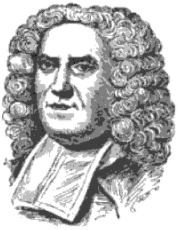
Rev. Hubbard

We will have more about the guy as we go along. For Gardners and friends? We need to remember, Rev. Hubbard was the first to write about Thomas and John (Tylly) and, thusly, deserves eternal honors.

I am putting this post here in that some controversy has raged about the start of New Hampshire (but, some of the posts will be at the technical site and at the Truth Engineering site). As in, what year ought to be placed for the first effort at a settlement (or attempt, thereof)?

The two images are from distinct viewpoints: a modern publication and Hubbard's work (pg 214).

NEHGS's GM, Vol. II, Pg. 950
(ca 1990)
Hubbard, Pg. 214
(ca late 1600s, published mid-1800s)

Why is Hubbard second? Well, we are going backward in time. The first publication quotes another work from the 1900s (Noyes, Libby, Davis) which we will get to. NLD takes Hubbard's book (and viewpoint) to task. Too, NLD may mention other work. We will get to that.

This post is just a starter bit; as we collect information, it'll be posted. We intend to be thorough.

Remarks: Modified: 03/14/2019

05/02/2015 -- So, one controversy (of several): 1623 or 1628. (See Heather Wilkinson Rojo's post)... Mind you, Hubbard was using material available at the time and talking to people of that era. Here is one example. Of course, we see new material coming up via the internet all the time. What did NLD have in their day (well, access to the original documents)? We will see.

05/03/2015 -- Some edit (late night post) on the morning after. It is not all about Rev. Hubbard. Rather, we want to see the total picture; commercialization schemes seem to be making the internet more fragmented than it need be (but, then, that is another topic that is being discussed, sometimes heatedly, in this day and age). ... One would think that New Hampshire would weigh in on this piece of its history.

05/04/2015 -- A collection of sites about the subject follows. The controversy seems to revolve around the Hiltons. Plenty of sites claim 1623 (Thompson's effort to settle, for one).
The Great Migration publication (RCA) has David Thomson arriving in 1623. The official NH page has that year, too. Thomson was there even if the Hiltons may not have been. 


Who was first? Portsmouth or Dover or who? Note, please, that this report says that some controversy about Hilton Head came from Hubbard, published in 1680. Sorry, folks, the poor guy's manuscript was carried/thrown about for 100 years or so (almost lost) before it was finally printed in 1815 and published with annotations in the mid-1800s. 

... So, some see Rev. Hubbard as the Rodney Dangerfield of historians. ... 

10/11/2018 -- The Rev. on John Tylly.

03/14/2019 -- Added image to our index on the portal to truth

Sunday, March 19, 2023

Square one?

TL;DR -- Hubbard was there. Talked to people. We need to research him. He mentioned that Thomas Gardner might have been there only one year. His tone seemed to indicate that he had talked to extant persons from what I have read. We can go back through the church records. Recheck. There were other earlier books, some of which have been digitized. We'll look at those. In the meantime, we can sketch out what is known and not. Anything not known, yet, can be considered (as long as it's noted to be conjectural). Even fiction will be welcomed. Square one? Not quite. What did we know of origins before? 

---

A week ago, we were considering how Margaret and the other ladies of Cape Ann could be featured in the 400th pages where they were asking for stories. There was a deadline with regard to getting into their book. Well, a day later, we saw the work at WikiTree where Bob Dunlap reported the results of his diving into the images of the early records of the Sherborne parish that were available on ancestry (we haven't seen these, yet). So, we will relook and extend the view to the region. 

Here are two links from the past week: Margaret (Fryer) Gardner; New not old planter. Bob's work changes the scope but in ways that are not the knee-jerk type. After some review of where we have been the last decade plus reflecting on the new information, we put this post: Old, and new, planter. We have barely started our reviews so patience is the virtue required. 

Too, we have researched all of our working lives in different contexts. We'll do this right with the help of those who would like to see some resolution. How long will this take? Who cares? That notion of schedule goes along with the ca-pital-sino's false predictions (show John that he is wrong) which have caused havoc on the economy's need for sustainability. 

So, we are almost (might appear to be) back to "square one," but not. Or, as the saying goes, back to the drawing board. But, before we relook at what we know and what we need to find out, we need to recognize some existing work that seemed to offer hints. 

And, our promise? We'll cover all of the bases. Our request? No leaping to decisions. Conjecturing, as long as it's noted as such? Bring it on (our take: paleoichnology - see discussion about 2/3 way down the page). 

This post looks at a few of those and discusses their importance.

Sarah Cushing Paine, Charles Henry Pope - in a blog post (Where was Thomas? - 27 Jan 2012), we noted that these ladies had been quoted in the Paine Ancestry book (from 1912) with respect to their Gardner Ancestry (see graphic). The book was on the family of Robert Treat Paine (WikiTree: Paine-195), Signer of the Declaration of Independence.

In this book, there is mention that Thomas may have gone back in 1626. Of course, when it was written 300 years later, and in the midst of celebrating Roger Conant, who would have been vocal about that. 

On WikiTree, there is some editorializing which ought not be. People, let's report what is known. Then, anything else is conjecture. Which we ought to love. Cannot live without them. 

Hubbard on Gardner 
Rev. Hubbard (from 2015) -- This post has a link to the Rev's manuscript as published 200 years later in the mid-1800s where he mentioned Tylly and Gardner. The latter? Hubbard noted that Gardner was here for "at least for one year's time" which comment needs to be put on the decision enabling list. Also, there are images from NEHGS' publication and from the Rev.'s manuscript with regard to who's first in New Hampshire.

The Rev. (we read somewhere) had talked to the principles. So, he would have talked to the Gardner extant during his research. That seems significant. 

Let's do one more as he is mentioned by Rev. Hubbard, too. 

Last year, John Tylly was featured in the NEHGR, finally. We had an earlier post on him in 2011 and noted that one of our interests is all of the families at Cape Ann.  

So, time can be a healer, so to speak. But, not necessarily. Having spent about three years now looking at the wide interior of the U.S. and considering the people who moved into the area, or through it, or who came back and forth, our thought goes toward a lost generation or two. We took two years to prove one person's heritage from the east coast (several place) to the Mississippi regions and then further west. Plenty remain open. The mother of one guy (who is gone now) was dropped off at a home in the mid-lands by her father who said that his wife had died and he would be back for her. Well, he never returned. The man searched all over. Prior to the modern mischief maker (the computer), he wandered and looked. DNA finally provided some possible hits. We have to check upon how that has gone with the family. 

But, like Thomas was unkown for along while, so are many more of that era and after. And, that still happens. Oh yes, cabbage patch comes up. Kid dropped in the middle of nowhere by magic. 

Our put is that technology might be great. But, it is not due to being a human affair. Doubt this with regard to computing? The reason that we picked technology as a focus is due to the problems that get over looked for cultural/social reasons. We can't trust. Verify? Not always possible without having a hand in all of the levels that pertain to some computational state.    

Doesn't matter? Well, from time to time, we get reminders that things are not copacetic. Do we pause and look? Not really. A decade later, lessons get unlearnt; things not supposed to happen again do. Won't mention the recent case as it's too new to really know. 

Which gets us back to the theme at hand. We're starting our relook. Want to help? Great. We'll begin by looking at what we know now and why. Then, anything thought known that isn't will be reviewed. Some of these have substance behind them which might give hints about an approach. But, some will remain unknown. 

And, the stories? Some of these may go way back. Blaming intermediate authors is not what to do. Can we approach this is a mature, research-oriented manner? There is no competition except, perhaps, against truth if we can pull it out of the hat. 

This site will be reorganized so as to emphasize research and progress (or not). Now, we have a focus with some support behind it. The stories over the years. Still of interest. Why? Humans and science.  

Remarks: Modified: 03/21/2023

03/20/2023 -- What we know? and FAQ will be updated. Too, we will be updating the Research posts and pages. Watch Sherborne research

03/21/2023 -- Mark up the image related to Hubbard's remark about 1 year. Emphasis added to the text. 


Monday, August 22, 2011

John Tylly

John deserves recognition for several reasons, not the least of which is that no account of Thomas' and Margaret's arrival and subsequent time at Cape Ann can be complete without mentioning John. We'll look at his background which seems to be as unknown as Thomas' might be. We also know that John was killed in 1636 at the time of the Pequot War.

John was in charge of the fishing effort. There has been much written about Cape Ann, including White's little Plea. Some, including White, cast aspersions on those who were there. Others have offered a more reasoned view, as we see depicted in this chapter on the Fisher Plantation and this report to the US Treasury, 1853.

Rev. Hubbard on
Tylly and Gardner
By the way, William Hubbard (1621-1704), in his retrospective, was the first to mention John and Thomas. One can envision those in that later 17th century time asking what happened; that is, what were the real people doing during the time; that is, those who did not spawn off countless words during their time here.

---

John and Thomas were part of the movement from Cape Ann to the Naumkeag area. Then, John seems to disappear. The Great Migration look (pg 1823) tries to make some sense. John was in the Dorchester area in the mid-1630s. He had a wife but no offspring.

John was active in coastal trade, seemed to go as far as Bermuda, and was killed in Connecticut as he tried to venture, despite warnings by Lion Gardiner, up the river to Hartford.

---

All sorts of questions remain to be answered, and old Rev White isn't here to say. How did these two men become leads in an effort that had such importance? And, then be pushed aside so easily? Ah, many, many more questions.

As said before, 'speculation' requires magical gains. In less than a decade, Massachusetts was shipping tons of fish to Europe. How could this happen in a year's time? Even with the Plymouth help (as they were there in Cape Ann, to boot, hence the conflict that Conant is supposed to have avoided), how could one expect for gains to accrue so quickly?

So much to deconstruct here. Thankfully, some have already started. Winthrop, and perhaps Rev White, wanted theocracy as a way of life. Though they were ahead of their time, John and Thomas were seen as 'irreligious' according to some. Actually, events 100 years in the future showed these two to be on the right path.

Hopefully, time and resources will get some of these types of things better answered.

Remarks: Modified: 03/21/2022

05/01/2012 -- Interest in the Old Planters is being assessed. Also, we'll do a sketch of John at this site

12/22/2012-- We need to differentiate between Old Planters of Beverly (see The Old Planters of Beverly in Massachusetts, 1930, Alice Gertrude Lapham, The Riverside Press) and the Old Planters of Massachusetts. One could even talk, Old Planters of New England.

10/11/2018 -- Some argument over who was first, in New Hampshire. Rev Hubbard was mentioned. As mentioned, he was the first one to mention Thomas Gardner. Too, his manuscript, though written in the 1600s, was not published until about one hundred and thirty years later. And, we almost lost it due to the mob rioting and doing damage to Hutchinson's dwelling, which, btw, was the Governor's mansion. So,  the good Reverend the Rodney Dangerfield of his time?

01/07/2019 -- Add snip from Rev. Hubbard's history that mentioned Tylly and Gardner.

03/21/2022 -- Our first post on John Tylly was on 22 Aug 2011 when we were newbies. We just did another post today under the name of John Tilley which is how the NEHGR identified him in an article in their Winter 2022 issue. In that post we link to research on the other Cape Ann families. 

Friday, April 5, 2019

History of New England

There were several early tales from New England. In our Bibliography (which is a continuing bit of work), we have tried to collect links to on-line versions of these. Below is an incomplete list that has only some of the earlier ones. We'll pick one, in particular, for this post.

The motivation comes from adding in more text from The Gardner Annals, Vol. I, No. 1 in which we collected entries from various issues of Gardner's Beacon to our portal. The first introduction of this included entries from Thomas' birth (1590s) to his death (1674). Lately, we added in more from the period of 1675 to the present. The last entry was 2009 and related to the work of John Goff. While editing the text, I noticed reference to a 1747 work by Neal. He mentioned Joseph Gardner. So that precipitated a review.

From the bibliography:
This time we want to look at Neal's book. To set the stage, in 1887 a book looked at early works from which we could learn the history: Narrative and Critical History of America: The English and French in North America by Justin Winsor. The author mentions Cotton Mather's The Ecclesiastical History of New England from 1620 to 1698 (which is not on our biblio, yet) and says that Neal was a successor to Mather. Except, Neal was never here and wrote from material available to him in England. Hence, he took his knocks from later researchers. 

However, my attention was drawn to his description of the campaign in which Joseph was killed. So, let's look at the book in terms related to our themes. In Volume 1, Neal reports on a survey of Christian activity. He quotes a letter from John Gardner of Nantucket who wrote in 1694 (pg. 255) about the churches in the area. Neal was reporting this same activity throughout Massachusetts. Neal also spent some time describing the experience of the Quakers. He got criticized for this by later authors. However, the amount of material that he had access to was remarkable, given the times. Of the letter by John, to whom was this addressed? In this first Volume, Neal lists the prior work. So, we'll have to go back through that and expand the coverage to the other colonies, such as Plymouth.

Volume 2 starts out after the first forty peaceful years with the conflict with Philip. Hubbard, as well, wrote of these troubles. Neal references the book, so he must have seen the manuscript. Again, Neal is quite descriptive. The troubles were experienced out in Deerfield which is far afield. On page 13, Neal begins a look at conditions before Joseph's death with five others.

While reviewing the material, I saw one footnote regarding the Pequot War, which was earlier, that led to this book: Relation of the Pequot Wars (1660) Lion Gardener (we took a brief look at this family, earlier - Gardiner's Island). He does not mention Joseph, in particular, but he does have the viewpoint of a participant that ought to be of interest. 

Remarks: Modified: 04/20/2019

04/20/2019 -- We have looked at The 1st Year. Also; Gloucester is planning their 400th.

Sunday, May 15, 2011

Old Planters, Beverly

Note: See this post: In summary. We have new information about the baptisms of the children and are in the process of researching to establish a proper narrative. For now, see comments at the WikiTree profile for Thomas Gardner. We will start with Rev. Hubbard who was there (1680 manuscript). 

--

As mentioned in this Wiki article, there are many types of 'old planters' that are worthy of attention. In New England, an early Maine group was particularly effective: came very early (into Popham), established a colony, and built a boat (Virginia) that was seaworthy sufficiently to cross the Atlantic several times. There are more examples. Time lines (Wiki article) show several settlements in the Massachusetts area prior to 1630.

In particular, we might ask about the Dorchester group that came in under Thomas Gardner and John Tilly, in 1623/24. For this, we can collect, and comment on, reports related to the topic. As a reminder, let's use The Winthrop Society's list of names (1623-27, where is Tylly?).
  • Allen, Balch, Conant, Cushman, Gardner, Gray, Jeffrey, Knight, Lyford, Norman, Oldham, Palfrey, Patch, Pickryn, Winslow, Woodbury
We can find some reports that do not reference Thomas Gardner, such as this one -- Woodbury family's book (in the context of old planters, four are named): Hubbard is precise that Mr. White solicited Conant, Woodbury, Balch and Palfrey because of their character, to undertake a new settlement at Nahumkeag, promising them men, goods and supplies, a commendation sustained by his associates. Neither did Mr. White reference Thomas in his Plea.

Now, we do find later references to Thomas, such as that of Rev. Hubbard who had talked, it is believed, to all of the principals and such as this 1869 Bulletin (George D. Phippen) of the Essex Institute. Felt's look at Salem has many references.

There was an Old Planters Society concurrent with the attention brought by the 300th celebration. The group seemed to have met regularly (meeting notice June 28, 1905 -- Dr Frank A. in attendance). Lucie M. Gardner (Dr Frank A's sister) wrote this report (notice the mention of pre-1630 for membership) for the Massachusetts Magazine.

Aside: A Balch family reunion (see Sarah) was recently hosted by Beverly Historical Society.

Remarks:

04/06/2026 -- We added "Oped" to this post and will be updating it. 

03/13/2023 -- See "New not old planter" post with regard to research findings. Thomas and Margaret have children registered in England until 1633. 

03/19/2022 -- Nice to see research on the family of John Tilly. NEHGR, Winter, 2022 has an article on John and his family by Clifford L. Stott. The title is "Rev. William Tilley of Broadwindsor, Dorset, and His Sons in New England: John, Nathaniel, and William." Identifies his child and more. 

01/12/2019 -- Dr. Frank (and Ann) are descendants of  Roger, to boot, through Lucy F. (Wilson) Gardner who had lots of Salem madness connections.

10/13/2014 -- Tabula raza, and more, will be of concern.

06/15/2013 -- John Farmer wrote that Thomas was from Scotland. Origins are, and will be, a focus. ... As of today, Historical genealogy is the all-time, most-read post. Coming in second is Old Planters, Beverly.

12/22/2012-- We need to differentiate between Old Planters of Beverly (see The Old Planters of Beverly in Massachusetts, 1930, Alice Gertrude Lapham, The Riverside Press) and the Old Planters of Massachusetts. One could even talk, Old Planters of New England.

05/01/2012 -- We'll need to talk singularity in the context of Alan. The computer has as many holes as do we; however, we can cut out of the fog. Genealogy (historic, biologic, and more) will be a basis for looking at this concept and its importance. That is a forward look. Going backward, we'll find a way to adopt memes, as a necessity. We are, one might say, meme readers. Too, we express what they convey. That is supposed to suggest something that we need to understand: parallel to we being expressions of our genes. Now, within that framework, our look back at Thomas is apropos.

05/01/2012 -- Will pull together sketches for those on the list. John Tylly has been mentioned, in brief. We'll try to find more about John (no offspring?). There is a lot of material about Woodbury, Conant, and Balch. I have seen some things about Norman and Allen, who both had offspring. It'll be interesting to read about the rest. Of course, verifying this list (or, at least, justifying it) is one necessary task.

05/01/2012 -- Backbone, in particular, this overview. Two things to be thankful for: Rev Hubbard's look back (his brief mention is sufficient) and the fact that the manuscript was not lost (otherwise, would Thomas had been even more unknown?).

04/30/2012 -- Major update to the post. Is the topic of interest in the context of the HSC?

04/26/2012 -- The sketches from the Great Migration data will be an interesting collection.

11/30/2011 -- Good description of the early voyages, including Popham's.

08/22/2011 -- John Tylly.

08/15/2011 -- Balch News link at the Beverly Historical Society has been removed. Added link to published minutes at Internet Archive.

05/24/2011-- capecodtoday (in The 'other' cape)  mentions Thomas Gardner.

05/15/2011 -- We will collect a representative example that will support future discussions.

Modified: 04/06/2026

Tuesday, January 19, 2021

Wikipedia I

TL;DR -- About the Wikipedia page(s) which need some attention.  

---

One of the first things that we did back in 2010 was start the Wikipedia page for Thomas Gardner (planter). To be exact, this is the first issue of the page on 10 Jan 2010. 

1st page - Thomas Gardner (planter)

It was short and quoted Dr. Frank. As well, we updated pages for Gloucester, Cape Ann and the Dorchester Company to reflect the existence of Thomas Gardner. And, of course, we mentioned John Lowell and Isabella Stewart Gardner. Since then, there have been lots of updates. We have created several supportive pages, such as Great House (Cape Ann)

We actually started this work in 2009, on ancestry. Later, a DAR Registrar mentioned the problems with that approach, so we started our own approach which needs some attention (having millions of bits of data). But, we'll start with Wikipedia which will be updated this month to be more in agreement with the Wikipedia requirements. For instance, some of our work was new though the web was full of stuff. Lots of the resources did not meet standards, even Dr. Frank's book. So, we will shift to using Anderson's look at the Great Migration, with updates. 

For our work here, we decided to use WikiTree since it uses the Wiki paradigm. Note some of the benefits of that in the image. We have been slowly editing the pages for Thomas and Margaret on WikiTree, after establishing our credentials via work at that site. We will be going into more detail this year.  

About Wikipedia, from the beginning, it stood out on the web. There is a lot that could be discussed, but, for most subjects, Wikipedia offered a perfect summary overview, many times written by experts. It's the first choice for our work, here, in most cases, even if we pick it off of the Google offerings after a search. With respect to technology and knowledge (that order, by choice), Wikipedia represents a worldview that is essential. Lots to discuss with regard to this.  

Early on, many academics argued against the approach for many reasons. One of these was the open edit which allows 'graffiti' of various natures, but that can be controlled. Too, lots of opinion has been expressed on the site. But, over the past decade, concerted effort with regard to reviews and such has paid off. 

With respect to changes, we will use CA Anderson's work with updates. Some of these have already been suggested on WikiTree to the Great Migration Project team who has demonstrated an approach that is sorely needed given the free-flow of fluff that one finds on ancestry and the like. 

We will be getting back to ancestry, somewhat using it as a means of demonstration to support the work that will be the focus of our portal (TGSoc.org). 2021 will have a heavy technical focus. As we move along, some requirements will become more in amenable to discussions about tasks. Right now, we are thinking of GitHub as a means for providing a project overview. There are other options. 

Those are configuration issues. Content will continue to grow in size and scope. For instance, one example of many deals with the descendants which has common interest. On WikiTree, all of the children have been represented. Some more sparsely than other. But, that work has to be done by Thomas Gardner descendant who care about the quality of the data. As we mentioned before, one tactic will be to reflect across DAR's view. To the rebellion, we're talking 250 years. Then, we have 150 years to cover before that. 

Now, there has been work done for over two centuries on these subjects. We want to have a bibliographic that is as inclusive as we can make it. We already started that. For instance, thank Rev. Hubbard for making the first reference to Thomas; had Rev Hubbard's manuscript (from 1680) been lost, we would be really deficit. On the computer, work started way before the internet was let loose by DARPA who is finally realizing some mistakes and thinking of the need for a 100-year outlook. 

Want an example? The B52 which is still flying (designed in the 50s). So, we had pre-web stuff. Then, the web stuff can be seen by its generation. We want to map that out. And, we will pull information that can be supported into a common view where WikiTree is only a part. After all, that graphic mode of ancestry does not make for a proper presentation that will survive across decades. 

Now, with respect to that, we might not see some of this come about, but we sure can set up the framework for continued work. If you look in this blog, you'll see our reference to the dude who spent his career at the Library of Congress and did genealogy on the side. When he died, there was some issue about how to support the continuation of the work and site. Fortunately, the NEHGS picked this up. BTW, we just has a post last month on CA Flagg who was at the LoC in the time of Dr. Frank and who contributed to The Massachusetts Magazine and a lot more. 

Remarks: Modified: 01/19/2021

01/19/2021 -- Followed this look with an update from two weeks later, 31 Jan 2020.


Tuesday, May 17, 2022

John Rogers

TL;DR -- As we continue or pace through the terms in an other-than-linear manner, we next see John Rogers who as born in England, was a graduate of Harvard, married into the Dudley/Bradstreet mix, worked with Rev. Hubbard come into his brief term as Head. Of note will be the Ipswich influence, that is, the Ipswich of Essex County of Massachusetts. 

--

Our look at the Heads of Harvard (Wikipedia) has been driven by different factors since we started the work. This one allows us to finish the early Heads with John Rogers (Wikipedia), so that we can start looking at periods. He came as a youngster from England with his parents but attended Harvard. 

Initially, the interests for looking at the Heads were several, but we can start with this list: 

As we complete a first pass through the list, we will tie U.S. generations back to these Heads in terms of general views of the U.S. For instance, D.A.R., in an overview of their mission, stresses the upcoming 250th where the U.S. split from European influence, somewhat. It still had to contend various ways. On the other hand, D.A.R. notes that the whole idea of an American Spirit has lapsed. To us, that has been apparent for some time. 

Does having an old pedigree mean anything? John Rogers married into a family that lived in Ipswich. This Essex County town is of importance to us for several reasons which we will get into. For the Heads, we like to provide WikiTree information: John Rogers; his wife, Elizabeth Denison. Her grandfather was Gov. Thomas Dudley. Too, John had William Hubbard, as in law. 

John Rogers' term which started after that of Urian Oakes was brief. Increase Mather came into the office next. 

Remarks: Modified: 06/28/2022

06/28/2022 -- Updated the typo in the Wikipedia reference. 
 

Thursday, December 27, 2012

Clamorous bunch

Thomas sticks out because of the dearth of information about him. He did not leave behind anything of a glib, or even querulous, nature. No, he was there and effective; and, he left his progeny. We have already mentioned that being free with words was a trait that seemed to come to fore here, in the first land of freedom.

Hence, Thomas can serve as a proxy for our look backs. Just like the "WWJD?" question, we can ask: what did Thomas think?

---

On reading Thomas Prince yesterday, I marveled at his scholarship and energy. His 1736 publication (Vol. I of the Chronological History of New England) had several pages of references. Luckily for us, Prince had read Rev. Hubbard's manuscript (finished in 1680, it was almost lost in the mayhem related to the tax issue - at Hutchinson's house which was trashed and burned) and used it.

Hence, we have the first reference of the role of Thomas and John (Tylly, of course) in a look back that was only 100 years after the fact. Of course, all sorts had their memoirs. I'll keep looking for the first reference, but, right now, it seems to be Hubbard (printed first by Prince).

Now, coming over to this land brought out several latent characteristics that had evolved over centuries. Think of the youngsters now running off to college and parties (and dire straits, many times). Same sort of thing; yet, some were more mature about it (hint, Thomas and his ilk). Others took their new-found power a little to far (despots, essentially - who? do I have to enumerate the whole set for you?).

---

I will redo Prince's bibliography in a modern format. It's really impressive. Many of these are in digital form, hence we can read them (so, we'll link to the on-line material).

But, looking at his work reinforced some notion that I've rolled around [in my mind]: you have to go back to the original sources, folks, to see what the person said by reading it yourself. As we would know from information theory, we have people expressing their opinion, then that opinion generates a retort (many times the original source is not reviewed to see what is what) and so forth, ad infinitum (it seems). We have to go back to the original source (which implies having it available and not just quoted by some later dude -- now, there may be additional information about motivation, milieu, etc., which all can be facilitated with the internet -- listening Zuck? -- what is this crap of claiming territory and making oodles of money -- yes, the cyber realm's landscape is being as screwed up as was the 1st world's).

---

The coming Gardner's Beacon issue will provide, hopefully, a new start on some of this stuff. The original basis will be minimal (somewhat).

---

The clamor accelerated with the advent of New England's reality, prowess, (in Thomas Prince's work, the scope includes all, not just the northern part that was started by the errant Pilgrims of 1620). The clamor reached some peak around the War of Revolution. However, the internet age has caused a worldwide surge (that is, beyond the huge amount daily captured in the Congressional Record). Lord help us (as in, who can eat or wear this vaporous thing that does not even have any semblance of being? -- ah, money as an analog).

Remarks:

01/01/2013 -- David Goss' talk at the 1999 Essex Society of Genealogists gives a perspective that also motivates. See the TGS bibliography.

Modified: 01/01/2013

Tuesday, July 22, 2014

1st Governor?

This post goes along with our efforts at organizing all of the material that has been collected. For one thing, we expect to have the bibliography documented more extensively than what we have done so far. For many topics, we want to have an annals unfolding of the discussion. Gardner's Beacon, Vol. II, No. 6 - Issue, Post, is an example.

Today, I got to reading Hutchinson's work (Vol. I, Vol. II) that he finished after going back to England (as a Loyalist). He, of course, had Hubbard's manuscript which we almost lost due to fire (and riot). That would have been a real disaster for the Gardner viewpoint, as Rev. William Hubbard was the first to write (we will check this - was Cpt. Johnson, first?); and he had talked to all of the principals (Rev. William's work was published in the early 1800s over 160 years after he did his work). And, we can see how extensively Rev. William talks about the early years (as in, pre-1620 - see Gardner's Beacon, Vol. III, No. 1 - Issue, Post).

Let's look at one little item.

---

If one asks the question (Who was the first Governor of Massachusetts?), the most general answer will be John Winthrop who came over in 1630. Others, who might be more considerate of specifics, will answer John Endecott since he had a Royal charter in 1629. For more information, look at Wikipedia which has a nice list of colonial governors of Massachusetts.

Now, considering Plymouth, one can add John Carver at the top. However, what about George Popham? The Popham effort was successful in many ways and was thirteen years prior to the advent of the Mayflower Compact.

Then, we get to Ferdinando Gorges who supported Popham. He, and his son, Robert, were involved with several attempts.

We must not hold that they moved locations against them. That was the reality in Virginia, too. And, the Cape Ann crew moved.

Now, speaking of which, some might say, Roger Conant. This is mentioned in the family book (note that this link goes to their discussion of what we called Margaret's house - Gardner's Beacon, Vol. II, No. 4 - Issue, Post - Note: there is no mention of Thomas Gardner). Rev. William talked about Roger's lament of being ignored (-- future post -- this quote plus the late 1800s meeting that included the noted descendants, such as William Crowinshield Endicott, Jr, Henry Cabot Lodge, and others).

---

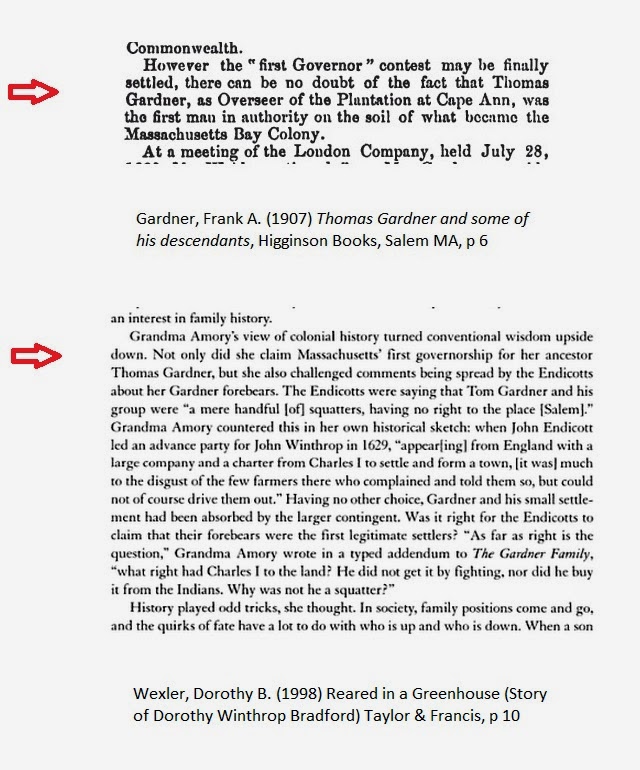
Now, in his book, Dr. Frank touches upon this, very briefly. But, in a section of Vol. II, No. 6, there is a look at the original source: Elizabeth Gardner Amory. Elizabeth's granddaughter, Dorothy Winthrop Bradford, writes about discussions with her. The image is from the book, Reared in a Greenhouse (preview mode at Google books) by Dorothy B. Wexler.

The time frame to which Elizabeth refers would be (say) post-US-Civil War. Elizabeth claims to have been the first to make this statement about the first governor. Her discussion about the matter is on page 10 (see image).

---

This little example is one of many. The recent book about how "invisibles" hold the world together offers a few modern concepts that can be useful as we proceed with further analysis (more later - but, there is no shadow nor is there any lament).

Remarks: Modified: 03/02/2019

07/22/2014 - Captain Edward Johnson published, in London, in 1654. His book was redone, in Andover, MA, in 1867 (this is in the collection for the bibliography). ... How could I not mention Higginson whose comment about Endecott's house lives on?

07/23/2014 - Read a little more of the book. Interesting. Added Elizabeth to the descendants list (Wikipedia, which has a page for the Dudley-Winthrop family). This list will be getting more attention; the last exercise got rid of stale and suspect links. We will reorganize (with the intent to foster analysis and discussion) and add more descendants (we need more of Miriam's progeny, for example).

01/19/2015 -- Maine History Online: Popham and Gorges.

03/02/2019 -- We are building an index of images at our portal to truth

Friday, November 24, 2023

Gloucester, 2nd year

TL;DR -- Gloucester did their 2023 lookback. Now, we're heading toward 2024. We have more information and will be taking a re-look at research. Were there two Thomas Gardners? Some have suggested this, over the years. But, that notion never shuffled up in attention. This and other questions are on the table for Gardner Research. 

---

Of course, we know that there was a party that over-wintered in the winter of 1623/4. Then, there were parties who came over in 1624. Plus, there would have been regular traffic from here to there. This year, Gloucester 400 looked at the original arrival. Except, it was not as there had been regular fishing expeditions sent here for several years before that. 

This year, fishing was a large focus, especially as it pertains to generations over the years since 1623. We expect that this will continue with the second year, as the 1624 party is recognized with less hoopla as is expected after the exhilaration of the the first year. In other words, now, let's get down to business. For one thing, we will be scrutinizing our posts (this blog) and editing/'updating with the new information. As well, as research continues, we will point to the work of others

Looking forward, by 1626, the failure of the effort was known. By then we will be looking at Roger Conant's move over to Naumkeak with part of his crew where he overwinterd at Massey's Cove. This was when the first controversies about Thomas Gardner cropped up, according to our records. He was not on the list of Roger Conant's for the old planters which we called Old Planters, Beverly.  

On the other hand, we did a recap of what we knew (based upon twelve years of browsing the material with respect to Thomas Gardner) in December 2022. We mentioned our FAQ and the work related to "whence" which was still open. We delayed digging further until March of this year when we had decided that Thomas' wife (Margaret, equal partnerMargaret (Fryer) Gardner) was to be the focus. 

Why the delay? Our initial thrust in the year was historic (see January 2023). Then, we found out about ChatGPT which had been released by OpenAI in Nov of 2022 (our first post on the subject was 2 Feb 2023). While we were getting familiar with the new AI and discussing issues, Bob Dunlap who is a Thomas and Margaret descendant, was wading through scores of images that were the digitization of the records of Sherborne, Dorset, UK. In doing this work, he found interesting information. We summarized this in a post: New not old planter. In summary, he found records about Thomas and Margaret plus all of their children, except for Seeth who was born in Salem, MA in 1636. 

After looking at the material, we proposed this: Old, and new, planter. We have many reasons for this point of view. Rev. Hubbard was the source for Thomas Gardner being involved with the Cape Ann venture. His reference does not suggest that it was not the Thomas extant in Salem when Hubbard was doing his work. Too, Thomas could have come over a couple of times. One of these would have been in 1624. In the records, there are gaps between children that would have allowed Thomas to have been away. But, the issue is open. 

Margaret, and the children at the time, would not have come over. Or, "may not" as we have to dig into this. In the meantime, we will report the determination of the Great Migration project at WikiTree. They pulled out another node and created two "Thomas Gardner" records. Here are a few words from each of the profiles. 

  • Thomas Gardner (abt. 1592 - 1674) - Thomas Gardner has recently been proven to be from Sherborne, Dorset, England with the discovery of the baptism of seven of his children.[1] He was baptized on 30 October 1591 in Sherborne.[2] This fits well with his deposed age of "about 69 years" on 26 November 1661.[3][4] Anderson states that Thomas Gardner's origins are unknown, but that was of course before the discovery of the baptism of his children.[5] Anderson also equates him with the Thomas Gardner who immigrated in 1624, though this is certainly incorrect as this Thomas Gardner had children born at Sherborne continuously until 1633. ... 
  • Thomas Gardner (1600 - aft. 1625) - Thomas came to New England as part of the Dorchester Company's failed attempt to establish a fishing colony on Cape Ann. The effort was funded by the Dorchester Company of Adventurers whose chief advocate was the Rev. John White of Dorchester, England.[1] Gardner was appointed as one of the overseers of the fishing colony.[2] It is not known if Thomas Gardner was among the first 14 men who arrived in Cape Ann in the fall of 1623; it is more likely he was in the group of 32 that arrived in 1624. ...


In short, we will start a major update in 2024 of our records and posts. Many issues remain to be researched. Until those are resolved, we will assume that there was one Thomas. That he was here more than once will be looked at thoroughly. 

On the other hand, that there were two Thomas Gardners in early Salem is not a new subject (Two Thomas Gardners in Salem; Back to DNA). What happened was that technology allowed access to the records. Bob Dunlap ought to be congratulated for wading through the non-indexed material. 

Remarks: Modified: 07/14/2024

07/14/2024 -- See updated comment: Why is 2024 quiet?

Friday, December 2, 2011

Backbone and more

These posts, of which this is the first to tie in the category, will be collected into a separate group. What will be the content? An outsider's assessment of those early years and Thomas' legacy from such. 'outsider' means in-law, basically.

---

Backbone has already been used with a different context: fedaerated. Why? The study of those times that were 150 years prior to the Revolution are very much apropos to understanding of the current problems. Even Naisbitt thinks so, though I don't agree with his slant.

---

Disclosure: The author is a 3rd generation American whose ancestors were basically post the Civil war. Hence, looking at Thomas and Margaret affords a new view into the history of northern Europe and the new world. As an aside, there has been a lot written about the past 400 years, even about that New England locale. Hence, one can easily get lost in all of the verbiage. And, there are conflicts in what was written. So, we seriously need some new overviews that try to help guide one through the mess (more below).

---

So, today, while I was reading the Annals of Salem (the overview) by Felt, I had some thoughts that will be expanded upon further. First of all, there were tyrannical doings almost from the beginnings. True, the aboriginal peoples were trampled. But, there was serious infighting among the settlers, even though they were from a common background.

Earlier, I had noted to myself that Thomas seemed to be above the fray (we'll expand upon this thoroughly). However, let me say that he was there, and of notice, even without corroboration of those writing the historical accounts (meaning, of course, that we can thank Rev. Hubbard (he died in 1704) for the first real reference -- it is said that he had talked to all of the principals -- Thomas, Roger, and John). In other words, Thomas, and Margaret, had been successful in bringing up their kids in the midst of turmoil and peril (we'll characterize this, to boot). Of course, many other families were equally adept. For this, we can be grateful.

---

It is of definite interest that the first year that Thomas deigned to undergo the 'freeman' yoke (1637), he was elected, with William Hathorne (Samuel's father-in-law), to be Deputy to the General Court. We'll go more into that later.

Some have wondered about what happened to Thomas after the group left Cape Ann because he's not in the record (see Remarks 12/03/2011). One author (Paine family) considered that the family might have gone back to England. As we know, some did. Rev. Lyford went to Virginia.

Think of it, though, that Thomas was the ultimate example of a self-sufficient, mature person. In other words, he was an archetypal New England'r before it had even become popular to think of those good traits. He was able to guide himself and his family through those dark times (and, we'll be getting into this in depth). When it became apparent that he had to conform to the powers that be in a public sense for the sake of his children, he did so. Then, his kids all excelled. Joseph stands out in that he married the sister of Sir Downing (there are several messages there). Samuel's wife had in-laws (the Corwins) who have royal descent. Richard and John did very well on Nantucket. George has his memorial (kidding). The girls have their esteemed offspring, too.

---

Of course, this brings up things related to the background. How did Thomas get his position from Rev White? And then, how could Rev White forget him so soon? When Conant came on the scene, Thomas showed a lot of maturity even though Conant is more touted for his acceptance of Endicott when he stormed on the set.

---

By the way, we'll go into some of the other parties who have their names blasted upon the pages of history. From where I sit (and that does mean that you can infer personal knowledge), some of these people were not much better than were their Christian brothers who sustained the energy behind the Inquisition for so long. What were the English doing? Trying to show up the Spaniards? Yes, a few things might be discussed along that line.

From what I've seen, Thomas has no recorded peccadilloes of this nature. In fact, given that the American Indians on Nantucket really liked John, we can assume something about John's upbringing.

---

Now, another thing that came up today was seeing a reference (in Felt's work) to the Magna Charta at a 1635 meeting (finally, I thought -- hey, that's 11 years later -- same issues as we face now with our leaders, don't you think?). Whoever brought that up may have had to duck (I'll research this more). But, it was wonderful to see the reference. In case it has not been noted, we're coming up on the 800th anniversary (2015) of this very important document.

Yes, it was brought up, in the meeting, that by-the-seats-of-the-pants governance, by second-rate people, was not conducive to a sustainable society, more or less. But, the U.S. did emerge, eventually.

Too, those with the real sense, such as Williams and Bachiler, went off to found Rhode Island and New Hampshire, respectively.

---

What? Did I read that Cromwell almost came over? It seems that the king prevented this, to his dismay a little later. That little bit sort of indicates that we must not forget some of the motives for coming over here (not just freedom, religious or otherwise). England was a mess, in many ways. So, would not New England exhibit that messiness, too?

---

There is a lot to read. So, at some point, a bibliography related to the 'backbone' theme will be presented. These posts will be like notes with a theme, hopefully.

Remarks:

07/12/2015 -- Of course, when Roger brought his people to Salem, Thomas was not there. Why? He and Margaret kept the Cape Ann house. Of course, when John Endicott came over, he saw Mr. Gardner in his nice house. John said, that is mine. Take it over to Salem. So, by splitting his time (Salem is not that far), Thomas had an idyllic time with his wife and kids; too, he had time to get himself and his family settled in the new realm.

04/20/2015 -- Yes, Cape Ann's life was idyllic, except any cohesive group must always endure the changes brought by new arrivals. Thomas and Margaret got to enjoy their house, once again, after Conant and crew left and Endicott saw the house and wanted it moved.

07/17/2014 -- The book about the Invisibles (the unsung heroes) offers another viewpoint. Of course, it is set in the modern context. But, we all know that history covers only a fraction of reality. What we see now is that technology will allow us suitable ways to go back and fill in the blank slates.

11/06/2013 -- While working on the next Beacon issue, I ran across some books. The one by Staloff was timely; imagine, I was wondering why the backbone series? Has the talented set ever allowed the lessors to have some semblance of a good life? Oh, you say yes? Winthrop, et al, were against this from the beginning. The stalwart of what could be (or could have been)? Thomas Gardner, of course.

11/27/2012 -- Let's itemize what we know, re-iterate some basics, and the proceed constructively.

05/01/2012 -- Two things to be thankful for: Rev Hubbard's look back (his brief mention is sufficient) and the fact that the manuscript was not lost (otherwise, would Thomas had been even more unknown?).

03/07/2012 -- Where was Thomas? 1626 or so and 1641 or so.

12/03/2011 -- The thing that grates? Thomas led the group into Cape Ann. When the group went to Naumkeag, Gardner is not on the list of planters. We see Conant, Balch, Woodbury, and Palfrey (each got 1K acres -- as well, all of the families have inter-married with the Gardners). When I say 'grate' I'm referring to my initial reaction a couple of years ago when I first started to read about this stuff. Gardner forgotten, ignored, shunned, what? And, Rev White was the instigator of that division. Well, it'll bear more scrutiny, no doubt.

Modified: 04/23/2021

Wednesday, May 21, 2014

Whence came Thomas and [Margaret]

One goal, all along, has been to tackle this issue. There has been a whole lot written about the subject (see comments on a massive collection) that I have seen the past few years. Anderson punted (Great Migration), but that he did was correct (the bracket around Margaret is a nod to the open issue) given what is known, definitely, at this time, and the genealogists' bailiwick. Some of the thoughts and talks were re-addressed when the Richard III discovery was in the news (and later).

We have been considering origins from various angles: motivation, the times, and more. Given the interest, and the amount of material, we will make it a regular topic.

---

Today, I ran across this findagrave page about the Thomas Gardner who died in 1635 (see Farmer and Frank). By the way, I really like the site and its intentions. Notice that the subject that we had multiple Thomas Gardners has been addressed (see summary in this post).

---

When putting together the annals look at Thomas' time for Gardner's Beacon, Vol. II, No. 6, it was interesting to see how references to Thomas, and opinions, changed over the years. Too, seeing the material in this format suggested the usefulness. Expect a more full "annals" to be collected.

Similar to this, there will be a list of things on the web. This work is for informational purposes only. Analysis will come later. Without a proper structure and indexing, there is just too much which can complicate matters more than necessary.

Much of the web material points elsewhere, so we will track those. Sound like a lot of work? Yes, but, taking incremental chunks will allow regular report. Of course, the question of resource comes up: yes, we'll collect elsewhere and point there from the blog.

Now, one benefit will be to collect look backs that were done in good faith. Notice that the annals report (see Beacon reference, above) lists various look backs that happened over the years. Fortunately, we had some that were almost current. Actually, Rev. Hubbard was of the time of Thomas' offspring. Some of these look backs go back across the pond.

Some proposals (conjectures?) appear to be interesting. Some have a lot of supporters. We will get these laid out, even those that have been shown to not have much (or little or no) support.

---

If you would like to contribute to the collection of material, please send an email. Especially, I would like to hear thoughts about Thomas' ancestry (John Goff's take, for instance). Actually, across the breadth of progeny, are there stories, etc., that ought to be brought forward?

Which brings up resource, again. We attempted, unsuccessfully, a Forum approach (see summary) last year. What method would be good to use (robust, secure, friendly, etc.)?

Remarks: Modified: 08/11/2020

05/22/2014 - Removed the redundancy from the title; kept it on the file (emphasis).

06/25,26/2014 -- rootsweb is back. Listing of 303 trees for Thomas (those with sources, showing descendants and providing the death year). ... Of the 303, 181 trees have parents for Thomas. ... Then, there are 43 trees with George being the grandfather of Thomas. ... See Whence came ...

07/02/2014 -- Featured in Gardner's Beacon (TM) Vol. IV, No. 2.

09/28/2014 -- A week ago, the record for the marriage of Thomas Gardner and Margaret Friar was discovered in Sherborne by John Cook of Minneapolis, Dorset files. This sets a type of focus. Looks as if some transcription work might be in order.

07/12/2015 -- Okay, turtle speed. But, we get there. Announcing a new project: Sherborne, Dorset. No doubt, it is about time. When finished with the data collection and analysis, we will present the strongest story (the prerogative of the family) that the facts, and abductive reasoning, will support. As such, we hope to demonstrate some very much needed research viewpoints.

08/06/2016 -- More on All things Gardners.

09/25/2018 -- Recently the Profile for Thomas Gardner on WikiTree changed to only have the two wives. This was due to research and discussion to which Gardner Research contributed. Earlier, there was a post that summarized the issue and accomplishment: Margaret, anew. Thanks are extended to all who made this update possible. The Profile is managed by the Puritan Great Migration Project sponsored by the NEHGS, publisher of the Great Migration books. So, Sherborne, as John said (see this page for images of documents).

08/11/2020 -- We have used categories in the post. We also have used pages which allow some structure. Then, we have the other media to consider. One thing is definite, we will have lists of important topics. On these, we will find Origins and Motivations.


Sunday, December 25, 2022

New Hampshire

TL;DR -- ME has been in sight since the beginning. NH only has had passing reference as we studied Cape Ann in relation to 400 years. They have 2023 for their commemoration, as does Gloucester. We look at a few of the posts over the years that mentioned our scope. In our future research, we will balance the view across the local territory and further, in this context: the long reach of New England.  

--

We have had a 400th focus for a while as we watched other celebrations (Plymouth - 2020, Weymouth - 2022). Gloucester comes up in a few days. Our start was with a focus on Cape Ann and Essex County

Then we extended our view to MA and New England. Incidentally, ME was involved due to its association with MA. After looking at the long reach of New England in the interior and the west of the U.S. and around the world, we now have a U.S. focus through the 400 years where we consider details through time of the other colonies (like New Spain) as well as the events related to populating the interior (Frontier century).  

Recently, while looking at the Northwest (as seen in the time of the Revolution), we saw Rhode Island being represented out west, in the form of a Governor of the Territory of Michigan. Having looked at the family involved and tying things back to Massachusetts, we thought to fill in the gap by looking at a family that had long been in RI (see H.P. Lovecraft). We had mentioned that we needed to bring in the surrounding States, such as CT (a little later), NH (which we had already touched upon), ME (which we have covered many times) and VT (already noted in looking at western movement). We will get these posts better categorized and related as we work the 400s going forward. RI and CT do not come up on the 400th list yet, that we know of. We should have looked north, again. 

Today, we saw (on FB) that the northern neighbor whom we associate with Rev. Bachiler is on the 2023 list. That was good to find out. We will spend more time researching the Rev. and his cohorts, but he was mentioned recently in this post (see Two Houses) which was motivated by research on New Hampshire families where it was noted the Gilman family was of interest with regard to the Revolution (both sides, plus the Society of Cincinnati). Nathaniel Ladd was one of the builders. We also had looked at the Dudley family who hung out there. 

Rev. Hubbard, friend of the family, weighed in on the controversy of when did NH start. John B. Sanborn (several posts) was born in NH. Sam Webber, Head of Harvard, was born in Essex Co, MA, but his family moved up north. Lots of Ann's folks did the same. 

Hence, in a few days, we'll have another commemoration to add to the list. As well, we need to find a time line for NH similar to the one for MA. 


This was a great reminder as it expands the scope at a good time, that is, when Essex County starts its long-awaited commemorations. 

Remarks: Modified: 12/25/2022

12/25/2022 --


Friday, June 14, 2013

Origins, again

Note: See this post: In summary. We have new information about the baptisms of the children and are in the process of researching to establish a proper narrative. For now, see comments at the WikiTree profile for Thomas Gardner. We will start with Rev. Hubbard who was there (1680 manuscript). 

---

To date, sources for the blog post and Beacon issues have been textual. The technical resource for these were several, including databases. That is, digitization projects have made many books available. There are several different copies of Dr. Frank's book (my favorite is at archives.org). Various groups, including collateral families, have websites. Some of these use database technology. rootsweb is another example.

A few days ago, knowing that we need to upgrade the TGS site to use more modern techniques (let's say that it is now, being generous, late 1990s). I started to look at options. Too, media types abound; genealogy might be dragging its feet (On blogs and other modern means), however presentation of this material will need to grow with advances. The NEHGS' emphasis of the relationship between history and genealogy gives more than enough motivation.

---

So, what if there were something presented about Thomas and Margaret using modern methods. Videos come to mind; too, though, gaming needs serious attention. So, I went looking to see what might be on youtube with regard to the Planters of New England.

Essentially, it was disappointing. Here are some examples why: NaumkeagSyracuse seriesEndicott, etc.

---

But, then I got side-tracked. I ran across a BBC series on the History of Scotland. I started in the middle and bounced around. Now, some experts harp at the series. To me, it was an eye-opener. As I listened, I went and researched what I was seeing. As well, trying to understand what it might have been like to live then. That is, preparing to address Thomas' decision to leave and to make a live elsewhere.

Here are links to the Scotland series on Youtube (the first part) and a Wiki page that summarizes the videos.

Is there something similar about Ireland? Yes (YoutubeWiki).

England? Yes, again (YoutubeWiki). Actually, I was looking at England first. Someone had a series that had little introductions to the Monarchy, in sequence. When I got to Ed I, the Hammerer, I searched on that. The above Scotland series popped up in that the presenter (Scottish) said Hammerers (plural). He added in Alexander (knocking the heads of his own people).

---

While looking at the videos on Scotland, I was paying attention to changes that were coincident with Thomas' time here. I had mentioned that before, several times, such as motivations. Given the annals framework that is being used for the Beacon, we can now do an issue pulling together some of this in a year-by-year fashion. That is, relate things at home to what was going on here.

Keeping in mind, please, that we're are still trying to figure out the ancestry of this couple.

---

While looking at the Ireland series, the presenter talked about how James I/VI sent Planters to Ulster. The idea was to colonize the incorrigible Irish and teach them how to be civilized.

Disclosure: the tone is set from a mixed heritage, including Irish -- from what I've seen, there are not saints in any of these people - except for St. Margaret, perhaps - but, we still must honor (Commandment - way back to Moses) -- nod to the U.S. Father's Day which is approaching. Too, today it's like the same old thing over and over again. What lessons may we learn from Thomas and Margaret?

---

Finally, but this is just a start, how the English (Elizabeth's bad side was quite apparent, too) thought of the Irish seemed real similar to me to how some settlers felt about the Natives as they arrived here. A lot of these opinions were written, so we have a record.

But, recall, if you would, that the Gardners, early on were on a friendly basis (story of John, for instance).

---

Too, are there other videos that we can add to our list? Games were mentioned. Think how the Game of Thrones books spawned off all sorts of things. Our purpose would be to teach the proper history (whatever that might be).

Remarks:

06/20/2023 -- Added note about the narrative situation. 

08/11/2020 -- We have used categories in the post. We also have used pages which allow some structure. Then, we have the other media to consider. One thing is definite, we will have lists of important topics. On these, we will find Origins and Motivations.

07/16/2016 -- Related work: Gardiners and Gardners.

07/12/2015 -- Okay, turtle speed. But, we get there. Announcing a new project: Sherborne, Dorset. No doubt, it is about time. When finished with the data collection and analysis, we will present the strongest story (the prerogative of the family) that the facts, and abductive reasoning, will support. As such, we hope to demonstrate some very much needed research viewpoints.

07/12/2015 -- We mention abductive approaches (my career was spent in advanced computing - software and modelling, essentially). Please refer, at least, to C.S. Peirce's (we mentioned him in an earlier post - Benjamin Peirce) work in the area. [Love it: From Ugly Duckling to Swan]

10/13/2014 -- Tabula raza, and more, will be of concern.

09/28/2014 -- A week ago, the record for the marriage of Thomas Gardner and Margaret Friar was discovered in Sherborne by John Cook of Minneapolis, Dorset files. This sets a type of focus. Looks as if some transcription work might be in order.

08/22/2013 -- The start of a look at what was what in early Salem (and New England) as far as Gardners is concerned.

08/07/2103 -- During a period of browsing classes, documentaries, and the like, I have run across many videos (youtube) that apply to our themes. One that I have not watched in its entirety deals with re-creating a Tudor Christmas feast using techniques and tools from the period: BBC UK. I'm putting it here as it nice to think of the cooler holiday period during the heat of August (say, put a snow scene on your desktop). Too, in 2011, the December Gardner Beacon issue had a theme of Tudor Christmas but also asked the question of Thomas' and Margaret's first Christmas here. That Christmas would have been before the heavy Puritan (wet) blanket descended upon those who were able to get themselves free from the old country.

06/17/2013 -- In the Great Migration write-up, Thomas' origins are noted as unknown.

06/15/2013 -- Was there a Thomas and a Thomas?

06/15/2013 -- Speaking of the NEHGS, what we are doing is historical genealogy (as of today, that post is the all-time most-read post). Coming in second is Old Planters, Beverly. Looking at origins would encompass the whole bit, out of which would then come the real story. That has not been done, that I can see, as of 2013 is not troublesome. Things come forward all the time. Too, has anyone surveyed the work to date in a comprehensive manner (meaning, of course, scholarly)? One goal will be to start, and sustain, such studies that would augment what has already been done as well as explore holes (which have to be defined, for starters). In the meantime, we'll try to document Thomas' life (such as, pulling out things related to character) and progeny. Also, we ought to look more closely at Damaris Shattuck and Thomas. That he married a Quaker and didn't suffer the wrath of the likes of Endicott says something (Mary Dyer was hung in 1660).

06/14/2013 -- As an afterthought, I ought to have used Barbarian in this post. Wiki has a nice little write-up on the term and its usage. While mentioning Wiki, please visit the Thomas Gardner page. It's a little over three years old and needs to be modernized (brought up to date - civilized?), too.

Modified: 06/20/2023