Showing posts sorted by relevance for query sanborn. Sort by date Show all posts

Monday, June 5, 2017

Franklin Benjamin Sanborn

Earlier, we looked at an author that helped Dr. Frank with his magazine, namely R.A. Douglas-Litghow, MD, LLD. RA was quite prolific.

There are many more, but let's look at F.B. Sanborn (updated the Wiki page with a pointer to the Massachusetts Magazine - See Remarks, 10/09/2022) who popped up as we were looking at, and digging into, the minutes of The Old Planters Society of Salem. In 1916, F.B. gave a talk about Hector St. John, calling him an evasive planter. The story is interesting.
It is interesting that Hector was the namesake of St. Johnsbury, VT through his friend, Ethan Allen.

There will be more in the upcoming issue of The Gardner Annals.

Too, we will bring forward all of the Old Planter Society minutes that we can find.

---

F.B. was remembered in TMM, Vol. X, No. 4.


---

The Wikipedia page has been extensively updated so show the huge amount of work accomplished by F.B. Sanborn. We ran into him through his remembrance of Col. TW Higginson. Too, as a graduate of Harvard, we have seen reference to F.B. during our look at the institution, so we will get back to him. For now, we can add a link to his WikiTree information: Sanborn-1542. 

Remarks: Modified: 11/16/2022

06/14/2017 -- F.B. corresponded with Thomas Wentworth Higginson.

07/12/2017 -- The Significance of Being Frank. ... Sanborn and Higginson were in the Secret Six.

06/04/2018 -- Added the snap from The Massachusetts Magazine Vol. X, No. 4.

03/07/2019 -- Added image from this post to the index on our portal to truth.

10/09/2022 -- Got to love Wikipedia's technology. Mentioned that  F.B.'s page had been updated with information about his writing about Hector St. John plus the talk at the Old Planters Society which has been published in The Massachusetts Magazine. This entry was there from 2017 until 2021 when it was removed via this edit. 
Had thought today to look at this since F.B. was mentioned on the Col. TW Higginson page. The Col and his family were covered in the recent issues of Gardner's Beacon, Vol. XII. No. 2. 

11/16/2022 -- Research continues; papers arise to awareness. One, of late, that appeared in The American Genealogist, had to do with the family of F. B. It is of interest to us for several reasons. He's a cuz. Too, there were several New Hampshire families involved with the Sanborn family. Then, a link was made from the immigrants to their grandmother. Our first intimation was a reference on WikiTree in a G2G context. We looked then and were intrigued. Then, Gary Boyd Roberts wrote of Sanborn, yesterday, in the context of his Royal Descent book (three vols) which just went to the printer. The post by GBR: Royal News Since the Release of Royal Descents of 900 Immigrants to the American Colonies, Quebec, and the United States. Second Edition. As well, today, I put a link to this post on the F.B. Sanborn page on Wikipedia (the Talk page). As an aside, this list of posts references F.B. and his work and life. 


Wednesday, March 4, 2020

Magazines and people

Book reviews are always a nice feature. The WSJ has had one in its weekend edition that has been enjoyable. The weekend of 02/15/2020, the review had several books of interest to us. For one, there was one about the founder of McClure's that ran 1893 to 1929. He had a longer run than Dr. Frank's The Massachusetts Magazine (1908-1918), however the scope was entirely different. But, McClure's co-founder had Sanborn and Phillips in his name. So, yes, his lineage is out of old New England. We are always interested in that connection.

Earlier in the year, Ida Tarbell was featured in a review. She, too, is of New England through her father. We will have more about her through time. Now, though, we need to mention The American Magazine which she founded with friends, including Phillips, after leaving McClure's. They converted an existing magazine.

Why the interest in magazines? Partly, Dr. Frank's effort is a factor, however we have researched several families involved in this type of effort. Of course, we know of The Atlantic Monthly. But, as the WSJ review noted, once the majority of the populace could read, they wanted to do so. Magazines filled the bill.

WSJ Feb 15, 2020
Let's stop a minute to list some of our posts on the subject: Spirit of '76; Magazine: American museum; Lyceum; TMM, a review. The web/cloud has brought in whole new dynamics (e-zine, for one).

In that same WSJ review collection, there was one about a book that looks at the Grand old Party. It's founding was in 1854. When we talk American 100s, included is a suggestion that locales are important to the essence of the U.S. (Locales and their history); hence, we have several posts related to places and names, though we ought to extend the range for this type of post.

GOP. In the book, there are three references that can catch our eye. We have mentioned all three: Brown, Stearns, Higginson. In what context? The Secret Six. These were supporters of John Brown who got the attention of the Federal law-keepers after the Harper's Ferry ordeal (Col. T.W. Higginson, Julie Ward Howe's husband, and F. B. Sanborn, among others). The book reviewer notes that TWH is not given as much attention as he ought. 

Of course, there are other book reviews published on a regular basis. We have done a few ourselves and ought to do  more: Albion's Seed; The First Seventeen Years, Virginia; Chronicles of Old Salem; Such men are dangerous ...

Doing such reviews might become a regular feature of The Gardner Annals for which Vol. V, No. 1 is being prepared. 

Remarks: Modified: 03/04/2020

03/04/2020 --

Sunday, October 9, 2022

Secret Six, the rest

TL;DR -- There were six. We looked at two of them before due to their association with The Massachusetts Magazine. We looked at another because of his wife. There were three left. With this post, we provide some links to support further research. 

--

We ran into the Secret Six (Wikipedia) as we were looking at the activities of John Brown in Kansas prior to the Civil War. That research had been motivated by references to Col. T. W. Higginson in The Massachusetts Magazine. Not much later, we got familiar with F.B. Sanborn who wrote of the Col. after his death in an article in the same magazine. Another name that we encountered via his wife was Samuel Gridley Howe. 

That gave us three of the six. The rest? They are in the below list with a pointer to their Wikipedia and WikiTree information. When we first looked at this group, some of the Wikipedia pages were not available. It is nice to see the research being done.  


T. W. Higginson - The Colonel collaborated with Dr. Frank on The Massachusetts Magazine and the Old Planters Society. Too, he supported 'bleeding Kansas' prior to the Civil War. In Gardner's Beacon, Vol. XII, No. 2 (recently published), we looked at his family with respect to the focus of the Thomas Gardner Society. Inc.  

F. B. Sanborn - F. B. was looked at earlier due to his association with T. W., but, on a further look, we see his involvement as being fairly broad. So, we'll take a deeper look.   

Samuel G. Howe - Husband of Julia (Ward) Howe whom we featured earlier (his WikiTree profile: Howe-2638); we will look further at him and his lineage. 

George L. Stearns - His ancestor came with Winthrop and Saltonstall and settled in Watertown, MA. He has Patriots (See SAR/DAR) in his lineage. His support for John Brown included pikes and rifles. WikiTree Profile: Stearns-2488

Gerrit Smith - His lineage is Dutch and English. He has Patriots (See SAR/DAR) in his lineage. Gerrit was quite successful which allowed him to engage in philanthropy. He provided financial support to John Brown and supported the Kansas Aid Movement. WikiTree Profile: Smith-199399 

Theodore Parker - He has colonial ancestors and Patriots (See SAR/DAR) in his lineage. Theodore was a minister whose work deserves attention. He supported John Brown, "whom many considered a terrorist." WikiTree Profile: Parker-16208 

These six are representative of the New England abolitionist's points of view. Further research will be done on their lives and important work. 

Oh yes, Harvard graduates are amongst these ones. 

Remarks: Modified: 10/09/2022

10/09/2022 -- Patriots are of many types. We think that these gents need more recognition than what has been shown so far. Each has a deep pedigree. They cover the basis in terms of traits and their life focus. But, they all were abolitionists and supported John Brown whom we will feature, as well. 

Thursday, May 27, 2021

Trapper, trader, rancher

TL;DR -- Movement to the west started early, hence the conflict with American Indians ensued which resulted in attempts at treaties. One of these attempts was at a meeting near the Little Arkansas River in 1865. The major tribes of the Plains were represented. The foremost negotiator for the U.S. was of New England. Also present was Kit Carson and William S. Bent who had an Indian wife and had spent several years in the west.  Like early treaties, this one did not take. Subsequent treaties resulted in a lessening of land available to the Tribes. 

--

Recently, we wrote of the frontier century that began after the trek of Lewis & Clark and continued until the early 1900s. The early part of the century gave us Jedediah Strong Smith and his peers. They interfaced out west with American Indians and people from New France. In this case, the movement west had been across the middle of the country. A couple decades later, there was more area covered, and we saw settlement taking hold. Some were already old, such as St. Louis MO. Others sprang up along the way and over time. For all of these periods we have identified families to research noting location and routes which included rivers. 

However, we also have looked at the time before the interest of New England changed the west. Turns out that Wikipedia is thinking along the same lines: American Frontier (article was started in 2016). 

This post looks at William S. Bent (1808-1869) who was a trapper, trader, and rancher. He built several posts along the Santa Fe trail. William was born in St. Louis, however his father, Silas Bent (1768-1827) was born in Rutland MA which is in Worcester County. Silas is of the generation too young to be a Patriot but his father was one. We will look at Silas later as he was educated in Wheeling WVA (at the time, VA) and became a surveyor of the Louisiana Territory. As can be seen, Silas shows an interesting part of the migration patterns out of New England where he had a deep pedigree. 

Missouri saw European influence early on but became a State in 1820. The image shows the Santa Fe Trial going across the middle region. William S. Bent built a fort along the northern route of the Trail in southeastern CO in 1833. The southern route of the Trail continued in KS in OK and then NM. It was along this route that Jedediah was killed. 


William was out in CO for several years and had a ranch. He bought land near Kansas City MO in 1858. He married the daughter of Cheyenne leader. There will be a lot more to look at as that whole area boomed over the next decade and one-half. 

In 1865 as the Civil War was dying down, the U.S. government developed a Peace Treaty with the American Indians and organized a signing ceremony. The tribes involved were the Apache, Arapaho, Cheyenne, Comanche, and Kiowa. This meeting took place near current day Wichita KS. 

William Bent was there for the signing of the Little Arkansas Treaty which is named for a tributary of the Arkansas River that originates in CO. William had been involved with the American Indians for several treaties: 1840, 1848, and 1861. There were many more in succeeding years. 

The treaty's text is available via Yale's Avalon Project: Treaty with the Apache, Cheyenne, and Arapaho; October 17, 1865. The Daughters of the American Revolution placed a marker in 1925 to honor the event (more details later). 

We wanted to mention a few of the others who were there representing the U.S. due to their connection with New England, both north and south. As we read of this, we saw a Sanborn name pop up, so that got our interest. 
  • John B. Sanborn - born in New Hampshire. John went to Dartmouth and ventured out to Minnesota in 1854. He served with a Minnesota military unit during the Civil War. After that, he got involved with the western frontier. 
  • Kit Carson - was born in Kentucky to a Patriot of the Revolution and 1812. His family moved out to MO and were friends with Daniel Boone. By 1826, Kit had gone west on the Trail and was all over the west. Even a summary would be too long for now. So, we'll look at him from time to time. 
  • William S. Harney - served in the U.S. Army from 1818 to 1863. President Johnson appointed him to the Indian Peace Commission. He was born in Tennessee in 1800, but his father was an officer in the U.S. Army.
  • Jesse Henry Leavenworth - born in Danville VT, he was the son of General Henry Leavenworth who was born in New Haven CT. 
 American Indian leaders who were there are: 

Remarks: Modified: 06/19/2021

06/03/2021 -- Added the TL;DR. 

06/19/2021 -- Very old St. Louis in the State of Missouri. 


Monday, March 7, 2022

Secret Six

TL;DR -- History will be a regular topic as it relates to New England and families from that region, especially those with ties to the early times and Essex County. 

--

A recent discussion on Quora got us back to a topic from several years ago that dealt with the period prior to the Civil War. By then, a wide swath of the Interior had been explored, if not settled though this was only a fraction of the eventual spread. In terms of the Heads of Harvard, we go to the pre-war period and stopped to regroup. This theme is an important one and will be reappearing on the topic list for some time. 


The Great Emancipators
WSJ 02/15/2020
The discussion was about John Brown, which looked at his abolitionist work including his time in Kansas. We had looked at that while getting familiar with Col. Thomas W. Higginson (Higginson-380 on WikiTree). At the time of that post, we noted that he was related to Thomas Gardner of Salem. However, his Gardner grandmother was the 2nd wife of his grandfather (John Higginson, #10, pg 13). The Colonel came out to Kansas with some men (some with their families) from Maine who were to settle the area to be free state. He wrote of his trip out to the area and back. 

We were introduced to the Colonel through articles about him when he died that Dr. Frank published in The Massachusetts Magazine. One of the authors was Franklin B. Sanborn. Both Sanborn and Higginson were members of the Secret Six who were Massachusetts men who supported the work of John Brown. One of the Six was Samuel Gridley Howe who was the husband of Julia (Ward) Howe who wrote the Battle Hymn of the Republic. 

The Civil War was less than 100 years after the Revolution whose 250th commemoration is coming up. It was not long ago that we saw the 150th of the start of the Civil War. One connection to look at would be the generational aspects such as we see with our study of the fifth generation bearing the brunt of the split with England. 

Remarks: Modified 03/07/2022

03/07/2022 -- 

Wednesday, June 14, 2017

Thomas Wentworth Higginson

We admit being late in writing about Thomas Wentworth Higginson. He was a contributor to, and editor of, the Massachusetts Magazine. Earlier, we looked at R.A. Douglas-Litghow, MD, LLD and F. B. Sanborn.

Today, I saw that several authors, including F.B. and Dr. Frank, had written about Thomas after he died (TMM, Vol. IV (1911), No. 3, pg 139). F.B. noted that he had corresponded with Thomas in regard to a topic that we addressed earlier (Final migration), in a different context. We quoted Cordley's book about the early efforts to found Lawrence, KS. There have been several posts about the long reach of New England into the western part of the country.

F.B. gives us a deeper look at the activity of Thomas in this regard. He helped form the State Kansas Committee. He was an active abolitionist. One motivation was the Charles Sumner attack. Charles was beaten in the Senate by a Southern Representative (1856). Too, Thomas, personally, knew, and admired, John Brown (more on that later). And, events in bleeding Kansas had gotten more violent.

There were several names for the Committee, such as The National Kansas Committee, as reported by The National Magazine, in Vol.17 (1893). Wikipedia does not have a page for this activity which is an oversight to be fixed.

Related material at Territorial Kansas On-line.

Thomas printed his notes and letters (in the New York Tribune) from his 1856 visit to Kanzas. Thomas stopped in several towns and wrote a lot of Lawrence. He gives us a view of the area just prior to the Civil War which ensued, largely, from those events out west.

We will look at all aspects of Thomas' life. He is [almost] a descendant of Thomas Gardner of Salem. Thomas was also first President of The Old Planters Society.
  • Note: 03/07/2022 -- Thomas' grandfather, John (#10, pg 13), married, in 1695, a descendant of Thomas and had six children. She died in 1713. His second wife was the mother of Stephen, father of Thomas. 
Several of the TMM authors had ventured west. For instance, Judge Francis M. Thompson, of Greenfield, MA, toured the west following Lewis and Clark. Too, he was a pioneer of Montana.

---

We used Col. T. W. Higginson (WikiTree, Higginson-380) as an example of the "Blended family" that was so common. This example comes from the early times and was documented by T. W. himself which we show with these two images. First, we have T. W.'s description of himself. 


 Then, we show the association of two of his great aunts with Harvard men: John Thornton Kirkland and A. Lawrence Lowell.  

Higginson and Harvard

Remarks: Modified: 09/23/2022

06/15/2017 -- Thomas donated his files related to Kansas to the Kansas Historical Society. Story of His Life (1914) by Mary Potter Thacher Higginson. "Kansas and John Brown" from The Writings of Thomas Wentworth Higginson.

07/11/2017 -- In 1929, a plague was put in a park in Lawrence, KS. It lists the names of the members of the first two parties. Thomas W. Higginson arrive two years later.

07/12/2017 -- Sanborn and Higginson were in the Secret Six.

08/13/2017 -- Posts on Lawrence (and surrounds): Trails West, Westward Ho, Blogging and such, Final Migration, Thomas Wentworth Higginson, Kansas and Lawrence.

03/07/2019 -- Added image from this post to the index on our portal to truth.

09/16/2019 -- The Colonel wrote a book on his ancestor, Rev. Francis Higginson, who is buried in the Charter Street Cemetery in Salem, MA.

03/07/2022 -- The WikiTree profile for Thomas W. Higginson (Higginson-380) is fairly complete. 

09/23/2022 -- Added info from Col T.W.'s book about his lineage. There are many Harvard graduates mentioned, both related and of a collateral family. Higginson was old Cambridge University. 

Sunday, June 3, 2018

What is the American?

Back in December, I was reading a book review and noticed reference to 'martial law' being imposed in Virginia. The punishment was quite extreme, however we know that even the Puritans up north were well capable of meting out harsh treatment.

Recall that Virginia is New England (south) and is very much of interest. One might argue about different world views, however the same little island was the source for these people. Yes, we are talking the same people. And, they had the first Thanksgiving down there.

Too, there are lots of other parallels that we can look at. Northern families went south and west. The big conflict (still apropos, today) caught up many families and ought to be in our sight.

So, we have central themes to explore. As I have been reading The Massachusetts Magazine (have been through most of the issues - we will cover all articles and republish through time), themes/memes related to other issues came forth.

For instance, a 2011 book (Foster, Thomas A: New Men: Manliness in early America) quoted J.Hector St. John De Crevecoeur (who was written about by F.B. Sanborn):
  • What then, is the American, this new man? He is an American, who, leaving behind him all his ancient prejudices and manners, receives new ones from the new mode of life he has embraced.
Foster's book looks at both Virginia and the north. The former was military in scope from the beginning. We know of the Mayflower passenger and crew. Cape Ann was commercial. But, this is a topic that ought to, and will, get more attention.

BTW, Hector came over here as a young man, with introductions, and went to various locales during the time of the conflict with England. His essays are very much of interest.

----
An example of an American would be F. B. Sanborn. He was remembered in The Massachusetts Magazine, Volume X, No. 4.


---

There was never 'martial law' in the north that I have found. Rather, the north had the notion of liberty. In 1868, John Ward Dean published A Memoir of the Rev. Nathaniel Ward, A.M. He dedicated the book to Samuel Gardner Drake. Who was Nathaniel (besides a brother of an ancestor)? He wrote (compiled) The Body of Liberties (1641). This is a 'bill of rights' over 100 years prior to the Philly's crowd prancing around.

---

In regard to the Memoir, who was John and Samuel? Samuel Gardner Drake was an antiquarian in Boston. Also, Samuel was one of the founders of the NEHGS. His parents were Simeon Drake and Love Muchamore Tuck. Where did Gardner come from? Love's brother, Samuel Jones Tuck (of Boston), married Judith Gardner (of Nantucket) daughter of Uriah Gardner (b 1716) and Judith Bunker (d 1789). So, Judith was a descendant of Thomas and Margaret.

John was of Maine (History of the Dudley family, Librarian of the New England Genealogical Library) and was a member of the NEHGS. John has an extensive list of books on-line (UPenn). John is a descendant of Nathaniel Ward through a granddaughter, Mary, who married Benjamin Woodbridge. Mary was daughter of son, John (1609-1693).

---

This post was introductory covering a lot of territory. Before ending, here are a few items related to Samuel's namesakes. His first name came from his mother's brother. His middle name came from his uncle's wife.

Samuel's uncle: Samuel Jones Tuck - findagrave (we like this effort and try to support it); Tuck book, Love #100, Samuel #99.

Samuel's aunt: Judith Gardner's tree (Manning - we know, rootsweb had a major outage - months - so, how to correct for that?), notice major Nantucket, and Quaker, families 

I will experiment with this type of thing that would be a footnote for an ahnentafel (NEHGR reference - 2016). Over the past few years, I have collected thousands of these for the tree (with auxillary families) that I built by hand. Not only do they need to be organized to support other research, we need to check consistency twixt these things through time. Yes, lots of work.

Remarks: Modified: 01/06/2019

06/04/2018 -- Add in the remembrance of F.B. that was in TMM, Vol. X, No. 4.

06/06/2018 -- Need to prepare for 2023/4. Some, of literary inclinations, have looked back 200 years: American Jeremiad. But, we need to go back to the Cape Ann times and before.


Tuesday, June 12, 2018

Early America

Our scope, of course, goes back to the beginning. As I finish up TGA Vol. IV, No. 1, various subjects related to the early times come up due to the review of all articles in The Massachusetts Magazine. At the bottom of this post is the TOC for the upcoming issue.

We have written about F. B. Sanborn (What is an American?). In TMM, Vol. IX, No. 2, pg 163, F. B. wrote about Hector St. John (namesake of St. John's, VT). Hector was here for a while, got caught in the Revolution, was captured by the Brits, taken back to England, and then got back to his folks in France. There, he wrote retrospectives of what he saw. They were immensely popular due to his first hand experience. Of note is that he experienced the time of turmoil and that he had a good opinion of the U.S. (which was to be). People on the continent were interested in what was going on. A little later, the French had their own revolution.

There have been some interesting looks at Hector and kindred souls. This is an example of a few works concerning Hector.
  • Hector's first work: Letters from an American farmer. 
  • Describing Early America - compilation by Pamela Regis. Includes an essay by Hector. 
  • Crevecoeur's Eighteenth-Century Travels in Pennyslvania & New York, translated/edited by Percy G. Adams. The following is the Table of Contents. 
I.     A trip up the Hudson
II.    Colonel Woodhull of Schunnemunk Valley
III.   A tour of the chief ironworks of New York
IV.   In the backwoods of Pennsylvania -
              the schoolteacher from Connecticut - a
                 Northumberland county pioneer
V.     In the backwoods of Pennsylvania -
               at the home of a Polish refugee in Luzerne County
VI.    Lost on a bee hunt in Bedford County
VII.   The bachelor farmer of Cherry Valley
VIII.  The Indian Council at Onondaga -
                the arrival
IX.     The Indian Council at Onondaga -
                 the great debate between Kesketomah and Koohassen
X.      A winter among the Mohawks, or, The story of Catta-Wassy
XI.     Niagara in Winter
XII.    Agouehghon, the Coohassa-Onas of Niagara
XIII.   Two Indian tales
XIV.    Wabemat's Reward, or, Why the first beaver was made
XV.     The use made of salt in American, and, The mountain pasture lands
All of these books are via Google books, in a preview mode that does not show all pages.

TOC for TGA Vol IV, No 1.

Remarks: Modified: 06/12/2018

06/12/2018 --

Wednesday, September 28, 2022

Rev. Higginson and family

TL;DR -- Cape Ann was a major start, after the dallying at Plymouth. Rev. Higginson had some 300 or so souls follow him to Salem. By then, the early party had moved from Cape Ann where Thomas Gardner was a lead in a crew who were to ship food back. Higginson was a preacher and wasted no time in getting started on that. His family? Interchanges twixt them and other families from Cape Ann and later. We start to look at this as an example of significance. 

---

As the 400ths look back at the Cape Ann event, we see it as an opportunity to identify, organize, and perform research projects on a regular basis. The past twelve years with this blog and with Gardner's Beacon was an effort at establishing a proper basis which will allow us to work and write. One of the tasks will be to look at families in a manner to allow a more coherent view going forward than has been given us to date. Partly, we are saying that this time around, we have the gift of the net (good and bad) to work with. This post is about one such family. 

---

Rev. Francis Higginson came over after Endicott and before Winthrop's fleet arrived bringing settlers on several ships. He was the one who wrote "we found a faire house newly built for the Governor" which we call the Great House that was constructed on Cape Ann and which was then moved from to Salem. See his book: New Englands Plantation; Or, A Short and True Description of the Commodities and Discommodities of that Country. 

For further information on the Rev., we can refer to research by his later descendant, Col. T.W. Higginson, who wrote of the Higginson family. We take a further look at Col.  T.W., below. Let's start a look at the family by considering the times and some of the ties with the Gardner family of Salem. In the Wikipedia post, Col. T.W. is quoted: 

They would have to build their lodgings for the coming winter from scratch. These were some of the first settlers of the Massachusetts Bay Colony, the main body who would start coming in 1630 on the Winthrop Fleet. The Higginson Fleet set sail on the 1 May 1629, arriving in Salem harbor on the 24 June 1629, and was greeted by a small group of settlers, led by John Endecott.
The 1st year
English Wigwam

The bold/italics emphasis is ours. We had a post on the "First year" where we showed a photo of an English wigwam as envisioned by Dow, the Salem expert, during the 300th celebrations a 100 years ago. This type of housing went on for a while until there was an effort to coerce families into building regular housing. That was a distraction from the regular duties related to farming, fishing, et al. 

---

Hannah (Gardner)
Higginson
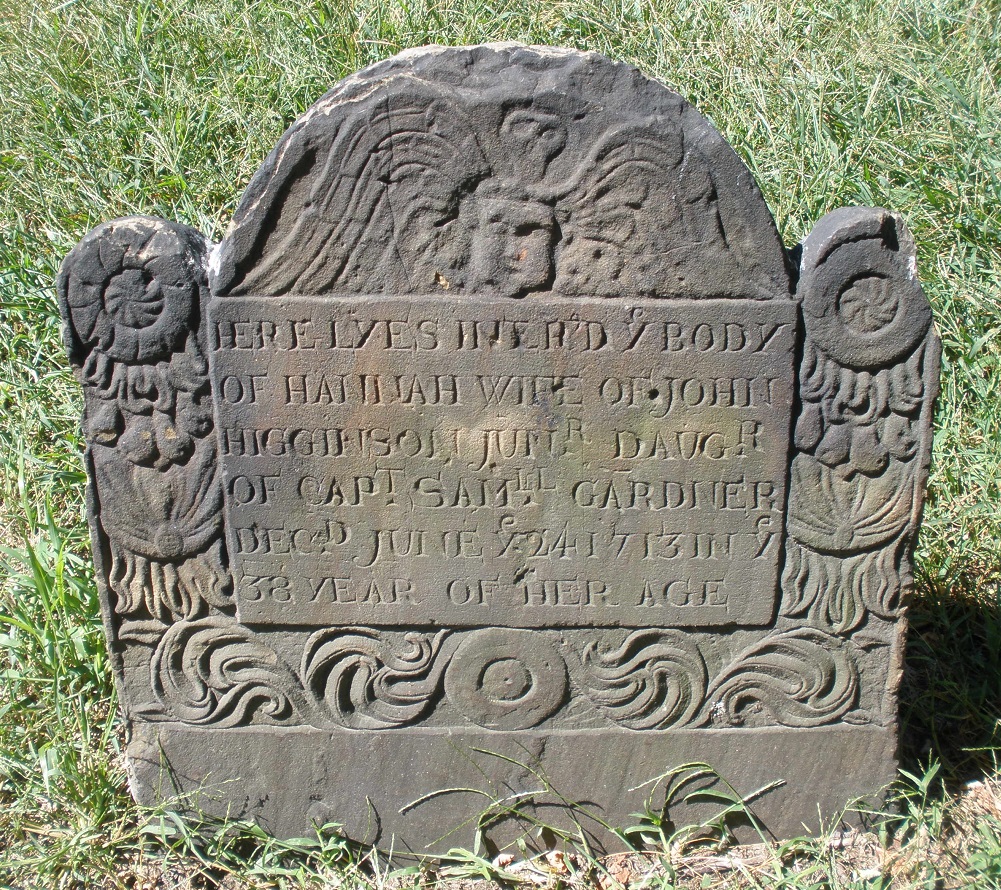
One of the great-grandsons of Rev. Francis, John Higginson (WikiTree and #10 in book), married a descendant of Thomas Gardner. She was Hannah Gardner (WikiTree) who was a granddaughter of Thomas' son, George. They are ancestors of many Higginsons. However, Col. T.W., while a descenant of John, is not a descendant of Hannah who died. John's second wife was the ancestor. 

Hannah's gravestone was recently cleaned using a new method. She was buried in Burying Point Cemetery (FindAGrave #8141517). There are 32 Higginson and Gardner graves in that cemetery including that of her husband, John, and his ancestor, Rev. Francis. 

---

The graphic shows "Gardner" in his book and "Higginson" in Dr. Frank's book. There are many more overlaps than shown with these looks at the index of their books. Modern techniques will allow us to look at this. 

We got our attention drawn to Col. T.W. in that he came out to KS during the pre-Civil-War era to support the Free-State movement. He gave support to John Brown by being a member of the Secret Six (Wikipedia - our post) along with Sanborn and others. He supported the Old Planters Society from its beginning with Frank A. Gardner, MD.  

The Higginson family was of the Old Planters of Massachusetts and has ties to many other families, including Gardner. Later in this post, we look at Harvard connections. 

Col. T.W. gathered data and wrote of the family's genealogy in the same time period that we saw lots of family histories being written, as these were motivated by the 300th anniversary.  

---

With respect to the culture of Massachusetts, in general, we will be doing research in that area, such as we have with our look at the History of Harvard. Our first focus is on the Heads of Harvard. We started this work after reading about James Bryant Conant. 

Col. T.W. was a graduate of Harvard, as was Dr. Frank. On the post about Col. T.W. that we did here, we included three pages of images from his book which show reference to Harvard University (or College). The two were John Thornton Kirkland and Abbot Lawrence Lowell. 

Two Presidents of Harvard

The Higginsons are still around as are the Gardners and others. This post is a beginning and looked at some aspects of their history over the 400 years. Lots more is there to look at. 

Example: Used Swift, Worth, Higginson and Gardner with respect to blended families. We had several cases where a Gardner mother was one of a series of spouses leaving us step-relationship to figure out. 

Remarks: Modified: 12/18/2022

09/29/2022 -- Added link to the "Blended family" post. ... Also, Hannah was the granddaughter of George, son of Thomas and Margaret (Frier) Gardner. 

12/18/2022 -- Site with the wigwam image disappeared. So, grabbed a copy from the web's memory. 

Sunday, June 25, 2017

Gardner's Beacon, Vol VII, No 1

This issue of Gardner's Beacon reports on several research activities of the last six months. These will be covered in more detail the next issue of The Gardner Annals (to be published later in 2017).
Vol. VII, No. 1
  • The Old Planters Society - At the first meeting in 1899, Col. Thomas W. Higginson gave an introduction about the motivation which had been summarized by the organizing committee. 
  • The Massachusetts Magazine - The TMM ran from 1908 to 1918. All issues have been digitized. The Gardner Annals provided Table of Contents for the first five Volumes in the issue of December of 2016. In the next issue, the remaining Table of Contents will be covered. 
  • TMM - Contributors - As well, there will be commentary on authors and articles. First up are F.B. Sanborn, Col. Thomas W. Higginson, and Judge Francis M. Thompson. These three were of the 19th century and had remarkable careers. Col. Higginson supported John Brown, brought help to the Territory of Kansas in its pre-Civil War struggles, and led the first colored regiment during the Civil War. He also was a correspondent for The Atlantic and a regularly interchanged mail with Emily Dickinson. Of course, Dr. Frank was central to the theme. His sister, Lucie, reported on meetings of family associations and carried forward work of Sidney Perley.  
Additionally, there is reference to the new URL, namely TGSoc.org. At this site, we will adapt a new format. While this activity is in process, the old site will be considered heritage (archival). Plus the new site will be the mail handler for the organization (contact - algswtlk@TGSoc.org). And, this year, we will print the first two volumes of The Gardner Annals with the first three volumes of Gardner's Beacon. We will announce when these are ready to be purchased.

---

See Vol. VII, No. 1 of Gardner's Beacon for a review of research to date.

Remarks: Modified: 03/03/2019

07/03/2017 -- Forgot to mention Rev. John Wise in the above writeup.

03/03/2019 -- We're building an index via images on our portal to truth.

Sunday, December 25, 2022

New Hampshire

TL;DR -- ME has been in sight since the beginning. NH only has had passing reference as we studied Cape Ann in relation to 400 years. They have 2023 for their commemoration, as does Gloucester. We look at a few of the posts over the years that mentioned our scope. In our future research, we will balance the view across the local territory and further, in this context: the long reach of New England.  

--

We have had a 400th focus for a while as we watched other celebrations (Plymouth - 2020, Weymouth - 2022). Gloucester comes up in a few days. Our start was with a focus on Cape Ann and Essex County. 

Then we extended our view to MA and New England. Incidentally, ME was involved due to its association with MA. After looking at the long reach of New England in the interior and the west of the U.S. and around the world, we now have a U.S. focus through the 400 years where we consider details through time of the other colonies (like New Spain) as well as the events related to populating the interior (Frontier century).  

Recently, while looking at the Northwest (as seen in the time of the Revolution), we saw Rhode Island being represented out west, in the form of a Governor of the Territory of Michigan. Having looked at the family involved and tying things back to Massachusetts, we thought to fill in the gap by looking at a family that had long been in RI (see H.P. Lovecraft). We had mentioned that we needed to bring in the surrounding States, such as CT (a little later), NH (which we had already touched upon), ME (which we have covered many times) and VT (already noted in looking at western movement). We will get these posts better categorized and related as we work the 400s going forward. RI and CT do not come up on the 400th list yet, that we know of. We should have looked north, again. 

Today, we saw (on FB) that the northern neighbor whom we associate with Rev. Bachiler is on the 2023 list. That was good to find out. We will spend more time researching the Rev. and his cohorts, but he was mentioned recently in this post (see Two Houses) which was motivated by research on New Hampshire families where it was noted the Gilman family was of interest with regard to the Revolution (both sides, plus the Society of Cincinnati). Nathaniel Ladd was one of the builders. We also had looked at the Dudley family who hung out there. 

Rev. Hubbard, friend of the family, weighed in on the controversy of when did NH start. John B. Sanborn (several posts) was born in NH. Sam Webber, Head of Harvard, was born in Essex Co, MA, but his family moved up north. Lots of Ann's folks did the same. 

Hence, in a few days, we'll have another commemoration to add to the list. As well, we need to find a time line for NH similar to the one for MA. 


This was a great reminder as it expands the scope at a good time, that is, when Essex County starts its long-awaited commemorations. 

Remarks: Modified: 12/25/2022

12/25/2022 --


Saturday, June 17, 2017

Judge Francis M. Thompson

Next up is Judge Francis M. Thompson of Greenfield, MA. This post continues our review of editors and contributors to The Massachusetts Magazine (started by Dr. Frank). Earlier, we looked at R.A. Douglas-Litghow, MD, LLD, F. B. Sanborn, and Thomas Wentworth Higginson (Thomas brought troops and supplies to Kansas in 1854 from New England, among other things).

Among other accomplishments, Francis was author of The History of Greenfield (Vol I - google.com, Vol II - archive.org). We will look at that.

For now, we want to list the articles published in the TMM, in order of their appearance. Both Thomas and Francis were out west prior to the Civil War. Francis spent more time and was a pioneer in Montana. So, there is a lot to cover.

The articles were titled "Reminiscences of Four-Score Years" and started to appear with Volume V.
We will go through these in more detail as they pertain to the westward expansion. The Montana Historical Society Press published Francis' story (2004): A Tenderfoot in Montana. The reprint mentions that the text came out of The Massachusetts Magazine.


Remarks: Modified: 07/08/2022

06/17/2018 -- F. M. will be featured in The Gardner Annals, Vol. IV, No. 1. 

03/07/2019 -- Added image from this post to the index on our portal to truth.

10/28/2019 -- Mentioned the Judge in a comment at this post: Seeking refuge in the valley

07/08/2022 -- We're adding new material to another post and will link in here. The WikiTree of his father, John Thompson (Thompson-35810). F.M. is the 8th generation. 

Sunday, February 11, 2018

Ground zero

Last time, we mentioned that January 1918 was the last publication of The Massachusetts Magazine. For possible contributing factors, we mentioned WWI as the United States was sending troops to Europe by the summer of 1918. Armistice followed that same year.

Coverage of flu cases, 1918
Another factor was that some of the earlier contributors aged or passed away: Col. Thomas Higginson, F.B. Sanborn, and others. Dr. Frank had collected editors and contributors from the ranks of Civil War veterans and various New England Illuminati.

Given the recent reminder, we must add the Spanish Flu. It was first observed in Kansas (Fort Riley) in March 1918. The map is from the Stanford University article on the pandemic (page has stale links, to be resolved). Not long after, the virus was seen at Camp Devens which is outside of Boston and was established in 1917.

This was the pandemic where we see rows and rows of cots with sick soldiers. During this time, medical personnel would have been extremely busy.

The base was named for Civil War general, Charles Bevens, who was involved in several battles in Virginia.

Remarks: Modified: 07/29/2022

03/04/2018 -- NIH, in 2004, published an article by JM Barry (The site of origin of the 1918 influenza pandemic and its public health implications) who had researched and written about the flu pandemic in 1918. JM points to Dr. Loring Miner as having observed cases in Haskell County in January and February of 1918. By March, the flu heavily hit Fort Riley. Haskell County is southwest of Dodge City and is named for Dudley C. Haskell (descendant of Miriam Gardner) who had moved to Lawrence, KS with his family in 1855. Dudley was the namesake of Haskell Indian Nations University.

04/04/2020 -- A video with a good overview of the times and situations: 1918 Spanish Flu documentary.

07/29/2022 -- Noted that Dudley is a descendant of Thomas and Margaret Gardner through their daughter, Miriam. 

Saturday, July 8, 2017

Kansas and Lawrence

Kansas was a project of New England. Lawrence, in particular, got special attention. In Robinson Park in Douglas County, there is a plaque that commemorates those families who were involved. Some of these came as pioneers. Some came to help and went back.

Plaque, Robinson Park, Lawrence KS
The plaque contains the names of those in the first two parties. Col. Thomas Wentworth Higginson came in two years later with more supporters under the auspices of The National Kansas Committee.

1854 was the year of first arrival. Rev. Cordley covered this in his History (Final migration). Two years later, Col. Thomas Wentworth Higginson came in with more supporters (Reinforcements).

Those on the Oregon Trail went right below Mt. Oread for twenty years, before this migration started, after they left Gardner Junction (map) having split with the folks headed to Santa Fe. There was continuing use of the Oregon Trail for a couple decades after this event.

In 1943, Louise Barry wrote 'The Emigrant Aid Company Parties' which is available at the site of the Kansas Historical Society. In her article, she provides some details about each individual.

The next issue of The Gardner Annals will have more information about The National Kansas Committee.

Views on the National Kansas Committee: Eli Thayer, Thaddeus Hyatt, Kansas Historical Society, Col. TW Higginson, FB Sanborn, Kansas Memory, KU in LK, Master's Thesis 1923 (Relief Work in Kansas), ...

Remarks: Modified: 07/27/2022

07/25/2021 -- Missouri is where the carving of the great U.S. landscape started. Driven, we might add, by New England. A hole exists in American history, namely the Frontier Century. We need to work on that. We'll think of some piece to honor George Kimball III who died this month in 2011, cuz of Ann several ways. 

05/06/2021 -- City of Lawrence voted to return the Big Red Rock to the Kaw Nation. 

08/07/2020 -- In this post, we are looking at two disparate spots that share a name, however there are many points in-between. Like Eudora, KS. Where "The Wakarusa meets the Kaw" is on their history site and is an example of local lore getting some attention. See "Along the Western Trails."

09/19/2018 -- Kansas saw the first case of the Spanish Flu (1918), several place. One of these was Haskell County, named for Dudley C. Haskell (descendant of Miriam Gardner).

07/23/2017 -- For those in Louise Barry's article, we need to update their information. The Thomas Gardner Society will be looking at those who were involved with The Massachusetts Magazine plus other information related to our interest. 

08/13/2017 -- Posts on Lawrence (and surrounds): Trails West, Westward Ho, Blogging and such, Final Migration, Thomas Wentworth Higginson, Kansas and Lawrence.

03/12/2022 -- Hannah Ropes spends 6 months in Kansas with loaded pistols and Bowie knife. ..., Daniel Webster risks it all on the 7th of March. 

06/24/2022 -- Updated links to Eudora's website as topic continues to be of interest: A Ride to Kansas. 

Wednesday, October 12, 2022

Hector St. John

TL;DR -- Hector St. John is considered, again. He was here for the French-Indian affair, on the side of France. Came down to the British side of the colonial divide. Was a farmer and more. Then, was caught in the land of Loyalist or not; the British got him, took him back to England, where he finally was let go to go get his inheritance. But, he wrote of his experiences and came back as a French consul. Finally, he gets some attention. 

--

Our recent look at the "Secret Six" after considering "Blended families" got us back to The Massachusetts Magazine which was presented by Dr. Frank and friends, one of whom was Col. T.W. Higginson. In this research, we got re-acquainted with F.B. Sanborn who was one of the Secret Six and contributed to many publication efforts. 

Then, along with our review of the pre-COVID times, we were looking at our posts on F.B. (What is an American?). And, we ran across an old name. Hector St. John was the subject of an article or two by F.B. We mentioned something about Hector in our post (Early America, 2018 - notice that we put the Table of Contents to his book on his early travels in Pennsylvania and New York) and went looking for newer material. 

One is a biography on this site: Freedom: A History of US. Hector, of France, was old enough to have been in Canada with the French during the French-Indian affair and to later be in the British side of the colonial divide prior to the American Revolution. 

So, his stories will be great to look at, with its foreign flavor. 

He got a Yankee introduction and was here during the conflict. The British took him prisoner and shipped him back to England. Lots of tales. He got back to his family in France. They had some pedigree to note. 

This is from the Annenberg Learner: The outbreak of the American Revolution marred Crèvecoeur’s idyllic farm life. Suspected of harboring Loyalist sympathies, he was persecuted and threatened by his neighbors. He tried to sail for France to escape harassment and to secure his children’s inheritance, but both the English authorities and the Revolutionaries found him suspicious and made his departure difficult. After being imprisoned by the English, he was finally allowed to leave for France in 1780. 

Okay, let's do one more quote, same source: Once he had arrived safely in Europe, Crèvecoeur published a manuscript he had produced while in America. His book, Letters from an American Farmer(1782), was an account of rural life and travels through America told in the voice of a naive, rustic narrator. These letters of “Farmer James” became popular in France and England and, trading on the book’s success, Crèvecoeur became a minor celebrity. He was appointed a French consul to America and returned to New York in 1783. 

So, yes, this gent needs some attention. Not to detract from Lafayette and those others, like the Polish officer of note. We'll touch on them, too. 

Remarks: Modified: 10/12/2022

10/12/2022 --

Thursday, May 27, 2021

Memorial Day 2021

TL;DR -- Memorial Day started with a special focus but became much broader. We want to take that even further to all conflicts on this side of the pond. Before the 250th event, we supported the Crown during the time of the Colonies. Every year, we will have activity that relates to remembering those who died during a military conflict. 

--

No excuse, but we finally did our first post regarding Memorial Day in 2019. Then, we did another post last year as we faced an uncertain future. This is our third of a regular series. 

First, a recap.

  • 2019's post - two years ago, we had been researching a part of the family by trying to identify and locate all of the siblings in one generation. While doing this work, we found out that one of the sisters had married a Scotsman who served in the U.S. Army during the Civil War. Too, he was buried at the veteran's section of the Saugus cemetery. FindAGrave gave his Massaschusetts unit but had left his birth and death information blank. So, we went to look and found information about his wife. Using WikiTree, we filled in records for these two linking them to FindAGrave record for the husband: Walter A Ingalls with links to his wife and his daughter. Now, also, at her FindAGrave record we include information and a link to her WikiTree profile. Her mother was a Sanborn (see post today on a relative who was out at a Treaty signing in Oct 1865). We still need to research Walter further. At the WikiTree profile of her father, we have information about her siblings, some of whom have their own profile. 
  • 2020's post - last year, we finally got to looking at Greenlawn as well as Harmony Grove. Dr. Frank (see Veteran's Day post, 2019) is buried with family members (Ann's grandparents, aunts, uncles and others). Too, we had been looking at barriers to the western movement in terms of terrain. Later, we specifically considered how rivers were obstacles as well as being modes of transportation. We mentioned that the scope of the holiday had changed to include the Revolution. 
Now, this year, we have done much more research related to the centuries and the changes that they brought. That included getting more familiar with New France from which came lots of the land in the middle of the country and in the west. But, New Spain was there, too. The earlier post today looked at some New England presence. Formerly, we were looking at the trappers and mountain men as being early which is true in the far west. But, at the frontier's start, considering that it moved west as people came into the region, there were New Englanders getting the new land organized. St. Louis was the western point for this type of activity. 

At the same time, we have been looking at the conflicts with New France where the officers of the American Revolution were taught the military trade as they supported the Crown. Then, we had the major conflicts of the Revolution, the War of 1812, the Civil War and the WWI. However, there were many other battles and skirmishes which were under the Indian Wars, the War with Mexico which gave us Texas, and the conflict with Spain. All of these campaigns had casualties. 

We want to include them in our Memorial Day work. 

U.S. Military History (Wikipedia)

About not having this theme until 2019, the thing is that there is a lot of data to wade through, historical and family-based material to handle, plus the sheer size of these endeavors in manpower, costs, material, and a lot more. 

A day of the year might be useful for administrative purposes in terms of memory, but we will be looking at all of this throughout the year. 

---

With regard to Memorial Day 2021, we are prompted by the blog, Streets of Salem, to look at a work that identified all of those who were from the Salem area and who served during the Civil War. 

As mentioned, this type of work can be continuous where we report as we have interesting data collected. However, the occasional ceremonial days will help us keep the information organized. 

Remarks: Modified: 05/28/2022

05/31/2021 -- Added image for our portal. 

05/28/2022 -- Memorial Day, 2022 - An Osage Mission. 

Monday, September 12, 2022

Tours, of the real

TL;DR -- We are of the west and have been, for the most part. Though, the long arm of New England is always there. A couple of years ago, we looked inward after considering all of the naval modes that came about in the 400 years of interest. Or, if we were doing land studies, the wilderness was only a few hundred miles away. Lewis & Clark, thanks to Jefferson, opened a huge vista. There had always been those who traipsed the regions, early on with the Native Americans. Then, we had this rolling wave, technologically abetted, that ran over the landscape, carving it into pieces. Or trying to. Our upcoming anniversaries will allow us to relook (again) and to, perhaps, make ourselves and things better. 

--

This year, we ran across a photo of a cemetery. Looked to be New England. Or, any of the northern wooded  areas that abound. It turned out to be in the area of The Catholic Osage Mission which was established in 1830s to serve Native Americans who had been forced out west by President Jackson. This was the early group. Our post looked at the Mission and those involved. Of note was that this was on the KS side of the area, not the MO side (referring to a conflict that ensued three decades later). 

Today, their FB page pointed to a site (Woodbury Historical Tours - link only, no endorsement) which had an image that showed part of the Santa Fe Trail. On visiting the site, we saw an image which shows details of a very interesting trek that is planned for next month. The trek (technically assisted) goes from Kansas City, MO to Sante Fe, NM. In the image, one sees two major rivers. One is the Arkansas; the other is the Cimarron. We spent some time the past couple of years, looking at rivers as a boon and a bane. 

It is great to see this type of offering which we hope will become more prevalent in the future. The U.S. start is coming up (250th). The Frontier Century started a couple hundred years ago. Before then, we had the fur trade drawing people out west. One example is William S. Bent (Trapper, trader, rancher). Pertinent to this graphic (map) is Jedediah Strong Smith who met his demise somewhere in the area depicted by the lower part. 

JSS has a modern following that was organized in the Berkeley, CA area. David Woodbury (Historians discuss the Civil War) lives and works in the Stanford area. He is not leading this tour but has been active in publishing which caught our interest with respect to different attempts over the years. Say, TMM (Dr. Frank) which published some of the western visitors, like Col. T.W. Higginson or Judge F.M. Thompson. Or, even someone of the Sanborn family. 

One of our regular modes is to find New England connections in general followed by determining if there are further links to the specifics of Massachusetts, Essex County or Cape Ann. Woodbury was one of the initial investors and "comoverers" (quoting H.H. Crapo). Of course, a Woodbury is in Ann's lineage through Benjamin Brown Gardner, spouse of Lucy Foster Wilson Gardner which is part of the additional interest. Families moved far and wide over the years.   

Aside: We have done extensive research in the large middle of the country and have barely touched the whole of it. At the same time, given Essex County's shoreline, we have lots and lots of work to do with regard to the navalphiles. Then, there are the other cultures who were here, the various News (Spain, France, Sweden, and others). We like the middle given our landlubber modes. 

There were many trails. Later, before the railroads came in, we had attempts at systems for moving people and goods by coach. One of these was the Butterfield effort which leveraged off some work done by an Ipswicher of the Giddings family. But, we are getting ahead of ourselves. As we really need to fill in lots of holes with regard to those early families that came after Lewis & Clark left and around the time that Boone came in. 

Back to David Woodbury, he wrote a diary starting with the March 2020 inception of the lockdown. Some of his comments are funny, such as the references to the totally unrealistic views of some Zuckerberg - types (did I get that right?). And, these ones (immature lot) gave us the stupid web out of silly valley. For a while, Woodbury worked with Savas Beatie who seems to be out of Iowa. We ran into that state when researching what happened to the North American Review. 

We are regrouping and, so, expect more of these recaps that are motivated by what others are doing to help get the message out about American, its past and why it induces a dream state so readily. 

Remarks: Modified: 09/22/2022

09/22/2022 --  Added "no endorsement" with respect to the tours. We are researching the relationships.