Sunday, October 9, 2022
Secret Six, the rest
Wednesday, October 12, 2022
Hector St. John
TL;DR -- Hector St. John is considered, again. He was here for the French-Indian affair, on the side of France. Came down to the British side of the colonial divide. Was a farmer and more. Then, was caught in the land of Loyalist or not; the British got him, took him back to England, where he finally was let go to go get his inheritance. But, he wrote of his experiences and came back as a French consul. Finally, he gets some attention.
--
Our recent look at the "Secret Six" after considering "Blended families" got us back to The Massachusetts Magazine which was presented by Dr. Frank and friends, one of whom was Col. T.W. Higginson. In this research, we got re-acquainted with F.B. Sanborn who was one of the Secret Six and contributed to many publication efforts.
Then, along with our review of the pre-COVID times, we were looking at our posts on F.B. (What is an American?). And, we ran across an old name. Hector St. John was the subject of an article or two by F.B. We mentioned something about Hector in our post (Early America, 2018 - notice that we put the Table of Contents to his book on his early travels in Pennsylvania and New York) and went looking for newer material.One is a biography on this site: Freedom: A History of US. Hector, of France, was old enough to have been in Canada with the French during the French-Indian affair and to later be in the British side of the colonial divide prior to the American Revolution.
So, his stories will be great to look at, with its foreign flavor.
He got a Yankee introduction and was here during the conflict. The British took him prisoner and shipped him back to England. Lots of tales. He got back to his family in France. They had some pedigree to note.
This is from the Annenberg Learner: The outbreak of the American Revolution marred Crèvecoeur’s idyllic farm life. Suspected of harboring Loyalist sympathies, he was persecuted and threatened by his neighbors. He tried to sail for France to escape harassment and to secure his children’s inheritance, but both the English authorities and the Revolutionaries found him suspicious and made his departure difficult. After being imprisoned by the English, he was finally allowed to leave for France in 1780.
Okay, let's do one more quote, same source: Once he had arrived safely in Europe, Crèvecoeur published a manuscript he had produced while in America. His book, Letters from an American Farmer(1782), was an account of rural life and travels through America told in the voice of a naive, rustic narrator. These letters of “Farmer James” became popular in France and England and, trading on the book’s success, Crèvecoeur became a minor celebrity. He was appointed a French consul to America and returned to New York in 1783.
So, yes, this gent needs some attention. Not to detract from Lafayette and those others, like the Polish officer of note. We'll touch on them, too.
Remarks: Modified: 10/12/2022
10/12/2022 --
Monday, March 7, 2022
Secret Six
TL;DR -- History will be a regular topic as it relates to New England and families from that region, especially those with ties to the early times and Essex County.
--
A recent discussion on Quora got us back to a topic from several years ago that dealt with the period prior to the Civil War. By then, a wide swath of the Interior had been explored, if not settled though this was only a fraction of the eventual spread. In terms of the Heads of Harvard, we go to the pre-war period and stopped to regroup. This theme is an important one and will be reappearing on the topic list for some time.![]() |
The Great Emancipators WSJ 02/15/2020 |
We were introduced to the Colonel through articles about him when he died that Dr. Frank published in The Massachusetts Magazine. One of the authors was Franklin B. Sanborn. Both Sanborn and Higginson were members of the Secret Six who were Massachusetts men who supported the work of John Brown. One of the Six was Samuel Gridley Howe who was the husband of Julia (Ward) Howe who wrote the Battle Hymn of the Republic.
The Civil War was less than 100 years after the Revolution whose 250th commemoration is coming up. It was not long ago that we saw the 150th of the start of the Civil War. One connection to look at would be the generational aspects such as we see with our study of the fifth generation bearing the brunt of the split with England.
Remarks: Modified 03/07/2022
Monday, July 22, 2019
Julia (Ward) Howe
We're looking at relationships in terms of nature and nurture. In the former, there would be some DNA linkage such as being descendant from or having a common ancestor. Then, we have the slew of cultural relations. In the above, we saw that Dr. Frank links with Henry VIII through his sister and three of his wives. The graph is on WikiTree and was easily attainable since they compute these for featured Profiles with Henry VIII being the current focus. To isolate some of the other connections, we went and used Dr. Frank's great-grandparents.
This analysis is supposed to work with any two Profiles, however several failed since they had a restriction on 10 links (takes lot of computer time and memory). Today, we were reading an old review in the WSJ about 'Songs of America.' One in particular is the Battle Hymn of the Republic, with lyrics by Julia (Ward) Howe (Wikipedia, her genealogy). Julia's husband (Samuel Gridley Howe) was one of the secret supporters (they went underground as the Feds came north, following rumors) of John Brown (she used the tune of John Brown's body), as was Col. Thomas W. Higginson about whom we wrote three years ago. The Colonel worked with Dr. Frank and his sister on The Massachusetts Magazine. So, there is a relationship right there.
#7 is Rev. John Wise (Thomas Gardner of Roxbury), the inspiration for the Declaration of Independence according to Calvin Coolidge. Here is another view.
This is interesting as just two generations removed from Abigail is the Howe connection (see below). This type of analysis is not as easy as it looks. Many times, as in the case of Henry VIII, many links are computed and stored. The query is merely looking for a match within a few generations. WikiTree has been doing this analysis for awhile. It'll be worth while to see how many of those have been stored so that we can retrieve the information.
As well, this is a connection search which has fewer constraints than would the relationship one have. Now, to do a manual search, we can get both profiles (Samuel Howe and Abigail Swazey) and do an ancestor graph. Then, we can match up nodes that will show the common ancestor.
So, starting with these two, we go back four generations.
Since Samuel is younger than Abigail, we see that in three more generations for him, there is the same ancestor as two more generations for Abigail. So, Samuel's 5th ggp is the same as Abigail's 4th ggp.
Samuel's and Julia's time was the U.S. Civil War. Abigail was the War of 1812 while her father was the Revolutionary War and the French-Indian War.
BTW, the great-uncle of Abigail's husband, and his wife, were the couple who were featured in McCullough's look at the Revolutionary War. McCullough used the The Letters of Joseph Hodgkins and Sarah Perkins – Historic Ipswich to build a story.
One motivation for this [type of] analysis will be to write stories related to the extended family of Thomas and Margaret (Fryer) Gardner.
Remarks: Modified: 10/10/2022
08/02/2019 -- Looked briefly at Ezra Pound's link to Thomas and HVIII.
Wednesday, September 28, 2022
Rev. Higginson and family
TL;DR -- Cape Ann was a major start, after the dallying at Plymouth. Rev. Higginson had some 300 or so souls follow him to Salem. By then, the early party had moved from Cape Ann where Thomas Gardner was a lead in a crew who were to ship food back. Higginson was a preacher and wasted no time in getting started on that. His family? Interchanges twixt them and other families from Cape Ann and later. We start to look at this as an example of significance.
---
As the 400ths look back at the Cape Ann event, we see it as an opportunity to identify, organize, and perform research projects on a regular basis. The past twelve years with this blog and with Gardner's Beacon was an effort at establishing a proper basis which will allow us to work and write. One of the tasks will be to look at families in a manner to allow a more coherent view going forward than has been given us to date. Partly, we are saying that this time around, we have the gift of the net (good and bad) to work with. This post is about one such family.
---
Rev. Francis Higginson came over after Endicott and before Winthrop's fleet arrived bringing settlers on several ships. He was the one who wrote "we found a faire house newly built for the Governor" which we call the Great House that was constructed on Cape Ann and which was then moved from to Salem. See his book: New Englands Plantation; Or, A Short and True Description of the Commodities and Discommodities of that Country.
For further information on the Rev., we can refer to research by his later descendant, Col. T.W. Higginson, who wrote of the Higginson family. We take a further look at Col. T.W., below. Let's start a look at the family by considering the times and some of the ties with the Gardner family of Salem. In the Wikipedia post, Col. T.W. is quoted:
They would have to build their lodgings for the coming winter from scratch. These were some of the first settlers of the Massachusetts Bay Colony, the main body who would start coming in 1630 on the Winthrop Fleet. The Higginson Fleet set sail on the 1 May 1629, arriving in Salem harbor on the 24 June 1629, and was greeted by a small group of settlers, led by John Endecott.
![]() |
| The 1st year English Wigwam |
The bold/italics emphasis is ours. We had a post on the "First year" where we showed a photo of an English wigwam as envisioned by Dow, the Salem expert, during the 300th celebrations a 100 years ago. This type of housing went on for a while until there was an effort to coerce families into building regular housing. That was a distraction from the regular duties related to farming, fishing, et al.
---
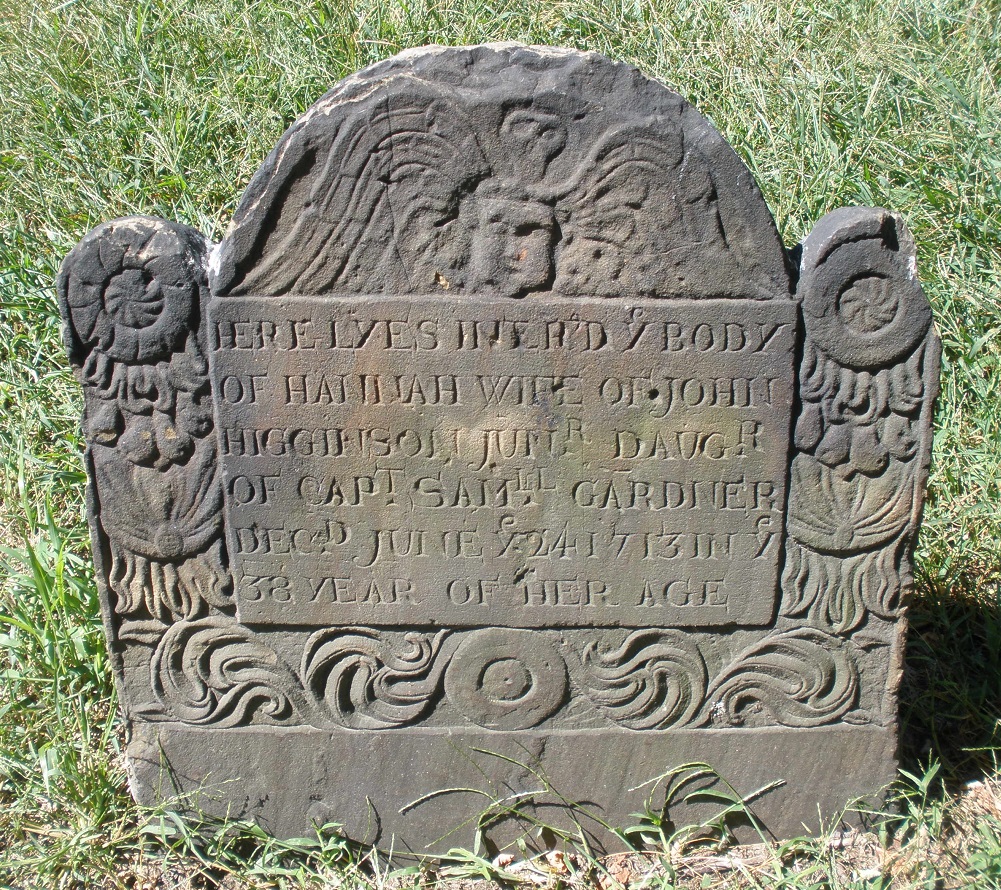
![]() |
| Hannah (Gardner) Higginson |
Hannah's gravestone was recently cleaned using a new method. She was buried in Burying Point Cemetery (FindAGrave #8141517). There are 32 Higginson and Gardner graves in that cemetery including that of her husband, John, and his ancestor, Rev. Francis.
---
The graphic shows "Gardner" in his book and "Higginson" in Dr. Frank's book. There are many more overlaps than shown with these looks at the index of their books. Modern techniques will allow us to look at this.The Higginson family was of the Old Planters of Massachusetts and has ties to many other families, including Gardner. Later in this post, we look at Harvard connections.
Col. T.W. gathered data and wrote of the family's genealogy in the same time period that we saw lots of family histories being written, as these were motivated by the 300th anniversary.
---
With respect to the culture of Massachusetts, in general, we will be doing research in that area, such as we have with our look at the History of Harvard. Our first focus is on the Heads of Harvard. We started this work after reading about James Bryant Conant.
Col. T.W. was a graduate of Harvard, as was Dr. Frank. On the post about Col. T.W. that we did here, we included three pages of images from his book which show reference to Harvard University (or College). The two were John Thornton Kirkland and Abbot Lawrence Lowell.
![]() |
| Two Presidents of Harvard |
The Higginsons are still around as are the Gardners and others. This post is a beginning and looked at some aspects of their history over the 400 years. Lots more is there to look at.
Wednesday, March 4, 2020
Magazines and people
Earlier in the year, Ida Tarbell was featured in a review. She, too, is of New England through her father. We will have more about her through time. Now, though, we need to mention The American Magazine which she founded with friends, including Phillips, after leaving McClure's. They converted an existing magazine.
Why the interest in magazines? Partly, Dr. Frank's effort is a factor, however we have researched several families involved in this type of effort. Of course, we know of The Atlantic Monthly. But, as the WSJ review noted, once the majority of the populace could read, they wanted to do so. Magazines filled the bill.
![]() |
|
WSJ Feb 15, 2020
|
In that same WSJ review collection, there was one about a book that looks at the Grand old Party. It's founding was in 1854. When we talk American 100s, included is a suggestion that locales are important to the essence of the U.S. (Locales and their history); hence, we have several posts related to places and names, though we ought to extend the range for this type of post.
GOP. In the book, there are three references that can catch our eye. We have mentioned all three: Brown, Stearns, Higginson. In what context? The Secret Six. These were supporters of John Brown who got the attention of the Federal law-keepers after the Harper's Ferry ordeal (Col. T.W. Higginson, Julie Ward Howe's husband, and F. B. Sanborn, among others). The book reviewer notes that TWH is not given as much attention as he ought.
Of course, there are other book reviews published on a regular basis. We have done a few ourselves and ought to do more: Albion's Seed; The First Seventeen Years, Virginia; Chronicles of Old Salem; Such men are dangerous ...
03/04/2020 --
Tuesday, July 10, 2018
Jedediah Strong Smith
The Judge's sojourn to the left coast and back, plus Col. Higginson's travels out to the wild west, are examples from a long period of history leading to now. We were just digging yesterday into the 'Sooner' events that were associated with the 1893 Land Rush where the Cherokee Territory was parceled out to a greedy bunch of people. There are tales to tell; fortunately, the www allows people to publish what they know. The usual caveats are in order, albeit that the Thomas Gardner Society would like to be involved with efforts a providing a 'clean, safe' web source.
You see, from the research mode, there are many things to discuss. However, a triad of culture, history, and genetics/genealogy rises to fore, in our opinion. These will be discussed further, as we go along. Culture is a human trait of long-standing interest. So, in a sense, memes trump genes? Well, lots to look at, however history does have a huge role. Actually, it deals with people and their dealings. People, of course, are the major players, but each generation comes and goes. We have to look at the broader scope of things. Humans have many cultures, most of which are age-old.
Both Thompson and Higginson were late, comparatively, to the subject guy. They were around during the pre-Civil War times. And, both were heavily New England in pedigree. One thing to remember is that after the Revolution, we had lots of people coming here. In fact, D.A.R. has many members whose patriot ancestors came sometime in the 18th century prior to the uproar. But, we also had the Spanish here for a few centuries by that time. And, people came from all over.
Just like now. And, given some of the discussions that we see, we really need educational thrusts related to the hidden history of the U.S. So, let's go back a few decades prior to these two guys. One of the early explorers, a mountain man, was out west in the 1820s. He started in St. Louis working in the fur trade business. Then, he went west and covered a whole lot of territory. He took notes, drew maps, and even wrote letters. And, he has a New England pedigree which needs to be researched further. We looked at some reports and provide a brief list of families: Smith, Strong, Partridge, Mather, Ingersoll, Langley, Adams, Kilborne, Foote, Eddy. Like many, he has oodles of cousins.
Jedediah did not have descendants, but his siblings did.
---
Now, let's switch to an example society that is doing very good work. In 1957, a group in California decided to found a group to research this guy and others like him and more. This is their website.
Being brief, just like the NEHGS helps lead the way, the JSS shines, too. Jedediah Smith
![]() |
| Area where Jedediah was killed, 1831 |
As we look at the filling in of the middle of the U.S., we can look at what was going on in New England. Like we know of Higginson, that he was one of the secret supporters of John Brown. By that time, there was regular publishing in eastern papers of articles sent from the west. Jedediah was before any of that.
His death was in 1831, in Kansas. There is a river that runs out of New Mexico into Colorado and then wanders east until it meets with the Arkansas River that comes out of Colorado, too. He was killed while drinking water from the Cimarron River during a parched time. His body was never found, however reports of his death traveled back quickly. In that area, they were laying out the Santa Fe trail.
---
It might be of interest to mention, now, that Jedediah and his crew were the first U.S. citizens to cross the Mojave Desert. And, this was in the summer.
After being detained and questioned by the New Spain Governor, Jedediah went north.
![]() |
| Jedediah maps out the Interstates |
There are similar maps of other areas created by researchers who have been studying Jedediah and his times.
---
As an aside, the JSS still uses checks for their membership payment and contributions. They have a nice newsletter, too, and published papers.
---
Jedediah was forgotten for a long while. One article is noted as having been written in 1922 by a grand-nephew who lived in Kansas not far from where Jedediah was slain. But, once the JSS was formed, it has been in action to get Jedediah recognized.
---
We see a similar role with regard to Thomas Gardner and the Cape Ann crew, especially with regard to the Old Planters Society. That is, do not let the world forget early New England. Lots of research has been done the past 100 years or so. Too, there is a huge stack of pending research. Using the www for coordination goes along with its purpose and facilities.
Remarks: Modified: 12/11/2022
Monday, January 2, 2023
Summary, 2022
The following shows the order of the popular reads by two criteria. "All time popular" goes back to the beginning of the blog. "Recently" covers post reads within the past 30 days.
Wednesday, August 9, 2017
Research for next issue of TGA
- Last time, we looked at Volumes I through V (reprint of article, link to digitized version) of The Massachusetts Magazine. That was really a cursory first look. While going through Volumes VI through XI, we took time to dive into all of the issues. So, we will provide a look at the Table of Contents, again. However, we will start to report on the dive. The next few bullets summarize some of the findings.
- Turns out that the co-editors of Dr. Frank were elderly. This time we got to look at Civil War veterans, including their activity prior to the onset of the major conflict. One example is Col. Thomas W. Higginson who was part of the Secret Six and who helped the western cause related to anti-slavery. The Colonel sent dispatches back to an eastern newspaper; hence, we have this personal view to digest. Then, we have Judge Francis M. Thompson who west as a young man following the path of Lewis & Clark. He wrote of his experiences. The State of Montana, recently, published part of this. The Judge returned to New England where he died. Franklin B. Sanborn left us several views of the times. These three are only part of the writers that Dr. Frank collected to support his magazine.
- Sidney Perley, the noted author, retired about the time that the TMM got started. Dr. Frank's sister, Lucie M, picked up his work and published in several issues. As well, she reported on the activities of lineage groups, including The Old Planters Society which used the TMM as its voice.
As a reminder, The Atlantic (Monthly) started in Boston in 1857. It moved to DC recently. There have always been new magazines starting.
The TMM was only one of several periodicals that started and had its day. Going back to the 1800s, we can look at two that related to our work. The Southern Literary Messenger had an illustrious set of editors, starting with Poe (of the Raven). Its run was from 1834 to 1864. We are interested in that it involves collateral families, is of VA, and had contributors from all over. One article on the Lyceum movement is an example. It was nation wide. New England played a heavy role. But, we see groups formed out in the western areas (which became states), too.
Then, we have a story that is New England to its core. Namely, learning about Count Rumford. Born in New England, he left due to being a Loyalist. Now, he did pioneering in thermodynamics. Actually, as a polymath, he worked in several areas. Did well. Got rich. Then, left monies to Harvard. After the first holder (Bigelow) of the Chair resigned, there was much discussion about the future use of the monies. So, we can look at this from several angles. An interesting twist is that Charles W. Eliot was supposed to get the Chair and did not. He went to Europe. Later, he was head of Harvard. And, made lasting changes.
Remarks: Modified: 08/09/2017
Wednesday, June 14, 2017
Thomas Wentworth Higginson
Today, I saw that several authors, including F.B. and Dr. Frank, had written about Thomas after he died (TMM, Vol. IV (1911), No. 3, pg 139). F.B. noted that he had corresponded with Thomas in regard to a topic that we addressed earlier (Final migration), in a different context. We quoted Cordley's book about the early efforts to found Lawrence, KS. There have been several posts about the long reach of New England into the western part of the country.
F.B. gives us a deeper look at the activity of Thomas in this regard. He helped form the State Kansas Committee. He was an active abolitionist. One motivation was the Charles Sumner attack. Charles was beaten in the Senate by a Southern Representative (1856). Too, Thomas, personally, knew, and admired, John Brown (more on that later). And, events in bleeding Kansas had gotten more violent.

There were several names for the Committee, such as The National Kansas Committee, as reported by The National Magazine, in Vol.17 (1893). Wikipedia does not have a page for this activity which is an oversight to be fixed.
Related material at Territorial Kansas On-line.
Thomas printed his notes and letters (in the New York Tribune) from his 1856 visit to Kanzas. Thomas stopped in several towns and wrote a lot of Lawrence. He gives us a view of the area just prior to the Civil War which ensued, largely, from those events out west.
We will look at all aspects of Thomas' life. He is [almost] a descendant of Thomas Gardner of Salem. Thomas was also first President of The Old Planters Society.
- Note: 03/07/2022 -- Thomas' grandfather, John (#10, pg 13), married, in 1695, a descendant of Thomas and had six children. She died in 1713. His second wife was the mother of Stephen, father of Thomas.
Then, we show the association of two of his great aunts with Harvard men: John Thornton Kirkland and A. Lawrence Lowell.
![]() |
| Higginson and Harvard |
06/15/2017 -- Thomas donated his files related to Kansas to the Kansas Historical Society. Story of His Life (1914) by Mary Potter Thacher Higginson. "Kansas and John Brown" from The Writings of Thomas Wentworth Higginson.
07/11/2017 -- In 1929, a plague was put in a park in Lawrence, KS. It lists the names of the members of the first two parties. Thomas W. Higginson arrive two years later.
07/12/2017 -- Sanborn and Higginson were in the Secret Six.
08/13/2017 -- Posts on Lawrence (and surrounds): Trails West, Westward Ho, Blogging and such, Final Migration, Thomas Wentworth Higginson, Kansas and Lawrence.
03/07/2019 -- Added image from this post to the index on our portal to truth.
09/16/2019 -- The Colonel wrote a book on his ancestor, Rev. Francis Higginson, who is buried in the Charter Street Cemetery in Salem, MA.
Monday, June 5, 2017
Franklin Benjamin Sanborn
There are many more, but let's look at F.B. Sanborn (updated the Wiki page with a pointer to the Massachusetts Magazine - See Remarks, 10/09/2022) who popped up as we were looking at, and digging into, the minutes of The Old Planters Society of Salem. In 1916, F.B. gave a talk about Hector St. John, calling him an evasive planter. The story is interesting.
It is interesting that Hector was the namesake of St. Johnsbury, VT through his friend, Ethan Allen.
There will be more in the upcoming issue of The Gardner Annals.
Too, we will bring forward all of the Old Planter Society minutes that we can find.
---
F.B. was remembered in TMM, Vol. X, No. 4.
Remarks: Modified: 11/16/2022
06/14/2017 -- F.B. corresponded with Thomas Wentworth Higginson.
07/12/2017 -- The Significance of Being Frank. ... Sanborn and Higginson were in the Secret Six.
06/04/2018 -- Added the snap from The Massachusetts Magazine Vol. X, No. 4.
03/07/2019 -- Added image from this post to the index on our portal to truth.
Monday, November 7, 2022
Veterans Day
TL;DR -- Veteran? We forgot the connection to 'Armistice' that was there in the beginning. We have covered topics related to this theme from the beginning but mainly point to the work of late. Related to the conflicts are the generations involved. A chart looking at the timeline rolls several generations together in a range of birth years. Our view, taking that route, tries to pull out this detail, such as the 5th generation (say, from Cape Ann) bore the brunt of the Revolution while the 4th led, and some of the 6th participated. In any case, we can see the endless nature of this aspect of ourselves.
--
In the spring, we have started posts related to Memorial Day (2019, 2020, 2021, 2022) which occurs on the last weekend of May, in the U.S. The holiday, early on, had a Civil War focus. Some of our posts were of that category: Jonathan Letterman, Young captain, Secret Six, STL to SFO (using a modern vernacular), and others.
We only have had one with a Veteran's Day theme: Dr. Frank's burial place. Given the memorial focus, we also have had several posts on cemeteries and their issues: Howard Street Burial Ground. Several posts were involved with the theme of "Where is Thomas?" that involved a decade-long quest to understand what happened to the old burial plot noted by Sidney Perley and others.
In particular, the focus of Veteran's Day is related to military service and the sacrifices thereof. Originally, this day was a remembrance of World War I: Victory Gardens, Ground zero, Frank Balch, James Bryant Conant, and more.
Indirectly, we have mentioned other conflicts of a wider, than personal, nature. After all, the tragedies and turmoil of the western movement were huge individually and collectively. We who look back have no notion of the extent of this (say, pondering the English Wigwam of early New England). Too, conflict with the American Indian was almost constant.
Yet, there have been major conflicts that impacted the whole of the U.S. from before and after the frontier century. We are coming upon the 250th of the Revolution (see SAR/DAR). After that, there was the continuation in the events of the War of 1812.
These recurrences are generational in scope. We will spend more time looking at this. The fifth generation bore the brunt of the Revolution; the sixth endured the 1812 problems. In general, generations will be of interest an almost uncountable number of reasons. The existence of Mayflower data has brought to fore several types of analysis: About generations.
So, to the theme of the post, what is a veteran? We have the general definition related to being old or experienced. But, the norm now ties the word to a military usage, hence the Department of Veterans Affairs of the U.S. Rather than point to the [dot]gov site, we let Wikipedia show its stuff with respect to coverage of something.Today, on Facebook (which seemed to come from the blog post that references Flickr which shrugs its shoulders (404) - we need a new focus - show provenance, give credit), I saw this chart which shows the conflicts which the U.S. has been involved with. Then, for each, it provides the expected birth year and a range. At the same time, the span of time for serving in the military during the time of each conflict is given.
The chart only goes to the Vietnam era. There, participants were born from 1914 to 1955. As we saw, there were some WWI, but mostly WWII and Korean veterans were serving in the military. The civilian population had a different mixture. Over a two-century span (remember, the Viet event is the context), the nine conflicts amount to over four conflicts per century which maps to conflict one per generation.
Let's see, has that carried on or accelerated?
We will continue to help document details from these past conflicts as we go forward with the several observances that are annual. At the same time, we have to bring in the world view, starting with our British cousins. Four hundred years ago, while our forefathers dabbled in a new environment and survived, that old world shook continually with conflicts, large and small. Some of that tension came over here over the long period.
11/12/2022 -- We will follow one veteran and his spouse as they venture west over the timeframe that included the Civil War and events before and after. That, too, brings in New Spain and New France.
Tuesday, December 19, 2023
New Frontier, 21st Century type
TL;DR -- Technology is one of our themes. History and genealogy are a couple of others. General interests in the 400ths and the 250ths are others. Like, Gloucester MA did its 400th this year. There will be others over the next few decades. And, the Boston mayhem on a ship is now 250th.
--
We were toying with various avenues of research which are endless in the modern age of the "cloud" despite its shortcomings which are many. For instance, in the western movement, we have looked in the vast interior and along the coasts. CA was a theme last year: LA and SF. We have looked at the middle of the country several times, in terms of the frontier and its settlement. In every case, we try to tie back to New England. As well, we are building a timeline by people and events that emphasizes individuals who are not in historical accounts and their families. That type of work will continue.
So, today, let's take Minnesota (MN) and Kansas (KS). Both are west of the Mississippi River. MN is north of St. Louis which is, for us, the focal point of the dividing of the land. KS is about the same level. The northern realm has a different dynamic which we have started to study, through the Michigan Territory. KS was on the way west. For instance, the trails run through the State. Lewis & Clark (1804) came up the Missouri River on their way west.
![]() |
| Cottage, Round house, Frontier in the making |
In MN, the town of White Bear Lake is named after its lake. We have run into MN several times in our research and skirted around details. But, for today, let's look at a famous cottage (ca 1868). It was built for Charles Phelps Noyes. His wife was Emily Hoffman Gilman. They're kin of lots of New England families that we are studying. That is the right time frame for some reflection on the Revolution (which was the 5th generation's deal) and on current themes. One thing to note is that Mark Twain liked the area so it got some press.
Aside: recent post on Little Exeter NH (where two esteems of technology - and AI - went to school. The Society of Cincinnati has a house of repute in the area.
In KS (and elsewhere), as technology, which is our focus, improved, the railroad replaced earlier modes of transportation. Several lines ran through KS from both directions. But, the photo is in the extreme southeast corner, in the little town of Cherokee. There were strip mines for coal in the area. What did these old iron horses run on? The photo is of a round house (ca 1888) which served several purposed. For one thing, one had to change from north to south, etc. Go to San Francisco and see these in action as the rail cars get switched to return. So, we'll have lots more about that area of the country that became the flyover country, later. We have shown, and will continue to do so, that the history of the country runs through the middle.
Now history and genealogy? We are talking about an organization whose membership included John Quincy Adams. We had an earlier post about his cousin, Grizzly Adams, and a few others. They are offering a webinar on Using AI in Family History Research.
What they meant to say is that they are going to show technology that can be put to use. We are going to use AIn't to keep the discussion going that this state of affairs does not offer sentience nor intelligence in the important sense. It is very easy for the imagination to run wild with respect to these things; that is a human trait that we can value.
But, as the NEHGS (their real initial) adds, in this:
She will also address aspects of AI that genealogists should be cautious of, such as accuracy and copyright concerns. Join us as we explore this exciting new technological frontier!
Okay, we'll take that. But, let's go further. The tricks are being done in a manner that we can understand as it's applied mathematics. People have been lazy and have let things get too loose. We will not use "fuzzy" as that is a legitimate logic and algebra. We will touch on that more.
In the meantime, our thrust over the past decade is to fill in the 400 years of all sides (New Spain, New France, New Sweden, ..., Native Americans, ..., New England). Plus, the 250th of the U.S. is coming up. What happened recently? The 250 of the Boston Tea Party. Nope, it wasn't with china and crumpets.
No, we're talking illegalities. Dumping someone else's product in the water. BTW, Samuel Adams, cousin of John whose son is mentioned above, was a participant. You know, later, we had John Brown. Guess where he was? KS. Also, who were his supporters? New England. So, we have a post on that as the Secret Six had to hide out when the Uncle Sam found out that the rebel was being kept by a few brave souls, one might say.
So, yes, we will do history. But, too, we will continue our support for discussing and using STEM plus. What is the plus? Kant, for one. If you don't know him, you'll hear from us. Stay tuned.
Aside, again, some think that the revolution was done by rabble rousers. Well, not. If we look, the King trained the men who took him on via their support of his French Indian affair. That was the 4th generation who supplied the leadership for the most part. But, the 5th bore the brunt.
Remarks: Modified: 12/20/2023