Showing posts sorted by relevance for query long reach. Sort by date Show all posts

Friday, November 11, 2022

Trails and tracks

TL;DR -- Trekking on the Santa Fe Trail started in 1821 at St. Louis MO. The traffic grew during the years up to the Civil War. Post the conflict, the railroad made its incursion which ended the majority of the traffic. Some still had this as their only recourse. However, the terminus of the Santa Fe Trail was on another trail that had been in operation since 1598 and was in New Spain that will be a continuing topic in our look at the long reach of New England. Too, going forward lots of effort by conservation groups has saved artifacts from the earlier periods. This focus will continue to be necessary.  

--- 

For awhile, we have been looking at the many commemorations that are in progress or will happen. The Cape Ann crew's arrival will be next up for the 400th. But, we have the 250th to consider, and even more, such as the 200th which is a few generations post the Revolution (250th). 

Last year was the 200th of the first trek by the eastern culture from St. Louis MO to Santa Fe NM along what became the popular trail. The trail went from the U.S., which had grown post Jefferson's purchase of the Louisiana Territory, to New Spain.  

To quote the Santa Fe Trail Association: "In 1821, the Santa Fe Trail became America's first great international commercial highway, and for nearly sixty years thereafter was one of the nation's great routes of adventure and western expansion." This association formed a few decades ago and has collected an astounding mixture of technology with which to tell the story of the times and the people who were involved. 

In terms of the later, they have been nominations for a Hall of Fame. On our review of the list, today, we saw many familiar names, some of whom are well-known characters of the American West, such as Kit Carson, Zebulon Pike, and more. The Bent family and others have been mentioned in this blog in the context of the long reach of New England. 

Also, the Association publishes a newsletter which is available online: Wagon Tracks (online list of issues). They have published since 1986. The latest issue (Wagon Tracks, Aug 2022) included an article on measuring distance traveled which looked at one invented by Ben Franklin. This article is an example of a technology focus which we will keep to the fore. In this case, miles were the enemy more so than others that are known, such as weather. We have looked at rivers and other waters as a means for travel as well as being a barrier.  

May 2021 issue of
Wagon Tracks
The image comes from an issue from 2021 (Wagon Tracks, May 2021). 

Another source for information is the Kansas Historical Society whose state is crossed diagonally by the trial. We have referenced this source before; an example was our earlier look at Col. Thomas W. Higginson who was from New England and was out in Kansas supporting abolitionism and John Brown.  

There are many persons to look at. Right now, let's consider Isaac Bowen and his wife Katie. He was in the military and brought his wife with him as he did his duties in several locations. She kept a diary and wrote to her mother on a regular basis. This is the KSH Overview of Santa Fe Trail Diaries - Katie Bowen. In 1996, the KHS published the diaries which is available for public reading: A Faithful Account of Everything. 

Their first visit out west was pre-Civil War and about the time of Col. Higginson. Post the conflict, there was another dynamic related to technology, the railroad. The National Park Service provides a timeline from 1866-1873 which is interactive and provide information by time and place with respect to the trail. As the railroad came in, people road the train to the endpoint of its rails and then continued in the mode of laborious travel. 

Unto this point, we have looked at New England and flow from east to west toward the southwest. We will be looking further at the northern route, too, as we take a deeper look at Oregon. Even up there, we will be considering New Spain as the extent of the U.S. was not the west coast until later. 

The Santa Fe Trail ended at a terminus of Camino Real in New Mexico whose existence needs more attention since it gets us more aware of European activity in Texas and points west. The trail used by Butterfield and others ran along those southern routes that were pioneered by New Spain and before them, the American Indians. The Camino Real is traversed today in a north-south direction from El Paso TX to Albuquerque NM. 

Just like we can see wagon wheel ruts today along the route of the Santa Fe Trail in areas where development has not blotted out the past, the same is true for those earlier travelers along the Spanish trails. An example can be see at Fort Selden with tracks along El Camino Real de Tierra Adentro still visible.  

Our interest is primarily New England but with scope large enough to cover the prior periods thoroughly. Our southern border, from TX to CA, has a lot of history still to be told, where generalization does not trump truth.  

The southern trail ran from 1820s to the 1880s. Putting this into the context of generations, that was post Jefferson's purchase and during the start of the push to the west where we had a century of frontier experiences in many places with results such as lost generations. 

Remarks: Modified: 11/12/2022

11/12/2022 --  We need to add New France into the triad in order to know how the U .S. is a phenomenal experiment in the experience of being, inner and outer. In other words, our focus will be on the long reach of New England but with a context filled in as only the internet will allow. 


Sunday, December 25, 2022

New Hampshire

TL;DR -- ME has been in sight since the beginning. NH only has had passing reference as we studied Cape Ann in relation to 400 years. They have 2023 for their commemoration, as does Gloucester. We look at a few of the posts over the years that mentioned our scope. In our future research, we will balance the view across the local territory and further, in this context: the long reach of New England.  

--

We have had a 400th focus for a while as we watched other celebrations (Plymouth - 2020, Weymouth - 2022). Gloucester comes up in a few days. Our start was with a focus on Cape Ann and Essex County. 

Then we extended our view to MA and New England. Incidentally, ME was involved due to its association with MA. After looking at the long reach of New England in the interior and the west of the U.S. and around the world, we now have a U.S. focus through the 400 years where we consider details through time of the other colonies (like New Spain) as well as the events related to populating the interior (Frontier century).  

Recently, while looking at the Northwest (as seen in the time of the Revolution), we saw Rhode Island being represented out west, in the form of a Governor of the Territory of Michigan. Having looked at the family involved and tying things back to Massachusetts, we thought to fill in the gap by looking at a family that had long been in RI (see H.P. Lovecraft). We had mentioned that we needed to bring in the surrounding States, such as CT (a little later), NH (which we had already touched upon), ME (which we have covered many times) and VT (already noted in looking at western movement). We will get these posts better categorized and related as we work the 400s going forward. RI and CT do not come up on the 400th list yet, that we know of. We should have looked north, again. 

Today, we saw (on FB) that the northern neighbor whom we associate with Rev. Bachiler is on the 2023 list. That was good to find out. We will spend more time researching the Rev. and his cohorts, but he was mentioned recently in this post (see Two Houses) which was motivated by research on New Hampshire families where it was noted the Gilman family was of interest with regard to the Revolution (both sides, plus the Society of Cincinnati). Nathaniel Ladd was one of the builders. We also had looked at the Dudley family who hung out there. 

Rev. Hubbard, friend of the family, weighed in on the controversy of when did NH start. John B. Sanborn (several posts) was born in NH. Sam Webber, Head of Harvard, was born in Essex Co, MA, but his family moved up north. Lots of Ann's folks did the same. 

Hence, in a few days, we'll have another commemoration to add to the list. As well, we need to find a time line for NH similar to the one for MA. 


This was a great reminder as it expands the scope at a good time, that is, when Essex County starts its long-awaited commemorations. 

Remarks: Modified: 12/25/2022

12/25/2022 --


Thursday, June 15, 2023

Hernando de Soto

TL;DR -- The west was won, as Hollywood says? Well not. It was carved up, though. Looking at research about De Soto's early journey (1540s) along the Arkansas River can give us some insight into the nature of the events that followed three centuries later. As one would expect, multiple views are there for us to look at while learning about American history and the long reach of New England. 

---

We like to follow the activity, virtually, of the Woodbury Historical Tours and have had several posts. We have posted and commented at the Facebook site. These are cousins of Cape Ann and Gloucester which is comemerating their 400th this year. 

Disputed paths, 
research views
They showed the following map from the Georgia Historical Society's article on De Soto's travels in the southeastern U.S. Several things caught our interest. For one, we are talkin the middle of the 1500s. Too, this deals with New Spain's reach. Then, this is part of the deal that the U.S. got with the Louisiana Purchase. 

Finally, looking at the left of the photo, we see Texas, Oklahoma, Kansas, Missouri and Arkansas. Not forgetting Louisiana, Mississippi, Alabama, Tennessee, and Kentucky, the Carolinas, plus Florida. Our view has been activity to the west of the Mississippi River. However, we will change that as up north of here, we will find Ohio and Michigan and other areas related to the great northwest. 

The legend in this view lists studies done about  De Soto. The U.S. founded a Commission in 1936. There were several reports. Let's look at one plus consider some of the human elements which are important to our studies. 
  • Final report of the United States De Soto Expedition Commission. This site is hosted at the University of Pennsylvania. The date is 1970. At some point, we can look more closely at the research. 
  • Soto, Hernando de, approximately 1500-1542. This page lists many sources for studying this person and his times. The following caught our attention. 
  • Scenes and Adventures in the Semi-Alpine Region of the Ozark Mountains of Missouri and Arkansas, Which Were First Traversed by De Soto, in 1541 (Philadelphia: Lippincott, Grambo and Co., 1853). Looking closely, we see that this deals with the travels of a geographer out of New England (its long reach is our focus). The following summarizes some of the personal details. 
    • Henry Rowe Schoolcraft (Wikipedia, WikiTree). Pick "Web presentation" which goes to a page at gutenberg[.]org's site where a book from 1853 is presented in a great format. 
    • The theme: Ozark Mountains of Missouri and Arkansas which were first traversed by De Soto, in 1541. 
    • Schoolcraft went to the area in 1816 and kept a journal. He provides fifteen chapters on his travels and turmoil. He spent three years doing his studies. 
    •  He provides more technical details (Mineralogy, Geology, and Mines; Geography; Antiquities and Indian History) in Appendices. 
Now, this is prior to the Missouri deal that also brought Maine into the Union. He got to St. Louis which was being set up as the headquarters for carving of the western land. 

As he travels, Schoolcraft references De Soto's work. Example: 

From the apparent vestiges in this quarter, I am of opinion that De Soto's "Tanico" must be located in this vicinity, and that he crossed the White river near this place. A march west of this point, over a hilly country, would bring him into the fertile valley of the Little Red river, or Buffalo creek—his probable Tula, where his people first tasted the flesh of this animal, and where he recruited his army for a new effort.

There are several things to note. For one, the White River that is mentioned can be thought of as related to Branson, MO. Most adults have heard of that entertainment area on the upper-west side of the Ozarks. Some mention Joplin in the same context. As the map say, "disputed paths" depicts the proper view, however we must not forget that this is real country of the U.S. settled, for the most part, after the Lewis & Clark expedition. 
One view, 
of many

Then, there are names given: Tanico; Tula. The image to the right provides some of these. The map is from the Georgia Historical Society's article. 

There is a lot to study and discuss. On a final note of the personal nature, the family of Schoolcraft's wife inspired Longfellow's poem about Hiawatha.  

 Remarks: Modified: 06/15/2023

06/15/2023 -- 


Friday, January 6, 2023

Charles Thomson, Secretary of the Continental Congress

TL;DR -- As we move to the 250th of the U.S. start, technology will be causing huge influences never seen before. Some of this will be good, some not. We will not know immediately. In the meantime, everyone using technology will be working to hone their mature use, for the most part. Philosophizing here? Not really. This is a looming reality. We can learn from the past, in many ways. Technology will help us, somewhat. Charles Thomson is a good example of what we can focus on. He was with the mythical crowd for years, in the background. Oh, sounds like work? Too, he came as an Irish orphan (his father died on the boat coming over right when they spotted the land around Baltimore MD). He then met the tests of the New World and came to be where the myth makers were pondering how things were, ought to be, and would be and such. Not really, it was chaos as we can imagine. Maintaining life and limb through such times. Or now. As Paine wrote: These are the times that try mens' souls ... 

---

This post is imperative, categorically so. Why? We all have heard of the American Dream and whether it is alive or not. Or, did it ever exist? Or, what ought it be? Well, the 400ths allow the opportunity. The upcoming 250th (split from the Brits) makes it even more important. 

Who is this Charles of the Title that we wrote about yesterday (Research and Learning)? Why write of him? The first motivation is that he was the Secretary of the Continental Congress during its years. Therefore, he was in the company of the big names of personalities that we adore. Who has heard of Charles? You see, he has no progeny. Some claim relationship. It's not clear how this will wash out. As you know, claims will not stand up without some sources whose provenance is legit. 

For me, I make no claims as I know when my ancestors came over (mid-19th century, post the Civil War). Too, having done this work of the TGS, Inc. now for a decade, I have a feel for the long reach of New England. Having lived outside of New England and the mid-Atlantic except for a few years, I can assess the long reach of New England throughout the middle part of the large landscape of the U.S. Too, looking at lineages, I have seen influences from outside of the locale, every generation, somewhere. The context is the extended family wherein we look at more than the thread that is of interest to the Hereditary Society Community organizations or DAR/SAR.    

Which gets us back to Charles? He's from Ireland. And, got his position through effort. Now, he came with his father and brothers. The former died on seeing Baltimore from sea. The latter ones? We will be looking into that, as we mentioned in the last post. Then, he has other family. The claims mentioned above are from a wide area. But, Charles was more than a clerk; he proposed a design for the Great Seal of the United States; he was a "Prime Minister" in a sense. He and John Hancock signed the Declaration of Independence. 

During Charles' time, there were many families coming to the colonies. So, it is fortunate that we can consider the times, and his position as a recent arrival, and, at the same time, look at what the cousins of various sorts were up to. As with the 300th last century, we will see stories arise to awareness needing some type of handling. Then, print was slow to spread around. But, think of the books written; many were good; some not (in fact, the repercussions for some took a bit of time to settle down). Now? The internet will make it worse. So, like then, we see this as Paine wrote: These are the times that try mens' souls ...  Be prepared. 

Aside: we need to update the Albion's Seed post (from 2016, see link prior paragraph) in terms of generations (say, the fifth doing the Revolution). In the book, the early folks were seen as being of a reconnaissance era, making the way for Winthrop. Up to the 1700, we need to pull these generations together with a tag, as the inflow picked up in the 18th Century. BTW, we'll map to going-ons in Europe (especially, England) and elsewhere. Of late, our focus has been the remote frontier that was beyond the Northwest Territory until we got our sea mode (see Water and air) moving again. 

That's our intent. I call it 'truth engineering' as a necessity that's been too long ignored. Perhaps, demonstrating the need and benefit through our work might be the proper avenue, for several reasons. 

Again, Charles? The following was used in a Harvard article on him (Course of Human Events blog - November Highlight: Charles Thomson). There is a link with the graphic. 

Declaration of Independence
Trumbull's painting

This painting is well-known.  Thomson is standing behind the desk (according to the Harvard article). As said, no descendant can claim him. Relations? Sure. Of late, we see copies of this painting where the gents are identified with markers that identify a descendant. This also has been copied with a descendant being in the same chair/position (see Different scopes) as of their ancestor's location at the event depicted. In one instance, multiple chairs were filled, with many left vacant. 

Question, can the chairs be filled with extant ones as descendants? Well, no, we can use Charles as an example of one with no offspring who had offspring (recurrently til now). His children died young.

We will see situations where families either already know their pedigree or will find it out. There will be creative use of the information. We need to take it back to say the time of Rev. John Wise who wrote words similar to what's in the Declaration document, over 80 years before. 

Another thing to remember is that this was early on. Lots of turmoil and suffering were coming down the pike. 

Remarks: Modified: 01/18/2023

01/08/2023 -- Added a few links to supporting material. 

01/18/2023 -- Author is descendant? To be looked at further. Independence, IA - Bulletin Journal: Charles Thomson, an American patriot. 


Friday, April 30, 2021

Two different times

TL;DR - The 400th can be split into the 250th plus others on both sides of that divide. There are many categorizations for analysis that do not get much attention in prior times. For one reason, we did not have the data nor the technology. That has changed this time around. Essentially, Gardner Research is setting itself up to follow the series of 400ths that we will be seeing in New England as each of the towns takes a pause to look back at their history. At the same time, we can look from the 250th onward with respect to these families. 

--

The overarching theme of 400 years of history is and will be our focus. Extensions? Well, there are various areas that we can learn more about. But, our first area was Massachusetts. All matters considered were from that focus with Essex County as core for several reasons. And, unless some conceptual modification comes into play, extending the boundaries of our views will be from the area of New England including both the north and the south. 

One impact of that will be always looking at how the long reach of New England came into play in any situation across the country. Actually, given our use of both north and south, we pretty much cover the basis. New England south had its 400th in 2007 with Elizabeth II visiting. At the same time, Maine was on the agenda, albeit without much fanfare. They endured much better up there; the decision to not continue had to do with a death in the family of the leader that required him returning to England. 

There are several points in time that could attract our attention, so as to make things seem disjoint. However we will use an event whose 250th is coming up. Namely, nodding to SAR/DAR, we will use the fifth generation's involvement with the Revolution where aspects before and after will be part of additional research. Partly, the necessity for this comes from our personal orientation with respect to history. That is, dealing with families can throw light back into situations and allow us to relook at what might have been thrown out through the desiccation process of history that removes the juices of truth. 

Some have done this type of thing. For instance, the 300th lookback from 100 years ago had lots of activity of this nature. These were local in scope, due to many reasons, such as technology. Too, the flu pandemic had influence. But, we, as a whole, are also more knowledgeable now than ever, with communication schemes that have lots more potential than we have seen come to fore. Technology, then, will be a part of our focus, too. 

Now, this post looks at two different times. Both are post the Revolution and are separated by a couple of hundred years. Why these? We can show that the parties have ties back before the turmoil. That will be part of the 'long reach of New England' study. Too, though, they are only examples that can be quickly done. We have lots and lots of other types of categorizing to do and which make sense. 

Now, the first time extends our look at the early times of the U. S., especially those things dealing with the west which was where the three major groups (New England, New France, and New Spain) interacted. The post titled Frontier century gives a little bit of a background. Here we point to a few incidents and people during the time when the northern borders were fluid so that restrictions were loose. And, we need to look at New France's contribution which was earlier; the American spread across the wide expanse was not until after the conflicts with Great Britain were settled. 

Reminder: this is work being done by Gardner Research. Too, we will address all types of media. We did not see the movie nor read the book (yet), but the film Revenant dealt with the area of MT and SD and surrounds in the 1820s. People there were from New England (north and south) and New France. It is that latter that caught our attention with respect to this posts. Who were the people? Why were they there? And more. Too, though, we argue that the 'frontier' experience is not getting proper attention by those of the east coast. So, let's let descendants of early arrivers here tell their tale, so to speak. At the same time, we'll do the proper generalizations to get the knowledge respected. 

The second time is more recent and deals with the current landscape where a blue/red bifurcation is noticeable. From our perspective, we see two sides of a coin. So, let's get the 'coin' defined better to start to abate some of the conflict.  Too, leadership in the world that is wanting and needs attention will be more amenable to analytics in a sense that the U.S. will help define. 

Small steps being proposed? Yes. But, things are screwed up. Lessons to be learned have not be grasped. The 400 years as pertinent? Well, we have not seen a proper look at the preceding 150 years. Yet, there are a slew of families with that whole bit of years as part of their legacy. 

--- So, to the times. 

A. We have looked at several periods where the early players were the trappers and where the eastern link was via St. Louis (MO). New France was in the MO area concurrently with Thomas' later years in the 1670s and further west. We have seen much later activity, such as Judge Thompson's trek, which was mid-1800. But, we really need to back up. For now, here are links to material with some comment. Plus, we can say that seeing a painting by Paul Kane got the query started that resulted in this post. 

Alexander Mackenzie (1764 - 1820) - born and died in Scotland. He was on this continent several times. He came into New York with his father prior to the Revolution. However, his father had already served in the Brit military so was a Loyalist. He shipped Alexander north where the young guy got bit by the fur fever (what else was there to do?). Jumping ahead, his treks went north (to the Artic Ocean) and west (almost the Pacific where he had wanted to go before wandering north). Being persistent he was and is known to have been the first European to cross to the Pacific (close enough to see) from the east. This was 1793. The U.S. was twixt the Revolution and the War of 1812.  

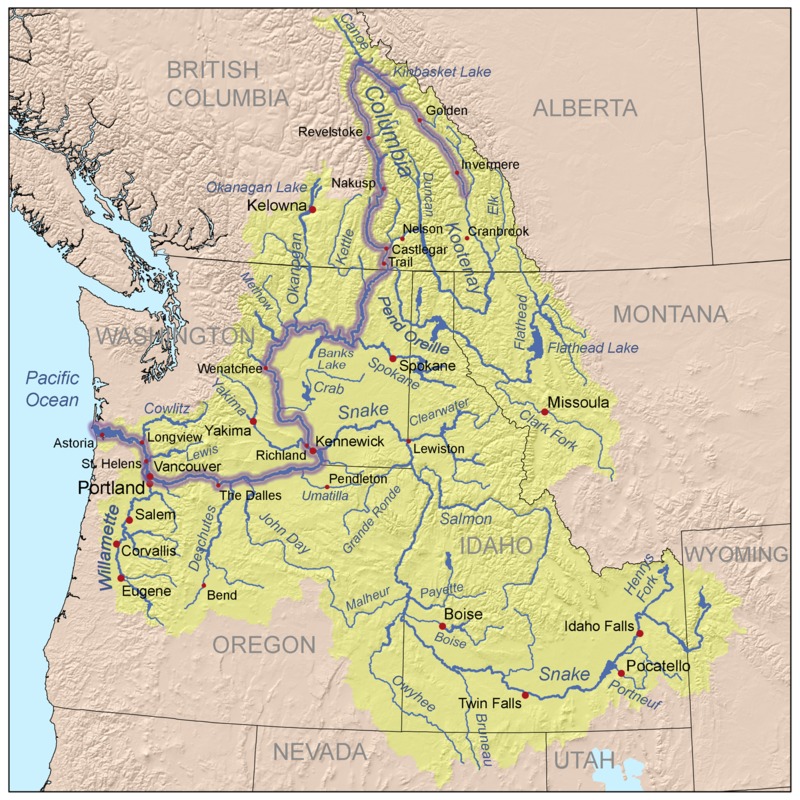
David Thompson (1770  1857) - born in England; his entry was into Manitoba. But, he too headed west. David mapped the headwaters of the Mississippi which goes south. In the same area, many rivers go toward the Lakes. Later, David navigated the entire length of the Columbia River (see image) which is what got our interest as most of the river is in the U.S. This party established a fort in what is now the State of WA. 

Thompson navigated
the entire Columbia 
River

Simon McGillivray, Jr () - was one of the managers of the Fort near Walla Walla (WA), serving in this capacity in 1831-1832. This was an early time when the Hudson Bay Company was still prominent in the area. Until the resolution of the boundaries in the 1840s, there were parties from both New England (and the U.S.) and Canada operating. A relation of his was Duncan McGillivray. 

Paul Kane (1810 - 1871) - he came into Canada from Ireland but did extensive travel here and abroad. Paul crossed the Rockies a few times. He did a lot of painting (sketching on site and doing the painting later). His painting of a buffalo hunt in SD which was done in 1846 got our attention for several reasons. 

B. Now, jumping ahead to the 20th century, we have several families that we can focus on in this regard. For now, this is a short list which would include William Coffin Coleman whose ancestry we are studying as it looks to be New England in general with particularities related to Essex Co, MA.  William was in the north and the south before getting into the central plains. 

A recent discussion got us thinking of the various threads that we can follow which would be families in the central areas from the beginning. Many of these have parts of their family that came in along the timeline, to now. We want to see that whole balance. 

So, these two gents are such where one side of their family is old New England while the other side is a recent import. This was a common occurrence. If we look at SAR/DAR, many patriots (and loyalists) were of one or two generations from the entry of their family. On the other hand, old New England (north and south) saw the fifth generation bear the brunt of the conflict with the fourth generation involved as leaders of various sorts. Too, though, some early members of the sixth generation were of sufficient age to contribute. 

This below pairing is of interest due to times that we are in. Too, one of the gents is of a family that stayed on the east coast. The ancestors of the other came to the wild west. And, for each, we have a much larger bucket of families to throw in. After all, when one takes the 400 years and considers what might be a generation, we can have 1000s of parental nodes, many of which can be known (see Numbers, again). 

John F. Kerry (1943 - ) - John is a descendant of Thomas Gardner, via son, George and is a representative of Winthrop-Dudley clan that has excelled in public service for the U. S. The ancestors of John's father, Richard John Kerry, were newbies. It was through his mother's (Rosemary Isabella Forbes') mother that John got his New England pedigree (WikiTree profile for Rosemary). John is still alive, however he is a public figure with documented histories available on the web. 

David Koch (1940 - 2010) - David's mother provides him the old New England heritage. His father, again, was of a newbie family (WikiTree profile for Mary Clementine Robinson).  

A quick glance at these two gentlemen and their families would bring out lots of differences some of which seem to generate a permanent bifurcation. That is one problem that Gardner Research is helping to work on. Similarities abound, of course. And, many of the seeming differences can be seen as 'spectral' in scope which points to one of our interests: the 400-year focus across families can now cover much more than was possible before. And, it's fortuitous that the capability of technology might just be ready for the work that is needed. 

Remarks: Modified: 08/15/2022

08/17/2021 -- We could do different scopes and themes. One constant will be showing related profiles from WikiTree. 

08/15/2022 -- Almost a year later. Haven't looked at this, however a new theme was the tying of earlier immigrant families to the time of the Revolution. Say, the Passenger to Patriot of the Mayflower focus where we have the Cape Ann to Patriot. 


Sunday, December 19, 2021

Yellowstone, plus

TL;DR -- In our research, we emphasize real people, their families, and events related to their lives. And, sometimes, one finds biographies that are truthful. There have been videos with the same characteristic. However, fiction reigns. So, getting more information about one dealing with areas around Yellowstone, we went to look at what we've researched the past couple of years and have listed the posts. As usual, the main theme is the long reach of New England across the U.S. and the world. And, Harvard fits in there, too, as its history is parallel with that of the country. 

---

Frankly, as we mentioned in looking at Harvard, we want to see the influence across the great land of the U.S. and beyond. Harvard? For the pampered? Our note on John Gardner and the Merrimack surveying crew might provide a hint on our view. Perhaps not. 

We'll have to relook at that, since Harvard started up, again, in 1640 after a bit of closure post the Eaton deal. So, at least, we can say that John was learning something as he worked with the older guys. Brings up a lagging bit of work which is looking at the classes through the generations. We'll start to sample that. One key one is the big gpp, Rev. John Wise (big in several ways). 

So, expect the theme to continue that relates to the blue and red today. Those on the coast; those in the large interior; of course, with perturbations causing permutations everywhere. Now, we're about to the subject. It has to do with some fiction, on TV. So, we're not reading it; rather, it's the thing of having people extant now portray those of the past through events that might have happened. Or not. It's like the Games of Thrones; we find that very tedious and erroneous since those involved with what the theme is were real flesh and blood. Perhaps, respect of sorts might happen someday, maybe not. 

The other side of this is that people then get a warped view since they are not get a true representation. But, so what? It's fantasy. Well, in the case of this show, they use a house that is real. We'll look at the owner who is out of New England. You see, folks, New England is the core, many ways. Yes, and in the Civil War, Massachusetts was prominent, especially in Gettysburg. 

Finally, to the theme? Let's see. We're continuing this theme: Harvard, in the west. Nowadays, sure, there are students from all over. But, we're talking 200 years ago. And, Harvard was going through some changes that need some attention. As in, we can provide a mirror to lift up to the institution, perhaps. 

As we come through time, we will note the changes in Harvard. Early on, the focus was on ministers or teachers. The Adams family can be a good example, say the two Johns (politician and the mountain man). The latter had no education (Grizzly, of TV fame). The former's father (John married to Abigail) went to Harvard. His grandfather did not, however a great-uncle did. There can only be so many preachers in a family. Someone has to do real work. 

Grizzly's ancestors were of the sea which does not quite go with the terrestrial life on campus. There was no remote learning in those days. One might say that the potential influence of Harvard grew with them. The more students, the likely the remote touch. And, New England had a long reach, as we will be showing. 

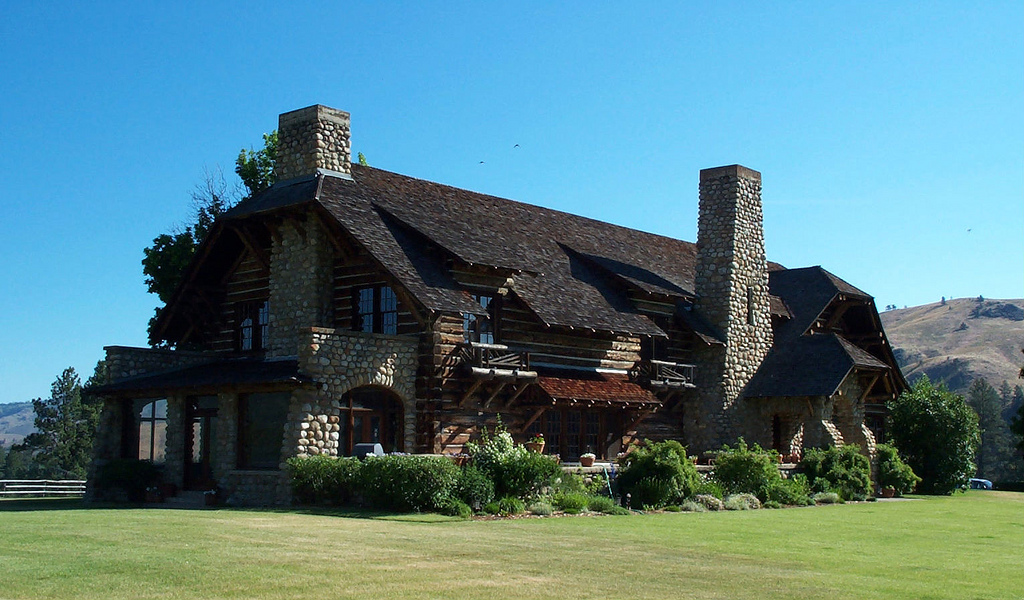
Built for
Howard Clark Hollister
and William S. Ford
However, to the theme, again. Oh yes, the show is 'Yellowstone' with an adjunct now starting with the title of '1883.' The house is the one built by Howard Clark Hollister (WikiTree: Hollister-3379). 

In the below, we provide pointers to material and to our posts (in order) on the subject so as to pull them into one place. Oh yes, from the east, it's a huge trek to Yellowstone. From the west, accomplished by sea to the coast, it's no big deal. There was regular traffic (American Indians and the French and Spaniards). 

Let's start with a map, that comes via Harvard. 

  • Map of the Yellowstone and Missouri Rivers and their tributaries -- this map, from the 1860, is great for a few reasons. It's can be panned and zoomed. Too, the 1860 timeframe is a demarcation line for us with respect to visitors and travelers. The early ones have had our focus, for a while. The later ones we are getting to as the expanse after the Civil War really accelerated. In both case, we have started to research families. 
  • Expedition of Harvard students -- this points to the journal of Henry F. Keyes who was out with others (1899) under the auspices of the Geological Department of Harvard. Have not read this yet. 
  • Jedediah Strong Smith -- have to add this since the Montana view ignores the guy who was there way early. Died in KS in 1831. The JSSS is out of the UCBerkeley area. No one back east cares?  
  • Gardner River -- we had not paid attention to The Revenant (movie) until we noticed the theme and saw that New Englanders (and southerners) were involved. We will be looking more closely at these individuals and their history. 
  • Cumberland Gap -- coming back a little in time, about the same time as Glass and his type were out there, people were coming west following Daniel Boone (real guy). Lots of those families are still around, scattered across the west. The Boones got to Missouri which is a focus for several reasons, including St. Louis' roles in the expansion of the west. Some claim that Daniel got out to Yellowstone as an old guy. 
  • Gathering of the trappers -- some came out of the east; some from the south, including the southeast; some from the coast. Again, St. Louis was a center for fur trade. 
  • Research: Rivers - having been out there several times, recently, we started to look at the mapping, especially with respect to sources. Say, the Missouri River, with tributaries that started west south of Yellowstone, coming around and heading to the Gulf of Mexico through a long trek. Nearby, the Snake collecting itself to head west. Then, the southern movement headed to the Gulf of California. The Grasshopper map is wonderful. 
  • Two different times -- looking at two times and the people involved. There were recent imports and older families early on. In fact, the Revolution's Patriots are, many times, only a generation or two from arrival, as opposed to being the Fifth Generation from New England (Massachusetts, of course). But, many were both old and new. That is one beauty of the country. 
  • Upcoming celebrations -- we do not have a 'west' focus or favor the wild places, such as Texas. We can really talk 100-year periods where, at any point, we can consider, looking back, events that were 100, 200, 250, 300, and 400 years ago. The 250? Yes, see SAR/DAR. 
This represents our ongoing research which has themes to study across a slew of time as well as across a wide expanse. No limit seen, as the U.S. keeps marching forward, its tail follows. 

Remarks: Modified: 04/07/2022

04/07/2022 --  Change Native Americans to American Indians. 

Saturday, January 27, 2024

Longhunter

TL;DR -- Boone was there, in the times of the French-Indian affair, the Revolution, and after. He was of a type that can be known as longhunter. They wandered and brought back information. And, turned around and led people west. This post is of the 250th theme. We are about two years away from that celebatory event. 

---

Four years ago, COVID became a reality. There had been little glimpses earlier. People were talking about an illness in China. We came home from a regional jaunt and heard, on the news, that people had been identified in the area where we had bee as being diagnosed with the disease. Okay, not long after, there was the respite put into  place. Rather, it was lockdown with rules put into place which went on for a few months. 

We had already been supporting history and genealogy work. Some of this had the flavor of finding paths taken by families as they went west. Or, from our perspective, as they came west. Earlier, we had seen entry into flyover country from several directions. The Ohio River ran from PA down to MO. But, it was Daniel Boone (see post Boone himself and search results - Boone) who figured in a large way. He was involved in the Revolution. Prior to that, though, he had explored westward our of the southern states. 

As we had noted, our focus was on the coast for a long while as we caught up with the 400 years that had passed by. Dr. Frank's work was a launching point bot from the family research and The Massachusetts Magazine which printed for eleven years and was discontinued when the Spanish Flu hit as well as WWI came about. But, we had done some work with families who went west. See Flyover Country, for one. As an aside, we are considering how to update Dr. Frank's work with respect to recent findings brought to us by technology. 

Fortunately, about the time of the pandemic, we were getting more inquires with regard to people coming west. Here are some examples (these posts are not in chronological order): Jedediah Strong Smith; Judge Thompson; Col. T. W. Higginson; and St. Louis as the site of the partitioning efforts. Too, though, we tracked several families that followed Boone west. He, BTW, ended up in MO with his son coming further into KS. 
Boone, wandering

Now, let's look at Boone and what he represented. He was a longhunter. These guys went out on their jaunts for months at a time. And, during that period, they were self-sufficient. When they returned, they brought back information and some artifacts, such a pelts. 

We are talking about the area, for the most part, that was east of the Mississippi River. There were explorers out further west, some from the Candian regions. Jedediah was out in California in the 1830, by foot both his and his steeds. He passed through St. Louis on his way. Later on, as we know, two massive killing periods happened out west: beaver; buffalo. 

The numbers of venturers was small. But, where Boone was, a Cherokee chief by 1769 was complaing about the influx of the long hunters. Mainly, they were noisy. And, other stories abound. 

But, getting to our interests, we are finally concentrating on Tennessee. It is a huge state. All together, it touches nine states. Its northern neighbor, Kentucky, touches seven states. We follow families who went west through both of those areas. Too, their border was a dividing line during the U.S. Civil War. We have not discussed that topic in detail, yet, but intend to at some point. Since we're in KS, there is a pre-civil-war history involved with families in the area. 


Back to the longhunters, they are similar in spirit to those who sailed the seas as we saw with New England. We had an earlier post (Final migration) that quoted authors on the subject. There were many trails west, as the railroads later showed us. Jedediah, in CA, had travels that map out the current highway system. Culturally, we would point the travels of the Native Americans over their long time on the continent. 

Other types of early travelers have been touched upon during our research. About a century before the area depicted in the Flower Moon movie, a mission was established in SE KS to aid the Osage and, eventually, other tribes brought into the area. Several local sites were the local for negotiations and treaty agreements. 

Back east, the history goes back 400 years. In the interior, we are talking the long reach of New England over a 250-year period. A lot of families arrived later; but, many carry the history int heir genes over the entire period. Both require attention. So, there's no end to research. 

Lately, we have had a focus on CA, for several reasons. Some of the interest has to do with family being there early. But, we have seen lots of older photos being brought to the fore. Recently, we did a post about a photo taken in downtown LA in the 1880s. We have one from this week to add. But, the area of the photo was where Butterfield had his stage coming into the area prior to going up to San Francisco. His first arrival was in the 1850s. Change is on theme. Some things remain. Many, most do not. 

Society needs its adventurers. Of late, there are new types that we will be discussing. Despite that, we still need the old ways for many reasons. 

---

Example? Technology has developed a thrust and lust for the virtual. That theme needs constant attention for several reasons. One deals with the respect for the land and the people involved across all of the time frames that will be associated with the U.S. and its history. 

Now, AI and even AIn't? History can be retold in more interesting ways using technology. Yet, the truth of the matter remains an open issue that hopefully we'll be able to address more fully if we determine the necessity as we ought. 

Remarks: Modified: 01/27/2024

01/27/2024 -- 


Thursday, December 1, 2022

Perspective, a necessity

TL;DR -- Ipswich has been a topic from time to time. It had shipwrights. Of course, different size of vessels were handled. There were no biggies like Boston (MA) or Bath (ME) or Norfolk (VA). Other examples of industry and technology can be used. But, Ipswich led the way to the expansion across the interior that we saw for over a century. We will be looking at that, as after all, New England has a long reach. Ipswich has done well for itself. 

---

As technology runs toward the future, we always get to states where we get locked in. We cannot go back. Technology is great, except for when it doesn't work. If the problem is solvable, then we have a glitch and a correction. If the problem is systemic or not resolvable within a reasonable timeframe and costs, we have adjustments rise as imperatives. Learning drives technology; unlearning drives recovery from technology's failures. 

The U.S. is about the best example that we have for several reasons. We have already addressed technology as being our main focus. We have 400 years of data to ponder, in this regard. But, just those pieces of evidence from the past 250 years is worthy of study, too. And, commemorative moments, such as we are having now which will last decades are a time to reflect and learn from the past. We are surely in a different mode than the generation of the recognition of the 300ths. 

Today, we are featuring Ipswich which does not come to bear until later, but it does involve Essex County. Reminder, Cape Ann (Gloucester) has their moments in 2023.  It was from Ipswich that a group went west. Gen. Rufus Putnam (Wikipedia, WikiTree) was one of the leaders of the effort. Let's look at some particulars. 

Historic Ipswich is a website that has been quite a motherlode of information. Of course, we are interested due to the many families in the heritage who had Ipswich connections. For one, Rev John Wise has an interesting bunch of  events in his life that we can learn from. We have been looking at shipbuilding in little Ipswich as well as similar work in the County (see Newbury Essex County MA).

The website has looked at Putnam's effort: Ipswich to Marietta, December 1787. First, they show the result of contention between the States with regard to this unsettled land to the west. We mentioned that in the last post about Family Search and their great support for research. Then, the post has the photo of a plaque that notes the endeavor. What? That got our attention, as we have been looking at the western expansion and its frontier century, including lost generations that plague genealogists who have no imagination. Why say that? These people were. Some were newcomers, true. Many were representative of the long reach of New England. Along with technology (and its specifics), our interest deals with identifying the examples of that reach plus the evidence now of its continuing existence. 

Then, the post looks at an effort in 1937 to redo the trek while documenting the effort. For one thing, they provide the map that gives details of the geography. That was great to see as we have looked at the west and its rivers and its great expanse and the carving that was inevitable. Lots of this was with a focus on St. Louis, the gateway. Putnam kept a journal. There were other reports written. In short, it was a great find that was more special since it involves little Ipswich (influence a huge multiple of its size). 

Now, let's look at perspective. Technology makes people lazy; oh, managers will say that it increases productivity. In terms of the former, heard of AI? It's a huge scam which we will show as we go along. Yes, balancing mathematics with knowledge with respect to culture that the broad history of U.S. allows. After all, we are a nation of immigrants. Luckily, we have two broad scopes, related to the colonial times versus later. Too, we have cultural associations with the old countries, for the most part. The list goes on and on. So, expect this theme to be recurrent. BTW, that which is being touted as AI is merely fancy math being exploited by computational prowess that came via modeling founded on (guess what?) mathematical modeling and the detailed work over the centuries. Yes, we will to touch upon all of that. 

For the time being, we will present the following map with some commentary afterwards. 


This graphic shows a map from the prior post which has one view of the partitioning before the carving that was involved in establishing the States. 

1) deals with the Michigan Territory (again, the prior post) that we just offhandedly dismissed as practice for the carving. Our only excuse was that we were dealing with the broad expanses beyond the Mississippi River, but that was not correctly assumed. We have to step back given that the focus of DAR/SAR is the upcoming 250th of the U.S. Besides, we have to give generations credit. This deals with the fifth and the sixth where the latter is the first of those that were heavily in the lost side of things. 

After all, people moved and did so quickly, once the way was set. Say, thanks to the likes of Daniel Boone and Jedediah Strong Smith. The former was doing his exploration prior to the Revolution. The latter was directly connected with St. Louis and its influence. We will go into that deeply. 

A point to make is this: that trek from Ipswich was difficult. Hence, there were real reasons why it took months. In fact, it was practice for the challenges of going even further which was all the way across the continent. On the right is a modern image with routes and times. Even today, travel is difficult. Try driving diagonally across West Virginia. It's fun; but, don't expect to make record time (except, perhaps, max time which is open). Those mountains run further north. By the time that they would use the Ohio, they had already trekked some distance. 

We will take the time to go into this further, since it does set the stage for later developments out west. 

2)  This view trails the other by only a couple of decades. Missouri, the starting point, was a State in 1821. By then, most of the issues related to the green area had been resolved. But, it was 1804 when Lewis & Clark did their venture from D.C. through St. Louis to the west coast. At that time, mountain men (trappers, explorers) and American Indians were mostly in the area. Except, that had been activity from the west coast in (New Spain), some of which got away from the coast. Too, the northern explorers had been more adventurous than those of New England. Boone in the south went further west than did those up north. Lots to discuss. 

Taking the same approach, notice that we are now in the middle of the country covering only a fraction of the area. Here, the issue is that folks would have followed a similar path down the Ohio River to the Mississippi River and then St. Louis and finally the Missouri River west. But, that was on to a starting point. There were several trails. This example uses that which went to Santa Fe in New Spain. One thing to note is that Santa Fe was the terminus of another trail that came up from the south. Too, there were trails out of the east through Texas to consider. 

But, taking that one small portion which involved about four hours of driving now, it took three weeks for a wagon train to cover that area with a daily grind of a few miles. Notice, too, that we are talking the plains portion which is supposedly flat. It isn't. You can still hurt yourself by falling off of a cliff at various places.  

In all of this travelling, rivers were both a barrier and a boon. In these graphics, they are not shown with any clarity, but, even recently, we have seen examples of traffic snarl ups due to bridge damage. One time, we were across the river from where we wanted to go. Okay. There was no ferry. This is a form of technology to note. So, the solution, since we didn't have a helicopter that would pick up the car and deliver us to our destination, was to backtrack to where we could follow a road that went over the river and then get back to where we needed to go which was a stone's throw (well now, as it was broad). 

During the times before bridge technology really advanced, one waited out water. Incidentally, here in the west, there are uncountable number of places where high water will stop traffic. And, in many others, the water comes up to the edge of the road. One hopes that the road engineers did a good job with the base. And, that's not mentioning storms such as we will be seeing with winter setting in. It does not even have to be like the recent dump on Buffalo, NY. A few inches can be catastrophic. 

 Oh yes, real examples. There is a method to that madness. AI and other computer has gone off the rail since a proper basis was lost. Yes indeed. We have seen so many examples of modeling gone wild (like the kids at spring break) due to a lack of grounding which comes about for several reasons. One of these is a lack of respect for the need. Some of that might be generational; a lot of it has to due with the computer being too new for us to really have a grasp of how truth engineering is necessary. Too, what John von Neumann wrought will bitt us until we learn several lessons that have been pending for a long time. 

You know, we are looking at the U.S. and its growth. But, at the same time, the world of thought was changing. There and here. Say, for the latter, Charles Sanders Peirce. But, parallel to the U.S. and its experiences, the world was changing, too. There is not end to that type of analysis. 

Remarks: Modified: 06/08/2023

12/16/2022 -- Rutland VT is hosting the Smithsonian's roving display:  The Smithsonian comes to Rutland. They are reading and discussing McCoullough's book The Pioneers as Rutland is on the pathway west. 

06/08/2023 -- Updated the URL for the Historic Ipswich post. It was originally dated in 2019. The 2022 update removed the older post. One of the technical concerns is that source linked by an URL can disappear or have some other issue, like the information changing drastically. Or, as we might wish not happen, contain undesirable information. In this case, an easy fix. 


Monday, October 24, 2022

Time lines

TL;DR -- The U.S. and its time lines and those of the world. Our timeline was prepared by the pre-school  of colonial life. This was unique when viewed properly. And. New England, in this sense, has a long reach which we have been discussing. The 400ths will allow us some markers with which to organize the information by, arbitrary as such might seem. 

-- 

This post covers an area of concern that will be in focus for a long while. We will mention Immanuel Kant, for one thing. That is 200 years ago, or so. One thing we will do is put events and people into perspective with regard to the 400 years on these shores. This will cover the broad scope due to the influence of New England and the U.S., but we have already started with mathematicians and philosophers. Those folks are of interest since the military and political people get lots of attention. And, we are picking up technology as our area of focus. We summarized part of this in our Gairdner Foundation post. Incidentally, both types deal with thinking and being smart humans with the math'ians being more practical many times, as mathematician, philosopher and cousin Charles Sanders Peirce showed. His work in logic is still very much apropos to this day and age's problems, as is the pragmatic view.  

Then take Spinoza, for instance. He has been mentioned in three of our posts: Spectral issues, Web'ing, and Origins and Motivations. Also, we mention Descartes and others. Mention? As in, name dropping? Nope. The mechanized age (though, Einstein showed us relativity) of the computational idiocies has thrown out the old timers. Why? Oh, digitize all of text, parse, model, and then spit out what humans will marvel at. 

We are not kidding, folks. This is what is happening. 

Any human knows the power of words; others know that that power does not come from mere textual manipulations even if what we see is somewhat syntaxy in mode. Consider that a brief reminder, like a blurb from advertising - oh, those folks, of something that needs serious attention. 

Paul Carus
Which brings us to the main theme, Kant. We will address this from one of his translators whose native tongue was German but who came over here and let down roots. That is, Paul Carus (introduced to C.S. Peirce by Judge Francis C. Russell - New England name) not only did a good job on Kant's Prolegomena, his commentary contributes to the discussion. Mind you, we are talking over 100 years ago. That is ancient to the Silicon Valley mind, it seems, though Stanford University (and Berkeley) is right there. 

If you look at Prof. Carus' profile on Wikipedia, one name pops out: C. S. Peirce (mentioned above). There was another name that we saw from New England with respect to translating Kant, Henry Cabot Lodge. BTW, earlier, we noted that young folks liked to translate Spinoza's Ethics which was written in Latin. One of those? George Eliot who worked from a German version. One New England contact there is R.W. Emerson who had been influenced by Kant. 

This post deals with occurrences before and around that which the 250th will commemorate. Kant's life was from 1724 to 1804. We will look at the generations that he spanned. Too, though, we can go back and look at things of influence. We already mentioned Winthrop's 1630 arrival as one milestone to use. Before that was reconnaissance according to the writer of Albion's Seed. And, we can come forward toward the explosion of knowledge and ability leading to the 21st century and its marvels.

But, with hapless souls, one might think, looking around. Using the timeline of the U.S. and its pre-school time, we can relook and learn, perhaps, things that were missed; or, we can recover things lossed in the shuffles that are always the case. 

Note: Carus' overview of Kant's look at his 2nd Critique is a good example of Kant's influence. It seems that you either love Kant or hate the guy's thoughts. 

Note: This is apropos. We will put a link to recent article that listed Americans (norte, U.S.) who are related to the Queen (QE II). There are two lists (more are possible) given in the article. One is of those who have common ancestors (the list is long, having families like Washington, Lee and too many to list). The other list? Those who are closer as a U.S. ancestor is shared with the Queen (QE II) and King Charles, in some cases, Lady Diana, too. Ann has ancestors on both lists. This happened as a colonial (or someone later) went back. For instance, Downing's Street namesake is a cousin-in-law. 

Remarks: Modified: 10/24/2022

10/24/2022 -- 

Thursday, August 25, 2022

Essex County, then and now

TL;DR -- Little Essex gives unending reason for research. It was used for the purpose of discussing the gerry-mander phenomenon. This post looks at views of the county in terms of maps of its internal boundaries. There was a lot of shuffling in place, with lots of the changes happening early. We will be looking at that further. 

---

We have had a few posts about the subject, Essex County; two of the posts mentioned the Essex National Heritage Area. The latter has been sponsoring events related to the upcoming 400th, such as a photography contest which resulted in tremendous photos of the little county that nestles in the northeast part of Massachusetts. 

Expect that we will always include Essex County in our work as Thomas and Margaret started their American lives in Gloucester which celebrates its 400th next  year. So, there will no ending to tales of the county even when we look at the western part of the U.S. in all of its grandeur. Our work has shown us the long reach of Essex County, Massachusetts, and New England. 

Of late, we relooked, in a post, at the Gerrymanding theme which comes and goes from time to time, usually around election events. We had seen the graphic before and enjoyed knowing more about the subject. 

Today's theme is just that. Let's look at a graphic from FB. 

 For more detail on the map, see the FB images: then (1692) and now. When we were first researching the topic of Thomas Gardner (Salem Planter), we noted that the cities/towns of Essex County cover the whole thing. Out west? Many places have huge counties with cities/town sparsely around and about. So, one finds many lonely places (long roads to nowhere, some say). But, even back east, one can find the unpopulated areas. 

Back in the day, people went to the wilderness to pioneer. We have lots of examples of that, as western movement was there from the beginning: let's look at Virginia. Up north, we had Ipswich Canada fairly early. BTW, the theme of America's Lost Generation will be considered more thoroughly. It's related to the frontier and is seriously misunderstood. 

Now, back to Essex county. Notice how almost all of the larger areas were split. Salem grew into Peabody, Danvers, and Middleton. Lynn split into three. Ipswich, Andover, and Newbury were trimmed. Only Gloucester remained somewhat intact, though it lost Rockport. 

Salem suffered more loss in this sense? Not really, as the place still shines in the American imagination. Too, That was the 2nd place for Thomas and Margaret. So, many more things to look at and consider are there, awaiting attention. 

Some of the changes happened early enough that the resulting entity can celebrate their 400th no long after others. Some changes were done much later. Lots to look at.  

Remarks: Modified: 08/27/2022

08/26/2022 -- We need to mention the 400ths that are coming up, some of these have already started, such as Weymouth (Norfolk County) this year as the first one post Plymouth's celebration. Gloucester's starts in January of 2023. 

08/27/2022 -- Put link to the Lost Generation post related to the frontier. 


Tuesday, September 26, 2023

Mirror building

TL;DR -- John Butterfield was involved with several businesses, some of which still exist today. Today, we look at his facilities in Los Angeles CA that supported the Butterfield line. When travelers got that far, some had already trekked from St. Louis, MO or Memphis, TN. Where Butterfiled hung out is now the building that houses the Los Angeles Times (or did until recently - need to update that).  

--

We have had several posts about John Butterfield and his work. This post is about his facilities for the Butterfield Overland Mail in LA which were at the Mirror building which was the home of the Daily Times of LA. Coming forward, Times-Mirror published the LA Times for which the poster (John) worked back in the early 60s while a student at UCLA. 

Butterfield Overland Mail
Company- 1st stage arrived
at LA on 7 Oct 1858
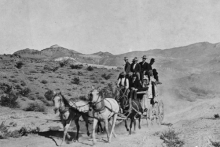
Our original interest in Butterfield's stage line was the start of a leg, either in St. Louis, MO or Mephis, TN. Then, there was the long trek of many days across the southern border. The travelers endured a lot; the photo is of the southern part of the route - dusty, hot, and dangerous. 

The Civil War interrupted the southern route as TX became part of the Confederacy. The nothern alternative was a little more treacherous in terms of terrain and weather: Winter won. Many took this northern route (Mark Twain) until the rails were in (Ralph W. Emerson). 

We will get back to Butterfield and his heritage and associations. For one thing, he's kin of John (and John Quincy) Adams. Another of his business interests is in operation: American Experss. The Times-Mirror Company, for a long while, was owned by a New England family. 

One continuing theme is the long reach of New England. 

Remarks: Modified: 12/23/2025

09/28/2023 -- Adams Express. Example of New England activity that covered the country. 250th themes apply. 

10/15/2023 -- Los Angeles Relics is a Facebook group with photos. This one is from 1888 and pre-auto. It's of First Street between Spring and Main. That's where the LA Times building is plus the City Hall is in the area. 

10/18/2023 -- More on the theme: Los Angeles, again; Bunker Hill, west. 

12/16/2023 -- Updated photo of LA: First between Spring and Main. In the photo, the Massachusetts Boot and Shoe House was the retail arm of the W. L. Douglas Shoe Company of Brockton, MA. William Lewis Douglas served a term as Governor of Massachusetts. 

12/23/2025 -- More on the Butterfield stage as representing the U.S. government's concern for handling Overland Mail. There has been lots of research about the trail from St. Louis MO to San Francisco CA. 


Tuesday, November 22, 2022

Lydia Maria Child

TL;DR -- Over the 400 years of our interest, we will be looking at people and events, here, there and everywhere. That goes with the long reach of New England. This post looks at someone from the seventh generation who was involved with several matters of long-standing concern. L. M. Child is of long New England pedigree as is her husband.

---

Book reviews can be a great resource. We don't always pay attention, as life is full of multiple areas of concern that need attention. But, the WSJ (weekend edition of the Wall Street Journal) has been a constant supplier of reviews of good books, that is, ones pertinent to our interests. For this post, we can point to three of these. One is that the childless can become lost as who pays attention down the pike? Lydia and her husband had no offspring. We have mentioned this interest several times, say with respect to Joseph and Ann - see Aunts, Uncles, Cousins which is from 2012 and needs some updating. Note, though, others have been added, such as Charles Alcott Flagg, friend of Dr. Frank and contributor to The Massachusetts Magazine. 

There are a couple more interests of many which we will itemize and discuss next year being motivated by the next 100 after the 400th commemorations cease, down the pike. The other two interests deal with identifying Essex County (Cape Ann) influences over the U.S. and the world, even today. So, that entails recognizing names of New England families in various contexts and looking for the specifics. The other is to find family associations within the large collection related to Thomas and Margaret (Fryer) Gardner. In this case, we have already found some but will keep those particularities out of focus for later. 

WBUR (news station, Boston) provides the following quote. 

BTW, we are finding that becoming stale is the norm for the web links and their offspring. This usually is only an inconvenience until one considers that what gets into place after the target of the scale link disappears. That can be problematic and will be covered under the topic of technology going forward. 

Here's the quote: 

  • Lydia Moland: "Lydia Maria Child: A Radical American Life" tells the story of what brought Child to this moment and the extraordinary life she lived in response. Through Child’s example, philosopher Lydia Moland asks questions as pressing and personal in our time as they were in Child’s: What does it mean to change your life when the moral future of your country is at stake? When confronted by sanctioned evil and systematic injustice, how should a citizen live? Child’s lifetime of bravery, conviction, humility, and determination provides a wealth of spirited guidance for political engagement today. 

The Frugal Housewife
by Lydia M Child
Information about Lydia Child is available many places (Wikipedia, WikiTree). She is the author of a popular poem; too, she wrote The Frugal Housewife, an early example of self-help. Her parents were Convers Francis and Susanna Rand. With respect to point #1, WikiTree does not have her heritage filled in as it could be since she does had New England families in her tree. So, we'll look at that. 
 
It ought to be an interesting bit of research. We can start here, with the VR of Medford which is in Middlesex County under the "Francis" surname for which there are several entries. 
  •  Lydia, d. Convers and Susanna, Feb. 11, 1802. ["took, when baptized, the name Lydia Maria" [w. David L. Child, Esq.] "the author of several valuable works," PR13]
The 'Francis' surname appears in Barnstable, Berkshire, Bristol, Dukes, Essex, Hampden, Middlesex, Nantucket, Norfolk, and Worcester Counties of Massachusetts. Okay?

---

We have looked a little at Lydia and her family. Let's stop to consider the times that she was born into. Recently, we did a look at veterans throughout the time of the U.S. (see Veterans Day) and showed a graphic of the conflicts. According to that source, the Revolution ran from 1775 to 1783. Lydia was born 21 years after the end of the revolution. The next conflict started in 1812, so she would have been aware of that war. Also, we had next the Mexican War and the Civil War. Now, Lydia was an early abolitionist as was her husband. We will get back to that as the extended family had a lot to do with the opposition to slavery. 

As an aside, Great Britain started the anti-slavery effort which we will look into. The U.S. had some involvement in the industry of slavery but pulled out of it. Needless to say, slavery still exists in our world. We really need to give credit to the folks of New England (they are legion) who worked and gave their lives for the effort, as we continue the efforts toward a more just life for everyone.   

So expect that we will continue our efforts at identifying abolitionists and other positions to be applied to new material about new people plus we will be going back for another look at what has been done so far in this regard. 

---

On the other side of things, 1804 was the year that Lewis & Clark got their sojourn going. They went down the Ohio River to St. Louis before running up the Missouri River. People were already going west, mostly for fur trading and exploring in the beginning. Boone himself was doing interesting things. We will be touching upon these themes as we continue our research. 

One category to keep in mind as we go forward deals with generations. The fifth were the core of the Revolution. The sixth were born but too young. The early seventh is where we would place Lydia. As we fill in more information about her, we will post updates. 

We will look at the family of Lydia's husband as well as that of the Francis family using the time of Lydia as a reflective point. 

Remarks: Modified: 12/29/2022

12/29/2022 -- Ipswich, MA led the way in settling Ohio post the Revolution.