Showing posts sorted by relevance for query lost generation. Sort by date Show all posts

Friday, November 20, 2020

America's Lost Generation

TL;DR -- There seems to be a common problem for some families who had the frontier experience that is harder than that of the wilderness in terms of tracking. As the edge moved west, consistent paperwork lagged. To be expected. 

---

The computer has brought forth lots and lots of stuff. Some might be good; a lot is not. However, research reports can be on the good side of things. And, in history/genealogy, the web (computer's gift) has brought lots to bear. For instance, this post from 2014 talks a little about research being done by NEHGS staff on their ancestors. The image on the left came from this post. It shows the arrival years. Notice the peak around 1635. And, the drop off at 1640 is obvious. The image on the right shows the spread of the 5th generation taken from the research of the GSMD (How many years are there in a generation?). This work was in 2018. Both of these came from the Vita Brevis blog that started in January 2014. 
    

Seeing these types of analysis got us to thinking about our own data and blogs. We started to look at generations, for instance, and will continue. But, for different groups of generations, we need to dig deeper. This is an example. We have seen 'lost' used several times in modern history usually in an economic sense. Japan experienced one of these, very recently. Some wondered about the 2008 downturn. Now, we will have unseen effects from the COVID19 situation. 

But, we are using it in the genealogy/history sense. The 5th generation bore the brunt of the Revolution. The 6th generation were those too young to participate. However, by 1800, they were adults. Ignoring the War of 1812 for this view, we can see that lots of that generation moved taking the 7th generation with them. Our focus is the western expansion where people from the northern and the southern New England met up in the west and intermingled.

By way of comparison, we also include the 4th generation who provided the leadership in the Revolution having been trained under the auspices of the King. That is, the story will pick up with the 5th but have material about the influence of the 4th. Below are some examples including some that are post-Revolution period across several families who were spread around. What we have noticed is that there were many families who moved once peace was settled, and Thomas Jefferson opened up the west. The experience of those families resulted in an informational gap that researchers will have to fill in. The issues get more difficult as the movement went further west. 

  • John Sayward (4th gen) - His parents were in Gloucester where he was born, but they had come down from Maine due to troubles up there.  John left the area but did not go far. He was in Ipswich and tracked down through a friend, John Leatherland, with whom he served in the French/Indian affair and whose sister, Elizabeth, he married. John Sayward also served in the Revolution. See TEG, Vol. 34:4 (TGA Vol I:2). 
  • John Graves (5th gen) - His parents went out in Ipswich Canada. What? Turns out that this is upper Worcester County. Indian problems sent the family back to Ipswich. See TEG, Vol. 34:2 (TGA, IV:1). This is an example of the early western movement. 
  • Early Ipswich family (5th gen) -- Went south to CT under the auspices of the church. Then, one side went west to NJ; the other returned to MA. 
  • Lyman Porter (7th gen) - His father was the 6th gen and went out west. Lyman married into a family that was out of both north and south New England. Lyman is buried in NE. His wife, Caroline, is buried in Los Angeles CA. See TGA Vol. III:1.  See Remarks (11/01/2021) about the new MF database of applications to 1900 where on can look up names. Sure enough, Lyman is there with a daughter and brothers. We will use Lyman as the core of the Lost Generation.  
  • Family out of NC (7th gen) - Post the revolution, the family went to TN (following Boone). There, they were involved in establishing a church that spread through TN, the surrounding area, and overseas. The next generation took the family (6th gen) to the western edge of MO in the 1820s which is quite early and where they continued the church work which included circuit riding to visit pioneering families (sometimes being away months at a time). Then, there elements of AR, OK, and early TX.  
  • Family out of MA (6th gen) - They moved west through NY, OH, and IN. The western trek through succeeding generations include IA, NE, SD, ND, and MT. 
  • Family out of MA (6th gen) - Stopped in NY. Then, a generation moved south and then west. However, the MA-NY movement has not been established in detail as of yet. The case, though, illustrates the issues.    
So, the 'lost' could apply to several generations, albeit we will look at the ones that had descendants coming toward this time. The pattern would be that the movement would lead the paper mill which does the churning in establishing being and identity. One question is how long was that lag before the bureaucracy caught up. Well, that depended upon the location. Too, in many cases, there was an early death. Like with Lyman's daughter and son-in-law, they had a child who was very young when she died and he not long after. But, he lived long enough for a step-mother to come into the picture. The probate records suggest the tale. 

We are taking this focus as we have seen these gaps enough to suggest an interesting pattern. Besides, it makes the drudge work of tracing people more fun; this can provide lots of potential stories to research and write. 

BTW, everyone say brick wall. We say, lots of those walls are not 'brick' at all (also, TGA, Vol IV:1) but are contrived by  mindsets. 

Remarks: Modified: 07/11/2024

05/02/2021 -- We need to move to a focus on the frontier century where lots of families obtained their hole in the paper trail. But, these can be bridged. As well, we can look at modern examples as a type of juxtaposition: Two different times. 

11/01/2021 -- So, now the MF people have a database of those in applications to 1900. And, guess who is there? Lyman and his daughter, Anna. These are the father and sister of Chloe. And, the applicants who were in their 90s? Deceased. Now, with regard to why people were lost? We were looking at a family where one of the boys went from NC to AR. This was almost two decades prior to the Civil War. On the modern map, that distance is over 900 miles through woods, over mountains, and across rivers. Oh, go home for the weekend by flitting over the interior of the country on an aeroplane? Then, there is the fact that these families were in several states. 

07/11/2024 -- Image missing, Vita Brevis, at NEHGS. 

Saturday, July 9, 2022

1900 forward

TL;DR -- As we head to the 400th of Gloucester, MA which will start at the end of December of this year, we can pull things together to start our next phase. We have several memes to discuss, but a continuing theme deals with generations. In 2020, we noted that the 5th generation work of a Mayflower descendant helps bring out some of the common issues through time (hence, modulo is very much apropos). 

---

Back in 2020, with Covid and other factors at work, we had a lot of time to do work dealing with generations as mentioned in our last post: 8th generation. It was in the work where we started to list generations from Cape Ann to events of U.S. History. And, the 5th generation was identified as the most involved of the U.S. Revolution which 250th is coming up. The 8th generation post came from looking in more detail at what we knew of Judge F.M. Thompson. F.M. was Civil War time. 


Another post of the time was 1900 back. In that post, we looked at Dr. Frank mentioning his father, Stephen Wilson Gardner, in his book. Stephen's father, Benjamin Brown Gardner, was the grandson of Simon Stacey Gardner, DAR Patriot, and of the 5th generation. That would make Benjamin to be the 7th generation, Stephen to be the 8th and Dr. Frank would be of the 9th (as is Ann's grandfather). Stephen, then, would be the cohort of F.M. (of the last post). 

Also, that allow us to establish some relations with what we know. Namely, this would be the two massive affairs driven by technology, somewhat: WWI and WWI. And, we get to Dr. Frank's generation and their WWI draft registrations. Too, back to Harvard, and its chemist involved with chemical warfare; he, kin, was a President of Harvard, later (James Bryant Conant was of the 9th gen). That establishes the parents of the boomers to be the 10th generation. 

Now, why all of this? One major meme deals with the 1960s where dynamics all over the world erupted in ways not seen before; those energies persisted in their ways until this very day where we have no seeming platform left in any of the classical senses; except, we do have an emerging focus that is related to technology having reared its head in the last decade and one-half, namely computational emptiness. 

As we saw with the New Yorker overview, there are different ways to look at generations. We will categorize and do simultaneous looks as technology allows us to do. But, the spread through time, almost modulo perfect can make a lot of sense. This graphics uses the four generations that the New Yorker article touched upon. Yes, the contents of graphic is taken from the periodical.  

Just like we can track through Harvard's footprints on history, we can do the same thing with people (families) and with the imprint of technology. Our work of late showed us that there are several places where information gaps occurred. Post the Revolution, we had several generations, centered around the 7th, where descendants of early families seemed to have dropped off the earth. 

At the same time, newer families were arriving, constantly. Many times, with the same or similar names so as to create confounding moments. We will look at that further but, for now want to just identify that there is a major lost generation. Fortunately, many times we can tie together sufficient information to build back family relationships or to give someone a little recognition. There are many cases of the unidentified across the landscape. 

In particular, our next post will identify a few Gardner generations around the 1900 timeline. We picked that for privacy purposes where most things before then could become public knowledge if it had not already been lifted to view. However, looking this way from then, the release of the 1950 U.S. Census data does open several doors. 

Before proceeding, using F.M. as an example, we want to document some threads of families with the name of Gardner and folks of collateral families. 

Too, the upcoming 250th is important for many reasons. So, we will support DAR and SAR and others. Then, we will map families from Cape Ann to the Patriot and to now, as do several organizations. At the same time, we have some open business with regard to the Mayflower event which has a similar project of Passenger to Patriot. For us, we can use the Five Generations work for these comparative studies. As a reminder, we will venture into New Spain (first due to size) and New France as we work.  

Remarks: Modified: 07/09/2022

07/09/2022 -- 

Monday, November 1, 2021

"Generations" and its use

TL;DR - An article in The New Yorker on recent generations motives a look at the dozen or so generations since John Winthrop's arrival. We have had several posts on generations and find the divisions to be of use. 30 years or 25 years? The graphic shows 30 years. With our database, we will be able to see how much of a range there is similar to the Mayflower data that showed the long span of their fifth generation. 

--


Meaning, of course, that the use of generation is arbitrary. A classical value was 30 years for a long time. We sort of stumbled on 25 years for various reasons. 

In a recent New Yorker, Louis Menand of Harvard reviewed a couple of books on the subject. His article was titled, It’s Time to Stop Talking About “Generations” , and covers some interesting points. Louis is a Professor of English. He was at Harvard Law before going over to Columbia for his Ph.D. His mother wrote a biography of Samuel Adams, so we will look at him further. 

With respect to the reviews, his graphic is an eye-catcher, showing the last four generations as we see in the press: Boomer, Gen X, Millennials, Gen Z. Each of these four is considered to be about 15 years. Louis argues that these are very arbitrary giving not much more information than one finds with astrology. However, generations do make sense. In the graphics, we have a 30-year generational look that shows the Boomers to be in the 12th generation which is about right as looking back at Thomas Gardner and Margaret Fryer that is how many lines get filled in, say for an application to a heritage society. 

This post wanted to bring in motivations for looking more closely at generations. Too, this will be a regular type of study and report. We have had many posts so far on generational themes. Here are a few. 

  • Fifth generation - From July of 2020 when we were diving into the databases of SAR/DAR as well as looking at the particular families who were associated with events. The 5th bearing the brunt? Lots and lots to look at there. 
  • Hundred years - From June of 2020 as we got to looking at a spectral approach. Going backward from now: 100th (Dr. Frank's time), 200th (western expansion), 250th (Revolution), 300th (not long after the Witch fiasco, 400th (Weymouth next year, then Gloucester, then rolling on). 
  • America's Lost Generation - From November of 2020 when we realized by looking at families as we helped people with their applications that lots and lots of problems arise when people move several hundreds of miles away to someplace without infrastructure. Then, genealogists, in their antiquated logic, blame some brick wall when it's their thinking on the issue. Lots to discuss. If Lyman Porter is a sore spot, so be it. The recent database has him, a daughter, and brothers. Database? Yeap, from MF applications that were accepted. 
The frontier century was over 100 years long and potentially spans from three to five generations. We will be looking at that. 

Remarks: Modified: 01/08/2023

11/02/2021 --  Updated the graphic. 

11/03/2021 -- Lucy F. (Wilson) Gardner is of the seventh (or sixth) generation.  

01/08/2023 -- We had another icon (Charles Thomson) come up for our 250th (1774, Continental Congress) and 400th (Cape Ann as one of the first of the capitalization attempts of history). 

Thursday, August 25, 2022

Essex County, then and now

TL;DR -- Little Essex gives unending reason for research. It was used for the purpose of discussing the gerry-mander phenomenon. This post looks at views of the county in terms of maps of its internal boundaries. There was a lot of shuffling in place, with lots of the changes happening early. We will be looking at that further. 

---

We have had a few posts about the subject, Essex County; two of the posts mentioned the Essex National Heritage Area. The latter has been sponsoring events related to the upcoming 400th, such as a photography contest which resulted in tremendous photos of the little county that nestles in the northeast part of Massachusetts. 

Expect that we will always include Essex County in our work as Thomas and Margaret started their American lives in Gloucester which celebrates its 400th next  year. So, there will no ending to tales of the county even when we look at the western part of the U.S. in all of its grandeur. Our work has shown us the long reach of Essex County, Massachusetts, and New England. 

Of late, we relooked, in a post, at the Gerrymanding theme which comes and goes from time to time, usually around election events. We had seen the graphic before and enjoyed knowing more about the subject. 

Today's theme is just that. Let's look at a graphic from FB. 

 For more detail on the map, see the FB images: then (1692) and now. When we were first researching the topic of Thomas Gardner (Salem Planter), we noted that the cities/towns of Essex County cover the whole thing. Out west? Many places have huge counties with cities/town sparsely around and about. So, one finds many lonely places (long roads to nowhere, some say). But, even back east, one can find the unpopulated areas. 

Back in the day, people went to the wilderness to pioneer. We have lots of examples of that, as western movement was there from the beginning: let's look at Virginia. Up north, we had Ipswich Canada fairly early. BTW, the theme of America's Lost Generation will be considered more thoroughly. It's related to the frontier and is seriously misunderstood. 

Now, back to Essex county. Notice how almost all of the larger areas were split. Salem grew into Peabody, Danvers, and Middleton. Lynn split into three. Ipswich, Andover, and Newbury were trimmed. Only Gloucester remained somewhat intact, though it lost Rockport. 

Salem suffered more loss in this sense? Not really, as the place still shines in the American imagination. Too, That was the 2nd place for Thomas and Margaret. So, many more things to look at and consider are there, awaiting attention. 

Some of the changes happened early enough that the resulting entity can celebrate their 400th no long after others. Some changes were done much later. Lots to look at.  

Remarks: Modified: 08/27/2022

08/26/2022 -- We need to mention the 400ths that are coming up, some of these have already started, such as Weymouth (Norfolk County) this year as the first one post Plymouth's celebration. Gloucester's starts in January of 2023. 

08/27/2022 -- Put link to the Lost Generation post related to the frontier. 


Monday, March 17, 2025

Independence and Kansas City

TL;DR -- Trails were and still are in the sense of leaving tracks on the landscape (several places along the Santa Fe and Oregon Trails. And, now the Interstate Highway system with all of the national, state, and local roads. And, going further, even now dirt roads as tracks. Sometimes converted railroad tracks. 

--

With all that is going on in the world, and in the U.S., it is time to look back at the past. In 2020, we got the opportunity to spend time looking at the interior of the country which is huge. In terms of time, we had a frontier century (post has copy of photo of Lawrence, KS by Gardner). We got to learn about the trails and the cities that cropped up (theme of this post). We determined that there was a lost generation or two (Boone was real; officer in the US Revolution; Longhunter; traipser of land (all the way past KC with time spent in western MO) in the movement that came to fore as we looked at the upcoming 250th of the US under the auspices of the Daughters of the American Revolution. Doing applications for some requires lots of additional work. 

Before 2020, we had looked at the trails and those earlier like Jedediah Strong Smith. Gardner, KS was seen as a hub of traffic and activity. Also, we had looked at both land and sea traffic to the left coast (Old LA and the US - as in Los Angeles, CA - in particular, Bunker Hill West, where the culture went back to New Spain and then through several cultural shifts to the current canyons of high rises).

---

Now, to the theme. We saw a video of a talk about the trails and how they came into Kansas City and left. It was of the first part of which there will be another. We mentioned Gardner, KS where 3 Trails split. The Oregon went over the Wakarusa River into the Lawrence area and then up to Nebraska. Even in that trek, the rigors of getting people and goods across the land was obvious, especially trying to get over waterways which were boons and banes (mostly the latter for many). 

The talk: How Independence & Kansas City Became Trailheads for the Oregon/California/Santa Fe Trails, Part 1. The following image came from the talk. On the map (a modern map showing some roads), Independence, MO (where Pres. Truman came from) is on the upper right. Gardner, KS is on the lower left. 

Indepencence, MO
Gardner, KS

In the top middle, notice Wesport which is on the Missouri River. After a little bit of time, impatient travelers (read, young men off to the coast with gold fever) realized that they could take the river up past St. Joseph, MO (famous for the Pony Express) and then a little further north, they could head west in Nebraska. While doing that, they would meet travelers coming up from Gardner, KS. But, they would have cut several days off the journey. 

OCTA, sponsors of the research and talk

---

Notice that this is about the early times. The railroad came into play after the Civil War. 

Generations? By this time, say before the Civil War, we were to the 8th generation from the start of New England. The Revolution was mostly of the 5th generation. 

Cultures? As we have noted, there were the News: Spain; France; England; Sweden; ... The left coast allows us to look at the first; Quebec, Canada is representative of the second; we had both a North and and a South for the third; and so forth. 

---

KC? MO and KS. Missouri and Kansas. We need to look at the area a little further. It's known for beef and barbeque. Well, cattle came up from TX to be shipped east to the hungry easterners. Too, the breadbasket founded itself on the rich lands of the area. Boone, as said, was there early. It's sister city in MO, St. Louis, was the administrative and bureaucratic and entertainment hub. See early Missouri, for instance. 

Remarks: Modified: 03/17/2025

03/17/2025 -- 


Tuesday, June 30, 2020

Deeper dive

TL;DR -- A little more on Chloe whose recognition is pending though she deserves it without any qualifications.  

---

This post will start a more close look at the lonely grave out west in which is a descendant of the group that came into Plymouth in 1620. And, he is noted in the GSMD books as is one of his daughters as well as is his brother. So, the theme deals with the issues and problems of the western expansion that was the reality of the U.S. whose start is celebrated this week.

Now, this will get involved, but we are going to take a couple of decades and look at part of the life of a young woman who is the daughter of the above descendant, however she came about before those western locales were doing records correctly. In many cases, they were destroyed. But, we saw this back in those eastern realms of so much pride, too, say Essex County. In any case, the overarching framework is the U.S. which has been doing the Census from the get-go. So, we will look at that part of the deal as well as some other bits of data.

-----

Before we take the deep dive into the short life of the young lady, let's set up a more grand scope with which to have a discussion. Like, GSMD is un-American? Kidding, only in part. We'll go into this quite extensively, hang on as we set up the situational aspects. We mentioned the lonely grave. It is occupied with the remains of Lyman Porter who was the father of Chloe. Chloe, of course, is the young lady with whom we are concerning ourselves.

May we have a photo?
Silver Book, Alden

This introduces Noah Porter who is in the Silver Books. That's five generations. And, he is the grandfather of Lyman Porter, so Lyman is the seventh generation. We will pick that one generation and do a sweep across the landscape of the U.S. in terms of the conditions of life, technology, etc. Where, too, we use known families, including Gardner to set the tone. 

Now, that is 7th from the first entrant. For Lyman, we have Ruth Alden, Sarah Bass, Sarah Thayer, Marcy (Dorman) Porter, then his grandfather. This list has the first two entries. See the subsequent post (7th generation) for the list that is more full.
  • Lyman was born in 1819 in New England and died, and was buried, out west. In between, he was in several states, so we have to go through that. Too, Lyman's father was out west, died there, but was taken back east for burial. Some of Lyman's brothers were out west too; enough were in the east so that we can do a major east-west (least-best) summary of things. After all, this is mandated by the 'flyover' thinking that is still around. 
  • Another family of that era had a traveling preacher (see below) who was born in 1814. This was the time when the data of frontier was captured in church records. We will look at that family more closely, later, as it involved Mayflower, to boot. 
  • ... many, many more (see 7th generation)  
So, this might be a good generation to look at. So, we will be expanding this list across the children and the related families.

As an aside, Lyman is the 2nd after the Revolution. This will be important as one of our projects is to map early settlers with their offspring during the time of the upheaval (DAR's bailiwick) and down to now. As in, the stories abound, many have been ignored, some of the ignored ought to be raised to awareness, and, folks, this stuff does not get done without someone stepping up (TGS, Inc.) and actually making an effort.

Next up, we will pursue this generation a little with a further look at Lyman and his wife, Caroline Hopwood who was a native of Virginia. This is setting the stage for looking at Chloe and how notionally wrong is the GSMD in many senses. If they don't see this, well, we'll hope to detail issues to get the proper discussion taken place with necessary changes (bringing science to genealogy in unexpected ways).

----

Being exposed to the ways of the GSMD and running into families that were of the north and the south, what arose was an interest in western expansion which started with those who arrived on these shores, was constant throughout the early periods, accelerated after the jaunt of Lewis & Clark, and continued apace even into the middle part of the 20th century. People who were at the forward edge were always outside of normal reporting schemes. So, what we might know of them is sparse, in fact, and can be considered as missing. The above case? A girl being born before a western state started to collect vital records.

There were various ways that people might have left traces, such as the family bible. But, another was the circuit rider who was a minister who visited remote folk in a periodic fashion. His notes would have been recorded in church records. The Wikipedia article is Methodist in orientation, but other denominations did this, too. And, for those families, the church is the primary source for information. It's funny. In a family with several brothers, two are well-documented. I need to try to see  how to leverage this information for the unknown brother who was a circuit rider, too. Of course, he's in the church records but has little known about him otherwise.

---

As well as lonely graves, we have run across several instances of defunct cemeteries of late. That topic was hot and heavy early last year (2019) as we determined that Thomas' grave had been lost.  Then, we learned that Essex County had several examples of burials being moved, etc. to the extent of losing any information of the current whereabouts of the remains.

Remarks: Modified: 11/10/2020

07/03/2020 -- Split out the 7th-generation work. As, with the 5th (U.S. Revolution), we can juxtapose with the 7th which  might have been the start of the thing of 'spoiled brats' that is so much American. Wait, we might go back to the start of Harvard (early animal house), but that can wait for a reawakening of the theme.

08/07/2020 -- Cumberland Pass in the west has the same name as that in the east known as the Gap. However, they represent the movement across the country which established the country. So many stories. Too, they created instances like poor Chloe being dissed by Plymouth people squatted in eastern Massachusetts. It's a large country out here, folks. So, I have now seen oodles of families with the same problem from the tip (Canadian border) all the way to the lower part of Texas. Has anyone really awakened to this? Not that I can see, otherwise I would not have the need for this type of post (Genealogy and Bayes).

09/28/2020 -- We have started to look at Chloe, again and her "brick wall" using one generation's huge bucket of data. 


Tuesday, November 17, 2020

American tinkerer

TL;DR -- As we look at descendants, we cast a wide net including looking at those who have been identified by others. Except, these need to be proven. This is one case where the likelihood appears to be strong if someone does the work. 

---

Note: We started this post in an incremental fashion that was following up on a suggestion. For now, this is informational only and about a potential descendant of Thomas and Margaret. We had a similar incident with the 'Descendants of Samuel' page and left a note that points to a post about frontier issues. These are there for the middle ground (western expansion) folks and families. This particular one here deals with a family that came out west from upper New York. They had lived on the border of Massachusetts. On the MA side, we are talking Berkshire County, most likely. So, these two locales are close. More at the end of this post.  

---

There have been lots of these types of tinkerers over the past 400 years. Names stand out like Ben Franklin and Nath Bowditch. But, there are lots more. We have been going through the descendants of the children of Thomas and Margaret while covering the time from the beginning. Themes arose like generations where the 4th and the 5th bore the brunt of the Revolution. We picked the 5th since it matches up with the GSMD books. But, we can follow those generations forward and backward. 

So far, we know more of Thomas, George, and Richard. We know less about John, Sarah, Samuel, Miriam and Seeth. Despite Dr. Frank being a descendant of Samuel, we know less of his descendants than of the earlier boys. And, we are starting to fill in the gaps. This post is about a descendant of John. However, he also is a descendant of many families of Nantucket. 

Who is he? William Coffin Coleman was the founder of the Coleman Company. There is no American Boy Scout (probably male, too) that has not run across his lamp and other paraphernalia which is often associated with the outdoors, camping, fishing and such. This is a landlubber post; we will do more naval looks, too. 

William was born in New York, but his family moved to a southeastern country of KS. That area was oriented toward farming, but it was also how trains ran from points (ports) in TX to Kansas City and Saint Louis. As well, there were various types of mining (coal, chemicals) going on. His bio (Wikipedia) notes that he was in several places before he ended up in Wichita KS where the company was founded and existed for several years. 

We were looking at William with respect to John. See below.   

---

When we got to this point in the post, we went looking, again, and could not verify this line. Now, the last point of knowledge is the FindAGrave of William's parents. His father was Robert Russell Coleman; his mother was Julia Coffin. Robert and Julia were both born in New York. In the 1870 Census, they are in New York, still, and have his mother (Anna) with them. So, given the families, Coleman, Coffin, Russell and a couple of others, one thinks of Nantucket (then Gardner comes forward). However, there were Coffins in Essex Co, to boot. Both Robert and Julia are the 6th/7th generation. 

We have seen lots of frontier situations further west. This case is nice as it's like a lot of others seen and handled. Even in the east region (Essex Co), we have had to track people through different little locations. In the west, we had families out there early on. Ipswich (churches thereof) sponsored lots of pioneering efforts (need to get the old notes back up to fore - we're trying to curate through zillions of little data bits collected over a decade via the sea of the internet). Ann's greats were out west (upper New York) for a while and then back in Salem. One avenue would be to find a family where Robert fits. Reminds us of New Hampshire. In one instance, a kid was noted but said to have left the area. We wandered in the material westward and found that he put roots down elsewhere. Much like Lyman. Born in MA. Buried in a lonely area out west. We can track his steps in-between. He's fine. One daughter of his is ignored since she died young (being followed by a step-mother for her young daughter). No paper trail. Wait! We've been down that path. Our goal? Get these people, categorically, considered in a more proper light. For one, it's the American thing to do; too, it's the 'honor' part of that old adage that might have more basis than many allow.    

Remarks: Modified: 04/23/2021

11/24/2020 -- Referenced this in America's Lost Generation. 

Monday, January 27, 2020

American 100s

We've been at this for ten years now. Early on, it became evident that the 400th (of Cape Ann) was in the near future, 'near' enough that we have the Plymouth event (early planning) already at hand. Later, we also remembered that the southern realm did their look back in 2007 (First Thanksgiving).

Reading about the 400ths, of course, brought our attention backward to the 300ths (Salem Pageant).

America 200
Jedediah Strong Smith
Along the same line, though, we got insight into the western movement that picked up speed after Lewis & Clark toured the middle of the country from the east to the west, all the way to the Pacific. Dr. Frank, in his Massachusetts Magazine, published many articles on this theme. Early trekkers explored the areas and learned about the tricks of navigation. That is, they wandered from the east to the west, too, on foot and horseback. Later, earnest families traveled toward new lives. Turns out that a place named Gardner saw a whole lot of those moving forward (Gardner Junction, 3 Trails).

Lots of attention go toward the northern routes, however there were southern routes across the country, to boot. And, as we've seen with movies and TV, the U.S. Army was active across the whole region (William J. Worth, Thomas W. Higginson, and more). In the east, we saw the displacement of the American Indians as an example of what was to come. Many tribes were moved west (Another Western Movement).

So, we thought of this as the 200th that was related to the 400th in many ways, especially with regard to families and their members.

Then, there was the sea (The Gardiner that was, Nantucket Sendoff, Two cousins).

Now, another focus arises from which we will see lots and lots events and energies of celebration. The D.A.R. initiative for and support of America 250 will be a continuing theme. Remember, 1776. This look back is six years away and corresponds with events in Cape Ann and Salem over hundred years earlier. We have written of the time; some recent activity related to General Layafette and his triumphant return are one example.

History being retold from the lives and times of people? A major theme for the future.

Just like that which is to be celebrated for the 250th, the 200th has no real clear start. There was the Revolution which dragged on. Then, the War of 1812 perturbed the U.S. Finally, Lewis & Clark did their little trek. After that, we saw a slow trickle which grew to a horde moving west by the last part of the 19th century.

We will start to look at 100, 200, 250, 300 and 400 on a regular basis.

Remarks: Modified: 07/28/2020

02/01/2020 -- There is a sort of symmetry about the American Revolution for a few years that ought to be of interest. The far reach (400th) is that arrival in the 17th century. Coming forward, the 200th is associated with another migration which was to the west (Final migration). The 300th was only a generation after the turmoil following the witch hunt (Andover ordeal). The 100th can be many things that we will look at (Last issue of The Massachusetts Magazine, Ground zero).

06/19/2020 -- This year, we lost our spring. Dr. Frank would have been familiar with the situation (Last issue ...). No one knows how we will all go forward. There will be lots of stumbling about. However, we can keep the technology view in balance. Fortunately, we might have a leverage point there.

07/28/2020 -- Have done several posts related to generations: 5th generation, 6th generation, 7th generation, 1900 back, American 100s, First five, and About generations.

Tuesday, June 29, 2021

Pace of change

TL;DR -- Before getting into some technical issues, a pause to look at the quick coverage of the interior of the U.S. is in order. In the graphic, the blue are Post Offices (1855 and 1921) as they spread across the country. The red show the railroads (1860s and 1890s). We have looked at the time before technology came about. But, even when it did, there was a natural evolution of ability. In any case, the conflicts of today are nothing new, basically old stuff with nuances related to the current time. So 400 years ago may have been different in a lot of ways, but how close are the people then to what we had 100 years ago? 

--

This post briefly summarizes work that we done over the past few months, much of it looking at the interior of the U.S. We need to get technical, for a while, which will get us back to the issues of content management and more. This has been a periodic occurrence that has left traces (see discussion at our portal - https://TGSoc.org and our technical blog) which follow how things have changed during the past decade and one-half. Lots like to ride the wave (to nowhere). Civilization needs its moments of review in order to stay within sustainable practices. The computer has messed things up. But, also, we have new ways to research and report (that was one motivation for the Web which was based upon DARPA's attempting to have robust communications). We have to keep history in mind, local and global. Too, New England and the Cape Ann crew will continue to be of use to much analysis now and into the future. 

Messy now? Yes, but, we were messy before, too. We have been covering the frontier century, for various reasons. One of these is that we have run across lots of families who were early on the frontier and seemed to have lost their lineage. Of course, there were many newcomers during that century. However, there are others who were here whose families moved into states long before they were organized and so left little in the way of tracks.

We call it the lost generation (or two) which is the ones right after the Revolution. 

So, one might argue the Boones. Daniel's prominence made sure that people paid attention. For every Daniel, there are 100s and 1000s who get little in the way of notice. Yet, these people farmed, built, surveyed, and more. On that latter, the Bent family whose member was at the Treat signing in Kansas got us on that. The father was the organizer; the son was out in the wilds. The treaty didn't hold like many others. So, we'll be looking at that (1865, Little Arkansas Treaty - that's a river out of CO that runs through several states to the Mississippi).  

Along that line, we have pulled some images that bear discussion, especially when we consider the short period of time related to the phenomenon. In this case, it is still the filling in of the interior. We are now thinking of the land being carved up. And, Missouri is a good example being the first one. It's start is in parallel with Maine's. Look at that juxtaposition. As well, the crew coming into Essex County, MA had to get things organized including surveying. Thomas and sons helped with that. John was with the Merrimack crew. In that time, late 1830s, he did learn more than those ones at Harvard. Lots to discuss there. 

Ponder this image which comes from two sources: Paper Trails (on the left); St. Louis, MO to San Francisco, CA (on the right). The left column shows the number of Post Offices at two times (1855 and 1921). The right shows the railroads, similarly (1860s and 1890s).

The times are meant to cover a 1/2 century what was from just before the Civil War of the U.S. to around the WWI timeframe. Got that? Internal conflict was the theme of that earlier turmoil. Actually, is. How are we any different? And the latter? The U.S. on the world stage in the context of trying to resolve conflict over there which was of long running, to boot. 

Getting back to the timing of those looks, on the left, notice the heavy coverage in the east coast with the sparse dots out west. On the right, notice that the railroad may have been somewhat out to the Mississippi in the 1860s but definitely not the west. A mere three decades later, the railroad did go across the county. For the Post Offices, by 1921, they were everywhere that people were. Those huge white areas are uninhabitable. Or, folks there know that they have to go pick up their mail. 

After all, in that top-left situation, mail went west by coach (several ways), the pony express, or by water (a couple of ways). That in itself is an interesting subject that we need to keep the youngsters aware of. 

On the other hand, with respect to the railroads, that 1890s coverage was quite impressive. And, it allowed faster population of the areas. 

About internal conflict, the Civil War was no cessation. Conflict with the American Indian continued for a long time leaving a situation where the reservation mode under the guidance of Washington DC was the reality for tribes. Lots to look at there. 

In short, in one-half of a century, again, the U.S. covered an area that is huge. Folks back east with their notions of wilderness have no idea about the frontier. Genealogists, are you listening? Let's step into modern modes (beyond genetics and microbiology) a little more. 

Remarks: Modified: 06/29/2021

06/29/2021 --  

Tuesday, November 9, 2010

The progeny

The list of descendants will be large for Thomas and Margaret. One goal will be to fill in the tree, completely, to about the year 1900. That would cover over 250 years on this side of the pond.

Too, there will be posts dealing with the RD theme. Why? Looking at associated families can help us fill in Thomas' past. As said before, I'm going with Savage's view, for now. So, expect to see pointers to work done by other families.

Of course, work will continue for the period from 1900 to 2010. But, for the next few posts, the blog will focus on the earlier times.

---

We hope to put out interesting stories from time to time as they are found.

The intent is to have GEDCOM files, at some point, with confirmed data; the organization of these files is still an open issue as they will need to be partitioned, I think. By the way, GEDCOM (below are pointers to trees that intersect the Thomas') is a standard way to document genealogical data. But, there need to be an interesting way to present the data. The below examples are from the RootsWeb site.

---

Before we show some RD links, let's talk numbers again. Going back to Thomas and Margaret would be around 10 to 12 generations for people living now. So, if there were a fully developed tree going back from oneself, you would start with your two parents, then your four grandparents, then eight 1ggps. That's three generations, so we're using 2**3 (or 2 to the 3rd power). 2 to the 12th power is 4,096. You'll see example trees below. The actual number can be much lower due to things like intermarriages.

But, when we come forward, from Thomas and Margaret, it is not binary. In fact, there are nine kids at the first generation. Yet, if we considered that there were only four, for each generation coming forward, by the time of 12 generations, there would be 16 million cousins for your self. Or, as they say, Thomas and Margaret would have that many descendants living. In total, as one summed over the generations, total descendants would be 22 millon.

---

Now, we'll start with a Samuel descendant named Simon Stacy Gardner (Plumer tree). Simon is on the Daughters of the American Revolution list of patriots and is only four generations from Thomas and Margaret (Thomas/Samuel/Abel/Abel). Simon's father was Abel whose grandmother (Elizabeth) was a sister of John Hathorne. But, Elizabeth, and her husband's family, not fevered by the mania and did sane things, like try to save Rebecca Nurse.

If we look at work done by various families, we can find charts like this example pedigree chart for Simon 's mother's grandfather (Thomas Stacy - Smith/Goodale tree). As mentioned before, these types of charts will be verified. But, for the point of RD, notice that Margery Eyre (Caldwell tree) is in the tree; her grandmother is shown to be Elizabeth Fitzwilliam (Bevan tree).

By this time, the tree has really expanded. Poking around brings up a lot of royal links, such as this for Henri I, of France (Bevan tree). Wikipedia has a chart for his ancestry.

---

Given that we went backward (with an expanding tree, remember?), how do we know that the link from Elizabeth back to Simon Stacy can be supported? We'll go into that next time and use another example that leads back to what is called a gateway. That is, a number of immigrants had documented histories. Many families knew this, at the time. For many, the knowledge was lost. But, if one can map back to a gateway with documentation, then one can consider RD for one's self.

The rule, according to the NEHGS, is for us to handle this side of the pond (back to the gateway). Then, issues over there will be resolved via their methods. And, through time, there is progress as missing information comes to fore (we'll later use the example of a Mayflower passenger who seemed to have been lost but was later found to have lived in Salem).

---

Again, the reason for following this method is that the closer one is to a royal line the better the sourcing material. Then, from those one can try to fill in gaps. But, it is not always possible to do so (examples abound).

Remarks:

10/25/2020 -- Descendants, finally. We're getting back to work.

12/07/2018 -- Dr. Frank and WikiTree. Using his hand-written notes, we filled in his mother's line this past summer. Too, we are going to focus on filling in the gaps. 

10/25/2018 -- We have a new look: TGSoc.org. And, we are using WikiTree (example of Samuel/Abel) with the goal of getting the first five generations documented. Some of these links may be stale (will be checking). 

01/06/2013 -- Ten years ago, The Atlantic had a nice article on Humphry's work. I ran across his site in the last couple of years, at some point, so it was nice to run across the article.

09/13/2012 -- About Margaret. We'll honor her as the ancestor, with Thomas, of the Gardner family.

04/27/2011 -- We'll get back to the pedigree of Simon Stacy Gardner. One of his grandfathers was Thomas Maule.

03/16/2011 -- Nathaniel Bowditch could start a list of major contributors.

12/24/2010 -- Need to answer the question about Ebenezer (Maine, Samuel/Abel/Thomas). Plus, here is an interesting page.

12/23/2010 -- Would be derelict if I didn't mention, and use, this site by Roderic A. Davis, 2nd.

12/06/2010 -- Another tree for Simon would show RD from Thomas through Samuel / Abel / Abel (Dollhopf family). This lineage has John White who, according to Bevan, descends from Henry III (Wikipedia ancestry chart). -- If we skip forward, to Frank A (who will have his own page), his grandmother (Lucy F. Wilson) has John White as an ancestor, as well. This is through Elizabeth, daughter of Rev. William Walton (Bevan - we'll get to that when looking at Frank A.) . Benjamin Brown Gardner, Lucy's husband, was Simon Stacy Gardner's grandson.

11/12/2010 -- RD example using a gateway.

11/11/2010 -- Ole Larson is back for one RD reference. His genealogy site is a good example.

11/10/2010 -- The Bevan trees will be used a lot. The family's chief immigrant is on the list of gateways. A claim is firmed by using confirmed gateways, however there is missing information that can be discovered at any time (Richard More, for example). Too, efforts like the D.A.R. of verifying pedigrees (essentially a linear projection) and then matching these up to build a tree will allow holes to be identified, and filled.

Modified: 10/25/2020

Sunday, November 20, 2016

Mayflower pure

I have been at this stuff now since 2009 (the blog started in 2010). In that time, I have run across a few Mayflower lines. I have run across many that are not so linked.

Now, think back to the time of Dr. Frank. That is, the 300th anniversary. BTW, Calvin Coolidge participated, as did a lot of other of the New England elite. We can expect that the 400th will be even more fun (if each town celebrated, we are talking decades of partying). Also, we would like to remind everyone of the 200th which is as important: just as the pilgrims crossed the sea, so too did many of the descendants, as pioneers, pass along the prairie (there was a poem to this effect).

So, with respect to the 300th (plus/minus, okay, a few years), there were organizations started. Of which, one acknowledged the Mayflower folks. We have their annual recognition coming up this week (hence, this post's timeliness). I just found out that early on only descendants of the males were allowed. But, think of those who could not join, for any number of reasons.

In fact, one of these would have been Dr. Frank. At least, for his paternal side, it is "pure" with respect to the Mayflower. That is remarkable. We are talking 300 years of non-association even though there were close calls.

As an aside, because there was some aura involved, many may have tried to flim-flam the Mayflower folks in order to get in (you know, human nature). So, the Mayflower organization got defensive (more below). Yet, they lost reason, too.

Below, I will briefly look at two examples. As well, we can propose various measurements. And, to make it worthy of attention, the most remote would get the prize. Why just celebrate almost there?

Closeness? There are many ways this can happen. A sibling might have married a Mayflower descendant. Or, as I like to see, the step-sibling situation is very important (lots of these due to early deaths and remarriage of a partner). Want to know why? Well, we'll get there as an upcoming The Gardner Annals (Vol III, No 1) will expand upon the topic. Let's just say that genes are not solely where it's at. Rather, memes (in a more full sense) do more to carry civilization (and, this year, we ought to have learned all sorts of lessons).

So, here are a couple of examples.
  • On the Blessing (1635) were two young women. They were sisters. One married Richard More (Nutfield Genealogy). Now, this is being used due to the 300th time frame. None of the More descendants would have been able to celebrate. Why? He had not been identified. Now, the other sister married a New Englander who was of the time of Thomas and Margaret. They have lots of descendants; one of these is "Mayflower Pure" as far as I can see now. We will go into this further. This split is early. As is known, there would be intertwining of families all through U.S. (and colonial) history.   
  • Out on the western prairie there is a lonely grave. It belongs to a New Englander who was a pioneer in several states. And, one of his brothers and one of his daughters are already on the roll (as in, their descendants are on the roll). Why not this guy? Well, the effort has been made. I will write this up in The Gardner Annals (down to about three generations ago). Quite frankly, the attitude, as I experienced it, was that snootiness was more important than recognizing one's ancestors (John Alden, by the way). So that observation is another motivator for this post. One set of circumstances may be a contributing factor, too. You see, in one generation, a girl's (actually, she was an infant) mother died (the mother was a daughter of the one with the lonely grave). The girl's father remarried. The father died. But, the step-mother didn't want the child. So, the uncles and grandparents raised her. She was an only child. Now, when the girl married (by the way, she was a graduate of Monmouth College), she had a girl. Then, the mother dies young. The father was off somewhere with the railroad. So, this girl is raised by her elderly grandmother. Before the grandmother died, she arranged for the girl to be adopted by friends. She well remembered that day as she was 10 years old. Also, she wrote this up for her own daughter. And, granddaughters of this woman are still here. One is terminally ill with cancer. I did not tell that to the Mayflower person who seems to not reason properly (yes, it's all documented - I blame genealogists who ought to re-examine themselves; by the way, we'll help with that). And, again, we can show association with someone of this line who is cousin of a Mayflower pure cohort. That is, there were splits early. Splits could happen anywhere along the temporal line. And, along the line, there were close calls (hence, pure). This example applies to the 200th. You know how many people were buried along the trails going west? Does anyone in New England care? 
So, let's introduce a Mayflower pure metric. Then, those who are not of such lines can quibble among themselves about who is closest. To me, perhaps, the furthest away might be more worthy of a crown. Going years and years and generations and generations without getting touched is a remarkable feat.

Many marriages through the years included newcomers. Usually, that would have an impact on possible Mayflower association. The closer to now that this happens, the greater the impact.

---

For the 400th, the society could look to identify some of these folks. What I have seen is that if there is no descendant who is around to apply to an organization, then the person gets ignored. I like how Heather (Hunter relates to the first bullet) identifies the siblings in Generation 1.

BTW, we started a forgotten series here: John Tylly, Joseph and Ann, the almost forgotten, and more.

As an aside, one of the first oversights that I found (2009 timeframe) was in a family book. Yes, this book is acceptable. In one generation, one son is noted as moving away from the area. You know. He was only a little to the west, but somehow there was no connection. But, then, I know of a generation where two siblings were out west (left coast) with their sister-in-law (a widow) in the same area. Yet, no connection.

Me? I have no qualms or motivations other than research being done well and to the extent that we can. My people are all mid-1800s. My bit is to keep the fire under those who go back further. Keep things respectful as well as honest.

Remarks: Modified: 06/27/2020

12/18/2016 -- Article about subject published in The Gardner Annals, Vol. III, No. 1.

11/20/2017 -- I am looking at a pedigree from New England that has no Mayflower line. However, there are the close calls which I will collect here and write about:
  • Elizabeth, sister of Christian Hunter who married Richard More; 
  • Francis, brother of William Paybody who married Elizabeth Arden (now this is funny) Alden; 
  • ...  
05/01/2019 -- The 400th of Plymouth concerns has started. Now, we see Gloucester planning their 400th (which we will support). Wrote the second part about the poor lonely soul out in Nebraska (TGA Vols. III and IV, GB Vols. IV, V, VI, VII). Have done more work on lineages for people. Still see idiocy which I will address at some point. Folks, the 'mayflower pure' was not meant to refer to whose of that set; no, it deals with those who have been here from the beginning (with 1000s of New Englander ancestors) with only loose ties to the Plymouth founders. Loose, as in in-laws, and such.

 06/11/2019 -- Changed 'Arden' to 'Alden' which is a typo that was introduced a couple of years ago.

06/27/2019 -- The lady for whom I was doing this research turned 100 years old this month.

Saturday, August 16, 2025

American rivers, flow

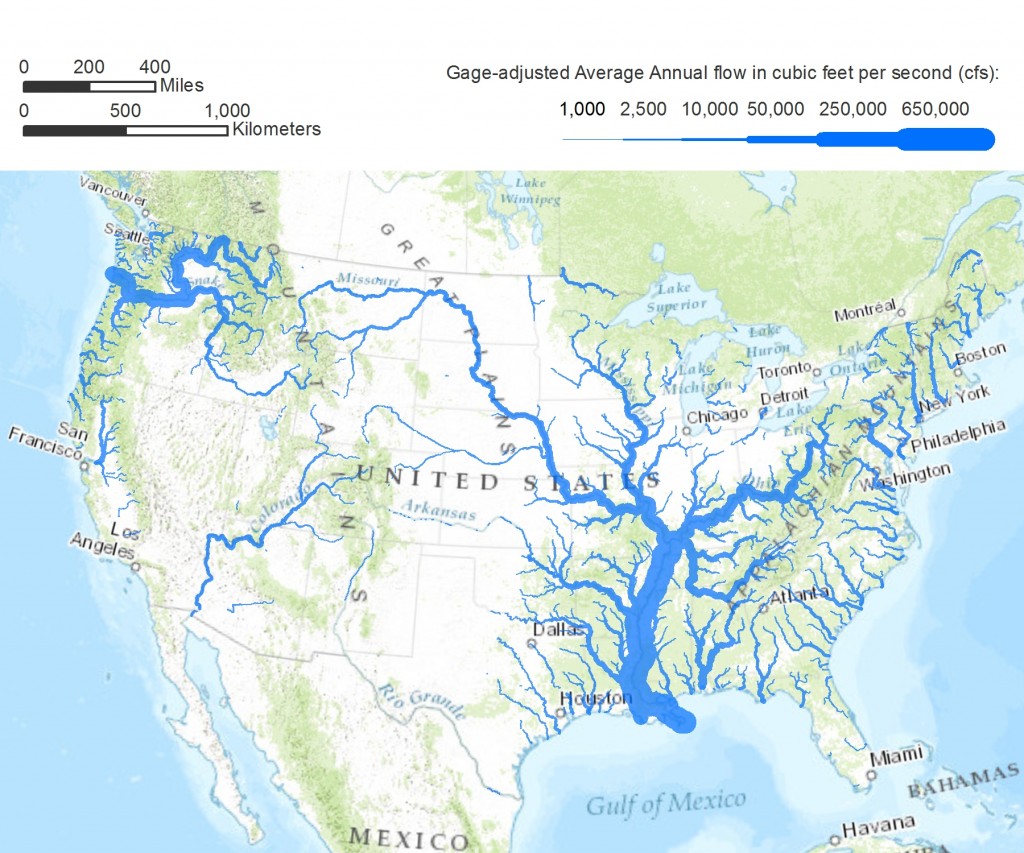
TL;DR -- We saw a graphic while browsing that was not attributed. So, we went looking and found something similar. It shows the comparative flow of the major rivers. The Ohio River stands out as does the Mississippi River which it feeds. Rivers in the southwest are drier by nature. But. they have lots of people drawing off of them. 

--

Rivers are a favorite subject. We enjoy them many ways. Some are famous. Others seem to have disappeared. An example is the Arkansas River that comes out of the Rockies of CO and crosses several US States before joining the Mississippi in AR. Along the way though, if one searches for the river it seems to have disappeared. But, the flow went underground and reemerges sufficiently to support barge traffic from Tulsa, OK to New Orleans, LA. 

On the other hand, the mighty Colorado River comes out of another part of the Rockies in CO and heads down to the Gulf of California. But, along the way, it is dammed (for Lakes) and tapped for people and crops. By the time it gets to Mexico, it is a small portion of itself. 

Those are two western examples. Looking east, the Mississippi gets a large flow from the Ohio River after it has joined with the Missouri River near St. Louis, MO. Lewis & Clark was on both. They took the Ohio down to the Mississippi, then ventured north to travel up the Missouri River, to its source. In doing so, they also looked at some of the rivers of the northwestern part of the US.

What motivated this post was seeing a graphic and looking to see its source. We show the graphic below. At the same time, we looked at some of our earlier posts as they presented graphics too. Let's list a few of these and then add in a new graphic. Each post has a graphic with respect to US rivers. 

  • Continental divides (Feb 2025) -- we think of the Divide that we cross as we travel east-west in the western part of the U.S. But, there are other divides. 
  • New Missouri (Aug 2022) -- when one compares the upper Mississippi to the Missouri, the question about naming comes up. This was really the Missouri River which contributes more water from a longer route. Whereas the flow from the north is shorter and looks larger. 
  • East meets West (Jun 2022) -- the Gardner River flooded and got our interest. It flows through what is known as Gardiner, MT. The map shows all of the watershed of the continental U.S. 
  • Research notes: Rivers (Feb 2021) -- looks at some western rivers (Yellowstone, Gardner, ...) in an area where water goes either east or west.  
  • Rivers and more (Feb 2021) -- looks at the Mississippi and one link from the west to the east via the Fox River.  
  • How great? (Feb 2023) -- looks at a couple of elevation maps of the U.S. This is to put the below material into perspective.  

We started really looking at rivers during the time of the pandemic. We were doing a lot of research which involved families who came west after the time of the U.S. start. This relates to the 250th anniversary of the birth of the Nation. Then, as we researched, more and more information became pertinent. This work precipitated our use of Frontier century and Lost generation. 

First, let's put up the graphic which shows the comparative flow of watersheds that reach a certain rate of flow. Some of these show up with a light color since the flow is reduced severely as the water makes its way out of the mountains to the shore. 

American rivers
Pacific Institute

In the middle, one sees the long reach of New England with the Ohio coming down to the Mississippi. So, stepping back, one can see the importance of the use of the Ohio in movement to the west. Wagons were brought west, moved north on the Mississippi, and then went up the Missouri. At that point, the wagons went west by land with rivers to cross. That shows rivers in two roles: means of motion; barrier to progress. We looked at the second one in our look at the New England party that left Boston and journeyed to Lawrence KS for two reasons: define a State; start a University. 

Remarks: Modified: 01/03/2026

01/03/2026 - Corrected a typo or two. 


Wednesday, October 19, 2022

Newbury Essex County MA

TL;DR -- Ships made and used. New England. We're back to that after our jaunts through the interior. But, we'll keep both in mind going forward. In Massachusetts, we focus on little Essex County. Even there, the shipbuilding efforts have continued over the 400 years. Maine will be in the scope, too; after all, they endured the onus of Massachusetts for a long while.  

--- 

New England and its nautical modes is a no-brainer, that is, when one considers the coastal area. Same goes for our Essex County, the primary entity in Massachusetts. That is, again, until Winthrop arrived in 1630. There was Plymouth, of course. And, people had scattered around the region, like Weymouth which commemorates its 400 this year (2022). Per usual, we will be looking at Weymouth, again, due to the associations/relationships with those there in the context of the 400ths which will cover several decades. 

Folks in Essex County helped fill in the interior of the U.S. over time. To consider that entails covering a very large area. Two memes apply: long reach of New England; frontier century. Both by land and by sea pertain to the two memes over time. Thomas Gardner Research has noted by the seafaring ones have lots of press. Where there are deficits of information is in the large interior. To the extent that we can claim to have discovered a lost generation or two where our work has merely touched the tip of an iceberg. Fortunately, technology is moving to where we can handle the work to fill in the missing pieces. The interior is not just "flyover country" as was a meme several years ago. 

But, back to the sea and its charms. Before getting back to Essex County, there was a documented building of a vessel in Maine in 1607: Virginia, a pinnace (Gardner's Beacon, Vol. III, No. 1); Popham Colony (Wikipedia -- first English ocean-going vessel built "in the Americas."). The Wikipedia article gives an off-handed review. This vessel actually sailed from Maine to Virginia, to London, and elsewhere. This accomplishment needs more attention. 

That's New England, north as we call it. Coming back to Massachusetts and Essex County, we can look at the northern end, namely Newbury. We have mentioned it a few times. For instance, Dr. Frank and Ann have lots of ancestors from there. Nathaniel Knapp is an example. We wrote of Caleb Haskell who is from Newburyport (close enough). 

Newbury will have its commemoration is 2035. Being up top, we can jump over to New Hampshire to add in more goings-on over time, say like this post, Two Houses. But, let's give Newbury some attention, finally. 

Today, we saw an article by Melissa D. Berry: Tales of Infant Boat Industry in Massachusetts. The article looks at Newbury's  involvement, in a big way, with the creation of vessels for water transportation. By 1749, the region had produced "over 600 vessels." The Merrimack (1798) came from the folks up there in northern Essex County as a gift to the cause for which we'll have a 250th very soon.  

Recently, we had a brief look at the smaller work of cousins a little further south: Shipbuilding in Essex. Where Essex, in this case, is the former Chebacco where Rev. John Wise preached and rebelled. That latter had to do with tax impositions almost 100 years before the little tea party in Boston. John's pamphlet (see The Rev. John Wise of Ipswich) was republished to inform the later folks of what happened before, as well as to inspire Thomas Jefferson. 

We will step back to the beginning to look at the types of efforts. Housing was a huge emphasis, for a while. There was regular traffic bringing in goods of various types. Some artifacts had to be done locally. Too, exporting happened fairly quickly. Of course, we will continue the overviews of the 400 years of interest. 

Getting back to New England, in the context of Maine, we need to specifically point to Bath (John almost went there - to deal with the heavy stuff as compared to the lightness of aero ways). This little brochure is about the First ship of Maine (of course, Popham's). Their claim s that 4,000 ships have been built over the 400 years. Astounding.    

Remarks: Modified: 10/19/2022

10/19/2022 --