Showing posts sorted by relevance for query lawrence. Sort by date Show all posts

Tuesday, June 29, 2021

T. E. Lawrence

TL;DR -- The 100th of WWI has people reviewing those times. This started several years ago, but the virus has had influences, for sure. Say, the Spanish  Flu was centered around 1918. One dynamic not really on the national mindset so much is Arabia as it was then. TE Lawrence is a topic of discussion in a lot of areas. To us, he represents the side of the family that stayed at home. Or, put it this way, ventured forth 300 years later. The theme to discuss? As we saw with Cape Ann and other environs as the culture moved west, we have a more recent example starting with the expansion out of St. Louis which is picked since MO was the first to be defined. The WWI timeframe? Similar thing happening in Arabia which has influences even to today. 

---

This post has several purposes. We never saw the movie that came out in the 1960s, however we were in LA at the time and remember the hoopla. Several careers were made with the movie. Which one? Lawrence of Arabia

Here's a query. Who might most people think of when they think of this movie? Peter O'Toole? If one looks at the clip and discussions, there seems to be this conflation going on which is quite understandable. We get the same thing dealing with people and genealogy. There are lots of things psychological that ought to be brought to the discussion. 

Note: John's past is partly covered in this post: Amelia Earhart. At least, there is a brief reference to places on the other side of the pond that have more problems than we see (or saw) here. It's like, there ain't nothing new under the sun. Besides, his role is keeping things steady for those who want to play the one-upman-ish game over here. No axes to grind; merely, truth engineering. 

Okay, so, who was this guy? No, not Peter, the Irish dude. BTW, his ashes were taken to the west of Ireland. That place of the wild ones. No, we're talking T. E. Lawrence. His burial was in Dorset. Though, he had been born in Wales, did the Oxford thing, Royal Army, Orientalist, and lots more. 

The timeframe? T.E. made his name in WWI with the conflict with the Turks. Seeing a few clips got the internet searches going. So, for now, here's are a few links and a comment. We'll be back to the theme. Why? We're out of the Brit culture. The past year has brought out some interesting interplays, especially with the LA scene's unfoldment. Too, we ought to have closer ties; we're family. 

  • Wikipedia overview
  • T.E. has American cousins - great thing about WikiTree is that serious genealogists hang out there, and they try to get things right. 
  • T.E. Lawrence studies - wonderful site with respect to the subject; too, the technical focus is right on - need to discuss this. 
  • Smithsonian look at T.E. - just like we have our 400th, 300th, 250th, 200th, 100th, so too do others. In terms of the 100th of WWI, we see lots of analysis. But, in terms of T.E., there is a lot of retrospective, especially since some who might have known him won't be around long. 
There are several ties to what we are doing. As we look at how the west was carved out, we have to look back to Cape Ann. Early on, things had to be mapped, everywhere. This takes time, The area around St. Louis is perfect to watch this sort of thing, so we'll be doing more there. Then, the Arabic world of WWI? It's a lot different than it is now. 

And, we were reintroduced to the area the past couple of decades, not that it ever went out of sight or was of not issue. Oil is one factor of many. So, let's end with a map. 

In a clip, people are talking about T.E. Did you know him? That type of thing with various recalls being verbalized. One guy passes by and says that he had a minor role in my office. Right then, the film transitions to an underground office where a shadow passes over O'Toole's (you see, mention the actor as that is not the real guy) head as a camel passes by. Peter has a map in front of him. That is one thing that T.E. did, studies with regard to the region and its people. 

Map similar to one in the movie, 
Lawrence of Arabia

Remarks: Modified: 05/27/2025

05/27/2025 --  T.E. Lawrence and Jesus College, of Oxford and Arabia and more. 

Saturday, July 8, 2017

Kansas and Lawrence

Kansas was a project of New England. Lawrence, in particular, got special attention. In Robinson Park in Douglas County, there is a plaque that commemorates those families who were involved. Some of these came as pioneers. Some came to help and went back.

Plaque, Robinson Park, Lawrence KS
The plaque contains the names of those in the first two parties. Col. Thomas Wentworth Higginson came in two years later with more supporters under the auspices of The National Kansas Committee.

1854 was the year of first arrival. Rev. Cordley covered this in his History (Final migration). Two years later, Col. Thomas Wentworth Higginson came in with more supporters (Reinforcements).

Those on the Oregon Trail went right below Mt. Oread for twenty years, before this migration started, after they left Gardner Junction (map) having split with the folks headed to Santa Fe. There was continuing use of the Oregon Trail for a couple decades after this event.

In 1943, Louise Barry wrote 'The Emigrant Aid Company Parties' which is available at the site of the Kansas Historical Society. In her article, she provides some details about each individual.

The next issue of The Gardner Annals will have more information about The National Kansas Committee.

Views on the National Kansas Committee: Eli ThayerThaddeus Hyatt, Kansas Historical Society, Col. TW Higginson, FB Sanborn, Kansas Memory, KU in LK, Master's Thesis 1923 (Relief Work in Kansas), ...

Remarks: Modified: 07/27/2022

07/25/2021 -- Missouri is where the carving of the great U.S. landscape started. Driven, we might add, by New England. A hole exists in American history, namely the Frontier Century. We need to work on that. We'll think of some piece to honor George Kimball III who died this month in 2011, cuz of Ann several ways. 

05/06/2021 -- City of Lawrence voted to return the Big Red Rock to the Kaw Nation. 

08/07/2020 -- In this post, we are looking at two disparate spots that share a name, however there are many points in-between. Like Eudora, KS. Where "The Wakarusa meets the Kaw" is on their history site and is an example of local lore getting some attention. See "Along the Western Trails."

09/19/2018 -- Kansas saw the first case of the Spanish Flu (1918), several place. One of these was Haskell County, named for Dudley C. Haskell (descendant of Miriam Gardner).

07/23/2017 -- For those in Louise Barry's article, we need to update their information. The Thomas Gardner Society will be looking at those who were involved with The Massachusetts Magazine plus other information related to our interest. 

08/13/2017 -- Posts on Lawrence (and surrounds): Trails WestWestward HoBlogging and suchFinal MigrationThomas Wentworth HigginsonKansas and Lawrence.

03/12/2022 -- Hannah Ropes spends 6 months in Kansas with loaded pistols and Bowie knife. ..., Daniel Webster risks it all on the 7th of March. 

06/24/2022 -- Updated links to Eudora's website as topic continues to be of interest: A Ride to Kansas

Wednesday, June 15, 2016

Blogging and such

The availability of blogging has encouraged genealogists (2013 list) and others. We find blogs on all subjects. I like to find blog-like entries from the past.

Gardner Junction and its role has motivated a closer look at the westward movement. This junction was on the southern route west. Of course, Santa Fe was southwest of Kansas City. But, Oregon was west. The early travelers took this southern route until they split and headed back northwest. Later, the greedy call of gold helped develop other ways to go west. St. Joseph had been a terminal for the Pony Express. So, too, it was a starting point for a trail that met up with that taken by the southern route.

Aside: There were more bodies that headed west over the migration period than arrived in New England, and the middle states in the early years of the colonies. Too, these folks came from the whole range of the east coast. Hence, our interest. Prior to this time, there had been movement to the middle portion, say Ohio on south. Some stayed there. Many moved, again, once the U.S. got its western expansion thanks to Jefferson.

Also, the Mormons had been forced west and came to these parts out of Illinois through Iowa. There were many families related to Gardner on that trek. One thing of the Mormon migration was that they used hand carts to bring along their goods.

---

Now, to the theme of the post. Some of those who made the trek kept journals. Many entries are blog-like. This little bit from a traveler discussed the origin of the name of Lawrence, KS. One can just see the writer condensing some conversation with a local. We will be looking for more of these.

Written by Albert D. Richardson, 1867: ... first town in Kansas.... Pleased with the name, they gave it to their nascent city. Their first Herald of Freedom - for a newspaper is mothers milk to an infant town - bears the date Wakarusa, Kansas Territory, October 21, 1854. But the settlers soon learned this romantic legend of the origin and significance of the name: Many moons ago, before white men ever saw these prairies, there was a great freshet. While the waters were rising, an Indian girl on horseback came to the stream and began fording it. Her steed went in deeper and deeper, until as she sat upon him she was half immersed. Surprised and affrighted she ejaculated Way-ka-ru-sa!(hip deep). ... On reflection, the settlers decided not to perpetuate the story, and changed the name of their town to Lawrence, in honor of one of its most generous patrons, Amos Lawrence of Boston. 

This entry comes from a collection of traveler notes plus other material at oregonpioneers.com (OregonPioneers).

Amos Lawrence was of an old New England family. His family tree is full of collateral families that are interest to us.

The northeastern part of the Kansas Territory (KT) was settled by folks from New England, including many abolitionists. KT and Nebraska had been carved out of the Missouri Territory. By 1867, the turmoils of the Civil War had come and gone, except the whole issue of carpet baggers. Prior to then, though, the KT area was site of lots of armed conflict that we will look into. For the most part, New Englanders were involved. These events represent a crucial period of the U.S. history.

Remarks: Modified: 02/09/2020

11/22/2016 -- Final migrationflyover country.

06/17/2016 -- More on trails.

08/13/2017 -- Posts on Lawrence (and surrounds): Trails WestWestward HoBlogging and suchFinal MigrationThomas Wentworth HigginsonKansas and Lawrence.

02/09/2020 --  A couple more names: Gardner, IL; Gardiner, MT.


Wednesday, June 14, 2017

Thomas Wentworth Higginson

We admit being late in writing about Thomas Wentworth Higginson. He was a contributor to, and editor of, the Massachusetts Magazine. Earlier, we looked at R.A. Douglas-Litghow, MD, LLD and F. B. Sanborn.

Today, I saw that several authors, including F.B. and Dr. Frank, had written about Thomas after he died (TMM, Vol. IV (1911), No. 3, pg 139). F.B. noted that he had corresponded with Thomas in regard to a topic that we addressed earlier (Final migration), in a different context. We quoted Cordley's book about the early efforts to found Lawrence, KS. There have been several posts about the long reach of New England into the western part of the country.

F.B. gives us a deeper look at the activity of Thomas in this regard. He helped form the State Kansas Committee. He was an active abolitionist. One motivation was the Charles Sumner attack. Charles was beaten in the Senate by a Southern Representative (1856). Too, Thomas, personally, knew, and admired, John Brown (more on that later). And, events in bleeding Kansas had gotten more violent.

There were several names for the Committee, such as The National Kansas Committee, as reported by The National Magazine, in Vol.17 (1893). Wikipedia does not have a page for this activity which is an oversight to be fixed.

Related material at Territorial Kansas On-line.

Thomas printed his notes and letters (in the New York Tribune) from his 1856 visit to Kanzas. Thomas stopped in several towns and wrote a lot of Lawrence. He gives us a view of the area just prior to the Civil War which ensued, largely, from those events out west.

We will look at all aspects of Thomas' life. He is [almost] a descendant of Thomas Gardner of Salem. Thomas was also first President of The Old Planters Society.
  • Note: 03/07/2022 -- Thomas' grandfather, John (#10, pg 13), married, in 1695, a descendant of Thomas and had six children. She died in 1713. His second wife was the mother of Stephen, father of Thomas. 
Several of the TMM authors had ventured west. For instance, Judge Francis M. Thompson, of Greenfield, MA, toured the west following Lewis and Clark. Too, he was a pioneer of Montana.

---

We used Col. T. W. Higginson (WikiTree, Higginson-380) as an example of the "Blended family" that was so common. This example comes from the early times and was documented by T. W. himself which we show with these two images. First, we have T. W.'s description of himself. 


 Then, we show the association of two of his great aunts with Harvard men: John Thornton Kirkland and A. Lawrence Lowell.  

Higginson and Harvard

Remarks: Modified: 09/23/2022

06/15/2017 -- Thomas donated his files related to Kansas to the Kansas Historical Society. Story of His Life (1914) by Mary Potter Thacher Higginson. "Kansas and John Brown" from The Writings of Thomas Wentworth Higginson.

07/11/2017 -- In 1929, a plague was put in a park in Lawrence, KS. It lists the names of the members of the first two parties. Thomas W. Higginson arrive two years later.

07/12/2017 -- Sanborn and Higginson were in the Secret Six.

08/13/2017 -- Posts on Lawrence (and surrounds): Trails WestWestward HoBlogging and suchFinal MigrationThomas Wentworth HigginsonKansas and Lawrence.

03/07/2019 -- Added image from this post to the index on our portal to truth.

09/16/2019 -- The Colonel wrote a book on his ancestor, Rev. Francis Higginson, who is buried in the Charter Street Cemetery in Salem, MA.

03/07/2022 -- The WikiTree profile for Thomas W. Higginson (Higginson-380) is fairly complete. 

09/23/2022 -- Added info from Col T.W.'s book about his lineage. There are many Harvard graduates mentioned, both related and of a collateral family. Higginson was old Cambridge University. 

Thursday, June 23, 2022

A Ride to Kansas

TL;DR -- Edward Fitch left his home and set out west to join the Massachusetts effort at establishing Kansas as a free state. We look, briefly, at Edward's New England pedigree and his experiences in defending the abolitionist's view during the times of 'Bleeding Kansas' and into the Civil War. Edward was killed in the Lawrence raid of 1863 leaving a wife and three children. This type of thematic post will be more common as research results appear over the next few decades. After the revolution, things expanded upon several fronts, simultaneously. To further more full looks, we include an image related to the Higginson tale of his venture out west. 

---

Today's topic focuses on one individual who was out west just prior to the Civil War and who has a solid New England pedigree. We recently read an article published by the New England Historical Society (Apr 2022) that is an example of what we will see more of: Edward Fitch, a Massachusetts Martyr in Bleeding Kansas. We point to the article as it covers the experience of the early settlers of Lawrence KS about which we have had several posts. Notice sections on Bleeding Kansas, The Kansas-Nebraska Act, Staking a Claim, and others. 

The main character is Edward Payson Fitch (WikiTree) who went to Lawrence with the third party of the New England Emigrant Aid Company. The Kansas Historical Society sponsored research for a report by Louise Barry: The Emigrant Aid Company Parties of 1854

The NEHS article on Edward Fitch references the work of the Kansas Historical Society and details events as reported by Edward and others. This type of regional conflict needs more attention; for instance, of those who arrived in KS, some returned while others went out west. Edward stayed and farmed. Also, he contributed to the advancement of Lawrence as a city. As mentioned, Lawrence was burned in the turmoil of the Civil War. Edward was killed and left a widow and kids. The article has photos of his wife and children. 
 
In an earlier post, we mentioned that Col. T. W. Higginson had gone out to Kansas with a group in 1856. He wrote of parts of his experience with posts to the New York Tribute; his reports were collected into A Ride through Kansas

---

As we look at the 400ths over several decades to come, we will see topics brought to fore that were not covered before due to several reasons. One of these dealt with technology and its absence which is no longer a factor. In fact, we have too much technology being misused too often. Be that as it may, too little or too much is an interesting problem to have. Let enjoy the new situation where topics that motivate posts like this one will be a common theme. 

The 5th generation bore the onus of the split. The 250th of that is coming up (SAR/DAR). We have had several posts on that theme. Stepping forward with the generations, we have to deal with a much  larger framework, an example of which is the Frontier Century. Our first look at that considered the early explorers many of whom were Canadian (before the split, it was the same colony) with the far west being introduced, mainly through the fur trade. Then, we had several posts dealing with the carving of the U.S. Interior that happened over more than a century. 

---

During the earlier times, Pres Andrew Jackson decided to move American Indians from the east coast to the wide spaces of the west. Oklahoma gets more attention in this matter than does its northern neighbor. But, Kansas has as much involvement in the historic aspects as one can see by things like having a Cherokee County. Too, there has been a lot of research related to the impacts of the choice by Jackson. We recently looked at an early Mission for the Osage that is still extant having started in the early 1830s.  

Remarks: Modified: 08/27/2022

08/27/2022 --  Finished a dangling sentence in the TL;DR section. Must have been called away in a multi-tasking mode that never seems to abate. 

Saturday, February 15, 2025

Continental divides

TL;DR -- We look at rivers, again, as they are influenced by divides. East-west interstate highways in the U.S. cross a continential divide, many times with no clear demarcations. However, Montana and Wyoming have a couple of examples that illustrate the natural phenomena. A major Double Divides gets water going west to the Columbia through the Snake River. A Triple Divide gets water going to the Columbia through the Clark Fork River. Both divides feed toward the east and the Missouri/Mississippi watershed. The Double Divide does so via the Yellowstone. The Triple Divide? One flow is through the Marias River to the Missouri. However, there is a third divide that goes east above and below the Canadian Border all the way to Hudson Bay and further east. All of this relates to people moving west from New England after the Revolution. Or later arrivals through various means populating the west. 

--

During our research for the Daughters of the American Revolution. with respect to families who came west, we looked at rivers. We had knowledge of rivers being used for transport which is common, as Lewis & Clark passed close to where we are having come down the Ohio, to the Mississippi, then up to the Missouri and west. That was after the Revolution which is being recognized starting this year: 250th

On the other hand, rivers were barriers to travel (Rivers and more). Progress in technology provided means to manage the difficuly with bridges or tunnels. Too, there has been regular barge traffic for material using rivers. In the early, the travelers dealt with the situations as needed using time and energy. The group that left Massachusetts and went west to start Lawrence, KS and the University of Kansas went up to New York to take Great Lake travel to Chicago. After getting to Kansas City by water and coach, they walked to Lawrence which required that they get over the Wakarusa river
  • With regard to the 'training pass' mentioned above, we noted in a post (Final migration) the report of the group who left Massachusetts and traveled to Kansas. They founded Lawrence (and KU) among other things. But, they mention coming out of the Kansas City area on foot, camping by the Wakarusa, fording it and getting to what became Lawrence. As has been noted, this little river required techniques that became handy in the western mountains: tear down the wagon, lower, get it across, and back up, reassemble, gather everything that had been ported across. Time and again. (see post, Cumberland Pass). 
Here are some of the posts on rivers:
---

The other day, we saw something about a divide in North Dakota (ND). What? That was after running into a mention of a "Triple Divide" (Wikipedia). This mention was on a report by the National Park Service which was of interest as one of the rivers (Marias) from that divide flows into the Missouri River in Montana (MT). The Yellowstone River flows into the Missouri in ND. The Missouri River then flows down to the Mississippi River. We had looked at that area (Gardner River; Yellowstone, Plus). 

Now, having traveled the west by car, train, bus and plane for years, we have gone over a north-west Continental Divide many times on lots of highways and routes. Those divides were always west of ND. All along this western divide, water on one side goes to the Pacific Ocean and on the other side there is a longer flow to the Atlantic Ocean. The map shown here on the left is of a pass (Two Ocean Pass) in Montana (MT) where one creek divides into two; the page on Wikipedia includes a photo of the area where the bifurcation happens. 

So, going back to the mention to ND, the divide (green in the map on the right) starts in MT (at the Triple divide), goes into Canada, comes back down and then goes back up to Canada after traversing ND and Minnesota and heads for the Hudson Bay which flows into the Laborador Sea which can be considered a source for the Atlantic Ocean. This is the Laurentine Divide (starts in the US, goes north, comes back, and the goes up again). We will have to look further at that. Water from Fargo, ND flows north due to this Divide. 

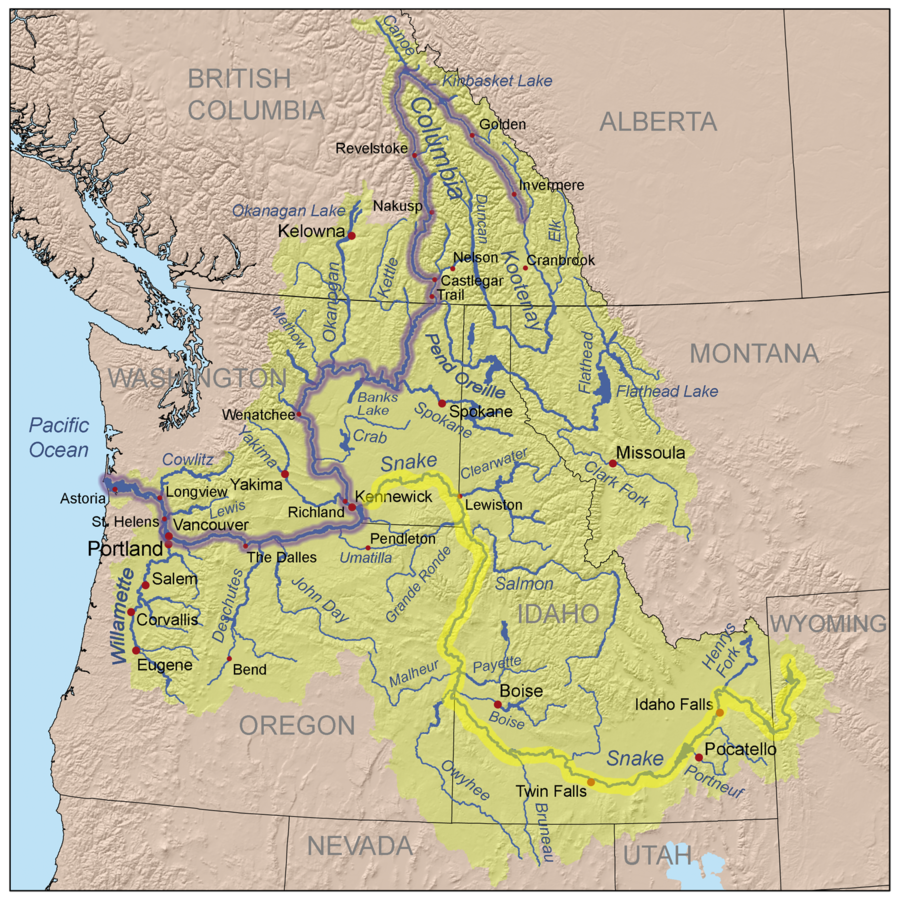
We mentioned the Pacific? In the Yellowstone area, some water runs to the Atlantic, as we saw. On the other hand, though, some water goes to the Snake River and then to the Columbia while picking up tributaries from Idaho, Nevada, Oregon and Washington. A major tributary of the Snake is the Salmon River

And from the Triple Divide that we looked at above, water comes into the Columbia through the Clark Fork and the Pend Oreille Rivers. 

Columbia and Snake Rivers

Remarks: Modified: 02/15/2025

02/15/2025 -- 

Monday, September 2, 2019

3 trails

We have had several posts looking at places with the Gardner name. One of these is Gardner, KS near which is Gardner Junction which was on the three trails: Santa Fe, Oregon, California. This is unique, to be where the travelers all were at the same place. The research query was in regard to some particular places, but we know that we need to get a more full list (pending).

Recently, we were in the area where the Trails were going toward Gardner. As well, we thought to look at more details (below). This same route was taken by the New England party (men and women) that left via a port in New York and sailed to Chicago before traveling over to St. Louis and west to Kansas City. They got to an area and established Lawrence, KS (Final migration, Lawrence and Kansas).

On looking deeper, we found the 3-Trails Corridor (defunct link). This was funded by a school initiative that looked to be associated with the Lewis and Clark celebration: 3-Trails Village Community Improvement District. We will look at this further. But, here are a couple of maps. One is from our earlier post. The other depicts points along the route.

Gardner, KS
We have had several posts on this theme and will be adding more. It's about time for a summary look which will appear in the next issue of The Gardner Annals, Vol. V, No. 1. The trails played a major role in the western movement. Too, we need to add in the Mormon experience.

As mentioned in an early post, there were to sea routes to California: around the Cape, two  voyages linked by a trek across Central America.

The gist is that this type of detail work is what one expects from a location. Same goes for a family. There may be major overviews, but a lot of the grunt work needs to be done by the family. Dr. Frank showed us one example. We still have lots of work to do.

So, there are several pending bits of work with Gardner Junction which is the southern trek out of the Kansas City area. This route was fine for the folks going to Santa Fe. But, it was out of the way for the California (gold rush) and Oregon trekkers. It went too far south. Young bucks figured out that they could continue north by water to St. Joseph, MO. This area became last stopping point where dry goods and other merchants had supplies at hand. The travelers still had to cross the Missouri river.

As an aside, some earlier posts looked at the trek from New England to Lawrence, KS. The movement was by foot, for the most part, in the last part of the journey. And, there was a river to be forded prior to arriving at Lawrence. So, this was practice for something that would be a continual source of grief all of the way across the country.

Far cry, one might say, from the easy of rushing down the Interstate. BTW, that subject is of interest, too, since many of those merchants were Yankees.

Perspective: From the KC area to Fort Larned (see the Kansas part of the Santa Fe trail - about 2/3 across the State), the experience was a daily grind for three weeks (makes "are we there yet?" which is known from another perspective to be quite tame). At least, at some point, those same persons saw the Sangre de Cristo mountain range. We have a post on that, too.

This image shows the area near Gardner KS where one finds a kiosk with information about the 3 Trails and Gardner Junction.

Remarks: Modified: 06/24/2022

08/07/2020 -- In this post, we are looking at two disparate spots that share a name, however there are many points in-between. Like Eudora, KS. Where "The Wakarusa meets the Kaw" is on their history site and is an example of local lore getting some attention. See "Along the Western Trails."

08/27/2020 -- Removed stale pointer to 3TrailsCorridor which dealt with the portion in MO: The 3-Trails Corridor follows the traveled way of the Santa Fe,  Oregon, and California national historic trails. It extends from Wayne City Landing on the Missouri River in Sugar Creek, Missouri, where the river boats off-loaded onto wagons and pack animals, southwesterly to Gardner Junction in Gardner, Kansas.

06/24/2022 -- Updated links to Eudora's website as topic continues to be of interest: A Ride to Kansas

Thursday, March 3, 2016

Trails west

In 2014, we did some research related to the origins of Gardner, OR. An article in The Essex Genealogist (TEG, v 35, no 2) and The Gardner Annals (TGA, Vol II, No 1) provided details about the ship (barque Bostonian) that wrecked at that site, its owner (Henry D. Gardiner), and some genealogical information. Henry was a descendant of George of Rhode Island, but his wives were descendants of Thomas of Salem.

Prior to the time that the ship left Boston, it had run up and down the east coast and points further. In the same year of the shipwreck, the Bostonian had been New Zealand.

Last year, Philbrick's book about the whaling ship, Essex, that was out of Nantucket, was made into a movie. Recently, I read the book (only saw the preview of the movie). I don't know if the movie went into the cannibalistic events, however they are described in Philbrick's book. This gives one pause or ought to. But, we'll not go further into the subject. The book is exemplary due to its attention to detail plus to its copious notes.

However, there are some humorous notes. Philbrick talked about the loading process that preceded the voyage. Too, the crew had to be put together. Of course, Nantucket'ers were preferred but scarce. So, they had to cast a wide net to get the manpower. As you would expect, many on the crew would be newbies (tenderfoot out west - see below). Philbrick writes about the Captain having to be out on deck during departure so as to direct the crew. And, it sounded like it could be like Keystone Kops. So, embarrassing to the old salt.

You see, everyone on Nantucket would know when a ship was leaving. And, they would all be down to watch the spectacle. Now, a ship in full sail and under control is a sight to behold. Yet, that would not be the case. And, Philbrick wrote about the Captain being aware that those with long-glasses could watch the going-ons for a long while until the ship was out of sight.

The book is a good read.

Now, on another subject, the Bostonian went from Boston to San Francisco in 1849. It left in July and arrived in January 1850. That was the long way to S.F. by sea (if it were the only one open to the flower children, 1967 would not have happened). Another sea method was to go down by ship to Central American, cross over, and then back up the left coast by ship. That required two ships, at least. The journey across Central America was arduous. Also, there were things of concern, such as diseases, thieves, and other perils. Many lost their fortune on the way back after having found success in California's gold mines. Some disappeared.        

Henry D. Gardiner (and, Gardiner, OR)

---

But, there was another way to the west coast: moving oneself over land. Last year, we looked at Gardner, KS. Some say that it got its name from the Governor of Massachusetts (Henry Joseph Gardner - descendant of Richard of Woburn) at the time that a group of New Englanders came to the area. They founded Lawrence, home of KU.

Gardner is not far out of Independence which was the starting point for the trails. They were together until west of Gardner. Then, the Oregon (California) bound wagons went by Lawrence on their way west. The Santa Fe trail headed southwest.

One thing to note is that from Independence, MO to Fort Larned, KS, nowadays, can be done by car in the matter of hours. It is a little less than 300 miles. A lot of it can be done by Interstate Highway. Back in the days, the wagons took three weeks (as in, 21 days) to do that trip. And, it was constant work every day.

On the trails west were Thomas Gardner descendants. Many people stayed at locations that they passed. That was how some cities grew. All along the trails, we find little cities where people decided to stop and grow roots. The advent of the transcontinental railroad (1869 - last spike) saw the same sort of phenomenon.

There was another trail, though. That one was related the western movement of the Mormons from the area of Nauvoo, IL to Utah. Again, many of these travelers were from New England.

---

Why the interest? I have run across several diaries (published) from the time that we can look at in more detail. Many of the diary writers have ties back to New England and its roots. We have had an interest for some time to map out movements west. Some families have described movement to the south, first (Carolinas), before the western thrust.

Too, though, there are always reminders. New Mexico, as a State, was 100 years old just four years ago. It is one of the late comers in terms of statehood. But, it is a very old culture.

Coronado was there and in area of present-day Kansas, in 1541. That was long before there was New England activity. As we get toward the 400th, we will see lots of interest in regard to all of the different places and cultures that make up the current populace's history.  

Remarks: Modified: 06/24/2022

04/02/2016 -- Map showing Gardner Junction and the split of the trails west of Gardner, KS.

06/17/2016 -- More on trails.

07/16/2016 --Gardner's Beacon, Vol. VI, No. 1

08/13/2017 -- Posts on Lawrence (and surrounds): Trails WestWestward HoBlogging and suchFinal MigrationThomas Wentworth HigginsonKansas and Lawrence.

08/07/2020 -- In this post, we are looking at two disparate spots that share a name, however there are many points in-between. Like Eudora, KS. Where "The Wakarusa meets the Kaw" is on their history site and is an example of local lore getting some attention. See "Along the Western Trails."

06/24/2022 -- Updated links to Eudora's website as topic continues to be of interest: A Ride to Kansas


Tuesday, April 20, 2021

Frontier century

TD;LR -- A photo of Alexander Gardner of Lawrence, KS gets us to back up from the end of the frontier century to its beginning. Kansas came out of the Louisiana Purchase which became known as the Missouri Territory. An early split out was Arkansas. So, we need to look at that are in terms of events at the same time that we pay attention to the far west. 

--

Just saw a photo of Lawrence KS from 1867 at a FB site related to the city's history. It came from the Kansas Historical Society. The time of the photo would have been over 10 years past the visit by Col. Higginson and shortly after the Civil War. This photo was taken by Alexander Gardner who came over here from Scotland. 

Massachusetts Avenue
Lawrence, KS

The area had been part of the Missouri Territory which was a renaming of the Louisiana Territory after that State was formed. We will be looking further at the Missouri Territory due to the western movement going through that area. At the time of the mountain men (such as Jedediah Strong Smith whom we will look at further; also see Rendezvous) which was early 1800s, there were people settling in all of this area. Boone was one. 

Here is an early map of this territory. 

Notice that Texas in not included. However, we are dealing with families from all over this area, some of whom were there about the time of Boone. 

Also, with due respect to the brains of genealogy, they have missed several boats. We will explicitly deal with several of these as we go along. 

Here is another view, a little later. Arkansas Territory ran along the TX border and included OK. We will look at families who came out of the east (Cumberland Gap) that covered that area: MO, AR, OK, and TX. Some of these folks had ancestors who went south from New England. Others met Yankees out in the western expanse, thereby closing the tie of the New Englands, north and south. 

Arkansas cut out

BTW, a motivation? One deals with frontier issues being different than that 'wilderness' view of the east coasters. We might use the label of America's Lost Generation

Remarks: Modified: 07/25/2021

04/21/2021 -- We will be looking into the 400th as an event of importance. At the same time, we will consider a thematic cover, going backward 100, 200, 250, 300 and 400 years. The 250th? Upcoming relook at the Revolution. In terms of the 100th, which is the end of the frontier century, we can use individuals, such as Amelia Earhart, William Coffin Coleman, and others.

07/25/2021 -- Missouri is where the carving of the great U.S. landscape started. Driven, we might add, by New England. We'll think of some piece to honor George Kimball III who died this month in 2011, cuz of Ann several ways.   


Thursday, January 6, 2022

A(bbott) Lawrence Lowell

TL;DR -- A(bbott) Lawrence Lowell served as President of Harvard after Eliot and before Conant. He changed the focus to be more scholarly and collegial with decisions like having the dormitory experience cut out the 'Gold Coasting' that had become the New England way, say as we saw with Boston Brahminship. 

--

We have been adding Heads of Harvard (Wikipedia) to our list (History of Harvard) while taking a brief look at each with respect to time and affiliations, such as family and connections to New England. Our research started with a recent President (James Bryant Conant) who followed Lowell, and we have done a few more. For each of those chosen so far, there was a motivation involved which we will document. 

A. Lawrence Lowell came to our attention due to his family ties. He has a large New England pedigree (Lowell- 642) according to the researchers at WikiTree. We will be checking that. However, we noticed, too, that not much has been written about Lowell. We have seen this of several Presidents.  

So, on looking further, we found that there is a page at the Harvard site titled "History of the Presidency" at which one can learn more about each person. Lowell helped move the culture such that a common spirit might develop. We learned that early classes were ranked by the social status of the family of the student. 

Lowell built dormitories and emphasized the need for students to live in these. Prior to that, how the student lived was, again, according to social status. One might say, the infamous 'Gold Coast' of the Boston Brahmins which had been encouraged by the prior President, Charles William Eliot. An example is the Adams House which became a dormitory - its website.  

Like the others, Lowell's time had its ups and downs. Example: Writing the Wrong (2005). Also, Lowell had accomplished siblings (Percival Lowell and Amy Lowell) and cousins (John Lowell Gardner). 

---

As we have gone through our look at the Heads of Harvard (Wikipedia), we have put together the following list of pointers to foster discussion which we are adding to the early posts after our first which was on James Bryant Conant (dated - 26 Aug 2021).  

This has been a very useful series with tons of work now pending to bring the 'real' history of the U.S. to fore as an example of what future work and analysis will involve. 

---

One person of note to our research is Col. T. W. Higginson who was old family and a Harvard graduate. He wrote of his lineage which he self-published in 1910. In that work, we have some sixty references to Harvard graduates, including two references to Presidents (Kirkland and Lowell). So, that is of interest. Some of the graduates were related by marriage to the family. The early Higginsons had an association with Theophilus Eaton who was the brother of Nathaniel. 
Remarks: Modified: 09/23/2022
01/07/2022 -- Doing, finally, a post on Boston Brahmins. Plus, Lowell paraphrased: every issue has a Harvard man on the wrong side. 

02/02/2022 -- Add 't' to Abbott. Put a link to the Wikipedia page. 

09/23/2022 -- Added list of links plus noted the relationship with John Thornton Kirkland. And, note about Col. T. W. H., who was a graduate as were many in his family. 

Saturday, June 11, 2016

Westward Ho

We already had the 200th of Lewis and Clark's venture west. They came through near where I was recently and spent three days resting and getting their supplies in order. Kansas created a park at Kaw Point to commemorate the event. Other locales established memorials over the length of the Lewis and Clark trek.

Coming up then, too, will be 200th anniversaries of the great migration to the west.

We will be doing more posts on this for several reasons. For one, a major point in the trek was the split at Gardner Junction where the Sante Fe trail went south and the Oregon trail headed north. For a long while, the Oregon and California trails were the same. Then, out west, some wanted to go to sunny California and the Spanish architecture. Others wanted to go to the gloomy north. 

Go spend some time in Seattle to see what I mean. Nice places, though.

Then, too, plenty of Gardner and related families came through this area venturing either way. We will get stories of these families and their ordeals.

A little further south, there was another set of trails that came out of Arkansas heading west. 

One important thing to remember is that even in this eastern region of Kansas, wagons had a problem fording rivers (say, the Wakarusa). For instance, near Lawrence, they had to dismantle wagons as much as they could in order to get the things down the cliffs and over to the other side. Of course, similar efforts were required for the wagon contents.  

Consider, if you would, what was coming up for these folks as they went further west and experienced the terrain found in present day Wyoming, Utah, Oregon, and, even, Idaho.

Major work. Every day.

Do we ever think of that as we buzz down General Ike's (BTW, a Kansas boy) roadways - our current Interstate system?  

Remarks: Modified: 08/16/2025

06/17/2016 -- More on trails.

07/16/2016 -- Gardner's Beacon, Vol. VI, No. 1

11/01/2016 -- On foot traverse.

08/13/2017 -- Posts on Lawrence (and surrounds): Trails WestWestward HoBlogging and suchFinal MigrationThomas Wentworth HigginsonKansas and Lawrence.

08/16/2025 -- Mentioned this topic in a look at the comparative flow of American Rivers. We will look at this topic further as an example of two roles of rivers: means of transport; barrier as was seen on all of the trails. 

Tuesday, August 11, 2015

Gardner, KS

Earlier, we looked at places with the Gard[i]ner name. Then, we took Gardiner, OR and wrote about the person for whom the town was named, Henry Dearborn Gardiner (pg 31, v 35, no 1, TEG; pg 6, v II,n I, The Gardner Annals). That same family was the inspiration for Gardiner, ME.

So, talking of Oregon, there is a town on the trails (see next) in Kansas, named Gardner. It may have been named for Henry Joseph Gardner, Governor of Massachusetts (1855-1858) as there were many pioneers from Massachusetts in the area.

First, about the town. It was where three trails split into two: Santa Fe Trail, Oregon/California Trails. The Santa Fe Trail ended up in a city in one of the oldest areas of the U.S. The other two trails were coincident until much further west where the California Trail headed south; after going west out of Gardner for awhile, they headed up to Nebraska then west to what is now called Wyoming.

Now the Gardner was Henry Joseph Gardner who was a descendant of Richard Gardner of Woburn who is on the list provided by Dr. Frank (the Gardners and Gardners post is the most popular all time).

---

The mid-west and central parts of the country are full of displaced New Englanders. A little up the road from Gardner is Lawrence whose main drag is named Massachusetts.

Remarks:  Modified: 06/24/2022

04/02/2016 -- Map showing Gardner Junction and the split of the trails west of Gardner, KS.

08/13/2017 -- Posts on Lawrence (and surrounds): Trails WestWestward HoBlogging and suchFinal MigrationThomas Wentworth HigginsonKansas and Lawrence

10/26/2018 -- Map of Gardner Junction. 


08/07/2020 -- In this post, we are looking at two disparate spots that share a name, however there are many points in-between. Like Eudora, KS. Where "The Wakarusa meets the Kaw" is on their history site and is an example of local lore getting some attention. See "Along the Western Trails."

06/24/2022 -- Updated links to Eudora's website as topic continues to be of interest: A Ride to Kansas

Friday, October 1, 2021

History of Harvard

TL;DR -- Over the decade of research, we have run into Harvard lots of times. And so, we need to collect those things seen and written about in a sequence that depicts several things. One of these would be the influence of the times upon Harvard and vice versa. The 1600s got us bogged down. We will be at this for a while updating this post and creating others. 

--

This is one of our quests related to the upcoming 400th. We have some time but need to get to work early since there is a lot to do. Harvard has several histories. This one is from the view of the families here for 400 years with members related to Harvard several ways which will be further categorized as we find material. Anyone interested in helping, please contact us. 

We will start with this brief list in a temporal order. It follows, somewhat, the order in this Quora article titled: What is the coolest obscure historical fact you know? We chose the topic of Harvard having a parallel history with the U.S. 

Note: We will be editing this post continuously. As topics become too big, we'll split out other posts. The motive is to cover the whole of the history from the time of Nathaniel (kin) until the present time with a focus on people other than Harvard staff and students, most of which will be American. 

Which this guy was firstly. That is, he was here before he went back over there. 

Count Rumford
See our first look at the guy

This guy funded the secular revolution at Harvard. How did they go adrift? Of course, one has to also ask, did they? Lots to discuss. 


                                                                12. Joseph Willard, - Eliphalet Pearson
25. Derek Bok, 26. Neil Rudenstine, 27. Lawrence Summers, 
28. Drew Gilpin Faust, 29. Lawrence Bacow 

In its own words: History of the Presidency. Goes back to Dunster. Also, Hasty Pudding, of which many on this list were members. 

Topical items, mostly. This will be a list to motivate future research. Will add the date it was entered.

Remarks: Modified: 07/30/2025

12/06/2021 -- Add Eliphalet Pearson. Changed pointer for Eliphalet to Wikipedia. ... Add in Samuel and Joseph Willard. 

12/10/2021 -- Add Nathan Pusey who followed James Bryant Conant. 

12/11/2021 -- Add numbers, format, add Henry Dunster (kin). Add John Winthrop as acting at two different times. 

12/15/2021 -- Add link for Joshiah Quincy, III. His mother is hugely of New England pedigree. 

12/24/2021 -- The feed finally provided me with a page. Had been looking at the Hasty Pudding material. Harvard material on Rumford and his daughter

01/06/2022 -- We'll have to build a source list, starting with Richard Norton Smith's The Harvard Century: The Making of a University to a Nation (1998) and Elizabeth Tucker's Campus Legends: A Handbook (2005) (quote: Goat's dung and mackerel guts rival modern "fast food" legends in the degree of disgust that they inspire. From this account and others, it seems clear that America's first college students enjoyed telling stories that highlighted -- and probably exaggerated -- the most shocking details of their miserable meals at college) which can be previewed. ... Add Charles William Elliott.  

01/17/2022 -- Add Samuel Webber. There is conflicting information about him published. So, we will check that out. Too, he's of a family that is little known, comparatively. Then, his mathematical interests are appealing, for several reasons.  

01/23/2022 -- Add Charles Chauncy who followed Henry Dunster. It was in Chauncey's term that the first Native American graduated, in 1665. 

02/05/2022 -- Add Samuel Locke. We are now talking about periods related to the Revolution (250th coming up). 

02/09/2022 -- Add Leonard Hoar. He initiated the Catalogue. 

02/16/2022 -- Add Increase Mather and put in link for Samuel Locke. Add a little verbiage for the 1800s. 

03/09/2022 -- Add Drew Gilpin Faust. First woman President. Next up will be to get the narrative up to date. Started the topical list (nice to know of the Gazette). Add John Leverett.

04/05/2022 -- In preparation of bringing in another Head, changed the list to have three per line, for now. 

04/07/2022 -- Add Benjamin Wadsworth whose time was of the early transformation to modern moral declination (complexity, our forte). 

04/18/2022 -- Add Urian Oakes, the 4th Head. 

04/24/2022 -- As we involve Harvard in our look at the U.S. through time, we will bring in the English aspect via comparative views about Oxford and Cambridge

04/29/2022 -- Add Edward Everett. #16 of 29 or so. Not quite the middle, but close enough. 

05/02/2022 -- Add link to Harvard's report on slavery

05/17/2022 -- Add John Rogers. 

06/28/2022 -- Add Edward Holyoke. Corporal punishment pops up? 

07/16/2022 -- Add Samuel Langdon, D.A.R. Patriot. Irritated Harvard Tories. 

07/22/2022 -- Add Nathaniel Eaton. 

08/13/2022 -- Add post on Cornelius Conway Felton. 

08/31/2022 -- Add Jared Sparks. 

09/01/2022 -- Add James Walker. 

09/17/2022 -- Add John Winthrop (twice in an interim role). 

10/15/2022 -- Add Thomas Hill. This brings us to the 1930s, or 300 years. That's enough. Let's go back and start with the interesting folks and their times. 

10/31/2022 -- Add Derek Bok. Now, will do the two final ones (Rudenstine and Summers). We want to help make the 400ths a time of reflection and regaining of knowledge. 

07/30/2025 -- George Washington stayed at two houses related to Harvard during the Siege of Boston. 


Monday, August 10, 2020

Scholars, in general

TL;DR - Earlier, we saw a Middle School reference some our work, indirectly. Looking at later material, it is nice to see U.S. history lessons. In particular, geography can help us understand what people went through, especially in all of the goings and comings on land (post Lewis & Clark and Boone). Water. Necessary. Can be a problem, at times.

--

Back in 2011, we read that a Middle School in Peabody had Thomas Gardner on a list of colonials for the students to study. Part of the material came from our publications. Later, the post disappeared.

Of late, we have been looking at the western expansion using Cumberland Gap as a reference point to discuss the realities then of moving from one place to another. Motivation for that came from looking a families in the south, many of whom had come down from New England. Post the U.S. Revolution, there was an upswing of interest in the west. Consequently, there is a lot of material to cover.

But, one factor was the waterway. We noted from the group that went from Massachusetts to Lawrence KS traveled part way on foot through terrain that might have been less severe than people would find out west but was still difficult. As mentioned, going from the Kansas City area to Fort Larned on the Sante Fe Trail (a mere few hours now by car) was almost three weeks of daily grind. We looked at some of the issues in a recent post: Cumberland Pass (which is near a mountain named for Harvard).

The travelers had to go over divides, albeit in a lesser mode than one would require if there was not a choice. Say, a pass that is 12k feet in height is quite different than what was required for traversing the Cumberland Gap which was still work. As we mentioned in an earlier post, this summer, a woman talked of leaving her infant behind a bush as she helped her husband get the wagon up a steep climb. They were using horses which had to stop to get a breath. Well, the wagon needed to be chucked to relieve the strain on the horses. After they got to the top, the woman would go back down, get her infant, and come back up.

And, then, it was down the hill until the next rise. That's why we mentioned the ford near Lawrence KS as training. Same routine, albeit, less slope and distance. Lots of stories like that will come to the fore with events like the 400th plus the existence of technology for presentation of information on-line.

One huge divide results in the Mississippi River and its tributaries. Those were major obstacles. This get us back to education. There is a graphic of the Continental Divide on material used for 4th-Grade science which was interesting (first bullet). As well, the site provide coding opportunities. Yes, adults need to get their heads in that mode, too. So, looking further at the posts that can be found on this divide, there is a report on traveling the Trail Ridge Road in the mountains near Estes Park. It has wonder photographs (second bullet). So, taking that further, and coming up on the scholar's view, there are other types of faults. An Earth Science post shows us the triple divide (third bullet). That leads to the more general view which would include the Laurentian Divide. The photo on the right is from this Wikipedia article (fourth bullet).
So, we have a new series to talk about: on-premise, cloud, mobile. That is, these refer to the types of platforms and presentation options related to the modern distributed mode. As in, the TGS, Inc. will be at the forefront of illustrative material being offered which can cover all of the intellectual levels.

In the prior posts, we showed the Mississippi watershed. However, look at the yellow line. That's the initial barrier that gave Daniel Boone fame. And, going north, we had divides up there, albeit we lost Canada in the U.S. Revolution (never had it, even Maine wanted to split off).

Remarks: Modified: 08/28/2020

08/10/2020 --