Showing posts sorted by relevance for query american indian. Sort by date Show all posts

Friday, April 23, 2021

Conflict with the American Indian

TL;DR - Early on, conflict was minimal. With more new entrants, the potential for conflict grew. For almost two centuries, the incursion covered coastal areas. Even though western movement started early on, it was a gradual affair with small steps. Until the Revolution and Europe (Spain, France) giving (selling) their claims. Even then, the expanding frontier was an experience of over a century. We can look at the history with an educated eye. What are resolutions that might be pending? Events like the 400ths (and the 300ths, and 250ths, and 200ths, and the 100ths) are good points to step back and review. 

--

Though we have mentioned the American Indians (changed in the blog from Native Americans) whose population experienced the incursion from Europe in several posts, we need to make this topic a regular point of research. Our focus was primarily New England for a while; just recently, we see that we need to change to a broader view since the West was established over several long decades after the Revolution. 

And, part of that widening is to bring New France and New Spain into the discussion where New England had much more association with the former. So, we will continue to have the early period that pertain to the colonies. Then, there is the following period that is around the Revolution and shortly after. Before, we had the French-Indian affair which involved quibbling with New France. Conflicts in that period occurred in what we can call the south (say Florida) and the mid-West. 

Then, we can focus on the period up to the Civil War. And, finally, there would be the time after the Civil War (which really is open ended). Each of these periods involve clashes between immigrants and the American Indians. But, there are inter-American-Indian issues to look at, too. Some talk of these latter two partitions as East of and West of the Mississippi (this post uses the Ohio River as an example of friction building). But, we saw it, too, with Boone, earlier

See Wikipedia's American Indian Wars

We can use our partitioning where we point to a post for an example of the period. 

  • Colonial (to 1776) - John Goff's article can serve as our example: King Philip's conflict (John Goff's article). 
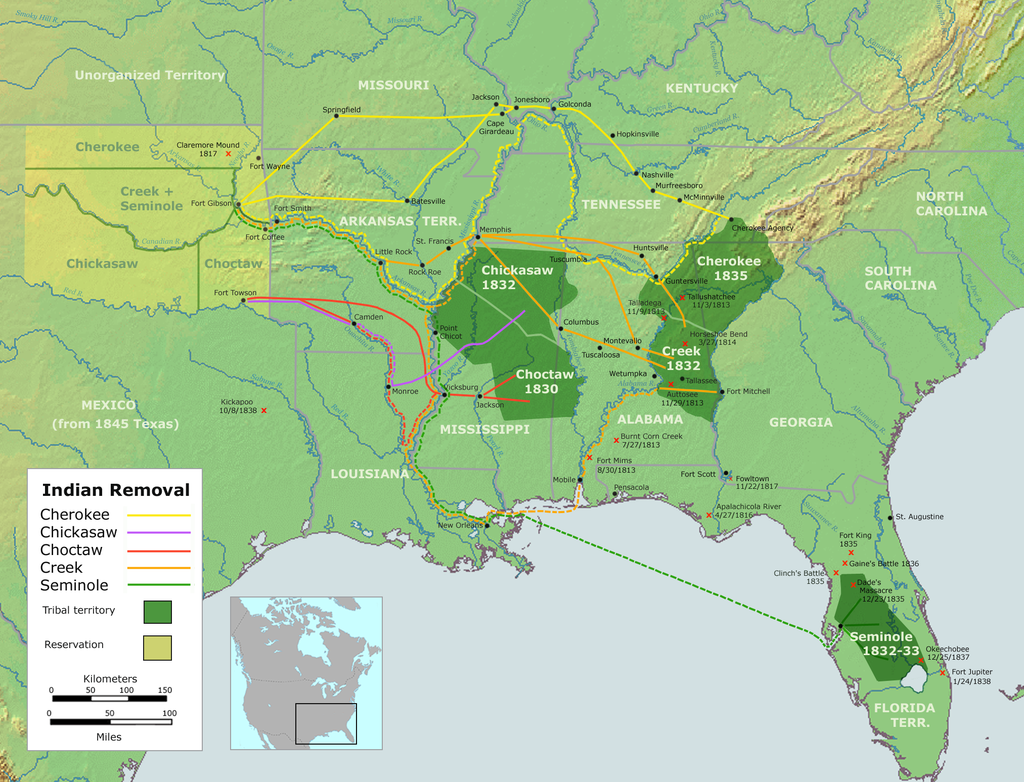
  • Wilderness (to Lewis & Clark) - A southern example would be the Trail of Tears
  • Going west (to Civil War) - The trappers were from the territories of New France, originally. Later, we find wanderers from the east coast. Example: Arikara War which gave us Hugh Glass and a movie (see Gardner River which is even further out). 
  • Everywhere frontier (Civil War, on) - Some of these conflicts were from the west coast (Oregon and surrounds) inward. 
Let's leave our cursory beginning with a couple of links. 
So, we have not been unaware. There was lots of material to read, digest, and organize. So, conflicts? Has the U.S. ever been without this? We mentioned from the beginning that the future would include participation by American Indians in ways to be discovered. The Mayflower event was a good example. 

An additional comment is in order. After the work of the past three years, it is our assessment that the eastern stuff is well handled. That is, the stories told, except we have found a few. So, we will have a continuing appreciation of the east (east is least?). On the other hand, the west is sorely covered and needs a whole lot more attention. It is not that easterners of note have not come out, after all we have Lawrence KS (see Frontier century) as an example. But, the NCAA is a good metaphor. How many easterners know about the PAC-12 (we have to kick ourselves to remember the PAC-8)? So, we'll end with this graphic. 

Promises in 1851

These are the promises of 1851. We can find those before and after. And, will. 

As an aside, this is about the time that Judge Thompson was on his jaunt where he helped found Montana. It is past the California Gold Fever. But, people were still on the look out for things that shine or had some value (the whole bit of establishing this will come into the discussion, as well). 

Remarks: Modified: 05/28/2022

05/02/2021 -- Brief recap of the later times: Great Sioux Reservation

06/02/2021 -- Learning more about the American Indian leaders and the New Englanders who were at the Little Arkansas Peace negotiations and signing. 

05/28/2022 -- Memorial Day, 2022 - An Osage Mission


Saturday, April 27, 2013

American Indians

After running across several sites with pertinent information, I'll start to post these here.
  • http://www.nativeamericandeeds.com/default.html - "The specific purpose of this project is to bring focus to the subject of the American Indian Deeds as recorded in Essex County and also to the American Indian population, which was living here in the 17th Century. "
  • http://www.neara.org/ - The site for the New England Antiquities Research Association.
---

There will be lots to collect about the Gardners and the prior residents. For instance, the King Philip's war was a threshold event, many ways. During that troubled time, Nantucket was peaceful,  with the Gardners playing a large role in this.

---

The focus remains the very early times. Lots to look at. Any volunteers want to cover other areas?

Remarks: Modified: 02/27/2021

02/27/2021 -- Changed to using American Indian. 


Sunday, July 22, 2018

Another western movement

Since an earlier post (and several others) mentioned western movement, we need to pause and look at the environment in the 1830s. Jedediah Strong Smith went west as a young man from New England (of course, our main focus) a little earlier. As such, he was an early explorer and lived the life of a mountain man. Before Jedediah went west, we had the conflict with England. One person to study further will be Hector St. John who wandered, as a foreign visitor, at that time and went home to write about it.

Turns out that there were others of such capability. Namely, the American Indians already on the continent. This post looks at events in the south, which was populated from England. However, many from New England went south, too. We will be looking at that (one of many examples). Then, some went west from the south.

A lot of the west has strong New England influence. Related posts: Gardner Junction, Final Migration, Gardner CO.

Today, we want to present the words of a American Indian leader. The words come from the address of George W. Harkins to the American People dealing with removal of the American Indians (related legalese).
  • It is with considerable diffidence that I attempt to address the American people, knowing and feeling sensibly my incompetency; and believing that your highly and well improved minds would not be well entertained by the address of a Choctaw. But having determined to emigrate west of the Mississippi river this fall, I have thought proper in bidding you farewell to make a few remarks expressive of my views, and the feelings that actuate me on the subject of our removal.... We as Choctaws rather chose to suffer and be free, than live under the degrading influence of laws, which our voice could not be heard in their formation.
Western movement, example
Popularly, people talk of the Trail of Tears. But, it deals with much more than that. Notice his words about wanting to be free of degrading laws. Does that not sound American?

---

Our theme, again: Culture, History, Technology (of which are the gene related things). In our broad sweeps, we will be sure to gather information about interaction with the American Indian. Thomas had peaceful relations, as did Richard and John in their leadership roles on Nantucket. But, we know issues are not simple. Yet, the stories will be told, especially given the web. We can have a more in-depth coverage from time to time.

Remarks: Modified: 05/28/2022

02/27/2021 -- Changed to using American Indians.  

05/28/2022 -- Memorial Day, 2022 - An Osage Mission

Sunday, January 23, 2022

Charles Chauncy

TL;DR -- We pick up one more President from the early years. In 1665, Harvard graduated its first American Indian. There are other topics of interest from the early times that we will look at further. As we go forward, we will bring in MIT, for balance, as we consider the scholarly side of things. 

--

This post is about the 14th of a series of unknown length. As such, it continues a theme related to the history of the U.S. as it might be seen through Harvard's history and as we focus on New England's influence from its beginnings, principally the northern realm. The topic of the post is change from the former technology focus which seems to drive the modern viewpoints more than does others. Seems is apropos, as there are plenty other views just as true. In fact, our getting a proper balance on technology will come from a broader scope in scholarship and in normal life. 

With respect to Harvard, these posts figure centrally: History of Harvard, Heads of Harvard (Wikipedia), History of the Presidency (Harvard), Catalogues of Harvard (Hathi Trust, mainly for the classes, years and graduates) and several posts in this blog concerning specifics of Presidents, their times, lives, and families. Of the last group of posts, we have picked interesting Presidents due to finding them instrumental to some point that we were researching. The first one was James Bryant Conant who had been mentioned in a New Yorker article. 

Today's post came from a search on American Indians and Harvard. We found a Harvard Gazette article that mentioned the first American Indians graduate whose graduation was in 1665. As well, there was mention of the Charter of 1650. Henry Dunster was President, then, the 1st. In 1665, we find Charles Chauncy. He has a WikiTree profile and a pedigree that we will look at further (Magna Carta - WikiTree: Chauncey-8). This somewhat motivates us to look further at the lineage of some of the others, mainly, with respect to tying U.S. particularities, in its early stages, back across the waters. After all, many who came here left descendants who have trouble, now, closing gaps left 400 years ago. 

We have had several posts on American Indian issues with respect to Essex Count, New England and the U.S. as a whole. With respect to institutions, MIT's School of Humanities, Arts, and Social Sciences will be added to the list of research topics. We have been following several American Indians sites via the internet. 

Here is an example article of note.

Note: earlier, we converted all references of Native Americans to American Indians. Our use in this post follows the use in the articles that are provided as reference. We will use the terms interchangeably. 

Remarks: Modified: 04/07/2022

03/14/2022 -- The wander though the hall of the Heads of Harvard has been quite interesting. We will summarize at some point about the varied cultural and societal aspects that come up. For instance, Chauncey (WikiTree pedigree: Chaucey-8)is on the list of Gateway Ancestors who represent descendants of aristocracy who came over here. In short, many of these are cousins of Prince William and Prince Harry, and others. Another tale, related to Harvard, is that (one of) the Cottons told some cats who wanted to come over with privileges that, no, come here and be like everyone else. Lose your pedigree. How would Harvard handle that now? 

04/07/2022 -- Changed most Native Americans mentions to American Indians. 

Thursday, May 27, 2021

Trapper, trader, rancher

TL;DR -- Movement to the west started early, hence the conflict with American Indians ensued which resulted in attempts at treaties. One of these attempts was at a meeting near the Little Arkansas River in 1865. The major tribes of the Plains were represented. The foremost negotiator for the U.S. was of New England. Also present was Kit Carson and William S. Bent who had an Indian wife and had spent several years in the west.  Like early treaties, this one did not take. Subsequent treaties resulted in a lessening of land available to the Tribes. 

--

Recently, we wrote of the frontier century that began after the trek of Lewis & Clark and continued until the early 1900s. The early part of the century gave us Jedediah Strong Smith and his peers. They interfaced out west with American Indians and people from New France. In this case, the movement west had been across the middle of the country. A couple decades later, there was more area covered, and we saw settlement taking hold. Some were already old, such as St. Louis MO. Others sprang up along the way and over time. For all of these periods we have identified families to research noting location and routes which included rivers. 

However, we also have looked at the time before the interest of New England changed the west. Turns out that Wikipedia is thinking along the same lines: American Frontier (article was started in 2016). 

This post looks at William S. Bent (1808-1869) who was a trapper, trader, and rancher. He built several posts along the Santa Fe trail. William was born in St. Louis, however his father, Silas Bent (1768-1827) was born in Rutland MA which is in Worcester County. Silas is of the generation too young to be a Patriot but his father was one. We will look at Silas later as he was educated in Wheeling WVA (at the time, VA) and became a surveyor of the Louisiana Territory. As can be seen, Silas shows an interesting part of the migration patterns out of New England where he had a deep pedigree. 

Missouri saw European influence early on but became a State in 1820. The image shows the Santa Fe Trial going across the middle region. William S. Bent built a fort along the northern route of the Trail in southeastern CO in 1833. The southern route of the Trail continued in KS in OK and then NM. It was along this route that Jedediah was killed. 


William was out in CO for several years and had a ranch. He bought land near Kansas City MO in 1858. He married the daughter of Cheyenne leader. There will be a lot more to look at as that whole area boomed over the next decade and one-half. 

In 1865 as the Civil War was dying down, the U.S. government developed a Peace Treaty with the American Indians and organized a signing ceremony. The tribes involved were the Apache, Arapaho, Cheyenne, Comanche, and Kiowa. This meeting took place near current day Wichita KS. 

William Bent was there for the signing of the Little Arkansas Treaty which is named for a tributary of the Arkansas River that originates in CO. William had been involved with the American Indians for several treaties: 1840, 1848, and 1861. There were many more in succeeding years. 

The treaty's text is available via Yale's Avalon Project: Treaty with the Apache, Cheyenne, and Arapaho; October 17, 1865. The Daughters of the American Revolution placed a marker in 1925 to honor the event (more details later). 

We wanted to mention a few of the others who were there representing the U.S. due to their connection with New England, both north and south. As we read of this, we saw a Sanborn name pop up, so that got our interest. 
  • John B. Sanborn - born in New Hampshire. John went to Dartmouth and ventured out to Minnesota in 1854. He served with a Minnesota military unit during the Civil War. After that, he got involved with the western frontier. 
  • Kit Carson - was born in Kentucky to a Patriot of the Revolution and 1812. His family moved out to MO and were friends with Daniel Boone. By 1826, Kit had gone west on the Trail and was all over the west. Even a summary would be too long for now. So, we'll look at him from time to time. 
  • William S. Harney - served in the U.S. Army from 1818 to 1863. President Johnson appointed him to the Indian Peace Commission. He was born in Tennessee in 1800, but his father was an officer in the U.S. Army.
  • Jesse Henry Leavenworth - born in Danville VT, he was the son of General Henry Leavenworth who was born in New Haven CT. 
 American Indian leaders who were there are: 

Remarks: Modified: 06/19/2021

06/03/2021 -- Added the TL;DR. 

06/19/2021 -- Very old St. Louis in the State of Missouri


Sunday, December 3, 2017

American manhood

Let's see, from the beginning, I have seen Thomas as an example of the American everyman. I gave him a title of the 'backbone' of the country. That is, his type represents such. There has been a whole series of posts related to this, such as juxtaposing John Gardner (son) being out with the crew that mapped the Merrimack with those of the early Harvard times arguing the 'angels on a pinhead' sort of thing. Too, Thomas appeared to be the first true gentleman of the Dorset effort. He stepped aside for Roger (ancestor, so no conflict there). Of course, he did get back the house when Roger and friends went over to Salem (see Cape Ann, of course and (Not) Far from idyllic). There are more posts on that theme. When John (Endicott) came over, the great house was in good shape, enough to be moved to Salem. So, Thomas and Margaret and kids, evidently, took great care of it.
Puritan couple

Now, switching perspective, of late, I have been studying Virginia. We did live there but did not pay much attention (you know, big DC across the river). Then, I started to research families who were both of the south and the north (Southern New England). Then, I read a book review recently that talked the early times. After all, did we not see the Mayflower celebration, again? So, who had the the First Thanksgiving over here. I remembered a book that I bought in DC way back in the '90s and never read. It covers the first seventeen years. Remember, they had their 400th in 2007 (as we ought to have seen in Maine, too, due to the Popham venture).

But, the new book being reviewed talked about martial law. Even the 'wheel' was mentioned. So, there will be more on this but, for now, look at this book from 2011 (New Men: Manliness in Early America). Hence, the title of this post.s

Also, consider the Wikipedia page on the time of Sir Thomas Dale. My thought was: now, that is something to be thankful for, that the martial law did not take. Subsequent literature suggested how this may have gone down, including the recent book.

But, the northerners were no angels, either. To wit (only one example), selling American Indian combatants into slavery in the Caribbean. They actually did this, to boot, with Quakers, including children.

So, there will be more on this topic. We have to look at all sides of the story (Thomas and Margaret left us mostly with a tabla raza, except for their children).

Remarks: Modified: 02/27/2021

03/01/2019 -- Added the image. We're building an index by images at our portal to truth.

02/27/2021 -- Changed to using American Indian. 

Saturday, July 26, 2014

John Gardner and the Merrimack River

John Gardner was a son of Thomas and Margaret who was born at Cape Ann in pre-Conant times (1624). We have mentioned him a few times, such as for his roles in Nantucket, but he also was involved with Essex County and Massachusetts.

Gardner's map
In 1638, Gov. John Winthrop wanted a survey of the Merrimack River. Nathaniel Woodward (NEHGR, Vol. 51, 1897), a mathematician and surveyor, led the effort. John Gardner was part of the crew (Browne, G.W. (1906) "The Merrimack River: Story of its First Survey" Granite State Magazine, Vol. 1, p 133). Later, John annotated a copy of the map that was drawn using survey results.

See the image which can be found at American Indian Deeds (John's signature is on Section C) which was accessed from Salem Deeds.

---

John would have been young, of apprentice age, but this had to be a good experience. Dr. Frank (1907, pg 52) wrote that he "was first mentioned in the records of the 'General Court' at Boston" when the treasurer was "ordered to pay John Gardner ... for witness charge & carrying Goodman Woodward, his instruments to Ipswich."

This crew's map was used until 1652's effort at determining the northern extent of Massachusetts.

---

Note: I ran across the map while researching another topic involved with Ipswich. One intent is to gather as much as is available, and can be found, for each person of the 1st generation. Then, providing a persistent means for presentation is (will continue to be) on the table.  

Remarks: Modified: 01/17/2022

07/27/2014 - In 1638, there was a Harvard class in progress. From the viewpoint of effectiveness required for successful establishment of a community, one can, easily IMHO, ask whether John's experience might have some, a lot IMHO, advantages over the classroom discussions related to the number of angels on a pin head (sorry, had to write that)? This is an age-old argument, very much apropos to some modern problems. We expect to address this topic, and related topics, again. For now, look at Staloff's book (see preview at Google books): The Making of an American Thinking Class (oh Lord, deliver us). I have mentioned him several times in posts. I would take 100 Thomas' as backbones and brains over any intellectual as would anyone who has to deal with reality and problems that have to be HANDled.

06/06/2015 -- Given the day, an aside: Harvard contributed, relatively in size, manpower for both WWI and WWII. In some ways, it's astonishing that the likes involved currently (and their whole worldview) is supported by those who put their lives on the line daily and not by the ilk (we can discuss this from a historical view, please). ... The school has also just picked up oodles of money which has caused some controversy. None here, as the money could go toward making their upcoming 400th more pertinent to the American (and the dream for many - say, Magna Carta) experience, as a whole. ... Another aside: John Gardner, being young, may have provided the muscle for the crew, but that type of experience is missing from the lives of many who go to the supreme, supposed (similar ilk from all over the world is attracted), academic environment (say, for instance, a draft and real contributions thereby - see above). ... Finally, the view here is not colored by the fact of being an in-law to descendants of the first head (whole tale ought to be re-visited with all sides represented).

11/23/2016 -- Looking further into Dr. Frank's periodical, "The Massachusetts Magazine," we found R.A. Douglas-Lithgow as a contributor. He also wrote on Nantucket, and more.

12/12/2018 -- Fixed link to the map which came from American Indian Deeds.

01/17/2022 -- Right after the Revolution, the Head of Harvard was Samuel Webber. He was a Mathematics professor of note. Too, he did the surveying for the boundaries for the northern border (at the time) which was "recognized by the Treaty of Paris." This crucial discipline deserves more attention (search results - surveying). 

Friday, February 12, 2021

New France

TL;DR -- French-Indian War? Which one? New France? We find out more about this colonial effort by France that covered a larger area than New England. 

---

Our research focus started in Essex County as Thomas Gardner was a central figure. From there, we branched to Massachusetts and surrounding areas as people moved west and south (to us, families include collateral relationships whether by blood or marriage). For instance, families from Ipswich were out in Ipswich Canada early on (puzzling, at first). Too, there were pioneers who went out to southwest Connecticut and then New Jersey. Then we got to follow families to the southern New England and then out west. Finally, we started to take a look at the groups that came in later, prior to the Revolution, and expanded our scope to "All things Gardner" somewhat. Then, we looked at families post the Revolution both in New England and across the U.S. The western expansion got a lot of our attention due to the long reach of New England throughout the States. Looking at these families led to considering events prior to the Civil War and after. 

All the while, we kept ourselves to looking at English culture in the various forms here while staying within an adage for researchers here to not look over there (let's the Brits handle things). Well, that didn't last long, as we saw with the Magna Carta celebration in 2015 that groups in the U.S. were a main motivator for getting celebrations going and sustained. The ABA sponsored placement of a memorial at Runnymede. 

We never looked closely at conflicts in terms of parties and motivations. Except, we did look closely at the years going back between Cape Ann and King John's time, we saw lots of conflict. Much of this was cousin quibbling. 

As well, Dr. Frank noted that the leaders of the U.S. Revolution had been trained by the Crown by their involvement with the French-Indian war. Then, later, we were reminded of the Queen Anne war, basically through reading about the Pamphlet War. There is always research being done, however continuing improvements in technology will facilitate lots of work that was not possible before. Examples abound which will be included in our bibliography. 

Reading of the Queen Anne war got us looking at the particulars of what went on. English-French ties are ancient, way before William I's incursion. Too, though, we started to look at the history of different areas of the U.S. where families of English heritage were moving. And, that got us reminded of other cultures. Of course, we had already discovered that there were Gardner descendants who were of American Indian heritage. The cultures that were here prior to Europe will be the basis for presentations as we go back that fill in the pieces related to events and people. This is an example (Wikipedia is probably the best curator of disparate information and views on the planet; do you support it?).

These are separated out by centuries. We have already mentioned some. Such as, Joseph Gardner being killed in the King Philips's war. He, and Ann Downey, had no progeny so they will get special attention

But, conflict here, in the early days, also was going on in Europe. We have mentioned Spanish influences a time or two. But, there was one huge absence. Fortunately, we don't have to venture far to find a connection. New Hampshire was considered part of New France at one time. We have not paid attention to that much, seeing it mainly as where Rev Stephen Bachiler went to get away from Winthrop and friends. 

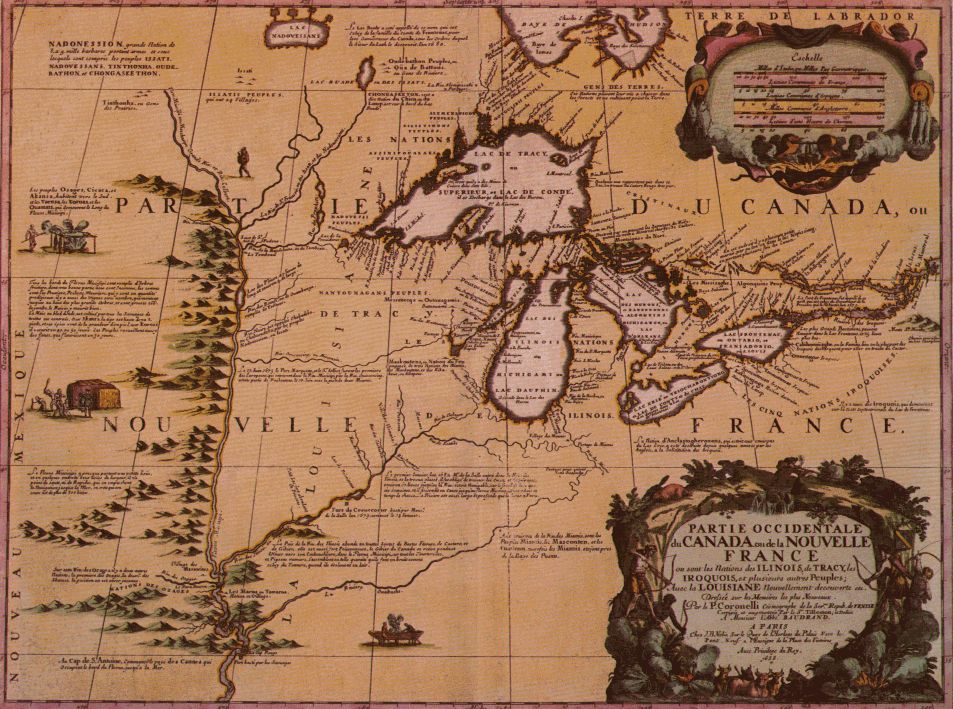
So, let's correct that. First, let's use a 1681 map from Joliet's and Marquette's journey out west in 1673. That was one year prior to Thomas Gardner's death. We just looked at that, briefly, noting that they went from upper Lake Michigan to Green Bay to the Fox River and down to the Mississippi. We will have a post soon on that and an update about Gardner River further west. This map shows the Arkansas River where they turned around as they started to see evidence of Spaniards being around and about. 

Map of Joliet's and Marquette's tour, 1673

This next map, we love. It's from 1688, and shows how huge New France was compared to New England, both north and south. Of course, upper New England was more populated in certain areas. We will look at that. However, that this was mapped out so early is astounding. However, the left coast is not in the picture at this point in time (claimed by the Spanish). 

Early view of New France

Now, these maps are from the latter part of the 17th Century. Things really changed the next century which as 100 years before the Louisiana Purchase which we looked at last year in terms of how people moved. 

We mentioned that we have many generations to look at. The 5th generation bore the brunt of the Revolution. The 4th was there, leading. The 6th was there as a transition. After that, New England mostly was maritime which we have looked at. Now, we can look at the landlubbers which we started to do from the perspective of D.A.R. with its 250th celebration of the Revolution coming up. D.A.R. itself dates from the latter part of the 19th Century. 

We are going to look very closely at the 150 years from the Revolution back to the Cape Ann times (upcoming 400th). And, given now the broad sweep across the continent, there is a lot that can be done. 

Not only can we consider families and their genealogy, we can look at generations and their times. The main boon of the internet (the reason for its existence) is knowledge sharing. So, we will see more research and reports from such, many taking avenues that are creative and unexpected. There are media issues for which we have a technology focus, to boot. 

But, stories of the characters of those times, generation by generation, will be something to look forward to. 

Remarks: Modified: 02/27/2021

02/27/2021 -- Further on the western rivers (and the Missouri River). Changed to using American Indian. Put in the TL;DR line. Looked at New Spain


Wednesday, June 2, 2021

HMS Resolute

TL;DR -- Over 400 years, a lot happened. At first, there was the Crown as the dominant factor. At the 250th split, we had two interests, namely the U.S. and the U.K. Of interest was presence in the northern regions. A U.K. attempt failed. Rescue efforts failed leaving a U.K. ship abandoned which was found later by a U.S. whaling crew. The ship was returned to the U.K. Later, Queen Victoria had furniture made from its wood. A desk made from the wood of this ship is in the White House and still in use. Later, the U.S. Army tried to establish a northern site. That failed as did early rescue efforts. Later, another rescue was attempted jointly by the U.S. and the U.K. The lost team was found, after they had spent three years in the remote region. We have lots to look at in that regard. 

--

In our early years, we were trying to match up Thomas Gardner descendants. We still do that but have expanded to include Cape Ann families and Essex County finally getting to New England which has a long arm across the nation since the end of the Revolution. Prior to the events that led up to Lewis & Clark's jaunt, that west was New France's or New Spain's. New England had continual sibling conflicts with the former. Dr. Frank noted that this allowed the colonists to be trained under the auspices of the Crown in order to get their moxie to become independent. 

There might have been the Paris deal of 1783, however conflicts with those ones over there continued. We know of the War of 1812. There were other little frictions mostly involving Canada. When we read about characters in The Revenant arguing about who could be where, it was due to the borders being fluid. The Revenant? Why did this get attention? It's the time of Jedediah Strong Smith who was in the area. Too, those characters were either New England (north and south) or New France. The time was the 1820s. Of course, the mountain man was there until later, such as that Adams character (shown on TV) who was a cousin of John Quincy Adams. If you go west, note the names (mostly New England). 

Except, a pause. The American Indian's experience will feature in our work. 

So, we had the ruffians out west and the elite back east. Was that all? Well, St. Louis comes to fore. Jedediah Strong Smith was there for a bit. Lewis & Clark passed by. It was out of New France and old. A crew came down to there from the Lakes, namely east of Montreal. How? Around Green Bay, they started to travel up [stream along] the Fox River and later did a portage (a minor distance) to the Wisconsin River and then came to the Mississippi which took them south. Their tale says that when they got to where the Arkansas came into the big muddy, the American Indians had New Spain trinkets. So, turn about was the choice. Guess when that was? About the time that Thomas as an old man. 

St. Louis will feature in several themes due to its age and to the roles it plays with the west. At the same time that the mountain men were out west, we had the organizing elements coming into the area. One example is Silas Bent who did surveying for the Louisiana Purchase among other things. His son, William, was a trapper, trader, and rancher. He was at the 1865 Peace Treaty signing along the Little Arkansas River with American Indian leaders and many from New England. 

So, that introduction shows the interplay of time and region. It's a huge subject that can be filtered somewhat by concentrating on families rather than big themes/memes. Partly. An early example was Gen Adolphus Greeley (at the time, a Lt) and Captain (USN) George William Coffin. The former is a descendant of Sarah (Gardner) Balch; the latter is of Richard Gardner and Sarah Shattuck. The latter was of the crew that saved the former after he and his men were stranded in the Artic for three years with little to no equipment. The rescue attempt included U.S. and U.K. ships. 

Imagine that? Greeley's wife got the support for another attempt after there had been several with no success. Greeley's expedition had been to the areas of the Franklin Bay. At the time of that post (2011), we didn't take a further look, so this post is a continuation. 

Recently, we heard of a desk in the White House that came from a ship, the H.M.S. Resolute. It had been abandoned and found by a New Englander. Well, the H.M.S. Resolute was one of the ships used by the group that went to rescue Sir John Franklin. He and his crew had been lost. This has to do with trying to find a Northwest Passage. 

Later, Greeley was there to try to establish a base for the U.S. Army. We are talking the 1840/50s for the Franklin effort and the 1880s for Greeley. 

The ship [left by the Franklin rescue crew] was discovered by a whaling crew out of New London, CT. It had been abandoned. When found, its contents were in a pristine state, and the Captain (Budington) got it prepared to sail home [to CT]. At the time, there was some discussion about what to do [with the ship]. A decision was made to refit the ship and present it to England. The motivation was to show good will as the two countries were having family spats. 

Queen Victoria was pleased. Later, she had the ship decommissioned and broken down. There were three pieces of furniture made with this wood: the desk, a writing table, and a smaller desk.  The first went to the President at the time, Hayes. The Queen kept the writing table and gave the smaller desk to the widow of one of the crew that went to rescue Sir Franklin. 

That smaller desk was later acquired by the New Bedford MA Whaling Museum. 

The gift from Queen Victoria was received in 1880. Our relations improved, and the U.S. got great allies via the U.K. It was not long after this that the U.S. needed help to rescue the Greeley group. 

Remarks: Modified: 09/09/2021

06/03/2021 -- Pushed this to the FB Cover for TGS and used the Greeley|Coffin photo for the Profile. 

09/09/2021 -- Typo changed which was found during a quiet review. 


Thursday, March 18, 2021

Foreign incursions

TL;DR - We had our head in New England for a long time. Much to learn. Then, we lifted our sights to other areas. There were many incursions over time, from the view of the American Indian population. How they mapped back to the Old World differed but in interesting ways. For New Spain, we don't usually think of the Pacific Northwest. Anywhere is Spain is like this? Of note, is while the quibbling was being done in the East (the Revolution), a Loyalist was making his way west out of New France. Took several trips, including a sojourn in London. But, he got coast to coast in the real way, on foot. Listen up, those who see the heart of America as flyover country. 

--

We know that this continent was populated prior to the incursion by Europeans. Our focus, from the beginning, has been efforts related to the establishment and development of New England. Of late, we decided to broaden our scope for the future which got us looking at the other colonial experiences, such as New Spain and New France. There were other countries involved early on which we will get to. The motivation, though, is to have a more full picture across time and space. 

We are taking New Spain first, since it is less known. England and France have a history going way back: Edward III had a claim to the French throne. William I invaded England from France. And, in the New World, France diddled with the English from the beginning. As well, the Magna Carta times involved activity by King John and his family with respect to property rights in France. 

We have thought of New Spain, mostly, with respect to the Louisiana Purchase which dealt with the middle region of the country. But, there was also the southwest and the west coast that we need to consider. In this post, we will take a look at the Pacific Northwest. Using Wikipedia, we see the history view starting with the indigenous peoples. Then, there is some coverage of European exploration starting with Drake for the English. New Spain paid more attention to area. 

But, it is nice that the Wikipedia's page looks at the first crossover from the east. This was done by Alexander Mackenzie and was fairly late, considering the early activity related to the fur trade. Mackenzie was Scottish and returned there after his trek. He came over before the Revolution and was sent north to Montreal as his family were a loyalist. We have looked at one Gardner loyalist family. 

As we have seen, New France ventured much further west than New England. They had water that they would travel on going west. It was from that region that Joliet and Marquette ventured down to what is now Arkansas. Later, it was from the western end of Lake Superior that MacKensie went west to Alberta. The first excursion from there to find the Pacific got to the Artic Ocean. That was in 1789. After going back to Great Britain in 1791 and returning the next year, to attempt to get to the Pacific. Ignoring some details, for now, he ended up in what is now British Columbia and can be known to have made the first coast to coast trip across the interior (that is, north of Mexico - and we might add, New Mexico - not the State, but the whole southern region). 

Next up, we need to look at southern New Spain as there was regular traffic from Florida all the way to California, by boat and foot. We will do a few of these posts, using old maps: Maps of Early America 1400-1800.

Remarks: Modified: 09/25/2021

03/18/2021 -- For starters, let's look at two routes: San Antonio TX to San Diego CA and the Butterfly-Overland route that took over three weeks to go from San Francisco CA to St Louis MO. We can look at these both ways: back to the American Indian trails; the modern highway system as we did with Jedediah Strong Smith

03/24/2021 -- Added the TL:DR. 

09/25/2021 -- We can look further at Oregon, by water and by land

Wednesday, August 8, 2012

King Philip, Joseph and Ann

August 12 is the 334th anniversary of Wampanoag King Philip's death (execution). The war with King Philip was a major event in New England in the latter part of the 17th century.

John Goff (a Thomas descendant and president of Salem Preservation Inc.) co-authors an article with Julianne Jennings (Strong Woman) that looks at the time and some of the facts.

       On the anniversary of Wampanoag King Philip's death 
       New England’s Second Colonial Armed Conflict: King Philip’s War Remembered 

The two authors ask some interesting what-if questions, such as: what would New England (and the rest of the continent) be like if there had been more peaceful relations between those who migrated here and those already in residence, the American Indians? As we all know from stories of the Pilgrims, things started off peaceful enough.

We know that Thomas and his children had good relations with the American Indians. We mentioned, earlier, John's (son of Thomas) effort on Nantucket.

---

The authors also remind us that American Indians, even those who surrendered, were sold, into slavery, to plantations in Bermuda (and the Caribbean). That may not seem to be in character and definitely not something to be proud of.

But, we know from history that the Puritans were not without fault, to say the least, in some of their dealings. Quakers and their children got this same type of treatment.

---

We featured Joseph (son of Thomas) and Ann in the February issue of Gardner's Beacon. Joseph and Ann had a house in Salem that had a long and interesting history. Unfortunately, it did not stand the test of time (however, its usefulness has been documented - coming issue on houses). The Joseph and Ann house was built by her father, Emanuel Downing, and had a remarkable structure for the time. Joseph, a captain in the militia, was a casualty in the Great Swamp Fight leaving Ann a widow. She later married Simon Bradstreet after having him sign a pre-nup. Her father, as a lawyer, trained his daughter well. The house became, then, known as Governor Bradstreet's house (such is the way of the world).

Remarks:

02/23/2022 -- Updated PDF for Gardner's Beacon, Vol. II, No. 1 to have links to sources. 

04/23/2021 -- Fixed link to John Goff's and Julianne Jennings' article. 

02/27/2021 -- Changed to using American Indian. 

01/12/2019 -- The article written by Julianne and John is missing. So, pulled one from Indian Country Today

12/19/2012 -- Changed article pointer to go to the Salem Gazette.

10/28/2012 -- September issue had a theme of houses.

08/14/2012 -- Drawn and quartered, after the swamp fight.

Modified: 02/23/2022

Wednesday, December 19, 2012

Aunts, Uncles, Cousins

1675: December 19 - Captain Joseph Gardner, who set out from his home on the present site of the Essex Institute, is killed. (pg 28, Chronicles of Old Salem, F.D. Robotti).

On that day, the colonists lost a lot of officers. The Great Swamp Fight was an engagement in the King Philip war. At this particular fight, 220 colonists were killed or wounded. John Goff and Julianne Jennings wrote about King Philip and the conditions that led to the war, earlier this year. As we noted, the Gardners, and others, had peaceful relations with the American Indian population on Nantucket.

---

Looking at family history, and genealogy, can by transitivity be seen as obeying the 5th Commandment. In a more full sense, that would include all of the children of a couple. Many folk do not have progeny who are here now that would remember them. So, we'll be sure to start that, perhaps as a meme.

So, given the honoring of those without issue, we would have the aunts and uncles. Perhaps, by extensions, cousins without issue would be remembered, too.

Finally, friends of the family deserve attention, as we show below, with one example.

---

Gardner's Beacon featured Joseph and his bride, Ann Downing, in the Valentine's issue. The couple lived in a great house that they received as a gift from her parents, Emanuel and Lucie (Winthrop) Downing. Joseph and Ann did not have issue.

When he died, Joseph left a widow, Ann. As the Beacon issue noted, Ann was very well educated. Yet, she, and her house, are now mostly known as having been associated with Gov. Bradstreet. It's interesting to note that Ann, prior to her second marriage, presented Simon with what was essentially a pre-nup. Was this the first of its kind on this continent?

---

We have mentioned many times the fact that Thomas and Margaret have been written out of history (my take, personally -- various motives will, eventually, be conjectured for this). The tone of the current post is remembrance. One friend of the family is John Tylly who came over with Thomas and Margaret to Cape Ann. John was a co-leader. He was killed in 1636, as an early casualty of conflicts with the American Indian population.

---

Genes and memes seem to be topics of increasing attention nowadays. Perhaps, the interest might be cyclic, such as the up rise in publications at century markings. Around the 300th anniversary of colonial times (plus or minus, of course), books on family and genealogy came into vogue and appeared in droves. Any large library has several thousand of these. We are coming up on the 400th anniversary. It'll be interesting to see how celebrations of the event unfolds.

Memes (to be discussed further) will be one key thing, IMHO.

Remarks:

12/23/2020 -- One might say, friends, too: Charles Alcott Flagg.  

06/25/2019 -- We have a few more examples of the forgotten. Of late, there was Lt. Benjamin West who was killed at Bunker Hill and forgotten. Prior to that, we were trying to count the number of lost graves in Essex County. Then, we have the travelers out west, such as Jedediah Strong Smith, except he did post some reports back east by courier. There were many lost a sea over the years.

01/18/2019 -- Add to the image index on our new site: TGsoc.org

03/11/2014 -- anceSTORY mentions that what is referred to as the Governor Bradstreet house (Simon's will says that he had a pre-agreement with Ann prior to marriage) has another story than suggested by Perley (and a study of Essex Registry of Deeds). Need to check this out.

12/24/2012 -- Thomas, unlike Conant, was not overshadowed in the world of being. We'll spend some time characterizing this fact and what it means to reasonable folks.

12/22/2012-- We need to differentiate between Old Planters of Beverly (see The Old Planters of Beverly in Massachusetts, 1930, Alice Gertrude Lapham, The Riverside Press) and the Old Planters of Massachusetts. One could even talk, Old Planters of New England.

Modified: 04/23/2021


Saturday, June 27, 2020

Hundred years

TL;DR -- About a case that is older than necessary due to factors that have no substance. Alas.  

---

The person for whom I was doing some research related to her Mayflower ancestry turned 100 years old this month. I thought that a recap of some of the posts related to that might be in order. As well, this will allow me to look at the posts and tie them together.

Incidentally, the lady is a descendant of Thomas and Margaret through their son George.

In brief, the issue with the Mayflower group was absence of primary documents for one generation, however there were plenty secondary ones that allowed analysis of the lineage. We can start with a later analysis.
  • Genealogy and Bayes (November 2019) -- It is encouraging to see papers being written on this subject. Lots of  attention has turned to chemical biology (DNA); however, we still have the 'meme' side of things with a strength that has not been understood. Lots to discuss on this matter. 
  • Mayflower pure (November 2016) -- When I started, there were two. Now, there is only one who reached a major milestone. Of course, this post is a reaction to the response by the authority figure. We all know of vanity genealogy. Well, the TGS, Inc. is not about that. Rather, we need to look at the total of the history of the U.S., what it might mean, and what the future entails. Lots and lots to look at. So, in this case, 2020 was to be a huge series of huge affairs. But, the virus came around. From another view, I have seen many who go back to the beginning and who have no Mayflower links, except for those of a 'step' relationship, or an in law, or such. That is what the 'pure' means, in this sense. Let's celebrate that 'rare' (or not) set of events (coming 'oh so close' through the years and generations. 
  • About generations (October 2019) -- There have been continual efforts at research in this vein from early on. With the explosion of interest related to the 300th (a 100 years ago), we saw this type of thing become more organized. The 'silver' books were published, for instance, covering five generations. Now, speaking of which, the NEHGS had a nice post that looked at the
    How long is a generation?
    question of 'How long is a generation?' It's interesting from several views. For one, we need the computer and data. The silver books plus updates gave the second. The computer's prowess with respect to crunching provides the first. And, that nexus is at the core of both good things to come and terrible stuff. In that latter regard, we look to consider, what would Thomas think?, a post from 2015 that will be a central theme. 
  • NEHGS as mentor (April 2018) -- About this time, several years had gone into planning the 400th. Trips were coming up, related to looking at particulars of the European experience of those involved prior to the sailing of the Mayflower. There was an early look at the parties which included the American Indian tribe that lived in the area. So, we were looking at a coordination between four nations: American Indian, England, Netherlands, plus the U.S. 
  • Flyover country (November 2016) -- The red/blue aspects really were at the forefront at this time. However, from the perspective of the lady applicant, there was the personal history of her families moving westward. Of late, I have had the opportunity to study many of these families. One organization has it right; the U.S. Census is full of good information about the people out west. Some might quibble nuances, however, if you are a U.S. citizen interested in history, then, the U.S. Census would be part of this. On a regular basis, the government tried to assess the citizenry; good citizens participated. Say, name the head of the household, the spouse, then the children in order of birth. Time, and again, this was true. And, you can see it in this case. Too, there is a lonely grave out west in which was interred the body of a Mayflower descendant. Do those back east care? Well, again, this theme is part of those meme'ish deals that we will look at. 
There are more posts. But, this gets the look back started. And, there is a dissing going on here with respect to a lady who died too young to leave much of a paper trail. A complication was that a step-mother came into the scene not long after the lady died. Of  course, this lady was 1st-ggp of the one who recently got the three digit age accomplished. And, the sister of this one being dissed is in the rolls of the Mayflower organization plus are her children; as well, an uncle of this lady is in with his progeny.

Stupid is what I call this type of thing. Oh yes, there has been a move by the NEHGS to provide material support in these cases (for huge fees - I work pro bono) where the Mayflower organization had to accept the determination of the NEHGS researcher, despite the Mayflower group's supposed superior processes. So, perhaps, there is some learning going on here.

Remarks: Modified: 01/23/2021

07/22/2020 -- Added image for the icon index at our portal to truth.

08/07/2020 -- Cumberland Pass in the west has the same name as that in the east known as the Gap. However, they represent the movement across the country which established the country. So many stories. Too, they created instances like poor Chloe being dissed by Plymouth people squatted in eastern Massachusetts. It's a large country out here, folks. So, I have now seen oodles of families with the same problem from the tip (Canadian border) all the way to the lower part of Texas. Has anyone really awakened to this? Not that I can see, otherwise I would not have the need for this type of post (Genealogy and Bayes).

Friday, November 3, 2023

American Indian Heritage Month

TL;DR -- Awareness months have different themes. We are targeting those related to heritage and study of such. Though, we do have a technology focus, as well. So, expect many themes and sub-themes to be on the table for research and discussion. 

---

Back in February of this year, we noted that we would be more regular in honoring heritage months: Awareness months. In this post, we looked at what we had done in 2022 and before. 

The month of November last year was announced by the White House, and we continue on that with this post. So far, we have touched upon five months. There are many awareness months, not all of them relate to heritage which relates more strongly to our work. 

We will start there, however technology is a theme chose, as well. Gairdner Foundation's work in medical biology was our initial example. This past month, they gave awards to researchers. We will get back to that news soon. --

Source: Wampum Wear
On Facebook, we saw this image and were captured by the list. Rather than point to a link, we traced down the source what was Wampum Wear (FB group, a Trading Company). Their intro says that they are "Pequot to Crow" in focus. 

We have mentioned the Pequot people a few times from the material that we read about New England. We will fill in that view with information from the American Indian viewpoint as we go forward.  

Remarks: Modified: 11/08/2023

11/08/2023 -- Had used image from FB whose URL signature expired. So, using copy.  

Thursday, August 27, 2020

US Territory

TL;DR - Military man. Went up the Mississippi to its start. Then, went out to see the Rockies. Found the source for the  Arkansas River. Had a run in with the Spaniards. So, was taken to Mexico. Sent back. The War of 1812 came up, and Zebulon Pike died. Young man. He, of several, helped us map out the western U.S. where the states can be huge.

--

Having been looking at families as they moved west, we have learned a lot with respect to history, genealogy, and life, in general. For one thing, there are people who need to be recognized for their lineage, albeit some of the genealogical bent have this bias (it's the paper that counts, silly). On the other hand, people had lives and left others behind. One consequence of the forever shift is that things get lost, like who was where.

As an aside, we know of Zebulon Pike's life. He wrote of it. After looking at Daniel Boone, we figured that we need to move further west, as Daniel stopped not far west of the Mississippi. Hence this post, as those who went west did it with labor. We'll get there in a continuation of the western movement series that started a few years ago. So, let's stop to look at the US States and some of their attributes.

After a brief pause, though. One thing that stood out in looking at early Massachusetts and New Hampshire is that someone could move, even two counties over, and be forgotten in the sense of not being included in some write up. So, it was understandable when someone went further west. Say, the Mayflower descendant out in the lonely prairie grave - see Bayes post - more coming. In his case, a book on his family starting with the 17th century arrivals just noted that he was out west. In another case, some abolitionist was hanged in Texas (pre-Civil War) for being there. We found this out by digging. Lots and lots of stories to tell; fortunately, the internet will allow a more full fleshing of history through time. So, people will be a common focus; we will set up a proof process for descendants of Thomas and Margaret; however, friends will be allowed, to boot.

So, there was a comment about Boone being known for migration on land. After all, his party went by foot from NC to TN and west out to MO. The old guy (in his 80s) is said to have taken a party out to the Yellowstone area. Pike, on the other hand, was young. He mapped the source of the Mississippi. He did the same for the Arkansas River, poorly equipped in late fall (snow of the Rockies). Then, he was taken down by the Spanish to Mexico and brought back. His travels were after Lewis & Clark and before the Santa Fe trail.

Note: we got on this theme with Jedediah Strong Smith and Judge Thompson of Massachusetts, in part.

Looking at the U.S., all of the larger states are out west. For instance, KS is 81K sq mi. This is mentioned since Col. Higginson went there explicitly to show support for John Brown. Too, it was traversed, in part, by the trails, with almost 6/8ths of the trail in KS (Santa Fe Trail). But, Pike went through the area, too, earlier (The White Man's Foot in Kansas). Lots have been written about Pike.

The largest state is Alaska with over 1/2 million sq mi. Texas is next (it'll be featured due to several connections with the East Coast, including New England). This comparison is not for bragging rights; rather, the amount of effort to go across an area relates to the distance. However, terrain was a larger factor. Drive across WV, sometime, and note the absence of any flat area. Or, what they call flat is not really.
Size of States, U.S.
The tales of the Sante Fe Trail mention that parties, sometimes, took the harder route in order to avoid conflict with the American Indian population. From a commercial view, that makes sense. We will look at that. Usually, the path of lesser resistance was taken. Say, moving from Gardner KS to above St. Joe MO in order to save a few days (the gold in CA was calling); besides, going up the MO river was easier than sloughing out west by land. Even if for a few days. Choices.

Remarks: Modified: 02/27/2021

02/27/2021 -- Changed to using American Indian. 

Wednesday, July 28, 2021

Practice for carving

TL;DR -- We were looking further west but have to take the time to look at prior conditions. From the French-Indian affair through the War of 1812, a lot of time passed. And, then, New England did not cover much territory. It was looking at western Ohio recently where we realized the oversight and stopped to take those matters into consideration. 

--

As we look at the details related to the 250th of the U.S. start, we have to consider lots of angles, such as before and after. Today, let's relook briefly as the "Carving of the land" that happened after Jefferson's deal. Starting with the area just east of the Mississippi, people settled. And, more came. Til now, we mainly were looking at land west of the Mississippi. Today, we will take a look at an area further east which was known as the northwest (albeit, before Oregon came on the scene). 

This map gives an overview of the status around the time of the Revolution. It shows the areas controlled by New England (red), New France (blue), and New Spain (orange). That whole area of the middle and leftmost was the topic in several prior posts, such as State of Missouri, 1821. For instance, most of the left coast was claimed by New Spain, except for some of the northern region. 

North America in 1750

Our interest is that families moved to these areas all of the time during the century of the frontier, including moving to many states. And, that left holes in the paper trail that genealogists love. We will have some posts on the fact that genealogists are not logical. Lots and lots to do. 

Now this next map is where we were going. Having followed some families out west from the time of the Revolution and also taking the lineage back to the beginning (400 years ago and so), we now see that we need to look more closely at the lost generations between the Patriot (SAR and DAR) and the generation about two after. Earlier, we mentioned that the fifth generation did the Revolution. The sixth and seventh got things going. Then, the eighth? Got the reward? Not really, as we still had decades and decades of hard work to be done. 

In Frank's magazine (The Massachusetts Magazine), there was regular column about Michigan. By C.A. Flagg, first of series was Vol. 1, No. 2, pg 73

It never really sunk in until of late. Our focus had been the southern route, where northerners came west through the Carolinas into Tennessee and west. Imagine tracking a family through that. 

This next map is great as it shows the colonies around the time that we (the U.S.ers) were being trained by the Crown militarily as we supported the conflicts with New France and its American Indian allies. Those colonies are on the right coast. Now, look left. 


Notice, New England states were ceding property. We had an earlier map that showed Virginia claiming land to the west out to the Rockies (not in this map). Great country? Right? We just saw this video of people (in other countries) watching another video that talked about the size of the U.S. both geographically and economically. Things are huge. 

With, it might be added, the vast majority of the population being on the coasts. Imagine that? The good life is in the interior. In any case, We had to go back to Massachusetts for the start of a family that then was spread over this region and west. 

Here's where we are heading. When we first ran into the problem, we knew too little to have an informed opinion. But, after running into a pattern time and again, we will say this. Lots and lots of American families have been dissed. John thinks that it stinks; he has no axe to grind since his lineages are all post the Civil War. As we look at the events that led up to the Civil War and many other conflicts such as with the American Indians, lots of things call for attention. Abstracted history throws out such details as if of no consequence. Genealogists with their plodding (a mere paper chase, with little reasoning going on). Time to talk advanced logic, okay? 

If you look at the map of Missouri (above link), in 1821, when the State got started (paired with Maine's entry in 1820) with a slave/free balance, there were few counties covering the state. Some of them huge. Then, these split over time. One of our tasks was looking at Bureau of Land Management records with respect to the opening of Missouri. Since then, we have looked at other states. 

Another thing to note. We have seen, time and again, the mother dying young. The recent one, a mere 20 years old. Then comes another wife. In one case, the step-mother split when her husband died leaving a youngster (wasn't hers anyway; step child) to be raised by the families (uncles, in this case, who did a good job). The thing that grates was one established organization, y'all can see it here, dissing this poor thing. 

Yes, this'll be discussed ad infinitum until the great minds (yes, genealogists, you) come to some type of awareness that we can assess being without relying to much on paper. Sheesh, I just saw a Census that is screwed up. It's not an issue yet. We'll document it to let people know that this can happen. Too, though, as one looks at that map (2nd one, okay?), depending upon the time of the document, it could have any of those labels. So, there ought to be a way, with technology now, to do errata that persists. 

Actually, we have just begun the necessary work. 

Remarks: Modified: 06/11/2025

09/03/2021 -- See Michigan where carving was early. 

04/07/2022 -- Change Native Americans to American Indians. 

06/11/2025 -- Changed image for the American claims. 


Sunday, February 26, 2023

Awareness months

TL;DR -- New England led to the U.S. Both have a long history. Part of our culture is having reminders of our history in terms of where we have been. In part, we do this with awareness months. We start a list of these which will be regularly recognized. 

--

We will pay more attention to the awareness months this year, as annual reviews of events of history pertain to the culture of the U.S. Let's start with a look at currently scheduled remembrances.  

We will fill in the other months this year. 

Remarks: Modified: 08/06/2026

02/27/2023 -- Added image for Native American and Black History. We will look at Women History, again, next month. 

04/16/2023 -- Added post for Arab History Month which we will continue to explore in terms of the mathematics behind AIn't. 

05/29/2023 -- Added National Military Awareness. 

10/14/2024 -- Native American Knowledge, via FB. 

04/06/2026 -- Added a few more days. 

08/06/2026 -- Added Purple Heart Day.