Showing posts sorted by relevance for query nehgs. Sort by date Show all posts

Sunday, September 20, 2020

Members, NEHGS

TL;DR -- We like the NEHGS.  

--- 

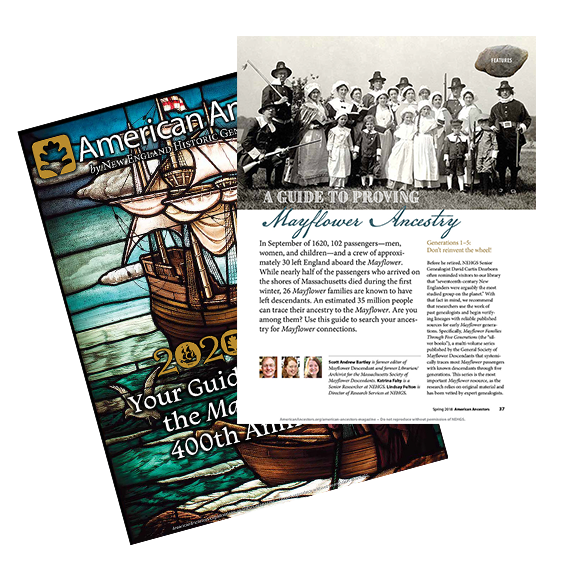
The recent American Ancestors magazine from the NEHGS looks at their history given that this year is the 175th anniversary. We learned several things from this overview which will lead to a little more attention to be paid to the group, their history, and work. For one, the tan books which are the vital records of Massachusetts towns were a NEHGS project. Early on, we saw that those books were available via the NEHGS membership. These was a very important endeavor. There was a latter on-line effort that we used a lot (Early Vital Records of Massachusetts). The NEHGS did the Great Migration series. There are other great things done in 175 years. 

We only have 10 years and do acknowledge that the research membership has been quite helpful in terms of having access to records plus hearing from researchers. Too, their staff help with the WikiTree project concerned with documenting early immigrants. 

Also, they have several databases, one of which contains images of the applications presented by members. We had not paid attention but went to look. How many included Thomas Gardner in their application as an ancestor? A quick search brought up over 300 mentions. On taking a closer look, some popped up as being of Thomas and Margaret. We can look at what membership entailed and the qualifications. The first member was President John Quincy Adams. Several other Presidents applied. 

Here are a few folks with Thomas Gardner in the past. This is just a random pick. We will find out more about the members as their auto-bios are included. The early ones are hand-written. 

As we were sampling, we saw Dr. Frank's name mentioned. He became a member in 1898. 

Pending is getting the rest of the descendants pulled out of Wikipedia to a post here on this blog. 

Remarks: Modified: 11/10/2020

09/20/2020 -- Something to research. If one looks at Dr. Frank's record, it says 'dropped' in 1930. Let's see, that was about 12 years post his TMM. Too, another record that I saw said 'resigned' (these notes are marked in red). Dr. Frank did good work. So, did he raise some hackles at the NEHGS? Why the drop? You know, we wondered why Anderson, et al, did not use him in the Great Migration work. Books (and their work) from lots of other families were used. Back to the TMM. It did look like some competitor to whatever the NEHGS was doing. BTW, is genealogist even a valid occupation? Or, an example of ways to tramp on people's dreams with lead feet? Partly serious. Search on this blog for Bayes. 
 

Tuesday, June 4, 2024

NEHGS Events

TL;DR -- We like the NEHGS which has been there since the 1830s and had many illustrious members, such John Quincy Adams. So, NE is in its name. But, it has been extending its reach. Okay, we like that. Let's compare notes. 

-- 

This post looks at several events so as to tie together what might be disparate research but really is cohesive, or will be in the longer run. We have noticed ads about the types of events events offered by the NEHGS from time to time. Some have raised thought of joining. Have not yet. But, we have attended several meetings of various groups of the  Hereditary Society Community which meet in the spring in D.C. 

Now, the recent three events scheduled by the NEHGS shown here are very much appealing. For one thing, we have had lots of posts mentioning both Northern and Southern California. Both of us have lived in the State and have family in the area. The history of both of these areas shows lots of New England influence. There is more on that later in the post. 

The NEHGS meetings in CA will be in Oakland (June 8th) and Los Angeles (June 9th) this weekend. The LA event will be held in San Marino. That specific reference is necessary due to the sprawl of LA. 

NEHGS in CA 

NEHGS has been slowly expanding its reach out of New England over the past decade or so. This is reflected in their databases. For instance, it was nice to see information brought forth on Virginia and the Northwest (which is really the mid-west). Now, with CA on the radar, we can expect to see more focus on the large interior that was covered in the frontier century

The reality is more than the flyover country that became popular, recently, brought by the technology of aircraft. In the areas between the coasts, we deal with real people. But, just as that theme comes up, we see that the NEHGS has found one of the libraries in the interior. 

Independence, MO

In August of this year, they'll be in MO where the trails came through the trails came through. The library has been a great assest to the region where, btw, Harry S. Truman's Presidential Library can be found as well as other historical notions that ought to be remembered. 

Like, across the Missouri River in KS is where we find that John Brown caused some turmoil. Kansas was a Massachusetts which can be seen in Lawrence. John had supporters in New EnglandThomas W. Higginson wrote of his visit to the area before the Civil War. 

-----

Let's get back to LA and defer more discussion to a later time about CA and SF. A recent post continued our look at Bunker Hill West (US History, details) we brought up the theme of details of someone's existence that is not related to the paper chase of genealogy. We will continue on that theme as it relates to our interest in technology and how it's being abused of late. 

But, technology is great, as well. Let's just use good old curated publishing as an example. Lots of the research to date has been looking at things known personally. Like, John lived in the Bunker Hill area for a while as a young worker. Given the work of the TGS, Inc. which has a focus on Essex County, for one thing, we have followed families as they went west. Too, the influence of New England is of interest and seems to have no end. 

Along that line, we can use Wikipedia's work to stop, look and listen (that's an old adage with regard to train tracks in the west - out where signs may be minimal). 

    • Downtown Los Angeles (DTLA) - this page has been seriously updated with new information since 2020 which is partly due to COVID. People were home and wanted to do something. In this case, the History section has increased significantly. We will go through this more thoroughly, but it does provide names of thsoe who were there at the time. We see missing names. Say, Butterfield who ran a stage-line from St. Louis, MO through upper TX and along the southern border (through Tucson, AZ) to LA. His stages stopped near the building that housed the LA Times for whom John worked while going to UCLA. (see post Mirror Building). Part of Butterfield's work met up in El Paso with a southern line started by someone from the Giddings family of Ipswich, MA. Like we noted, the stories are endless. 
    • El Pueblo de Los Angeles - several buildings exist from the New Spain era. La Iglesia de Nuestra Señora la Reina de los Ángeles is an example. We had a post about the area with LA City Hall in view in one of the photos (see post Old LA and the U.S.. One can also see the City Hall (which was remarkable for its time and was the limit for buildings - the high-rise phenomenon came about when that was repealed) is also visible from Olvera Street
    • Bunker Hill (we added the "west") as it's named for the Boston landmark and cultural icon of the U.S.) - fortunately, photos exist that were taken at various times throughout the history. Now, the southern part of the Hill is high-rise laden. The Hill itself was scarfed several times but seriously so in the 1970s to make way for the skyline makers. Yet, there were elegant and quite remarkable buildings in the area. At least, the Angels Flight rail was saved through a dismantle, store during reconstruction, and then put back into place. 
    • St. Vibiana - this was an early Cathedral whose building from the 1870s still stands. There had been some earthquake damage, but mostly it's there as an events center. There is a newer building up on the Hill (appropriately along Temple Avenue): Cathedral of Our Lady of the Angels that has remarkable architectural features and serves the role of the former building. 

This post looked at NEHGS's work and then pulled the focus to LA specifics. We'll do the same for San Francisco, later. When we do that, the original look will be at the Presidio which is of New Spain. 

Remarks: Modified: 06/04/2024

06/04/2024 --

Friday, August 9, 2019

Samuel Gardner

This post is about Samuel Gardner (Gardner-614) and John Curwen (Corwin-10). John was the step-brother of Mary (White-3107), Samuel's wife.

We were looking to see who was Mary's father. Anderson did not mentioned her maiden name (Great Migration (requires NEHGS account), see Image 1). But, then, Torrey did not either.

Dr. Frank did. Was he correct? Well, Frank mentioned that Elizabeth was Mary's mother and she had married John White. Mary's father died, and Elizabeth married George Curwen (Corwin). We know this from Torrey (New England marriages prior to 1700 (requires NEHGS account), see Image 2).

But, we know more. The NEHGR published an article about Elizabeth. In it, Mary and Samuel are mentioned. So, Dr. Frank was correct. However, this work was after Anderson published, so he is off the hook.See NEHGR Vol 163 (requires NEHGS account), page 190, (see Image 3) starting at page 192. As we can note, the research had to be carried out in England.

Images 1, 2, 3 
This is an example of the type of thing that families need to do and which the TGS sees as in its mission.

There is more to be found in NEHGR Vol 150 (requires NEHGS account), page 190 (see Image 4), "Elizabeth Herbert, Wife of (1) John White and (2) George Corwin." Elizabeth was the mother of Mary who married Samuel Gardner. The article mentions a petition to the court by Samuel with regard to the estate of George Corwin. Dr. Frank had mentioned that, too.

Elizabeth (Herbert)(White) Corwin
---

Note: the family was in Cape Ann in the 1623/24 time frame. Thomas, George, and Richard were born in England (see WikiTree discussion on Margaret Fryer). John was born here, too. However, there is a record for a John in Dorset at the same time. This may have been John who came over later (open area of research). Samuel was born here, as well. The Samuel mentioned in Dorset in 1624 was of another family. We are working to separate the families as we try to figure out where Samuel's father came from.

Children (according to the NEHGS and the Great Migration Project - as represented by WikiTree): Thomas, GeorgeRichard, JohnSarahSamuel, JosephMiriamSeeth.

List of descendants of Samuel

Remarks: Modified: 12/13/2020

12/05/2019 -- Added in the images to go with the links (which require a NEHGS account) as Samuel is important to our work. A middle child, somewhat. Too, he's the ancestor of Dr. Frank. So, that gives us a focus with which to work the unknowns.

12/13/2020 -- Added link to list of descendants of Samuel. 

Sunday, October 26, 2014

Status and focus

As we continue our emphasis on research and review which can involve a long period of quiet, we thought that a status update might be in order. There are a lot of things on the plate.

As we proceed, we will continue to use this blog for posting general reports and for commenting of things of interest to the Thomas Gardner Society, Inc. The technical blog will be used for those things dealing with the details whether of content, configuration, or other.

---

The following addresses a few things that are of special interest.
    - This year, the Thomas Gardner Society will offer two types of membership: descendant and supporting. The former will offer a means for those who descend from Thomas and Margaret to provide supported documentation of their lineage. We are preparing the application process. 
    Those are interested in membership, or in making contribution to the Society, please contact Ann at algswtlk[@]aol[.]com. 
Vita Bevis image
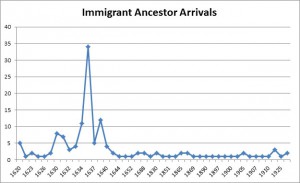
Arrival, by year, ancestors
of NEHGS staff members
    - Some NEHGS offerings are of special interest, given that we are working on an application process. For one, a recent video talks about lineage societies and how one applies to them: How to Apply to Lineage Societies: Tips from NEHGS. This can be used as an introduction to the general ideas. 
    As an aside, we are going to ask for documentation from the applicant's great-grandparent out. That is, more recent information related to the applicant and spouse(s), the applicant's parents, and the applicant's grandparents ought to be considered private and privileged, and handled thusly. From what we have seen (to be discussed) so far (many applications), we wonder just how respectful are these storage methods. 
    There is much to discuss, but those pieces of recent information ought to be collected and verified once. By whom and how? Then, whoever might need the information would get redacted results. There are (ought to be) ongoing discussions on this matter.  
    So, the applicant can expect to offer a lineage from about three generations out to Thomas and Margaret. We will collect these into a fully-sourced, accessible, document (technical choices under review). 
    Prior to submitting an application, though, one needs to have details about one's lineage and its acceptability. We will address this further (technical post, soon). However, R.C. Anderson, recently, published a book on his methods (Elements of Genealogical Analysis) that were developed through the Great Migration effort. 
    The technical post (see Remarks, 10/31/2014) mentioned in the prior bullet will deal with the format for supporting documentation. We, personally, have submitted packets of 50+ pages in support of applications (with some complaining of the size - however, one genealogist did say that the application that we have submitted was one of the best that he has seen in terms of supporting material presenting a cogent story). 
    At the same time, an organization that allows use of another society's information can result in a much smaller packet. For one example that we can show, a D.A.R. Record Copy can replace 17 pages. In the 50+ case, that would leave 33+. For some reason, many genealogists don't seem to trust others (this is something to analyze, to boot). 
    On the other hand, we can also show an application with a mere 7 pages with the D.A.R. Record Copy. That later case may be too small, but not if it references easily accessible information. The support material, essentially, consisted of links to on-line material with a small snap-shot from each source. 
    Silly? No. Let's use Rich Hall's work (see below). He has the "famouskin" site (take off on some works by G.B. Roberts of NEHGS) which shows how celebrity and its attention motivate filling in genealogical pieces. So, finding famous cousins may offer help to researchers. we have found it to be so. 
    That is, have you not heard that the rich and famous get the genealogical attention? Or, the corollary? Many with pedigrees have been ignored due to several reasons, such as lack of resources, nobody interested, etc. 
    In the top box of the Edith graph, mouse-over either Emanuel Downing or Lucy Winthrop. Notice the drop-down menu. Also, notice that you can transition over to a lot of the sources and read the material. That will be a focus of the presentation that we expect to pursue. 
    Now, having said that about sources (prior bullet), we will use the ahnentafel of Lucy Foster Wilson Gardner who was the grandmother of Dr. Frank A. as the means to demonstrate the ideas. There are many ways to approach the task, but we will convert the PDF material to a linked HTML file. Notice that the ahnentafel is fully sourced with footnotes. Just about all of those source references are to on-line material. 
    ---
In the application process, we expect to use about a third of the pages (see above application reference, 50+ pages). That requirement comes from requiring a snapshot, in time, of the source material, principally to overcome the latent fallibility of the web, non-persistence - there until we see semantic approaches have more wide-spread use in genealogy and family histories.


Remarks: Modified: 11/13/2024

10/28/2014 - The 400th anniversaries are a more remote focus. 

10/31/2014 - See start of technical discussion: Supporting material.

03/02/2019 -- We're build an index via images at our portal to truth.

08/04/2020 -- Updated the link for the image of arrivals of ancestors for the staff.

11/13/2024 -- Updated the link, again, for the image of arrivals of ancestors for the staff (Mayflower context). 

Friday, October 9, 2020

Support specifics

TL;DR -- We have ten years under our belt with respect to things pertinent to TGS, Inc. futures.  

---

We have mentioned that we look to the NEHGS as a 'mentor' from afar. That is, we pay attention to what they do. For one thing, their NEHGR is still around; Dr. Frank's TMM ran into the events (pandemic) of 1918. Too, the NEHGS did well getting the various parties to coordinate with respect to the Mayflower lookback. The conditions of Covid-19 got in the way of the partying, but the acknowledgement has taken place. Lots of good information was brought out that will facilitate further work. 

In addition, we have looked at the methods used to establish membership criteria for various groups, such as the GSMD. Their efforts at proving lineage is captured in a set of books that cover five generations. In the past, one found these in libraries. Now, the NEHGS provides on-line access through their American Ancestor database. Another research group of note is the LDS (Family Search). There are many others, but the list is too long for this post. 

Before getting to the specifics (this and the next post), we need to mention the Hereditary Society Community. The HSC consists of societies whose purpose is honoring heritage and, for one thing, the culture of the U.S.A. HSC society members gather each spring, in Washington DC, for their annual meeting. An example member would be Mrs. Philip Wendall Bernstoff (Betty Jane James) who was in the same DAR Chapter as Ann. 

Ann has just completed a series of tenures as Historian, Librarian, Treasurer and Registrar for a local DAR Chapter. For several months this year, Ann did the work of both Treasurer and Registrar. Now that this work is winding down, we will have more time for the Thomas Gardner Society, Inc.'s work which would include documenting descendants of Thomas. So far, we have been posting a list of names that came from the Wikipedia collection. The latest post was "Descendants of Samuel". But we want to expand upon the work of Dr. Frank as well as get several generations filled in. 

Part of the work this year as Registrar included working on over twenty applications in the NSDAR context, completing most of them, and concluding with acceptance via the review process. Some of the applications were for new members. The majority were what are called supplemental applications that are done by after membership is attained. That is, one uses a Patriot to join. Then, other Patriots in one's tree can be identified and proven. For an effort related to process improvement, Ann worked on almost twenty supplemental applications with eleven of these being completed for a review process. Ten have already been verified and are in the final stages. 

That depicts work effectivity. As well, we have completed over thirty applications in other contexts for various individuals. Too, we have done preliminary work for a score of others. Given the experience, we are ready to set up some conditions for applying to the Thomas Gardner Society, Inc. Stayed tuned.  

With regard to approaches, we have had discussions on this topic where technology is brought into play. Many efforts seen on the public approaches (Ancestry, ...) follow less rigor than one would like to see. As we mentioned earlier, we took the notes that Dr. Frank wrote up about his mother's genealogy and compared it with what had been done on WikiTree (WT). WT is where the Great Migration Project (NEHGS) has been working. For instance, the Thomas Gardner profile there is owned by the GMP. There are lots of missing pieces, including descendants. Samuel's line is fairly sparse. 

Where does one go to find good information. Take an organization, for instance, which supports genealogy studies with their database which is public (Genealogical Research). One limit is that the database is based upon applications. With respect to the supplemental effort, this will fill in lines over time. In fact, it is quite possible now for one to build an application without needing any additional sources since one just matches up existing trees. 

On WT, there has been an effort to identify those involved with the American Revolution (example: Joseph Swazey 1750 - 1816). But, getting beyond New England, there are studies with respect to other interests, such as Magna Carta. As technology improves, we would expect to find better and better representations that can be trusted. That is one goal of the TGS, foster this work and the related discussions. It's one of our many goals. 

And, given that we're back to work, we'll be more regular: Gardner's Beacon, Vol X, No 1, soon. 

Remarks: Modified: 11/10/2020

10/09/2020 --

Friday, September 26, 2025

TEG in DB of NEHGS

TL;DR -- We published in The Essex Genealogist (TEG). The NEHGS printed a listing of TEG in their NEHGR. Later, the NEHGS made a database for the TEG issues and are now up to Vol 37 which published in 2017. 

--

First things first. This is the announcement by the American Ancestor publisher of the NEHGS about their making issues of The Essex Genealogist of the Essex Society of Genealogists available via their database. We already tried it today with respect to our last article. 

The Essex Genealogist: Volume 37 (2017) now      

In the middle of the 2010s, we published a few articles in The Essex Genealogist. Later, we published the same article in The Gardner Annals. The following is a list of posts related to those publications. 

Essex Society
of Genealogists

The last one was about the barque Bostonian which was built in New England, roamed the world, and then wrecked along the Oregon border. The owners were Henry D. Gardiner and his brother. 

At the time, we had lots of material related to research along several topics: the captain at the time of the wreck; passengers on that voyage; the town of Gardiner, OR which was founded at the spot; and, of course,  more about the Gardiners who were descendants of Gardiner of Rhode Island. 

This work got us, landlubers, familiar with some naval issues and terminology. Looking forward to digging deeper. 

Remarks: Modified: 09/26/2025

09/26/2025 - 

Wednesday, September 16, 2020

175th for the NEHGS

We have mentioned the NEHGS several times. For one, they did the Great Migration Project. Also, they were involved heavily with the planning of the Mayflower 400th which was this year. We also looked to their work for inspiration. Recently, they started a blog with an endless number of pertinent posts: How long is a generation?

Buried 'neath all of the goings on was the approaching anniversary. The recent American Ancestor had a brief history of the NEHGS starting with the founders who are listed below (Wikipedia has a few links):
    Charles Ewer (1790-1853)
    Lemuel Shattuck (1793-1859)
    Samuel Gardner Drake (1798-1875)
    John Wingate Thornton (1818-1878)
    William Henry Montague (1804-1889)
Familiar names. As well as looking at the early years, the brief history came forward in time with information that deserves a closer look.

Congratulations to the NEHGS.


Remarks: Modified: 09/26/2020

09/26/2020 -- Added image for the portal (TGSoc.org). 


Tuesday, April 24, 2018

NEHGS as mentor

I have been reviewing the Spring 2018 issue of NEHGS' American Ancestor and was given a much needed shot in the arm. The topic deals with the upcoming celebrations of the 400th of Mayflower event which are centered around 2020. Frankly, the scope was quite good, and we can look forward to more of this over the next couple of years and beyond.

Can't wait for all of the settlements to have their party: Timeline of settlements (from Weymouth (1622) to Worcester (1673). And, after. Of course, the list is incomplete (Wikipedia requires continual editorial help).

So, why a shot in the arm? Well, I'm in my 10th year of this work which I have done independently, but I already knew research, mathematics, and computing (which gives the particular bent of my posts). Of course, I started with ancestry[.]com but was off of it soon due to a remark by a D.A.R. registrar. Never looked back. Rather than research other options, I started my own format (works for me) and have millions of items to organize. As I have worked applications (a good exercise and test) to lineage groups (including GSMD), I got the chance to hone the material. As well, I did Dr. Frank's line which I have in ahnentafel (sourced) form (his two paternal grandparents - BB Gardner and LF Wilson).

Along that line, I just looked at a genealogy chart handwritten by Dr. Frank in 1907 (thereabouts). His father's line agrees with what I documented. However, I have more. I noticed that some Mayflower people are now mentioning John Billington (see NEHGS, above). I get to bring up Nathaniel Eaton (friend of John Harvard and first head of his school). And, I have a lot of material including a paper written by a member of The Eaton Families Association. The next TGA (print of Vol III and Vol IV) will include an article on this.

Essentially, Dr. Frank did not expand this tree, publicly. I can see why given what I have read out of Harvard. But, the whole story bears significance of some turmoils now. Just as the 200th of the western expansion pre-dated the major conflict twixt the north and the south, the 400th had lots to tell us about the U.S. and what it might be about. But, just in himself, Nathaniel is interesting (holder of several degrees, including M.D. and Ph.D); his Catholic leanings may have played a large part in his treatment, especially that which might be termed propaganda.

I have done the genealogy of enough now to have covered New England and Virginia and its environs. That leads to things that we ought to be doing. We need an effort to publish the first five generations from Thomas and Margaret. I finally got a chance to look at the Silver Books. Too, we need to go back and re-look. David T. Gardner, from a Pennyslvania Gardner family, has looked at how he might relate to Thomas. See King's Slayer Court. This was the first part that was published in TGA Vol. III. This and the next part will be in the print version (before summer 2018). BTW, mentioning propaganda, David has found some interesting Tudor material (interpretation will always an issue - like the ad, what's in your wallet? - how do you see this is not something to leave totally to experts). Thomas is almost a tabla rasa from what I have seen.

Yet, there is a lot that ought to be collected and organized. That is one task; as well, weighing in with a proper view ought to be more easily done when is little negative influence (such as, Endicott hanging Mary - no last name is needed).

So, we can watch the NEGHS over the next couple of years and learn a whole lot.

Too, we can look at the particulars that Thomas and Margaret bring to bear. Has that sort of thing not waited long enough for some attention?

Remarks: Modified: 01/10/2022

12/30/2018 -- The 400ths will be one theme next year. 

01/10/2022 -- Changed the NEHGS image which disappeared. This year, it's Weymouth's turn. 

Friday, February 27, 2015

Gardner Research and discussion

Report on Gardner Research, results and The Gardner Annals (TGA).

---

The latest issue of The Essex Genealogist (TEG), Vol. 35, No. 1, completes the look at Dr. Frank A. Gardner's paternal ancestry. See the following two ahnentafel charts for his paternal grandparents; the related TEG articles are noted.
All of the TEG articles are published, as well, in The Gardner Annals.

Turns out that Dr. Frank is a descendant of Nathaniel Eaton. Nathaniel was degreed in the theological framework and, as well, had M.D. and Ph.D. degrees. That might put him in a different light, one might think. Say, misunderstood nerd. 

---

Dr. Frank wrote two books on the Gardner family; this table lists the persons mentioned in the two books with their number. The page has links to on-line copies of the books.

The 1907 book filled in Dr. Franks's tree (descendant of son, Samuel) with cursory mention of the collateral families. The referenced TEG articles provide more details about these families.

The 1933 book covered the descendants of son George (book is available on-line).

---

A discussion area has a brief overview of documenting lineage (one example). See related post.

Remarks: Modified: 10/10/2021 

02/27/2015 - On page 52, there is a footnote, 48 - NEHGS, GBR, *************. Ah, how did that get through? Well, we all know NEHGS. GBR? The cousin researcher, of course. ... Late last year, NEHGS let out a re-configured site. Now, as we have seen with the web/cloud, things change. In fact, we have providers pushing out changes (seemingly willy-nilly) without any (am I wrong?) consideration for ramifications (see nonmonotonic logic). But, then, free it is (so, suffer users). ... Anyway, there is a lot of misinformation, as we all know, that proliferates. Who was the mother of Anthony Potter's kids is an example. Many said Elizabeth Whipple. But, Elizabeth Stone it is. And, GBR had a note to that effect to which I had a pointer at the NEHGS site (the link, then, became bad). And, I have not gone to refresh the information, yet.

05/08/2015 -- The Essex Society of Genealogists has a FB page.

05/21/2105 -- We will feature Dr. Frank in our research. For now, we have the ahnentafels (fully sourced) for his paternal grandparents.

09/23/2015 -- Content for the GBR ******* footnote can be found here: American Ancestors, Static pages.

10/10/2021 -- The Count features in our history of Harvard (a special project dedicated to Nathaniel Eaton). 

Saturday, June 27, 2020

Hundred years

TL;DR -- About a case that is older than necessary due to factors that have no substance. Alas.  

---

The person for whom I was doing some research related to her Mayflower ancestry turned 100 years old this month. I thought that a recap of some of the posts related to that might be in order. As well, this will allow me to look at the posts and tie them together.

Incidentally, the lady is a descendant of Thomas and Margaret through their son George.

In brief, the issue with the Mayflower group was absence of primary documents for one generation, however there were plenty secondary ones that allowed analysis of the lineage. We can start with a later analysis.
  • Genealogy and Bayes (November 2019) -- It is encouraging to see papers being written on this subject. Lots of  attention has turned to chemical biology (DNA); however, we still have the 'meme' side of things with a strength that has not been understood. Lots to discuss on this matter. 
  • Mayflower pure (November 2016) -- When I started, there were two. Now, there is only one who reached a major milestone. Of course, this post is a reaction to the response by the authority figure. We all know of vanity genealogy. Well, the TGS, Inc. is not about that. Rather, we need to look at the total of the history of the U.S., what it might mean, and what the future entails. Lots and lots to look at. So, in this case, 2020 was to be a huge series of huge affairs. But, the virus came around. From another view, I have seen many who go back to the beginning and who have no Mayflower links, except for those of a 'step' relationship, or an in law, or such. That is what the 'pure' means, in this sense. Let's celebrate that 'rare' (or not) set of events (coming 'oh so close' through the years and generations. 
  • About generations (October 2019) -- There have been continual efforts at research in this vein from early on. With the explosion of interest related to the 300th (a 100 years ago), we saw this type of thing become more organized. The 'silver' books were published, for instance, covering five generations. Now, speaking of which, the NEHGS had a nice post that looked at the
    How long is a generation?
    question of 'How long is a generation?' It's interesting from several views. For one, we need the computer and data. The silver books plus updates gave the second. The computer's prowess with respect to crunching provides the first. And, that nexus is at the core of both good things to come and terrible stuff. In that latter regard, we look to consider, what would Thomas think?, a post from 2015 that will be a central theme. 
  • NEHGS as mentor (April 2018) -- About this time, several years had gone into planning the 400th. Trips were coming up, related to looking at particulars of the European experience of those involved prior to the sailing of the Mayflower. There was an early look at the parties which included the American Indian tribe that lived in the area. So, we were looking at a coordination between four nations: American Indian, England, Netherlands, plus the U.S. 
  • Flyover country (November 2016) -- The red/blue aspects really were at the forefront at this time. However, from the perspective of the lady applicant, there was the personal history of her families moving westward. Of late, I have had the opportunity to study many of these families. One organization has it right; the U.S. Census is full of good information about the people out west. Some might quibble nuances, however, if you are a U.S. citizen interested in history, then, the U.S. Census would be part of this. On a regular basis, the government tried to assess the citizenry; good citizens participated. Say, name the head of the household, the spouse, then the children in order of birth. Time, and again, this was true. And, you can see it in this case. Too, there is a lonely grave out west in which was interred the body of a Mayflower descendant. Do those back east care? Well, again, this theme is part of those meme'ish deals that we will look at. 
There are more posts. But, this gets the look back started. And, there is a dissing going on here with respect to a lady who died too young to leave much of a paper trail. A complication was that a step-mother came into the scene not long after the lady died. Of  course, this lady was 1st-ggp of the one who recently got the three digit age accomplished. And, the sister of this one being dissed is in the rolls of the Mayflower organization plus are her children; as well, an uncle of this lady is in with his progeny.

Stupid is what I call this type of thing. Oh yes, there has been a move by the NEHGS to provide material support in these cases (for huge fees - I work pro bono) where the Mayflower organization had to accept the determination of the NEHGS researcher, despite the Mayflower group's supposed superior processes. So, perhaps, there is some learning going on here.

Remarks: Modified: 01/23/2021

07/22/2020 -- Added image for the icon index at our portal to truth.

08/07/2020 -- Cumberland Pass in the west has the same name as that in the east known as the Gap. However, they represent the movement across the country which established the country. So many stories. Too, they created instances like poor Chloe being dissed by Plymouth people squatted in eastern Massachusetts. It's a large country out here, folks. So, I have now seen oodles of families with the same problem from the tip (Canadian border) all the way to the lower part of Texas. Has anyone really awakened to this? Not that I can see, otherwise I would not have the need for this type of post (Genealogy and Bayes).

Thursday, February 27, 2025

Robert Charles Anderson

TL;DR -- Robert Charles Anderson was a Fellow of the Society of American Genealogists. We look at his lineage and then one ancestor in particular. As well, the American Dream? What of the English-American basis that set the tone 250 years ago? On this side, we kept the interest in the Magna Carta whose 800th of the original sealing was observed in 2015 and which is again in focus. Last time, it was King John; this time it will be his son, Henry III. In this context, we look at President Carter's lines. That gets us back to Anderson's connection with Thomas Cranmer, Archbishop of Cantebury, who assisted Henry VIII in establishing the Church of England. Many Americans, like Anderson, descend from his brother. These long threads of lineage speak of many things, many of which pertain to modern issues and choices to be made. 

--

This post is the first of a new series and honors a recently deceased member of the NEHGS who worked in genealogy and heritage: Robert Charles Anderson (WikiTree). He was the lead in their Great Migration Study Project (WikipediaAmerican Ancestors). This project produced several volumes of biographical and historical information. 

The Puritan Great Migration project at WikiTree is atempting to capture the pedigree and descendants of each of these immigrants. That effort and the NEHGS continue their research as indicated by this post at the Vita Brevis website: Everything You Need to Know About the Newest Great Migration Book.

Anderson also joined the American Society of Genealogist and served as President from 1989 to 1992. This obituary is from the SAG site. 

We will look at one of Anderson's ancestral family (in the time of Henry VIII) below. Before that, we will touch upon a few topics such as the Magna Carta, President Jimmy Carter's lineages, and some of the Magna Carta folks who will feature the rest of the year. 

---

We really do need the theme of American Dream, even as we have thought. You know, over the 400 years, lots of folks came here, so there would be a dream per lots of people and lots of family. We somewhat look at the cardinality of that number of lots and lots below. 

We can broaden the view and concentrate on English-American dreams and stories. At some point, the focus of the scope will be European. There will be stories that will look at the 400+ years in terms of a person, their heritage (lineage), up to the arrival (400 years ago), and then back to the origins. For now, we will limit the go back to King John's time and that of his son, King Henry III using the theme of the Magna Carta. Have you heard of that?

We supported the 800th anniversary of the 1st sealing (in 2015). This was a big deal to those who wrote the foundational materiall for the U.S. (250 years ago). Now, ten years later from 2015, there will be celebration of John's son Henry III taking an interest in the Magna Carta document. 

Note: we recently mentioned the Magna Carta in our writeup of Presiden Jimmy Carter (The Carters). We had a link to this report (Magna Carta (800th Anniversity). Ancestors who carried the Magna Carta lineage have been put into a "gateway" category. The Magna Carta project at WikiTree has been verifying at least one lineage of each person in the category. Using that resource, let's step through research results. 

  • Category:Gateways Ancestors - We know that President Carter's ancestor was Thomas Carter of Virginia (WikiTree). But, let's go to Famous Kin (caveat: all claims need scrutiny which is what the WikiTree project for Magna Carta is all about). Presiden Carter has these links: John Fitz Robert; William Malet; Gilbert de Clare; Saher de Quincy; Roger le Bigod; ...   

Gilbert de Clare (Wikipedia) was of a family (de Clare) that came over with the Norman Conquest of William the Conqueror who was a kinsman. There were 25 Sureties who took up the onus of seeing that King John kept his agreement. The history from that point to now is very much of interest. 

Having completed the look at President Carter, let's get back to Anderson and his heritage. 

---

Using the WikiTree information, we can look at one line of Anderson's through his third-great-grandfather Howard Gay. Of interest was that Ander was related to one of the Archbishops of Cantebury, Thomas Cranmer, through his brother the Archdeacon. Cranmer was burned at the stake by Mary, Queen of the Scots. 

Lineage thread from Anderson
to Thomas Cranmer,
Archbishop of Cantebury,
showing 15 generations

We ran into this martyr early in our research and noticed the open issues that needed resolution. We didn't venture far into those issues as there are many Americans who descend from Thomas Cranmer (see Foxe's Book of Martyrs). These things are best worked correctly (our latest open question deals with origins - not in terms of location but of the logistics involved - how many times did Thomas come over here?, was it only once?). But, having this linkage back to Cranmer confirmed by Anderson's work has a lot of meaning for us. 

That is some of the type of work that the SAG does. We will be using Anderson's lineage to look at other issues related to questions needing this research. 

---

The American dream, again? The English connections go much further than than the generations around the efforts to establish colonies in New England. We have our shared heritage which needs to be brought to awareness. We have been trying to do that sort of thing. Needless to say, the type of research that will be requied will use technology (such as, computer modeling) which then fits well with our themes. So, expect us to pay more attention to technology in and of itself as well as its usages, including discussions of what the U.S. is all about. 

Too, the phenomenal world of people and their generations carries a lot of informaton through time in ways that we have not been allow study due to various factors. Those factors? We will address them philosophically in a manner necessary for smart living. Why? Because of the change in the dynamics that we see with the 21st century, we have to go back and considered what we did not learn as we ought to have in the 19th and 20th centuries. 

We might add, quite frankly. As, generations of people  represent being and real matter. From that dynamic, humans evolved to where we are now. The past two centuries have seen acceleration along several fronts which we need to look at. One huge area needing attention is mathematics. How long thing analysis will take is anyone's guess. First? Demonstrate the necessity of such an effort.  

Remarks: Modified: 02/28/2025

02/27/2025 -- 


Friday, July 8, 2022

8th generation

TL;DR -- We have several threads that relate families to events and their themes. For instance the 5th generation did the Revolution, guided by the 4th and assisted by the 6th. Post the Revolution, the western activity kicked into higher gear. The 7th generation was involve out west early. Now, with the 8th, we can bring in the Civil War and further looks at western activity. 

---

We have used generation often without much definition, example - Fifth generation (the Revolution). Then, we talked of others, such as the 4th (leadership during the Revolution) or later generations. Of course, this is a topic which will always be with us: "Generations" and its use, About generations. As well, we are using a thread about the History of Harvard to follow 400 years of the U.S. 

So, it's time to put 'generation' to work on a usual basis. Today, after looking at our post on Judge F. M. Thompson, we looked at his generation. F.M. contributed to the Massachusetts Magazine. Too, some of this material was collected into a book, Tenderfoot in Montana. Now, his mother was a Adams (WikiTree) so we will now use the Adams family to compare lives of cousins, like we did with those in the lineage of Grizzly and John Quincy and with Dr. Frank's book.  

In short, F.M. was of the 8th generation. As such, his western jaunt is of interest as this is the second wave where the first wave consisted of the earlier group, such as Jedediah Strong Smith. Jedediah's group were the early explorers out west; too, they got the carving of the land started with its result of a century of the frontier. If we were to pick a major event in the U.S. related to this generation, it would be the U.S. Civil War

Seal of the 
Territory of Montana
F.M. was in New England at the start of the conflict. He was on the west coast and at in-between locations for a lot of the duration of the war. We will let him describe his experiences for himself. For now, here are a few posts related to F.M. and his jaunts. 

We will be back to this post as we define more generations and their contributions. Generations overlap. So, we can talk a mid-point and spread. Then, how about some fuzzy logic, such as: mostly late 7th and somewhat early 8th? There are other methods that could be used. Too, we need to pick one of two choices: either the generation of Thomas and Margaret are in the count or not. We have mixed this a little, to date, and will get that issue settled before we bring generations further into our model for discussing dynamics of change in the sense of history. 

So, following up on John Quincy Adams, we find Mary Gardner (Adams) Quincy. On looking at the Gardner connection, she is a descendant of Thomas and Margaret of Cape Ann and Salem. In terms of Grizzly Adams, his son, Seymour Adams, served in the Civil War. That shows some credence for our counting this type of segregation. 

Let's check the Harvard connections. The two Presidents during the conflict were Cornelius Felton (1860-1862) and Thomas Hill (1862-1868). We have not looked at these two as of yet. For now, let's take Felton whose brother, Samuel, was a railroad engineer. He was President of the Philadelphia, Wilmington, and Baltimore Railroad during the "pivotal Civil War" era. 

Remarks: Modified: 09/29/2022

07/09/2022 -- Add NEHGS Proceedings entry for F.M. that appeared in the 1917 NEHGR.  

09/29/2022 -- Col. T. W. Higginson was of the 8th generation. 

Tuesday, July 10, 2018

Jedediah Strong Smith

We commented on the wonderful job that is being done for the Mayflower events and mentioned the work being done by the NEHGS. That will be something to watch. Of late, after reading of Judge Thompson spending time out west, we have been paying attention to events of the past 200 years. As, we have the opportunity to celebrate those while the 400th stream of fetes rages for several decades.

The Judge's sojourn to the left coast and back, plus Col. Higginson's travels out to the wild west, are examples from a long period of history leading to now. We were just digging yesterday into the 'Sooner' events that were associated with the 1893 Land Rush where the Cherokee Territory was parceled out to a greedy bunch of people. There are tales to tell; fortunately, the www allows people to publish what they know. The usual caveats are in order, albeit that the Thomas Gardner Society would like to be involved with efforts a providing a 'clean, safe' web source.

You see, from the research mode, there are many things to discuss. However, a triad of culture, history, and genetics/genealogy rises to fore, in our opinion. These will be discussed further, as we go along. Culture is a human trait of long-standing interest. So, in a sense, memes trump genes? Well, lots to look at, however history does have a huge role. Actually, it deals with people and their dealings. People, of course, are the major players, but each generation comes and goes. We have to look at the broader scope of things. Humans have many cultures, most of which are age-old.

Both Thompson and Higginson were late, comparatively, to the subject guy. They were around during the pre-Civil War times. And, both were heavily New England in pedigree. One thing to remember is that after the Revolution, we had lots of people coming here. In fact, D.A.R. has many members whose patriot ancestors came sometime in the 18th century prior to the uproar. But, we also had the Spanish here for a few centuries by that time. And, people came from all over.

Just like now. And, given some of the discussions that we see, we really need educational thrusts related to the hidden history of the U.S. So, let's go back a few decades prior to these two guys. One of the early explorers, a mountain man, was out west in the 1820s. He started in St. Louis working in the fur trade business. Then, he went west and covered a whole lot of territory. He took notes, drew maps, and even wrote letters. And, he has a New England pedigree which needs to be researched further. We looked at some reports and provide a brief list of families: Smith, Strong, Partridge, Mather, Ingersoll, Langley, Adams, Kilborne, Foote, Eddy. Like many, he has oodles of cousins.

Jedediah did not have descendants, but his siblings did.

---

Now, let's switch to an example society that is doing very good work. In 1957, a group in California decided to found a group to research this guy and others like him and more. This is their website.


It's partly based in Berkeley (CA). They use WordPress nicely. But, their research work is real nice. There is some discussion, below. But, they have a Rendevouz that is planned and allows people to walk in Jedediah's steps, if you would. And, he covered a whole lot of western states, as an early traveler. We will look at one, below, a little.  

Being brief, just like the NEHGS helps lead the way, the JSS shines, too. Jedediah Smith
Area where Jedediah
was killed, 1831
 was born in 1799, so he's a post-Revolution baby. His parents were in New York. They both have New England pedigree. By 1822, he was in St. Louis. Mind you, this was before the trails kicked in (see Gardner, KS at the split). After that, he went many places. He helped establish the Oregon Trail's route.

As we look at the filling in of the middle of the U.S., we can look at what was going on in New England. Like we know of Higginson, that he was one of the secret supporters of John Brown. By that time, there was regular publishing in eastern papers of articles sent from the west. Jedediah was before any of that.

His death was in 1831, in Kansas. There is a river that runs out of New Mexico into Colorado and then wanders east until it meets with the Arkansas River that comes out of Colorado, too. He was killed while drinking water from the Cimarron River during a parched time. His body was never found, however reports of his death traveled back quickly. In that area, they were laying out the Santa Fe trail.

---

It might be of interest to mention, now, that Jedediah and his crew were the first U.S. citizens to cross the Mojave Desert. And, this was in the summer.

After being detained and questioned by the New Spain Governor, Jedediah went north.

Jedediah maps out
the Interstates
We had to include this map, which came from the JSS website. For those who may be familiar with the area, the long south to north line is, essentially, today's I5. Then, in the lower area, we see what is now I15. And that northern line is I80 which goes across the whole continent ending up in New York City.

There are similar maps of other areas created by researchers who have been studying Jedediah and his times.

---

As an aside, the JSS still uses checks for their membership payment and contributions. They have a nice newsletter, too, and published papers.

---

Jedediah was forgotten for a long while. One article is noted as having been written in 1922 by a grand-nephew who lived in Kansas not far from where Jedediah was slain. But, once the JSS was formed, it has been in action to get Jedediah recognized.

---

We see a similar role with regard to Thomas Gardner and the Cape Ann crew, especially with regard to the Old Planters Society. That is, do not let the world forget early New England. Lots of research has been done the past 100 years or so. Too, there is a huge stack of pending research. Using the www for coordination goes along with its purpose and facilities. 

Remarks: Modified: 12/11/2022

07/17/2018 -- Continuation of the theme: culture | history | technology.

02/26/2019 -- A couple of decades later, in the same area: Lost '49ers.

11/05/2020 -- The Wikipedia page has some additions, such as the image. 

02/13/2021 -- We will use Jedediah as representative of this time (see Gardner River about things of this time). We always thought coming this way, but we need to step back and look at New France. And, the Joliet/Marquette journey (1673 venture to the Mississippi from the Great Lakes region) will be key, representing the time of Thomas's death.  

04/09/2021 -- We continue to research Jedediah. So do others. His Wikipedia page has a lot more information than it did three years ago. 

06/24/2022 -- Wagon Bed Spring, KS is a well-known waterhole in the area where Jedediah disappeared. Legends of American has collected facts and created stories about the west and some of its characters. They add material constantly as this graphic shows. The Daughters of the American Revolution recognized the site in 1906, placing a marker in 1961. The Santa Fe Trail Research site provides research articles such as DAR Marker Locations in the State of Kansas. 

12/11/2022 -- We have a nice map (PDF) which can zoom provided by KDOT titled "19th Century Kansas Trails" (Point of Rocks is shown). 


Friday, February 28, 2025

E Pluribus Unum

TL;DR -- The NEHGS has a 10 Million Names project to identify the Americans of African descent who were here from the 1500s and 1865. D. A.R. has a project to identify and document Patriots of Color. The databases can be accessed at either site. 

---

Black History Month ends today. We report on recent work of the NEHGS and D.A.R. with respect to the identifying unknown patriots. 

  • E Pluribus Unum - "has been a motto of the United States since the earliest days of the Republic. But in practice, the history of the country has often overlooked the participation of certain groups, including the vital contributions of people of color and women to the War of Independence and the founding of the United States."
  • 10 Million Names -  "collaborative project dedicated to recovering the names of the estimated 10 million men, women, and children of African descent who were enslaved in pre- and post-colonial America (specifically, the territory that would become the United States) between the 1500s and 1865."
  • Daughters of the American Revolution: Patriots of Color, 1712 – 1888 database - "was originally released in 2021 on the DAR’s Genealogical Research System (GRS) website and is filled with more than 6,500 names of individuals of African, Native American, Iberian, Latin American descent, or of multiracial ancestry who served in or supported the American Revolution. The names and sources tied to the names can assist researchers in their quest to uncover important facts about heritage or more general information about the Revolutionary War."
  • American Ancestors Database News: Daughters of the American Revolution: Patriots of Color, 1712 – 1888 - "This database encompasses a less-examined aspect of the American Revolution: the Black, Native American, and mixed-descent participants. For the patriots that can be found here, the information available is extremely varied and comes from many diverse sources. There were both free Black and enslaved Patriots, and these entries sometimes only include a first name, or a first name and their enslaver’s last name as parenthetical information. Native American participants may be listed under their indigenous names and their tribal affiliation will be provided when known. These entries cover the original thirteen colonies as well as some of the frontier areas, such as the “Old Northwest,” which encompasses most of the Great Lakes region."

This watercolor from the American War of Independence is by Jean Baptiste Antoine de Verger (1762-1851). The watercolor shows the variety of soldiers fighting for American independence, depicting, from left to right, a black soldier of the First Rhode Island Regiment, a New England militiaman, a frontier rifleman, and a French officer. Public domain, via Wikimedia Commons.

Remarks: Modified: 02/28/2025

02/28/2025 -- 


Sunday, May 24, 2020

Major players

This starts with a Memorial Day twist but merely touches on the topic of some necessary work.

Just like we look to the NEHGS as a focal for all things of that northeast part of the country, we look at another group for a focus. So the span is from the start of the early seventeenth to around 1776. These two are important factors in the study of history of the U.S. from several perspectives related to our 100-year theme. Then, we need to get more of a focus on the post Revolution expansion.

The NEHGS is out of Boston and came into existence in the 1830s; DAR is from the latter part of the 1800s. So, they each have a heritage and an accumulation of material of importance. And, they both have genealogists on board and have been major players in how things are done.

Genealogy anew? I saw one paper dealing with genealogy and advanced methods without looking too hard. The Lord knows, there are plenty examples of computational support for these types of studies, say WikiTree and its peers. The following two links came up in a search this morning as I was trying to get some notion related to the public-ness issue. You see, the old and the new are going to need to adjust themselves. Some want to run after new media (say, the social type); others want to be a little more conservative.

Example (mainly  as there is a whole lot to discuss):
Wide spread of topics? Sure, and we can fill in the pieces as well as extend boundaries. On the former, we have broached on the subject of databases, virtual experiences, truth engineering (our thing) and more. Going into the future will not see any diminishing of complexity. Speaking of which, an old thought ties back to Rev. Bayes. Guess what? He's now the darling of the computational crowd. Lots to discuss. From a genealogy mode, we can speak of him, too: Genealogy and Bayes. That post was motivated by another group, not mentioned, who do several things wrong. Actually, I would argue that they are un-American which is a proper theme for the Memorial Day weekend.

Be that as it may, we are back to work and looking forward to 2023, 2026 and further. BTW, within the context of the Hereditary Society Community, I have proposed that we need a database with a particular theme brought to fore for discussion. Some like the idea; others were more adamant that they did it well already (I beg to differ); this mention is merely a reminder that the topic has not been closed and still requires some type of attention.

Hereditary societies are also known as lineage societies (Genealogy 105). 

Remarks: Modified: 10/31/2020

05/25/2020 -- The organization handled 23K 'applications and supplementals' last year (2019, through November) of which 19k were verified. Now, that is impressive work. BTW, 'Patriots' include people who performed all types of service supporting the inception of the U.S. Also, technically, this discussion relates to the 'scale up' that we have seen be so prominent the past fifteen years. All sorts of issues come to fore; almost, one might say, this represents a modern 'Babel' where the underlying problems now do map back to those former times where lessons to be learned were not.

Friday, December 7, 2018

Descendants of Thomas and Margaret

From the beginning, we have thought of the offspring over the generations. The first post listed the kids with some commentary. This would have been a year after the initial exposure to this whole subject matter. One half of that year was spent spinning wheels in ancestry (following the shaking leaves to perdition). In January of 2010, I talked to my first genealogist courtesy of D.A.R. who told me to avoid ancestry (dot com) as much as possible.

I, then, went and created my own style and format and got to work. Most of the stuff picked up from ancestry was not good. One resource that I did like was rootsweb (later bought by ancestry (dot com) especially when the researcher had sources). It was absent a year ago and came back slowly this year. I mean slowly. It seems to have perked up of late. Some of the links might be stale (we'll be looking for those).
  • Persons in the books (fall 2009) - I wrote up the lists in 2009 having both books in hand. It was in a handwritten form and put at our site later. The two books covered part of the descendants of Samuel and of George. What of the rest of the kids? 
  • The kids (26 Sep 2010) - This list comes from Dr. Frank's 1907 book. At the time, I had not heard of the NEHGS Great Migration Project. That was to come shortly. 
  • Two generations (28 Oct 2010) - Notice that for most of the kids, only a few of their children had been studied, to this point. Those ones were bolded with larger letters. For instance, Samuel (#6) and Abel? That is Dr. Frank's line. George (#3) and Samuel? That is the line of the Memorial book (1933).  
  • The progeny (9 Nov 2010) - So, I started to do a list of descendants. This forced us to fill in the line. At the same time, there was a list put on the Wikipedia page for Thomas. 
  • More progeny (6 Dec 2010) - By this time, finally, I found the 1933 book, on-line. There are several copies (different scans) which is nice. 
Incidentally, I need to mention that neither of Dr. Frank's books are considered as reliable due to them being self-published. So, we have our work cut out. I have already verified Dr. Frank's line. It can be seen at WikiTree. I have been down the Gardner lines as they were used for applications to Heritage Societies. We just got his mother's line this past summer.

This is the descendant's page for Thomas: Gardner-Descendants-159. Looks like Richard and John have had the most attention which is good. I heard, early on, of a pending Richard book (what happened?). This Thomas node is owned by the NEHGS project, Great Migration. As you descend the tree, there are other owners. One can edit using the normal courtesy. And, bringing sources to the table is always welcomed. 

Remarks: Modified: 12/29/2019

12/29/2019 -- This year, we did a post on each of the children, where we will collect information (ThomasGeorgeRichardJohnSarahSamuelJosephMiriamSeeth). Also, we have run into various descendants while reviewing recent material: Stephen Wilson GardnerThomas Needham Gardner, three Elizabeth Gardners - Blanchard, Gardner, Dabney Bridges Stevens.