Showing posts sorted by date for query boone. Sort by relevance Show all posts

Thursday, June 12, 2025

Lord Fairfax

TL;DR -- Little known facts are around and about upon the landscape of the U.S. Our normal attention is west (west is best; east is least - sort of thing ;>). However, there has been and will be attention to the eastern activities as the western part came about 150 years later where the Revolution became a central theme. This post touches upon the time that Braddock came over. Evidences abound due to preservation efforts. Otherwise, the landscape has been abused (data centers abound, for instance). 

--

We had to mention the 400th (Jamestown, et al) so as to set a stage that will be permanent. We would not have had the 250th without the earlier phases. So, Fairfax? His name is all over northern Virginia as are others of the upper class (kin/cuz, as well). But, the main thread will be dual. For this post, let's use "French, Indian affair" which we have touched upon before. 

While researching people who went out west from the older east side of the country, we had to bring in other cultures, such as New France and New Spain. From each, the U.S.obtained land that had to be incorporated into the Union. Too, there had to be maps that to allow reasonable control of land use (or misuse). We looked at some of this in a post titled Practice for carving about the work that went on for decades, starting in St. Louis. 

Now, in the interior, we usually think about things that happened after Lewis & Clark and the War of 1812. However, there was earlier activity out there by Europeans, for the most part related to involvement as trapper, trader, and rancher. In that regard, prior to what we are now celebrating (the 250th anniversary), there was the conflict that trained colonists for the coming Revolution. 

Namely, we consider the French, Indian affair which seems to have been mostly forgotten. Dr. Frank wrote about this conflict in his series on the Regiments that were at the Boston Siege. But, stepping back, we have had posts on this affair.  A grandpappy kept a diary that was later published: Nathaniel Knapp's diary about his time with the Louisbourgh Expedition. Some who were involved participated in the later Revolution, many times in a leadership role. 

--- 

With the French, Indian affair, we have taken a New England focus since Quebec was the principal establishment of New France. But, the conflict involved all of the colonies. An example is Virginia. 

Today while at a park, we read a historic sign. It mentioned Braddock. But, being in Virginia, there were two other names of note: George Washington; Daniel Boone. We last mentioned the former (Washington) here in this blog in a post on Col. John Glover who was featured in the series by Dr. Frank. But, Washington mapped and surveyed the Potomac River which we have to consider further. This post is a start as we have covered many of the rivers of the west. 

Now, the latter (Boone) has been mentioned many times in posts about the early settlement of the west. Boone, well-known explorer: opened a pass; served in the French, Indian affair and the Revolution; settled areas from the east to western Missouri; ventured out into the west.  

---

Washington was also involved with a conflict between the British and the French. The resentments that led to the Revolution are thought to have resulted with the arrival of Edward Braddock  and the reaction of the colonists to his methods. One of Braddock's early campaigns involved a planned attack on Fort Duquesne, French facility, near the start of the Ohio River. This expedition did not go well which left lasting impressions on both Washington and Boone. Braddock was mortally wounded which meant that he had no say in subsequent matters nor in the trashing of his reputation. 

---

Braddock arrival into Virginia was near Hampton Roads. After some meetings in Virginia, there was preparation for the attack on the Fort. Now, accomplishing this required going over a moutainous region that impeded traffic. Washington was familiar with the area due to his duties with the surveying crews that mapped the Potomac. 

But, let's look at the route that was set up for Braddock's forces by using a couple of images. 
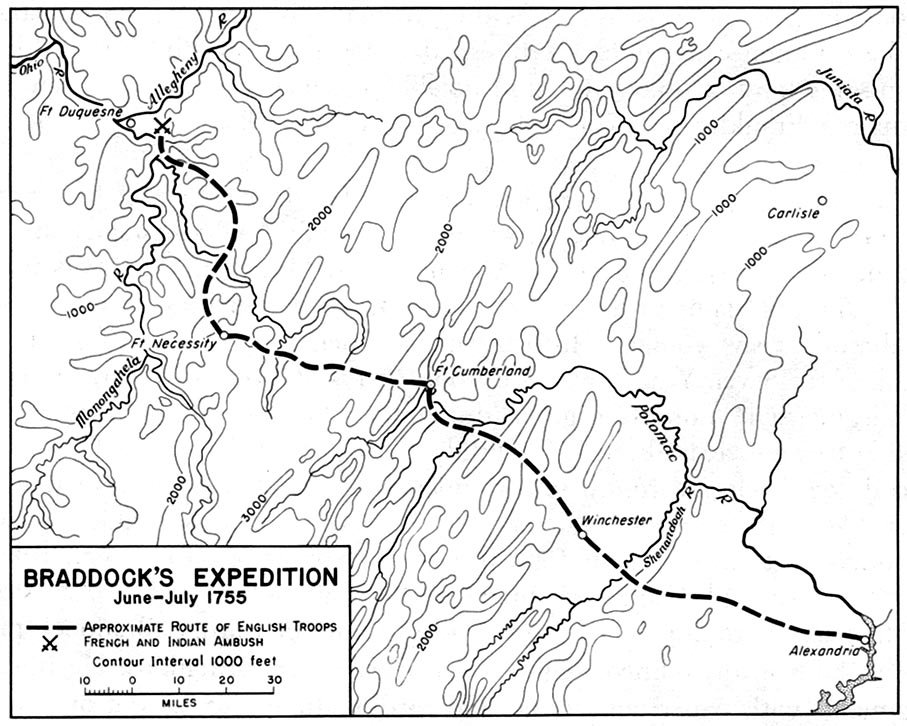
Braddock's route from 
Alexandria, VA to Braddock, PA

Braddock's route from
Cumberland, MD to Braddock, PA

The first images shows the "approximate" route from Alexandria (on the coast) which is on the Potomac to the final destination near Fort Duquesne. It passes through the interior of Northern Virginia and climbs up into the Blue Ridge mountains. This map gives us the elevations. At Cumberland, the elevation is much higher, and we see the route through western Maryland into Pennsylvania. 

---

Braddock's route went through the Keyes' Gap which is over 900-feet high. Formerly, that route from Alexandria to the mountains was called Vestal's Gap. Parts of the trail can be seen in eastern Loudoun County of Virginia. This area is near Dulles Airport outside of Washington, DC. 

The route follows an old Indian trail which is 65 miles in length from Alexandria to the  mountains. 

---

In terms of historic preservation, Loudoun County has provided historical markers with notes in the area. Too, they have a website which is of interest. This is an example of the web/cloud being useful to education at several levels. One example (2019, LoudounNow): 
  • In Our Backyard: Preserve the Vanishing Vestal’s Gap Road - property of Lord Fairfax, originally, almost 400 acres are preserved surrounded now by heavy residential and commercial development including Dulles International (and recently, the heavy foot of data centers trample the countryside). Pieces of the trail still exist (with an interest not unlike those remnants that we can see of the Santa Fe and Oregon trails in the middle of the country. 
We have written of New England (south) for several reasons, such as people from New England (north) going south. As well, the culture is the same. The south was more swashbuckling and plantation driven, not that the north was heaven on earth, let alone a beacon as desired by John Winthrop. 

Now, finally, for this post, the Native trail ran from the coast up into those things called the Blue Ridge mountains where we find things like the Shenandoah River and artifacts related to the Civil War that was mentioned on historical markers too. Right by the above-mentioned site runs a modern highway that was prototyped (real life) in the early 1800s since the traffic was heavy. It bears the name, in areas, realated to one of the early towns. 
  • Leesburg, Virginia - county seat of Loudoun County. Town of the Carters, Lees, and Masons. was in an area that was good for farms and plantations. In the War of 1812, federal documents were brought from DC for safety. 
As we proceed being involved with the eight years of the 250th and then the long trek to 1820 and Boone's western influence taking hold, there is no end to the topics to cover. One theme will always relate to the influence of New England and it families that contributing to the establishment of the U.S.  

Remarks: Modified: 06/26/2026

07/31/2025 - One of the Lord's American cousins was George Washington. We need to look more closely at the relationships between those here 400 years ago and those of the 250th being celebrated.

06/26/2026 - Updated URL for the Wikipedia image (one change - number of pixels). 

Saturday, May 31, 2025

2021, time of the pandemic, I

TL;DR -- The pandemic started. Life was restricted. We did local things. And, worked on the web/cloud in various modes. 2021 culminated in the most posts that we had since our start with topics that cover a very wide range. Knowing the U.S. and its history is one motivation. 

---

Part 1 of 2 (Part 2). 

In 2020, we found out about the coming restrictions after being in one of the cities where the disease was reported and said to be related to someone returning from overseas. Then, we endured the restrictive period with access to the outdoors as well keeping busy with "web/cloud" activity along several lines of research. 

Our focus on technology was one line of study for the Thomas Gardner Society, Inc. The next year, 2021, had the most, 105, posts published since the start of our work. Below, we provide a list by month of the titles of the posts. As can be noted, the topics varied greatly which we will comment on below. 

First, here is a list of the topics for the first six months. 

A subject of lots of focus was the travel of folks from the east to the west through the middle. Of course, looking further at the west coast got our attention to New Spain. The rivers of the interior were of particular interest as the Missouri River starts out in the far western mountains, closer to the Pacific than to the Mississippi River which it joins at St. Louis. Not far from there, the Ohio River comes in from the distant east having started in Pennsylvania. But, there is more. The Arkansas is a little south of that area and had eastern visitors from (what became) Canada early on. That exploratory group from New France headed back up north when they started to see evidence of New Spain. 

Naturally, looking at the Missouri, we had to consider other rivers near its origin, such as the Gardner River (Yellowstone, plus) which flooded recently. We looked at several tales related to the area, including that which motivated the movie, The Revenant. Our earlier focus was there, namely Jedediah Strong Smith. 

Going back up north from the Arkansas on the Mississippi, we get to the Wisconsin River that joined above St. Louis. The French group had traveled over the Great Lakes to the mouth of the Fox River. About one-half way to the Mississippi River, there was a portage which was brief, comparatively, being only two miles or so between the Fox and the Wisconsin (on the western part of the trip).  

In work related to family history and genealogies, we decided that there was a frontier century which is observant now with respect to missing documents. St. Louis was a hub of movement. The U.S.Government was early there with land management. Think of the time of Daniel Boone who was out, with his family, to western  Missouri (Kansas City area) as a settler. But, he also ventured further out past the Rockies. Other federal activity was military: Fort Larned, KS. 

Speaking of which, there was a stage line that ran from St. Louis to San Francisco. Not across the middle of the country. No, this one went south and joined regular movement from Texas to Los Angeles through Tucson in Arizona. In Los Angeles, the activity was in the Bunker Hill West area which has a long history that we have written about (Mirror building). Of course, then we had to look at mail and freight. Too, newspapers were delivered. 

We didn't forget the sea as the California cities were largely populated by ship in the beginning. Once the internal trails were established there was a huge flow across the middle. The Pony Express carried mail and small material. Several stage lines carried people and freight. We looked closely at the Butterfield Express. 

Why? All of this activity was seriously associated with, or driven by, New England influences. In fact, Kansas was a Massachusetts project with its University being founded by a group that included women who came to set up a free State. We have a lot more to write of that. 

Everywhere in the unmapped territory, we had trappers. Some were even venturing down from New France and Canada. Then, the next phase was trader as folks moved across the country, many of them stopping at locations that exist today having been started by the pioneers. 

Along came the railroads which have a special interest due to family involvement. That facilitated one of the major memes of the west, driving cattle to the markets. So, rancher/farmer would be the next phase continuing today, in the flyover country (had to menton that - it's from an earlier post). 

Next up, we'll look at the second half of 2021 in terms of posts. These posts cover the U.S. and its history. Interspersed are posts on technology, which increased with the release of OpenAI's GenAI/LLM. 

Remarks: Modified: 06/03/2025

06/03/2025 - Clarify that the journey on the Fox to the Mississippi starts at the Great Lakes and runs upstream in IL to a point where the Fox is close enough to the Wisconsin for a reasonable portage. The Wisconsin then runs down, and connects, to the Mississippi. In the reverse, the journey goes up the Wisconsin to the portage and down the Fox to the Great Lakes. Modern technology has improved that route with locks allowing the height changes to be managed. 


Monday, March 17, 2025

Independence and Kansas City

TL;DR -- Trails were and still are in the sense of leaving tracks on the landscape (several places along the Santa Fe and Oregon Trails. And, now the Interstate Highway system with all of the national, state, and local roads. And, going further, even now dirt roads as tracks. Sometimes converted railroad tracks. 

--

With all that is going on in the world, and in the U.S., it is time to look back at the past. In 2020, we got the opportunity to spend time looking at the interior of the country which is huge. In terms of time, we had a frontier century (post has copy of photo of Lawrence, KS by Gardner). We got to learn about the trails and the cities that cropped up (theme of this post). We determined that there was a lost generation or two (Boone was real; officer in the US Revolution; Longhunter; traipser of land (all the way past KC with time spent in western MO) in the movement that came to fore as we looked at the upcoming 250th of the US under the auspices of the Daughters of the American Revolution. Doing applications for some requires lots of additional work. 

Before 2020, we had looked at the trails and those earlier like Jedediah Strong Smith. Gardner, KS was seen as a hub of traffic and activity. Also, we had looked at both land and sea traffic to the left coast (Old LA and the US - as in Los Angeles, CA - in particular, Bunker Hill West, where the culture went back to New Spain and then through several cultural shifts to the current canyons of high rises).

---

Now, to the theme. We saw a video of a talk about the trails and how they came into Kansas City and left. It was of the first part of which there will be another. We mentioned Gardner, KS where 3 Trails split. The Oregon went over the Wakarusa River into the Lawrence area and then up to Nebraska. Even in that trek, the rigors of getting people and goods across the land was obvious, especially trying to get over waterways which were boons and banes (mostly the latter for many). 

The talk: How Independence & Kansas City Became Trailheads for the Oregon/California/Santa Fe Trails, Part 1. The following image came from the talk. On the map (a modern map showing some roads), Independence, MO (where Pres. Truman came from) is on the upper right. Gardner, KS is on the lower left. 

Indepencence, MO
Gardner, KS

In the top middle, notice Wesport which is on the Missouri River. After a little bit of time, impatient travelers (read, young men off to the coast with gold fever) realized that they could take the river up past St. Joseph, MO (famous for the Pony Express) and then a little further north, they could head west in Nebraska. While doing that, they would meet travelers coming up from Gardner, KS. But, they would have cut several days off the journey. 

OCTA, sponsors of the research and talk

---

Notice that this is about the early times. The railroad came into play after the Civil War. 

Generations? By this time, say before the Civil War, we were to the 8th generation from the start of New England. The Revolution was mostly of the 5th generation. 

Cultures? As we have noted, there were the News: Spain; France; England; Sweden; ... The left coast allows us to look at the first; Quebec, Canada is representative of the second; we had both a North and and a South for the third; and so forth. 

---

KC? MO and KS. Missouri and Kansas. We need to look at the area a little further. It's known for beef and barbeque. Well, cattle came up from TX to be shipped east to the hungry easterners. Too, the breadbasket founded itself on the rich lands of the area. Boone, as said, was there early. It's sister city in MO, St. Louis, was the administrative and bureaucratic and entertainment hub. See early Missouri, for instance. 

Remarks: Modified: 03/17/2025

03/17/2025 -- 


Friday, February 21, 2025

U.S., 1820

TL;DR -- New France has always been on the mind from school days. Later, we found that the officer corps of the generation (5th) that drove the Revolution had been trained by the English Crown during the French & Indian affair. The Revolution is coming up for commeration of its 250th. For the 400th, northern New England started these in 2020. Coming up will be Salem MA - 2026. Some of our themes will continue to be rivers, carving the interior, and more. 

--

During the Covid times, we had time to do a lot of research, some of it related to families who came into (or passed through) the middle part of the country after the Lewis & Clark trip and report plus there was study of simultaneous activities in other than the New England part of the country. Mountain men, like Jedediah Strong Smith, were exploring. He went west through St. Louis which became a hub of activity. Jediediah got through the Mojave Desert and arrived in the Los Angeles area where the Spaniards took notice. After that he went up to northern California and was headed back to New England when he met his demise in the area now known as Kansas. 

See these posts as examples: State Missouri, 1821; U.S. Interior; and New Spain. There are posts covering later times before and after the Civil War: St Louis MO to San Francisco CA; Trapper, trader, rancher; and Old L.A. and the U.S. Our focus is across the board and 400 years: Boone, himself; Two different times; and, even, Josiah Willard Gibbs. That last one deals with serious early reserach in thermodynamics that got the attention of Maxwell, Planck and countless others. 

----

We have followed a Space in Quora that deals with Spain, including people and events related to New Spain's ventures on the American continents. And, we have a particular interest in California with family involved with New England's long reach across the interior. Too, the writer of the post lived (and worked, studied) in CA, including dwelling on the Bunker Hill area of DTLA for a while.  

Today, we saw this map in a post on Quora (next section) which got our attention. The Adams-Onis Treaty was signed under the adminstration of John Quincy Adams (kin - see Mary Gardner Boylston) and represents the increase in activity that followed the Revolution which is coming up this year for recognition. 

Frankly, we like the map as it represents one of the views of the time. Also, we already have noted that New Spain (see New Spain span) has not gotten the attention that we saw with New France. So, we will be paying more attention, starting with the left coast side of things. 

--- post in Quora Space -- 

In the post, which is an answer to a Quora question (Who founded Los Angeles and in what year did California become a state?), there are interesting historic details including photos. The Quora Space has been a good resource. Our post is to recognize its importance. 

---

And, we have two views to balance: the 250th - Lexington/Concord imminent; the 400th - Salem is next year - 1626 - Massey's Cove. 

We would like to point to more information on New Spain in those same times. 

---

We will get back to this topic after more review of those early years of the U.S. For completion, we cannot ignore the great state of Texas (Juneteenth; Pre-Civil War, San Antonio TX to San Diego CA). This map is from a couple of decades later which is pre-Civil war. 

U.S. Territorial Acquisitions

Other topics will include the U.S. Interior and Carving the land. 

Remarks: Modified: 02/21/2025

02/21/2025 -- 

Saturday, January 27, 2024

Longhunter

TL;DR -- Boone was there, in the times of the French-Indian affair, the Revolution, and after. He was of a type that can be known as longhunter. They wandered and brought back information. And, turned around and led people west. This post is of the 250th theme. We are about two years away from that celebatory event. 

---

Four years ago, COVID became a reality. There had been little glimpses earlier. People were talking about an illness in China. We came home from a regional jaunt and heard, on the news, that people had been identified in the area where we had bee as being diagnosed with the disease. Okay, not long after, there was the respite put into  place. Rather, it was lockdown with rules put into place which went on for a few months. 

We had already been supporting history and genealogy work. Some of this had the flavor of finding paths taken by families as they went west. Or, from our perspective, as they came west. Earlier, we had seen entry into flyover country from several directions. The Ohio River ran from PA down to MO. But, it was Daniel Boone (see post Boone himself and search results - Boone) who figured in a large way. He was involved in the Revolution. Prior to that, though, he had explored westward our of the southern states. 

As we had noted, our focus was on the coast for a long while as we caught up with the 400 years that had passed by. Dr. Frank's work was a launching point bot from the family research and The Massachusetts Magazine which printed for eleven years and was discontinued when the Spanish Flu hit as well as WWI came about. But, we had done some work with families who went west. See Flyover Country, for one. As an aside, we are considering how to update Dr. Frank's work with respect to recent findings brought to us by technology. 

Fortunately, about the time of the pandemic, we were getting more inquires with regard to people coming west. Here are some examples (these posts are not in chronological order): Jedediah Strong Smith; Judge Thompson; Col. T. W. Higginson; and St. Louis as the site of the partitioning efforts. Too, though, we tracked several families that followed Boone west. He, BTW, ended up in MO with his son coming further into KS. 
Boone, wandering

Now, let's look at Boone and what he represented. He was a longhunter. These guys went out on their jaunts for months at a time. And, during that period, they were self-sufficient. When they returned, they brought back information and some artifacts, such a pelts. 

We are talking about the area, for the most part, that was east of the Mississippi River. There were explorers out further west, some from the Candian regions. Jedediah was out in California in the 1830, by foot both his and his steeds. He passed through St. Louis on his way. Later on, as we know, two massive killing periods happened out west: beaver; buffalo. 

The numbers of venturers was small. But, where Boone was, a Cherokee chief by 1769 was complaing about the influx of the long hunters. Mainly, they were noisy. And, other stories abound. 

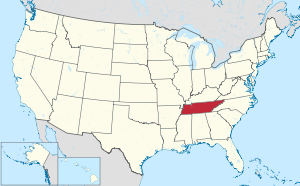
But, getting to our interests, we are finally concentrating on Tennessee. It is a huge state. All together, it touches nine states. Its northern neighbor, Kentucky, touches seven states. We follow families who went west through both of those areas. Too, their border was a dividing line during the U.S. Civil War. We have not discussed that topic in detail, yet, but intend to at some point. Since we're in KS, there is a pre-civil-war history involved with families in the area. 


Back to the longhunters, they are similar in spirit to those who sailed the seas as we saw with New England. We had an earlier post (Final migration) that quoted authors on the subject. There were many trails west, as the railroads later showed us. Jedediah, in CA, had travels that map out the current highway system. Culturally, we would point the travels of the Native Americans over their long time on the continent. 

Other types of early travelers have been touched upon during our research. About a century before the area depicted in the Flower Moon movie, a mission was established in SE KS to aid the Osage and, eventually, other tribes brought into the area. Several local sites were the local for negotiations and treaty agreements. 

Back east, the history goes back 400 years. In the interior, we are talking the long reach of New England over a 250-year period. A lot of families arrived later; but, many carry the history int heir genes over the entire period. Both require attention. So, there's no end to research. 

Lately, we have had a focus on CA, for several reasons. Some of the interest has to do with family being there early. But, we have seen lots of older photos being brought to the fore. Recently, we did a post about a photo taken in downtown LA in the 1880s. We have one from this week to add. But, the area of the photo was where Butterfield had his stage coming into the area prior to going up to San Francisco. His first arrival was in the 1850s. Change is on theme. Some things remain. Many, most do not. 

Society needs its adventurers. Of late, there are new types that we will be discussing. Despite that, we still need the old ways for many reasons. 

---

Example? Technology has developed a thrust and lust for the virtual. That theme needs constant attention for several reasons. One deals with the respect for the land and the people involved across all of the time frames that will be associated with the U.S. and its history. 

Now, AI and even AIn't? History can be retold in more interesting ways using technology. Yet, the truth of the matter remains an open issue that hopefully we'll be able to address more fully if we determine the necessity as we ought. 

Remarks: Modified: 01/27/2024

01/27/2024 -- 


Friday, June 23, 2023

Winter won

TL;DR -- As we track New England folks across the country and back, we note that information becomes available continually. The Woodbury folks pointed to the Wyoming History Society and their article on the Pony Express in which we have an interest for many reasons. This new source has interesting graphics of which we provide two. One is of the Butterfield (southwestern) route. The other has details about the route through Wyoming as research for the 1960 look back. 

--

As we follow New England's influence away from the east coast, we have to consider that left coast which was also accessible by sea and the huge middle. A recent post looked at the excursion of Hernando de Soto through the southeast all the way to Boone's Missouri. Then, we had periods of time from Lewis & Clark's jaunt onward with trappers and fur traders leading the way. 

A major theme for our posts which were done after some research has always been rivers. Then, we had looks at people, including other cultures such as New Spain. When New England was the origin, we tracked down their information, if available, on WikiTree and Wikipedia. And, destinations were important whether Oregon or Texas or any other of the current States. 

We also looked at the work of other researchers. Recently, we became aware of Woodbury Historical Tours. These are cousins via the Cape Ann venture. But, there have been lots of other researchers that we paid attention to, such as those with the Jedediah Strong Smith's society. 

On Facebook today, the Woodbury's pointed to the work of the Wyoming Historic Society. Anyone going west in the northern U.S. went through that region. One reason was that the mountains of Colorado were too difficult. So those headed to Oregon or California went up out through Wyoming and then split. We have had many posts on the various trails. 

Butterfield route 
through the Southwest
What was interesting about the article on The Pony Express in Wyoming is its focus on accuracy. They mention, of course, Buffalo Bill Cody but just cursorily. What caught our attention was the acknowledgement that "winter won" with respect to the effort to establish the Pony Express (which we wrote of last year) as a northern mail route. 

At the time, the Butterfield southern route was in operation (see  map). In our post, we tracked down the principals, one of whom was of the Giddings family of Ipswich, MA (Ann's kin). Too, we noted some of the other players who ended up founding banks and other businesses. 
 
As we saw earlier, the Butterfield route stopped when the Civil War brought too much uncertainty. So, the effort was taken back to the northern route which Samuel Clemens (Mark Twain) took out west in the days of the stagecoach. Ralph Waldo Emerson went out via train a little later. 

We will get more into detail, but the Pony Express did run in the winter. It took longer. The southern route was longer and arduous as it carried freight, to boot. We need to know of these enterprising people, many of whom were of New England stock. 

Let's just leave it with this map of the 1960 rerun. Plus, we will mention one of the founders: William Russell (Wikipedia, WikiTree) born in VT in 1812, moved as a kid to MO.  

Pony Express
Route through Wyoming

Remarks: Modified: 06/23/2023

06/23/2023 -- Reminder: research continues. Example open research topic.


Monday, May 22, 2023

Three years ago

TL;DR -- Three years ago, we were coping with changes due to the pandemic that cropped up and circled the world. One lasting theme was that we got into specifics. Starting with movement to get over the barriers from the east to the west (say, Boone), we incrementally have followed families as they ratcheted west (move, settle for a while, move). The interior is full of such families. 

--

We are approaching the Memorial Day weekend which starts the summer season. It's the first of three holidays with July 4th and Labor Day being the other two. School is out for most students. Vacations are on the horizon, usually. 

But, as a reminder, three years ago, a pandemic arose worldwide, with awareness of the situation becoming to the fore in March. Pandemic? We had already written of two: Throat distemper, Spanish flu. The latter coincided with the last issue of The Massachusetts Magazine. But, this was something new: sheltering in place with little public exposure. We adapted to new ways, that were supposedly temporary. 

These posts in these three months depict some reactions of the time:
  • March 2020 - This was the first effort at adapting to the new way. Where we lived, we have wide-open spaces and were out every day. Being older, lots of events in the public sphere managed access and time (a carry-over are the carts being filled with orders to be delivered that one see while shopping). But, the themes this month were retrospective, anyway since we were in our tenth year of blogging. 
  • April 2020 - Like being house bound, we took the time to review our ten years of research. One thing that came of that was the focus, for a few months, on the interior of the U.S. as it was carved under the control of St. Louis. We sampled various times and places related to the movement out west.  
  • May 2020 - Tales from the westward movement started to crop up. Just getting out of the east was problematic. The below quote? Trying to conquer the western portion of an Atlantic State. 
    • "One lady was quoted that she would hide her infant by a bush and follow the wagon up hill (with one task of chocking the wheels of the wagon if the horses tired). Once the hill (very large one) had been conquered, she went back down and came up with her child." A huge name involved with the escape was Boone of the south, who got people over the mountains into the area that launched the western movement. Boone himself, as an old guy, was all the way to what is now known as Kansas City. But, that was not even half-way to the west coast. 
There was a change in focus that has continued. We did not have an explicit post on Covid until later (June 2020 - Modes and protocols; The future). We did several retrospectives over that time. Then, we wrote of a 100+ year old lady who application to the Mayflower Society (Deeper dive) never took, for several reasons (we have written of that here). She is now gone (and knows, Mayflower people). 

Actually, about that, one wonders how well the computer will be in doing some of this work (that is, genealogy). We already have many examples, so the topic will be on the table. 

Remarks: Modified: 05/22/2023

05/22/2023 -- 


Sunday, January 22, 2023

U.S. hills and valleys

TL;DR -- New England has a long reach, as we have noted time and again. But, it also is the origin point for lots of movement that went north, south and west. We look at how names for places came about in New England. This will carry further as we review how the country filled. 

--

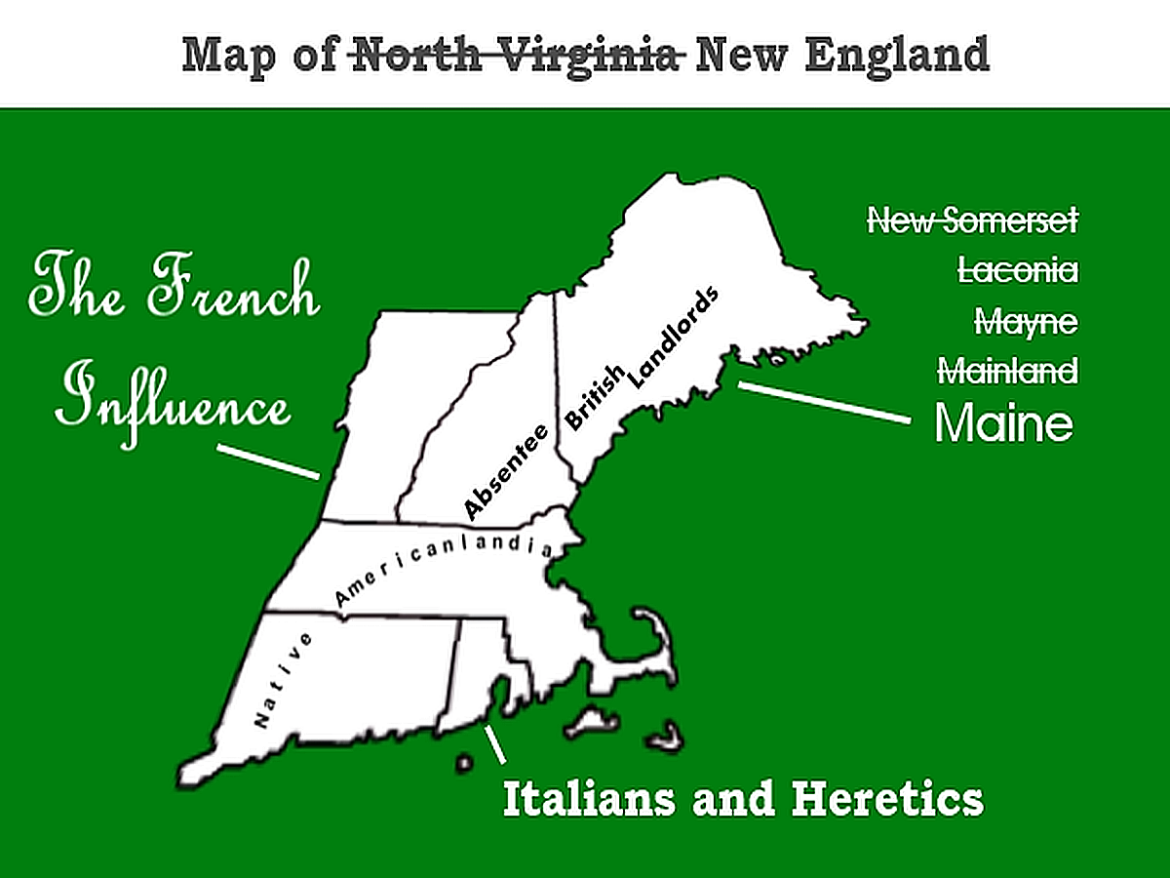
We do this post for several reasons. One is to familiarize ourselves and our readers about New England, given the 400th is now being observed by Gloucester in MA and Portsmouth in NH. The New England Historical Society updated, recently, an article with the title of  "HOW THE NEW ENGLAND STATE NAMES CAME TO BE" which had this interesting map. 

Another reason was that several names came from those used by American Indians. For Massachusetts (MA), the name refers to the Great Blue Hill whose elevation is over 600 ft. Looking at that geographic site brings up the subject of comparative heights, not only in New England but in other regions. 

Let's take a look at the numbers remembering that those of the east went west. And, we know that the heights are much more in the western areas. But, what about other areas of the country, such as the South. We will also take a look at the middle parts that trekkers going west had to pass through, as the interior of the U.S. was filled? 

As we proceed, we will consider the highest point in terms of mountains. For Massachusetts, this would be Mount Greylock at 3,489 ft. Looking north, Vermont's name is for the Green Mountains as they were marked on a map by Samuel de Champlain (of New France). The highest peak in that State is Mount Mansfield at 4395 ft. Before moving on to another region, New Hampshire was named for an old English county. It's highest peak is Mount Washington at 6,288. 

Moving on and looking at New England south, we change a little for reasons that are apparent soon. For these States, let's list its highest point plus a prominent city to indicate the differences: Georgia 4,784', Atlanta 738'; Virginia 5,729', Charlottesville 594'; Maryland   3,360', Frederick 302'. 

Virginia stands out, being the home of both Presidents Washington and Jefferson. We have done a few posts on the area and will continue as we move toward the 250th of the Revolution. The focus of the conflict moved south as time went along. Too, we mentioned the Cumberland Gap and Boone several times as we looked at the migration that picked up after the Revolution. Both Atlanta and Charlottesville are fairly high as they touch on the plateau of the Appalachians. Frederick features in the Gettysburg battle which we will get back to and was on the middle route out of the east to the west. A few posts ago, we looked a Ohio as a destination from that area and New England. A continuing theme will be the areas east of the Mississippi River.  

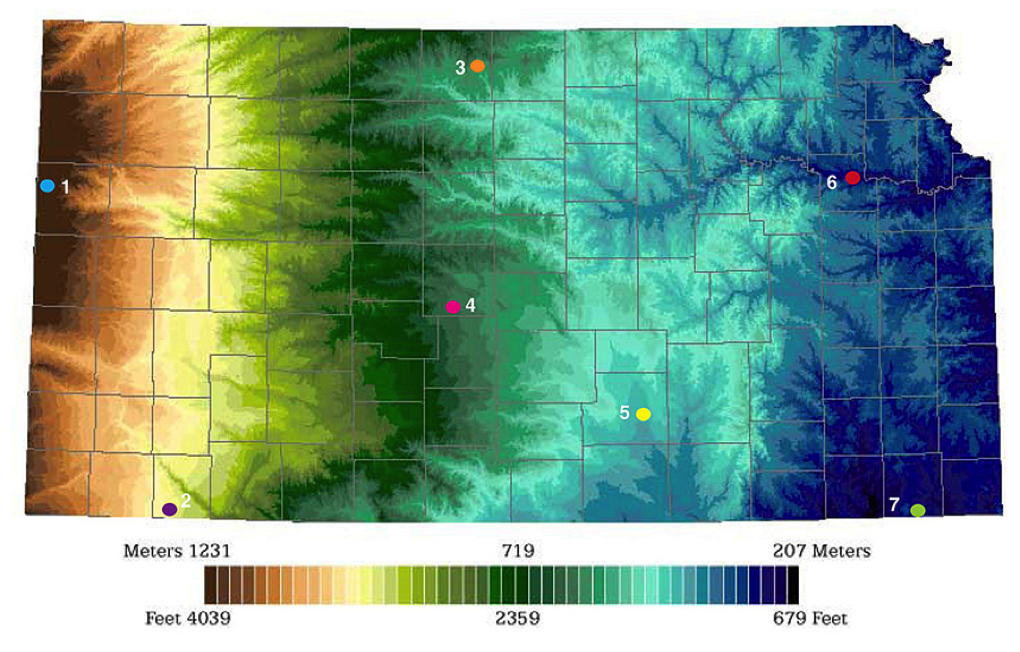
Elevation,
Kansas
Leaping west, let's look at few States that were on the route. First, though, the image is an elevation map of Kansas which we looked at in December in terms of traffic and events through the period of the Frontier Century. Think back to those times which we have covered in several posts. But, as the map show, there is serious elevation change from the east to the west. The amount of change is almost as much as those peaks of the east. In Kansas, that is, as definitely getting to Denver brings in a new level that exceeds the east. 

The complaint in the age of the auto is that Kansas is flat. Well, it's not. That's illusion; plus, the car is doing the work in order to allow lazy evaluations. Why say that? Expectations and interpretation are huge issues with how technology influences us. We'll get back to that theme, regularly. 

But, here are the states in that area (same format as above): Kansas 4,039', Kansas City 909'; Arkansas 6,581', Little Rock 335'; Oklahoma 4,974', Oklahoma City 1,198'; Missouri 1,772', St. Louis 466'; Texas 8,751', Fort Worth  653'. 

Tying back to the former list, note Texas's highest peak. That is due to the fact of it being almost beneath Denver. Kansas City is higher than St. Louis and Little Rock as it is on the Missouri which flows down to the Mississippi. Oklahoma is even higher. Forth Worth, south of Oklahoma City, is lower as it's on the route of water going to the Gulf of Mexico. Why look at this? Remember, water was either a boon or a bust. We see it now. But, then, it either helped the movement or was a hindrance. Just look around at bridges and consider traffic if they were not there. We see that from time to time as bridges collapse, through accidental damage or neglect (a topic to bring up, as well). 

Click image
for interactive map
So, we're right in the middle. Those considering ancestors who went on, yes, it was a lengthy and hard row to hoe. But, many made it. Lots were buried along the way. Some were lost forever. 

To wind things up, we look at the highest peaks in the western continental U.S. with a map. The query could be, how many are over 12,000 ft? This site has 178 rows showing that we have many over 12K and 13K and 14K. This does not include Alaska. 

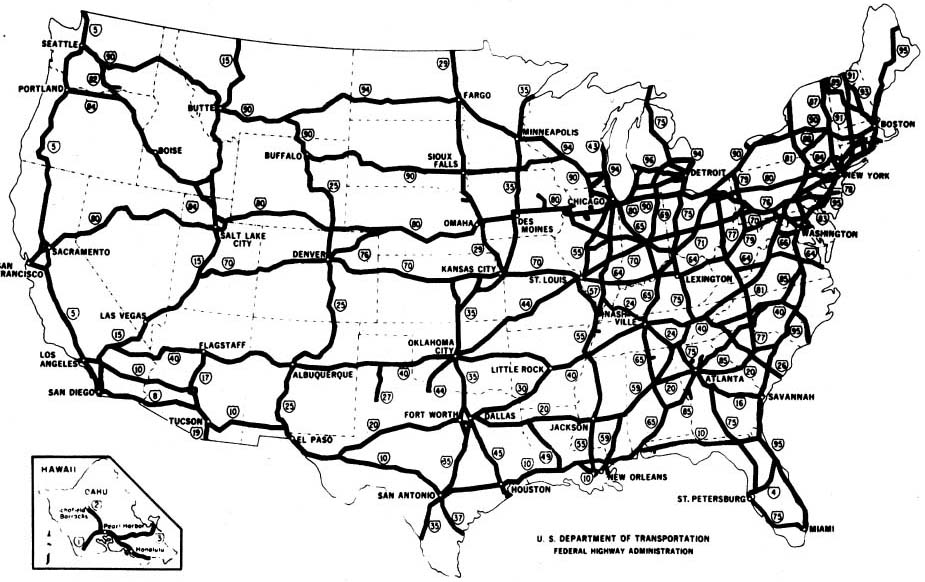
As we consider this overview, note the dots and then look at the trails which smartly tried to stay away from the impossible. Or, the dots aren't impressive? Consider this, the State of Nevada which has only two names on this list has over 130 mountains that are over 10,000 ft. Notice, there is no north-south Interstate highway in Nevada. The red dots had a huge influence on how this system was designed. 

The Dwight D. Eisenhower System
of Interstate and Defense Highways

The 400th commemorations and the 250th will allow us to get familiar with our country from stem to stern and left to right. Ought to be fun. 

Remarks: Modified: 01/25/2023

01/25/2023 -- Added link to New France. 

Sunday, December 11, 2022

19th Century details

TL;DR -- Earlier we took a look at transcontinental travel in the early 19th century and its ardors. There was nothing easy about the ordeals, but people took up the gauntlet. Here we look at one site where travelers made their presence known and link to a map that has local details of interest. 

--

We have had several posts on trails. Recently, we looked at a well-known trail (to Santa Fe) as it was the terminus of another trail in New Spain which provided other trails such as that which provided a route used by the Butterfield Overland Mail Company in carrying mail, freight, and passengers from the east coast, through St. Louis and to San Francisco. This was pre-Civil War and was interrupted. Further north, the Pony Express went from St. Joseph, MO to California carrying mail. Butterfield established a new route up north using coaches. Mark Twain wrote of his journey on this route. 

There was another Butterfield in that area who was not related and who had a  Butterfield Overland Dispatch (using a post at the Legends of America site) through Kansas. Both of these Butterfield gents had investors back east. The amount of stations, equipment, horses and people required to have regular routes was tremendous. As we know, the rails of steel were going to play havoc with these routes. But, that was enough later for history to be made. 

As a reminder, at the same time, there was regular traffic from New England which moved south by sail to the area of Panama which involved going across land from ship to ship and then sailing back north. Of course, one could go around South America. We looked at this briefly when writing of the Bostonian (barque) that wrecked along the Oregon coast in 1850. The barque left Boston in July and arrived at San Francisco the following January. It was later seen in New Zealand and, evidently, carried goods to San Francisco before venturing north to its fate. Gardiner, OR resulted from that incident. The overland trails had as many dangers; but, even without those happenstances, the travel was arduous. 

Besides looking further at the specifics of these overland efforts where we find the two Butterfields, we want to bring in more detail as is required for doing history of the events better and for considering the people involved in a more respectful light. Also, the area in the center of the U.S. was very busy. For comparison, we looked at a railroad town and its specifics from the early 1900s (see KATY - western railroad). 

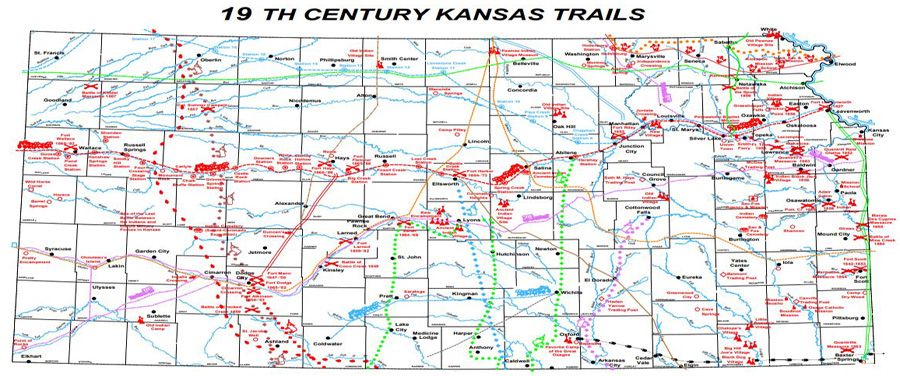
Let's start with a map that comes from KDOT (see 19th Century Kansas Trails). Notice that the Santa Fe and Oregon Trails come into the area in the northeast corner. The Oregon Trail splits off and heads northwest. Another trail in that area is the Butterfield Overland Dispatch which terminated in Denver, CO. The other Butterfield route would have been north of this area. 

Click for detailed 
map from KDOT

The map includes other trails of interest including those used by indigents and that related to the cattle trade where heads were brought as herds to a rail terminus for loading. As one looks at images, the wild west was in this area (see Dodge City). "Hell on the plains" might apply to our few decades of the web. 

Looking at some of the details, there was a military road (double green) that went from Ft. Leavenworth to Ft. Scott and further south. This was there early. We mentioned a Mission in the southeast corner (see Memorial Day 2022). Nathaniel Boone (son of Daniel) was in the area. Col. T.W. Higginson was in Lawrence and Topeka. Lawrence was founded as part of the abolitionists' interest in keeping Kansas free. Take a close look and note a trail (blue dashes) from Leavenworth which was originally for supplying Army posts as they expanded westward but ended up with a California connection. 

In a recent post, we looked at how Ipswich MA got Ohio going. That was not long after the Revolution and was similar many ways with what happened later out west. In fact, we included a graphic (map) showing both areas. So, we could look at this type of detail across the whole of the region. 

One of our interests is the long reach of New England. Both Butterfields were from New England (their relationship, if any, needs to be researched). For the most part, we will be taking time to link with both genealogical and historical information (see Lorenzo and Peggy). As well, we have a technology interest and want to include specifics of the reality of the earlier times. After all, everyone here had forebears who were alive then. The particulars of the American west are such that we can see the transitions clearly over the frontier century's span. We mentioned it before, but this map brings up the fact: going from the northeast (Kansas City) to Ft. Larned (south central, look for Great Bend) took three weeks of daily work on the Santa Fe Trail. 

One more detail, Jedediah Strong Smith was last seen in the area of Point of Rocks (lower left - southwest). He was killed by an indigent part. 

Remarks: Modified: 12/12/2022

12/11/2022 -- 


Thursday, December 1, 2022

Perspective, a necessity

TL;DR -- Ipswich has been a topic from time to time. It had shipwrights. Of course, different size of vessels were handled. There were no biggies like Boston (MA) or Bath (ME) or Norfolk (VA). Other examples of industry and technology can be used. But, Ipswich led the way to the expansion across the interior that we saw for over a century. We will be looking at that, as after all, New England has a long reach. Ipswich has done well for itself. 

---

As technology runs toward the future, we always get to states where we get locked in. We cannot go back. Technology is great, except for when it doesn't work. If the problem is solvable, then we have a glitch and a correction. If the problem is systemic or not resolvable within a reasonable timeframe and costs, we have adjustments rise as imperatives. Learning drives technology; unlearning drives recovery from technology's failures. 

The U.S. is about the best example that we have for several reasons. We have already addressed technology as being our main focus. We have 400 years of data to ponder, in this regard. But, just those pieces of evidence from the past 250 years is worthy of study, too. And, commemorative moments, such as we are having now which will last decades are a time to reflect and learn from the past. We are surely in a different mode than the generation of the recognition of the 300ths. 

Today, we are featuring Ipswich which does not come to bear until later, but it does involve Essex County. Reminder, Cape Ann (Gloucester) has their moments in 2023.  It was from Ipswich that a group went west. Gen. Rufus Putnam (Wikipedia, WikiTree) was one of the leaders of the effort. Let's look at some particulars. 

Historic Ipswich is a website that has been quite a motherlode of information. Of course, we are interested due to the many families in the heritage who had Ipswich connections. For one, Rev John Wise has an interesting bunch of  events in his life that we can learn from. We have been looking at shipbuilding in little Ipswich as well as similar work in the County (see Newbury Essex County MA).

The website has looked at Putnam's effort: Ipswich to Marietta, December 1787. First, they show the result of contention between the States with regard to this unsettled land to the west. We mentioned that in the last post about Family Search and their great support for research. Then, the post has the photo of a plaque that notes the endeavor. What? That got our attention, as we have been looking at the western expansion and its frontier century, including lost generations that plague genealogists who have no imagination. Why say that? These people were. Some were newcomers, true. Many were representative of the long reach of New England. Along with technology (and its specifics), our interest deals with identifying the examples of that reach plus the evidence now of its continuing existence. 

Then, the post looks at an effort in 1937 to redo the trek while documenting the effort. For one thing, they provide the map that gives details of the geography. That was great to see as we have looked at the west and its rivers and its great expanse and the carving that was inevitable. Lots of this was with a focus on St. Louis, the gateway. Putnam kept a journal. There were other reports written. In short, it was a great find that was more special since it involves little Ipswich (influence a huge multiple of its size). 

Now, let's look at perspective. Technology makes people lazy; oh, managers will say that it increases productivity. In terms of the former, heard of AI? It's a huge scam which we will show as we go along. Yes, balancing mathematics with knowledge with respect to culture that the broad history of U.S. allows. After all, we are a nation of immigrants. Luckily, we have two broad scopes, related to the colonial times versus later. Too, we have cultural associations with the old countries, for the most part. The list goes on and on. So, expect this theme to be recurrent. BTW, that which is being touted as AI is merely fancy math being exploited by computational prowess that came via modeling founded on (guess what?) mathematical modeling and the detailed work over the centuries. Yes, we will to touch upon all of that. 

For the time being, we will present the following map with some commentary afterwards. 


This graphic shows a map from the prior post which has one view of the partitioning before the carving that was involved in establishing the States. 

1) deals with the Michigan Territory (again, the prior post) that we just offhandedly dismissed as practice for the carving. Our only excuse was that we were dealing with the broad expanses beyond the Mississippi River, but that was not correctly assumed. We have to step back given that the focus of DAR/SAR is the upcoming 250th of the U.S. Besides, we have to give generations credit. This deals with the fifth and the sixth where the latter is the first of those that were heavily in the lost side of things. 

After all, people moved and did so quickly, once the way was set. Say, thanks to the likes of Daniel Boone and Jedediah Strong Smith. The former was doing his exploration prior to the Revolution. The latter was directly connected with St. Louis and its influence. We will go into that deeply. 

A point to make is this: that trek from Ipswich was difficult. Hence, there were real reasons why it took months. In fact, it was practice for the challenges of going even further which was all the way across the continent. On the right is a modern image with routes and times. Even today, travel is difficult. Try driving diagonally across West Virginia. It's fun; but, don't expect to make record time (except, perhaps, max time which is open). Those mountains run further north. By the time that they would use the Ohio, they had already trekked some distance. 

We will take the time to go into this further, since it does set the stage for later developments out west. 

2)  This view trails the other by only a couple of decades. Missouri, the starting point, was a State in 1821. By then, most of the issues related to the green area had been resolved. But, it was 1804 when Lewis & Clark did their venture from D.C. through St. Louis to the west coast. At that time, mountain men (trappers, explorers) and American Indians were mostly in the area. Except, that had been activity from the west coast in (New Spain), some of which got away from the coast. Too, the northern explorers had been more adventurous than those of New England. Boone in the south went further west than did those up north. Lots to discuss. 

Taking the same approach, notice that we are now in the middle of the country covering only a fraction of the area. Here, the issue is that folks would have followed a similar path down the Ohio River to the Mississippi River and then St. Louis and finally the Missouri River west. But, that was on to a starting point. There were several trails. This example uses that which went to Santa Fe in New Spain. One thing to note is that Santa Fe was the terminus of another trail that came up from the south. Too, there were trails out of the east through Texas to consider. 

But, taking that one small portion which involved about four hours of driving now, it took three weeks for a wagon train to cover that area with a daily grind of a few miles. Notice, too, that we are talking the plains portion which is supposedly flat. It isn't. You can still hurt yourself by falling off of a cliff at various places.  

In all of this travelling, rivers were both a barrier and a boon. In these graphics, they are not shown with any clarity, but, even recently, we have seen examples of traffic snarl ups due to bridge damage. One time, we were across the river from where we wanted to go. Okay. There was no ferry. This is a form of technology to note. So, the solution, since we didn't have a helicopter that would pick up the car and deliver us to our destination, was to backtrack to where we could follow a road that went over the river and then get back to where we needed to go which was a stone's throw (well now, as it was broad). 

During the times before bridge technology really advanced, one waited out water. Incidentally, here in the west, there are uncountable number of places where high water will stop traffic. And, in many others, the water comes up to the edge of the road. One hopes that the road engineers did a good job with the base. And, that's not mentioning storms such as we will be seeing with winter setting in. It does not even have to be like the recent dump on Buffalo, NY. A few inches can be catastrophic. 

 Oh yes, real examples. There is a method to that madness. AI and other computer has gone off the rail since a proper basis was lost. Yes indeed. We have seen so many examples of modeling gone wild (like the kids at spring break) due to a lack of grounding which comes about for several reasons. One of these is a lack of respect for the need. Some of that might be generational; a lot of it has to due with the computer being too new for us to really have a grasp of how truth engineering is necessary. Too, what John von Neumann wrought will bitt us until we learn several lessons that have been pending for a long time. 

You know, we are looking at the U.S. and its growth. But, at the same time, the world of thought was changing. There and here. Say, for the latter, Charles Sanders Peirce. But, parallel to the U.S. and its experiences, the world was changing, too. There is not end to that type of analysis. 

Remarks: Modified: 06/08/2023

12/16/2022 -- Rutland VT is hosting the Smithsonian's roving display:  The Smithsonian comes to Rutland. They are reading and discussing McCoullough's book The Pioneers as Rutland is on the pathway west. 

06/08/2023 -- Updated the URL for the Historic Ipswich post. It was originally dated in 2019. The 2022 update removed the older post. One of the technical concerns is that source linked by an URL can disappear or have some other issue, like the information changing drastically. Or, as we might wish not happen, contain undesirable information. In this case, an easy fix. 


Tuesday, November 22, 2022

Lydia Maria Child

TL;DR -- Over the 400 years of our interest, we will be looking at people and events, here, there and everywhere. That goes with the long reach of New England. This post looks at someone from the seventh generation who was involved with several matters of long-standing concern. L. M. Child is of long New England pedigree as is her husband.

---

Book reviews can be a great resource. We don't always pay attention, as life is full of multiple areas of concern that need attention. But, the WSJ (weekend edition of the Wall Street Journal) has been a constant supplier of reviews of good books, that is, ones pertinent to our interests. For this post, we can point to three of these. One is that the childless can become lost as who pays attention down the pike? Lydia and her husband had no offspring. We have mentioned this interest several times, say with respect to Joseph and Ann - see Aunts, Uncles, Cousins which is from 2012 and needs some updating. Note, though, others have been added, such as Charles Alcott Flagg, friend of Dr. Frank and contributor to The Massachusetts Magazine. 

There are a couple more interests of many which we will itemize and discuss next year being motivated by the next 100 after the 400th commemorations cease, down the pike. The other two interests deal with identifying Essex County (Cape Ann) influences over the U.S. and the world, even today. So, that entails recognizing names of New England families in various contexts and looking for the specifics. The other is to find family associations within the large collection related to Thomas and Margaret (Fryer) Gardner. In this case, we have already found some but will keep those particularities out of focus for later. 

WBUR (news station, Boston) provides the following quote. 

BTW, we are finding that becoming stale is the norm for the web links and their offspring. This usually is only an inconvenience until one considers that what gets into place after the target of the scale link disappears. That can be problematic and will be covered under the topic of technology going forward. 

Here's the quote: 

  • Lydia Moland: "Lydia Maria Child: A Radical American Life" tells the story of what brought Child to this moment and the extraordinary life she lived in response. Through Child’s example, philosopher Lydia Moland asks questions as pressing and personal in our time as they were in Child’s: What does it mean to change your life when the moral future of your country is at stake? When confronted by sanctioned evil and systematic injustice, how should a citizen live? Child’s lifetime of bravery, conviction, humility, and determination provides a wealth of spirited guidance for political engagement today. 

The Frugal Housewife
by Lydia M Child
Information about Lydia Child is available many places (Wikipedia, WikiTree). She is the author of a popular poem; too, she wrote The Frugal Housewife, an early example of self-help. Her parents were Convers Francis and Susanna Rand. With respect to point #1, WikiTree does not have her heritage filled in as it could be since she does had New England families in her tree. So, we'll look at that. 
 
It ought to be an interesting bit of research. We can start here, with the VR of Medford which is in Middlesex County under the "Francis" surname for which there are several entries. 
  •  Lydia, d. Convers and Susanna, Feb. 11, 1802. ["took, when baptized, the name Lydia Maria" [w. David L. Child, Esq.] "the author of several valuable works," PR13]
The 'Francis' surname appears in Barnstable, Berkshire, Bristol, Dukes, Essex, Hampden, Middlesex, Nantucket, Norfolk, and Worcester Counties of Massachusetts. Okay?

---

We have looked a little at Lydia and her family. Let's stop to consider the times that she was born into. Recently, we did a look at veterans throughout the time of the U.S. (see Veterans Day) and showed a graphic of the conflicts. According to that source, the Revolution ran from 1775 to 1783. Lydia was born 21 years after the end of the revolution. The next conflict started in 1812, so she would have been aware of that war. Also, we had next the Mexican War and the Civil War. Now, Lydia was an early abolitionist as was her husband. We will get back to that as the extended family had a lot to do with the opposition to slavery. 

As an aside, Great Britain started the anti-slavery effort which we will look into. The U.S. had some involvement in the industry of slavery but pulled out of it. Needless to say, slavery still exists in our world. We really need to give credit to the folks of New England (they are legion) who worked and gave their lives for the effort, as we continue the efforts toward a more just life for everyone.   

So expect that we will continue our efforts at identifying abolitionists and other positions to be applied to new material about new people plus we will be going back for another look at what has been done so far in this regard. 

---

On the other side of things, 1804 was the year that Lewis & Clark got their sojourn going. They went down the Ohio River to St. Louis before running up the Missouri River. People were already going west, mostly for fur trading and exploring in the beginning. Boone himself was doing interesting things. We will be touching upon these themes as we continue our research. 

One category to keep in mind as we go forward deals with generations. The fifth were the core of the Revolution. The sixth were born but too young. The early seventh is where we would place Lydia. As we fill in more information about her, we will post updates. 

We will look at the family of Lydia's husband as well as that of the Francis family using the time of Lydia as a reflective point. 

Remarks: Modified: 12/29/2022

12/29/2022 -- Ipswich, MA led the way in settling Ohio post the Revolution.  

Monday, September 12, 2022

Tours, of the real

TL;DR -- We are of the west and have been, for the most part. Though, the long arm of New England is always there. A couple of years ago, we looked inward after considering all of the naval modes that came about in the 400 years of interest. Or, if we were doing land studies, the wilderness was only a few hundred miles away. Lewis & Clark, thanks to Jefferson, opened a huge vista. There had always been those who traipsed the regions, early on with the Native Americans. Then, we had this rolling wave, technologically abetted, that ran over the landscape, carving it into pieces. Or trying to. Our upcoming anniversaries will allow us to relook (again) and to, perhaps, make ourselves and things better. 

--

This year, we ran across a photo of a cemetery. Looked to be New England. Or, any of the northern wooded  areas that abound. It turned out to be in the area of The Catholic Osage Mission which was established in 1830s to serve Native Americans who had been forced out west by President Jackson. This was the early group. Our post looked at the Mission and those involved. Of note was that this was on the KS side of the area, not the MO side (referring to a conflict that ensued three decades later). 

Today, their FB page pointed to a site (Woodbury Historical Tours - link only, no endorsement) which had an image that showed part of the Santa Fe Trail. On visiting the site, we saw an image which shows details of a very interesting trek that is planned for next month. The trek (technically assisted) goes from Kansas City, MO to Sante Fe, NM. In the image, one sees two major rivers. One is the Arkansas; the other is the Cimarron. We spent some time the past couple of years, looking at rivers as a boon and a bane. 

It is great to see this type of offering which we hope will become more prevalent in the future. The U.S. start is coming up (250th). The Frontier Century started a couple hundred years ago. Before then, we had the fur trade drawing people out west. One example is William S. Bent (Trapper, trader, rancher). Pertinent to this graphic (map) is Jedediah Strong Smith who met his demise somewhere in the area depicted by the lower part. 

JSS has a modern following that was organized in the Berkeley, CA area. David Woodbury (Historians discuss the Civil War) lives and works in the Stanford area. He is not leading this tour but has been active in publishing which caught our interest with respect to different attempts over the years. Say, TMM (Dr. Frank) which published some of the western visitors, like Col. T.W. Higginson or Judge F.M. Thompson. Or, even someone of the Sanborn family. 

One of our regular modes is to find New England connections in general followed by determining if there are further links to the specifics of Massachusetts, Essex County or Cape Ann. Woodbury was one of the initial investors and "comoverers" (quoting H.H. Crapo). Of course, a Woodbury is in Ann's lineage through Benjamin Brown Gardner, spouse of Lucy Foster Wilson Gardner which is part of the additional interest. Families moved far and wide over the years.   

Aside: We have done extensive research in the large middle of the country and have barely touched the whole of it. At the same time, given Essex County's shoreline, we have lots and lots of work to do with regard to the navalphiles. Then, there are the other cultures who were here, the various News (Spain, France, Sweden, and others). We like the middle given our landlubber modes. 

There were many trails. Later, before the railroads came in, we had attempts at systems for moving people and goods by coach. One of these was the Butterfield effort which leveraged off some work done by an Ipswicher of the Giddings family. But, we are getting ahead of ourselves. As we really need to fill in lots of holes with regard to those early families that came after Lewis & Clark left and around the time that Boone came in. 

Back to David Woodbury, he wrote a diary starting with the March 2020 inception of the lockdown. Some of his comments are funny, such as the references to the totally unrealistic views of some Zuckerberg - types (did I get that right?). And, these ones (immature lot) gave us the stupid web out of silly valley. For a while, Woodbury worked with Savas Beatie who seems to be out of Iowa. We ran into that state when researching what happened to the North American Review. 

We are regrouping and, so, expect more of these recaps that are motivated by what others are doing to help get the message out about American, its past and why it induces a dream state so readily. 

Remarks: Modified: 09/22/2022

09/22/2022 --  Added "no endorsement" with respect to the tours. We are researching the relationships.