Showing posts sorted by relevance for query sidney. Sort by date Show all posts

Wednesday, May 8, 2019

Sidney's Antiquarian

Sidney Perley has been mentioned a lot over the years. He wound down his Antiquarian look at Essex County and Salem at the time that Dr. Frank's The Massachusetts Magazine was starting up. We probably ought to have a page for Sidney (will, at some point) as he did so much work. Too, he published Dr. Frank's early draft of the 1907 book on Thomas Gardner (Planter).

Recently, while researching a plate that was in Dr. Frank's 1907 book, I got into Sidney's walkabout. His maps are phenomenal. He showed where Gardner's Bridge was. He mapped other areas of Salem, as well. Too, he published material from the early records of Salem and other towns. These we will go through just like we did all issues of Dr. Frank's magazine.

For starters, here are pointers to all of the issues of The Essex Antiquarian that are hosted at the Peabody Institute Library (disappeared - below links go to Hathi Trust).
This resource will be greatly used in the future.

Remarks: Modified: 09/21/2019

05/08/2019 -- While reading Volume VII, I ran across Sidney's story on Lord Timothy Dexter (page 107). So, I go to Wikipedia to see that they have: Timothy Dexter. Yes, there was a page, however there were issues related to sources. And, Sidney was not referenced. So, we'll correct that oversight. Too, the page on Sidney needs a little work: Sidney Perley. This is one example of many of continuing (curating) work that might get more attention as the 400ths loom for other towns.

05/16/2019 -- Lots going on that can get in the way, but we persist. The first of many posts: Massey's Cove. This came about by seeing Henry Lunt mentioned on one of Sidney's maps in an area downstream along North River.

08/06/2019 -- magenweb.org disappeared. Will switch to Hathi Trust. Vol VIII - 1904 updated.

09/21/2019 -- Finally got links to point to Hathi Trust. ... New England Historical Society mentions that Sidney knew where the Salem hanging site was. The recent study just confirmed his findings.


Wednesday, November 20, 2019

Winter Island

Part of our work will be a deep review of things related to Salem. We have lots of examples of this type of work since 2010 and will go back to organize the material. However, it will be good to have some type of focus. Fortunately, Sidney Perley's work is there for us to use. He deserves a whole lot more credit than we have seen given to him during my own diggings into Salem. More on that later.

Earlier this year, we were trying to understand just where Gardner Brook was. It had a bridge over it that allowed people to go from Salem to the north fields. There were several paintings. Example: Gardner's Bridge. Dr. Frank's 1907 book showed this area. Turns out that we're talking the upper part of North River where it was more of a brook. And, the water way had several names over the years. Of course, Sidney had mapped this area.

Then, we saw where Sidney had mapped part of Salem Common along North River. Per usual, Sidney showed plots which he determined from his walk abouts plus his reading of records. This is being mentioned at that is the area where Roger Conant and crew spent their first winter: Massey's Cove. At the time, we took notice of one of the lots that had been in Gardner hands at one point. This area was bounded by North River and Collins Cove. Also it ends at Danvers River.

Across North River are the fields that will be of interest, too. In particular, Greenlawn Cemetery is where Dr. Frank's remains are interned.

Today, while reading on Samuel in order to get three more of the children covered at the portal to truth, there was a mention that in 1864, he was "granted permission to erect wharves at Winter Island" along with his brother, Thomas, and his nephew, Samuel son of his brother George. Interesting. Others being granted the right are: Gedney, Price, Hathorne, Higginson, Hirst, English and Pilgrim. We'll look at each of those. Hathorne and Higginson have been looked at due to family ties.

Where was that location? Ah, research required. This bit of land is off of Salem Neck. We found that Sidney had mapped this area, as well. There is a lot more to look at but here are some references to note.
In looking at this subject, we can see that Sidney published Thomas' descendant, no doubt in collaboration with Dr. Frank. See Old Planters Society, Remarks 11/20/2019.

Remarks: Modified: 11/26/2019

11/26/2019 -- Added image for index to be used at our portal to truth

Wednesday, July 6, 2022

Gerry-mander

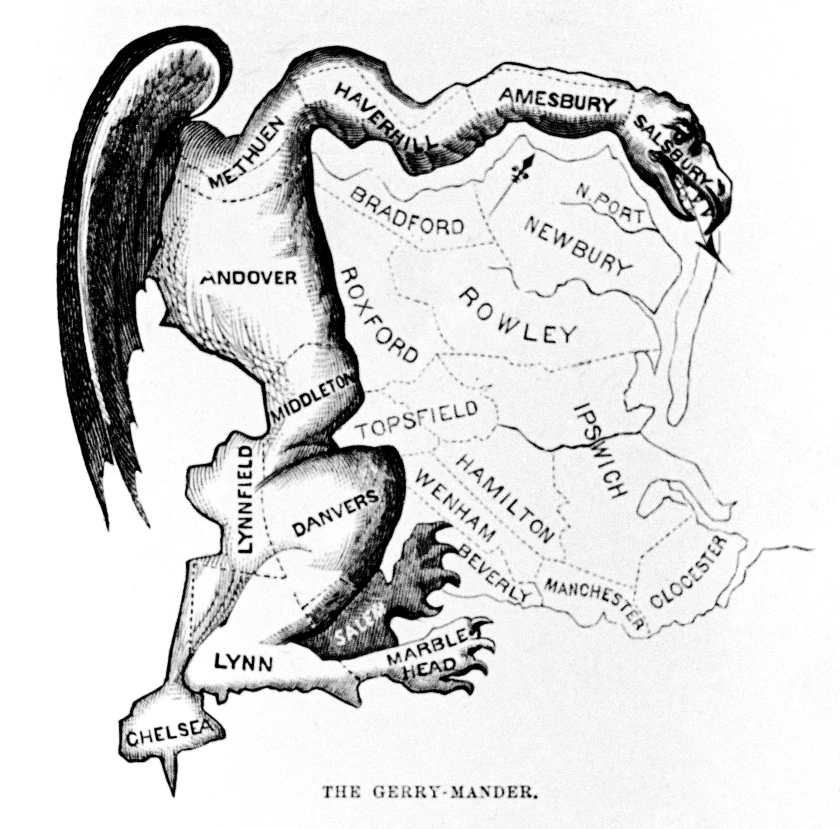
TL;DR -- Gerry was the Governor of Massachusetts. The image associated with the topic is of Essex County. There has been much discussion about the topic. We want to bring awareness to the origins, plus the milieu. For one thing, we are talking post Revolution and during the time of the 1812 conflict. Concerns then are familiar to what we see now. This is a common theme.

---

This topic has been on the table for a few years. Turns out that Massachusetts was the first site of the controversial method being applied. It got its name from the Governor of the time. But, the image that has come down from that time was of Essex County. We got reminded of image through a book review in a recent weekend edition of the WSJ. 

The following links pertain to the subject matter.
    -- South (east and central) Essex County (9 Jan 2011) -- At this time, we were getting acquainted with the layout of Essex County. From a western view, we expect large counties with a few towns. Except, of course, LA with it wide expanse differs. We had learned about Sidney's work. In short, though, little Essex County is interesting from several viewpoints. 

    -- Essex County (3 May 2019) -- Sidney Perley was the chief antiquarian for the County and did a lot of work. This post shows an announcement of his final bit of work. We wrote of this in a post titled "Sidney, his discontinuance." Sidney talked of how hard the work was. He traipsed through Essex County and other areas, researched records, drew up maps, and more. Dr. Frank's sister, Lucie, picked up some of Sidney's work (see TMM, below).  

    -- Sidney's Antiquarian (8 May 2019) -- We had pointed to a site that had Sidney's work available which disappeared. So this post provides links to Hathi Trust's copies. 

    -- TMM (Page), The Massachusetts Magazine (25 May 2015) -- Sidney mentioned this effort by Dr. Frank and friends and noted its relationship with the Old Planters' Society. We had gone through all of the issues and written some summaries. Lots more needs to be done, such as republishing parts of the work. We saw one example done with regard to Judge Thompson (Tenderfoot in Montana). 


    -- Where did the term come from? (Smithsonian, 2017) -- Given the upcoming 250th, we need to learn about Gerry and the times. 

    -- One person, one vote (L.A. Times, review, June 2022) -- This recent book looks at the topic, albeit without much notice about its origins. We, of course, want to preserve information about how all of this came about. The WSJ review provides another viewpoint. 

The Gerry-mander

Remarks: Modified: 07/06/2022

07/06/2022 --  

Thursday, June 6, 2019

Sidney, his discontinuance

Earlier, I wrote of Dr. Frank's effort at The Massachusetts Magazine and his last issue. In looking at the TOCs for all issues that we printed in two issues of The Gardner Annals, one could see that there was less and less content. Too, Dr. Frank, and his sister, Lucie, were providing more and more of the content. However, the Spanish Flu coming into New England would have been a contributing factor.

Now, of late, Sidney Perley's work has been of interest: links to all of the issues of The Salem Antiquarian. It ran from 1897 to 1909. I mentioned that I was going through all of the issues. Sidney had access to records. Too, he was thorough. In the last issue, he covered the Brown families of Essex county. That is an area of research, so I found it interesting. He had started with the A's and got to the B's before his energy ran out (below). Sidney published Dr. Frank's early work. I have one example where Dr. Frank changed his material, yet the original work is there. And, it has been digitized. So, that is another story to tell. Lucie picked up Sidney's work and published it in the TMM. Sidney mentioned the TMM a couple of times in his issues.

But, please, read his little explanation (Notice of discontinuation - pg 210).

As Sidney mentioned, he did ninety-five percent of the work. The guy got older over those thirteen years of publication. His walkabouts were phenomenal, as we have said. And, Gardner Research will be using them. Already, looking at one map opened up a little avenue of unexpected research which resulted in several posts and a stack of things to do.

To facilitate the discussion, we will be putting out a list of things to do. Some will be easy enough like writing a little bit. There may be some technical things for those who are interested.

Incidentally, after he left his hard work at the Antiquarian, Sidney did more writing, including his History of Salem in three volumes (see copy at the University of Virginia - Volume I, Volume II, Volume III). The text is quite extensive in its handling of the witch trial. 

Remarks: Modified: 06/06/2019

06/06/2019 -

Thursday, May 16, 2019

Massey's Cove

As mentioned earlier, we're going through Sidney's "The Essex Antiquarian." This is on-line at the Peabody Institute Library. Remember, Sidney was a friend of Dr. Frank. Besides, we like his idea of a walk-about. Quite frankly, his stuff matches up well with modern views (example: How close is close? II).

So, we are not taking them sequentially. And, I am paying attention to the walk-abouts that Sidney did. As, we learned about Gardner Hill (and Gardner's Bridge) from this work. Sidney sketched a map of Salem and the area as he thought it might look in 1700 from his walk-abouts plus reading the official records. So, these volumes are interesting from the first word to the last.

So, in Vol. VIII (1904), we see the area where we have Massey's Cove and the area that leads to Essex Bridge. In all of these maps, we look for obvious Gardner references. Many times, we find this in the text. But, we saw that a Henry Lunt had his name on a lot. This is a Newbury family that came in 1635. It's a grandson of the original water crosser who received land from his father-in-law.

But, you see Massey's Cove mentioned. On the other side, you see 'The Cove' which is now known as Collins Cove. We'll get back to that. On a search, we see an entry in Streets of Salem about this area. It was supposed by Sidney to be where Conant's little crew landed after their move from Gloucester (Cape Ann). Too, there was a painting (I'm trying to collect these - see Gardner Bridge above). It's theme is the first winter. we just did a post on the first year.

The Hardships and Sacrifice, Massey's Cove, Salem, 1626

In the comments for the Streets of Salem post, there is one mention that this might not be correct. So, we'll have to dig deeper in that controversy. Whatever the situation at Naumkeag, Thomas and Margaret were cozy in Gloucester (house and all). As we mentioned, the first idyllic on the American shores (Cape Ann).

But, getting back to the work of Sidney, one of the lots, it is said, had been in the possession of Thomas Gardner, Jr. It was in the area marked "Old Planters Marsh" which is where they got materials, such as thatch. The ownership went Balch, Balch, Gardner, Higginson.


That reminded us of Thomas, Jr. We have not heard much of him. On looking further (Dr. Frank's 1907 book), we see that he had a wide-ranging bit of land, including some that was above Ipswich River. So, we'll be digging deeper to get a better sense, including looking at all of Thomas' children.

Before today, we had not looked at this area and find it very interesting. Hence, we'll be going back through Sidney's maps and digging a little deeper than before.

Remarks: Modified: 03/07/2026

05/16/2019 -- Put in a comment at Streets of Salem:
            https://streetsofsalem.com/2016/04/06/masseys-cove/#comment-54569.

06/02/2019 - Profile of Sidney on WikiTree.

02/22/2025 -- Changed the image source for Massey's Cove to Historic New England. With respect to the tales of early Salem, recent digitization of records in Sherborne, UK indicate that the children of Thomas and Margaret were born in England, except for Seeth who was born here. See WikiTree for details of the research and discussion. There are now two Thomas Gardner records. 
  • Gardner-159 -- Husband of Margaret Fryer and father of the children and well known to be of Salem MA with descendants described by Dr. Frank. 
  • Gardner-924 (new record) -- Of the Dorchester records. Of unknown origins. He was here, at least, the first year. 
"Are these the same guy?", is one question to answer. Questions need to be raised and answered. See Gardner Research

03/07/2026 -- We are back at it, having spent some time looking at AIn't, buckets'o'bit' and such with respect to technology going wild, perhaps. Our put is that Thomas were here in the beginning. So,we will look at our reasons for such a statement. Too, besides the 400th (Salem, 1626), we will pay attention to the 250th as it goes through the long years of the Revolution. 


Wednesday, October 17, 2018

A new twist

Note: See Remarks, 11/14/18, for a view of the colonial (via Perley) with the modern (via Google). We will now be able to do a "missing tombstone Tuesday" for awhile.

Sidney comes through, again. First of all, he and Dr. Frank worked together. Then, Lucie picked up Sidney's work and published such in The Massachusetts Magazine. So, expect to hear more about Sidney and his work, such as the following.

Of late, I have been trying to assess what happened to the bodies at Gardner Hill. When I first started this work, the general thing was there was a transfer to Harmony Grove Cemetery. That is, everyone was moved nicely. Re-interned, in other words. But, where in the Cemetery? By the Peabody gate? And, one write up says, well, it was only a handful of yards. In fact, there is misinformation everywhere I go to read on this topic.

So, we'll post an improvement once we know a little more.

Well, let's look at Sidney's map (The Essex Antiquarian, Vol VI, No 4, October 1902, pg 149). He shows the burial plot as being north of the Trask one. Too, it is toward Boston/Main. So, according to the scale, we're talking a couple hundred of yards.

Of course, Sidney did this from the ground, given his times. However, he was thorough so I accept his depiction. According to the satellite map of Google, we are talking almost 1,000 feet (well, 300 yards).

However, there is a winkle. Dr. Frank saw notes from Samuel Pickering Gardner where he mentioned his visit to the burial plot in the 1830s, before the road work, and some stones had already been moved and some broken. In other words, graves were already lost in terms of identification. All for commerce. Of course, Samuel P. was upset.

And, Samuel P. said that the seller was William (Harvard grad, so we're talking a secular influence more than mere money - well, it's a debate that continues) who I am researching further (How close is close?). He is a descendant of Samuel (#6 in the book), son of Thomas. Now, Samuel P. is a descendant of George (#3 in the book), who was the brother of Samuel. In this map, the Samuel who owned the plot north of Abel is a son of George. And, Samuel's plot is right above Abel's who was a son of the original Samuel.     

This re-look came about since I heard this year that stones were moved. What? The bodies were cast into the river? Gosh, the fire? Payback? So, we can say, some. How many? Who was there? We need to research this. Where to start? All sorts of questions.

Well, this is more of a story than the witch thing that is so popular, somewhat. We have culture (Harvard and not), history (the rush to do shoes, etc.), and technology. I'm trying to envision how Gardner Hill was leveled. Too, what was the elevation change? All of this can be answered one way or another.

However, Sidney saves the day. He mentions that some bodies were moved to Trask's plot. That makes a whole lot of sense. So, thank you, Trask family. Their plot was closer, actually, than Harmony Grove. It wasn't commercial (don't worry, I have been gathering the history of the place, before, after and so forth).


So, we now have three classes of people: those whose remains were moved to Harmony Grove, those whose remains went to Trask's plot, and those whose remains were lost due to the stones being removed to allow for industrial expansion. Then, we can talk the different classes of stones. Not many survived. Two trophy stones stand in Harmony Grove (placating the conscience?). We may not be able to identify all who were put into Gardner's burial ground, but we ought to make an effort. Now of those were moved to Trask, did the stones go with them? Of course, many may not have had stones.

At least, we need to get the verbiage in an improved state in order to tell the story a little better.

Of course, the seller did not get the buyer to honor the 'in perpetuity' that was supposedly left behind. Ah, lots of other angles to look at, too.

Remarks: Modified: 06/02/2019

11/14/2018 -- Finally, getting somewhere. Pushed this image up to the New England Family and Genealogy group on Facebook with comments. Too, it shows the deal. In essence? Stones were moved in the 1820s and 1830s and piled. Hence, graves location were lost. One of these was that of Thomas Gardner. We want an inventory of the others. How to do this?
#3 was the burial plot on the side of Gardner's Hill (#4). #2 is Trask's plot to which some bodies were moved in the 1840s. Some graves may have been moved to #6 which is across the river. However, stones were moved as #6 claims. The real issue is that re-internment has become the assumption. Not, people. We need to weed this out. The irony? The current #4 spot is the site of The Holy Ghost Society which was built by Portuguese immigrants.

12/06/2018 -- The Richard III Society reported that a 500 year old body had been found in the Thames. Its skeleton was still there. Too, a pair of boots indicated something of the person's life. Now, the burials at Gardner's plot were from the latter part of the 1600s to the early part of the 1800s. The trashing of the graves was due to commercial interest. Too, the plot was sold by someone in the immediate family, as in a descendant of Abel (Samuel, Thomas). Abel was buried there, too. His stone, and that of his wife, was moved. More coming.

12/08/2018 -- Back in October, this post (Gentleman, every man, and much more) was started as a basis for the discussion and research work. In it are early posts which show the naivete of those times having just started this stuff. Never would have thought that this incident would have been allowed to go under the radar. It's being raised as one of the many oversights to correct in the upcoming 400th.

01/04/2019 -- Starting to pull things together for the next issue of Gardner's Beacon which will deal with the grave deal: 29 December 1674.

02/28/2019 -- Gardner's Beacon, Vol. IX, No. 1 gives an overview of what we know after looking at the issue of missing graves. Then, there are more missing graves, we see.

05/16/2019 -- The map that compares Sidney's walk-about with Google is way off. That is because I was looking at landmarks and not paying attention to details, like distance. So, see this update: How close is close ? II. Here is the updated graphics.
Oh yes, we are now honing into the area. 

06/02/2019 - Profile of Sidney on WikiTree.


Monday, October 7, 2019

Gallows Hill

It would be nice if we could resurrect a 'google' map of Salem of old. Of course, that's sheer laziness.

What we can do is appreciate Sidney's work (walkabouts). Too, we can look for paintings that were of the period before the modern. When, I might add, progress caused lots of changes.

One that I am tracking down? The missing graves of Gardner's Hill. The search has involved Sidney's work: How close is close? II As well, there were several paintings of an area upstream that allow some notion of how things were, somewhat, at the time of the elders: Gardner's Bridge.

Of late, we have seen discussion about where the hangings were. Well, Ann's family had a house on Gallows Hill so they know the area. Myself, only 20th and 21st century experience, way after the fact. But, Sidney knew: Gallows and more.

The gist? Somewhere I read that Thomas Gardner liked the place where he was buried since he could sit there and see the water. Mind you, this area was between Gallows Hill and Harmony Grove Cemetery. We'll be mapping this out. I could not get some notion of the elevation. No doubt, there are records at the State level about the work involved with the road adjustment in the 1840s. Too, there was a lawsuit.

But, why pursue this 'dead' horse? Samuel Pickering Gardner who had left Salem for Boston visited the area in the 1830s and was upset by the situation: How close is close? And, it's a family matter as the seller of the property was of the Samuel (son of Thomas) line as is Dr. Frank, Ann, and others. In fact, Samuel owned this land after Thomas died. So, there are lots of reasons. However, a motivational event happened, today (below).

Okay, was reading Streets of Salem: A County in Crisis, 1692. Great post, per usual. On the page was a link to a post about the Salem Heritage Trail. And, that post contained an image of a painting from 1818 by Alvin Fisher. What? First, the image.


From Gallows hill, a view of Salem. Will have to map this out, but it does give some indication of elevation. Gardner's Hill would have been to the left following a 'U' (dimensions to be defined).

Landmarks? Anyone know of some analysis that has been done of this painting? Of course, we'll keep looking for other paintings of this type.

But, in terms of research, yes, there are more questions than answers. So, today there was a 'shot in the arm' type of thing. I feel that I have gotten a run around by those who ought to know, since I first started poking around this issue.

'Where is Thomas?' seems like a reasonable question. Notice that I first asked that question in October of 2010. Never heard an answer that stood up to query. It has taken a while for me to piece things together. And, Sidney was very instructive once I got to know his work.

BTW, Harmony Grove? Yes, I have been there. Dr. Frank's grandmother is buried there.

Aside, Dr. Frank remains are in Greenlawn Cemetery, Salem, MA.

This might be a good place for the good Gardners (and their friends) who are descendants of Thomas to think about having some little memorial to Thomas and Margaret. We can measure how far this is from where Thomas' grave was in the Gardner Burial Plot.

Note: Went looking for maps of Salem. Of course, Sidney's came up. Plus, I found a site that had collected many views: The Mystery of Gallows Hill (references this work - Gallows Hill: Where Were the Witches hung?). The pages have the photo of Sidney at the Crevice and more. Also, in the painting, one can see North River (below) and Ledge Hill (to the left) which is south(east) of where Harmony Grove Cemetery is now. ... All we have to do is figure the dimensions from this in order to place Garner's Hill appropriately.

Reminder: The Trask view. One of their plots is still on Boston Street. It was near the Gardner Burial Plot. Too, History of Mass blog.

Remarks: Modified: 11/10/2019

11/10/2019 -- Changed Dr. Frank's record to read Greenlawn Cemetery rather than Harmony Grove Cemetery. His remains are in the Gardner/Dennett plot established in 1880.


Thursday, May 25, 2017

Lucie following Sidney

Lucie? Dr. Frank's sister, Lucie M. Gardner.

Sidney? Need you ask? Sidney Perley, the long-time editor of the Essex Antiquarian. He published the magazine from 1897 to 1909.

We are working on the next issue of The Gardner Annals. Last time, we looked at the Table of Contents for Volumes I through V of The Massachusetts Magazine (TMM). Also, we featured a bit about R.A. Douglas-Lithgow who provided several articles to Dr. Frank's effort.

This time, we will look at the Table of Contents for Volumes VI through XI. We also will feature a few things from those times.

After that, we will bring out lots of topics, especially those that are apropos to today.

This image is from Vol II. Sidney quit publishing. He mentioned Dr. Frank's periodical. Lucie picked up and published several articles on "Family Genealogies."


Anyone wishing contribute an article, please contact us at jmswtlk@tgsoc.org. 

What I have seen by looking thoroughly at Volumes I through V is that the initial thrust with many authors settles into a few authors providing the material (while working like mad). Several factors went into the demise of TMM. One had to do with the age of the authors. Then, WWI came along. We will show a graphic from a survey done in 1914.

Remarks: Modified: 10/28/2019 

06/14/2017 -- Sidney last published Oct 1909. The next issue of The Massachusetts Magazine had the first continuation by Lucie.

06/02/2019 -- Profile of Sidney on WikiTree.

10/28/2019 -- Mentioned Lucie in a comment at this post: Seeking refuge in the valley.

Wednesday, August 15, 2018

How close is close?

In the last post, we summarized several queries concerning the current state of Thomas (The remains of Thomas). What does state mean? Well, the norm would be for the remains to be in the ground under the stone. If they are not, usually there is some explanation.

The following is the start of some sleuthing that is needed to establish the 'state' of many others, not just Thomas Gardner (planter).

Modern (left), earlier (right)
Where is Thomas? III
1. In his earlier book, Dr. Frank (1907) wrote that court records indicated that Gardner Hill was around Main and Grove in Salem (lower red line, image). That means, too, the old burial ground. In other places, I have seen arguments that Harmony Grove touches where the Gardner plot was. Well, we will see. One opinion talked about a few yards of movement from the old plot to the corner where stones were thrown. Well, how few might few be? Of note, we have to consider the North River.

Then, Dr. Frank (1933) wrote that Samuel Pickering Gardner, ancestor of the John Lowell Gardners, had visited the place (1830s?) and noted that Samuel had written his observations which Dr. Frank got to read. The place was being used for tanning operations which caused some stones to have already been thrown aside, including that of Thomas, the planter. In this image, I rotated the old and the new views to almost agree. The markings map to a few landmarks. Notice that this has the hill on the other side of the river from Harmony Grove Cemetery. That is, looking up river, to the left. So, we do have to consider the river. Too, we have to look at Trask's property and burial site as it is germane to the topics to discuss.

Perley's view
Nutfield Genealogy
2. So, I have been poking around. We can start with Perley's map that shows Salem in 1700 based upon Sidney's study of the documents (Sidney Perley 1858-1928). Also, we are talking about Frank A. Gardner, MD (1861-1938). So, these two are cohorts. When Sidney got ill, Lucie, Dr. Frank's sister, picked up his work (Lucie following Sidney). Lucie and Dr. Frank published a whole lot of material in this regard in The Massachusetts Magazine.

The image comes from the Nutfield Genealogy post on Trask (see prior paragraph for link). Notice that Gardner's Hill is next to the Trask cemetery. That is, on the same side of the river. Note, too, the bulging of the river at that point.

3. Now, if we jump ahead to a view that is later, we can see Harmony Grove on the other side of the river which has been reconfigured. If you follow the history of the river, it has been encroached upon, and polluted, to support industry. And, tanning of leather for shoes turned out to be a huge deal (for a while). Samuel, above, saw the beginning of this. In the below image, I put a red circle about where Trask's (South) burying place was. Notice the difference in the shape of the river?

Trask, now and then

All of this is preliminary to a greater study that we will do. What happened to the bones of the 150 or so souls who were buried? It is a subject worth digging into (no pun). And, Gardners have to do this work with help.

4. Finally, let me show what a little sleuthing does. We need to do a lot more. I found a map at a Brit source that was with an article on glass making in the colonies, namely in Salem: Glass blower at Salem. The article is not very old; the map seems to be of the time (however, I do not know its provenance - if it was done in 1985, then that's worse than what Sidney (who was quite thorough) did a hundred years ago).

Salem, 1692? 
There is a lot more to learn. However, we intend to push to get this settled in the sense of the most reasonable answer that we can do given what we can gather as data. There are 150 souls, perhaps, looking from some type of recognition.

We ought to, as well, get a list of the names of those buried at Gardner's Hills.

Remarks: Modified: 05/16/2019

08/16/2018 -- Added a virtual cemetery to findagrave: Gardner's Hill. With this, we can have people put memorials for those who were known to have been buried at Gardner's Hill and, at the same time, reference where they or their stones were moved. MHC Report: some hills approached 200 feet.

08/17/2018 -- Gardner's Hill on findagrave is now Gardner's Hill Burial Ground (Defunct). It points to Harmony Grove Cemetery with a few words. Also, the rule is there will be no memorials connected to this. So, we'll need to figure out another method to have a virtual view of who was buried there. For starters, we can start with a page here on this blog and improve as we go. Gardner's Hill was in the same family through seven generations. It was sold at the eighth generation. We'll be writing more about this. However, it's a gain, as when one looks at cemeteries in Salem, MA, they will see Gardner's Hill.

11/13/2018 -- With a new twist, as bodies and stones were also moved to the Trask site. Add in Sidney Perley's map of Gardner Hill.

01/04/2019 -- This topic will be followed more regularly this year (344th of 29 December 1674). We will initiate a discussion on WikiTree (see link in sidebar) in support of the research.

02/28/2019 -- Gardner's Beacon, Vol. IX, No. 1 gives an overview of what we know after looking at the issue of missing graves. Then, there are more missing graves, we see.

05/16/2019 -- The map that compares Sidney's walk-about with Google is way off. That is because I was looking at landmarks and not paying attention to details, like distance. So, see this update: How close is close ? II. Here is the updated graphics.
Oh yes, we are now honing into the area. 

Thursday, June 8, 2017

Sidney at his best

Perley, of course. While working on the next issue of The Gardner Annals, I am looking at The Massachusetts Magazine, The Essex Antiquarian, and others. Too, we are looking at how Lucie M. Gardner picked up Sidney's work.

But, this little article on chimney sweeping got my attention. That, folks, was England and New England.

Please read the article. No need to say anything more.

Remarks: Modified: 06/02/2019 

06/14/2017 -- Sidney's periodical is available for ready at Hathi Trust: The Essex antiquarian : an illustrated ... magazine devoted to the biography, genealogy, history and antiquities of Essex County, Massachusetts.

Sidney last published Oct 1909. The next issue of The Massachusetts Magazine had the first continuation by Lucie.

06/02/2019 - Profile of Sidney on WikiTree.

Friday, May 3, 2019

Essex county

This is our focus county for several reasons. It's nice that GenWeb has some information related to our focus. And, their resource page has the whole series of Sidney Perley's The Essex Antiquarian. Following is Sidney's review of the first issue of The Massachusetts Magazine.

A couple of items about Sidney. He quit publish in 1909 which is one year after Dr. Frank started the TMM. Lucie, sister of Dr. Frank, picked up Sidney's work and published in the TMM which published until 1918. 

Remarks: Modified: 06/02/2019

06/02/2019 - Profile of Sidney on WikiTree.

Thursday, August 15, 2019

Streets of Salem

This is a blog that has very interesting posts as Donna, the blogger, does walk-abouts as did our friend, Sidney Perley. I have commented a couple of times of late: Massey's Cove and Tale of Benjamin West, the Patriot. The first post came about by seeing the Cove on one of Sidney's maps. Conant and crew spent their first winter in that location (1626). The second post related to a veteran of Bunker Hill who was overlooked. Turns out that Benjamin West was the only casualty from Salem.

Of late, there was this post: Cemetery under Siege. Of course, that called for bringing some attention to the experience of Gardner's burial plot. We covered that in several posts, with the first one from 2010; this deals with the question: Where is Thomas?

This is the text of the comment (unaltered).
    It isn’t as if a cemetery or two has not already been destroyed in little Essex County of Massachusetts. At last count, there were over 200 graves that would need attention.

    Start to read about it here: https://thomasgardnerofsalem.blogspot.com/2019/02/another-twist.html. I point to a report by a Trask researcher about Lynn’s movement of stones, leaving the remains. But, have, since, found other references to this sort of thing.

    Before discovering that little jewel of news about disappear cemeteries, and after much reading and talking to people, it became evident to me that we had this very thing in Salem. In short, the Gardner burial plot, which was near the current Trask one, was disturbed. It was violated in the interest of commerce which is not unlike now with the witch mania (every fall). At first, this news was troublesome, I took a long while before accepting the fact. But, I heard from people about missing bodies. Also, I went deeper into Sidney’s (need I mention his last name, Perley’s) work. Later I saw that he mentioned that some bodies had been moved to the Trask plot. https://thomasgardnerofsalem.blogspot.com/2018/10/new-twist.html

    Lots of research pending.

    Some graves had already been destroyed in the Gardner plot when Simon Pickering Gardner visited the site in the 1830s (stones thrown about). I have tracked down who sold the land, etc. This is a story waiting to be told. The property had been in the Gardner family since Thomas’ time.

    But, about October’s cah’ching of the registers due to visitors and tramplers of graves. Right near where the Gardner plot had been (according to Sidney, again), we now have the Holy Ghost Center. To me, how appropriate it would be for Salem to mark that area and direct some attention that way. Say, before getting in revelries, consider that some of this stuff is real.

    Some have argued this, well, Harmony Grove is where this site was. These two (HGC and Gardner’s plot) were on different sides of the brook/river (Gardner/Proctor/North, what have you) that disappeared, evidently filled in with the bones of our ancestors.

    Much to discuss, especially given the 400th that is pending.
I wrote 'Simon' rather than 'Samuel' for the 1830s visitor. But added in a correcting comment. Again, we're putting together the next issue of The Gardner Annals. Contributions of articles is encouraged.

Remarks: Modified: 08/15/2019

08/15/2019 --


Thursday, December 12, 2019

Houses of Salem

Houses of Salem? There are many. Some have put these into periods. We'll start with what's called 'Period One' and venture around a little. We'll be at this, for a while, so stay tuned.

What precipitated this little journey was an article posted on the Stanford University site. It was titled: The Salem Houses of William "Old Billy" Gray. The author was a descendant who missed a chance to see one of the houses of his ancestors while he was in the area as a student back in the '60s.

And, the principal focus of the article was the area of Essex Street in Salem, near where the PEM is now. Having been following Sidney Perley's work the past couple of years, we have to compare notes with the information that the Stanford author used. Sidney roamed the archives, walked about the area, drew up maps, and left very good records for us to study.

But, first, how did we get to Old Billy? Well, looking a Loyalists was the key. After we looked at Abigail Gardiner, we went looking for other Gardner Loyalists. Abigail had been painted by Copley. Well, we found a good example of Loyalists: Henry and Weld Gardner. Old Billy had dealt with this family. The Grays were in several of the  towns in the area (William Gray of Salem and Samuel Gray of Medford) and were of note (Our First Men). Billy was quite successful as a ship owner and lost business due to the Revolution (see Gardner-Pingree house as an example - this was the following conflict - War of 1812).

The Old Billy article had a map from 1780. Sidney drew one up from records for the time period of 1700. We provide a snap of those maps below. The great thing about Sidney's look is that he tells us what the records say about each of the lots.

Now, this look is cursory as we will be digging deeper. Just as we mentioned that the Gray family was spread around, so too was Downing. Turns out that Emmanuel sold land to John Porter. It's in Danvers and known as the Porter-Bradstreet homestead. This Bradstreet is of a later time (Revolution), so this all pulls together.

John Porter is an ancestor of Dr. Frank. John had two daughters marry sons of William Hathorne. A granddaughter of William married a grandson of Thomas and Margaret. Sarah (Porter) Gardner and her husband were buried near Thomas in the Gardner Burial plot. Harmony Grove has their stone, but it's unclear what happened to the bodies. That was work being done late last year and earlier this year.

As said, we'll dive into this more. This area of little Essex County is just full of stories waiting to be told. Such as? A lonely grave in the west having a remains of a descendant of John and William (as in, Porter and Hathorne, respectively). That is, a cousin of Dr. Frank (and Ann). Too, though, he's a descendant of Alden and has a granddaughter who married someone from the Brewster line (one of his daughters is already in the database of members of MF).

However, seems that those (or some types of) western-moving people get dissed. I'm sorry, but we are facing a situation that needs attention (yes you, Mayflower people and NEHGS). As if, someone has to pay $1000 or so for a genealogist. We did this work (and a whole bunch more) pro-bono.

Let's get intellectual, too: Genealogy and Bayes. This is one of many examples.

As said, everywhere we look, there is something to dive into. So, we have no lack of work to do.

Remarks: Modified: 04/05/2025

12/25/2019 -- Found out about the Lost New England blog, today (Gardner-Pingree House).

04/05/2025 -- Add "OpEd" label. Will explain. 

Sunday, June 2, 2019

Technology as imperative

There are two entries in our Devlog dated yesterday and today that are reminders of a reorg in process. We use that for technical notes along with our technology-focused blog which is moving from WordPress[dot]com to be under the TGSoc[dot]org site. As we do this, we're looking at the main site, too (ThomasGardnerSociety[dot]org). This site started in 2010 under the 'apx' regimen of MicroSoft using their OfficeLive approach which was quite nice. We have documented that move with respect to research and decisions in the context of general technical discussions that pertain to technology and its influences.

TGS site over the years
What the graphic shows is our look over the years as we have improved upon a minimal basis. That is, we did not buy into any of the commercial thrusts. Why? Many reasons. Too, we have watched the state of the art with respect to the Open Source efforts. You know what? We avoided that, to date, but are seeing signs that are encouraging.

What? Say, old, experienced eye versus the over-enthusiasm of the youth. Turns out, my contrary way has not been solitary. I watched a video of a meeting at Google which got my old heart palpitating. The message was right on. Or as I just heard a FBI guy say, two days ago, the more complex something is the more it is prone to being misused. We all know that.

In any case, we have requirements that need to be brought together. The original focus was to cover 100 years of research which is since the time of Dr. Frank. And, to look closely at his and his peers efforts in the entirety. Modern means involve the computer (now? augmentation - we were doing that two and more decades ago). There have been enough mis-starts for us to learn. Too, we can show how to address issues and make steady progress, albeit at times things might seem like they are more in disarray than is actually the case.

Who walks into a newly framed house and sees what the end product will look like? Well, we have the modern gal now (Waco) who shows simulation. Not possible without the computer.

So, we are dealing with more than genealogy. History will be redone with newer looks using all sorts of media. In terms of family trees, it was nice to see 'wiki' applied (WikiTree). But, the NEHGS now has their own method which we will be trying and writing about.

Lots to do. Any help would be appreciated.

---

Note: With regard to technology, I went looking for material on the ancestry of Sidney Perley (Sidney's AntiquarianHow close is close? IILucie following SidneyEssex County, South (east and central) Essex County, and more). There was a little on rootsweb (at ancestry). However, WikiTree has a Profile on him. He has colonial New England roots. So, that link represents two types of technology that will be in focus. The first deals with presentation which was print for a long time. Various types of on-line presentation methods have evolved with new ones all of the time. I was pleased to see a good one re-emerge after a little absence. The second technology focus will be genealogy and its related history. We have used WikiTree enough to be impressed by its power and the ease with which an expert can work. One can get out of the mouse or touch mode, for instance. But, other technologies? Well, consider genetics. However, we will see more, perhaps, those dealing with the likes of paleoichnology (see note  07/15/2015) will come to fore sooner than we might expect. In any case, our intent right now is to demonstrate a minimal basis with a few extensions of note. Then, we'll be prepared to talk the future in a mode that is necessary. BTW, the NEHGS now has a tree tool, ancesTREES.

Remarks: Modified: 06/30/2019

06/02/2019 - Profile of Sidney on WikiTree.


06/02/2019 -- Current location of the new site (Technology blog). Formatting is not final. Too, we need to update pointers to the old site (at WordPress[dot]com). One benefit will be no ads. We will need to do tuning and other technical admin work while we try to determine requirements and performance specs.

06/30/2019 -- While looking at the Pageant of Salem from 100 years ago, I was noticing the names and went to search. Of course, WikiTree came up. And, there was a pointer to some material being hosted by TNG which looked interesting. Here is one example (Kloosterman), which keeps a blog dealing with their effort.

Thursday, November 21, 2013

Where was he and is he?

One never knows what one will run across while browsing, and reading, at the NEHGS, or any like, site. I just ran across a map (The Essex Antiquarian - available via Google, pg 149) showing land owned by two cousins, Samuel Gardner and Abel Gardner, while looking at material for an entirely different search. The article was by Sidney Perley who was writing about Salem in 1700. Of course, Sidney is writing in 1900 or so, about 200 years after the fact.

---

We, earlier, had looked at a couple of topics: Where is Thomas? and Where was Thomas? In answer to the first, we can say that he's interned somewhere near the Peabody boarder in the Harmony Grove cemetery. In answer to the second, we'll have to say it depends. But, we know that he spent some time in the area near where the Essex Institute is now.

---

Lower part of Peabody,
Google (left), Perley (right)
The image shows a Perley map and a Google map side by side (somewhat oriented the same). I have marked three places on the maps for reference (Mill Pond, Burial Place, Gardner's Hill). It is about 3 miles (crow distance) from the Gardner's Hill to Mill Pond.

The Perley map is quite nice and would overlay very well if I could get a precise rotation (too, there have been a lot of changes in 100 years). Perley's writeup is based upon records and is the 9th in a series that ought to be part of the bibliography (right now, the only Perley document that we have sourced is based at The University of Virginia).

Both Samuel and Abel are grandsons (as such, they were first cousins) of Thomas and Margaret. Samuel is George's son. Abel is Samuel's son. Abel, and his wife, Sarah Porter, were buried near Thomas and were moved. The part owned by Abel had been owned by Thomas, originally.

Remarks:      Modified: 05/16/2019

03/28/2014 -- See Vol. IV, No. 1 for a discussion of the movement from Cape Ann to Salem.

03/12/2015 -- Dr. Frank's 1933 book (pg. 22) does not mention the move.

08/17/2015 -- Response to Wikipedia change that questions the move(?).

11/13/2018 -- With a new twist, as bodies and stones were also moved to the Trask site. Add in Sidney Perley's map of Gardner Hill.

05/16/2019 -- The map that compares Sidney's walk-about with Google is way off. That is because I was looking at landmarks and not paying attention to details, like distance. So, see this update: How close is close ? II. Here is the updated graphics.
Oh yes, we are now honing into the area. 
Friday, April 10, 2020

Themes

Two themes pop out for this post. We are in a different time. A pandemic rages for the first time in 100 year. The last one was the Spanish Flu. We relate that to the end of the publishing of the Massachusetts Magazine. Probably, we could use associate and have things to discuss. The current mode of stay-home (social distancing) is meant to flatten the curve.

We mentioned the 'father of battlefield medicine' a little earlier. Post Gettysburg, he had a tent-city hospital put into place. We have seen that in NYC with both empty structures (to wit, the houses commandeered in the U.S. Civil War) being converted (one contributor of expertise was the U.S. Army Corps of Engineers) as well as tents being raised (Central Park).

So, a new reality, lots say. One new trend is the digital/virtual; that is, almost universal work from home taking place. Except, again, those who deal with the real issues do not have this choice. And, the techies can learn that 'robotics' will not replace need for human qualities, of which compassion is not the most desired. TLC in the context of doing things right is the huge factor that got ignored in the supposed progress of the past decade and one-half.

So, that's one theme. Another deals with the TGS, Inc. and the future. Research has been a key focus with lots of accomplishments (which are found discussed in these posts - see Timelines which will be extended). As we see with 2020, the Mayflower's arrival is (will be) celebrated, though the state of affairs with respect to a virus has had an impact. There is a long list of pending task related to our interest. As seen by Sidney, there is an absence of support and assistance, somewhat like we're seeing with the onslaught of demands upon the front-line medical folks. With regard to Sidney, he stopped the Essex Antiquarian work which was picked up by Lucie (sister of Dr. Frank). Then, Sidney went on to write the History of Salem.

BTW, the chapters on the witch hunt can be found at the University of Virginia. Mentioning this as someone expressed surprise on FB. Oh yes, FB. An example of the past decade and one-half that needs attention and will get it. But, it is an example of the new way mentioned above. Lots and lots of characteristics of the life of the early New Englanders have some applicability to this type of discussion. As in, the American experiment is not just related to the latest in-flow of those in need. Lots to discuss.

Too, though, history will be rewritten, many ways. We have seen glimmers of this. And, the U.S. and its experiences are a key item, starting from 400+ years ago and going back and forth in time. There are many technological approaches that will apply, some of which we have not seen due to improper foci by the parties involved. Oh yes, we have posts on that.

The past few months, we have had several posts here. This is the first for April, so that raised the question. How many posts have there been per month? Well, it might be better to look at the spread which goes from a min of 1 to a max of 12.  Those '1' months happened much more than we would want. The '12' months were from last year. So, the average varies by year. One thing brought by technology is the numeric overlay, but it can be carried too far (see above mention of the human element's forte - it's not number theory).

Remarks: Modified: 05/07/2020

05/07/2020 -- Added image for scroll at portal.

Thursday, June 1, 2017

The Old Planters Society

Thomas Wentworth Higginson was the first President of The Old Planters Society (TOPS) that instituted in 1899. Frank A. Gardner, M.D. was Vice-President. The members list consists of illustrious descendants of the early colonists (see below).

The following documents are found at archive.org.
In the pamphlet, published June 19, 1900, there is an overview of the society (page 11) and its motivations. We have seen this mentioned elsewhere, but one purpose was educational. And, one focus was to get those here before 1630 included in historical looks, excluding the "Mayflower people." 

The Thomas Gardner Society, Inc. agrees with this view and will carry this forward using The Gardner Annals. The issue for Vol. IV, No. 1 is in preparation.  


In that same section, we find the reading list of the Society. These are on our bibliography, but we will be looking at them again. 


Finally, the pamphlet starts out with a talk by Col. Higginson. It was titled "The Alliance between Pilgrim and Puritan in Massachusetts." The TOPS published many talks which we will document. 

Of note, briefly, though, is that in 1900, Col. Higginson was 77 years of age. Many other members were elderly.

Dr. Frank and his sister were much younger. Too, later, Lucie M. Gardner was Secretary of the TOPS. TOPS published via The Massachusetts Magazine (started printing in 1908) while it was published. Lucie edited a section that was titled "Pilgrims and Planters" that reported on meetings of the TOPS, offered commentary, and gave notice of the activity of other organizations, such as the Balch Family Association and The Gardner Family Association. The TMM ceased publishing in 1918. 

--

Earlier, we wrote of this group in a post (December 2012): Old Planters, Massachusetts. A corresponding post covered another group (May 2011): Old Planters, Beverly.  

Remarks: Modified: 11/20/2019 

06/14/2017 -- Thomas Wentworth Higginson and Bleeding Kansas. The Massachusetts Magazine (Vol. II, No. 2, pg 117)  reported that it was an official arm of the Old Planters Society.


06/04/2019 -- Sidney on the Old Planters Society via The Massachusetts Magazine

11/20/2019 -- Sidney on the Old Planters in his History of Salem (page 60).  Starting at page 68, Sidney publishes Dr. Frank's look at the early times of the Gardners.


Friday, May 3, 2019

How close is close? II

Last year, a post asked, how close is close? It compared several posts over the years that asked, where is Thomas? As in, his bones.

Well, the graphic in each was way off. So, we will update this today and will follow up with an in-depth look at this particular concern of ours in terms of how the realization came about of what happened over the years plus start a look at Thomas' timeline.

What led to this review was seeing the plate in Dr. Frank's book (1907). He mentioned Gardner's bridge being visible. And, it turns out that the  plate was in the area of Main and Central in Peabody. Fortunately, there had been two paintings (1826/28 and 1848) of the area that helped fill in some notion of dimension.

We're looking at a small area. The South Church was attended by the Gardners (Dr. Frank's and Ann's ggps). Thomas owned a lot of this land when he died; he had it by grant, or he had purchased lots, or he had quietly homestead'd in the context of the time since the land that he acquired this way adjoined his.

At the moment, I'm perusing Sidney's antiquarian periodical for all maps and text that will be pertinent to writing the proper story.

Remarks: Modified: 06/02/2019

05/16/2019 -- Lots going on that can get in the way, but we persist. The first of many posts: Massey's Cove. This came about by seeing Henry Lunt mentioned on one of Sidney's maps in an area downstream along North River.

06/02/2019 - Profile of Sidney on WikiTree.

Thursday, September 26, 2019

Gallows and more

There's a lot that we can learn about Salem, yet. Recently, we had a day pass on which, in 1692, several persons were 'hung' by the  neck. Now, why is this of interest to us? Several reasons. This happened in the town of Thomas and friends. So, there is a lot of stuff to look at that can be personal and not.

In terms of the personal, Dr. Frank had two ancestors in that group. We looked at that with our study of his paternal grandmother, Lucy Foster Wilson. Also, Sidney Perley, friend of the family, figured out where the hanging site was. Sidney is now be documented on WikiTree; there is a photo of him at the hanging site. Of late, academic researchers confirmed his findings. So, Sidney, in his walkabouts, was quite astute in getting the facts straight.

The New England Historical Society posted an update, on FB, on their story about the places: Six Places Where A Gallows Once Stood. Of course, one of these was the Salem point of departure.

We looked at the closure of Charter Street Cemetery this year during the Halloween period. That is right next to the memorial for those executed during the Witch Trials in the Salem area.

Next year, we want to remember September 22. There are other dates to add to the list, too, such as December 29. We can add these to the scrolling text of our portal to truth. Many families lived in houses on Gallows Hill. The history of that area can be studied.

Remarks: Modified: 09/30/2019

09/26/2019 --