Showing posts sorted by relevance for query quora. Sort by date Show all posts

Friday, February 21, 2025

U.S., 1820

TL;DR -- New France has always been on the mind from school days. Later, we found that the officer corps of the generation (5th) that drove the Revolution had been trained by the English Crown during the French & Indian affair. The Revolution is coming up for commeration of its 250th. For the 400th, northern New England started these in 2020. Coming up will be Salem MA - 2026. Some of our themes will continue to be rivers, carving the interior, and more. 

--

During the Covid times, we had time to do a lot of research, some of it related to families who came into (or passed through) the middle part of the country after the Lewis & Clark trip and report plus there was study of simultaneous activities in other than the New England part of the country. Mountain men, like Jedediah Strong Smith, were exploring. He went west through St. Louis which became a hub of activity. Jediediah got through the Mojave Desert and arrived in the Los Angeles area where the Spaniards took notice. After that he went up to northern California and was headed back to New England when he met his demise in the area now known as Kansas. 

See these posts as examples: State Missouri, 1821; U.S. Interior; and New Spain. There are posts covering later times before and after the Civil War: St Louis MO to San Francisco CA; Trapper, trader, rancher; and Old L.A. and the U.S. Our focus is across the board and 400 years: Boone, himself; Two different times; and, even, Josiah Willard Gibbs. That last one deals with serious early reserach in thermodynamics that got the attention of Maxwell, Planck and countless others. 

----

We have followed a Space in Quora that deals with Spain, including people and events related to New Spain's ventures on the American continents. And, we have a particular interest in California with family involved with New England's long reach across the interior. Too, the writer of the post lived (and worked, studied) in CA, including dwelling on the Bunker Hill area of DTLA for a while.  

Today, we saw this map in a post on Quora (next section) which got our attention. The Adams-Onis Treaty was signed under the adminstration of John Quincy Adams (kin - see Mary Gardner Boylston) and represents the increase in activity that followed the Revolution which is coming up this year for recognition. 

Frankly, we like the map as it represents one of the views of the time. Also, we already have noted that New Spain (see New Spain span) has not gotten the attention that we saw with New France. So, we will be paying more attention, starting with the left coast side of things. 

--- post in Quora Space -- 

In the post, which is an answer to a Quora question (Who founded Los Angeles and in what year did California become a state?), there are interesting historic details including photos. The Quora Space has been a good resource. Our post is to recognize its importance. 

---

And, we have two views to balance: the 250th - Lexington/Concord imminent; the 400th - Salem is next year - 1626 - Massey's Cove. 

We would like to point to more information on New Spain in those same times. 

---

We will get back to this topic after more review of those early years of the U.S. For completion, we cannot ignore the great state of Texas (Juneteenth; Pre-Civil War, San Antonio TX to San Diego CA). This map is from a couple of decades later which is pre-Civil war. 

U.S. Territorial Acquisitions

Other topics will include the U.S. Interior and Carving the land. 

Remarks: Modified: 02/21/2025

02/21/2025 -- 

Tuesday, January 4, 2022

Challenges of technology

TL;DR -- We have looked at the 400 years. At the 150th timeframe, we split. And, now are at a 250th stop and review time. We have been doing that. Rivers were (and are) important. There are other resources. Somehow, the American dream has become, arrive and start to take. Oh, the older families did? Not really. We can show thousands of families whose contribution has been similar. Oh yes, there have been those who exploited, mainly. Now, technology? Will it help get sustainable versus just add to the inequities? That might be one of the challenges. 

--

Quora got our attention in that their approach does approximate scholarship, somewhat. Wikipedia is an encyclopedia, thereby has a constrained view. There are other sites that allow free flowing discussions. The genealogy sites are an example. 

Quora has had many threads on technology include artificial intelligence. Here is an example question that generated lots of viewpoints: 

Why is that with modern technology the US has not diverted surplus water from the Mississippi River to drought devasted California and other western states as was done through Aqueducts by the Romans thousands of years ago?

Most questions are not this long. And, there have been other questions of a similar nature. What got our attention was this map. We have shown many maps the past few years, but this one is related to views that can be formed using modern technology. 

Answer by E. Allwell

Another thing about Quora is its contributors. Erik Painter, native Californian, is an example and has good response to this question to which we provide a link. 

This question, as of today, had 44 answers. Some are quite brief. The two referenced here are thorough and not short. Another thing of the new media is the huge potential readership which can increase the number of views to an answer. Those add up: E. Allwell has over 25M views; Eric Painter has nearly 14M. 

An issue is, how good is an answer? We can assess that partly by looking at other answers by the person. But, the subject matters covered run the gamut. And, this is a phenomenon that goes across the web. We can look at the growth just like we looked at the coverage of the railroad over the interior of the U.S. 

There are automated means that read, parse, and present summaries. This related to AI or other means for handling text. It's never-ending in the sense that we have not seen a quiescence point ever. Not that such could not happen as we saw with airline traffic into the U.S. after 9/11 or even some of the recent flight issues related to decisions about the pandemic. 

Given the growing scope, there must be efforts put toward curating information. And, for the TGS, Inc., our interests cover more than genealogy. Too, the historic connections have been known for some time, hence we see the New England Historic Genealogical Society. One huge topic is culture and its association. 

Remarks: Modified: 01/04/2022

01/04/2022 --

Sunday, October 22, 2023

History redux

TL;DR - Quora has been mentioned a few times over the past few years. This month, we point to an answer which deals with naming of the tribes of North America. Also, we need to always mention technology. Time to recall the contributions of RA Douglas-Lithgow, MD, LLD. 

---

Earlier this year, we mentioned an intent to get Awareness months on our radar, regularly. This month, we had a holiday which is associated with the populace here prior to the "discovery" of Columbus in 1492 which we all grew up learning about. 

So, we are a little late getting to this. Since 2015, we have spent times on Quora which touts itself as " a place to gain and share knowledge. It's a platform to ask questions and connect with people who contribute unique insights and quality answers." 

In fact, we have posted several answers which link back to blog posts related to the Thomas Gardner Society. Here is an example from five years ago: Thomas Gardner (Cape Ann). As we can see from activity this year, we will be redoing the history with regard to Cape Ann. See the "In summary" post.  

---

Erik Painter is a writer on Quora covering several topics. One of these is about Native American culture. The topic of this post is very much apropos to our interest. 

Erik answered this question: How did the different Native American tribes of North America get their names (i.e. Sioux, Cherokee, Mohawk)?  He mentions several tribes, including Narragansett, Mohawk, and Mohican, who were cohorts of the early New England activity.  

Then, his coverage of the western tribes was quite instructive. There have been several other answers by Erick that we can discuss in the future. 

For now, here is a listing of posts with the topic of Native American in this blog. Expect  more of these as we look to the west coast to provide a focus for the 250 years of expansion of the U.S. 

Prior to that, we will relook at the history of Cape Ann, Essex County and Salem with the intent to update Dr. Frank's two books as well as our own posts (and publications). 

---

On another note, and with regard to technology, this year (or since the Nov. 2022 release of ChatGPT) we have seen how technology is going to be more of a bane than ever. For us, balancing the views by including Native American insights will be a prime aspect of truth engineering. Gloucester, MA showed this with their 400th activites in 2023 (Cape Ann, 1623, crew overwintered). 

---

Finally, let's mention an import who wrote a book on New England names and places: RA Douglas-Lithgow, MD, LLD.

Remarks: Modified: 10/22/2023

10/22/2023 -- 

Tuesday, September 22, 2015

Miscellaneous status

Last year, about this time, we had a diversion to Charles Olson. He was the Gloucester poet. Also, in that same post, we mentioned paleoichnology. These themes concern relating to prior times.

Of late, I ran across Alberto Rios. One (The Who That I Am) of his poems struck several chords. I have attached an image, from Mesa Arts Center.


---

For a couple of months, I have used Quora. It has a question/answer format (see examples). I need to collect those answers related to New England history and other TGS interests. Several times, I have seen answers that were lifted from elsewhere on the web, with no attribution. That type of copying seems to be taken as okay, as if plagiarism is the norm and acceptable.

Yet, one has to think that some type of structure could be built there. Wikipedia has a policy of no original research. Quora does not have that NOR restriction. They do have the neutral tone policy which is not hard to adopt.

Remarks:  Modified: 09/23/2015

09/22/2015 --

Sunday, February 27, 2022

Hearty Canadians

TL;DR -- An oversight became apparent, recently, as we were researching. Quora had a discussion where we saw mention of the York Factory Express which started on the Columbia River, near the Pacific, and ended up at Hudson's Bay. Now, that's a feat. We looked for particulars and have generated some notes for future work which overlaps our interest in the specifics of moving to new areas as well as keeping lines of communication open. We have the diary of a person who did the trek plus well as modern overviews on the subject. 

--

This post lifts to awareness something that has been on the back burner and needs more attention. Our focus early on was New England plus issues related to whence. Then, we had to learn specifics about Massachusetts' early times, in particular Essex County and Cape Ann. Following that, the attention was on the 400 years of generations in a mode that covered the whole of the threads which one might call being interested in the influence of collateral families. Not only have we done this for the major thread, we have worked with dozens of other families. Too, we have noted specifics related to events connected with frames of time, mainly (years ago) 100, 200, 250, 300, and 400. The 250th has to do with the coming lookback at the conflict with the Crown. The closer years deal with the wild west (think, internet) and the frontier which are still with us. Then, the 300th is the time of the witches, after all, we are dealing with  Salem, MA. And, the 400th is right around the corner. 

The past few years have dealt with a variety of subjects that are related where we have seen reference to Canada but tabled a closer look. Now, we can venture down that path as the information is there for scrutiny. From time to time, we run into a topic which overlaps what we have run across. The past year or so, we have traversed the west in the U.S. within the framework of the 200th anniversary of the expansion of the U.S. through the Louisiana property and other deals. We started out looking at early explorers and the whole of the frontier as civilization moved. That included studying rivers as a means to  move as well as a barrier to doing so. And, the whole of the land management concerns a lot of which centered upon activity in St. Louis, MO (Carving the land). We considered various types of transportation. 

The York Factory Express
On a forum for discussions (Quora), we saw a reference to boating from the terminus of the Columbia River (Eric Painter) at the Pacific to the Hudson Bay. What? That would have been a major feat, impossible in the winter except for a small party.  But, the claims were that there were regular treks, enough to be coined as an express (we had our Pony Express). The eastern terminus was the York Factory north of Montreal which was under the auspices of Hudson's Bay Company. 

One could do that up there, similarly to the traffic from New Orleans to Los Angles very early? Got to see that.    

So, let's consider a few pointers to set up a bit of research. We had known that the northern boundaries in the west were settled late. We also have followed the explorers and the trade people and the ranchers across the northern and southern routes of the U.S. We knew of the fluid flow from the north with regard to immigrants. 

This topic allows us to now connect more dots and, also, to study the History of Washington State and related areas. In doing so, we can get a better hold on our Canadian cousins, many of whom had been Loyalists during the conflict with the Crown. Some Patriots were forced down south (Maine Gardners, say Ebenezer, descendant of Samuel). 

These are markers for reminding us of the subject area and pieces of its puzzles. We have the view of a diarist who can tell us of the existential aspects. We have diaries from many of the major historical points. The movie Revenant touched upon this area as does a recent TV series (which we have not watched). A review mentioned names of the characters who were real people from families back east. Or, they were newcomers. We had already started to look north for several reasons. Too, as we look at families in the west, many have families that were in Canada or came through to the U.S. via Canada.

But, the focus will be on those who did the trek, both ways, with a commercial interest. Such determination by people is what drives the progress of civilization, in part. 

And, not chasing technology as some type of panacea under the guise of a utopian dream hood.    

Remarks: Modified 02/27/2022

02/27/2022 -- 

Friday, October 13, 2023

Technology thoughts

TL;DR -- We look at four bits of disparate themes; or it appears to be seemingly so. For one thing, we have to mention SIGGRAPH. If you haven't heard of that, well, it's part of the evolution of the computer. Then, we find ourselves in the "cloud" age which spawned many marvels, such as ChatGPT. On the other hand, engineering is the basis for this progress. We need to lift that to awareness, commonly. Then, technology in action? Let's hear from a Spanish view on the Roanoke venture. 

--

This posts gathers a few items pertaining to our interests and technology. These are widely varied? It seems, but they deal specificially with current methods and means. 

To start the list, we have to mention SIGGRAPH. This is an old meeting. In two months, Sydney will host, again. My first exposures to the meetings was decades ago. It is interesting to see how the focus has gone from graphics to interactive means which pertain to human and machine interfaces among other things. 
  • ACM SIGGRAPH is the sponsoring organization. SIGGRAPH ASIA is doing the 2023 meeting. I like to tell the tale that back in the '80s, AAAI got about 1,000 attendees while, even then, SIGGRAPH pulled in 30, 000. 
  • ACM COMM, this month, had this article: Generative AI as a New Innovation Platform. The author is a Dean at MIT and ought to know better. "generative" has been in use for a long while, including as the pits of the mathematics involved in this round of AI (which, John likes to remind every one about, is mostly AIn't - as the Dean notes, things seems to have gotten out of hand). We have to give the Dean his chops. In October of 2019, he published this: The Cloud as an Innovation Platform for Software Development. Sure enough, we have seen lots of advancements related to the cloud. John's reminder: lots of issues came to fore, as well. 
  • KBE design methodology at undergraduate and graduate levels - This is from 1999 and is important for several reasons. One main reason is that it shows the use of "generative" long ago. Also, one motive is that the likes of ChatGPT (and its cousins which we can go into at any detail necessary) took over the concept of AI in a gradual mode over the past 10 years. "learning" is emphasized, as if this is what a machine (bucket of bits can do). My argument is that we have many examples of people learning and doing it well. Engineers are the best example where STEM comes to fore (the "E" for engineering), albeit these disciplines are examples of applied mathematics in action, therefore right at the forefront. It's ironic that engineers set the stage for xNN/LLM to show its stuff. Now, the common theme seems to have moved toward that approach coming in as oracle (which can be characterized otherwise, too). 
  • Spain and the Roanoke Colony - This article is not a mere aside and appeared recently on Quora. We pay attention to the space that is devoted to discussions of Spain. Quora is one of several examples of modern sites that will continue into the future, hopefully helping maintain sanity. But, New Spain will be a regular theme for discussion which then brings in old Spain. 
Disparate little bit of info, it may seem. Not, "omni" is the looming threat with many manifestations. One of which would be omniscience. The training approach and jargon sure seems to convey that notion to its fullest. Lots to discuss. 

Remarks: Modified: 10/13/2023

10/13/2023 --

Thursday, September 3, 2015

Unique ancestors

As we dig for ancestors, we can think about lots of things, of which numbers (example) is one. How many ancestors do we have and how many can we identify?

We know that intermarriage between families reduces the number since an ancestor will appear in more than one part of the tree. So, how common is that situation? Using Dr. Frank, in one of his ahnentafels, there is no duplication until the immigration time.

These types  of question has been posed many times. And, they have been looked at in various ways. Of interest is a 1978 paper by Kenneth Wachter, titled "Ancestors at the Norman Conquest." This paper has been referenced in a lot of subsequent work. Too, we find statisticians and others weighing in.

I ran across this question on Quora: For most of us, how far back in time do we have to go before we no longer have unique ancestors in every generation? There are several answers. One was given by David Joyce who does genealogy well. I have run across his work several times and considers those who have colonial ancestors.

There was a book in 2002 by Steve Olson, titled "Mapping Human History" (USA Today story) in which he discusses a common ancestor for all of us. We have all heard of Lucy. But, is there one closer in time? Olson claims that around 1,200 years back we could find an ancestor who appears multiple times (as in, 1000s of times) in our tree.

Using the generational count, we could figure that there are a trillion people on the tree. At at time, there were 200 million on Earth. So, we know that each person, if they had children, would appear multiple times. But, many did not have children. Too, many had lines that died out long before we got to the present.

There are many more studies that we could discuss. But, in terms of Thomas, we do not know his ancestors, yet. Our goal is to find out who they are.

---

We are looking to build some knowledge about Thomas using Quora. But, more, we hope to fill in information through this type of crowd sourcing.

Remarks:  Modified: 03/14/2019

09/03/2015 -- David Joyce's site.

09/22/2015 -- A related question: Is-there-anyone-for-whom-all-1-024-of-his-her-10th-generation-ancestors-are-traceable-all-of-them-separate-individuals

03/14/2019 -- Added image so that we can index at our portal to truth.

Saturday, July 11, 2020

American Ancestor database

TL;DR -- Wherein we see that our publications make it into the NEHGS database.  

---

We will be getting back to our bibliography and other collections in the near future as we work toward defining our 'app' view. There was a query the other day about the motivations for people coming here. We mentioned Albion's seed where the Plymouth, Cape Ann and are Massachusetts efforts were seen as reconnaissance. Nice to be pigeon-holed. But, we have written other posts on this theme: Black death, Origins - motivations, and more.

But, the discussion got back to this History of Massachusetts post: The Great Puritan Migration. We like the site; too, we get a local focus which is nice, albeit we do have to broaden the scope as we go forward. That is, of the underlying database which needs to be inclusive. Then, filters would be one of the many options offered to tailor views. Of course, always have some thread back to Thomas Gardner, Cape Ann, and those early times. With we need to add, filler material that follows families all the way to now. We have already started this with The Gardner Annals.

Recently, the American Ancestor's database was updated with TEG vol 34 issues. It was in the Spring of 2014 that we put out our first article in a common framework. That went on for over a year after which we got involved in activities that were associated with the purpose of a wider view. Too, it was then that the Quora facility became more popular, hence we have published many posts there that relate to the themes of our research. Plus, Quora is an interdisciplinary framework upon which are great looks at any of the technological advances that face us while many times being a puzzle. One truth is, 'code' is needed for proper management of truth, or maintenance, in other words.

So, due to the availability of the first three articles, here is a pointer to them within TEG v34 (each link requires one to be logged into NEHGS' site). Next up, we hope would be Vol. 35 with more articles, one on Dr. Frank.


Remarks: Modified: 11/10/2020

07/12/2020 -- Earlier notifications dealt with the articles being indexed within the NEHGR: v34 in 2016, v35 in 2017. 

Saturday, December 16, 2023

Little Exeter NH

TL;DR -- Exeter NH has been on our plate from day one. But, we had lots of Massachusetts material to digest, including that from elsewhere. So, while redoing our site, we thought to venture into the surrounding area. A WSJ article on OpenAI's Board got us started by mentioning Phillips Exeter Academy. That ties together several themes for this year. 

--

In an earlier post, we mentioned that we need to look at New Hampshire more often. We now have additional motivation for that effort. The earlier post was about the Dudley family. But, the State celebrated their 400th this year, through honoring Portsmouth. 

We have touched upon people, such as Rev. Bachiler (who could not abide Winthrop and went north), General Aldophus Greeley (led the Lady Franklin Bay Expedition), Nicholas Gilman, Jr (signer of the United States Constitution). and others. One of the places mentioned was Exeter, NH which town was home to many ancestors found in Ann's tree. 


One of two houses

Today, we saw another name to look at further: John Taylor Gilman. He was born in Exeter; we got to him in a roundabout manner that ties together several themes. We have been seeing references to this site for years but had a Massachusetts focus for obvious reasons. Though, we learned early, that northern and western movemernt started very early on. 

So, how did we get to John? He attended Phillips Exeter Academy which was founded by John Phillips who was descendant of Rev. George Phillips of Watertown, MA. So, we find several tie-ins here with the major theme of the times. Rev. George was on the first Board of Harvard about which we have had several posts. Of his many descendants, one was Bill Gates of Microsoft. 

Finally, how did we get here? We saw in a report in the WSJ that the head of Meta (Facebook) and Quora had been students at Phillips. And, our technology theme pertains specifically to new ways, of which the computational is a major part. The reference we saw was in a WSJ article about a member of the Board of OpenAI.

We have made use of Quora since 2015. With respect to OpenAI, their release last November of their ChatGPT did not get our attention until February of this year. Somehow the hype associated with these things escaped our awareness. But, since then, we have taken a "deep" look at the "generative" movement of the machine learning crowd. 

Let's just say, the jury is out along several axes. We will discuss this further, see: AI not solely ML. But, tying the new back with the old in this regard makes a lot of sense. After all, the focus of AI (however fruited) ought to be people and their freedoms. 

Not some dominance posturing (and following through) that is problematic even when not out of control. But, then, politics? We avoid that. 

 Remarks: Modified: 12/16/2023

12/16/2023 --


Sunday, March 31, 2024

Winter ice cooling Dodge City beer

TL;DR -- We point to an article/answer on Quora dealing with cooling beverages of the alcoholic type in Dodge City, say around the time of Marshal Earp. The article points back to Wisconsin, but ice collection happened all along the northern border in the winter months. The technology of cooling has an interesting history which we will look at in order to get a focus beyond the shenanigans to the computational crowd. 

---

Quora has accumulated a lot of great articles over its  years. These are written as answers to questions. Of late, we are seeing more with pictures from the past. Photos, that is, which we hope are of sufficient provenance to use for research. Right now, this problem is only an idea, for the most part, as fakery has been easy to spot. 

But, it's getting harder. So, we will be addressing that from a technical sense. For now, we will be looking at old photos. We have referenced articles of Erik Painter several times, mostly with respect to the over 100 years of frontier experience that brought the U.S. (us) to today from the start 400+ years ago. The frontier experience exploded post the U.S. Revolution. There are lots of tales to tell about this as we look at the expansion across the interior. On the other side of the matter, Erik Painter has posted well-written articles about Native American culture and the impact on it that the past 200 years has had. 

Today, though, we go to Dodge City, KS. Here is a link to the question and answer: 

Erik showed photos of ice being gathered and shipped. The railroad arrived in the area in the early 1870s. So, shipment would have been regular. Ice could be stored until almost the end of summer under the proper conditions up north. We will look at that further. 

This photo is of a drawing of what an iced railcar delivery adult beverages would have looked like.  


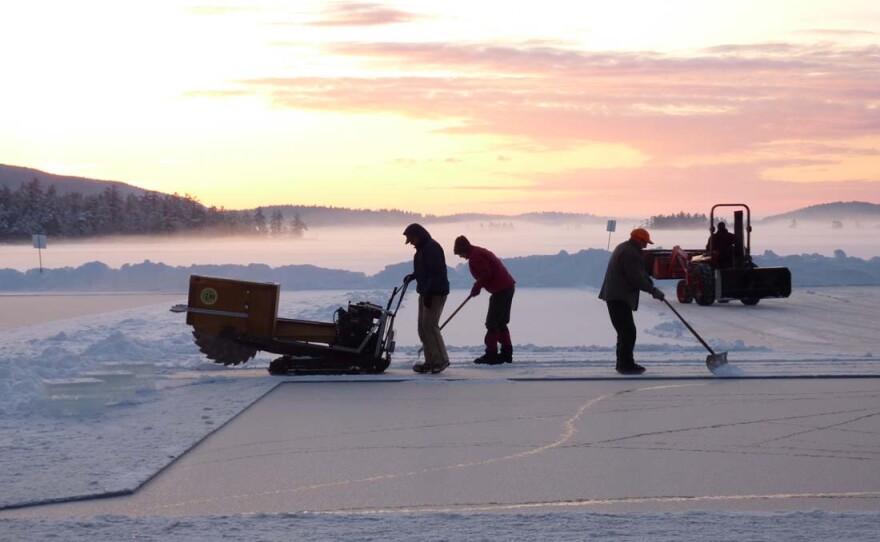
This was a great answer as it pointed to a part of the culture of the early times. A recent article described how some in New Hampshire are trying to keep the "traditon alive" and has photos depicting some of the work and processes. 
Ice Harvesting in
New Hampshire

Switching to a more family-oriented topic, this is actually an issue of technology which is more than the computational flimflam of late. There will be a later post on the history of ice cream in the west as John's family had an early diary in southeast Kansas with an outlet in Oswego, KS in the latter part of the 1800s and early 1900s. As the technology improved, they shipped on the Katy railroad all the way to Kansas City.  

Looking at the history, Washington even had a taste for the sweet and icy stuff. New York had a parlor for this product in the 1770s. But, the interest in cold refreshments go back much further. 

Remarks: Modified: 03/31/2024

03/31/2024 --  

Sunday, December 17, 2023

What do we know?

TL;DR -- So, what happened in 2023? Lots. The world has changed, and it has not. People showed their seemingly limitless capacity to bow to the machine. 

---

This post serves two purposes. For one, it looks at AI (usual sense) over the past year and collects material pertinent to ongoing discussion and work. The first list contains links with some commentary for each of item. This collection points to different periods over the last year. OpenAI made their announcement on 30 Nov 2022. At that time, we had these two posts which pertained to our continuing topics of research which includes technology.

  • Family Search (29 Nov 2022) - we have used this site form the beginning. It represents the efforts of descendants of those who went west. Over the past few years, our focus was on the Interior of the country for several reasons.   
  • Perspective, a necessity (1 Dec 2022) - the post looked at veterans from Ipswich, MA (after the Revolution) who went out to Ohio and created a settlement. The trip was well-documented and even repeated later in the 1900s. At the time, that was Michigan Territory. It was only 40 years later that the Santa Fe Trail was formed out of St. Louis, MO. A mere half-century after that, the railroad allowed easier coast to coast travelling. 

The image shows a copy of the "All time, popular" count by post. The topmost, related to the marriage of Thomas and Margaret, comes from the 2014 timeframe. The next one is 2021 as is the one titled "St Louis MO to San Francisco CA" which has spawned several of posts and discussions. The "San Francisco" post is from 2023. 

So, we will continue this area of research as there is plenty questions that are open. Our FAQ will be updated in 2023 to account for new information. In the post titled "A(rtificial) I(Intelligence) researched properly", we go through our own work over the past decade and make some predictions about the future. Given that this work carries on prior research allows a longer time frame that seems to be normal now. So, we will continue to describe things from the historical viewpoint, both technolically and phenomenonally (which is how we view the U.S.). 

Disclosure: We did not get involved with the xnn/LMM, generative material until after a couple of months had elapsed.  As noted above, our timeframe is much longer than normal; and, we need to slow things down in order to establish a little bit of maturity. All of this will be discussed. 

So, going forward, the second list deals with the major change in 2023. We will also use this to start a summarization of our positions on the subjects. The list follows a sequential timeline and uses posts from this blog and related material. 

  • Introducing ChatGPT (30 Nov 2022) - there is a thorough overview of the motivation and what was being offered. But, access to the OpenAI system was announced. It did not take long for millions of people to sign up. We did see references to this activity on sites like Quora (who offered POE, later; the head of this organization is on the Board of OpenAI - mentioned them, in yesterday's post - Little Exeter NH).
  • ChatGPT (2 Feb 2022) - we heard of the system from a colleague (a linguist) in late Jan and finally got around to doing a query on the 2nd (Groundhog Day). We asked about Thomas Gardner and thought that we were enlightening the thing with a suggestion. In this post, we mentioned that the output did not read correctly. That is a result of the techniques used and can be controlled, somewhat. On the other hand, there is a "omni" and "know-it-all" nuance that is obvious. The New York Times review, How ChatGPT Kicked Off an A.I. Arms Race (3 Feb 2023), looked at some of the issues which were to get increasing attention over the year.  
  • Square one? (19 Mar 2023) - Gloucester MA had kicked off their 400th. We were supporting from a distance without bringing in the crew as that would be a 2024 issue, we thought. Our thought was, too, to emphasize Margaret (Fryer) Gardner's contribution. We had not been paying attention to the feeds from WikiTree, however a researcher in Feb of 2023 went through the load of images from the digitized files of Sherborne, Dorset. In doing so, he discovered birth records for about all of the Gardner children, as having been born in the old country. Seeth was born in Salem. So, the family did come over. Did Thomas come over to support the Cape Ann effort? Rev. Hubbard suggested such. Remember, he talked to the principals. But, one thing noticed a while ago was that the Conant family's book did not mention Gardner. Nor did the Woodbury writeup. This feat of technology is interesting in itself, for various reasons. The current state of affairs? There are two Thomas Gardner profiles on WikiTree. One is our Thomas; the other has no information about him. So, one or two? It's like being back at the questions of two or three wives. We settled that in 2012 using the same records. So, Gardner Research opened the door. In the meantime, we did research on California families (the long reach of New England). 
  • Research notes (2 Apr 2023) - using our new WP site, we summarized the situation and provided a copy of the list of names and births. There is a gap between the birth of John and Samuel which might show Thomas being away. John was born in December. Thomas could have left without knowing that Margaret was with child. Supported conjecturing will be allowed and supported by technology. Note: at some point, let's discuss how an imaginary basis (of several types) supports science.  
  • Technology, computing (May 2023) - after some reading and discussion, I contacted the head of the former Sperry Univac Knowledge Systems Center. He wrote a brief article on how Univac got involved with the effort in the mid-1980s. Lately, one hears more of this, but our contention then and now was that the machine learning solely approach is unbalanced. Hence, we see that the output is not to be taken without some bit of salt (perhaps, a whole lot). But, that is not how it ought to be. Stay tuned. There are several other approaches that can bring maturity. A recent survey points to the diminishing in trust which has been ongoing for a while. But, ChatGPT and its ilk are accelerating the downward slide. Fact? Not there. Fiction? Have at it. Except, one caution (rule) would suggest that "fake" results be tagged as such (analog, truth in advertising). 
  • Intro to Bard (7 Jul 2023) - after some time with ChatGPT and looking at issues all around, we finally tried Bard. That activity was all research including things like evaluating how the generative approach performed with mathematical problems. One thing to note is that Wolfram tied this approach to his mathematics system early one, mostly to have more full interchange with users. We need to see how this work is progressing. But, there is a lot more. Bard, basically, was more palatable as it did not try to be argumentative nor did it spout out just to hear itself speaking, so to speak. The post, To Bard or not, summarized some of the issues. For instance, we ran into a PhD thesis that looked at concepts from Kant (the philosopher) being brought bear during training. A known downfall is that the xNN, as being used, squashed nuance. One cannot expect to retract either input or its influence; definitely, there is a need to honor the requirements for footnotes and other referencing modes. In Dec of 2023, Bard was updated significantly. We tried it, but the issue of more fiction than fact remained. One noted improvement was that Bard now stresses teaming, human and machine (rather the "omni" status mentioned above). That was significiant as it changes the tone of the interchange. 
  •  ChatGPT a year on: 3 ways the AI chatbot has completely changed the world in 12 months (30 Nov 2023) - we don't agree with the list, as a huge result is trust and its diminishing. What to believe? All of these purveyours suggest checking the results give by their system. Oh, we all have time and energy for that? 
  • AI not solely ML (4 Dec 2023) - this is our retort and focus for the future. We need to bring to awareness the knowledge work done in the industrial world. There are many varieties. But, the focus needs to be on humans and their abilities. Enhancements would not be of the machine and its dominance; no, human would obtain an extremely useful tool if this were to be done right.  
So, themes abound. But, what is America about? The dream? Technology can be both a boon and a bane. Why has the latter been more prevalent? We still say AIn't about the emergence of "intelligence" of note. On the other hand, phenomenal mathematical processing has been done by the computer. That could be and ought to be our focus going forward. 

We have a super abacus and slide rule at our disposal now. That is, if only we can understand the need for maturity and the capabilities that it brings. 

Remarks: Modified: 04/04/2025

12/22/2023 -- Dartmouth '99; New Frontier, 21st Century Type. ... THE FUTURE OF AI IN SCIENCE AND MEDICINE, talk at Gairdner Foundation, Oct 25, 2023. 

12/28/2024 -- See updates in GB, XIV, 1 for 2024 updates. 

04/04/2025 -- David T. Gardner has been exercisting Grok with prompts and reports finding documents that support his claim about Wyllym Gardynyr (see King Slayer Court blog). ... We have begun to incorporate changes into the structure and context of the blog. See Restart, somewhat. 

Friday, October 23, 2015

Wikipedia

This is one of several projects (also, Sherborne, Dorset) about which we will have a regular status update.

About a year ago, an issue tag (multiple) was put on the Thomas Gardner (planter) page on Wikipedia. See the Talk page for some discussion of this and for subsequent changes. The image shows the current state of the page.


There will be more editing. For one thing, the text is based upon Dr. Frank's view. Since his time, there has been a lot of research some of which has been covered by this blog. So, another section will be added to bring in the other viewpoints.

Remember, all things need (ought) to be sourced with good citations.

Too, we will be going to other informational sites, such as Quora (related post).

Remarks:  Modified: 10/23/2015

10/23/2015 -- See Talk page on clarification of unreliable references. Wiki doesn't like Higginson published works (which includes Dr Frank's books), family-oriented sites, blogspot, ... So, there is some work to do to find replacements. A lot of Dr Frank's stuff was quoted in Sydney's History of Salem. So, that will work. The others will take a little more effort. C'est la vie.  

Sunday, October 17, 2021

Research markers

TL;DR -- The influence of New England on the U.S. and the world never ceases. We try to cover these as they are found and as we learn how it relates to the families of Cape Ann. We are a mere two months from 2022 which will have Weymouth stepping up to an acknowledgement of its history and the pedigree of its people. 

---

This post pulls together information on three disparate but pertinent topics. They relate to recent work and will be discussed further as we proceed. 

The first two were seen while browsing Facebook which is where we have our expanded index of activity. 

  • Ties to New England - This story appeared in a Cape Code periodical and is about a Harwich resident learning about his heritage. He is 3/4 Chinese but has English ancestors. Among the families are Bradford, Blaisdell, Vassall, and more. He is a member of the new group, Descendants of Cape Code and the Island so we expect to be able to learn more in the context of how families intermingle, in particular with respect to the long reach of New England. 
  • French Baron who almost drove the English from Maine - We already mentioned New Hampshire of late as a focus for research. But, as expected, Maine comes into play. There is a group with the name The First Families of Maine that meets regularly about area and its peoples. As we know, Maine was part of Massachusetts, for a while. A major work looked at the History and Genealogy of New Hampshire and Maine. However, with respect to New France, that is on our topics.  

This next article was seen on Quora. In it, the author looks at AI now and into the future. We have mentioned that thrust as being of importance to our work, as well. 

  • Transdisciplinary artificial intelligence - Putting this here as a placeholder. This brief look is worth a quick read as the summary is good, and the discussion about the future is very much apropos to the times. 
As mentioned before, Weymouth is up for notice in 2022. Then, Essex County and Gloucester follow in 2023. 

Remarks: Modified: 12/11/2021

10/30/2021 -- Added the TL;DR. 

12/11/2021 --  Ties to Harvard. 

Friday, June 23, 2017

Gardner Research citation

Until a few days ago, we thought that we were the only defenders of Nathaniel Eaton. Along that line, we, recently, did a post on Nathaniel Eaton and noted his academic accomplishments which were substantial. Yet, he is vilified via Harvard's view related to tales told. Or, so it seems to go. Too, notice that we remark, in the post, about Dr. Frank's ignoring this subject.

Then, very recently, we were contacted by David Danielson Eaton who is a descendant of Nathaniel and is member of The Eaton Families Association (EFA). This group has been at it since 1884 and so will be of interest. Too, they have a connection with descendants of Theophilus Eaton. He was the brother of Nathaniel. We got an update to Nathaniel's Wikipedia page.

As an aside, as the Gardner Research article (next) was being prepared, the Eaton group was writing about Nathaniel (newsletters for members only). We have a copy of an article published by the EFA in defense of Nathaniel (Barbara Fitzsenry The 'New' Etonian (June 2015) "A Discussion of Nathaniel Eaton's Reputation as Seen by History").

This article was not seen prior to the Gardner Research article about Dr. Frank being a descendant: TGA Vol. II, No. I "Benjamin Brown Gardner (and Nathaniel Eaton)" which was published too in TEG 35:1. In our article, we commented that Nathaniel's experience at Harvard needs another look; there have been many posts alluding to this theme.

In a coming TGA, we will reprint parts of the EFA paper. Too, though, we learned that the Gardner Research article had been referenced in an Eaton article in The American Genealogist (see image).


As an aside, many early writers noted that Anna, the daughter of Benoni who was a son of Nathaniel, died young. But, we referenced the notion of H.H. Crapo and the Knapp family that Anna married and had offspring. Too, we have this excerpt from a New Haven meeting in which Anna's information is corrected in pencil: The family of Nathaniel Eaton (at the Boston Library, available via archive.org).

No doubt, there is a lot to the stories and their provenances. But, it will be good to have Nathaniel get another hearing. Expect this theme to be continued in the near future.

One motivation. This may have been an early witch hunt. Dr. Frank's ancestors can tell us of that. As well, the whole theme applies to today (various ways). To us, it is another example of New England's long reach.

---

Note (01/06/2022 - see Remarks, this day, for the motivation for the addendum) -- We have seen two The Harvard Crimson (thecrimson.com) that were dated 2014 and 2019. We never thought to check further as there were plenty of other fish (gutted?) to fry. Too, we were confirming information about Benoni and lots of other persons of that time and place. Imagine Benoni's life, in Cambridge after his father left first, then his family (who were shipwrecked?). Whatever the tales, the phenomenal aspects are our main interest. But, to be complete, we did a search and found these tales, from the past: 23 September 1940, 5 November 1940, 10 December 1949, 25 September 1979, and 14 February 2007. There are many more links listed by Google to a specific query (the harvard crimson - eaton - pudding - dung); it would be interesting to extend this research (future grant). At least one mentioned the PhD and MD degrees, later extended. There wasn't much on Eaton's Virginia time with a supposed new family. On the other hand, the tale is there. Let's leave this, for now - see Richard Norton Smith's The Harvard Century: The Making of a University to a Nation (1998) and Elizabeth Tucker's Campus Legends: A Handbook (2005) (quote: Goat's dung and mackerel guts rival modern "fast food" legends in the degree of disgust that they inspire. From this account and others, it seems clear that America's first college students enjoyed telling stories that highlighted -- and probably exaggerated -- the most shocking details of their miserable meals at college) which can be previewed. 

Remarks: Modified: 01/06/2022

08/03/2017 -- What is the coolest obscure history fact you know? This question, on Quora, seemed a good place to present some of research findings. Nathaniel's experience is first, since the answer deals with Harvard and its roles. Not to condone bad behavior, however we need to look at this from Nathaniel's side, too. He was highly educated before coming over here. He met up with uncouth youth of the colonies. Now, here is an issue. Do you realize how Captains on ships treated their measly sailors? Not well. One might say torture. Too, slavery has been the norm for mankind for a very long time. Seems to sit well with some cultures, even today, that is, misbehavior there on the part of slavers, of several type. Incidentally, look at how the Puritans handled their misfits. Say, Quakers? The look from now to then, seemingly celebrated each year at the esteemed institution, is (has been) one-sided.

08/09/2017 -- In the School of Tyrannus (2014). Left this comment (Some of the 'apologies' (see latest updates on the Wikipedia page for Nathaniel) may have come from descendants (via Benoni who was left in Cambridge). Over the years, several have researched the matter which, to me (an outsider, and in-law, and johnny-come-lately), does need another look. See thomasgardnerofsalem for an overview.) on the page. There needs to be an engaged discourse.

08/06/2018 -- Added Benoni Eaton, son of Nathaniel Eaton and father of Anna (Eaton) Knapp to WikiTree.

09/27/2018 -- Nathaniel Eaton in the U.S. Christian Encyclopedia.

02/28/2019 -- Corrected a typo.

10/10/2021 -- The Count features in our history of Harvard (a special project dedicated to Nathaniel Eaton). 

01/06/2022 -- Refresh on Eaton (7 Nov 2019), balanced with Dunster (our series on the History of Harvard) who was next. 

Wednesday, July 22, 2020

TL;DR

TL;DR -- we will be offering some bit of abstract with regard to a post's content early on.

---

We first paid attention to this while working on Quora. This is definitely an artifact of types of modern technology but seems to have a purpose for us. By way of background, Wikipedia is our normal first stop.
There are other means to accomplish a similar purpose. For now, we'll just "TL;DR" and hope to get additional attention via merit.

Remarks: Modified: 07/22/2020

07/22/2020 -- 

Sunday, August 20, 2023

Reworks and recaps

TL;DR -- During our thirteen years of working, we have had a few readjustments. We are at that time, again, and will be organizing the posts and their information content. At the same time, we are now into American History fully having been given a shot in the arm by the COVID constraints. At the core and toward the periphery, and everywhere else, we will see technology's influence growing, regulary. Probably, too, that will be more steady; after the pop of this latest bubble related to AIn't. 

---

This post collects together stories that are American at the core.  We will add to this for a while. Then, each of these deserves some further study and comment. 
  • Royal connections --  This comes from the Nutfield Genealogy blog that is about as old as this Thomas Gardner Society, Inc. one. We have been working on applications for D.A.R. for a while which has lead to many stories of historical interest. From this work, we continued exploring our theme "the long reach of New England" in many directions which seems to be endless in scope. This post is about a Spanish Lady (with uncountable titles, almost) who applied for D.A.R. membership through a Scottish connection. 
  • Salton Sea -- This huge affair (see article at Wikipedia) in southern CA is well known by visitors and locals. Is it naturally there? This is an answer that was found on Quora with respect to the subject.  

Our first post was on the 25th of September of 2010. We had started to study the family lineage the prior summer (2009). As the winter was amongst us, we started the Wikipedia page, Thomas Gardner (Planter), on the 10th of January of 2010. BTW, one can use "View history" to see the edits through time in detail with regard to the change and the person doing the change. This page needs to be rewritten (see the post, In summary) as does many of the blog posts. Before the blog, we had started the Thomas Gardner Society, Inc. website (summer of 2010). Our first issue of Gardner's Beacon was in the spring of 2011. Our first redo was in 2012 (movement from Microsoft's cloud). We will have more recaps on all subjects as we go along. 

As we research Sherborne records and modify the story, we will also identify places where we cannot tell the story without some speculative modes. These will be clear. We will watch to see how others might conjecture. The thing with the internet and the process used by most publishers to verify information, we expect that those things published will be in good order. However, on the other hand, anyone with a creative bent is free to write to their heart's content. The future will be fun, even with technology muddying up the water. 

Remarks: Modified: 08/20/2023

08/20/2023 --

Monday, September 9, 2019

Edward III and Boris

I couldn't resist this. Earlier, I did an answer on Quora to this question:
First, note that it says 'related to' not 'descendant from.' So, that is one key. Another is that modern technology allows a little more precision in this type of search. Of course, there are more things to discuss, but let's avoid those this time. The answer allowed me to feature WikiTree using Dr. Frank A. Gardner's lineage to the extent that we know it (we extended this last fall using his notes about his mother's heritage). Later, I was able to see his father's notes in an early copy of the 1907 book (given to Stephen Wilson Gardner by Dr. Frank).

The work, notes, books and such went along with a burst of energy and activity related to genealogy and family history motivated, in part, by the 300th celebration. Now, we have the 400th look-backs either coming up or having already started, such as the Mayflower activity. Due to several factors (location, family ties, and more), the Mayflower descendants have been more scrutinized than many others. Yet, the information is not entirely complete according to one blog post. We will get back to that, take the case of Richard More who will be mentioned in a coming post. We looked at him earlier: seemingly lost, rediscovered, related to the family, etc.

In fact, Richard came up as I was going through notes to find the earliest Mayflower connections with the children of Thomas and Margaret, eight of whom had children. Richard's daughter married the son (Joshua Conant) of Thomas' daughter (Seeth). Further, Richard's sister-in-law married a Woodbury so there are all sorts of relationships to follow through on. Even with technology, those things are tedious and error prone: tired/old eyes, say, or quality of the provenance of the material being used.

Oh for a good database to start with. Well, there are several, hence the Mayflower reference. We can use those as a yardstick for comparison. There is more, as many who came over had known histories. The Mayflower look back is considering their ancestors in this regard. And, their data can be used for studies, such as mentioned in this answer:
There is a chart to a related theme of 'How long is a generation?' The data from the 'fifth generation' from the Mayflower one provides a view that only technology can give us. We need to keep that in mind.

Everyone, for the most part, has Edward III as some focal point, for Americans. Later ties are clearer and less prevalent. Earlier ties are associated with huge amounts of hits. BTW, WikiTree's efforts at their Magna Carta Gateway study are apropos. Lineage path by lineage path, the route from Gateway Ancestor to a Baron is being confirmed, using Richardson's books, for one.

What of the other side of the waters? Well, this recent blog post looks at one person of current interest: Edward to Boris, how many times? The author did the generation length study mentioned above. He references work by both Douglas Richardson (mentioned above) and Gary Roberts.

Relevance? This same type of work and technology needs to be done with Thomas, Margaret and all who relate to them. What Edward III studies allow is sufficient material that has been scrutinized for centuries. Getting away from that brings in all sorts of uncertainties that can be interesting in themselves.

BTW, Boris, of course, is the newly appointed (as of August 2019) U.K. Prime Minister Boris Johnson. He has an American Ancestry. But, we can use this work for other families, too, as Gateway Ancestors left family in the old country.

It's nice to see this type of thing where news motivates research and holes close. Then, the small folk can leverage off the work of the big-time folks ;>).

There are several hundred mappings from Boris to Ed III. The post's image looks at one. That is one aspect of the situation. Say, for lineage? One maps directly. Or with the one with the most documentation. Maybe, later, one goes back and fills in collateral information. But, other people (cousins) can leverage off of this work, if they have siblings of someone on a pedigree line.

We'll have several posts later related to this 'open issue' for Gardners.

Remarks: Modified: 10/11/2025

10/11/2025 -- Updated link to the "How many times ..." article for Boris. 


Friday, June 2, 2023

US, by comparison

TL;DR -- What makes American great? It's more than a dream. 

--

On Quora, an older post (from four years ago) gave five reasons for the successes of the U.S. Now, whether those successes represent epitomes can be discussed, in time. This post shows the graphics that were provided with the post which are fantastic. 

Why is the United States successful compared to other Countries? There were many answers, but this one gave these five reasons:

  • Geography - mentions waterways, such as the Mississippi River. 
  • Natural resources - land for food; minerals; etc. 
  • Isolation - water and Canada as buffers. 
  • Culture - settler culture, mainly European with English as a common language. 
  • Adherence to English Common Law - "An adherence to the common belief in the divinity of the individual and the respect of individual liberties, has kept the government of the United States from interfering with the development of American enterprise."
What makes American great?

We have touched upon all of these themes in the context of the 400 years of struggle and toil on this continent (as noted by President Lincoln at Gettysburg) and will continue to do so as we proceed with our organizational work and in the resulting research. 

We will grapple, too, with issues of this theme: What is the American Dream?

Remarks: Modified: 06/02/2023

06/02/2023 -- 

Thursday, August 22, 2024

Trust whom?

TL;DR -- After doing an extensive sweep of the internet (information universe), especially with respect to technical details, one can ask, whom to trust? GenAI, over time, will make the problem worse. So,our technology focus fits within that scheme of things. Where do we go from here? 

--

There has not been a post since early August as busy with an assessment of technolgy with respect to computing and the GenAI that has been becoming more prominent on the landscape throughout the year. 

My activity has been reviewing the past two decades which saw the internet bloom and had machine learning come back with a vengeance once Job's gift got out and was replicated by other players. 

In particular, I have been concenttrating on database management changes plus the newer modes of accomplishing functionality.  

A post on Quora somewhat summarizes the current viewpoint (worldview, educated opinion) that I have which stresses that technology is now suitable for a regular focus as it runs throughout our lives introducting changes that many times have not been beneficial.

This is the question/answer: As Oracle's CTO, what emerging AI and machine learning advancements are poised to revolutionize enterprise data management in the next decade? The questions was asked by Larry Ellison in his role as CTO of Oracle. 

I created this post for the answer which starts a series of stick diagrams that will be improved later. 


Another bit of activity involves a project that will experiment with a new technique for handling economic resources thereby removing some of the downsides of the ca-pital-sino which will be sandboxed, eventuall.  

 Remarks: Modified: 08/22/2024


08/22/2024 --    

Sunday, September 25, 2016

Albion's Seed

I ran across this book earlier. In some discussion on Quora, I see that the book has a wide audience within the American community of historians. It isn't so much referenced in the U.K.

Google has a copy in preview mode: Albion's Seed, David Hackett Fischer. We will be referencing the book from time to time. Fischer discusses four pathways that map from regions in England to areas of the U.S. Of course, These are generally described.

As the 400th comes up for the many cities of New England, we can also look at the 200th of the western expansion. That will be one focus for this blog and the related sites. Below, there are a couple of snaps from the book.

In general, genealogy and history are separate, but they do intertwine. We really ought not have one without the other. So, I expect to see historical accounts be a little more sensitive about what happened to families. For instance, one example would be a lone stone out on the western prairie. It is of a Mayflower descendant. Of course, the pioneer has a slew of other New England ancestors. However, one would think the GSM would want to know what happened to the offspring of their people. In fact, mixing history and genealogy can be problematic, as I have recently found. But, that is another story.

Now, those dealing with genealogy ought to be aware of historical trends, to boot. You see, your bit of data is considered anecdotal when compared to the larger picture. Yet, it is more than that. People are not abstractions. These two types of views will be having some interesting interplays. The NEHGS might be aware of a good balance. We shall see.

So, in Albion's Seed, Thomas is only mentioned peripherally along with Joseph, his son. That may be due to Joseph's relationship with the Downing's. Sir Christopher is mentioned, too, similarly. And, we are going to be diving deeply into that story as mentioned earlier.

So, this page goes over the time prior to the start of the major pathway events. Balch and Conant are mentioned. So, too, the Maverick family comes up. We will be filling in more there.

As it says, the early parties were doing reconnaissance. Nice. In case you might wonder with regard to what, this table explains the four pathways.


The earliest deals with New England. Then, we have Virginia. Finally, the Quakers are given some attention along with the back country folk.

Historical view from way up. Having just dealt with families from the north and the south that merged in Boone's areas (which is a wide swatch), I expect to be able to use this book for some analysis and discussion. And, there are other example works like this.

Remarks: Modified: 01/08/2023

12/18/2016 -- Article about the subject published in The Gardner Annals, Vol. III, No. 1.

11/20/2017 -- We will be looking more closely at the south.

01/08/2023 -- We had another icon (Charles Thomson) come up for our 250th (1774, Continental Congress) and 400th (Cape Ann as one of the first of the capitalization attempts of history).