Showing posts sorted by relevance for query erik painter. Sort by date Show all posts

Sunday, March 31, 2024

Winter ice cooling Dodge City beer

TL;DR -- We point to an article/answer on Quora dealing with cooling beverages of the alcoholic type in Dodge City, say around the time of Marshal Earp. The article points back to Wisconsin, but ice collection happened all along the northern border in the winter months. The technology of cooling has an interesting history which we will look at in order to get a focus beyond the shenanigans to the computational crowd. 

---

Quora has accumulated a lot of great articles over its  years. These are written as answers to questions. Of late, we are seeing more with pictures from the past. Photos, that is, which we hope are of sufficient provenance to use for research. Right now, this problem is only an idea, for the most part, as fakery has been easy to spot. 

But, it's getting harder. So, we will be addressing that from a technical sense. For now, we will be looking at old photos. We have referenced articles of Erik Painter several times, mostly with respect to the over 100 years of frontier experience that brought the U.S. (us) to today from the start 400+ years ago. The frontier experience exploded post the U.S. Revolution. There are lots of tales to tell about this as we look at the expansion across the interior. On the other side of the matter, Erik Painter has posted well-written articles about Native American culture and the impact on it that the past 200 years has had. 

Today, though, we go to Dodge City, KS. Here is a link to the question and answer: 

Erik showed photos of ice being gathered and shipped. The railroad arrived in the area in the early 1870s. So, shipment would have been regular. Ice could be stored until almost the end of summer under the proper conditions up north. We will look at that further. 

This photo is of a drawing of what an iced railcar delivery adult beverages would have looked like.  


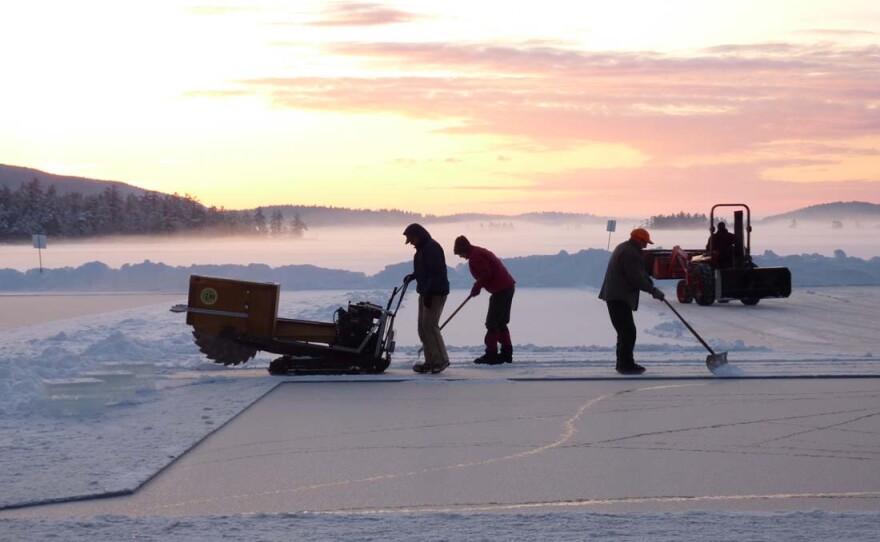
This was a great answer as it pointed to a part of the culture of the early times. A recent article described how some in New Hampshire are trying to keep the "traditon alive" and has photos depicting some of the work and processes. 
Ice Harvesting in
New Hampshire

Switching to a more family-oriented topic, this is actually an issue of technology which is more than the computational flimflam of late. There will be a later post on the history of ice cream in the west as John's family had an early diary in southeast Kansas with an outlet in Oswego, KS in the latter part of the 1800s and early 1900s. As the technology improved, they shipped on the Katy railroad all the way to Kansas City.  

Looking at the history, Washington even had a taste for the sweet and icy stuff. New York had a parlor for this product in the 1770s. But, the interest in cold refreshments go back much further. 

Remarks: Modified: 03/31/2024

03/31/2024 --  

Tuesday, January 4, 2022

Challenges of technology

TL;DR -- We have looked at the 400 years. At the 150th timeframe, we split. And, now are at a 250th stop and review time. We have been doing that. Rivers were (and are) important. There are other resources. Somehow, the American dream has become, arrive and start to take. Oh, the older families did? Not really. We can show thousands of families whose contribution has been similar. Oh yes, there have been those who exploited, mainly. Now, technology? Will it help get sustainable versus just add to the inequities? That might be one of the challenges. 

--

Quora got our attention in that their approach does approximate scholarship, somewhat. Wikipedia is an encyclopedia, thereby has a constrained view. There are other sites that allow free flowing discussions. The genealogy sites are an example. 

Quora has had many threads on technology include artificial intelligence. Here is an example question that generated lots of viewpoints: 

Why is that with modern technology the US has not diverted surplus water from the Mississippi River to drought devasted California and other western states as was done through Aqueducts by the Romans thousands of years ago?

Most questions are not this long. And, there have been other questions of a similar nature. What got our attention was this map. We have shown many maps the past few years, but this one is related to views that can be formed using modern technology. 

Answer by E. Allwell

Another thing about Quora is its contributors. Erik Painter, native Californian, is an example and has good response to this question to which we provide a link. 

This question, as of today, had 44 answers. Some are quite brief. The two referenced here are thorough and not short. Another thing of the new media is the huge potential readership which can increase the number of views to an answer. Those add up: E. Allwell has over 25M views; Eric Painter has nearly 14M. 

An issue is, how good is an answer? We can assess that partly by looking at other answers by the person. But, the subject matters covered run the gamut. And, this is a phenomenon that goes across the web. We can look at the growth just like we looked at the coverage of the railroad over the interior of the U.S. 

There are automated means that read, parse, and present summaries. This related to AI or other means for handling text. It's never-ending in the sense that we have not seen a quiescence point ever. Not that such could not happen as we saw with airline traffic into the U.S. after 9/11 or even some of the recent flight issues related to decisions about the pandemic. 

Given the growing scope, there must be efforts put toward curating information. And, for the TGS, Inc., our interests cover more than genealogy. Too, the historic connections have been known for some time, hence we see the New England Historic Genealogical Society. One huge topic is culture and its association. 

Remarks: Modified: 01/04/2022

01/04/2022 --

Sunday, October 22, 2023

History redux

TL;DR - Quora has been mentioned a few times over the past few years. This month, we point to an answer which deals with naming of the tribes of North America. Also, we need to always mention technology. Time to recall the contributions of RA Douglas-Lithgow, MD, LLD. 

---

Earlier this year, we mentioned an intent to get Awareness months on our radar, regularly. This month, we had a holiday which is associated with the populace here prior to the "discovery" of Columbus in 1492 which we all grew up learning about. 

So, we are a little late getting to this. Since 2015, we have spent times on Quora which touts itself as " a place to gain and share knowledge. It's a platform to ask questions and connect with people who contribute unique insights and quality answers." 

In fact, we have posted several answers which link back to blog posts related to the Thomas Gardner Society. Here is an example from five years ago: Thomas Gardner (Cape Ann). As we can see from activity this year, we will be redoing the history with regard to Cape Ann. See the "In summary" post.  

---

Erik Painter is a writer on Quora covering several topics. One of these is about Native American culture. The topic of this post is very much apropos to our interest. 

Erik answered this question: How did the different Native American tribes of North America get their names (i.e. Sioux, Cherokee, Mohawk)?  He mentions several tribes, including Narragansett, Mohawk, and Mohican, who were cohorts of the early New England activity.  

Then, his coverage of the western tribes was quite instructive. There have been several other answers by Erick that we can discuss in the future. 

For now, here is a listing of posts with the topic of Native American in this blog. Expect  more of these as we look to the west coast to provide a focus for the 250 years of expansion of the U.S. 

Prior to that, we will relook at the history of Cape Ann, Essex County and Salem with the intent to update Dr. Frank's two books as well as our own posts (and publications). 

---

On another note, and with regard to technology, this year (or since the Nov. 2022 release of ChatGPT) we have seen how technology is going to be more of a bane than ever. For us, balancing the views by including Native American insights will be a prime aspect of truth engineering. Gloucester, MA showed this with their 400th activites in 2023 (Cape Ann, 1623, crew overwintered). 

---

Finally, let's mention an import who wrote a book on New England names and places: RA Douglas-Lithgow, MD, LLD.

Remarks: Modified: 10/22/2023

10/22/2023 -- 

Monday, October 16, 2023

Los Angeles, again

TL;DR -- Los Angeles has had a few mentions in this blog. Following up on details related to development in the downtown area, we looked further at some historic moments. For one, a service club started in 1942 went on for over 10 years. That building was next to a Cathedral. We look at some details related to that associated area of downtown LA. 

-- 

We have had a few posts on this city (recently, Mirror Building) and its northern neighbor (San Francisco). Yesterday, we saw that Facebook has a group dealing with LARelics which has many older photos of the LA area. The one that got our attention was from the Victory Service Club (VSC) from 1942. Since we are following the long arm of New England to LA, we had to dig deeper. 

We won't detail every site that we visited, today, but we followed several threads. One dealt with Main Street in LA, in particular the area around where the City Hall was built. It's remarkable, for several reasons. But, there were many blocks along the street with differing histories. For this case, we wanted to know what building housed VSC. In that area, several bank buildings were built in the late 1890s. That brings up how things worked before banking. Expect a post on that topic. 

Where the VSC was, the 1st National built. But, many changes had taken place between the 1890s and 1942. First, what was that VSC building, and when was it built? Turns out that the VSC was run by the Union Rescue Mission (URM, see notes on Wikipedi page for Main Street (Los Angeles). Those are my notes which reference a 1955 book plus pionts to various other photos from different times. The URM was on of the early missions and was large. 

---

Turns out that the book noted that the URM picked up part of the Swanfeldt building at 226 So. Main. Next door was the IOOF building that they acquired in the late 1930s. That's not the gist of this post, it's coming. The Swanfeldt family had a canvas company and did tents and awnings in the LA area. They were from Sweden and show the influence of a new family. We have many New Englan families to detail, though, some of which deal with the LA Times and the buildings in the area. 

---

Next door to the VSC and URM was an old Catholic cathedral (Saint Vibiana). That's our theme today. The parish had to move. Part of the reason might have been earthquake damage, however enough of the structure was saved to be extant today. Most likely, the move was through gentrification which had earlier brought the URM into the area as it had to move back in the 1930s to make room for LA's new City Hall. There are sites with photos taken during the construction which ought to be of interest. 

This photo is of the church not long after it is built. This area is right downtown LA off of US 101. 

Vibiana Lofts

Does it look to be in a scrubby desert? Well, LA is a dry place. Guess what? That building still stands. When the diocese was forced to move, there was an effort to save the building which worked. Then, the government got involved and made it a National Historic building. Now the site is an events center of some note. This is very analogous to what happened to the Presidio in San Francisco

While searching I found this site which has period photos. It is just wonderful what the web is allowing in terms of independent historical work. We want to encourage that. 

So, the site shows both the IOOF and the Swanfeldt buildings. Now, we want to look for when they were built and by whom. 

Remarks: Modified: 10/25/2023

10/17/2023 -- Following our usual mode, we went to the FB page for TGS, Inc. and posted a few words with a link to this post. It was liked by one of the regular readers. But, within about 10 minutes, there was a message of the FB post being deleted with an ominous message. Still not sure what precipitated this reaction by Meta's watcher (which one and of what variety - I would like to know specifics). Have heard of this type of thing. Have been watching over the past decade, various debacles, as technology was put into the place of people. Also, noticed that companies that cared about the clients kept people in the loop that one could talk to. This image is the message about the FB (Meta) post. 

10/18/2023 -- More on the theme: Los Angeles, againBunker Hill, west

10/25/2023 -- Earlier (or Earliest) LA. -- Why was downtown LA built so far inland? Erik Painter, on Quora.  

02/19/2024 -- Bunker Hill, the Cathedral, and such.