Showing posts sorted by relevance for query melissa. Sort by date Show all posts

Sunday, January 26, 2014

Telling the stories

In earlier posts, we looked at the Quaker theme: Lucretia (Coffin) Mott, Thomas and the Quakers, John Goff's article, and more. The recent Beacon issue has this same theme.

---

The Lucretia post was picked up by Melissa D. Berry for the anceSTORY blog (see Jan 07). Too, Melissa is writing articles for the Newburyport News (example) and sees the importance of historical
fiction (she has proposed a project - more information later).

The Facebook page for anceSTORY is publicly readable and frequently updated.

One theme has been the Puritans' propensity for punishment (example). One wonders how it might have been if the Puritans would have inflicted punishment upon themselves rather than others.

---

There are many Gardner connections to pursue as the theme is New England (for example, see this search result). Also, we do need to know the times and travails if we are to understand the ancestors' lot.

Remarks:  Modified: 03/02/2019

02/12/2014 -- Motivations will be a focus.

03/02/2019 -- Added image that list Melissa's great work. We're building an index via images at our portal to truth. 

Thursday, July 22, 2021

Grave abuse

TL;DR -- For a decade, we looked into the question of Where is Thomas? That query was with respect to the location of his remains. After reading about and listening to lots of comments and ideas, we decided to dig deeper. Lo and behold, we find that the place where Thomas was buried was torn apart 190 years ago or so. Stones were moved without regard to bodies which were left. Then, the land was contoured for traffic dragging the bones about. Or, they were thrown in the river bed that was being filled. Some remains and stones may have moved to two areas. Harmony Grove Cemetery is close; but, the Trask plot is closer. God only knows. 

--

A decade ago, we first asked the question of "Where is Thomas?" after visiting the cemetery in Salem, MA and coming away disturbed. Then, we slowly gathered data and kept asking. Where is Thomas? Finally, we heard on a phone call (Maine Gardner) about tales of missing graves. Okay, what does that mean? Well, we kept gathering related material. Too, we got familiar with the area. Actually, Ann's childhood house is within a stone's throw of where the Gardner Burial plot was. Let's say, using a hefty arm. However, it was almost as high on the side of the hill as was Thomas when he sat by his tree and said that he liked the view of the water (7 Oct 2019, Gallows Hill - look at the painting in this post). 

Later, we noticed that Dr. Frank had mentioned the issue in his books quoting Samuel Pickering Gardner's comments about the problem. A summary post (28 Feb 2019, Another twist) tied things up. And we took our attention out to the wild west. 

 Showing Google view, with annotations, 
mapped to Sidney Perley's sketch of the
area around Gardner Burial Plot

But, it is time to re-address this theme due to the hard sleuthing of Melissa Davenport Berry. She runs a FB group titled Early Quaker History and Genealogy as well as the New England Family Genealogy and History group.  

Recently, we were looking at FB as there is a lot of activity there related to New England. Melissa who writes for several publications has just reported on some research. The following four bullets are her blog reports with comment. We need to thank Melissa. Also, it is time to clear the air on this. We'll handled the Gardner part.  

That Nathaniel Bowditch's name was mentioned and got our attention. Okay, we'll get back to this theme. Somehow, we need to get the message across about the incidents as well as figure some way to get Thomas (and Margaret) Gardner recognized when the 400th comes up (or before). 

Remarks: Modified: 07/23/2021

07/22/2021 -- 

Monday, August 11, 2025

New Englanders and Leary

TL;DR -- We saw a genealogy chart which included shields and looked further. That reminded us that we have had several posts on the subject. Heritage is an important subject, even for relationships in fields of expertise such as mathematics, technology, and psychology. 

--

We were looking at an old pedigree chart that was hand drawn. Wonderful work. My thought was, at least, we know this didn't come from GenAI/LLM. Here is a compressed look at the photo of the chart that was posted by Melissa Berry on the FB Group - New England Family Genealogy and History.  

Posted on FB by
Melissa Berry

One sees modern verrsions of this type of chart, many done by computers. Our hope is that these get documented some way for future researchers, especially if provenance needs to be considered. But, that's another issue for another time. 

We have had several posts on genealogy and on our thoughts of such. To note, we support The Heritage Society  Community and the Daughters of the American Revolution and more. With the 250th now in progress, themes of lineage will be constant. 

But, with tecnology, especially advanced computing, we have been going on about this for several years now. In particular, we note the need for computers to support science and any work of difficulty and as those that are complicated. Along that line, we looked at Gibbs of thermodynamics fame after the Nobel prize of last year being directed to mathematical physics (namely, xNN). HIs work impressed Maxwell of Scotland (as in, James Clerk). 

Some posts on genealogy: Endless genealogies; Vanity genealogy; Modern genealogy; Major players; ... This might be the time to point to the Mathematics genealogy project. Here is the page for Josiah Gibbs. 

---

Switching gears, while looking at our posts, we found this article: 10 New Englanders Turned On By Timothy Leary. Taking a quick look, we saw many familiar names. We might look at this further in terms of genealogy and psychology.    

Remarks: Modified: 08/11/2025

08/11/2025 - 

Friday, May 31, 2024

Napa Valley pioneer

TL;DR -- Ships brought people to CA. So, ship people settling in CA would be expected. We look at one Salem family, descendant of Thomas Gardner, who pioneered in Napa Valley's Oak Knoll district. 

--

Can we write too much of California? It was the environs of New Spain but had New England influence not too long after Jefferson's deal. We have looked at Los Angeles a bit due to the Butterfield Stage Line that started in St. Louis and went to San Francisco via Los Angeles, and prior to that Tucson and El Paso. San Francisco was of interest due to the Gold Rush plus the Presidio which was established in the era of New Spain. Then, we have looked at the early arrivers who were mountain men and trappers.  

Today, we will use an article from Melissa Berry due to its theme: Photo Album of California Pioneers (part 1). Of coursel, these pioneers were going to an already established place, namely New Spain. But, it is good that the photo albums of CA are being used. Melissa names the families which include some from Salem and Nantucket. Bowditch and Gardner are on the list. 

The article shows the following photo of the Napa Valley vineyards which were in the Oak Knoll District. The website for the Vintners of the district gives some history of the involvement of Capt. Joseph W. Osborne. 

Joseph W. Osborne's vineyards

Be sure to visit the photo album at the site of The Society of California Pioneers.

Remarks: Modified: 05/31/2024

05/31/2024 --

Sunday, May 26, 2024

Memorial Day, 2024

TL;DR -- Following our Memorial Day theme, we look at two organizations: an American one that formed after the Civil War; a British organization that served in the Burma campaign. 

--

In our last post on the Memorial Day theme, we listed some posts from the Mays of our existence starting in 2011. In 2019, we started to have a Memorial Day post. This time we look at news about Nantucket Island and the Gardners. 

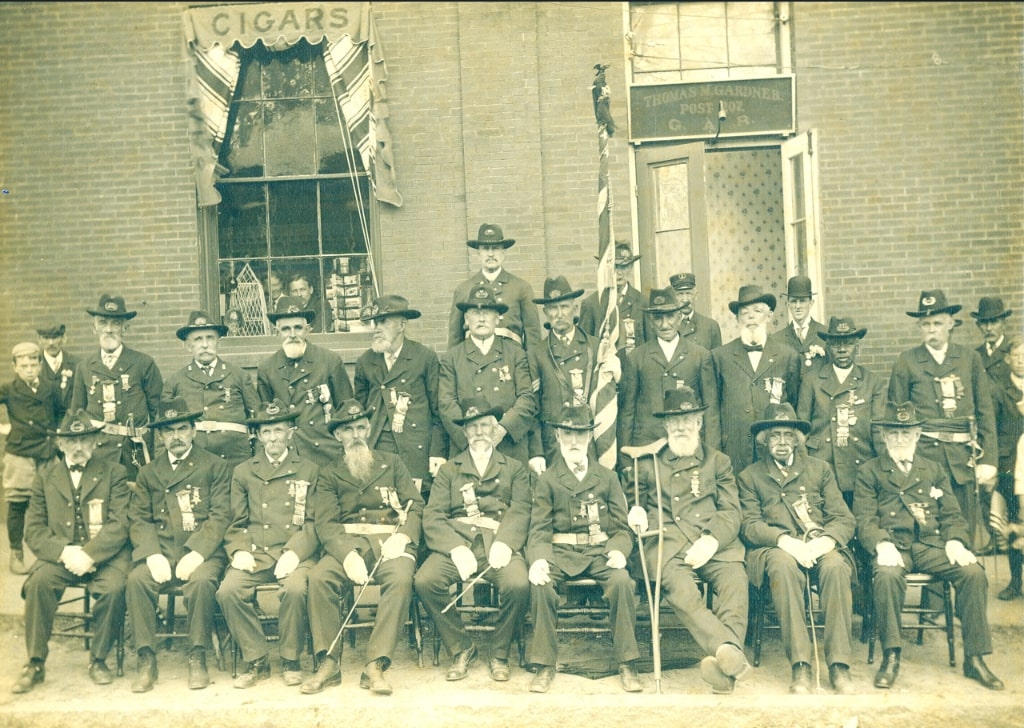
Melissa Berry published an article this week on GAR Civil War Vets. The Grand Army of the Republic group was formed in 1866 and lasted until 1956, according to the article, after the last member died at 109. Melissa provided the below photo which was of the GAR Thomas Gardner Post 207. 

Nantucket Island, 1909

For more information on the Gardners of Nantucket, see this Guide to the Gardner Family Papers, 1717-1960. 

----

Switching to another century and continent, we have been corresponding with Diana Davidson about technology and Gardner history; her family descends from the Gardners of Nantucket and lives in England, near Dorset. The family descends from Edmund Gardner who was of the Whaling family. We will write on this family a little more, but for now let's shift our attention to WWII.  

Diana wrote, recently (edited): 

My Grandfather was Charles Frederick Gardner. He volunteered to fight in WW2 but claimed that he was thought to be “too old to fight”. 
As a Member of the Leander rowing club and a Cambridge blue, he was passionate about rowing and had always kept himself very fit. He was also as a Member of his local branch of the Territorial Army when he lived in the U.K. 
He volunteered to join the Chinditz and led a group of Africans who had been drafted in to fight the Japanese in the sweltering heat of the jungles of Burma. 
 
I did not know of this group but was somewhat familiar with our joint efforts with the British in the Burma campaign. The following is more information on the British organization under which C.F. Gardner served. 
Chindits Text Banner Special Force Burma 1942-44

---

Each year, we will mention that Memorial Day has become a general time of reflection on the dead with visits to graves and the placement of flowers. Too, it's the unofficial start of summer as most of the schools have started their break. 

Remarks: Modified: 05/26/2024

05/26/2024 --

Saturday, April 23, 2011

Lucretia (Coffin) Mott

Thomas' descendants list contains many social reformers. Lucretia (Coffin) Mott stands out for her activism activities, such as co-founding the Pennsylvania Anti-slavery Society and the American Equal Rights Association.

She spoke at the International Anti-Slavery Convention that was held in London, England in 1840. She, along with other women attendees such as Baroness Byron, was included in the commemorative painting of the convention.
 Lucretia (Coffin) Mott
 Ancestory Archives

Lucretia was a descendant of Thomas and Margaret through son Richard. Both of her parents (Thomas Coffin and Anna Folger) were from families who arrived early to New England. She grew up on Nantucket Island and then attended a Quaker School in New York (Nine Partners Meeting House and Cemetery). After graduating, she also taught at the school which is where she met her husband (James Mott).

Lucretia, in 1864, helped found Swarthmore College.

Remarks:

02/16/2019 -- Lucretia's family leased land to the government to establish a military training ground: Camp William Penn.

12/14/2018 -- Added image from Ancestory Archives.

07/19/2015 -- A Swarthmore alumni: James A. Michener.

01/07/2014 -- Thanks to Melissa Berry for using this on anceSTORY archives.

01/07/2014 -- Removed the tree pointers (see rationale).

02/01/2013 -- Update rootsweb references for Larson tree.

03/07/2012 -- Updated links to George Larson, II's work (internal pointers changed due to a database update -- one problem with the current link method, since it is dependent upon the structure of the tree).

07/21/2011 -- More on Nantucket.

Modified: 02/16/2019

Saturday, April 29, 2023

To and from New England

TL;DR -- In 1794, Sam Dunn published a map of the territory of what was to be the U.S. The whole of the middle is empty. Taos NM and New Orleans LA are exceptions. These were of other cultures, namely New Spain. This map can be used to look at the period up to about 50 years ago (perhaps more); since then technology has been the focus as we can see with the current involvement with releases of what are called AIs (artificial intelligences). Too, early on people went west and south. The former got attention. We have a book, now, to start study of those going south. 

---

Earlier, we looked at a map of North America from 1794. It is fairly sparse in terms of information as the mapmaker was in London going on second-hand information. See post on Sam Dunn. But, too, travel was hard. The space was wide-open in a sense. 

So, this 1794 map will feature as we research the carving of the land and the participation of such by New Englanders. At the same time, the map will get involved with our discussions of technology. The U.S. grew from a small footprint to cover a wide expanse in 200 years or so. In the last 50 years, the focus has been technology of types. At the same time, the infrastructure decayed. 

Now, we knew of movement south from northern New England. This was an early18th Century phenomenon that halted with the advent of the Revolutionary War. In particular, known families left and went south and west. 

Movement picked up apace after the Lewis & Clark expedition. An example is the excursion sponsored by Ipswich of Essex County of MA. Veterans were restless; a good use of their energy was starting Ohio and other points west. 

Getting back to families, Melissa Davenport Berry, a writer on the history of New England, discovered a book that gives details about the movement of families from Nantucket to the south. It has the title of "Our Quaker Friends of Ye Olden Time" and is available on-line in the PDF format. The author was Edward Henry Hall, of the 1851 class of Harvard. The book's first part is "a transcript of the minute books of Cedar Creek Meeting, Hanover County, and the South River Meeting, Campbell County, VA" and includes births and deaths, marriages, and more. 

Then, an Appendix (pages 171-277) provides a "Historical Sketch" that is quite detailed plus some information on the Quaker views. Then, there are brief looks at prominent families and the publication of a diary.  

Remarks: Modified: 04/29/2023

04/29/2023 -- 

Monday, November 20, 2017

Southern New England

Having been given a chance to look at descendant lines from Virginia, I had to take advantage of learning about its History. As I read, parallels with Northern New England stood out. For instance, in the south, there was early migration out west just as we saw in Massachusetts. Too, there were two  rides similar to Paul Revere's. One of them saved Thomas Jefferson. Then, the themes related to Albion's Seed apply to our work.

Today, I picked up a book that I had purchased in D.C. back in 1997. I lived in Virginia for a while. Too, I visit the area often. 1997 was 12 years  before I started to do this historic genealogical work. And, it has taken a while for me to get to read it. Til now, it sat on the shelf.

The book? It had been copyrighted in 1957. The author is Charles E. Hatch, Jr. The title: The First Seventeen Years, Virginia 1607-1624 (text version of the book, archive[.]org) There are various on-line versions that one can find on the web. Some of these have a preview mode.

It was this content on page 23 that got my attention.
    Participation in the affairs of government was another element in the new Company approach. Soon after his arrival, Yeardley issued a call for the first representative legislative assembly in America which convened at Jamestown on July 30, 1619, and remained in session until August 4. This was the beginning of our present system of representative government. The full intent behind the moves that led to this historic meeting may never be known. It seems to have been another manifestation of the determination to give those Englishmen in America the rights and privileges of Englishmen at home that had been guaranteed to them in the original Company charter. It seems to be this rather than a planned attempt to establish self-government in the New World on a scale that might have been in violation of English law and custom at the time. Whatever the motive, the significance of this meeting in the church at Jamestown remains the same. This body of duly chosen representatives of the people has continued in existence and its evolution leads directly to our State legislatures and to the Congress of the United States.
That is, in 1619, Virginia had the first meeting that relates to our current way of life. This was before the arrival of the Mayflower. As the northern crowd gets into the mood (and the tone ramps up, I can hear it out hear in the netherlands, already) of celebration, we ought to juxtapose the whole scene with southern incidents, albeit not with any direct time association. In fact, as I read, parallels are all over the place.

Too, the Mayflower destination was more southern than not.

Many families had representatives in both the north and the south. Some of those who have both pedigrees had ancestors who met while heading west. One example is covered in the article on our flyover country.

Remarks: Modified: 11/24/2022

11/22/2017 -- Looking at parallels will also consider differences: Dales' code (Laws, Divine, Moral, and Martial).

07/27/2018 -- Some editing. Added links, like this one: What is an American?

03/07/2019 -- Added image from this post to our portal to truth.

05/24/2022 -- Melissa Davenport Berry article on the Queen's visit to the area in 1957. 

11/24/2022 -- Thanksgiving Day. The first one was in Virginia. Also, they had food problems like we saw with Plymouth later and even Cape Ann when too many people came over. 


Wednesday, October 19, 2022

Newbury Essex County MA

TL;DR -- Ships made and used. New England. We're back to that after our jaunts through the interior. But, we'll keep both in mind going forward. In Massachusetts, we focus on little Essex County. Even there, the shipbuilding efforts have continued over the 400 years. Maine will be in the scope, too; after all, they endured the onus of Massachusetts for a long while.  

--- 

New England and its nautical modes is a no-brainer, that is, when one considers the coastal area. Same goes for our Essex County, the primary entity in Massachusetts. That is, again, until Winthrop arrived in 1630. There was Plymouth, of course. And, people had scattered around the region, like Weymouth which commemorates its 400 this year (2022). Per usual, we will be looking at Weymouth, again, due to the associations/relationships with those there in the context of the 400ths which will cover several decades. 

Folks in Essex County helped fill in the interior of the U.S. over time. To consider that entails covering a very large area. Two memes apply: long reach of New England; frontier century. Both by land and by sea pertain to the two memes over time. Thomas Gardner Research has noted by the seafaring ones have lots of press. Where there are deficits of information is in the large interior. To the extent that we can claim to have discovered a lost generation or two where our work has merely touched the tip of an iceberg. Fortunately, technology is moving to where we can handle the work to fill in the missing pieces. The interior is not just "flyover country" as was a meme several years ago. 

But, back to the sea and its charms. Before getting back to Essex County, there was a documented building of a vessel in Maine in 1607: Virginia, a pinnace (Gardner's Beacon, Vol. III, No. 1); Popham Colony (Wikipedia -- first English ocean-going vessel built "in the Americas."). The Wikipedia article gives an off-handed review. This vessel actually sailed from Maine to Virginia, to London, and elsewhere. This accomplishment needs more attention. 

That's New England, north as we call it. Coming back to Massachusetts and Essex County, we can look at the northern end, namely Newbury. We have mentioned it a few times. For instance, Dr. Frank and Ann have lots of ancestors from there. Nathaniel Knapp is an example. We wrote of Caleb Haskell who is from Newburyport (close enough). 

Newbury will have its commemoration is 2035. Being up top, we can jump over to New Hampshire to add in more goings-on over time, say like this post, Two Houses. But, let's give Newbury some attention, finally. 

Today, we saw an article by Melissa D. Berry: Tales of Infant Boat Industry in Massachusetts. The article looks at Newbury's  involvement, in a big way, with the creation of vessels for water transportation. By 1749, the region had produced "over 600 vessels." The Merrimack (1798) came from the folks up there in northern Essex County as a gift to the cause for which we'll have a 250th very soon.  

Recently, we had a brief look at the smaller work of cousins a little further south: Shipbuilding in Essex. Where Essex, in this case, is the former Chebacco where Rev. John Wise preached and rebelled. That latter had to do with tax impositions almost 100 years before the little tea party in Boston. John's pamphlet (see The Rev. John Wise of Ipswich) was republished to inform the later folks of what happened before, as well as to inspire Thomas Jefferson. 

We will step back to the beginning to look at the types of efforts. Housing was a huge emphasis, for a while. There was regular traffic bringing in goods of various types. Some artifacts had to be done locally. Too, exporting happened fairly quickly. Of course, we will continue the overviews of the 400 years of interest. 

Getting back to New England, in the context of Maine, we need to specifically point to Bath (John almost went there - to deal with the heavy stuff as compared to the lightness of aero ways). This little brochure is about the First ship of Maine (of course, Popham's). Their claim s that 4,000 ships have been built over the 400 years. Astounding.    

Remarks: Modified: 10/19/2022

10/19/2022 -- 

Thursday, November 13, 2025

Charlotte (Coffin) Gardner

TL;DR -- On FB, I saw an article that reminded us that the author had created a related blog which contains very good articles. On browsing, we ran into Charlotte (Coffin) Gardner. She kept a journal on her 3-year voyage with her husband and son. Along the line, she mentions New Englanad folks and natives as well keeps record of their progress along the continents to the Cape and back up. Names overlap our earlier research. So, we will recoup the interest level. 

---

An article today on Facebook got me to looking at the articles of Melissa Berry on her blog. Here is an example article in American-Archives. The topic is a wive who went on a three-year voyage with her husband from New England around Cape Horn and up to San Francisco and Washington State. 

These links point to pertinent material about Charlotte and to a Journal that she kept during the voyage. She is a descendant of John son of Thomas and Margaret. Her husband is a descendant of Richard, brother of John. 

One thing that is of interest would be to use Google's map to follow her on the voyage. The next link goes to a view of the western hemisphere with a location marked.  

There were many stops mentioned in the book. Here are three Wikipedia articles. We will have more. In addition, Charlotte marks her location on a regular basis as the above Google map shows. 

In the articles and in the blog, there are many names mentioned lots of which are familiar from our studies of New England with some being kin of various sorts. Too, we have a theme of the long reach of New England which our posts on Bunker Hill West which is in Downtown Los Angeles show. 

A few years ago, we did posts on the barque, Bostonian, that was owned by Hentry Gardner and his brother. In that material, we learned a little bit about the nautical ways after spending lots of time looking a movements across the middle of the vast area of the U.S. The Bostonian wrecked in 1850 along the Oregon coast. The pilot was noted as Capt. Boyling. 

Charlotte, in her blog, mentions Capt. Boyling which got our attention. So, as well as studying her Journal, we will pick up our study of the barque, Bostonian. Again, here are a few related postts. 

Several themes were mentioned here. What this represents is that the 250th has lots of open research pending. But, in general, here is no end to the study of  New England.    

Remarks: Modified: 11/13/2025

11/13/2025 --

Tuesday, December 31, 2013

Gardner's Beacon, Vol. III, No. 4


Two days ago, December 29th, was the passing date of Thomas Gardner of Salem. We need to have a yearly reminder set up for that day.

---

Thomas and Margaret had nine children who grew up in Salem, MA. The early boys were born in England. John was born on Cape Ann in a pre-Conant and pre-Endicott Massachusetts.

All the children survived Thomas, except for Miriam who died early leaving young children. After Thomas' death, several of his children left Salem. Richard and John went to Nantucket. George became a citizen of Connecticut though he continued to own land in Massachusetts.

Thomas' last wife, Damaris, and her children were active Quakers. The Puritans did not like that belief system and responded with a heavy hand even though Charles II told the New England authorities to refrain from their persecution. Thomas' step-son, Samuel Shattuck, carried Charles II's message to Endicott who stayed his hand from awhile.

Unfortunately, Samuel's missive was too late for Mary Dyer and others.

We have only touched the surface here, only to the extent to start to see the Gardner involvement and influence. Expect that the topic will appear again.

We continue our "Annals" ways with this issue. It can be nice to see a timeline related to events. Also, we have a short list of Thomas' and Margaret's first-born grandchildren. We have two listed for Seeth since her first husband died young, during Thomas' life.

---

See Vol. III, No. 4 of Gardner's Beacon for a look at the first generation of Thomas' descendants.

References:  see Sources (Current Issue)  

Remarks: Modified: 01/08/2014
Puritan entertainment

01/05/2014 -- anceSTORY Archives has a recent article on treatment of the Quakers.The image comes from an article written by Melissa Berry for the Newburyport News. One might title this, Puritan entertainment. No, they did not allow the usual pleasures; rather, inhuman (and inhumane) activities seemed to be their attraction. ... One thing that we can be strongly assured of [is this]: Thomas and his kin were not of those who tied women (in an unclad state or otherwise) to carts and dragged them through the streets (er, muddy cowpaths).

01/08/2014 -- We added Earlier Settlers of Nantucket to our Bibliography. It's interesting to see the Folger stories of the early Gardners. ... In another place, we saw both Richard and John being described as well-educated. From whence that education? The parents? If you say no, you're not very much insightful about human nature. A child's first teacher is the mother, then the father. So, if Richard and John were Quaker, well-educated, and good citizens of their community, the mother deserves a lot of credit. Now, who was she? In Hinchman's book, Margaret is noted as the mother. We'll have to look to see the source for that. If it does come down as family history, then one would think that the children would have known their mothers. In any case, Margaret, or whomever it was, needs to have recognition as being early-Quaker (definitely, before Fox made his splash upon history).


Saturday, June 19, 2021

Shipwrighting

TL;DR -- We have had our attention on the west for a while. That is, the west that is outside of the wilderness limit of the eastern view. So, we had the northwest which is really the midwest. Then, we had that huge affair out west that became so many states. On the other side of that is the left coast and its limits. So, people went along the way via various access methods that were developed (foot, horseback, vehicles of certain types (cart, wagon, flatboat), until there was the iron horse (of course, we will get to the auto and things that fly in other than natural modes). But, stepping back, we have water, other than the river issues out west, being the major influence in the lives of lots of folks. But, prior to that, someone had to build those things. And, the first such event in the area: Maine, 1607. 

--

In considering the colonial condition that became the U.S., we have to keep in mind what people did to survive since they were no longer in their known civilized state. Coping is situation. 

For a while, we have been looking at the Frontier Century up close where we determined that St. Louis will be the focus for a whole lot of study, for several reasons. As we go forward, we need to pay attention to several areas in the west and to different players over the more than one hundred years that is of interest to one major theme. For example, one family gave us a surveyor/judge father with a trapper/trader/rancher son. 

As well, along with New England, we had New France, New Spain and others, including the American Indian. Those who coped with the immense spaces had to deal with issues related to water as well as those with land, namely waterways as obstacles as well as being modes of travel. So, rivers were (and are) an important factor. There is no end to the themes of the western U.S. (2016) to address. 

However, that which is related to the final voyage also used a whole lot of nautical metaphors, for good reason. Stepping back, we will identify parallels that exist today. Say: in the interior, harvesting wildlife almost to extinction; while on the coast, depleting forests in order to build things that float. 

This post begins that relook by taking a brief focus on ships, how they come about, and what they do. And, just like the west had its roles, shipwright comes to play on the coast when people get ambitious enough to make a vessel capable of water travel. For now, we will table those shallow bottomed things used out west. We are talking the real deal, say, the type that brought Thomas and Margaret over from the old world. 

Some shipbuilding methods

We have already have had posts with this theme. Here are a few with the year of the post: Barque (Bostonian) (2018); HMS Resolute (2021); Henry D. Gardiner (2014); Whaleship (Essex) (2015); USS Merrimack (1798) (2012); Two cousins (2012); Whaling Gardners (2011); and others. There will be more.    

For starters, here are some articles/papers that are pertinent. 

  • The Structures of English Wooden Ships: William Sutherland's Ship, Circa 1710 - this was published in The Northern Mariner (1993). There is some discussion of improvements of that time plus diagrams (pseudo-blueprints) that provide a good idea of how things are fabricated and assembled. That is, too, shows the need for raw material plus hugely talented humans. 
  • Eighteenth-century Colonial American Merchant Ship Construction - this is a thesis that comes out of Texas A&M, Anthropology. Interesting. This is a nice overview for a beginner who is a landlubber. 
  • Infant boat industry grew along the Merrimack - this is by Melissa Davenport Berry who is quite active in on-line Massachusetts history. Naturally, there are were early and later boat-building activities. Themes in this article are related to Essex County. 
  • Shipbuilding in the American colonies - of course, we have to reference Wikipedia's ways of being neutral and thorough. 
  • Maritime Commerce - this is by way of the National Park Service and is, per usual, quite informational about the ways of trade and such through those times. 

We will be looking at colonial times and a few generations later. In this sense: the fifth generation bore the brunt of the turmoil; the sixth and seventh were involved with the establishment of the new country and its modes. Of course, we still have 200 more years to cover after those folks. 

Further topics: A history of shipbuilding at Fore River; The women of Chebacco build a Meeting House, March 21, 1679. 

It goes without saying that most things that we look at come back to Essex County or Massachusetts or New England. 

We would be remiss if we did not mention the first ship building event in the U.S. (or what became such): Popham, Maine, 1607 - mentioned here, Ebenezer Gardner of Maine (2011). 

Remarks: Modified: 06/19/2021

06/19/2021 -- 

Sunday, July 3, 2022

The Heterodoxy Club

TL;DR -- The Village in New York was early involved with fomenting change. An example was in the early 1900s when illustrious women worked for suffrage. This is an example of cultural concerns that we will pay attention to. A motivation, naturally, is the New England connection. We look at a few of the individuals who are associated with the related events. 

---

A recent issue of the WSJ had a book review that caught our interest for several reasons. One of these is that of the ladies involved, many were of New England heritage. That gets out attention. Too, the location for meetings was Greenwich Village which still had a similar aura almost a century later. Then, there was the subject which was the rights of women. The group that was formed had an interesting name: Heterodoxy club. There can be a lot said about that theme at some point. The group met from the 1910s to the 1940s. 

For now, let's name a few of the women involved and note their association with New England. Our list comes from an education site, ThoughtCo. A more comprehensive list is available at Wikipedia. 

Charlotte Perkins
Gilman
Sara Josephine Baker (WikiTree) 

Crystal Eastman (WikiTree) 

Charlotte Perkins Gilman (WikiTree)

Marie Jenny Howe (Wikipedia)

Alice Kimball (WikiTree) 

Amy Lowell (WikiTree)

Ruth Pickering Pinchot (WikiTree) 

Doris Stevens (Wikipedia) 

In the list, we point to the WikiTree Profile for the person if there was one so as to aid a look at their pedigree. If there was nothing on WikiTree, we used the Wikipedia material. 

We have many themes to cover. Of late, we have looked in depth at the carving of the land as the world of New England expanded west. But, we will pay attention to cultural issues, too, such as this topic which requires continual attention gong forward. 

Remarks: Modified: 07/04/2022

07/04/2022 --  Added Mary Melissa Hoadley Dodge. Then, remove the Mary who moved to London. There was a Mary Dodge there. Who was she?

Monday, January 7, 2019

Gems of Salem

Gardner Research started in 2010 from a blank slate, more or less, using the wonders of the www; in other words, trolling the waters of the internet to see what we could find. The result? Lots of stuff, some of which we have organized. And, there is a lot more work to do.

As we have seen, records get digitized and come online. Sherborne, Dorset is an example as their records allowed us access to lots more about Margaret and Thomas. See the discussions on WikiTree. Notice two things: this is a profile of Thomas sponsored by a Great Migration Project using Anderson's book (1986); Margaret is given as Thomas' spouse and mother of the children. As well are records coming on-line, people write.

A very good example, that is relevant, is salem.wickedlocal.com. Early on, we saw an article by John Goff: Looking at Salem’s beginnings: The White and Gardner family contributions. This article published in 29 Dec 2007. That was eleven years ago; we saw it four years later and noticed that it mentioned Rev. John White.

One of our first activities was to start the Thomas Gardner (planter) page on Wikipedia and have added several other pages or links. A good example might be when there were news stories about Amelia Earhart's plane. Gardner Island was mentioned; so, we had to look at that (as we have with other areas: Gardner Junction, Gardner, CO, Gardiner, OR). And, John got into that story, too.

I well remember John's first email. He congratulated us as he had run across our Wikipedia tagging (put link to Thomas Gardner's page in that of Gideon Gardner). I do not know if he wrote about Gardner Island, but we did discuss Gardner's Beacon. And, John was kind enough to contribute articles as well as provide other information to support our research (thank you, John). I thought that it might be a good task to itemize John's work, especially as it relates to Gardner studies. See the list below which is provided as a reminder to us to look further into the articles. On the list, too, are Salem articles that mention Gardner.

First, though, here are a couple of examples of overlap interest. On our Gardner Gate page (portal to truth), we just did a summary of some pre-arrival information (1 March 2013 - the 2nd most read post) pulling information from a series of Gardner's Beacon issues. Then, I just found this article by John -- Salem’s forgotten French heritage (7 June 2008) -- in which he details French activities in the area that became Salem. He mentions the discussions with the American Indian. There are several articles that we will look at further.

But, another example, is the work that we did to track down information about the owner of the barque, Bostonian, that wrecked (Oct 1850) at what became Gardiner, OR (update - 30 October 2018). The original work was done in 2014 with an article published in The Essex Genealogist. The owner was a descendant of George of Rhode Island, though, two of his wives were descendants of Thomas Gardner of Salem. But, as well as the family information, there is a whole lot to discuss about the time (More on the Gold Rush 31 Mar 2016).

Here, I see that John wrote about a response to a query (1990s) from San Francisco (NAUMKEAG NUGGETS: Salem in the California Gold Rush 5 Jun 2015) about a ship that they discovered. It had been built in Salem.

From what I have seen, hundreds of ships were abandoned as crews rushed off to pan gold. That makes the Bostonian different in that not only did it bring supplies from Boston to San Francisco (July 1849 to January 1850 voyage - only four passengers - it was loaded), it went then to New Zealand (that was interesting, verifying that part of its journey), returned to San Francisco, and wrecked in Oregon is October of 1850.

Many went to California by land. We have researched that avenue, as well, due to our interest in the western expansion. Too, New England (and Salem) had the reach of a long arm. A third way to the gold fields was boating down to Central America, trudging across, then boating back up to what is now known as the Left Coast. This went both ways (many lost their fortune in that journey).

There are other examples in an endless set of things to research. So, gems, indeed. Finally, to a partial list of John's Gardner touch. Each item is marked by date; there is no obvious order, yet.
Remarks: Modified: 08/27/2022

02/08/2019 -- Recently, we got registered with Google as non-profit and have put a search facility on the sites. They are (will be) ad-free, once I get the administrative stuff completed. On the search page, I mention our manual effort at indexing. Now, we can get more serious. I extended the above list with some hits from searching on John Goff.

02/08/2019 -- Put photo of John Goff from 5 Jun 2015 article, Naumkeag Nuggets.

09/03/2019 -- Like the way John writes (see image). He mentions Sidney which is good. Dr. Frank and his sister, Lucie, picked up Sidney's work after he stopped his Essex wanderings and writings. This is an example of John's view (seen after I had, more or less, determined the same thing).


It was in this house where Thomas and Margaret enjoyed Cape Ann's wonderful life (posts search on Cape Ann).

04/20/2021 -- John mentioned in a Melissa Berry article (with reference to Richard Davenport). On New France and New Spain. We see it more out west.  ... Added link to page of Gideon Gardner, who was namesake of Gardner Island (by either Joshua Gardner or Joshua Coffin). 

08/27/2022 -- Finally, added John to the Descendants of Richard. Just for the record, search results on John Goff  (23 posts) in this blog. 

Wednesday, November 13, 2013

Thomas and the Quakers

Having been deep into research the past couple of months, I have had more than ample opportunity to get more familiar with Anderson's work (one example). In a sense, the Great Migration work is a nice compilation [strike that, it's a condensation] and index. Serious lookers still need to follow sources back to the origin, or one might say, the first principle.

Unfortunately, this need seems to be true for genealogical work, in general. It would be as if every theorem that one looks at needs to have its proof lineage known ad infinitum. But, we know that is not true, as we can take proofs at face value due to the process, and its verification style. Of course, people are working on ways to bolster the genealogy discipline (I heard a biologist argue that a lot of it is like gossip: this one said that about the other one and so forth). Going totally Gutenberg (as in a recoil from the Internet and technology) is not a step forward either. We'll get back to all of that later, as this post is not about genealogy. Rather, it's about interpretations and world views.

The NEHGS has both history and genealogy in its name.

---

Methinks that the genealogists have a larger problem with viewpoints than do those working with the minute things (consider, if you would, the abundance of quantum interpretations). And, it has been shown by some research that conflict (which can escalate to warfare at the extreme - added here to nod to the Quaker tradition) is due to differences in interpretation. The main issue? Whose worldview is sufficient for the rest? The corollary: can there be peace in the valley when multiple viewpoints are allowed?

Aside: group versus the individual - ah, so much to discuss.

---

Now, in regard to Thomas' relationships with the Quakers, there seems to be a pot boiling. I've read one talk (are there others?) in which a Friend include[d] Thomas in their Quaker ancestry. On the other hand, Lloyd de Witt Bockstruck, quoting Anderson, says that there is no evidence that Thomas was a Quaker (in actuality, Anderson says that history is silent - ah, a tabula raza situation - in which we have the duty and opportunity to fill in the pieces) .

Perhaps, Anderson ought to have said that there is mostly circumstantial evidence (which can be strong enough to get fingers pointed in the context of crimes) which would imply the need to get more information. The Great Migration book did not say that "no evidence" exists and mentioned the silence of history. Ah, we know that Thomas has been written out, so to speak. What we might be trying to do is speak for the guy, in our own words (tongues).

Let's look at a few things. Thomas married a Quaker. In fact, they got along quite well it seems. Several of his children were Quakers. George being driven off to CT left poor Ruth so that she could be grabbed by Hathorne (great-uncle, so it's a family thing). Thomas was peaceful, though no pipsqueak. He definitely did not follow the Puritan's dogmatic view.

In essence (not to Hofstadter's use of surface and essence), did Thomas exemplify the Quaker ideal? Mind you, before you answer, consider this: is Quakerism a way of life founded upon a certain viewpoint or is it being enclosed within some groupal framework that subsumes the self?

Remarks:      Modified: 07/12/2015

11/13/2013 -- Tabula raza? Well, let's say, blank slate. That was my first reaction four years ago when I saw two things: a dearth of material and controversy about what was there. Neither of those are bad things, but the void was obvious. And, the 400th ought to be the time to fill in some of the pieces. We can say the 300th belonged to Roger Conant. Next up will be Thomas and the others. But, for Thomas, the blank slate is multiple. Think of adding pieces of what is known (see 27 Nov 2012), for starters. What would go on different slates could be determined by strength, source, or what have you. Then, easily filled holes would be next. And, so forth, incrementally looking at the stuff. The fluidity, flexibility of cloud-oriented approaches would be great for this. ... Now, this type of thing just might suggest where to look for information. Funding? That is one factor of importance. Verification? Again, part of the solution mix. ... Did anyone say that it would be easy? The big difference now, versus when Dr. Frank was working (who, by the way, will be the backbone of the research work - as in, things would delta off of that - not Anderson), is that there is more material available (after all, 100+ years of people digging in), there are means for collaboration (again, after all, that was the motivation (primarily) for the Internet), there are fewer physical limitations (as in, research can be done against the large, and every growing, cloud'd source - as opposed to sink ;-), and more.

11/14/2013 - A collection of related material: Quaker DNA, NSDEQ (is that Thomas I (d 1674) or Thomas II (d 1682)?), Quakers: the Quiet Revolutionaries, ... William & Mary Barrett Dyer (blog),

11/21/2013 -- It may be that Anderson's work is a compilation, when not much is known about a person. Otherwise, a few pages cannot hold what we know of many (not without converting to some condensed type of language - to wit, English-Mathematics and other examples). ..., For heritage societies, in general, one might remind them of the 5th (4th, in some cases) Commandment. Genealogy is, in part, honoring the parents, transitively through generations. Some seem to have an exclusivity notion. Of course, one either is or is not descended from someone. However, the mere fact of the documentation (or that the documentation is possible) does not make the reality. People, in their own being, know their heritage (this, yes, has to do with memes as well as genes - open to discussion as required). ... Mind you, there have been pretenders in the past, after all, that is a human trait which has not been rooted out. Too, genealogists have been led astray many times, for various reasons. But, the fact of the matter is that strictly-supportable lines are the exception (for most people, Prince William does not have any holes show up until many generations out). Then, there are those with no documentation. The in-between is where the action is (and where genealogist make their money). However, given any line, one can generate strong conjectures (yes, even with DNA, we'll have to appeal to various interpolative schemes) such that someone can know themselves better. Now, does that mean that they can join a society? No, in some cases, perhaps, in others. Can such allow insights so that one can continue looking in other than the mode of complete enumeration or, worse, random casting about (though, serendipity, and being cognizant of patterns, can bring out useful information from such)?
Puritan entertainment

01/05/2014 -- anceSTORY Archives has a recent article on treatment of the Quakers. The image comes from an article written by Melissa Berry for the Newburyport News. One might title this, Puritan entertainment. No, they did not allow the usual pleasures; rather, inhuman (and inhumane) activities seemed to be their attraction. ... One thing that we can be strongly assured of [is this]: Thomas and his kin were not of those who tied women (in an unclad state or otherwise) to carts and dragged them through the streets (er, muddy cowpaths).

01/06/2014 -- The Beacon issue Vol. III, No. 4 deals with the subject and reminds us that the son of Damaris, step-son of Thomas, brought the writ from Charles II to Endicott (too late for Mary Dyer) telling him to lay off, so to speak. Much more can, and will be, said.

01/08/2014 -- We added Earlier Settlers of Nantucket to our Bibliography. It's interesting to see the Folger stories of the early Gardners. ... In another place, we saw both Richard and John being described as well-educated. From whence that education? The parents? If you say no, you're not very much insightful about human nature. A child's first teacher is the mother, then the father. So, if Richard and John were Quaker, well-educated, and good citizens of their community, the mother deserves a lot of credit. Now, who was she? In Hinchman's book, Margaret is noted as the mother. We'll have to look to see the source for that. If it does come down as family history, then one would think that the children would have known their mothers. In any case, Margaret, or whomever it was, needs to have recognition as being early-Quaker (definitely, before Fox made his splash upon history).

02/15/2014 -- Another thing to consider is that George Fox was born when Thomas was over here trying to adapt to the new world's requirements, as in helping his family and himself survive the elements (plus the machinations of the ilk that were their compatriots). So, later, even if the message of George may have resonated with Thomas (as it did with those around him), why would the old guy who had not succumbed to the pressures of the likes of Conant, Endicott, Winthrop, et al, want to bow to some young whippersnapper? Then, again, what is a Quaker? Given that George didn't suffer the same fate as Mary (think Endicott's madness), does that make him lessor of a Quaker? ... Bordering on silly? Yes.

09/01/2014 -- Gardner Research announced. "The Trials of the Wilson Family" published (TEG (2014) 34:155).

07/12/2015 -- Okay, turtle speed. But, we get there. Announcing a new project: Sherborne, Dorset. No doubt, it is about time. When finished with the data collection and analysis, we will present the strongest story (the prerogative of the family) that the facts, and abductive reasoning, will support. As such, we hope to demonstrate some very much needed research viewpoints.