Showing posts sorted by relevance for query lewis clark. Sort by date Show all posts

Monday, October 23, 2023

Lewis & Clark, again

TL;DR -- Today, a great map of the interior of the U.S. came up via a FB group who follows the venture of Lewis & Clark. In those areas visited by the L&C team, people living there now pay attention to the trek and the surrounds visited. This is an example of technology being used for a good cause. 

--

It is always nice to see great maps pop up. This one comes to us via a post today on the FB page of The Lewis and Clark Historical Trail. It is of the great interior of the U.S. which was traversed along its northern side in 1804/5 by the two gentlemen. At the time, TGS, Inc. and our websites did not exist. It is nice to see that the historic interest continues through local participation. 

Lewis and Clark Historical Trail 

Fortunately, the 250th of the U.S. is being celebrated through planned remembrances and active research. D.A.R./S.A.R. are examples of groups who are maintaining the interest and keeping up with research pertaining to families. 

Especially, we need to follow families, during the frontier century, who went west from the east coast, whether they had only recently arrived or were descendants of earlier settlers such as those of interest to our research. Or, whether they came from the northern or southern areas, we have an interest; our areas of interest are large when one considers all of the extended family relationships. 

This is an example of technology in use. We will be touching on that subject on a regular basis. 

Remarks: Modified: 10/23/2023

10/23/2023 -- 

Thursday, April 8, 2021

Border conflicts

TL;DR -- Earlier, we went west, looking at pre-and-post Civil War movement across the country. Too, we started to look at the players beyond New England (north and south). New France and New Spain were here too, all of the time. So, seeing some of the activity of New France got us looking at the west prior to Jefferson's deal. Too, Lewis and Clark saw some of the activity. So, we will look into these matters until a few questions are satisfactorily answered. 

---

In looking at the western movements earlier, we wrote about Jedediah Strong Smith, considered the other parties (such as New Spain and New France), got more into other early travelers like the trappers, and kept looking at information that is available. And, we can see that more information is now being available which does indicate that the web has some benefit in research as it was supposed to have. 

Jedediah covered a lot of area. But, where he was has significance for the U.S. as we see it now. There is more information about his death now on Wikipedia. Too, he went west out of St. Louis which we will look at further. One reason to use Jedediah is how many places he went and early on which means not long after Lewis and Clark's trek became well known. Jedediah dealt with Great Britain in the northern regions as things had not settled. Oregon was still a dream. He had a run-in with Spain in the lower part of California. He was killed by American Indians in territory that belonged to New Mexico. 

His peer list is long including many well-known names that we will get into, such as Bridger, McLoughlin, Ashley, Glass (Revenant), and many more. A couple of Gardners were in the area which we are researching Also, Jedediah was mauled by a grizzly bear and lived. 

For now, here a some links to additional information. 

  • Lewis and Clark - Early commerce seen by them on their trek. 
  • Lewis and Clark - Early Missouri fur trade. 
  • Oregon Country - New Spain was there plus New France. We are looking at the territory prior to the final resolutions that created the borders of Washington and Idaho. 
  • Hudson's Bay Company - Though started in 1670 back east, the HBC was involved in the west early on. They established a line from Fort Vancouver (now British Columbia) to London. 

Remarks: Modified: 09/25/2021

04/09/2021 -- Used this in a look at the Rendezvous which lured the trappers to a meeting.  

04/09/2021 -- Added the TL;DR. 

09/25/2021 -- We can look further at Oregon, by water and by land. 

Monday, January 27, 2020

American 100s

We've been at this for ten years now. Early on, it became evident that the 400th (of Cape Ann) was in the near future, 'near' enough that we have the Plymouth event (early planning) already at hand. Later, we also remembered that the southern realm did their look back in 2007 (First Thanksgiving).

Reading about the 400ths, of course, brought our attention backward to the 300ths (Salem Pageant).

America 200
Jedediah Strong Smith
Along the same line, though, we got insight into the western movement that picked up speed after Lewis & Clark toured the middle of the country from the east to the west, all the way to the Pacific. Dr. Frank, in his Massachusetts Magazine, published many articles on this theme. Early trekkers explored the areas and learned about the tricks of navigation. That is, they wandered from the east to the west, too, on foot and horseback. Later, earnest families traveled toward new lives. Turns out that a place named Gardner saw a whole lot of those moving forward (Gardner Junction, 3 Trails).

Lots of attention go toward the northern routes, however there were southern routes across the country, to boot. And, as we've seen with movies and TV, the U.S. Army was active across the whole region (William J. Worth, Thomas W. Higginson, and more). In the east, we saw the displacement of the American Indians as an example of what was to come. Many tribes were moved west (Another Western Movement).

So, we thought of this as the 200th that was related to the 400th in many ways, especially with regard to families and their members.

Then, there was the sea (The Gardiner that was, Nantucket Sendoff, Two cousins).

Now, another focus arises from which we will see lots and lots events and energies of celebration. The D.A.R. initiative for and support of America 250 will be a continuing theme. Remember, 1776. This look back is six years away and corresponds with events in Cape Ann and Salem over hundred years earlier. We have written of the time; some recent activity related to General Layafette and his triumphant return are one example.

History being retold from the lives and times of people? A major theme for the future.

Just like that which is to be celebrated for the 250th, the 200th has no real clear start. There was the Revolution which dragged on. Then, the War of 1812 perturbed the U.S. Finally, Lewis & Clark did their little trek. After that, we saw a slow trickle which grew to a horde moving west by the last part of the 19th century.

We will start to look at 100, 200, 250, 300 and 400 on a regular basis.

Remarks: Modified: 07/28/2020

02/01/2020 -- There is a sort of symmetry about the American Revolution for a few years that ought to be of interest. The far reach (400th) is that arrival in the 17th century. Coming forward, the 200th is associated with another migration which was to the west (Final migration). The 300th was only a generation after the turmoil following the witch hunt (Andover ordeal). The 100th can be many things that we will look at (Last issue of The Massachusetts Magazine, Ground zero).

06/19/2020 -- This year, we lost our spring. Dr. Frank would have been familiar with the situation (Last issue ...). No one knows how we will all go forward. There will be lots of stumbling about. However, we can keep the technology view in balance. Fortunately, we might have a leverage point there.

07/28/2020 -- Have done several posts related to generations: 5th generation, 6th generation, 7th generation, 1900 back, American 100s, First five, and About generations.

Saturday, June 11, 2016

Westward Ho

We already had the 200th of Lewis and Clark's venture west. They came through near where I was recently and spent three days resting and getting their supplies in order. Kansas created a park at Kaw Point to commemorate the event. Other locales established memorials over the length of the Lewis and Clark trek.

Coming up then, too, will be 200th anniversaries of the great migration to the west.

We will be doing more posts on this for several reasons. For one, a major point in the trek was the split at Gardner Junction where the Sante Fe trail went south and the Oregon trail headed north. For a long while, the Oregon and California trails were the same. Then, out west, some wanted to go to sunny California and the Spanish architecture. Others wanted to go to the gloomy north. 

Go spend some time in Seattle to see what I mean. Nice places, though.

Then, too, plenty of Gardner and related families came through this area venturing either way. We will get stories of these families and their ordeals.

A little further south, there was another set of trails that came out of Arkansas heading west. 

One important thing to remember is that even in this eastern region of Kansas, wagons had a problem fording rivers (say, the Wakarusa). For instance, near Lawrence, they had to dismantle wagons as much as they could in order to get the things down the cliffs and over to the other side. Of course, similar efforts were required for the wagon contents.  

Consider, if you would, what was coming up for these folks as they went further west and experienced the terrain found in present day Wyoming, Utah, Oregon, and, even, Idaho.

Major work. Every day.

Do we ever think of that as we buzz down General Ike's (BTW, a Kansas boy) roadways - our current Interstate system?  

Remarks: Modified: 08/16/2025

06/17/2016 -- More on trails.

07/16/2016 -- Gardner's Beacon, Vol. VI, No. 1

11/01/2016 -- On foot traverse.

08/13/2017 -- Posts on Lawrence (and surrounds): Trails West, Westward Ho, Blogging and such, Final Migration, Thomas Wentworth Higginson, Kansas and Lawrence.

08/16/2025 -- Mentioned this topic in a look at the comparative flow of American Rivers. We will look at this topic further as an example of two roles of rivers: means of transport; barrier as was seen on all of the trails. 

Monday, September 12, 2022

Tours, of the real

TL;DR -- We are of the west and have been, for the most part. Though, the long arm of New England is always there. A couple of years ago, we looked inward after considering all of the naval modes that came about in the 400 years of interest. Or, if we were doing land studies, the wilderness was only a few hundred miles away. Lewis & Clark, thanks to Jefferson, opened a huge vista. There had always been those who traipsed the regions, early on with the Native Americans. Then, we had this rolling wave, technologically abetted, that ran over the landscape, carving it into pieces. Or trying to. Our upcoming anniversaries will allow us to relook (again) and to, perhaps, make ourselves and things better. 

--

This year, we ran across a photo of a cemetery. Looked to be New England. Or, any of the northern wooded  areas that abound. It turned out to be in the area of The Catholic Osage Mission which was established in 1830s to serve Native Americans who had been forced out west by President Jackson. This was the early group. Our post looked at the Mission and those involved. Of note was that this was on the KS side of the area, not the MO side (referring to a conflict that ensued three decades later). 

Today, their FB page pointed to a site (Woodbury Historical Tours - link only, no endorsement) which had an image that showed part of the Santa Fe Trail. On visiting the site, we saw an image which shows details of a very interesting trek that is planned for next month. The trek (technically assisted) goes from Kansas City, MO to Sante Fe, NM. In the image, one sees two major rivers. One is the Arkansas; the other is the Cimarron. We spent some time the past couple of years, looking at rivers as a boon and a bane. 

It is great to see this type of offering which we hope will become more prevalent in the future. The U.S. start is coming up (250th). The Frontier Century started a couple hundred years ago. Before then, we had the fur trade drawing people out west. One example is William S. Bent (Trapper, trader, rancher). Pertinent to this graphic (map) is Jedediah Strong Smith who met his demise somewhere in the area depicted by the lower part. 

JSS has a modern following that was organized in the Berkeley, CA area. David Woodbury (Historians discuss the Civil War) lives and works in the Stanford area. He is not leading this tour but has been active in publishing which caught our interest with respect to different attempts over the years. Say, TMM (Dr. Frank) which published some of the western visitors, like Col. T.W. Higginson or Judge F.M. Thompson. Or, even someone of the Sanborn family. 

One of our regular modes is to find New England connections in general followed by determining if there are further links to the specifics of Massachusetts, Essex County or Cape Ann. Woodbury was one of the initial investors and "comoverers" (quoting H.H. Crapo). Of course, a Woodbury is in Ann's lineage through Benjamin Brown Gardner, spouse of Lucy Foster Wilson Gardner which is part of the additional interest. Families moved far and wide over the years.   

Aside: We have done extensive research in the large middle of the country and have barely touched the whole of it. At the same time, given Essex County's shoreline, we have lots and lots of work to do with regard to the navalphiles. Then, there are the other cultures who were here, the various News (Spain, France, Sweden, and others). We like the middle given our landlubber modes. 

There were many trails. Later, before the railroads came in, we had attempts at systems for moving people and goods by coach. One of these was the Butterfield effort which leveraged off some work done by an Ipswicher of the Giddings family. But, we are getting ahead of ourselves. As we really need to fill in lots of holes with regard to those early families that came after Lewis & Clark left and around the time that Boone came in. 

Back to David Woodbury, he wrote a diary starting with the March 2020 inception of the lockdown. Some of his comments are funny, such as the references to the totally unrealistic views of some Zuckerberg - types (did I get that right?). And, these ones (immature lot) gave us the stupid web out of silly valley. For a while, Woodbury worked with Savas Beatie who seems to be out of Iowa. We ran into that state when researching what happened to the North American Review. 

We are regrouping and, so, expect more of these recaps that are motivated by what others are doing to help get the message out about American, its past and why it induces a dream state so readily. 

Remarks: Modified: 09/22/2022

09/22/2022 --  Added "no endorsement" with respect to the tours. We are researching the relationships. 

Tuesday, February 16, 2021

Gathering of the trappers

TL;DR -- Paintings by Remington and Jackson give a good flavor of the times. 

---

There were several ways to start this post, however using Remington is very much apropos. Picked this photo up from the page about Jedediah Strong Smith on the Legends of America site. We got to Jedediah through articles by Judge Thompson in Dr. Frank's The Massachusetts Magazine where the Judge wrote of his journey out west (over land, to the left coast, and back) in the early days. However, he was in a later time than that of the mountain men who were associated with the fur trade.  


We had not paid attention, but a movie (The Revenant, only saw the ads and read a few brief reviews) was showing in the 2015 timeframe. A little later, while we were trying to identify places that have Gardner in the name, we came across Gardner River that flows out of the Yellowstone Park area in Wyoming merges into the Yellowstone River in Montana. The namesake of the river, a little eddy along the river, and a town turned out to be Johnson Gardner. He was of the cohort of Jedediah. The movie is about an event in the life of Hugh Glass. He had a comrade named John S. Gardner who was killed in the same incident as Hugh was injured in. 

These guys were working for Gen. Ashley of the Rocky Mountain Fur Company. Ashley, himself, was out of Virginia and went west before the Lewis & Clark journey. Lewis & Clark were of the official world. We hear of mountain men and expect them to be roughed individuals. But, an added aura is the realm in which they were roaming. The American west. The painting above depicts these individuals coming to a rendezvous which, it turns out, was something that the General got started. 

This next two paintings are from W. H. Jackson: a rendezvous and view of a wagon train. These are meant to show some of the cultural context as well as the scope/scale of what we need to do. Paintings can be seen in the Eye for History publication of the National Park Service. 


As we look at these, we can not help but think of the "flyover country" discussions that were never resolved. 

So, let's end this post and look at what is coming up in the next few posts. We will look further at this fur company, in the context of the long reach of New England. Notice that where W. H. Jackson was born is way upper New York and close to Vermont. To us, that implies the possible links to Massachusetts, perhaps even Essex. Ann's great-grands went out to that area for a while. But, we have another puzzle where the lineage is along that border, and the family names are right out of Essex County (and Nantucket). No end to the work to be done. 

Too, though, we will look again at rivers and their sources. The Yellowstone area is interesting in this sense as it spawns a number of waterways. There are many ways that rivers come into the picture. But, too, as we work details related to events and people and their families, we will be aware of earlier takes on the matter, both the historical and the informal looks. 

Remarks: Modified: 03/08/2021

02/27/2021 --  Looked at the rivers of Yellowstone and New Spain. Added the TL;DR line. 


Tuesday, November 10, 2020

All that Louisiana brought

TL;DR -- Jefferson bought land west of the Mississippi. It and its watersheds to the west were serious barriers to movement. Yet, people endure and overcame. This whole region is full of descendants of early New England folk. We study the families and situations in order to fill in history with a personal note. 

---

Incidentally, this continues a series related to western expansion. Efforts to move west started as soon as people were here, even before Winthrop. He arrived at Salem, didn't like it, went on to what is now Boston. This theme will be constant. Why? It honors all of those forgotten heroes (male and female) who got this country going, starting with the arrival of Thomas's crew at Cape Ann. History can look at the topmost issues; we will be looking at the nitty-gritty which is very much overlooked by many in this day of technology that entices yet offers no reality (yes, that is a focus, too, that we will touch upon). 

We have been trying to follow a few threads of families out of New England (upper right of the yellow region) to the south and to the west. As we do that, we have to consider the situational aspects with respect to culture, history and technology. The periods that we are looking at now run from the French Indian War through the Revolution and then through the War of 1812. That would be generations four, five and six. The location would be the east coast until after the Louisiana Purchase during the term of President Thomas Jefferson, the second President from the south. Before him had been President George Washington and President John Adams. 

So, we are not really paying attention to the larger picture as history has done a good job of that. We want to follow lots of families and consider the situations until, say, 1900. Or last post on this subject looked at Grizzly Adams who went from New England to California and back. Lots of people did this before Grizzly and continued to do so without cessation, even until now. One can cross the whole of the continent now within a matter of hours - without breaking laws such as speed. The record is under 28 hours. Imagine that if you were Daniel Boone who established one route. Naturally, he followed the American Indians who had been here long before. We will look at that, too. 

So, this map shows what was obtained in the deal that Jefferson did. In our posts, we have touched upon this area quite a lot. Take Kansas. Col. Higginson went there before the Civil War to help the free staters. John Brown was a friend of his. Before that, Jedediah Strong Smith was killed in Kansas. Those folks were New Englanders. About the same time, an itinerant came out of the south and was in the same area: Joseph L. Walker (1798-1876) - see the post on Grizzly Adams. 

Louisiana Purchase 

For now, let's just consider another map which was in the post on Cumberland Pass. 

The top map shows the western extent of the Mississippi's watershed. The extraordinary thing is that this was French territory and that it had been visited early. We will step back and look at that in the near future. Right now, we are focusing on the time from the exploration of Lewis & Clark that started in 1804. One thing to note is St. Louis which is in an area first explored in the 1670s. That was the period in which Thomas died. The river provided the means for movement. One thing to look at is the exploration of the rivers that feed into the Mississippi. Lewis & Clark went up the Missouri. People arrived from the east via the Ohio River. It's amazing that the eastern reach of the Mississippi is in Pennsylvania.  

Also, all of those wanderers that we have looked at so far went through St. Louis on the way to and from the left coast. Tales from the interior tell us a lot. We want to identify families and their groupings. Fortunately, lots of descendants fill the area.   

Remarks: Modified: 08/13/2021

02/15/2021 -- We are looking further at rivers as means of transportations as well as being barriers starting with the Mississippi River system. 

02/27/2021 -- Further on the western rivers (and the Missouri River). Changed to using American Indian. 

08/13/2021 -- Updates: Gloucester after Weymouth for the 400ths. The 250th of the sixth generation? SAR/DAR. 200ths: Michigan, Carving the land, Missouri and the west. 

Friday, June 17, 2016

Trails again

These are links to material about the settlement of the colonies and the later western movement that the U.S. saw after the conclusion of the American Revolution and after the jaunt of Lewis and Clark under the auspices of President Jefferson. Lewis and Clark told the people about the large bit of land out west.

One theme of the upcoming issue of Gardner's Beacon deals with the west. The long arm of New England reached across the country.

Many more people went across these trails than came over by boat in the early days. The trip was arduous. Present day cities exist along the trails. Modern roads parallel their ways.

In Kansas and immediate territories, the issues that lead to the U.S.Civil war were being played out as abolitionists left New England and helped found the free state.

Finally, from the genealogical side of history, people populated those cities and places in-between as they dropped off the traversing of the trail to settle down to roost. Many stories abound.

Trails (a mere sampling):
Earlier history (southern New England):
This effort is part of our bibliographical effort.

Remarks: Modified: 03/01/2019

07/16/2016 -- Gardner's Beacon, Vol. VI, No. 1

11/01/2016 -- On foot traverse.

03/01/2019 -- Added image. We're building an index by images for the portal to truth.

Wednesday, June 2, 2021

HMS Resolute

TL;DR -- Over 400 years, a lot happened. At first, there was the Crown as the dominant factor. At the 250th split, we had two interests, namely the U.S. and the U.K. Of interest was presence in the northern regions. A U.K. attempt failed. Rescue efforts failed leaving a U.K. ship abandoned which was found later by a U.S. whaling crew. The ship was returned to the U.K. Later, Queen Victoria had furniture made from its wood. A desk made from the wood of this ship is in the White House and still in use. Later, the U.S. Army tried to establish a northern site. That failed as did early rescue efforts. Later, another rescue was attempted jointly by the U.S. and the U.K. The lost team was found, after they had spent three years in the remote region. We have lots to look at in that regard. 

--

In our early years, we were trying to match up Thomas Gardner descendants. We still do that but have expanded to include Cape Ann families and Essex County finally getting to New England which has a long arm across the nation since the end of the Revolution. Prior to the events that led up to Lewis & Clark's jaunt, that west was New France's or New Spain's. New England had continual sibling conflicts with the former. Dr. Frank noted that this allowed the colonists to be trained under the auspices of the Crown in order to get their moxie to become independent. 

There might have been the Paris deal of 1783, however conflicts with those ones over there continued. We know of the War of 1812. There were other little frictions mostly involving Canada. When we read about characters in The Revenant arguing about who could be where, it was due to the borders being fluid. The Revenant? Why did this get attention? It's the time of Jedediah Strong Smith who was in the area. Too, those characters were either New England (north and south) or New France. The time was the 1820s. Of course, the mountain man was there until later, such as that Adams character (shown on TV) who was a cousin of John Quincy Adams. If you go west, note the names (mostly New England). 

Except, a pause. The American Indian's experience will feature in our work. 

So, we had the ruffians out west and the elite back east. Was that all? Well, St. Louis comes to fore. Jedediah Strong Smith was there for a bit. Lewis & Clark passed by. It was out of New France and old. A crew came down to there from the Lakes, namely east of Montreal. How? Around Green Bay, they started to travel up [stream along] the Fox River and later did a portage (a minor distance) to the Wisconsin River and then came to the Mississippi which took them south. Their tale says that when they got to where the Arkansas came into the big muddy, the American Indians had New Spain trinkets. So, turn about was the choice. Guess when that was? About the time that Thomas as an old man. 

St. Louis will feature in several themes due to its age and to the roles it plays with the west. At the same time that the mountain men were out west, we had the organizing elements coming into the area. One example is Silas Bent who did surveying for the Louisiana Purchase among other things. His son, William, was a trapper, trader, and rancher. He was at the 1865 Peace Treaty signing along the Little Arkansas River with American Indian leaders and many from New England. 

So, that introduction shows the interplay of time and region. It's a huge subject that can be filtered somewhat by concentrating on families rather than big themes/memes. Partly. An early example was Gen Adolphus Greeley (at the time, a Lt) and Captain (USN) George William Coffin. The former is a descendant of Sarah (Gardner) Balch; the latter is of Richard Gardner and Sarah Shattuck. The latter was of the crew that saved the former after he and his men were stranded in the Artic for three years with little to no equipment. The rescue attempt included U.S. and U.K. ships. 

Imagine that? Greeley's wife got the support for another attempt after there had been several with no success. Greeley's expedition had been to the areas of the Franklin Bay. At the time of that post (2011), we didn't take a further look, so this post is a continuation. 

Recently, we heard of a desk in the White House that came from a ship, the H.M.S. Resolute. It had been abandoned and found by a New Englander. Well, the H.M.S. Resolute was one of the ships used by the group that went to rescue Sir John Franklin. He and his crew had been lost. This has to do with trying to find a Northwest Passage. 

Later, Greeley was there to try to establish a base for the U.S. Army. We are talking the 1840/50s for the Franklin effort and the 1880s for Greeley. 

The ship [left by the Franklin rescue crew] was discovered by a whaling crew out of New London, CT. It had been abandoned. When found, its contents were in a pristine state, and the Captain (Budington) got it prepared to sail home [to CT]. At the time, there was some discussion about what to do [with the ship]. A decision was made to refit the ship and present it to England. The motivation was to show good will as the two countries were having family spats. 

Queen Victoria was pleased. Later, she had the ship decommissioned and broken down. There were three pieces of furniture made with this wood: the desk, a writing table, and a smaller desk.  The first went to the President at the time, Hayes. The Queen kept the writing table and gave the smaller desk to the widow of one of the crew that went to rescue Sir Franklin. 

That smaller desk was later acquired by the New Bedford MA Whaling Museum. 

The gift from Queen Victoria was received in 1880. Our relations improved, and the U.S. got great allies via the U.K. It was not long after this that the U.S. needed help to rescue the Greeley group. 

Remarks: Modified: 09/09/2021

06/03/2021 -- Pushed this to the FB Cover for TGS and used the Greeley|Coffin photo for the Profile. 

09/09/2021 -- Typo changed which was found during a quiet review. 


Wednesday, October 5, 2022

U. S. and Harvard, II

TL;DR -- We can split the group of Heads into three eras by a major event. The Revolutionary War (Declaration of Independence) ends the Colonial period. Then, we go until 1900 covering a century of frontier living with respect to the interior. From there, we stop at 2000. We have looked at some of these periods, already having spent some time roaming the interior, with the last two being restricted to virtual looks. 

--  

We had an earlier post on this subject (U.S. and Harvard, I) that was motivated by History of Harvard (ours) in the 1900s. Another interest behind the stop and look had been our experience in looking for the pedigrees of these folks, many of whom are of New England families. A few were new arrivers. 

This time, we are looking at generations using fuzzy founds, which result in three categories: Colonial, Revolutionary War to 1900, and, then, post 1900. Let's look at each of these and identify the Heads as they relate to the period.  

  • Colonial - The fifth generation was heavily involved with the war that ended this period, however the fourth provided crucial leadership. After all, they had been trained by the Crown to fight in the French-Indian affair. 
Here we start with the era of Eaton (0th) and Dunster (who was on 1st) and end with Samuel Langdon who was the 11th). The count? Eleven if Eaton is excluded. But, Samuel Willard brings it to twelve. 
  • Revolutionary War to 1900 - This period saw the U. S. Civil War which was an affair of the 8th generation. C. E. Eliot (21st) came in right after this conflict and was there until the end of the period. There were seven Heads from the turn of the century (1800 or pre-Lewis/Clark) until the Civil War. This is a period of huge adjustment. Was that later one (from the Civil war on) larger?  

With this, we have the eras of Langdon (11th) and Willard (12th - his ggp was a Head, as well) in the beginning; the twentieth century found C. E. Eliot still as the Head. Count? Eleven (see image). 
  • From 1900 to 2000 - A period of huge changes, all around. We have not touched upon this as of yet, due to privacy concerns. As in, going to 1900 excludes most of the living who are in the sets of interest (Cape Ann, Essex County, Massachusetts, New England, U. S., where this series applies to both space and time). But, we can research and protect the living (the Census waits 70 years - data from the collection of 1950 recently released; we can be a little more current). 
Here, we have a start with C. E. Eliot continuing his reign and an end Neil Rudenstine (26th). Count? Six.  

Even with the first period, we can cover a lot of area due to the presence of other colonial efforts: Spain, France, and others. The last period seemingly has no bounds as development in the U.S. continues at a pace that is astounding, especially since the influx of people never really slowed down much. In that middle period, we have dared to tread for several reasons. In terms of the theme here, we will finish up the Heads and then make sure that we have appropriate information for each about heritage and family history. Then, we will venture into the various research schemes that are pending.  

Remarks: Modified: 10/07/2022

10/07/2022 -- Aligned the image with the Revolutionary War bullet.

Saturday, March 21, 2020

Jonathan Letterman, MD

Everyone knows about the new enemy, Covid-19. This expression is meant to  suggest that we can learn from military experience. Given that the Army Corps of Engineers has stepped up to convert buildings in several cities into hospitals, we ought to look at that process and the players. The process involves meeting several requirements with respect to cleanliness and effectiveness. By way of comparison, this is a brief note about field hospitals which can be compared to the U.S. Navy's hospital ship that has been put into action.

In terms of context, we are talking the future where everyone is elated due to an initial flattening of the curve as they figure that we've won. Well, no. Down the pike will be recurrences. The current effort is to help handle those future cases. How permanent these need to be is unknown. Earlier this year, China put together a hospital in less than two weeks. These are consider temporary structures but met the requirement. What are the longer term necessities?

100 years ago, we had the Spanish flu. We have had a post or two about that (Ground zero). This coincided with the efforts at supporting Europe in WWI. So, there were lots of impacts from a reduction of the male population. England's ordeal has been covered quite well over the years. Now, we're seeing a resurgence of some type of threat that we ought not have lost sight of. Oh yes, inoculation? Cannot cover the basis. One contributing factor was technology and its child, globalization. So, there is nothing easy here.

Photo by Alexander Gardner
The interest of the TGS, Inc.? You bet. First, we will focus on Dr. Letterman. He is the namesake of the Army Hospital that was situated at the Presidio of San Francisco. So, lots of history. Too, Dr. Letterman is involved with the western movement. He was out in Kansas and other points west in the 1850s. This was before his real contribution. Which was? He is considered the 'Father of Battlefield Medicine' and is noted for his humane treatment of the wounded from both sides of the Civil War in the U.S. His introduction of improvements grew out of the experience of the Battle of Antietam. By Gettysburg, his contributions were seminal. There were heavy casualties. His methods saved a lot of people.

Dr. Letterman got his MD degree from the University of Washington and Jefferson in 1849. The U.S. Army offered him a commission. So, his career in the military and after will be of note. Hence expect several posts. He was later a coroner in San Francisco. This would have been after the wild times of the gold rush, however SF was a major port. Lots of tales there.

More information on Dr. Letterman.
---

We have taken several themes in the context of the groupings by year. As D.A.R. is telling us, we have the 250th coming up in 2026. So, we have that as a focus. Before that, we had the 100th of the coming over. Guess what? People were too involved in survival to celebrate, however we will look to see if any researcher/writer mentioned this. That was just a few years post the Salem idiocy (Andover ordeal). On the other side, it was post the Revolution and Lewis/Clark that we saw the major moves west. Some of this was by water; however, we need to look at those special situations related to moving by land (trails, et al). Dr. Letterman was further west (New Mexico). We can add efforts of the U.S. Army to our look at the western movement.

---

When I first got to editing on Wikipedia, I added information to Dr. Letterman's profile. We think of hospitals as permanent structures, but there are many times when a temporary structure is required. Say, post a tornado. I have seen many rise and function for a year or two while the rebuilding took place. The naval hospital ship has gone to many a port over the past decade or so.

Provisions have to be there, though, for future use which means warehousing. And, those things warehoused must be managed for replacement due to time, fatigue, or just orneriness by nature.

Personally, I remember that after Korea that the U.S. Army worked to improve the field hospital (think MASH). My role was in the operating room (surgical specialist) which consisted of a GP medium and small adjunct. All that was necessary was packed, judiciously. The joy of it? Going out into the fields and mountains in blackout conditions (vehicles and flashlights were limited light; tents had entry way with flaps to conceal ins and outs) and setting up the operating room overnight in all types of weather. And, that whole set of material fit into a 2 1/2-ton truck with a trailer. The overall hospital had several wards.

Oh yes, what tent went up first? The mess, what else? You have to take care of the workers.

--

We see that Virginia hospital is setting up a field hospital in a parking garage. Good thinking.

Remarks: Modified: 06/26/2025

03/29/2020 -- Today, I listened to a MD (Respiratory specialist) talk about his experiences with Covid-19, on a daily basis for a while now, in an environment with hundreds of beds in a highly stressful place (U.S.). His message dealt with contagion and other aspects that will be answered eventually. Right now, there is a lot of mania/hype on the internet and other media (TV). So, it was good to hear an expert speak. And, the result of listening to the guy? A calming effect. I'll forgo the details, but, for the most part, there are clear rules that will assist mitigation of the spread. Hopefully, those will become more clear and accepted. And, on the next go-around, we'll do better. Any chance that?

04/04/2020 -- With regard to this Spanish Flu, this video provides a very good overview of the times and the situations. The MD mentioned as identifying the problem early was Dr. Loring Miner.

08/08/2023 -- Mentioned Dr. Letterman with respect to the San Francisco quake and fire of 1906. The Presidio was supportive during the aftermath of this catastrophe. 


Saturday, February 15, 2025

Continental divides

TL;DR -- We look at rivers, again, as they are influenced by divides. East-west interstate highways in the U.S. cross a continential divide, many times with no clear demarcations. However, Montana and Wyoming have a couple of examples that illustrate the natural phenomena. A major Double Divides gets water going west to the Columbia through the Snake River. A Triple Divide gets water going to the Columbia through the Clark Fork River. Both divides feed toward the east and the Missouri/Mississippi watershed. The Double Divide does so via the Yellowstone. The Triple Divide? One flow is through the Marias River to the Missouri. However, there is a third divide that goes east above and below the Canadian Border all the way to Hudson Bay and further east. All of this relates to people moving west from New England after the Revolution. Or later arrivals through various means populating the west. 

--

During our research for the Daughters of the American Revolution. with respect to families who came west, we looked at rivers. We had knowledge of rivers being used for transport which is common, as Lewis & Clark passed close to where we are having come down the Ohio, to the Mississippi, then up to the Missouri and west. That was after the Revolution which is being recognized starting this year: 250th. 

On the other hand, rivers were barriers to travel (Rivers and more). Progress in technology provided means to manage the difficuly with bridges or tunnels. Too, there has been regular barge traffic for material using rivers. In the early, the travelers dealt with the situations as needed using time and energy. The group that left Massachusetts and went west to start Lawrence, KS and the University of Kansas went up to New York to take Great Lake travel to Chicago. After getting to Kansas City by water and coach, they walked to Lawrence which required that they get over the Wakarusa river. 
  • With regard to the 'training pass' mentioned above, we noted in a post (Final migration) the report of the group who left Massachusetts and traveled to Kansas. They founded Lawrence (and KU) among other things. But, they mention coming out of the Kansas City area on foot, camping by the Wakarusa, fording it and getting to what became Lawrence. As has been noted, this little river required techniques that became handy in the western mountains: tear down the wagon, lower, get it across, and back up, reassemble, gather everything that had been ported across. Time and again. (see post, Cumberland Pass). 
Here are some of the posts on rivers:
---

The other day, we saw something about a divide in North Dakota (ND). What? That was after running into a mention of a "Triple Divide" (Wikipedia). This mention was on a report by the National Park Service which was of interest as one of the rivers (Marias) from that divide flows into the Missouri River in Montana (MT). The Yellowstone River flows into the Missouri in ND. The Missouri River then flows down to the Mississippi River. We had looked at that area (Gardner River; Yellowstone, Plus). 

Now, having traveled the west by car, train, bus and plane for years, we have gone over a north-west Continental Divide many times on lots of highways and routes. Those divides were always west of ND. All along this western divide, water on one side goes to the Pacific Ocean and on the other side there is a longer flow to the Atlantic Ocean. The map shown here on the left is of a pass (Two Ocean Pass) in Montana (MT) where one creek divides into two; the page on Wikipedia includes a photo of the area where the bifurcation happens. 

So, going back to the mention to ND, the divide (green in the map on the right) starts in MT (at the Triple divide), goes into Canada, comes back down and then goes back up to Canada after traversing ND and Minnesota and heads for the Hudson Bay which flows into the Laborador Sea which can be considered a source for the Atlantic Ocean. This is the Laurentine Divide (starts in the US, goes north, comes back, and the goes up again). We will have to look further at that. Water from Fargo, ND flows north due to this Divide. 

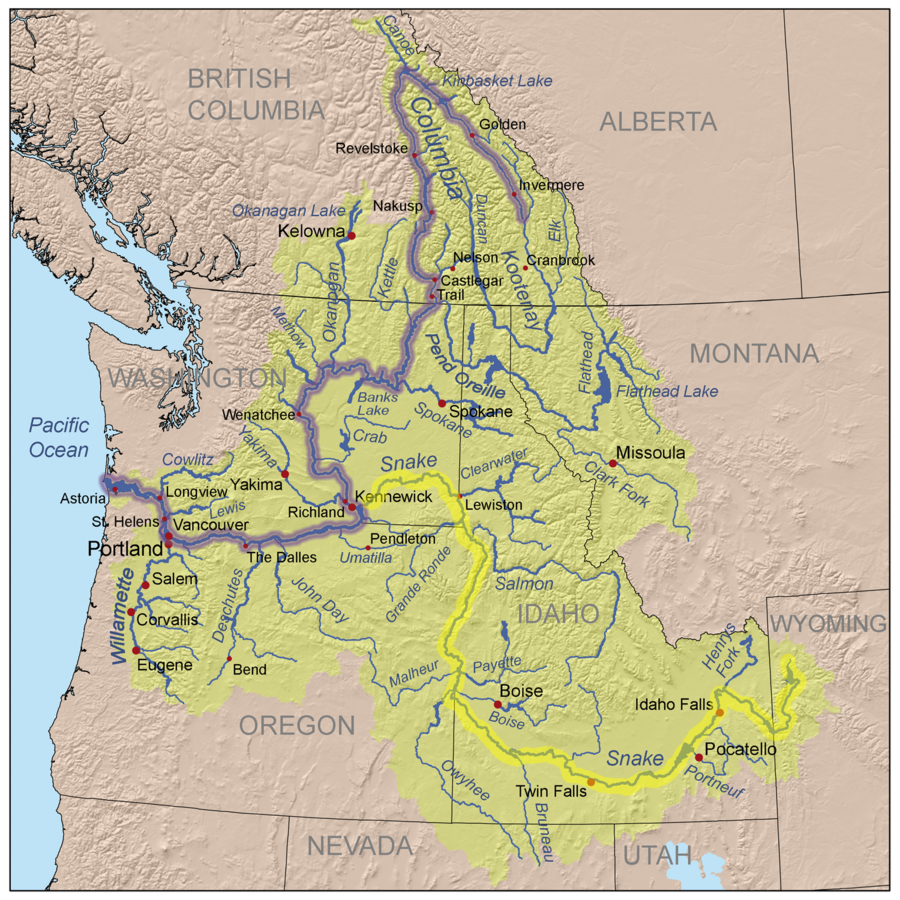
We mentioned the Pacific? In the Yellowstone area, some water runs to the Atlantic, as we saw. On the other hand, though, some water goes to the Snake River and then to the Columbia while picking up tributaries from Idaho, Nevada, Oregon and Washington. A major tributary of the Snake is the Salmon River. 

And from the Triple Divide that we looked at above, water comes into the Columbia through the Clark Fork and the Pend Oreille Rivers. 

Columbia and Snake Rivers

Remarks: Modified: 02/15/2025

02/15/2025 -- 

Friday, February 21, 2025

U.S., 1820

TL;DR -- New France has always been on the mind from school days. Later, we found that the officer corps of the generation (5th) that drove the Revolution had been trained by the English Crown during the French & Indian affair. The Revolution is coming up for commeration of its 250th. For the 400th, northern New England started these in 2020. Coming up will be Salem MA - 2026. Some of our themes will continue to be rivers, carving the interior, and more. 

--

During the Covid times, we had time to do a lot of research, some of it related to families who came into (or passed through) the middle part of the country after the Lewis & Clark trip and report plus there was study of simultaneous activities in other than the New England part of the country. Mountain men, like Jedediah Strong Smith, were exploring. He went west through St. Louis which became a hub of activity. Jediediah got through the Mojave Desert and arrived in the Los Angeles area where the Spaniards took notice. After that he went up to northern California and was headed back to New England when he met his demise in the area now known as Kansas. 

See these posts as examples: State Missouri, 1821; U.S. Interior; and New Spain. There are posts covering later times before and after the Civil War: St Louis MO to San Francisco CA; Trapper, trader, rancher; and Old L.A. and the U.S. Our focus is across the board and 400 years: Boone, himself; Two different times; and, even, Josiah Willard Gibbs. That last one deals with serious early reserach in thermodynamics that got the attention of Maxwell, Planck and countless others. 

----

We have followed a Space in Quora that deals with Spain, including people and events related to New Spain's ventures on the American continents. And, we have a particular interest in California with family involved with New England's long reach across the interior. Too, the writer of the post lived (and worked, studied) in CA, including dwelling on the Bunker Hill area of DTLA for a while.  

Today, we saw this map in a post on Quora (next section) which got our attention. The Adams-Onis Treaty was signed under the adminstration of John Quincy Adams (kin - see Mary Gardner Boylston) and represents the increase in activity that followed the Revolution which is coming up this year for recognition. 

Frankly, we like the map as it represents one of the views of the time. Also, we already have noted that New Spain (see New Spain span) has not gotten the attention that we saw with New France. So, we will be paying more attention, starting with the left coast side of things. 

--- post in Quora Space -- 

In the post, which is an answer to a Quora question (Who founded Los Angeles and in what year did California become a state?), there are interesting historic details including photos. The Quora Space has been a good resource. Our post is to recognize its importance. 

---

And, we have two views to balance: the 250th - Lexington/Concord imminent; the 400th - Salem is next year - 1626 - Massey's Cove. 

We would like to point to more information on New Spain in those same times. 

---

We will get back to this topic after more review of those early years of the U.S. For completion, we cannot ignore the great state of Texas (Juneteenth; Pre-Civil War, San Antonio TX to San Diego CA). This map is from a couple of decades later which is pre-Civil war. 

U.S. Territorial Acquisitions

Other topics will include the U.S. Interior and Carving the land. 

Remarks: Modified: 02/21/2025

02/21/2025 -- 

Saturday, August 16, 2025

American rivers, flow

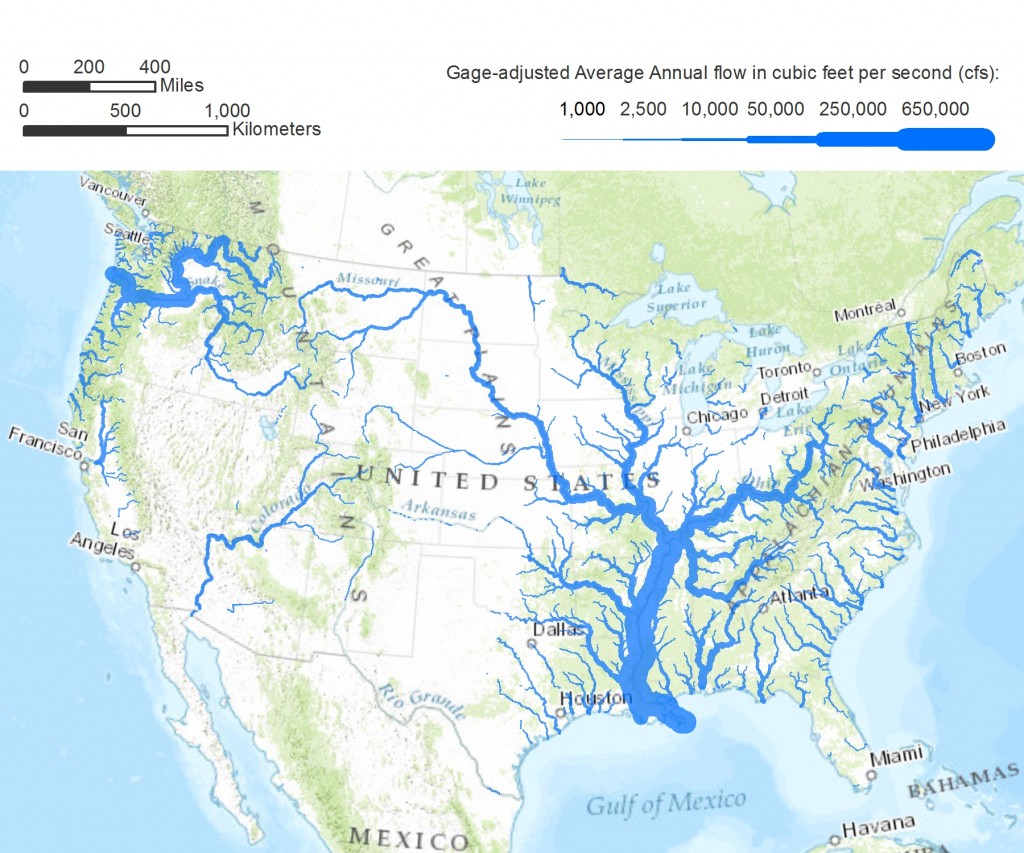
TL;DR -- We saw a graphic while browsing that was not attributed. So, we went looking and found something similar. It shows the comparative flow of the major rivers. The Ohio River stands out as does the Mississippi River which it feeds. Rivers in the southwest are drier by nature. But. they have lots of people drawing off of them. 

--

Rivers are a favorite subject. We enjoy them many ways. Some are famous. Others seem to have disappeared. An example is the Arkansas River that comes out of the Rockies of CO and crosses several US States before joining the Mississippi in AR. Along the way though, if one searches for the river it seems to have disappeared. But, the flow went underground and reemerges sufficiently to support barge traffic from Tulsa, OK to New Orleans, LA. 

On the other hand, the mighty Colorado River comes out of another part of the Rockies in CO and heads down to the Gulf of California. But, along the way, it is dammed (for Lakes) and tapped for people and crops. By the time it gets to Mexico, it is a small portion of itself. 

Those are two western examples. Looking east, the Mississippi gets a large flow from the Ohio River after it has joined with the Missouri River near St. Louis, MO. Lewis & Clark was on both. They took the Ohio down to the Mississippi, then ventured north to travel up the Missouri River, to its source. In doing so, they also looked at some of the rivers of the northwestern part of the US.

What motivated this post was seeing a graphic and looking to see its source. We show the graphic below. At the same time, we looked at some of our earlier posts as they presented graphics too. Let's list a few of these and then add in a new graphic. Each post has a graphic with respect to US rivers. 

  • Continental divides (Feb 2025) -- we think of the Divide that we cross as we travel east-west in the western part of the U.S. But, there are other divides. 
  • New Missouri (Aug 2022) -- when one compares the upper Mississippi to the Missouri, the question about naming comes up. This was really the Missouri River which contributes more water from a longer route. Whereas the flow from the north is shorter and looks larger. 
  • East meets West (Jun 2022) -- the Gardner River flooded and got our interest. It flows through what is known as Gardiner, MT. The map shows all of the watershed of the continental U.S. 
  • Research notes: Rivers (Feb 2021) -- looks at some western rivers (Yellowstone, Gardner, ...) in an area where water goes either east or west.  
  • Rivers and more (Feb 2021) -- looks at the Mississippi and one link from the west to the east via the Fox River.  
  • How great? (Feb 2023) -- looks at a couple of elevation maps of the U.S. This is to put the below material into perspective.  

We started really looking at rivers during the time of the pandemic. We were doing a lot of research which involved families who came west after the time of the U.S. start. This relates to the 250th anniversary of the birth of the Nation. Then, as we researched, more and more information became pertinent. This work precipitated our use of Frontier century and Lost generation. 

First, let's put up the graphic which shows the comparative flow of watersheds that reach a certain rate of flow. Some of these show up with a light color since the flow is reduced severely as the water makes its way out of the mountains to the shore. 

American rivers
Pacific Institute

In the middle, one sees the long reach of New England with the Ohio coming down to the Mississippi. So, stepping back, one can see the importance of the use of the Ohio in movement to the west. Wagons were brought west, moved north on the Mississippi, and then went up the Missouri. At that point, the wagons went west by land with rivers to cross. That shows rivers in two roles: means of motion; barrier to progress. We looked at the second one in our look at the New England party that left Boston and journeyed to Lawrence KS for two reasons: define a State; start a University. 

Remarks: Modified: 01/03/2026

01/03/2026 - Corrected a typo or two. 


Wednesday, April 21, 2021

Amelia Earhart

TL;DR -- Most think of Ms Earhart as being from KS, however her parents had long pedigrees of New England, both north and south. She was a prodigy and wife of  George P. Putnam. They supported the efforts of the Switlik Parachute Company which was started by a 20th century immigrant from Poland (Austria at the time). This link gives us a technology. We will make that type of connection for all of the centuries of the frontier. Why? The 21st century has already shown us new things. Do lessons from the past still make sense? Well, we really need to identify these first? 

--

Amelia Earhart, from KS, will be part of our series on the Frontier century (post Lewis & Clark). We first looked at Amelia, in 2011, when "Gardner's Island" was mentioned with respect to her disappearance. There is a discussion of the naming on the Wikipedia page. Later, we were contacted by John Goff (Salem Preservationist) who had been searching, too, due to reports of findings that might be related to her loss. Since then, there have been other mentions in the media from time to time. 

Recently, we noticed that a Switlik Parachute had a Putnam as an early investor with respect to training via a tower. Turns out that he was Amelia's husband and soon-to-be widower. Well, the name Putnam is old Salem; on a closer look, Amelia has a balanced pedigree from Maine to Virginia with stops in-between, CT, NY, MD, and PA. 

Amelia and chute drop
(see history of parachute, below)

So, all three are cousins, of some sort to be sorted out (it's easy on this side of the pond since New England kept good records). Which brings up this adage: what's in a name? We'll get to that. The focus ought to be Poland, though, in its many configurations while the dynamics here played out (over 400 years). Switlik in Poland is like some families in Brit-ville and here: Gardner, Porter, even Davenport (several of that name) and others. 

Aside: Former President Bush (1) used a Switlik when he was shot down in WWII.  

For now, a few links:

Some of Amelia's lines are: Otis, Cornell, Swazey (Swayze). That last is a family that came to Salem and split. Not unusual. One part stayed in Salem and its surrounds. The other went to Long Island and branched from there. BTW, the journalist (TV) and the actor (dancer) are of the southern variety. We'll post more on the northern kin. 

Relates to the west: Frontier century. As well, we will be looking more closely at work related to the 400ths in a different sense. First, we need to look across the board at the 70 or so towns and cities that came about in Massachusetts. Each has its own founding families and history. Too, on any day, we really could look at the 100th (say Amelia's time - end of the frontier century), 200th (start of the frontier century), 250th (Revolution with nods to DAR and SAR), 300th (that would have been not long after the Salem ordeal of the witches) and 400th. 

A technology theme will be continual. Some might say spectral. What's next? Meaning, the 21st century? Computing plus human abilities long left ignored. However things start to unfold, lessons from the past will continue to be of importance, if only we paid attention. 

Remarks: Modified: 04/23/2021

04/23/2021 -- Modified Putnam's involvement to the training venture. 

Saturday, June 18, 2016

Gardner's Beacon, Vol. VI, No. 1

The current issue of Gardner's Beacon starts to look at upcoming 200th anniversaries. More people went out west through the various trails (Westward Ho) than arrived both in northern New England and its southern counterpart. In those early days, there was motivation to go west. For one, claiming land would keep out settlers from other countries. In that case, there were conflict with the American Indian population and with other countries.

By the time of the end of the long American Revolution, people were ready to go west. Lewis and Clark helped capture the imagination. Families took the long trek to Oregon and California. During the gold rush, many 49ers went out by the trails.

An older trail, to Santa Fe, provided the starting point. But, as more people gathered, there were issues, such as a cholera outbreak, that establish another starting point, present-day St. Joseph, MO. Too, the 49ers were in a hurry and wanted to take some days off the trip.

The story would not be interesting without the people. That launching point for western expansion turned out to be where early conflicts started between pro- and anti-slavery proponents. "Bleeding Kansas" was more than a name.

And, New Englanders were heavily invested in the area, in terms of money and blood and sweat.

Of late, DNA has been put on the plate and will be getting more attention. Lots to discuss.

Charles Sanders Peirce (his father, Benjamin) did some marvelous work without much attention. He died destitute. He was the first to look at abductive approaches (see DNA above). Also, he was probably the best mind of that generation, though Eliot of Harvard did not think much of him.

---

See Vol. VI, No. 1 of Gardner's Beacon for a review of research to date. Sources: Oregon-California Trails Association (Trails, again).

Remarks: Modified: 04/23/2021

06/19/2016 -- Switched to larger font, two pages, and introduction to Charles Sanders Peirce.

Friday, October 14, 2016

Another trail

Earlier, we looked at the western movement (Westward Ho) that started after Lewis & Clark let the easterners know about the huge country to the west. As well as going on land, there were ways by sea. One was long and around the Cape. The other consisted to two sails with an arduous crossing in Central America.

There was another trail. That followed by the Mormons (Mormon Trail). It had some commonality with the Oregon Trail, however the mode of travel was somewhat different after the earlier trips. Putting together proper supplies for the trip required funds.

There were many who wanted to go west, yet they could not afford to do it in the normal manner. So, they went on foot, pulling hand carts: Mormon handcart pioneers.

While researching the western flow, I ran across a book that provides information about those who took the journey. There is genealogical information; plus, their arrival and with what company is noted. Each year, people formed groups that traveled together.
Both of these reference Gardner/Gardiner families. Some of the families came from Europe. We will look at that further. The later issue of the book has more information with photos.

There were many New England families, such as Herber Chase Kimball. Herber was the grandfather of Spencer W. Kimball (LDS President 1973-1985).

The launching point for this moving over land was western Illinois. There were many New England families that were involved in the development of this and surrounding states. We will look at some interesting aspects of that.

Meanwhile, some links to further material.
An example of movement by sea is the Brooklyn that sailed New York to San Francisco in 1845.

Remarks: Modified: 10/15/2016

10/14/2016 --