Showing posts sorted by relevance for query gardner ks. Sort by date Show all posts

Thursday, April 10, 2025

A trillion cuts by GenAI

TL;DR -- We saw a Chrome report which featured Gemini with respect to Gardner KS and its role in the trails west, one of which was the Oregon Trail. And, the report was not right. "Who cares?" has been my response to having Gemini spout off. I ignored it like I am very good at doing with ads. But, today, I read and saw errors. Okay. What to do? There is no method now. People are training these things. I say, you will not train out the crap. Okay. I wrote this post as an intro and was going to snap the Gemini report and mark it like a teacher would do an exercise. Oh, Gemini, my sweets, you left without telling me. What?  

---

Our purposes are several. An important one we have named as All Things Gardner. There are lots of families with the name Gardner. "What's in a name?", we asked once: Amelia Earhart. 

We have been at this genealogy and history work since 2010, learning as we go. On the other hand, we have decades of advanced computing experience under our belt (mainly, situations requiring precision). So, our work here has been largely abetted by computing which has changed in so many ways in the past 20 years (2 decades of decline in some areas). 

We have striven to be correct as to former work. But, we know that is not sufficient. Technology has aided in the digitizing of old records which have been analyzed via human effort and mechanical means such as OCR. A case in point is that we do not know the origins of Thomas Gardner about whose progeny we know a lot due to records over the past 400 years. So, that is an issue to resolve. 

As we work the solution, we have adopted a category: OpEd (category). That will be used to label any of the former posts that touch upon the subject. The information will not be entirely wrong. So, when we figure out the corrections we will make them. Until then, someone can still follow our approach and analysis as we looked at new material. 

Aside: the genealogy crowd split Thomas Gardner into two guys, one who was at Cape Ann with the Dorchester Company and one who is the ancestor of a whole lot of folks. Myself? I think that they are the same guy or were father and son. Both of those alternatives have some basis. The intent will be to find the truth: A Thomas here and a Thomas there. 

And, we would like technology to be of assistance. And, it can. See Bosworth and Gardner, with new revelations coming about of late through use of the facilities of Grok. How well this will stand up though remains to be determined. The battle settled the 100-year war (some use, War of the Roses - I say, cousin war - needless bickering). 

Anyway, this post will look at Gemini which we have liked. But, it is now on the top of a search report. And, I was trying to look at Gardner, KS being right this minute not far from that place. We have had many posts on the little town which we have buzzed by on I35 for countless times. 

---

Now, that was an intro. Here is the gist of the post. This image was snapped from a Chrome query today. ... Wait, did not snap the earlier search. Now, Gemini has disappeared from its featured position. 

Inserted as placeholder 4/11/25 0457 AM CDT
--- 

Note (04/11/25 0458 AM CDT): the absence stopped the flow. "How to handle?" was the question. The following text is from the post from last night. The image was to show what Chrome was presenting. 

---  

Actually, earlier, when I read the Gemini summary, I scrolled and found this first on the list which is from the National Park Service. Gardner was a stop on the earlier Santa Fe trail which was largely commercial going from St. Louis as the gateway to New Spain. 

That trail passed through Independence MO. So, Oregon traffic followed that same route to Gardner and then turned to the north and west going by Lawrence KS which is the site of the University of Kansas which was founded by a group of New Englanders who came out, including women, by that same trail through Gardner KS.

Later, young bucks in a hurry figured that they could take the Missouri River north from Independence past St. Joseph MO into Nebraska and head west from there. Guess what? They eventually met up with the travelers who had come up through Gardner. What did the folks in a hurry gain? Maybe, two days, perhaps a little more. 

But, gold gets the blood boiling. Like? Things easily hyped. 

Note (04/10/2025 2100 CDT) - On going to the Google development mode, I see that there is a new button ("Vibe") which I have been reading about. Sometimes, I might add as it sounded like the usual affair of misdirected enthusiasm. Whatever is going on in the background with this problem will settle down. Then, I'll use this topic for a deeper look. In any case, running into a "tantrum" however invoked does not make for stable knowledge processing. 

Remarks: Modified: 04/11/2025

04/11/2025 (about 0500 CDT) -- Put in proxy of the expected image and a note to explain. Something related to "Who moved my cheese?" (when did that become normal?). 

04/11/2025 (0738 CDT) -- It's back, AI Overview. But, buried under a label. The only quibble is the use of intersection for a split. I dealt with precision in highly technical engineering support work (computational modeling). 

Kudos, somewhat. Let's talk.


Monday, March 17, 2025

Independence and Kansas City

TL;DR -- Trails were and still are in the sense of leaving tracks on the landscape (several places along the Santa Fe and Oregon Trails. And, now the Interstate Highway system with all of the national, state, and local roads. And, going further, even now dirt roads as tracks. Sometimes converted railroad tracks. 

--

With all that is going on in the world, and in the U.S., it is time to look back at the past. In 2020, we got the opportunity to spend time looking at the interior of the country which is huge. In terms of time, we had a frontier century (post has copy of photo of Lawrence, KS by Gardner). We got to learn about the trails and the cities that cropped up (theme of this post). We determined that there was a lost generation or two (Boone was real; officer in the US Revolution; Longhunter; traipser of land (all the way past KC with time spent in western MO) in the movement that came to fore as we looked at the upcoming 250th of the US under the auspices of the Daughters of the American Revolution. Doing applications for some requires lots of additional work. 

Before 2020, we had looked at the trails and those earlier like Jedediah Strong Smith. Gardner, KS was seen as a hub of traffic and activity. Also, we had looked at both land and sea traffic to the left coast (Old LA and the US - as in Los Angeles, CA - in particular, Bunker Hill West, where the culture went back to New Spain and then through several cultural shifts to the current canyons of high rises).

---

Now, to the theme. We saw a video of a talk about the trails and how they came into Kansas City and left. It was of the first part of which there will be another. We mentioned Gardner, KS where 3 Trails split. The Oregon went over the Wakarusa River into the Lawrence area and then up to Nebraska. Even in that trek, the rigors of getting people and goods across the land was obvious, especially trying to get over waterways which were boons and banes (mostly the latter for many). 

The talk: How Independence & Kansas City Became Trailheads for the Oregon/California/Santa Fe Trails, Part 1. The following image came from the talk. On the map (a modern map showing some roads), Independence, MO (where Pres. Truman came from) is on the upper right. Gardner, KS is on the lower left. 

Indepencence, MO
Gardner, KS

In the top middle, notice Wesport which is on the Missouri River. After a little bit of time, impatient travelers (read, young men off to the coast with gold fever) realized that they could take the river up past St. Joseph, MO (famous for the Pony Express) and then a little further north, they could head west in Nebraska. While doing that, they would meet travelers coming up from Gardner, KS. But, they would have cut several days off the journey. 

OCTA, sponsors of the research and talk

---

Notice that this is about the early times. The railroad came into play after the Civil War. 

Generations? By this time, say before the Civil War, we were to the 8th generation from the start of New England. The Revolution was mostly of the 5th generation. 

Cultures? As we have noted, there were the News: Spain; France; England; Sweden; ... The left coast allows us to look at the first; Quebec, Canada is representative of the second; we had both a North and and a South for the third; and so forth. 

---

KC? MO and KS. Missouri and Kansas. We need to look at the area a little further. It's known for beef and barbeque. Well, cattle came up from TX to be shipped east to the hungry easterners. Too, the breadbasket founded itself on the rich lands of the area. Boone, as said, was there early. It's sister city in MO, St. Louis, was the administrative and bureaucratic and entertainment hub. See early Missouri, for instance. 

Remarks: Modified: 03/17/2025

03/17/2025 -- 


Monday, September 2, 2019

3 trails

We have had several posts looking at places with the Gardner name. One of these is Gardner, KS near which is Gardner Junction which was on the three trails: Santa Fe, Oregon, California. This is unique, to be where the travelers all were at the same place. The research query was in regard to some particular places, but we know that we need to get a more full list (pending).

Recently, we were in the area where the Trails were going toward Gardner. As well, we thought to look at more details (below). This same route was taken by the New England party (men and women) that left via a port in New York and sailed to Chicago before traveling over to St. Louis and west to Kansas City. They got to an area and established Lawrence, KS (Final migration, Lawrence and Kansas).

On looking deeper, we found the 3-Trails Corridor (defunct link). This was funded by a school initiative that looked to be associated with the Lewis and Clark celebration: 3-Trails Village Community Improvement District. We will look at this further. But, here are a couple of maps. One is from our earlier post. The other depicts points along the route.

Gardner, KS
We have had several posts on this theme and will be adding more. It's about time for a summary look which will appear in the next issue of The Gardner Annals, Vol. V, No. 1. The trails played a major role in the western movement. Too, we need to add in the Mormon experience.

As mentioned in an early post, there were to sea routes to California: around the Cape, two  voyages linked by a trek across Central America.

The gist is that this type of detail work is what one expects from a location. Same goes for a family. There may be major overviews, but a lot of the grunt work needs to be done by the family. Dr. Frank showed us one example. We still have lots of work to do.

So, there are several pending bits of work with Gardner Junction which is the southern trek out of the Kansas City area. This route was fine for the folks going to Santa Fe. But, it was out of the way for the California (gold rush) and Oregon trekkers. It went too far south. Young bucks figured out that they could continue north by water to St. Joseph, MO. This area became last stopping point where dry goods and other merchants had supplies at hand. The travelers still had to cross the Missouri river.

As an aside, some earlier posts looked at the trek from New England to Lawrence, KS. The movement was by foot, for the most part, in the last part of the journey. And, there was a river to be forded prior to arriving at Lawrence. So, this was practice for something that would be a continual source of grief all of the way across the country.

Far cry, one might say, from the easy of rushing down the Interstate. BTW, that subject is of interest, too, since many of those merchants were Yankees.

Perspective: From the KC area to Fort Larned (see the Kansas part of the Santa Fe trail - about 2/3 across the State), the experience was a daily grind for three weeks (makes "are we there yet?" which is known from another perspective to be quite tame). At least, at some point, those same persons saw the Sangre de Cristo mountain range. We have a post on that, too.

This image shows the area near Gardner KS where one finds a kiosk with information about the 3 Trails and Gardner Junction.

Remarks: Modified: 06/24/2022

08/07/2020 -- In this post, we are looking at two disparate spots that share a name, however there are many points in-between. Like Eudora, KS. Where "The Wakarusa meets the Kaw" is on their history site and is an example of local lore getting some attention. See "Along the Western Trails."

08/27/2020 -- Removed stale pointer to 3TrailsCorridor which dealt with the portion in MO: The 3-Trails Corridor follows the traveled way of the Santa Fe,  Oregon, and California national historic trails. It extends from Wayne City Landing on the Missouri River in Sugar Creek, Missouri, where the river boats off-loaded onto wagons and pack animals, southwesterly to Gardner Junction in Gardner, Kansas.

06/24/2022 -- Updated links to Eudora's website as topic continues to be of interest: A Ride to Kansas. 

Friday, November 7, 2014

Places and names

Context: Gardner place names

This week, there was a query from Dr. Stuart Gardner Garrett of Oregon about the "1850 Gardner connection" with the ship, Bostonian. Did we know?

Well, no; however, there is an interest in places as they involve people. And, this story is very interesting. Too, Gardner Research has this as one of its foci.

From one account, a ship coming up from San Francisco found another that had run up on a sand bar in a river in Oregon. One story was told by a descendant of a passenger on the later ship, Kate Heath. The ship that was lost was the Bostonian.

Firstly, there were no lives lost; the crew had saved the cargo which was of a very useful variety. As well, the crew had begun to dismantle the ship which was used to build structures in the town that was to be. The cargo was stored on shore under the ship's canvas. At that place, the town was built using the ship's lumber and part of the supplies.

The town? Gardiner, OR. It was named after the New Englander, named Gardiner, who had funded the ship. The descendant's account said that Coffin was captain. Actually, the captain was George Snelling who was a nephew of Mr. Gardiner. Another thing of note is that Winchester, Payne & Co. was involved.

The History of the Pacific Northwest (Volume 1) had a nice coverage of the story. But, they did not have much about Gardiner. There were various suggestions in many later writings.

Finally, research done for the National Register of Historic Places pulled things together (see page 8) in 1994. They identified the owner as Henry Gardiner, also Coffin was captain of the Kate Heath. Later work, added an initial. So, we have Henry D. Gardiner.

But, who was, and whence came, he? To be studied further.

There will be regular "Places" posts, due, in part, to the stories associated with them. Descendants of New England's Gardners can be found everywhere in the U.S. New England towns drove all sorts of settlements (to wit, Ipswich Canada which covers the area near Gardner, MA but fairly remote in the 1600s). Lawrence, KS has a main drag of Massachusetts Avenue due to the influence of the founding folk. Not far away is Gardner, KS. Perhaps, a list of cities/towns named Gardner/Gardiner in every state ought to be done.

Back to Henry, though. Unfortunately, "Bostonian" was popular for names of all types of boats (oops). Too, did no one in Oregon ask particulars about Henry, at the time? This seems so much like the case of hidden information about Thomas.

Remarks: Modified: 02/09/2020

11/19/2014 - Henry D. Gardiner and his life/times.

12/23/2015 -- Places to research origin of: Gardner - CO, IL, KS, MA, ND, TN, WI, NJ; Gardiner - NY, MT, ME.

03/17/2015 -- Timeline of the barque Bostonian

04/07/2015 -- Article submitted for review (see Timeline).

08/07/2016 -- Gardner, KS; Gardiners Island; Gardner, CO

08/17/2018 -- The 2nd wife of H.D. was Caroline B. Turner (see note this day at this post) of Maine and not Caroline C. Turner of Nantucket.

03/02/2019 -- Update of information (lots - Gardiner that was, Historic Puzzles). Added the image as we're building an index via images at our portal to truth.

02/09/2020 -- A couple more places: Gardner, IL; Gardiner, MT.


Tuesday, August 11, 2015

Gardner, KS

Earlier, we looked at places with the Gard[i]ner name. Then, we took Gardiner, OR and wrote about the person for whom the town was named, Henry Dearborn Gardiner (pg 31, v 35, no 1, TEG; pg 6, v II,n I, The Gardner Annals). That same family was the inspiration for Gardiner, ME.

So, talking of Oregon, there is a town on the trails (see next) in Kansas, named Gardner. It may have been named for Henry Joseph Gardner, Governor of Massachusetts (1855-1858) as there were many pioneers from Massachusetts in the area.

First, about the town. It was where three trails split into two: Santa Fe Trail, Oregon/California Trails. The Santa Fe Trail ended up in a city in one of the oldest areas of the U.S. The other two trails were coincident until much further west where the California Trail headed south; after going west out of Gardner for awhile, they headed up to Nebraska then west to what is now called Wyoming.

Now the Gardner was Henry Joseph Gardner who was a descendant of Richard Gardner of Woburn who is on the list provided by Dr. Frank (the Gardners and Gardners post is the most popular all time).

---

The mid-west and central parts of the country are full of displaced New Englanders. A little up the road from Gardner is Lawrence whose main drag is named Massachusetts.

Remarks:  Modified: 06/24/2022

04/02/2016 -- Map showing Gardner Junction and the split of the trails west of Gardner, KS.

08/13/2017 -- Posts on Lawrence (and surrounds): Trails West, Westward Ho, Blogging and such, Final Migration, Thomas Wentworth Higginson, Kansas and Lawrence. 

10/26/2018 -- Map of Gardner Junction. 


08/07/2020 -- In this post, we are looking at two disparate spots that share a name, however there are many points in-between. Like Eudora, KS. Where "The Wakarusa meets the Kaw" is on their history site and is an example of local lore getting some attention. See "Along the Western Trails."

06/24/2022 -- Updated links to Eudora's website as topic continues to be of interest: A Ride to Kansas. 

Thursday, March 3, 2016

Trails west

In 2014, we did some research related to the origins of Gardner, OR. An article in The Essex Genealogist (TEG, v 35, no 2) and The Gardner Annals (TGA, Vol II, No 1) provided details about the ship (barque Bostonian) that wrecked at that site, its owner (Henry D. Gardiner), and some genealogical information. Henry was a descendant of George of Rhode Island, but his wives were descendants of Thomas of Salem.

Prior to the time that the ship left Boston, it had run up and down the east coast and points further. In the same year of the shipwreck, the Bostonian had been New Zealand.

Last year, Philbrick's book about the whaling ship, Essex, that was out of Nantucket, was made into a movie. Recently, I read the book (only saw the preview of the movie). I don't know if the movie went into the cannibalistic events, however they are described in Philbrick's book. This gives one pause or ought to. But, we'll not go further into the subject. The book is exemplary due to its attention to detail plus to its copious notes.

However, there are some humorous notes. Philbrick talked about the loading process that preceded the voyage. Too, the crew had to be put together. Of course, Nantucket'ers were preferred but scarce. So, they had to cast a wide net to get the manpower. As you would expect, many on the crew would be newbies (tenderfoot out west - see below). Philbrick writes about the Captain having to be out on deck during departure so as to direct the crew. And, it sounded like it could be like Keystone Kops. So, embarrassing to the old salt.

You see, everyone on Nantucket would know when a ship was leaving. And, they would all be down to watch the spectacle. Now, a ship in full sail and under control is a sight to behold. Yet, that would not be the case. And, Philbrick wrote about the Captain being aware that those with long-glasses could watch the going-ons for a long while until the ship was out of sight.

The book is a good read.

Now, on another subject, the Bostonian went from Boston to San Francisco in 1849. It left in July and arrived in January 1850. That was the long way to S.F. by sea (if it were the only one open to the flower children, 1967 would not have happened). Another sea method was to go down by ship to Central American, cross over, and then back up the left coast by ship. That required two ships, at least. The journey across Central America was arduous. Also, there were things of concern, such as diseases, thieves, and other perils. Many lost their fortune on the way back after having found success in California's gold mines. Some disappeared.        

Henry D. Gardiner (and, Gardiner, OR)

---

But, there was another way to the west coast: moving oneself over land. Last year, we looked at Gardner, KS. Some say that it got its name from the Governor of Massachusetts (Henry Joseph Gardner - descendant of Richard of Woburn) at the time that a group of New Englanders came to the area. They founded Lawrence, home of KU.

Gardner is not far out of Independence which was the starting point for the trails. They were together until west of Gardner. Then, the Oregon (California) bound wagons went by Lawrence on their way west. The Santa Fe trail headed southwest.

One thing to note is that from Independence, MO to Fort Larned, KS, nowadays, can be done by car in the matter of hours. It is a little less than 300 miles. A lot of it can be done by Interstate Highway. Back in the days, the wagons took three weeks (as in, 21 days) to do that trip. And, it was constant work every day.

On the trails west were Thomas Gardner descendants. Many people stayed at locations that they passed. That was how some cities grew. All along the trails, we find little cities where people decided to stop and grow roots. The advent of the transcontinental railroad (1869 - last spike) saw the same sort of phenomenon.

There was another trail, though. That one was related the western movement of the Mormons from the area of Nauvoo, IL to Utah. Again, many of these travelers were from New England.

---

Why the interest? I have run across several diaries (published) from the time that we can look at in more detail. Many of the diary writers have ties back to New England and its roots. We have had an interest for some time to map out movements west. Some families have described movement to the south, first (Carolinas), before the western thrust.

Too, though, there are always reminders. New Mexico, as a State, was 100 years old just four years ago. It is one of the late comers in terms of statehood. But, it is a very old culture.

Coronado was there and in area of present-day Kansas, in 1541. That was long before there was New England activity. As we get toward the 400th, we will see lots of interest in regard to all of the different places and cultures that make up the current populace's history.  

Remarks: Modified: 06/24/2022

04/02/2016 -- Map showing Gardner Junction and the split of the trails west of Gardner, KS.

06/17/2016 -- More on trails.

07/16/2016 --Gardner's Beacon, Vol. VI, No. 1

08/13/2017 -- Posts on Lawrence (and surrounds): Trails West, Westward Ho, Blogging and such, Final Migration, Thomas Wentworth Higginson, Kansas and Lawrence.

08/07/2020 -- In this post, we are looking at two disparate spots that share a name, however there are many points in-between. Like Eudora, KS. Where "The Wakarusa meets the Kaw" is on their history site and is an example of local lore getting some attention. See "Along the Western Trails."

06/24/2022 -- Updated links to Eudora's website as topic continues to be of interest: A Ride to Kansas. 


Saturday, August 6, 2016

Gardner, CO

Context: Gardners and Gardners.

Two years ago, we received a query about Gardiner, OR. The question was: for whom was the town named? While getting information about the town in Oregon, we went through a list of places in the U.S. with the Gardner (Gardiner) name.

Turned out that Henry D. Gardiner was the namesake of the Oregon town near where his ship (barque Bostonian) wrecked in 1850. This Henry was a descendant of George of Rhode Island.

Lately, I have been following trails west in terms of the long reach of New England (both north and south). Travelers going west who left from Independence all went by Gardner, KS after which the Santa Fe and Oregon Trails split (Gardner Junction).  The town was named for the Governor of Massachusetts, Henry Joseph Gardner. This Henry was a descendant of Richard of Woburn.

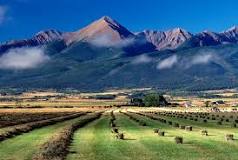
Today, we go to the region of the Sangre de Cristo range. This impressive range was visible to those who took the northern part of the Santa Fe Trail. Rather than cut down toward Las Vegas, NM, the travelers went west and joined up with traffic coming south from Denver and other northern points.

On their way south, the wagon went through what is now Walensburg on their way to tackle the Raton Pass. A mere 30 miles or so to the northwest of the Walensburg area, we find Gardner, CO.

The area has a long Spanish history. The Spanish Conquistadors visited. Settlement from the east began in the 1850s. The Post Office had the Gardner name in 1871. The town is named for Herbert Gardner who was the son of Governor Gardner (MA). So, Herbert was a descendant of Richard of Woburn.

The below list is of interesting reads about the area. Some have photos of the area, including a landmark named Gardner Butte.
This site brought together two old cultures. Santa Fe, which is south of Gardner, was the mainstay of northern Mexico from the 1500s. The trails carried travelers from the east on their way west. As such, the trail travelers had covered more miles.

There are a few more Gardner locations in Northern America for us to mention.

Remarks: Modified: 12/03/2019

08/07/2016 -- Gardner, CO is at the entry of the Wet Mountain Valley. Herbert Gardner introduced agriculture into the area early.

12/03/2019 -- Updated link to image of agricultural field.

Friday, April 28, 2023

California, Golden State

TL;DR -- Our first bit of tasks dealt with learning about New England, especially little Essex County of MA. Later, we considered movement away from that area either to the south or to the west. And, by water, too, as that traffic had been constant from the beginning. After the Revolution and Lewis & Clark's journey, the expansion started in earnest. However, the interior of the U.S. is huge and took a while to be carved up. Travel across the country took time by land. And work. Too, water travel was full of its travails. With the 400th from the beginning, the 250th coming up relates to the U.S. being populated. California will get a little more focus as it is first by many categories. 

---

Our first mention of the Golden State was in 2015 which is the sixth year after the blog had its first post. It was a brief mention as we researched the Barque Bostonian owned by Henry Gardiner that wrecked in Oregon. The ship had been in San Francisco prior to that. But, we found out that it had also been in New Zealand and a number of other places. 

Then, about that time, while being at a lavender farm near Lawrence, KS and realizing that the trails had passed through that area, the thought was: did the students up on Mount Oread see the trekkers as they labored past? The post: Gardner KS (11 Aug 2015). We had seen signs while traveling but were overwhelmed with learning New England particularities. Even little Essex County was unknown to us and took some time for study. A year later, we started to update the information dealing with the western movement (Gardner Junction).   

Of course, given the drive to get to the gold rush as fast as possible, the CA traffic dwindled after the young guys figured that going up the Missouri River past St. Joseph saved them a few days. Rather than the circuitous route into upper KS and then heading northwest to NE, they just got off the boat and joined the trail goers after a shorter jaunt. But, traffic to the southwest (Santa Fe) still went through Gardner, KS as did some going to CO first and then joining the OR/CA trail in Wyoming. 

That deals with movement by land. While researching the early venturers (mountain men, trappers), we looked at CA, too, principally. Though, Jedediah Strong Smith got there in 1826 and was the first European to go across the Mojave desert (even doing so in the summer). Then, he mapped out the Interstate system with his wanderings before coming back to meet his demise in the Great Plains region. Along with and after him, there were other travelers that we looked at. 

But, there is an area that we have avoided, to dated. How did CA end up with its 1850 entry into the U.S.? For this historic portion, we will use documents published by the U.S. By 1847, the area of California was home to 150K indigenous people plus about 14K folks of European ancestry. Most of the Europeans lived south of Monterey, especially Los Angeles. San Francisco (then Yerba Buena) had a scattering, until after the 1848 discovery of gold at Sutter's who had arrived in 1838. In 1849, 100K additional people arrived from the U.S. and Australia, New Zealand and Hawaii. 

We will back up and look further at New Spain in California. Mexico had won its Independence in 1821. As well, we will look into the lives of the indigenous folks prior to and after the arrival of the Europeans. 

There will be more posts on this and other states. As well as New England States and Missouri, we have looked at Virginia, Kentucky, Ohio and Michigan which got started after the Revolution, mostly by restless veterans. So, we will cover the States, interior and along the coast lines. 

Remarks: Modified: 04/28/2023

04/28/2023 -- 

Saturday, March 5, 2016

Gardner Junction

In the last post (Trails west), we looked at ways to get from the East Coast to the West Coast prior to the modern age. Of course, the choices were by land (below) or sea. In terms of the latter, one could cut across Central America or take the long journey around the end of South America. We can show examples of each of these.

Now, the American Indians were in all areas of the country prior to the arrival of the Europeans. Then, there were many mountain men and other explorers around and about. Lewis & Clark was the first organized party sent from the U.S. Spain had already ventured inward from the West Coast and from Mexico. Coronado ended up not far from Gardner Junction.

But, the Trails are, by right, the focus of many as they think of western travel. There were several ways to get to the KC area, but that was the launching point. And, not long after, there was a split at Gardner Junction which is just west of Gardner, KS. This map illustrates how the Trails went after the split.

 
It comes from the National Park Service site which provides three maps plus other graphics related to the subject. One of these deals with the advent of the railroad. With the transcontinental travel via rail being available, the traffic on the Trails ceased.

Remarks: Modified: 04/23/2021

04/02/2016 -- Map showing Gardner Junction and the split of the trails west of Gardner, KS

06/11/2016 -- We have 200th anniversaries coming up.

06/17/2016 -- More on trails

07/16/2016 -- Gardner's Beacon, Vol. VI, No. 1

06/29/2019 -- Example mountain man: Jedediah Strong Smith.

Monday, December 2, 2019

Gardner River

This river flows into the Yellowstone River near Gardiner, MT. As such, these waters flow into the Missouri River and then the Mississippi. Yes, that is a long waterway. Lewis & Clark went back up the other way. Post that, more people went west. One of them was Johnson Gardner for whom the River and the area were named.


Gardner River: Starts in Yellowstone Park, at 10K feet, flows 25 miles, but has a 202 sq mile basin.

Johnson Gardner was a cohort of Jedediah Strong Smith, Hugh Glass (read about The Revenant which names some of the characters), John S. Gardner (killed in 1823 when Hugh Glass was wounded - letter from Gen. Ashley) and others. We are researching families related to these folks.

We started by looking for places with Gardner in the name (and will look at other associations): Gardner, KS, Gardner, CO, Gardiners Island, Gardiner, OR, and others. We'll pull these together some time. The idea is that we might be seeing the 400th recognized; however, the 200th covers a whole lot more territory in more ways that one.

On looking further at Johnson Gardner, we find out that he is out of Virginia. We will be looking further at that.  But, we want to consider the New England influence as we see via all of those names that come out of the area (starting with Cape Ann) and are found in the huge western expanse.

Here's a quick example which will be written further in its own post. Not far from where Gardner River starts, there is a change due to the Continental Divide. And, we find Conant Creek (Wyoming - known as Berry Creek) that flows into the Snake River (History of the Teton area). There's another Conant Creek in Idaho that flows into the Boise River that flow into the Snake River.

This water goes to the Pacific. The namesake of one of the Creeks arrived in the area in the latter part of the 1800s. We will look further at the family history.

Roger Conant is a gpp of Dr. Frank.

Further reading: Human influences on the Northern Yellowstone Range, ...

Remarks: Modified: 04/11/2026

02/15/2021 -- We are looking further at rivers as means of transportations as well as being barriers starting with the Mississippi River system. Shortly, we will update this with regard to how the Gardner relates to the other two flows from this area that do not go to the Yellowstone River. 

02/16/2021 -- There was another Gardner in the area who was with the Gen. Ashley group. We will look at all in that party. The Rocky Mountain Fur Company had been founded by Ashley. It employed Jedediah Strong Smith. We will look at the North American fur trade, in general. 

06/20/2022 -- Recent flooding due to snow melt and heavy rain. Clobbered the area. 

04/11/2026 -- Changed (missing) photo of river with one from Wikipedia. 

Wednesday, September 28, 2022

Rev. Higginson and family

TL;DR -- Cape Ann was a major start, after the dallying at Plymouth. Rev. Higginson had some 300 or so souls follow him to Salem. By then, the early party had moved from Cape Ann where Thomas Gardner was a lead in a crew who were to ship food back. Higginson was a preacher and wasted no time in getting started on that. His family? Interchanges twixt them and other families from Cape Ann and later. We start to look at this as an example of significance. 

---

As the 400ths look back at the Cape Ann event, we see it as an opportunity to identify, organize, and perform research projects on a regular basis. The past twelve years with this blog and with Gardner's Beacon was an effort at establishing a proper basis which will allow us to work and write. One of the tasks will be to look at families in a manner to allow a more coherent view going forward than has been given us to date. Partly, we are saying that this time around, we have the gift of the net (good and bad) to work with. This post is about one such family. 

---

Rev. Francis Higginson came over after Endicott and before Winthrop's fleet arrived bringing settlers on several ships. He was the one who wrote "we found a faire house newly built for the Governor" which we call the Great House that was constructed on Cape Ann and which was then moved from to Salem. See his book: New Englands Plantation; Or, A Short and True Description of the Commodities and Discommodities of that Country. 

For further information on the Rev., we can refer to research by his later descendant, Col. T.W. Higginson, who wrote of the Higginson family. We take a further look at Col.  T.W., below. Let's start a look at the family by considering the times and some of the ties with the Gardner family of Salem. In the Wikipedia post, Col. T.W. is quoted: 

They would have to build their lodgings for the coming winter from scratch. These were some of the first settlers of the Massachusetts Bay Colony, the main body who would start coming in 1630 on the Winthrop Fleet. The Higginson Fleet set sail on the 1 May 1629, arriving in Salem harbor on the 24 June 1629, and was greeted by a small group of settlers, led by John Endecott.
The 1st year
English Wigwam

The bold/italics emphasis is ours. We had a post on the "First year" where we showed a photo of an English wigwam as envisioned by Dow, the Salem expert, during the 300th celebrations a 100 years ago. This type of housing went on for a while until there was an effort to coerce families into building regular housing. That was a distraction from the regular duties related to farming, fishing, et al. 

---

Hannah (Gardner)
Higginson
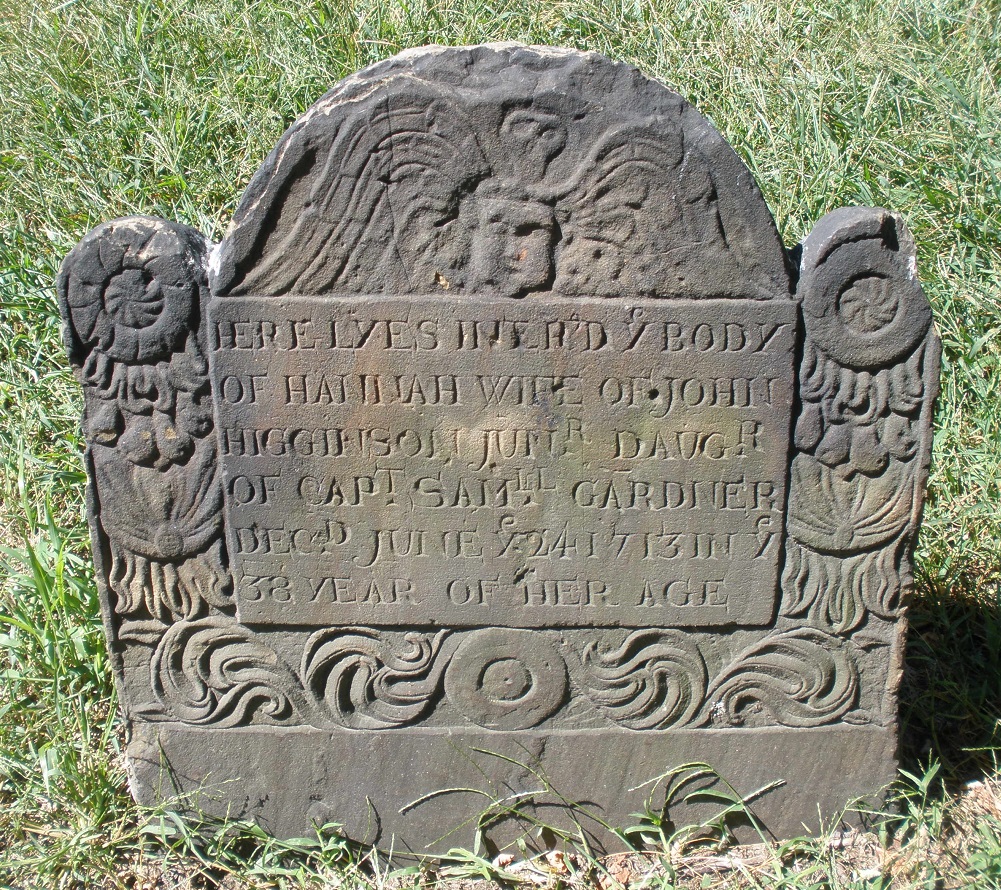
One of the great-grandsons of Rev. Francis, John Higginson (WikiTree and #10 in book), married a descendant of Thomas Gardner. She was Hannah Gardner (WikiTree) who was a granddaughter of Thomas' son, George. They are ancestors of many Higginsons. However, Col. T.W., while a descenant of John, is not a descendant of Hannah who died. John's second wife was the ancestor. 

Hannah's gravestone was recently cleaned using a new method. She was buried in Burying Point Cemetery (FindAGrave #8141517). There are 32 Higginson and Gardner graves in that cemetery including that of her husband, John, and his ancestor, Rev. Francis. 

---

The graphic shows "Gardner" in his book and "Higginson" in Dr. Frank's book. There are many more overlaps than shown with these looks at the index of their books. Modern techniques will allow us to look at this. 

We got our attention drawn to Col. T.W. in that he came out to KS during the pre-Civil-War era to support the Free-State movement. He gave support to John Brown by being a member of the Secret Six (Wikipedia - our post) along with Sanborn and others. He supported the Old Planters Society from its beginning with Frank A. Gardner, MD.  

The Higginson family was of the Old Planters of Massachusetts and has ties to many other families, including Gardner. Later in this post, we look at Harvard connections. 

Col. T.W. gathered data and wrote of the family's genealogy in the same time period that we saw lots of family histories being written, as these were motivated by the 300th anniversary.  

---

With respect to the culture of Massachusetts, in general, we will be doing research in that area, such as we have with our look at the History of Harvard. Our first focus is on the Heads of Harvard. We started this work after reading about James Bryant Conant. 

Col. T.W. was a graduate of Harvard, as was Dr. Frank. On the post about Col. T.W. that we did here, we included three pages of images from his book which show reference to Harvard University (or College). The two were John Thornton Kirkland and Abbot Lawrence Lowell. 

Two Presidents of Harvard

The Higginsons are still around as are the Gardners and others. This post is a beginning and looked at some aspects of their history over the 400 years. Lots more is there to look at. 

Example: Used Swift, Worth, Higginson and Gardner with respect to blended families. We had several cases where a Gardner mother was one of a series of spouses leaving us step-relationship to figure out. 

Remarks: Modified: 12/18/2022

09/29/2022 -- Added link to the "Blended family" post. ... Also, Hannah was the granddaughter of George, son of Thomas and Margaret (Frier) Gardner. 

12/18/2022 -- Site with the wigwam image disappeared. So, grabbed a copy from the web's memory. 

Sunday, November 20, 2016

Flyover country

Last post, we mentioned a lonely grave. It is in Nebraska. This is a photo. As suggested, it's out in the middle of nowhere. And, the type of cemetery is a common thing in this part of the country. People drive by, at a high rate of speed. The stones sit.

But, this is not entirely wilderness. It is highly productive farm land.


Back east, settlement was dense, in terms of area being covered. Essex country in Massachusetts has no really open areas. That is, everything is identified by one of the communities. Granted, through time the boundaries of those communities changed, say as new ones were defined. But, no place was left untouched by human feet. 

Out here, it's wide open. The past century plus, things have been mapped. We have counties that cover the territory. These collect into states. And, given the recent situation (for instance, look at the red/blue map by county), these areas, and their residents, need some attention. You know, the "red" folk love it out here. Americans really ought to know this part of the country better. And, we can use New Englanders as the main thread in order to do this. 

As an aside this area is near the Oregon Trail as it wound its way from Gardner, KS to the Platte River. So, this area saw the travelers going by. Lots to tell, there. 

---

Now, the grave is of a descendant of John Porter of Salem. Buried here was Lyman (d 1898) who was born in Wendell, MA (he is also a descendant of John Alden - his offspring, who precipitated the work, is also descendant of old guy Brewster and others). Why, and how, Lyman ended up here is a story that will be told, in part, in the next issue of The Gardner Annals. The story has more appeal in that his children represent a merge of lines from northern and southern New England (that part which we know as Virginia and its neighboring states - see Albion's Seed). This happened post the revolution, however the Virginian folk were from the very early times, to boot. In this case, the joining up was via Kentucky.

In terms of the Society, Lyman's ancestor (Joseph) married a daughter of William Hathorne. Joseph's brother married another daughter. These two lines merge in a descendant of Lyman. As well, one of William's sons (Joseph's brother-in-law) married a granddaughter of Thomas Gardner. That couple gave us Nathaniel Hawthorne. Joseph's sister married a granddaughter of Thomas Gardner. Joseph's niece (daughter of his brother) married a grandson of Thomas Gardner. And, this is not the whole shebang. So, you see, all of this relates from the beginning to what we are interested in. 

And, that little bit is only one of several other (actually, very many) threads that we can follow.  

Before, we mentioned the long arm of New England. Lawrence, KS ( Final migration, remember that, Jayhawk'ers) was formed in order to bring anti-slavery settlers out west. There were armed Quakers out here having fun. There were Quakers in Virginia (and other southern states). In short, a whole lot of American History was not (has not been) told, properly. New England researchers can help fill in. 

So, we get a chance to add to the mix. And, having these long threads of 100s of years are going to be important. All along, new folks were coming in, just as we see now. So, the fabric of the American people is a lot more than has been described.

---

Aside: I have an interest due to being born in the west, having attended KU (whose students do not, for the most part, realize that their hill overlooked the major campground of the Oregon-bound trains), living all over the country, working in all aspects (government, business, non-profit) of our economy, seeing the interplay twixt us and the world (especially Europe), following the mischief of finance, and then falling into the opportunity to see the fleshed version of the long American experience.  

---

It is interesting that Lyman's brother is already in the Mayflower organization roll. Too, one of his daughter's is in the roll. The thread that we researched was the eldest daughter of Lyman and his wife, Caroline. That daughter (d 1872) is the 3rd-great-grandmother of root of the thread being used for the study.  

Remarks: Modified: 11/01/2021

11/22/2016 -- Discussions (questions) on another forum brings up just how much this relates to the red/blue split that is dividing the country. So, we need to get to that, at some point next year.

12/18/2016 -- Article published in The Gardner Annals, Vol. III, No. 1.

11/20/2017 -- We will be looking more closely at the south.

11/01/2021 -- So, now the MF people have a database of those in applications to 1900. And, guess who is there? Lyman and his daughter, Anna. These are the father and sister of Chloe. And, the applicants who were in their 90s? Deceased. 

Saturday, December 20, 2025

Overland mail

TL;DR -- Bunker Hill West was on our sights early as we looked at the progress of New England's influence into the west coast. We noted that a coach company had facilities there and that the journey for some arriving had started in St. Louis and was going up to San Francisco. That route was covered in both directions. There is a group that has been documenting the company and its involvement. One of the investors was of a Gardner family. We went to look for information about him which we will report. This post is an introduction to Overland Mail as an initiative of the U.S. government starting early. 

--- 

As earlier posts mentioned, we used the isolation of the COVID times to pay more attention to the interior of the country. We got started with the naval activities, such as coastal attempts at colonies, fishing in the waters over here every year with the expectation of going back with some dried fish, and more. Too, the naval history of New England is rich prior to the Revolution which is facing its 250th lookback and after with the proliferation of companies related to shipping. 

In those earlier times, western movement didn't go much beyond New York. Though, early on, locations like Ipswich MA sponsored migration as best they could. Except, there were the wanderers even prior to the Revolution. Northern movement down to the area of Arkansas was going on about the same time that northern New England was getting its start. Even the west saw Europeans coming into the area even before Lewis & Clark's venture. 

Once the U.S. was born, it took a generation for activity in the west to reach a level of interest with St. Louis MO as a focus area. Much of the western traffic moved through that area, partly due its proximity to where the Ohio river joined up with the Mississippi. But, there was naval access to the west coast, as well before the Gold Rush of California. Some of this was due to Hawaii being a stopover point for sailing the Pacific. We intend to look further into that theme.

But, with land movement, we can map out areas and time frames. Jedediah Strong Smith was a focus due to his going out west through St. Louis (1820s when MO became a State) and then his extensive journeying in the west, including a stint in the LA area when it was still under Spanish rule. 

It was about then that we bcause aware of the St. Louis to San Francisco (LA_SF) coach route. Our focus was mostly about LA due to it being a stopover on the trail going to  San Francisco. The image shows DTLA in 1900 which a view toward what became known as Bunker Hill West which was named by a displaced New Englander. 

1900 scene, of Bunker Hill West
where Overland Trail coaches
came in, for relief of passengers
and sources (horses)

Recently, we noticed that there have been more publications on a website on the subject with information related to the LA_SF jaunt. More information has also been provided about the TX to SF part of the trip. Now, the eastern portion has better coverage is getting attention: Missouri, Arkansas, and Oklahoma (with respect to the Overland Mail). For instance, AR is mountainous. One thing passenger were requied to do was get out and walk with the coach as it was slowly moved through the hilly areas. 

States in the area. Kansas had a lot of east west traffic. One research provided lots of information and commentary on that state's support for Overland Mail  (as it is seen in KS). That is now the name of this activity which denotes the main purpose plus the involvement with the U.S. government. St. Louis had heavy activity as the country was divided and sold throughout the west. 

Other states involved were TX, NM and AZ in the south. We will be looking at other views on Overland Mail as the Pony Express came to be for that specific purpose and ran across the northern states.  

People? The group devoted to the history and preservation of the Overland Mail route (that is associated with Butterfield - who never put his name on the venture) (The Historic Butterfield Overland Trail in Arizona) has done remarkable research. We are fortunate in that area. One of their latest ventures is to identify the employees who saw to it that the coach made it from MO to northern CA. The infrastructure was astoundingly complicated. 

In terms of comparison, we have a post that shows how the 21 days (3 weeks) of one way of this journey compared to other situation. For instance, the same amount of time was taken for a portion of the trip by wagon train from Independence MO (across KS and NM) to Sante Fe NM. Fort Lanerd KS is on the trail and 3 weeks away from the start. 

We made contact with the Butterfield group. There was a query. One of the investors was named James V P Gardner. Who was he? On a quick look, we identified one resource from the late 1800s that suggested that he was from a New England family. James V P Gardner (son of Daniel (6) - James Van der Poel Gardner -- as descendant of George of Rhode Island) would be a cousin of the Gardiner for whom the city in Maine was named. Too, he would have been related to the Gardiner who owned the ship that wrecked off the coast of Oregon in 1850. 

We will post what we know about James V P Gardner as a preliminary report from which we will build something adequate to serve as a truthful basis for information about him. 

The information from TGS, Inc. efforts is being provided now with the caveat that we need to look further into sound/solid provenance of the sources that are used. Bringing in another factor? Technology of late has seen itself contributing more to disinformation than to information. The theme is on our watchlist and is (will be) an actual focus for the TGS, Inc. at all levels. 

John likes to use this example: From the top, we have folks of huge cachet for whom History has lots ot say; getting modern, we have the top-level offices of the G-Suite (military) and the C-Suite (the industrial/commercial part of the activity); then the huge middle management realm; down to the workers and users of whatever the economy is about in terms of keeping the modern life viable. At each level, there is no one truth that can be said to be accurate from top to bottom. Or from bottom to top. 

The computer has both helped and hindered attempts at briding the gaps. Of late, things have been more problematic than necessary for various reasons. John jokes about buckets'o'bits and their misleading clouds, though many are working to make things more stable and sustainable. We all can help. 

So, with respect to our research and reports, we will keep the "shining light on the hill" (Winthrop) in mind. Too, our site will be "bespoke" for many reasons with the goal of providing a "portal to truth" which notion comes from the mid-2010s as we incorporated in order to organize future efforts.  

About sources? We have them. For Gardner Beacon issues over the fifteen volumes, we started with a Bibliography and Source page. However, we started to provide links from the issues to posts from this blog. However, we are looking into a better organization of our several blogs for proper curation of sources. 

Note 1: The information about J V P Gardner and his life looks good, even though we need to check the provenance of the pedigree. There are many extant documents that will support this work. This Note will be updated when the post about J VP Gardner is published. 

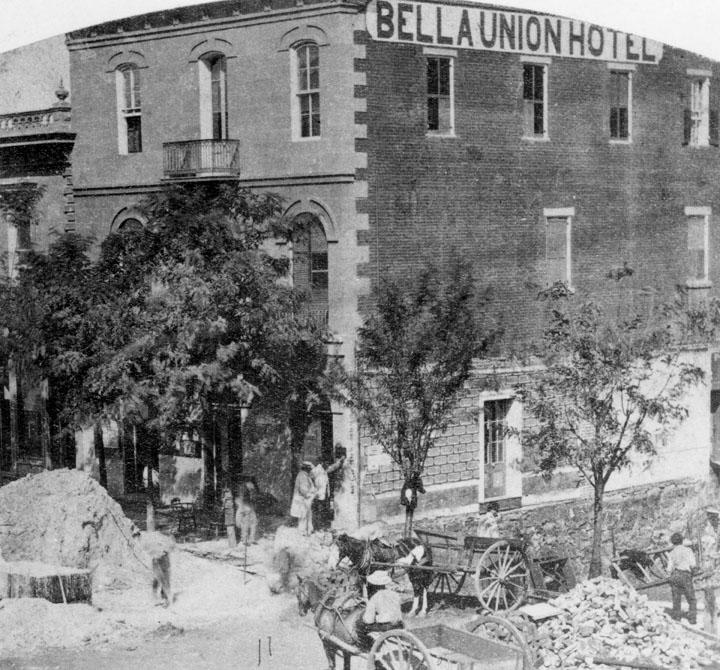
Note 2: The following photo is more apropos being from the correct period. The Bella Union Hotel had roots back to the 1830s. The Wikipedia page has some of the history. 

This is east of Temple and Main Streets. Temple runs up into Bunker Hill West. 

Remarks: Modified: 12/23/2025

12/23/2025 --


Monday, June 20, 2022

East meets west

TL;DR --  One thing that technology will allow us to do is keep up with the times and its events; too, though, if done right, we can tie together stories about matters in ways not possible before. In fact, as we have seen, we will be able to recreate (Meta's one good attribute, so far) events, and do so in ways that are almost real. On the other hand, we will see tragedy as well as triumphs. This is a case of the former. 

--

We will have several themes which will be described as we organize our work. Technology will be an important one. In fact, we will have a separate blog for posts of a detailed nature. But, technology is also cultural, so we'll address those aspects here. This week, we saw Yellowstone River flooding in the area of Gardiner MT due to the combination of snow melt and heavy rain. On flat ground, we would say 'flash flood' which comes unexpectedly and is gone before you notice (unless you are in its path). What is noticed is the aftermath. Gardiner MT has an 'i' and is where Gardner River feeds the Yellowstone. 

Gardiner MT
before the Gardner River
went on a rampage

In that area, there are lots of New England names, such as Conant Creek, Harvard Mountain, and more than we want to look at now. Fly over the region with Google Maps and see what I mean. In most cases, what you are looking at was seen or even had footsteps put on by the early wanders. 

We wrote of the Gardner River under our theme of the early western life as influenced by the long arm of New England. We had been looking at U.S. rivers in toto, especially with a view to the major carving of the land that was managed, in part, out of St. Louis. We noted that Jedediah Strong Smith, an early guy, passed through that little burg. Johnson Gardner was of the same timeframe. The movie, The Revenant, is about another Gardner, but Johnson Gardner was there. We will explore more about these fellas and their peers, some of whom left their names on the landscape in a larger scope. Actually, the following generation was of Bridger, Pike, and a whole lot more. 

Before going on, here is material related to Johnson Gardner, the so-called Mountain Men, Gardiner MT, Jedediah (WikiTree; Jed has a huge following out of Berkeley CA), and more, such as Grizzly Adams (cousin of the ones who were husband to and son of Abigail). 

In this post, several names have been mentioned. We show family information via WikiTree when we can. Besides technology, and the early west (say, Lawrence KS as project of Massachusetts), we will look at nautical themes (the Carolinas, say). There will be more discussion about this. 

Following up, though, the Smithsonian wrote about Gateway Towns and what this flooding may mean. 

Remarks: Modified: 06/20/2022

06/20/2022 --

Thursday, August 27, 2020

US Territory

TL;DR - Military man. Went up the Mississippi to its start. Then, went out to see the Rockies. Found the source for the  Arkansas River. Had a run in with the Spaniards. So, was taken to Mexico. Sent back. The War of 1812 came up, and Zebulon Pike died. Young man. He, of several, helped us map out the western U.S. where the states can be huge.

--

Having been looking at families as they moved west, we have learned a lot with respect to history, genealogy, and life, in general. For one thing, there are people who need to be recognized for their lineage, albeit some of the genealogical bent have this bias (it's the paper that counts, silly). On the other hand, people had lives and left others behind. One consequence of the forever shift is that things get lost, like who was where.

As an aside, we know of Zebulon Pike's life. He wrote of it. After looking at Daniel Boone, we figured that we need to move further west, as Daniel stopped not far west of the Mississippi. Hence this post, as those who went west did it with labor. We'll get there in a continuation of the western movement series that started a few years ago. So, let's stop to look at the US States and some of their attributes.

After a brief pause, though. One thing that stood out in looking at early Massachusetts and New Hampshire is that someone could move, even two counties over, and be forgotten in the sense of not being included in some write up. So, it was understandable when someone went further west. Say, the Mayflower descendant out in the lonely prairie grave - see Bayes post - more coming. In his case, a book on his family starting with the 17th century arrivals just noted that he was out west. In another case, some abolitionist was hanged in Texas (pre-Civil War) for being there. We found this out by digging. Lots and lots of stories to tell; fortunately, the internet will allow a more full fleshing of history through time. So, people will be a common focus; we will set up a proof process for descendants of Thomas and Margaret; however, friends will be allowed, to boot.

So, there was a comment about Boone being known for migration on land. After all, his party went by foot from NC to TN and west out to MO. The old guy (in his 80s) is said to have taken a party out to the Yellowstone area. Pike, on the other hand, was young. He mapped the source of the Mississippi. He did the same for the Arkansas River, poorly equipped in late fall (snow of the Rockies). Then, he was taken down by the Spanish to Mexico and brought back. His travels were after Lewis & Clark and before the Santa Fe trail.

Note: we got on this theme with Jedediah Strong Smith and Judge Thompson of Massachusetts, in part.

Looking at the U.S., all of the larger states are out west. For instance, KS is 81K sq mi. This is mentioned since Col. Higginson went there explicitly to show support for John Brown. Too, it was traversed, in part, by the trails, with almost 6/8ths of the trail in KS (Santa Fe Trail). But, Pike went through the area, too, earlier (The White Man's Foot in Kansas). Lots have been written about Pike.

The largest state is Alaska with over 1/2 million sq mi. Texas is next (it'll be featured due to several connections with the East Coast, including New England). This comparison is not for bragging rights; rather, the amount of effort to go across an area relates to the distance. However, terrain was a larger factor. Drive across WV, sometime, and note the absence of any flat area. Or, what they call flat is not really.
Size of States, U.S.
The tales of the Sante Fe Trail mention that parties, sometimes, took the harder route in order to avoid conflict with the American Indian population. From a commercial view, that makes sense. We will look at that. Usually, the path of lesser resistance was taken. Say, moving from Gardner KS to above St. Joe MO in order to save a few days (the gold in CA was calling); besides, going up the MO river was easier than sloughing out west by land. Even if for a few days. Choices.

Remarks: Modified: 02/27/2021

02/27/2021 -- Changed to using American Indian.