Showing posts sorted by relevance for query white. Sort by date Show all posts

Tuesday, October 29, 2013

Rev. John White, further

As the time frame of the 400th look backs makes its way forward, there will be a lot of things to do in preparation for celebration. Too, though, there will be a lot to learn.

We could start by pulling together our view of the Dorchester company under whose auspices Thomas and Margaret made their transition to the New World. And, getting a proper focus of the company would require us to know a whole lot more about Rev. John White.

We have mentioned the Reverend in several posts, so far. These had him as a focus.
  • White and Gardner family contributions (2011) -- John Goff uses the day of Thomas' passing (Dec. 29th) to write about the relationship between the families. This relationship was not brought out in the Great Migration series' look at Thomas. Too, one Dorchester writeup does not show Elizabeth White having a son named Thomas. Several questions will be proposed related to these early years, and we'll pay special attention to noting what is known (Example: How many wives?).   
  • Gardner and Conant families (2013) --  We know that other relatives of Rev John came over. This post deals with one of those families (we will be listing others). Given the two families in focus in the post, we can see that a lot more is known about the pre-move life of Roger; how can we fill in information about Thomas?  
  • 400th, again (2013) -- One of the churches that the Rev was associated with has a nice website with interesting details. See below for more on that.     

---

As we saw with 400th post, information is starting to appear about the company and Rev. John White. Today, I noticed that they have the Rev as a great-grandfather of John Wesley who founded Methodism.

There is a biographical sketch of Susanna Wesley, John's mother, in a compilation of her writings that was published, by Oxford, in 1997.  Her mother is noted as Mary (?) White (d. 1693).

---

The next Gardner's Beacon issue will start a closer look at the company started by Rev John.

Remarks:  Modified: 07/14/2018

10/30/2013 -- Note the addition of the Viewpoints category. These may split by topic, but there are all sorts of things to research and to document. Viewpoints? Yes, consider it like the multiple basic views of our underlying reality (yes, interpretations abound). Look, for any situation, we can befuddle things (fuzzify, if you would). Some things are more set (say the Royal births that were witnessed so that there would be no switching of infants -- thanks Dr. Lucy Worsley - see Tales from the Royal bedchambers) than are others. But, even as paternity issues can show, it doesn't take much to muddy the waters. So, genealogy is a matter of providing strong arguments backed up by, hopefully, inviolable bits of history (all inclusive, including administratively handled pieces). 

09/26/2014 -- Rev. John White, the Patriarch of Dorchester.

07/14/2018 -- Need to update pointers to the Dorchestor work (et al). It moved from ancestry. http://www.opcdorset.org/fordingtondorset/Files/DorchesterRevJohnWhite1575-1648.html Notice, in looking at his sister, Elizabeth, there is no son Thomas Gardner. Dorset County page on Rev. John White.


Thursday, January 24, 2013

Gardner and Conant families

As we know, Roger came into the Cape Ann area at the request of Rev. John White (more below). We had an earlier post that considered some differences between Roger and Thomas. Too, the last Beacon issue looked in a Annals format (we're going to use this for awhile) at several things, one of which was John's (as in, Endicott's) relationship with Thomas (as in, John knew that Thomas was a "Mr" and related to him thusly). Thomas and Margaret were resident in the house when John had it knocked down and brought over to Salem.

---

Aside: By the way, we're going to document this more thoroughly on Wikipedia - Great House (Cape Ann). We have John Goff's expertise available to assist us. This house was the first of its kind in New England.

---

Uncle?
Now, there are relationships between the families of Thomas and Roger. Seeth married Roger's son, Joshua. No doubt, there are others. Let's look at one that is interesting. Take Rev. John White (please). His sister, Martha, married William Cooke. Then, their daughter, Elizabeth, married William Walton. Elizabeth and William and their kids came over to New England. And, their daughter, Elizabeth, married Lot Conant.

This would mean, given the association mentioned by John Goff (in his article), that the Elizabeth who married Lot was a grand-niece of Thomas. However, according to a UK page, dealing with the Dorchester Company, the sister, Elizabeth, of Rev. John White who married Thomas Gardner did not have a son named Thomas.

---

Aside: From an outsider's view, Rev. John White didn't act like much of an uncle, or did he? If he were, he sure sold his nephew done the river, IMHO. (See Remarks 06/15.2013)

---

As you can see by the links, we are, mostly, in an acquisition'l mode. The intent is to find out all of the sides and their supporting material. The hope would be to find some reasonable story that has good support. Now, when it is a case that is not so strong, we can make proper conjectures. To wit? About the number of wives of Thomas: we say two.

The beauty of newer methods (disparate view bridging in the cloud) will be to allow multi-faceted looks at something. We don't live in a black/white world. Yet, even fuzzy approaches can (must) de-fuzzify now and then. How to present the material with the proper richness will be a continuing challenge.

---

Aside: There are many such questions to work on.

Remarks:

02/06/2019 -- Last night, the 'Roots' show (PBS, Gates) reported on Mike Stahan, a TV personality. Mary Gye came up with descendants of a mix of Essex County families. Her granddaughter married Samuel Walton whose father was a nephew of the good Rev. Samuel's sister married the son, Lot, of Roger Conant. Lots to look at regarding this particular tree (southern moves, etc.). For now, a brief mention with a graphic.

09/05/2013 -- Nice site with information related to Rev. John White.

08/22/2013 -- The start of a look at what was what in early Salem (and New England) as far as Gardners is concerned.

06/15/2013 -- Was there a Thomas and a Thomas? -- About a funny uncle, I'll admit an err. Based upon what I've seen in researching for the next Beacon issue (and even from personal observation), uncles are not saints, many times.

01/25/2013 -- John Goff is noted for his Salem preservation efforts.

Modified: 02/06/2019

Saturday, August 13, 2011

White and Gardner family contributions

The motivation for this post comes mostly from a nice article written by John Goff, a descendant of Thomas. John heads Salem Preservation, Inc. Fortunately, there has been this type of effort as, at one time, Salem was disappearing due to progress and re-building.

When I first read this article a few months ago, I thought that we need to put December 29 on the calendar. That was the day of Thomas' death in 1674 in Salem. So, let's not forget to get something on Salem's Twitter roll, or even their Facebook page, on that date.

---

We earlier looked at where Thomas is now.

---

John Goff talks about the family of John White who was one of the supporters behind the efforts of the Dorchester Company. Many do not think about White when they consider the development of New England and the U.S.A. Too, Thomas is more than under the radar. John's article helps us to overcome that deficiency.

---

Roger Conant got his statue, finally, the last century. He had been known as the 'forgotten' founder (with Endicott, of course, taking the limelight).

---

John Goff, then, mentions a little about the Gardner contribution, which is large. I like to point to the descendants list, as an example. Expect that this list will grow as research continues.

For instance, John mentions a few families who are not on the list, yet, such as Gedney, Parkman, Greenough, and, of course, Goff. We'll be looking into that.

Remarks:

08/06/2016 -- More on All things Gardners.

09/05/2013 -- Nice site with information related to Rev. John White.

06/15/2013 -- John Farmer wrote that Thomas was from Scotland. Origins are, and will be, a focus.

10/27/2012 -- John Goff looks at the Corwin House in his book which mentions Rev. John White.

05/01/2012 -- We ought to remember Hawthorne every year, on this day.

08/21/2011 -- Added in some comments about the house built on Cape Ann and about the party's description by White (in his Planters' Plea). Seems to me, from this write up (the badly led and ill-disciplined landsmen left at Cape Ann), that Rev John threw Thomas into a group that included those at Morton's shindig at Wollaston.

Modified: 08/06/2016

Friday, June 28, 2019

Two Thomas Gardners in Salem

We are reviewing research results from the beginning, to now. This will be an iterative task over the next few months as we look at different themes. We will be making changes to our presentation material and format as we go along: Renovation, plus. Since we have a Cape Ann focus and are starting at before the arrival, the first two passes dealt with houses and sources of which there are many. So, as we go along, we will report. But, we will also built a coherent view that seems to be lacking.

Now, another theme dealt with the different Gardner families. There were several views of how many Thomas Gardners there might have been: A Thomas here and a Thomas there. Associated with that issue is this question: Whence came Thomas and [Margaret]? Too, when Roger Conant took the group to Naumkeag, we need to know this: Where was Thomas? What was the story concerning the early times? There is really no end to this.

Our intent is to be thorough, as much as we can, and build coherency as we progress. Too, we will be on the outlook for new material. Example of the latter was the 2014 find by John Cook of the marriage notice. This was taken further in 2018 such that Thomas is seen as having only two wives: Margaret anew.

There are many examples of the first part, that is being thorough. Our bibliography (History of New England) will record what we have accessed and read. We will be adding to that on a regular basis.

Today, let's look at Frances Rose-Troup's study of Rev. John White. This was published in 1930. She spent time looking at records and made some interesting finds. There are two that we summarize.
  • The Thomas who was married to the sister of the Reverend went back to England. "Her husband Thomas Gardner was one of two Overseers of her fathers will and clearly close to and trusted by the family. In 1623/4 as a successful yeoman farmer he was employed by the Dorchester Co to oversee the establishment of their first settlement at Cape Ann in New England. After about a year Roger White arranged for governship of the settlement to be handed over to Roger Conant and Thomas Gardner returned to England." This is quoting Rev John White MA (1574/5-1648) which is hosted at Dorset, England. As well, this Thomas did not have a son named Thomas. Too, he died in England and left a will.  
  • So, Rev. White is not the uncle of the Thomas of Salem of TGS, Inc. We know that there was the Thomas who was the father of the kids that are the focus of our work. These kids were the children of Margaret Fryer. Too, this Thomas died in Salem and was buried at Gardner's Hill (the status of his remains are unclear at this time). How did he relate to the prior Thomas that was related to the Dorchester Company? 
There were lots of tales of two Thomases. Dr. Frank said that he didn't see evidence of this. But, he didn't see the work of Frances Rose-Troup. The post (A Thomas here and a Thomas there) is a 2013 look at the issue. This needs to be brought up to date. It's early, incomplete, and indicative of why we are in the organizing mode. 

For the important themes, we will collect what we have. Also, we can point to additional work that was mentioned but not done. For one thing, the notion from the start was to be thorough and collect all that has been done. It needs to be brought to light for future researchers to not think that they have discovered some missing piece. 

Times are different than when Dr. Frank was working. It is much easier to do this type of consolidation. Too, though, there are technology aspects that will be of on-going concern. Hence, one goal is to have our work be used as an example. Many have started down this type of road, however, with regard to Thomas and Margaret, we'll cover the basis as best we can. 

So, as mentioned. I think that Thomas was related to the Thomas that married into the White family some way. If you look at the Dorchester investors, you will see Conant. So, Roger was sent to Cape Ann due to a business decision. Thomas was chosen, originally, due to family ties, I would bet. That was the norm in those days. He and Roger were not of the same class. Endicott, from what I can see from my reading, knew Thomas' background (talked to him). Called him Mr. They did several things together long before Thomas deigned (I said that before) to become a Freeman. Even in those day, the Church (of whatever variety and its people) was not all powerful. That has been a continual dynamic throughout history. 

It is significant that Thomas married a Quaker right in front of those ones, such as Endicott who put Dyer to the rope. Of course, they did some little fines with her not going to the services. Anything said about stocks, or whatever? 

Thomas seems to be tabula raza. He didn't leave writings. However, his sons spoke of him. Like, John mentioning Sherborne, Dorset. Too, they were well educated. That was due to their folks. Thomas talked to Rev. Hubbard who also talked to Conant (who bemoaned being handled improperly). We didn't see that published until almost 200 years later. Plenty of folks have reported what they saw or thought they saw. 

We'll methodically go through all of this stuff. Actually, already have. Blogs are the best was to organize this stuff. So, we'll use pages (see above (Tabs): What's new, FAQ, Page map, TMM - there are lots more). Plus, we'll write articles. That is what The Gardner Annals is for, in part. 

While working, we always look for new areas to poke into. So, the tasks build as more are pushed on the stack than are ever popped. And, we will get to (through) that (long list) by funding research. Also, there really is no limit in that all of the Cape Ann families need to be looked at. Right now, Conant, Woodbury, Trask, and Palfrey are covered. Why? Due to their being involved with the Old Planters - Beverly. In the beginning, it bothered me, a little, that these other families never mentioned Gardner. 

What was that? At least, Felt, in going through the records, brought out references to activities by Thomas. Dr. Frank wrote of some of these. So, Thomas was here. The kids are evidence of that. 

Did they talk of leaving? As in, what the Paine sisters wrote? You know, the stories of some going back to England or going to Virginia. Well, Thomas and Margaret and the kids were at Cape Ann. Having a good time. 

Lots to do. The 400th will have an entirely different feeling than did the prior commemorations. Oh yes. The 200th? A parade was mentioned (Chronicles of Old Salem). It coincided with the 50th of the U.S.

Remarks: Modified: 03/13/2023

07/17/2019 -- Changed to using commemoration.

09/20/2020  -- Added the Category. 

03/13/2023 -- See "New not old planter" post with regard to research findings. Thomas and Margaret have children registered in England until 1633. So, there were two Thomas Gardner, just not like we would have expected. But, the jury is still out. 

Friday, August 9, 2019

Samuel Gardner

This post is about Samuel Gardner (Gardner-614) and John Curwen (Corwin-10). John was the step-brother of Mary (White-3107), Samuel's wife.

We were looking to see who was Mary's father. Anderson did not mentioned her maiden name (Great Migration (requires NEHGS account), see Image 1). But, then, Torrey did not either.

Dr. Frank did. Was he correct? Well, Frank mentioned that Elizabeth was Mary's mother and she had married John White. Mary's father died, and Elizabeth married George Curwen (Corwin). We know this from Torrey (New England marriages prior to 1700 (requires NEHGS account), see Image 2).

But, we know more. The NEHGR published an article about Elizabeth. In it, Mary and Samuel are mentioned. So, Dr. Frank was correct. However, this work was after Anderson published, so he is off the hook.See NEHGR Vol 163 (requires NEHGS account), page 190, (see Image 3) starting at page 192. As we can note, the research had to be carried out in England.

Images 1, 2, 3 
This is an example of the type of thing that families need to do and which the TGS sees as in its mission.

There is more to be found in NEHGR Vol 150 (requires NEHGS account), page 190 (see Image 4), "Elizabeth Herbert, Wife of (1) John White and (2) George Corwin." Elizabeth was the mother of Mary who married Samuel Gardner. The article mentions a petition to the court by Samuel with regard to the estate of George Corwin. Dr. Frank had mentioned that, too.

Elizabeth (Herbert)(White) Corwin
---

Note: the family was in Cape Ann in the 1623/24 time frame. Thomas, George, and Richard were born in England (see WikiTree discussion on Margaret Fryer). John was born here, too. However, there is a record for a John in Dorset at the same time. This may have been John who came over later (open area of research). Samuel was born here, as well. The Samuel mentioned in Dorset in 1624 was of another family. We are working to separate the families as we try to figure out where Samuel's father came from.

Children (according to the NEHGS and the Great Migration Project - as represented by WikiTree): Thomas, GeorgeRichard, JohnSarahSamuel, JosephMiriamSeeth.

List of descendants of Samuel

Remarks: Modified: 12/13/2020

12/05/2019 -- Added in the images to go with the links (which require a NEHGS account) as Samuel is important to our work. A middle child, somewhat. Too, he's the ancestor of Dr. Frank. So, that gives us a focus with which to work the unknowns.

12/13/2020 -- Added link to list of descendants of Samuel. 

Monday, August 22, 2011

John Tylly

John deserves recognition for several reasons, not the least of which is that no account of Thomas' and Margaret's arrival and subsequent time at Cape Ann can be complete without mentioning John. We'll look at his background which seems to be as unknown as Thomas' might be. We also know that John was killed in 1636 at the time of the Pequot War.

John was in charge of the fishing effort. There has been much written about Cape Ann, including White's little Plea. Some, including White, cast aspersions on those who were there. Others have offered a more reasoned view, as we see depicted in this chapter on the Fisher Plantation and this report to the US Treasury, 1853.

Rev. Hubbard on
Tylly and Gardner
By the way, William Hubbard (1621-1704), in his retrospective, was the first to mention John and Thomas. One can envision those in that later 17th century time asking what happened; that is, what were the real people doing during the time; that is, those who did not spawn off countless words during their time here.

---

John and Thomas were part of the movement from Cape Ann to the Naumkeag area. Then, John seems to disappear. The Great Migration look (pg 1823) tries to make some sense. John was in the Dorchester area in the mid-1630s. He had a wife but no offspring.

John was active in coastal trade, seemed to go as far as Bermuda, and was killed in Connecticut as he tried to venture, despite warnings by Lion Gardiner, up the river to Hartford.

---

All sorts of questions remain to be answered, and old Rev White isn't here to say. How did these two men become leads in an effort that had such importance? And, then be pushed aside so easily? Ah, many, many more questions.

As said before, 'speculation' requires magical gains. In less than a decade, Massachusetts was shipping tons of fish to Europe. How could this happen in a year's time? Even with the Plymouth help (as they were there in Cape Ann, to boot, hence the conflict that Conant is supposed to have avoided), how could one expect for gains to accrue so quickly?

So much to deconstruct here. Thankfully, some have already started. Winthrop, and perhaps Rev White, wanted theocracy as a way of life. Though they were ahead of their time, John and Thomas were seen as 'irreligious' according to some. Actually, events 100 years in the future showed these two to be on the right path.

Hopefully, time and resources will get some of these types of things better answered.

Remarks: Modified: 03/21/2022

05/01/2012 -- Interest in the Old Planters is being assessed. Also, we'll do a sketch of John at this site

12/22/2012-- We need to differentiate between Old Planters of Beverly (see The Old Planters of Beverly in Massachusetts, 1930, Alice Gertrude Lapham, The Riverside Press) and the Old Planters of Massachusetts. One could even talk, Old Planters of New England.

10/11/2018 -- Some argument over who was first, in New Hampshire. Rev Hubbard was mentioned. As mentioned, he was the first one to mention Thomas Gardner. Too, his manuscript, though written in the 1600s, was not published until about one hundred and thirty years later. And, we almost lost it due to the mob rioting and doing damage to Hutchinson's dwelling, which, btw, was the Governor's mansion. So,  the good Reverend the Rodney Dangerfield of his time?

01/07/2019 -- Add snip from Rev. Hubbard's history that mentioned Tylly and Gardner.

03/21/2022 -- Our first post on John Tylly was on 22 Aug 2011 when we were newbies. We just did another post today under the name of John Tilley which is how the NEHGR identified him in an article in their Winter 2022 issue. In that post we link to research on the other Cape Ann families. 

Tuesday, December 25, 2012

Gardner's Beacon, Vol. II, No. 6


See Vol. II, No. 6 of Gardner's Beacon for a look at the legacy of Thomas and Margaret () Gardner using an Annals format and being accompanied by a bibliography (with links to digitized versions of references).

---


In 1995, the Great Migration series had its first publication. Over the next few years, the early settlers (1620-1633) were covered in three volumes. If we take the first three "governors" and their coverage, we have this: Thomas Gardner (six pages), Roger Conant (eight pages), John Endicott (seven pages). This publication covers what is known about the settlers at this time.

As such, though, there is a lot of material that is not referenced. Too, a look back, such as the Great Migration one, can cover 1000s of people and cannot get into as much detail as we might want. We have to go elsewhere, and, frankly, the sum total of information that I have seen can be less than clear, for many reasons. One such controversy is how many wives that Thomas had. There are others.

For instance, on March 20, 1999, a talk at the ESOG (Essex Society of Genealogists) by David Goss looked at the Old Planters of Beverly (TEG, Vol. 19, pg. 123 -- our earlier take on the subject in 2011). He described how the term came about and to whom it applied. From the Beverly-group's perspective, the names are familiar as they've been used in many papers and books (Conant, Balch, Trask, Woodbury, Palfray). These were, in other words, the stalwarts of John White or the group led by Roger Conant (Reminder: the Beverly group did not get their land until 1635 - we need to talk about the time from 1624 up til then, more or less).

Along this same theme, we saw, in 1899, the founding of an Old Planters Society whose membership included those who had ancestors who came before 1630. That effort was led, in part, by Dr. Frank. A. Gardner. Dr. Frank A. is noted for his books on Thomas Gardner and his descendants using material that he had gleaned through a lifetime of research. It is of interest, that in the early 1900s, the group seemed to be a Balch/Gardner reunion (Benjamin Balch's/Sarah Gardner's descendants). The latest events have a flavor of the History of Beverly. The 1899 group talked about the injustice of history overlooking these early planters and wanted to correct the matter, ostensibly before the 300th anniversary. We're preparing now for the 400th.

---

David's paper, which I ran across recently, was the latest find during a three-year search and review, by the blogger, of all material related to the Cape Ann group. This long effort, essentially, looked in all corners and created a huge pile of material (searched with a very-wide net). Now, the task is sifting through the huge pile, developing a bibliography, laying out a timeline, and building a view that can go further as support for future research. That motive of this work is to honor Dr. Frank's work and to present a coherent, and as complete as we can, view of Thomas.

Too, many conjectures have been presented which do not fit the bill, otherwise there would not be the controversy (unless one expects that these types of things are not resolvable).

---

The current issue presents the material in a timeline by year, up until the present. In doing so, it hopes to show a view that makes sense. The timeline is not complete; rather, think of it as an outline from which we can define research projects that will clarify, fill in, information. If done correctly, this type of timeline would become more and more strong such that future people with interests in Thomas and Margaret can use it as a launch point.

That brings up a new view though. Thomas' crew put together a house their first year. Too, they did come prepared and were successful in establishing themselves. The only failure was not having sufficient output to send back to the capitalists in England. What White may have wanted was for them to send what they needed to sustain themselves, but reasonable folks do not do that without the threats of the taxman or strong arm (those who came here were not serfs, in other words).

When Conant showed up, he didn't find starving people. He found a boisterous group. The use of insubordinate shows White's failure (hey, the descendant of Thomas has White on the tree more than once). The effort was not a military expedition. It was a plantation building effort.

Here is the thing, though. When Conant and his group went down to Naumkeag, it was not an all-in-one trip. Whoever thought that has not had to deal with the real world. We're talking a trip that could be taken by a good man in a day. By water, the trip could be less in the right conditions (look at the image which shows an entry from Winthrop's diary - courtesy of Judy Jacobson - in which he talks of going to Salem, eating, then going to Cape Ann, for dessert, so to speak). Too, Thomas' group had established themselves at Cape Ann (which is a real nice place, by the way). There was the house and other dwellings. They had gardens. They had cattle. They could fish. There was game. Who the heck sees this as failure?
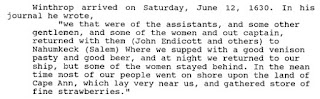
The movement over to Naumkeag took time and many trips. What ought to be considered is that Thomas had a presence at both places, but he was principally in Cape Ann. He could take care of (and feed) himself and his family very well. Now, when Endicott showed up and pushed Conant aside, he saw Thomas in the Cape Ann house. He liked the house and had it moved to Naumkeag.

Too, though, Endicott knew that Thomas was of the "Mr" variety. Hence, Endicott wrote about him (the 1629 meeting mention). Due to the lack of "press coverage" as we expect nowadays, Thomas might be considered peripheral by some, but so what? He was taking care of his own. Most likely, he helped other people, too. And, why would he follow Conant? Too, as said before, Thomas' proof of being is his progeny. And, being, folks, is still the reality (we have seen plenty examples, of late, of effective people who do not announce their deeds prior, or even ex post facto, to accomplishment).

Thomas was not a freeman (as if he needed someone to set him free) until 1637. He joined the Church the year before. But, he was signing things, like land grants, before this. In other words, he and Endicott got along, so Endicott gave him some responsibility. But, as we know how people are, the Church people noted that Thomas hadn't shown up (in modern parlance, took a boondoggle to Cape Ann to look at the crops when service time came around - okay?) so they had to rope him in. Also, Thomas knew that his kids would have to be of the social element in order to have any success. So, he deigned to join.

Not long afterwards, though, he married a Quaker. Do we hear of anyone threatening Thomas (Endicott would know better!) on this? We have not seen such documented. And, this type of thing would have been recorded. Also, it was not that Thomas was a bully causing people to fear him. Rather, his stature (I would presume from what I know of Gardners) was above normal; he have a solid, and large, character; and he was a man's man of the peaceful type (the American Indians loved him).

In other words, the preeminent individual so loved by Emerson (in his mind - by the time of Ralph Waldo, too many of the elite had ruined things for the rest - that is part of the Thomas story) was here within the first generation (actually was the first generation).

---

That first group, all of them, had remarkable characters. They did not fail at Cape Ann. When Endicott got here, he did not find starving, helpless people. But, guess what? Not long after Endicott arrived, here came boats of people (too many) who swamped resources. At this time, Thomas would still have been house-sitting where they were well-provisioned. He probably helped move the great house (1628/1629) from Cape Ann to Naumkeag (at least, he probably was able to do this - of the many that we read about, they would be about as effective as a slug for any useful purpose -- unfortunately, history's details are about such and not those who can get, know how to get, things done).

The winters of 1628 and 1629 were dire due to the influx of the unprepared, and the results were catastrophic. We'll have to touch on this in our research. By the time Winthrop arrived, though, things were going great again, though, due to efforts of people like Thomas.

---

Aside: Salem, the wallflower? This little city ought to be as beloved as is San Francisco, for many reasons. Why is it not?

References:  see Sources and Bibliography (further delineation, soon)  

Remarks:

03/27/2019 -- Image added to the index on our portal to truth.

06/15/2013 -- John Farmer wrote that Thomas was from Scotland. Origins are, and will be, a focus.

01/25/2013 -- By the way, we're going to document this more thoroughly on Wikipedia - Great House (Cape Ann). We have John Goff's expertise available to assist us. This house was the first of its kind in New England.

.01/08/2013 -- Added a forum to facilitate discussion, etc.

12/30/2012 -- 2nd edition, with changes, published today (see Afterthoughts & Modifications for this volume).

12/29/2012 -- In Afterthoughts & Modifications, mentioned the David Goss talk in 1999.

12/29/2012 -- Beacon issue uploaded with the start of a Bibliography with links to digitized versions of reference material.

12/26/2012 -- Someone else had the same idea: Balch Leaflets (1896): That Cape Ann was left utterly deserted at this time is very improbable; it could be plainly seen from their new abode and was distant but a few hours coast-wise by boat or canoe. ... There was a frame building there of considerable size and other property that demanded care. (This particular leaflet is dated 1877)

12/25/2012 -- The issue will be completed this week; this advance notice is a Christmas gift to Thomas descendants, and friends, who wondered about the times after Cape Ann.

Modified: 04/23/2021

Monday, January 7, 2019

Gems of Salem

Gardner Research started in 2010 from a blank slate, more or less, using the wonders of the www; in other words, trolling the waters of the internet to see what we could find. The result? Lots of stuff, some of which we have organized. And, there is a lot more work to do.

As we have seen, records get digitized and come online. Sherborne, Dorset is an example as their records allowed us access to lots more about Margaret and Thomas. See the discussions on WikiTree. Notice two things: this is a profile of Thomas sponsored by a Great Migration Project using Anderson's book (1986); Margaret is given as Thomas' spouse and mother of the children. As well are records coming on-line, people write.

A very good example, that is relevant, is salem.wickedlocal.com. Early on, we saw an article by John Goff: Looking at Salem’s beginnings: The White and Gardner family contributions. This article published in 29 Dec 2007. That was eleven years ago; we saw it four years later and noticed that it mentioned Rev. John White.

One of our first activities was to start the Thomas Gardner (planter) page on Wikipedia and have added several other pages or links. A good example might be when there were news stories about Amelia Earhart's plane. Gardner Island was mentioned; so, we had to look at that (as we have with other areas: Gardner Junction, Gardner, CO, Gardiner, OR). And, John got into that story, too.

I well remember John's first email. He congratulated us as he had run across our Wikipedia tagging (put link to Thomas Gardner's page in that of Gideon Gardner). I do not know if he wrote about Gardner Island, but we did discuss Gardner's Beacon. And, John was kind enough to contribute articles as well as provide other information to support our research (thank you, John). I thought that it might be a good task to itemize John's work, especially as it relates to Gardner studies. See the list below which is provided as a reminder to us to look further into the articles. On the list, too, are Salem articles that mention Gardner.

First, though, here are a couple of examples of overlap interest. On our Gardner Gate page (portal to truth), we just did a summary of some pre-arrival information (1 March 2013 - the 2nd most read post) pulling information from a series of Gardner's Beacon issues. Then, I just found this article by John -- Salem’s forgotten French heritage (7 June 2008) -- in which he details French activities in the area that became Salem. He mentions the discussions with the American Indian. There are several articles that we will look at further.

But, another example, is the work that we did to track down information about the owner of the barque, Bostonian, that wrecked (Oct 1850) at what became Gardiner, OR (update - 30 October 2018). The original work was done in 2014 with an article published in The Essex Genealogist. The owner was a descendant of George of Rhode Island, though, two of his wives were descendants of Thomas Gardner of Salem. But, as well as the family information, there is a whole lot to discuss about the time (More on the Gold Rush 31 Mar 2016).

Here, I see that John wrote about a response to a query (1990s) from San Francisco (NAUMKEAG NUGGETS: Salem in the California Gold Rush 5 Jun 2015) about a ship that they discovered. It had been built in Salem.

From what I have seen, hundreds of ships were abandoned as crews rushed off to pan gold. That makes the Bostonian different in that not only did it bring supplies from Boston to San Francisco (July 1849 to January 1850 voyage - only four passengers - it was loaded), it went then to New Zealand (that was interesting, verifying that part of its journey), returned to San Francisco, and wrecked in Oregon is October of 1850.

Many went to California by land. We have researched that avenue, as well, due to our interest in the western expansion. Too, New England (and Salem) had the reach of a long arm. A third way to the gold fields was boating down to Central America, trudging across, then boating back up to what is now known as the Left Coast. This went both ways (many lost their fortune in that journey).

There are other examples in an endless set of things to research. So, gems, indeed. Finally, to a partial list of John's Gardner touch. Each item is marked by date; there is no obvious order, yet.
Remarks: Modified: 08/27/2022

02/08/2019 -- Recently, we got registered with Google as non-profit and have put a search facility on the sites. They are (will be) ad-free, once I get the administrative stuff completed. On the search page, I mention our manual effort at indexing. Now, we can get more serious. I extended the above list with some hits from searching on John Goff.

02/08/2019 -- Put photo of John Goff from 5 Jun 2015 article, Naumkeag Nuggets.

09/03/2019 -- Like the way John writes (see image). He mentions Sidney which is good. Dr. Frank and his sister, Lucie, picked up Sidney's work after he stopped his Essex wanderings and writings. This is an example of John's view (seen after I had, more or less, determined the same thing).


It was in this house where Thomas and Margaret enjoyed Cape Ann's wonderful life (posts search on Cape Ann).

04/20/2021 -- John mentioned in a Melissa Berry article (with reference to Richard Davenport). On New France and New Spain. We see it more out west.  ... Added link to page of Gideon Gardner, who was namesake of Gardner Island (by either Joshua Gardner or Joshua Coffin). 

08/27/2022 -- Finally, added John to the Descendants of Richard. Just for the record, search results on John Goff  (23 posts) in this blog. 

Sunday, January 9, 2011

South (east and central) Essex County

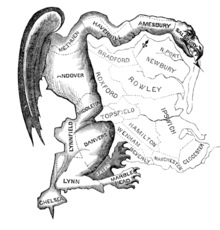
How can we look at Thomas and Margaret and not include something about the area? A whole lot went on in Essex County (note the dragon -- ca 1812), so we'll separate it further. The sister blog centers itself on Newbury.


The original point of entry was on Cape Ann, namely Gloucester. Then, the group moved close to the mouth of the Naumkeag river and started a settlement that would become Salem.

---

By the way, the Massachusetts Bay Colony page has a timeline for the settlements. As we look at the Gardner family, and its related families, we'll cover about all of these.

---

The following is a list of web-accessible information about Salem and the 'Old Planters' of whom Thomas was a member.
We will update this list with new information from time to time.

Remarks:

06/02/2019 - Profile of Sidney on WikiTree.


01/18/2011 -- We'll be looking at the northern and the middle parts of Essex County.

01/14/2011 -- Should have known. Follow Salem on Twitter.

08/20/2020 -- Recently, wrote on little Essex County's involvement with the evolution of Gerrymandering

Modified: 08/20/2022

Saturday, March 1, 2014

The glory that is Cape Ann

Did we miss something? Captain John Smith came over to New England in 1614/15. We're only two months into this period, so there is still time for Cape Ann to celebrate.

Yes, Cape Ann was named after this exploration.

Celebrate? Yes, in terms of the 400th anniversaries that will string along keeping New England in a jolly spirit for many years to come. The parties this time will make the 300th pale in comparison. However, our 1st cousin - Dr. Frank A. Gardner - was there for the Salem festivities.

---

For some reason, Cape Ann does not get the attention that it deserves. But, we can start to pull the research together now, 2014, as part of our effort at remembering (and honoring) what went on there in that seeding place.

The crew lead by Thomas Gardner got to Cape Ann about ten years later as part of a commercial fish and plantation effort under the auspices of the Dorchester Company which was headed by Rev. John White. There are connections with White and Conant. How Gardner relates needs further study.

In essence, we know Thomas and Margaret through their progeny.

One thing that would have been accomplished the first year was erecting the "great" house which would have been ready for their first New England winter. This house was later moved to Salem on the order of John Endicott.

John Winthrop beer'd and dined in this same house on his arrival at Salem in 1630; at this event, he enjoyed strawberries that had been picked that very day in Cape Ann (per his journal).

---

The next Gardner Beacon (Vol. IV, No. 1) will take a Cape Ann focus, especially in the period prior to the exodus. By the way, Thomas showed character when Roger showed up.

Many write of the Dorchester crew, under Conant, leaving that area to go to the area that became Salem. However, left at Cape Ann was the house and their plantings. Too, the distance is minimal. It would make sense to consider that Thomas remained active at both places. In the Salem area, he would have been involved with the settlement. In Cape Ann, he would have kept the house and the plantings in order. In fact, harvests at Cape Ann would have been brought to Salem.

We have no note that Conant found starving people at Cape Ann when he showed up. Rather, those there were boisterous and contended well with their Plymouth neighbors. In essence, the crew was fit and sound. Now, we know that they did not succeed in getting beyond subsistence. Hence, Rev. John White's Plea will follow us forever.

Thomas' name does not appear with the planters who were named explicitly (see Written out of History). Some have tried to enlarge the list (see Phippen plus). There was an effort before the 300th to form an Old Planters' society.

On further look, though, one might argue that Thomas did not have the cloud over his head that worried Conant and his guys. We know that he was there as Endicott refers to him in 1629 as Mr. Gardner.

---

But, we have other unknowns from the crew. For one, John Tylly needs some attention. If we take Phippen's list, for instance, we ought to document each of those guys and their families. Some are already well-studied (Woodbury, Balch, Trask, ...). For all, we need to create a lasting presence through publication and discussion.

Remarks:  Modified: 09/28/2014

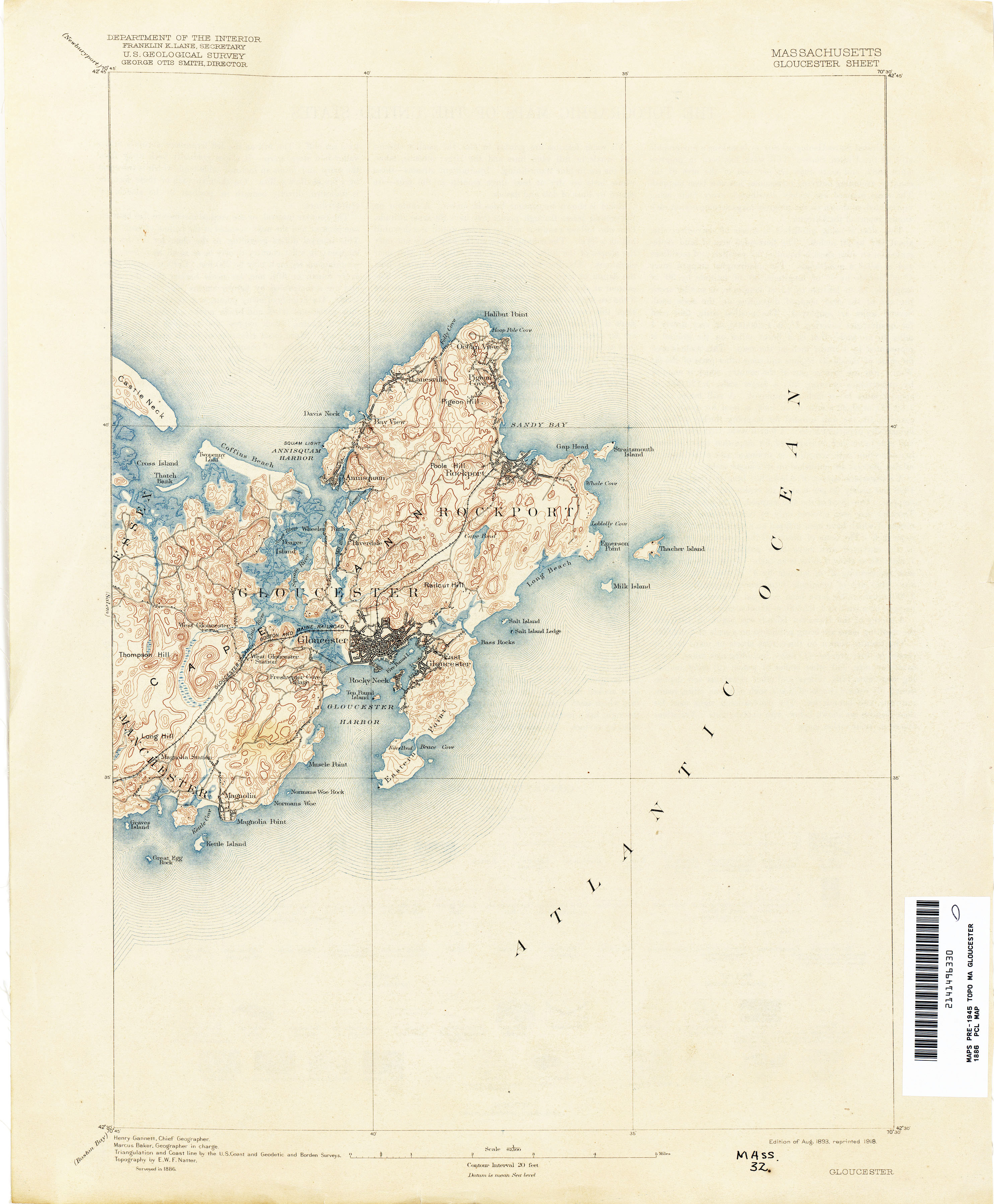
03/02/2014 -- Added piece of a topological map from 1886 (courtesy University of Texas).


03/18/2014 -- More thoughts on Cape Ann, Thomas and Margaret, and, not least, strawberries.

03/23/2014 - Cape Ann featured in Beacon Vol. IV, No. 1.

09/28/2014 -- A week ago, the record for the marriage of Thomas Gardner and Margaret Friar was discovered in Sherborne by John Cook of Minneapolis, Dorset files. This sets a type of focus. Looks as if some transcription work might be in order.


Tuesday, December 4, 2018

Wikipedia, Rev. John White et al

On Wikipedia, John White (Reverend) has moved to John White (colonist priest). Just now, fixed the redirection to the particular page, rather than have it go to the page listing all of the John Whites.

One nice reference to this page is from capecodtoday.com in their article on Cape Ann which references the Thomas Gardner (planter) page. This page was originally posted in 2010 but has been updated.

On the Thomas Gardner page, I have been changing sources to meet the Wikipedia requirements. Once that is done, we can remove the warning which is a distraction. See the Talk page for comments with regard to updates that have been done and are pending.

Remember, Wikipedia edits are open to whomever want to help in this matter. The page for Thomas Gardner (planter) was created on 10 January of 2010. Of the 366 edits, 279 are mine. From the Thomas page, there several auxiliary pages that need attention. I will list these at some point. As we have, Wikipedia, Wikitree, and the blogs plus the two websites to keep current.

Example page: Great House (Cape Ann). After hearing from John Goff, I researched this a little more. This is the house that John Endicott had moved to Salem. Thomas and Margaret enjoyed it after most went over to Naumkeag.

Much to do. The 400th looms.

Remarks: Modified: 12/04/2018

12/04/2018 --

Tuesday, August 11, 2020

Reasons ... for New England

TL;DR - Why did people come here? That is, to this side of the pond. Lots of reasons. Boone is an example of a later arrival who made good.

--

Recently, we revisited the topic of Origins and Motivations. In that post, we listed earlier posts dealing with the subject. As we proceed, we will be pulling posts from the past, into some type of cohesive view as this allows us to reflect on what we have seen as well as think about the future. And, we need to consider post-virus realities, for various reasons such as our sanity.

Speaking of reasons, we had a query about the motivations for New England. Our response went along this line which follows what we have run into the past decade.
    Rose-Troup (she researched the Dorchester Company in England for years), Albion's Seed (nice look at the paths that led to the U.S. from England), and on Dorset (great countryside).
However, let's broaden the scope. As a first step, we can look at the view of the Revs. White, Winthrop, and Higginson. At The Winthrop Society's site, we find this document: "Reasons for the Plantation in New England". It has a list of Reasons and then some Objections. We will go back through these, but let's look at one Objection.


In the introduction, we are told that the author is not known but that later edits were done by John Winthrop. The changes are in the hand of his son.
    Redacted and introduced by Marcia Elaine Stewart.

    The following document was found among the papers of Governor John Winthrop. Other abridged versions are known, and variously ascribed to Rev. John White, John Winthrop or Rev. Francis Higginson. While the true originator may never be known, suffice it to say that this copy was written in the hand of Forth Winthrop, son and sometime secretary of the future Governor, and has marginal notes by the elder Winthrop, dated 1629. It was evidently a widely distributed and influential piece of propaganda in furtherance of the proposed settlement of Massachusetts Bay, judging from the number of copies in various forms which are still extant, along with numerous responses pro and con penned by various interested worthies of the day. The Rev. John White probably conceived the initial nine arguments, but we suspect, due to the legal style of its arguments, that Winthrop has here substantially amplified it to its present form with the addition of the objections and answers. In any event, it is surely an expression of Winthrop's own views on the subject, and is of great significance in revealing the motivation of the colonists.
Now, we picked this objection since we have looked at the topic, example: The First Year. We quote Anne Bradstreet's reaction to the new environment. Now, why mention this? As people went west, or to any of the newer areas, it was the same thing (like Yogi said, deja vu, all over again).

Too, though, this type of material allows to discern some of the thinking of the time, especially since there is more of a meditative tone than the modern mind might like. Yet, are we missing something?

Remarks: Modified: 08/28/2020

08/28/2020 -- Daniel Boone will be a focus, for a while. Quaker family that came into PA pre-Revolutionary times. 

Thursday, December 29, 2011

Gardner-Pingree house (and murder)

This house is just east of the Essex Institute; actually, it is now part of the Peabody Essex Museum. Some of the features of the house, with a very nice description, can be seen at an arts blog: Part 1, Part 2.

In a brochure for the Hawthorne in Salem walking tour, the house is mentioned as the site of a crime whose trial caught the attention of Nathaniel (Thomas descendant) and everyone else in the area. Capt Joseph White was found murdered in the house in April, 1830. It turned out that the crime had been committed by a member of a prominent family; two brothers from another well-known family were involved in the planning. The prosecution was handled by Daniel Webster who, despite difficulty related to the case, got the jury to convict. The perpetrator had killed himself before the trial; the other two were hung after their conviction.

---

The Salem brochure says that this house was built in 1804. Then, it says that Joseph White bought it in 1814. Elsewhere, we see that John (descendant through sons, Samuel and George) and Sarah (West) Gardner were the builders. Too, we see that John bought the land from his father.

Then, we learn that the Gardners sold the house in 1811 because of financial difficulties. Which were?

Essentially, it turns out that these were due to losses incurred during events that led up to the War of 1812. John and his father lost several ships to the British. They didn't go broke; but John and Sarah had to sell this magnificent house. We will look at the details later, but John is covered as #162 (his father is #110) in Dr. Frank A.'s book.

Now, we learn further that John sold the house to Nathaniel West who was related to his wife. As well, they lived in the house until 1814, so they did get a chance to enjoy their effort in getting it put together. Then, when the house was sold to Joseph White, they moved.

---

John and his father owned land in several areas of Essex county. There were other Gardner owners, too. It might be interesting to pull these together. The Dr. Frank A. book might be a start as he did a thorough review of records.

---

Too, the interplay of families will be a subject worth pursuing. For instance, in this case, the two brothers were of the Knapp family. The perpetrator was a Crowninshield. How do the Knapps relate to Samuel?

---

Recently, the Smithsonian published an article about the trial.

Remarks:

01/07/2020 -- While looking for information on Joseph Gardner and Ann Downing, I found a reference that seems to conflate the two ladies: The murder that led to the murder of two Presidents. Need to look into that further. See Gardner's gate.

12/25/2019 -- Found out about the Lost New England blog, today (Gardner-Pingree House).

06/19/2019 -- Remembering pending research such as this one. Left comment at Streets of Salem: The Most Beautiful House in America (and the Power of the Place)

10/10/2018 -- This house was on land owned by Thomas. We are looking at where he was and where he is now.

07/11/2012 -- A recent issue of Gardner's Beacon looks at the War of 1812.

01/05/2012 -- John Sr was first cousin of John Gardner who was the grandfather of John Lowell Gardner, I.

12/31/2011 -- Kudos to Louise DuPont Crowninshield for her preservation efforts. Too, we have her to thank for the gardens.

12/31/2011 -- David Pingree bought the house from Nathaniel West (brother of Sarah) in 1834. The house was donated to the Essex Institute in 1933.

12/30/2011 --  The Pingree family preserved the house and donated it to the Essex Institute. 

Modified: 01/07/2020

Thursday, June 27, 2019

True stories

We are reviewing our material and looking at common themes, such as houses. While researching for Gardner's Beacon, Vol. IV, No. 1, we wrote this post: No shadow over Thomas. The gist of the matter was that a researcher was talking about the motivation for the land grant to the Beverly group, Conant, Balch, Woodbury, and Palfrey. It was noted that the gents were worried of losing privileges.

Thomas isn't recorded as having any reservations. So, we need to discuss that. Endicott called him Mr. Gardner. Whether we're talking strength of character, being knowledgeable, pedigree, or some combination of those and other factors, we have found no bad mouthing of Thomas. Well, Anderson noted the thing of some grave conflict. But, that was son Samuel's doing. Thomas was dead at that point.

So, what is this all about? Well, a recent comment, in a blog, says that Roger found a mess when he appeared at Cape Ann. What? They were quite well and taking care of themselves. From notes for Gardner's Beacon, Vol. II, No. 6.
    That brings up a new view though. Thomas' crew put together a house their first year. Too, they did come prepared and were successful in establishing themselves. The only failure was not having sufficient output to send back to the capitalists in England. What White may have wanted was for them to send what they needed to sustain themselves, but reasonable folks do not do that without the threats of the taxman or strong arm (those who came here were not serfs, in other words).

    When Conant showed up, he didn't find starving people. He found a boisterous group. The use of insubordinate shows White's failure (hey, some descendants of Thomas, such as Dr. Frank, have White on the tree more than once). The effort was not a military expedition. It was a plantation building effort.
We also addressed that, here Cape Ann, Retrospective and elsewhere. We need to focus on the events prior to 1623/24 plus a few years after. And, that means looking at the whole of the affairs.

Take Thomas Weston. Briefly, he is run up the mast several ways. The Maypole affair is associated with his group. But, this was a legit attempt at establishing a colony. We'll get back to this below.

First, there are several motivations, but we know of two that need to be re-addressed. Take Sir Christopher Gardiner. When we first read of him, we only saw the Winthrop-influenced take on the matter. Then, we ran into a re-write that is not generally used. And, found another. That is, the story that is told is not the right one. Propaganda?

Then, after we found out that Dr. Frank was a descendant of Nathaniel Eaton, we saw that he had not raised that to general awareness. Why would he? It's a mess, Harvard (and, we'll retell this story from the perspective of descendants). We have written several posts about this plus one summary overview of Nathaniel's life.

Okay, there had been several attempts prior to the Dorchester effort: Sagadahoc (1607-1608), Plymouth, and Wessagusset (1622-1624). Some minor ones will be added as we continue. And, we want to address these as well as other motivations. For instance, we have these notes for Gardner's Beacon, Vol. III. No. 3:
    Every March small ships of between thirty and eight tons, manned by crews of twenty to forty men and boys ... carried salt, provisions, equipment. Brought material for their boats. Took two months to get here. Put their boats together and fished.

    Split the work between fishing and salting. Fill the hold and return in autumn.

    Crews were gathered yearly by the master. Principally young, fifteen to twenty-five years old. Many were trying to get money to get established in their home area.

    At first, Newfoundland. Then, Gulf of Maine.
There were lots of reasons for people coming over. Whence, origins, and motivations will be a theme for further research for a long while.

Remarks: Modified: 12/29/2020

06/28/2019 -- Added image so that we can index.

12/29/2020 -- A few edits as this is on the image at FB with respect to this date in 1674 (death of Thomas Gardner in Salem, MA). 

Friday, December 2, 2011

Backbone and more

These posts, of which this is the first to tie in the category, will be collected into a separate group. What will be the content? An outsider's assessment of those early years and Thomas' legacy from such. 'outsider' means in-law, basically.

---

Backbone has already been used with a different context: fedaerated. Why? The study of those times that were 150 years prior to the Revolution are very much apropos to understanding of the current problems. Even Naisbitt thinks so, though I don't agree with his slant.

---

Disclosure: The author is a 3rd generation American whose ancestors were basically post the Civil war. Hence, looking at Thomas and Margaret affords a new view into the history of northern Europe and the new world. As an aside, there has been a lot written about the past 400 years, even about that New England locale. Hence, one can easily get lost in all of the verbiage. And, there are conflicts in what was written. So, we seriously need some new overviews that try to help guide one through the mess (more below).

---

So, today, while I was reading the Annals of Salem (the overview) by Felt, I had some thoughts that will be expanded upon further. First of all, there were tyrannical doings almost from the beginnings. True, the aboriginal peoples were trampled. But, there was serious infighting among the settlers, even though they were from a common background.

Earlier, I had noted to myself that Thomas seemed to be above the fray (we'll expand upon this thoroughly). However, let me say that he was there, and of notice, even without corroboration of those writing the historical accounts (meaning, of course, that we can thank Rev. Hubbard (he died in 1704) for the first real reference -- it is said that he had talked to all of the principals -- Thomas, Roger, and John). In other words, Thomas, and Margaret, had been successful in bringing up their kids in the midst of turmoil and peril (we'll characterize this, to boot). Of course, many other families were equally adept. For this, we can be grateful.

---

It is of definite interest that the first year that Thomas deigned to undergo the 'freeman' yoke (1637), he was elected, with William Hathorne (Samuel's father-in-law), to be Deputy to the General Court. We'll go more into that later.

Some have wondered about what happened to Thomas after the group left Cape Ann because he's not in the record (see Remarks 12/03/2011). One author (Paine family) considered that the family might have gone back to England. As we know, some did. Rev. Lyford went to Virginia.

Think of it, though, that Thomas was the ultimate example of a self-sufficient, mature person. In other words, he was an archetypal New England'r before it had even become popular to think of those good traits. He was able to guide himself and his family through those dark times (and, we'll be getting into this in depth). When it became apparent that he had to conform to the powers that be in a public sense for the sake of his children, he did so. Then, his kids all excelled. Joseph stands out in that he married the sister of Sir Downing (there are several messages there). Samuel's wife had in-laws (the Corwins) who have royal descent. Richard and John did very well on Nantucket. George has his memorial (kidding). The girls have their esteemed offspring, too.

---

Of course, this brings up things related to the background. How did Thomas get his position from Rev White? And then, how could Rev White forget him so soon? When Conant came on the scene, Thomas showed a lot of maturity even though Conant is more touted for his acceptance of Endicott when he stormed on the set.

---

By the way, we'll go into some of the other parties who have their names blasted upon the pages of history. From where I sit (and that does mean that you can infer personal knowledge), some of these people were not much better than were their Christian brothers who sustained the energy behind the Inquisition for so long. What were the English doing? Trying to show up the Spaniards? Yes, a few things might be discussed along that line.

From what I've seen, Thomas has no recorded peccadilloes of this nature. In fact, given that the American Indians on Nantucket really liked John, we can assume something about John's upbringing.

---

Now, another thing that came up today was seeing a reference (in Felt's work) to the Magna Charta at a 1635 meeting (finally, I thought -- hey, that's 11 years later -- same issues as we face now with our leaders, don't you think?). Whoever brought that up may have had to duck (I'll research this more). But, it was wonderful to see the reference. In case it has not been noted, we're coming up on the 800th anniversary (2015) of this very important document.

Yes, it was brought up, in the meeting, that by-the-seats-of-the-pants governance, by second-rate people, was not conducive to a sustainable society, more or less. But, the U.S. did emerge, eventually.

Too, those with the real sense, such as Williams and Bachiler, went off to found Rhode Island and New Hampshire, respectively.

---

What? Did I read that Cromwell almost came over? It seems that the king prevented this, to his dismay a little later. That little bit sort of indicates that we must not forget some of the motives for coming over here (not just freedom, religious or otherwise). England was a mess, in many ways. So, would not New England exhibit that messiness, too?

---

There is a lot to read. So, at some point, a bibliography related to the 'backbone' theme will be presented. These posts will be like notes with a theme, hopefully.

Remarks:

07/12/2015 -- Of course, when Roger brought his people to Salem, Thomas was not there. Why? He and Margaret kept the Cape Ann house. Of course, when John Endicott came over, he saw Mr. Gardner in his nice house. John said, that is mine. Take it over to Salem. So, by splitting his time (Salem is not that far), Thomas had an idyllic time with his wife and kids; too, he had time to get himself and his family settled in the new realm.

04/20/2015 -- Yes, Cape Ann's life was idyllic, except any cohesive group must always endure the changes brought by new arrivals. Thomas and Margaret got to enjoy their house, once again, after Conant and crew left and Endicott saw the house and wanted it moved.

07/17/2014 -- The book about the Invisibles (the unsung heroes) offers another viewpoint. Of course, it is set in the modern context. But, we all know that history covers only a fraction of reality. What we see now is that technology will allow us suitable ways to go back and fill in the blank slates.

11/06/2013 -- While working on the next Beacon issue, I ran across some books. The one by Staloff was timely; imagine, I was wondering why the backbone series? Has the talented set ever allowed the lessors to have some semblance of a good life? Oh, you say yes? Winthrop, et al, were against this from the beginning. The stalwart of what could be (or could have been)? Thomas Gardner, of course.

11/27/2012 -- Let's itemize what we know, re-iterate some basics, and the proceed constructively.

05/01/2012 -- Two things to be thankful for: Rev Hubbard's look back (his brief mention is sufficient) and the fact that the manuscript was not lost (otherwise, would Thomas had been even more unknown?).

03/07/2012 -- Where was Thomas? 1626 or so and 1641 or so.

12/03/2011 -- The thing that grates? Thomas led the group into Cape Ann. When the group went to Naumkeag, Gardner is not on the list of planters. We see Conant, Balch, Woodbury, and Palfrey (each got 1K acres -- as well, all of the families have inter-married with the Gardners). When I say 'grate' I'm referring to my initial reaction a couple of years ago when I first started to read about this stuff. Gardner forgotten, ignored, shunned, what? And, Rev White was the instigator of that division. Well, it'll bear more scrutiny, no doubt.

Modified: 04/23/2021