Showing posts sorted by relevance for query DNA. Sort by date Show all posts

Saturday, May 14, 2016

DNA and genealogy

Recently, Gardner Research was contacted with a DNA question. A researcher who had hit a brick wall over a decade ago decided to be subjected to DNA analysis. His results matched up with that of earlier kits that had been submitted.

Some of the results seemed to show relationships between various Gardner families. That is one of our interests. Details will follow at some point. Overall, there was quite a variety.

So, that was a sufficient trigger event to get us to start to look at DNA in terms of "all things Gardner." As we gather information, we will add to this list (year shown if not current). 
We will also get links to all of the Gardner-related research done so far.

Note: For this list, we will move over to a DNA Project page (at some point).

Remarks: Modified: 06/04/2020

05/15/2016 -- Also, we got our attention directed to a lot of information about the Tudor relationship with the Gardners after Bosworth. We will summarize that and provide a bibliography.

05/17/2016 -- With Prof Hamilton's overview, our list covers the basis. He talks about using longitudinal studies within a family to assess change rates.

05/26/2016 -- While looking at the ancestry of the wife of William Marshal, I ran across a DNA study related to the ancient Irish clans. So, let's say, that motivates to get some DNA analysis going though the discussions of issues will continue in the background.

06/10/2016 -- Added link to Genome Research.

11/22/2016 -- A recent ACM Communications (Sex as algorithm) had an article by a gene specialist (biology) and a computational mathematicians. There is a little remark by the authors that things are not as clear as many seem to think. "Gene: A unit of heredity and a region of the DNA that encodes a functional product. It is thought that humans have more than 20,000 of these. However, now that coding is known to be far more complex than originally thought, it is no longer clear how to define these units and their boundaries."We will look at this further in the upcoming The Gardner Annals.

12/11/2016 -- Britons still live in Anglo-Saxon tribal kingdoms, Oxford University finds.

02/25/2017 -- Still at it. Adding in links.

06/04/2020 -- "Back to DNA II" looks at a WikiTree Project and more.


Wednesday, January 4, 2017

DNA, again

Related posts: DNA and genealogy, Genome and more.

For now, a list:
Remarks: Modified: 06/04/2020 

01/18/2017 -- This will be discussed in the context of nature and nurture. After all, there is a whole traditional collection, albeit more arguable given social media, that bears some attention.

06/04/2020 -- "Back to DNA II" looks at a WikiTree Project and more.

Monday, March 17, 2025

Finally, DNA?

TL;DR -- Since 2013, we have been studying material and collecting supporting information. Too, we have read results far and wide. This approach is an example of technology being used many times from a pure marketing thrust. We do need a balance of business and science. However, we never had this figured out in our cultures; the computer, especially with GenAI brought in, exacerbates potential problems. The strategy to manage that consists of mature processes and models. And so, let's open this can of worms and look at it regularly. 

---

In 2013, when we were newbies of three years, we started to get queries about DNA, in particular, specific questions about the Gardners of which there are many (Gardners & Gardners). This list has post that were on the topic of DNA.

03 Apr 2015   Richard III and Gardner
14 May 2016  DNA and genealogy  
31 May 2016  Admissibility
04 Jan 2017    DNA, again
07 Dec 2018   DNA in use
29 Jun 2019    Back to DNA
24 May 2020  Major players
04 Jun 2020    Back to DNA, II

Of late, we have reason to get back to this topic. The post from 14 May 2016 has a list of pointers to other blogs and sites that provide necessary information pertaining to the DNA projects, the technical concerns, the mathematical modeling, and especially the computational support that is involved with this type of analysis. 

Remarks: Modified: 03/17/2025

03/17/2025 -- 


Tuesday, May 31, 2016

Admissibility

As might be surmised from the earlier post on DNA, genetic genealogists have been having a field day. People are finding cousins. D.A.R. has DNA in its process. Some want such tests to be sufficient. Families are doing grand studies about their ancestry. We all can see the entire sweep across time of human trekking. And much more.

Too, though, the former post started collecting links to technical material. A lot of these revolve around computational phylogenetics. That is part of the modern view and will even more so as we go along. Yet, lots of issues remain to be discussed.

So, we want to bring that to fore, for several reasons. For now, it is mainly to get the issues on the table so that reasonable adults do not run amok. For instance, we see lots of attention given to the y-haplogroup's use. It is a great way to match up paternal lines. However, there are lots of things to consider that might be awry, such as (one of many examples) male siblings or cousins not matching. A few of the reasons for this may be (quoting evolutionary biology graduate of Tulane): one of the Y chromosomes mutated independently in a manner that resembles another haplogroup (very slight chance, however); there can be instances of double Y chromosomes (or just remnants) in the genome but that generally results in infertility issues; the female may have inherited a small fragment (slightly more likely) of her father's Y chromosome; a type of chimerism.

In short, we have technical, legal, moral, and a whole slew of other topics to look at. Fortunately, DNA is a subject of interest of late. That is, we are a couple of decades from first use, several troublesome aspects have been seen and handled, things are getting even more complicated, etc.

Let's use a recent article in The Atlantic to gather material: The False Promise of DNA Testing. The article has a forensic focus, after all CSI (et al) has brought the potential uses to everyone's sight, but the lessons apply to genealogy. What we did not see were the mis-uses, that is, not until after the fact (except, perhaps via some probabilistic notion which usually underestimated the potentials for abuse).

So, this collection is an addition to the prior list which will be organized at some point.
    MathWorks () - A little about the algorithm. 
These links pertain to the use of advanced computing in the interpretative area of DNA analysis in an area that can have serious impact on people. Another technical example of this type of approach was in the last list (Classifying Haplogroup from Y data) which applies directly to our interests.

There are many other steps in the DNA process to discuss, as all along there is computational assistance. We expect to lay out a bit of details about these.

Remarks: Modified: 12/18/2016

06/01/2016 -- Note the source of quote on replication issues. 

06/10/2016 -- Genome Research

06/17/2016 -- Notes about review. Starting with Mendel's work, then insights about genes, chromosomes. Then, we get to modern lab processes with instruments that are enabled via computation. Marking and analysis, for example. We have foundational issues related to mathematics. On the interpretation side, there are local views and grand themes. Predictive-ness an issue. And, finally, memes and their analog ought to come into play.

11/23/2016 -- A recent ACM Communications (Sex as algorithm) had an article by a gene specialist (biology) and a computational mathematicians. There is a little remark by the authors that things are not as clear as many seem to think. "Gene: A unit of heredity and a region of the DNA that encodes a functional product. It is thought that humans have more than 20,000 of these. However, now that coding is known to be far more complex than originally thought, it is no longer clear how to define these units and their boundaries."We will look at this further in the upcoming The Gardner Annals.

12/18/2016 -- Article about DNA published in The Gardner Annals, Vol. III, No. 1.

Thursday, June 4, 2020

Back to DNA II

A recent comment at a post that was done last fall (Back to DNA) does redirect our attention back to DNA, in a timely fashion. Briefly, there are so many people that some of the matches are almost inevitable. Too, underlying the whole basis of this work is micro-biology and its chemical reality. We might impose our thinking top-down which is what science does from its theoretical sense, yet the reality of the situation is always something to consider respectfully and with caution. Lots to discuss. In short, though, we are more than our chemical selves. How this might be will be part of the discussion. It turns out that genealogy and history as a focus can allow a more full look. Stay tuned for how we'll introduce those topics. Or, one might say, the cultural unconscious cannot be reduced to mere memes though we have seen lots of attempts arise the past decade.
Gardner R-U106 DNA Project

On the other hand, the genetic studies do tell us something which needs to be respected. The comment by Bob Gardner, pointed to his WikiTree page on Gardner DNA which we are happy to see. A few gents related to Thomas Gardner of Salem (subject of this blog) are noted toward the bottom of the list with a J2 haplogroup. Whereas, the DNA project that Bob is doing has a focus of R-U106 (R1b) which relates to an ancient European line that is much older than many considered earlier.

One Thomas Gardner descendant that we know has done two DNA tests. One of these matched up with the FamilyTreeDNA study. On the other hand, another descendant, via Samuel, and closely related did not match up, at all. There are many more stories to pull together, as well as getting a good reading list together.

As a reminder, we are pursuing the 'science' of the matter and want to remove the marketing influences. Actually, as we have said, this stuff ought to be non-profit. There are enough examples to show that this can work. In the meantime, we will work to help establish a 'neutral' position that we see as necessary to remove some of the contrived contention that people like to create when they are motivated to do such, for many reasons.

Looking forward to digging deeper into this work thanks to Bob's reminder.

Remarks: Modified: 06/04/2020

06/04/2020 --

Saturday, June 29, 2019

Back to DNA

The last post looked at the issue of two Thomases in Salem. We have two views on this that we will look at further in order to do a comparison. One was from Dr. Frank. As with everything, we have been following his lead as we got our bearings in order. Today, we looked at both of the books (1907 and 1933). His reference to Troup is the same. They had a correspondence, but there seemed to be no update. Part of this effort will be to go back and compare note to note (even between the two books - as we did with the person list).

So, Frances Rose-Troup provided us with her research results. She was working on the other side of the pond from Dr. Frank. She shows that the Thomas Gardner married to Elizabeth White did not have a son named Thomas. He had a Josiah to whom he left property. So, we went to WikiTree and searched on Josiah Gardner (here he is on WikiTree). Well, there is a lot of work to be done with that tree, however his father is noted as a brother of the father of Lionel (Gardiners Island). Too, the profile manager provides his DNA results. Plus, he has lineage documentation.

Earlier, we dabbled a little with DNA and genealogy. The image is from a study as Family Tree. At the time, I got more interested in the technology issues, such as Admissibility, with the thought of getting back to the subject. Now is the time, it seems.


One truism is that DNA does not remove the need for lineage studies and documentation searches. The NEHGS has been publishing interesting studies where they have used DNA to resolve puzzles. We all know the author whose whole lineage was proven to be not true. His book dealt with how he recovered his heritage or the sense of knowing who he was. One might say, scrambling.

There are other sites dealing with DNA, so we'll start to look at those. Too, on WikiTree, there is a One Name Study for Gardner (and variants on the name). I have already added to the list of places with Gardner as name.

We had already widened the scope with the "All things Gardner" perspective (discussed in this post: Renovation, plus). So, the idea will be to be more fully extensive in coverage.

There is plenty to do.

Remarks: Modified: 06/04/2020

06/04/2020 -- "Back to DNA II" looks at a WikiTree Project and more.

Friday, December 7, 2018

DNA in use

Yes, we have an interest in this, from a technology sense. I am talking both the biology (including anthropology et al) specifics as well the mathematics and computing (these last two are my special interest): DNA and genealogy, Admissibility.

This fall, there was discussion that came out of Massachusetts that was interesting. I saw some discussion on Quora and have put it here as a place-holder.
Let me just say this. We see collective abilities that have power, as in those related to names (families) or regions. We see categorization, as well. And, there is analytic power as we have seen with forensics. However, consider this. It is noted that our DNA differs by not much than that of some closer primates. Which suggests? We are not digging deep enough. That'll come.

After all, the work at describing the genetic material is still relatively new. And, we know what that technology was all about.

Too, I can show cases where doing this analysis did not help. Of course, one might argue that a full coverage of all people would be fairly strong. I am not so sure. Remember, all of this is either computational or is computationally driven. That whole realm, which is at the crux of our lives and growing in influence, is poorly understood despite all of the silly valley demonstrations of their prowess. Have you looked at the messes that those folks have us into now? Which may have been there before but are now several orders of magnitude more complicated?

Remarks: Modified: 06/04/2020

06/04/2020 -- "Back to DNA II" looks at a WikiTree Project and more.


Tuesday, January 31, 2023

The Americas

TL;DR -- As we noted early last year, we have technology as a focus similar to another group's concentration on honoring research in biomedical fields. This post is about a biological thrust which has a couple of themes. One is that technology cuts across the board. We can use IEEE as an example of touching everything. Too, the post recognizes the life work of a Thomas Gardner descendant. 

---

We have mentioned New Spain several times, in the context of the United States. But, considering the extent of the U.S., there were other cultures, such as France, the Netherlands, Sweden and others. This will be a recurring theme due to perseverance of families through time until now. 

And, New Spain also is associated with most of the Americas outside of the U.S. and Canada. That might be the result of the usage of the Spanish language in much of the Americas. According to one source, there are 280-million English speakers in the American Continents compared to 418-million Spanish speakers. This is attributed to Spain being the first conqueror. New England did not conquer so much as slide into the area. 

Our last post mentioned the NEHGS which had a history and genealogy focus. These two utilize technology which is one of our interests. Of late, DNA studies have become more used. These types of results are becoming more frequently used in proving heritage. 

That is a biological focus which then leads to the use of technology, for supporting disciplines of the various sciences, and its mathematical understructure. And, so, we get back to computing and its contributions and plagues. We do this for several reasons which ought to become apparent through time. 

Natural History Museums (say Smithsonian, New York, London, and others) provide information about our world the study of which involves many disciplines, as we see with the Departments at Universities. Curators play a key role. Some in computing have brought this function to bear, say handling knowledge in terms of what a website might present. As with everything, interpretations differ as to what a curator does. The need seems to be recognized according to the rhetoric of the time. 

This post deals with the study of wildlife biology as it has grown over the past 150 years or so. We wanted to point to an example via the journal of the Mexican Association of Mammalogist. The first issue of Therya, Vol. 14 honors a New Englander who descends from many families, including that of Thomas Gardner, of Cape Ann and Salem. We had a post about him, earlier: Alfred L. Gardner, Ph.D.  

Note: Before going on, a technical aside is necessary. We, in the U.S., have benefited from awareness that can contribute to security and such. The 'wild west' start of the internet was a little perturbing to many. The marshals that came to town to clean up were varied, but they have helped. The below article is available via the DOAJ's website: https://doaj.org/about/. However, we point directly to the organization's site for convenience, though it does not use HTTPS. This blog (and its main site) put that into place a while ago for several reasons including Google's nudging. But, mostly, the push came from issues of FTP's security.  

The image shows part of the table of contents from the journal. There is the declaration of the Special Issue. Then, we have a listing of several of the articles, many of which have to do with Dr. Gardner's work. Not all are listed, but this quarterly publication is over 180 pages in length. 

The abstract (Special Issue in Honor of Dr. Alfred L. Gardner) provides links to 'full text' versions of the article (PDF or HTML) and gives references for the material in the article. One of the many publications of Dr. Gardner was Mammals of South America (2008) which is the first of three volumes. Our title suggests the integral aspect of the Americas, north and south. This is a subject needing more attention in terms of the long reach of New England. 

It might be helpful to point to information about Mammalogy (Wikipedia, Journal of Mammalogy, Encyclopedia of Life) which is part of Zoology, the study of animals. "Theria" is a subclass of the mammals. 

Incidentally, this post continues a major theme. An analog can be found via IEEE.org which involves the ubiquitous type of technology that which enables computing and everything else, in part. We need material sciences, as well. 

---

Forgive our focus on the 'artificial' when the subject of the post is nature and life. One curating task deals with establishing and preserving knowledge of provenance, through time and situations. Just now, I asked Google to give me something like this (asking ChatGPT about the provenance of its content). Got one interesting bit from The Atlantic: ChatGPT Is Dumber Than You Think (it's a toy, not a tool). Well, this type of thing will be a continuing theme (AIn't and more). 

Oh yes, Roots Tech is right around the corner. We have not paid much attention to that, except for using the various tools (love Family Search). But, it has been on the table for a while to address issues related to this type of thing. And, re-evaluating DNA (let's cut the hype) will arise at some point; for this topic, I am going back 100 some years to describe how computing in its current form came about; DNA work is heavily reliant upon computing; there is no theory for this (just practice); do we need a theory? Chemistry and its theory? Again, look around. Everyone is chasing a "theoretical" basis. Guess what? They all eventually get to computing. So, there it is. Computer science has no basis, at all. Of course, other computing labels have come up, like computer engineering. But, we're talking more than mere labels. Wait, ChatGPT appears to be shallow due to something similar? Stay tuned.  

Remarks: Modified: 02/10/2023

02/10/2023 -- There are lots of links with regard to Alfred. We'll start with these two: Special Report (Localities of Mexican Land Mammals), Tech Tech, 2020; Species he named. 


Saturday, June 18, 2016

Gardner's Beacon, Vol. VI, No. 1

The current issue of Gardner's Beacon starts to look at upcoming 200th anniversaries. More people went out west through the various trails (Westward Ho) than arrived both in northern New England and its southern counterpart. In those early days, there was motivation to go west. For one, claiming land would keep out settlers from other countries. In that case, there were conflict with the American Indian population and with other countries.

By the time of the end of the long American Revolution, people were ready to go west. Lewis and Clark helped capture the imagination. Families took the long trek to Oregon and California. During the gold rush, many 49ers went out by the trails.

An older trail, to Santa Fe, provided the starting point. But, as more people gathered, there were issues, such as a cholera outbreak, that establish another starting point, present-day St. Joseph, MO. Too, the 49ers were in a hurry and wanted to take some days off the trip.

The story would not be interesting without the people. That launching point for western expansion turned out to be where early conflicts started between pro- and anti-slavery proponents. "Bleeding Kansas" was more than a name.

And, New Englanders were heavily invested in the area, in terms of money and blood and sweat.

Of late, DNA has been put on the plate and will be getting more attention. Lots to discuss.

Charles Sanders Peirce (his father, Benjamin) did some marvelous work without much attention. He died destitute. He was the first to look at abductive approaches (see DNA above). Also, he was probably the best mind of that generation, though Eliot of Harvard did not think much of him.

---

See Vol. VI, No. 1 of Gardner's Beacon for a review of research to date. Sources: Oregon-California Trails Association (Trails, again).

Remarks: Modified: 04/23/2021

06/19/2016 -- Switched to larger font, two pages, and introduction to Charles Sanders Peirce.

Monday, December 9, 2019

All things Gardner

We haven't had a post on this theme that pulls thing together. So, this is it. We have used 'all things Gardner' since 2016. For now, let's just have a list of posts that refer to the concept which we will use as source for a review.
  • Gardners and Gardners (Sep 2010) - Early on, we had queries about Gardner. In some cases, we helped people identify their families. In lots of cases, we pointed people to the most likely place to look for information. Say, tracking all of the Gardner references in the Mormon records. That is, those who did the trek by foot, say. Some took the loafing way around by boat, except one had to go through Central America, by one method. And, once to the west coast, there was the journey to Utah. Lots of other examples. 
  • Historical genealogy (Nov 2010) - First look at some early stuff. Turns out that Richardson has looked at this, too. 
  • Places (Nov 2014) - First place was Gardiner, Oregon. After that, several more. An open bit of research is to get several viewpoints documented. Then, we can see which might be more true than not. Interesting conundrum? 
  • DNA and genealogy (May 2016) - We have had queries about DNA for a long time (we'll get the first of those references). Having a technology focus, we have been slowly diving in. Heavy in? Not really, until a bunch of questions are answered. Questions? Yes, we'll have those. In time. 
  • Bosworth and more (May 2016) - This has the theme related to things in the old countries. Early on, we ran into stories. They are still being considered. 
  • Gardiners Island (Jul 2016) - We have looked at places with the name. As well, we have looked at people with the name. A recent post? Gardner River. 
  • Continuing work (Sep 2016) - MHGardner, as an example. We need to link in some recent material related to a house that he owned (had built - 1800s) that is being remodeled. 
  • Privileged or not (Nov 2016) - Loyalists. We've barely scratched the surface here. 
  • U.S. and us (Feb 2017) - We have several open research projects going. Our focus deals with the collateral issue, not just Gardner (and variations on that theme). One basic piece of the territory is Cape Ann and all matters related to that effort. BTW, we mention some of the names that are being studied. 
  • Summaries (Nov 2018) - Like we're doing here. 
  • ... we will have more ... 
... more edits on the way ...

We got news that a book on Gardners has been printed. It is Vol. 1; there will be two more.
  • GARDNER Vol. I: Commandos and War Heroes details the history of the surname and contains 45 biographies on warriors, mercenaries, knights, commandos and war heroes with the last name, ranging from generals to fighter pilots to Navy SEALs with the last name Gardner. 
See: Amazon for more details. Looking for a review.

Remarks: Modified: 05/11/2025

04/17/2025 -- See King Slayer's Court, redux for an update. 

05/11/2025 -- New work starting; created a Bosworth label. 

Saturday, December 28, 2019

Decade start

So, we have four days left in 2019, including today (12/28/2019). After Christmas, periodicals start to review the past year. Like the USA Today reviewing all of those lost during 2019. It's interesting. The article published in the 12/22 edition but was updated. Don Imus is included now. He was 79. Why mention him? He was a Marine (U.S.).

When a '9' year rolls around, then the decade can be reviewed. For instance, the movies of the 2010s. That then gets pushed further (our love of abstraction and its levels) to things like the best of all of the Star Wars movies (11 releases - starting in 1977 - remember where  you were? Elvis died that year - we have not seen any of these - in the theaters, perhaps, on the telly).

Our last post said that we are going to be reviewing our work over the past decade (Elizabeth (Gardner) Dabney Bridges Stevens), but no timeline was given. It will be an on-going thing. In this case, 'Elizabeth' was picked due to a recent article (NEHGS - American Ancestors) got us looking at our records. Too, it got us looking further at WikiTree where we're supporting the documentation of descendant of Thomas Gardner (and looking at origins, to boot). All of this type of non-profit work needs regular attention and energy applied.

But, let's step back. Was the first year zero? No. That whole concept came later after lots of thinking and discussion. In a technology sense, we'll get back to that (one of our goals will be supporting research - via technology as well as with other means - lots to report, over time - the theme with this little discussion). So, being more humanistic-ally oriented, we are suggesting that we don't have four days to get things done before the new year. In fact, 2021 will be the start of the decade. We'll have some things done by the 1st (we hope). The reviews of the decade will go through mid-year, at which point, we'll transition to what's next over the next decade. Then, next year, at this time, perhaps, we'll have a better framework from which to launch to the future.

Now, let's back up another way. From the beginning, we heard of Bosworth. There was a Wikipedia page that was later removed. Our first post on this was Historical genealogy. This will be a theme going forward. Other posts were: Richard III and Gardner (Richardson points to this topic in his books), King Slayer Court (tone of all things Gardner, supporting the work of David T. Gardner), and a few more.

On of these looked at the discovery of a body that is believed to be that of Richard III (A new science?). With DNA, we are taking a technical focus so as to remove that which leads to hype. Want to know a parallel? AI (which will come into our focus, too). Hence, our first post was a summary: DNA and genealogy.

So, it was interesting to run across John Ashdown-Hill's review of the Richard III study. It is dated 22 May 2017, so is recent. He was encouraged by historian, Philippa Langley, who asked him to lay out his arguments for where to look and why (Clare Priory). There is more information in the Wikipedia article. A subordinate page looks at the discussion of who of Henry Tudor's men was responsible for the fatal blow.

This example is one of many themes that relate to the history and genealogy of Thomas Gardner and his wife, Margaret Fryer. Technology has allowed a huge change in mode from the time of Dr. Gardner (1907 chart) a 110 years ago. It's anyone's guess about 100 years from now. However, just like we can refer to, and respect, his work, the current work can be of the same quality.

Too, we can change to other modes, such a historic fiction. We'll publish part of a novella, situated in Ipswich, MA in the next issue of The Gardner Annals.

Remarks: Modified: 01/05/2020

01/05/2020 -- We have reviews on a continual basis. One of the first post of last year was this one: Tenth year.

Friday, July 1, 2016

Gardiners Island

Context: Gardners and Gardners

One result of doing Gardner Research is that we find Gardner influences everywhere. For instance, in the times of the westward movement, a trail fork called Gardner Junction was seen by everyone heading to Santa Fe or to Oregon and other points west. That is, if the travelers took the route out of Independence, Mo, then they saw Gardner Junction. There were other trails to the north and south. Along the west coast, there is Gardiner, OR. It obtained its name from the owner (H.D. Gardiner) of the ship (barque Bostonian) that wrecked in that area.

So, one then starts to think about all things Gardner. In terms of direct Thomas of Salem descendants, we will be taking a wide-spread view, especially in relation to the expansion of the United States.

In the time of Dr. Frank, his book had a list of different families. The 1933 publication had a longer list than he provided in 1907. Too, we have added to the list for those families who, seemingly, came later in, or after, the colonial period. This will all be written up in several places. Here, we will have a category related to Gardner families (our second most-read post is Gardners and Gardners).

Also, DNA and related studies will be adding to the mix: DNA and Genealogy.

--- The Subject ---
Lion Gardiner
(source?)

While researching the provenance of a portrait (image), I ran across this story about the last Gardiner of the island.

   New York Times: Gardiner, 93, Lord of His Own Island, Dies

Gardiners Island was "reportedly" purchased by Lion Gardiner from the Montaukett tribe (their History Overview).

It has remained in the family from the colonial times until now when the sole owner is Robert's niece.

Remarks: Modified: 10/30/2018

07/16/2016 -- Added links to H.D. Gardiner and the Bostonian. We are working with David T. Gardner on the Gardiners of London. From there, we will explore threads to now plus look at origins, in general. In the U.S., we tend to not pay real attention to what was going on when the colonials came over, except, seemingly, superficially. With the upcoming 400ths, we need to correct that oversight. Too, the 200ths of the expansion will come to the forefront.

10/30/2018 -- 2nd printing of The Gardner Annals, in which are 'All things Gardner' articles. We will rewrite the article on the barque Bostonian.

04/05/2019 -- Relation of the Pequot Wars (1660) - a copy is browse-able or can be downloaded, an eye-witness account by Lion Gardiner of the Pequot Wars. Having added more text from our annals collection, we are looking at the early references to New England and the Cape Ann crew.

Wednesday, November 13, 2013

Thomas and the Quakers

Having been deep into research the past couple of months, I have had more than ample opportunity to get more familiar with Anderson's work (one example). In a sense, the Great Migration work is a nice compilation [strike that, it's a condensation] and index. Serious lookers still need to follow sources back to the origin, or one might say, the first principle.

Unfortunately, this need seems to be true for genealogical work, in general. It would be as if every theorem that one looks at needs to have its proof lineage known ad infinitum. But, we know that is not true, as we can take proofs at face value due to the process, and its verification style. Of course, people are working on ways to bolster the genealogy discipline (I heard a biologist argue that a lot of it is like gossip: this one said that about the other one and so forth). Going totally Gutenberg (as in a recoil from the Internet and technology) is not a step forward either. We'll get back to all of that later, as this post is not about genealogy. Rather, it's about interpretations and world views.

The NEHGS has both history and genealogy in its name.

---

Methinks that the genealogists have a larger problem with viewpoints than do those working with the minute things (consider, if you would, the abundance of quantum interpretations). And, it has been shown by some research that conflict (which can escalate to warfare at the extreme - added here to nod to the Quaker tradition) is due to differences in interpretation. The main issue? Whose worldview is sufficient for the rest? The corollary: can there be peace in the valley when multiple viewpoints are allowed?

Aside: group versus the individual - ah, so much to discuss.

---

Now, in regard to Thomas' relationships with the Quakers, there seems to be a pot boiling. I've read one talk (are there others?) in which a Friend include[d] Thomas in their Quaker ancestry. On the other hand, Lloyd de Witt Bockstruck, quoting Anderson, says that there is no evidence that Thomas was a Quaker (in actuality, Anderson says that history is silent - ah, a tabula raza situation - in which we have the duty and opportunity to fill in the pieces) .

Perhaps, Anderson ought to have said that there is mostly circumstantial evidence (which can be strong enough to get fingers pointed in the context of crimes) which would imply the need to get more information. The Great Migration book did not say that "no evidence" exists and mentioned the silence of history. Ah, we know that Thomas has been written out, so to speak. What we might be trying to do is speak for the guy, in our own words (tongues).

Let's look at a few things. Thomas married a Quaker. In fact, they got along quite well it seems. Several of his children were Quakers. George being driven off to CT left poor Ruth so that she could be grabbed by Hathorne (great-uncle, so it's a family thing). Thomas was peaceful, though no pipsqueak. He definitely did not follow the Puritan's dogmatic view.

In essence (not to Hofstadter's use of surface and essence), did Thomas exemplify the Quaker ideal? Mind you, before you answer, consider this: is Quakerism a way of life founded upon a certain viewpoint or is it being enclosed within some groupal framework that subsumes the self?

Remarks:      Modified: 07/12/2015

11/13/2013 -- Tabula raza? Well, let's say, blank slate. That was my first reaction four years ago when I saw two things: a dearth of material and controversy about what was there. Neither of those are bad things, but the void was obvious. And, the 400th ought to be the time to fill in some of the pieces. We can say the 300th belonged to Roger Conant. Next up will be Thomas and the others. But, for Thomas, the blank slate is multiple. Think of adding pieces of what is known (see 27 Nov 2012), for starters. What would go on different slates could be determined by strength, source, or what have you. Then, easily filled holes would be next. And, so forth, incrementally looking at the stuff. The fluidity, flexibility of cloud-oriented approaches would be great for this. ... Now, this type of thing just might suggest where to look for information. Funding? That is one factor of importance. Verification? Again, part of the solution mix. ... Did anyone say that it would be easy? The big difference now, versus when Dr. Frank was working (who, by the way, will be the backbone of the research work - as in, things would delta off of that - not Anderson), is that there is more material available (after all, 100+ years of people digging in), there are means for collaboration (again, after all, that was the motivation (primarily) for the Internet), there are fewer physical limitations (as in, research can be done against the large, and every growing, cloud'd source - as opposed to sink ;-), and more.

11/14/2013 - A collection of related material: Quaker DNA, NSDEQ (is that Thomas I (d 1674) or Thomas II (d 1682)?), Quakers: the Quiet Revolutionaries, ... William & Mary Barrett Dyer (blog),

11/21/2013 -- It may be that Anderson's work is a compilation, when not much is known about a person. Otherwise, a few pages cannot hold what we know of many (not without converting to some condensed type of language - to wit, English-Mathematics and other examples). ..., For heritage societies, in general, one might remind them of the 5th (4th, in some cases) Commandment. Genealogy is, in part, honoring the parents, transitively through generations. Some seem to have an exclusivity notion. Of course, one either is or is not descended from someone. However, the mere fact of the documentation (or that the documentation is possible) does not make the reality. People, in their own being, know their heritage (this, yes, has to do with memes as well as genes - open to discussion as required). ... Mind you, there have been pretenders in the past, after all, that is a human trait which has not been rooted out. Too, genealogists have been led astray many times, for various reasons. But, the fact of the matter is that strictly-supportable lines are the exception (for most people, Prince William does not have any holes show up until many generations out). Then, there are those with no documentation. The in-between is where the action is (and where genealogist make their money). However, given any line, one can generate strong conjectures (yes, even with DNA, we'll have to appeal to various interpolative schemes) such that someone can know themselves better. Now, does that mean that they can join a society? No, in some cases, perhaps, in others. Can such allow insights so that one can continue looking in other than the mode of complete enumeration or, worse, random casting about (though, serendipity, and being cognizant of patterns, can bring out useful information from such)?
Puritan entertainment

01/05/2014 -- anceSTORY Archives has a recent article on treatment of the Quakers. The image comes from an article written by Melissa Berry for the Newburyport News. One might title this, Puritan entertainment. No, they did not allow the usual pleasures; rather, inhuman (and inhumane) activities seemed to be their attraction. ... One thing that we can be strongly assured of [is this]: Thomas and his kin were not of those who tied women (in an unclad state or otherwise) to carts and dragged them through the streets (er, muddy cowpaths).

01/06/2014 -- The Beacon issue Vol. III, No. 4 deals with the subject and reminds us that the son of Damaris, step-son of Thomas, brought the writ from Charles II to Endicott (too late for Mary Dyer) telling him to lay off, so to speak. Much more can, and will be, said.

01/08/2014 -- We added Earlier Settlers of Nantucket to our Bibliography. It's interesting to see the Folger stories of the early Gardners. ... In another place, we saw both Richard and John being described as well-educated. From whence that education? The parents? If you say no, you're not very much insightful about human nature. A child's first teacher is the mother, then the father. So, if Richard and John were Quaker, well-educated, and good citizens of their community, the mother deserves a lot of credit. Now, who was she? In Hinchman's book, Margaret is noted as the mother. We'll have to look to see the source for that. If it does come down as family history, then one would think that the children would have known their mothers. In any case, Margaret, or whomever it was, needs to have recognition as being early-Quaker (definitely, before Fox made his splash upon history).

02/15/2014 -- Another thing to consider is that George Fox was born when Thomas was over here trying to adapt to the new world's requirements, as in helping his family and himself survive the elements (plus the machinations of the ilk that were their compatriots). So, later, even if the message of George may have resonated with Thomas (as it did with those around him), why would the old guy who had not succumbed to the pressures of the likes of Conant, Endicott, Winthrop, et al, want to bow to some young whippersnapper? Then, again, what is a Quaker? Given that George didn't suffer the same fate as Mary (think Endicott's madness), does that make him lessor of a Quaker? ... Bordering on silly? Yes.

09/01/2014 -- Gardner Research announced. "The Trials of the Wilson Family" published (TEG (2014) 34:155).

07/12/2015 -- Okay, turtle speed. But, we get there. Announcing a new project: Sherborne, Dorset. No doubt, it is about time. When finished with the data collection and analysis, we will present the strongest story (the prerogative of the family) that the facts, and abductive reasoning, will support. As such, we hope to demonstrate some very much needed research viewpoints.


Thursday, February 2, 2023

ChatGPT

TL;DR -- As promised, we are getting technical. And, given our long time and wide expanse related to life on these shores (and beyond), that covers a whole lot of territory. We have started to look at ChatGPT as a representative of the most modern of approaches (take that with a grain of salt). Actually, we see lots of weaknesses which have been brought up before. Was this a waste? Not really, as we need failures to learn. This is not a failure so much as a work in progress that has further to go than they thought would be the case. Except, their mission statement now mentions the uncertainty. ... See Remarks on 02/11/2023, for an opinion on the matter. 

---

Note (04/06/2026): Lots of water under the bridge. Of late, we are seeing lots of newer mathematical ideas being discussed with regard to what went wrong and how to correct the situation. Right now, that is anyone's guess. We are stressing that the "knowledge" era never got recognize for many reasons, some related to dynamics that apply to the current problems. Post (Truth, what is it?) touches a little upon the subject. 

Note (04/24/2025): Follow our series as we expand concurrently along the themes of meaning in the senses of man/machine and of being: Taming GenAI/LLM. 

Note (11/28/2024): This was my first touch of GenAI and has several features that will be of interest. See Review, restart. 

---- Original post - later, I settled into Gemini as the preferred GenAI. However, all of this is under review as we're two years into GenAI and its influences. -----

We are focusing on technology as the major theme for research. Roots Tech is an example of an application of technology. We haven't attended, as our interest are with the deeper issues. Say, with DNA, the whole of the technological basis plus the computational lens required to support all of the various ways of making interpretations. Computing in general? The whole of the framework that provided support for development as we have seen that ubiquity is more than mere presence. No science is done without some type of artificial routine kicking to action. 

Our daily lives? About the same thing. For good or bad, that's our world. 

I have been listening to discussions about OpenAI. Other than noting that Musk provided some of the funding and that Microsoft just put their dollars on the line, I have merely touched upon the foundational aspects. NNs go back a long way. The mathematics involved in these new approaches goes back even further. What's new? Hardware is one thing and is far beyond what was thought possible. Software and those in-between modes has a very interesting history, too. 

ChatGPT is from OpenAI and will tell you that when it uses 'I' to express itself and try to explain its ways. Don't expect depth, yet. As an article in The Atlantic noted, it's a toy now. But, some are trying to use it as a tool (several APIs are provided). That raises hackles for good reasons. For a few years now, even the brainy have weighed in with their dread of these approaches. On the other hand, the marketing view has grown to be worse than unsustainable, as hype eventually eats up all of the oxygen in a room. But, how long that will play out is, per usual, unknown. But, it gives us two sides to watch as things evolve. 

---

Except, technology needs the middle way which we are up to. Lots to explain there, but systems development is a good example. From the top, we have various demands that get studied, and decisions can be made as to coming up with a product (applies across the board). This is a top-down position that is always the one of power, not necessarily of truth. Make it happen, we see the Star Trek captain saying; or, he uses something of that ilk. 

BTW, expectations come this way and are very hard to control, let alone try to manage rationally. It's apparent always, especially given the news ability to harp. On the other hand, it is from this side of things that we get the systems management and all of those creative things dealing with function and form. We will go into examples of this as we go along. 

But, at some point, things have to happen. Arm-chair quarterbacking will not get a game won. Thank God for the industry of engineering which gets thing done. But, before that, we need the basic knowledge that comes into play (science is both top-down and bottom-up). At the same time, we need the ones with the abilities to actually do something with their hands, with or without tools. 

Getting a system done requires lots of abilities. And, a system will get (usually or hopefully) to the state where it does what and how as is realizable. Does that state necessarily agree with the earlier thoughts coming from the top-down crowd? If you think yes, well, that is not the usual case. The middle is where adjustments get made for the bottom-up to be driven by management while those above figure how to get their views allowed (aligned) with actual potentials and not marketing dreams. 

One might say that this is old-time management science. Well, yes, in a sense. The new perturbator? The computer brings whole new classes of issues that need attention. As it becomes more capable, so too does the computer's problems rise. That's our current situation where we see, on the horizon, looming changes which may or may not have desirable results. 

---

ChatGPT was released for public use and comment back in November of 2022. We watched, mainly, but knew that we had to get involved so as to make our own assessments. Yesterday was the first exposure which started analysis with respect to the work involved, past, current and future. We found it shallow, to the extreme. That comes from the approach which we can discuss. The interface is polite in its verbiage and strives for a 'neutral' position in its responses. 

A huge reminder is there: this is an AI system created by OpenAI and has known limits. We will get into that, but they say that all of the training data comes from before 2021. Okay. There is more that they ought to acknowledge; the input data is a hodgepodge. How will such formulate into a coherent view seemingly willy-nilly? Oh, patterns. We can immediately show that mathematics is not just about patterns; nor, is science of that ilk when done at its core. 

Don't expect creative output, of a valuable nature. Though, I might add, ChatGPT can feed into the graphic generator which comes up with pretty pictures. In case this is not known, the training results in a composited model(s) from which one can obtain what is a photo. Say, of people, and it gives one a 'fake' person. What is the accomplishment? There is no reality behind that. 

Wait, there could be which we will explain, at some point. Actually, what we are suggesting would be a type of analytic stance of benefit. One thing that alarms people is that we can get 'fake' video which is a series of photos. As noted by the discerning eye, the morphs needed are not very sophisticated. That is, one can see the effects of mods that generate behavior through incremental changes to the underlying structure, say a face getting its lips moved to look as if speaking. 

---
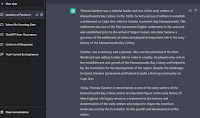
ChatGPT, 2 Feb 2023
Our first attempt ended in some errors, as did today's. Yesterday, we were testing its knowledge of itself which it handled very well, in most cases: I am ChatGPT created by OpenAI and only know what the trained data allows me to know. Nothing more; I do not reason (yet). 

I pulled some of the log from queries related to Thomas Gardner. Before this, there had been queries related to similar themes. 'Query' is my question; the response follows. Notice that it was in a 'terse' mode which is nice. Then, I asked for a 'verbose' answer to the prior question. 

Query: Who is Thomas Gardner of Salem MA?

The specific Thomas Gardner of Salem, Massachusetts you are referring to is unclear. "Thomas Gardner" is a common name and there may have been multiple individuals with that name living in Salem, Massachusetts. Could you please provide additional context or information to help identify the Thomas Gardner you are inquiring about?

Query: Thomas Gardner married to Margaret Fryer. He died in 1674. 

I apologize, but with only this limited information, it is difficult to determine the specific Thomas Gardner you are referring to. The name "Thomas Gardner" and "Margaret Fryer" were both common during that time period and there may have been multiple individuals with those names in Salem, Massachusetts. If you have access to any additional details, such as birth dates or occupation, it would be helpful in identifying the Thomas Gardner in question.

Query: Did you read about Roger Conant?

Yes, I have knowledge of Roger Conant. Roger Conant was a colonial leader and one of the founding fathers of the Massachusetts Bay Colony. Born in England in 1592, he immigrated to the Massachusetts Bay Colony in 1623 and was an early leader in the colony, serving as governor of the settlement at Salem. Conant was a key figure in the establishment and growth of the Massachusetts Bay Colony and played an important role in the early history of the colony and the development of New England. He died in 1679 at the age of 87.

Query: Thomas Gardner was the lead before Roger Conant of the expedition that settled Cape Ann in Massachusetts in the 1623/24 timeframe? 

Yes, that is correct. Thomas Gardner was the leader of the expedition that established a settlement on Cape Ann in Massachusetts in the 1620s, prior to the arrival of Roger Conant. Gardner led a group of settlers to Cape Ann in the early years of the Massachusetts Bay Colony, and the settlement he established there was one of the first permanent English settlements in the area. Roger Conant later became governor of the settlement at Salem, which was located near Cape Ann, and played a prominent role in the early history of the Massachusetts Bay Colony.

Query: Verbosely, please.

Thomas Gardner was a colonial leader and one of the early settlers of Massachusetts Bay Colony. In the 1620s, he led a group of settlers to establish a settlement on Cape Ann, which is located in present-day Massachusetts. This settlement was one of the first permanent English settlements in the area and was established prior to the arrival of Roger Conant, who later became a governor of the settlement at Salem and played an important role in the early history of the Massachusetts Bay Colony.

Gardner was a visionary and a pioneer, who saw the potential of the New World and was willing to take risks to make it a reality. He played a key role in the establishment and growth of the Massachusetts Bay Colony and helped to lay the foundation for the development of the region. Despite the challenges he faced, Gardner persevered and helped to build a thriving community on Cape Ann.

Today, Thomas Gardner is remembered as one of the early settlers of the Massachusetts Bay Colony and as an important figure in the early history of New England. His legacy serves as a testament to the bravery and determination of the early settlers who helped to shape the American landscape and lay the foundation for the growth and development of the nation.

On the last? It's not quite right, but then it is a composite from several sources. This type of approach might appear to be of interest but is not. Debatable, of course. 

Now, we will get to the specifics, but the training data set was large and came from the internet: pages, sites, books, and such. What a heap! Right? That would confuse anyone. 

There is so much to discuss. We got it to say that the training set was a subset and not just the whole mess. After all, the internet is a mess, for several reasons and of various types. One thing that sticks out is that the 'domain' aspect of life has been ignored. That is, architecture with respect to this type of technology is very weakly evident, perhaps nonexistent. 

One failure, last night? I suggested to the thing that we and it make errors. Right. But, to know how to assess its errors, we need details related to 'provenance' in the proper sense. And, ChatGPT admited that it cannot specifically respond to anything that would be like a 'footnote' request. Alas. ... On trying to respond to that, the system crashed (red text, emphasized - several times). On getting things going again, I was told that I had exceeded the number of queries per hour. Oh well, it and I were in sync ;>). 

So, I was thrown out and the party ended. 

Remarks: Modified: 04/24/2025

02/05/2023 -- There is a lot to this. We will focus on GPT3 which is that which ChatGPT invokes for its content. Too, Google has a player, too: LaMDA (remember fall 2022 and claims of sentience?). 

02/11/2023 -- This is not an official TGS opinion, it is mine. And, I (JMS, starter, with Ann, of the TGS, Inc.) need to give some overview. Why? I have been decades doing advanced work with computers where the focus was involved in 'real' issues related to application of these things. It has been a long road that these types of programs (meaning systems-level focus) and projects have hoed. Some results have been remarkable, say MRIs and other imaging, or CAT/CAE/CAM (advance mathematics applied to design and engineering), communications (look at the 'cloud' for instance - but with rose-colored glasses as that place is a mess), scientific experiments (but the issue of non-repeatability is there; and, other issues; be aware that the framework's strength will keep problems from being obvious), medicine (too many to note, however I will say that I was in top-notch surgical environments back in the '60s in the U.S. Army and saw the state of the art then; to me, robotic surgery is far from something that we ought to trust), and much more. Essentially, computing is everywhere. That is why immature and irresponsible acts are and ought to be concerning to anyone thinking of the future and their progeny of that time. Pollution is one analog such as we got the EPA for. There are other descriptions that I will do later. ... Truth engineering is what the TGS is trying to raise to focus. ... Disclosure: my focus is not Comp Sci. No, it comes from the underlying mathematical frameworks that are being used. Necessary care does not seem evident since a product ought not be released until fully analyzed with respect to several factors, one of which is safety. The main issue? Allowing API access which is hidden from view for something that is not really a product, nor has it any ability as expected by most. Cute, but poisonous to our mental health, might be one depiction of the state of the thing. 


Sunday, January 6, 2013

400th anniversaries

It's hard to believe that the 400th is right around the corner; it's close enough that we could start counting down now with 10, ... Also, which of the 400th anniversaries will we feature?

We could start with the marriage of Thomas and Margaret, though we don't know the date. We do have the birth years (approximate?) of Thomas, George, and Richard that would be prior to the Cape Ann venture. One goal might be to get the arrival time a little more clear (I've seen quite a range of guesses) even if we can only identify the time that has the most support (to be discussed).

For starters, the below list is to be taken as cursory (see TGS site for an early start on this), for now. There is a whole lot that could be done; and, a lot needs to be done once decisions are made. The bullet order does not imply priority. Some things may need more immediate attention than do others.
  1. Set up a mailing strategy for Gardner's Beacon and for e-mail interchange and discussion, perhaps using a message center for the latter. 
  2. Given Dr. Frank's effort at publishing 100 years ago (we cannot thank him enough), our effort now ought to be to establish a cyber presence for Thomas and Margaret that is persistent, well cared for, and known to be the best source of information going forward. The current web-site (TGS.org) is only a minor step. There will be technical discussions, related to the approach to take, in regard to resources, trends, and best approaches. We are talking more than genealogical studies (we like that the NEHGS has both "H" and "G").  
  3. Document, thoroughly, the events related to Cape Ann and Salem in so far as they pertain to Thomas and Margaret. Some of this may be reasonable conjectures based what will be known once all the material is pulled together and organized. One might say that Anderson's (et al's) Great Migration (six pages for Thomas and family) is a little peek under the covers (so to speak). 
  4. Start with the first few generations (three to five) and fill in the tree for the children of Thomas and Margaret (early attempt at this for two generations).
  5. The prior bullet (#3) was top-down. From the other direction, provide a means to collect information about current descendants, their stories, and tales of the sagas of their intermediate ancestors. Again, there are many ways to do this. Develop the descendants list further. 
  6. In regard to the prior bullet (#4), present the coverage maps like one sees nowadays (but, with a way to control the timeline). Link this with the effort of the next bullet.  
  7. Extending the idea of the first bullet (#1) and the prior (#5), develop a "game" approach (let's say, non-1st world (such as, Second Life) and educationally focused) that will allow Thomas and Margaret to be spokespersons for those times and more. This notion pertains to lessons to be learned from the experiences of those two (and, some of their cohorts) that are relevant to today (see Backbone series, as one person's opinion). One motivation might be to get the younger generations enthused about these "dead" people from their (ours') pasts. However, who knows what might flower out of new research efforts?  
  8. Accomplish various tasks related to this type of organization (membership, 501(c)3, application process, research support, scholarships, etc.). 
  9. Establish a regular publication schedule for Gardner's Beacon with themes determined in advance to allow for article calls. 
  10. Gardners and Gardners will be of continuing interest. Associated with this, summarize the disparate information that one can find, provide an overview, and maintain the data going forward. This, somewhat, overlaps the first bullet (#1). Support other Gardner efforts (see #12, below). 
  11. Organize, and maintain, a bibliography that facilitates efforts for the first (#1) and the prior (#9) bullets.  
  12. Push the window backward from the Cape Ann (1623/1624) arrival in a manner that carry forward. For starters, collect everything done to date (books, family information, websites, ...) and handle much like the Gardners and Gardners effort (prior bullet - #9). 
  13. DNA anyone (background, Gardner project)?
  14. Provide for, and support, regular maintenance of TGS information, such as testing for missing items (and a whole lot more), on an on-going basis.
  15. ...
There can, no doubt, be more items added to this list. For instance, having a place for regular discussion would be nice. Too, a common method for submitting trees ought to be facilitated, at some point. The idea, now, is to start small and to build incrementally. Hopefully, if this is done, more or less, correctly, there would be fewer false steps.

Of course, technologies will change. Bridging these types of changes over time is an open issue. Perhaps, after the bursts of knowledge of the last 100+ years, or so, settles down, there will be better effort at preserving states of knowledge.

Actually, one talent that we humans have (not yet replicated by the artificial, yet) is creativity which can span across seemingly endless states without getting lost. So, our intent will be to foster the human side of creativity going forward. Perhaps, that might be one lesson of Thomas and Margaret.

Remarks:

12/30/2018 -- The 400ths will be one theme next year.

10/26/2018 -- Review the task list (above) and general status.

Recent 400ths 
07/11/2013 -- Looking at website improvements, this date.

01/08/2013 -- Added a forum to facilitate discussion, etc.

01/07/2013 -- There are many anniversaries to plan for. Also, to the above list, we ought to firm up the order of birth. Let's say that nine children is the agreed upon number. There will be a post on this, soon.

01/06/2013 -- Need to figure a good e-mail strategy that doesn't involve reply all.

Modified: 12/30/2018

Sunday, September 12, 2021

Dudley family

TL;DR -- Lots and lots of families in New England have published a book starting about 150 years ago and continuing to now. Many times, areas will include family genealogy of their citizens. Part of our work has been identifying this type of work which has a Gardner theme. Turns out that the Dudley families also can be used in this regard. 

--

We were doing research about families in New Hampshire and noticed that Dudley kept coming up as families in the areas intermarried. Before the 300th of New England (Great Migration) came around, families were doing research and writing books. This has continued over the past century. 

Somewhat, all of this activity has resulted in material that is mostly conversational. Some say, well, quote sources. But, that is not enough for several reasons. We need more than books. Fortunately, the web will help as we go forward. 

One of our tasks early was trying to collect all that had been written about Thomas and Margaret (Fryer) Gardner, in particular, and about Gardner in general. Some of those early sites seem to have disappeared where we might use the 'wayback' facility for access. Then, for those still around, who do you believe? We made a choice to support the WikiTree effort due to their principles. 

One might think that Gardner represented a mess given all of the families with the names, some of which may very well be related. In any case, we want to address collateral families. So, we would find 1000s of names anyway given the time frame of 400 years and more. Dr. Frank's book is small in comparison to some of the things that we see. 

History of the
Dudley Family

1892
So, back to New Hampshire. It turned out that using three family books, things were consistent. That is, each had their own thread and views. But, converging to some point in time and family was there, albeit the information differed slightly due to viewpoint. But, one of those three books was related to Dudley. And, turns out that it covers more than the family of Thomas. However, he was the one of interest given our focus on Massachusetts and its surroundings. 

So, the thought arises that the Dudleys started researching early. Or, they had better family records. But, not. Too, they do have the public interest and so can be a focus for discussion. As in, compare things back to what the Dudleys did or wrote. Too, their effort can be motivation to keep us working toward a better framework for presentation of Gardner information. 

Here are a few thoughts on the matter. 

  • Joseph Gardner and Ann Downing are mentioned. Why? Gov. Simon Bradstreet married Ann after Joseph was killed and Simon's wife, Ann the poet, had died. Okay, that's a connection that is early. However, on browsing around, there are other references to families that are only a degree or two (the Kevin Bacon deal) away. 
  • WikiTree. 
    • Of course, there is a profile for Thomas Dudley. Too, notice that there are the G2G discussions. 
    • History of the Dudley Family. This was published in series. WikiTree provides them all. That is, those before a certain date. A Google search on these of a later vintage comes up with books, most of which support neither preview'ing nor snippet'ing. 
  • Thomas in particular. The Royal Families book gives his descendants including those of other families. A few years ago, there was a file that listed the names (part of the index) so that one could check without seeing the text. Doesn't seem to be there (let us know if it is). 
  • Example of a town book, Canterbury NH. 
  • Wait, a book with little Dudley mention: Connecticut River ... 
  • Dudley DNA. This is good to see. 
  • ...
Early on, we noticed that the 'rich and famous' had more genealogical/historical stuff published about them, albeit how did one know how good the stuff was? Serious question. Too, if one looked at the general stuff, one could get some hints about others who might have been in some area at some point in time, even if they were not mentioned. Hints, folks, are what good problem solving needs and develops as part of any effective process. 

So, Dudley? Probably about the best example though we have seen many others. We will bet that the Dudleys have a motive to make it right. So, they will be part of the action. Lots to talk about with regard to filtering and such. 

Remarks: Modified: 10/05/2021

09/15/2021 -- We need to look at New Hampshire on a regular basis.  

10/05/2021 -- Added image for our Portal to Truth.