| U.S. Territorial Acquisitions |
Other topics will include the U.S. Interior and Carving the land.
02/21/2025 --
| U.S. Territorial Acquisitions |
02/21/2025 --
TL;DR -- After doing an extensive sweep of the internet (information universe), especially with respect to technical details, one can ask, whom to trust? GenAI, over time, will make the problem worse. So,our technology focus fits within that scheme of things. Where do we go from here?
--
There has not been a post since early August as busy with an assessment of technolgy with respect to computing and the GenAI that has been becoming more prominent on the landscape throughout the year.
My activity has been reviewing the past two decades which saw the internet bloom and had machine learning come back with a vengeance once Job's gift got out and was replicated by other players.
In particular, I have been concenttrating on database management changes plus the newer modes of accomplishing functionality.
A post on Quora somewhat summarizes the current viewpoint (worldview, educated opinion) that I have which stresses that technology is now suitable for a regular focus as it runs throughout our lives introducting changes that many times have not been beneficial.
This is the question/answer: As Oracle's CTO, what emerging AI and machine learning advancements are poised to revolutionize enterprise data management in the next decade? The questions was asked by Larry Ellison in his role as CTO of Oracle.
I created this post for the answer which starts a series of stick diagrams that will be improved later.
Another bit of activity involves a project that will experiment with a new technique for handling economic resources thereby removing some of the downsides of the ca-pital-sino which will be sandboxed, eventuall.
Remarks: Modified: 08/22/2024
TL;DR -- STEM ought to be MSET+. Too, we see science in practice everyday. A Thomas Gardner descendant was recently honored at LSU. On the other hand, an old name from Harvard is apropos to analyzing the times and their turmoils with respect to computing. It's time to raise the level of discussion.
--
The conglomeration of Science, Technology, Engineering and Mathematics (STEM) has gotten a lot of press, of late. Magic ensues when one considers the potential based upon the proficiency of the practice.
Wait, nope. Nope. AIn't is all of the evidence that we need. The main mess is attributable to mathematics. You know, the sequence ought to be this: Mathematics, Science, Engineering, Technology (MSET). Okay?
So, this post is to start a discussion and the followup actions, over a large scale. First, though, we will mention two parties. Second, we will have a brief look at how the two mix in this day and age.
------------
In this photo, we see Alfred L. Gardner, Ph.D. giving his acceptance speech for the award. To the right is the Dean of the College of Science, LSU: Cynthia Peterson. The award dinner was held on 19 Apr 2024, at the Baton Rogue, LA campus.
![]() |
| LSU COLLEGE OF SCIENCE CELEBRATES 20 YEARS OF HONORING TRAILBLAZERS IN RESEARCH AND EDUCATION |
The second person is Benjamin Peirce (SEP article) whose son, Charles Sanders Peirce, we have paid attention to. Today, we honor Benjamin, himself. We have had lots of posts on technology over the last decade and many just from the last year. GenAI and its foibles were the theme. Mainly, the problem is that AI is not some creature. Look, we are dealing with buckets-of-bits. Even if there is the robotic side of things, those are buckets-of-bolts, albeit plastic many times.
So, let's clarify the issue using Benjamin's work. First, observing over the past two decades has shown a decline all around. Quality has gone away. The only way to find it now is with the "bespoke" methods that are custom done by those who care. Companies are whole-hog adopting AIn't with deleterious results that can be seen all around.
They are forcing their customers into untenable situations. Actually, they are treating their workers even worse. And, at some point, the illusional mindset that is allowing this will burst its bubble. We'll see tears all around.
So, may we prepare? No less an authority than Bourbaki noted the importance of the Peirces. As said, we ran into C.S. Peirce long ago in the context of computational intelligence. But, his father is noted as being instrumental in taking Hamilton's notion (quaterions) and bringing it forward. Look, this was in the mid-portion of the 1800s. What happened since then? We will look at that.For now, here are two sites offering Benjamin's paper: MAA Mathematical Treasure; Linear Associative Algebra. We will focus on Benjamin and his son, for a bit, as we get the situation described.
Benjamin and his son are Thomas Gardner descendants, too, with two children in their pedigree: George and Seeth. So, we will be looking at that further, too.
----
Now, to a brief bit of the necessary discussion, our last post was the forebear of the message: map-territory. That is partly philosophical in nature. But, mathematics threw out the old way. Let's bring it back.
The reason for these two being tied together stems from our interest in truth engineering which will be another piece of work on the table for taming AI which is computing and mathematics going aground. That is, they got grounded but in an improper way.
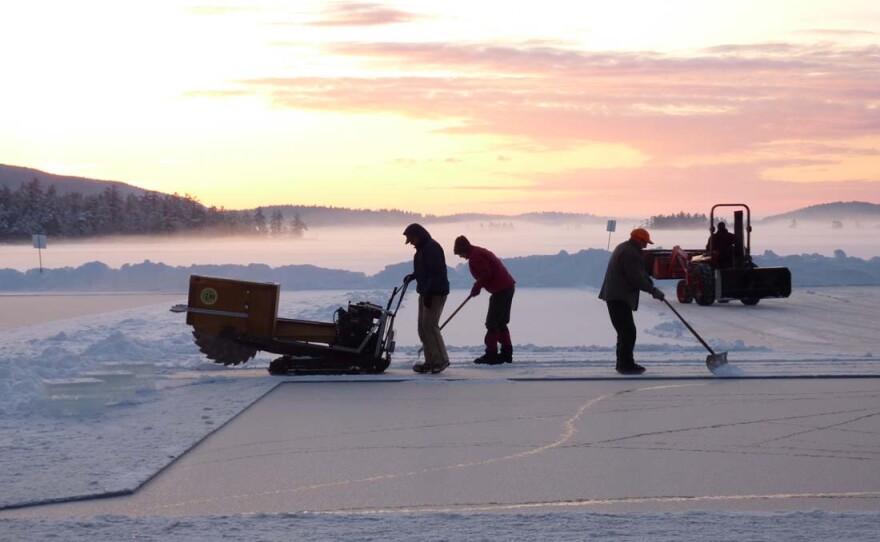
TL;DR -- We point to an article/answer on Quora dealing with cooling beverages of the alcoholic type in Dodge City, say around the time of Marshal Earp. The article points back to Wisconsin, but ice collection happened all along the northern border in the winter months. The technology of cooling has an interesting history which we will look at in order to get a focus beyond the shenanigans to the computational crowd.
---
Quora has accumulated a lot of great articles over its years. These are written as answers to questions. Of late, we are seeing more with pictures from the past. Photos, that is, which we hope are of sufficient provenance to use for research. Right now, this problem is only an idea, for the most part, as fakery has been easy to spot.
But, it's getting harder. So, we will be addressing that from a technical sense. For now, we will be looking at old photos. We have referenced articles of Erik Painter several times, mostly with respect to the over 100 years of frontier experience that brought the U.S. (us) to today from the start 400+ years ago. The frontier experience exploded post the U.S. Revolution. There are lots of tales to tell about this as we look at the expansion across the interior. On the other side of the matter, Erik Painter has posted well-written articles about Native American culture and the impact on it that the past 200 years has had.
Today, though, we go to Dodge City, KS. Here is a link to the question and answer:
![]() |
| Ice Harvesting in New Hampshire |
Looking at the history, Washington even had a taste for the sweet and icy stuff. New York had a parlor for this product in the 1770s. But, the interest in cold refreshments go back much further.
Remarks: Modified: 03/31/2024
TL;DR -- So, what happened in 2023? Lots. The world has changed, and it has not. People showed their seemingly limitless capacity to bow to the machine.
---
This post serves two purposes. For one, it looks at AI (usual sense) over the past year and collects material pertinent to ongoing discussion and work. The first list contains links with some commentary for each of item. This collection points to different periods over the last year. OpenAI made their announcement on 30 Nov 2022. At that time, we had these two posts which pertained to our continuing topics of research which includes technology.The image shows a copy of the "All time, popular" count by post. The topmost, related to the marriage of Thomas and Margaret, comes from the 2014 timeframe. The next one is 2021 as is the one titled "St Louis MO to San Francisco CA" which has spawned several of posts and discussions. The "San Francisco" post is from 2023.
So, we will continue this area of research as there is plenty questions that are open. Our FAQ will be updated in 2023 to account for new information. In the post titled "A(rtificial) I(Intelligence) researched properly", we go through our own work over the past decade and make some predictions about the future. Given that this work carries on prior research allows a longer time frame that seems to be normal now. So, we will continue to describe things from the historical viewpoint, both technolically and phenomenonally (which is how we view the U.S.).
Disclosure: We did not get involved with the xnn/LMM, generative material until after a couple of months had elapsed. As noted above, our timeframe is much longer than normal; and, we need to slow things down in order to establish a little bit of maturity. All of this will be discussed.
So, going forward, the second list deals with the major change in 2023. We will also use this to start a summarization of our positions on the subjects. The list follows a sequential timeline and uses posts from this blog and related material.
Remarks: Modified: 04/04/2025
12/28/2024 -- See updates in GB, XIV, 1 for 2024 updates.
04/04/2025 -- David T. Gardner has been exercisting Grok with prompts and reports finding documents that support his claim about Wyllym Gardynyr (see King Slayer Court blog). ... We have begun to incorporate changes into the structure and context of the blog. See Restart, somewhat.
TL;DR -- Exeter NH has been on our plate from day one. But, we had lots of Massachusetts material to digest, including that from elsewhere. So, while redoing our site, we thought to venture into the surrounding area. A WSJ article on OpenAI's Board got us started by mentioning Phillips Exeter Academy. That ties together several themes for this year.
--
In an earlier post, we mentioned that we need to look at New Hampshire more often. We now have additional motivation for that effort. The earlier post was about the Dudley family. But, the State celebrated their 400th this year, through honoring Portsmouth.
We have touched upon people, such as Rev. Bachiler (who could not abide Winthrop and went north), General Aldophus Greeley (led the Lady Franklin Bay Expedition), Nicholas Gilman, Jr (signer of the United States Constitution). and others. One of the places mentioned was Exeter, NH which town was home to many ancestors found in Ann's tree.
![]() |
| One of two houses |
Today, we saw another name to look at further: John Taylor Gilman. He was born in Exeter; we got to him in a roundabout manner that ties together several themes. We have been seeing references to this site for years but had a Massachusetts focus for obvious reasons. Though, we learned early, that northern and western movemernt started very early on.
So, how did we get to John? He attended Phillips Exeter Academy which was founded by John Phillips who was descendant of Rev. George Phillips of Watertown, MA. So, we find several tie-ins here with the major theme of the times. Rev. George was on the first Board of Harvard about which we have had several posts. Of his many descendants, one was Bill Gates of Microsoft.
Finally, how did we get here? We saw in a report in the WSJ that the head of Meta (Facebook) and Quora had been students at Phillips. And, our technology theme pertains specifically to new ways, of which the computational is a major part. The reference we saw was in a WSJ article about a member of the Board of OpenAI.
We have made use of Quora since 2015. With respect to OpenAI, their release last November of their ChatGPT did not get our attention until February of this year. Somehow the hype associated with these things escaped our awareness. But, since then, we have taken a "deep" look at the "generative" movement of the machine learning crowd.
Let's just say, the jury is out along several axes. We will discuss this further, see: AI not solely ML. But, tying the new back with the old in this regard makes a lot of sense. After all, the focus of AI (however fruited) ought to be people and their freedoms.
Not some dominance posturing (and following through) that is problematic even when not out of control. But, then, politics? We avoid that.
Remarks: Modified: 12/16/2023
TL;DR -- Since we are taking a focus on technology as a thing deserving of attention, we will have to be regular in posting information. Expect that more regularly in 2024 as we commemorate the arrival of Thomas and Margaret (or not, depending upon our research)
---
We ought to have these on a regular basis and will starting next year. For this post, we'll look at a New Yorker article, briefly. Then, we'll add in a comment about a recent post. After that, we'll show a graphic with regard to one of our web servers. Then, we'll start a list of the web presence plus gather all of the technical posts together under various categories.
Ambitious task? Yes, we'll start today and finish this up with a week. At the same time, we will consider how to do these and with what frequency.
---
AIn't and AI. We'll be more specific next year.
![]() |
| Related to: TGSoc.org/papers |
What we see are six metrics. The world has gone mad numerically, many ways. So, that, too, will be discussed. But, with respect to the flow of activity, the topic was motivated by OpenAI's little trick last November. They didn't do the world a whole lot of favors; rather, we will see, in less than two years, just how negative the impact might have been. Now, will subsequent activity on their part relieve some of this.
An adage is apropos: one cannot train out the crap that was trained into a system via machine learning.
At the "Papers" site, we put out an article in May and then followed in the latter months.
TL;DR - Quora has been mentioned a few times over the past few years. This month, we point to an answer which deals with naming of the tribes of North America. Also, we need to always mention technology. Time to recall the contributions of RA Douglas-Lithgow, MD, LLD.
---
Earlier this year, we mentioned an intent to get Awareness months on our radar, regularly. This month, we had a holiday which is associated with the populace here prior to the "discovery" of Columbus in 1492 which we all grew up learning about.
So, we are a little late getting to this. Since 2015, we have spent times on Quora which touts itself as " a place to gain and share knowledge. It's a platform to ask questions and connect with people who contribute unique insights and quality answers."
In fact, we have posted several answers which link back to blog posts related to the Thomas Gardner Society. Here is an example from five years ago: Thomas Gardner (Cape Ann). As we can see from activity this year, we will be redoing the history with regard to Cape Ann. See the "In summary" post.
---
Erik Painter is a writer on Quora covering several topics. One of these is about Native American culture. The topic of this post is very much apropos to our interest.
Erik answered this question: How did the different Native American tribes of North America get their names (i.e. Sioux, Cherokee, Mohawk)? He mentions several tribes, including Narragansett, Mohawk, and Mohican, who were cohorts of the early New England activity.Then, his coverage of the western tribes was quite instructive. There have been several other answers by Erick that we can discuss in the future.
For now, here is a listing of posts with the topic of Native American in this blog. Expect more of these as we look to the west coast to provide a focus for the 250 years of expansion of the U.S.
Prior to that, we will relook at the history of Cape Ann, Essex County and Salem with the intent to update Dr. Frank's two books as well as our own posts (and publications).
---
On another note, and with regard to technology, this year (or since the Nov. 2022 release of ChatGPT) we have seen how technology is going to be more of a bane than ever. For us, balancing the views by including Native American insights will be a prime aspect of truth engineering. Gloucester, MA showed this with their 400th activites in 2023 (Cape Ann, 1623, crew overwintered).
---
Finally, let's mention an import who wrote a book on New England names and places: RA Douglas-Lithgow, MD, LLD.
Remarks: Modified: 10/22/2023
TL;DR -- Los Angeles has had a few mentions in this blog. Following up on details related to development in the downtown area, we looked further at some historic moments. For one, a service club started in 1942 went on for over 10 years. That building was next to a Cathedral. We look at some details related to that associated area of downtown LA.
--
We have had a few posts on this city (recently, Mirror Building) and its northern neighbor (San Francisco). Yesterday, we saw that Facebook has a group dealing with LARelics which has many older photos of the LA area. The one that got our attention was from the Victory Service Club (VSC) from 1942. Since we are following the long arm of New England to LA, we had to dig deeper.
We won't detail every site that we visited, today, but we followed several threads. One dealt with Main Street in LA, in particular the area around where the City Hall was built. It's remarkable, for several reasons. But, there were many blocks along the street with differing histories. For this case, we wanted to know what building housed VSC. In that area, several bank buildings were built in the late 1890s. That brings up how things worked before banking. Expect a post on that topic.
Where the VSC was, the 1st National built. But, many changes had taken place between the 1890s and 1942. First, what was that VSC building, and when was it built? Turns out that the VSC was run by the Union Rescue Mission (URM, see notes on Wikipedi page for Main Street (Los Angeles). Those are my notes which reference a 1955 book plus pionts to various other photos from different times. The URM was on of the early missions and was large.
---
Turns out that the book noted that the URM picked up part of the Swanfeldt building at 226 So. Main. Next door was the IOOF building that they acquired in the late 1930s. That's not the gist of this post, it's coming. The Swanfeldt family had a canvas company and did tents and awnings in the LA area. They were from Sweden and show the influence of a new family. We have many New Englan families to detail, though, some of which deal with the LA Times and the buildings in the area.
---
Next door to the VSC and URM was an old Catholic cathedral (Saint Vibiana). That's our theme today. The parish had to move. Part of the reason might have been earthquake damage, however enough of the structure was saved to be extant today. Most likely, the move was through gentrification which had earlier brought the URM into the area as it had to move back in the 1930s to make room for LA's new City Hall. There are sites with photos taken during the construction which ought to be of interest.
This photo is of the church not long after it is built. This area is right downtown LA off of US 101.
![]() |
| Vibiana Lofts |
Does it look to be in a scrubby desert? Well, LA is a dry place. Guess what? That building still stands. When the diocese was forced to move, there was an effort to save the building which worked. Then, the government got involved and made it a National Historic building. Now the site is an events center of some note. This is very analogous to what happened to the Presidio in San Francisco.
While searching I found this site which has period photos. It is just wonderful what the web is allowing in terms of independent historical work. We want to encourage that.
So, the site shows both the IOOF and the Swanfeldt buildings. Now, we want to look for when they were built and by whom.
Remarks: Modified: 10/25/2023
10/17/2023 -- Following our usual mode, we went to the FB page for TGS, Inc. and posted a few words with a link to this post. It was liked by one of the regular readers. But, within about 10 minutes, there was a message of the FB post being deleted with an ominous message. Still not sure what precipitated this reaction by Meta's watcher (which one and of what variety - I would like to know specifics). Have heard of this type of thing. Have been watching over the past decade, various debacles, as technology was put into the place of people. Also, noticed that companies that cared about the clients kept people in the loop that one could talk to. This image is the message about the FB (Meta) post.
10/18/2023 -- More on the theme: Los Angeles, again; Bunker Hill, west.
10/25/2023 -- Earlier (or Earliest) LA. -- Why was downtown LA built so far inland? Erik Painter, on Quora.
02/19/2024 -- Bunker Hill, the Cathedral, and such.
Remarks: Modified: 10/13/2023
10/13/2023 --
TL;DR -- We're approaching a year since the release of OpenAI's system. There are many others in the mix. After a little review of the situation, we [will] look at an interchange with Bard (of Google) with respect to core items that are usually ignored. [As such, we] We will demonstrate that such oversights are not tenable now (the piper always arrives; karma unfolds its retribution or reward).
--
Technology is a focus that we have adopted. We see it and its influences all around. Of late, machine learning (ML) has risen to attention after decades of preparatory (saw this; forgot to fix; Boston influences caused the "r" drop ;>) work. Well, a side note would emphasize the improvement of hardware over that time period as being of primary importance.
Actually, we can thank gaming and its emphasis on graphics that is fast and representative beyond merely providing stick figures [plumbed out and shaded]. Recently attention has grown even more in this area with the stock of Nvidia bursting out as a consequence of its last quarter's boom in revenue. Nvidia made chips for the graphics processing used in gaming (GPU) which are now [which now] have another alternative that has potential. That relates to a better way to handle the processing of numbers.ML requires huge expenditures of several types, including computer time. One expectation is that the new Nvidia chip will get things done faster or allow more work within the same timeframe. But, what is ML and why is it getting attention? That is one topic that we will cover. Is this topic related to artificial intelligence (AI) which has seen so much coverage in the press? Yes.
Right now, there are two items to present. Over the past few years, we have had several posts which covered various aspects of this new way of doing business. We have plans to continue that emphasis but more thoroughly and with regularity.
Remarks: Modified: 09/07/2023
09/07/2023 -- A few changes, wording, grammar.
Remarks: Modified: 08/20/2023
08/20/2023 --
TL;DR -- What makes American great? It's more than a dream.
--
On Quora, an older post (from four years ago) gave five reasons for the successes of the U.S. Now, whether those successes represent epitomes can be discussed, in time. This post shows the graphics that were provided with the post which are fantastic.
Why is the United States successful compared to other Countries? There were many answers, but this one gave these five reasons:
![]() |
| What makes American great? |
06/02/2023 --
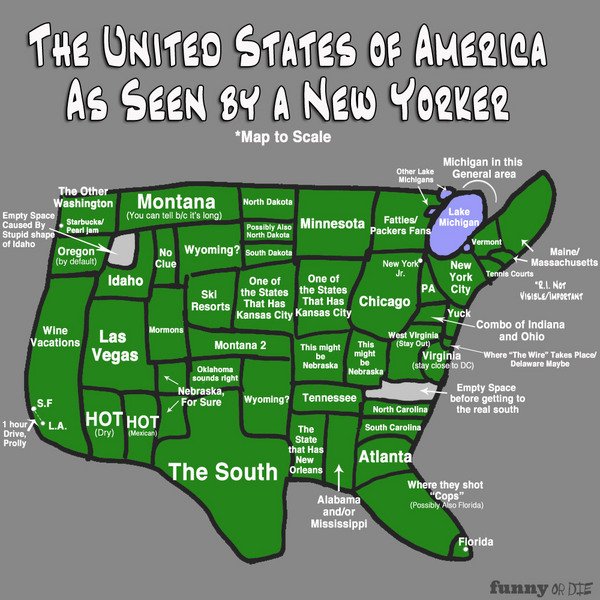
TL;DR -- Our technology focus will be regular with a lot of areas to cover. As we do this, we need to define the areas of focus which principally will be about computational approaches that have come about in the past 1/2 century. In one case, AI, we can look at the decades and mark the changes, some of which were related to progress and others were known as static periods. But, in every case, something as left. The earliest AI efforts left us with user interface capabilities that we take for granted. We use a map showing opinion as an example of several issues needing attention, now and later.
-- Preview (Hint? See Remarks 01/31/2023):
As we go along, technology's impact increases, both for the good and the bad. Observing technology and its ways is an example of humans and their learning ability. This is a simple review of a complicated affair, but we all know of the long trek to ourselves. Perhaps, it's not a moment-to-moment deal, as the demands of life can loom hot and heavy, whether it's some of the time or most of the time. No one ever has no 'looming' though one might tout their proper attitude of detachment, or not as inattentiveness is problematic, too.
Get the drift, yet? Some use the academic experience (in toto: from childhood - usually kindergarten but this can start at home; through the early grades which some see as more of social orientation than not; then those higher ones leading to the diploma that will be a companion throughout your life - some of those who don't get this far recoup with the GED certificate; and, onward, through undergrad, then grad, and then postgrad - where we shuffle people into categories related to their benefit and ours - as in, cultural contributions - the gamut); done?, nope, as we have life-long learning. Too, let's consider the autodidact, please.
What we are doing here is, in part, where history and genealogy come together (take the 1834 start of the New England Historic Genealogical Society, as an example) . We mentioned the 'academic' experience above, but what of the 'real-life' learning that is necessary. Some call this common sense. One AI (let's point to a general page, Wikipedia) project has worked to building a system (see Cyc) with this characteristic for a few decades, now. So, we will get more into that below.
--- Intelligence:
But, our learning is not rote where we follow what we learned (say, as a computer might - it's called programming which is the core of AI with some clever extensions thrown in that look smart when the related behavior is observed). We, humans, need our judgment which might be a wrong term to some. But, other words apply such as being able to evaluate, make decisions, interpret in all sorts of situation, and a long list of other things. Through history, we saw lots of examples, again, both good and bad, of human creativity (another aspect that will be on the agenda) in action.
In knowledge matters, there is a bifurcation that is taken for granted. Some might say 'book' versus 'street' learning. But, it's not that split. This has to deal with whether the mode is real (as in, what science provides when done right) or fiction (which is what 'fiat money' is, for an example - think of that and the ways people can lose so fast becomes more amenable to being understand). For the latter, we have had decades now of highly creative Sci Fi put upon the population and its requirements for adult sanity.
--- Technology:
![]() |
| How a New Yorker sees the U.S. |
It's almost a particle/wave type of deal. Or, think phases of nature (ice and water is a good one for the winter in most of the U. S.). Operationally, we might thing of brain sides. That old idea is still being used by some studying consciousness. There is a balance that effective people attain for these two, especially when one sees more than a mere bifurcation as we deal mostly with multi-factored problems.
Nothing is easy. And, we got to the 1950s, let's say, using our own faculties (that honed by life and education) and facilities (that which we create - artifacts of various types) in known ways. We can look at history to see the changes along these lines. BTW, faculty/facility became more of an issue, of late.
Ignoring that we could say that our own faculties include facilities. Yes, but that involves something having to do with our human abilities. For now, let's keep facilities as artificial, as we see with AI. We will go into depth about what this is and how it came about. Too, we want to explain how we see angst and its opposite (lots of ways to characterize this) boiling up (say, the recent discussion related to ChatGPT (which is one of several examples).
Turning that around, we have enthusiasm (or exuberance thinking back to the Head of the Fed usage) on the one hand and extreme dread on the other. What gives? Okay, this was mere attention getting which we will get back to.
--- US and its roles:
We are talking the U.S. and its roles in all of this. Believe it or not, that is how the leadership has been exhibited; there is nothing that says that the focus has changed. The U.S. can be considered an experiment. Now, that brings up what has happened and why over the 400 years (going back to the original time for a whole lot of families). History tells us some of it. We see information emerging due to the web (computing contribution to us - and the source for a lot of that which has been in the news with regard to machine learning). A blog is an example as it can convey new information. Social media has too many examples for a quick look. Facebook/Meta can be used for this. We have a page on FB; to Meta or not to Meta is a choice having serious philosophical implications.
In any case, the computer changed the whole context with respect to how we learn, what we ought to learn, even to the extent of determining what is real or true (we will bring up truth engineering). Everywhere, there are new things to consider: automatic cars; robot surgeons; addictions exhibited by folks who drive with their noses to a droid or such; ...
Then, people have more ability to express themselves. We always had that; with the internet, the bounds have been loosened. The past decade saw a lot of this being discussed (say, influence that is more than we might have expected). But, of late? It's even more differentiated.
We have what are called 'bots spouting off' which is what we would use for a human, perhaps. It has been going on awhile, and we have paid attention. But, students submitting papers through this means raised the awareness, generally. Call to chat with a company; you get a 'virtual' assistant. Get on some people move; it might be driven by software (to be nice) that is heavily biased due to its learning experience. Someone wrote: death by math. But, then, we had 'death by test' when technology firms were allowed to shirk responsibility. This was a few decades ago, that the problem arose.
-- The gist and its example:
Finally, to the gist, of this. We like maps and have used them. Our last post had two maps. A little snap is given below. But, this next image is from a creative mind. When? Well, FB pushed it to me. I went to look. Guess what? There was an interesting collection, but ads abounded. I steer away from those. Even the glorious PInterest had it wrong. Again, getting the drift? Lots and lots of adults have pushed out stuff under their name which is plagiarism. We cannot have that. Except, I read things that I like, lots of times. Then, I go look. Who wrote this? Well, my search gets us back to our stuff. I just laugh. A proper analysis would show by time the provenance and precedence.
01/31/2023 -- I’m writing a post for the TGS, Inc. blog with a topic of The Americas where I will note the journal of the Mexican Mammalogists and their nod to a U.S. mammalogist. But, in doing so, I was addressing the perils of technology as noted by my last post and stopped to ask Google a question. Why? I like giving Google long queries.
So, query: Asking ChatGPT to tell the provenance of something that it wrote.
This deals with a category, not phrasing for some text response. Too, the thought that we need to trace the source of what we know has always been there. Unfair usage without attribution is the height of stupidity, is it not? Yes, Quora, you allow this.
So, Google gave me a lot of stuff. I picked this one. For one thing, I am mad as hell at The Atlantic for screwing up its New England heritage. Talk to me, people. So, I have been buying the New Yorker. Much better. BTW, the Atlantic, what happened to the real Caitlin, as in Flanagan?
Anyway, I got this: ChatGPT Is Dumber Than You Think (Dec. 7, 2022). Gosh, do I need to give them another chance? ‘shallow’ is used. And, ‘lacking depth and insight’ is not a wrong assessment.
When I was a kid I was taught that the Mississippi-Missouri was the world's longest river (I went to school in Belgium). Now it appears to be the Nile or the Amazon. What happened?
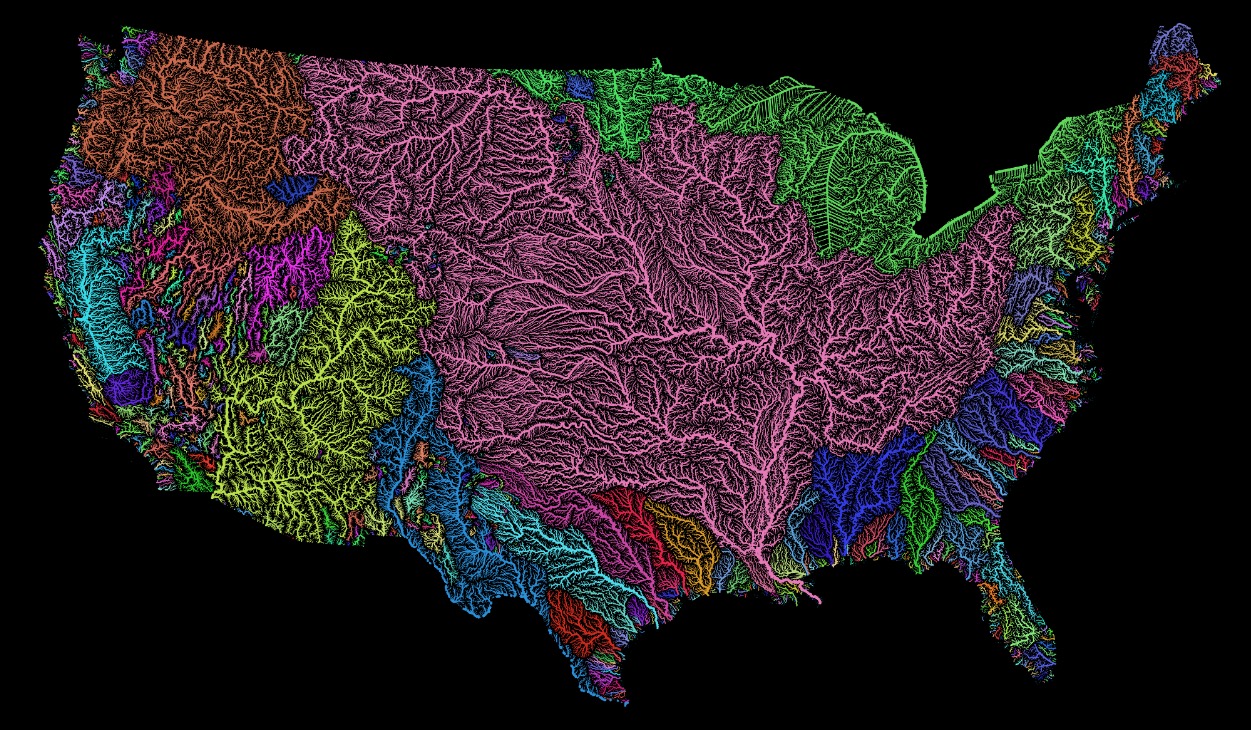
When we were looking at rivers, we showed a map of watershed where that of the Missouri filled the whole of the center of the U.S. reaching from Pennsylvania to Idaho.Answer by David Gray (not recent, but apropos).
![]() |
| Watersheds, U.S. |
Remarks: Modified: 08/08/2022