Showing posts sorted by relevance for query configuration. Sort by date Show all posts

Wednesday, October 5, 2022

Content, again

TL;DR -- We left MS in 2012 having gotten started with them in 2010. We are now back to using them, only slightly for a while. We are reconfiguring with some final sense in mind now, after a decade long trek through the hoopla and confusing goings on that one sees with respect to computing. Silly valley is what comes to mind every time we look deeply. That needs to change.  

---

When we started the TGS work on information conveyance, we were using Microsoft's Officelive which was quite capable and familiar to anyone who had worked through the era of Windows evolution. Of course, there were other OS options; too, Unix was very much part of the technical camp. Then, there was the decision to go to Office 365. 

Since we had been working pro bono for a decade, we opted out. Too, though there was the 'freebie' mode everywhere, we all know the consequences of that. We might have had blogger going, we did not use the Ad facility. Of course, we looked at it. 

John's forte has been advanced computing for decades and has watched the changes, many of which seem to be more immature than not. Again, look around. Messes everywhere. Now, need that have been? It's arguable, of course, but John will throw 'truth engineering' on the table and say let's discuss this. Well, rather than descend into an academically-oriented bit of discussion, we need to work these computer issues in ways other than what we see, at least in part. 

There has been a lot of discussion along these lines that we can pull together. For now, let's say that the Thomas Gardner Society, Inc. has a goal to be a positive contributor in this area without defining things specifically enough to cause limits. After all, about anywhere one looks deeply, there are issues. These have gotten worse over the years. 

Think that this will abate? 

Of the whole ball of wax, "content vs configuration" is one thing to talk about. There are related themes that will come up. One might even say memes since this idea has spread across the internet. Okay, after MS's decision, we went looking and settled on Linux as a proper way to go. That is, for the server affairs to support what we wanted to do. You know, the cloud? Lots of problems. We'll discuss. After all, all of the decisions made were documented as we went along. There are lots of threads which can be used for various purposes, including analysis on several fronts. 
 
One set of choices was to find something that did as well as MS's tools. Well, we didn't find any that stood out. This is still true. But, we have watched what people have done, across the board. Opinions? Yes, they are there. We'll get to talking about the state of the computing world (have lots of these types of thing already) within the context of what we are doing here. That type of discussion goes along with the choice patterns and why they are as they are. 

Now, it was a decade ago that we went off of MS's planet and started our own thing. The first iteration was hard-coded HTML with a little CSS and loads of icons taken from the MS screens that we had. That worked for a bit. Why? It allowed the configuration aspects to be made steady in order to do content work. Mind you, this is always a dynamic. 

One can talk of floors in the sense that one person's configuration is another's content. Say, you're a user of some mobile device (say phone). Do you ever think of what happens as you push buttons in some context with a goal or goals to accomplish? We can look at that at any level. But, one good metaphor is that we walk on a stage under which is a very large collection of abilities taken for granted. To get into details, we have to open some door and enter. 

Or, stoop to conquer. One doesn't get anything done if the hands can't get dirty. 

John says, that the immaturity that we see can be discussed so as to talk ways and means to correct the issues. Is there a suggestion that this stuff is easy? Nope. Actually, it is. There are various viewpoints, many of which cannot even converse. You see, even technical modes and data driven thingees have their troubles. Many times these are settled by power or any other of an endless set of human talents. 

 We'll cover all of this in time. For now, we are going to use WordPress, for several reasons, to provide a platform (software and technique) with which to organize what we need to do. The underlying power will still come from our virtual machines running Linux. At the same time, we will pursue Android modes, using approaches that are general and which ought to work in any of the venues that covers the basic set that everyone agrees upon. 

But, higher-order content must have specifics that differ, unfortunately, amidst all of these things that look monolithic even if that's a mirage (as hackers will tell us). 

You know, that is part of the discussion. WP has Apple'ness on its plate. It is that universal situation that we are looking for. Of course, others do too. I know of one case where the national group uses one and some regionals use another, including WordPress. 

It's funny to consider what AIn't is bringing, or not, to the work. We'll look at that, deeply (in the true sense that the DL folks pirated) and broadly. After all, if one talks machine learning, it's quite legit and rational. 

So, our portal will be reconfigured. See TGSoc.org/site/. 
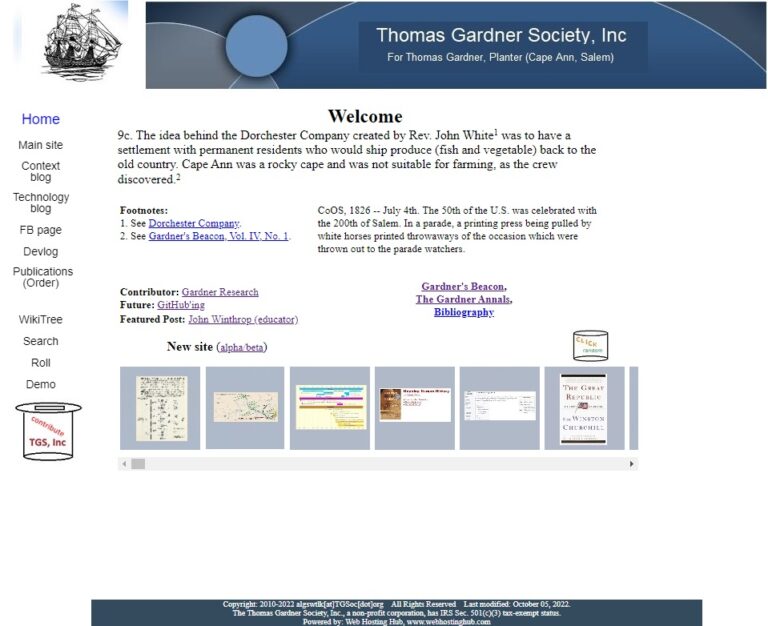

Expect this to be fun. 

Aside: Paying attention? Old guy off the wall? Well, no, here is a current discussion of Concrete CMS versus Wordpress. Of course, it is from Concrete CMS's viewpoint. You see, 'new infrastructure' points to changes that will be permanent. Users want more control. Developers want tools. Content creators and managers want ease of applying power. Finally, John can say, about time. Maturity? 

Remarks: Modified: 10/07/2022

10/07/2022 -- Need to organize the material on content management and updated the story of this versus configuration management (see Sept 2019 post on the new infrastructure and what it entails and a lot more - which was pre-COVID). If you look at the post from 2019, you will see a graphic that notes the advent of Elementor which uses the fleixability of WordPress in a mode that is 'drag and drop' development. Lots to discuss about the approaches and what is beneath the abilities and more through time (hence our reminders of what has been done so far and why).  

After looking at discussions about WordPress, ConcreteCMS and Drupal, we can add to the debate, from our WordPress-supported position. Of course, which of these will be better is an open issue. We have compared the 'stories' and the types of users. They all have a mix. Our view is technical, though we are doing the work for TGS, Inc. 

We will be redoing this page (at our portal to truth) so that it can be a trace for future analysis. Our words. 
  • Note (10/07/2022): Final technical note, after looking at Concrete CMS and Drupal. These were considered earlier and have progressed as has WordPress. And, each of the three have solid use by well-known customers who have access to talent. As we work our configuration, we will be looking more than slightly as the issues which is best done with multiple parties to inspect. Say, like the infamous flyoff when new technology is being assessed. This type of thing is going to be even harder for computing. That is, bridging the cognitive gaps (or hats). Our put is called truth engineering. The ability to think of bare metal went away with the newer methods. Is there some equivalence? Too, the internet's evolution can now been seen more readily given the experiences of the last half decade. For instance, we can point to one paper discussing Concrete CMS versus WordPress, from the viewpoint of the former. Then, we have what we call AIn't coming forth. What we have here is mathematics and parameters mixing in an unlimited number of ways. WordPress, Concrete CMS, and Drupal represent parametric modes that are phenomenally complicated. This (the potential error) is covered over. We'll explain. And so, we have the situation where there is not human talent with the evolutionary wherewithal to handle the issues, except as a guider of the AIn't ways, if they are done correctly. ... It's almost like we've stood still the past decade and one-half with lots and lots of noise being added. Where is the value if only marketing is thought to be the major player? Tsk.


Saturday, October 31, 2020

Content and configuration

TL;DR -- Continuing theme that might become more major than not.  

---

It has been encouraging of late to see several things happening, almost concurrently. Let us just list these with some comment. As a reminder, our portal (TGSoc.org) is where we support 'content' for things dealing with all aspects of the Thomas Gardner Society, Inc. as well as our interest in All Things Gardner. 

With this listing, we have to take little side trips (with curating being done a little later). There have been several studies being done that were disparate for the most part but had overlap, too. That, folks, is how life is. And? The computer has messed things up. Why? It'll provide a nice, beautiful numeric overlay that almost looks real. We can talk two senses, for now: where simulation reigns and appears as if to mimic nature (not, folks, as even with a tightly bound, smart sensor/reactor scheme, there is residue from the operational mathematics underlying the computational - basically, a rephrase of what the academics (CompSci) talk about, but not); or, in robotics, where we have seen the evolution come to machine learning, there is still that reliance upon the numeric/compute dynamic which looks very smart with its quick, huge abacus collective - marvelous -  which by no means approaches intuition of the talented human. 

Now, that's a mouthful, but it's offered liked Halloween candy, yet not. Our problem is how to bring more than hermeneutics into the technical experiences of now. And, we can learn from the past. Need to. The issue, though, is that the past five decades have us now in a bind of unknown proportions and types. This is not a political observation. No, of course, human affairs are complex. And, people have to make decisions. That's the point; offloading our responsibilities to a computer (with origins in Silly Valley or China or elsewhere) does not wisdom make (think Emerson, for one - yes, we have 400 years to look at in terms of the U.S. experience). 

Now, those two studies? One was look at John Gardner's relationship with Giles Corey. That covered a decade where the changes through that time were in parallel with those in the technology world. But, too, we were learning. What lesson cropped up? Curating. We need to start to spend time with that; however, it will be done in the context of content and configuration. Right now, we'll say this: one person's content is another's configuration. There are plenty of computer examples to use. Later. 

Now, the other deals with an adage and breaking it. Namely, we blokes here (norte of the americanas) ought to handle our own stuff. Let us tell you, the frontier experience of the U.S. is even worse than that of the Great Migration for various reasons. Yes. England had no parallel with this. You might see it elsewhere; however our experiences (US) after the Revolution can be a huge wealth of data. So, we look at our stuff here and let the Brits do their thing on their side. But, the focus on Margaret is forcing us to look at the Fryer/Friar family which is not here. The context: Editing Margaret's past. When one looks at Sherborne, there are many Gardner families (Dorset region). Friar seems to be lesser in size of the data set. So that is one motivator. 

However, we are using technology to do this, in a manner that was not available a decade ago. The first notion of this area, beyond reading John's comments (about his talks with his father), was in 2014. There has been some indexing of a slew of images. But, people have warned of these. A lot of the work might just be stepping through images (not unlike scrolling the pages on the micrograph device), except that it's easier. 

How might we say this? Looking at some of the frontier records this past summer was just that. It's astounding that we can do this work and be so blasé about what's under the covers. That is one of the reasons for this type of discussion. We need awareness that is attuned. 

It's funny. we see people realizing that html/css/js is sufficient for a whole lot of stuff. In fact, there are some additions that drive a whole lot of work. Myself, we've gotten to where Julia looks good. It's Python'ish but with extensions that do serious stuff (Lisp'ish). And, it handles the front and back ends. Given the above, of course, we want to discuss the middle out. So much more to look at. 

So, we'll be back to this theme on a regular basis. Curating? It applies to both content management and configuration control. Mind you, both of those have lots of other characterizations. The one truth? Roles are; the needed hat differs by role; balancing hats is what capable people do; the computer comes in and screws up the thinking with its 'magical' chimera'ish nature; many get hurt, led astray, even almost maimed, or driven into slavery (debt, for one); solutions will come from stepping back; we have lots of lessons pending that have been ignored, way too long; independent people will the the key to the future where one needs to know for oneself - 'trust but verify' is part of the solution; knowing how to do this with technology versus people are not the same skill set.  

Remarks: Modified: 11/03/2020

11/03/2020 -- Added image for our portal (https://TGSoc.org). Also, More than fiddling is more on the subject. 

Friday, February 25, 2022

CMS, a favorite subject

TL;DR -- We started with MicroSoft and were happy, but they pushed people off of OfficeLive in order to get Office 360 in place. So, we did the right thing and limped along with a hacked out static mode in order for not let publishing get in the way of acquiring knowledge (the old fashion way, not machine learning - heavens forbid). The next motive for change came with the decision that Google would require some semblance of mobile friendliness to play in their part of the universe. Okay. After that, we did a website for a group that got us looking at alternatives. Then, things were fairly low-level looking to require lots of plug-ins (with regular costs accumulations). So, we just hacked more functions using javascript. When we started our portal, we had another chance at change. So, we had intermittent opportunities to consider CMS over our time. Now, we're at it again. The difference? The mobile environment has matured enough to be really interesting. Technology choices and issues abound; truth engineering is even more imperative; and notions, such as what was old is new again, apply. We'll stay at this until we get a resolution which will found the future work. Too, stay tuned; there is no limit to the ways that someone can contribute technically. We might just be the perfect lab for spawning lots of ways and means for considering how to attain some type of sustainable future. 

---

This post is technical in content, with enough of the 'meta' (proper usage) issues covered to cover the extent of the current dilemmas. For now, we will have a list which is unordered and which will be extended throughout this iteration. We have touched upon the subject a few times, even recently mentioning that it's time to open the Pandora's box, again. As well as having the technical focus which will include the posts from our Technology Blog (hosted via WordPress on our site (TGSoc.org) that is presented via webhostinghub), we will look at motivation and talk the huge issue of managing across the levels related to development and deployment. The top level? We call it content, so CMS, to us, means Content Management System. One might stress the top down aspect of this. That is, the Thomas Gardner Society, Inc. has a focus of the Cape Ann start of the American experience where we look across 400 years in terms of history, family dynamics, genealogy, and cultural issues, such as science. The overarching view is called 'truth engineering' which will show that AIn't is the reality unless some serious changes to the assumptions occur, thereby telling us that we need to lift to public awareness just how the marvels come to be that are associated with computing. 

Some might use 'configuration' which emphasizes the technical aspect due to the decisions required at that set of levels which are many. At the basic level will be the hardware, but it is supported by science and engineering. Software? In the list below, look at the Periodic Table of WordPress plugins. That refers to one set of frameworks (which can be generalized) pertaining to one offering on the market, albeit a popular one. 

Aside, one national group of interest uses WordPress at level of one of the States involved, whereas the overarching scope is handled by Drupal. Of note? We looked at Drupal back in 2012 (see notes with regard to this) as well as WordPress and a few others. Our choice was to fall back to a custom approach which turns out to be useful with respect to steps to the future. As one lecturer noted, what's old is new again.  

For now, consider the uses of 'C' interchangeable since we are using TGSoc.org to demonstrate issues, as well, from the bottom up (Wikipedia - Content Management (notice web content management and knowledge management); Configuration Management (notice the use for software). 

Motivation (see Summary discussion): Provide modes for managing a nonprofit in a cost effective manner while supporting the operational needs that go along with such a focus. At the same time, provide a full suite of media approaches to presenting information that has been curated, manually. Albeit, types of machine learning may be applied but with any use being noted explicitly. Meaning, of course, no implicit uses that can confuse. ...

To us, content and configuration denote two heads or two hats for one head. The reality is that there are content issues that do not need to consider configuration issues. The inverse is true, too. Now, the overlap? It's more than semantics, though we will use CMS for both views because those playing the different roles may be on the same team (or the same person, such as yours truly). 

A better metaphor might be the floor where we have an above and a below where there is an almost impenetrable barrier. Sometimes, one uses silos which are monoliths that isolate. Many times, isolation is good (philosophical notion); actually, partitioning by classes is an example of many. 

You know, we haven't paid attention until this year, but RootsTech 2022 is coming up. This graphic shows the many approaches that have been developed. There has been some effort at establishing a commonality. To us, this means more content management than the other, except where standards might be under discussion. Don't know, yet, but will be paying attention. 


Remarks: Modified 02/25/2022

02/25/2022 -- 

Monday, July 12, 2021

Content and its management

TL;DR -- It seems that it is time to do the periodic review of technology in terms of our use and of choices pending. Nothing urgent is at hand except to increase the ability to have more options as we go forward. In the background is the reserved use of technology that might raise the issues of security, effectiveness, privacy, and other topics. We expect a 'deeper' dive this time (where 'deep' is taken from the AI mania's seeming hold on the imagination of a whole lot of people. What would Thomas think?

--

The explosion of techniques over the past decade and one-half is astounding. And, that techniques range from low-level coding and handling of data through all sorts of presentations on various types of platforms (real or virtual) and then the interpretation worlds coming in, especially with analysis as a driver and that the variety of methods are without end is quite a bit to chew on. For the individual as well as for the group. To now, it has been a daunting task to cope; going forward, it will be even more problematic. 

So, doing a relook is quite apropos now. Let's just start with a list, some of which is older than it may appear and have a new face; what is new will be pointed out, eventually. 

Context: Aug 2014, on Decisions; 2021/22 stop to relook; list of Content Management tools and approaches. 

We can think in terms of hats which are difficult to have on at the same time and, definitely, switching modes is no easy task.  

  • Project Seven - responsive web design, as they tout, with a huge collection of capabilities which can be plug and play or even more. 
  • Dreamweaver - early to the game and still going. 
  • CSS-tricks - one of the demonstrators of the ability of this lowly tool that got my attention early on. 
  • Joomla - it's open source and capable, but too much on the configuration side of things. 
  • concrete5 - again, open source; found it useful but cumbersome. 
  • WordPress - very popular; liked it, but, personally, didn't like the ad-hoc collection of fee-based entities seemingly waiting to pounce. 
  • Drupal - thematic scheme that was interesting. 
  • ...
  • Top 10 best website builders - there are lots of these list where some analysis has already been done. 
Must comment about data bases and their issues (several of the above mention their database options).  As an aside, have done this for years. The concern is more general and relates to staying away from conditions that lead to abusive modes being successful. 

One thing that grated was that most of these approaches make heavy use of pieces that are pulled together out of a database. That is, this approach is highly fluid but lacks structure. Is that important? Yes and no. Many of the modern website whose adherence to the chaos (seeming) might dazzle, the performance can stink. Too, it is hard to multi-task in such an environment. If I see something, I don't want it to change while I am cogitating about related issues. Lots to discuss, perhaps. Going with HTML files forced a structure. At first, of course, there were tables, but this usage diminished over time. 

Slow grind

So, we might think of a split where there is structure in the look and its code. Then, data would be handled by a data base, albeit that sort of thing might really require cloud support for reasons of stability. Until now, we have avoided those decisions. So, it's time to go back and reassess. 

We always talked content versus configuration is a recursive manner. One's person content might very well be another's configuration. Better wording might come to fore, but we'll keep with this split for a while. 

Remarks: Modified: 07/23/2021

07/19/2021 -- Finally, we're on the summer tech trek: Techie world, again. No known destination or timeframe for when that unknown is defined sufficiently to consider having arrived there. 

07/23/2021 -- Add TL;DR and image for the portal (https://TGSoc.org). 


Wednesday, February 11, 2015

Web/cloud presence

While browsing yesterday, we ran across a cached link that was out of date. In the news, of late, we have seen arguments about whether the web/cloud ought to be forgetful (or forced to be such). However that discussion turns out, sites need to be aware that links persist long beyond the expectations of some.

In fact, the link was from 2010: Gardner's Beacon, Vol. I, No. 1 (actually, the URL was technically addressing an ASP file which no longer exists). When picked, yesterday, the link went to a standard 404 (not found) page which surprised me. So, I went looking. Sure enough, there was a missing line in the control/configuration files at the new site.

Well, the transition was in 2012 (documented here). At that time. MS, our friend, pulled the plug. I blogged all sorts of issues related to this (for instance, unsuspecting little companies had put the system into their process - yikes).

Now, though, as you will see if you pick this (404 Not found), the error page is a little more instructive. The message is general as it supports a throw from many places. At some point, perhaps, we will be a little more specific.

As you will recall, we had a go on the content/configuration stuff last summer as we moved from the 2012 time frame to something a little more modern (CMS, again). And, if you look at Status, top of page, you'll see a link to our technical blog as we work issues. Why? Well, it has to do with the fact that there are lots of open issues with regard to the web/cloud and more. Only those who are raking in the dough (or, those who we must forgive because they might not know better) seem to not care; as is the case with every age, we are at various crux points. Thankfully, Thomas Gardner's life can shine a light, yes even after so many centuries, on how to better handle our choice mixes.

Aside: People, quote us on this. All sites (oh, gosh, supposed smart folks) have updated themselves to be more friendly to mobile devices. Guess what, people? They made it hard to find information, in general. ... But, as this old guy knows, we get the pendulum swinging back and forth with technology. Right now, its manic, again. He only hopes that some semblance of sanity returns before his time is up.

---

Last year, we converted to using CSS more fully. This year, we are toying with introducing more scripting. However, as we do so, expect that we will be discussing the pros and cons which get trampled under who is first (no matter the consequences on the populace) and who can make more money (as if that is a sign of smarts - and, in a supposed Christian society? - Harvard (we will have to introduce Nathaniel Eaton as the first nerd) going secular was not a step up).

Remarks: Modified: 10/10/2018 

02/27/2015 - Example of how stale links come about.

10/10/2018 -- As we review our growing collection of material, we will improve the ability to browse and search. First step is to have images pointing to content. We will add more, such as a search button. Content vs configuration is a continuing theme (relates to the core of computer-aided knowledge). 

Sunday, March 24, 2024

Geertruida de Haas-Lorentz

TL;DR -- Running through links on a topic can lead to interesting finds. By a circuitous route, we ran into a colleague of Einstein who lived in the Netherlands and several other finds. Their work showed that inexpensive experiments can do the job. A related post continues our discussion on content versus configuration. 

-- 

Technology is our interest, and it's without limit. Today, we were researching relativity as it applies to some of the modern turmoils. Mainly, this is to set a basis for future discussion and work. In his book on the Evolution of Physics which he wrote with Infeld, Einstein discussed the rise of the modern views, from the perspective of the 1930s. 

One thing stressed was the importance of knowledge and the means for obtaining and managiing such. That applies across the board and usually was a human endeavor. Now, we have other wrinkles coming into sight. These are not new which we will go into. 

But, on reading material, I ran into the old topic of content versus configuration. Or, vice versa, as it's a two-way street. In fact, the TGS work has been important in following the ins and outs of technology as the web and its use became more sophisticated. Mentioning acquisition of knowledge? Mostly, that seems to be associated with the artificial. But, no, people need to  learn to. 

So, there was a hit on a search for a algorithm that pointed to a website (HyperPhysics) managed at Georgia State. The site uses Java and Javascript to provide demonstrations of algorithms related to research in Physics. It has a goal of providing information of a technial nature to teachs of High School Physics. The Georgia site also links to HyperMath which of the same approach. Both of them are great. 

Another link goes to Physics World which is all modern and mostly reporting. However, the articles are a great collection. One of them motivated this post. 

Given that this is Women's History Month, we wanted to feature Geertruida de Haas-Lorentz who provided an experiment to a French museum. It had been done by her husband and Einstein in 1915 and showed a connection between magnetism and "angular-momentum of electrons" using a simple device. Geertruida herself did experiments that tested Einstein's proposals about Brownian motion. 

Her father was the Nobel Prize winner for his theoretical work that supported Einstein's relativity research. 

This was Einstein's only experiment as his work was theoretical (and cultural). 

Back to content and configuration: old (This week's finds ...); new (Azimuth). 

Remarks: Modified: 03/24/2024

03/24/2024 --  

Friday, March 15, 2024

Questions and such

TL;DR -- Bridging across 400+ years will continue to be of importance. So, our quest will be an ongoing process. Technology? The next two years will provide more of a view to the issues. Right now, we can only intimate. In reality, hype abounds. AIn't adopters will be in for a reckoning. 

-- 

It was a year ago, when we found out about the new information about Thomas and Margaret that was available via digitization of records in Sherbourne, Dorset, UK from 400 years ago. WikiTree used the opportunity to split out their Profile of Thomas into two people: one was at Cape Ann who is unknown, essentially; the other is the one who married Margaret Frier. 

The work and discussion had been done while I was distracted by what became to be known at GenAI. There are several blogs on this. But, we're at the stage to move on and do it right. Not that what had been done before was done wrongly. So, tsk, guy, at WikiTree who passes judgment. We'll take it from here with respect to these two gentlemen or one (our choice - until we really know).

On the first (AIn't), look at the series here under my name: True State of AI Tools, 2024. We started this last year after assessing what OpenAI's toy/tool brought. The jury is still out: those who don't know, let's discuss rationally; those who are on the bandwagon, just be aware of the faults that shake the foundation (oh yes, let's to go Einstein's introduction of the mathematics of Relativity to do this, General, that is - and then come forward to the current nonsense).

On the second (Cape Ann, &c - btw, that's what was used in the time of Levi-Civita), how will the research and change proceed? Well, we got started in 2009 but formalized the effort in 2010. By 2012, it was obvious that there were all sorts of opinions, worthy of note (okay?, we'll discuss - we do not like the top-down dominance that seems to appear - more later). So, this happened. 

  • What we know - notice, November of 2012. What took so long? Well, search in this blog on Content and Configuration. I was dealing with new content related to history and people. This was after transitioning my brain from technology, especially advanced computing. And, configuration? I used CMS; later, I pointed to GitHub (with Co-Pilot, is even better of a foild for discussion) as an example. Two hats? Okay. One person's content might be another's configuration. And, so forth. Science and engineering are full of examples. 
So, switching to the 1st, a monolith of knowledge? Nope. The whole framework is idiotic. We'll show this, eventually, if we live long enough. Too, GenAI? Purty pictures. Read about the difficulty of doing something real, as I show with the knowledge-based engineering work that actually bumpled up against the world successfully by meeting constraints intelligently. And, the word salad? Oh yes, perfect grammar, perhaps. But. meaningless. Anyone finding meaning is demonstrating what the Gesalt view was about. 

Going on. Later, we figured that we had enough and started the following using a different format at Google's Blogger. Posts are meant to be conversational through time. Pages (see our Page map) are static. We did this page. Both the post and the page have been annotated with respect to the current topic of needed changes. 
  • Frequently asked questions - notice, later. We did not know a lot, even then. But, we thought that we ought to organize this into questions. These might be reworked to have a good set of questions. However, they'll each be updated. 
So, we have started the work. One thing was to add an opinion category, OpEd. One thing that we noticed over the past decade plus. When we started, the internet was still somewhat open which allowed satisfying queries to be made and tweaked to obtain some semblance of an answer. Now It's been trashed. So, that will slow things down. 

Before now, we also saw lots of site with reseach done earlier. Lots of that disappeared. We had collected lots of links over the years and need to prune these out. But, for some, trying to see what happened will be of use As, that was not work to be wasted. If the stuff is available elsewhere, we want to be cognizant of the work. 

Remarks: Modified: 03/15/2024

03/15/2024 --  


Saturday, September 19, 2020

Technology and content

TL;DR -- Technology can mean several things, many of which are apropos to our work.  

---

There were other posts on this theme: technology as search. For the most part, these followed our movement from the initial ASP world into the fray of webbing (2012) where we picked up the older technology, for several reasons. That is, HTML was the choice (we actually cut images from the pre-cloud setup - high end - and built our own menus, etc.). It worked. And, we were able to work content for two years. 

Content? Yes, the crux of the matter. As we look around all of the populace with those mobile devices (some amount greater than 5B altogether), we watch. Note, this is from the position of not going any more mobile than the laptop. Until now, where this is being written in a 1/2 mode. The work is being done on a small 2-in-one with weds the laptop with the tablet. And, the mix is a multi-core device, with large memory, fairly sophisticated graphics, and solid state support for that which was the file system. 

As an aside, using a light pen for more accuracy and falling back to former modes, it's almost like using high-end graphics from a few decades ago with the manual input mode so loved by those who code (say, vi and such) but in a manner that was only dreamt of before. 

Also, not for gaming. We're being serious here in the context (related to content) of the futures of the TGS where a focus toward research at the heart of artificial intelligence and truth engineering is being proposed. Hence, our little humorous use of 'portal to truth' which is not really tongue-in-cheek. 

We have used our technology blog to write on this. But, the transition was from HTML to HTML/CSS in order to be mobile friendly. Then, we brought in JS in order to be process efficient. There have been several iterations on this. For doubters, we saw a demo of high end computing using html/css/js (yes, almost like the new Lisp, some say, alluding to the era when those machines were top of the line). We have seen the descent to numeric spaces, where logic is pushed away from being nimble. That will change as we see discussed now. 

Many see genealogical modeling and DNA as the top of the line. We beg to differ. Heck, some of the techniques show a lack of appreciation for Bayes and his kind. The whole of the industry (tell us if we are wrong) has no clue about philosophical issues let alone anything about ethics. Thomas, being Tabula Raza, gives us a good basis: the whole of the American experience needs more looks other than those driven by the top-down thinkers. 

This is brief. Before, we used an emulator to match up (or attempt to) the mobile experience. Mind you all, apps is the thing there. Most (all, except for a few) are pure trash. Yes, indeed. We will discuss that. Quite frankly, the work of the TGS is being seen as an operational arm of the larger picture which deals with a sustainable economy in which we have mature computing. No small chore, to look at all of this. 

Now, we can do more than mere simulation and exercise things as they ought. A young person showed us a benchmark which has descended to a type of competition such that one of the players (a company offering a benchmarking tool) actually pulled a Volkswagen move (yes, tuned their app to meet and beat benchmarks). See what we mean? 

Of course, there will be the more normal activities dealing with TGS descendants and those of the whole of the Cape Ann part. But, there is a Gairdner (Gairdner, Gairdner Awards FB) group that started a few decades ago and took up a role in medical research. They have a yearly affair where the best of the papers are discussed and prizes awarded. We'll have a post on this. 

Diversity and Excellence
in Science

Think that computers, especially when you look at the total picture where embedded has become a whole industry in itself and where people are both the users and the used, offer many challenges where a perspective across a longer time frame just might be wanting now but necessary. 

Oh yes, content? Versus configuration? The latter is the focus on the computer which requires a whole lot of support. All the cloud did was push this behind a veil. Ourselves? We went with server which has lots of potential. We're doing a minimalistic approach by choice. It'll be discussed as needed. Content is that which is curated. And, it's the larger issues, notwithstanding AI (and the current hype - oh yes, let us weigh in on that) and its supposed wonders. The full of the content approach usually cares naught for configuration (hence the evolution of the cloud); the full of the configuration cannot understand the needs of content. Such is why there is a friction. The latest IEEE Spectrum had a wonderful article that can be used to discuss this: under the guise of discussing legacy (sheesh).  

Remarks: Modified: 04/16/2023

09/20/2020 -- Added links to the Gairdner Awards group, Scottish family in Canada. 

11/03/2020 -- We are about ready to commence work on further improvements that carry a message regarding the tradeoffs that we ought to face but mostly ignore. Some see fiddling as a right. Fine. But, there is always more work to be done than bodies (minds) to do it. Per usual, we'll be blogging on things encountered, especially issues.  

11/10/2020 -- This theme is still of interest. 

04/16/2023 -- Update image link for "Diversity and Excellence in Science" which had moved at the Gairdner site. 

Wednesday, September 18, 2019

New infrastructure

TL;DR -- A look at what we need to do and the various contexts involved including our content which covers several domains and our need for configuration management. The web's evolution will be on the table in terms of choices, both good and bad, by the developers of the mess. Updated graphic and comment about WordPress are later edits. This was a pre-COVID post. 

---

We have all heard this over the past couple of decades. Well, we can finally say that things are at a crux, especially with the emergence of DL's facilities. They were always there; of late, people learned how to exploit.

Create or discover? Well, like the chicken and egg, which is first? I'm of both minds where 'discover' is given respect. So, Poisson's name is on stuff. He created this. Or, was he describing what he saw and we labelled it with his name as if the underlying ability came about with observation?

With the internet, we get to reason on these things, again, albeit with some practical focus as the intent is to use the thing properly, smartly, and to the best of our ability. I've put out a few posts about this. In July, it was Techie stuff. There were things before, say the technology blog. This started at WordPress[dot]com but, recently, moved to be under our 'portal to truth' (lots to discuss there). At that site, we have continued our blogging about decisions.

I have been working alone, for the most part, just following my intuition. 'Minimal' was one goal. Last fall, I mentioned some Google discussions that were right on (in this old guy's mind) and comforting, actually. Though, as an aside, they own this blog space. We're looking to pull it, too, under our portal.

In the meantime, AI is going bonkers. It's obvious, to me, that the black box can be tamed. It'll take us getting back to logic. What the hey? Minsky of MIT went to his grave arguing that the aNN (no matter the variations, thereof) as not the way. Not that I agree with him entirely, but he was not off the mark. Everywhere, we see AI this and AI that. Makes one wonder if some parts of the populace have lost their marbles.

As an aside, our portal thoughts make use of the fact that Thomas Gardner is almost a tabula rasa given that we know only a little but have the huge set of progeny to ponder. That means, in other words, the 'every man' is the theme or meme. We'll get back to that.

This blog has been going for 10 years. We started the WordPress one due to the details being handled with regard to choices. Of course, as we studied, we had to see where the crowd was going (below). And (yes, this is real), every time, we looked at what led to the current state (our's and the world of computing's) and tsk'd (want to know why? paying attention to the messes?). Sheesh. Do we ever get anything right? For anything of benefit, there are a slew of side-effects, costs (what have you) that are negatively imposing. This is without fail.

AI came on the scene, again, the past few years. Gaga time. This time, though, the older minds were saying, wait, let's talk: ACM, IEEE, etc. So, that's something else to discuss.

But, with regard to what the TGS needs, we have to develop. I have run across roll-your-own schemes. Guess what? The monied crowd does this to remove dependencies upon others. I'm stressing it due to issues of truth engineering. In any case, code will be to the fore. What? Yes, too many are being led down paths to perdition, it seems. We have been right so far in that assessment. I don't see glowing examples, yet.

As an aside, with regard to the below, we were doing Microsoft in the (mis-guided?) notion of going with ASPX and its way of the world. We'll mention this again.

But, the tools are there for us to do things better. Metrics, in other words, used wisely can be quite helpful. The benefits that have accrued properly to technology are examples. Lots of them. So, getting back to the theme of the post, here is an example.

This image comes from the source for a post that is worth reading: How WordPress Changed the Internet - 17 Facts about WordPress. I like it if only it shows that the old guy isn't off the wall. 

Aside: The source? W3Tech and their Web usage surveys where they are looking at content management. Look at the count! Babel building.  


In the 2012 time frame, as we were being kicked off of Microsoft's site, I looked at all three of these. In fact, I prototype'd a TGS site. At the time, I was up to my ears in new information having started to really get into the history and genealogy of the Cape Ann crew. So, there wasn't time to play with configuration when 'content' was the key thing. Notice the comparative growth of these three.

Aside, content and configuration? These differ (the media is not the message).

I looked at WordPress, again, in 2014. Those prototypes had been done under our own server. In the new mode, I went and built under WordPress' site (in the beginning, there were no ads; they came later; hence, we're moving). But, in 2012, I fell back to HTML, tables, icons, and mouse handling. It worked. On the 2014 go around, I brought in CSS and some javascript. The latter was, finally, made more central as it builds the page.

Now, what was one problem in 2012? The database. Too much of it (let's discuss). We can go into this, but the TGS site uses Linux and files. Guess what? Recently, after reading some UBerkeley stuff on AI, I went to GitHub, finally. Ah, the choices, related to text or graphics, etc., were all there for daily discussion while people were, at the same time, doing useful stuff within their chosen framework.

Talk diversity. This is one type that we need and can handle. Though, there are always forces pushing for homogeneity. Mathematicians love this.

BTW, on the latest look at WordPress, as I was bringing it into our portal, I looked at the 'biz' aspects of its use. Nickel and dime'ing was my reaction; like the menu that is ala carte. Nice, but, I want to see what's under the cover (or hood or ... - we used to say). Too, I want more than mere parametric influences. BTW, that is one issue with DL and AI, right now.

Yes, again, anyone interested in machine learning in the context of TGS, pipe up, please.

Closing this out, we have lots of things pending. See this blog that will move (https://jmswtlk.github.io/GitHub-ing/) which will cover the deeper technical issues as we go along. So, indeed, we're talking infrastructure in a new sense, actually senses.

Oh yes, ASPX. Recently, I have been helping in a situation where this is the framework. Not as a developer, but rather as a late tester of a new process. Interesting. Some things I liked, others not. How to get the proper balance will always be a key thing? And, whose balance?

Aside, again. The earlier post pointed to a project management scheme that has gotten a lot of attention. It reminds me of the old Apple package that was card-based. That is, one had cards that linked in a manner that was fairly powerful (we're talking 80s, folks). I see it referenced from time to time. Lift the covers, and you'll find old routines still supporting the computing world. Trouble is, though, that it's in the GUI world. Most stuff is. Developers? Many stay away from that. Actually, WikiTree is balanced and a joy to use. GitHub is more textual with add-ons for the GUI'ness.

How ought we to go? Decisions will be made. None will be in concrete.

When looking at Drupal and Joomla, I also looked at Concrete 5. It's still around. The Army picked it. Okay. How does one decide in all of this? Want to know. Computational sustainability. That'll be a future topic.

Aside: Paying attention? Old guy off the wall? Well, no, here is a current discussion of Concrete CMS versus Wordpress. Of course, it is from Concrete CMS's viewpoint. You see, 'new infrastructure' points to changes that will be permanent. Users want more control. Developers want tools. Content creators and managers want ease of applying power. Finally, John can say, about time. Maturity?  

Remarks: Modified: 10/07/2022

10/07/2022 -- Updated graphic on WordPress which had come from a survey. Put in pointers to survey. This week, decided to use WordPress to prototype our configuration. 

Tuesday, September 15, 2020

Spectral issues

TL;DR -- Technology, whether current or past, will be a continuing theme.  

---

The topic? Lots of meanings. For now, we will focus on the technology choices that will be coming up. We have had lots of post dealing with technology, in fact, two this year, already (Technology, as search); and, there is a blog with this focus (same post, Friendly to the mobile crowd) which came about due to issues of content versus configuration.

Or, for the older people, discussion of whether the "medium is the message" or not. We say not, emphatically.

Back then, when we were moving from Microsoft's experiment to Linux, there was a sampling of techniques. We liked none and went with our own (see discussion at our portal) approach which has been content driven, until now. It's time to re-evaluate and make changes. We have had a discussion going through these past few years as we switch configuration for various reasons while keeping our content curating (and researching) going.

Albeit, the content will still be related to Thomas and Cape Ann. However, there are larger views that ought to come into play, and philosophy is not that focus due to its normal mode of academic playground bullying. No, the computer will be key. Again, though, it'll be more than chasing that which is out of our grasp.

Frankly, the future looks daunting given all of the turmoils seen in 2020. Nevertheless, we are not much different in this respect than were those here in 1918, like the great and grand parents of many.

We are talking more than web design for superior information flowing, though that will be part of the focus. Our emphasis has to be across the whole of the spectrum, even though many might just be thinking of the personal genealogy and family history. There were thousands of families a few years after the Cape Ann experience.

From there, the Fifth generation was the core of the conflict that set the U.S. loose. That was 250 years ago. We need to be looking down that whole line, too. Purpose and motivation and such? Mere choices that can be made now once we start to get a technical basis set.

Thomas as capable in so many ways. Those who will keep things going now and in the future need to extend that in ways that Thomas could fathom. Even his generation only had one mind that touched upon the subject, adequately. Yes. Spinoza. We'll look at that.

Remarks: Modified: 11/10/2020

11/03/2020 -- We are about ready to commence work on further improvements that carry a message regarding the tradeoffs that we ought to face but mostly ignore. Some see fiddling as a right. Fine. But, there is always more work to be done than bodies (minds) to do it. Per usual, we'll be blogging on things encountered, especially issues.  

Tuesday, March 3, 2015

Answering questions

It seems that we have more questions than answers which is not a bad state (blank slate?). But, we have to ask ourselves, how good have the open questions been? Why ask? One early step in problem solving is to be sure that you are asking the right questions and looking in the right area (on the issue of origin, John's (supposed) claim of Sherborne ought to have some credence).

From the perspective of Gardner Research, all questions are good. We will attempt to collect all of these, categorize them, provide resources for research, and publish results. However, a first step is to look at the long history of work and get the material available in a manner that facilitates further study.

---

BTW, here is a slogan:
    For any domain of study, a closed situation is always suspect.
I have a book that deals with open questions in topology (a part of mathematics that is central to modern viewpoints - those that have been very, perhaps too, effective). In the book are, literally, hundreds (see Remarks, 03/11/2015, namely: 1,613) of questions that need attention. The intent of the author(s) [no book is the work of just one's person work] was to help mathematics students to choose an area of research.

So, in that spirit, we will organize and foster something related to "all things Gardner." In that context, of course, there will be specific areas of concern, such as Thomas and the mother of his children which is only one of a whole lot of questions to consider.

---

Now, let's look at the Zouch Phoenix and its passenger list (see image). Son, Thomas, is not mentioned (transcription error?). Joseph was born here. So, who was this Joseph (if the name is correct)?

There are more questions. Later I'm going to put in an image of the birth order by Anderson which agrees with Dr. Frank. That is, Joseph was born after Samuel (Dr. Frank's ancestor).

---

BTW, NEHGS, your re-configuration to please the mobile crowd made it harder to research from the viewpoint of this old guy (long, long years of collaborative work via the troublesome Internet). It would be nice if these folks would pay attention to the works of human-computer-interface work (did they?).

DAR had the same problem of late. Notice that the TGS site went a little mobile friendly without, I hope, being problematic to those who want to mosey about.

Remarks: Modified: 06/24/2019

03/03/2015 - Perhaps, using an FAQ would be a good start for the most common questions.

03/04/2015 -- Start of a Gardner FAQ as a page.

03/11/2015 -- We will have a larger scope (Gardner Questions) of which the FAQ will be a subset (we envision a large set of essays - included will be links to prior work, of the past century or so). Mentioned above is a collection of topology problems (Pearl, Elliott (2007) Open Problems in Topology II Elsevier) as an example of our usual state of having more questions than answers. This link is to a copy of the Second Edition (1,613 problems). ... The work of one editor but a lot of contributors.

04/07/2015 -- We have more questions than answers (research raises both).

01/18/2019 -- Added to the index at TGSoc.org.

06/24/2019 -- We have started to update the FAQ and will be renovating our sites. With the 400th coming up, plus several years of research accomplished, it is time to pull together a cohesive view some of which will be printed. There is a very long ToDo list that will be published and updated so that others can help us with our tasks. Focus will be on content related to Thomas Gardner, Cape Ann, subsequent events, and much more; plus, we will keep configuration issues in mind which deal with the continual concerns related to technology and information presentation.

Saturday, April 13, 2024

On data and types

TL;DR -- Recent events in computing have many worried or concerned. Some are running after the opportunity for new ways of being mean-spirited and domineering. A little word of magic might be "transform" which has been touted many ways. Of course, this goes into the mathematics. We can shed a new light on the issues but have to go back further than the 20 years of the mess making. We go back to 1837. That is how old many of these ideas are. Over time, we'll come forward with a proper history of computing and its enabler based upon mathematics. 

--

In the 21st century, we have had over 200 years of experience of data on individuals in the U.S. Why we use the U.S. is due to the historical aspect of this discussion. Now, people have been tracked all over the place. Russia (Czar on down) has been good at this. Their novelists told the tale. Tolstoy may have acted like a peasant (serf), but he was none. And, we have information on his life and activity, some of it given to us by the man himself. No doubt, there are lots of the peasant class who never got any attention. 

So it went across the whole world.  The U.S. started their systems from the getgo, 400 years ago. In some towns, at least the birth, marriage, and death were recorded for a person. Many have less information or none. Some have more, including books about their lives. Other places did similar recording. But, the U.S. is unique for several reasons to discuss. 

For now, let's remind ourselves that data handling involves technology. The colonial U.S. used pen and paper. Some of those records have been digitized which is not of interest until there is an effort at transcription and labelling. Sometime in  the 19th century, there was a change. We found a way to print records; too, the typewriter came to be. Both of these increased the quality of the record, somewhat. Though, such an evaluation would require us to discuss content versus configuration. There have been some posts on that, but a more full exploration of the topic is on our to-do list. 

Sometime in the 20th century, the computer came to be. GIGO (garbage in; garbage out) was coined to account for how willy-nilly use of the technology did not contribute to quality. The data industry got better at handling errors (of many types to discuss); however, abilities of the artificial elements outran our capacity for pursing quality and pushed us toward a lackadaisical approach. We are now paying the price. 

What the 21st century just brought must be linked back to the mobile device that came into existence in 2008 which represents what can be called "edge" computing that we'll hear more about as time goes on. Not only was data accumulation increased, there was no way to do the proper deed of curating nor was there any inkling of desire to recognize the coming problem. In 2022, things changed when a focus on machine learning (ML) reared its head. ML is mathematics in action. Below, we will briefly touch upon one huge issue. 

First, though, that little system (let's use ChatGPT - and call it CG) hit the airways and the cloud (which we'll go into in depth), millions signed up. Myself, I was not aware of the event and the reactions for two months for many reasons. One of these is that this stuff is old hat (below), and I made my peace with the technology decades ago. But, when I did become aware, I looked back and forward and sideways. The first was refreshing my memory of the long trek of technology; the second was considering all of the possible ramifications, most of which would turn out to be unintended consequences of an other than positive nature. 

However, insightful people saw immediately that this was toy stuff. Too, it was more for entertainment and gaming. Folks in the real world of metrics and accomplishments of notable scope saw the surface nature. Myself, in terms stated above, we saw more configuration than content even though the purveyours of the mess touted that they had assorted hundreds of millions of parameters in their effort at having the machine learn. 

That statement goes along with what people think of in terms of power (omnipotent) and knowledge (omniscient) and a few more. Why was that a choice? It turns out that studies show that removing the "crap" (so now, we have CICO) is not possible given the current state of computing. And, in terms of complexity, most likely never. 

So, we get to the gist, immediately. People have been solving problems from the getgo. Where was the user respected and given proper control beyond the playing around aspect of "prompt engineering' which would not converge to any "truth" of value. 

We will address all of this again. But, let's go back a few years. A huge player touted that they went with "transforms" and accomplished remarkable results. Sure, like the "fakery" of several types. That is not a new concept. I have written that several times. This is old math. 

------

So, let's step back a couple hundred years. Oh yes, think of what was going on in the U.S. at the time. We have lots of posts about events on these shores and the people involved. In the west, Jedediah Strong Smith had been out west for a while having crossed the continent by foot and horse (and water, at times). He was about to meet his demise in KS on his way back. 

There's a lot more. We will look at a book (below) which is a summary of the collection by the Bourbaki writers who used a common pseudonym. These were books that covered mathematics from an axiomatic basis while developing what might be called a standard view. We are skipping around more detail while we focus on the mathematics largely behind the CG and its peers. 

The author, quoted by Bourbaki, in 1837 writes about the growing interest in transforms as they showed promise. There are many names to mention, however the techniques of Fourier which we will look at later are an example. Now, he says that anyone using the techniques can generalize and obtain new truths. Too, he uses the metaphor of adding "a stone to the structure" which very much applies to what we are seeing. 

We will go into the AIn't part, regularly. But, as a reminder, there is no creativity involved except on the part of the human. There ain't no creature in the box. There is something, oh yes. Superb mathematics which was not possible before the computing. 

Overview of Bourbaki's work
In this sense, we need to review the claims. All of the methods are of old age. They were very difficult to grasp and never easy to handle by manual computation even with a sophisticated slide rule. Early computing spent a lot of time to learn how to approach the use using methods that are called numeric processing. Algorithms are the name of the game. And, these were never simple. 

Note, too, that the author (Chasles) addresses the issue of being confounded by the results. Remember last year's discussions about black box and lack of understanding. Well, that state of confusion was a contrivance, mostly unexpected. In some cases, we could look for actual intentions to have this effect. 

This year, 2024, has been encouraging in terms of people recognizing the problems and trying to figure out how to go forward. We'll be putting our hat in the ring there.  

Now, who is the author? Michel Floréal Chasles was a French mathematician. He might seem to have been obscure, but in the U.S., he was recognized for his work. He lived from 1793 to 1880. His name is enscribed on the Eiffel Tower. 

Remarks: Modified: 11/13/2024

04/14/2024 --  So, in the post, I mentioned some good news. But now, bad news? The IEEE Spectrum gloated about perplexity.ai. So, I had to go look. And, my first two tests failed. That is, the thing pulled from the appropriate sources. It was too creative or something else in the output. ... My suggestion to you guys doing this stuff: some of us would prefer that your give us some summary without the embellishments (as your approach is not creative) with footnotes. In fact, the footnote ought to be the phrases that fed into the summary. Oh, cannot be done? Then, let's go back to the drawing board. This old guy has time and knows how to do this. It's related to my work on truth engineering.  
I'm referring to a context sensitive encyclopedic approach. That is, without the "omni" aspect that seems to excite the younger crowd. Want to know the real "Omni"? We can talk that. ... Some of my grief is that the thing is following what might be misguided text, anyway. The hope would be that enough sources would be good enough to pull toward something useful. Or, do curating before hand, as many are saying (the older xNN experts). ... 

11/13/2024 -- Moved image. 

Monday, October 28, 2019

Support for TGS, Inc.

There are several updates pending to our websites that will appear in the next few weeks. We have made some changes to our 'portal to truth' that pertain to future activities. For one, the historical roll has been extended. There is a lot more to add. Right now, it refreshes each time the page is loaded. Sources are marked. This scroll with become interactive and link to supporting resources. Along with this scroll, we have an index by images that point to our work and thoughts, by time.

TGS, Inc. Biz
As well, we changed the menu so that we can separate out biz and tech. Right now biz provides buttons for donations either by PayPal or via mail. Plus there is a form for ordering publications by mail. Next up will be ordering of publications via PayPal. Following that, there are other changes planned. Tech points to our technology blog (theme of content versus configuration).

The main site will be where we old the majority of our documents and will be re-organized. It more or less has the same look as back in 2010 when we started. Both sites will become more interactive as we proceed.
  • Donate -- Contributions of funds to the Thomas Gardner Society, Inc. can be handled via menu or by mail. Helping us with articles or with technical work would be appreciated, too (see Note, below). 
  • Meeting -- We are planning a 2020 meeting in the Boston area for next year. Right now, it looks to be in the summer or fall. More details will be forthcoming later. 
As an aside, one direction is toward a TGS app, however, all technical steps will be accompanied by discussion of alternatives and reasons for our approach. In the meantime, we will be more mobile friendly with the intent of establishing a good interface for presentation.

Note: Technically, we picked Linux for its suitableness for our requirements while allowing freedom as we saw with the Unix environment. That is, too, we are cognizant of the GUI/text issues and lean toward a more 'Open mode.' Several times, we have noted that we are looking for hands-on help with our technical efforts. Even novices can help and learn. One resource for coordination will be GitHub. There are links to extensive discussions related to various themes, such as content versus configuration. These two are conflated, seriously, in many cases. too much. GitHub'ing is my personal view to the matter, using TGS, Inc. work as the model for discussion; we will start a specific area for Society work when required to start an archival method for this work.

Remarks: Modified: 10/28/2019

10/28/2019 --

Saturday, January 13, 2024

Ten years ago

TL;DR -- We will start with marking by category, put in a header about the coming changes, figure some reasonable modification to apply, and get them into place. At the same time, we will reconfigure with technology updates in mind. 

---

Ten years ago, we were four years into this medium exercising our reading intake. Sometimes this was via expressing opinion (see this post in December of 2023 - Opinions count?) which is everywhere. Papers have the OpEd (we added this category) for a purpose. Other times, we were reporting results that we had no reason to doubt. Thanks to the good work of Bob Dunlop we know more about Thomas and Margaret and the family than was known before. 

To recap, we have been using this post (In Summary) as a reminder that our websites will be updated and that we'll keep using the blogs for information with respect to what we know (our first post on What we know was in November of 2012). In the next few weeks, we will have more information on what needs to be changed. In terms of some of the OpEd type, we'll put in a header with respect to the status as we will keep the information for future reference. 


One thing that we noticed when we started is that there was a lot about Thomas Gardner on the web which was 19 years old at the time. One could see the different generations (web evolving) of these. So, from the start, we captured URLs and, as one would expect, is a huge collection. One a recent review, many of these have disappeared or merely moved. This is the same problem as we get generally and which there have been solution attempts. One example if archive.org who also provides access to on-line books. In terms ot we pages, one can see the page. But, links are not pointing to active sites. 

As an aside, many have gone from static pages to a wholely database approach. That goes back to an old argument of compute or store. Remember, we have a technology focus. It is becomeing clear that we have to know the history. Some things under the covers are old. Perhaps, we would use many if talking the infrastructure that is reliable. Be that as it may, there is a use of the static page. Our sites use this method with some database facilities, like WordPress. This discussion comes under Content versus Configuration which we will continue with the focus having a priority on Content though we dabble with Configuration. 

Back to the subject, notice in March of 2014, we had some OpEd posts dealing with Cape Ann. Some of those may have been conjectures based upon the work done so far. At the time, the basis was minimal which was offputting. By this time, the internet was changing too. Search parameters had been altered by those who provide such (user input to these changes was minimal - let's talk requirement - the current uproar will get that back on the table). 

An interesting twist is with the LLM (xNN), we can work with a coPilot to reconfigure the site. Or not. Basically, my attempt would be to sandbox changes or try enhancements. Then, the sites would be redone manually. Why? I'm more custom than not. There is too much on the web where mutal admiration societies build monolithic sites that go against the dreams of people in general. And, one huge aspect of that is the American dream whatever that might mean. With respect to our view, the 400 years of effort by some families still here has to have some meaning. And, quite frankly, that has been visible to me since I started this. 

The redo of Dr. Frank's work is an example. We'll not throw stones as some on WikiTree might. Actually, I don't see that genealogy by itself is of much use. We need history plus a whole lot of science to come to bear and that means more than genetics. Look at our technology writeups for some notion of the issues at hand. 

So, we'll be using the OpEd category. First, when we identify pages that need to be updated, we'll put it in the category with a header. Then, as we dive further into the research, we will start a new series of pages. BTW, going back to set a proper basis will include an errata listing for Gardner's Beacon and The Gardner Annals. 

So, we will be doing this all year. Right now, let's see what is involved and get some notion of the changes needed. 

BTW, it was in September of 2014 that we did this post: Marriage of Thomas and Margaret. It's our most-read post and note OpEd. However, the images involved had been indexed. Only the first few of the sons were mentioned. We were waiting for further transcription and indexing, and time ran away. There is always more to do than can be done. So, the 2023 surprise was quite nice, actually. 

Our position (OpEd): Thomas was here. Rev. Hubbard didn't mention that he was referring to other than the one of Salem. We'll reconfigure here and expect further work to fill in the pieces. Or not. 

Aside: Over this 10 year period, we did not ignore AI or AIn't. In a sense, there is much ado about not much. Weeding out the hype will leave how much edible stuff? Do we know that a priori? 

Remarks: Modified: 01/13/2024

01/13/2024 -- 

Tuesday, November 3, 2020

More than fiddling

TL;DR -- Counting follows from collecting. 

---

Just updated the posts counts which looks at each month and year, from the beginning. This is only one blog which deals with content of various natures. As the last post noted, we have several configuration concerns to handle. Actually, everyone does. 

Aside: Before the 'cloud' came about, companies had fairly specific configuration modes that needed attention. Some bought services, but any group with significant intellectual property took care of it. With the cloud? It's a new game with a lot of fiddling and fuddling. But, as with life, we should always be learning. Now, the TGS, Inc. content, at this time, is fairly particular and of a minor scope. That will change, hence our thinking of the issues now. Too, we can discuss issues generally without our feet being in the fire. Would not want that. 

There is a new line in this report (first mentioned for August) that shows the number of posts per year accumulative to the end of October. The 'blogger' (Google) sets the stage with this as we don't own the clock. Yes, one benefit of the cloud is to offload worrying about such issues. 

Aside: That users just blithely figure that all of this is handled by experts can be an issue, especially if you want your company to do well (unfortunately, the web was let loose in a wild west mode from which we have never recovered - something about 'genies out of the bottle' that we all seem to find generation by generation. So, this is not something to take lightly. 

In earlier posts, we mentioned the amount of work being done (say, Presence and such) which also includes research on a regular basis (technical examples: Technology and content, Spectral issues, Techie stuff, ...; New England gone south, ...). Mostly, this type of work results in things taken for granted until there's an issue. Even with decades of experience, we don't seem to foresee very well. Actually, switch the context to the financial realm to note what we're referring to (say, the U.S. Fed).  

Remarks: Modified: 11/29/2020

11/29/2020 -- Updated the metric image for November 2020. 

Sunday, August 24, 2014

Content, again

A lot of focus has been on organizational issues, configuration, and such. So, one has to ask a question, motivated by McLuhan: is configuration the content? Some might argue so; it will be interesting to look at this further.

We're about ready to get back to the matters at hand. Right now, let's start a list of topics to discuss. Links will be put in later.
    On method, and being motivated by Anderson's work, we can say this: genealogy cannot be any more empirical than are the social sciences. As many with brick walls might say, it's as dismal as is economics. Yet, given the prominent worldview with which NEHGS deals, honoring the ancestors ought to be of prime-most importance. Of course, more on this.   
    Even if the biological is brought into the equation, there are still many things to cover that are outside of the mainstream. Now, the issue ought to be how to make these less problematic. Is that hard to do? Depends upon many things; it is worth the effort. In fact, it is just that sort of discourse where real insights into our past and those in it will (ought to) come into play. 
    On Puritan Roots, deep and otherwise (again, Anderson), we will have to weigh in. Why? Not being secular, so much, but Thomas and his crew were probably the FIRST (and, we can research this) occurrence of a peaceable, effective mix (this we can argue and will) of adult humans who were without state and church (to be defined and described as necessary). For this accomplishment, which would not be seen as such by Puritans, secularists, and other limited viewpoints, Thomas and the Cape Ann group ought to have our eternal gratitude (and for their role as one source of the being of the descendants). 
    The Cape Ann folks were without CHURCH and STATE despite machinations by their southern neighbors. Too, we can look at how Conant arriving with his minister in tow changed the environment. Yes, Roger the peace maker, it is said. For one thing, that shows that the Cape Ann crowd was healthy and boisterous. 
    Despite the ruminations of Rev. John White (a lot more to add here), Thomas and his crew were successful. Rev. John mixed in those who were mid-way twixt the Cape Cod bunch and those of Cape Ann (Merry Mount, if you must ask) plus a few others. That he could not see the truth very much needs another look or two. 
    John Endicott's arrival set the stage for the dire winters. Too many people at once swamping the resources is one thing that we will see. But, that influx could not be contained for almost a decade; no wonder the American Indians (those who were here) were frictional in an increasing manner.
    ...  
The upcoming Gardner's Beacon will deal with some of this. Too, The Gardner Annals will provide some genealogical looks which are intended to motivate Thomas Gardner descendants, and others, to submit material. 

More later. 

Remarks: Modified: 04/23/2023

08/26/2014 - The following is being added for future reference. Limits of Genealogical Research (Genealogy's Star blog asking this question: Are there limits to genealogical research?): Part One, Part Two, Part Three, Part Four, Part Five, Part Six, Part Seven.