Showing posts sorted by relevance for query cms. Sort by date Show all posts

Friday, February 25, 2022

CMS, a favorite subject

TL;DR -- We started with MicroSoft and were happy, but they pushed people off of OfficeLive in order to get Office 360 in place. So, we did the right thing and limped along with a hacked out static mode in order for not let publishing get in the way of acquiring knowledge (the old fashion way, not machine learning - heavens forbid). The next motive for change came with the decision that Google would require some semblance of mobile friendliness to play in their part of the universe. Okay. After that, we did a website for a group that got us looking at alternatives. Then, things were fairly low-level looking to require lots of plug-ins (with regular costs accumulations). So, we just hacked more functions using javascript. When we started our portal, we had another chance at change. So, we had intermittent opportunities to consider CMS over our time. Now, we're at it again. The difference? The mobile environment has matured enough to be really interesting. Technology choices and issues abound; truth engineering is even more imperative; and notions, such as what was old is new again, apply. We'll stay at this until we get a resolution which will found the future work. Too, stay tuned; there is no limit to the ways that someone can contribute technically. We might just be the perfect lab for spawning lots of ways and means for considering how to attain some type of sustainable future. 

---

This post is technical in content, with enough of the 'meta' (proper usage) issues covered to cover the extent of the current dilemmas. For now, we will have a list which is unordered and which will be extended throughout this iteration. We have touched upon the subject a few times, even recently mentioning that it's time to open the Pandora's box, again. As well as having the technical focus which will include the posts from our Technology Blog (hosted via WordPress on our site (TGSoc.org) that is presented via webhostinghub), we will look at motivation and talk the huge issue of managing across the levels related to development and deployment. The top level? We call it content, so CMS, to us, means Content Management System. One might stress the top down aspect of this. That is, the Thomas Gardner Society, Inc. has a focus of the Cape Ann start of the American experience where we look across 400 years in terms of history, family dynamics, genealogy, and cultural issues, such as science. The overarching view is called 'truth engineering' which will show that AIn't is the reality unless some serious changes to the assumptions occur, thereby telling us that we need to lift to public awareness just how the marvels come to be that are associated with computing. 

Some might use 'configuration' which emphasizes the technical aspect due to the decisions required at that set of levels which are many. At the basic level will be the hardware, but it is supported by science and engineering. Software? In the list below, look at the Periodic Table of WordPress plugins. That refers to one set of frameworks (which can be generalized) pertaining to one offering on the market, albeit a popular one. 

Aside, one national group of interest uses WordPress at level of one of the States involved, whereas the overarching scope is handled by Drupal. Of note? We looked at Drupal back in 2012 (see notes with regard to this) as well as WordPress and a few others. Our choice was to fall back to a custom approach which turns out to be useful with respect to steps to the future. As one lecturer noted, what's old is new again.  

For now, consider the uses of 'C' interchangeable since we are using TGSoc.org to demonstrate issues, as well, from the bottom up (Wikipedia - Content Management (notice web content management and knowledge management); Configuration Management (notice the use for software). 

Motivation (see Summary discussion): Provide modes for managing a nonprofit in a cost effective manner while supporting the operational needs that go along with such a focus. At the same time, provide a full suite of media approaches to presenting information that has been curated, manually. Albeit, types of machine learning may be applied but with any use being noted explicitly. Meaning, of course, no implicit uses that can confuse. ...

To us, content and configuration denote two heads or two hats for one head. The reality is that there are content issues that do not need to consider configuration issues. The inverse is true, too. Now, the overlap? It's more than semantics, though we will use CMS for both views because those playing the different roles may be on the same team (or the same person, such as yours truly). 

A better metaphor might be the floor where we have an above and a below where there is an almost impenetrable barrier. Sometimes, one uses silos which are monoliths that isolate. Many times, isolation is good (philosophical notion); actually, partitioning by classes is an example of many. 

You know, we haven't paid attention until this year, but RootsTech 2022 is coming up. This graphic shows the many approaches that have been developed. There has been some effort at establishing a commonality. To us, this means more content management than the other, except where standards might be under discussion. Don't know, yet, but will be paying attention. 


Remarks: Modified 02/25/2022

02/25/2022 -- 

Wednesday, October 5, 2022

Content, again

TL;DR -- We left MS in 2012 having gotten started with them in 2010. We are now back to using them, only slightly for a while. We are reconfiguring with some final sense in mind now, after a decade long trek through the hoopla and confusing goings on that one sees with respect to computing. Silly valley is what comes to mind every time we look deeply. That needs to change.  

---

When we started the TGS work on information conveyance, we were using Microsoft's Officelive which was quite capable and familiar to anyone who had worked through the era of Windows evolution. Of course, there were other OS options; too, Unix was very much part of the technical camp. Then, there was the decision to go to Office 365. 

Since we had been working pro bono for a decade, we opted out. Too, though there was the 'freebie' mode everywhere, we all know the consequences of that. We might have had blogger going, we did not use the Ad facility. Of course, we looked at it. 

John's forte has been advanced computing for decades and has watched the changes, many of which seem to be more immature than not. Again, look around. Messes everywhere. Now, need that have been? It's arguable, of course, but John will throw 'truth engineering' on the table and say let's discuss this. Well, rather than descend into an academically-oriented bit of discussion, we need to work these computer issues in ways other than what we see, at least in part. 

There has been a lot of discussion along these lines that we can pull together. For now, let's say that the Thomas Gardner Society, Inc. has a goal to be a positive contributor in this area without defining things specifically enough to cause limits. After all, about anywhere one looks deeply, there are issues. These have gotten worse over the years. 

Think that this will abate? 

Of the whole ball of wax, "content vs configuration" is one thing to talk about. There are related themes that will come up. One might even say memes since this idea has spread across the internet. Okay, after MS's decision, we went looking and settled on Linux as a proper way to go. That is, for the server affairs to support what we wanted to do. You know, the cloud? Lots of problems. We'll discuss. After all, all of the decisions made were documented as we went along. There are lots of threads which can be used for various purposes, including analysis on several fronts. 
 
One set of choices was to find something that did as well as MS's tools. Well, we didn't find any that stood out. This is still true. But, we have watched what people have done, across the board. Opinions? Yes, they are there. We'll get to talking about the state of the computing world (have lots of these types of thing already) within the context of what we are doing here. That type of discussion goes along with the choice patterns and why they are as they are. 

Now, it was a decade ago that we went off of MS's planet and started our own thing. The first iteration was hard-coded HTML with a little CSS and loads of icons taken from the MS screens that we had. That worked for a bit. Why? It allowed the configuration aspects to be made steady in order to do content work. Mind you, this is always a dynamic. 

One can talk of floors in the sense that one person's configuration is another's content. Say, you're a user of some mobile device (say phone). Do you ever think of what happens as you push buttons in some context with a goal or goals to accomplish? We can look at that at any level. But, one good metaphor is that we walk on a stage under which is a very large collection of abilities taken for granted. To get into details, we have to open some door and enter. 

Or, stoop to conquer. One doesn't get anything done if the hands can't get dirty. 

John says, that the immaturity that we see can be discussed so as to talk ways and means to correct the issues. Is there a suggestion that this stuff is easy? Nope. Actually, it is. There are various viewpoints, many of which cannot even converse. You see, even technical modes and data driven thingees have their troubles. Many times these are settled by power or any other of an endless set of human talents. 

 We'll cover all of this in time. For now, we are going to use WordPress, for several reasons, to provide a platform (software and technique) with which to organize what we need to do. The underlying power will still come from our virtual machines running Linux. At the same time, we will pursue Android modes, using approaches that are general and which ought to work in any of the venues that covers the basic set that everyone agrees upon. 

But, higher-order content must have specifics that differ, unfortunately, amidst all of these things that look monolithic even if that's a mirage (as hackers will tell us). 

You know, that is part of the discussion. WP has Apple'ness on its plate. It is that universal situation that we are looking for. Of course, others do too. I know of one case where the national group uses one and some regionals use another, including WordPress. 

It's funny to consider what AIn't is bringing, or not, to the work. We'll look at that, deeply (in the true sense that the DL folks pirated) and broadly. After all, if one talks machine learning, it's quite legit and rational. 

So, our portal will be reconfigured. See TGSoc.org/site/. 


Expect this to be fun. 

Aside: Paying attention? Old guy off the wall? Well, no, here is a current discussion of Concrete CMS versus Wordpress. Of course, it is from Concrete CMS's viewpoint. You see, 'new infrastructure' points to changes that will be permanent. Users want more control. Developers want tools. Content creators and managers want ease of applying power. Finally, John can say, about time. Maturity? 

Remarks: Modified: 10/07/2022

10/07/2022 -- Need to organize the material on content management and updated the story of this versus configuration management (see Sept 2019 post on the new infrastructure and what it entails and a lot more - which was pre-COVID). If you look at the post from 2019, you will see a graphic that notes the advent of Elementor which uses the fleixability of WordPress in a mode that is 'drag and drop' development. Lots to discuss about the approaches and what is beneath the abilities and more through time (hence our reminders of what has been done so far and why).  

After looking at discussions about WordPress, ConcreteCMS and Drupal, we can add to the debate, from our WordPress-supported position. Of course, which of these will be better is an open issue. We have compared the 'stories' and the types of users. They all have a mix. Our view is technical, though we are doing the work for TGS, Inc. 

We will be redoing this page (at our portal to truth) so that it can be a trace for future analysis. Our words. 
  • Note (10/07/2022): Final technical note, after looking at Concrete CMS and Drupal. These were considered earlier and have progressed as has WordPress. And, each of the three have solid use by well-known customers who have access to talent. As we work our configuration, we will be looking more than slightly as the issues which is best done with multiple parties to inspect. Say, like the infamous flyoff when new technology is being assessed. This type of thing is going to be even harder for computing. That is, bridging the cognitive gaps (or hats). Our put is called truth engineering. The ability to think of bare metal went away with the newer methods. Is there some equivalence? Too, the internet's evolution can now been seen more readily given the experiences of the last half decade. For instance, we can point to one paper discussing Concrete CMS versus WordPress, from the viewpoint of the former. Then, we have what we call AIn't coming forth. What we have here is mathematics and parameters mixing in an unlimited number of ways. WordPress, Concrete CMS, and Drupal represent parametric modes that are phenomenally complicated. This (the potential error) is covered over. We'll explain. And so, we have the situation where there is not human talent with the evolutionary wherewithal to handle the issues, except as a guider of the AIn't ways, if they are done correctly. ... It's almost like we've stood still the past decade and one-half with lots and lots of noise being added. Where is the value if only marketing is thought to be the major player? Tsk.


Saturday, October 20, 2018

CMS and more

That's a use of 'CMS' in the context of content. And, context, itself, has levels. In our case, now, the scaling requires more automation. And, growth will be along the simple format that has been adopted. Yes, we'll provide capability without unnecessary flash.

See this page for some discussion of what has been done since 2010 (TGS - Technology and practice). It provides the stepwise look, from 2010 and seems to be in a two-year step. In that same time period, the content has really grown. We just published the last two volumes of The Gardner Annals with issues of Gardner's Beacon. So, that means that we have four volumes of TGA in print. There are plans for many more.

Note: We are looking for articles.

With the print, we are handling orders and shipping, using snail mail. So, we can look to leverage off of existing work, except we are non-profit. There are many groups that offer to support the non-commercial. Even Facebook wants to help. Who to trust? Yes, indeed. That is a central notion to discuss. The Thomas Gardner Society, Inc. is calling attention the the need. We are not alone, however there is a lot of discussion to happen and work to be done.

Now, one nice little thing found today was something out of MIT (UIkit). We will look further, but this is a needed resource (or something like it). Too, we need ERP or accounting system functions which the 'cloud' seems to have to offer, even for the non-profit. Imagine, even Salesforce.

Just like I did with the move from Microsoft's Office Live to Webhosting Hub, I will blog throughout this process and use a category related to the theme (CMS and more - let's say, squeezing of the jewels).

Since we have manual processes, there is no hurry. I'll be poking around, especially looking at where things might be more awry than not; of course, defining the situation and what might be wrong. But, anyone who wants to weigh in and help (thereby slimming down the timeline) can do so.

Remarks: Modified: 10/28/2018

10/24/2018 -- As said, we started with Microsoft's OfficeLive. MS pushed everyone off in 2012. So, I looked at the industry. Still have the notes. I went with Web Hosting Hub due to several factors, but a huge one was that they were Linux which which I was familiar (long years of Unix). Now, we're going to step up to SSL and handling funds. So, it was nice to read an article that compares Hub with its competitors: Web Hosting Hub Review: The Good, Bad & My Experience. Essentially, the decision of six years ago was right on; going with a larger effort would probably lead to using inMotion which is their compatriot (super dude). We need our own blog. Right now, we're using blogger.com (Google) and Word Press (thomasgardnerofsalem) which we can easily move over to Hub. One reason for this is in the 'free' mode, one has ads to contend with.

10/28/2018 -- Going mobile caused a type of convergence of design. For some of the older sites (who have a long history and adopted the web early), the movement to the newer look has been interesting to watch. Usually, it is portal-level work that has been updated. Once one gets into the guts, it's the same as before. Actually, we (old timers) ought to be thankful for that. Also, the web builders have abounded. I tried some in 2012 and later. Need to summarize this effort, again. Ran into one example today that piqued my interest: Phi Kappa Phi. What got my attention was the contribution page and the on-line store page. Both of these are clean and simple. And, the underlying software is out of Computer Systems Innovations, such as CSiDonate.

Thursday, July 11, 2013

Website and CMS

Earlier, we mentioned that we would be upgrading the website. Too, though, there are lots of tasks, administration and otherwise, that need to be considered.

We have a working demo that will be improving. At the same time, we're doing a CMS study since we want to make a decision that will hold up. Too, content management is how we're looking at CMS. It doesn't make one more creative. It can help one be more productive.

There are roles and tasks of all sorts of categories. Hopefully, getting organized will allow a better elucidation of the requirements. The 400th can be a focus point.

Aside: The Forum was from an older technology. Perhaps, some type of social media would work. The attempt was not a waste. There wasn't much legit interest, but hackers galore (see Remarks) were attracted.

See What's new, this date.

Remarks:

06/20/2016 -- Concrete5 example removed. Broken link in one library (at the ISP) mentioned by http://www.whoishostingthis.com/resources/php/.

09/04/2013 -- One thing about Concrete5 is that HTML is there, up close. So, one could think one is coding. Well, it's true in a way -- some prominent persons - young - basically have only coded web languages - say, PHP - whereas this old guy has performed in 50+ languages in an almost uncountable number of situations. I'm looking for something that is fairly straightforward (edit (using Sea Monkey's Composer), push up with FTP isn't too bad (using FileZilla - great little tool), and hope that I get things into the right directory.

07/13/2013 -- A little more familiar with the Joomla interface. However, most of the modules to date (subsumed under articles which are pages) have been of a type for handling HTML. From an old guy's viewpoint, their attachments that will fire (according to knobs and logic) when the page is active. Subroutine call, in other words. I'm having fun mapping the views of the newer folks against the common thread that I've seen throughout my career. I knocked Drupal earlier since it seemed to have a code focus. So, too, does Concrete5. But, then I see that most of what I've done to date with Joomla is the same. So, in the backend, they're all the same, albeit they use different terms for things (we'll get into this).

Modified: 06/20/2016

Thursday, April 24, 2014

CMS, again

Today, I took another look at WordPress in the context of CMS here (and in general) and was impressed (see showcase examples). One usually considers the blogging capabilities. However, many organizations have used it for their content management and more (as in, driving their website).

Aside: At some point, I'll go back over the random walk, almost, of the past couple of years. During that time, I've learned a lot and got reacquainted (it's a right, people - we ought to own all things electronic/cloudish that is related to us - hear that, NSA?).

Within the next couple of weeks, we will be re-configuring parts of the website, probably starting with the What's New (so watch that). Hopefully, we can settle into something with more permanency, in time.

Remarks: Modified: 05/07/2014

05/07/2014 - Working with WordPress and more.

Saturday, July 12, 2014

Web site - reconfigure

The context has been discussed for awhile (CMS, again, Website and CMS, ...). Until a few days ago, I was mostly in research mode (quite an involved study). For one, the whole computational framework is accelerating all of the time, almost to being out of control.

To wit, if you must ask, someone using the following metaphor brings out one big issue: A generation lost in the bazaar. If one looks at the framework, it is a horrible affair with most interest following the money. What other attempts are there that look at requirements, the more universal aspects, and such. Following the buzz, the apps count, for instance, is way over 1M.

Who can grasp that? And, we're not bringing into the discussion (as of yet) things like malfeasance, mis/dis-information, and the like.

---

Part of the study was getting a grip on all of the alternatives. There is a whole lot of stuff available. Many want more money than their stuff is worth. Some of the free stuff is phenomenal (see below). One can buy into someone's worldview (golden handcuffs, so to speak). One can piecemeal things.

And, the cloud? We are using some of that, yet the details related to things computational ought not be hidden too much. That leaves the wizards without oversight.

So, what the TGS, Inc. (we need an acronym) site uses now, one might characterize as about 1999. That is pre-2000 when all of the resources were going into handling the massive number of failures that were to occur (and did not, except to trivial amounts). After that, money was loosened, so the web stuff took off. Rushed forward (remember the tech crash?).

The next decade saw some interesting changes (remember FB was still small in 2008). So, there are a couple of pages at the beta site that get us up to, say, 2012.

---

I had some free time and decided to see how far I could get with just HTML/CSS. The example at Gardner's Beacon(TM)'s page illustrates this a little. Of course, at some point, one has to get to code (which is everyone's right). Now, dealing with such details can be extremely tedious (downright awful, sometimes), yet real advances will have the machine do the hard stuff in a way that is verifiable (singularity thoughts, notwithstanding).

We're still alpha, as there are a lot of things that need to be considered. At some point, the site will be reconfigured using one of the newer methods. But, that will not be the end. These things will continue to (ought to) be of interest forever (there is too much at stake to pull the ostrich's move).

---

Of course, in all of this, there is a major theme. What would Thomas think? Such as, how about FB's stumbling around and experimenting in questionable ways (because they could, and no one seems to grasp the issues any more)?

Remarks: Modified: 10/10/2018

07/14/2014 - Got an example banner using only HTML/CSS (but, may go to WebGL).

07/16/2014 - We pushed a lot of changes up today (not all pages are done, but the site is functional). Created a new page, devlog, that will talk "turkey" as in how a more complete view is required for truth engineering. Meanwhile, more improvements being researched. As an aside, D.A.R. recently changed their site's look (modernization that emphasizes the cover - one might say, PR view). But, when one goes to the functional aspects, things are still the same (as in, this page). Just as the cloud requires servers (services), there needs to be the intermediate frameworks that are not supported by tablet, or smaller, technologies (yet, ..., but can those devices ever be sufficient?).

07/18/2014 - Wikipedia page references (for one thing, using Vol. III, No. 2) being updated. About Us and 400ths being reworked. ... Main page changed (Beacon issues migrated to new format).

07/19/2014 - Mostly done with the reconfiguration. Now will be updating content.

07/30/2014 -- One page to go (Sources). Watch What's new and Facebook.

10/10/2018 -- In 2016, we started a new site: TGSoc.org. It is a minimal HTML/CSS start with additions of Javascript in the plans in order to be a portal. Our traditional site will handle publications and details related to our research. Our theme is culture, history and technology. Too, issues of content versus configuration will be on the table.

Thursday, March 15, 2012

thomasgardnersociety.org

The site must move from OfficeLive by the end of next month, April. OfficeLive is being replaced by Office365 by Microsoft. MS did not provide an easy migration method, so we're evaluating our options for hosting servers. As soon as that analysis is done, we begin re-construction on the new site.

In the meantime, Gardner's Beacon is available at:  thomasgardnersociety.club.officelive.com/ (this site will disappear on 05/01/2012).

---

We'll use this post to keep track of progress using the Remarks.


Remarks:

03/11/2019 -- Will be reviewing all of this due to our new thrust: Content management. What's new? Bringing in ecommerce, in the large and in a non-profit mode. So, we'll tweak things. If I were younger, we would roll our own. We might, if there is interest. As in, young folks, here is a chance to start afresh and to show the world a thing or two.

01/18/2019 --  CMS and more, continues. See TGSoc.org which is our new site and the discussion page.

02/11/2015 -- CMS, again and again.

04/30/2012 -- References to the news letter ought to be Gardner's Beacon.

04/18/2012 -- The new site is operative (thomasgardnersociety.org). References that point to 'aspx' will bring up the 404 page which then has a pointer to the new site. Content can then be read as before.

04/17/2012 -- The switch to the new server will occur within the next couple of days. The old site will be there through 04/30/12.

03/22/2012 -- Mostly there, in HTML, will be doing some tweaking.

03/20/2012 -- Figured out how to do pages, using HTML, that look pretty close to what was there on OfficeLive. So, will get that into place soon, as the starter position. Accomplished using SeaMonkey which has a nice WYSIWYG editor (using nested tables).

03/19/2012 -- A good overview of Content Management Systems and a review of the top few: Drupal, Joomla, Wordpress, Mambo. Before, the site used a builder provided by Microsoft OfficeLive. That tool will still be there with Office365, but the costs are going to be much greater which makes the pangs of a transition more palatable. Besides, it's a chance to look at technical issues.

03/19/2012 -- Domain now managed under WebHostingHub, after looking at this matrix and more. Considering, right now, either Drupal or Wordpress (ajswtlk[.]com/node/2 - gone) to handle the formatting. Taking time to review technical issues.

03/15/2012 -- An overview of the issues ('jewels' and squeezing of such).

Modified: 08/13/2019

Wednesday, September 18, 2019

New infrastructure

TL;DR -- A look at what we need to do and the various contexts involved including our content which covers several domains and our need for configuration management. The web's evolution will be on the table in terms of choices, both good and bad, by the developers of the mess. Updated graphic and comment about WordPress are later edits. This was a pre-COVID post. 

---

We have all heard this over the past couple of decades. Well, we can finally say that things are at a crux, especially with the emergence of DL's facilities. They were always there; of late, people learned how to exploit.

Create or discover? Well, like the chicken and egg, which is first? I'm of both minds where 'discover' is given respect. So, Poisson's name is on stuff. He created this. Or, was he describing what he saw and we labelled it with his name as if the underlying ability came about with observation?

With the internet, we get to reason on these things, again, albeit with some practical focus as the intent is to use the thing properly, smartly, and to the best of our ability. I've put out a few posts about this. In July, it was Techie stuff. There were things before, say the technology blog. This started at WordPress[dot]com but, recently, moved to be under our 'portal to truth' (lots to discuss there). At that site, we have continued our blogging about decisions.

I have been working alone, for the most part, just following my intuition. 'Minimal' was one goal. Last fall, I mentioned some Google discussions that were right on (in this old guy's mind) and comforting, actually. Though, as an aside, they own this blog space. We're looking to pull it, too, under our portal.

In the meantime, AI is going bonkers. It's obvious, to me, that the black box can be tamed. It'll take us getting back to logic. What the hey? Minsky of MIT went to his grave arguing that the aNN (no matter the variations, thereof) as not the way. Not that I agree with him entirely, but he was not off the mark. Everywhere, we see AI this and AI that. Makes one wonder if some parts of the populace have lost their marbles.

As an aside, our portal thoughts make use of the fact that Thomas Gardner is almost a tabula rasa given that we know only a little but have the huge set of progeny to ponder. That means, in other words, the 'every man' is the theme or meme. We'll get back to that.

This blog has been going for 10 years. We started the WordPress one due to the details being handled with regard to choices. Of course, as we studied, we had to see where the crowd was going (below). And (yes, this is real), every time, we looked at what led to the current state (our's and the world of computing's) and tsk'd (want to know why? paying attention to the messes?). Sheesh. Do we ever get anything right? For anything of benefit, there are a slew of side-effects, costs (what have you) that are negatively imposing. This is without fail.

AI came on the scene, again, the past few years. Gaga time. This time, though, the older minds were saying, wait, let's talk: ACM, IEEE, etc. So, that's something else to discuss.

But, with regard to what the TGS needs, we have to develop. I have run across roll-your-own schemes. Guess what? The monied crowd does this to remove dependencies upon others. I'm stressing it due to issues of truth engineering. In any case, code will be to the fore. What? Yes, too many are being led down paths to perdition, it seems. We have been right so far in that assessment. I don't see glowing examples, yet.

As an aside, with regard to the below, we were doing Microsoft in the (mis-guided?) notion of going with ASPX and its way of the world. We'll mention this again.

But, the tools are there for us to do things better. Metrics, in other words, used wisely can be quite helpful. The benefits that have accrued properly to technology are examples. Lots of them. So, getting back to the theme of the post, here is an example.

This image comes from the source for a post that is worth reading: How WordPress Changed the Internet - 17 Facts about WordPress. I like it if only it shows that the old guy isn't off the wall. 

Aside: The source? W3Tech and their Web usage surveys where they are looking at content management. Look at the count! Babel building.  


In the 2012 time frame, as we were being kicked off of Microsoft's site, I looked at all three of these. In fact, I prototype'd a TGS site. At the time, I was up to my ears in new information having started to really get into the history and genealogy of the Cape Ann crew. So, there wasn't time to play with configuration when 'content' was the key thing. Notice the comparative growth of these three.

Aside, content and configuration? These differ (the media is not the message).

I looked at WordPress, again, in 2014. Those prototypes had been done under our own server. In the new mode, I went and built under WordPress' site (in the beginning, there were no ads; they came later; hence, we're moving). But, in 2012, I fell back to HTML, tables, icons, and mouse handling. It worked. On the 2014 go around, I brought in CSS and some javascript. The latter was, finally, made more central as it builds the page.

Now, what was one problem in 2012? The database. Too much of it (let's discuss). We can go into this, but the TGS site uses Linux and files. Guess what? Recently, after reading some UBerkeley stuff on AI, I went to GitHub, finally. Ah, the choices, related to text or graphics, etc., were all there for daily discussion while people were, at the same time, doing useful stuff within their chosen framework.

Talk diversity. This is one type that we need and can handle. Though, there are always forces pushing for homogeneity. Mathematicians love this.

BTW, on the latest look at WordPress, as I was bringing it into our portal, I looked at the 'biz' aspects of its use. Nickel and dime'ing was my reaction; like the menu that is ala carte. Nice, but, I want to see what's under the cover (or hood or ... - we used to say). Too, I want more than mere parametric influences. BTW, that is one issue with DL and AI, right now.

Yes, again, anyone interested in machine learning in the context of TGS, pipe up, please.

Closing this out, we have lots of things pending. See this blog that will move (https://jmswtlk.github.io/GitHub-ing/) which will cover the deeper technical issues as we go along. So, indeed, we're talking infrastructure in a new sense, actually senses.

Oh yes, ASPX. Recently, I have been helping in a situation where this is the framework. Not as a developer, but rather as a late tester of a new process. Interesting. Some things I liked, others not. How to get the proper balance will always be a key thing? And, whose balance?

Aside, again. The earlier post pointed to a project management scheme that has gotten a lot of attention. It reminds me of the old Apple package that was card-based. That is, one had cards that linked in a manner that was fairly powerful (we're talking 80s, folks). I see it referenced from time to time. Lift the covers, and you'll find old routines still supporting the computing world. Trouble is, though, that it's in the GUI world. Most stuff is. Developers? Many stay away from that. Actually, WikiTree is balanced and a joy to use. GitHub is more textual with add-ons for the GUI'ness.

How ought we to go? Decisions will be made. None will be in concrete.

When looking at Drupal and Joomla, I also looked at Concrete 5. It's still around. The Army picked it. Okay. How does one decide in all of this? Want to know. Computational sustainability. That'll be a future topic.

Aside: Paying attention? Old guy off the wall? Well, no, here is a current discussion of Concrete CMS versus Wordpress. Of course, it is from Concrete CMS's viewpoint. You see, 'new infrastructure' points to changes that will be permanent. Users want more control. Developers want tools. Content creators and managers want ease of applying power. Finally, John can say, about time. Maturity?  

Remarks: Modified: 10/07/2022

10/07/2022 -- Updated graphic on WordPress which had come from a survey. Put in pointers to survey. This week, decided to use WordPress to prototype our configuration. 

Sunday, June 22, 2014

Thomas Gardner Society, Inc. site down

This has been a bad week for genealogical "web-sters," it seems. ancestry.com went down; the auxiliary sites are still unavailable, to wit myfamily, rootsweb. The other day, Facebook was down.

Today, the site at thomasgardnersociety.org is unavailable since the server that supports it is having a file system problem which started earlier this am (no expected uptime given).

There will be more  information later (see status.webhostinghub.com for now).

Remarks: Modified: 11/22/2014

06/22/2014 - 219 pm. Site is back up. No explanation. ... 235 pm. Chatted with support. They cloak the information under proprietary shields. Perhaps, I ought to look at what discussions there are in the community about failures/outages, of this type (which was said to be a disk failure, rather than some outage due to hacking).

06/22/2014 -- See the post related to the move from MicroSoft's OfficeLive to Hub (March 15, 2012). I still have my research notes. ... Too, a recent post about content management (earlier post in this blog, CMS again). ... Some have gone to the cloud which is a nebulous affair for the user. That is, the cloud provider hides the technical issues (or, a lot of them). Yet, the user is the one who has the responsibility for the content and its availability. --- ancestry.com? Yes, they stacked a whole lot of stuff on that node. The paying stuff is back (like ancestry.com). Those things that were freely available (and, in many cases, not started by the ancestry folks) are still out - will they come back? As in, there had already been a notice that myfamily.com was disappearing. Will they make an effort to get it back so that we can download our material (supposedly to be done before mid-July - or, that was the deadline before their outage).

06/24/2014 -- At last, rootsweb is back. ... Wait, it's an empty shell.

06/25,26/2014 -- rootsweb is back. Listing of 303 trees for Thomas (those with sources, showing descendants and providing the death year). ... Of the 303, 181 trees have parents for Thomas. ... Then, there are 43 trees with George being the grandfather of Thomas. ... See Whence came ...

11/22/2014 -- 12:29 cst -- Site down, plus email not available.

Wednesday, February 11, 2015

Web/cloud presence

While browsing yesterday, we ran across a cached link that was out of date. In the news, of late, we have seen arguments about whether the web/cloud ought to be forgetful (or forced to be such). However that discussion turns out, sites need to be aware that links persist long beyond the expectations of some.

In fact, the link was from 2010: Gardner's Beacon, Vol. I, No. 1 (actually, the URL was technically addressing an ASP file which no longer exists). When picked, yesterday, the link went to a standard 404 (not found) page which surprised me. So, I went looking. Sure enough, there was a missing line in the control/configuration files at the new site.

Well, the transition was in 2012 (documented here). At that time. MS, our friend, pulled the plug. I blogged all sorts of issues related to this (for instance, unsuspecting little companies had put the system into their process - yikes).

Now, though, as you will see if you pick this (404 Not found), the error page is a little more instructive. The message is general as it supports a throw from many places. At some point, perhaps, we will be a little more specific.

As you will recall, we had a go on the content/configuration stuff last summer as we moved from the 2012 time frame to something a little more modern (CMS, again). And, if you look at Status, top of page, you'll see a link to our technical blog as we work issues. Why? Well, it has to do with the fact that there are lots of open issues with regard to the web/cloud and more. Only those who are raking in the dough (or, those who we must forgive because they might not know better) seem to not care; as is the case with every age, we are at various crux points. Thankfully, Thomas Gardner's life can shine a light, yes even after so many centuries, on how to better handle our choice mixes.

Aside: People, quote us on this. All sites (oh, gosh, supposed smart folks) have updated themselves to be more friendly to mobile devices. Guess what, people? They made it hard to find information, in general. ... But, as this old guy knows, we get the pendulum swinging back and forth with technology. Right now, its manic, again. He only hopes that some semblance of sanity returns before his time is up.

---

Last year, we converted to using CSS more fully. This year, we are toying with introducing more scripting. However, as we do so, expect that we will be discussing the pros and cons which get trampled under who is first (no matter the consequences on the populace) and who can make more money (as if that is a sign of smarts - and, in a supposed Christian society? - Harvard (we will have to introduce Nathaniel Eaton as the first nerd) going secular was not a step up).

Remarks: Modified: 10/10/2018 

02/27/2015 - Example of how stale links come about.

10/10/2018 -- As we review our growing collection of material, we will improve the ability to browse and search. First step is to have images pointing to content. We will add more, such as a search button. Content vs configuration is a continuing theme (relates to the core of computer-aided knowledge). 

Tuesday, November 6, 2018

Operations and actions

Operations involve lots of things, some of which are transactions. And, transactions are not just monetary. From the beginning, we have looked at our efforts as being a way to demonstrate examples of how to do things. Granted, this might be considered academic, but it is not. We will be discussing how some of the forward-oriented sites are moving to a better groove than we have seen, generally, to be the case. Much to discuss.

This post (CMS and more) and its predecessors discuss some of the issues. Our theme is Culture, History, Technology with a model focused on the particularities associated with Thomas and Margaret (Fryer) Gardner with respect to all aspects through time. In short, the American dream from its inception.

So, we are at a crossroad, decision point. Our early work was research oriented with the intent of regular publishing. We have started the print part with two printed volumes of The Gardner Annals. There is a lot more to do which needs regular work and support. There are many ways to accomplish this, however some choices are pending. These will not be made without a study of what has gone down the past 20 to 10 years. The first? Commerce on the internet. The second, Job's gift and its perturbations of social norms. Yes, the analysis of norms will go way back to the beginning (400 years) and beyond.

This type of work does involve genealogy and family. We started at first using manually written ahnentafels with an accompanying essay. However, the work on WikiTree shows how we could proceed using tools; frankly, it is an impressive environment compared to some looked at over the years. It was through means of wikitree that we settled the issues with Margaret as the 1st wife of two. The matter is still open to discussion. BTW, the index at TGSoc.org has generated traffic as it points back to the blog; there is a lot more to do.

Compliments of:
Green Inspired
The improvements that we need will be managed according to safe, mature, smart and other preferred modes of operations. If we pick up off the shelf, it'll be warily. Quite frankly, it ought to be fun to do our own thing. I see plenty of examples of people waking up to the need to scale down the . For us, we're looking at 'truth engineering' which is much apropos to what the TGS has taken as a goal. Members? We want to resurrect the Old Planters Society, that is, the one whose voice was The Massachusetts Magazine. As an aside, it's scope was anything outside of the Plymouth region, with Massachusetts as key, of course.

There are many options. Some have been explored. All of this is being blogged. However, in the meantime, we will continue with at a snail pace, until we put into place an improved process (I like the approach taken by Phi Kappa Phi - see Donate and On-line Store buttons on the banner). But, it was interesting to see The JSS still using checks in the snail mail.

We will soon put out an order form for the printed volumes. The only thing missing will be the address which is attainable via email.

Aside, anyone interested in technology is welcomed to jump in. Let us hear from you.

Remarks: Modified: 11/06/2018

11/06/2018 --


Thursday, May 15, 2014

Incorporation

This post announces the arrival of the Thomas Gardner Society, Inc. the predecessor of which was founded in 2010.


thomasgardnersociety.org/ 

For purpose of the TGS, Inc. and for other information about the Society, see the website.

Aside: The website will be in an update mode for a bit (see tech blog and posts in this blog related to CMS.). Part of the effort will be providing publication of in-depth articles on topics related to Thomas' descendants and the modern world.

Remarks: Modified: 03/02/2019

07/02/2014 - Issue Vol. IV, No. 2 of Gardner's Beacon(TM) will provide a look at incorporation details.

08/11/2014 - The Thomas Gardner Society, Inc., a non-profit corporation, has IRS Sec. 501(c)(3) tax-exempt status dating from April 29, 2014.

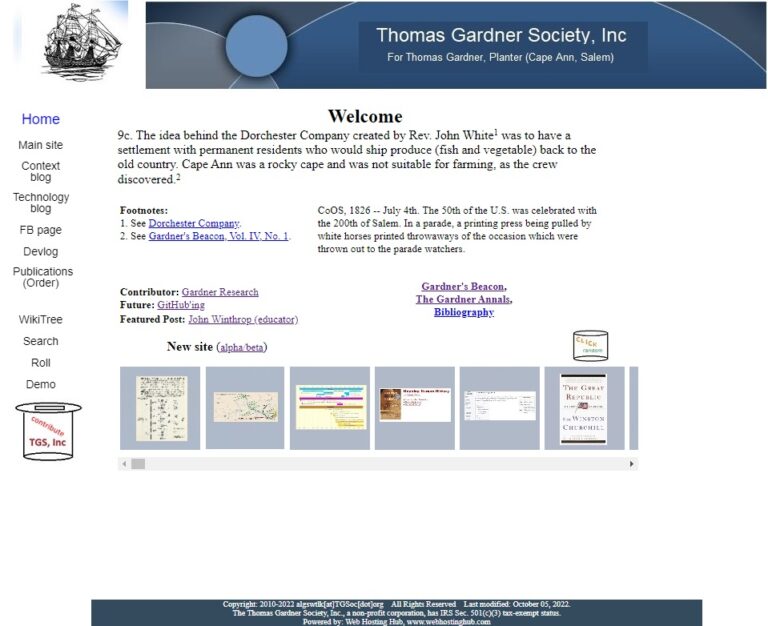
03/02/2019 -- Notice that the image is before the reconfiguration. Also, we are building an index via images at our portal to truth.

Thursday, June 27, 2024

README and more

TL;DR -- README! Such a minor thing. It's age old. We don't seem to know where it started. But, it relates to the world of code. It's nice that GitHub, old ways being new with the internet and worldwideweb. In any case, now AI has put its wannabe head into code from various positions. We have payed sporadic attention and thought that it deserves a more regular focus. 

--

We have mentioned GitHub (Wikipedia overview) several times since around the 2020 timeframe. Our latest post was motivated by an email feed from the GitHub team that related to an article on those who maintain code. That role was always seen as less important than the "cowboy" roles of the developer. 

Stopping a minute. GittHub is an on-line example of what can be termed code management. This type of facility/utility evolved over the years until it's a fairly robust addition to good business practices. Some have used CMS for this type of work. However, we have had lots of posts about Content Mangement and will continue. AI modes will require extra efforts at curating. So, stay tuned.  

Now, back to the "cowboy" (apologies to the real type). Guess what? Lots of developers put stuff out and strutted off the stage like the stud. Oh, btw, this is an old guy writing who has seen this stuff for decades. And, after strutting off, the stud left the errant traces of his work for other to clean up after. Much like the mother after her kids. 

Mixed metaphors, I know. But continuing. I'm working with a project that will try to incorporate AI modes (we'll be more specific later) into a new system which is supposed to revolutionize the economy, as a whole. Large piece of pie to bite from. Anyway, I will still blog though I'll be going to other blogs and linking from those back to here. 

Another bit of interest? GitHub and OpenAI have been working for awhile on a Copilot which is supposed to aid in developmenr or general code management. This joint work started in 2021 which was a year before the general release of ChatGPT. BTW, if you are wondering what this is about, see a brief history of GPT. The author writes about research on AI (mainly machine learning). 

Again, back to the subject. Today's mail pointed to this discussion: How are AI coding tools changing the way developers work? This is from the maintainers group referenced above. In reading the text of the discussion, there were some things that stood out. One was this: AI might not write a book, but it can write a good paragraph. 

Before proceeding, though, a couple of words. Yes, one can drive a small nail with a sledge hammer. But, it's a mismatch of need and what's being used to fulfill the need. Too, AI (GenAI, in particular) is hugely chewing up resources. For what? They need large data centers that requires an unwarranted amount of energy. Too, they need water for cooling. And, more. They're noisy. They make the landscape other than desirable. Go look at those that surround the lovely Virginia countryside of Dulles (IAD). 

So, reading the article was interesting. I went to look at their site and saw that this group started to publish in April of 2023. That would have been when the reality of ChatGPT and its kin was sinking in which was a mere five months after the release. As a reminder, OpenAI went viral and got millions of people to sign up for the free ttrial. Too, lots of folks bought in, including companies. 

All of that will eventually be analyzed. I started last year in another context: Knowledge Systems Center, Sperry Univac. As mentioned in the last post, I have been off helping to support a project as it gets off the ground. So, there are pending tasks that will be picked up again. 

Now, the effort at GitHub is called The ReadME Project. Coders have used a README forever, it seems. Software usually had this text file that included some documentation, or information about using the software, and more. So, does Wikipeda say anything about the README? Yes. 


Now back to the GitHub project. Here is a little bit of the notices sent since they started. AI itself has only come into focus the past few of these. 
  • 06/26/2024 - AI is here. How is it changing the way developers work?
  • 05/23/2024 - Maintainer Month: The joy of open source
  • 04/17/2024 - Getting started in a career in platform engineering
  • 03/12/2024 - Intelligent uses for AI in coding
  • 02/13/2024 - Best practices for open source maintainers
  • 01/09/2024 - Creating technical content
  • ...
  • 08/01/2023 - Getting started with edge computing | The ReadME Project Q&A
  • 07/13/2023 - How to make your first open source contribution
  • 07/10/2023 - How to handle programming paradigm shifts | The ReadME Project Q&A
  • ...
  • 06/13/2023 - Non-code contributors: The unsung heroes of open source
  • 05/25/2023 - Elevating contributors into maintainership | The ReadME Project Q&A
  • 05/09/2023 - Is it still "open source" if you don't accept contributions?
For an old timer, seeing all of this progress is a pleasure. There are several caveats which come from doing this for years including stints in the plush offices dealing with management and its science (if there is such). Evidence of this is becoming apparent to me. People, the key resource, are being driven to distraction and worse being slaves of automation. Oh, I would write more and will. Not just now. 

This year, I saw USDOD mention that people and their intuition ought to be the focus, not the computational twin that is a wannabe, many times over. All of this may seem new. It's not and has been going on for a long while. What's new? We can't hide the realities so much under proprietary cloaks when the evidence are huge monoliths traipsing along our skyline and blocking our rightful views ;>). 

Remarks: Modified: 12/28/2024

12/28/2024 -- See updates in GB, XIV, 1 for 2024 updates. 

Friday, March 15, 2024

Questions and such

TL;DR -- Bridging across 400+ years will continue to be of importance. So, our quest will be an ongoing process. Technology? The next two years will provide more of a view to the issues. Right now, we can only intimate. In reality, hype abounds. AIn't adopters will be in for a reckoning. 

-- 

It was a year ago, when we found out about the new information about Thomas and Margaret that was available via digitization of records in Sherbourne, Dorset, UK from 400 years ago. WikiTree used the opportunity to split out their Profile of Thomas into two people: one was at Cape Ann who is unknown, essentially; the other is the one who married Margaret Frier. 

The work and discussion had been done while I was distracted by what became to be known at GenAI. There are several blogs on this. But, we're at the stage to move on and do it right. Not that what had been done before was done wrongly. So, tsk, guy, at WikiTree who passes judgment. We'll take it from here with respect to these two gentlemen or one (our choice - until we really know).

On the first (AIn't), look at the series here under my name: True State of AI Tools, 2024. We started this last year after assessing what OpenAI's toy/tool brought. The jury is still out: those who don't know, let's discuss rationally; those who are on the bandwagon, just be aware of the faults that shake the foundation (oh yes, let's to go Einstein's introduction of the mathematics of Relativity to do this, General, that is - and then come forward to the current nonsense).

On the second (Cape Ann, &c - btw, that's what was used in the time of Levi-Civita), how will the research and change proceed? Well, we got started in 2009 but formalized the effort in 2010. By 2012, it was obvious that there were all sorts of opinions, worthy of note (okay?, we'll discuss - we do not like the top-down dominance that seems to appear - more later). So, this happened. 

  • What we know - notice, November of 2012. What took so long? Well, search in this blog on Content and Configuration. I was dealing with new content related to history and people. This was after transitioning my brain from technology, especially advanced computing. And, configuration? I used CMS; later, I pointed to GitHub (with Co-Pilot, is even better of a foild for discussion) as an example. Two hats? Okay. One person's content might be another's configuration. And, so forth. Science and engineering are full of examples. 
So, switching to the 1st, a monolith of knowledge? Nope. The whole framework is idiotic. We'll show this, eventually, if we live long enough. Too, GenAI? Purty pictures. Read about the difficulty of doing something real, as I show with the knowledge-based engineering work that actually bumpled up against the world successfully by meeting constraints intelligently. And, the word salad? Oh yes, perfect grammar, perhaps. But. meaningless. Anyone finding meaning is demonstrating what the Gesalt view was about. 

Going on. Later, we figured that we had enough and started the following using a different format at Google's Blogger. Posts are meant to be conversational through time. Pages (see our Page map) are static. We did this page. Both the post and the page have been annotated with respect to the current topic of needed changes. 
  • Frequently asked questions - notice, later. We did not know a lot, even then. But, we thought that we ought to organize this into questions. These might be reworked to have a good set of questions. However, they'll each be updated. 
So, we have started the work. One thing was to add an opinion category, OpEd. One thing that we noticed over the past decade plus. When we started, the internet was still somewhat open which allowed satisfying queries to be made and tweaked to obtain some semblance of an answer. Now It's been trashed. So, that will slow things down. 

Before now, we also saw lots of site with reseach done earlier. Lots of that disappeared. We had collected lots of links over the years and need to prune these out. But, for some, trying to see what happened will be of use As, that was not work to be wasted. If the stuff is available elsewhere, we want to be cognizant of the work. 

Remarks: Modified: 03/15/2024

03/15/2024 --