Showing posts sorted by date for query gardner ks. Sort by relevance Show all posts

Thursday, January 29, 2026

Kansas Day, 2026

TL;DR -- 29 Jan 1861. That was the day that Kansas came into the Union. We look at some information about the history. But, other States will get some attention, too. 

--

In this blog, we have mentioned many states, mostly those of the colonial period. But, the state of Kansas has been mentioned a lot, for various reasons. Its neighbor, Missouri, has featured as well. Then, Calfornia has had more than its share of mentions. Of the other states, Texas has come up several time. And, there are many others that we ought to consider. 

Well known area that impeded 
the travel along the Sante Fe trail
(courtesy of the Friends of Flint Hills)

A category related to States would not be a bad idea. We'll add it. Meanwhile, here are some of the posts with a Kansas theme. 
  • Kansas and Lawrence (2017) -- This post reminds us that the State was a project of New England. Some of those involved are mentioned, such as Col. TW Higginson. Another post describes the trip from New England of the folks who came here and got Lawrence and the University of Kansas going. 
  • Kansas Day (2024)  -- Theme of the 29 Jan 1861 entry of the State into the Union. 
  • 3 Trails (2019) -- This post was about Gardner, KS where the trails split after having started in Independence, MO. They went in different directions to Sante Fe, Colorado, and Oregon (California). Hundreds of thousands of persons passed through the site. 
  • KATY- western railroad (2021) -- Looks at the spread of the railroad through the southeast corner which has its own history. Several New England families who passed through or settled are mentioned. Holbrook is one example. 
  • Coronado of the early times (2023) -- The Spanish explorers were into northern Kansas back in the 1540s. So, the 400th of this place happened almost 100 years ago. A related story involved Arkansas and its river. As well, Pike of the peak passed through. 

What is this about? We will look to celebrate State anniversaries. Perhaps, we might look at the Northwest Territory first. That's the area around Michigan, by the way. In The Massachusetts Magazine published by Dr. Frank and friends, there was a regular report of families that moved to the area. 

Remarks: Modified: 02/28/2026  

02/28/2026 -- Chased down the image which disappeared. 

Saturday, December 20, 2025

Overland mail

TL;DR -- Bunker Hill West was on our sights early as we looked at the progress of New England's influence into the west coast. We noted that a coach company had facilities there and that the journey for some arriving had started in St. Louis and was going up to San Francisco. That route was covered in both directions. There is a group that has been documenting the company and its involvement. One of the investors was of a Gardner family. We went to look for information about him which we will report. This post is an introduction to Overland Mail as an initiative of the U.S. government starting early. 

--- 

As earlier posts mentioned, we used the isolation of the COVID times to pay more attention to the interior of the country. We got started with the naval activities, such as coastal attempts at colonies, fishing in the waters over here every year with the expectation of going back with some dried fish, and more. Too, the naval history of New England is rich prior to the Revolution which is facing its 250th lookback and after with the proliferation of companies related to shipping. 

In those earlier times, western movement didn't go much beyond New York. Though, early on, locations like Ipswich MA sponsored migration as best they could. Except, there were the wanderers even prior to the Revolution. Northern movement down to the area of Arkansas was going on about the same time that northern New England was getting its start. Even the west saw Europeans coming into the area even before Lewis & Clark's venture. 

Once the U.S. was born, it took a generation for activity in the west to reach a level of interest with St. Louis MO as a focus area. Much of the western traffic moved through that area, partly due its proximity to where the Ohio river joined up with the Mississippi. But, there was naval access to the west coast, as well before the Gold Rush of California. Some of this was due to Hawaii being a stopover point for sailing the Pacific. We intend to look further into that theme.

But, with land movement, we can map out areas and time frames. Jedediah Strong Smith was a focus due to his going out west through St. Louis (1820s when MO became a State) and then his extensive journeying in the west, including a stint in the LA area when it was still under Spanish rule. 

It was about then that we bcause aware of the St. Louis to San Francisco (LA_SF) coach route. Our focus was mostly about LA due to it being a stopover on the trail going to  San Francisco. The image shows DTLA in 1900 which a view toward what became known as Bunker Hill West which was named by a displaced New Englander. 

1900 scene, of Bunker Hill West
where Overland Trail coaches
came in, for relief of passengers
and sources (horses)

Recently, we noticed that there have been more publications on a website on the subject with information related to the LA_SF jaunt. More information has also been provided about the TX to SF part of the trip. Now, the eastern portion has better coverage is getting attention: Missouri, Arkansas, and Oklahoma (with respect to the Overland Mail). For instance, AR is mountainous. One thing passenger were requied to do was get out and walk with the coach as it was slowly moved through the hilly areas. 

States in the area. Kansas had a lot of east west traffic. One research provided lots of information and commentary on that state's support for Overland Mail  (as it is seen in KS). That is now the name of this activity which denotes the main purpose plus the involvement with the U.S. government. St. Louis had heavy activity as the country was divided and sold throughout the west. 

Other states involved were TX, NM and AZ in the south. We will be looking at other views on Overland Mail as the Pony Express came to be for that specific purpose and ran across the northern states.  

People? The group devoted to the history and preservation of the Overland Mail route (that is associated with Butterfield - who never put his name on the venture) (The Historic Butterfield Overland Trail in Arizona) has done remarkable research. We are fortunate in that area. One of their latest ventures is to identify the employees who saw to it that the coach made it from MO to northern CA. The infrastructure was astoundingly complicated. 

In terms of comparison, we have a post that shows how the 21 days (3 weeks) of one way of this journey compared to other situation. For instance, the same amount of time was taken for a portion of the trip by wagon train from Independence MO (across KS and NM) to Sante Fe NM. Fort Lanerd KS is on the trail and 3 weeks away from the start. 

We made contact with the Butterfield group. There was a query. One of the investors was named James V P Gardner. Who was he? On a quick look, we identified one resource from the late 1800s that suggested that he was from a New England family. James V P Gardner (son of Daniel (6) - James Van der Poel Gardner -- as descendant of George of Rhode Island) would be a cousin of the Gardiner for whom the city in Maine was named. Too, he would have been related to the Gardiner who owned the ship that wrecked off the coast of Oregon in 1850. 

We will post what we know about James V P Gardner as a preliminary report from which we will build something adequate to serve as a truthful basis for information about him. 

The information from TGS, Inc. efforts is being provided now with the caveat that we need to look further into sound/solid provenance of the sources that are used. Bringing in another factor? Technology of late has seen itself contributing more to disinformation than to information. The theme is on our watchlist and is (will be) an actual focus for the TGS, Inc. at all levels. 

John likes to use this example: From the top, we have folks of huge cachet for whom History has lots ot say; getting modern, we have the top-level offices of the G-Suite (military) and the C-Suite (the industrial/commercial part of the activity); then the huge middle management realm; down to the workers and users of whatever the economy is about in terms of keeping the modern life viable. At each level, there is no one truth that can be said to be accurate from top to bottom. Or from bottom to top. 

The computer has both helped and hindered attempts at briding the gaps. Of late, things have been more problematic than necessary for various reasons. John jokes about buckets'o'bits and their misleading clouds, though many are working to make things more stable and sustainable. We all can help. 

So, with respect to our research and reports, we will keep the "shining light on the hill" (Winthrop) in mind. Too, our site will be "bespoke" for many reasons with the goal of providing a "portal to truth" which notion comes from the mid-2010s as we incorporated in order to organize future efforts.  

About sources? We have them. For Gardner Beacon issues over the fifteen volumes, we started with a Bibliography and Source page. However, we started to provide links from the issues to posts from this blog. However, we are looking into a better organization of our several blogs for proper curation of sources. 

Note 1: The information about J V P Gardner and his life looks good, even though we need to check the provenance of the pedigree. There are many extant documents that will support this work. This Note will be updated when the post about J VP Gardner is published. 

Note 2: The following photo is more apropos being from the correct period. The Bella Union Hotel had roots back to the 1830s. The Wikipedia page has some of the history. 

This is east of Temple and Main Streets. Temple runs up into Bunker Hill West. 

Remarks: Modified: 12/23/2025

12/23/2025 --


Saturday, August 16, 2025

American rivers, flow

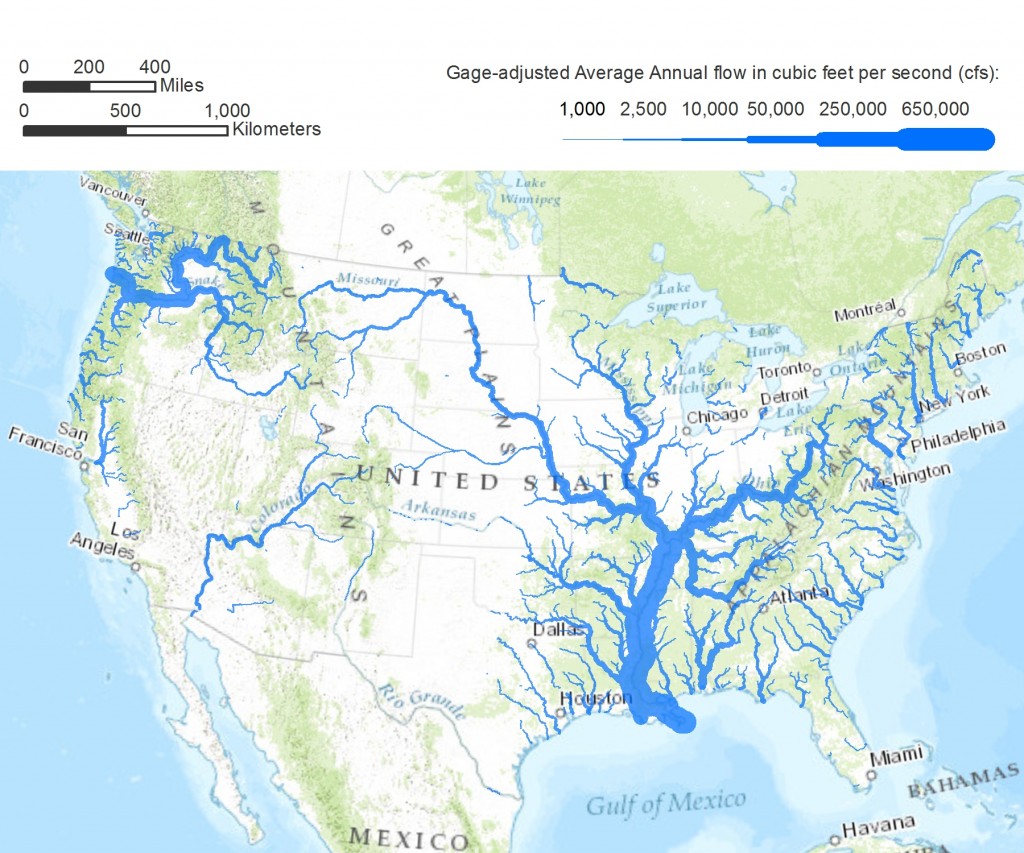
TL;DR -- We saw a graphic while browsing that was not attributed. So, we went looking and found something similar. It shows the comparative flow of the major rivers. The Ohio River stands out as does the Mississippi River which it feeds. Rivers in the southwest are drier by nature. But. they have lots of people drawing off of them. 

--

Rivers are a favorite subject. We enjoy them many ways. Some are famous. Others seem to have disappeared. An example is the Arkansas River that comes out of the Rockies of CO and crosses several US States before joining the Mississippi in AR. Along the way though, if one searches for the river it seems to have disappeared. But, the flow went underground and reemerges sufficiently to support barge traffic from Tulsa, OK to New Orleans, LA. 

On the other hand, the mighty Colorado River comes out of another part of the Rockies in CO and heads down to the Gulf of California. But, along the way, it is dammed (for Lakes) and tapped for people and crops. By the time it gets to Mexico, it is a small portion of itself. 

Those are two western examples. Looking east, the Mississippi gets a large flow from the Ohio River after it has joined with the Missouri River near St. Louis, MO. Lewis & Clark was on both. They took the Ohio down to the Mississippi, then ventured north to travel up the Missouri River, to its source. In doing so, they also looked at some of the rivers of the northwestern part of the US.

What motivated this post was seeing a graphic and looking to see its source. We show the graphic below. At the same time, we looked at some of our earlier posts as they presented graphics too. Let's list a few of these and then add in a new graphic. Each post has a graphic with respect to US rivers. 

  • Continental divides (Feb 2025) -- we think of the Divide that we cross as we travel east-west in the western part of the U.S. But, there are other divides. 
  • New Missouri (Aug 2022) -- when one compares the upper Mississippi to the Missouri, the question about naming comes up. This was really the Missouri River which contributes more water from a longer route. Whereas the flow from the north is shorter and looks larger. 
  • East meets West (Jun 2022) -- the Gardner River flooded and got our interest. It flows through what is known as Gardiner, MT. The map shows all of the watershed of the continental U.S. 
  • Research notes: Rivers (Feb 2021) -- looks at some western rivers (Yellowstone, Gardner, ...) in an area where water goes either east or west.  
  • Rivers and more (Feb 2021) -- looks at the Mississippi and one link from the west to the east via the Fox River.  
  • How great? (Feb 2023) -- looks at a couple of elevation maps of the U.S. This is to put the below material into perspective.  

We started really looking at rivers during the time of the pandemic. We were doing a lot of research which involved families who came west after the time of the U.S. start. This relates to the 250th anniversary of the birth of the Nation. Then, as we researched, more and more information became pertinent. This work precipitated our use of Frontier century and Lost generation. 

First, let's put up the graphic which shows the comparative flow of watersheds that reach a certain rate of flow. Some of these show up with a light color since the flow is reduced severely as the water makes its way out of the mountains to the shore. 

American rivers
Pacific Institute

In the middle, one sees the long reach of New England with the Ohio coming down to the Mississippi. So, stepping back, one can see the importance of the use of the Ohio in movement to the west. Wagons were brought west, moved north on the Mississippi, and then went up the Missouri. At that point, the wagons went west by land with rivers to cross. That shows rivers in two roles: means of motion; barrier to progress. We looked at the second one in our look at the New England party that left Boston and journeyed to Lawrence KS for two reasons: define a State; start a University. 

Remarks: Modified: 01/03/2026

01/03/2026 - Corrected a typo or two. 


Saturday, May 31, 2025

2021, time of the pandemic, I

TL;DR -- The pandemic started. Life was restricted. We did local things. And, worked on the web/cloud in various modes. 2021 culminated in the most posts that we had since our start with topics that cover a very wide range. Knowing the U.S. and its history is one motivation. 

---

Part 1 of 2 (Part 2). 

In 2020, we found out about the coming restrictions after being in one of the cities where the disease was reported and said to be related to someone returning from overseas. Then, we endured the restrictive period with access to the outdoors as well keeping busy with "web/cloud" activity along several lines of research. 

Our focus on technology was one line of study for the Thomas Gardner Society, Inc. The next year, 2021, had the most, 105, posts published since the start of our work. Below, we provide a list by month of the titles of the posts. As can be noted, the topics varied greatly which we will comment on below. 

First, here is a list of the topics for the first six months. 

A subject of lots of focus was the travel of folks from the east to the west through the middle. Of course, looking further at the west coast got our attention to New Spain. The rivers of the interior were of particular interest as the Missouri River starts out in the far western mountains, closer to the Pacific than to the Mississippi River which it joins at St. Louis. Not far from there, the Ohio River comes in from the distant east having started in Pennsylvania. But, there is more. The Arkansas is a little south of that area and had eastern visitors from (what became) Canada early on. That exploratory group from New France headed back up north when they started to see evidence of New Spain. 

Naturally, looking at the Missouri, we had to consider other rivers near its origin, such as the Gardner River (Yellowstone, plus) which flooded recently. We looked at several tales related to the area, including that which motivated the movie, The Revenant. Our earlier focus was there, namely Jedediah Strong Smith. 

Going back up north from the Arkansas on the Mississippi, we get to the Wisconsin River that joined above St. Louis. The French group had traveled over the Great Lakes to the mouth of the Fox River. About one-half way to the Mississippi River, there was a portage which was brief, comparatively, being only two miles or so between the Fox and the Wisconsin (on the western part of the trip).  

In work related to family history and genealogies, we decided that there was a frontier century which is observant now with respect to missing documents. St. Louis was a hub of movement. The U.S.Government was early there with land management. Think of the time of Daniel Boone who was out, with his family, to western  Missouri (Kansas City area) as a settler. But, he also ventured further out past the Rockies. Other federal activity was military: Fort Larned, KS. 

Speaking of which, there was a stage line that ran from St. Louis to San Francisco. Not across the middle of the country. No, this one went south and joined regular movement from Texas to Los Angeles through Tucson in Arizona. In Los Angeles, the activity was in the Bunker Hill West area which has a long history that we have written about (Mirror building). Of course, then we had to look at mail and freight. Too, newspapers were delivered. 

We didn't forget the sea as the California cities were largely populated by ship in the beginning. Once the internal trails were established there was a huge flow across the middle. The Pony Express carried mail and small material. Several stage lines carried people and freight. We looked closely at the Butterfield Express. 

Why? All of this activity was seriously associated with, or driven by, New England influences. In fact, Kansas was a Massachusetts project with its University being founded by a group that included women who came to set up a free State. We have a lot more to write of that. 

Everywhere in the unmapped territory, we had trappers. Some were even venturing down from New France and Canada. Then, the next phase was trader as folks moved across the country, many of them stopping at locations that exist today having been started by the pioneers. 

Along came the railroads which have a special interest due to family involvement. That facilitated one of the major memes of the west, driving cattle to the markets. So, rancher/farmer would be the next phase continuing today, in the flyover country (had to menton that - it's from an earlier post). 

Next up, we'll look at the second half of 2021 in terms of posts. These posts cover the U.S. and its history. Interspersed are posts on technology, which increased with the release of OpenAI's GenAI/LLM. 

Remarks: Modified: 06/03/2025

06/03/2025 - Clarify that the journey on the Fox to the Mississippi starts at the Great Lakes and runs upstream in IL to a point where the Fox is close enough to the Wisconsin for a reasonable portage. The Wisconsin then runs down, and connects, to the Mississippi. In the reverse, the journey goes up the Wisconsin to the portage and down the Fox to the Great Lakes. Modern technology has improved that route with locks allowing the height changes to be managed. 


Thursday, April 10, 2025

A trillion cuts by GenAI

TL;DR -- We saw a Chrome report which featured Gemini with respect to Gardner KS and its role in the trails west, one of which was the Oregon Trail. And, the report was not right. "Who cares?" has been my response to having Gemini spout off. I ignored it like I am very good at doing with ads. But, today, I read and saw errors. Okay. What to do? There is no method now. People are training these things. I say, you will not train out the crap. Okay. I wrote this post as an intro and was going to snap the Gemini report and mark it like a teacher would do an exercise. Oh, Gemini, my sweets, you left without telling me. What?  

---

Our purposes are several. An important one we have named as All Things Gardner. There are lots of families with the name Gardner. "What's in a name?", we asked once: Amelia Earhart. 

We have been at this genealogy and history work since 2010, learning as we go. On the other hand, we have decades of advanced computing experience under our belt (mainly, situations requiring precision). So, our work here has been largely abetted by computing which has changed in so many ways in the past 20 years (2 decades of decline in some areas). 

We have striven to be correct as to former work. But, we know that is not sufficient. Technology has aided in the digitizing of old records which have been analyzed via human effort and mechanical means such as OCR. A case in point is that we do not know the origins of Thomas Gardner about whose progeny we know a lot due to records over the past 400 years. So, that is an issue to resolve. 

As we work the solution, we have adopted a category: OpEd (category). That will be used to label any of the former posts that touch upon the subject. The information will not be entirely wrong. So, when we figure out the corrections we will make them. Until then, someone can still follow our approach and analysis as we looked at new material. 

Aside: the genealogy crowd split Thomas Gardner into two guys, one who was at Cape Ann with the Dorchester Company and one who is the ancestor of a whole lot of folks. Myself? I think that they are the same guy or were father and son. Both of those alternatives have some basis. The intent will be to find the truth: A Thomas here and a Thomas there. 

And, we would like technology to be of assistance. And, it can. See Bosworth and Gardner, with new revelations coming about of late through use of the facilities of Grok. How well this will stand up though remains to be determined. The battle settled the 100-year war (some use, War of the Roses - I say, cousin war - needless bickering). 

Anyway, this post will look at Gemini which we have liked. But, it is now on the top of a search report. And, I was trying to look at Gardner, KS being right this minute not far from that place. We have had many posts on the little town which we have buzzed by on I35 for countless times. 

---

Now, that was an intro. Here is the gist of the post. This image was snapped from a Chrome query today. ... Wait, did not snap the earlier search. Now, Gemini has disappeared from its featured position. 

Inserted as placeholder 4/11/25 0457 AM CDT
--- 

Note (04/11/25 0458 AM CDT): the absence stopped the flow. "How to handle?" was the question. The following text is from the post from last night. The image was to show what Chrome was presenting. 

---  

Actually, earlier, when I read the Gemini summary, I scrolled and found this first on the list which is from the National Park Service. Gardner was a stop on the earlier Santa Fe trail which was largely commercial going from St. Louis as the gateway to New Spain. 

That trail passed through Independence MO. So, Oregon traffic followed that same route to Gardner and then turned to the north and west going by Lawrence KS which is the site of the University of Kansas which was founded by a group of New Englanders who came out, including women, by that same trail through Gardner KS.

Later, young bucks in a hurry figured that they could take the Missouri River north from Independence past St. Joseph MO into Nebraska and head west from there. Guess what? They eventually met up with the travelers who had come up through Gardner. What did the folks in a hurry gain? Maybe, two days, perhaps a little more. 

But, gold gets the blood boiling. Like? Things easily hyped. 

Note (04/10/2025 2100 CDT) - On going to the Google development mode, I see that there is a new button ("Vibe") which I have been reading about. Sometimes, I might add as it sounded like the usual affair of misdirected enthusiasm. Whatever is going on in the background with this problem will settle down. Then, I'll use this topic for a deeper look. In any case, running into a "tantrum" however invoked does not make for stable knowledge processing. 

Remarks: Modified: 04/11/2025

04/11/2025 (about 0500 CDT) -- Put in proxy of the expected image and a note to explain. Something related to "Who moved my cheese?" (when did that become normal?). 

04/11/2025 (0738 CDT) -- It's back, AI Overview. But, buried under a label. The only quibble is the use of intersection for a split. I dealt with precision in highly technical engineering support work (computational modeling). 

Kudos, somewhat. Let's talk.


Monday, March 17, 2025

Independence and Kansas City

TL;DR -- Trails were and still are in the sense of leaving tracks on the landscape (several places along the Santa Fe and Oregon Trails. And, now the Interstate Highway system with all of the national, state, and local roads. And, going further, even now dirt roads as tracks. Sometimes converted railroad tracks. 

--

With all that is going on in the world, and in the U.S., it is time to look back at the past. In 2020, we got the opportunity to spend time looking at the interior of the country which is huge. In terms of time, we had a frontier century (post has copy of photo of Lawrence, KS by Gardner). We got to learn about the trails and the cities that cropped up (theme of this post). We determined that there was a lost generation or two (Boone was real; officer in the US Revolution; Longhunter; traipser of land (all the way past KC with time spent in western MO) in the movement that came to fore as we looked at the upcoming 250th of the US under the auspices of the Daughters of the American Revolution. Doing applications for some requires lots of additional work. 

Before 2020, we had looked at the trails and those earlier like Jedediah Strong Smith. Gardner, KS was seen as a hub of traffic and activity. Also, we had looked at both land and sea traffic to the left coast (Old LA and the US - as in Los Angeles, CA - in particular, Bunker Hill West, where the culture went back to New Spain and then through several cultural shifts to the current canyons of high rises).

---

Now, to the theme. We saw a video of a talk about the trails and how they came into Kansas City and left. It was of the first part of which there will be another. We mentioned Gardner, KS where 3 Trails split. The Oregon went over the Wakarusa River into the Lawrence area and then up to Nebraska. Even in that trek, the rigors of getting people and goods across the land was obvious, especially trying to get over waterways which were boons and banes (mostly the latter for many). 

The talk: How Independence & Kansas City Became Trailheads for the Oregon/California/Santa Fe Trails, Part 1. The following image came from the talk. On the map (a modern map showing some roads), Independence, MO (where Pres. Truman came from) is on the upper right. Gardner, KS is on the lower left. 

Indepencence, MO
Gardner, KS

In the top middle, notice Wesport which is on the Missouri River. After a little bit of time, impatient travelers (read, young men off to the coast with gold fever) realized that they could take the river up past St. Joseph, MO (famous for the Pony Express) and then a little further north, they could head west in Nebraska. While doing that, they would meet travelers coming up from Gardner, KS. But, they would have cut several days off the journey. 

OCTA, sponsors of the research and talk

---

Notice that this is about the early times. The railroad came into play after the Civil War. 

Generations? By this time, say before the Civil War, we were to the 8th generation from the start of New England. The Revolution was mostly of the 5th generation. 

Cultures? As we have noted, there were the News: Spain; France; England; Sweden; ... The left coast allows us to look at the first; Quebec, Canada is representative of the second; we had both a North and and a South for the third; and so forth. 

---

KC? MO and KS. Missouri and Kansas. We need to look at the area a little further. It's known for beef and barbeque. Well, cattle came up from TX to be shipped east to the hungry easterners. Too, the breadbasket founded itself on the rich lands of the area. Boone, as said, was there early. It's sister city in MO, St. Louis, was the administrative and bureaucratic and entertainment hub. See early Missouri, for instance. 

Remarks: Modified: 03/17/2025

03/17/2025 -- 


Saturday, February 15, 2025

Continental divides

TL;DR -- We look at rivers, again, as they are influenced by divides. East-west interstate highways in the U.S. cross a continential divide, many times with no clear demarcations. However, Montana and Wyoming have a couple of examples that illustrate the natural phenomena. A major Double Divides gets water going west to the Columbia through the Snake River. A Triple Divide gets water going to the Columbia through the Clark Fork River. Both divides feed toward the east and the Missouri/Mississippi watershed. The Double Divide does so via the Yellowstone. The Triple Divide? One flow is through the Marias River to the Missouri. However, there is a third divide that goes east above and below the Canadian Border all the way to Hudson Bay and further east. All of this relates to people moving west from New England after the Revolution. Or later arrivals through various means populating the west. 

--

During our research for the Daughters of the American Revolution. with respect to families who came west, we looked at rivers. We had knowledge of rivers being used for transport which is common, as Lewis & Clark passed close to where we are having come down the Ohio, to the Mississippi, then up to the Missouri and west. That was after the Revolution which is being recognized starting this year: 250th. 

On the other hand, rivers were barriers to travel (Rivers and more). Progress in technology provided means to manage the difficuly with bridges or tunnels. Too, there has been regular barge traffic for material using rivers. In the early, the travelers dealt with the situations as needed using time and energy. The group that left Massachusetts and went west to start Lawrence, KS and the University of Kansas went up to New York to take Great Lake travel to Chicago. After getting to Kansas City by water and coach, they walked to Lawrence which required that they get over the Wakarusa river. 
  • With regard to the 'training pass' mentioned above, we noted in a post (Final migration) the report of the group who left Massachusetts and traveled to Kansas. They founded Lawrence (and KU) among other things. But, they mention coming out of the Kansas City area on foot, camping by the Wakarusa, fording it and getting to what became Lawrence. As has been noted, this little river required techniques that became handy in the western mountains: tear down the wagon, lower, get it across, and back up, reassemble, gather everything that had been ported across. Time and again. (see post, Cumberland Pass). 
Here are some of the posts on rivers:
---

The other day, we saw something about a divide in North Dakota (ND). What? That was after running into a mention of a "Triple Divide" (Wikipedia). This mention was on a report by the National Park Service which was of interest as one of the rivers (Marias) from that divide flows into the Missouri River in Montana (MT). The Yellowstone River flows into the Missouri in ND. The Missouri River then flows down to the Mississippi River. We had looked at that area (Gardner River; Yellowstone, Plus). 

Now, having traveled the west by car, train, bus and plane for years, we have gone over a north-west Continental Divide many times on lots of highways and routes. Those divides were always west of ND. All along this western divide, water on one side goes to the Pacific Ocean and on the other side there is a longer flow to the Atlantic Ocean. The map shown here on the left is of a pass (Two Ocean Pass) in Montana (MT) where one creek divides into two; the page on Wikipedia includes a photo of the area where the bifurcation happens. 

So, going back to the mention to ND, the divide (green in the map on the right) starts in MT (at the Triple divide), goes into Canada, comes back down and then goes back up to Canada after traversing ND and Minnesota and heads for the Hudson Bay which flows into the Laborador Sea which can be considered a source for the Atlantic Ocean. This is the Laurentine Divide (starts in the US, goes north, comes back, and the goes up again). We will have to look further at that. Water from Fargo, ND flows north due to this Divide. 

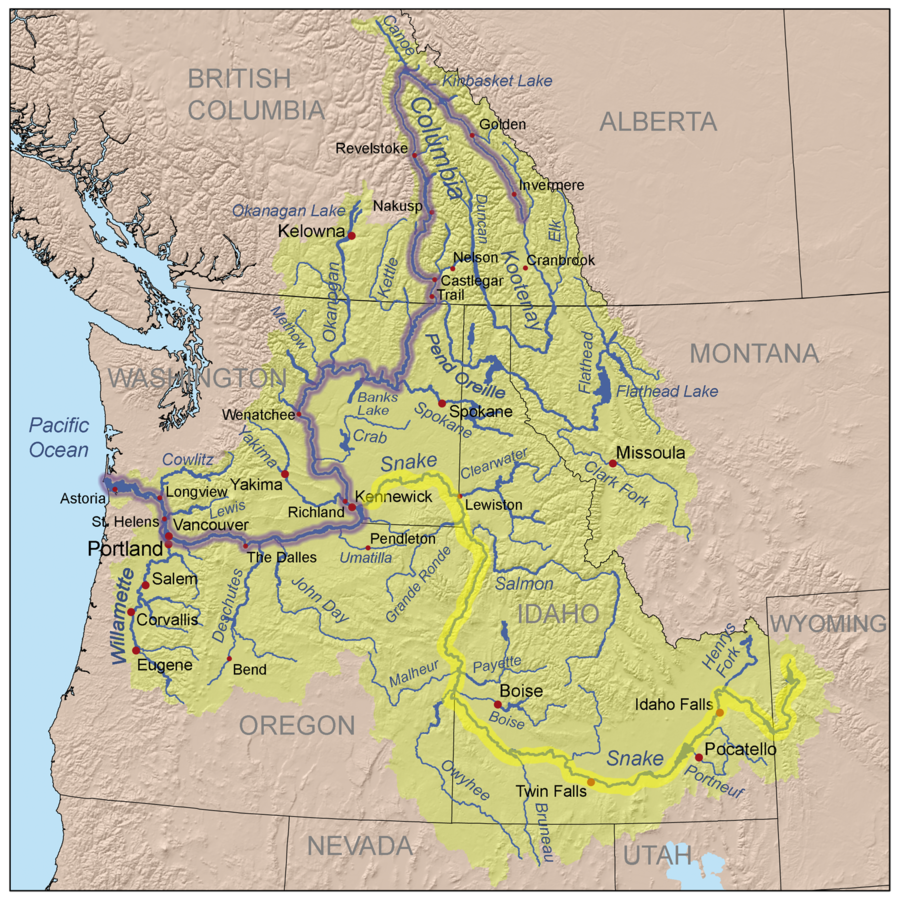
We mentioned the Pacific? In the Yellowstone area, some water runs to the Atlantic, as we saw. On the other hand, though, some water goes to the Snake River and then to the Columbia while picking up tributaries from Idaho, Nevada, Oregon and Washington. A major tributary of the Snake is the Salmon River. 

And from the Triple Divide that we looked at above, water comes into the Columbia through the Clark Fork and the Pend Oreille Rivers. 

Columbia and Snake Rivers

Remarks: Modified: 02/15/2025

02/15/2025 -- 

Friday, September 27, 2024

Past and present

TL;DR -- The 250th of the U.S. will allow lots of research to get some air, as the attention goes to the history of the country. We will follow that thread several ways, including a deep look at technology of computing with respect all aspects that we know, to date. We can compare different areas. One of these one-up looks will be NYC and LA, in order by age. LA is comparatively a youngster. The dynamisms of the two difer quit a bit, too. 

--

Some locations kept good records via photographs of their change through time. At the same time, we have temporal issues such as Los Angeles being younger than New York City. Then we have technology bringing in abilities that can be pinpointed in time. For instance, we know that Gardner, the photographer, was active during the Civil War. We posted several photos from his era, including one from Lawrence, KS. We called the post with the photo "Frontier century" (April 2021); its themes were several: the great expansion in the middle after the revolution (deed done primarily by the 5th generation); families being lost in time as they escaped the heavy hand of documentation; and modern efforts at recovering evidence of their existence). 

We will continue to focus on the middle of the country but have, of late, been looking at Los Angeles and its Bunker Hill (west, we call it) that mainly appeared in the late 1800s and went away a century later to be replaced by high-climbing things that cast a long shadow. We have had lots of photos of the LA area and can be more intimate as we find older photos to match up with something recent. 

LA and NY City
across time

In this photo, the left side shows part of the train yard in LA at two different times. Reminder, LA was Old Spain and Mexico until the latter part of the 1830s. LA claims a start in the early 1780s which is associated with New Spain. The area settled is known, now, as Down Town LA (we'll use DTLA). A church built in the area in 1784 later burned. At that site, the Old Plaza Church (still standing) was built built in 1814.  

On the right of the photo, we have snaps of NYC's Manhattan starting with a photo from 1876. This an old area and was part of the colonies prior to the U.S. Revolution. With the 250th of that event coming up, we will have time to cover stories about all areas of the U.S. 

One of our themes will deal with the long reach (Mirror building; Settlements, temporary and otherwise; NEHGS events) of New England. There will be others, such as technology. 

Before moving on, we know that NY City has tall builidngs. Lots of them. The tallest now is the One World Trade Center at almost 1,800 feet. Wikipedia has a list of buildings taller than 600 feet (110 buildings). 

In DTLA, the tallest building is only 1,100 feet). The LA City Hall is 454 feet (it's shown on the left in photo) and is the 42nd largest building. The smallest (53rd in the Wikipedia list) stands at 352 feet. 

We mentioned Bunker Hill west. It got its name, of course, from the site of a Revolutionary battle. We will be looking more at that area in DTLA as it represents changes over time, as influx of population changes the dynamics of a location. With a great collection of photos from different periods, we find people taking photos from that same area and focus of direction. 

Related to Bunker Hill west is this one that show 101 early on and then later. In the meantime, St. Vibiana's was closed as a church (became an event's center) and moved up the hill from Main Street to the summit. Parts of that area had been lowered early. Houses and dirt were taken away to have proper foundation for buildings. One story to look at is the Central Library which experienced two fires by arson. During the time of recovery, maneuverings got the building limit raised from that related to the height of the City Center. So, the first one went up to cast a shadow over the library. The library sold its "air rights" as one means to fund getting back to its work. They had to replace $Ms in burnt books, for instance. 

LA Central Libray with its
"twin" (to the right)
U.S. Bank Tower

On the list of tallest, the "library tower" now is #2. 

Reminder: with respect to photos (such as we see from Water and Power Associates of CA), provenance needs to have special attention, always. How all of this influence from Gen AI plays out will be a thing to watch. The ease with which fakes can be generated will make the problems more diffficult to resolve, albeit there are known ways to attempt to obtain stable and safe environments. Technology will provide the means many times for its managment; a key choice concerns human involvement. Yes, we humans can handle the complexity. Unfortunately, we could have known more; that is to be discussed.  

Remarks: Modified: 09/27/2024

09/27/2024 --  

Saturday, July 27, 2024

Three weeks

TL;DR -- We take modern travel for granted. To wit, the Delta recoil from the Microsoft fail just a week ago. Now, we can look at the details, and ought to. As well, let's ponder three weeks of travel back in the good old days.  

--

Having just written on Los Angeles and then finding more information on the California Trail to which travelers on the Oregon Trail switched if they were headed to the Great State of California. Per usual, everywhere we look in the US, we seek out connections to New England. 

A recent focus on Bunker Hill West brought to fore lots of information about people from the east coast and their activities on the left coast. For the record, this area in downtown LA is where we now find the skyscrapers. But, under many of those are destroyed records of, at least, two cultural developments. Fortunately, there is an association in LA that has photos and records about the different eras and areas. 

That will be a regular theme along with technology which comes into play due to the potential for mischief. Already, we have seen photos that seem to have been generated by methods other than a human with photoshop or the like. We're not paying close attention, yet, as there are plenty of photos for study from the repositories that are available. 

On the other hand, tales of people abound and mostly are not known. Technology, you see, can be a boon as it will help document the past better than we have ever seen. 

Case in point, in the graphic on the left, I made the connection between a middle piece of the US with a Gardner name. It was on the Oregon/California and Santa Fe Trails. At the same time, I knew of Butterfield for a long while but only paid attention of late as the researching of New England's diaspora came to be aided by technology. Butterfield's stage line went from St Louis MO down through TX into NM and AZ and onto CA and arrived in LA after three weeks. From there, it was another week plus to SF. Nowadays, that is a little more than a five-hour drive.  

In the graphic below, the bottom middle view has two lines in red on the left. Both represent three weeks. Nowadays, that's not so long. But, if you worked 21 days without a break, you would feel it. 

The shorter line goes back to the top of the graphic which is the route from Independence Mo to Ft Larned KS. Nowadays, that's less than a five-hour drive. Earlier, we had a tale of the founders of Lawrence KS, including women, from Massassachuets who traversed that same route in 1854. The trip was to found the town and the University at Lawrence. Most returned to New England after the al fresco meeting leaving a hearty crew to carry on with the settlement. 

And, it was in the summer. They only had to do one fording of a river which is not large (the Wakarusa). Now, following the route to Santa Fe through Ft Larned has lots of these.

Now, on the right, one sees a line from Boston to London. Three weeks. When on things of that time span, what could one do? Well, that voyage took a bit of time in the past. But, nowadays, a week is sufficient for a modern cruise liner to make the trip. So, three weeks would be three trips from Boston to London, a return trip, and then back to London. Let's say after that, one would spend 7 hours or so flying back to New England. We need to think of other examples. 


As the modern analysis show, One can drive the same route from St. Louis MO to San Franciscso CA in about 39 hours. Most of that would be on the U.S. Interstate system. I have driven that a lot. 

That brings up another three weeks. This Butterfield route tied in with one from San Antonio TX. From there to El Paso took about the same amount of time. See, Pre-Civil War, San Antonio to San Diego (2021). This was a combination of two routes. 

Now, the top part of the image is of a wagon train pulled mostly by oxen. In the bottom part is of a coach pulled by horses. Consider the logistic for this, as horses needed to be replaced and cared for while they recovered for their next trip. People had to be fed, and other supplies would have been essential. 

Supposedly, this is a photo of a Butterfield stage arriving in LA. On the first trip. a report rode the whole way. We need to find that article. See this post: Mirror Building (2023). 

Remarks: Modified: 07/27/2024

07/27/2024 --    

Thursday, July 25, 2024

Oregon, by land

 TL;DR -- Getting to Oregon, however done, was arduous. Today, we look at the land routes and note that the ordeals are subject of studies and have been for over a century. 

--

Oregon is in the west, nestled above California. They respect their history ought there so preservation of material is a common theme. Recently, the Oregon-California Trails Association had their meeting. 

There were several ways to get to the west coast and Oregon from New England. We covered the water route in several posts and articles: The Gardiner that was (2018). Gardiner's barque left Boston in July of 1849 and got to San Francisco in January of 1850. It had passengers and sold its freight at the harbor. There was a subsequent voyage to New Zealand. In October of 1850, the barque (Bostonian) wrecked along the Oregon Coast. 

Family members went out another route which was descent to Panama, getting across to the Pacific, and taking another ship north. The return trip was as arduous. We'll look at that further at some point. 

We have written a lot about the land route. As, for a while, the trail went through Gardner, KS (3 Trails, 2019) where it split with the Santa Fe Trail. Over time, as people got familiar with the Kansas City area, they ventured north on the Missouri River to where they could cut out KS and go through NE. This saved a few days. 

Young bucks in high fever were in a hurry to get to the gold field. 

On the journey through Nebraska, the traffic went by Scotts Bluff (Facebook). For now, we put in a photo of the new and the old way which is apropos. People still ride the trail; one of the east-west Interstate Highways runs through the area. So, a brief nod to technology. 

Eagle Rock and a solar car, 2022

Now, let's go further west and look at another split. In Wyoming, the US Government sponsored work to shorten the trip to California. Lander Road was the cutoff that was made. This bypass saved 60 miles for those going to California via the southern route through Idaho. 

Lots of trails crossed the countrry. We appreciate that folks keep up attention on these routes and work to preserve the historical aspects. We expect that the coming 250th of the country will see a surge of interest. At the same time, we need to keep technology on the beneficial side of things, especially with regard to its potential for aiding historical work. 

Remarks: Modified: 07/25/2024

07/25/2024 --    

Wednesday, May 1, 2024

Old L.A. and the U.S.

TL;DR -- We continue to look at CA via two cities in order to learn more about the Spanish period that preceded the entry of New England's influence into the area. Period photos are the enabling technology. 

--

We have been looking at two CA cities, LA and SF. Early on, we had Jedediah Strong Smith representing the eastern culture in his wanderings across that country. He was there in the 1830s. Later, we looked at the Butterfield Express which brought people, goods and mail from St. Louis, MO and from points in between, such as TX and AZ, to LA and onward to SF. This was in the 1850s and was quite successful despite the arduous nature of the trip. However, the Civil War interrupted the business for a few years, but post that conflict things boomed again. 

There were several motivations for looking at this area of the country which include the early explorations when it was a territory of Spain, then the initial comings and goings by sea and land, the acceleration of the New England influence after the Civil War, and, in particular, an area of DTLA that was known as Bunker Hill. As we have mentioned, it now is full of sky scrapers (high-rise corner), but the area represents changes that were fast and furious over the years. However, a huge change was the introduction of the railroad across the country. We can read of this: Samuel Clemens took the trip by stage coach; later, R. W. Emerson took a similar trip by rail. Clemens disliked the journey so much that he returned to the east coast by sea which was no mean feat either.  

W e have mentioned, before, the Cathedral (St. Vibiana's) that moved from the base of Bunker Hill to being on top in the latter part of the 1900s as urban renewal took its toll. The older building still stands, near the LA City Hall and serves the function of an event center. Today, we saw an early photo which was from before the time that the Cathedral was built. It is a smaller Catholic church with an interesting history with respect to our continuing studies of the other colonial experiences in the founding of the U.S.  

Before going further, let's pause to recognize and honor the work of the Water and Power Associates (WPA) which has collected photos related to the history of Los Angeles. This is their mission statement: 

to inform and educate its memberrs, public officials, and the general public on critical water and energy issues affecting the citizens of Los Angeles, Southern California and the State of California.

The below photos and information are courtesy of their virtual museum and collection of period photos. 

---

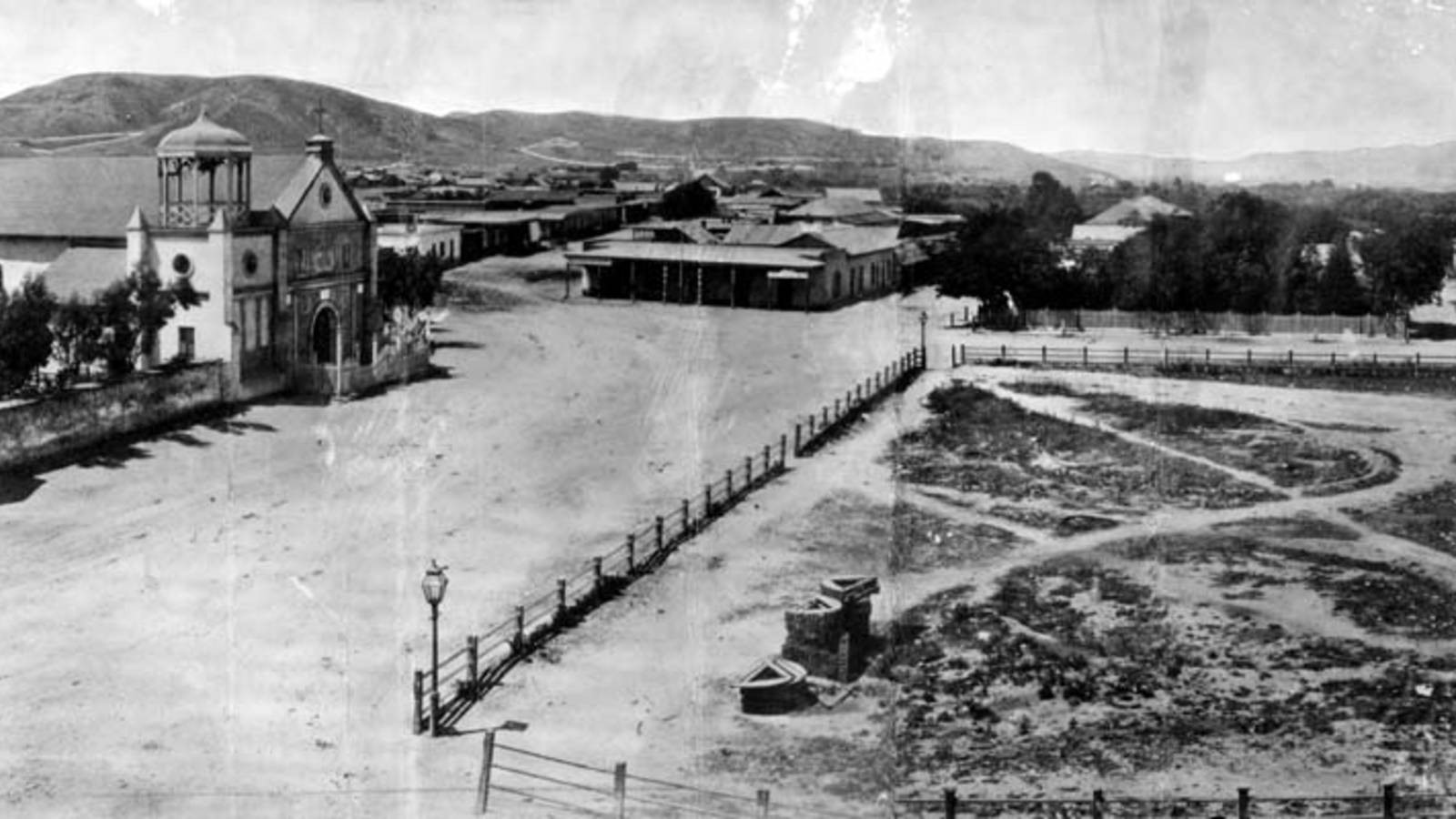
We start by looking at an earlier church (La Iglesia de Nuestra Señora la Reina de los Ángeles - Wikipedia). It is on the left of this photo that looks north on the Calle Principal which is now Main Street (Wikipedia) and which has been mentioned many times. We can consider the area to be at the foot of hills to the west of DTLA such as Bunker Hill. 

Old Plaza Church 

Zanja Madre
The caption for the photo at the WPA site mentions the "Mother Trench" (Wikipedia) with this caption:

The "Old Plaza Church" facing the Plaza, 1869. The brick reservoir in the middle of the Plaza was the original terminus of the Zanja Madre.

As mentioned, LA is a very dry place. So, water was brought in early and has continued to be of concern as the population abounded, and still abounds, almost without bounds. 

But, in the beginning: 

The Pueblo de Los Angeles was an official settlement of Spain. They had three types of settlements in Alta California: presidio (military), mission (religious) and pueblo (civil). The pueblos would provide the commercial and agricultural needs of the military as an alternative to the missions. (source Wikipedia) 

When researching Jedediah's experiences, we looked briefly at the military aspect of the community. The Old Plaza Church and St. Vibiana's are examples of the religious. In some of the early photos that we show below there were other churches appearing as New England's influence grew. But, for now, let's look at travel and trade, again. Butterfield is mentioned in one of these photos. 
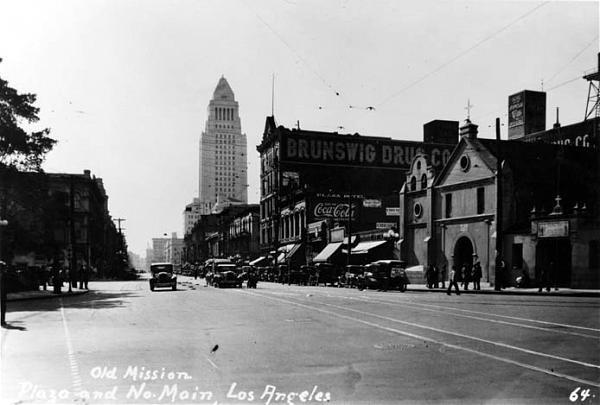
Old Plaza Church
and the LA City Hall

In our earlier look, we mentioned how his coaches came into the area where the Times-Mirror building is now. Let's use a photo of Main Street looking south to set the dimensions. The photo is from 1928 which was not long after City Hall was finished. We see that the civic building is just down the street from the church. 

And, the facilities used by Butterfield (and his cohorts) would have been just on the other side of the City Hall from the church. 

Quoting the WPA site: 

The Overland Mail Company operated by John Butterfield (the founder of American Express) rented space for a station until it built new quarters in 1860 at Second and Spring--the present location of Mirror Building. The Wells, Fargo and Company also had their office here and Phineas Banning (Wikipedia) operated coaches to Wilmington and San Bernardino from the hotel.

But, that brings up another view to consider. We will be looking more at the history of Bunker Hill, eventually. It is just south of Fort Moore Hill which is in the background of the church in this photo. From this perspective, one can see why there was an effort to tunnel through these hills to go west. 

Fort Moore Hill to 
the west of the 
Old Plaza Church

The PWA site on Fort Moore hill: 

Fort Hill (also known as Fort Moore Hill) was a prominent hill overlooking the pueblo of Los Angeles. Its commanding view of the city made it a strategic location.

Fort Moore was an historic U.S. Military Fort during the Mexican–American War. Its approximate location was at what is now the Hollywood Freeway near the intersection of North Hill Street and West Cesar Chavez Avenue, downtown. The hill on which it was built became known as Fort Moore Hill, most of which was removed in 1949 for construction of the freeway. The hill was located one block north of Temple Street and a short distance south of present day Cesar Chavez Avenue, between the Los Angeles Civic Center and Chinatown.

The fort is now memorialized by the Fort Moore Pioneer Memorial, 451 North Hill Street.

----

Now, getting back to Butterfield, the building where he started was built in 1835. That is very early as the area was still under Spanish control. This next photo is from 1865 and shows the state of the building after additional floors were constructed. 
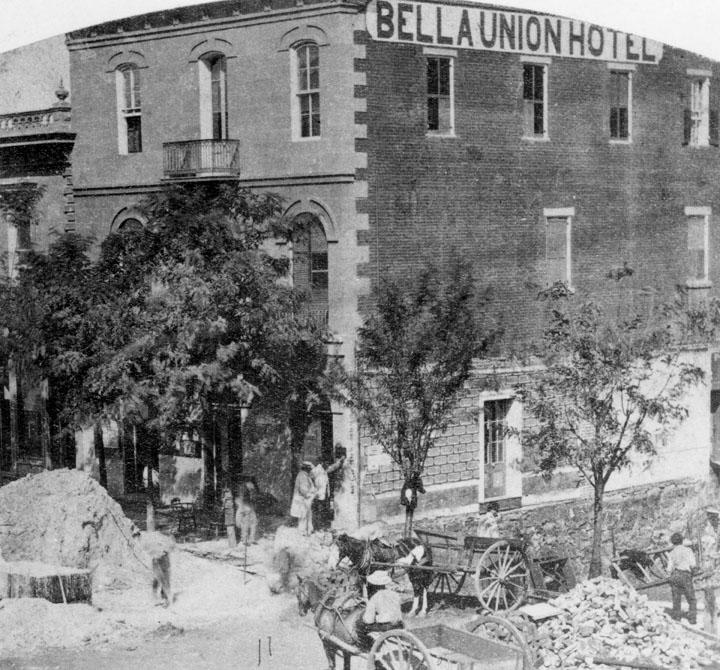
1865 view after
addition to 1835 building of
Isaac Williams (Wikipedia)

Quoting the PWA site: 

The Bella Union Hotel was considered the first hotel in Los Angeles. It became the Clarenden in 1873 and the St. Charles in 1875.

Constructed in 1835 as the home of Isaac Williams, a New England merchant who moved to Los Angeles three years earlier, the one story adobe became the last capitol of Alta California during the Mexican era when Governor Pio Pico purchased it for his office.

After the conquest of Los Angeles by American forces in 1847, the building was used by Lt. Archibald Gillespie, who commanded the occupying forces. Later it housed American troops, and after they left, it became a saloon. By early 1850, the building was operating as the Bella Union Hotel. Later that year, it became the county's first courthouse and beginning in 1858, it was the region's transportation hub. The Overland Mail Company operated by John Butterfield (the founder of American Express) rented space for a station until it built new quarters in 1860 at Second and Spring--the present location of Mirror Building. The Wells, Fargo and Company also had their office here and Phineas Banning operated coaches to Wilmington and San Bernardino from the hotel. 

Wikipedia quote: 

On October 7, 1858, the first Butterfield Overland Mail stagecoach from the East, arrived 21 days after leaving St. Louis, Missouri. "Warren Hall was the driver, and Waterman Ormsby, a reporter, the only through passenger. In that era it was the region's transportation hub: Wells, Fargo & Co. and Phineas Banning's coaches to and from Wilmington and San Bernardino had offices there.

By way of comparison, the Sante Fe trail went from Independence, MO through Fort Larned, KS on its way to NM after passing through Gardner, KS. That trek, western MO to western KS took three weeks of hard work, daily. The coach trip took the same. Mostly, the horses did the work. However, think of the difficulties of the trip compared to our modern times and its highways. 

Isaac Williams is an example of the multifaceted gents who were into fur searching, trading and then ranching. Earlier, we looked at William S. Bent, New Englander, and his adventures in the middle of the country; he was a cohort of Kit Carson and others. Williams was close to the same time and followed Jedediah Strong Smith out through the Mojave Desert to the lower coast.  

Connection: One owner was Obed Macy (WikiTree) who was a Thomas Gardner descendant of a Nantucket Island family. 

---

Let's do one more photo as the three-story building that started as the Bella Union Hotel (Wikipedia) and became the St. Charles Hotel was there for a long while. And, it has a storied history that needs some attention. We will look more closely. The Daily Mirror sent an artist to visit the St. Charles and published a sketch March 16, 1936. It was demolished in 1940. 

As well, we will look at Bunker Hill houses and other buildings and identify those built by New England families. There are many photos to browse through which show the houses to be quite demonstrative of culture and money, considering the problems of LA and obtaining building materials. In one case, a mansion was converted to an apartment hotel and operated for years. 
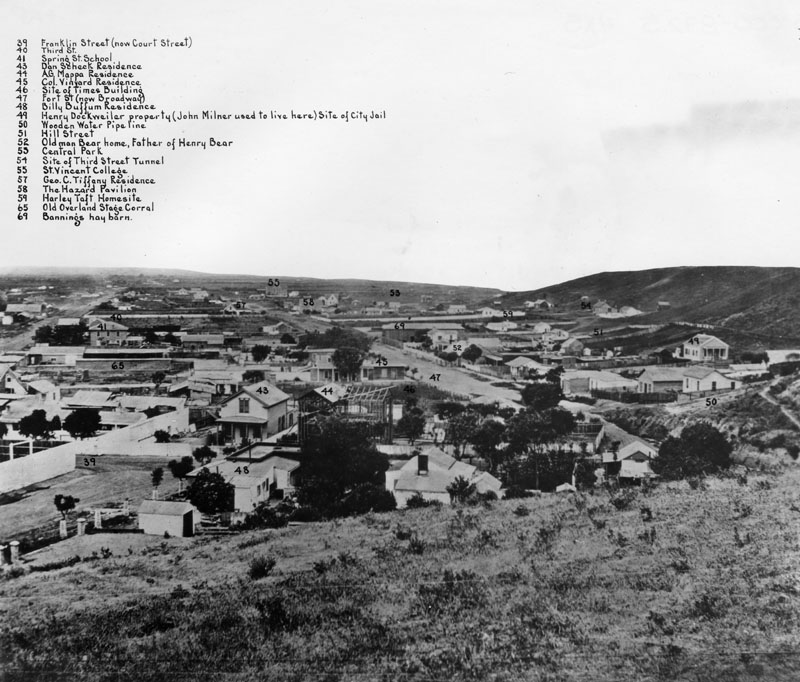

Labeled photo, 1869

This photo is from one end of Bunker Hill which sweeps around to the right. It mentions the Times building and the "old" Overland Stage Corral. The Civil War interrupted the flow of traffic. This was several years after that conflict. Notice that the 3rd Street dig for the tunnel had already started. 

---

So, as grounding or control, here is a modern view of the Bunker Hill area and its surroundings from Kenneth Hahn State Park (Times article). 


May human curators reign for a long while. Thank you, Power and Water Associates. 

Remarks: Modified: 12/23/2025

12/23/2025 -- More on the Butterfield stage as representing the U.S. government's concern for handling Overland Mail. There has been lots of research about the trail from St. Louis MO to San Francisco CA. 

Monday, January 29, 2024

Kansas Day

TL:DR -- Kansas joined the U.S. in 1861. There is a lot of history to look at, including families. 

---

Today marks the day that Kansas joined the Union, in 1861. So, this is Kansas Day in these parts. We had have several posts on Kansas over the years. Here are a few. 

  • John Brown - He was here more than once. We have written about the era of "bloody Kansas" in several posts. John and his battle at Black Jack will be mentioned in a post, soon. 
  • Lawrence - This city is mentioned several times. Kansas was a Massachusetts project which had the goal of keeping the area slave free. 
  • Trails - There were several trails. One was the Santa Fe Trail that cut diagonally across the state. 
  • Frontier century - Associated with this is the Lost Generation or two. Families came west prior to record keeping. 
  • Early work with Native Americans - A mission was established in the southeastern corner of the State in the early 1830s which was not long after Missouri came to be. 
  • Incorporation - Founded in 2910, the Thomas Gardner Society incorporated in Kansas in 2014. 
  • ... 
Lawrence, KS
by Alexander Gardner

Of course, further words could be said about the trappers who came through and the cattle that ran through the state on their way to being shipped back east by train. Too, trains were a large part of KS. 

Remarks: Modified: 03/17/2025

01/31/2024 --  Added image from the Frontier Century post. 

03/17/2025 -- Independence and Kansas City. Stopovers for people going several ways. 

Thursday, August 10, 2023

Knowability

TL:DR -- This post introduces a topic of long-standing debate which pertains closely with how we ought to consider technology and choices related to it. 

--

Can we know it all? Can any one? Or any thing? That latter case? One might point to the new approach to AI which is doing just that, albeit the source for knowledge is the collection (of stuff, over about three decades) on the internet. A good look at that might get one to realize one huge issue: how much is believable?; or, knowable, for that matter? 

And one consequence is that we see failures and have since one major release in November (ChatGPT). Of late, the six months of experience (with multitudes making updates and supposed improvement via learning) brings out another observation: failures are increasing despite an attempt at training by the public. 

We might add, you cannot train out the crap that was originally introduced. 

Earlier, we mentioned Charles Sanders Peirce and his work which will become more usable. There are other Americans of note to bring into the discussion. We learned of one yesterday: Frederic Brenton Fitch (Wikipedia). He was a mathematical logician and is the maternal grandfather of D. Brenton Simons (Wikipedia) who is CEO and President of the NEHGS (New England Historic Genealogical Society) which we all know and love. It's been around for a while having had an illustrious start in the 1830s. The NEHGR is a phenomenal publication providing historic and genealogical information that has been verified, somewhat.  

This is brief, but Prof Fitch is known for his paradox about knowability. There are many sides to this issue. We will look at each of those. Why? They are interwoven with the debates about computing and what we have been calling "AIn't" since there is more promise than actual realization with the current approaches. 

Aside: Fitch, too, had a Paradox: (1) Possibility (blog of Bas van Fraassen). Simons mentioned him in his commentary in the summer (2023) edition of American Ancestors. 

One dynamic is business versus academic. Or rather, proprietary information versus science. Who owns knowledge that is applicable to us, generally?

Another aspect of S. B. Simons' background is that he has New Amsterdam heritage (van Deusen). We will look at that. Too, he has an ancestor who was born in Lawrence KS (E. L. Simons) and went to TX and became a paleontologist of note dealing with primates. Notice the drifts that we will be considering. S. B.'s ancestor visited seveal continents in his pursuit of knowledge. 

Earlier, we mentioned a Thomas Gardner descendant who was a field biologist with many publications and species named after him. 

But, technology and computing? They are inseparable. As said, we are picking this up as our operational interest with regard to all aspects some of which get little consideration in today's environment of rah-rah money chasing, silly boys rushing and breaking things, issues related to undecidability being shouted down by the bullying environment, and other things best left for later.  

Remarks: Modified: 08/09/2023

08/09/2023 --