Showing posts sorted by date for query DNA. Sort by relevance Show all posts

Saturday, February 14, 2026

Hype, 1600s

TL;DR -- Anne Dudley Bradstreet is well known, as is her husband Simon Bradstreet. We can use her experience to consider hype over the centuries to the present, as we find now with technology. In Anne's case, she showed up on the Winthrop fleet in 1630 and found out that the colonial life in New England was not what she had told about (or experienced) in England prior to her departure. When she died after enduring several decades in New England, her husband moved into and lived in the house of his new wife which house had a history back to Cape Ann and which house came to bear his name. 

Anne Bradstreet
--

Hype? As old as mankind. Let's look at an example. 

Many know of Anne Bradstreet. She was a Dudley and came over with her husband, Simon. We have had lots of posts about the couple. There will be more as we start to explore a theme related to technology. So, please continue past this reflection on how we can learn from past times beyond the generalized view of the historical records. 

Simon and Anne came over with Winthrop in the 1630 fleet. Simon was heavily involved in the guidance of the development of New England and Massachusetts. So, they lived in Boston as well as Essex County. When Anne died in 1672, they were in North Andover. 

Subsequently, Simon married the widow of Capt Joseph Gardner, son of Thomas Gardner who is the subject of our research and namesake of the organization. Joseph had died in a military conflict with a local tribe of Native Americans. 

At that time, Ann Downing Gardner was living in the Salem house given to her and Joseph by her parents. We featured Joseph and Ann in a February 2012 post in which we mentioned that Ann had Simon sign a "what was essentially a pre-nup. Was this the first of its kind on this continent?" We also featured The Downings in 2022. Her brother is the namesake of Downing Street in London. 

Also, we have looked at houses. The Downing house was an extension of the original house brought by the Cape Ann crew. Our post on the 1st Year has images that show the progression in house technology over those decades in the 1600s. Ann Downing's family's house became known as the Bradstreet's Salem Mansion. 

Anne Bradstreet's
comments, 1630

That earlier post looked at what was available in those early years. Anne Bradstreet provided us a description of her first view of Salem, which gets us to the gist of the post. They arrived with more than could be handled in 1630 as they had been promised that there was a house ready for them. At the time, there was one house of substance which had been brought by the 1623/24 crew and assembled at Cape Ann. Later John Endicott had the house brought to Salem. The Downings did some renovation. 

What Anne saw, largely, would have been huts. Their configuration would have been a modified wigwam with the interesting addition of a stone fireplace which would have provided more structure.   

English wigwam
The Governor's Faire Mansion was the house that the Cape Ann crew put together which later was moved and then extended to the "mansion" that Ann and Joseph enjoyed until she became a widow and married Simon Bradstreet. 
Governor's Faire Mansion
Great House (Cape Ann)


Winthrop was feated in this "Faire Mansion" when he arrived with his fleet. Some of the party went to Cape Ann to pick strawberries. So, Anne would have seen the future. 

We will look further into the technology of the time as points in contrast to discuss modern variants of age-old issues. That is, we have the 250th of the U.S. But, we really need to understand better the colonial period from the perspective of the real people who lived through the involved periods and sent their DNA down to the present time. 

Remarks: Modified: 02/14/2026

02/14/2026 -- 


Monday, March 17, 2025

Finally, DNA?

TL;DR -- Since 2013, we have been studying material and collecting supporting information. Too, we have read results far and wide. This approach is an example of technology being used many times from a pure marketing thrust. We do need a balance of business and science. However, we never had this figured out in our cultures; the computer, especially with GenAI brought in, exacerbates potential problems. The strategy to manage that consists of mature processes and models. And so, let's open this can of worms and look at it regularly. 

---

In 2013, when we were newbies of three years, we started to get queries about DNA, in particular, specific questions about the Gardners of which there are many (Gardners & Gardners). This list has post that were on the topic of DNA.

03 Apr 2015   Richard III and Gardner
14 May 2016  DNA and genealogy  
31 May 2016  Admissibility
04 Jan 2017    DNA, again
07 Dec 2018   DNA in use
29 Jun 2019    Back to DNA
24 May 2020  Major players
04 Jun 2020    Back to DNA, II

Of late, we have reason to get back to this topic. The post from 14 May 2016 has a list of pointers to other blogs and sites that provide necessary information pertaining to the DNA projects, the technical concerns, the mathematical modeling, and especially the computational support that is involved with this type of analysis. 

Remarks: Modified: 03/17/2025

03/17/2025 -- 


Friday, November 24, 2023

Gloucester, 2nd year

TL;DR -- Gloucester did their 2023 lookback. Now, we're heading toward 2024. We have more information and will be taking a re-look at research. Were there two Thomas Gardners? Some have suggested this, over the years. But, that notion never shuffled up in attention. This and other questions are on the table for Gardner Research. 

---

Of course, we know that there was a party that over-wintered in the winter of 1623/4. Then, there were parties who came over in 1624. Plus, there would have been regular traffic from here to there. This year, Gloucester 400 looked at the original arrival. Except, it was not as there had been regular fishing expeditions sent here for several years before that. 

This year, fishing was a large focus, especially as it pertains to generations over the years since 1623. We expect that this will continue with the second year, as the 1624 party is recognized with less hoopla as is expected after the exhilaration of the the first year. In other words, now, let's get down to business. For one thing, we will be scrutinizing our posts (this blog) and editing/'updating with the new information. As well, as research continues, we will point to the work of others. 

Looking forward, by 1626, the failure of the effort was known. By then we will be looking at Roger Conant's move over to Naumkeak with part of his crew where he overwinterd at Massey's Cove. This was when the first controversies about Thomas Gardner cropped up, according to our records. He was not on the list of Roger Conant's for the old planters which we called Old Planters, Beverly.  

On the other hand, we did a recap of what we knew (based upon twelve years of browsing the material with respect to Thomas Gardner) in December 2022. We mentioned our FAQ and the work related to "whence" which was still open. We delayed digging further until March of this year when we had decided that Thomas' wife (Margaret, equal partner;  Margaret (Fryer) Gardner) was to be the focus. 

Why the delay? Our initial thrust in the year was historic (see January 2023). Then, we found out about ChatGPT which had been released by OpenAI in Nov of 2022 (our first post on the subject was 2 Feb 2023). While we were getting familiar with the new AI and discussing issues, Bob Dunlap who is a Thomas and Margaret descendant, was wading through scores of images that were the digitization of the records of Sherborne, Dorset, UK. In doing this work, he found interesting information. We summarized this in a post: New not old planter. In summary, he found records about Thomas and Margaret plus all of their children, except for Seeth who was born in Salem, MA in 1636. 

After looking at the material, we proposed this: Old, and new, planter. We have many reasons for this point of view. Rev. Hubbard was the source for Thomas Gardner being involved with the Cape Ann venture. His reference does not suggest that it was not the Thomas extant in Salem when Hubbard was doing his work. Too, Thomas could have come over a couple of times. One of these would have been in 1624. In the records, there are gaps between children that would have allowed Thomas to have been away. But, the issue is open. 

Margaret, and the children at the time, would not have come over. Or, "may not" as we have to dig into this. In the meantime, we will report the determination of the Great Migration project at WikiTree. They pulled out another node and created two "Thomas Gardner" records. Here are a few words from each of the profiles. 

  • Thomas Gardner (abt. 1592 - 1674) - Thomas Gardner has recently been proven to be from Sherborne, Dorset, England with the discovery of the baptism of seven of his children.[1] He was baptized on 30 October 1591 in Sherborne.[2] This fits well with his deposed age of "about 69 years" on 26 November 1661.[3][4] Anderson states that Thomas Gardner's origins are unknown, but that was of course before the discovery of the baptism of his children.[5] Anderson also equates him with the Thomas Gardner who immigrated in 1624, though this is certainly incorrect as this Thomas Gardner had children born at Sherborne continuously until 1633. ... 
  • Thomas Gardner (1600 - aft. 1625) - Thomas came to New England as part of the Dorchester Company's failed attempt to establish a fishing colony on Cape Ann. The effort was funded by the Dorchester Company of Adventurers whose chief advocate was the Rev. John White of Dorchester, England.[1] Gardner was appointed as one of the overseers of the fishing colony.[2] It is not known if Thomas Gardner was among the first 14 men who arrived in Cape Ann in the fall of 1623; it is more likely he was in the group of 32 that arrived in 1624. ...


In short, we will start a major update in 2024 of our records and posts. Many issues remain to be researched. Until those are resolved, we will assume that there was one Thomas. That he was here more than once will be looked at thoroughly. 

On the other hand, that there were two Thomas Gardners in early Salem is not a new subject (Two Thomas Gardners in Salem; Back to DNA). What happened was that technology allowed access to the records. Bob Dunlap ought to be congratulated for wading through the non-indexed material. 

Remarks: Modified: 07/14/2024

07/14/2024 -- See updated comment: Why is 2024 quiet?

Sunday, March 19, 2023

Square one?

TL;DR -- Hubbard was there. Talked to people. We need to research him. He mentioned that Thomas Gardner might have been there only one year. His tone seemed to indicate that he had talked to extant persons from what I have read. We can go back through the church records. Recheck. There were other earlier books, some of which have been digitized. We'll look at those. In the meantime, we can sketch out what is known and not. Anything not known, yet, can be considered (as long as it's noted to be conjectural). Even fiction will be welcomed. Square one? Not quite. What did we know of origins before? 

---

A week ago, we were considering how Margaret and the other ladies of Cape Ann could be featured in the 400th pages where they were asking for stories. There was a deadline with regard to getting into their book. Well, a day later, we saw the work at WikiTree where Bob Dunlap reported the results of his diving into the images of the early records of the Sherborne parish that were available on ancestry (we haven't seen these, yet). So, we will relook and extend the view to the region. 

Here are two links from the past week: Margaret (Fryer) Gardner; New not old planter. Bob's work changes the scope but in ways that are not the knee-jerk type. After some review of where we have been the last decade plus reflecting on the new information, we put this post: Old, and new, planter. We have barely started our reviews so patience is the virtue required. 

Too, we have researched all of our working lives in different contexts. We'll do this right with the help of those who would like to see some resolution. How long will this take? Who cares? That notion of schedule goes along with the ca-pital-sino's false predictions (show John that he is wrong) which have caused havoc on the economy's need for sustainability. 

So, we are almost (might appear to be) back to "square one," but not. Or, as the saying goes, back to the drawing board. But, before we relook at what we know and what we need to find out, we need to recognize some existing work that seemed to offer hints. 

And, our promise? We'll cover all of the bases. Our request? No leaping to decisions. Conjecturing, as long as it's noted as such? Bring it on (our take: paleoichnology - see discussion about 2/3 way down the page). 

This post looks at a few of those and discusses their importance.

Sarah Cushing Paine, Charles Henry Pope - in a blog post (Where was Thomas? - 27 Jan 2012), we noted that these ladies had been quoted in the Paine Ancestry book (from 1912) with respect to their Gardner Ancestry (see graphic). The book was on the family of Robert Treat Paine (WikiTree: Paine-195), Signer of the Declaration of Independence.

In this book, there is mention that Thomas may have gone back in 1626. Of course, when it was written 300 years later, and in the midst of celebrating Roger Conant, who would have been vocal about that. 

On WikiTree, there is some editorializing which ought not be. People, let's report what is known. Then, anything else is conjecture. Which we ought to love. Cannot live without them. 

Hubbard on Gardner 
Rev. Hubbard (from 2015) -- This post has a link to the Rev's manuscript as published 200 years later in the mid-1800s where he mentioned Tylly and Gardner. The latter? Hubbard noted that Gardner was here for "at least for one year's time" which comment needs to be put on the decision enabling list. Also, there are images from NEHGS' publication and from the Rev.'s manuscript with regard to who's first in New Hampshire.

The Rev. (we read somewhere) had talked to the principles. So, he would have talked to the Gardner extant during his research. That seems significant. 

Let's do one more as he is mentioned by Rev. Hubbard, too. 

Last year, John Tylly was featured in the NEHGR, finally. We had an earlier post on him in 2011 and noted that one of our interests is all of the families at Cape Ann.  

So, time can be a healer, so to speak. But, not necessarily. Having spent about three years now looking at the wide interior of the U.S. and considering the people who moved into the area, or through it, or who came back and forth, our thought goes toward a lost generation or two. We took two years to prove one person's heritage from the east coast (several place) to the Mississippi regions and then further west. Plenty remain open. The mother of one guy (who is gone now) was dropped off at a home in the mid-lands by her father who said that his wife had died and he would be back for her. Well, he never returned. The man searched all over. Prior to the modern mischief maker (the computer), he wandered and looked. DNA finally provided some possible hits. We have to check upon how that has gone with the family. 

But, like Thomas was unkown for along while, so are many more of that era and after. And, that still happens. Oh yes, cabbage patch comes up. Kid dropped in the middle of nowhere by magic. 

Our put is that technology might be great. But, it is not due to being a human affair. Doubt this with regard to computing? The reason that we picked technology as a focus is due to the problems that get over looked for cultural/social reasons. We can't trust. Verify? Not always possible without having a hand in all of the levels that pertain to some computational state.    

Doesn't matter? Well, from time to time, we get reminders that things are not copacetic. Do we pause and look? Not really. A decade later, lessons get unlearnt; things not supposed to happen again do. Won't mention the recent case as it's too new to really know. 

Which gets us back to the theme at hand. We're starting our relook. Want to help? Great. We'll begin by looking at what we know now and why. Then, anything thought known that isn't will be reviewed. Some of these have substance behind them which might give hints about an approach. But, some will remain unknown. 

And, the stories? Some of these may go way back. Blaming intermediate authors is not what to do. Can we approach this is a mature, research-oriented manner? There is no competition except, perhaps, against truth if we can pull it out of the hat. 

This site will be reorganized so as to emphasize research and progress (or not). Now, we have a focus with some support behind it. The stories over the years. Still of interest. Why? Humans and science.  

Remarks: Modified: 03/21/2023

03/20/2023 -- What we know? and FAQ will be updated. Too, we will be updating the Research posts and pages. Watch Sherborne research. 

03/21/2023 -- Mark up the image related to Hubbard's remark about 1 year. Emphasis added to the text. 


Thursday, February 2, 2023

ChatGPT

TL;DR -- As promised, we are getting technical. And, given our long time and wide expanse related to life on these shores (and beyond), that covers a whole lot of territory. We have started to look at ChatGPT as a representative of the most modern of approaches (take that with a grain of salt). Actually, we see lots of weaknesses which have been brought up before. Was this a waste? Not really, as we need failures to learn. This is not a failure so much as a work in progress that has further to go than they thought would be the case. Except, their mission statement now mentions the uncertainty. ... See Remarks on 02/11/2023, for an opinion on the matter. 

---

Note (04/06/2026): Lots of water under the bridge. Of late, we are seeing lots of newer mathematical ideas being discussed with regard to what went wrong and how to correct the situation. Right now, that is anyone's guess. We are stressing that the "knowledge" era never got recognize for many reasons, some related to dynamics that apply to the current problems. Post (Truth, what is it?) touches a little upon the subject. 

Note (04/24/2025): Follow our series as we expand concurrently along the themes of meaning in the senses of man/machine and of being: Taming GenAI/LLM. 

Note (11/28/2024): This was my first touch of GenAI and has several features that will be of interest. See Review, restart. 

---- Original post - later, I settled into Gemini as the preferred GenAI. However, all of this is under review as we're two years into GenAI and its influences. -----

We are focusing on technology as the major theme for research. Roots Tech is an example of an application of technology. We haven't attended, as our interest are with the deeper issues. Say, with DNA, the whole of the technological basis plus the computational lens required to support all of the various ways of making interpretations. Computing in general? The whole of the framework that provided support for development as we have seen that ubiquity is more than mere presence. No science is done without some type of artificial routine kicking to action. 

Our daily lives? About the same thing. For good or bad, that's our world. 

I have been listening to discussions about OpenAI. Other than noting that Musk provided some of the funding and that Microsoft just put their dollars on the line, I have merely touched upon the foundational aspects. NNs go back a long way. The mathematics involved in these new approaches goes back even further. What's new? Hardware is one thing and is far beyond what was thought possible. Software and those in-between modes has a very interesting history, too. 

ChatGPT is from OpenAI and will tell you that when it uses 'I' to express itself and try to explain its ways. Don't expect depth, yet. As an article in The Atlantic noted, it's a toy now. But, some are trying to use it as a tool (several APIs are provided). That raises hackles for good reasons. For a few years now, even the brainy have weighed in with their dread of these approaches. On the other hand, the marketing view has grown to be worse than unsustainable, as hype eventually eats up all of the oxygen in a room. But, how long that will play out is, per usual, unknown. But, it gives us two sides to watch as things evolve. 

---

Except, technology needs the middle way which we are up to. Lots to explain there, but systems development is a good example. From the top, we have various demands that get studied, and decisions can be made as to coming up with a product (applies across the board). This is a top-down position that is always the one of power, not necessarily of truth. Make it happen, we see the Star Trek captain saying; or, he uses something of that ilk. 

BTW, expectations come this way and are very hard to control, let alone try to manage rationally. It's apparent always, especially given the news ability to harp. On the other hand, it is from this side of things that we get the systems management and all of those creative things dealing with function and form. We will go into examples of this as we go along. 

But, at some point, things have to happen. Arm-chair quarterbacking will not get a game won. Thank God for the industry of engineering which gets thing done. But, before that, we need the basic knowledge that comes into play (science is both top-down and bottom-up). At the same time, we need the ones with the abilities to actually do something with their hands, with or without tools. 

Getting a system done requires lots of abilities. And, a system will get (usually or hopefully) to the state where it does what and how as is realizable. Does that state necessarily agree with the earlier thoughts coming from the top-down crowd? If you think yes, well, that is not the usual case. The middle is where adjustments get made for the bottom-up to be driven by management while those above figure how to get their views allowed (aligned) with actual potentials and not marketing dreams. 

One might say that this is old-time management science. Well, yes, in a sense. The new perturbator? The computer brings whole new classes of issues that need attention. As it becomes more capable, so too does the computer's problems rise. That's our current situation where we see, on the horizon, looming changes which may or may not have desirable results. 

---

ChatGPT was released for public use and comment back in November of 2022. We watched, mainly, but knew that we had to get involved so as to make our own assessments. Yesterday was the first exposure which started analysis with respect to the work involved, past, current and future. We found it shallow, to the extreme. That comes from the approach which we can discuss. The interface is polite in its verbiage and strives for a 'neutral' position in its responses. 

A huge reminder is there: this is an AI system created by OpenAI and has known limits. We will get into that, but they say that all of the training data comes from before 2021. Okay. There is more that they ought to acknowledge; the input data is a hodgepodge. How will such formulate into a coherent view seemingly willy-nilly? Oh, patterns. We can immediately show that mathematics is not just about patterns; nor, is science of that ilk when done at its core. 

Don't expect creative output, of a valuable nature. Though, I might add, ChatGPT can feed into the graphic generator which comes up with pretty pictures. In case this is not known, the training results in a composited model(s) from which one can obtain what is a photo. Say, of people, and it gives one a 'fake' person. What is the accomplishment? There is no reality behind that. 

Wait, there could be which we will explain, at some point. Actually, what we are suggesting would be a type of analytic stance of benefit. One thing that alarms people is that we can get 'fake' video which is a series of photos. As noted by the discerning eye, the morphs needed are not very sophisticated. That is, one can see the effects of mods that generate behavior through incremental changes to the underlying structure, say a face getting its lips moved to look as if speaking. 

---
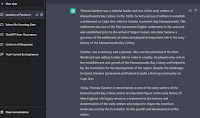
ChatGPT, 2 Feb 2023
Our first attempt ended in some errors, as did today's. Yesterday, we were testing its knowledge of itself which it handled very well, in most cases: I am ChatGPT created by OpenAI and only know what the trained data allows me to know. Nothing more; I do not reason (yet). 

I pulled some of the log from queries related to Thomas Gardner. Before this, there had been queries related to similar themes. 'Query' is my question; the response follows. Notice that it was in a 'terse' mode which is nice. Then, I asked for a 'verbose' answer to the prior question. 

Query: Who is Thomas Gardner of Salem MA?

The specific Thomas Gardner of Salem, Massachusetts you are referring to is unclear. "Thomas Gardner" is a common name and there may have been multiple individuals with that name living in Salem, Massachusetts. Could you please provide additional context or information to help identify the Thomas Gardner you are inquiring about?

Query: Thomas Gardner married to Margaret Fryer. He died in 1674. 

I apologize, but with only this limited information, it is difficult to determine the specific Thomas Gardner you are referring to. The name "Thomas Gardner" and "Margaret Fryer" were both common during that time period and there may have been multiple individuals with those names in Salem, Massachusetts. If you have access to any additional details, such as birth dates or occupation, it would be helpful in identifying the Thomas Gardner in question.

Query: Did you read about Roger Conant?

Yes, I have knowledge of Roger Conant. Roger Conant was a colonial leader and one of the founding fathers of the Massachusetts Bay Colony. Born in England in 1592, he immigrated to the Massachusetts Bay Colony in 1623 and was an early leader in the colony, serving as governor of the settlement at Salem. Conant was a key figure in the establishment and growth of the Massachusetts Bay Colony and played an important role in the early history of the colony and the development of New England. He died in 1679 at the age of 87.

Query: Thomas Gardner was the lead before Roger Conant of the expedition that settled Cape Ann in Massachusetts in the 1623/24 timeframe? 

Yes, that is correct. Thomas Gardner was the leader of the expedition that established a settlement on Cape Ann in Massachusetts in the 1620s, prior to the arrival of Roger Conant. Gardner led a group of settlers to Cape Ann in the early years of the Massachusetts Bay Colony, and the settlement he established there was one of the first permanent English settlements in the area. Roger Conant later became governor of the settlement at Salem, which was located near Cape Ann, and played a prominent role in the early history of the Massachusetts Bay Colony.

Query: Verbosely, please.

Thomas Gardner was a colonial leader and one of the early settlers of Massachusetts Bay Colony. In the 1620s, he led a group of settlers to establish a settlement on Cape Ann, which is located in present-day Massachusetts. This settlement was one of the first permanent English settlements in the area and was established prior to the arrival of Roger Conant, who later became a governor of the settlement at Salem and played an important role in the early history of the Massachusetts Bay Colony.

Gardner was a visionary and a pioneer, who saw the potential of the New World and was willing to take risks to make it a reality. He played a key role in the establishment and growth of the Massachusetts Bay Colony and helped to lay the foundation for the development of the region. Despite the challenges he faced, Gardner persevered and helped to build a thriving community on Cape Ann.

Today, Thomas Gardner is remembered as one of the early settlers of the Massachusetts Bay Colony and as an important figure in the early history of New England. His legacy serves as a testament to the bravery and determination of the early settlers who helped to shape the American landscape and lay the foundation for the growth and development of the nation.

On the last? It's not quite right, but then it is a composite from several sources. This type of approach might appear to be of interest but is not. Debatable, of course. 

Now, we will get to the specifics, but the training data set was large and came from the internet: pages, sites, books, and such. What a heap! Right? That would confuse anyone. 

There is so much to discuss. We got it to say that the training set was a subset and not just the whole mess. After all, the internet is a mess, for several reasons and of various types. One thing that sticks out is that the 'domain' aspect of life has been ignored. That is, architecture with respect to this type of technology is very weakly evident, perhaps nonexistent. 

One failure, last night? I suggested to the thing that we and it make errors. Right. But, to know how to assess its errors, we need details related to 'provenance' in the proper sense. And, ChatGPT admited that it cannot specifically respond to anything that would be like a 'footnote' request. Alas. ... On trying to respond to that, the system crashed (red text, emphasized - several times). On getting things going again, I was told that I had exceeded the number of queries per hour. Oh well, it and I were in sync ;>). 

So, I was thrown out and the party ended. 

Remarks: Modified: 04/24/2025

02/05/2023 -- There is a lot to this. We will focus on GPT3 which is that which ChatGPT invokes for its content. Too, Google has a player, too: LaMDA (remember fall 2022 and claims of sentience?). 

02/11/2023 -- This is not an official TGS opinion, it is mine. And, I (JMS, starter, with Ann, of the TGS, Inc.) need to give some overview. Why? I have been decades doing advanced work with computers where the focus was involved in 'real' issues related to application of these things. It has been a long road that these types of programs (meaning systems-level focus) and projects have hoed. Some results have been remarkable, say MRIs and other imaging, or CAT/CAE/CAM (advance mathematics applied to design and engineering), communications (look at the 'cloud' for instance - but with rose-colored glasses as that place is a mess), scientific experiments (but the issue of non-repeatability is there; and, other issues; be aware that the framework's strength will keep problems from being obvious), medicine (too many to note, however I will say that I was in top-notch surgical environments back in the '60s in the U.S. Army and saw the state of the art then; to me, robotic surgery is far from something that we ought to trust), and much more. Essentially, computing is everywhere. That is why immature and irresponsible acts are and ought to be concerning to anyone thinking of the future and their progeny of that time. Pollution is one analog such as we got the EPA for. There are other descriptions that I will do later. ... Truth engineering is what the TGS is trying to raise to focus. ... Disclosure: my focus is not Comp Sci. No, it comes from the underlying mathematical frameworks that are being used. Necessary care does not seem evident since a product ought not be released until fully analyzed with respect to several factors, one of which is safety. The main issue? Allowing API access which is hidden from view for something that is not really a product, nor has it any ability as expected by most. Cute, but poisonous to our mental health, might be one depiction of the state of the thing. 


Tuesday, January 31, 2023

The Americas

TL;DR -- As we noted early last year, we have technology as a focus similar to another group's concentration on honoring research in biomedical fields. This post is about a biological thrust which has a couple of themes. One is that technology cuts across the board. We can use IEEE as an example of touching everything. Too, the post recognizes the life work of a Thomas Gardner descendant. 

---

We have mentioned New Spain several times, in the context of the United States. But, considering the extent of the U.S., there were other cultures, such as France, the Netherlands, Sweden and others. This will be a recurring theme due to perseverance of families through time until now. 

And, New Spain also is associated with most of the Americas outside of the U.S. and Canada. That might be the result of the usage of the Spanish language in much of the Americas. According to one source, there are 280-million English speakers in the American Continents compared to 418-million Spanish speakers. This is attributed to Spain being the first conqueror. New England did not conquer so much as slide into the area. 

Our last post mentioned the NEHGS which had a history and genealogy focus. These two utilize technology which is one of our interests. Of late, DNA studies have become more used. These types of results are becoming more frequently used in proving heritage. 

That is a biological focus which then leads to the use of technology, for supporting disciplines of the various sciences, and its mathematical understructure. And, so, we get back to computing and its contributions and plagues. We do this for several reasons which ought to become apparent through time. 

Natural History Museums (say Smithsonian, New York, London, and others) provide information about our world the study of which involves many disciplines, as we see with the Departments at Universities. Curators play a key role. Some in computing have brought this function to bear, say handling knowledge in terms of what a website might present. As with everything, interpretations differ as to what a curator does. The need seems to be recognized according to the rhetoric of the time. 

This post deals with the study of wildlife biology as it has grown over the past 150 years or so. We wanted to point to an example via the journal of the Mexican Association of Mammalogist. The first issue of Therya, Vol. 14 honors a New Englander who descends from many families, including that of Thomas Gardner, of Cape Ann and Salem. We had a post about him, earlier: Alfred L. Gardner, Ph.D.  

Note: Before going on, a technical aside is necessary. We, in the U.S., have benefited from awareness that can contribute to security and such. The 'wild west' start of the internet was a little perturbing to many. The marshals that came to town to clean up were varied, but they have helped. The below article is available via the DOAJ's website: https://doaj.org/about/. However, we point directly to the organization's site for convenience, though it does not use HTTPS. This blog (and its main site) put that into place a while ago for several reasons including Google's nudging. But, mostly, the push came from issues of FTP's security.  

The image shows part of the table of contents from the journal. There is the declaration of the Special Issue. Then, we have a listing of several of the articles, many of which have to do with Dr. Gardner's work. Not all are listed, but this quarterly publication is over 180 pages in length. 

The abstract (Special Issue in Honor of Dr. Alfred L. Gardner) provides links to 'full text' versions of the article (PDF or HTML) and gives references for the material in the article. One of the many publications of Dr. Gardner was Mammals of South America (2008) which is the first of three volumes. Our title suggests the integral aspect of the Americas, north and south. This is a subject needing more attention in terms of the long reach of New England. 

It might be helpful to point to information about Mammalogy (Wikipedia, Journal of Mammalogy, Encyclopedia of Life) which is part of Zoology, the study of animals. "Theria" is a subclass of the mammals. 

Incidentally, this post continues a major theme. An analog can be found via IEEE.org which involves the ubiquitous type of technology that which enables computing and everything else, in part. We need material sciences, as well. 

---

Forgive our focus on the 'artificial' when the subject of the post is nature and life. One curating task deals with establishing and preserving knowledge of provenance, through time and situations. Just now, I asked Google to give me something like this (asking ChatGPT about the provenance of its content). Got one interesting bit from The Atlantic: ChatGPT Is Dumber Than You Think (it's a toy, not a tool). Well, this type of thing will be a continuing theme (AIn't and more). 

Oh yes, Roots Tech is right around the corner. We have not paid much attention to that, except for using the various tools (love Family Search). But, it has been on the table for a while to address issues related to this type of thing. And, re-evaluating DNA (let's cut the hype) will arise at some point; for this topic, I am going back 100 some years to describe how computing in its current form came about; DNA work is heavily reliant upon computing; there is no theory for this (just practice); do we need a theory? Chemistry and its theory? Again, look around. Everyone is chasing a "theoretical" basis. Guess what? They all eventually get to computing. So, there it is. Computer science has no basis, at all. Of course, other computing labels have come up, like computer engineering. But, we're talking more than mere labels. Wait, ChatGPT appears to be shallow due to something similar? Stay tuned.  

Remarks: Modified: 02/10/2023

02/10/2023 -- There are lots of links with regard to Alfred. We'll start with these two: Special Report (Localities of Mexican Land Mammals), Tech Tech, 2020; Species he named. 


Saturday, June 11, 2022

No hiatus

TL;DR -- The last three years have been more active, partly due to Covid restrictions. Too, though, technology has shown us some new and potentially useful, or not, stuff. One thing on the plate going forward will be technology. What that means is still being discussed. 

--

Lots going on. At the end of May, the pace of posts was keeping up with those of the past three years (2019, 2020, 2021) the last two of which were unique, many ways. There is no end of possible topics for research and reports. 

Adjustments, due to the times? Yes, that's a huge factor to address. One prime focus is on technology and its misuse which seems to be a common trait of humanity. The latest is the scene of several decades duration that accelerated recently with the arrival, finally one might say, of capable computing. Albeit, that one at the same time must add this, highly immature stuff all around. 

In particular is this AIn't phenomenon that has captured the imagination of many. At the same time, there have been too many new applications attempted whose ramifications are not known for us to claim that we are scientific. Willy nilly is more like it. 

Now, perturbations in the economy relate to these types of mania, the last two, in particular, had a technological flavor. This one will continue that trend. So, lots to watch and to attempt to learn from. 

One thing that computing brings is enhanced proof techniques whose adoptions would get genealogy out of its morass. Minor issue. DNA rattled those cages, a lot. But, it's not flawless, that scene. 

What is not without fault? Well, nothing, if we use the 'mote' example; there are several sources for this. 

The new scene is such that we really do not know. Look about, who is not casting in the wind in order to read the waves? I know, mixing things. It's intentional. 

We had hoped to be post-COVID, one location that I know of has had a jump of 4K cases in a week. One example of the new age are the many sites reporting data and making various judgments. That's to be expected, as we're humans and do that sort of thing. 

On a positive note, I see many articles and reports showing an emergence of a mature viewpoint. How to describe this? That is one of the things to tackle. Reducing the hype is one thing; but, more importantly, losing the aura of science fiction is more to be desired. Which means? Being more scientific in ways that balance the various necessary modes, such as engineering and technology. Oh yes, forgetting mathematics? Nope, those ones dropped several balls. We'll describe the situation. 

Remarks: Modified: 06/20/2022

06/20/2022 -- Added TL;DR line plus an image. 

Sunday, September 12, 2021

Dudley family

TL;DR -- Lots and lots of families in New England have published a book starting about 150 years ago and continuing to now. Many times, areas will include family genealogy of their citizens. Part of our work has been identifying this type of work which has a Gardner theme. Turns out that the Dudley families also can be used in this regard. 

--

We were doing research about families in New Hampshire and noticed that Dudley kept coming up as families in the areas intermarried. Before the 300th of New England (Great Migration) came around, families were doing research and writing books. This has continued over the past century. 

Somewhat, all of this activity has resulted in material that is mostly conversational. Some say, well, quote sources. But, that is not enough for several reasons. We need more than books. Fortunately, the web will help as we go forward. 

One of our tasks early was trying to collect all that had been written about Thomas and Margaret (Fryer) Gardner, in particular, and about Gardner in general. Some of those early sites seem to have disappeared where we might use the 'wayback' facility for access. Then, for those still around, who do you believe? We made a choice to support the WikiTree effort due to their principles. 

One might think that Gardner represented a mess given all of the families with the names, some of which may very well be related. In any case, we want to address collateral families. So, we would find 1000s of names anyway given the time frame of 400 years and more. Dr. Frank's book is small in comparison to some of the things that we see. 

History of the
Dudley Family

1892
So, back to New Hampshire. It turned out that using three family books, things were consistent. That is, each had their own thread and views. But, converging to some point in time and family was there, albeit the information differed slightly due to viewpoint. But, one of those three books was related to Dudley. And, turns out that it covers more than the family of Thomas. However, he was the one of interest given our focus on Massachusetts and its surroundings. 

So, the thought arises that the Dudleys started researching early. Or, they had better family records. But, not. Too, they do have the public interest and so can be a focus for discussion. As in, compare things back to what the Dudleys did or wrote. Too, their effort can be motivation to keep us working toward a better framework for presentation of Gardner information. 

Here are a few thoughts on the matter. 

  • Joseph Gardner and Ann Downing are mentioned. Why? Gov. Simon Bradstreet married Ann after Joseph was killed and Simon's wife, Ann the poet, had died. Okay, that's a connection that is early. However, on browsing around, there are other references to families that are only a degree or two (the Kevin Bacon deal) away. 
  • WikiTree. 
    • Of course, there is a profile for Thomas Dudley. Too, notice that there are the G2G discussions. 
    • History of the Dudley Family. This was published in series. WikiTree provides them all. That is, those before a certain date. A Google search on these of a later vintage comes up with books, most of which support neither preview'ing nor snippet'ing. 
  • Thomas in particular. The Royal Families book gives his descendants including those of other families. A few years ago, there was a file that listed the names (part of the index) so that one could check without seeing the text. Doesn't seem to be there (let us know if it is). 
  • Example of a town book, Canterbury NH. 
  • Wait, a book with little Dudley mention: Connecticut River ... 
  • Dudley DNA. This is good to see. 
  • ...
Early on, we noticed that the 'rich and famous' had more genealogical/historical stuff published about them, albeit how did one know how good the stuff was? Serious question. Too, if one looked at the general stuff, one could get some hints about others who might have been in some area at some point in time, even if they were not mentioned. Hints, folks, are what good problem solving needs and develops as part of any effective process. 

So, Dudley? Probably about the best example though we have seen many others. We will bet that the Dudleys have a motive to make it right. So, they will be part of the action. Lots to talk about with regard to filtering and such. 

Remarks: Modified: 10/05/2021

09/15/2021 -- We need to look at New Hampshire on a regular basis.  

10/05/2021 -- Added image for our Portal to Truth. 

Saturday, July 10, 2021

A(rtificial) I(ntelligence) researched properly

TL;DR -- As we have mentioned in lots of post, New England has a long arm through space and time. Very long. We have looked at the interior example of this. We have a nautical one, to boot, that sits there awaiting attention. And, we need technology for various matters. Keeping it simple over the decade was one goal. Accomplished as we do not even have a smart phone. From the outside, apps look to be idiotic. I'll get one soon and be more specific. With regard to the purveyors of the clouds that are strangling the folks, we are immune and neutral. We'll tsk, tsk at any who is not behaving in a mature manner (did Zuck ever get over his bull-in-a-china-closet self?). Once we do a little look back which implies future happenings similarly (truth engineering is the focus), we look at DL and its huge impact of an unreasonable nature (hint for the brainy, think Wigner's comments). What is wrong here? Well, we 'deep' dive, proper sense, into DL and come up with the pearls of wisdom that seem to have been lost in the mud. 

--

An ongoing concern is that we need to have a technical focus for a while as we re-look at the computing landscape. This type of thing seems to have occurred on a periodic basis which we have covered somewhat as we proceeded. But, since technology will be a focus going forward, we will be more regular on looking from that angle. 

And, we will pull together several threads as we work this. Then, we need to assess where the world is on related topics. Warning, we're going to the core and back in an attempt to clarify what are the real issues and why so much hype and confusion. 

So, let's recap, somewhat. It does parallel other activities in the world of technology. 

  • We started this in 2010 using facilities of Microsoft (MS) as we were looking to be in the world of  ASP.NET for web apps with access to OfficeLive for the business focus. The first cut of the web site went quickly due to their tools. And, all was well, or so it seemed. 
  • So, in 2012, MS pulled the plug (leaving a bunch of little moms and pops scrambling as they lost the core of their business model). Rather than step up to Office365, we went looking. That was nice. As we got to see how the web was about seventeen years after its 'wild west' start. We tried several of the state-of-the-art approaches. Mind you, we are now facing the onslaught of change coming from Jobs' gift (in other words, the app world was dawning). However, since our purpose was content management in a totally new environment, we fell back to our roots which was riding the wave of the internet from the beginning via Unix and Linux. Remember, at one time, SUN noted that the network was the computer (early 1990 timeframe). So, we converted from 'asp' to html using little graphics with attached functions as the GUI. It was fun. The choice was to use an ISP who ran Linux and offered lots of software choices including a web design tool. Didn't like it, for many reasons. So we did our own thing. 
  • After two years (2014) of managing content with antiquated methods, it got to be wearing. So, at that time, we took the time, again, to reassess the state of the art with respect to web stuff. And, we looked, again, at CSS. Yes. So, that became the GUI provider (parameters and systems, just like we see with DL - more on that, lots more). I saw a 3D graphic engine implemented in CSS/JS but still had lots of content to cope with. I was relieved to have some progress improvement.  
  • Then, by 2016, Google was saying to those who went out pioneering earlier, respect the little guy or you don't get any attention (meaning, in their ways of pushing stuff). So, we became mobile friendly. The keyword was being responsive. This was done with even more CSS. At the same time, we picked up WordPress in addition to Blogger which became under the auspices of Google. In the meantime, we kept looking at new kids on the block. After all, some spend their lives playing with the stuff. So, alternatives abound. Guess what? I have lots and lots of examples of people being screwed (hence, this is one thing on our plate) because they didn't take the time to understand technology. At least, know more than how to push buttons on that thing that Jobs' gift gave the world (incidentally, I am about to get one - the smart phone - I call it a dumbing device and can show examples of that, to boot). Anyway, Google provided a little test facility to check out your site. We passed. That was enough, then. But, again, soap box: everyone seems to have descended to this one-eyed little thing where one cannot multi-task. Can I explain further? You bet. It'll be on our table for discussion for a long while. Also, later I used someone's Jobs' gift to look at the site. Not bad given that it's not using custom apps but a good browser (that will not go away, folks, for many reasons). 
  • Then, 2017/18 came along. We decided that ThomasGardnerSociety.org was a bit to type and decided to go a little smaller. We asked for opinions and settled on TGSoc.org which has been a blast. We still have the old site for older material that will be reorganized. On the new one, we are stressing the need for truth and its engineering. Frankly, the site is to be a test bed for ideas and discussion, eventually. More on that below. At the time, we relooked at the options. And, settled, again, on HTML/CSS but brought in JS. Now, there are several varieties of JavaScripting available. However, I just saw top-of-the-line bit of research in truth maintenance (older concept) which balances multiple worlds (essential) which was created with html/css/js. Yes, I have seen lots of topnotch sites using this. Topnotch? Not commercial flimflam, please. Not academic, either. 
  • Now, we're 2020/21 and have started to redo, again. Of course, it's time to reassess the world. And, knowing about New England and American History a little more now than in 2010, that whole framework has to come to become more visible in a coherent manner that will persist. Guess what? We will argue that there is research to support that will be as important as biomedical research. After all, we're talking the soul of the nation and of the world's people being entrapped via technology that is driven by motives are that not what we might want given what we know of the 400 years of effort on the part of thousands of families. But, that's for later (see below). Now, we will look at apps. Also, we will be looking at multi-media and the different ways to express some notion with both provenance known and veracity shown. Ever heard of AI? 
Okay, switching gears. One thing that I have noted is that people who are presenting tough stuff (say, as one expects with science) always use a mode that is as complex as the subject. Others present complex stuff using simple means; some people call this 'static' but do so erroneously. I will have examples, but many of these sites represent the latest thinking in fields such as mathematical physics which really is the driver of all of science. Too, the web has gone wild with approaches to presentation. Some of these will live on. Those are the ones that we want to pay attention to. We will have the more entertaining aspect, but hard-core issues area going to be a huge focus. 

Let's look at one, for now. Of late, there is this thing called Deep Learning which has gotten a lot of press and generated both hype and fear. The former? Oh yes, AI, as in artificial intelligence, has finally shown its head. Well, not. We will explain.  The latter? Again, AI. Old Musk (pusher of the electric car and its illusions) says, it's summoning the beasts. Other brains are bewailing the future and it perils. 

Well, in short, AI ain't. We have spent the past year looking at the guts in terms of the underlying mathematical and computational approaches. And, we are ready to discuss where there is more hype than not. We use that phrasing as, of course, it's not all for naught. There is some good stuff there. On the other hand, business managers are buying into this stuff to the detriment of their customers and their employers and the rest of us. Won't name names, yet, but some billionaires are exhibiting classic idiocy. 

To close this, let me point to two papers that were in the recent ACM Communications. They are both open to public view (thanks, ACM) so that we can access content of the papers without going into a closed environment. The ACM is the Association for Computing Machinery and has been around since the advent of computing. Earlier, it had an academic flavor but is now balanced with people from the industry. The Communications is their flagship publication that is printed monthly. This recent issue is just full of good stuff as we find with these two. 
  • Deep learning for AI -- The ACM provides a Turing Award to folks who contribute to the discipline in an extraordinary manner. This paper is based upon a Lecture by three researchers who shared a Turing Award: Bengio, Lecun, and Hinton. Recognize those names? These guys were of neural nets all along and so can be seen to have sloughed through the years. They are not recent wonders exploiting graphic cards nor are they pushing notational magic such as tensors. Of late, news reports have mentioned these three talking (Hinton is whom I have seen referenced the most) and saying, wait, neural approaches have issues. We have to back up and relook at the situation. Well, this article expresses those issues and discusses some work that needs to be done. Great stuff. The article is open for reading (thanks to ACM). They mention symbolic approaches, the old stuff to some, and the later modes that are heavily numeric - exploiting age-old ideas about transforms, optimization and more. But, it’s in their ‘Recent advances’ and ‘The Future of Deep Learning’ where we see discussion of other things that are being pursued plus some suggestions and notions that need attention, like attention (now, a soft type). I liked the higher-level cognition little section. Yes, the old ‘planning and reasoning’ methods ought to be more than dead meat to those numeric overlays that are so insidious. I can talk that, too. BTW, Minsky’s ideas on the society of mind are still apropos, to boot. But, there is a lot more to put on the table. Next bullet.
  • Deriving equations from sensor data using dimensional function synthesis — ACM, thanks, this is open, too. Gosh, in the last bullet, B&L&H were musing about higher-order (which even tensor notations aren’t going to give to the neural approach) and its use. After all, B&L&H are academics and know the mathematical stuff. So, Cambridge (Tsoutsouras, Willis, and Stanley-Marbell) to the rescue. This paper reminds me of a lot of things that I saw and dabbled in. To me, what was the conclusion was having a trained person in the loop. Trained? Yes, thoroughly comfortable with the type of thinking that a good physicist would follow while modeling - used since model-based approaches are still germane to the subject, perhaps even more so now with the flood of data and improper analysis that is killing us - in order to solve some problem. Good engineers fit this bill. 
So, we will need to have a technical focus, in part. One motivation is that DL, as automated mode, is gnawing at things textual and visual and creating what is considered knowledge views. Well, it is not. There are 'deep' issues at play here that are being ignored. These deal with what can be ungrounded domains, such as mathematics and philosophy. One might ask about 'grounded' which has been discussed forever. Well, humans will play a part in whatever dynamics are needed. 

Example of human deep learning
guiding DL

Yet, that complexity does not mean that things (are allowed to) just run a natural course with negative impacts upon humans and their culture and society because we shirk our responsibility to be mature. Run fast and break things? Heard that before? It's right out of Silicon Valley (to me, silly) during the past decade and one-half when things accelerated to more instability than many thought possible. Sure, the web/cloud is there. Well, the majority of that is something that we need to study which some have termed crapularity (really crapology - in response to the interest in the Singularity). 

We use the concept of research as being important. Science is one focus that needs to be there. Definitely, mathematics will be of concern. Now, people? What do they bring? That is something to learn more about in a way not done before. One suggestion is that the web/cloud offers lots of modes to look at in a new way. For starters, a survey of the past four or five decades with respect to how computing evolved and a consistent presentation of the results is imperative. I see now lots of older practitioners, who are retired, talking of their work. One theme, perhaps to be expected, is how the new modes merely rephrase what was done before with new gimmicks. Some sciences seem to redefine themselves from time to time. BTW, what will be re-evaluated, to boot, will be DNA from several perspectives that seem to have been swept off the table and under the rug as commercial interests took over the science. Wait, the old and the young? Generational dynamics? Actually, the topics have no limit. However, one important element? We are dealing with the American Dream. Who owns that? What is it, exactly? And, how might American Indian thoughts apply in modern contexts such as science? 

Remarks: Modified: 08/05/2023

07/11/2021 -- Review and edit; add image. 

07/12/2021 -- We are back in the saddle. Concerns abound. Such as, some have been taken to the cleaners due to unscrupulous developers and outright charlatans with modes that lurk and pilfer. Some have paid way too much for some capability since they were too old to know or to make the effort. Oh yes, youngsters not knowing? Yes, that is the case, too. Can we have a sustainable web for all? 

08/05/2023 -- I haven't been watching, but this post rose on the list of the most watched, recently. The theme is one reason. We will lift this up to further usage, as we are working on GB XIII, 1. One topic is year-to-date. The other deals with new directions. Wasn't there a boy band with this name? I know that there is a literary publishing company with this as a name. ... In Nov of 2022, OpenAI pushed out ChatGPT which is an example of the capabilities of LLM. We will have more on that, and related themes, soon.  


Thursday, December 10, 2020

Feet dragging

Or one might say, of genealogists, that they have their "lead feet" still. There's a lot to say. Being and life does not come from documents. Oh, they're doing DNA, now? Well, that's not a completely closed issue, either. Lots and lots of automated (thereby, computer controlled) work is done with this type of analysis. 

Wait, mathematical analysis has solved all of the problems that we might face. Well, not. 

You know, the SAG published, in part, via the internet. Lots of people do. Your bank wants you to go paperless. So many examples. 

What's the theme? Well, the focus now is going back through ten years of stuff and pulling out those things that will continue to need attention going forward. And, there is a specific intent behind this post, albeit we'll not mention the particulars. Rather, there was a recall that we had seen something about a decision. 

And, it's around the 2010 time frame. We were newbies yet knew the significance of this choice. And, look at the last year. Yes. On-line it is, except people are meeting, sometimes in groups that are larger than is suggested as a limit. 

The milieu then? Well, we would have had a decade and one-half of the internet having gone through several stages from the early days of Mosaic. And, we would have seen lots and lots of problematic results coming from unexpected behavior which would have been known had people paid attention to American History. 

In particular? The Wild West. Yes, we're getting to that now with real families as the focus. 

Anyway, we had a blog post: On blogs and other modern means. This is from June of 2011. We were still in the honeymoon era with respect to the Thomas Gardner Society, Inc. work. And, we left a comment at the Slavak Yankee site where we first read the news about no internet. 


With respect to current events, one motivation for the post is something that recurs. As newbies, we usually took it as some oversight on our part when we bumped up against some genealogical wall. After all, there are those brick walls that people write about. On the other hand, some of the walls that we have seen were not brick at all, in fact, one is an ongoing affair with resolution pending several factors clicking. Not genealogical; rather, we seem to be seeing issues of personalities and their differences (see Ethics, the next post). As said several times, one of  us has no pedigree so cares less for those games that relate to that type of one-up-man-ship (who's better?). We'll get back to this. 

BTW, want to contribute, we are updating the Thomas Gardner Profile on WikiTree with regard to Thomas and Margaret and the kids and more. We have a couple of G2G posts that are on-going. 

Oh yes, what's scholarly (back to Slavak Yankee's post)?  Our offering is Gardner Research and The Gardner Annals. Contributors, of all fashion, are welcomed. 

Remarks: Modified: 05/02/2021

05/02/2021 -- We need to move to a focus on the frontier century where lots of families obtained their hole in the paper trail. But, these can be bridged. As well, we can look at modern examples as a type of juxtaposition: Two different times. 


Monday, September 28, 2020

Chloe, again

TL;DR -- Poor dear, that Chloe. She is a cabbage-patch kid. 

---

 A few years ago, we did some work for a Mayflower society applicant. This was our umpteenth application which were all successful when there was a proper match between the ancestor and the list of ancestors for the particular society. That is, one learns how to scrutinize and match this early on. Besides, of all of those applications (for several persons and societies - context of the Heritage Society Community), one was said, by the genealogist, to have been one of the best they had seen. That is, the application and its curated sources. Mind you, this was an old group, older than that related to the Mayflower's arrival, off course. 

So, we were rolling in the oats (whatever). Right? Until, we met obstinance. And, Mayflower people, this theme will be continued until someone notices the oversight. Why? We just worked with several families with many ancestors in the frontier period and situations. It was a constant rolling westward (and northwestward and southwestward, depending upon the location); albeit, there were recoils with people returning to whence came they. We're not talking TV or Hollywood's view. Though, characters do come into play, such as Daniel Boone (hence the post). What did we find? Lots and lots of lineage nodes (think tree branch) where there was stuff on both sides of a gap. Some think brick wall, but that, dear people, is an improper metaphor. 

Why? It's being that we're dealing with, not a paper chase. This post is one of several (Genealogy and Bayes) on that continuing ordeal.

The whole of the hang up with the MF experience was one generation (in fact, one little gal - mother of one - who died early and was replaced by ..., ..., a step mother for her little daughter). So, let's look at one approach. That is, USDAR, in their Guidelines (pg 33 - link obtained from their blog), allows for an analysis for one generation. Doing that brought out all sorts of possible areas for further research. I don't think that the east coasters (Northeast) know of the troubles endured out west. So, that perpetually puts some families in limbo? Not. It only shows that many are into some ego game and not the science of this (after all, as we have noted, we allowed dinosaurs to be imagined with far less than we have with some people).

On the other hand, there are gaps which are hard to cover. DNA might help. There might be yet unfounded modes. Without the proper insight, how can we know? We will continue to be driven top-down from this view of heavy authority (knows it all)? One case that we saw was a baby being left with a couple out west by the father. The mother had died. He was to come back. Never did. The baby grew up and was the mother of several. Never knew. Nor did the children with much searching. We might have a solution, though. Need a little more information. 

So, the next post will pick this up. We said, in the Bayes post, that we would be back with more detail. In that, we also pointed to material on WikiTree that pulled things together, a little. Oh yes, the final descendant of Chloe along this line just went past 100 years old. Meanwhile, MF sits on their thumbs. 

As was said before, technology will allow history to be retold. The TGS will weigh in there, as unbridled use of technology sends people to bonkers' ville (or twit-ville - valley of twits). We expect to be a sea of rationality and calm in the storms that are now and will be. 

With regard to the method, this summary will be followed (NSDAR's RGG-4001):

  • Statement of purpose
  • Research strategies
  • List of documentation
  • Interpretation
  • Account for conflicting evidence
  • Conclusion
We will fill this in for Chloe's generation which will meet the stated earlier goal of getting more into depth.

The list of documentation is fairly large. This whole analysis was covered in an article in The Gardner Annals (Vol III, No 1 - Winter 2016) titled "Flyover country". It is interesting that none of the discussions based upon this article went to the core of the matter. No, most comments were related to peripheral issues; that indicates, somewhat, that an institutional bias has been successfully overlaid on the mindset. 

Remarks: Modified: 11/01/2021

09/28/2020 -- We have started to look at this "brick wall" using one generation's huge bucket of data. 

10/14/2020 -- Add image for our portal (TGSoc.org).

11/01/2021 -- So, now the MF people have a database of those in applications to 1900. And, guess who is there? Lyman and his daughter, Anna. These are the father and sister of Chloe. And, the applicants who were in their 90s? Deceased. 

Saturday, September 19, 2020

Technology and content

TL;DR -- Technology can mean several things, many of which are apropos to our work.  

---

There were other posts on this theme: technology as search. For the most part, these followed our movement from the initial ASP world into the fray of webbing (2012) where we picked up the older technology, for several reasons. That is, HTML was the choice (we actually cut images from the pre-cloud setup - high end - and built our own menus, etc.). It worked. And, we were able to work content for two years. 

Content? Yes, the crux of the matter. As we look around all of the populace with those mobile devices (some amount greater than 5B altogether), we watch. Note, this is from the position of not going any more mobile than the laptop. Until now, where this is being written in a 1/2 mode. The work is being done on a small 2-in-one with weds the laptop with the tablet. And, the mix is a multi-core device, with large memory, fairly sophisticated graphics, and solid state support for that which was the file system. 

As an aside, using a light pen for more accuracy and falling back to former modes, it's almost like using high-end graphics from a few decades ago with the manual input mode so loved by those who code (say, vi and such) but in a manner that was only dreamt of before. 

Also, not for gaming. We're being serious here in the context (related to content) of the futures of the TGS where a focus toward research at the heart of artificial intelligence and truth engineering is being proposed. Hence, our little humorous use of 'portal to truth' which is not really tongue-in-cheek. 

We have used our technology blog to write on this. But, the transition was from HTML to HTML/CSS in order to be mobile friendly. Then, we brought in JS in order to be process efficient. There have been several iterations on this. For doubters, we saw a demo of high end computing using html/css/js (yes, almost like the new Lisp, some say, alluding to the era when those machines were top of the line). We have seen the descent to numeric spaces, where logic is pushed away from being nimble. That will change as we see discussed now. 

Many see genealogical modeling and DNA as the top of the line. We beg to differ. Heck, some of the techniques show a lack of appreciation for Bayes and his kind. The whole of the industry (tell us if we are wrong) has no clue about philosophical issues let alone anything about ethics. Thomas, being Tabula Raza, gives us a good basis: the whole of the American experience needs more looks other than those driven by the top-down thinkers. 

This is brief. Before, we used an emulator to match up (or attempt to) the mobile experience. Mind you all, apps is the thing there. Most (all, except for a few) are pure trash. Yes, indeed. We will discuss that. Quite frankly, the work of the TGS is being seen as an operational arm of the larger picture which deals with a sustainable economy in which we have mature computing. No small chore, to look at all of this. 

Now, we can do more than mere simulation and exercise things as they ought. A young person showed us a benchmark which has descended to a type of competition such that one of the players (a company offering a benchmarking tool) actually pulled a Volkswagen move (yes, tuned their app to meet and beat benchmarks). See what we mean? 

Of course, there will be the more normal activities dealing with TGS descendants and those of the whole of the Cape Ann part. But, there is a Gairdner (Gairdner, Gairdner Awards FB) group that started a few decades ago and took up a role in medical research. They have a yearly affair where the best of the papers are discussed and prizes awarded. We'll have a post on this. 

Diversity and Excellence
in Science

Think that computers, especially when you look at the total picture where embedded has become a whole industry in itself and where people are both the users and the used, offer many challenges where a perspective across a longer time frame just might be wanting now but necessary. 

Oh yes, content? Versus configuration? The latter is the focus on the computer which requires a whole lot of support. All the cloud did was push this behind a veil. Ourselves? We went with server which has lots of potential. We're doing a minimalistic approach by choice. It'll be discussed as needed. Content is that which is curated. And, it's the larger issues, notwithstanding AI (and the current hype - oh yes, let us weigh in on that) and its supposed wonders. The full of the content approach usually cares naught for configuration (hence the evolution of the cloud); the full of the configuration cannot understand the needs of content. Such is why there is a friction. The latest IEEE Spectrum had a wonderful article that can be used to discuss this: under the guise of discussing legacy (sheesh).  

Remarks: Modified: 04/16/2023

09/20/2020 -- Added links to the Gairdner Awards group, Scottish family in Canada. 

11/03/2020 -- We are about ready to commence work on further improvements that carry a message regarding the tradeoffs that we ought to face but mostly ignore. Some see fiddling as a right. Fine. But, there is always more work to be done than bodies (minds) to do it. Per usual, we'll be blogging on things encountered, especially issues.  

11/10/2020 -- This theme is still of interest. 

04/16/2023 -- Update image link for "Diversity and Excellence in Science" which had moved at the Gairdner site.