Showing posts sorted by relevance for query twain. Sort by date Show all posts

Sunday, April 30, 2023

R Waldo Emerson, out west

TL;DR -- In 1871, R Waldo Emerson went out, leisurely, on the train from coast to coast as the labor of many finally got the rails in place. Out there, the party looked around for a while but did not really report as we saw with some of the other earlier travelers. Except, Waldo mentioned that he would have moved out if younger to get his land from the government. So, a recent book is of interest to this theme which we will look at further. Mark Twain went by coach, a decade earlier. 

--

This post is about Ralph Waldo Emerson (Wikipedia, WikiTtree) and his travel west once the railroad was in place all the way from his Boston surrounds to San Francisco. First, here is a long post on his house (The Home of Ralph Waldo Emerson). 

We have looked at the travels of others both before and after the railroad was in place. This trip was a good time as it was post the Civil War. And, there was a recent book that reported on research which exemplifies what needs to be done: The California Days of Ralph Waldo Emerson by Brian Wilson. There have been many reviews, but these two are especially pertinent. 

  • Zeringue Marshal - mentions that Emerson's group tried their hand at the wagon passage through the mountains and other things to note. Also, in his wandering arounds, why would he not love the place? He wrote to his wife that if they were younger they might have gone out and took up the government's offer of land. 
  • Donner Summit Historical Society - the reviewer notes several things missing which we agree with. Note, we have mentioned Donner Pass several times, including mentioning John's first pass through it in 1962. Of note, though, is the Woodbury Historic Tours being mentioned in a post. 

We'll be looking at this trip further. But, let's close with a well-known person's take on Emerson, courtesy of the Sierra Club: John Muir's opinion. 

But, we have to mention Mark Twain's journey, earlier: Riding the Overland stage, our posts on the subject. 

Remarks: Modified: 04/30/2023

04/30/2023 -- 

Thursday, March 18, 2021

Pre-Civil War, San Antonio to San Diego

TL;DR - We had our head in New England for a long time. Much to learn. Then, we lifted our sights to New France as they quibbled quite a bit with the English colonies. And, of course, being a westerner (the huge heart of America north), New Spain came forward. So, crossings is a theme that we will continue. And, how about three weeks from San Antonio TX to El Paso TX? In a stage coach? And, then, heading to San Diego CA partly through the area hosting El Camino del Diablo. Lots to discuss. BTW, this route was traveled one hundred and more years prior to the pre-Civil War period. 

--

This post looks at a couple of southern routes. One was for mail and has been described quite thoroughly. The other was a stage coach route carrying easterners to the So Cal coast and points in-between. The motivation is to fill in a more full picture of the U.S. as we get ourselves out of the New England bias. 

Earlier, we wrote of the first recorded cross-continental trek. Turns out that it was across lower Canada where the individual went from Montreal to British Columbia. The time? 1793. This is not long after the Revolution and before Clark and Lewis. Now, the context of this was western expansion where we realized that we had to include New Spain and New France into our work to be thorough. As mentioned in earlier posts, people went west almost immediately both in northern and southern New England. Up in the north, the Northwest Territory was a limit at one time. Today, this area is noted as being the mid-west. A lot of the western movement went by water. We are looking at the various ways that the crossing was done by land which was difficult.  

However, there were efforts that were quite successful. The Santa Fe and the Oregon Trails are good examples. But, we wanted to look at the lower areas of the country. As well, we always want to note routes that were known to American Indians. An example of that might be El Camino del Diablo. There are other old trails down in that area.  

As we look around, we try to establish a New England connection. We found one with George Henry Giddings. Actually, we found several through the collateral families. But, George and his brothers went from the TX area from PA, however they are descendant of the Giddings family from Ipswich MA. However, the family was successful in Texas, too (Giddings Family papers). 

  • San Antonio-San Diego Mail Line -- This route took over a month using mules and wagons. This graphic shows some of the places that the line went through using modern roadways. Note the distance of over 1300 miles with a time of 22 hours where a lot of it is the U.S. Interstate system. 

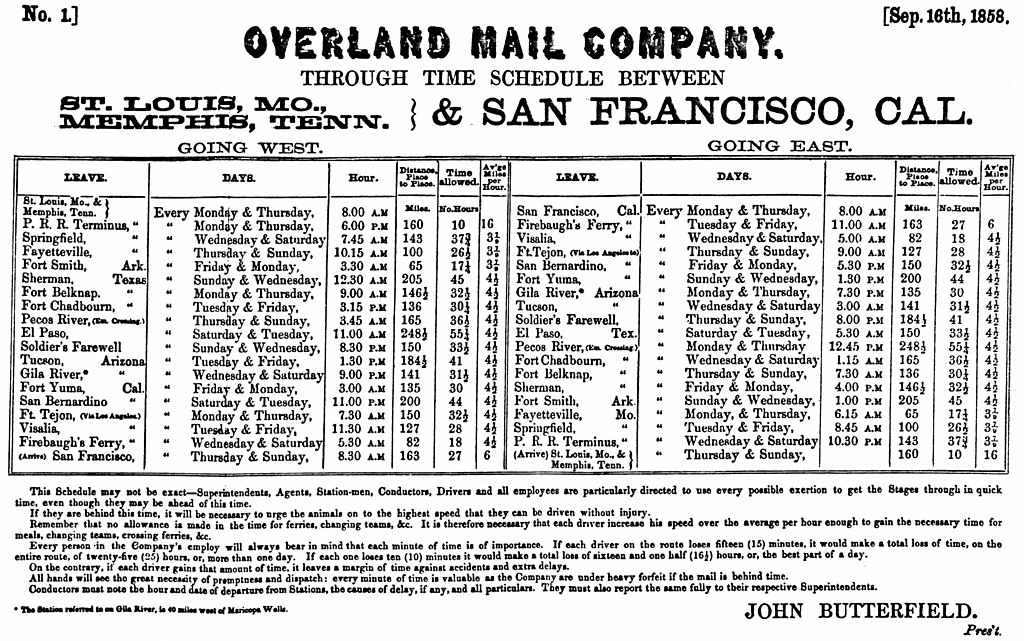
The Texas part of this road was over 580 miles. It was used from 1849 to 1882. One variant was called the San Antonio - El Paso Road which Giddings developed. We must look at the stage coach line that existed at the same time as the mail route. It was a different company, but they ran over the same trail in part. This was the Butterfield-Overland line that went from St. Louis MO to San Francisco. Here is the time table and mileage on the return trip. The route was by coach except for a short bit between St Louis Mo and Tipton MO. 

Mark Twain went out to see the sights and described his long journey by coach. Jedediah, and his kind, did it by foot or horseback. 

Remarks: Modified: 06/01/2021

03/24/2021 -- Add the TL;DR. 

06/01/2021 -- Need to add this image with regard to the schedule of the Butterfield-Overland run. Notice that the animals were run at the "highest speed" supposedly without injury. There is more detail about the intermediate legs of the journey. 

Given that, here is Mark Twain's description of his jaunt on the northern route. It was such a bother that he delayed his return trip. 


Friday, May 5, 2017

Magazines

We are going through The Massachusetts Magazine (TMM) in order to document the effort by Dr. Frank and friends. The TMM published from 1908 to 1918. When we first were researching the TMM, we encountered The New England Magazine (1886-1900) which had started as the Bay State (1884-1885, 1886-1887) monthly (edited by John McClintock who was a contributing editor for the TMM).

Then, we ran across the Southern Literary Messenger, that published from 1834 to 1864, while researching southern families with New England ties. An early editor was Edgar Allen Poe. We will look at this further as we make comparison between the periodicals.

Today, there was a message sent to all interested by Jeffrey Goldberg of The Atlantic. It started publishing in 1857 and is still going strong. We have to be interested in that the magazine started in Boston and was there until just a few years ago when it moved to D.C.

Message:
    On May 5, 1857, a group of Boston Brahmins gathered for dinner at the Parker House Hotel and decided to create a new magazine, one that would make politics, literature, and the arts its chief concerns. These men, united in their opposition to slavery, their love of American writing, and their tripartite names, included such eminences as Henry Wadsworth Longfellow, Ralph Waldo Emerson, and James Russell Lowell. They did not set out to exclude women from the gathering; Harriet Beecher Stowe, the author of Uncle Tom's Cabin, was invited, but she boycotted the dinner when she learned that alcohol would be served.
    A plan for this new magazine was set. The question of a name soon arose. Oliver Wendell Holmes, another of the founders, proposed "The Atlantic," to convey the notion that an immense ocean would separate this New World journal from its cousins in the Old. A manifesto was written, one that made ambitious promises: In politics, The Atlantic would be "the organ of no party or clique, but will honestly endeavor to be the exponent of what its conductors believe to be the American idea," and it would bring to the attention of the reading public the newest and most interesting American writers. The manifesto was signed by, among others, Herman Melville, Nathaniel Hawthorne, and yes, "Mrs. H. Beecher Stowe."
    In November of 1857, the first issue of this magazine was published, and we have never stopped publishing. And since its founding, this magazine has published everyone from the aforementioned Hawthorne (who served as the magazine's Civil War correspondent) to Frederick Douglass and Walt Whitman; from Robert Frost and Helen Keller to W. E. B. Du Bois and Booker T. Washington; from Emily Dickinson and Virginia Woolf to Mark Twain and Ernest Hemingway and Sylvia Plath, to a raft of future presidents—Theodore Roosevelt and Woodrow Wilson and JFK—and on to the great writers of today, too many to even begin mentioning.
    We know that the America of today would be unrecognizable to the founders of this magazine, but my hope is that they would take quickly to today's Atlantic. They would recognize in our journalism the stringent application of intelligence and analytic rigor to the great problems of the day; the devotion to the explication of not only the American idea, but also the nature of an unsettled world; and a great love of literature and culture in all of its manifestations—"the whole domain of aesthetics," in the words of the founding manifesto. I believe that the founders would be able to locate these values in our print magazine, on our website, at our events, and in our documentaries. (I also believe that they would be confused by our Instagram account.)
    Today, on the 160th anniversary of the conception of The Atlantic, I write to thank you, our subscribers, for your support, and your devotion across the years.
Magazine? One can think of these as condensed views from a particular time. They go beyond journalism. And, in the future, these will be condensations of the ever-flowing web material. As such, they are important to history; and, there are those with genealogy as subject (NEHGR, for example - published since 1847).

Remarks: Modified: 03/07/2019

03/07/2019 -- Added an image to add this to the index at our portal to truth.

Tuesday, September 26, 2023

Mirror building

TL;DR -- John Butterfield was involved with several businesses, some of which still exist today. Today, we look at his facilities in Los Angeles CA that supported the Butterfield line. When travelers got that far, some had already trekked from St. Louis, MO or Memphis, TN. Where Butterfiled hung out is now the building that houses the Los Angeles Times (or did until recently - need to update that).  

--

We have had several posts about John Butterfield and his work. This post is about his facilities for the Butterfield Overland Mail in LA which were at the Mirror building which was the home of the Daily Times of LA. Coming forward, Times-Mirror published the LA Times for which the poster (John) worked back in the early 60s while a student at UCLA. 

Butterfield Overland Mail
Company- 1st stage arrived
at LA on 7 Oct 1858
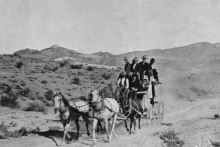
Our original interest in Butterfield's stage line was the start of a leg, either in St. Louis, MO or Mephis, TN. Then, there was the long trek of many days across the southern border. The travelers endured a lot; the photo is of the southern part of the route - dusty, hot, and dangerous. 

The Civil War interrupted the southern route as TX became part of the Confederacy. The nothern alternative was a little more treacherous in terms of terrain and weather: Winter won. Many took this northern route (Mark Twain) until the rails were in (Ralph W. Emerson). 

We will get back to Butterfield and his heritage and associations. For one thing, he's kin of John (and John Quincy) Adams. Another of his business interests is in operation: American Experss. The Times-Mirror Company, for a long while, was owned by a New England family. 

One continuing theme is the long reach of New England. 

Remarks: Modified: 12/23/2025

09/28/2023 -- Adams Express. Example of New England activity that covered the country. 250th themes apply. 

10/15/2023 -- Los Angeles Relics is a Facebook group with photos. This one is from 1888 and pre-auto. It's of First Street between Spring and Main. That's where the LA Times building is plus the City Hall is in the area. 

10/18/2023 -- More on the theme: Los Angeles, again; Bunker Hill, west. 

12/16/2023 -- Updated photo of LA: First between Spring and Main. In the photo, the Massachusetts Boot and Shoe House was the retail arm of the W. L. Douglas Shoe Company of Brockton, MA. William Lewis Douglas served a term as Governor of Massachusetts. 

12/23/2025 -- More on the Butterfield stage as representing the U.S. government's concern for handling Overland Mail. There has been lots of research about the trail from St. Louis MO to San Francisco CA. 


Friday, July 30, 2021

Travel and Leisure

TL;DR -- The T&L magazine has its 50th this year. Some articles on areas of the U.S. caught our attention. But, it was the visit to Yellowstone and the Tetons that was first seen. The author even mentioned the trappers and traders as well as the American Indians who were familiar with the area. 

--

This is an unusual post. Since travel has been restricted the past year, Travel &Leisure (T&L) had various articles from the past, for a while. Then, we had people writing of their trips to local sites that were close to where they lived. That was a nice touch. Everyone recognized that they had overlooked some great opportunities when opting to venture far away from home. We might look at some of those. 

What motivates this is the 50th anniversary edition that is just out. As well as looking at travel since 1971, they also offer some trips that had been thought about for a while but not done. There are two articles with an U.S theme. One was a loop by a French couple through the literary landscape of New England. Stops were made in Concord, Amherst, Lenox, Pittsfield in MA and Hartford in CT. Many names were mentioned, however the sites visited were connected to Alcott, Dickinson, Melville, Wharton, and Twain. We will look further into that later. 

As an aside, the 400, 300, 250, 200, 100 is on the horizon. SAR has a clock on their site. That's for the 250th part. The 400th still needs definition. According to the Gloucester MA folks, it's 2023, a mere two years. But, we say there are 10s of MA towns that will be celebrating for a few decades. Too, are presence will be persistent and consistently oriented toward the then and the now. T&L mentioned this. 

Which brings up the 2nd article. It was of the west. The author writes that in her 19th years, she and a friend boarded a bus in New York. After 40 hours they ended up in Billings MT after being glued to unfolding as they went west of the U.S. landscape. Their destination was Yellowstone. Of course, Gardiner, the gateway city on the northern end, was mentioned. The two were going to spend the summer working in the Yellowstone Hotel. In this return trip, she brought her son. Of course, they covered the area, including being in Jackson Hole WY. 

What got our attention was that the author really enjoyed her first experience which had a lingering effect. So, we got to see her reminiscing but also talking to experts about the changes. She mentioned the awe that the American Indian and the trapper/trader must have had on seeing Lake Yellowstone for the first time. We have been looking at rivers in that vicinity in our look at waterways associated with movement to the west. And, we appreciated that the author took time to report details that are important. Here is the article to read (thank you, T&L). 

Why I Took My Son on a Classic Adventure
Through Yellowstone and 
Grand Teton National Park

Let's look at a couple of lists that T&L put together for people in the U.S. who might want to do a car trip this year. Lots of people are buying travel trailers with that in mind. 

  • Best US Cross-country Road Trip - nothern route -- It starts in the west with Seattle WA. Then we see Idaho, Montana, Wyoming, and South Dakota. They only did nine so we're already five. Then, we have Minneapolis MN and Chicago IL. The final two are Pittsburg PA and NY NY. They mention the need to stop in Yellowstone. In the article mentioned above, there are notes about the early exploration plus the push to make the area a National Part. 
  • Best US Cross-country Road Trip - southern route -- Again, starting in the west we have LA CA, Sedona AZ, the Santa Fe NM, Amarillo TX, OKC OK, Hot Springs AR, and two in TN (Memphis and Nashville). Then, they go to NC and VA. They had to go out of the way to get to Sedona AZ but did put the Grand Canyon on the list.  
In terms of the western expansion, Santa Fe was there early in New Spain. The map of the routes west shows their following somewhat along the natural terrains (Western expansion) that allowed the early travel. 

Again, this is a landlubber post which we will balance with posts of nautical themes. 

Remarks: Modified: 04/07/2022

08/05/2021 -- Added the TL;DR. 

04/07/2022 -- Change Native Americans to American Indians. 


Wednesday, September 30, 2026

Butterfield, again

TL;DR -- The 250th even was, mostly, ink on paper. The turmoil was mostly after that day (though, we have the earlier times to remember, too). Later in the history of the country, technology brought ideas. Like, going from St. Louis to San Francisco (through the south, of course) and back. This post briefly looks at the segment that ran through the Choctaw Nation. This is our first of many coming posts on the eastern side of that long trek.  

--

One thing that we expect is that as time goes on from the 250th start, we will be seeing stories related to the history of the U.S. and its people and events that start to have a more personal touch. 

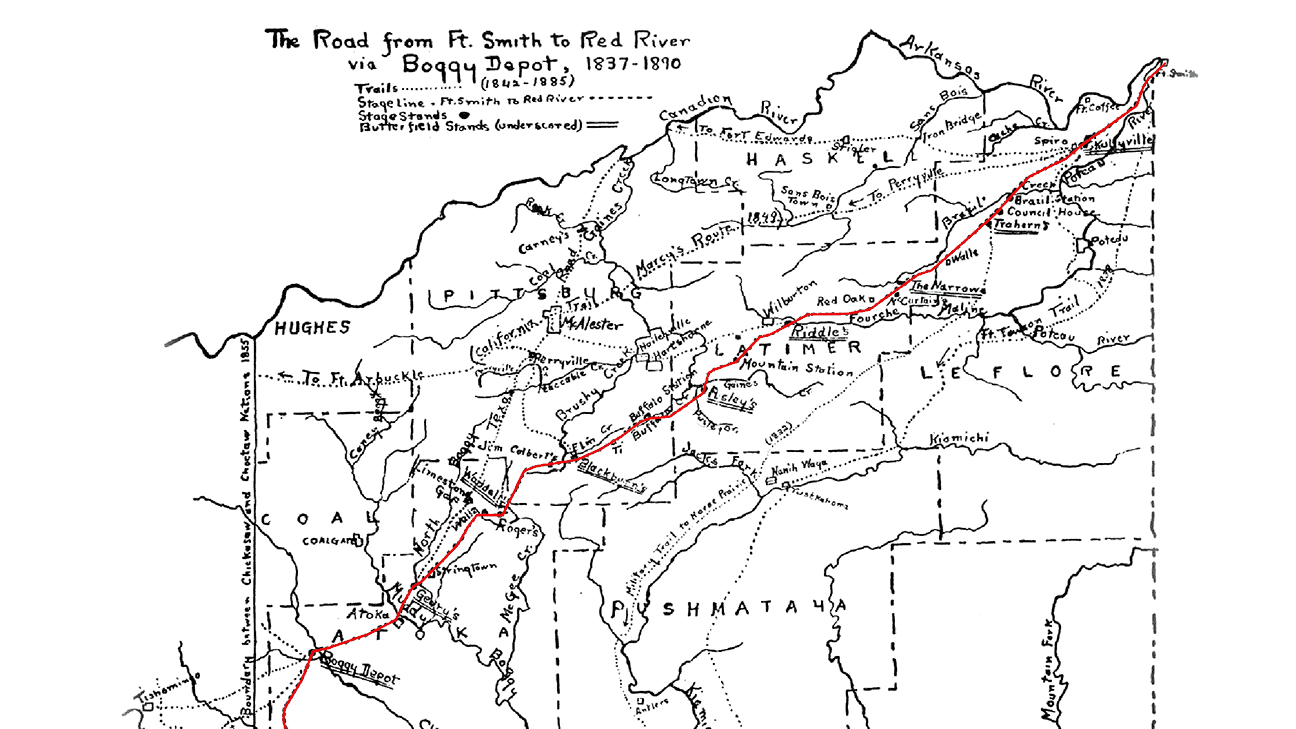
We have mentioned in several posts about the regular coach run from St. Louis, MO to San Francisco, CA. Today, we just saw a post on FB (Diamond Station) about the first run of the coach, westward. It left St. Louis on 16 Sept 1858. As we have mentioned, it went down to TX and across to El Paso and then across lower NM and AZ into CA. Sometimes, it ventured into Mexico. A major stop was LA at the bottom of Bunker Hill West. Then, the coach went on up to San Francisco. After a quick breather, they turned around to go back, carrying people, mail, and small freight. 

This map is of a recent post about the route through the Choctaw Nation. The route went from Ft. Smith, AR to the "Red River" in TX via "Boggy Depot".That segment was 192 miles of the total distance of 2,800 miles of arduous travel. Most of our posts have been of the western side and mostly from El Paso onward. It will be a great change to look at the eastern portion. 

Butterfield route,
from AR to TX

We will be looking more closely at this segment with respect to the logistics of the times. This post sponsored by the Choctaw Nation of Oklahoma provides a lots of important information. 

Remarks: Modified: 09/30/2026

09/30/2026 -- Butterfield was of an old New England heritage; the line by him and his associates joined up with a regular route out of Houston that went through El Paso and west which was, again, of new England (kin). Butterfield's company had a station in LA in the area where the Mirror Company established itself; the eventual Times-Mirror Company published the LA Times. Details? Similar to what we know of the Pony Express, there was regular change of horses/mules (and wagons - as needed). The people traveling had little comfort. In fact, Mark Twain went out by a similar route over the northern landscape that was set up after the Civil War started (and stopped the Butterfield route - 1861), but took a ship back to the east coast. Whereas, by the time that R W Emerson went out, the railroad's line to the west coast had been established. Just considering the realities of the travel ought to be fully described to compare those days against our own. 

Wednesday, June 2, 2021

St. Louis MO to San Francisco CA

TL;DR -- New England has a long arm as there were two centuries along the East side prior to any attempts at expanding west. For most situations, one can find newly arrived families as well as those of various older lineages. In particular, we will focus on individuals including their business activity. A case is Butterfield who was Yankee and quite active out west. In his life, we see the impact of the Civil War. Too, we see progress via technology, such as the telegraph and the train. Butterfield did other things, but he designed a system to transport people, mail, and goods overland from St. Louis to San Francisco sweeping down through the southern regions. This was a regular activity for more than two years and deserves attention, for many reasons. 

--

The 250th of the American Revolution gives us a chance to relook at history. One thing to note is that the rebellion was the onus of the 5th Generation. Post the conflict, the 6th and the 7th were involved with the fulfillment of Manifest Destiny. Of course, we will look at that, too. But, in this context, we are looking at particular periods leading up to the 20th century whereby the U.S. slowly got its bearings. As we follow the populace, we will note the state of technology and more.  

Earlier, we mentioned the Butterfield Overland Express which went from St. Louis, MO to San Francisco, CA by swinging down south into Texas, ran across the bottom of NM and AZ (Tucson), went along the southern border to Los Angeles, and then up to San Francisco. We can do that trip easily now, all by Interstate Highways. The image shows the modern look with about 40 hours estimated for the trip. That means that drivers switching off would make the trip in two days (see map, courtesy of Google maps). 

As an aside, flying now from STL to SFO is a little over four  hours. Also, there are faster modes by air.

Even though part of the Butterfield route ran from 1849 until 1882 when the railroad offered a better means, the Civil War interrupted the pattern in 1861. This was a regular run by a system that employed people and animals and required equipment. The organizational work must have been mind-boggling with little communication means beyond telegraph. The Schedule for Sept 16, 1858 (available on-line) laid out the route, the time, and discusses some of the particulars (see following image) about the company and its mission. 

Butterfield: Miles, Hours
(from SF to StL)

On digging deeper, we found that John Warren Butterfield (WikiTree profile of John) was the owner. Too, he came from New England stock which raises our interest. The part of this route that ran from West Texas to Southern California had been established by another New Englander, George F. Giddings, of the Ipswich, MA family. 

On looking further at John, we found that he was involved with the start of American Express, too, with two other New Englanders, Henry Wells (WikiTree profile of Henry) and William George Fargo (WikiTree profile of  William). Yes, Wells and Fargo established Wells Fargo (their motif was a stagecoach with horses) in San Francisco during this period. 

As the country expanded, the need for business communication increased all around. Too, the U.S. Postmaster General had the responsibilities for mails and used companies. AmEx started in Buffalo, NY in 1850 but established itself in Manhattan, NY before too long. It's focus became financial express. 

As people spread west, there was a corresponding need for personal, as well as business, mail. And, delivery was a growing business. Another business model involved moving people with coaches. Hence, the need for the overland express. Of those available at the time, the Postmaster General decided that Butterfield's express was the most capable. 

At the time, there was a more northern route (Central Overland California and Pikes Peak Express Company) which included the Pony Express. This was the means that Mark Twain used to go west and that he wrote of later. We will look further for comparative views on this subject from those who were there. The southern route, though longer, was preferred due to less hassle related to snow issues. However, in the summer, there was the opposite as part of the route was labeled El Camino del Diablo.

The Civil War interfered with the business success of these express companies. Some of the routing was moved up north while the southern route was abandoned. Fortunately, the rail system became a little transcontinental in 1869 thereby offering an improved method for this type of express from Kansas City to San Francisco and all points between That is, there was one line running across the country. Leland Stanford led these choices. It took another couple of decades to get more rail installed. These three maps indicate the rail lines in red. The west is without rail in the 1860s. Then, we see the one line of the 1870s. Finally, see 1890s which still has lots of open space in the west. 

So, things were booming prior to the Civil War as the new nation got its legs. Then, the war was a huge disrupter across the board. It took another generation or two to recover. That, too, is part of the U.S. story. 

We think that the western stories need to be brought to attention. For the 300th, the ceremonies were mainly east coast. However, it was not long after WWI. In 1890, the largest concentration of red is in IL showing the prominence of Chicago and its access to the Lakes. The slight red around the lower Mississippi is due, in part, to the river being so useful for transportation. Notice eastern Texas as opposed to its western counterpart. Again, that is due to the flow related to the shipping industry of the Gulf. 

Reminder, we looked the Unfoldment. Notice the change of the population pattern through time. 

Remarks: Modified: 08/23/2026

06/19/2021 -- Very old St. Louis in the State of Missouri. 

10/06/2022 -- Have used this post in many posts, newsletters and comment. Updated the error for the URL for the post on the Gidding's route: West Texas to Southern California

12/23/2025 -- More on the Butterfield stage as representing the U.S. government's concern for handling Overland Mail. There has been lots of research about the trail from St. Louis MO to San Francisco CA. 

08/23/2026 -- Image of schedule disappeared from Wikipedia. Swapped in a snap of the divisions of the route which covered almost 3,000 miles and took almost 600 hours. 


Sunday, December 11, 2022

19th Century details

TL;DR -- Earlier we took a look at transcontinental travel in the early 19th century and its ardors. There was nothing easy about the ordeals, but people took up the gauntlet. Here we look at one site where travelers made their presence known and link to a map that has local details of interest. 

--

We have had several posts on trails. Recently, we looked at a well-known trail (to Santa Fe) as it was the terminus of another trail in New Spain which provided other trails such as that which provided a route used by the Butterfield Overland Mail Company in carrying mail, freight, and passengers from the east coast, through St. Louis and to San Francisco. This was pre-Civil War and was interrupted. Further north, the Pony Express went from St. Joseph, MO to California carrying mail. Butterfield established a new route up north using coaches. Mark Twain wrote of his journey on this route. 

There was another Butterfield in that area who was not related and who had a  Butterfield Overland Dispatch (using a post at the Legends of America site) through Kansas. Both of these Butterfield gents had investors back east. The amount of stations, equipment, horses and people required to have regular routes was tremendous. As we know, the rails of steel were going to play havoc with these routes. But, that was enough later for history to be made. 

As a reminder, at the same time, there was regular traffic from New England which moved south by sail to the area of Panama which involved going across land from ship to ship and then sailing back north. Of course, one could go around South America. We looked at this briefly when writing of the Bostonian (barque) that wrecked along the Oregon coast in 1850. The barque left Boston in July and arrived at San Francisco the following January. It was later seen in New Zealand and, evidently, carried goods to San Francisco before venturing north to its fate. Gardiner, OR resulted from that incident. The overland trails had as many dangers; but, even without those happenstances, the travel was arduous. 

Besides looking further at the specifics of these overland efforts where we find the two Butterfields, we want to bring in more detail as is required for doing history of the events better and for considering the people involved in a more respectful light. Also, the area in the center of the U.S. was very busy. For comparison, we looked at a railroad town and its specifics from the early 1900s (see KATY - western railroad). 

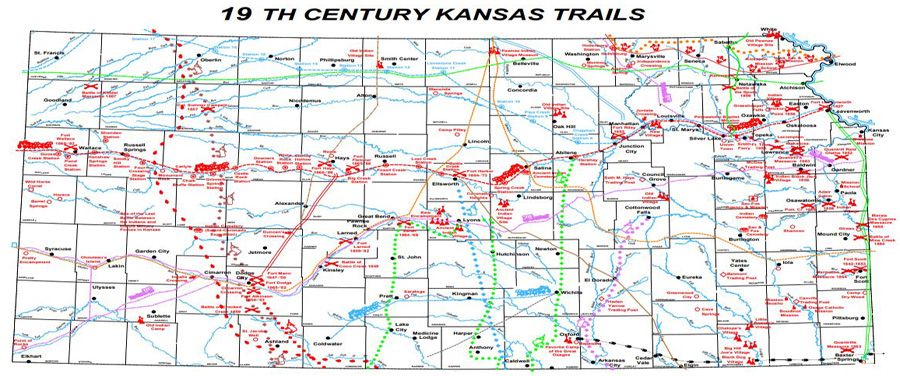
Let's start with a map that comes from KDOT (see 19th Century Kansas Trails). Notice that the Santa Fe and Oregon Trails come into the area in the northeast corner. The Oregon Trail splits off and heads northwest. Another trail in that area is the Butterfield Overland Dispatch which terminated in Denver, CO. The other Butterfield route would have been north of this area. 

Click for detailed 
map from KDOT

The map includes other trails of interest including those used by indigents and that related to the cattle trade where heads were brought as herds to a rail terminus for loading. As one looks at images, the wild west was in this area (see Dodge City). "Hell on the plains" might apply to our few decades of the web. 

Looking at some of the details, there was a military road (double green) that went from Ft. Leavenworth to Ft. Scott and further south. This was there early. We mentioned a Mission in the southeast corner (see Memorial Day 2022). Nathaniel Boone (son of Daniel) was in the area. Col. T.W. Higginson was in Lawrence and Topeka. Lawrence was founded as part of the abolitionists' interest in keeping Kansas free. Take a close look and note a trail (blue dashes) from Leavenworth which was originally for supplying Army posts as they expanded westward but ended up with a California connection. 

In a recent post, we looked at how Ipswich MA got Ohio going. That was not long after the Revolution and was similar many ways with what happened later out west. In fact, we included a graphic (map) showing both areas. So, we could look at this type of detail across the whole of the region. 

One of our interests is the long reach of New England. Both Butterfields were from New England (their relationship, if any, needs to be researched). For the most part, we will be taking time to link with both genealogical and historical information (see Lorenzo and Peggy). As well, we have a technology interest and want to include specifics of the reality of the earlier times. After all, everyone here had forebears who were alive then. The particulars of the American west are such that we can see the transitions clearly over the frontier century's span. We mentioned it before, but this map brings up the fact: going from the northeast (Kansas City) to Ft. Larned (south central, look for Great Bend) took three weeks of daily work on the Santa Fe Trail. 

One more detail, Jedediah Strong Smith was last seen in the area of Point of Rocks (lower left - southwest). He was killed by an indigent part. 

Remarks: Modified: 12/12/2022

12/11/2022 -- 


Friday, June 23, 2023

Winter won

TL;DR -- As we track New England folks across the country and back, we note that information becomes available continually. The Woodbury folks pointed to the Wyoming History Society and their article on the Pony Express in which we have an interest for many reasons. This new source has interesting graphics of which we provide two. One is of the Butterfield (southwestern) route. The other has details about the route through Wyoming as research for the 1960 look back. 

--

As we follow New England's influence away from the east coast, we have to consider that left coast which was also accessible by sea and the huge middle. A recent post looked at the excursion of Hernando de Soto through the southeast all the way to Boone's Missouri. Then, we had periods of time from Lewis & Clark's jaunt onward with trappers and fur traders leading the way. 

A major theme for our posts which were done after some research has always been rivers. Then, we had looks at people, including other cultures such as New Spain. When New England was the origin, we tracked down their information, if available, on WikiTree and Wikipedia. And, destinations were important whether Oregon or Texas or any other of the current States. 

We also looked at the work of other researchers. Recently, we became aware of Woodbury Historical Tours. These are cousins via the Cape Ann venture. But, there have been lots of other researchers that we paid attention to, such as those with the Jedediah Strong Smith's society. 

On Facebook today, the Woodbury's pointed to the work of the Wyoming Historic Society. Anyone going west in the northern U.S. went through that region. One reason was that the mountains of Colorado were too difficult. So those headed to Oregon or California went up out through Wyoming and then split. We have had many posts on the various trails. 

Butterfield route 
through the Southwest
What was interesting about the article on The Pony Express in Wyoming is its focus on accuracy. They mention, of course, Buffalo Bill Cody but just cursorily. What caught our attention was the acknowledgement that "winter won" with respect to the effort to establish the Pony Express (which we wrote of last year) as a northern mail route. 

At the time, the Butterfield southern route was in operation (see  map). In our post, we tracked down the principals, one of whom was of the Giddings family of Ipswich, MA (Ann's kin). Too, we noted some of the other players who ended up founding banks and other businesses. 
 
As we saw earlier, the Butterfield route stopped when the Civil War brought too much uncertainty. So, the effort was taken back to the northern route which Samuel Clemens (Mark Twain) took out west in the days of the stagecoach. Ralph Waldo Emerson went out via train a little later. 

We will get more into detail, but the Pony Express did run in the winter. It took longer. The southern route was longer and arduous as it carried freight, to boot. We need to know of these enterprising people, many of whom were of New England stock. 

Let's just leave it with this map of the 1960 rerun. Plus, we will mention one of the founders: William Russell (Wikipedia, WikiTree) born in VT in 1812, moved as a kid to MO.  

Pony Express
Route through Wyoming

Remarks: Modified: 06/23/2023

06/23/2023 -- Reminder: research continues. Example open research topic.


Tuesday, December 19, 2023

New Frontier, 21st Century type

TL;DR -- Technology is one of our themes. History and genealogy are a couple of others. General interests in the 400ths and the 250ths are others. Like, Gloucester MA did its 400th this year. There will be others over the next few decades. And, the Boston mayhem on a ship is now 250th.  

--

We were toying with various avenues of research which are endless in the modern age of the "cloud" despite its shortcomings which are many. For instance, in the western movement, we have looked in the vast interior and along the coasts. CA was a theme last year: LA and SF. We have looked at the middle of the country several times, in terms of the frontier and its settlement. In every case, we try to tie back to New England. As well, we are building a timeline by people and events that emphasizes individuals who are not in historical accounts and their families. That type of work will continue. 

So, today, let's take Minnesota (MN) and Kansas (KS). Both are west of the Mississippi River. MN is north of St. Louis which is, for us, the focal point of the dividing of the land. KS is about the same level. The northern realm has a different dynamic which we have started to study, through the Michigan Territory. KS was on the way west. For instance, the trails run through the State. Lewis & Clark (1804) came up the Missouri River on their way west. 

Cottage,
Round house,
Frontier in the making 
But, we are looking much later, after the Civil War. The image shows three things: a cottage in MN; a round house in KS; news of a new frontier. 

In MN, the town of White Bear Lake is named after its lake. We have run into MN several times in our research and skirted around details. But, for today, let's look at a famous cottage (ca 1868). It was built for Charles Phelps Noyes. His wife was Emily Hoffman Gilman. They're kin of lots of New England families that we are studying. That is the right time frame for some reflection on the Revolution (which was the 5th generation's deal) and on current themes. One thing to note is that Mark Twain liked the area so it got some press. 

Aside: recent post on Little Exeter NH (where two esteems of technology - and AI - went to school. The Society of Cincinnati has a house of repute in the area. 

In KS (and elsewhere), as technology, which is our focus, improved, the railroad replaced earlier modes of transportation. Several lines ran through KS from both directions. But, the photo is in the extreme southeast corner, in the little town of Cherokee. There were strip mines for coal in the area. What did these old iron horses run on? The photo is of a round house (ca 1888) which served several purposed. For one thing, one had to change from north to south, etc. Go to San Francisco and see these in action as the rail cars get switched to return. So, we'll have lots more about that area of the country that became the flyover country, later. We have shown, and will continue to do so, that the history of the country runs through the middle. 

Now history and genealogy? We are talking about an organization whose membership included John Quincy Adams. We had an earlier post about his cousin, Grizzly Adams, and a few others. They are offering a webinar on Using AI in  Family History Research. 

What they meant to say is that they are going to show technology that can be put to use. We are going to use AIn't to keep the discussion going that this state of affairs does not offer sentience nor intelligence in the important sense. It is very easy for the imagination to run wild with respect to these things; that is a human trait that we can value. 

But, as the NEHGS (their real initial) adds, in this: 

She will also address aspects of AI that genealogists should be cautious of, such as accuracy and copyright concerns. Join us as we explore this exciting new technological frontier!  

Okay, we'll take that. But, let's go further. The tricks are being done in a manner that we can understand as it's applied mathematics. People have been lazy and have let things get too loose. We will not use "fuzzy" as that is a legitimate logic and algebra. We will touch on that more. 

In the meantime, our thrust over the past decade is to fill in the 400 years of all sides (New Spain, New France, New Sweden, ..., Native Americans, ..., New England). Plus, the 250th of the U.S. is coming up. What happened recently? The 250 of the Boston Tea Party. Nope, it wasn't with china and crumpets. 

No, we're talking illegalities. Dumping someone else's product in the water. BTW, Samuel Adams, cousin of John whose son is mentioned above, was a participant. You know, later, we had John Brown. Guess where he was? KS. Also, who were his supporters? New England. So, we have a post on that as the Secret Six had to hide out when the Uncle Sam found out that the rebel was being kept by a few brave souls, one might say. 

So, yes, we will do history. But, too, we will continue our support for discussing and using STEM plus. What is the plus? Kant, for one. If you don't know him, you'll hear from us. Stay tuned. 

Aside, again, some think that the revolution was done by rabble rousers. Well, not. If we look, the King trained the men who took him on via their support of his French Indian affair. That was the 4th generation who supplied the leadership for the most part. But, the 5th bore the brunt. 

Remarks: Modified: 12/20/2023

12/20/2023 -- Ramsey County History - Fall 1997 - The Women's Institute and How It revived Downtown St. Paul - 'A Beautiful, High-Minded Woman' Emily Gilman Noyes and Woman Suffrage. She was a daughter of Charles P. and Emily H. Noyes. 

Saturday, September 18, 2021

COVID

TL:DR -- We have had an atypical year and one-half since the disease made its appearance. We were close to ground zero in the U.S. which brings up thoughts about 100 years ago and the Spanish Flu. Now, we have world-wide communication, at the blink of an eye. Yet, that power is not yet tamed. We don't know if it can be. Our work can contribute to stability, though. 

--

We just realized that we have not mentioned the plague that has been on everyone's mind for the past eighteen months. There were rumblings of a flu-like illness going around that started early in 2020. Later, we heard that the early warnings were in late 2019. In December of 2019, we were looking at our ten years of work and anticipating, as everyone else, the start of the Mayflower remembrances. The month before that, we had started a look at the children of Thomas and Margaret using some of the posts that we had done with them as the theme. Later, we did this again using a collection of descendants that had been first published on Wikipedia. There is a post per child with a list that can grow. Too, we were looking at the preparatory work being done by others (Salem's Start) and had figured out the issues related to Thomas' remains. 

We had looked further into Dr. Franks' books and into his and Lucie's (his sister's) relationship with Sidney Perley. We had gone through the eleven years of Dr. Frank's "The Massachusetts Magazine" and had published the Table of Contents for all of the issues. It had been in 2018 when we mused about the last issue of the TMM and mentioned the Spanish Flu's wide-spread influence on the U.S. We also were supporting research efforts at WikiTree. 

In short, we recognized all of the threads that were related to the necessary work and were doing an assessment of what had been done and to plan for future work. 

Then, there was the lockdown. COVID was here. Like with the Spanish Flu, Kansas had some of the early deaths from people in retirement communities being visited by some who had traveled with the few weeks before. Back in 1918, it had been in an Army post where troops were returning from overseas. This outbreak had been in the spring and long before the huge impact in Boston. So, thoughts of the prior century's ordeal was on everyone's mind. 

One problem was finding out good information. What was the reaction was that several news organizations allowed free access to their blogging about COVID. Also, in some venues, technical people were weighing in with facts and educated opinion. 

Tracking, Johns Hopkins

Too, a side-effect was that workers used internet access to work starting off a new paradigm that is still being managed for continuation. People could only go out for certain purposes, such as getting food. Food delivery became a norm. Lots of other patterns emerged. After that first lockdown, people were let out with restrictions. These were gradually relaxed but then tightened as new waves came about. We saw several of these. 

Finally, early this year, the vaccines became available. That release was done step-wise but was mostly available to all in the summer. We're only September. Most who wanted to be vaccinated in the U.S. have been. There were issues related to economic status and other factors that has delayed access to the vaccine in various parts of the world. 

Today, we were out in an open area. There were some masks which became the norm in the spring of 2020. And were dropped and picked back up. Right now, it's by choice of the person or the establishment where they might be. One sees large gatherings. Some are traveling. Some have traveled  due to necessity all of this time with some restrictions. That is, this is not normal travel. 

But, a corner seems to have been turned. Weymouth is up for its recognition in 2022. 2023 will see Gloucester doing its thing. Salem is not until 2026. But, there are many of these events that will take decades to go through. And, adding in New Hampshire will give us more to look at. 

Oh yes, the surrounding areas? Sure. That will be an update in the near future. Example: Two houses. 

In the last eighteen months, we followed up on the early western experience related to the trappers and mountain men (Jedediah Strong Smith). Also, we found out the significance of a recent movie (The Revenant) with respect to this theme, New England and family. Then, we broadened an earlier scope of migrating from the north by following southern routes through the Cumberland Gap. And, then, there was the attempts at settling at various sites (States) along the way to the west coast. 

For instance, Missouri became a State in 1821, two hundred years ago. St. Louis was a prime factor in the western expansion. The government's effort at surveying is an important topic as we watch the land being carved up. Even the area east of the Mississippi was not settled until after Louis and Clark's venture. As we look at the history, we will deal with families from New France and New Spain. Of that latter, the whole of the southwest from Texas to California will be on the scope. 

Technology? It played then as it does now. We looked at the various modes of travel. Before the railroad got its act together which involve lots of hard work as well as the maneuverings of people like Stanford (yes, of the University). But, people went west and back by various means. Samuel Clemens, himself before Mark Twain came aboard, went to California by stage across the northern route. Didn't like it. But, people made the trip on a regular basis, such as those who led folks to Santa Fe or Oregon through Gardner Junction, we might add. 

In our studies, we see that the Revolution (SAR/DAR) was the onus of the fifth generation. The fourth provided guidance through their experiences in the French and Indian conflicts. These, btw, had corresponding events back across the waters. So, we need to consider that whole area. It was the seventh and eighth generations who started to harvest the fruit of the U.S. Lots to discuss there. 

Remarks: Modified: 09/25/2021

09/25/2021 -- Added the TL;DR. Also, we can, and need to, research more on Oregon.