Showing posts sorted by relevance for query donner. Sort by date Show all posts

Sunday, April 30, 2023

R Waldo Emerson, out west

TL;DR -- In 1871, R Waldo Emerson went out, leisurely, on the train from coast to coast as the labor of many finally got the rails in place. Out there, the party looked around for a while but did not really report as we saw with some of the other earlier travelers. Except, Waldo mentioned that he would have moved out if younger to get his land from the government. So, a recent book is of interest to this theme which we will look at further. Mark Twain went by coach, a decade earlier. 

--

This post is about Ralph Waldo Emerson (Wikipedia, WikiTtree) and his travel west once the railroad was in place all the way from his Boston surrounds to San Francisco. First, here is a long post on his house (The Home of Ralph Waldo Emerson). 

We have looked at the travels of others both before and after the railroad was in place. This trip was a good time as it was post the Civil War. And, there was a recent book that reported on research which exemplifies what needs to be done: The California Days of Ralph Waldo Emerson by Brian Wilson. There have been many reviews, but these two are especially pertinent. 

  • Zeringue Marshal - mentions that Emerson's group tried their hand at the wagon passage through the mountains and other things to note. Also, in his wandering arounds, why would he not love the place? He wrote to his wife that if they were younger they might have gone out and took up the government's offer of land. 
  • Donner Summit Historical Society - the reviewer notes several things missing which we agree with. Note, we have mentioned Donner Pass several times, including mentioning John's first pass through it in 1962. Of note, though, is the Woodbury Historic Tours being mentioned in a post. 

We'll be looking at this trip further. But, let's close with a well-known person's take on Emerson, courtesy of the Sierra Club: John Muir's opinion. 

But, we have to mention Mark Twain's journey, earlier: Riding the Overland stage, our posts on the subject. 

Remarks: Modified: 04/30/2023

04/30/2023 -- 

Wednesday, April 19, 2023

San Francisco

TL;DR -- San Francisco stands as an icon in the American psyche for several reasons. There was sufficient traffic from the east to the area to warrant regular routes which started as mere trails. The railroads closed up the gap as they offered the speedy delivery not attainable by the sea routes. Whereas, in 1859, Horace Greeley's route to the city was by stage coach after Kansas City, MO. But, in 1906, San Francisco had a quake. We will have that as a regular theme (reach of New England). 

---

San Francisco has been mentioned many times in our posts, as it is a well-known destination by land and by water on the west coast of the U.S. And, it is old. Somewhat. Yesterday, we mentioned Horace Greeley's one-way trip out in 1859. He returned by sea. And, he sent dispatches back to his publishing company that were collected into a book which is currently available on-line. 

In our post, we mentioned Gen. A.W. Greeley who is a cousin of Horace's. Too, we brought up the link twixt two Thomas Gardner descendants with the Artic rescue of Greeley by team that included Capt. George William Coffin, a graduate of the Naval Academy. Turns out that the General is also a Coffin cousin of the Captain through his grandfather, Stephen Greeley (aft 1769-1830) of Essex County who was a descendant of Tristram Coffin, Sr. of Nantucket. There are many other New England families in the pedigree of the General. 

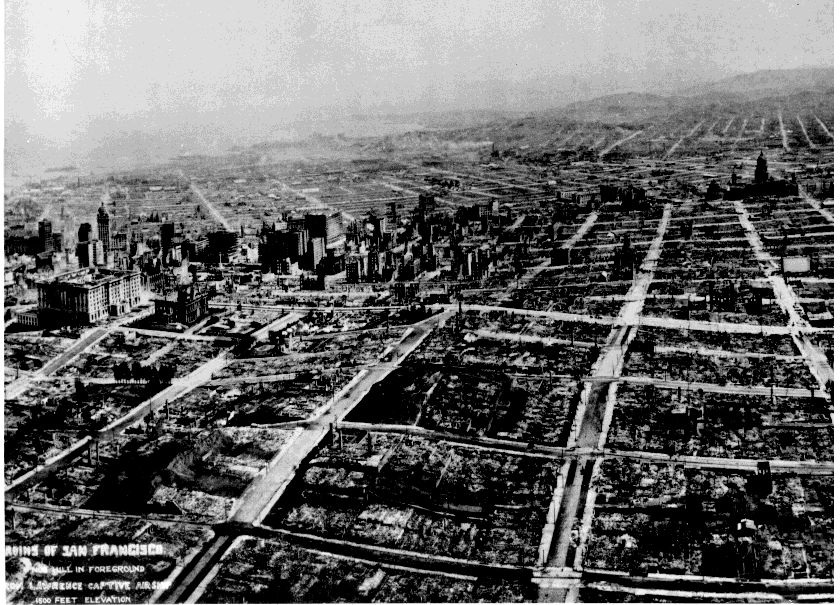
The General features briefly in this post's look at San Francisco (SF). On April 18, 1906, there was a devastating earthquake in the city that destroyed a large percentage and resulted in several thousand deaths. The U.S. Army was local and available to assist in relief efforts. 

This photo was of several taken from kites looking over Knob Hill. 

From USGS, photo
of San Francisco after the
1906 quake

There are many sites with photos and reports which we will look at from time to time. This photo tells many tales of the destruction near the area of Post and Grant which is near to Union Square. 

1906 damage near
Post and Grant

We will put that on our calendar to remember. Earlier, we learned more about the Salem, MA fire of 1914. The old city of SF was mainly of wooden structures that were leveled. But, brick building burned, as well. Fortunately, the Presidio of San Francisco was not damaged and was able to support the population. Gen. A.W. Greeley was involved in the relief effort and reported that they were feeding 250,000 per day. A tent city was put up at the Presidio and another area close to Golden Gate Park. 

On a personal note, John remembers descending by car in April of 1962 from a dreary ride across frozen northern U.S. and through Donner's Pass which was a tunnel of snow into the green valleys of interior CA and then onto the Presidio. That would have been the new city which cropped up as people recovered from the quake. 

With respect to the Presidio, we had an earlier post on Jonathan Letterman, MD who was there later in his career. We mentioned the Dr. in relation to his work with battlefield medicine. The effort to clean up after the battles of Antietam and Gettysburg included handling the injured from both sides of the conflict. The Army Hospital in the Presidio was named after Dr. Letterman. 

There are many stories about New England's reach to San Francisco that we will look at in the future. But, the early years before and after the Gold Rush will continue to be a topic, as well. 1906 is a good demarcation point for splitting the old and the new. 

Remarks: Modified: 05/14/2023

04/29/2023 -- The Fairmont Hotel is visible in the first picture. It has an interesting history, being constructed at the time of the quake. It passed the test. They fixed it up and finished the work. ... We, of course, will pay more attention to the history of the Golden State. 

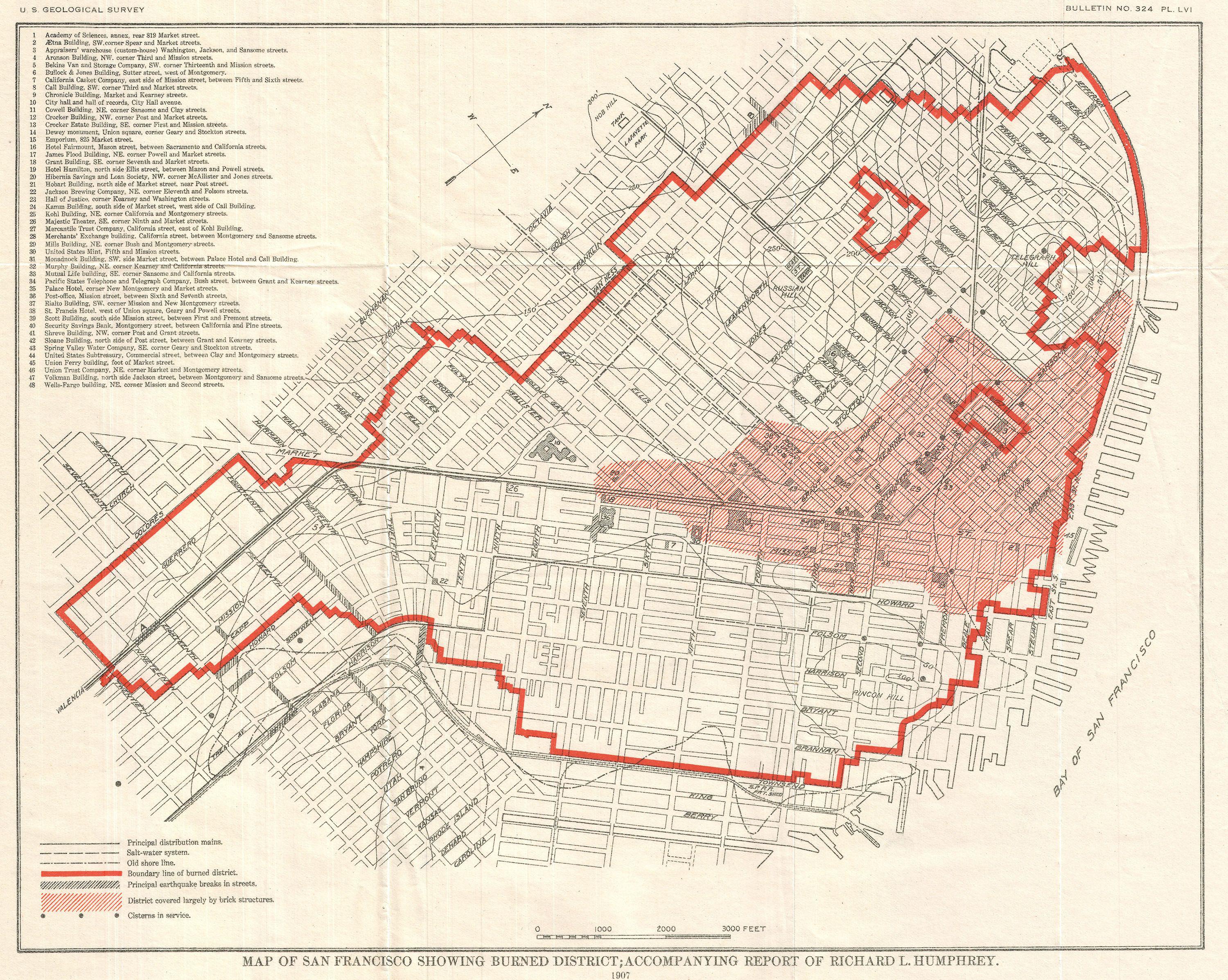
04/30/2023 -- The Geological Survey has a nice map with a legend of the extent of the fire. The legend shows the area of the Fairmont Hotel and the Flood Mansion, both of which still exist.  

05/14/2023 -- Added link to the fire area outline. 


Tuesday, January 18, 2011

Two cousins

The descendants list for Thomas and Margaret holds a lot of potential stories, from the early times onward. As mentioned before, we want to look at some of these before coming forward with Dr Frank A.'s tree (RD, et al). In some cases, we have separate lines merging back together.

So, we can talk about the meeting of two cousin lines. The first of the cousins, General Adolphus Greely (ancestors) is from John and Sarah (Gardner) Balch through their son, Freeborn. After serving in the Army in the Civil War, he became an explorer. He led, as a First Lieutenant, the Lady Franklin Bay Expedition (1881-1884) that found itself stranded because of the inability of supply ships to reach their location. There were follow-up attempts, but his wife succeeded in her efforts to keep the interest up. What was left of the team was rescued by Admiral Schley.

3 -- Coffin, 22 -- Greely
July 1884, USS Thetis
Now, the second of the cousins commanded one of the rescue vessels. He was Captain George William Coffin (ancestors). He is a descendant of Richard and Sarah (Shattuck) Gardner through their son, John. George was a US Naval Academy graduate and spent much of his career at sea. For the rescue, George captained the HMS Alert which had been lent to the US by Britain for the specific purpose of the relief mission.

Needless to say, the Schley attempt was successful, as one descendant, of Thomas and Margaret, came to the aid of the other in an event that was five generations removed from the early times.

Remarks:

04/18/2023 -- While researching Donner Pass and the California Trail, we ran into Horace Greeley's writeup of his trip west in 1859. ... He shares an ancestor with Adolphus. Also, here is the Naval Career for Capt. George William Coffin. 

06/03/2021 -- Sir Franklin had been in the area in the 1840s while looking for the Northwest Passage. He and his crew disappeared. In the 1850s, a rescue attempt was made that included the ship, H.M.S. Resolute which got stuck. It was abandoned and discovered later by a whaling crew. And, the Resolute was returned to England. Queen Victoria had its timber used for ceremonial furniture. A desk in the White House was one of the pieces.  

02/18/2018 -- Written seven years ago, when I was still a newbie. Such as, I didn't know the different towns of Essex County. I had to wonder what North Shore meant. In the western part off the U.S., towns are far apart. What is it like to live cheek to jowl with your neighbors? 

10/31/2014 -- AnceSTORY archives (02/18/2018, this blog is no longer around).

07/06/2013 -- While researching for Gardner's Beacon, Vol. III, No. 2, I ran across this photograph (Wikipedia) that has both of the cousins in close proximity on the USS Thetis. The team lost several men (there is another photo of the team in 1881), but there were some accomplishments. For instance, a new farthest north was attained by two of the members: 83°24′N 40°46′W.

05/21/2011 -- Sarah (Gardner) Balch.

Modified: 04/18/2023

Tuesday, April 18, 2023

Go West, wrote Horace

TL;DR -- Supposedly, the phrase associated with "Go west" is attributed to Horace Greeley. While researching, we found that Horace had gone west, prior to the Civil War. He did it cross country and wrote of the journey in detail. This information pertains to our current time and issues; as such, it is worthy of our attention. 

--

In an earlier post, we looked at two cousins, one of which was Adolphus Greeley and the other was USN Captain George William Coffin. They met in the Artic as the latter rescued the former who had been stranded with the crew of his Lady Franklin Bay Expedition. 

A generation earlier, we have another name, Horace Greeley who shares ancestors with Adolphus. Too, Horace journeyed west prior to the Civil War. We ran into his correspondence while researching the historic weather of Donner Pass with respect to the California Trail as this topic is part of our interest in the western expansion and the related trails that crossed the vast interior of the country.  

As an aside, this winter's total snowfall will set a new record. 

Before getting into the gist, we provide profiles for Horace (WikiTree, Wikipedia) and Adolphus (WikiTree, Wikipedia) Greeley. Also, we provide more information on George William Coffin who was a graduate of the U.S. Naval Academy and served in the U.S. Navy. 

---

Along with information about trails and passes, we ran into an on-line copy of Horace's book on his trip: An Overland Journey from New York to San Francisco (1860). His journey started in New York by rail and boat until he reached St. Joseph, MO. Until others who headed off west on the trails, Horace went down to Kansas for a Republican Convention at Osawatomie, KS. He mentions going through Lawrence which whose settlement was supported by The New England Emigrant Aid Company. The Convention was on the 18th of May in 1859 (Miami County). This chapter of the book was submitted from Atchison, KS on May 15th. 

His book has thirty-four Chapters of which more than ten are on Kansas, the Plains, the Desert, and gold. These will be of interest as we pursue the history of the U.S. and its interior. He heads west out of Denver by jaunting up to Fort Laramie (Chapter 16) and then west to Utah. Several Chapters deal with Salt Lake City and the area. And, he provides several views of California (Chapters 27 to 33). His final Chapter looks at traffic into and out of San Francisco and discusses the need for a railroad. 

In our post, St. Louis MO to San Francisco CA, we describe the route from St. Louis down into Texas and across the southern border to Los Angeles, CA and then up the coast to San Francisco. The 1860 portion (top) of this graphic shows the transportation status when Horace went west. 

Horace Greeley returned by boat. For this book, his last Chapter was posted on the 9th of September of 1859. 

----

Of note, this was no virtual trip. We have to match this effort up with that of the comedic guy (Samuel Clemens), later. As said, we had several posts on this theme (starting with the mountain men). 

----

This story has several points of interest related to our work. This applies even to our current interest in technology and its historical impact, especially as activities of our times may portend to the future. 

Remarks: Modified: 06/14/2023

06/16/2023 -- Added "Horace" to the title. He went himself.  

Wednesday, November 16, 2022

Rails of steel

TL;DR -- In the territory of the U.S., whether the colonial times or after, people have trekked along trails leaving tracks. Technology brought us several ways to make tracks more permanent, namely the railroad and the road are examples. The rails? In the1880s (later part), there was rail from coast to coast (let's say, one thread of such though there was already a network of such) that supported passable traffic, to a degree. Mountains and rivers continued to be an inhibitor of traffic. Accomplishments related to these facilities took lots of blood, sweat and tears. And, remembrance of that is important; first, though, we need acknowledgement of the deeds. That suggests knowing details beyond mere generalization. 

---

We just had a post (Trails and tracks) on the trail of notoriety that crossed the middle U.S. and ended up at a terminus of another trail that came out of Mexico (New Spain) and was much longer. The New Spain route was part of the Camino Real system. We will look further at that topic. 

With respect to other types of tracks, the railroad (see Recap, again) comes to mind as it spread over the landscape. We have a graphic which show the growth by marking the post offices as they moved with the rails. See Pace of change. These two, the railroad and the post office, are types of technology that were (are and will be) of importance. 

Today, Woodbury Historical Tours shared a link to a monument on Donner Summit  The site is dedicated to the Chinese workers who came over to help build the railroad and were the largest group of laborers. Near the monument is the "China Wall" which is a retaining wall built by hand. There were two walls. Additionally, tunnels were dug out by hand.  

Of course the Pass was infamous earlier in the century. However, it still is fierce in the winter and creates havoc for traffic of all sorts. An interstate through that area experiences frequent closings. By April, snow banks are piled high on the side of the road. 

As mentioned, the Chinese workers were by far the largest group. Comparatively, several other groups stand out, such as the Irish. There is a monument to this group in the next state: Irish Railroad Workers. 

We might take a relook at the industry since John is from a railroad family. There are plenty of other jobs related to this accomplishment which is usually associated with names like Stanford in the West and Cornelius Vanderbilt in the East, of the U.S. 

We might use the Katy Railroad as an example as it has already come up in reference to the long reach of New England. Too, population centers shifted as the railroad made decisions about routes. Today, one finds long paths in many places where rails were lifted so that walkers and bikers can traverse the resulting trail. U.S. and railroads go way back. 

Earlier, we had a post about the Woodbury Historical Tours as we ran into their posts while browsing different subject. That was a nice thing to find. On the other hand, Woodbury was a Cape Ann family. We have not explored that aspect as of yet.  See Tours, of the real. One motivation for that post was something they wrote mentioning the Bents who we looked at earlier. And, their approach appealed for several reasons. A main one? In this day and age, we need to 'ground' lots of information and rhetoric by specific effort due to the influence that technology can have on our grasp of what is. 

That's another discussion best left for another day. 

Remarks: Modified: 11/16/2022

11/16/2022 -- 

Saturday, September 25, 2021

Oregon or bust

TL:DR -- We looked at a wreck in Oregon in 1850 of a ship owned by a Mr. Gardiner and found material about the subject, including some family information. We summarized what we knew. Now, we can know more due to research about Oregon being on the web. This includes more material about the wrecks. But, we also see the other way to arrive being documented further. The land trek of several month's duration with a daily grind across the great western landscape. 

--

Earlier, we wrote about a Gardiner-owned ship that wrecked on the Oregon Coast in 1850. It had left Boston in 1849 with a load for San Francisco. A post titled "The Gardiner that was" summarized what we learned on researching the owner. Given what we found, we could only classify this as a Historical puzzles which needed more research. 

Not only is there the issue of commerce and transportation, we have family stories to consider. Too, this all fits within the context of our research the past two years related to the establishment of the U.S. In particular, we have several posts related to Oregon that can be organized. 

One resource will be material related to Southern Oregon History the attention to which we got via a researcher to found our posts. Turns out that there is a lot more about the parties involved. For instance, Gardiner had a second shipwreck in the same area. If one looks at the Oregon coast, it's like graveyard: List of shipwrecks of Oregon. The two boats of interest are the Bostonian (1850) and the Nassau (1852) which are in the section on the Central Coast. 

A place for us to start is this article: Drew's side. In this, we find G. L. Snelling giving us his take on the whole deal. We will (need to) find the Henry Gardiner side of things at some point. There is a character of note who was Gardiner Chism and a nephew of Gardiner. Born in Maine, he covered a lot of area, including being in the Nevada region for awhile, before ending up in Oregon. 

So, after that cursory look at this bit of history, let's switch over to land events. This page lists people who emigrated to Oregon by trail in 1846. That was the year of the Donner party. Putting that in perspective, it was over 21 years after Missouri was getting itself carved up after its 1821 start. Too, it was a decade before people were going southwest on the Santa Fe Trail. As we see, some parties went to OR. Others split out, like the Donners, to go to CA. 

Too, we are talking the time after the early mountain men and their yearly Rendezvous. By then, we had the Trapper, Trader, and Rancher. Of course, we need to mention our first research subject, Jedediah Strong Smith who died the prior decade. 

Look at the names in this list: Emigrants to Oregon in 1846. Some of these were new to the U.S. A lot of them are east coast families. Some of these even go back to Cape Ann. That is something to pursue. 

We also will keep the foreign incursions and border conflicts in mind.  

Remarks: Modified: 09/25/2021

09/25/2021 --