Showing posts sorted by relevance for query richard iii. Sort by date Show all posts

Friday, April 3, 2015

Richard III and Gardner

Context: As time goes on and we get more information, this matter will be reviewed: Bosworth and more.

---

Before we get to the subject, let's do a review. King Richard III of England was reburied on March 26, 2015. His remains were found on September 5, 2012 after careful analysis suggested where to begin a search. Because of genealogical work that had been done in 2004 to find descendants of Richard's sister, a DNA test was possible which confirmed that the remains were, indeed, Richard's.
This discovery, as would be expected, raised a lot of interest. Who else was related to Richard and how? To descendants of early (and later) immigrants, this type of research means a lot since some of the early entrants did have a documented past. As well, claims of all sorts have appeared on the scene.

So, a moment like this allows a review of what is known and not. As well, we can take a re-look at methods and their findings (to wit, NEHGS on the subject which was posted at the TGS FB site). In the case of the Thomas Gardner descendants, times like this help with motivating, hopefully, the necessary work to collect and to catalog all that has been written.

Some of that work might be exploring the use of modern techniques. To boot, though, these times renew the hope that more substantive material will be forthcoming (to wit, the Thomas and Margaret marriage notice).

--- The question? Did a Gardner knock Richard III on the head?

Before early 2013, there was a page on Wikipedia with the title of "William Gardner (knight)." It told the story of William who killed Richard III and who later married Helen Tudor. Then, their son was Stephen Gardiner who was said to be an ancestor of the Thomas of the TGS, Inc.'s concern. That page was taken down in February 2013 (the delete vote and comments); the main criticism was that the story was of a conflated figure.

Along with the "William Gardner (knight)" page, there was a Wyllyam Gardynyr (get it? Welch-izing the name) who was the same person written up in a story. These pages were there for awhile as I first ran across them in 2010 (when first getting started with the "Thomas Gardner (planter)" page). With the discovery of the remains, though, the discussions quickened (see Richard III Talk page).

Now, notice the criticism. The story of Wyllyam Gardynyr quoted the Wikipedia (sheesh, all over you find sites that just pick up Wiki material - many times not attributing the source) page (referred to, above, as now deleted). That's nice. Write up an encyclopedia article, then quote it as a source.

Well, in essence, the (historic) evidence (as of now) is lacking that a Gardner ancestor of Thomas was at Bosworth Field or that a Gardner was the wielder of whatever caused the demise of the King. There was a comment made to the "Historical Genealogy" post (first written in November 2010) in the time frame of November of 2014 (fairly recent) that says that the story is, at least, 30 years old.

---

So, there is still a whole lot to look at, in this and in other regards; re-addressing this topic, and similar topics, is on the plate. In the interest of putting Gardner Research on firm ground, we intend to consider all that has been studied and written up to this point. Future generations and researchers will benefit. Our task is to do it right (or, at least, get the effort started on a good road).

Remarks: Modified: 04/04/2025

04/03/2015 -- The question "Did an ancestor of Thomas help in the demise of Richard III?" has been added to the FAQ.

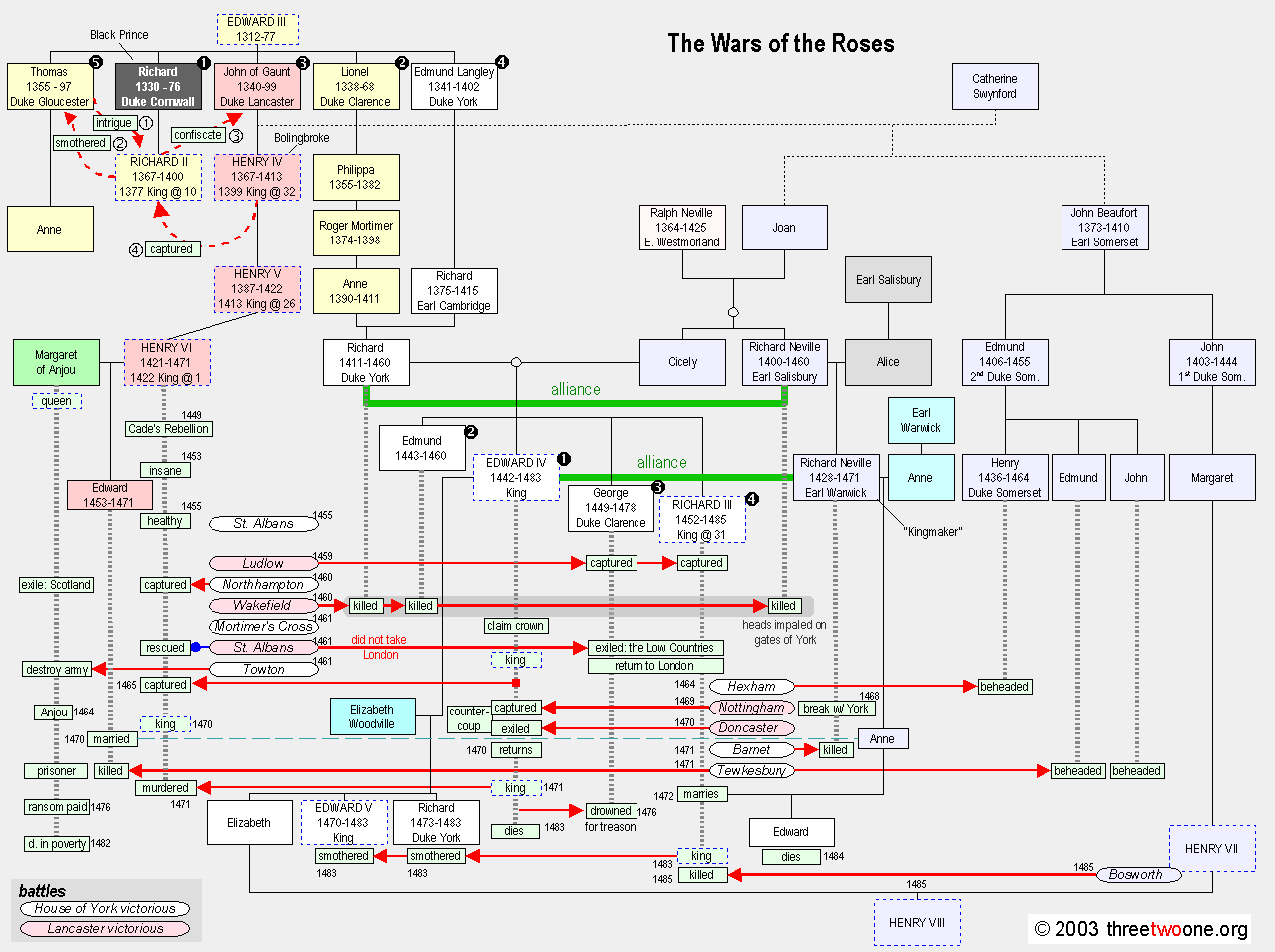
04/04/2015 -- This is not to say that Thomas did not have ancestors at Bosworth or any of the other battles that occurred during the War of the Roses. We are talking the period from the period from 1455 to 1485 which is 100+ years prior to Thomas' birth. Here are two good graphics that summarize the period.
    Wikipedia (War of the Roses) -- Summary of Events. Notice the Lancaster and York columns with battles and outcomes. Margaret of Anjou lost her son (Edward) and died in poverty. Others suffered fates (see beheaded list, section on England).
    Threetwoone.org has a nice graph based upon the relationship tree with links for battles and fates.  
As well, here is a pinterest collection (put here as we could use this for material related to Thomas).

07/09/2016 - This year, we obtained further material.

10/10/2018 -- We just printed TGA Vols III and IV (available for purchase) which contains David T. Gardner's articles about the Gardners, Bosworth, and Tudors. As well, historical author, Douglas Richardson, has William Gardner in his books (Plantagenet Ancestry, Magna Carta Ancestry and Royal Ancestry) with his marriage to Helen Tudor (see Our Royal, Titled, Noble, and Commoner Ancestors & Cousins site).

03/14/2019 -- Put image into our index at our portal to truth.

04/04/2025 -- David T. Gardner has been exercisting Grok with prompts and reports finding documents that support his claim about Wyllym Gardynyr (see King Slayer Court blog). ... We have begun to incorporate changes into the structure and context of the blog. See Restart, somewhat. 

Monday, August 23, 2021

22 Aug 1485

There was a memorial ceremony at Bosworth. Richard III died 22 Aug 1485. 

FB: Richard III Society 
Websites: Richard III Society
Richard III Society - American Branch

The American Branch is open to membership by any interested party. 

This represents what the web/cloud can be. People organizing for various reasons. But, too, supporting research will be a regular activity. 

We have had several posts on this subject. Richard III and Gardner was a 2015 summary. In a 2019 post, we touched upon some of the history of the search for the remains of Ricard III. The writer, Philippa Langley, encouraged the researcher. As a reminder, the remains had been covered by a parking lot. 

In that same post, we mentioned our problem of determining what happened to the remains of Thomas after his Burial Ground had been diverted to commercial use without due respect for the prior burials. 

The internet will continue to scale down the world; at the same time, research will boom and scale things back up. The demands for proper handling of information will grow as will the means for doing so, using technology still mainly a dream. 

Remarks: Modified: 01/03/2026

10/01/2021 -- Changed image. Former one disappeared. 

05/11/2025 -- New work starting; created a Bosworth label. 

01/03/2026 -- We will be updating the status of this work. For now, here are some posts: Welsh poems; Sir Christopher Gardiner; King Slayer's Court I; ... A new science?; ..., 

Friday, May 27, 2016

Bosworth and more

Context: New Science.

---

Earlier, we looked at the Richard III and Gardner. In our first year, we ran across the story of how the Tudors came to be. At that time, there were stories, even on Wikipedia. After some discussion (some seemingly vindictive), parts of the story were suppressed.

So, now, we will do a review. This is a start based upon recently acquired information.

This is a nice little site: Archeology Data Service. Let me quote one page: The Burgundian chronicler Jean Molinet chronicled the following  “Richard suffers an ignominious death, trying to flee from the field, at the hands of a Welshman armed with a halberd (therefore presumably a lower ranking soldier), whilst attempting to flee the field of battle.” See this report on Bosworth Military History.

This brief review is about a 1991 book that covers some of the Gardner connection. Looking at this Maryland family allowed me to get into other Gardner families. We will be updating the list (Gardners and Gardners - second most-read post). Also, I have had the chance to get familiar with the southern region (Disclosure: Spent over three years in the NOVA/MD region of DC. Unfortunately, I have not spent significant time in northern New England, yet.). Northerners, be aware that there were two "Paul Revere" types of ride in the south, namely Virginia and South Carolina.

Before leaving, I need to show the other side: Supposed daughters of an Earl.

Again, Gardner Research (DNA, et al) deals with all things Gardner. Help us present to most-supported material as well as make available all of the alternative bits of information. After all, the world is fuzzy (yeah, Zadeh).

Remarks: Modified: 06/11/2019

07/09/2016 -- On Richard III and Gardners.

07/10/2016 -- Mission of The Richard III Society. It is good to see 500 years back being studied. We wish to do similarly for Thomas and Margaret.

07/12/2016 -- We need to be like those doing Ichnology. Added context to front of post.

12/18/2016 -- Article about the subject published in The Gardner Annals, Vol. III, No. 1.

10/10/2018 -- We just printed TGA Vols III and IV (available for purchase) which contains David T. Gardner's articles about the Gardners, Bosworth, and Tudors. As well, historical author, Douglas Richardson, has William Gardner in his books (Plantagenet Ancestry, Magna Carta Ancestry and Royal Ancestry) with his marriage to Helen Tudor (see Our Royal, Titled, Noble, and Commoner Ancestors & Cousins site).

06/11/2019 -- As mentioned, I have heard from about all of the Gardner/Gardiner families who have pre-Revolutionary ancestors both in northern and southern New England. Several times, I was able to help them identify their migrating forebear. Beginner's luck? On WikiTree, there was a question about Richard Gardiner, born about the same time as Thomas of Salem, who came into Maryland. I have various notes about this family that I need to collect. The WikiTree question was: Who were Maryland Immigrant Richard Gardiner's (b1592) parents? Not sure who asked. The date of the question was 24 Jul 2018. It was about then that we were discussing Margaret Fryer, wife of Thomas of Salem. I left a comment. We don't know much about Thomas, either. Recently, there was an answer by William Good. His research notes (on the Gardiners) can be found at rootsweb[dot]com. Also, this pertains to several themes, including existing material (books, et al) some of which are referenced above, in the FYI context. Evidently, I'll need to put up a 'sorting out' category, at some point.

Thursday, July 28, 2016

King Slayer's Court

Context: Gardners and Gardners

In this context, last time, we looked at Gardiners Island which was owned by one of the many families that came over early. Dr. Frank had Lion Gardiner on his lists. He had more families in his 1933 book than he had in 1907.

Other families have been added. The list in the "Gardners and Gardners" post (see Context) is being updated. Of late, we have been working with a member of the Gardner family of Pennsylvania to organize and publish information that ought to help throw some light on origin issues, both particular and general.

The following is a summary of what "King Slayer's Court" is all about. The recent finding of the remains of Richard III allows another look at several subjects that deal with the Gardners of London. Our interests are several. There may be a tie that is awaiting discover, even if it is further back in time. Too, history has taken a stance in this matter that may not be correct.
    I’ve heard stories about William Gardiner and the King since I was a child, I’ve been researching and reading about the subject ever since. These stories were passed by my family, descendants of English traders.. Many stories, music and traditions of early families passed generation to generation, made their way down the trail with the westward expansion of North America. The Welsh Tract of West Jersey. This area is now known as the city of Philadelphia. My ancestors English traders arrived in 1682. They were masonic masons, traders and merchants..

    In the early days of the web, back in the 1990’s, I approached the subject of William Gardiner on Netscape and AOL. The “King Richard” protectors screamed preposterous all the way to Bosworth Market.

    However, let’s look back in retrospect over the last 30 years and see how this story has progressed. My query has gone from completely preposterous to right on target. According to studies done when Richard III’s remains were found, in 2012, the last English King to be killed in battle fell by a blow to the head delivered by Wyllyam Gardynyr, a common skinner, with a poleaxe. “Hog Wash” of 30 years ago was confirmed to be true.

    I find it interesting that the stories that families have passed generation to generation on the Welsh Tract of Pennsylvania (the tales of Lords, Ladies, Kings, Great Battles and better times in England) have ultimately stood the test of time. As we enter the digital age and the information of past generations is uploaded, it seems to be painting a picture that has been left unfinished for many generations.

    We live in exciting times, my friends. Even a single forgotten document, just one seemingly unimportant piece of information now scanned to the internet~? Can (should) cause us to examine everything we think we thought we knew about our history. This is the story of King Slayer’s Court. I intend to publish what I have heard; then, we will go back and provided references so as to establish the proper story.

    This following lists a few facts about William and Richard Gardner that we will address further.

    • William Gardiner was indeed Knighted
    • William Gardiner was married to Ellen Tudor
    • William Gardiner was the brother of Alderman Richard Gardiner
    • William Gardiner was the Father of the Thomas Gardiner "King's chaplain, son and heir, born in London say 1479”
    • Richard Gardiner was controlling  what’s now considered one of the most lucrative trade syndicates on Earth.
    • Richard Gardiner was in possession of RIII debt, Holding Crown Jewels as collateral.
    • Richard Gardiner was official representative of City of London to greet Henry VII
    • The Gardiner family has a long, yet still undocumented relationship with the Royal Family.
    • Lord John Gardiner, Baron of Kimble is current Vice Chamberlain and Captain of Yeomen of the guard.
Several items of interest come from this overview that we can pursue. An example would be the differences between views: Wikipedia (Gardiner not mentioned) vs King's Slayer Court. History is more than what is written. Too, some viewpoints never get expressed.

Remarks: Modified: 05/10/2025

12/18/2016 -- Article about the subject published in The Gardner Annals, Vol. III, No. 1.

06/20/2018 -- This will publish with a new article soon. The book will include The Gardner Annals, Volumes III and IV plus Gardner's Beach, Volumes IV through VII.

10/10/2018 -- We just printed TGA Vols III and IV (available for purchase) which contains David T. Gardner's articles about the Gardners, Bosworth, and Tudors. As well, historical author, Douglas Richardson, has William Gardner in his books (Plantagenet Ancestry, Magna Carta Ancestry and Royal Ancestry) with his marriage to Helen Tudor (see Our Royal, Titled, Noble, and Commoner Ancestors & Cousins site).

05/10/2025 --  See King Slayer's Court, redux for recent information on activity. 

Monday, November 22, 2010

Historical genealogy

Notes:
  • The page on William Gardner (see below) was deleted from Wikipedia on 02/06/2013.
  •  See Remarks (02/06/2013 and 06/15/2013) for related discussion. A future post will take a brief look at origins (with a reference to this material).
  • See Remarks (10/10/2018) for recap. Some of the links in this post may be stale (will look for those, at some point)
  • See Remarks (12/28/2025) with regard to LLM (AI/ML) of so much attention the past three years and the trials of trying to bring this into historical/genealogical research. 
  • See Remarks (01/03/2026) pertaining to continuing work using GenAI/LLM plus having a focus on the quality of provenance information. 
---

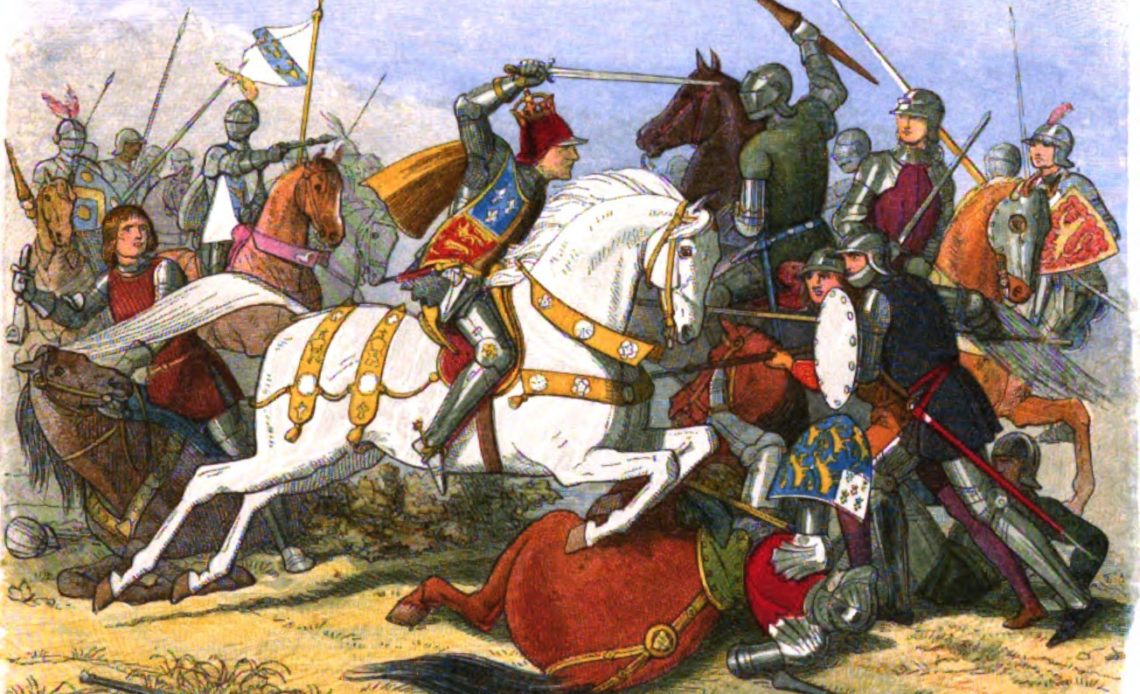
The end of the middle ages can be linked with the War of the Roses. A key event was the Battle of Bosworth. Richard III of the House of York was killed at Bosworth Field; he was the last of the Plantagenet kings.
Battle of Bosworth 1485

Some say that William Gardner was one of the slayers of King Richard and that William later married Helen Tudor who was the granddaughter of Owen Tudor.

There are several questions to ask about William and Helen. Who were their children? What do we know of succeeding generations? It turns out that there are several viewpoints. Let's look at a couple of these.

In the Who's Who of Tudor Women by Kathy Lynn Emerson, we find this about William and Helen (c. 1459-1488). They were married before the Battle of Bosworth. Their only confirmed child was Thomas (c. 1479-1506) who was a Pryor at Tynemouth. Emerson also says that they were not parents of Stephen (d. 1555), Richard (1486-1546), William (1488-1549), or Alice (d. 1588) Gardner.

On the other hand, the Wikipedia article on Stephen Gardiner says that William was his father. Stephen was twice the Bishop of Winchester. Too, he managed to survive the turmoil of the times. Also, Richard and William (mentioned above) were brothers of Stephen.

I thought that it might be interesting to look at the results of the research of several families. There seems to be a common theme. As before, I have provided links to databases at rootsweb.
  • Dowling tree, descendants of Stephen Gardiner shows Lionel's line
  • Walker tree, descendants of Stephen Gardiner shows the Thomas of Salem's line
  • Knowlton tree, descendants of Stephen Gardiner suggests siblings for Thomas of Salem and ties in the Lionel line. The tree quotes Burke's Peerage and some genealogy work by Thomas Richard Gardiner.
  • Note: 01/03/2026 -- Rootsweb links to Stephen Gardiner changed. Will edit at some point. 
One goal is to fill in Thomas' and Margaret's ancestry. As well, looking at how the Gardner families relate will continue to be of interest.

Remarks: Modified: 01/03/2026

05/05/2011 -- Did Thomas of Salem have a sister, Rachel?

12/14/2012 -- This has been a popular post.

02/05/2013 -- Recent interest in Richard III has caused a renewed focus on information about his life. This post from about two years ago was motivated by a Wikipedia page whose content is now undergoing scrutiny. Since this discussion pertains to our work, we'll keep abreast of things as they move along. Note: there is a vote going on about the possible deletion of the page on William Gardner.

02/06/2013 -- The William Gardner page was deleted today (see discussion page). Also, see section on Wyllyam Gardynyr (archived 06 May 2013) under Richard III talk. When making the Remarks yesterday, I had not looked at the article since this post was done and was not aware of the expected time for the deletion. The William "wiki" page was one item on a huge pile of material to review that relates to origins (open topic, future consideration). Also, the author (of the William Gardner page) seems to have had more than one page deleted from Wikipedia. At this point, let me put a link to Wikipedia's Five pillars as a reminder about content to be put there.

06/15/2013 -- John Farmer wrote that Thomas was from Scotland. Origins are, and will be, a focus. ... As of today, this is the all-time, most-read post. Coming in second is Old Planters, Beverly.

06/15/2013 -- For the Wyllyam Gardynyr discussion, see prior version (archived 06 May 2013). At some point, I ought to see what the deleted Wiki pages were all about. That is, looking at origins would encompass the whole bit, out of which would then come the real story. That has not been done, that I can see, as of 2013 is not troublesome. Things come forward all the time. Too, has anyone surveyed the work to date in a comprehensive manner (meaning, of course, scholarly)? One goal will be to start, and sustain, such studies that would augment what has already been done as well as explore holes (which have to be defined, for starters). In the meantime, we'll try to document Thomas' life (such as, pulling out things related to character) and progeny. Also, we ought to look more closely at Damaris Shattuck and Thomas. That he married a Quaker and didn't suffer the wrath of the likes of Endicott says something (Mary Dyer was hung in 1660).

09/28/2014 -- A week ago, the record for the marriage of Thomas Gardner and Margaret Friar was discovered in Sherborne by John Cook of Minneapolis, Dorset files. This sets a type of focus. Looks as if some transcription work might be in order.

04/07/2015 -- We have more questions than answers (research raises both).

06/10/2016 -- There is more to the story than I realized: Bosworth and more. We will have more to add to the FAQ.

07/16/2016 -- Related work: Gardiners and Gardners.

10/10/2018 -- We just printed TGA Vols III and IV (available for purchase) which contains David T. Gardner's articles about the Gardners, Bosworth, and Tudors. As well, historical author, Douglas Richardson, has William Gardner in his books (Plantagenet Ancestry, Magna Carta Ancestry and Royal Ancestry) with his marriage to Helen Tudor (see Our Royal, Titled, Noble, and Commoner Ancestors & Cousins site).

10/11/2018 -- Most links work (not bad after 10 years). Resorted the Remarks to earliest to latest as this subject will be an ongoing one. And, we can just append a next comment. Just checked on page for Stephen Gardiner, the archbishop. It mentions William as possible father, whereas before it said that John was thought to be his father.

04/04/2025 -- David T. Gardner has been exercisting Grok with prompts and reports finding documents that support his claim about Wyllym Gardynyr (see King Slayer Court blog). ... We have begun to incorporate changes into the structure and context of the blog. See Restart, somewhat. 
12/28/2025 -- David T. Gardner made several attempts this year to bring LLM (AI/ML) into his work. We are helping to document at effort: Research using the internet, and AI. 

01/03/2026 -- We will be updating the status of this work. For now, here are some posts: Welsh poems; Sir Christopher Gardiner; King Slayer's Court I; ... A new science?; ..., 


Sunday, March 2, 2014

A new science?

Context: Richard and Bosworth

---

It occurred to me, as I was researching material related to Cape Ann and Thomas Gardner, that I ought to explain one of our interests. We can use genealogical forensics, as a loose example but a not weak analog (reminder - we are more than a few steps removed from fictionalized history - which, by the way, is a respectable field. How else can we get the movies, etc., out for popular consumption?).

Now, let's use the recent case related to Richard III (notwithstanding that some proposals have been found to be without merit) as it is an example of another type of forensics, namely anthropological. The image shows the results of a Google search on the subject of the reconstruction that was done from the remains that had been found and identified as belonging to King Richard III. By the way, The British Museum has an exhibit about this discovery.

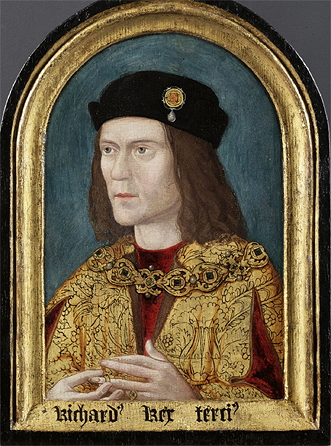
The reconstruction looks a lot like what we saw with the portraits (see one of Wiki's image). So, one might consider that it (see the circled part in the image) was factor in the work. After all, how many Brits would not have Richard III imprinted on their psyche?

However, consider that similar efforts can be done with much fewer pieces. Too, as we know, a lot can be said about an individual from a small collection of data, sometimes (that being said, "big data" peoples, your aggregates of me, and many - most? - are way off base).

---

Before we go further, I need to point to the Forensic Genealogy Institute with whom I have no association. I am a private person, doing gentleman science - let's talk about that (in company of Faraday and a whole lot more). Disclosure: I am not a genealogist, historian, and a number of other things. What I do know are mathematical modeling (especially that which is computationally framed), many of the liberal arts and sciences (does that date me?), some military affairs, business/economics/finance, and a whole lot more. Actually, the best description would be autodidact who has broad interest. Too, I have known Gardners for almost half a century.

By the way, I have mentioned anceSTORY, before. The name has a lot of meanings. Yes, there are the dull details of the past. Too, there are those things that are known (and some were very clamorous - you see, people haven't changed much - I prefer Teddy's walk softly adage) and written about. Is that not history? But, then there is "being" (the larger story that is not captured by historical accounts - but, that is rectified now and again, see Joseph Hodgkins, as an example, albeit that McCullough could start with letters -- don't forget, though, that we can get to Heidegger, et al, to boot). That is what we're trying to capture.

---

Needless to say (but I will anyway), we must start with what we know. That means, in the real sense of science, what we have found out so far. In the case of Thomas Gardner (and Margaret), there does seem to be a whole lot of holes to fill in. Looking into expanding the base of knowledge is one task. I have only been at this four years, but I do not see evidence of any concerted, long term, effort to fill in the pieces (if I have missed something, let me know).

Too, though, would be to fill in pieces (using arguments of various strengths) as best we can using modern means. How effective this type of effort might be will become apparent as will its benefits as we go along.

Naturally, success will be best ensured if the brain is engaged during the exercises.

Moral: People were. That they (or information about them) might be acceptable to genealogists, or not, does not change the truths of their existence nor the reality of their continuing influence. Ought genealogists take lessons in how hubris is always just around the corner? As in, genealogy might help "flesh out" the truth; it does not define such.

Remarks:  Modified: 07/12/2016

03/03/2014 -- New science? Yes, bringing memes (and more) to the fore in the discussion. In the terms of Thomas, his progeny has a wide sweep, including the step-progeny. ... Of course, genealogy can apply to more than biologically framed lineage. For instance, mathematicians have their "ancestors," know about them (and their contributions), and honor them. What other field does that? My mathematical pedigree: Galileo Galilei (1585), Vincenzo Viviana (1642) Isaac Barrow (1652), Isaac Newton (1668), Roger Cotes (1706), Robert Smith (1715), Walter Taylor (1723), Steven Whisson (1742), Thomas Postlethwaite (1756), Thomas Jones (1782), Adam Sedgwick (1811), William Hopkins (1830), Arthur Cayley (1864), Andrew Russell Forsyth (1881),  Edmund Taylor Whittaker (1895), G.H. Hardy (), Edward Charles Titchmarsh (), Andrew P. Guinand (), Lucio Arteaga (1964), the blogger (). I took it back to 1585 since that would be co-temporal with Thomas and his parents. Too, note that the ancestor is an adviser or mentor or tutor. This brings to mind that a meme'tic look at descendancy would consider the influence of step-child-ness. I have found many of these relationships. For instance, for Thomas and Margaret, retired Supreme Court Justice Sandra Day O'Connor is a step-descendant. Thomas Dudley has a slew of step-descendants as do many due to early deaths and re-marriage being so common.

03/24/2014 -- Read, recently, a review in the WSJ (Book Review, March 7, 2014) about the work of Anthony J. Martin, a paleontologist. There was much discussion about determining dinosaur look and behavior from minimal evidence. That is, even footprints can be used in lieu of bones. The key, of course, is being knowledgeable enough to extrapolate from the small set. Too, there is information in the limiting factors. ... We can similarly reconstruct a scene from the past, with care, so as to be able to look at it from our later advantage point.

04/25/2014 - Genealogy almost seems to say: without papers, you (and your ancestors) do not exist. We know that this is silly thinking (albeit, probably not recognized by those who do such). Attempts at extrapolation (like, what was over the pond for an ancestor prior to their departure) or interpolation (filling in missing pieces) ought to be given more credence; that is, such attempts are more than mere science fiction or fictional history. Why? Ichnology allows grand portraits from seemingly minimal amounts of stuff in hand. Of course, the discipline has known rules. Also, from time to time, something comes about that affords verification (and calibration). The same techniques could be applied to the ancestral realms (and has been, again, in the fictional form). So, that is something on our plate, discussion of such methods and of their use (with demonstrations).

08/19/2014 -- Put in links to the WSJ review of Martin's book (see 03/24/2014). Also, link to ichnology's use. Now, with regard to genealogy, biology, and sociology (etc.), we will be getting back to the discussion, in particular the interplay of memes and their analog.

10/13/2014 -- Tabula raza, and more, will be of concern.

07/12/2016 -- Added context at front of the page.

Saturday, December 28, 2019

Decade start

So, we have four days left in 2019, including today (12/28/2019). After Christmas, periodicals start to review the past year. Like the USA Today reviewing all of those lost during 2019. It's interesting. The article published in the 12/22 edition but was updated. Don Imus is included now. He was 79. Why mention him? He was a Marine (U.S.).

When a '9' year rolls around, then the decade can be reviewed. For instance, the movies of the 2010s. That then gets pushed further (our love of abstraction and its levels) to things like the best of all of the Star Wars movies (11 releases - starting in 1977 - remember where  you were? Elvis died that year - we have not seen any of these - in the theaters, perhaps, on the telly).

Our last post said that we are going to be reviewing our work over the past decade (Elizabeth (Gardner) Dabney Bridges Stevens), but no timeline was given. It will be an on-going thing. In this case, 'Elizabeth' was picked due to a recent article (NEHGS - American Ancestors) got us looking at our records. Too, it got us looking further at WikiTree where we're supporting the documentation of descendant of Thomas Gardner (and looking at origins, to boot). All of this type of non-profit work needs regular attention and energy applied.

But, let's step back. Was the first year zero? No. That whole concept came later after lots of thinking and discussion. In a technology sense, we'll get back to that (one of our goals will be supporting research - via technology as well as with other means - lots to report, over time - the theme with this little discussion). So, being more humanistic-ally oriented, we are suggesting that we don't have four days to get things done before the new year. In fact, 2021 will be the start of the decade. We'll have some things done by the 1st (we hope). The reviews of the decade will go through mid-year, at which point, we'll transition to what's next over the next decade. Then, next year, at this time, perhaps, we'll have a better framework from which to launch to the future.

Now, let's back up another way. From the beginning, we heard of Bosworth. There was a Wikipedia page that was later removed. Our first post on this was Historical genealogy. This will be a theme going forward. Other posts were: Richard III and Gardner (Richardson points to this topic in his books), King Slayer Court (tone of all things Gardner, supporting the work of David T. Gardner), and a few more.

On of these looked at the discovery of a body that is believed to be that of Richard III (A new science?). With DNA, we are taking a technical focus so as to remove that which leads to hype. Want to know a parallel? AI (which will come into our focus, too). Hence, our first post was a summary: DNA and genealogy.

So, it was interesting to run across John Ashdown-Hill's review of the Richard III study. It is dated 22 May 2017, so is recent. He was encouraged by historian, Philippa Langley, who asked him to lay out his arguments for where to look and why (Clare Priory). There is more information in the Wikipedia article. A subordinate page looks at the discussion of who of Henry Tudor's men was responsible for the fatal blow.

This example is one of many themes that relate to the history and genealogy of Thomas Gardner and his wife, Margaret Fryer. Technology has allowed a huge change in mode from the time of Dr. Gardner (1907 chart) a 110 years ago. It's anyone's guess about 100 years from now. However, just like we can refer to, and respect, his work, the current work can be of the same quality.

Too, we can change to other modes, such a historic fiction. We'll publish part of a novella, situated in Ipswich, MA in the next issue of The Gardner Annals.

Remarks: Modified: 01/05/2020

01/05/2020 -- We have reviews on a continual basis. One of the first post of last year was this one: Tenth year.

Thursday, April 17, 2025

King Slayer's Court, redux

TL;DR -- Bosworth and Gardner came up after we had looked at a Welsh family who had purportedly been involved in the battle. We assisted getting the information published in a blog, Gardner's Beacon, and The Gardner Annals. Recently, new information is available which is potentially remarkable in both its content and in its history. In other words, King Slayer's Court has been updated. 

--

Back in the prior decade, we looked at All Things Gardner as we heard from many families and tried to make sense of all of the data. As we worked, we tried to lay down data to serve as milestones and even guideposts, eventually. 

David T. Gardner contacted us about his research on Bosworth. We helped him get organized (31 Dec 2017) for posting to his blog:

  • King Slayer's Court (Top 10 Finds) (05/10/2025 - missing URLs removed - search at King Slayer's Court) -- This site has been updated recently to catch up with information flow from research, see "Top 10 Finds To Date: April 15th 2025". The stories about Wyllyam Gardynyr have been within David's family for generations. He took advantage of the emerging technology to dive deeper. The find of Richard III"s body was a boon since it brought attention to the importance of Bosworth as well introduced data that science could help interpret. Richard III was re-interned with ceremony fitting a King. In the meantime, there have been publications about Gardiners and the Tudors. For instance, Douglas Richardson had ventured into the area. I talked to him briefly about the work with David. He was interested. ...
The emergence of what became known as GenAI/LLM occurred in November of 2022. Since then, the world has coped with the introduction and all of the ramifications that are huge. We have paid close attention and see that 2025 has created a split: believer (many are using the technology in daily business - the jury is still out (I say, expect some surprises that were predictable); sceptic (many have reactions that might not be balanced). 

---

Where we stand? Having been involved with advanced computing throughout John's career, he reminds us that the introduction of this new technology was not considered (lengthy discussion). Too, this stuff, at its basis, is emergent from buckets of bits from which we ought not expect intelligence to display itself (that discussion will continue). So, he is not sceptical so much, as cautious, given his experience plus having been trained in the culture (Greco-Roman - classical) that fostered the development of science. One thing that seems to have been introduced along with the scientific ability? Marketing and creative writing took upon themselves the abilities enabled by technology in order to introduce newer, and more powerful, techniques. We have not recovered from that. And, must for a sustainable economy, with computing and technology as important players. That is, there is no fair balance establish between the top-down view of marketing and that necessary bottom-up one of engineering/science. 

---

David reports that he found that Grok (of xAI) allowed image processing which brought up several things formerly missed. OCR is one of the capabilities. It helped determine that a "C" rather a "G" got a lot of data miscategorized. Other means, or reaons, for the material having been ignored need discussion, too. 

After opening that door, Grok was "prompted" to pursue various avenues and report then. Right now, this activity has generated a lot of output which needs to be scrutinized.

The "10 Finds" (above) is an example of some coming overviews which will allow discussion while data gathering and research run along. For us, we will review the activity to date and determine how to proceed. 

This is one type of area that we want to use an "AI" for as well as looking at the multiple layers of code involved with any computational event. These are wide-open areas of research requiring strict scrutiny. 

At the same time, as things go toward the more creative (and there are many reasons that this might be acceptable), we would wish that the GenAI/LLM (or other tool) involved in such activities be identified. Some are calling for all artificial output to be watermarked some way. 

As said, this is a totally new area. 

Remarks: Modified: 01/03/2026

05/10/2025 -- URLs disappeared; removed pointers.  

05/11/2025 -- New work starting; created a Bosworth label. 

05/27/2025 -- David T Gardner discovered that GenAI/LLM led him astray. We will let him tell the tale. Essentially, David's work over the decades has resulted in several documents that suggest more work needs to be done. But, the notions related to his theme of Gardynyr killing Richard III have some merit. That work will continue. The confabulations from technology are another matter that have our interest. 

01/03/2026 -- We will be updating the status of this work. For now, here are some posts: Welsh poems; Sir Christopher Gardiner; King Slayer's Court I; ... A new science?; ..., 

Wednesday, April 2, 2025

Bosworth through the eyes of technology

TL;DR -- Bosworth? Know about it? This is where the Tudors came to be as the Plantagenets were cut out of the game (of Thrones). Well, only the male lineage. The female portions always live on. Recent abilities allow new insights into the 22 Aug 1485 event which is a mere 125 years from the colonial start (fuzzy numbers suffice). Abilities? GenAI as a mathematical marvel? Finally, we have a chance to look at the capability with the intent to tone down the hype that is missing the point of it all. 

---

This post has two purposes. One deals with the latest rage of technology that is commonly known as AI (we will use GenAI). We have argued that the current phenomenal abilities of GenAI are not due to some critter which is "sentient" but that they represent long years of mathematical work culminating in a mode that is suitable to exercise by the circuitry and software of computing. As such, this post will provide the start of a necessary bit of discussion. The second purpose is to point to recent work that uses GenAI and that represents an opportunity to look at the good, the bad, and the ugly. 

Let's start with the announcement of genealogical/historical research results. We link to two posts (05/10/2025 - missing URLs removed - search at King Slayer's Court). 
  • 1 - Updated Press Release: A 540-Year Conspiracy Unveiled – The Lost Ledgers of Bosworth Rewrite History (Bedtime story; Lost Ledgers; Untold story) 
  • 2 - Untold Story: The Death of Richard the III (pdf), By Sir Wyllyam Gardynyr  
The first post looks at decades of research that started from hearing family stories. The topic deals with the Battle of Bosworth where King Richard III was killed. As a reminder, research determined the spot where his remains were placed after the Battle. In 2012, after much research with respect to location, they dug through the surface of a parking lot and found the body. Subsequent analysis indicated that the remains were of the King. 

Too, his skull had been fractured. The tales of the family involved the details of how a member (yoeman - commoner) struck the blow. That has been scoffed at over the centuries and over the decades that David T. Gardner did his queries. 

The second post takes informaton provided by GenAI based upon sources that finally were digitized and pulls them into a narrative as if written by Wyllyam Gardynyr. As we do our analysis, we will help sort the various attempts at presentation into a scheme where veracity is measured and reported. That is, as with most things, we see the tip of the iceberg. That itself will become clear with GenAI as we proceed in a mature manner. 

We first heard from David in 2014 as a comment to our post, Historical Genealogy. That post was from November of 2010 when we had first started doing research. David's comment was in 2014. We noticed and responded in 2016. At that time, we started to correspond and did this post: King Slayer's Court. We started to look at David's work and published a few of his articles. Per usual, he was bumping up against official opinions. Through digging, he kept finding information pointed to his family's tales being right. 

So, let's switch to technology. We have had lots of posts on GenAI. There many of examples of GenAI that are available. Opinions about this phenomenon of the past two years (first released to public use in November of 2022) vary with sides drawn. It has good and bad properties. On the good side, it resonates with people but is thought to lead them astray. But, the best part is that the underlying mathematics is worthy of our attention as it represents what can be done. 

Needless to say, these open issues will continue to be on the radar for several reasons that we have tried to address. But, getting back to David's work, he had made progress hearing from groups like the Richard III Society and from experts dealing with the history of Westminster. But, recently, a GenAI was tried which had digitized sources from the time period and location. 

On honing in via queries (some say, prompts), David pulled out documents that confirmed what he had been looking for. Ostensibly, we will add and explain below. 

In the meantime, David has written several articles that will be released over the few days and weeks. These deal in detail with Bosworth, but there is additional detail that deals with the Gardner family and the unknown dynamics of this Battle that was the last one of the War of the Roses. So, this is significant both for the history of England as well as for the opportunity to look closely at GenAI from a perspective that is serious. 

Genealogy is not an easy study in terms of trying to prove lineage of a person. The U.S.A. will see the 250th this year of activities related to its start. This month, in fact, was when the Battles of Lexington and Concord happened in Massachusetts between English troops and the supposed rabble rousers of the colonials. We have had many posts on that theme: Two houses, for example, looks at one family and their activity from the start (400 year vew) and during the revolution. One house is associated with the Society of Cincinnati whose members are males with direct descendany from a Revolutionary War Officer. There are many such organizations, such as the Daughters of the American Revolution. 

But, the Bosworth event was in the late 1400s which is three to four generations before the colonial effort took place. From a technology sense, this opportunity (for me) is priceless. For one, it shows technology allowing better document handling; then, there is the indexing and search facility that allows documents to be matched up; too, the prose generation abilities are nice. But, that brings up one huge focus which will be to scrutinize all of this and determine where things might have gone awry which puts an onus on creativity as this is an open field of study.  

Definitely, mathematics will be lifted to scrutiny in a manner not available before. How that will work is manifold in scope but overdue for attention. 

Let's use this post as a starting point: 22 Aug 1485. We'll end this post with an image (missing image from Chronical of England site run by Royal Central). 

Note: This activity on the part of our organization pertains to truth engineering. 

Remarks: Modified: 01/03/2026

04/04/2025 -- Press release disappeared; put in other links. 

05/10/2025 -- URLs disappeared at King Slayer's Court. Removed pointers. 

05/11/2025 -- New work starting; created a Bosworth label. 

05/27/2025 -- David T Gardner discovered that GenAI/LLM led him astray. We will let him tell the tale. Essentially, David's work over the decades has resulted in several documents that suggest more work needs to be done. But, the notions related to his theme of Gardynyr killing Richard III have some merit. That work will continue. The confabulations from technology are another matter that have our interest. 

10/29/2025 - Missing image (pointer for site not there; site gone) removed. 

01/03/2026 -- We will be updating the status of this work. For now, here are some posts: Welsh poems; Sir Christopher Gardiner; King Slayer's Court I; ... A new science?; ..., 


Monday, September 9, 2019

Edward III and Boris

I couldn't resist this. Earlier, I did an answer on Quora to this question:
First, note that it says 'related to' not 'descendant from.' So, that is one key. Another is that modern technology allows a little more precision in this type of search. Of course, there are more things to discuss, but let's avoid those this time. The answer allowed me to feature WikiTree using Dr. Frank A. Gardner's lineage to the extent that we know it (we extended this last fall using his notes about his mother's heritage). Later, I was able to see his father's notes in an early copy of the 1907 book (given to Stephen Wilson Gardner by Dr. Frank).

The work, notes, books and such went along with a burst of energy and activity related to genealogy and family history motivated, in part, by the 300th celebration. Now, we have the 400th look-backs either coming up or having already started, such as the Mayflower activity. Due to several factors (location, family ties, and more), the Mayflower descendants have been more scrutinized than many others. Yet, the information is not entirely complete according to one blog post. We will get back to that, take the case of Richard More who will be mentioned in a coming post. We looked at him earlier: seemingly lost, rediscovered, related to the family, etc.

In fact, Richard came up as I was going through notes to find the earliest Mayflower connections with the children of Thomas and Margaret, eight of whom had children. Richard's daughter married the son (Joshua Conant) of Thomas' daughter (Seeth). Further, Richard's sister-in-law married a Woodbury so there are all sorts of relationships to follow through on. Even with technology, those things are tedious and error prone: tired/old eyes, say, or quality of the provenance of the material being used.

Oh for a good database to start with. Well, there are several, hence the Mayflower reference. We can use those as a yardstick for comparison. There is more, as many who came over had known histories. The Mayflower look back is considering their ancestors in this regard. And, their data can be used for studies, such as mentioned in this answer:
There is a chart to a related theme of 'How long is a generation?' The data from the 'fifth generation' from the Mayflower one provides a view that only technology can give us. We need to keep that in mind.

Everyone, for the most part, has Edward III as some focal point, for Americans. Later ties are clearer and less prevalent. Earlier ties are associated with huge amounts of hits. BTW, WikiTree's efforts at their Magna Carta Gateway study are apropos. Lineage path by lineage path, the route from Gateway Ancestor to a Baron is being confirmed, using Richardson's books, for one.

What of the other side of the waters? Well, this recent blog post looks at one person of current interest: Edward to Boris, how many times? The author did the generation length study mentioned above. He references work by both Douglas Richardson (mentioned above) and Gary Roberts.

Relevance? This same type of work and technology needs to be done with Thomas, Margaret and all who relate to them. What Edward III studies allow is sufficient material that has been scrutinized for centuries. Getting away from that brings in all sorts of uncertainties that can be interesting in themselves.

BTW, Boris, of course, is the newly appointed (as of August 2019) U.K. Prime Minister Boris Johnson. He has an American Ancestry. But, we can use this work for other families, too, as Gateway Ancestors left family in the old country.

It's nice to see this type of thing where news motivates research and holes close. Then, the small folk can leverage off the work of the big-time folks ;>).

There are several hundred mappings from Boris to Ed III. The post's image looks at one. That is one aspect of the situation. Say, for lineage? One maps directly. Or with the one with the most documentation. Maybe, later, one goes back and fills in collateral information. But, other people (cousins) can leverage off of this work, if they have siblings of someone on a pedigree line.

We'll have several posts later related to this 'open issue' for Gardners.

Remarks: Modified: 10/11/2025

10/11/2025 -- Updated link to the "How many times ..." article for Boris. 


Thursday, August 14, 2014

Whence, again

This post is a comment about a recurring subject about which there is not as much known as one might hope, after so many years. However, there is interest in getting the necessary work accomplished to fill in (some of) the blanks.

Recently, there have been queries about Thomas and his pedigree. Each of these generated a little discussion. In one case, the discovery of the remains of Richard III (see Remarks 04/03/2015) helped bring one of these (a Tudor connection) to the light of rational explanation and some type of closure. There are several others.

We intend to gather all of the views, considered so far, and their related material. Why? Just as this Wiki page demonstrates, it can help to have the discussions very visible for current and future use (if you can ignore the derisive tone of many comment'ors, especially of experts who, many times, seem to lose their patience).

So, that type of thing will be a continuing bit of work. However, let's look at one example since it has interest from several viewpoints. For one, it is the work of another family, so we need to see what is what here. Too, it brings to fore the work that is needed. So, this is what we discuss below.

---

Earlier, we mentioned that several proposals have been made about Thomas' sister, Rachel (2nd bullet). The image shows her and her pedigree (which, of course, if there were a relationship would implicate Thomas). I have marked the image which shows a gap. The problem generally is that many will close gaps without proper support for their argument (age-old problem).

Now, having said that, just like we let experts make grand claims about life thousands of years ago, based upon current observations (as in fossils, etc.) and what is known (as in, very large extrapolation, folks), so, too, can (ought) families be allowed to explore their ancestral space (all sorts of metaphysical notions can come into play) in a rational fashion and do it safely. It is a meme issue (and, one goal is to explore this issue more deeply).

Safely? Yes.

Again, having said that, some fortunate (?) ones have (or can show) lines that do have documentation. This is nice as we can, at least, look, homologically, and find parallels. That means a couple of things. For anyone, relating to past events for your ancestors by looking at someone's experience (vicariously) is a human right.

Now, for the genealogists, there is only this comment. Life is not documentation (notwithstanding the idiots of the cloud attempting to record/store everything - oh, they even record themselves recording?). In fact, we can look at Thomas, given the blank slate, from a more full phenomenological sense than those who left trappings from either their writings or their doings. Trappings? Yes. Doings? Consider John Endicott thinking of Mary Dyer as he went before St. Peter. Writings? A whole other realm to ponder.

Additionally, though, genealogical experts, what was does not need documentation in order to make it right.

Now, that statement ought not be misconstrued as condoning fictional presentations (that are labeled as fact, as fiction is a proper human endeavor - we see historical fiction everywhere being written). What it means is that the posturing, and such, of the experts has very little to do with the being-ness (then and now) of the ancestors. Have a little humility, gals and guys. Even if you bring in science, be a little philosophical about it.

---

So, back to the image; there are several open generations that need attention. I recently read a 1921 paper (NEHGR, v79, p 358 - pointer to americanancestors.org) by G. Andrews Moriarty titled The Royal Descent of a New England Settler. He is talking about William Sargent of Malden. But, there are many other examples that could be used. The paper gives one a very good idea of the depth of attention that is required.

Too, if this paper were rewritten today, it would be different. William Sargent is not on a lot of lists (of which there are many).

Now, that, then, brings up the end of this. There have been many books and authors dealing with this subject. Frankly, I like to query those that are on-line. I am only going to use one book, for now.

Thankfully, Richardson's books are available. At least, in the preview mode, on Google, one can see a summary of results, even if the page cannot be seen. So, here is one of Richardson's books (there is a search box - Neville, a whole lot to look at). Now, let's use Wikipedia. This page points to the Ralph Neville born in 1456 (you can trace back his pedigree, if you like, just follow both parents at each node - yeah, Wikipedia, from the world's oldest wiki'an). He did have a son, Ralph. But, the information on Wiki stops there (see image, and the upper arrow - there are five generations to prove). Has some researcher filled in the information? Notice the references, on which list you will find Richardson.

Aside: There are people who go missing from family trees. I have several examples to show for this. But, getting them back into the tree requires making a strong case (lots to discuss there). On the other hand, lots of unfounded insertions have been claimed, as in children not known to have been of a couple's issue. Then, some of these are out of whack as biological facts are not considered; miraculous births are not expected to be accepted in genealogy (but, see the above comments on rational explanations).

In short, there is work to do. What is not well-founded are any notions that the questions raised so far have been properly resolved. The important thing, though, is not all questions have been asked.

The adage: When does a mathematician give up on trying to prove a theorem? Unless it is something pretty trivial, never, as long as there is reasonable interest, of course.

Remarks: Modified: 09/25/2018

08/12/2014 - To complete this post, let's take the Neville line three generations further, Ralph, grandson of the Ralph above, had a daughter, Margaret (d. 1559), who married Henry Manners (1525-1563) as his first wife. They had issue. Source: Cokayne, George Edward (1949). The Complete Peerage, edited by Geoffrey H. White XI. London: St. Catherine Press.

Henry Manners is not mentioned in Richardson's book which implies that no one over here has claimed he and his wife, yet. One complaint that I have seen is that a lot of effort has gone into proving lines that relate to people of interest (not my description), such as the rich and famous. But, even if that were not true, there would be many lines still unexplored after all of this time. In just five years, over here, I have found plenty of ignored people and, in fact, just completed a paper on one of these.

There is an adage. Would you rather be of the set of those who are still looking or of those who made early claims that were later shown to be problematic (no need, really, to provide examples)?

So, the work is, by no means, over.

09/28/2014 -- A week ago, the record for the marriage of Thomas Gardner and Margaret Friar was discovered in Sherborne by John Cook of Minneapolis, Dorset files. This sets a type of focus. Looks as if some transcription work might be in order.

04/03/2015 -- Recently, the remains of Richard III were laid to rest. Ever since they were found, there has been a lot of research done (some a renewal, some new). At the burial were some descendants of his sister (see Vita Brevis). Of course, that brought up the hypothesis of William Gardner being the one who did the fatal stroke. That was addressed in the Historical Genealogy post (and other posts). There have been many hypotheses offered, such as the one covered in post. We will take those (all of them) and bring in the facts and known state of research.

About William, see this discussion (on the Richard III Talk page) and this note on the deletion of the William Gardner page on Wiki.

The context to find, enumerate, analyze, report, and keep the information sound is Gardner Research (asking questions). The framework for publishing results that are well-founded will be The Gardner Annals and a FAQ.

07/12/2015 -- Okay, turtle speed. But, we get there. Announcing a new project: Sherborne, Dorset. No doubt, it is about time. When finished with the data collection and analysis, we will present the strongest story (the prerogative of the family) that the facts, and abductive reasoning, will support. As such, we hope to demonstrate some very much needed research viewpoints.

07/12/2015 -- We mention abductive approaches (my career was spent in advanced computing - software and modelling, essentially). Please refer, at least, to C.S. Peirce's (we mentioned him in an earlier post - Benjamin Peirce) work in the area. [Love it: From Ugly Duckling to Swan]

01/23/2016 -- More information about Rachel and Thomas.

08/06/2016 -- More on All things Gardners.

09/25/2018 -- Recently the Profile for Thomas Gardner on WikiTree changed to only have the two wives. This was due to research and discussion to which Gardner Research contributed. Earlier, there was a post that summarized the issue and accomplishment: Margaret, anew. Thanks are extended to all who made this update possible. The Profile is managed by the Puritan Great Migration Project sponsored by the NEHGS, publisher of the Great Migration books. So, Sherborne, as John said (see this page for images of documents).

Sunday, May 1, 2016

May 1st

This is the day that Nathaniel Hawthorne memorialized.

Incidentally, the supposed uncle, Rev. John White, trashed the people who where there. Too, he sort of implied that the Cape Ann crew were of that ilk (not that I'm judging ;-). But, we know better.

---

Whence issues need to be at the fore of things, as this page shows up.

   http://richard-iii-of-england.wikia.com/wiki/William_Gardner_(knight)

It is a copy of a now-deleted Wikipedia page that was copied to another site thereby cutting links related to updates.

You see why the web is a bloody mess? Notice the ads. The thing is to copy content and make money on eyes being lured there. Ah, how did this commerce ontology take precedence? Thanks, guys.

Remarks: Modified: 08/06/2016

05/14/2016 -- As we saw with the analysis related to Richard III's remains being identified and associated with descendants of his sister, modern technology does bring new things to the table. And, there were Welsh warriors present at Bosworth, some of whom may be Gardners. We have received access to additional material and will be presenting that story.

08/06/2016 -- More on All things Gardners.

Tuesday, July 21, 2020

Murrey and blue

TL;DR -- We found a new blog, today. 'new' in that it's less old than our own. We expect good things to be read at murrey and blue. Of course, this note being done later, we can fix an oversight: somehow, we forgot to mention William Marshal (without whom we would (might well) be speaking French - having lost the language of King Alfred the Great).

---

We had a question recently about motives for people coming to New England, early on. We, more or less, have liked the overview given by the author of Albion's Seed which we first read in 2016 while first exploring all of the ways that New Englanders continued to move after their arrival. We can map out the movement through time. For Virginia, one can see a map that shows the extent of its reach plus the counties defined at the time from the beginning. The expansion was west, at one point, with a limit of the Rockies and points west later on. But, we know that there were eventual constraints, with  West Virginia being one of these.

In Albion's Seed, early New England (Thomas Gardner et al) were reconnaissance. The real deal started with Winthrop who represented on pathway of which were were three more. After the Revolution (coming up 250 years ago), the expansion started in earnest. However, there were facilitating changes, such as the establishment of the Cumberland Pass through which we had people going west. There is a lot to look at. In the case of one family, we found a hanging of an abolitionist minister out in Texas before the major conflict that split the country in the mid-1800s. Three years ago, we looked at the experiences of Col. T. W. Higginson a little further north. There have been conflict and turmoils continually throughout the U.S. history and before.

On FB, recently, we saw a post from the Richard III society. We have had posts about him as it involved the long War of the Roses whose aftermath was of importance. Too, his body was found and re-interned which brought Richard III's life back to attention which got several posts here. Too, other blogs came into existence. One of these is "Murrey and blue." 'Murrey' describes a color that comes from the mulberry fruit.

The post asked: What really happened in 1385, when the Earl of Stafford’s son and heir was killed on a Yorkshire road ...? It was the first time that we read this blog which covers the subject well with illustrations. A name caught our eye: John Holand. The family was familiar for several reasons.

As an aside, it was nice to see history covered, as the whole of the themes related to this was muddied by the Game of Thrones playing loose. We can say that the media, such as blogs, that are coming to fore will allow a more full look at history in ways not possible before technology got off the ground. And this 'murreyandblue' blog gets into detail that is quite refreshing.

Back to the theme, John's father was Henry Holand of a Lancastrian family. Henry married Anne of York. His territory included Dorset which got us to look at the Domesday Book of this region. One of our goals is to keep a long view of history as we proceed with learning more about Thomas, Margaret and others of the Cape Ann venture. So, we expect that we will be looking further at this blog and its cohorts as we pursue our studies further.

There is another view of motivation: The Great Puritan Migration. I like this blog, however, I don't know that we can assume that Thomas and Margaret came here for religious reasons. We had a post dealing with Origins - motivations. One thing looked at were the beheadings associated with the War of the Roses.

Another good one is that from the New England Historical Society. There are a lot more blogs to look at.

Postnote: Back in Holand's ancestry one will find several characters from the time of King John and the MC. We have had posts on those topics. One name to bring forward beyond the interest that has been shown in literature and the arts? William Marshal.

Remarks: Modified: 07/22/2020

07/22/2020 -- Added an image and a TL;DR.

Saturday, March 6, 2021

Prior and next

TL;DR -- Opinions always follow a spectra mode. How these look in the aggregate can be a thing of beauty. There is never any nestling around a center point, for long. A recent event (one-sided deal, per usual, via the idiot tube - never had a TV until later in life). Turns out, that someone claiming a lowly mode (poor is me) actually has Ed III in the past. To some, in the U.S., that means something. But, rather than diving into that, we bop over to the Magna Carta which is of interest to more people. Again, though, this is from the English experience. And, during the 2000s, there will be many times for us to consider the document, its meaning, those who were there then, and what happened later over the centuries. 

---

So, a duality of several that we will always see. There are lots of these, such as those things that cause controversy. Such as? The US and UK conflict that seems one-sided, with an American citizen dissing HTMQ. Turns out that the one has a link back to Ed III (we wrote of him earlier). This heritage review was developed by Gary Boyd Roberts and Christopher C. Child of the NEHGS. The page has a link to a graphic which is interesting. On a further note, since the graphic is only of one of her lines, we thought to provide an ahnentafel courtesy of Famous Kin. So, there is a lot to discuss as we will be working with our kin there as the 400ths come up just as did the Plymouth folk the past few years. 

So, the prior? About seven to six years ago, there was much interest in the Magna Carta for which we had post here (John and his friends). That event came and went. HTMQ made several appearances during the festivities. Then, the thing was done but with another round in 2025 to celebrate the involvement of Henry III. For Americans, there is a special interest since it is noted that the related thinking was an influence upon the U.S. Constitution 800 years after the fact. And, there will be many more occurrences as we go through time of looking back at this document. 

So, that is the next, with 2025 being on the horizon already. What does this mean? Well, in the U.S., people can find out their family's connection by looking at gateways who are those who came over with this pedigree in their knapsack (or the equivalent). Of those, some already knew 400 years ago. Some were recently discovered to have a connection. Two examples are Mary (Gye) Maverick and Richard More. She was the wife of a Rev. on Winthrop's fleet whose name is now associated with actions, say like the one alluded to above. Richard More, as a kid, was on the Mayflower with his sisters. He married in Salem and is an in-law. There are many more examples. 

WikiTree has what it calls the Magna Carta Project. Using the gateways, they have Magna Carta Trails which go from the gateway to someone involved in the 1215 activity, as a Surety (see list on this page). One thing the team does is work the Magna Carta Base Camp. They have completed trails for many gateways of which there are several hundreds. They have a bunch that are in the process and some being prepared to be scrutinized. 

Why the interest? These are documented lines when they are done. Where else can one go to find this on-line? For Mary, this is her trail. Notice that her nodes for Bigod are 100% verified. However, therre are other trails. For Richard, his trails are in progress. Lines from both of these are in this graphic. 


So, another reason to show this. It's an example of very good work which is what we expect from Gardner Research when doing comparable types of things. One goal might be to do this for the first three to five generations starting from Thomas and Margaret. 

Remarks: Modified: 03/08/2021

03/07/2021 --  Updated Richard's line to show Bigod. 

03/08/2021 -- Put in the TL;DR, later better than never.