Showing posts sorted by relevance for query dorchester company. Sort by date Show all posts

Tuesday, February 23, 2021

Dorchester Company, further

TL;DR -- Need to look further at the Dorchester Company and what it meant to Thomas Gardner. Part of that will be getting familiar with Rev. John and his investors. 

---

It is time to spend more energy and time looking at specifics related to the commercial venture that was sponsored by The Dorchester Company. This will take several directions. While Rev. John White will be one focus, we will also take a closer look at the investors. For now, here are a few posts that we have done, to date, on the subject. 

  • The Dorchester Company (2013) - and Rev. John White (2013) One task will be to update this chart with a little more information on the Company and the investors, plus a more full look at the American experiment.

  • Two Thomas Gardners (2019) - Definitely, we need to look at Thomas Gardner who was married to Margaret Fryer and who stayed here. The other Thomas Gardner is mentioned by Frances Rose-Troup (2020) as having been married to Elizabeth, sister of the Reverend. 
  • John Tylly (2011) - As we mentioned long ago, we need to know more about John. Did he relate to any of the investors (The Original 119 Members)? 
  • Sir Christopher Gardiner (mentioned in several posts) - He is the cousin of one of the investors. We want to look at him further with respect to the different tales that one might run across. 
  • ... 

This is to fill in the whole picture as we look at New Spain and New France as well as New England. Of course, that brings in the whole scope of the continental U.S. early on, though we will still have a special interest in the western expansion after the Revolution. Again, USDAR will be a basis looking back 250 years, that is, both their database and their existence for the past century and a quarter plus. There is a lot to research with respect to the earlier 150 years, especially since Cape Ann has more of a significance than has been assumed, to date.  

Remarks: Modified: 01/14/2022

02/27/2021 --  Looked at the rivers of Yellowstone and New Spain. Added the TL;DR line.

08/09/2021 --  Gloucester's clock has 509 days to 2023.  

01/14/2022 --  Weymouth, MA's time has arrived. 


Monday, November 4, 2013

Dorchester Company

This company (and Rev. John White) is the focus of the next issue of Gardner's Beacon. There is a lot to be said for the company as many have weighed in with their views. It might be interesting to collect some of these here, whether or not they mention Thomas.

Too, research, and summaries thereof, needs to take a broad scope, probably wider and deeper than that taken by the Great Migration project. Such work will take some time; priorities have not been set. Right now, the thing is to gather material (even those that are, might be, of lessor value). So, the bibliography will continue to grow (we'll have a section for material from websites). This time around, ought we have a Dorchester Company subsection? 

As well, most of the material that we use will be accessible on-line. Library work will occur as time permits. Or, I ought to mention, work will depend upon having access to material. From what I've seen, the Boston area is loaded with gems (need to spend some time there); perhaps, someone in that locale will contribute (as John Goff did earlier).

Some sites recently encountered are:
  • answer.com - This site has a nice little overview with interesting sources. One thing mentioned is that several men were left to over-winter in 1623. When did Thomas arrive? Then, or the next spring? By the time that Roger arrived in 1625, the headcount was fifty persons or so. 
  • Salem Focus - The site deals with Salem. The particular PDF presents a story, in the early chapters, about the Cape Ann/Salem crew that was written by Richard Scott. The author starts each chapter with a year-event tidbit. Nice, as these can help motivate the look back in annals format. Governor Roger figures heavily. Governor Thomas has a mention or two. John Balch and a few of the other "old planters" have roles, too. Up to Chapter 30 (covers the period of 1661-1674) deals with the early times. 
  • Two books of interest: Vickers (1994) - Farmers and Fishermen: ..., Staloff (1998) - The Making of an American Thinking Class. In terms of the first, there is a nice discussion that helps to think about the motivation for the Cape Ann crew's configuration. The second? Ah, yes, the class that can do nothing but split hairs (for whom the farmers and the fishermen labor - how did this come about?). Ah, why there is a backbone series.   
  • ...
We will be adding to this list as we find interesting things related to the theme of the issue.

Remarks:  Modified: 03/21/2022

03/21/2022 -- Further on the Company. John Tilley's father was an investor. 

08/29/2016 -- More on Cape Ann, 1623.

11/01/2013 -- When we get a few things collected for the Dorchester subsection of the bibliography, we'll put a notice here. 

11/06/2013 -- While working on the next Beacon, I ran across some books. The one by Staloff was timely; imagine, I was wondering why the backbone series? Has the talented set ever allowed the lessors to have some semblance of a good life? Oh, you say yes? Winthrop, et al, were against this from the beginning. The stalwart of what could be (or could have been)? Thomas Gardner, of course.


Monday, March 21, 2022

John Tilley (Tylly, Tilly)

TL;DR -- John Tilley has been of interest from day one, as we learned about Cape Ann and its history. As with the others, what happened to John after Conant got the group to move to the to-be Salem area? Finally, we have a research report.  It confirms that John was at Cape Ann. His father was an investor in the Dorchester Company. He went back. Then, he married in England. The couple returned not long after Winthrop's arrival. The couple was in Dorchester, MA and Saybrook/Windsor, CT. John may have had a daughter. And, he was tortured and died in sight of his peers.  

--

According to Dr. Frank who was quoting Rev. Hubbard and Rev. Joseph B. Felt, John Tilley came with Thomas Gardner into the Cape Ann area to establish a colony. The former was the head of fishing endeavors; the latter was in charge of the planting aspects. The intent, by the way of the Dorchester Company, was to begin regular shipment of feedstuff back to the jolly old country. So, as a peer of Thomas, John Tilley got our attention early. And, we didn't know about any offspring. So, we added him to our not-to-be-forgotten list which included Joseph Gardner. 

But, the capitalists had expectations that were too high. And, they sent in Roger Conant to try to improve on matters which did not work due to the poor conditions at the chosen location among other things. Then, things went south. Conant move the colony to what was to become Salem. Some followed. Others had unknown fates. One of these was John Tilley. And, Thomas Gardner was not of the mix as he received no recognition with respect to what became the focus of the Old Planters of Beverly society. 

Conant was well documented by his family. We have lots of information about Thomas, some of it might be fictive (See the "What we know" post that needs to be updated). On the other hand, we did find their marriage. That is, Thomas and Margaret Fryer are noted to have married in Dorset. Also, after much digging, we think that Thomas and Margaret stayed in Cape Ann with their kids in the house until John Endicott arrived. There were other families at Cape Ann which we intend to research. 

This post is about the family of John Tilley which was featured in an article in the recent NEHGR by one of the consulting editors. His father was William Tilley.

Clifford L. Stott "Rev. William Tilley of Broadwindsor, Dorset, and His Sons in New England: John Nathaniel, and William" NEHGR, Winter 2022, page 40

William Tilley
father of John Tilley, Cape Ann
The Original 119 Members

Summary: 

John Tilley's father was an investor in the Dorchester Co. Investors (our post).  Roger Conant's brother was an investor, as well. (We know that a Gardner was married to a sister of Rev. John White MA (1574/5 - 1648) (our post). Frances Rose-Troup noted that he came over and went back and was buried there. So, some connection to an investor would not be out of the question.) 

John went back after the Conant move. And married. (see Paine sisters on people going back.) Then, the couple returned. Went to Dorchester. Later, they were in Windsor, CT.  

John was stated to have harsh words with Lion Gardiner. (Great) John went north as he stated that he would. On the way back, he was captured by the American Indians and tortured. That included having both of his hands and feet cut off, and other atrocities. The Indians said that John performed well (when men were men - BTW, this all happened within sight of his fort'd peers. How's that for leaving men behind?) 

There was no known connection established with John Tilley of the Mayflower.  

Tilley-954 has a good start on a Profile for John at WikiTree. He married Edith (Moorecock) Garland, a widow. In England. There is a probable daughter, Elizabeth Tilley who married Thomas Merrick. After John died, Edith married Nicholas Camp. 

The article provides information about the two brothers who came over.  

Several of the families of Cape Ann have been researched, such as the Woodbury family. But, do we have a good list of the families. Many lists are based upon families that went with Conant (see Families at Cape Ann) or are mentioned in work by the Old Planters Society started by Dr. Gardner and Col. Higginson. We attempt a survey to find out where there are missing pieces to look for.  

Remarks: Modified: 04/07/2022

04/07/2022 -- Change Native Americans to American Indians. 

Tuesday, October 29, 2013

Rev. John White, further

As the time frame of the 400th look backs makes its way forward, there will be a lot of things to do in preparation for celebration. Too, though, there will be a lot to learn.

We could start by pulling together our view of the Dorchester company under whose auspices Thomas and Margaret made their transition to the New World. And, getting a proper focus of the company would require us to know a whole lot more about Rev. John White.

We have mentioned the Reverend in several posts, so far. These had him as a focus.
  • White and Gardner family contributions (2011) -- John Goff uses the day of Thomas' passing (Dec. 29th) to write about the relationship between the families. This relationship was not brought out in the Great Migration series' look at Thomas. Too, one Dorchester writeup does not show Elizabeth White having a son named Thomas. Several questions will be proposed related to these early years, and we'll pay special attention to noting what is known (Example: How many wives?).   
  • Gardner and Conant families (2013) --  We know that other relatives of Rev John came over. This post deals with one of those families (we will be listing others). Given the two families in focus in the post, we can see that a lot more is known about the pre-move life of Roger; how can we fill in information about Thomas?  
  • 400th, again (2013) -- One of the churches that the Rev was associated with has a nice website with interesting details. See below for more on that.     

---

As we saw with 400th post, information is starting to appear about the company and Rev. John White. Today, I noticed that they have the Rev as a great-grandfather of John Wesley who founded Methodism.

There is a biographical sketch of Susanna Wesley, John's mother, in a compilation of her writings that was published, by Oxford, in 1997.  Her mother is noted as Mary (?) White (d. 1693).

---

The next Gardner's Beacon issue will start a closer look at the company started by Rev John.

Remarks:  Modified: 07/14/2018

10/30/2013 -- Note the addition of the Viewpoints category. These may split by topic, but there are all sorts of things to research and to document. Viewpoints? Yes, consider it like the multiple basic views of our underlying reality (yes, interpretations abound). Look, for any situation, we can befuddle things (fuzzify, if you would). Some things are more set (say the Royal births that were witnessed so that there would be no switching of infants -- thanks Dr. Lucy Worsley - see Tales from the Royal bedchambers) than are others. But, even as paternity issues can show, it doesn't take much to muddy the waters. So, genealogy is a matter of providing strong arguments backed up by, hopefully, inviolable bits of history (all inclusive, including administratively handled pieces). 

09/26/2014 -- Rev. John White, the Patriarch of Dorchester.

07/14/2018 -- Need to update pointers to the Dorchestor work (et al). It moved from ancestry. http://www.opcdorset.org/fordingtondorset/Files/DorchesterRevJohnWhite1575-1648.html Notice, in looking at his sister, Elizabeth, there is no son Thomas Gardner. Dorset County page on Rev. John White.


Wednesday, February 12, 2020

Frances Rose-Troup

Cape Ann, 1623, has always been a theme in this blog. We have many posts about those early times and about Thomas Gardner and Margaret Fryer. However, Dr. Frank, and Ann, are descendants of several families who were at Cape Ann during that time. We would want to look at those further, including Roger Conant. As well, we want to see a fuller picture.

Guess who tried one, over 90 years ago? Frances Rose-Troup in her book, The Massachusetts Bay Company and Its Predecessors.


We referenced her several times here. Also, the web site related to the Dorchester Company referred to, and quoted, her work.

Notice, this book was published here, in New York. She did her work in England. Notice, too, that it is on-line by the way of Hathi  Trust (thank them). This gives us a chance to use Frances as a starting point for work that will continue as long as there are unanswered questions.

With this post, we'll just point back to some earlier work to start to set the stage. We will have several of these which will be in a Category of 'Cape Ann.' Looking forward to this bit of study.

Now, Frances wrote of Rev. John White. He was thought to be an uncle, at one time. That is not the case; however, the web is full of these references. Well, we intend to use Gardner's Gate, framed upon our portal (to Truth) as the clearing house for 'All things Gardner' and for Thomas (of Salem) information, in particular. Part of that will be collecting information about known sites, like this one on The Dorchester Company.

As an aside, we already have taken the FAQ approach. It might need some updating, but nothing there is really out of date (perhaps, incomplete, in some cases). And, we need to have this cover a whole lot more material.

We have taken several looks at Cape Ann: Cape Ann, 1623 and Cape Ann, Retrospective. Too, there are several Gardner themes to study further. Example: Two Thomas Gardner in Salem.

Finally, research is a team affair. So, anyone who has an interest? Pipe up (using the old saying).

Remarks: Modified: 03/01/2020

03/01/2020 -- Added link to Google Docs version. Working on collecting information about the families at Cape Ann.

Friday, August 26, 2022

Essex County timeline

TL;DR -- Starting with the Plymouth colony (2020), there will be celebrations until 2073 for settlements across Massachusetts. Weymouth followed that this year (2022); Gloucester will be next (2023) with a special focus since that was the location of the Dorchester attempt. Then, we will have Salem (2026) and more. Those last two are of Essex County; hence, we will use this focus to explore more closely the site of the start of the U.S. as this effort was a lead in to the Massachusetts Bay Colony which then formed the core of New England (arguable assertion, of course). Let's put it this way, lots of the other colonies were the result of friction with the Massachusetts way, even to the extent of what is now Maine being under the thumb of Boston. 

---

We posted last time about the Essex National Heritage Order and their Facebook page which shows two maps of Essex County, 1692 and now. This got us to thinking of the 400ths that are coming up. That 400ths post shows a timeline for Massachusetts (from Wikipedia) which covers all of the settlement's towns prior to 1673. We mentioned that Weymouth (Norfolk County) had their look back this year, 2022. Next up is Gloucester (Essex County) which has picked 1623 (some argue 1624) with respect to the arrival of Thomas Gardner's crew. The arrival particulars are still being researched as we continue to study information as it becomes available with digitization efforts. 

The 400ths list is fairly long, so this post pulls out Essex County locations so that we can track events specific to the County. This list is in process and will continue after the 1673 cutoff of the Wikipedia listing. 

That list indicates that there could be sixteen celebrations from next year until thirty years hence. Some will be in the same year, such as Lynn, Saugus, Manchester-by-the-Sea, and Marblehead in 1629. There were latter starts of towns which split from those on the list. We will look at those, too. 

We are talking the context of early New England, in particular, the Cape Ann Settlement (Wikipedia) related to the establishment of the Massachusetts Bay Colony which was the Dorchester Company venture lead by Thomas Gardner. 

 As this graphic shows, there were settlements prior to 1640 along the east coast. The English colonies are colored. Other colonies were of Swedish, France, and Dutch origins. Those of Spain are south of this area and not shown.  

Remarks: Modified: 08/26/2022

08/26/2022 -- We will compare New England north with the south, in several ways. Expect some look at population counts and such through these first few decades. The focus for this is the inception of the effort with discussion of pros and cons, successes and failures. Too, we need to bring in what was going on back in England and Europe. Then, expect a whole different look when DAR/SAR kick in for their 250th events in 2026. You know, before that, we'll have 2025 and Henry III of England's support of the Magna Carta. It all goes together with respect to talking intelligently about the American dream. 

Friday, November 24, 2023

Gloucester, 2nd year

TL;DR -- Gloucester did their 2023 lookback. Now, we're heading toward 2024. We have more information and will be taking a re-look at research. Were there two Thomas Gardners? Some have suggested this, over the years. But, that notion never shuffled up in attention. This and other questions are on the table for Gardner Research. 

---

Of course, we know that there was a party that over-wintered in the winter of 1623/4. Then, there were parties who came over in 1624. Plus, there would have been regular traffic from here to there. This year, Gloucester 400 looked at the original arrival. Except, it was not as there had been regular fishing expeditions sent here for several years before that. 

This year, fishing was a large focus, especially as it pertains to generations over the years since 1623. We expect that this will continue with the second year, as the 1624 party is recognized with less hoopla as is expected after the exhilaration of the the first year. In other words, now, let's get down to business. For one thing, we will be scrutinizing our posts (this blog) and editing/'updating with the new information. As well, as research continues, we will point to the work of others. 

Looking forward, by 1626, the failure of the effort was known. By then we will be looking at Roger Conant's move over to Naumkeak with part of his crew where he overwinterd at Massey's Cove. This was when the first controversies about Thomas Gardner cropped up, according to our records. He was not on the list of Roger Conant's for the old planters which we called Old Planters, Beverly.  

On the other hand, we did a recap of what we knew (based upon twelve years of browsing the material with respect to Thomas Gardner) in December 2022. We mentioned our FAQ and the work related to "whence" which was still open. We delayed digging further until March of this year when we had decided that Thomas' wife (Margaret, equal partner;  Margaret (Fryer) Gardner) was to be the focus. 

Why the delay? Our initial thrust in the year was historic (see January 2023). Then, we found out about ChatGPT which had been released by OpenAI in Nov of 2022 (our first post on the subject was 2 Feb 2023). While we were getting familiar with the new AI and discussing issues, Bob Dunlap who is a Thomas and Margaret descendant, was wading through scores of images that were the digitization of the records of Sherborne, Dorset, UK. In doing this work, he found interesting information. We summarized this in a post: New not old planter. In summary, he found records about Thomas and Margaret plus all of their children, except for Seeth who was born in Salem, MA in 1636. 

After looking at the material, we proposed this: Old, and new, planter. We have many reasons for this point of view. Rev. Hubbard was the source for Thomas Gardner being involved with the Cape Ann venture. His reference does not suggest that it was not the Thomas extant in Salem when Hubbard was doing his work. Too, Thomas could have come over a couple of times. One of these would have been in 1624. In the records, there are gaps between children that would have allowed Thomas to have been away. But, the issue is open. 

Margaret, and the children at the time, would not have come over. Or, "may not" as we have to dig into this. In the meantime, we will report the determination of the Great Migration project at WikiTree. They pulled out another node and created two "Thomas Gardner" records. Here are a few words from each of the profiles. 

  • Thomas Gardner (abt. 1592 - 1674) - Thomas Gardner has recently been proven to be from Sherborne, Dorset, England with the discovery of the baptism of seven of his children.[1] He was baptized on 30 October 1591 in Sherborne.[2] This fits well with his deposed age of "about 69 years" on 26 November 1661.[3][4] Anderson states that Thomas Gardner's origins are unknown, but that was of course before the discovery of the baptism of his children.[5] Anderson also equates him with the Thomas Gardner who immigrated in 1624, though this is certainly incorrect as this Thomas Gardner had children born at Sherborne continuously until 1633. ... 
  • Thomas Gardner (1600 - aft. 1625) - Thomas came to New England as part of the Dorchester Company's failed attempt to establish a fishing colony on Cape Ann. The effort was funded by the Dorchester Company of Adventurers whose chief advocate was the Rev. John White of Dorchester, England.[1] Gardner was appointed as one of the overseers of the fishing colony.[2] It is not known if Thomas Gardner was among the first 14 men who arrived in Cape Ann in the fall of 1623; it is more likely he was in the group of 32 that arrived in 1624. ...


In short, we will start a major update in 2024 of our records and posts. Many issues remain to be researched. Until those are resolved, we will assume that there was one Thomas. That he was here more than once will be looked at thoroughly. 

On the other hand, that there were two Thomas Gardners in early Salem is not a new subject (Two Thomas Gardners in Salem; Back to DNA). What happened was that technology allowed access to the records. Bob Dunlap ought to be congratulated for wading through the non-indexed material. 

Remarks: Modified: 07/14/2024

07/14/2024 -- See updated comment: Why is 2024 quiet?

Wednesday, August 26, 2026

Announcement

TL;DR -- Our cousin, DTG, has switched to another LLM with provenance on his mind. One area of focus will be Dorset in the time before and after the Dorchester Company's effort on these shores. 

--

Announcement, at WikiTree

This is the "announcement" mentioned in WikiTree as a Comment in the Thomas Gardner (of Salem) Profile. It pertains to the two-person choice and how we will proceed in our work using modern techniques. 

David Todd Gardner, for the past two years, has been working with one of the GenAI/LLMs (we'll reveal later). We had reported on his work with the Richard III incident. Was there a Gardner involvement? The TGS blog has posts on this topic. 

DTG noted by Mar/Apr of 2025, that that LLM (using the vernacular of those heavy into "agentic AI" which I will write about, too, having spent several decades in KBS/KBE where knowledge systems were powerfully effective with precision that engineers dream about. Of course, the approach was engineering support. What happened there? Essentially, for those interested, digital engineering came forth but is now being seen as messy. Lots to discuss there.) was more than 95% not verifiable. Actually, less than 2% was okay. 

Typical. Frustrating. ... But, on discussing this result, we agreed that DTG would start over and put more emphasis on provenance. How to do that is an ongoing task to figure out. 

How does this pertain to this Profile? Well, the US gave the world this stuff; the US ought to help clean it up. And, the US of 250 years (ink on paper, folks, the turmoil went on until 1783)? It was principally New England (south - VA and north - MA) that got it started. 

Back to DTG's work. He is now using Gemini/Gemma. And, DTG reports seeing records related to a bankruptcy of the Dorchester Company that references Thomas Gardner. Well, we knew a Thomas was here. 

Now, we don't need to conjecture, yet. But, on the coming over, being brought back from here to there for that review would bring an interesting set of conditions. 

Related post in the blog: Modern techniques. Also,we will report our progress in DTG's blog as well as our own. 

A whole lot of adjustment will become known with respect to this technology. How much real reward can result from the efforts? At least, the work will be entertaining.

Remarks: Modified: 08/30/2026

08/30/2026 --  Truth Engineering, a historic view -- post to summarize and to start to bring the old back to fore for several motivations. 


Tuesday, April 25, 2023

In summary

Note (02/27/2024): See Current status. 

---

TL;DR -- Research continues on origins with a different focus. Now, we can look over the waters and see what happened over there during the time of the Dorchester Company. 

--

Recently, we found more information about 'origins' that shuffled the stack a little. As noted in the FAQ, we have found records about the baptism dates and place for more of the children of Thomas and Margaret. The indications are that most were born in Sherborne, Dorset, England. 

Earlier, we were able to settle the marriage issues. The Great Migration Project of NEHGS had proposed that Thomas had three wives with the mother of the children being UNKNOWN. In our research, we found that child John had noted that his father had told them about Sherborne being their prior home. Too, researchers had noted that Margaret Fryer had been mentioned over the years. 

As this icon shows, the marriage record had been digitized and indexed. A U.S. researcher found the record on AOL in 2014. See the post (Margaret, anew) which was written in the 2018 timeframe when WikiTree discussions led to having Margaret as the first wife and Damaris as second. 

We have changed the header graphic to remove Cape Ann. 

Thomas and Margaret
Planters of Salem, MA

Due to the recent work, there are now two profiles on WikiTree for Thomas Gardner. One is for the Salem family who seemed to have come over after the birth of Miriam who was born in Sherborn and that of Seeth who was born in Salem. 

The other profile is blank but for the Thomas Gardner who was here. Rev. Hubbard, and others, suggested that this was the same person. The Rev. is important as he talked to the principals and wrote of his findings, albeit his manuscript was two centuries in peril (went through the Revolution) prior to its publication. Too, some researchers in England noted that there was a relationship between the Thomas Gardner involved with the Dorchester Company's effort and a sister of Rev. John White. 

Many questions will be formulated and answered. If there were two Thomas Gardners, were they related? If so, how? 

Remarks: Modified: 12/28/2024

05/11/2023 -- A few typos corrected.  

12/27/2023 -- Add link for WikiTree Profile which has the details of this work. Don't agree with the interpretation nor the language of Joe. But, for now, we can work with the two records. 

02/27/2024 -- Added link at top for the "Current status" post. 

12/28/2024 -- See updates in GB, XIV, 1 for 2024 updates. 


Tuesday, June 21, 2022

400th, finally

TL;DR -- It's been a long time coming, that is, the 400th, albeit Florida (New Spain) had its 500th. So, we do a little recap. Technology now differs tremendously from when the Salem group did their little pageant. We can jump the waters to research. Interesting articles are popping up. Veracity? Provenance? Those are continual issues needing constant attention. The days of dreaming of internet heaven might have produced somethings of note but not as much as we would like. Chimeras abound. Despite all of that, the 400ths (across the board in MA, we are talking decades of partying) ought to be fun and full of promise of better things to come. 

-- 

Our first post on the 400th was early on our website: Recent 400th Anniversaries. That had been motivated by reading about the 300th anniversary. And, of course, we had to mention Florida's 500th. Then, as time went along, the Pilgrim's 2020 came along. 

With that, there was cooperative efforts between those here and those in the older realm. Earlier, we saw Virginia with it look back. But, the difference now is technology. So, expect a much wider variance in activities, analysis, and reports. An example is the post at Enduring Gloucester by Mary Ellen Lepionka who is researching the history of the Cape Ann endeavor. That post gave us a chance to make comment in which we pointed to Gardner Research and its efforts. 

One thing that we did was try to establish some notion of what we know. That effort started in 2012 after we got a little bit of experience. There was lots of ground to cover. By 2014, we had attention brought to Margaret as mother of the children that we know. At the same time, we made contributions on WikiTree to Thomas Gardner's profile and that of his descendants. Too, we attempted a FAQ that needs updating. 

As said, there is a lot to do. One task will be reviewing work over the past decade and firming up the material due to the changes that occur as one studies a topic. Some of the earlier references are not longer of the same identifying scheme (results of what can be called refactoring) or are missing (or perhaps moved). 

So, it is the first day of summer and 1/2 of the year is gone. Weymouth's 400th was this year. According to some, Cape Ann (via Gloucester) will be next year. There may have been people there before; definitely, we have seen 1624 used, as well. So, that is something that will be firmed up this time around. As in, the 200th was of the time of the period between the Revolution and the 1812 conflict. Going back, the 100th was just post the Salem madness associated with witches. 

Then, the 300th? WWI and the Spanish Flu. For the Gardners, Dr. Frank's works stand tall. His The Massachusetts Magazine was phenomenal and will get more attention. He got a lot of old Salem to participate and contribute to that effort. But, 1917/8 was the last issue after a decade of continual work. As we go forward from here (after a brief pause that was not a hiatus), we will attempt to be several things including a clearing house for research, note counsel on things Cape Ann and Gardner, at the forefront of using technology to close information gaps, and more. Part of the regular activity will be looking at current themes. 

Here are two that came from the same search related to "Dorchester Company - Cape Ann - arrival" a (reminder: this is Google'ish; results will differ by the search facility or parameter mix). There are so many hits to wade through, that we'll have to figure out a newer method (hint, ML might be of interest - without the AIn't baggage). 

So, on Roger Conant, we have a new site and a recent post: 56. ‘A whirlwind and wonderful trip’ to Roger Conant’s birthplace. With photos galore, this deals with the visit by a descendant to Roger's stomping grounds. Okay, the Mayflower group had done that. One thing that came from the effort was coordination with regard to what was worth seeing as well as historically established veracity (have to use that as Harvard will play heavy in our future schemes). 

Roger Conant
the Peacemaker
But, there was, too, this gem: Roger Conant on Cape Ann -- Part I: The Dorchester Company. It is from 2019 and by Mary Ellen Lepionka (noted above). It mentions the relationship between Rev. John White and Thomas Gardner which is an open issue in the sense of several views are extant, none of which have entirely proven their case. But, not to bother too much, as this is what John does; he has no ax to grind being of late-coming families (post the Civil War). Too, Ann has both Conant and Gardner (and many others) on her bundle of ancestors. 

Our conundrum, having looked at years of research and writing (all the back to Hubbard and before - plus the later stuff, say Anderson's work), what framework is there for dealing, more or less (and point in time - btw, that's not a waffle) permanently with regard to various factors such as provenance, with the subjects of such interest. You know, when we started there were lots of sites from the older days that looked to have interesting data. Well, wayback modes might apply. 

Otherwise, we are facing no more of a problem than any other discipline that has gone through adjustments brought by technology. 

BTW, the Conant site has some interesting pictures that we will use, with attribution. We have a recent example of a photo (western railroad theme) taken by the father of a member of a FB group for which we make full declaration of source; yet, he tells me that his father's photos have been used without any notice all over the place. Not on the topic? Wrong. We have messes that need attention in order to have a sustainable future, such as the one set by the likes of Thomas and Margaret Gardner. 

Remarks: Modified: 06/21/2022

06/21/2022 --

Friday, June 28, 2019

Two Thomas Gardners in Salem

We are reviewing research results from the beginning, to now. This will be an iterative task over the next few months as we look at different themes. We will be making changes to our presentation material and format as we go along: Renovation, plus. Since we have a Cape Ann focus and are starting at before the arrival, the first two passes dealt with houses and sources of which there are many. So, as we go along, we will report. But, we will also built a coherent view that seems to be lacking.

Now, another theme dealt with the different Gardner families. There were several views of how many Thomas Gardners there might have been: A Thomas here and a Thomas there. Associated with that issue is this question: Whence came Thomas and [Margaret]? Too, when Roger Conant took the group to Naumkeag, we need to know this: Where was Thomas? What was the story concerning the early times? There is really no end to this.

Our intent is to be thorough, as much as we can, and build coherency as we progress. Too, we will be on the outlook for new material. Example of the latter was the 2014 find by John Cook of the marriage notice. This was taken further in 2018 such that Thomas is seen as having only two wives: Margaret anew.

There are many examples of the first part, that is being thorough. Our bibliography (History of New England) will record what we have accessed and read. We will be adding to that on a regular basis.

Today, let's look at Frances Rose-Troup's study of Rev. John White. This was published in 1930. She spent time looking at records and made some interesting finds. There are two that we summarize.
  • The Thomas who was married to the sister of the Reverend went back to England. "Her husband Thomas Gardner was one of two Overseers of her fathers will and clearly close to and trusted by the family. In 1623/4 as a successful yeoman farmer he was employed by the Dorchester Co to oversee the establishment of their first settlement at Cape Ann in New England. After about a year Roger White arranged for governship of the settlement to be handed over to Roger Conant and Thomas Gardner returned to England." This is quoting Rev John White MA (1574/5-1648) which is hosted at Dorset, England. As well, this Thomas did not have a son named Thomas. Too, he died in England and left a will.  
  • So, Rev. White is not the uncle of the Thomas of Salem of TGS, Inc. We know that there was the Thomas who was the father of the kids that are the focus of our work. These kids were the children of Margaret Fryer. Too, this Thomas died in Salem and was buried at Gardner's Hill (the status of his remains are unclear at this time). How did he relate to the prior Thomas that was related to the Dorchester Company? 
There were lots of tales of two Thomases. Dr. Frank said that he didn't see evidence of this. But, he didn't see the work of Frances Rose-Troup. The post (A Thomas here and a Thomas there) is a 2013 look at the issue. This needs to be brought up to date. It's early, incomplete, and indicative of why we are in the organizing mode. 

For the important themes, we will collect what we have. Also, we can point to additional work that was mentioned but not done. For one thing, the notion from the start was to be thorough and collect all that has been done. It needs to be brought to light for future researchers to not think that they have discovered some missing piece. 

Times are different than when Dr. Frank was working. It is much easier to do this type of consolidation. Too, though, there are technology aspects that will be of on-going concern. Hence, one goal is to have our work be used as an example. Many have started down this type of road, however, with regard to Thomas and Margaret, we'll cover the basis as best we can. 

So, as mentioned. I think that Thomas was related to the Thomas that married into the White family some way. If you look at the Dorchester investors, you will see Conant. So, Roger was sent to Cape Ann due to a business decision. Thomas was chosen, originally, due to family ties, I would bet. That was the norm in those days. He and Roger were not of the same class. Endicott, from what I can see from my reading, knew Thomas' background (talked to him). Called him Mr. They did several things together long before Thomas deigned (I said that before) to become a Freeman. Even in those day, the Church (of whatever variety and its people) was not all powerful. That has been a continual dynamic throughout history. 

It is significant that Thomas married a Quaker right in front of those ones, such as Endicott who put Dyer to the rope. Of course, they did some little fines with her not going to the services. Anything said about stocks, or whatever? 

Thomas seems to be tabula raza. He didn't leave writings. However, his sons spoke of him. Like, John mentioning Sherborne, Dorset. Too, they were well educated. That was due to their folks. Thomas talked to Rev. Hubbard who also talked to Conant (who bemoaned being handled improperly). We didn't see that published until almost 200 years later. Plenty of folks have reported what they saw or thought they saw. 

We'll methodically go through all of this stuff. Actually, already have. Blogs are the best was to organize this stuff. So, we'll use pages (see above (Tabs): What's new, FAQ, Page map, TMM - there are lots more). Plus, we'll write articles. That is what The Gardner Annals is for, in part. 

While working, we always look for new areas to poke into. So, the tasks build as more are pushed on the stack than are ever popped. And, we will get to (through) that (long list) by funding research. Also, there really is no limit in that all of the Cape Ann families need to be looked at. Right now, Conant, Woodbury, Trask, and Palfrey are covered. Why? Due to their being involved with the Old Planters - Beverly. In the beginning, it bothered me, a little, that these other families never mentioned Gardner. 

What was that? At least, Felt, in going through the records, brought out references to activities by Thomas. Dr. Frank wrote of some of these. So, Thomas was here. The kids are evidence of that. 

Did they talk of leaving? As in, what the Paine sisters wrote? You know, the stories of some going back to England or going to Virginia. Well, Thomas and Margaret and the kids were at Cape Ann. Having a good time. 

Lots to do. The 400th will have an entirely different feeling than did the prior commemorations. Oh yes. The 200th? A parade was mentioned (Chronicles of Old Salem). It coincided with the 50th of the U.S.

Remarks: Modified: 03/13/2023

07/17/2019 -- Changed to using commemoration.

09/20/2020  -- Added the Category. 

03/13/2023 -- See "New not old planter" post with regard to research findings. Thomas and Margaret have children registered in England until 1633. So, there were two Thomas Gardner, just not like we would have expected. But, the jury is still out. 

Thursday, April 14, 2016

Cape Ann, Retrospective

Note (03/15/2023 -- See Old, and new, planter. 
---
Cape Ann ought to get special consideration, in our view. The following is a brief summary that is meant to summarize some of the work done to date and to suggest further research and discussion.

Introduction
Europeans were early in the visitation of New England, including Cape Ann. John Cabot reported in 1497 about his journey along the North American coast. By 1517, dozens of ships were fishing along the Newfoundland banks. Later, England, Spain, Portugal and France accounted for over three hundred boats that were fishing in the area.
During the 1580s, Sir Walter Raleigh made his attempt to establish a colony at Roanoke in the area now known as North Carolina. John White, the governor, went to England for supplies. On his return in October of 1590, he found his colony deserted. The fate of those early colonists remains a mystery.
By 1600, thousands of English boats were fishing the bays and coves of New England. Captain Bartholomew Gosnold had the honor of naming Cape Code and Martha’s Vineyard. Gosnold found that the area was pleasant enough during the summer of 1602, with an abundance of fish, to attempt a colony that did not take hold due to several problems such as conflict with the American Indian population. 
Captain John Smith explored Maine in 1614 and suggested that the excellent fishing could be exploited by having stations. Also, he mapped out the area of Cape Ann (named by Prince Charles). 
The Plymouth experience was at a location not far from Cape Ann. Fishing crews from Plymouth did use the area for processing fish.
Cape Ann experience
In 1623/24, the Dorchester Company made an attempt to found a commercial venture in New England at Cape Ann. Thomas Gardner was in charge of the planting, according to Hubbard. A year later, Roger Conant came to the area as supervisor on the direction of the merchants in England. At that time, there had been growing conflict with the Cape Ann crew and those of Plymouth due to differences in opinion concerning who had authority in the area. Conant is noted as arriving in time to play peacemaker. Too, the venture never found commercial success.
The Cape Ann crew did succeed in establishing themselves, by the time of Conant’s arrival, by overwintering twice. A group had spent the summer of 1623 fishing in the area. Part of this group remained and awaited the coming of the party the next year. In 1624, a house was erected using, in part, material brought from England. Too, they planted crops which were sufficient to support the group given that we have no record of the deaths that occurred later when the influx swamped the local capacity to support the population.
This house, later, was seen by Higginson in Salem and termed the great house. Conant got access to the house upon his arrival. Prior to that, the occupants may have been Gardner and family. With Conant coming in to take charge, there was the first of several transitions in power that were to come.
Salem move (where was Thomas and his family?)
By 1626, Conant had determined that Cape Ann was not suitable for supporting the commercial expectations of the company. Hence, he asked for and got permission to move the Cape Ann crew to the area that became Salem. He and those who went with him were later to be called “old planters” to distinguish them from those newcomers who came after the arrival of John Endicott in 1628.  
Many have asked questions pertaining to the short list of “old planters” since many of the Cape Ann crew are not on the list. The Paine sisters, for instance, suggested that Thomas Gardner may have returned to the old country.  Other stories abound.
When John Winthrop showed up on 1630, his party stopped on Salem. They were welcomed with a feast, in the Great House. Too, the party went over to Cape Ann for strawberries.
A proper retrospective would have Thomas staying in Cape Ann, using the house, and keeping the plantings properly maintained. 
Old planters (Thomas not in the group)
Craddock wrote to Endicott that he ought to soothe the feathers of Conant and friends who had worried that they would lose their privileges of being free men. Each got a grant of a thousand acres. Thomas Gardner was not of that group of worriers.
When Endicott came over, he visited Cape Ann and saw the house which was occupied by Thomas and family. After the house was moved to Salem, Thomas would have moved with his family. In 1629, Endicott mentions Mr. Gardner in a letter to London.
Old Planter Society
In the latter part of the 19th century, as the 300 anniversary of the arrival loomed, there was much interest in the colonial ancestors around and about the country. Many families got acquainted with their family history and wrote books.
Frank A. Gardner, M.D. authored a book on his genealogy. Too, he, and several illustrious colleagues were instrumental in establishing an Old PlanterSociety. Dr. Gardner also established the second try of the MassachusettsMagazine which published for ten-years. One section dealt with history and genealogy, including meetings of Societies. One discussion brought up during this time was that the Cape Ann crew had been forgotten in history and had not been given the proper credit. Also, Dr. Gardner tried to get Thomas Gardner and others on the old planter list.
The Old Planter Society became associated with the Balch family which has had regular meetings in Beverly over the years.
Retrospective
In review, we can describe how Thomas Gardner, with his family, remained in Cape Ann after Conant left with the “old planters” crew. There were plantings to attend. Too, the house which was the first two-story structure in New England would have been available.
One might consider that this “solitary” time on Cape Ann was the first example of an idyllic life experience. Essentially, there would have been no church and no preacher. There were peaceful relationships with the American Indians. Too, the area was still supporting fishing.
Hence, Cape Ann would have given us the first experience of the American Dream. That is, an effective pair of a man and his spouse in a non-turbulent environment would have been free to pursue those ideals we later see in writing.
The upcoming 400th anniversaries ought to encourage re-looks such as this which represents the start of a series that will argue the importance of Cape Ann. 

Remarks: Modified: 03/25/2023

08/29/2016 -- More on Cape Ann, 1623.

06/06/2018 -- Need to prepare for 2023/4. Some, of literary inclinations, have looked back 200 years: American Jeremiad. But, we need to go back to the Cape Ann times and before.

01/05/2019 -- Enduring Gloucester. How did I miss this? Commented. I guess, the focus on the western expansion that still has tales needing telling. Wait, I did a post on a story about the beginnings. 

Friday, July 7, 2023

Intro to Bard

TL;DR -- ChatGPT has been on our radar since February of 2023. Bard has been a recent interest. We will be comparing these two. In this post, we provide the trace of our interchange with Bard. Future post will carry the discussion further. 

-- 

We have looked at ChatGPT of OpenAI, a few times, starting in February of this year. In our first interchange, we had to tell ChatGPT about Thomas Gardner of Salem MA. Since then, we have used it for a few other subjects, including some arithmetic/algebraic problems. 

Of late, Google has been allowing testing with Bard, its generative large language model. We have compared the two approaches.  

Turns out that ChatGPT is problematic but has the personality (adopted by choice of the designers) of someone who knows it all. It can even be argumentative. 

Bard, on the other hand, is more circumspect as one would expect. It says that it can, and does. fail. And, has other warnings about its use. 


Today, we asked Bard some questions with respect to Thomas Gardner. The trace is below with the questions and answers marked. 

----------------------   Bard interchange ------------------------------

In your training, did you run across Thomas Gardner of Salem?

Yes, I did. Thomas Gardner of Salem was a prominent figure in the early history of Massachusetts. He was one of the "old planters" who founded the colony at Naumkeag (now Salem) in 1626. He served as a deputy to the Massachusetts Bay General Court and was a member of the Salem church. He was also the father of nine children, including Samuel Gardner, who was a prominent merchant and landowner in Salem.

Thomas Gardner was born in Sherborne, Dorset, England, in 1592. He came to America in 1624 as part of the Dorchester Company, which was granted a charter to colonize Cape Ann. The company's first settlement was at Wessagassett (now Gloucester), but it was abandoned in 1626 due to poor soil conditions. Gardner and the other planters then moved to Naumkeag, which was renamed Salem in 1629.

Gardner was a successful merchant and landowner in Salem. He owned a large farm and several buildings in the town. He also served as a deputy to the Massachusetts Bay General Court from 1637 to 1658. In 1644, he was one of the founders of the Salem church.

Gardner died in Salem in 1674. He was buried in the Gardner Burying Ground, which is now part of Harmony Grove Cemetery. His gravestone is no longer extant, but his name is listed on a memorial plaque in the cemetery.

I am glad that I was able to learn about Thomas Gardner of Salem in my training. He was a significant figure in the early history of Massachusetts, and his story is an important part of the state's heritage.

What about the Thomas Gardner Society, Inc.?

The Thomas Gardner Society, Inc. is a non-profit organization that was founded in 1999 to promote the study of the Gardner family and its history. The society publishes a quarterly newsletter, Gardner's Beacon, and organizes genealogical conferences and workshops. It also maintains a website with a wealth of information on the Gardner family, including biographies, family trees, and historical documents.

The society's mission is to "foster interest in the Gardner family, to promote the study of its history, and to preserve its records." It does this through a variety of activities, including:
  • Publishing a quarterly newsletter, Gardner's Beacon
  • Organizing genealogical conferences and workshops
  • Maintaining a website with a wealth of information on the Gardner family
  • Providing grants to researchers studying the Gardner family
  • Promoting the preservation of Gardner family records
The Thomas Gardner Society is a valuable resource for anyone interested in the Gardner family. Its website is a great place to start your research, and its newsletter and conferences are a great way to connect with other Gardner researchers. If you are interested in learning more about the society, you can visit its website at https://thomasgardnersociety.org/.

Here are some of the specific things that the Thomas Gardner Society does:
  • Publishes a quarterly newsletter, Gardner's Beacon. The newsletter contains articles on the Gardner family, book reviews, and news about the society's activities.
  • Organizes genealogical conferences and workshops. These events provide opportunities for Gardner researchers to share their findings and learn from each other.
  • Maintains a website with a wealth of information on the Gardner family. The website includes biographies, family trees, historical documents, and links to other resources.
  • Provides grants to researchers studying the Gardner family. The society offers grants to help researchers with the cost of travel, research materials, and publication.
  • Promotes the preservation of Gardner family records. The society works to ensure that Gardner family records are properly preserved and made available to researchers.
The Thomas Gardner Society is a valuable resource for anyone interested in the Gardner family. Its website is a great place to start your research, and its newsletter and conferences are a great way to connect with other Gardner researchers. If you are interested in learning more about the society, you can visit its website at https://thomasgardnersociety.org/.

Again, more subtle in expression?

Sure, here is a more subtle description of the Thomas Gardner Society:

The Thomas Gardner Society is a non-profit organization that aims to promote the study of the Gardner family and its history. It does this through a variety of activities, including publishing a quarterly newsletter, organizing genealogical conferences and workshops, and maintaining a website with a wealth of information on the Gardner family.

The society's website is a valuable resource for anyone interested in the Gardner family, as it provides access to a wide range of information, including biographies, family trees, and historical documents. The society also organizes events that allow Gardner researchers to connect with each other and share their findings.

The Thomas Gardner Society is a valuable resource for anyone interested in learning more about the Gardner family. Its website and events are a great way to connect with other Gardner researchers and to learn more about the history of this important family.

Here are some of the specific things that the Thomas Gardner Society does, expressed in a more subtle way:
  • Publishes a quarterly newsletter, Gardner's Beacon. The newsletter provides updates on the society's activities and features articles on the Gardner family.
  • Organizes genealogical conferences and workshops. These events offer opportunities for Gardner researchers to share their findings and learn from each other.
  • Maintains a website with a wealth of information on the Gardner family. The website includes biographies, family trees, historical documents, and links to other resources.
I hope this is more subtle. Let me know if you have any other questions.
----------------------------------------------------------------------

As to the veracity of these responses, we will be looking at that. The next post looks at this activity plus research findings that will be use for testing these approaches. In this case, we will need to get Bard updated. Getting that done will be an interesting exercise. 

Remarks: Modified: 08/26/2023

08/08/2023 -- Several articles in the Communications of the ACM give some good insights. For one, these things are terribly expensive to train, using lots of bucks and kilo-watts of power plus adding gobs and gobs of CO2 to the environment. Then, they "hallucinate" and approach success of truthful response about 80% of the time. Or did. As there is a concept called "drift" that indicates that further training which would improve matters actually make them worse. 


Thursday, October 13, 2011

The pond

Some see it as the pond. Earlier, it required a long trek over water with a lot of unknowns. It? Yes, the big ocean over which came the great bunch of migrate'rs who became the basis for U.S. of A.

Now, we are dealing, here, with genealogy. One adage is this: we handle things over here, and let those over there handle their part. That is, or as in, don't conjecture without a proper foundation upon what went on over there before the immigrant showed up here.

Some families have made the link twixt here and there. Kudos to them. Many others have not.

Our intent has always been to work on the bridging. How (the operative question)? Well, visits will be in order, at some point. For this post, let's start a list of resources.
  • The 1923/24 crew (and Margaret's house) was sponsored by the Dorchester Company. Recently, I ran across this list of the funders. These were the bosses of Thomas and John and the others. So we ought to get to know them. Many, of them, turn up in various family trees, anyway, so they'll get attention. The John White page mentions his siblings. The list for Elizabeth's children does not mention Thomas. That needs to be looked at. As well, how was Thomas introduced into the Company's rolls (and roles - see the Aside)?
  • The Dorset Parish Clerks pages provide information that comes from a lot of work by a lot of people. How many others, of this type of site, are there for us to use? It was said that John mentioned Sherborne as a place of origin for Thomas. This site might be a place to start to look at that issue.
  • A U.K. site relates to the work of one researcher; the organization is superb. Really like the display by counties in the New England states. Use this site a lot for reading about collateral families.
  • ...
Remarks:

04/26/2012 -- Last month, I was reading about Alan Turing and the 100th celebration. Sherborne School was mentioned. One thing to do is check whether, or not, they have records back to the early 1600s. I know that they can identify the headmaster from that period. As well, what other schools are in the area?

Modified: 04/30/2012

Saturday, March 1, 2014

The glory that is Cape Ann

Did we miss something? Captain John Smith came over to New England in 1614/15. We're only two months into this period, so there is still time for Cape Ann to celebrate.

Yes, Cape Ann was named after this exploration.

Celebrate? Yes, in terms of the 400th anniversaries that will string along keeping New England in a jolly spirit for many years to come. The parties this time will make the 300th pale in comparison. However, our 1st cousin - Dr. Frank A. Gardner - was there for the Salem festivities.

---

For some reason, Cape Ann does not get the attention that it deserves. But, we can start to pull the research together now, 2014, as part of our effort at remembering (and honoring) what went on there in that seeding place.

The crew lead by Thomas Gardner got to Cape Ann about ten years later as part of a commercial fish and plantation effort under the auspices of the Dorchester Company which was headed by Rev. John White. There are connections with White and Conant. How Gardner relates needs further study.

In essence, we know Thomas and Margaret through their progeny.

One thing that would have been accomplished the first year was erecting the "great" house which would have been ready for their first New England winter. This house was later moved to Salem on the order of John Endicott.

John Winthrop beer'd and dined in this same house on his arrival at Salem in 1630; at this event, he enjoyed strawberries that had been picked that very day in Cape Ann (per his journal).

---

The next Gardner Beacon (Vol. IV, No. 1) will take a Cape Ann focus, especially in the period prior to the exodus. By the way, Thomas showed character when Roger showed up.

Many write of the Dorchester crew, under Conant, leaving that area to go to the area that became Salem. However, left at Cape Ann was the house and their plantings. Too, the distance is minimal. It would make sense to consider that Thomas remained active at both places. In the Salem area, he would have been involved with the settlement. In Cape Ann, he would have kept the house and the plantings in order. In fact, harvests at Cape Ann would have been brought to Salem.

We have no note that Conant found starving people at Cape Ann when he showed up. Rather, those there were boisterous and contended well with their Plymouth neighbors. In essence, the crew was fit and sound. Now, we know that they did not succeed in getting beyond subsistence. Hence, Rev. John White's Plea will follow us forever.

Thomas' name does not appear with the planters who were named explicitly (see Written out of History). Some have tried to enlarge the list (see Phippen plus). There was an effort before the 300th to form an Old Planters' society.

On further look, though, one might argue that Thomas did not have the cloud over his head that worried Conant and his guys. We know that he was there as Endicott refers to him in 1629 as Mr. Gardner.

---

But, we have other unknowns from the crew. For one, John Tylly needs some attention. If we take Phippen's list, for instance, we ought to document each of those guys and their families. Some are already well-studied (Woodbury, Balch, Trask, ...). For all, we need to create a lasting presence through publication and discussion.

Remarks:  Modified: 09/28/2014

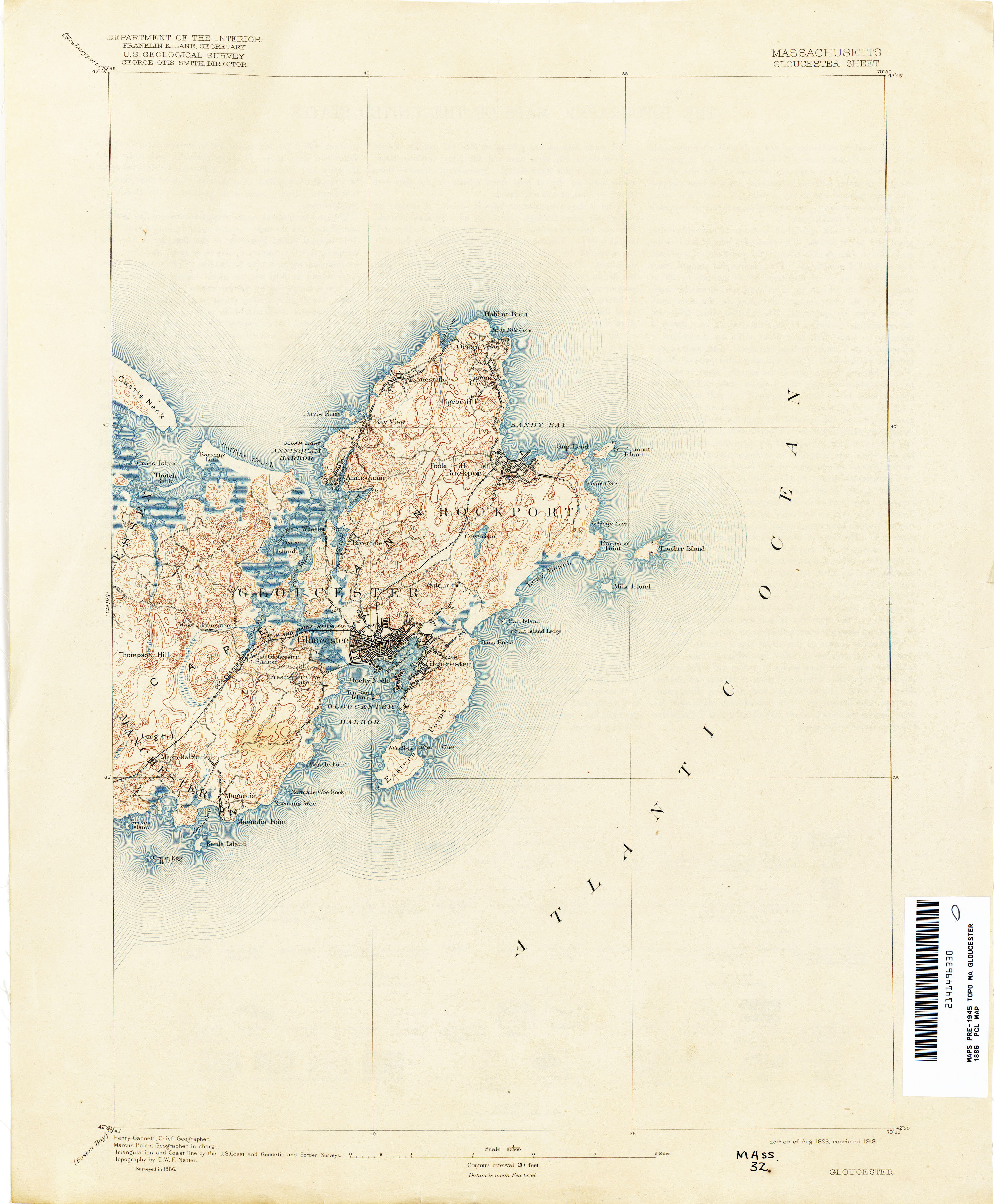
03/02/2014 -- Added piece of a topological map from 1886 (courtesy University of Texas).


03/18/2014 -- More thoughts on Cape Ann, Thomas and Margaret, and, not least, strawberries.

03/23/2014 - Cape Ann featured in Beacon Vol. IV, No. 1.

09/28/2014 -- A week ago, the record for the marriage of Thomas Gardner and Margaret Friar was discovered in Sherborne by John Cook of Minneapolis, Dorset files. This sets a type of focus. Looks as if some transcription work might be in order.