Showing posts sorted by date for query count rumford. Sort by relevance Show all posts

Friday, January 9, 2026

Small world, science

TL;DR -- The U.S. is at its 250ths in 2026 with the festivities and lookbacks starting in 2025. That was the time of the Declaration of Independence. The conflicts started the prior year and continued until 1783 giving us now several years to use to study specifics. While, we might add, dancing around the mischief to be expected from wide-spread use of this AI/ML thingee. And also, looking at going-ons in France related to Independence and science. 

---

We have been posting on the 250th for a few years with lots happening in 2025: Gardner's Beacon, Vol XV, No 2. This year, we see the thing that brings fireworks. What was that? Well, as we go along, we will pull forward associations with history and genealogy plus ties to science. 

We will introduce Rev. John Wise, inspiration for The Declaration of Independence. At the same time, we need to remind everyone of the extent of the conflicts. We will be addressing that mostly in the context of General Nathanael Greene and his Southern Campaign. 

All along, we have mentioned the 400ths and stressed the three major cultures: Spain; France; and the English. The first and last have been covered a lot. With the events of the 250th being followed by similar activity in France, we will be more regular in bringing in that cultural influence. 

Again, all of our activity will be influenced by history, genealogy (implying family, extended family, regions, and more), and science (starting with computational aspects which are now at the core of information and knowledge). 

---

One thing that we can do is bring into focus the U.S. contributions over the years. Let's take thermodynamics which is a core subject, too. We have addressed several persons: Count Rumford; and Josiah Willard Gibbs. Both are kin. The former, as a Loyalist, made his name in Europe where he went when things got hot here. But, he sent back money to Harvard. We will look at that further. The latter is a descendant of Thomas Gardner and is known for his mathematical contributions. We will mention him more.

For example, there is someone to know: Lazare Carnot. He was a French Army officer with a cool head. In the heat of their revolution, he was there and influential: French Directory. This topic will be of interest later. Now, let's look at his son: Nicolas LĂ©onard Sadi Carnot. His work in thermodynamics was only recognized posthumously. In this sense, he is like Galois who was  misunderstood during his time. Carnot probably needs more credit than we have seen; that is one of our goals - namely, research and report on this. 

In another venue, we are setting up a series of articles that will tie all of these notions together as we can use the time of the U.S. Revolution as the control and basis. Say, a classical view of substance. Then, we will come forward to the time of those in the boom era of Levi-Civita and Planck. Oh yes, do we need to mention Einstein? 

Too, we will bring in New Spain and the other major contributors to what became the U.S. 

Remarks: Modified: 01/10/2026  

01/10/2026 -- Reminder: Jane Austen was born 250 years ago. Same generation as John Quincy Adams. 
 

Tuesday, July 1, 2025

Rev. John Wise

TL;DR -- Everyone talks of the 250th. Wait a moment. That's a year away. And so, let's use the coming days to look at the Revolution in new ways that represent the marvels of the modern times.While, at the same time, look to the idiciocies that potentially loom and recognize them for what they are. We suggests a focal of the human variety. Aside: in 2026, we have the 400th of what became Salem. 

--

Now, we are a few days prior to the commeration of the signing of the Declaration of Independence. Lots has been written and said about that event. Some people have been mentioned (too many to list). Many (most) were not. Even Dr. Frank's look at the Siege of Boston only mentions the officers. 

And, at the same time, we are approaching one year to the 1776 event's celebration. Meanwhile, we can use this year to dig in. Sometimes, we'll dive deeply. Mostly, we expect to mention pending research items that would keep us busy for a very long time. 

So, this week's look back is from the timeframe of 249 years having elapsed. The 250th, then, is next year. What else is associated with 2026? Well, 100 years ago, Salem celebrated its 300th. You see, the country was too new to do the 200th. Besides, the War of 1812 had just ended. "Manifest destiny" was beginning to bloom. All of that is already on the list. The next year, we will specifically deal with the Revolution and the 365 days leading up to the big split on paper. 

Given the times, Salem MA sponsored a pageant which was a play about the early days leading up to the establishment of the Naumkeag settlement. Cape Ann has been mentioned a lot here; since last year, we are in a new era there as digital records indicate that some of the information might have been other than correct. Typical. 

Anyway, the Pageant of Salem was performed in the towns of Essex County and elsewhere. Of note, most of the characters were played by descendants. We can look at that closer. Too, many of those of the time of the 300th were descendants, too, of participants in the Revolution (both sides - warning, we also look at Loyalists - say, Count Rumford who gave money to Harvard so that that provincial institute could modernize - needless to say, Rumford and later Gibbs will again get time in the spotlight this year). 

Recently, we looked at a Roxbury (muddy waters, whatever, Suffolk County) family who married into a family at Ipswich (Essex County) or was it the other way: Gardner married Wise. In this case, Abigail Gardner was the sister of Mary Gardner Boylston. They were both grand aunts of a causalty (Col. Thomas Gardner) of Bunker Hill which we just looked at. 

---

Abigail married Rev. John Wise. Who is this guy? Well, large male. Harvard graduate. As we see, Reverend. Was in an area of what was/is known as Ipswich. That little place on the waters even produced seagoing vessels. The American spirit, so to speak. 

But, this is about John. He has lots of tales about him. One dealt with his early years when he was out with a hunting party. They ran into some Native Americans so as the potential for violence rose. But, John's party negotiated a wrestling match with John being chosen. The tale notes that the Reverend-to-be won and did so by throwing his opponent several feet in a remarkable feat of strength. 

Ipswich MA
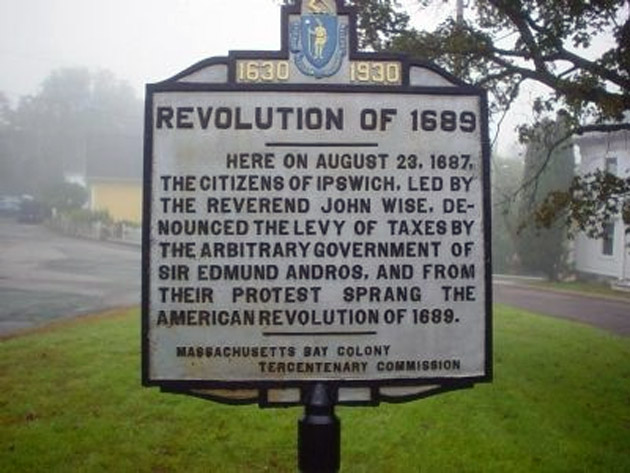
One can just imagine this guy. Not like John Adams who fled the farm to be a lawyer. Nope, Rev John was involved with physical labor all of this life. And, he was noted to be an inspiration of the Declaration of Independence. The image is about the 1689 event where the colonials rebelled against taxes. Mind you, from 1620 until later in the 1640s, the colonials were more or less here and living freely. We will look at what led up to this event. Why? When the Patriots were getting hot-headed (again, a cousin, Samuel of the beer), someone published a pamphlet written by Rev. John decades prior.  

We need more types like Rev. Wise, especially in the age with the digital illusions grasp people psychologically and wreck havocs on lives that way. And, let's count the other ways of mischief. Don't doubt that we can do this. Well, that needs to be our technology focus which will go forward with our arguing the importance of psychology and other studies that deal with humans. 

---

Aside: We have waited a whole for this: in 2026, we have the 400th of Conant's moving from Cape Ann to Naumkeag which became Salem: Massey's Cove. 

Remarks: Modified: 07/01/2025

07/01/2025 -  


Saturday, June 21, 2025

Harvard, technology

TL;DR -- Harvard goes back 400 as does our focus. Of late, they have free courses that are pertinent to current technological events. We appreciate that. But, we also call attention to the 250th and remind of Rev. John Wise who was the inspiration of the Declaration of Independence. 

--

I wonder how many students at Harvard know that the money to move the institution from a clergy-focused mode to work in the emerging senses of science and engineering came from a Loyalist who went over to the older realms and used his talents: thermodynamics; system engineering; ... Count Rumford (our blog post) will be in focus from time to time. Of course, Harvard did the legal side of things early, as well. 

And, early? We're involved since the beginning: The Hebraist. But, lots and lots of the family went to Harvard over the years; lots and lots did not. So, we will provide a balanced view of 400 years that led to that which we will be commemorating: The 250th.  

Now, technology will be a huge focus. The GenAI/LLM mischief of late is an example of things that could have been (were) forseen. How was it missed? We have a good story to tell there. Meanwhile, to change subject somewhat, Harvard is providing free access to courses dealing with AI and related. 

Now switching gears, of the 250th, we have not even reached the point of the real split, yet. That will happen next year where July 4th is one known day every year celebrated. That we have eight years to look at the turmoil and rhetoric and activities and more in a new vein, brought by the internet, is daunting to think about. 

We will look at parallel events, such as the 200th and 300th of New England (which was huge in impact on the culture) of the U.S. Here's an example, dealing with Rev. John Wise. His pamphlet was republished when the fever of independence was starting to grow after the French, Indian affair. 

Ipswich: John Wise

Disclosure: All kinfolk, directly. But, we will honor everyone of New England who was not given proper attention by history in the sense before technology. And, the sense means sources with known provenance as well as discussions about issues. And, technology? Can be tamed. 

Remarks: Modified: 06/21/2025

06/21/2025 - 

Sunday, June 1, 2025

2021, time of the pandemic, II

TL;DR -- Continuation of the pandemic theme from before. We look at posts from the remainder of 2021 and at the themes covered which are of a wide variety. 

--
Part 2 of 2 (Part 1). 

In 2020, restrictions changed our activity. Like most, we did computer work over the time of the pandemic but had been doing such work anyway. What was different was the focus. 

We looked more at local issues. But, we had anyway (to wit, our post of Flyover country). By 2021, we were rolling along and did more posts. Part 1 looks at those from Jan through Jun. Now, we'll pick up with posts from Jul through Dec.

The 250th came more into focus. We also spent a little time looking at S.A.R. which is the sons version of what the daughters did with D.A.R. But, AI started to come into focus after almost a decade of making headway (according to some views - the jury is still out) and claiming attention: Jeopardy win; Go win; modeling complicated lab work (Google had several of these); ... 

But, we had a post (Carving the land) which was motivated by our study of the activities out of St. Louis which was a hub for land management of the U.S and its west.  At the same time, Gloucester was approaching its 400th. We had an interest in that as the Dorchester crew came into that area in 1623. But, the great northwest? Michigan was approaching its 200th. 

Another twist was diving into the history of Harvard starting with an introduction to James Bryan Conant. He was a chemist and professor. He had wanted the Rumford chair. But, ended up in Europe and came back to become a Head of Harvard. At the same time, we decided that the long reach of New England was a theme of interest, as we had settled on All Things Gardner (22 Aug 1485) with respect to the many families with the name. 

Oh yes, AI was proposed for genealogy work. Again, that is an ongoing bit of study. But, we started to look at the genealogy of Harvard Heads. Many were of old New England families. D.A.R. found an interest in the 400th as well by starting work on identifying Patriot to Passenger (in this case, Mayflower) families. We took on Cape Ann to Patriot. 

Houses? While looking at the Dudley family, we got into houses of note. There were two in New Hampshire of interest. Both were built by relatives of descendants of Thomas and Margaret. One is now associated with the Society of Cincinatti. That brings up the other side of a coin. We honor the Loyalists of the family. Count Rumford mentioned above was a Loyalist who found success in Europe and left money to Harvard. 

The technology focus became more prominent. IEEE had an article: How dumb is AI? A few years later, we saw a general amount of interest. One observaton? Humans degradate themselves to make technology look good. Yes. Expect to see that theme periodically. 

A photo of the grandmother Dr. Frank (and 2nd great of Ann and her siblings) was found. We got that published. Generations? An eternal topic. Looking at this, we can say that the Revolution (250th now in progress) was done by the 5th generation. More on these. 

We picked up Dr. Frank's series on the Siege of Boston that were published in The Massachusetts Magazine, with issues four times a year for a decade. He started the series with Col. John Glover of Marble head. One of his vessels was the first vessel of the U.S. Navy. 

We continued our interest in rivers, as we mentioned in Part 1. The trails and railroads are always of interest, as well. But, jumping to technology now, we looked at John's favorite site dealing with the mathematics of physics. It was of the old style until a few years ago. The old stuff is still there and serves as the basis for the new. 

Aside, we are seeing lots of websites being done using new methods. Our prediction is that this method is not as stable as claimed and so have failures that are hugely visible and that will have negative repercussions. But, other than be aware, we have to wait and see. 

Why? If one looks at the whole campus of techies, there is no solution yet. Experiments have become a mainstay of life. But, take a plane, experiment types of these are not used to carry passengers. 

Remarks: Modified: 06/01/2025

06/01/2025 - 

Tuesday, February 18, 2025

Charles Horton Cooley

TL;DR -- The Economist is British and published weekly. We like their humor plus their take on matters across the globe. But, given that England is a large part of our history, we appreciate their in-depth reports on things over here. Recently, they mentioned Charles Horton Cooley. Per usual, we went looking. Hence, the following. And, the implications of all of this? Stay tuned. 

---

A recent issue of The Economist had an OpEd on the origins of  "soc med" and provided some details about engineering and science, in a humanist sense, and the messes of the internet gone bad. We like The Economist and read, at least, their double issue that is published in late December of each year. But, we sample issues from time to time. 

Charles Horton Cooley was born in Michigan. His father, who was the Chief Justice of the Supreme Court of Michigan was born in New York. WikiTree did not show data past Charles' grandfather. However, records at FindAGrave (follow links for parents at each generation) suggest that Charles is a descendant of early New England pioneers. That is of interest to our research from the historical sense. Too, Charles was a sociologist. He coined "social media" in 1897. 

Reading further, Wikipedia has an article (that needs a little TLC) on the "Looking-glass self" of Charles which considers how the concept applies to social media (his neologism) especially of the type that we see now, over 150 years later of meddling with life by science, engineering, and technology. 

---

Staying with the times, here is what Gemini (becoming a drag on Google - tsk, guys - I really liked Bard and its representation choices) says:

  • Charles Horton Cooley is credited with the term "social media," which he coined over a century ago in 1897, even though the concept of social media as we know it today didn't exist at the time; this is significant because his work focused on how individuals perceive themselves based on how they believe others see them, which aligns with the idea of how people present themselves online through social platforms. 

---

Now, we have been pursing the study of computing, since Kant, through mathematics, science and engineering without consideration of the "social/personal" sciences. Even though, we might add, that we see people as more complicated than anything that physics deals with in its fantasy (cosmology) or destructive modes (reductionist's grappling with wannabe particles and/or waves). 

About Kant? He was before the expansion of mathematics that happened in the 19th century. But, there was general increases in most areas of study during that time. We need know about that. Too, we are fortunate to have the American experience as a provider of threads for research. 

So, knowing things of his time (coincident with our Revolution), he stressed that we need to look at Reason as source of our abilities to know a priori and to cogitate from that in his analytic sense. All else is synthetic. Too, Kant was right on the target as he showed what modern theorem provers know: we cannot prove the existence nor the non-existence of God via logic (Kant's Prolegomena and Logic). It is a matter of choice. Right there? Free will. But, we will save this discussion for later. 

For now, please understand (Kant's emphasis) that the 400 years of the colonies that started the U.S. 250 years ago gave (give) adequate support for a new basis. Note, we are not using new science as did Wolfram. We just started to dig and can name four names of note in the American contributions: Count Rumford; Nathaniel Bowditch; Josiah Willard Gibbs; and James Bryant Conant. We could pick more (Peirce - father and son - Benjamin and C.S.), 

Notes: 

  • 1. See Charles Horton Cooley. The Social Self -- 1. The Meaning of "I", Chapter 5 in  Human Nature and the Social Order (Revised Edition). New York: Charles Scribner's Sons, (1922): 168-210.
  • On education, see our post on the Nobel influence. We will get more into that as the colonies (U.S.) took up education, in general, early on. There lots of things that were done in the U.S. of note beyond running after optimization which is freedom taken to an extreme and stupid as hell. 
  • 2. John's education was classical in scope (four years of Latin, mathematics, and science - ages ago, in high school). As such, he strongly thinks that education ought to be Liberal Arts and Sciences (and engineering - get those ones involved in learning about the world before they screw it up, please). This cursory remark will be expanded over time as we deal with the 250th and the various 400ths before that. The American Dream is more "light on a hill" than ruling the world. 
  • 3. Now, that the C-Suite is running after the illusion of GenAI wholehog, what can we do? Look at "humanist mathematics" for one thing. That is, we have to persevere in pursuit of truth across levels from atoms up to the ethereal. By doing so, we will get science and engineering back on track, as well, one might hope.  
Remarks: Modified: 02/18/2025

02/18/2025 -- 


Sunday, January 15, 2023

American dream

TL;DR -- John W. Gardner, of Stanford and the west coast, represents several things about the U.S. He is the second (or first) generation of his family. His life was exemplary. We have mentioned others of the same background (as in, immigrant after the early start) in posts over the years. So, we will make this a category as we proceed preparing for commemorating the 250th, starting in 2024 with the attempt in Boston to use the Harbor as a tea dispensing device. 

---

We already have several posts in this category; there will be more. This post will list a few below. 

Today, we will look at John W. Gardner. He represents several things which we will expand up. First, though, his name got our attention as we were looking at an organization, in his name, that has been supporting social issues. There was not much in terms of biography with family specifics. We found his father and mother. He died when John was young. His mother has been referenced by several names, so we will look at that further. One report had her name as Marie Burns. One Census had a different name. Second, he is of the west, having been born in LA. He went to Stanford. His father had been born in England, we surmise after seeing him referenced as an English gentleman. 

Third, John's life? He founded Common Cause after several roles in the U.S. government. For instance, he was Secretary of H.E.W. under President Johnson. We are being brief now as John had a remarkable life and served humanity several ways. He had two daughters with his wife of 65 years who he met at Stanford. She was from Guatemala. 

Now, his organization reminded us of the Gairdner Foundation that we wrote of early last year. We have a task of finding this type of representative organization to write up specs for our future. 

But, back to the "American dream" which is an important topic. Let's start with a list of posts where we can address this theme more thoroughly. Of course, John (Wikipedia) will be there. 

It turns out that the 250th and the 400th are of the same timeframe, as in the revolution start and the commercial colony inception. That makes things interesting going forward with respect to the span and scale of research. 

Remarks: Modified: 01/17/2023

01/17/2023 -- Correct the link to  Common Cause. Added link to H.H.S. (Health and Human Services) which was H.E.W. (Health, Education, and Welfare) until May 1980 having been established in 1953.  


Saturday, September 17, 2022

John Winthrop (educator)

TL;DR -- John Winthrop's post is imperative. He served twice, before and after the term of Samuel Locke, while he was a Professor, as well. 

---

We continue covering all of the Heads of Harvard (Wikipedia) with John Winthrop (Wikipedia) who served briefly before and after the term of Samuel Locke. With this post, we have covered all of the Heads of Harvard from Eaton (1636) to Cornelius Conway Felton (1860) which is a nice 200-year span.  

As we look at the Heads, we have done some research related to their families, mostly using WikiTree. The terms of Winthrop were in 1769 and 1773. Winthrop (WikiTree) is old Massachusetts being a descendant of the John Winthrop who came in 1630 with a fleet of settlers, many of whom were of families with old English pedigree. 

Later, we will post more about Winthrop's life.    
Winthrop died in 1779. More later (see following notes).

---

Notes:

1. John Winthrop was a Professor of Harvard. We mentioned him earlier with respect to the early years of Count Rumford who attended Winthrop's classes as a youngster and will follow that theme a little further. Just added notes to the Wikipedia Talk page with three references to Rumford, including mention of Loammi Baldwin who attended Winthrop's classes with Rumford. 

2.  ...

Remarks: Modified: 09/17/2022

09/17/2022 -- John Winthrop, like some of the others, is kin which will be an interesting bit of study. 'kin' covers both aspects, blood and collateral (say, in-laws). This is a common occurrence in New England that provides endless amounts of research which could only happen with technological assists. 

Sunday, April 24, 2022

Cambridge

TL;DR -- We have been looking at the History of Harvard as a way to study the history of the U.S. Several times, we have mentioned older universities. This is the first post dealing with the subject where we note that both Oxford and Cambridge have had ties from the beginning, back to Rev. John White and before. 

--

One of our research thrusts has been to parallel Harvard's experiences via looking at the Heads (with Benjamin Wadsworth and Urian Oakes as our latest entries) over the centuries with that of the U.S., its colonial beginning, and post Civil War accomplishments. But, we realize that we have to consider the old country in our analysis, so we will start to look at the Universities (Oxford, Cambridge) with respect to U.S. history. 

For instance, "Cambridge is the UK’s leading university for graduate studies in American History" and offers regular seminars to the public on the subject. On the other hand, Oxford claims "particularly strong connections" to the U.S. We have mentioned comparing events at Harvard over the years with its peers in the old world without being specific. Now, we are looking to use both. 

For instance, Rev. John White's education is of Oxford. On looking at his extended family, there are many from Cambridge, including Ann's ancestors. John Harvard was a Cambridge man; Harvard was modeled on Cambridge. 

The alumni list of both schools include many of the U.S., including modern day scholars. Of interest is, that of the first class of Harvard (1642), the majority went back to England. One of these was George Downing the namesake of Downing Street. They went back to an England in turmoil. Nathaniel Brewster studied further at Trinity College, Dublin and served under Henry Cromwell, son of Oliver. 

As well as current-event issues, technology will be a focus. One of our tasks is to follow technology over the four centuries as it evolved here and over there with quite a bit of disparity until after the Revolution. Too, we will look at classes and trace the influence of graduates. 

Reminder: Count Rumford about whom we will have further discussion. 

In the arts, we can point to Ezra Pound who was at all three places. In academia, the first Head of Harvard, Henry Dunster, studied at Cambridge. Stepping back to a subject still pending some attention, the prior Harvard Head, Nathaniel Eaton, was a Cambridge graduate who later earned MD and PhD degrees from the University of Padua. Those are samples from the modern era and from the beginning with lots of time in-between to fill in. 

Remarks: Modified: 12/20/2022

04/24/2022 -- 

Saturday, February 5, 2022

Rev. Samuel Locke

TL;DR -- Samuel Locke was Head of Harvard in the period prior to the Revolution in which he is noted to have been a Patriot. He is one of the neglected Heads about whom little has been written or has been lifted to public attention. Given that our 250th view of those times is coming up, we expect to spend some time looking at Samuel. He was from Woburn, MA as was Count Rumford. 

-- 

As we continue our look at Harvard, we have started to build a list of pertinent posts: History of Harvard (ours), Heads of Harvard (Wikipedia), History of the Presidency (Harvard), Catalogues of Harvard (Hathi Trust, mainly for the classes, years and graduates) and several posts in this blog concerning specifics of Presidents, their times, lives, and families (including information from WikiTree). We had been picking interesting Presidents due to their being pertinent to some point that we were researching starting with James Bryant Conant who had been mentioned in a New Yorker article in 2021. 

Grave of Samuel Locke
The subject of today's post comes from the period right before the Revolution which was 250 years ago, to which event SAR and DAR are  paying attention. Samuel Locke (WikiTree: Locke-1406, the Collection of his papers) came into his role in 1770 which was 150 years (six generations) after the noted arrival, but he had a short reign. 

Locke graduated from Harvard in 1755 during the reign of Edward Holyoke who has not been covered yet in this series of post (will be soon). Locke was ordained at Sherborn, MA. His Harvard position started in 1770 during a time of turmoil. We will look at that further. 

Locke has minimal information published about him in Wikipedia. The Biography at the Collection is much better and mentions his patriot stance in the Revolution. Locke was the first Head where we thought to look for information in the SAR/DAR databases and in the multi-volume Massachusetts Soldiers and Sailor collection; however, he died in 1777 (we will review other Heads of that time). The material on him given at the History of the Presidency site at Harvard can support more research. 

Future work will look at Woburn, MA, the birthplace of Locke. Benjamin Thompson, Count Rumford, was born there. Locke was followed by Winthrop, for a brief time. Thompson, when young, had attended, unofficially, lectures by Winthrop. 

Remarks: Modified: 06/28/2022

06/28/2022 -- Added link to post on Edward Holyoke. 

Monday, January 17, 2022

Samuel Webber

TL;DR -- Samuel Webber was a student at Harvard during the time of the Revolution. His term as President was in the period right after the split was accomplished and before the War of 1812. Those crucial times, 250 years ago, will be getting more scrutiny using new methods allowed by computing. That is, history can be made more relevant through personalization. 

--

Continuing the look at the History of Harvard (ours) through the Heads of Harvard (Wikipedia), we next consider Samuel Webber (Harvard, Wikipedia, WikiTree: Webber-762) who distinguished himself as a Mathematics Professor at Harvard prior to his short time as President. During his time, the secular spirit was rising and changing the character of Harvard. That topic has always had our interest which we will follow more closely now, given that we can identify family names to go with the discussions. One of Samuel's specialties was surveying which we have an interest in, for several reasons, such as Gardner surveying (early 1600s) and the carving of the west of the U.S. But, we want, as well, to get into changes with respect to mathematics during those times of turmoil, albeit more brainy than brawny. 

Born in Essex County, MA, Samuel moved with his family to New Hampshire. He attended Harvard as class of 1784. So his time matches up with the events of 250 years ago. There will be lots to look at. For instance, the Wikipedia bio does not agree with that of Harvard and WikiTree. Too, Webber is in our large extended family. Samuel was on of the Presidents of Harvard with little genealogical information available. 

His son married the daughter of a Loyalist. Great. So was Count Rumford whose money came in later. 

Remarks: Modified: 02/18/2022

01/17/2022 --

Thursday, December 16, 2021

Ralph Waldo Emerson

TL;DR -- How could a study of Harvard only point to a foreigner? Even if it's Dickens? So, to balance that, we are picking Ralph Waldo Emerson for several reasons. He had a long-term relationship with the institution. Too, he was there when the Count Rumford monies came in and changed things. He was in the Divinity School. And, juxtaposing these two talents has a lot of potential for considering the U.S. and its roles: past, present, and future. 

--

We got to Charles Dickens (1812-1870) from our study of the Heads of Harvard. On our first read of this material, we saw Ralph Waldo Emerson (1803-182) mentioned. After looking at Josiah Quincy, III (1772-1864) whose biographer talked to Emerson, it is imperative that we give him some attention. 

Self-Reliance 

Ralph Waldo Emerson (WikiTree: Emerson-46) was New England to the core via both parental lines. On his mother's side, he has Mayflower lineage. Emerson was in Harvard in 1817 when he was 14. John Thornton Kirkland was the President, at the time. That was about the time that Count Rumford's impact on the institution with his Loyalist's donation. Though, Emerson stayed true to his calling in the Divinity School. The secularization moves would come later. This has not really been addressed in our research, yet, but is on the agenda. 

With respect to Dickens, Emerson went to one of his talks and noted the obvious talent. That was during the 1842 visit. It was in the later visit by Dickens, in the 1860s, when the two had a chance to talk further. There were several commonalities, such as being abolitionists. And, they both had deep insights with disparate means of expressing these. Their two talents represent something that we have not learned to balance and must. 

A few mentions of Emerson by Dickens are noted in an article on Dickens meeting with Edgar Allen Poe. We mentioned Poe, earlier, in a post on Magazines. 

This is a cursory mention, mainly serving as a placeholder and reminder. We have been paying more attention of late to those who went west. Dickens bailed out at St. Louis. The travel was arduous. We really need to get the proper view back on what people did in the middle of the country to establish that part of the nation. With Emerson entering the picture, we can go back and look at the east coast over the same timeframes of the generations of the country. 

Reminder: Emerson is of the 7th generation. 

Remarks: Modified: 12/19/2021

12/19/2021 --  Put photo of Emerson with link to Self-Reliance. Actually, what I know now of Emerson and Harvard, the latter has dropped a load of sins. He grew up there, after his father died. For general purposes, we need to mention Walt Whitman. 

Wednesday, December 15, 2021

Josiah Quincy, III

TL;DR -- So far, we have looked at a few of the Presidents of Harvard which came about from our studying the History of Harvard with respect to the unfolding of the U.S. The visit of Dickens happened during the term of Josiah Quincy, III which motivated this post. Too, he is heavily New England on his mother's side which is a continuing theme for our research. As well, his term was the first one after the Count Rumford donations changed Harvard which, too, will be reviewed. 

--

While looking at the Heads of Harvard, we have been sampling somewhat driven by interests that map back to the mission of TGS, Inc. An important aspect of our mission is the 400 years of history from Cape Ann and the 250th celebration that is the focus of SAR/DAR. That is, history needs to be fleshed out with the reality of individuals and their families, in part. Of course, the total picture is larger. 

While looking at Felton (who is coming up for some attention), we got reference to a book which looks at the 300 years of Harvard (see History of Harvard). We found the Table of Contents. Lots to read, but Charles Dickens was one of those published in the book. Turns out that Dickens visited the U.S. in 1842. He was mostly in the east, lots of time in Boston where he liked the Harvard crowd, one of whom was Felton. An article in the Crimson noted who was there and met Dickens. A who's who which we could relate to having done this look at the Heads. 

Josiah Quincy, III was the Head at the time. We haven't mentioned generations yet with respect to these Heads, but Quincy was of the 6th generation (WikiTree: Quincy-306). His mother was of the Phillips family with a solid New England history. 

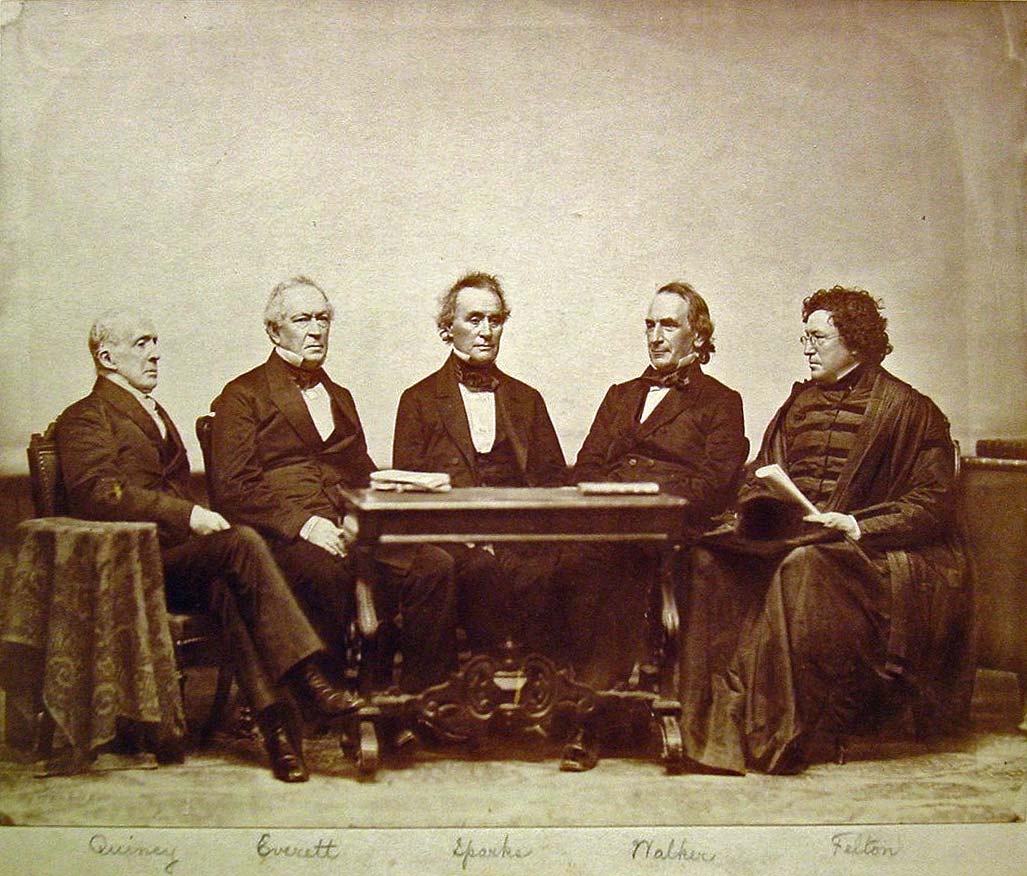
On Quincy's Wikipedia page, there is a photo of five Heads of Harvard. On the left was Quincy. On the right was Felton. The range of their terms was from 1829 (start of Quincy's term) to 1862 (end of Felton's term). That included the frontier years in the west prior to the Civil War. We will be looking at that history further using the Heads as guideposts.

Dickens' visit is only one of several events to consider. However, we need to mention the opinions that he wrote of American and Americans. Too, though, Dickens was quite perceptive. As an example, the below link is him writing about social classes which is very much apropos to the Harvard experience. Somewhat an aside, but not, as this was written during Quincy's term:
Too, it's apropos to the time of the year, where the Christmas Carol (written after the trip to the U.S.) gets attention, yearly. 

Remarks:  Modified: 12/26/2022

12/16/2021 -- Added the TL;DR line. 

12/26/2921 -- Some editing to make "The Haves and The Have Nots" stand out. 

12/29/2022 -- Benjamin Peirce was at Harvard and is listed as one of the few mathematicians from the USA in the XVIII Century. Quincy encouraged him; Benjamin became head of the mathematics department. 

Saturday, December 11, 2021

Charles Dickens

TL;DR -- Dickens visited the U.S. twice. The first was in 1842. He liked Boston and Harvard. At a site that offers Dickens-related material, his view during the 1842 visit of some people of fame can be found. He noted the American ways, good and bad. His western jaunt only went to St. Louis. On a later visit after the Civil War, he mainly read his writings at eastern locales. The west was still too wild. Dickens's views will be more apropos than those of the aristocrats who visited, too. 

--

We got to Charles Dickens (1812-1870) somewhat in a circuitous manner. We, briefly, looked at Cornelius Conway Felton as one of the Heads of Harvard in order to assess information about him. Neither Wikipedia nor WikiTree had much. Lots of these profiles seem to be ignored; so, we will table Felton until we look at a few other administrations. 

On further search, Felton was mentioned in relation to a publication: The Harvard Book. The record on archive[.]org is only the Table of Contents. Dickens was included. On browsing the content list, it does look worth while for further reading. 

So, that led to a search on Dickens and Harvard. One article was published by The Crimson (A Moist and Oystery Twinkle: Charles Dickens at Harvard). This visit was in 1842. The article mentioned that Dickens loved three things about Boston, "its literature, its oysters, and its Harvard men."  And, the article mentions the people who entertained Dickens whose names we now know due to this research. Felton was mentioned. 

When Dickens ventured outside of Boston, Felton went with him to some areas. Dickens went further west; that is something to look at. St. Louis was as far as he got in the 1840s. Travel was arduous. Wherever people had started to settle there and further west, but it takes time to develop facilities. 

A wonderful site covers the authors two visits to the U.S. and his other ventures: The Charles Dickens Page. Technically, we really like the layout of the site which is loaded with information and will be using it as a resource for our work when Dickens applies. 

Dickens' travels, 1842

The first trip was in 1842. Missouri was all of twenty years old. One thing about the above site is that Dickens wrote of his travels. The Dickens site has made these writings available. This is the page on Travels in America and Canada 1842. Sites up to St. Louis are on the list and covered. But, here is Dickens on St. Louis. As mentioned, that was his furthest point west. 

On his return trip in the 1860s, post the Civil War, Dickens did not even venture out of the east. This is the article about his travels: Charles Dickens in America 1867-68. A table provides some detail about the itinerary with some notes. These are not as extensive as he did with the 1842 trip. He was older. Also, he was reading his works. He got to DC but the furthest west was Niagara Falls. 

The following are links to related articles provide only for reference. 

It's great to hear of Harvard and Dickens repairing the ties that bound the old and the new English cultures. After all, there were still some conflicts going on in the 1840s as Canada served as the means for friction. The boundaries of Oregon were not settled until 1846. 

Too, in 1842, Dickens was meeting the upper crust Americans who really had no counterpart in England. In fact, that type of dynamic is still with us and motivates some of our work. Over the 400 years of the U.S., all sorts of social and cultural issues have been a hotbed of conflict some of which we still see as unresolved.

So, actually, it is great to run into Dickens and his two trips. There is a more real flavor to this than we saw with the visits by the French aristocracy (say Lafayette's Trail).  

Remarks: Modified: 12/16/2021

12/15/2021 --  From the home page of the Charles Dickens site, one can branch to pages related to many themes. Dickens' work was quite broad. So, not only are there many links, it can be difficult to follow all of these and not get lost. That's why 'search' was created. But, in the first article there is a link to material related to his Travels in America with information about the 1842 and the later trips. This Remarks contains major pointers to remember with regard to browsing on the travel theme. 

12/16/2021 -- Added years to Dickens (which helps place people with their generations - multiple as we will explain). Also, Ralph Waldo Emerson needs attention. He was around Harvard most of his life. Too, he was there, as a youngster, about the time that the Count Rumford monies arrived. ... At the Crimson article on Dickens, a comment mentions Dickens' opinion of the American Titian: Washington Allston. Mentioning this due to our early look at an exhibit: Titian at Isabell's place. 

Henry Dunster

TL;DR -- Henry Dunster is the 1st Head of Harvard, coming in not long after Nathaniel Eaton's tenure was ended. Dunster had fallings out with the Puritans, as well. 

--

We have been adding Heads of Harvard to a list while taking an initial look at each with respect to time and affiliations, including family and New England. Our research started with a recent one, comparatively, and we have done a few more. But, we missed the first one and are correcting that oversight with this post. As mentioned, we mostly are using links, in our posts, to Wikipedia and WikiTree for the first pass and will be diving deeply into the term of each along with our review of U.S. history from the time of the revolution until the time that the frontiers were mostly settled. That get us from 250 years ago (plus or minus a few years) to the early part of the 20th century.  

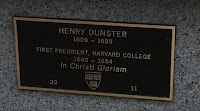
Well, our list of heads is in our post titled History of Harvard. We were adding numbers to show where there are still gaps and noticed that we ought to include #1, Henry Dunster to anchor the list. Dunster held the position from 1640 to 1654. He took over after Nathaniel Eaton found himself facing the first American cancel culture. We need to discuss that and will, at some point. 

Dunster came over in 1640 after teaching for a time. He earned his bachelor's and master's degree from Magdalene College, Cambridge. Dunster experienced some controversy in conflict with Puritan views which led to him leaving the position in 1654. 

Henry Dunster (WikiTree - Dunster-36) requires a little work on his Profile. But, that there is a lack of interest in researching seems apparent for some of these profiles (we have only looked at a small set of the total). 

We will get back to his term as we look at a few more profiles and establish a framework for our study. We started this review with Count Rumford's contribution as a key item. However, going back before the U.S. Revolution will require more concern about English culture and its influences.  

Remarks: Modified: 12/15/2021

12/15/2021 -- Added the TL;DR line.  

Friday, December 10, 2021

U.S. and Harvard, I

TL;DR -- Looking at Harvard goes from 1636 to now, and one could think about the before times as well as what's next. Our interest is partly personal due to having connections over the toto of the life of the country and the school. Too, though, the U.S. might have started on the coast, but it has filled in a huge continent (or part of it) over these centuries. It was a mere 200 years ago, when the carving of the middle was the vogue and had everyone's attention. Well, not, as most who left the busyness of the east coast became unknowns out here. The recent Head's life motivated this review which is intended to be a usual affair as we go along. BTW, us is the US and its folks. 

--

Having started to look at Harvard and its ties to the U.S. (which is us, the people - not just the brainy who need to be fed and told how to move one foot in front of the other -- as the embodiment of that notion of Winthrop quoting the Bible about humanity needing a 'light' or two, whether on a hill or not is immaterial, though we love lighthouses and gaslights) that we all live in and try to know, from several perspectives, it appeared useful to consider the 32 Heads of Harvard over the almost 400 years of its existence. 32? The official count is 29, however we added three. Two of these were in an interim position, for more than a year. So, they count. Then, we have the first one who is mentioned already in this blog. 

Note: There is a note that John Winthrop served as acting Head on two different occasions. So, the count would be 33 Heads. Winthrop is a descendant of the original Governor and taught Count Rumford in his youth. Other acting presidents are listed (Presidents of Harvard). 

See this post, History of Harvard, for the list which has a few names on it as of now. Of course, an early one was James Bryant Conant. It was a New Yorker article that got our attention, so we went to look at New England and family ties. From that, it was easy picking from various areas. For example, an important time is when Count Rumford funded Harvard's efforts at becoming more secular. John Thornton Kirkland was there at the time, but we have other names to run down. It seems like the Pearce family was more involved with setting up the technical focus for the institution.  

While doing this work, our principal modes of information are Wikipedia and WikiTree, both of which we support via editing and usage. But, we go to other sources, to boot. Right now, we look for and find New England connections, where we expect that later folks may have tenuous links in comparison with those from the early ages who would have had closer ties. 

In fact, our last two Heads were related, with Samuel Willard being the great-grandfather of Joseph Willard. We have been picking people by name and noticed the two Willards. Will there be others who relate more closely than New England cousin? As well, we expect to follow threads especially as we consider the frontier. Too, Harvard ties will hit all over the place and ought to be interesting for several reasons. 

One of these is U.S. history as it relates to its future. We have been dealing with the frontier for two years now (U.S. Interior) with respect to families. Many were new arrivals; lots of patriots were 1st or 2nd generation in their family. New England patriots were mostly the fifth generation. 

Presidents of Harvard

However, our net will be cast wide. The U.S. has many aspects of its history that never got attention. Part of this was technology. However, part of the oversight is due to the ruling mindset. The internet will allow more freedom. Actually, it'll allow more effective means for research. We already see that with the genealogical and historical approaches with family data. That is both good and bad. 

But, like with brainstorming, we look at things in order to get sufficient material to make those assessments that are necessary for maintaining society and sanity. What follows might seem wide-spread, or too unfocused, but it is not. Rather, it represents a mere scratch on the surface. Digging deeper? That is always a choice for which decision theory, hopefully, will be helpful. 

So, this post is motivated by noticing that Nathan Pusey was the next Head after Conant who was a descendant of Roger Conant of Cape Ann and Salem. It looked like Pusey's heritage was principally from Pennsylvania and the south. Then, the family moved west. Pusey was born in Iowa. His extended family was scattered around in that area west of the Mississippi. 

When did the family arrive? On a closer look, we can see that his paternal ancestors were with William Penn in the late 1600s. Some have done genealogical work on Pusey's; we will be looking into this further at some point. We had noticed that some of the Heads have very slim information about them, as if there is some popularity aspect that determines interest. 

Well, all of these Heads will be important, as we step through the many generations. Fortunately, we have family involved with Harvard, as well as in-laws and friends. So, personal motivation will help fill in the historic look. 

Let's consider this little tie. Pusey taught at the Riverdale School in New York City early in his career. He is mentioned in the 'Notable staff' section. Looking at the 'Notable alumni' section brought up several names that are of interest. President JFKennedy and his brother, RFK, are on the list. The school started in 1907, so the names are fairly contemporary. Others of a wide variety are Ratan Tata, Carly Simon, Cesar Romero, Steven Mnuchin, and others. 

But, so was Lawrence Ferlinghetti an attendee of the school. He is well-known for his literary work and his book store in San Francisco (City Lights Bookstore). Given our focus of late, what caught the eye was that his wife was the granddaughter of Edmund Kirby-Smith. Families went south and then west. Some came in and went west, like Pusey's. And, when west, there was the huge U.S. Interior involved which took over 100 years for a frontier experience to not be the norm. 

His folks were from Connecticut, but Kirby-Smith was born in Florida. After attending a military academy in Virginia, he went to West Point and served in several military campaigns. With the start of the Civil War, he was a superior officer. By the time of Bull Run, where he was wounded, he had held several positions of General Officer. After the war, he had several positions, ending up as professor of mathematics and botany. 

According to WikiTree (Smith-39301), his tree is fairly well filled in with lots of Connecticut connections. However, there are Massachusetts connections, as well, including Essex County. This is an example of a New England family from the north going south. Many had done so much earlier. 

One might wonder about the Harvard association as it seems fairly weak. But, it is not, just like the reference to West Point is there constantly when we look at the military history. Harvard is part of that long-arm of New England which threads heavily from one coast to the next across the large middle. And, then, of course, U.S.ers were very much active overseas from the beginning. 

Lots of things to look at and ponder. 

Remarks: Modified: 12/11/2021

12/11/2021 -- Add image for our portal (to truth).  

Monday, November 22, 2021

Favorite site

TL;DR -- Considering technological issues related to computer systems some of which are exhibiting, supposedly, behavior that might be considered intelligent. Some of these systems handle language interchange with humans, somewhat. On the other hand, we have the example of educated humans who grasp lots of material with an understanding that is apparent in effective action. Versus, the more focused modes that we see with computer systems. The debate continues. In the meantime, we can see slow progress with respect to computer-based information. A long-time example is provided. 

--

We have had several posts on technology over the years in a general sense. We have also taken up the them of History, Culture, Technology. And, we have several times remarked about content versus configuration in terms of knowledge management. The computer has really changed the landscape. 

We started in 2010 using Microsoft's Office Live. It was two years later that they switched to Office 360 and pruned out lots of small business systems that had developed. We are to where we want to incorporate an ecommerce flavor, of sorts, but our focus is research. WikiTree is sufficient to support our genealogical needs. How to handle the rest of the requirements is a recurring them? Associated with this is the issue of what are the requirements. 

Since the introduction of the smart phone 14 years ago, we have watched the evolution. 'apps' were one major enhancement (for better or for worse is to be discussed) with wide-spread ramifications. We just got our first smart phone a couple of weeks ago which will help hone our research. That is, the platforms for interface are several, but we have three as a focus, at the moment: mobile, tablet/laptop, desktop. Other platforms? The whole of the gaming theme, including the 'meta' dreams of Facebook. 5G and IOT as frameworks for the future are a big deal. At the upper end, we have the huge systems doing massive computing. We have to mention the cloud which is not to be without huge farms of computers dealing with distributed systems in disparate areas and across a never-ending landscape of information. 

Got the drift, yet? I may have mentioned this once, but the Gairdner Foundation was an inspiration when first seen years ago. It was started in Canada by a Gairdner gent from Scotland. Their focus is medical research for which they support work and offer prizes for results. This is a huge domain. 

Computing? It's larger, for several reasons. For one thing, it's supportive of everything. Like IEEE.org says, their members have been involved intimately with all advances in technology of the past century. Then there are all of the issues related to 'smarts' with respect to computing. I already mentioned the 'smart' phone. Another topic would be AI and its association with knowledge and autonomy of artifacts. Of note are the discussions currently looking at the various subjects. Lines are being cast. 

Our focus is the U.S., principally, with New England a key topic. A large part of our history has been technology as it evolved in our timeframe. The past few decades saw an acceleration where American ingenuity influenced the world. Of late, China has made inroads which will be discussed. For now, this image is from the Communications of the ACM, Nov 2021. 

There are several articles to discuss, such as this one reviewing NLP with respect to the historical work plus enhancements that accrue to applying modern techniques: Knowledgeable Machine Learning for Natural Language Processing. 

In the larger picture which deals with complexity and thereby limits to computing, technical perspectives article provides and overview and arguments for MIP* = RE. This has direct implications related to the need for management of expectations. 

One might argue that AI AIn't. In the general way of progress, hype has been let loose of its restrictions. Mind you, much misinformation is out there. Where does one go to find any type of truth? Well, that is one thing that we can help with. Our little portal is meant as a means to define, discuss, and determine matters that go to the core, even with regard to our very essence as humans. 

So, let's put here a little bit of text from a discussion. This from a post by Prof. John Baez with regard to thermodynamics as seen from an introductory framework (Composited thermodynamics). 

I'm sure there's much more to be done. But I feel happy to see modern math being put to good use: making the foundations of thermodynamics more precise. Once Vladimir Arnol'd wrote:
    • Every mathematician knows that it is impossible to understand any elementary course in thermodynamics.
I'm not sure our work will help with that---and indeed, it's possible that once the mathematicians finally understand thermodynamics, physicists won't understand what the mathematicians are talking about! But at least we're clearly seeing some more of the mathematical structures that are hinted at, but not fully spelled out, in such an elementary course.

How this relates to the above is that thermodynamics has been studied for a few centuries now. Count Rumford was an early researcher. AI? Modern to its core. Most classical views that might relate are not consider. Or, have not been for several reasons. But, the computer and changes to cognition can be observed. We are too new to this game to know as much as we are assuming. 

Be that as it may, finally we can get to the gist of the post. Favorite site? It has been mentioned several times in posts (Culture, History, Technology). Prof. Baez started blogging in the 1990s using the blogging mode in vogue at the time which was the minimal type of framework. He kept at it until about ten years ago. Reminder, this blog dealt with advanced mathematics of the highest order with embedded images and many equations written out in a textual format. The message got conveyed. 

When he transitioned, he left his old blog that was full of content which is one of our themes. And, he went to WordPress (Azimuth) which we have been using, somewhat. Seeing him work with both the old and the new is encouraging. 

Right now, we have two sites. We will transition to using the new (https://TGSoc.org) while we work issues with regard to re-configuring and adding in new facilities, such as ecommerce functions. 

Remarks: Modified: 08/12/2023

12/10/2021 -- Added the TL;DR line. 


Wednesday, October 13, 2021

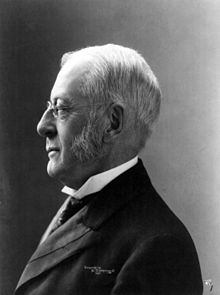
Charles William Eliot

TL;DR -- CW Eliot's name came up earlier when we were looking at the effects of the gift to Harvard by Count Rumford. At that time, we merely noted that CW wished to obtain appointment to the Rumford Chair put into place by Benjamin Peirce (cuz). CW did not get that and went to spend time in Europe. That little sojourn was instrumental in later changes to Harvard that CW accomplished. Also, it was in the reign of CW Eliot that Leland Stanford came to talk using money to endow education. 

--

Today's browse brought up a familiar name which got us looking closer at the subject of Harvard in Massachusetts, in New England, in the U.S. and in the world. Earlier, we had posts that looked at James Bryant Conant (1893-1978, #23 1933-1953) and, then, John Thornton Kirkland (1770-1840, #14 1810-1828) due to topical reasons. Notice the numbers on the 2nd timeframe for each. It is their order in serving as Head of Harvard (see History of Harvard). Too, though, notice the time span with respect to their deaths which was over a century. We just looked at that. 

As the name that came up was Charles William Eliot (1834-1926. #21 1869-1909). Given the gaps that are still there, we have several more names to look at. The next one will be considered for his role in the split whose 250th is coming up (SAR/DAR). 

All three of these gentlemen are of early New England heritage, have family ties with Ann, and played a role in the History of Harvard. For instance, one ancestor is Thomas' 2nd wife, Demaris Shattuck. His WikiTree Profile is sparse to say the least. 

Charles was initially of interest for two reasons. There are more that will be looked at. But, he was a candidate for the Rumford Chair. The money for this came in during the time of John T. Kirkland. We will look at that from several angles dealing with the Count's work and writings plus topics still pending some type of discussion. When Charles did not get the chair, he went to Europe for a couple of years. One thing he looked at was the roles of the university in the culture. His study experience prepared him for his long tenure and resulted in his leading Harvard to the future. So, lots to look at there as we are on the verge of changes that are even more drastic. 

---

His biography at Harvard Square Library provides a wonderful take on Eliot's motivations for change. 

Remarks: Modified: 09/01/2022

10/30/2021 --  Added the TL;DR. 

12/11/2021 -- Added link to History of Harvard.

 01/06/2022 -- Leland and Jane Stanford visited Harvard in Eliot's time. Oh well, kind of liked the 'hick' story. Stanford, yeah. 

01/07/2022 -- Eliot started the Gold Coast scheme for housing which was halted by Lowell. ... Tributes to Charles William Elliott (The Massachusetts Magazine, Vol. II, No 2) by Edward J. James, Booker T. Washington, David Starr Jordan, Cyrus Northrup. 

09/01/2022 -- While doing post for Jared Sparks and James Walker, we ran into the Harvard Square Library which keeps us aware of Unitarian ways and their benefits. Harvard plays, specifically, in this arena. The HSL is now a regular resource. 


Thursday, October 7, 2021

Connections by WikiTree

TL;DR -- After much consideration, we expect to use WikiTree going forward for several reasons. For one, what we have seen so far is excellent research and genealogically sound methods. Too, it's more than menu driven. In this sense, the world has bifurcated into two types (nuances, of course): GUI-framed and textual-logical. This applies to content as well as to programming. 

--

This post seems a little repetitious but isn't really. After a bit more work, we will get more of a focus on WikiTree until something better comes along. Based upon what we have looked at, that might take awhile. So, we need to move forward. Along with the attempt at a database, we will recognize the work done so far at collecting information. Example: Empty branches on the family tree (category/Gardner). Put in a comment today (October 7, 2021 at 11:19 am) pointing to Thomas & Margaret as well as to a Coleman query. 

We first saw WikiTree in the 2014 timeframe as we were looking for places to put information about Margaret Fryer that was recently discovered. We didn't hang around long, except we put, in the main menu, a link to the Thomas Gardner profile on WikiTree. Later, we got back to the site and have been helping with the edits of Thomas' Profile as well as that of Margaret Friar. 

About WikiTree, they have one Profile per person which everyone edits, similar as one does with Wikipedia. If a duplicate gets made, easily done by error, then Profiles are merged with nothing being lost due to the methods. That is, WikiTree tracks changes through time very well (what change, when, by whom and reason). Today, we saw their blog for the first time. And, one topic was the Connections function (17 Dec 2019), hence this post. 

This image is from a post that asks: Have a Connection, do you? The Force is strong in this post. There are some example queries that show relationships between actors. 

In terms of using WikiTree, we used the occasion of getting Dr. Frank's hand written notes about his mother's pedigree to link him to existing trees on WikiTree and to get familiar with the ways and means of the site. 

As we got more familiar, we now used WikiTree almost daily. Example: John Thornton Kirkland (Head of Harvard when two things happened: Transcendental modes via Emerson and friends; Count Rumford gave money to establish a technical, engineering, and scientific framework - the Peirces were involved). 

In a sense, we actually used WikiTree almost like Wikipedia. That is, the first stop on a journey on some new person or subject. The trouble can be that WikiTree is more tightly controlled so that one doesn't find the conjucture-fluent world such as that of ancestry. As one researcher noted, these things are hints and, perhaps, some old map to be updated. 

To other views, these are examples of group work where contribution is noted, managed, and rewarded where we get something of use. Guess what? A recent The Economist (Brit-humoured attempt at looking at the world's economy every week - they call it a paper - the only place where the contributors are not named) bemoaned the situation of the web (Silly Valley's disinformation bucket - okay?) and noted that one shining start was Wikipedia. Yes, indeed. Saw that back at its start. And, remember in the 2008 timeframe discussing this; academics were dissing the instrument; many pages now are done by the experts in the area, including academics. 

We'll start a WikiTree category when we clean up those references. However, they did offer this Connections function (app). Here are a couple of examples: Dr. Frank and Henry VIII, Julia Ward Howe. The latter was motivated by an article in Wall Street Journal about an American hymn. As such, we showed some relationships between people somewhat following the Famous Kin mode. 

Note, though, that the links are not only of direct relationships which is nice, actually. As collateral families and their associations are part of the social fabric that the people we are studying live in. So, that is important. See the Dudley post for a discussion. This family started early to study these relationships. One motivation would have been to sort things out. As in one line, there were two instances where a Dudley descendants married into an existing family. So, we have both the part-sibling and the step-sibling occurrence. 

As an aside, seeing that got us thinking of the Mayflower Pure post which was misunderstood. In the line just referenced, there were two instances where one missed the Dudley link. Not that there were not others. So, those were Dudley pure instances. We really need to discuss this type of thing. Again, Mayflower Pure was to represent a line that came through 400 years of close association with MF families and no taint of that blood entering the line. And, we mean, lots of generations in the same locale. Miraculous is the word. Now, let's look at the characteristics involved more closely. That is, it's on the stack of research subjects. 

Remarks: Modified: 10/07/2021

10/07/2021 --