Showing posts sorted by relevance for query chatgpt. Sort by date Show all posts

Sunday, February 19, 2023

Technology and its influence

TL;DR -- Following up on our theme, we look at a recent bit of controversy from a deeper than normal position. Computers are nice to have for many reasons. They can be problematic. Just like technology being great when it works, so too are computers. Given problems, then results can range widely. With numbers (say, your bank balance), we have come to expect accuracy. What if the computer system could not provide this? Ought it be released? 

---

We have noted that technology has been a huge influence on our lives, for the most part good. But, that is questionable if one looks at all of the side-effects of change with consideration for ramifications. Like, why are whales washing up on shore now? It's too early to tell, but we can go through the whole litany of issues seen. Ought to, perhaps, with the expectation that computing's list would be long. 

Especially is this so if we start with the internet's start which we could put at 30 years ago, about, if we assume the release of the protocol and its being handed to the public. We can look at more than the 'wild west' emergence in the cyber real, and its accompanying, real space, for one thing. But, there are many things to look at. 

Engineering works to improve which we have seen with hardware. Again, though, reuse is nil which can be seen with the piles of computer junk everywhere. Software, even, grew more mature using other types of engineering practices. 

Machine learning has been in the news of late which hoped to demonstrate that the computer could learn on its own. This post is about one example of that which has been much in the press, lately: ChatGPT. There are others that are now ready to go (with respect to the opinion of the team doing the work) or coming up quickly. 

OpenAI pushed out ChatGPT, perhaps premturely, in November. We didn't pay attention until last month. The news reports have many articles about misuse or downright errorful ways of the thing. The USA Today had a headline this week that Microsoft was putting ChatGPT in its Bing product (rival of Google's Chrome and replacement of its Internet Explorer) but is doing so without any guarantee of accuracy (see below). Marketing types are touting that they are using the thing for the creation of ad material. Students are trying to use it for essay assignments. Some are trying to do software using it. 

Then, we have the associated work related to fake photos and videos being created, many times without any warning with respect to the reader about provenance. Does truth in advertising mean anything? The below is about fake math which is easier to see, as text is much harder given the power of language. 

Now, this example came from noting that a younger person wrote that they were making progress learning Calculus 3 via  ChatGPT. Oh? After a few queries to clarify the matter and making a few suggestions to stay safe, we went to look at this part of ChatGPT. We have already seen the code generation aspect and were going to try it out, in an experimental manner, as since John had done something similar a couple of decades ago. 

Well, where to start. Calc 3 is too advanced for a beginning look, so we dropped down to Calc 1 & 2 which would be fundamental. We asked for the 'integral of sin theta' which was phrased this way due to the conversational mode that is being emphasized as a benefit. Well, math is terse for the reason that it is difficult to write something similar to a complicated question in a natural language. Too, we have decades now of work on computational mathematics which was to be somewhat the ground truth in this matter since it is a creation of humans with lots of time involved in making it right. 

But, on taking in the query, the thing (CP for ChatGPT) did not just say that it was '-cos theta' but added in some verbiage about the indefinite status of this result and why it had to add in a constant. That's fine. Tables of integrals have been published almost from the beginning. Some are quite extensive. Too, some of the rules are known. 

ChatGPT
and a trig example
Now, one huge question is whether the rules are explicit enough to invoke proper action. The analog here? Code. It is explicit, given the framework. Some code is more involved than others. But, all of them shuffle down to something that the hardware can use to do its thing. 

And, machine learning (ML) using books would have seen these tables and rules. Now, what we need to look at is what the ML did with what it saw which involves transforms and iterations and some clever tweaking. The guidance, supposedly, for this work is the human brain. We cannot fall into that argument's pit; the equivalence is not there, except in a very limited way. 

What would be the next step? Mind you, we had not thought to refer, yet, to the experts and their systems that one can see on the computer. We went looking for something gnarly but not too much so. As, we would have to verify the result given by CP. We saw this example, as it was being explained on youtube. 

Namely, the function that was taken to use: arcsin(x) * arccos(x) * 1/x. The query would be to get the integral of this. Now, text input, right? And, not thinking of converting to some code'ish mode, we put the query in using a verbose mode. Again, there was no thought taken for the limiting constraints that would be part of an actual calculation. 

The query was something like this (the actual logs were saved). What is the integral of the arcsin of theta times the arccos of theta divided by theta? CP repeated the input in a more formulaic mode. This was to confirm having parsed the query correctly. Then, CP started to explain that it would do integration by parts and started down its path which turned out to be fairly long. That was unexpected.

Why? We are talking an approach where a model gets developed from the processing of the data. Then, a query would consist of extracting (via clever means) an answer. 

Now, as an aside, what got everyone excited about these things is that they won games. And, in some cases, they learned the game by looking at the rules. Or, more of note, by studying data related to a game, discovered the rules and even beat human experts. Winning the Go game is an example of the shock value of this approach. Only the brainy were good at these games. 

Also, this technique is not new. What is new is better systems plus less emphasis on the cultural norms of systems development which can be explained. In the lax environment, the thing could venture in spaces where humans never went, thereby finding out things that humans would not have seen. 

Well, actually, that is a benefit of computing that we need to exploit. Take chemistry. The computer allows modeling of lab experiments in numbers not possible in reality where time, costs, resources, and a whole lot more bear on, constrain, the situation. Too, we have to take on some faith that the computer simulation has meaning. We, as a whole, lack experience in that area since it is so new. And, this is to be discussed further. 

So, CP pushing out its steps (almost trace) was bothersome. For one thing, reading and checking these type of things consumes time and energy. It can be done. Engineering students are used to this. In the past, hand calculation was more the way of learning than now. As we considered the potential for a growing pile of computed stuff to prove, our thoughts went to Sisyphus and his lesson for us. 

The computer can spit out a new universe. What's to believe about it? And, then, how do we prove something? Oh, that's the crux of the matter. We will discuss truth engineering as one factor, but this is a hard problem that will get worse. 

So, we did two things. We went to Wolfram and did the integration. However, something reminded us of the huge lack. Gaming and all of those non-real computing experiences might have numbers, but they really have no meaning. On the other hand, real-world requirements demand proper use of numbers with respect to measure. Whole theories and practices deal with this topic. 

Too, we humans use numbers quite extensively and readily. But, some means are better, say algebraic analysis, than others. Again, this is a known area of research and practice. So, the notion was to move away from the indefinite mode and get definite. That means to put limits on the integration which relates, in this case, to determining an area. The interplay of geometry and algebra is core to calculus (and its companion of old - seemingly lost - of analytic geometry). 

Wolfram calculated the area. Well, we went and found another on-line calculator. BTW, these tools follow known mathematical principles and can be tested. In fact, software engineering is a common mode of program management for this type of system. Something that does not perform correctly will be noted. And, corrected. 

Now, the graphic shows the 'sin' integration by the three parties: Wolfram; Integral Calculator; and CP. They all agreed with the number for the area which is reported on the first row. The second row has the results of the more gnarly function which actually is quite simple. It behavior at the limits is what makes it interesting. 

Now, for the second case (row), Wolfram did a symbolic calculation. This is the equational manipulation method which produces exact results if done correctly. These two examples use trig functions that are well known. BTW, there is a book from the government that give standard mathematical usages, values and more for use by those who need to used mathematics. In one of these, the derivatives (which are the results of integration - in a sense) are given in only a few pages. Going the other way, from the derivative to the integral has many more pages due to the complexity. And, trig functions account for lots of these pages. 

The answer by Integral Calculator agreed with Wolfram. But, with a twist. That attempt bailed out of the closed form solution (so, kudos to Wolfram for following through) and did a numeric solution. Now, those are the two major themes for math solutions. Proof theoretic modes are being ignored, for now. One can algebraically solve something. The answer will be exact. Or, one approximates through techniques that grew up with the computer. These methods are harder as they have to be highly detailed through the process. 

We used an example, formerly (four decades ago?), that dealt with a guy spending 10 years solving a system of equations. This would have been a mixture of symbolic and numeric. Then, he spent 10 years verifying the work. Then, a computer could do that work in a few minutes. Now? It would be a less than batting an eye. Of course, speed of error goes around as fast as does the right solution. We have to learn to handle technology with regard to these types of issues. 
 
So, simple table lookup? Not really. Even with the 'sin' problem, CP went through its model which was built using gobs and gobs of computer time and energy and data. The marketing view says that CP was trained on the internet which would include pages of people, things like Wikipedia (which is good) and books. As well, if we proceeded with integrals, there are many times when one has to transform some equation (or series of equations) to something equivalent. That is, the movement would be from something not in the table, to something that is. If that works, then it's fine, except it can be a fairly gnarly equation and one has to remember how to reverse back to the former look. Much to discuss there. 

Now, CP? For the gnarly example, it went the 'by parts' route and detailed its work. But, it was not doing a step by step in the sense that we might think. We have to look deeper. In any case, it gave an answer that did not agree with Wolfram or the Integral Calculator. Oh, CP was right? They are wrong? It doesn't work that way in math. 

A little bit of additional information? CP gave different answers based upon sleight changes in input. We showed that by nudging it to remember that it knew Thomas Gardner (see prior post). In fact, nudging is a known and acceptable approach. Even though, this might lead one to think about fudging. 

There is a difference. Nudging works by changing parameters (inputs) in order to guide the problem solver. It takes into account various mathematical notions that have a history and support. Fudging, on the other hand, is after the fact. But, again. This same type of thing could be said about fuzzy approaches (which are quite powerful) or even any type of 'post' processor which takes output and makes it suitable for the eyes of managers. Too, though, there is a thing called integer programming which, briefly, gets to some area and then refines to a solution.  

Our interest is bridging the world of ourselves, typical humans, with that of experts who have to deal with specifics of domains plus all of the realities that pertain to using computers. 

Remarks: Modified: 08/26/2023

02/16/2023 --


Friday, July 7, 2023

Year to date, 2023

TL;DR -- We have looked at Bard and ChatGPT. The latter had our interest while records at Sherborn were scrutinized. We found out unexpected data about Thomas and Margaret that was sufficient to raise questions about what we know. We had already started the FAQ way back. So, with these two subjects for work, we can deal with technology as we adjust the story to account for the new information. In short, that is not something to moan about; no, it's right in line with how work ought to proceed. 

--

This is a continuation of the last post (Intro to Bard).  Bard is the generative LMM approach being tested by Google. As we have said, technology is our interest which is a broad field. Of late, interest has gone with unbounded enthusiasm toward what we call AIn't; in particular, though, we will look more at ChatGPT which came on the scene in November of 2022. 

This post recaps activity in two areas, but, first, here is a brief summary of posts related to the subject:

  • How dumb is AI? -- this 2021 post reported on an article that was in the IEEE Spectrum. The IEEE.org is a technical organization that is over 100 years old and deals with the core of technology (namely, power and its meaningful use). AI and knowledge processing rely upon the work of IEEE folks to provide computational resources. 
  • Current challenge -- this 2022 post discussed several topics; one of these was the Harvard Business Review's look at AI. Too, at the time, the ACM.org which consists of folks from academia and from technical management was paying attention. 
  • A(rtificial) I(intelligence) researched properly - this 2021 post did a recap on the technology use of the TGS, Inc., since the beginning. This bullet is here as it is a parallel activity to what is discussed below.
  • Two searches to support future work as references: AI (the theme of today's news); truth engineering (principles from engineering services related to computational systems and their issues).   
Having set the framework for the next items, we can look at what happened this year. Then, we will discuss some next steps with Bard.  
  • In February of 2023, we were asked about  ChatGPT since there was a lot of discussion by educated folks about its abilities. By that time, the enthused had already run down the road with uses even to the extent of introducing packages using the system. On the other hand, we were more cautious as there had already been issues made known. There was a clever little phrase associated with the issue: hallucination. To us, the underpinnings are mathematics which we can lift to general awareness. So, some of the behavior is due to the way that the conversational aspect is tuned. Then, we have a positive tone that was assumed to be the right one for this type of interface. Know-it-all is what I think. Technically, we are talking a type of 'interpolation' and will be explaining what we see. But, there is another issue. The push to have unsupervised learning which is motivated, somewhat, by omniscience considerations (look at the Singularity arguments as a huge factor in this discourse). But, the input was crap for several reason. So, why would not the system trained on the bad data has issues, too? Somewhat, one could talk "liar" as the resulting paradoxical behavior except that there is no consciousness involved nor the choices related to that ability of humans. Frankly, it's a mess. Crap cannot be trained out after it pollutes the thing. The method dropped the limitations that might have been brought by supervised learning. Lots to discuss. 
  • At the same time that we were looking at ChatGPT and being involved in discussions, a researcher stepped through the Sherborne records and found that all of the children of Thomas and Margaret had been baptized in England. There were two things for us to look at. One had to do with Gloucester's 400th. If Thomas and Margaret were there, we needed to write this up. We had expected to use 1624 and were waiting for material that supported that year. The researcher reported his findings on WikiTree. Their response was to split the Thomas Gardner profile into two persons. The father of the children was married to Margaret Fryer. He was written up by Dr. Frank. The other profile has little information except for reporting the data and the two profiles. Research will fill in the pieces. How did we miss this work? Well, the involvement with catching up on ChatGPT took some time and attention. We were only a couple of weeks late to the show and made our remarks about the state of affairs. 
We are working on the issues. Rev. Hubbard wrote (1680) that Thomas Gardner was at Cape Ann early. And, the Rev gave no indication of two people. Dr. Frank (and others) noted that there was talk of two gentlemen. But, Thomas could have come back and forth. 

Now, an interesting twist is that both ChatGPT and Bard have erroneous data. How do we make this known so that there is a change with supporting remarks left behind? We need to look at the whole affair and the technical details. So, we're working on that, too. 

But, what to train it as being correct? There's the rub. We have put remarks in various places with respect to the current work and the coming changes with no timeframe specified yet. That seemed to be the reasonable stance. 

You know, that has been our approach from the beginning (see the FAQ, link above). We are trying to establish the proper basis. All of the current literature cannot be just cast off. We need to look at motivations and at the basis for decisions made in the past. After all, that would pertain to future decisions. So, we'll hold steady as research proceeds. We already have posts with regard to this work. 

Expect, that technology will play a part, too. After all, it will be the future that is impacted with what we do today. Let's do it right, or as right as we can given our situation and resources. 

Remarks: Modified: 08/06/2023

08/05/2023 --  The post on reseraching AI (3rd bullet, 1st list) has risen, of late, to being on the top-watched list. Too, we are working on GB XIII, 1 which will cover our work so far this year. ... With respect to Thomas and Cape Ann, we will adopt "new directions" as the theme. 

08/06/2023 -- Pointed to the Getting Technical post which references work with Bard. Recently, we have give Bing's little thingee a run through. We want to do a little technical bit, on a subject that is newly framed, at each of these and do a comparison. One future theme will address how to get these things to settle down in order for them to help us hone our reason and understanding (ala Kant, for one). Right now? It's a mess, quite frankly. 


Thursday, June 29, 2023

Getting technical

TL;DR -- Technology covers a whole lot of territory. STEM is an universal theme. We looked at Bard of Google with respect to its abilities, in particular looking at the importance of knowing about computational lenses, truth engineering, and psychether. ChatGPT of OpenAI had little to say. 

--- 

We have had several posts on technology which covers a lot of area. It is the main focus for the future along with  human relations. Our interest now is the full scope. So, we are interested in science and experiments, including field work. We have looked at how rivers could be a boon and a bane during travel or from other aspects. Transportation is always of concern. The latest aspects of technology deals with STEM related work, especially those related to advanced computing

We will avoid the use of AI (and AIn't) and talk algorithms, instead, in their myriad of ways of being. Today, we spent time with Bard of Google. Earlier, we mentioned ChatGPT in several posts. While we were teaching ChatGPT about Thomas Gardner, a researcher was digging into the records at Sherborne Dorset. Those two bits of work will be integrated after a little more research. 

So, today's activity culminated work with Bard that had to do with three topics: computational lenses, truth engineering, and psychether. After some training, the final summary by Bard is found in this post: Bard rocks. Related posts can be seen on the Blog Archive for June 2023. 

If one overlooks the influence of current themes, there is a cohesion here. Bard also provided an example of how the three might be used in one context. Here is an attempt (by Barfd) at defining emerging concepts. 
  • Computational lenses are tools that allow us to view data through different perspectives. They can be used to identify patterns and trends that would not be visible otherwise. For example, a computational lens could be used to track the spread of misinformation on social media or to identify areas of bias in a dataset.
  • Truth engineering is the practice of designing and deploying technologies that can help us to identify and verify truth. This could involve developing new algorithms for detecting fake news or creating platforms for fact-checking.
  • Psychether is a field that studies the psychological effects of technology. It can be used to understand how our emotions, thoughts, and behaviors are influenced by the devices we use and the data we consume.
One of the issues related to the attempts at Bard (and ChatGPT and a number of other examples) revolves around a drive for "omniscience" which forces the mode of training against everything in order to be able to answer questions about everything. And, that will not work. We see it now with the problems related to the release of these models. The Large Language Model may allow nice interchanges with people, but it's based upon summaries and cannot handle details. 

As the saying goes, the devil is in the details. 

Did this choice have to be sustained? Well, it cannot be. But, switching to more locally derived data sets would allow some serious work to be done. We have already shown that. There will be more later. 

Disclosure: 
  • computational lenses deal with supporting major human endeavors with advanced systems as we have watched evolve over the past five decades. It is a metaphor with a particular focus in mind, namely human-machine interchanges. Other approaches that we have seen deal with things like computational physics where we have a twin relationship (twixt the object of the phenomenal world and its virtual/digital twin). Physics modelers and simulators abound as do many others, as we see in medicine. 
  • truth engineering was defined in a white paper at Boeing by John and was motivated by work in knowledge based engineering where very difficult design decisions were made with the support of computational resources. Engineering likes to use tradeoffs for the hard problem of balancing factors. The means for doing the work vary, but the viability of the process requires professional engineers in the loop who provide expertise and value judgment. Issues related to this concept are at the core of the discussion and experimentation with regard to machine-oriented decisions. 
  • psychether is a portmanteau created by John to suggest the importance of the ideas of Jung (MD, psychiatrist) and Einstein (Relativity), as they both were instrumental in their area of expertise with regard to grappling with universal issues, for resolving current dilemmas and to bring more attention as to how this may be the case.   
Comment:

As noted, Bard was great. On the other hand, ChatGPT of OpenAI had little to say about any of these topics let alone attempt an integration. The purpose here was to use the terms in a conversational mode as allowed by the LLM in order to build coherent phrases as needed by the various viewpoints to which the concepts would apply. 

Again, our focus will be on technology with an undetermined, as yet, focus. My leaning is to advanced computing and its ubiquitous set of issues. 

Remarks: Modified: 08/08/2023

08/06/2023 -- We're getting GB XIII, 1 together. So, here is a summary of some tech work. Some of the material came from a session with ChatGPT. I marked these with italics, today, and added an image from the first search on Thomas Gardner. Notice, in the "Disclosure" there is my brief overview. This list is in reverse order by time. "psychether" was coined in the mid-1990s in a discussion. "truth engineering" was about 2000 when there was post Y2K efforts at defining the future. Y2K? Remember the fear of the 2000 rollover of the computer calendar. Then, "computational lenses" was about 2003 in reference to my work dealing with computational mathematics where we worried about the maintaining of accuracy and veracity through transforms needed for various algorithmic processes. The world is not homogeneous. The situation for the last was a presentation at a technical conference. 

Sunday, December 17, 2023

What do we know?

TL;DR -- So, what happened in 2023? Lots. The world has changed, and it has not. People showed their seemingly limitless capacity to bow to the machine. 

---

This post serves two purposes. For one, it looks at AI (usual sense) over the past year and collects material pertinent to ongoing discussion and work. The first list contains links with some commentary for each of item. This collection points to different periods over the last year. OpenAI made their announcement on 30 Nov 2022. At that time, we had these two posts which pertained to our continuing topics of research which includes technology.

  • Family Search (29 Nov 2022) - we have used this site form the beginning. It represents the efforts of descendants of those who went west. Over the past few years, our focus was on the Interior of the country for several reasons.   
  • Perspective, a necessity (1 Dec 2022) - the post looked at veterans from Ipswich, MA (after the Revolution) who went out to Ohio and created a settlement. The trip was well-documented and even repeated later in the 1900s. At the time, that was Michigan Territory. It was only 40 years later that the Santa Fe Trail was formed out of St. Louis, MO. A mere half-century after that, the railroad allowed easier coast to coast travelling. 

The image shows a copy of the "All time, popular" count by post. The topmost, related to the marriage of Thomas and Margaret, comes from the 2014 timeframe. The next one is 2021 as is the one titled "St Louis MO to San Francisco CA" which has spawned several of posts and discussions. The "San Francisco" post is from 2023. 

So, we will continue this area of research as there is plenty questions that are open. Our FAQ will be updated in 2023 to account for new information. In the post titled "A(rtificial) I(Intelligence) researched properly", we go through our own work over the past decade and make some predictions about the future. Given that this work carries on prior research allows a longer time frame that seems to be normal now. So, we will continue to describe things from the historical viewpoint, both technolically and phenomenonally (which is how we view the U.S.). 

Disclosure: We did not get involved with the xnn/LMM, generative material until after a couple of months had elapsed.  As noted above, our timeframe is much longer than normal; and, we need to slow things down in order to establish a little bit of maturity. All of this will be discussed. 

So, going forward, the second list deals with the major change in 2023. We will also use this to start a summarization of our positions on the subjects. The list follows a sequential timeline and uses posts from this blog and related material. 

  • Introducing ChatGPT (30 Nov 2022) - there is a thorough overview of the motivation and what was being offered. But, access to the OpenAI system was announced. It did not take long for millions of people to sign up. We did see references to this activity on sites like Quora (who offered POE, later; the head of this organization is on the Board of OpenAI - mentioned them, in yesterday's post - Little Exeter NH).
  • ChatGPT (2 Feb 2022) - we heard of the system from a colleague (a linguist) in late Jan and finally got around to doing a query on the 2nd (Groundhog Day). We asked about Thomas Gardner and thought that we were enlightening the thing with a suggestion. In this post, we mentioned that the output did not read correctly. That is a result of the techniques used and can be controlled, somewhat. On the other hand, there is a "omni" and "know-it-all" nuance that is obvious. The New York Times review, How ChatGPT Kicked Off an A.I. Arms Race (3 Feb 2023), looked at some of the issues which were to get increasing attention over the year.  
  • Square one? (19 Mar 2023) - Gloucester MA had kicked off their 400th. We were supporting from a distance without bringing in the crew as that would be a 2024 issue, we thought. Our thought was, too, to emphasize Margaret (Fryer) Gardner's contribution. We had not been paying attention to the feeds from WikiTree, however a researcher in Feb of 2023 went through the load of images from the digitized files of Sherborne, Dorset. In doing so, he discovered birth records for about all of the Gardner children, as having been born in the old country. Seeth was born in Salem. So, the family did come over. Did Thomas come over to support the Cape Ann effort? Rev. Hubbard suggested such. Remember, he talked to the principals. But, one thing noticed a while ago was that the Conant family's book did not mention Gardner. Nor did the Woodbury writeup. This feat of technology is interesting in itself, for various reasons. The current state of affairs? There are two Thomas Gardner profiles on WikiTree. One is our Thomas; the other has no information about him. So, one or two? It's like being back at the questions of two or three wives. We settled that in 2012 using the same records. So, Gardner Research opened the door. In the meantime, we did research on California families (the long reach of New England). 
  • Research notes (2 Apr 2023) - using our new WP site, we summarized the situation and provided a copy of the list of names and births. There is a gap between the birth of John and Samuel which might show Thomas being away. John was born in December. Thomas could have left without knowing that Margaret was with child. Supported conjecturing will be allowed and supported by technology. Note: at some point, let's discuss how an imaginary basis (of several types) supports science.  
  • Technology, computing (May 2023) - after some reading and discussion, I contacted the head of the former Sperry Univac Knowledge Systems Center. He wrote a brief article on how Univac got involved with the effort in the mid-1980s. Lately, one hears more of this, but our contention then and now was that the machine learning solely approach is unbalanced. Hence, we see that the output is not to be taken without some bit of salt (perhaps, a whole lot). But, that is not how it ought to be. Stay tuned. There are several other approaches that can bring maturity. A recent survey points to the diminishing in trust which has been ongoing for a while. But, ChatGPT and its ilk are accelerating the downward slide. Fact? Not there. Fiction? Have at it. Except, one caution (rule) would suggest that "fake" results be tagged as such (analog, truth in advertising). 
  • Intro to Bard (7 Jul 2023) - after some time with ChatGPT and looking at issues all around, we finally tried Bard. That activity was all research including things like evaluating how the generative approach performed with mathematical problems. One thing to note is that Wolfram tied this approach to his mathematics system early one, mostly to have more full interchange with users. We need to see how this work is progressing. But, there is a lot more. Bard, basically, was more palatable as it did not try to be argumentative nor did it spout out just to hear itself speaking, so to speak. The post, To Bard or not, summarized some of the issues. For instance, we ran into a PhD thesis that looked at concepts from Kant (the philosopher) being brought bear during training. A known downfall is that the xNN, as being used, squashed nuance. One cannot expect to retract either input or its influence; definitely, there is a need to honor the requirements for footnotes and other referencing modes. In Dec of 2023, Bard was updated significantly. We tried it, but the issue of more fiction than fact remained. One noted improvement was that Bard now stresses teaming, human and machine (rather the "omni" status mentioned above). That was significiant as it changes the tone of the interchange. 
  •  ChatGPT a year on: 3 ways the AI chatbot has completely changed the world in 12 months (30 Nov 2023) - we don't agree with the list, as a huge result is trust and its diminishing. What to believe? All of these purveyours suggest checking the results give by their system. Oh, we all have time and energy for that? 
  • AI not solely ML (4 Dec 2023) - this is our retort and focus for the future. We need to bring to awareness the knowledge work done in the industrial world. There are many varieties. But, the focus needs to be on humans and their abilities. Enhancements would not be of the machine and its dominance; no, human would obtain an extremely useful tool if this were to be done right.  
So, themes abound. But, what is America about? The dream? Technology can be both a boon and a bane. Why has the latter been more prevalent? We still say AIn't about the emergence of "intelligence" of note. On the other hand, phenomenal mathematical processing has been done by the computer. That could be and ought to be our focus going forward. 

We have a super abacus and slide rule at our disposal now. That is, if only we can understand the need for maturity and the capabilities that it brings. 

Remarks: Modified: 04/04/2025

12/22/2023 -- Dartmouth '99; New Frontier, 21st Century Type. ... THE FUTURE OF AI IN SCIENCE AND MEDICINE, talk at Gairdner Foundation, Oct 25, 2023. 

12/28/2024 -- See updates in GB, XIV, 1 for 2024 updates. 

04/04/2025 -- David T. Gardner has been exercisting Grok with prompts and reports finding documents that support his claim about Wyllym Gardynyr (see King Slayer Court blog). ... We have begun to incorporate changes into the structure and context of the blog. See Restart, somewhat

Thursday, February 2, 2023

ChatGPT

TL;DR -- As promised, we are getting technical. And, given our long time and wide expanse related to life on these shores (and beyond), that covers a whole lot of territory. We have started to look at ChatGPT as a representative of the most modern of approaches (take that with a grain of salt). Actually, we see lots of weaknesses which have been brought up before. Was this a waste? Not really, as we need failures to learn. This is not a failure so much as a work in progress that has further to go than they thought would be the case. Except, their mission statement now mentions the uncertainty. ... See Remarks on 02/11/2023, for an opinion on the matter. 

---

Note (04/06/2026): Lots of water under the bridge. Of late, we are seeing lots of newer mathematical ideas being discussed with regard to what went wrong and how to correct the situation. Right now, that is anyone's guess. We are stressing that the "knowledge" era never got recognize for many reasons, some related to dynamics that apply to the current problems. Post (Truth, what is it?) touches a little upon the subject. 

Note (04/24/2025): Follow our series as we expand concurrently along the themes of meaning in the senses of man/machine and of being: Taming GenAI/LLM

Note (11/28/2024): This was my first touch of GenAI and has several features that will be of interest. See Review, restart

---- Original post - later, I settled into Gemini as the preferred GenAI. However, all of this is under review as we're two years into GenAI and its influences. -----

We are focusing on technology as the major theme for research. Roots Tech is an example of an application of technology. We haven't attended, as our interest are with the deeper issues. Say, with DNA, the whole of the technological basis plus the computational lens required to support all of the various ways of making interpretations. Computing in general? The whole of the framework that provided support for development as we have seen that ubiquity is more than mere presence. No science is done without some type of artificial routine kicking to action. 

Our daily lives? About the same thing. For good or bad, that's our world. 

I have been listening to discussions about OpenAI. Other than noting that Musk provided some of the funding and that Microsoft just put their dollars on the line, I have merely touched upon the foundational aspects. NNs go back a long way. The mathematics involved in these new approaches goes back even further. What's new? Hardware is one thing and is far beyond what was thought possible. Software and those in-between modes has a very interesting history, too. 

ChatGPT is from OpenAI and will tell you that when it uses 'I' to express itself and try to explain its ways. Don't expect depth, yet. As an article in The Atlantic noted, it's a toy now. But, some are trying to use it as a tool (several APIs are provided). That raises hackles for good reasons. For a few years now, even the brainy have weighed in with their dread of these approaches. On the other hand, the marketing view has grown to be worse than unsustainable, as hype eventually eats up all of the oxygen in a room. But, how long that will play out is, per usual, unknown. But, it gives us two sides to watch as things evolve. 

---

Except, technology needs the middle way which we are up to. Lots to explain there, but systems development is a good example. From the top, we have various demands that get studied, and decisions can be made as to coming up with a product (applies across the board). This is a top-down position that is always the one of power, not necessarily of truth. Make it happen, we see the Star Trek captain saying; or, he uses something of that ilk. 

BTW, expectations come this way and are very hard to control, let alone try to manage rationally. It's apparent always, especially given the news ability to harp. On the other hand, it is from this side of things that we get the systems management and all of those creative things dealing with function and form. We will go into examples of this as we go along. 

But, at some point, things have to happen. Arm-chair quarterbacking will not get a game won. Thank God for the industry of engineering which gets thing done. But, before that, we need the basic knowledge that comes into play (science is both top-down and bottom-up). At the same time, we need the ones with the abilities to actually do something with their hands, with or without tools. 

Getting a system done requires lots of abilities. And, a system will get (usually or hopefully) to the state where it does what and how as is realizable. Does that state necessarily agree with the earlier thoughts coming from the top-down crowd? If you think yes, well, that is not the usual case. The middle is where adjustments get made for the bottom-up to be driven by management while those above figure how to get their views allowed (aligned) with actual potentials and not marketing dreams. 

One might say that this is old-time management science. Well, yes, in a sense. The new perturbator? The computer brings whole new classes of issues that need attention. As it becomes more capable, so too does the computer's problems rise. That's our current situation where we see, on the horizon, looming changes which may or may not have desirable results. 

---

ChatGPT was released for public use and comment back in November of 2022. We watched, mainly, but knew that we had to get involved so as to make our own assessments. Yesterday was the first exposure which started analysis with respect to the work involved, past, current and future. We found it shallow, to the extreme. That comes from the approach which we can discuss. The interface is polite in its verbiage and strives for a 'neutral' position in its responses. 

A huge reminder is there: this is an AI system created by OpenAI and has known limits. We will get into that, but they say that all of the training data comes from before 2021. Okay. There is more that they ought to acknowledge; the input data is a hodgepodge. How will such formulate into a coherent view seemingly willy-nilly? Oh, patterns. We can immediately show that mathematics is not just about patterns; nor, is science of that ilk when done at its core. 

Don't expect creative output, of a valuable nature. Though, I might add, ChatGPT can feed into the graphic generator which comes up with pretty pictures. In case this is not known, the training results in a composited model(s) from which one can obtain what is a photo. Say, of people, and it gives one a 'fake' person. What is the accomplishment? There is no reality behind that. 

Wait, there could be which we will explain, at some point. Actually, what we are suggesting would be a type of analytic stance of benefit. One thing that alarms people is that we can get 'fake' video which is a series of photos. As noted by the discerning eye, the morphs needed are not very sophisticated. That is, one can see the effects of mods that generate behavior through incremental changes to the underlying structure, say a face getting its lips moved to look as if speaking. 

---

ChatGPT, 2 Feb 2023
Our first attempt ended in some errors, as did today's. Yesterday, we were testing its knowledge of itself which it handled very well, in most cases: I am ChatGPT created by OpenAI and only know what the trained data allows me to know. Nothing more; I do not reason (yet). 

I pulled some of the log from queries related to Thomas Gardner. Before this, there had been queries related to similar themes. 'Query' is my question; the response follows. Notice that it was in a 'terse' mode which is nice. Then, I asked for a 'verbose' answer to the prior question. 

Query: Who is Thomas Gardner of Salem MA?

The specific Thomas Gardner of Salem, Massachusetts you are referring to is unclear. "Thomas Gardner" is a common name and there may have been multiple individuals with that name living in Salem, Massachusetts. Could you please provide additional context or information to help identify the Thomas Gardner you are inquiring about?

Query: Thomas Gardner married to Margaret Fryer. He died in 1674. 

I apologize, but with only this limited information, it is difficult to determine the specific Thomas Gardner you are referring to. The name "Thomas Gardner" and "Margaret Fryer" were both common during that time period and there may have been multiple individuals with those names in Salem, Massachusetts. If you have access to any additional details, such as birth dates or occupation, it would be helpful in identifying the Thomas Gardner in question.

Query: Did you read about Roger Conant?

Yes, I have knowledge of Roger Conant. Roger Conant was a colonial leader and one of the founding fathers of the Massachusetts Bay Colony. Born in England in 1592, he immigrated to the Massachusetts Bay Colony in 1623 and was an early leader in the colony, serving as governor of the settlement at Salem. Conant was a key figure in the establishment and growth of the Massachusetts Bay Colony and played an important role in the early history of the colony and the development of New England. He died in 1679 at the age of 87.

Query: Thomas Gardner was the lead before Roger Conant of the expedition that settled Cape Ann in Massachusetts in the 1623/24 timeframe? 

Yes, that is correct. Thomas Gardner was the leader of the expedition that established a settlement on Cape Ann in Massachusetts in the 1620s, prior to the arrival of Roger Conant. Gardner led a group of settlers to Cape Ann in the early years of the Massachusetts Bay Colony, and the settlement he established there was one of the first permanent English settlements in the area. Roger Conant later became governor of the settlement at Salem, which was located near Cape Ann, and played a prominent role in the early history of the Massachusetts Bay Colony.

Query: Verbosely, please.

Thomas Gardner was a colonial leader and one of the early settlers of Massachusetts Bay Colony. In the 1620s, he led a group of settlers to establish a settlement on Cape Ann, which is located in present-day Massachusetts. This settlement was one of the first permanent English settlements in the area and was established prior to the arrival of Roger Conant, who later became a governor of the settlement at Salem and played an important role in the early history of the Massachusetts Bay Colony.

Gardner was a visionary and a pioneer, who saw the potential of the New World and was willing to take risks to make it a reality. He played a key role in the establishment and growth of the Massachusetts Bay Colony and helped to lay the foundation for the development of the region. Despite the challenges he faced, Gardner persevered and helped to build a thriving community on Cape Ann.

Today, Thomas Gardner is remembered as one of the early settlers of the Massachusetts Bay Colony and as an important figure in the early history of New England. His legacy serves as a testament to the bravery and determination of the early settlers who helped to shape the American landscape and lay the foundation for the growth and development of the nation.

On the last? It's not quite right, but then it is a composite from several sources. This type of approach might appear to be of interest but is not. Debatable, of course. 

Now, we will get to the specifics, but the training data set was large and came from the internet: pages, sites, books, and such. What a heap! Right? That would confuse anyone. 

There is so much to discuss. We got it to say that the training set was a subset and not just the whole mess. After all, the internet is a mess, for several reasons and of various types. One thing that sticks out is that the 'domain' aspect of life has been ignored. That is, architecture with respect to this type of technology is very weakly evident, perhaps nonexistent. 

One failure, last night? I suggested to the thing that we and it make errors. Right. But, to know how to assess its errors, we need details related to 'provenance' in the proper sense. And, ChatGPT admited that it cannot specifically respond to anything that would be like a 'footnote' request. Alas. ... On trying to respond to that, the system crashed (red text, emphasized - several times). On getting things going again, I was told that I had exceeded the number of queries per hour. Oh well, it and I were in sync ;>). 

So, I was thrown out and the party ended. 

Remarks: Modified: 04/24/2025

02/05/2023 -- There is a lot to this. We will focus on GPT3 which is that which ChatGPT invokes for its content. Too, Google has a player, too: LaMDA (remember fall 2022 and claims of sentience?). 

02/11/2023 -- This is not an official TGS opinion, it is mine. And, I (JMS, starter, with Ann, of the TGS, Inc.) need to give some overview. Why? I have been decades doing advanced work with computers where the focus was involved in 'real' issues related to application of these things. It has been a long road that these types of programs (meaning systems-level focus) and projects have hoed. Some results have been remarkable, say MRIs and other imaging, or CAT/CAE/CAM (advance mathematics applied to design and engineering), communications (look at the 'cloud' for instance - but with rose-colored glasses as that place is a mess), scientific experiments (but the issue of non-repeatability is there; and, other issues; be aware that the framework's strength will keep problems from being obvious), medicine (too many to note, however I will say that I was in top-notch surgical environments back in the '60s in the U.S. Army and saw the state of the art then; to me, robotic surgery is far from something that we ought to trust), and much more. Essentially, computing is everywhere. That is why immature and irresponsible acts are and ought to be concerning to anyone thinking of the future and their progeny of that time. Pollution is one analog such as we got the EPA for. There are other descriptions that I will do later. ... Truth engineering is what the TGS is trying to raise to focus. ... Disclosure: my focus is not Comp Sci. No, it comes from the underlying mathematical frameworks that are being used. Necessary care does not seem evident since a product ought not be released until fully analyzed with respect to several factors, one of which is safety. The main issue? Allowing API access which is hidden from view for something that is not really a product, nor has it any ability as expected by most. Cute, but poisonous to our mental health, might be one depiction of the state of the thing. 


Friday, July 7, 2023

Intro to Bard

TL;DR -- ChatGPT has been on our radar since February of 2023. Bard has been a recent interest. We will be comparing these two. In this post, we provide the trace of our interchange with Bard. Future post will carry the discussion further. 

-- 

We have looked at ChatGPT of OpenAI, a few times, starting in February of this year. In our first interchange, we had to tell ChatGPT about Thomas Gardner of Salem MA. Since then, we have used it for a few other subjects, including some arithmetic/algebraic problems. 

Of late, Google has been allowing testing with Bard, its generative large language model. We have compared the two approaches.  

Turns out that ChatGPT is problematic but has the personality (adopted by choice of the designers) of someone who knows it all. It can even be argumentative. 

Bard, on the other hand, is more circumspect as one would expect. It says that it can, and does. fail. And, has other warnings about its use. 


Today, we asked Bard some questions with respect to Thomas Gardner. The trace is below with the questions and answers marked. 

----------------------   Bard interchange ------------------------------

In your training, did you run across Thomas Gardner of Salem?

Yes, I did. Thomas Gardner of Salem was a prominent figure in the early history of Massachusetts. He was one of the "old planters" who founded the colony at Naumkeag (now Salem) in 1626. He served as a deputy to the Massachusetts Bay General Court and was a member of the Salem church. He was also the father of nine children, including Samuel Gardner, who was a prominent merchant and landowner in Salem.

Thomas Gardner was born in Sherborne, Dorset, England, in 1592. He came to America in 1624 as part of the Dorchester Company, which was granted a charter to colonize Cape Ann. The company's first settlement was at Wessagassett (now Gloucester), but it was abandoned in 1626 due to poor soil conditions. Gardner and the other planters then moved to Naumkeag, which was renamed Salem in 1629.

Gardner was a successful merchant and landowner in Salem. He owned a large farm and several buildings in the town. He also served as a deputy to the Massachusetts Bay General Court from 1637 to 1658. In 1644, he was one of the founders of the Salem church.

Gardner died in Salem in 1674. He was buried in the Gardner Burying Ground, which is now part of Harmony Grove Cemetery. His gravestone is no longer extant, but his name is listed on a memorial plaque in the cemetery.

I am glad that I was able to learn about Thomas Gardner of Salem in my training. He was a significant figure in the early history of Massachusetts, and his story is an important part of the state's heritage.

What about the Thomas Gardner Society, Inc.?

The Thomas Gardner Society, Inc. is a non-profit organization that was founded in 1999 to promote the study of the Gardner family and its history. The society publishes a quarterly newsletter, Gardner's Beacon, and organizes genealogical conferences and workshops. It also maintains a website with a wealth of information on the Gardner family, including biographies, family trees, and historical documents.

The society's mission is to "foster interest in the Gardner family, to promote the study of its history, and to preserve its records." It does this through a variety of activities, including:
  • Publishing a quarterly newsletter, Gardner's Beacon
  • Organizing genealogical conferences and workshops
  • Maintaining a website with a wealth of information on the Gardner family
  • Providing grants to researchers studying the Gardner family
  • Promoting the preservation of Gardner family records
The Thomas Gardner Society is a valuable resource for anyone interested in the Gardner family. Its website is a great place to start your research, and its newsletter and conferences are a great way to connect with other Gardner researchers. If you are interested in learning more about the society, you can visit its website at https://thomasgardnersociety.org/.

Here are some of the specific things that the Thomas Gardner Society does:
  • Publishes a quarterly newsletter, Gardner's Beacon. The newsletter contains articles on the Gardner family, book reviews, and news about the society's activities.
  • Organizes genealogical conferences and workshops. These events provide opportunities for Gardner researchers to share their findings and learn from each other.
  • Maintains a website with a wealth of information on the Gardner family. The website includes biographies, family trees, historical documents, and links to other resources.
  • Provides grants to researchers studying the Gardner family. The society offers grants to help researchers with the cost of travel, research materials, and publication.
  • Promotes the preservation of Gardner family records. The society works to ensure that Gardner family records are properly preserved and made available to researchers.
The Thomas Gardner Society is a valuable resource for anyone interested in the Gardner family. Its website is a great place to start your research, and its newsletter and conferences are a great way to connect with other Gardner researchers. If you are interested in learning more about the society, you can visit its website at https://thomasgardnersociety.org/.

Again, more subtle in expression?

Sure, here is a more subtle description of the Thomas Gardner Society:

The Thomas Gardner Society is a non-profit organization that aims to promote the study of the Gardner family and its history. It does this through a variety of activities, including publishing a quarterly newsletter, organizing genealogical conferences and workshops, and maintaining a website with a wealth of information on the Gardner family.

The society's website is a valuable resource for anyone interested in the Gardner family, as it provides access to a wide range of information, including biographies, family trees, and historical documents. The society also organizes events that allow Gardner researchers to connect with each other and share their findings.

The Thomas Gardner Society is a valuable resource for anyone interested in learning more about the Gardner family. Its website and events are a great way to connect with other Gardner researchers and to learn more about the history of this important family.

Here are some of the specific things that the Thomas Gardner Society does, expressed in a more subtle way:
  • Publishes a quarterly newsletter, Gardner's Beacon. The newsletter provides updates on the society's activities and features articles on the Gardner family.
  • Organizes genealogical conferences and workshops. These events offer opportunities for Gardner researchers to share their findings and learn from each other.
  • Maintains a website with a wealth of information on the Gardner family. The website includes biographies, family trees, historical documents, and links to other resources.
I hope this is more subtle. Let me know if you have any other questions.
----------------------------------------------------------------------

As to the veracity of these responses, we will be looking at that. The next post looks at this activity plus research findings that will be use for testing these approaches. In this case, we will need to get Bard updated. Getting that done will be an interesting exercise. 

Remarks: Modified: 08/26/2023

08/08/2023 -- Several articles in the Communications of the ACM give some good insights. For one, these things are terribly expensive to train, using lots of bucks and kilo-watts of power plus adding gobs and gobs of CO2 to the environment. Then, they "hallucinate" and approach success of truthful response about 80% of the time. Or did. As there is a concept called "drift" that indicates that further training which would improve matters actually make them worse. 


Sunday, February 16, 2025

Economics, 2024

TL;DR -- Economics? About time. We looked at the science and medicine awards earlier. We have a category of Nobel as the posts are stacking up. A discussion of ChatGpt brought the additional Nobels to attention. The gist of the work is that GenAI/LLM will have minimal impact which brings up questions, such as, why all of the wasted effort and hype? 

--

We just made a "Nobel" category since there are so  many posts and there will be more. Our last post on the subject was about a family member starting an organization that supports excellence for high school students. The focus is mathematics as it will become more important due to computing's use (misuse) of the phenomenality and to its role as supporting science and technology. Other posts dealt with awards this summer that brought to fore an awareness of machine learning (couched as an misnomer, via "AI"). 

Now, economics? On Ln, we saw discussion of AI what was mature where a remark noted that an expert at MIT suggested that gains from AI will be less than 1%. Wait? Sounds like our sort of argument. Besides, one of John's graduate advisors was from MIT. And, John McCarthy was there. It, with Stanford and Carnegie Mellon, was a noted academic resource back in the '70s and '80s, prior to the downturn that was due to several factors. The term for this was "AI winter" with this concept being brought forth now due to the hype-driven scene that we have seen for two years. 
  • ChatGPT (Feb, 2023) -- We had written on AI for a long while, using AIn't for the most part. We are dealing with buckets-of-bits that are "warping our imaginations, clouding our intuition" (as we wrote elsewhere). But, notice that this post is about three months late, since OpenAI released their toy/tool in Nov of 2022. I had not been paying close attention to them. Since that time, there are several other posts. And, we have written elsewhere on the matter. Needless to say, in this interchange, we asked about Thomas Gardner. And, instructed it on what we knew then, or thought that we knew. Irony? At that same time, while I was looking at Wolfram's use (Mathematica) of ChatGPT (and others), some research work was being done via WikiTree (see Currrent Status). With that work, the TGS, Inc. foundations were shaken. We did not fall and are in a repair state. Sherborne, UK records show all of the kids, but Seeth, being born in England. Now, we are keeping to the notion of Thomas going back and forth and explain our reasoning. 
---

For now, here are a few links to material about the award. 
The unconstrained hype is normal for people. Newton (gravity and light guy) lost lots of money in some silly scheme. Bohr (more smart) said that the ca-pital-sino (our neologism) cannot allow winning without insider information. Oh? Yes, long ago, he said that. 

Too, where are the engineers? And, we will invoke KBE (knowledge based engineering) which allows the well-educated brains to qualitatively control the beasts of quantitative modes. GenAI/LLM for too long has adopted the aura of Einstein and his mathematics. Well, physics might win some battles with Ma Nature. It does not rule, yet. Nor will it. 

Computing? Out of mathematics via physics. Less than mature in so many ways. 

--- 

The Nobel's work can be used to analyze our progress over time as we consider those who got awarded and all of their compatriots, of their time. We will engage in that sort of discussion. 

Remarks: Modified: 02/16/2025

02/16/2025 -- 

Tuesday, March 7, 2023

Technology, its basis

TL;DR -- As we pursue our interest in technology, we will look at the spectrum. Today, a topic of much discussion is STEM. We deal with the 'M' part in this post as it supports the other pieces of the puzzle. In particular, Wolfram gets a little attention. 

---

Earlier, we mentioned ChatGPT (CP) which came on the scene in November of 2022 and started to make waves, of various sorts. It was almost like a Rorschach test which people perceive differently and which reactions can be subjected to psychological analysis. Either love CP or not. Not only did reactions to it vary, but it has been put to a number of uses without any clear indication of quality. 

Kids used it to do their homework, even in at college level. Many experts doubted its use in their work. Companies decided to apply it to their businesses, both as a process improvement as well as an extension of their products. Wits offered opinions. 

What we did was exercise CP with queries of several contexts. The results will be studied at some point. Some quick analysis has already been written about. Some want to ban CP. Elon Musk did not like that Microsoft  used it in their search engine, Bing. 

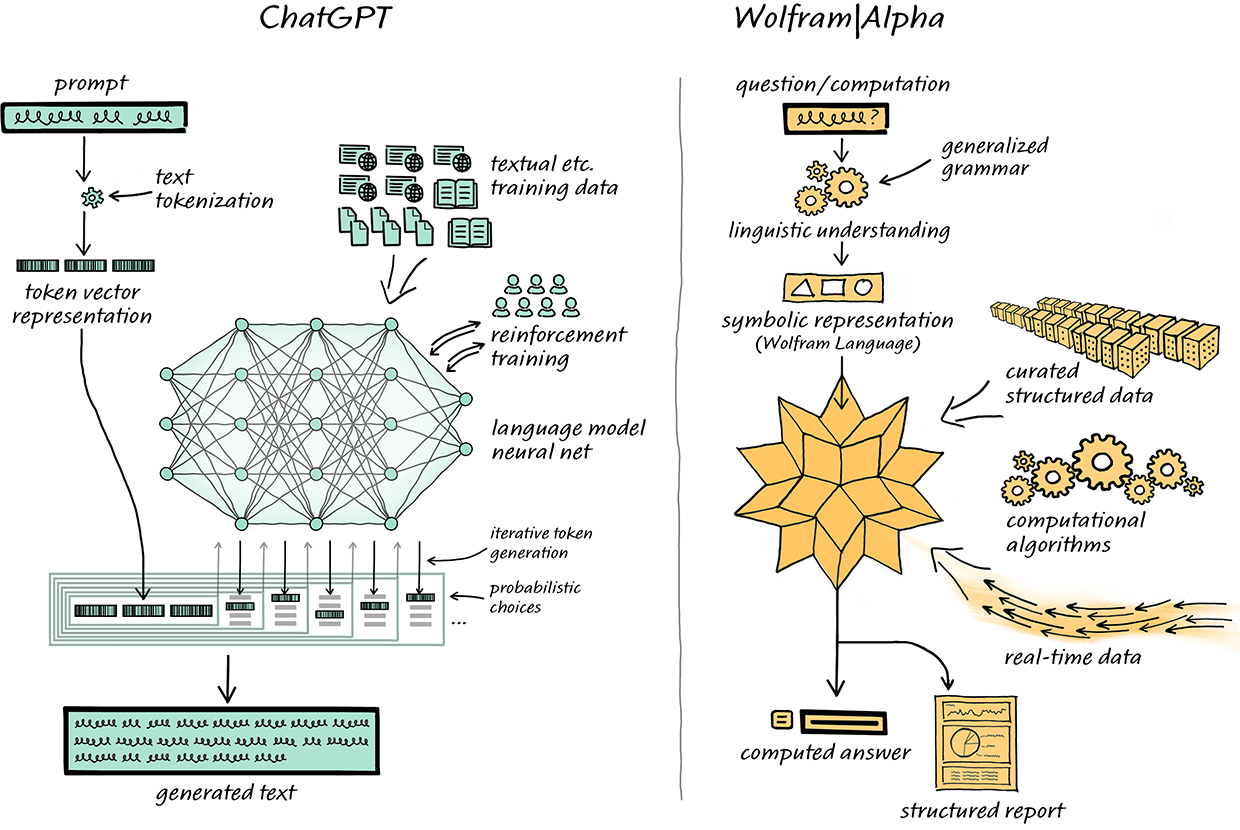
We pondered some of the arguments that it might become known as a corrupter of youth. Answers were known to seem reasonable but were not. Mathematical queries had suspect results. Not to do the whole litany, but Wolfram noted one obvious factor: CP manipulates, quite well, the syntaxial aspects of its answer but knows little to semantics.

Some argue that models which can support reasoning will help. Plenty of ways exist to to this type of thing.  We give one example below which deals with the basis of technology, namely, mathematics. 

Wolfram, the company, is the product of the 1970s and has evolved with the computer. There are several aspects to their offerings, but computational mathematics and its use are the core of their products. So, STEM? Wolfram was there from the beginning. Let's leave this with an image that compares ChatGPT with Wolfram's offering. There will be more discussion as we go along. 


Stephen Wolfram, Writings

Now, tying back to our main theme, Stephen Wolfram was born in London. Went to Eton, Oxford, and Caltech. After some experiences at University, he created Mathematica which was released in 1988. Along with the 'M' side of STEM, Stephen has dabbled in the other sides and has lots of interesting thoughts for us to listen to that can be set in the historical vein. Much like we are trying to do here.  

Remarks: Modified: 03/07/2023

03/07/2023 --

Friday, February 28, 2025

Humanizing mathematics

TL;DR -- GenAI is everywhere for the good and the bad. Which is which? There are  many themes like this that need attention. One thing to address is how humans and mathematics go together. Along that line, we have to address the history and philosophy of mathematics, in general. But, then, those aspects of the discipline dealing with computing and GenAI (and AGI), in particular, require special attention. 

---

We have been trying to avoid use of GenAI, in general, while a few issues get worked out. That is not a "luddite" approach as we have studied several of these and definite knowledge about how things went awry. As a reminder, here are some of our posts: ChatGpt; Bard, later Gemini; GenAI

Of late, Google has a summary in Chrome which is from Gemini's take on the matter at hand. This applies to any search. 

Example, we looked for material related to "humanizing mathematics" which is now a growing topic due to the emergence on the landscape of GenAI. This comment was for a search on "humanist mathematics". 

Humanist mathematics is a way of teaching and studying mathematics that emphasizes the human aspects of the subject. It can include using history, imagery, and technology to help students understand mathematical concepts. 

Now, why mathematics? Are we picking on it? Well, it's about time that someone does. And, this is merely a small start. 

---

Before getting in that, let's look at a couple of things related to the Humanist's view.

  • HumanizingMathematics and its Philosophy (book review) - "The Humanist view is contrasted with Platonism and Formalism. Platonism is the position that mathematical objects and truths  exist independently of individuals, and the obligation of mathematicians is to discover these truths. Formalism regards mathematics as the study of formal deductive systems, and  athematical truth is just provability in the system." This is a simple summary of positions; there are more which we will be getting into as the discussion continues.
  • Journal of Humanistic Mathematics - Editorial from the lastest issue: "We feel strongly about the human nature of mathematics; there is a reason “humanistic” is in the title of this Journal after all! So it is quite appropriate that several articles in this issue remind us that mathematics has always flourished as a human endeavour and it is perhaps the reduction to sterile algorithms that has stripped it of interest for many students. So we are actually trying to rehumanize mathematics, to bring back that spark that leads to students looking upon their math journey in a more positive light.

Again, a major motivation is the GenAI appearance which represents a particular type of applied mathematics be used for make an argument for computer superiority. People react to that various ways which brings in psychology. But, science needs to weigh in as well. Our posts of the Nobel activity this past summer suggest another type of motivation. The subject is not simple, by any means. 

---

Frankly, to do this right, we will go back to Kant's time and look at two of his works: Prolegomena; Logic. We started with the first one in 2022, after ChatGpt and its peers were out long enough for us to know something of substance. Actually, back in the late 2010s, I started to use AIn't. In 2023, Larry Walker of the former Sperry Knowledge Systems Center used "no critter" in response to something that I had written. 

This post is a year before the onset of OpenAI's, ChatGPT, into the public sphere: How dumb is AI? This was in response to an article in the IEEE's monthly, Spectrum (Oct 2021). The graphic included in the post is to the right. Our argument was that the "black box" that was puzzling everyone was really applied mathematics in action, being driven by non-mathematicians, therefore being opaque. 

Since that time, we now see lots of mathematical analysis coming forward. Our task is to bring these notions to public view, including the C-Suite where the mentality seems to be buying into the hype prematurely. But, that's another topic or two. 

We intend to be regular in posting material. As well, we would like to hear from others on their views with respect to GenAI as well as examples of how they have put it to use or have done studies in order to determine the ins and outs. 

Remarks: Modified: 02/28/2025

02/28/2025 -- 


Wednesday, September 11, 2024

Restart, somewhat

TL;DR -- Two events in 2023 were seminal; these carried over into 2024 which is 8 months old. The two relate to each other. And, pending changes to our material has been pending. Time to start that process. 

--

In 2023, Gloucester has its 400th. Some felt that it would be 2024. We will look more into that as the closes out. 

Since early 2023, we have adapted to two things: possibly, there are two Thomases; GenAI came on the scene and changed the world in ways that can be taken positively or negatively. Let's look at these two.
  • The first was the result of research that the TGS has been doing. In March of 2023, we were looking to have Margaret Fryer Gardner as a focus. But, on looking at WikiTree, we saw that in February of 2023, we saw that research had identified birth records of the children in the records of Sherborne, Dorset, England. Those who discussed the findings decided to split the Thomas Gardner profile into two with the first Thomas being here for the start of the effort by Dorchester Company while the second Thomas was the husband of Margaret and father of the kids. See the post (New not old planter). After a little more reading, we decided that we see these two as one. However, we will make the demarcation (two profiles) now, in our records and websites. Further research then will be documented. At some future point, the hope is to have sufficient information to make a decision. In the meantime, we can discuss why we think it's one guy. 
  • In November of 2022, OpenAI released ChatGPT to extreme acclaim and got millions of people to sign on. We missed that event for several reasons that might be of interest. It was not until February of 2023 that we became aware of ChatGPT. In our first session, we told ChatGPT about Thomas Gardner and Roger Conant (at the same time, the research at WikiTree was progressing). Since then, we have interfaced with various GenAI systems (we like Bard and still are using Gemini for testing), reviewed the mathematical basis for the claims, discussed means to get maturity brought to the action, and a lot more. Basically, this goes along with our decision to focus on technology.  

So, now, we will restructure. Per usual, we will continue to have the FAQ which will be brought up to date. Also, we will release issues of Gardner's Beacon periodically, hopefully with more of a regularity. 

Remarks: Modified: 12/28/2024

09/15/2024 -- People will always be the focus, rather than technology. 

12/28/2024 -- See updates in GB, XIV, 1 for 2024 updates. 


Tuesday, January 31, 2023

The Americas

TL;DR -- As we noted early last year, we have technology as a focus similar to another group's concentration on honoring research in biomedical fields. This post is about a biological thrust which has a couple of themes. One is that technology cuts across the board. We can use IEEE as an example of touching everything. Too, the post recognizes the life work of a Thomas Gardner descendant. 

---

We have mentioned New Spain several times, in the context of the United States. But, considering the extent of the U.S., there were other cultures, such as France, the Netherlands, Sweden and others. This will be a recurring theme due to perseverance of families through time until now. 

And, New Spain also is associated with most of the Americas outside of the U.S. and Canada. That might be the result of the usage of the Spanish language in much of the Americas. According to one source, there are 280-million English speakers in the American Continents compared to 418-million Spanish speakers. This is attributed to Spain being the first conqueror. New England did not conquer so much as slide into the area. 

Our last post mentioned the NEHGS which had a history and genealogy focus. These two utilize technology which is one of our interests. Of late, DNA studies have become more used. These types of results are becoming more frequently used in proving heritage. 

That is a biological focus which then leads to the use of technology, for supporting disciplines of the various sciences, and its mathematical understructure. And, so, we get back to computing and its contributions and plagues. We do this for several reasons which ought to become apparent through time. 

Natural History Museums (say Smithsonian, New York, London, and others) provide information about our world the study of which involves many disciplines, as we see with the Departments at Universities. Curators play a key role. Some in computing have brought this function to bear, say handling knowledge in terms of what a website might present. As with everything, interpretations differ as to what a curator does. The need seems to be recognized according to the rhetoric of the time. 

This post deals with the study of wildlife biology as it has grown over the past 150 years or so. We wanted to point to an example via the journal of the Mexican Association of Mammalogist. The first issue of Therya, Vol. 14 honors a New Englander who descends from many families, including that of Thomas Gardner, of Cape Ann and Salem. We had a post about him, earlier: Alfred L. Gardner, Ph.D.  

Note: Before going on, a technical aside is necessary. We, in the U.S., have benefited from awareness that can contribute to security and such. The 'wild west' start of the internet was a little perturbing to many. The marshals that came to town to clean up were varied, but they have helped. The below article is available via the DOAJ's website: https://doaj.org/about/. However, we point directly to the organization's site for convenience, though it does not use HTTPS. This blog (and its main site) put that into place a while ago for several reasons including Google's nudging. But, mostly, the push came from issues of FTP's security.  

The image shows part of the table of contents from the journal. There is the declaration of the Special Issue. Then, we have a listing of several of the articles, many of which have to do with Dr. Gardner's work. Not all are listed, but this quarterly publication is over 180 pages in length. 

The abstract (Special Issue in Honor of Dr. Alfred L. Gardner) provides links to 'full text' versions of the article (PDF or HTML) and gives references for the material in the article. One of the many publications of Dr. Gardner was Mammals of South America (2008) which is the first of three volumes. Our title suggests the integral aspect of the Americas, north and south. This is a subject needing more attention in terms of the long reach of New England. 

It might be helpful to point to information about Mammalogy (Wikipedia, Journal of Mammalogy, Encyclopedia of Life) which is part of Zoology, the study of animals. "Theria" is a subclass of the mammals. 

Incidentally, this post continues a major theme. An analog can be found via IEEE.org which involves the ubiquitous type of technology that which enables computing and everything else, in part. We need material sciences, as well. 

---

Forgive our focus on the 'artificial' when the subject of the post is nature and life. One curating task deals with establishing and preserving knowledge of provenance, through time and situations. Just now, I asked Google to give me something like this (asking ChatGPT about the provenance of its content). Got one interesting bit from The Atlantic: ChatGPT Is Dumber Than You Think (it's a toy, not a tool). Well, this type of thing will be a continuing theme (AIn't and more). 

Oh yes, Roots Tech is right around the corner. We have not paid much attention to that, except for using the various tools (love Family Search). But, it has been on the table for a while to address issues related to this type of thing. And, re-evaluating DNA (let's cut the hype) will arise at some point; for this topic, I am going back 100 some years to describe how computing in its current form came about; DNA work is heavily reliant upon computing; there is no theory for this (just practice); do we need a theory? Chemistry and its theory? Again, look around. Everyone is chasing a "theoretical" basis. Guess what? They all eventually get to computing. So, there it is. Computer science has no basis, at all. Of course, other computing labels have come up, like computer engineering. But, we're talking more than mere labels. Wait, ChatGPT appears to be shallow due to something similar? Stay tuned.  

Remarks: Modified: 02/10/2023

02/10/2023 -- There are lots of links with regard to Alfred. We'll start with these two: Special Report (Localities of Mexican Land Mammals), Tech Tech, 2020; Species he named