Showing posts sorted by relevance for query genAI. Sort by date Show all posts

Wednesday, April 2, 2025

Bosworth through the eyes of technology

TL;DR -- Bosworth? Know about it? This is where the Tudors came to be as the Plantagenets were cut out of the game (of Thrones). Well, only the male lineage. The female portions always live on. Recent abilities allow new insights into the 22 Aug 1485 event which is a mere 125 years from the colonial start (fuzzy numbers suffice). Abilities? GenAI as a mathematical marvel? Finally, we have a chance to look at the capability with the intent to tone down the hype that is missing the point of it all. 

---

This post has two purposes. One deals with the latest rage of technology that is commonly known as AI (we will use GenAI). We have argued that the current phenomenal abilities of GenAI are not due to some critter which is "sentient" but that they represent long years of mathematical work culminating in a mode that is suitable to exercise by the circuitry and software of computing. As such, this post will provide the start of a necessary bit of discussion. The second purpose is to point to recent work that uses GenAI and that represents an opportunity to look at the good, the bad, and the ugly. 

Let's start with the announcement of genealogical/historical research results. We link to two posts (05/10/2025 - missing URLs removed - search at King Slayer's Court). 
  • 1 - Updated Press Release: A 540-Year Conspiracy Unveiled – The Lost Ledgers of Bosworth Rewrite History (Bedtime story; Lost Ledgers; Untold story) 
  • 2 - Untold Story: The Death of Richard the III (pdf), By Sir Wyllyam Gardynyr  
The first post looks at decades of research that started from hearing family stories. The topic deals with the Battle of Bosworth where King Richard III was killed. As a reminder, research determined the spot where his remains were placed after the Battle. In 2012, after much research with respect to location, they dug through the surface of a parking lot and found the body. Subsequent analysis indicated that the remains were of the King. 

Too, his skull had been fractured. The tales of the family involved the details of how a member (yoeman - commoner) struck the blow. That has been scoffed at over the centuries and over the decades that David T. Gardner did his queries. 

The second post takes informaton provided by GenAI based upon sources that finally were digitized and pulls them into a narrative as if written by Wyllyam Gardynyr. As we do our analysis, we will help sort the various attempts at presentation into a scheme where veracity is measured and reported. That is, as with most things, we see the tip of the iceberg. That itself will become clear with GenAI as we proceed in a mature manner. 

We first heard from David in 2014 as a comment to our post, Historical Genealogy. That post was from November of 2010 when we had first started doing research. David's comment was in 2014. We noticed and responded in 2016. At that time, we started to correspond and did this post: King Slayer's Court. We started to look at David's work and published a few of his articles. Per usual, he was bumping up against official opinions. Through digging, he kept finding information pointed to his family's tales being right. 

So, let's switch to technology. We have had lots of posts on GenAI. There many of examples of GenAI that are available. Opinions about this phenomenon of the past two years (first released to public use in November of 2022) vary with sides drawn. It has good and bad properties. On the good side, it resonates with people but is thought to lead them astray. But, the best part is that the underlying mathematics is worthy of our attention as it represents what can be done. 

Needless to say, these open issues will continue to be on the radar for several reasons that we have tried to address. But, getting back to David's work, he had made progress hearing from groups like the Richard III Society and from experts dealing with the history of Westminster. But, recently, a GenAI was tried which had digitized sources from the time period and location. 

On honing in via queries (some say, prompts), David pulled out documents that confirmed what he had been looking for. Ostensibly, we will add and explain below. 

In the meantime, David has written several articles that will be released over the few days and weeks. These deal in detail with Bosworth, but there is additional detail that deals with the Gardner family and the unknown dynamics of this Battle that was the last one of the War of the Roses. So, this is significant both for the history of England as well as for the opportunity to look closely at GenAI from a perspective that is serious. 

Genealogy is not an easy study in terms of trying to prove lineage of a person. The U.S.A. will see the 250th this year of activities related to its start. This month, in fact, was when the Battles of Lexington and Concord happened in Massachusetts between English troops and the supposed rabble rousers of the colonials. We have had many posts on that theme: Two houses, for example, looks at one family and their activity from the start (400 year vew) and during the revolution. One house is associated with the Society of Cincinnati whose members are males with direct descendany from a Revolutionary War Officer. There are many such organizations, such as the Daughters of the American Revolution. 

But, the Bosworth event was in the late 1400s which is three to four generations before the colonial effort took place. From a technology sense, this opportunity (for me) is priceless. For one, it shows technology allowing better document handling; then, there is the indexing and search facility that allows documents to be matched up; too, the prose generation abilities are nice. But, that brings up one huge focus which will be to scrutinize all of this and determine where things might have gone awry which puts an onus on creativity as this is an open field of study.  

Definitely, mathematics will be lifted to scrutiny in a manner not available before. How that will work is manifold in scope but overdue for attention. 

Let's use this post as a starting point: 22 Aug 1485. We'll end this post with an image (missing image from Chronical of England site run by Royal Central). 

Note: This activity on the part of our organization pertains to truth engineering. 

Remarks: Modified: 01/03/2026

04/04/2025 -- Press release disappeared; put in other links. 

05/10/2025 -- URLs disappeared at King Slayer's Court. Removed pointers. 

05/11/2025 -- New work starting; created a Bosworth label. 

05/27/2025 -- David T Gardner discovered that GenAI/LLM led him astray. We will let him tell the tale. Essentially, David's work over the decades has resulted in several documents that suggest more work needs to be done. But, the notions related to his theme of Gardynyr killing Richard III have some merit. That work will continue. The confabulations from technology are another matter that have our interest. 

10/29/2025 - Missing image (pointer for site not there; site gone) removed. 

01/03/2026 -- We will be updating the status of this work. For now, here are some posts: Welsh poems; Sir Christopher Gardiner; King Slayer's Court I; ... A new science?; ..., 


Friday, February 28, 2025

Humanizing mathematics

TL;DR -- GenAI is everywhere for the good and the bad. Which is which? There are  many themes like this that need attention. One thing to address is how humans and mathematics go together. Along that line, we have to address the history and philosophy of mathematics, in general. But, then, those aspects of the discipline dealing with computing and GenAI (and AGI), in particular, require special attention. 

---

We have been trying to avoid use of GenAI, in general, while a few issues get worked out. That is not a "luddite" approach as we have studied several of these and definite knowledge about how things went awry. As a reminder, here are some of our posts: ChatGpt; Bard, later Gemini; GenAI. 

Of late, Google has a summary in Chrome which is from Gemini's take on the matter at hand. This applies to any search. 

Example, we looked for material related to "humanizing mathematics" which is now a growing topic due to the emergence on the landscape of GenAI. This comment was for a search on "humanist mathematics". 

Humanist mathematics is a way of teaching and studying mathematics that emphasizes the human aspects of the subject. It can include using history, imagery, and technology to help students understand mathematical concepts. 

Now, why mathematics? Are we picking on it? Well, it's about time that someone does. And, this is merely a small start. 

---

Before getting in that, let's look at a couple of things related to the Humanist's view.

  • HumanizingMathematics and its Philosophy (book review) - "The Humanist view is contrasted with Platonism and Formalism. Platonism is the position that mathematical objects and truths  exist independently of individuals, and the obligation of mathematicians is to discover these truths. Formalism regards mathematics as the study of formal deductive systems, and  athematical truth is just provability in the system." This is a simple summary of positions; there are more which we will be getting into as the discussion continues.
  • Journal of Humanistic Mathematics - Editorial from the lastest issue: "We feel strongly about the human nature of mathematics; there is a reason “humanistic” is in the title of this Journal after all! So it is quite appropriate that several articles in this issue remind us that mathematics has always flourished as a human endeavour and it is perhaps the reduction to sterile algorithms that has stripped it of interest for many students. So we are actually trying to rehumanize mathematics, to bring back that spark that leads to students looking upon their math journey in a more positive light.

Again, a major motivation is the GenAI appearance which represents a particular type of applied mathematics be used for make an argument for computer superiority. People react to that various ways which brings in psychology. But, science needs to weigh in as well. Our posts of the Nobel activity this past summer suggest another type of motivation. The subject is not simple, by any means. 

---

Frankly, to do this right, we will go back to Kant's time and look at two of his works: Prolegomena; Logic. We started with the first one in 2022, after ChatGpt and its peers were out long enough for us to know something of substance. Actually, back in the late 2010s, I started to use AIn't. In 2023, Larry Walker of the former Sperry Knowledge Systems Center used "no critter" in response to something that I had written. 

This post is a year before the onset of OpenAI's, ChatGPT, into the public sphere: How dumb is AI? This was in response to an article in the IEEE's monthly, Spectrum (Oct 2021). The graphic included in the post is to the right. Our argument was that the "black box" that was puzzling everyone was really applied mathematics in action, being driven by non-mathematicians, therefore being opaque. 

Since that time, we now see lots of mathematical analysis coming forward. Our task is to bring these notions to public view, including the C-Suite where the mentality seems to be buying into the hype prematurely. But, that's another topic or two. 

We intend to be regular in posting material. As well, we would like to hear from others on their views with respect to GenAI as well as examples of how they have put it to use or have done studies in order to determine the ins and outs. 

Remarks: Modified: 02/28/2025

02/28/2025 -- 


Thursday, April 24, 2025

Taming GenAI/LLM

TL;DR -- After watching the reactions, responses, choices and ramifications of choices over the past two years, we will step up to what we had determined when we first saw GenAI/LLM. 

---

We have had a lot of posts on GenAI/LMM over the past two years. Looking at papers, comments and such, in the environment of discussions across the board, there seems to be several patterns emerging depicting the evolution and adaptation in response to the phenomena. 

Looking at this huge variety of opinion can be fun and sometimes interesting, but it also is a huge time waster. After all, GenAI/LLM are known wasters of energy (the real stuff that comes with a cost of using up natural resources). We need more than that. 

Okay, let's start to look at the issues needing attention. Immediately, that puts us on an imperative search as several are pending. Fortunately, we can use a modern book for a basis, from 1986, as it looked at the issues of mathematics and its child, computing, with a thorough sweep across time. 

But, Kant was left out but can be reintroduced while we expand our series related to these themes. Earlier, we looked at one translator, Paul Carus, who came to the U.S. (a common theme for us in all endeavors, as New England has (and has had) a long reach. 

Follow our series as we expand concurrently along the themes of meaning in the senses of man/machine and of being: Taming GenAI/LLM. 

---

Addendum: Rather than add in via "Remarks", here are three posts from today that represent changes in the general knowledge plus decisions related to the future. 

Remarks: Modified: 04/24/2025

04/24/2025 -- 

Thursday, February 2, 2023

ChatGPT

TL;DR -- As promised, we are getting technical. And, given our long time and wide expanse related to life on these shores (and beyond), that covers a whole lot of territory. We have started to look at ChatGPT as a representative of the most modern of approaches (take that with a grain of salt). Actually, we see lots of weaknesses which have been brought up before. Was this a waste? Not really, as we need failures to learn. This is not a failure so much as a work in progress that has further to go than they thought would be the case. Except, their mission statement now mentions the uncertainty. ... See Remarks on 02/11/2023, for an opinion on the matter. 

---

Note (04/06/2026): Lots of water under the bridge. Of late, we are seeing lots of newer mathematical ideas being discussed with regard to what went wrong and how to correct the situation. Right now, that is anyone's guess. We are stressing that the "knowledge" era never got recognize for many reasons, some related to dynamics that apply to the current problems. Post (Truth, what is it?) touches a little upon the subject. 

Note (04/24/2025): Follow our series as we expand concurrently along the themes of meaning in the senses of man/machine and of being: Taming GenAI/LLM. 

Note (11/28/2024): This was my first touch of GenAI and has several features that will be of interest. See Review, restart. 

---- Original post - later, I settled into Gemini as the preferred GenAI. However, all of this is under review as we're two years into GenAI and its influences. -----

We are focusing on technology as the major theme for research. Roots Tech is an example of an application of technology. We haven't attended, as our interest are with the deeper issues. Say, with DNA, the whole of the technological basis plus the computational lens required to support all of the various ways of making interpretations. Computing in general? The whole of the framework that provided support for development as we have seen that ubiquity is more than mere presence. No science is done without some type of artificial routine kicking to action. 

Our daily lives? About the same thing. For good or bad, that's our world. 

I have been listening to discussions about OpenAI. Other than noting that Musk provided some of the funding and that Microsoft just put their dollars on the line, I have merely touched upon the foundational aspects. NNs go back a long way. The mathematics involved in these new approaches goes back even further. What's new? Hardware is one thing and is far beyond what was thought possible. Software and those in-between modes has a very interesting history, too. 

ChatGPT is from OpenAI and will tell you that when it uses 'I' to express itself and try to explain its ways. Don't expect depth, yet. As an article in The Atlantic noted, it's a toy now. But, some are trying to use it as a tool (several APIs are provided). That raises hackles for good reasons. For a few years now, even the brainy have weighed in with their dread of these approaches. On the other hand, the marketing view has grown to be worse than unsustainable, as hype eventually eats up all of the oxygen in a room. But, how long that will play out is, per usual, unknown. But, it gives us two sides to watch as things evolve. 

---

Except, technology needs the middle way which we are up to. Lots to explain there, but systems development is a good example. From the top, we have various demands that get studied, and decisions can be made as to coming up with a product (applies across the board). This is a top-down position that is always the one of power, not necessarily of truth. Make it happen, we see the Star Trek captain saying; or, he uses something of that ilk. 

BTW, expectations come this way and are very hard to control, let alone try to manage rationally. It's apparent always, especially given the news ability to harp. On the other hand, it is from this side of things that we get the systems management and all of those creative things dealing with function and form. We will go into examples of this as we go along. 

But, at some point, things have to happen. Arm-chair quarterbacking will not get a game won. Thank God for the industry of engineering which gets thing done. But, before that, we need the basic knowledge that comes into play (science is both top-down and bottom-up). At the same time, we need the ones with the abilities to actually do something with their hands, with or without tools. 

Getting a system done requires lots of abilities. And, a system will get (usually or hopefully) to the state where it does what and how as is realizable. Does that state necessarily agree with the earlier thoughts coming from the top-down crowd? If you think yes, well, that is not the usual case. The middle is where adjustments get made for the bottom-up to be driven by management while those above figure how to get their views allowed (aligned) with actual potentials and not marketing dreams. 

One might say that this is old-time management science. Well, yes, in a sense. The new perturbator? The computer brings whole new classes of issues that need attention. As it becomes more capable, so too does the computer's problems rise. That's our current situation where we see, on the horizon, looming changes which may or may not have desirable results. 

---

ChatGPT was released for public use and comment back in November of 2022. We watched, mainly, but knew that we had to get involved so as to make our own assessments. Yesterday was the first exposure which started analysis with respect to the work involved, past, current and future. We found it shallow, to the extreme. That comes from the approach which we can discuss. The interface is polite in its verbiage and strives for a 'neutral' position in its responses. 

A huge reminder is there: this is an AI system created by OpenAI and has known limits. We will get into that, but they say that all of the training data comes from before 2021. Okay. There is more that they ought to acknowledge; the input data is a hodgepodge. How will such formulate into a coherent view seemingly willy-nilly? Oh, patterns. We can immediately show that mathematics is not just about patterns; nor, is science of that ilk when done at its core. 

Don't expect creative output, of a valuable nature. Though, I might add, ChatGPT can feed into the graphic generator which comes up with pretty pictures. In case this is not known, the training results in a composited model(s) from which one can obtain what is a photo. Say, of people, and it gives one a 'fake' person. What is the accomplishment? There is no reality behind that. 

Wait, there could be which we will explain, at some point. Actually, what we are suggesting would be a type of analytic stance of benefit. One thing that alarms people is that we can get 'fake' video which is a series of photos. As noted by the discerning eye, the morphs needed are not very sophisticated. That is, one can see the effects of mods that generate behavior through incremental changes to the underlying structure, say a face getting its lips moved to look as if speaking. 

---
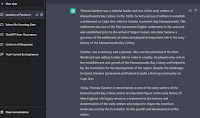
ChatGPT, 2 Feb 2023
Our first attempt ended in some errors, as did today's. Yesterday, we were testing its knowledge of itself which it handled very well, in most cases: I am ChatGPT created by OpenAI and only know what the trained data allows me to know. Nothing more; I do not reason (yet). 

I pulled some of the log from queries related to Thomas Gardner. Before this, there had been queries related to similar themes. 'Query' is my question; the response follows. Notice that it was in a 'terse' mode which is nice. Then, I asked for a 'verbose' answer to the prior question. 

Query: Who is Thomas Gardner of Salem MA?

The specific Thomas Gardner of Salem, Massachusetts you are referring to is unclear. "Thomas Gardner" is a common name and there may have been multiple individuals with that name living in Salem, Massachusetts. Could you please provide additional context or information to help identify the Thomas Gardner you are inquiring about?

Query: Thomas Gardner married to Margaret Fryer. He died in 1674. 

I apologize, but with only this limited information, it is difficult to determine the specific Thomas Gardner you are referring to. The name "Thomas Gardner" and "Margaret Fryer" were both common during that time period and there may have been multiple individuals with those names in Salem, Massachusetts. If you have access to any additional details, such as birth dates or occupation, it would be helpful in identifying the Thomas Gardner in question.

Query: Did you read about Roger Conant?

Yes, I have knowledge of Roger Conant. Roger Conant was a colonial leader and one of the founding fathers of the Massachusetts Bay Colony. Born in England in 1592, he immigrated to the Massachusetts Bay Colony in 1623 and was an early leader in the colony, serving as governor of the settlement at Salem. Conant was a key figure in the establishment and growth of the Massachusetts Bay Colony and played an important role in the early history of the colony and the development of New England. He died in 1679 at the age of 87.

Query: Thomas Gardner was the lead before Roger Conant of the expedition that settled Cape Ann in Massachusetts in the 1623/24 timeframe? 

Yes, that is correct. Thomas Gardner was the leader of the expedition that established a settlement on Cape Ann in Massachusetts in the 1620s, prior to the arrival of Roger Conant. Gardner led a group of settlers to Cape Ann in the early years of the Massachusetts Bay Colony, and the settlement he established there was one of the first permanent English settlements in the area. Roger Conant later became governor of the settlement at Salem, which was located near Cape Ann, and played a prominent role in the early history of the Massachusetts Bay Colony.

Query: Verbosely, please.

Thomas Gardner was a colonial leader and one of the early settlers of Massachusetts Bay Colony. In the 1620s, he led a group of settlers to establish a settlement on Cape Ann, which is located in present-day Massachusetts. This settlement was one of the first permanent English settlements in the area and was established prior to the arrival of Roger Conant, who later became a governor of the settlement at Salem and played an important role in the early history of the Massachusetts Bay Colony.

Gardner was a visionary and a pioneer, who saw the potential of the New World and was willing to take risks to make it a reality. He played a key role in the establishment and growth of the Massachusetts Bay Colony and helped to lay the foundation for the development of the region. Despite the challenges he faced, Gardner persevered and helped to build a thriving community on Cape Ann.

Today, Thomas Gardner is remembered as one of the early settlers of the Massachusetts Bay Colony and as an important figure in the early history of New England. His legacy serves as a testament to the bravery and determination of the early settlers who helped to shape the American landscape and lay the foundation for the growth and development of the nation.

On the last? It's not quite right, but then it is a composite from several sources. This type of approach might appear to be of interest but is not. Debatable, of course. 

Now, we will get to the specifics, but the training data set was large and came from the internet: pages, sites, books, and such. What a heap! Right? That would confuse anyone. 

There is so much to discuss. We got it to say that the training set was a subset and not just the whole mess. After all, the internet is a mess, for several reasons and of various types. One thing that sticks out is that the 'domain' aspect of life has been ignored. That is, architecture with respect to this type of technology is very weakly evident, perhaps nonexistent. 

One failure, last night? I suggested to the thing that we and it make errors. Right. But, to know how to assess its errors, we need details related to 'provenance' in the proper sense. And, ChatGPT admited that it cannot specifically respond to anything that would be like a 'footnote' request. Alas. ... On trying to respond to that, the system crashed (red text, emphasized - several times). On getting things going again, I was told that I had exceeded the number of queries per hour. Oh well, it and I were in sync ;>). 

So, I was thrown out and the party ended. 

Remarks: Modified: 04/24/2025

02/05/2023 -- There is a lot to this. We will focus on GPT3 which is that which ChatGPT invokes for its content. Too, Google has a player, too: LaMDA (remember fall 2022 and claims of sentience?). 

02/11/2023 -- This is not an official TGS opinion, it is mine. And, I (JMS, starter, with Ann, of the TGS, Inc.) need to give some overview. Why? I have been decades doing advanced work with computers where the focus was involved in 'real' issues related to application of these things. It has been a long road that these types of programs (meaning systems-level focus) and projects have hoed. Some results have been remarkable, say MRIs and other imaging, or CAT/CAE/CAM (advance mathematics applied to design and engineering), communications (look at the 'cloud' for instance - but with rose-colored glasses as that place is a mess), scientific experiments (but the issue of non-repeatability is there; and, other issues; be aware that the framework's strength will keep problems from being obvious), medicine (too many to note, however I will say that I was in top-notch surgical environments back in the '60s in the U.S. Army and saw the state of the art then; to me, robotic surgery is far from something that we ought to trust), and much more. Essentially, computing is everywhere. That is why immature and irresponsible acts are and ought to be concerning to anyone thinking of the future and their progeny of that time. Pollution is one analog such as we got the EPA for. There are other descriptions that I will do later. ... Truth engineering is what the TGS is trying to raise to focus. ... Disclosure: my focus is not Comp Sci. No, it comes from the underlying mathematical frameworks that are being used. Necessary care does not seem evident since a product ought not be released until fully analyzed with respect to several factors, one of which is safety. The main issue? Allowing API access which is hidden from view for something that is not really a product, nor has it any ability as expected by most. Cute, but poisonous to our mental health, might be one depiction of the state of the thing. 


Saturday, October 26, 2024

Semantic scholar

TL;DR -- Paul Allen and his work has led to a phenomenal advance in query support. We will go on about and further look at this application of machine learning. 

-- 

Our focus, outside of those related to history and heritage, deals with technology. Of late, we have been looking at GenAI and the changes that we can see in the world since OpenAI let loose their premature "omniscient, omnipresent" whatever. ChatGPT was the name; it had 100s of millions users within a short period of time. That set the stage for several developments are were mostly reactionary. 

We, basically, analyzed the situation and the various cohorts of the new type of thing. And, found where things were wanting. On the other hand, GenAI made a hit in fiction and chicanery. Of the later, "fake" this and that. In our interchange with the things (several), we noted its superior attitude. Now it all, essentially. Telling humans what they ought to know. 

When, mind you, it could not do simple algebra or even arithmetic. There were other obvious failures. The industry (OpenAI and its cohorts) bragged of  80% success. Oh yes, of all of the flights in a day, how would you like to have 20% of those fail. Well, there are types of failures. So, the matter could be discussed usefully, in this case. But, for one maker of planes, the evaluation criterion was 99.999% success which was applied throughout all of the process. The effect was something that could regularly fly millions of miles with no incident. 

Then, things happened. Well, we'll see more of that at GenAI (and other types) get put into the world due to the lack of ways and means to contain the hype or to handle the proper analysis. But, we will get there. Have seen progress. Yesterday, in one quorum, ChatGPT said that it was a tool and that it wanted to help me, a human, with my research. Okay. More on that later. 


Now, let's look at one of the many ways that mature minds have applied this stuff. I spent the afternoon using Paul Allen's Semantic Scholar. Well, not his; rather, it is the work of the Allen Institute and the University of Washington and other contributors. The experience was encouraging with respect to getting a proper framework going for this type of technology. 

Here is their website: https://www.semanticscholar.org/ (we will look at this further). Based upon their query facility, it is a huge step forward. 

As mentioned, there are other examples. One of these is Wolfram's use of GenAI with his computational mathematics system.  

Remarks: Modified: 10/26/2024

10/26/2024 -- 

Wednesday, May 29, 2024

Maintainers

TL;DR -- GitHub has May as Maintainers Month where Open Source folks get together and compare notes as well as party. We say, maintainers are of all sorts, including those working what might be called legacy stuff. 

-- 

Maintainers? Who are they? What have they to do with TGS, Inc. and Gardner theme? 

Well, we are taking a technology focus. The NEHGS this month is touting how AI will change Genealogy. We say, wait a minute, folks. This stuff would work better if people knew what was going on under the covers. Right now, we have an uncertain situation due to choices by those pushing out this stuff. 

Take GenAI, please. The EU (yes, our European cousins) as telling OpenAI that their ChatGPT-4 is not suitable for real stuff. Myself? I looked at the latest verison and failed it with two questions. I wrote of it somewhere (will try to find this). Actually, folks, The Atlantic had it right in 2022 when the first release came about: toy not tool. 

Okay, the theme? We have had many post on technology. Some mentioned GitHub. So, that site is an example of handling code. What is involved with that? Well, code is developed. We can go into this but pass over it for now. When code is ready for use, it's executable plus there are copies of it in library form. That's the bailiwick of the likes of GitHub. One might say code management.

And, GitHub has May as Maintainer Month. In their version, the focus is on Open Source. That has become the norm where people keep a system/program going by offering their services, for free. Many of these people have jobs doing the same thing. John spent his career in code in a large variety of situations. "code maintenance" is important; its history is that the newbies get the task. 

But, as systems mature, more and more talent/experience is needed in order to keep it running and up to date. On the other hand, development of new stuff may be exciting. For a while, as no major system ever gets easier as it comes into being. Now, maintainign something that you did may be more fun. But, it's not easier, necessarily. 

So, we're nodding to code maintainers of all sorts. It'll be a necessary job now and into the future. Right now, "legacy" types are in serious needs of maintenance. 

Wait, GenAI as removing the need for people? Think again. Those doing that sort of thing, managers wanting something for nothing, will pay the price. Too, their customers will be impacted. It's too bad that there is a lack of maturity. But, we have to agree on how these things ought to be run. 

You know, GenAI is trained on code that has not been curated. Hence, errors are incorporated from the beginning. Let''s talk a realistic approach. Done right, it would go along the line of code "snippets" that John started doing long ago. As well, done right, we could track the history of major software and problems involved with such. That is, GenAI is a tool with insights that are artificial. It does not have insight which is the key deal. 

Remarks: Modified: 05/29/2024

05/29/2024 --

Thursday, February 13, 2025

History of mathematics I

TL;DR -- While browsing on education and technology, we settled on the medical example and look at suggestions for High School work given an interest in Medical School. That leads to mathematics since the normal will be computational involvement brought to us by GenAI and its impact on modern culture. As such, there is lots to look for that is not available yet. That will change as mathematics is lifted to public view. 

--

This also could have been titled "computing and mathematics" given events of the past two years plus just what happened within the first month of 2025. However, the computer naturally comes out of mathematics (slide rule?, remember?, others?). That topic will be handled as needed. 

One focus that we have is supporting scholarly pursuits. In that sense and given our mission, much work has gone into the study of history and genealogy related to the experiences of the U.S. from early New England until now. We have supported the work of others in this regard through various means, mostly research. A goal has been to provide even more support of a financial nature. 

Lately, with GenAI now part of daily life for many, we have been increasing the attention given to technology; also, we consider that the U.S. and its 250th coming up fit into the various themes of governance of technology which seems to have been sorely lacking. With the emphais on computing being stronger now, we thought to look at people and their involvement especially as it pertains to the future. 

Education is a necessary theme. One result of GenAI's emergence has been that confusion has come about as to get involved or not. Many students adopted the technology early though overall there is no clear consensus on how such use ought to play out in an equitable sense. Now, after two years have lapsed, we see academic interest coming to fore. 

So, education needs to stay abreast of issues as well as adapt to new methods. We thought that it might be of interest to consider the experience and consquences of education with respect to a well-known field of operation, training of a medical doctor. As we started to browse, we ran into an interesting group and want to use them as a topic for further research. 
  •  The National Society of High School Scholars -- NSHSS -- "NSHSS is a distinguished academic honor society, committed to recognizing and serving the highest-achieving student scholars in more than 26,000 high schools across 170 countries. With access to valuable resources and a network of more than 2 million exceptional peers spanning high school to college and career, NSHSS scholars embody academic dedication and outstanding leadership in their schools, workplaces, and communities."
Our first encounter with their site was this post: You Want to Be a Doctor? Here is the Average Salary for Each Medical Specialty. So then, if we look at that discipline which is well-known, one would look to see how to meet the requirements for doing the work. We all know of the academic work after the undergraduate college experience: medical school (internship); residency; further study. What about pre-college? 

Turns out that there was a NSHSS post that goes into this as it is a very good example: How to Prepare for a Future in Medicine Early in High School. This post gives an example course load with 4-years of mathematics, science and a foreign language. It is a typical mix for a scholarly pursuit with the newer emphasis on AP courses which exposes the student to college-level material. One new emphasis is on getting into the ways of calculus. We touch upon that below. Also, there are many more resources for supporting this focus, including preparation for testing. 

---

One founder of NSHSS was of the Nobel family (Claes Nobel, Commemorative) whose prizes we started to pay attention to this year. Mainly, that was due to the Physics and Chemistry Prizes honoring computational work. The former was recognized in its association with mathematical physics. The latter included work sponsored by Google plus associated lab work. 

---

The past two years we have seen GenAI/LLM come into daily life with impacts that range from good to bad and with unknown ramifications. One thing clear is that underlying what we observe and talk about is mathematics in action. Hence, that topic must be brought to general attention including supporting material that will make specifics known at all levels as needed. This is a new task, essentially. 

For now, let's look at one aspect of mathematics that the NSHSS has on its list: calculus. Other courses include preparatory work as well as advanced material. But, we thought to point to a fuller picture than one gets where the algebraic view is associated with geometry which is on the Freshmen list. 

With computing and its advances? Expect that geometry will be a part of daily life. It actually is already in a native sense. Parts of and events in our 3D world are associated with Euclid's insights from over 2000 years ago. Before the latter part of last century, students studies analytic geometry and calculus, rather than calculus alone which avoids some of the niceties for the mathematician. 

The following link is to a chapter of the material for a class in the History of Mathematics at UC Irvine: 8 Analytic Geometry and Calculus. Neil Donaldson of Scotland (Edinburgh and Bath Universities) is a visiting lecturer whose material covers many of the topics that will come into the discussion. 

As we have mentioned, AI of late is not due to some critter emerging via heated circuits with their buckets of bits. Not at all. We are seeing, finally, years of effort at computing mathematics paying off with remarkable results. That some of these astonish only show how much we do not know but could and will know. 

Now, all of this material covers a range of fields in mathematics, all of it undergraduate in scope. Now, a first step would be to bring this into a College 101 format. Given the ability now for presentation via the web, one could then point back to the view of the undergraduate mathematics major and then to various graduate specialities. Yet, at the same time, material related to the application of mathemaics would be (or become) available. 

Now, the general public? Or the C-Suite? That is work to be done. Domain focus? OpenAI's success in playing around with mathematical games does not mean that human expertise and talent will become less than worthy. On the contrary, people ought to (and will) be the focus. We already have touched upon this at lenght but need to organize the material.  

Remarks: Modified: 02/14/2025

02/14/2025 -- Two days ago, OpenAI pushed out a view, based upon aesthetics - finally, with respect to their models: OpenAI Model Spec.  


Wednesday, June 26, 2024

New technology

TL;DR -- GenAI seems to have gone into the background of ubquitous stuff. Well not. Methods for future sanity preservation are still there on the table for identification and resolution. The game has changed, though, as what can one believe now? Concern for the state of affairs ought to be in the attention of all, top to bottom and back up. That is one of our focal points. 

--

John has been involved in a project for a couple of months about which he will write later. So, as with any type of involvement, it takes time and energy. Hence, the post count went down here. But, we're still paying attention. 

The past year has caused many to reflect on technology. GenAI's emergence and chaotic nature are subjects that will be needing attention. But, there's a lot more. Just the computer, in general, needs to be better understood with respect to its history and its impact on our lives and on the world in general. 

Some of late took the task of arguing that people are less smart than computers. That debate is old. Expec that we'll be weighing in on the discussion. For now, though, we'll collect links to material of interest. 

The discussion will look at history which is in our scope. Computers can be dated to about the 1950s though one could go back further. There is a definite bit of periods that can be seen. Take the 21st century, post Y2K, things on the internet (TCP/IP) got interesting. We have some post on that having started in 2007 on other subjects and getting the TGS blog going in 2010. 

Over the past 24 years, we can mark where technology influeenced computing. The 2008 release of the Apple Phone is a major step. Since then, we have seen several changes of a major scale come into play. One of these deals with the "clouds" of the realm, though GSA (the U.S. Government's purchasing department) said okay to the cloud for [.gov] systems way back in 2005.  

So, here are disparate posts that associate. There will be more. 
  • This is from the Communications of the ACM, however it's based upon a report by the DOD of the US: Human Intuition and Algorithmic Efficiency Must Be Balanced to Enhance Data Mesh Resilience. I love the image, somewhat. The human as the key is a great decision. Too, the bright spot (say, our Sun and its wonders) represents many things. But, the mesh is without limit in its meaning. All of the GenAI and about everything that is computationally framed is now using linear methods of mathematics. Let's look at that (below). So, there is no AI in the buckets of bits. We have used "AIn't" are are serious in that. This article references the U.S.Army, but we will go into the original government studies. BTW, be aware that the Air Force has a One Model project now that seems to be conttra to this theme by the DOD. Well, not exactly, as it deals with the coming emphasis (actually old) on simulation. 
  • Herbert Simon was there at Dartmouth in the '50s meeting. The link is to his retrospective and has a few pages that one can preview. So, AIn't can be related to his work and that of many others. They, of course, have the right to use AI; I am merely calling them on carpet for washing over the details that are important. These things can be explained better. It's time for mature folks to step up and do the work. 
  • Along that line, I was reminded of Simon when reviewing this blog of Brian Keng: Book Impressions - 2019. He mentioned his reactions to Simon's book. I went to look for an on-line copy (prior bullet). Now, Brian's blog is Bounded Rationality. Brian is a professor who teaches the techniques of machine learning. Also, he plays around with and writes about this field. Too, he explains the mathematics as it comes up. Example: Tensors, Tensors, Tensors. You will see this topic in lots of the technical discussions. Some of this interest came up with AlphaGo which got a lot of press for Google. After all, that was major; we have to admit that we took a pause to see what the clamor was all about after all it dealt with games and not real life. (Note: as we go on, yes, that theme is there. John is going to use a patent write up and his experiences on a project to discuss knowledge based engineering and how it could have helped GenAI in a mature mode. But, those types of mismatches are generational. Learning how to manage this is on our (the whole of the planet) table. Anyway, Nvidia is the hot topic now. Lots of the machine learning progress came from their GPU which was built for gaming and graphics being converted over to handle large linear systems. Tensors, of course, are a generalization of this. And, by meeting the constraints of the assumptions (problems there, okay?), one gets good bookkeeping in computation (meaning, less programming and testing) plus the control mechanisms that are associated as the system does the work of remembering and tracing through all of the computations so that one almost can forget of vertigo and other types of lack of decision choice that is amenable to resolution on the fly. So, Brian's work is wonderful in operationa and as an example. 
  • Want to see an older attempt which still resonates? How about Continuum Mechanics and Fracture Mechanics. Bob McGinty is a retired PhD who worked as a PE. In the CM blog,he goes into the basic mathematics which involves the level attained for an engineering bachelors. I said older, but Bob's pages applied the advances of the time as he notes: 
    • Two relatively new web technologies are used on these pages. The first is Scalable Vector Graphics, or SVG. Pages on this site will display SVG files in compatible browsers, and PNG files in incompatible ones. The advantage of SVG over PNG is that SVG graphics can be scaled to any size without the onset of pixelization. SVG files used here were created using Inkscape, an excellent graphics program available free on the internet here. 
    • The second new technology used here is MathJax, a Javascript based display engine for mathematical equations programmed in the LaTeX language. MathJax eliminates the need to display equations as GIF or PNG graphics files (or even SVG for that matter). 
Of late, we have noticed stale pointers. Some of these come quickly due to the use of temporary links in various web sites. After all, nothing hangs around forever. Others of the missing pages are due to sites disappearing. We have paid attention and will made attempts at presenting material so as to lessen the event of the infamous 404. Of course, 404 (and related) handling will be part of the work, to boot. 

Remarks: Modified: 06/26/2024

06/26/2024 --

Sunday, February 16, 2025

Economics, 2024

TL;DR -- Economics? About time. We looked at the science and medicine awards earlier. We have a category of Nobel as the posts are stacking up. A discussion of ChatGpt brought the additional Nobels to attention. The gist of the work is that GenAI/LLM will have minimal impact which brings up questions, such as, why all of the wasted effort and hype? 

--

We just made a "Nobel" category since there are so  many posts and there will be more. Our last post on the subject was about a family member starting an organization that supports excellence for high school students. The focus is mathematics as it will become more important due to computing's use (misuse) of the phenomenality and to its role as supporting science and technology. Other posts dealt with awards this summer that brought to fore an awareness of machine learning (couched as an misnomer, via "AI"). 

Now, economics? On Ln, we saw discussion of AI what was mature where a remark noted that an expert at MIT suggested that gains from AI will be less than 1%. Wait? Sounds like our sort of argument. Besides, one of John's graduate advisors was from MIT. And, John McCarthy was there. It, with Stanford and Carnegie Mellon, was a noted academic resource back in the '70s and '80s, prior to the downturn that was due to several factors. The term for this was "AI winter" with this concept being brought forth now due to the hype-driven scene that we have seen for two years. 
  • ChatGPT (Feb, 2023) -- We had written on AI for a long while, using AIn't for the most part. We are dealing with buckets-of-bits that are "warping our imaginations, clouding our intuition" (as we wrote elsewhere). But, notice that this post is about three months late, since OpenAI released their toy/tool in Nov of 2022. I had not been paying close attention to them. Since that time, there are several other posts. And, we have written elsewhere on the matter. Needless to say, in this interchange, we asked about Thomas Gardner. And, instructed it on what we knew then, or thought that we knew. Irony? At that same time, while I was looking at Wolfram's use (Mathematica) of ChatGPT (and others), some research work was being done via WikiTree (see Currrent Status). With that work, the TGS, Inc. foundations were shaken. We did not fall and are in a repair state. Sherborne, UK records show all of the kids, but Seeth, being born in England. Now, we are keeping to the notion of Thomas going back and forth and explain our reasoning. 
---

For now, here are a few links to material about the award. 
The unconstrained hype is normal for people. Newton (gravity and light guy) lost lots of money in some silly scheme. Bohr (more smart) said that the ca-pital-sino (our neologism) cannot allow winning without insider information. Oh? Yes, long ago, he said that. 

Too, where are the engineers? And, we will invoke KBE (knowledge based engineering) which allows the well-educated brains to qualitatively control the beasts of quantitative modes. GenAI/LLM for too long has adopted the aura of Einstein and his mathematics. Well, physics might win some battles with Ma Nature. It does not rule, yet. Nor will it. 

Computing? Out of mathematics via physics. Less than mature in so many ways. 

--- 

The Nobel's work can be used to analyze our progress over time as we consider those who got awarded and all of their compatriots, of their time. We will engage in that sort of discussion. 

Remarks: Modified: 02/16/2025

02/16/2025 -- 

Tuesday, July 16, 2024

OpEd, again, plus Salem

TL;DR -- We have two changes to explain and process. One deals with the Thomases.The other is about technology. But, we also will catch up with Salem and its 400th preparations. Then, OpEd as an interim device to keep coherence? We'll look at that. 

--

Recently, we looked at the status. Two changes were noted: 1) a new question arose - were there two Thomas Gardners?; 2) technology has become more interesting due to GenAI and will be a continuing focus for us into the future. 

Also, we looked at 2024 in which Chelsea has its 400th, then 2025 where Qunicy is the celebrant, and then 2026 with respect to Roger Conant moving the crew over to Salem. The first two towns are not in Essex County but in the Boston area and consists of lots of families. As mentoned, we will look at all towns with those in the County of Cape Ann getting special attention. 

Salem? We have written a lot about that coming event. For example, we had a post in Pageant of Salem (6 Jun 2018) which had family members playing their ancestors during the time of the 300th. The play was performed in several areas. Dr. Frank was one of the participants. We mentioned that the celebration was not long after the outbreak of Spanish Flu which dampened things a little. 

Sound familiar? We're not not past Covid with many issues (such as vacine, potential for yearly outbreaks, and more) still being discussed. 

We will pull together the posts about the Salem commerations and mark them as the first step of a restructuring. Mark with what? For starters, we will put those posts in the "OpEd" category (30 Dec 2023). We were reviewing the year. One thing that we marvelled about was the gall of releasing GenAI which was premature in so many ways. Right now, there seems to be potential raging. But, there will be a downturn from this hype, including reactions on the ca-pital-sino that is over 40K. 

You know, there is an adage that when one is getting tips on stock from those that are in the daily life, then a downturn is on the horizon. Okay, we had a major downturn in 2008 (thereabouts) which we saw up close. Since then, there have been several drops, but frankly we have going on 20 years of the "bull" side of things. 

A headline today touted at a GenAI era stock trading program is making lots of money. And, it's on the web/cloud for people to use. Remember crypto (of recent vintage - the bank failure)? This is similar. We also saw a pop last year of the stock of a company that was not worth the evaluation that accompanied the rise in its stock. The pop was due to gaming. We can go into detail, but it's the gist of matter that applies here. 

We will touch upon all aspects of computing and its value to our lives including specifics of advanced systems which is where we spent out life's energy. Along with that, we'll emphasize the mathematics that is involved. One good area to focus on would be machine learning. 

-----

Again, OpEd? What's that about? See Current Status (9 Feb 2024). Well, one might talk about fact and fancy. Or in betweeen? Okay, the binary logic is not how real life works. The computer's limits many times come from ignoring that basic truism of life. 

So, measurements, tolerances, evaluations, and such? Yes, all are appropriate. If we assume the two Thomases (pre-1635 and post-1635), we can look at either or both or not at all in our work. If you go back, we said long ago that we didn't know much. See What we know? (22 Nov 2012). 

Too, we found the marriage notice in 2014. So, we have been following the right path. Now, we need to go back through the whole of it and separate out the "fanciful" (even Dr. Frank's stuff prior to 1635) and collect them into a historical view. 

Salem's first fort (1629)
Then, the rest will be what carries to the next decision point. 

Oh yes, terms? We have conjectures and hypotheses that we will document. Too, what is a proof? That's an important issue related to technology as well as to humans and their lives. So, tackling the topics fits well within our mission. 

---

A focus on Salem (Learn about Salem's History - 400th Salem).  We'll get into this more as we go along, but these are links related to our research. 
This is "OpEd" just to include it in the list of earlier posts so that we can collect all of the posts which need some revision. That revision might be a foreward, explaining the situation. 

Remarks: Modified: 07/16/2024

07/16/2024 --    


Maturity, mathematics

TL;DR -- GenAI is a hot topic. Has been for more than a year. But, what is there? Some think it's great; others see worries forming. Many don't care. Yet, it represents something important. 

--

For over a year, we have argued that people ought to not exult too much about Gen AI. Here is a summary of the points that were being made.
  • Providers - those who let loose immature software without due regard to consequences. This war started right before 2023 in Nov of 2022.
  • Users - almost immediately, the launch of a package with "free" access set the world aflame. There were millions (10s of millions, eventually 100s of millions) who signed up. You know, I didn't become aware until 1 Feb 2023. That's two months later. What was the draw? 
  • Insight issues - as early as a week after the release, one brain at The Atlantic noted that this stuff was for fun and games; it could not do serious work. That theme played out the whole year of 2023 and even until now. Along with these two camps we saw the scientific minds trying to understand its ways and uses; too, engineers pondered use in a mature sense. 
  • Myself - I got involved since people were talking about how badly these things did simple math. I took it further and compared ChatGPT with Mathematica. Yeap. It's not even close. But, Wolfram saw the potential for the thing as an interface; he tied ChatGPT with the langauge of his system and showed that LLM (the other side of this coin) was a terrific frontend to major systems. That has now been done in many situations. Wolfram took it further and increased his work on adding knowledge of physics to his system. My counsel was that these buckets of bits with their novelty were really examples of applied mathematics in action but lead to abuse quickly since the underlying mathematics is complicated. Too, it's easily misused (please keep reading).   
Let's stop there as we want to get to the gist of this post and can expand upon this list as the discussions continue. 

A few days ago, a paper was submitted to arXiv by researchers at several institutions. arXiv is supported by Cornell University and allows quick publication of research results. This graphic was built from the contents of, and is included as a figure in, the article: Beyond Euclid: An Illustrated Guide to Modern Machine Learning with Geometric, Topological, and Algebraic Structures. 


As I have been reviewing the situation plus exercising a few of the GenAI variety of system, I recall my experience with KBE (knowledge based engineering) about which I will be writing further. Also, I wrote articles on the subject: 1st -- AI, not solely machine learning (11 Dec 2023). This seems late, but I wanted to be thorough. I just started the fifth of the series which has no expected ending. 

In several forums, I have argued that we need to lift out the mathematics to public view and scrutiny. Okay, some might see this math as magical. Some will not. In fact, we can explain as needed, just like Einstein said that he could explain his relativity theory to his grandmother (or ought to be able to). This article is an attempt at that and a very good one. 

Let's see that this type of thing becomes an area of research and study. 

Wait, on the other hand, I also argued that we are dealing with buckets of bits that are good at pulling our leg. We can explain the phenomena behind the effects that we see. There is no creature involved that is emerging to take over. GenAI is no closer to a "Singularity" causing issues than anything else that we have seen.  

Heck, we humans can do that ourselves (evidence abounds). 

Next up, I am going to write more on KBE and its history as well as the evolution of CAD/CAE and other computationally assisted systems with computing over the past few decades. 

----

Hint: I may as well get it off of my chest. My focus is truth engineering. There are reasons for that. One is that people are involved with the judgments that involve truth. We cannot compute truth. Nor, can we know it outright, in general. Truth is a private experience. Now, then, computing and truth? Let me just mention a few concepts that we will look at further: homogeneity (this is a strong assumption being taken without a basis many times; and ignored that I can see, many times - lots to discuss); equivariance (yes, fiddling, fudging, force fit - I will use the 777 and its success in attaining "fit" as well as meeting form and function - that is, it was the first attempt at complete (not met) digital design; and the metrics accomplishment, it was real - in this paper, the mention of the concept can be found in references and in one area where Lie algebra plays a role); geometry, topology, algebra (there are more subjects to bring to proper attention, such as category theory, dynamics (various sorts), and more). Essentially, as Poincare noted, mathematics is a huge subject. What's been associated so far with this approach of computing is a small subset, yet it got attention due to the unexpected ability to bring results that got our attention. So, computing got more powerful? We are so far from truth that we have to step back and get more scholarly. 

Remarks: Modified: 07/19/2024

07/16/2024 --

Saturday, April 11, 2026

On Gardners, redux

TL;DR -- David T. Gardner has made progress in his work and now has a timeline that is interesting for several reasons. One is the scope, back to the BCE era. But, it brings up twists to Gardner history that are going to be fun to study. Say, one that ties Rome and London. 

--

We have mentioned the work of David T. Gardner a few times: Welsh poems; Research, using the Internet and AI; Sir Christopher Gardner. These are from late 2025. There are earlier posts that will come into play, as well. 

After several false starts related to getting GenAI/LLM to act right, David has been working now bringing out the content of long-lost material that has been digitized. The tools from GenAI/LLM can be remarkable, from a distance. I say that since my computer career dealt with things requiring precision from the data side of things and from algorithms, especially routines supporting the form, fit, function requirements of engineering of critical parts for major systems. 

Then, loosy-goosy GenAI/LLM came along. The head of one prime company shrugged the other day when he was asked about his tool not being able to calculate time functions, not even to the extent of establishing the current time at a locale. That's one small issue; huge ones have been documented. 

On the other hand, David is pulling out materal, using OCR to get it digitized, and various analysis methods to determine the content, significance, and possible ramifications of the data. 

I have been watching loosely as the work progressed. David is keeping the necessary requirements in mind, such as establishing provenance. Anyone who works knows that it takes energy and is tiring. Even brainy work. And, long hours in surgery? (I know, having been introduced by working in the surgical side of an Army hospital in my late teens - in the operating room. But, I can talk about digging ditches and doing concrete - in the old days of manual labor.). 

David has produced a timeline: Guardians of Liberty: Kingslayers of the Counting House. Guardians? With a millenial view? Yes, consider the Latin phrasing and a new view of Gardner comes to fore. One of particular interest ties Rome to London in the early days of legionairre prominence. We will be looking more closely at this. 

Right now, I want to mention a couple of entries in David's timeline that we looked at earlier; when I saw the new material being brought out, it caught my attention. 
  • Sir Christopher Gardner -- 1625. 1630 on the timeline. Let's just say that the story from John Winthrop does not match up with some of the newer material. Pending further research on David's material. 
  • Johnson Gardner -- 1820s, 1830s on the timeline. Naturally, the movie Revenant got our attention. With all events and places in the interior of the U.S. over the 1800s, we look for potential New England or Gardner links. 
  • ... 
There are more events from the time of "origins" which are actively under study and from even before. We appreciate the breadth of David's scope in this regard. 


Remarks: Modified: 04/11/2026

04/11/2026 --  


Thursday, April 17, 2025

King Slayer's Court, redux

TL;DR -- Bosworth and Gardner came up after we had looked at a Welsh family who had purportedly been involved in the battle. We assisted getting the information published in a blog, Gardner's Beacon, and The Gardner Annals. Recently, new information is available which is potentially remarkable in both its content and in its history. In other words, King Slayer's Court has been updated. 

--

Back in the prior decade, we looked at All Things Gardner as we heard from many families and tried to make sense of all of the data. As we worked, we tried to lay down data to serve as milestones and even guideposts, eventually. 

David T. Gardner contacted us about his research on Bosworth. We helped him get organized (31 Dec 2017) for posting to his blog:

  • King Slayer's Court (Top 10 Finds) (05/10/2025 - missing URLs removed - search at King Slayer's Court) -- This site has been updated recently to catch up with information flow from research, see "Top 10 Finds To Date: April 15th 2025". The stories about Wyllyam Gardynyr have been within David's family for generations. He took advantage of the emerging technology to dive deeper. The find of Richard III"s body was a boon since it brought attention to the importance of Bosworth as well introduced data that science could help interpret. Richard III was re-interned with ceremony fitting a King. In the meantime, there have been publications about Gardiners and the Tudors. For instance, Douglas Richardson had ventured into the area. I talked to him briefly about the work with David. He was interested. ...
The emergence of what became known as GenAI/LLM occurred in November of 2022. Since then, the world has coped with the introduction and all of the ramifications that are huge. We have paid close attention and see that 2025 has created a split: believer (many are using the technology in daily business - the jury is still out (I say, expect some surprises that were predictable); sceptic (many have reactions that might not be balanced). 

---

Where we stand? Having been involved with advanced computing throughout John's career, he reminds us that the introduction of this new technology was not considered (lengthy discussion). Too, this stuff, at its basis, is emergent from buckets of bits from which we ought not expect intelligence to display itself (that discussion will continue). So, he is not sceptical so much, as cautious, given his experience plus having been trained in the culture (Greco-Roman - classical) that fostered the development of science. One thing that seems to have been introduced along with the scientific ability? Marketing and creative writing took upon themselves the abilities enabled by technology in order to introduce newer, and more powerful, techniques. We have not recovered from that. And, must for a sustainable economy, with computing and technology as important players. That is, there is no fair balance establish between the top-down view of marketing and that necessary bottom-up one of engineering/science. 

---

David reports that he found that Grok (of xAI) allowed image processing which brought up several things formerly missed. OCR is one of the capabilities. It helped determine that a "C" rather a "G" got a lot of data miscategorized. Other means, or reaons, for the material having been ignored need discussion, too. 

After opening that door, Grok was "prompted" to pursue various avenues and report then. Right now, this activity has generated a lot of output which needs to be scrutinized.

The "10 Finds" (above) is an example of some coming overviews which will allow discussion while data gathering and research run along. For us, we will review the activity to date and determine how to proceed. 

This is one type of area that we want to use an "AI" for as well as looking at the multiple layers of code involved with any computational event. These are wide-open areas of research requiring strict scrutiny. 

At the same time, as things go toward the more creative (and there are many reasons that this might be acceptable), we would wish that the GenAI/LLM (or other tool) involved in such activities be identified. Some are calling for all artificial output to be watermarked some way. 

As said, this is a totally new area. 

Remarks: Modified: 01/03/2026

05/10/2025 -- URLs disappeared; removed pointers.  

05/11/2025 -- New work starting; created a Bosworth label. 

05/27/2025 -- David T Gardner discovered that GenAI/LLM led him astray. We will let him tell the tale. Essentially, David's work over the decades has resulted in several documents that suggest more work needs to be done. But, the notions related to his theme of Gardynyr killing Richard III have some merit. That work will continue. The confabulations from technology are another matter that have our interest. 

01/03/2026 -- We will be updating the status of this work. For now, here are some posts: Welsh poems; Sir Christopher Gardiner; King Slayer's Court I; ... A new science?; ..., 

Sunday, August 31, 2025

Map and territory

TL;DR -- Concrete isn't something thought about with computers, except we know of one software package that used the name. But, we need to use concrete language and examples to hone intelligent approaches toward something that represents maturity. How to do that? We expect that New England and the US over time have plenty of examples. Real people doing real thngs. That will continue to be the case even as we see technology continue to expand and play havoc with stability, if we  let it. 

--

Last year, we had a post (Three weeks) that looked at early travel across pieces of the U.S. This was in the vein of our recent report on Knox's movement of tons of cannons from Fort Ticonderoga to Boston. His crew had to go two directions across New York and Massachusetts during winter months. And, this feat was accomplished during the time of the Siege of Boston which was part of the American Revolution that occurred 250 years ago. 

So, we are dealing with historic events which are of time and space. As a reminder, 100 years ago or so, Albert Einstein proposed a model of space and time that was confirmed and has been at the core of our model of the physical world. For the most part, that focus deals with cosmology though the science of physics has its quantum theory that has to deal with Einstein's equations of relativity. We can ignore all of the technical details and focus on some local events (explained below). 

The considerations technically handled by Einstein apply across the board which is part of the complexity of life. Another bit of adjustment, though, came with computing. We have written a lot about that and will continue. Of late (the past three years), lots and lots of attention (perhaps, too much) has been put upon GenAI/LLM. "AI" has been around since the '50s. The "Gen" part is 21st Century as is "LLM" which is the latest approach to handling language for input, control of the computer, and specifying output. 

For instance, there are ChatGPT (OpenAI) and Gemini (Google) and many others. We have sampled a few of these but kept it brief. Why? The approach is heavily dependent upon using resources by design. This did not have to be. There have been more efficient methods demonstrated. From our experience, there was not much new offered by this approach as we will see, eventually. 

Right now, consider this post and its graphics: Deadly consequences. In this post, there is an appealing image with respect to our work. The first reaction concerns what can be learned. Did someone do new research and find a gem? Nope, in looking at the image with a critical eye, things pop out. The raft is wrong. Some of the horses are badly modeled. How many errors are there? 

The point is that with this type of bad output, people can be fooled. On FB, one of the groups dealing with early LA (where our interest is DTLA and its Bunker Hill neighborhood) has had many images that were obviously fake but not identified as such. One rule needed? Anything done by algorithm needs to be identified with respect to what we need for verifying provenance. 

Note: Bunker Hill west in DTLA was named for the Bostonian mound of much fame. But, our interest is in the long reach of New England where LA provides us lots of examples. We like Bunker Hill since from the time of New Spain/Mexico to now, New England had a heavy influence. Several generations of buildings are represented in this area that pertain to a proper study of the history of the U.S. 

So, now to the point of the post. This image I put together for the "Three weeks" post. The gist of the matter is that a group traveling along the Sante Fe trail across Kansas would have taken three weeks to go from Indpendence MO to Fort Larnerd KS with the grind of daily travel.


Now, we will discuss each of the pieces of this image in terms of map and territory. Nowadays, advanced computing likes to demonstrate its prowess in modeling nature. Then, if that model is good, the computer can control something in the world. Take autopilot. This software can take off and land a plane. Now remember, involved is a lot more involved with this. We use "map" for the digital model in the computer and "territory" applies to the outside world. So, a control item on the wing of a plane would have means to feed back to the computer about its status and then take instructions from the computer to make some movement, say for a turn. 
 
The recent visible demonstration of this is the auto-car that can drive itself. Some do not even have a steering wheel. In the case that human input is needed, it can be handled by interfaces common with computer games, such as joy sticks. 

There is something called the map-territory problem (Wikipedia; John's Truth Engineering site). In the auto-car, too much reliance on interpolation between points on the computer could result in it not knowing the proper position of the car. There are many ways to discuss this, but, in general, when people are dealing with "smart" systems, it is very easy to forget where some data originates. Handling critical conditions in the world would put more emphasis on the local condition. But, what if a person is not there or incapitated? 

That is why the discussion is always in scope. Fortunately, most software development processes run through these types of things and determine how to handle, before the fact. People in the world do this but also have to think on their feet. The computer cannot do that, in general, despite the claims that we hear. Some reports might come from someone who does not know that they're engaging in a fallacy. It's not so much a matter of "truth" as it is of verification and all that such entails. 

John also has a site that discusses complex systems and the computational problems faced with these. It's called "7 'oops 7" and considers map-territory from a different angle which relates to abstraction and generalization. Frankly, this site pertains to GenAI/LLM's problems more than truth engineering given the present situation.  

---

Now, let's look at the top, middle and botttom of the image. All images are from Google maps with annotations. 
  • Top - The blue line represents a current bit of highways from the Kansas City area to Fort Larnerd. The post on KC provides another map and details This follows the Sante Fe Trail which went from the KC area to Sante Fe NM and was followed by thousands of wagon trains going in both directions. Too, the travelers could have come from the east coast or from overseas. Many came though St. Louis MO. This blue line represent three weeks of hard, daily travel. Even at this point, one still had hundreds of miles to go to get to Santa Fe. The modern trip planner says that one might expect to spend about 5 hours doing this journey. 
    • The topic? In this time, there was no map beyond hand-written sketches. There were models. The guides and wagon masters knew the route. Choices had to be made during the travel. As we know, weather changes and can do so drastically. Many water ways had to be forded. Along part of some trails, there were ferries that were basically flat barges that could carry weight across the water. 
    • With respect to territory, as well, energy was expended by people and their animals to do the traveling. After hours of travel, one had to set up camp for the night, feed ones self, handle maintenance task related to the living or the inanimate. Most wagon trains had guides and hunters who could acquire game for food if such was available. But, in those hundreds of miles along the blue line, the territory changed drastically. In terms of gear, wheels broke. One thing about crossing a water way, many times there was a need to tear the wagon down, cross the waters (bringing the gear in the wagon - several trips) and then put things back together in order to continue. One modern term related to this is logistics. We see semis running down the road touting their expertise and efficiency.  
  • Bottom - The blue line this time shows the trip from St. Louis MO to San Francisco CA. Quite a jaunt? The modern estimate is 39 hours as it is mostly on higher speed Interstates. But, this was also several weeks of travel covering a larger territory as the vehicles were stage coaches. We will be looking further at this line as there were several others. But, this one was three weeks from St Louis to DTLA. We mentioned Bunker Hill west above. The stage line came into LA in that area, where people could tidy themselves and such. Then, the trip continued up the coast to SF. At that point, there was then a return trip covering the same territory. 
  • Middle - The two images set up the condition of three weeks of constant travel across the US. The slower on never left one State. The faster one went from the middle of the country to the coast. That's pointed out with the red lines on the left. The trail to Fort Larnerd was three weeks of grind and danger. The STL to LA to SF trip was no joke either. We will go into that later. Passengers bounced on hard springs, the carriage was open to the weather (unlike the modern car), and people had to keep hold of their belongings which could go flying out the window. The horses and drivers were doing the work. 
    • Again, the territory reigns here. The drivers need to know their way which is a map issue. In many cases, the coaches even traveled at night as the trails were marked. Yet, there was nothing like modern pavement. Too, even KS has hills, creeks, and rivers. This is more pronounced with the western route across the country which had to pass through mountain passes which are more benign than one would have found in CO (which even today has many areas closed over the winter season). 
    • We added in the black line which crosses the waters back to the source of New England's population at the time of its start. We can speak of two ways to go. A cruise line of a modern type can travel that route in a week. Mind you, back in the 1600s, this could be months even if only a few generally. But, nowadays, in three weeks, one could take three of these trips. Granted, modern travel brings in more interesting issues of map-territory. Mainly, the cabin crew would know where the ship was and its heading. Passengers would have to know the "lay of the land" of the ship in order to get around and enjoy the cruise.  
This was to emphasize the reality of the ordeals of our ancestors which we can easily forget about with the ease of life brought by technology. But again, someone keeps those technical efficiencies going. That's a map-territory issue, as well. The purpose for this post is to explain why we are using the TGS, Inc. framework to discuss technology and its issues. Well, the map-territory mismatches are prime examples and can be used to explain how problems arise. 

Take vibe coding or prompt engineering. The human has the maps (knowledge) and, for the most part, the territory. Robotics with change this dynamic but has its own issues which we'll get to. The interchange by language or other input is part of the system. But, the computer has no notion of the territory in other than the "map" sense, using the word loosely. In fact, with respect to coding, there are issues of how pulling together fragments from the past being coupled with tests as the evaluation scheme can do more than a gross approximation. 

Frankly, I see this with increasing frequency as GenAI/LLM's influence grows. Take website. They look good. The semantics is way off, to say the least. The hard partt? There is no one to talk to about this and the interchange with people has been cut off with bots being asked to take over. I see it operationally, as well, as logic is not quite up to snuff as it was released using other than mature and quality-fluent methods. 

One final bit would be to add in aerospace to the middle image. Where the cruise takes days, a modern jet of capacity can traverse the spanse in part of a day. One can expect that a good airplane could go one way in the morning and return in the afternoon (notice we're talking NY to London which can range around 7 to 8 hours plus or minus two or three hours - fuzzy math - Zadeh's, so being serious). Then consider the map-territory issues of flying which again range widely with respect to the crew and the passengers. 

This example uses something real in the context of Kant's emphasis on experience for knowing. Human life is full of real territory examples and the map examples prior to GenAI//LLM. The computer has been complicating things with that accelerating in the past three years. Concrete examples are going to be important. Meaning, in part, that some of our work now will be to explain errors that crop up and to use examples to explain. 

That is, appealing to "black box" issues cannot be taken at face value. That is a copout. I see lots of discussion now about the mathematics of GenAI/LLM with some of it ex post facto. That means that people have taken the initiative to build an analyzer to do comparative analysis after the fact. Some of this is very encouraging as this could have been done before.

You will hear me argue that the past three years would not have happened had the "knowledge" processing work been allowed to continue. And, my example will be KBE and its contributions to engineering. At the same time, there were many other examples. These, incorporated into the model framework, will settle down that which is fueling the hype so that we can get real work done. 

Remarks: Modified: 08/31/2025

08/31/2025 -