Saturday, January 30, 2021

Research as a focus

TL;DR -- Lots and lots of things to look at with respect to 400 years plus or minus a century or two or more. And, an important one, the 250th, comes up which is now associated with a dancing Hamilton. Tsk. 

---

One of our common interests will be history from several perspectives; examples abound of how the cloud/web is enabling new looks at history that were not possible in the prior years. So, yes, some history can be informal, such as we find with the family looks that are so prevalent. There will be the academic looks that take another look at some area, from time to time. Then, we will have our own production which will come from sponsored work. To date, there have been a few recurrent themes; however, we expect to be adding more to the list, especially with regard to technology wherein the absence of ethical concerns might point to a lack of appreciation of history. 

And, in terms of the U.S., we are coming up on the 250 anniversary, almost concurrently with the upcoming 400th of the Cape Ann endeavor related to the arrival of Thomas Gardner and others. 

The following is a brief summary of some of the work to date with pointers to earlier posts, as well as to additional information. One thing that we will bring to fore is awareness of the generational aspects of the cloud/web which provides a more proper basis with which to do the necessary analysis. 

These are categorized, loosely, by themes. 

  • Quarrels - Some of these seem interminable, such as those of late with regard to elections. We can bring in a look at the Pamphlet War of 1707, between Rev. Cotton Mather and Gov. Joseph Dudley (see image). Joseph was a Royally appointed governor and American-born Tory.  
  • Whence issues - For instance, we had a couple of posts in 2020 about this subject which is a recurring theme: Origins and motivations; Reasons ... for New England. We have the 'Origins' issue since little has been discovered about Thomas' past. On the other hand, we might have identified his wife, Margaret Fryer. 
  • Comparative views - There is a quote from Benjamin Franklin that he had never heard anyone, whether sober or drunk, say that they would like to split from England. Yet, it happened. One area really needing attention is a more cohesive view of life before and after, including economic issues, daily life, and such. For instance, a book from 1995 gave an estimate of population for England and 'National income' for three periods (count, English pounds): 1086 (2.25m, 0.4m); 1300 (6m, 4.66m); 1470 (2.3m, 3.5m). Yes, the black plague had a devastating impact.   
  • New England view - We will look at this further, but let's use the History of New England (Wikipedia) to look at population growth. This page fits with our view of northern and southern New England. Here is a look at the population of Massachusetts Bay: By 1629 - 506; by 1640 - 8,932; by 1650 - 14,307; by 1670 - 30, 000. We stopped there at Thomas died in 1674.  
  • Family events - An example is the ordeal of 1692 and following. Example: Trials of the Wilson family
Of course, New England's early activity is considered reconnaissance (see Albion's Seed). So, we need to look at the whole picture before the Revolution. We know that coming this way has even more interesting material to cover. 

Mather vs Dudley

Remarks: Modified: 01/30/2021

01/30/2021 -- Oh yes, we need to thank Queen Anne for the Georges. 

Monday, January 25, 2021

Maine

TL;DR -- Maine, scene of some early activity and part of Massachusetts for a long while, will be on our radar, for the most part.  

---

One of the first groups that we ran into, after NSDAR, was OFFME (Order of the First Families of Maine) which had been founded in 2003. Perusing their Eligibility page was another learning experience. Early on, all of our work was focused on Essex County, MA and then extended out to other areas of Massachusetts and then New Hampshire. So, Maine was new territory. But, data seemed sparse, at least, that which was digitized at the time. 

The most recently seen issue of the American Ancestors Magazine has a section on the 200th (1820 - 2020) of Maine. One article listed resources for learning about the area and its people. We started with the Old Kittery (Stackpole) book which represented a lot of research. It turns out, as most know, that this work was an example of efforts by researchers that happened throughout the whole area starting after the inception of the NEHGS. 


In fact, Dr. Frank started his work (1907 release) on Thomas Gardner back in the latter part of the 1800s. 

We have had several posts related to Maine and have open research going on with respect to the area. 
We will be looking at the State further as we continue our research. We commend the NEHGS on having the two-hundred year focus. 

Remarks: Modified: 11/25/2021

11/25/2021 -- Maine, first Thanksgiving (see Remarks, 11/25/2021), 1607?


Tuesday, January 19, 2021

TGS, Inc. References

This post provides some material to external sources via links somewhat offering a curated view. 

 A. Descendants of Thomas Gardner (by children), for the Wikipedia article:


B. ...


Remarks: Modified: 01/25/2021

01/25/2021 --

Wikipedia II

TL;DR -- Love Wikipedia.  

---

Last post looked at the first issue of the Wikipedia page (10 Jan 2010). It was a very cursory look based upon what we had read. Over the next few days, more information was added, and the page was organized with sections. We started to collect descendants and noted which child they were from. We have found that some descendants have more than one child. As well, some OpEd material was added which came from reactions to the reading. 

This material has been moved to the 'Talk' page, but we will bring it out in this post or at the site with updates. For instance, there seemed to be a dearth of data with respect to Thomas and his life. Slowly, we have gathered more of this, including links to records in Dorset, UK with respect to both Thomas and Margaret. But, there is still a lot of curating and organizing work to do. 

The below image shows the page and sections from 31 Jan 2010. Now, this work is a classic example of juggling content and configuration simultaneously. That is, we were reading and leaning. Look at the reference section which is only partially complete at that time. Too, we were trying to make sense of the material. Now, that is against Wikipedia policy which would like the encyclopedic approach of quoting existing work. We were doing that as where else would we get information (aerial extraction?)? However, there is also the interpretative aspect dealing with "No Original Work." Again, we saw what we were doing as just reporting what we read, except for the OpEd features (now to be moved elsewhere). We had a list of descendants which has been moved to this blog and will become a regular feature of Gardner's Beacon and The Gardner Annals. The extraction from Wikipeda was completed in October (going backward from Seeth). Hence, our plan to now update the page.  

1st page - Thomas Gardner (planter)

Our coming edits will give us back an initial state which can be enhanced as we go forward.  

With respect to Dr. Frank's book, the main impediment to its use is that it's a family book with a private publisher (Higginson). 

Remarks: Modified: 01/19/2021

01/19/2021 --

Wikipedia I

TL;DR -- About the Wikipedia page(s) which need some attention.  

---

One of the first things that we did back in 2010 was start the Wikipedia page for Thomas Gardner (planter). To be exact, this is the first issue of the page on 10 Jan 2010. 

1st page - Thomas Gardner (planter)

It was short and quoted Dr. Frank. As well, we updated pages for Gloucester, Cape Ann and the Dorchester Company to reflect the existence of Thomas Gardner. And, of course, we mentioned John Lowell and Isabella Stewart Gardner. Since then, there have been lots of updates. We have created several supportive pages, such as Great House (Cape Ann)

We actually started this work in 2009, on ancestry. Later, a DAR Registrar mentioned the problems with that approach, so we started our own approach which needs some attention (having millions of bits of data). But, we'll start with Wikipedia which will be updated this month to be more in agreement with the Wikipedia requirements. For instance, some of our work was new though the web was full of stuff. Lots of the resources did not meet standards, even Dr. Frank's book. So, we will shift to using Anderson's look at the Great Migration, with updates. 

For our work here, we decided to use WikiTree since it uses the Wiki paradigm. Note some of the benefits of that in the image. We have been slowly editing the pages for Thomas and Margaret on WikiTree, after establishing our credentials via work at that site. We will be going into more detail this year.  

About Wikipedia, from the beginning, it stood out on the web. There is a lot that could be discussed, but, for most subjects, Wikipedia offered a perfect summary overview, many times written by experts. It's the first choice for our work, here, in most cases, even if we pick it off of the Google offerings after a search. With respect to technology and knowledge (that order, by choice), Wikipedia represents a worldview that is essential. Lots to discuss with regard to this.  

Early on, many academics argued against the approach for many reasons. One of these was the open edit which allows 'graffiti' of various natures, but that can be controlled. Too, lots of opinion has been expressed on the site. But, over the past decade, concerted effort with regard to reviews and such has paid off. 

With respect to changes, we will use CA Anderson's work with updates. Some of these have already been suggested on WikiTree to the Great Migration Project team who has demonstrated an approach that is sorely needed given the free-flow of fluff that one finds on ancestry and the like. 

We will be getting back to ancestry, somewhat using it as a means of demonstration to support the work that will be the focus of our portal (TGSoc.org). 2021 will have a heavy technical focus. As we move along, some requirements will become more in amenable to discussions about tasks. Right now, we are thinking of GitHub as a means for providing a project overview. There are other options. 

Those are configuration issues. Content will continue to grow in size and scope. For instance, one example of many deals with the descendants which has common interest. On WikiTree, all of the children have been represented. Some more sparsely than other. But, that work has to be done by Thomas Gardner descendant who care about the quality of the data. As we mentioned before, one tactic will be to reflect across DAR's view. To the rebellion, we're talking 250 years. Then, we have 150 years to cover before that. 

Now, there has been work done for over two centuries on these subjects. We want to have a bibliographic that is as inclusive as we can make it. We already started that. For instance, thank Rev. Hubbard for making the first reference to Thomas; had Rev Hubbard's manuscript (from 1680) been lost, we would be really deficit. On the computer, work started way before the internet was let loose by DARPA who is finally realizing some mistakes and thinking of the need for a 100-year outlook. 

Want an example? The B52 which is still flying (designed in the 50s). So, we had pre-web stuff. Then, the web stuff can be seen by its generation. We want to map that out. And, we will pull information that can be supported into a common view where WikiTree is only a part. After all, that graphic mode of ancestry does not make for a proper presentation that will survive across decades. 

Now, with respect to that, we might not see some of this come about, but we sure can set up the framework for continued work. If you look in this blog, you'll see our reference to the dude who spent his career at the Library of Congress and did genealogy on the side. When he died, there was some issue about how to support the continuation of the work and site. Fortunately, the NEHGS picked this up. BTW, we just has a post last month on CA Flagg who was at the LoC in the time of Dr. Frank and who contributed to The Massachusetts Magazine and a lot more. 

Remarks: Modified: 01/19/2021

01/19/2021 -- Followed this look with an update from two weeks later, 31 Jan 2020.


Friday, January 15, 2021

American Dream

TL;DR -- The American Dream? Starts where? Is?  

---

On social media, every topic expands many times its value. This is somewhat like the markets that puff up, mainly due to the ca-pital-sino (our own neologism and not the only one) where things inflate to the bursting point (expectation for this rises). 

There are lots of topics on the web (framework for social media) that are worth attention, some genealogy being an example. But, lots of disciplines have their presence as due various platforms for increasing awareness, such as BLM, of late. A real boon is that technical subjects are covered, many times to the nth degree. That is nice if one trusts the source. We have several posts related to technology (some of which needs to help to mature culture not merely disrupt it mainly for personal gain). 

Now, one topic that we have paid a little attention to is the 'American Dream' which seems to many to mean that one comes over here and gets rich (see ca-pital-sino which bears discussion). Some tout freedom. Per usual, Wikipedia weighs in nicely: American Dream. The web has made the appeal of the U.S. to be even stronger as part of the dynamics of this deals with that old 'grass in greener' (Holsteins really like that notion) phenomenon. But, it is more complicated than that. 

Getting back to Wikipedia, notice that the discussion starts post the American Revolution which was carried on by the 5th generation for the most part. We have several times reminded people that lots went down here on this side of the pond prior to the rebellion. So, we will be getting back to that with another twist related to the 'American' dream. 

For instance, the motivations for the Plymouth experience (off course'ness) differed from that of the Cape Ann venture. The latter is an example of an investment effort motivated, of course, by profit. Oh, wait. Lots to discuss there, as there are many considered opinions (yes, even educated notions are opinions - let's get to the basis of truth and knowledge - turns out that this subject will be one of our research foci going forward with an intent to support research). 

We have already moved about time and space with regard to study of the pre-rebellion time, both before and after. In fact, another focus deals with the western expansion which would include those 'American dream' chasers who came as the land opened up (say, John's folks - of the four grands, one was foreign born, three were here a generation or two prior to that; so, we are talking post the Civil War; principally, Polish and Irish). There have been several waves of incomers. 

Again in Wikipedia, they look at the 19th and 20th centuries. We'll be sure to pull the discussion back to the 17th and 18th. Wikipedia also mentions consumerism which turns out to be a huge driver, albeit we never got this right (diminishing quality is one of many problems). 

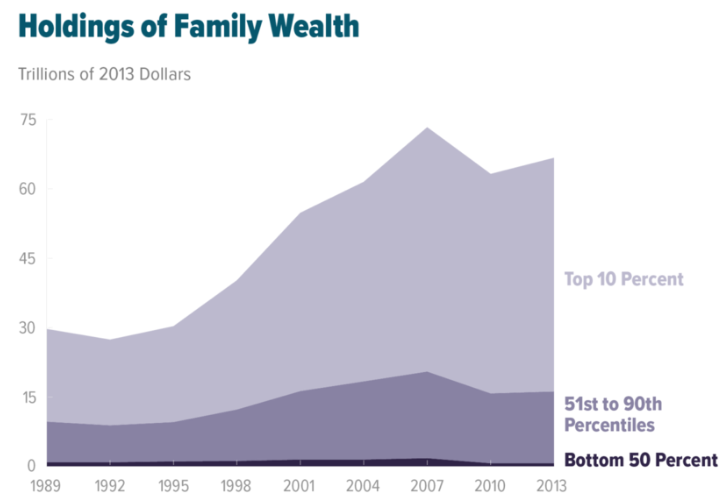
So, we can end with this graphic (wealth inequality). 

Wealth inequality in the U.S. - 2013

To be complete, we need to bring in later data, say 2020. The next chart comes from the FED of the US and shows from 2005 to 2020 (Q3). According to these numbers, the bottom 50% had a total of $2.36T out of $116.53T. 

Wealth percentile groups - U.S. to 2020 (Q3)

In short, 1/2 of the population might be pursuing that stupid dream that is now in vogue. We hope to change the focus a bit by balancing back beyond the rebellion time, somewhat symmetrically. The other 1/2 do not partake, so how are we any different than the 'developing' situation? We learn history in school and have a never-ending supply of books. 

What we don't have is a history that maps to regular people and their families. We have seen attempts of late, as we mentioned before that we see with McCullough's work. The web/cloud will facilitate a better attempt at this. We will support such research efforts several ways. 

Remarks: Modified: 01/08/2023

01/30/2021 -- Example of the before: The Pamphlet War (Tories and not - very familiar). 

01/31/2021- Example of the use of the American Dream: Cris Gardner. Gosh, lots of popular push behind the rags to riches stories which can be situated, many times, in the US scene. 

03/15/2021 -- This theme will continue: Victory Gardens. New Englander, out west in Detroit, helping to employ and feed the underworked and underfed. This was in 1893, long before WWI. 

01/08/2023 -- We had another icon (Charles Thomson) for our 250th (1774, Continental Congress) and 400th (Cape Ann as one of the first of the capitalization attempts of history). 

Tuesday, January 5, 2021

Summary, 2020

We have done some type of summary since 2011. We missed 2017, for some reason. Until two years ago, these were in a similar format. Not now (mobility's influence).

Like in 2019, we are using 'Last 3 months' rather than last 30 days. The new mode has more options than there were before. It is interesting to see that the "Marriage of Thomas and Margaret" post is still on top. Last year, it was also on top for both the past month and for all time.

We will get a multiple year view in 2021. Also, when we look at Summary, 2014, we see a more thorough review. We'll have to get back to that sort of thing.

Recaps: 2020, 20192018, 2017 (missing), 201620152014201320122011.

Remarks: Modified: 01/05/2021

01/05/2021 --