Wednesday, December 15, 2021

Josiah Quincy, III

TL;DR -- So far, we have looked at a few of the Presidents of Harvard which came about from our studying the History of Harvard with respect to the unfolding of the U.S. The visit of Dickens happened during the term of Josiah Quincy, III which motivated this post. Too, he is heavily New England on his mother's side which is a continuing theme for our research. As well, his term was the first one after the Count Rumford donations changed Harvard which, too, will be reviewed. 

--

While looking at the Heads of Harvard, we have been sampling somewhat driven by interests that map back to the mission of TGS, Inc. An important aspect of our mission is the 400 years of history from Cape Ann and the 250th celebration that is the focus of SAR/DAR. That is, history needs to be fleshed out with the reality of individuals and their families, in part. Of course, the total picture is larger. 

While looking at Felton (who is coming up for some attention), we got reference to a book which looks at the 300 years of Harvard (see History of Harvard). We found the Table of Contents. Lots to read, but Charles Dickens was one of those published in the book. Turns out that Dickens visited the U.S. in 1842. He was mostly in the east, lots of time in Boston where he liked the Harvard crowd, one of whom was Felton. An article in the Crimson noted who was there and met Dickens. A who's who which we could relate to having done this look at the Heads. 

Josiah Quincy, III was the Head at the time. We haven't mentioned generations yet with respect to these Heads, but Quincy was of the 6th generation (WikiTree: Quincy-306). His mother was of the Phillips family with a solid New England history. 

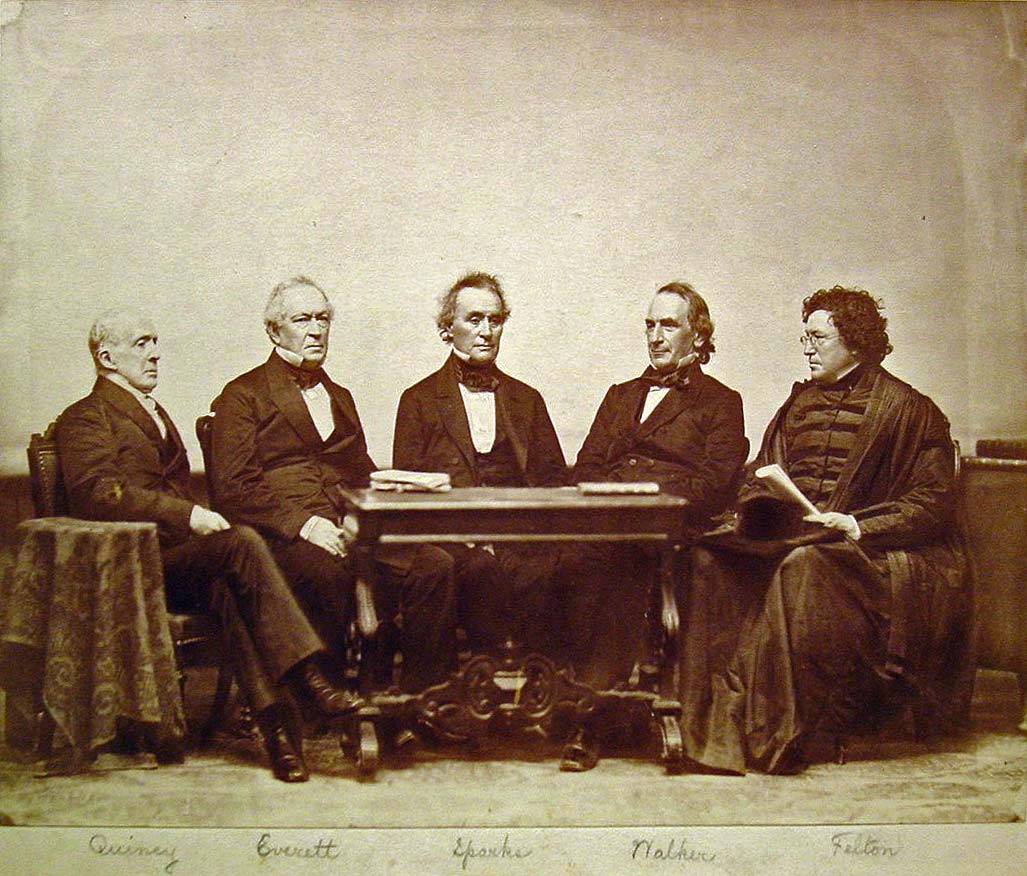
On Quincy's Wikipedia page, there is a photo of five Heads of Harvard. On the left was Quincy. On the right was Felton. The range of their terms was from 1829 (start of Quincy's term) to 1862 (end of Felton's term). That included the frontier years in the west prior to the Civil War. We will be looking at that history further using the Heads as guideposts.

Dickens' visit is only one of several events to consider. However, we need to mention the opinions that he wrote of American and Americans. Too, though, Dickens was quite perceptive. As an example, the below link is him writing about social classes which is very much apropos to the Harvard experience. Somewhat an aside, but not, as this was written during Quincy's term:
Too, it's apropos to the time of the year, where the Christmas Carol (written after the trip to the U.S.) gets attention, yearly. 

Remarks:  Modified: 12/26/2022

12/16/2021 -- Added the TL;DR line. 

12/26/2921 -- Some editing to make "The Haves and The Have Nots" stand out. 

12/29/2022 -- Benjamin Peirce was at Harvard and is listed as one of the few mathematicians from the USA in the XVIII Century. Quincy encouraged him; Benjamin became head of the mathematics department. 

Saturday, December 11, 2021

Charles Dickens

TL;DR -- Dickens visited the U.S. twice. The first was in 1842. He liked Boston and Harvard. At a site that offers Dickens-related material, his view during the 1842 visit of some people of fame can be found. He noted the American ways, good and bad. His western jaunt only went to St. Louis. On a later visit after the Civil War, he mainly read his writings at eastern locales. The west was still too wild. Dickens's views will be more apropos than those of the aristocrats who visited, too. 

--

We got to Charles Dickens (1812-1870) somewhat in a circuitous manner. We, briefly, looked at Cornelius Conway Felton as one of the Heads of Harvard in order to assess information about him. Neither Wikipedia nor WikiTree had much. Lots of these profiles seem to be ignored; so, we will table Felton until we look at a few other administrations. 

On further search, Felton was mentioned in relation to a publication: The Harvard Book. The record on archive[.]org is only the Table of Contents. Dickens was included. On browsing the content list, it does look worth while for further reading. 

So, that led to a search on Dickens and Harvard. One article was published by The Crimson (A Moist and Oystery Twinkle: Charles Dickens at Harvard). This visit was in 1842. The article mentioned that Dickens loved three things about Boston, "its literature, its oysters, and its Harvard men."  And, the article mentions the people who entertained Dickens whose names we now know due to this research. Felton was mentioned. 

When Dickens ventured outside of Boston, Felton went with him to some areas. Dickens went further west; that is something to look at. St. Louis was as far as he got in the 1840s. Travel was arduous. Wherever people had started to settle there and further west, but it takes time to develop facilities. 

A wonderful site covers the authors two visits to the U.S. and his other ventures: The Charles Dickens Page. Technically, we really like the layout of the site which is loaded with information and will be using it as a resource for our work when Dickens applies. 

Dickens' travels, 1842

The first trip was in 1842. Missouri was all of twenty years old. One thing about the above site is that Dickens wrote of his travels. The Dickens site has made these writings available. This is the page on Travels in America and Canada 1842. Sites up to St. Louis are on the list and covered. But, here is Dickens on St. Louis. As mentioned, that was his furthest point west. 

On his return trip in the 1860s, post the Civil War, Dickens did not even venture out of the east. This is the article about his travels: Charles Dickens in America 1867-68. A table provides some detail about the itinerary with some notes. These are not as extensive as he did with the 1842 trip. He was older. Also, he was reading his works. He got to DC but the furthest west was Niagara Falls. 

The following are links to related articles provide only for reference. 

It's great to hear of Harvard and Dickens repairing the ties that bound the old and the new English cultures. After all, there were still some conflicts going on in the 1840s as Canada served as the means for friction. The boundaries of Oregon were not settled until 1846. 

Too, in 1842, Dickens was meeting the upper crust Americans who really had no counterpart in England. In fact, that type of dynamic is still with us and motivates some of our work. Over the 400 years of the U.S., all sorts of social and cultural issues have been a hotbed of conflict some of which we still see as unresolved.

So, actually, it is great to run into Dickens and his two trips. There is a more real flavor to this than we saw with the visits by the French aristocracy (say Lafayette's Trail).  

Remarks: Modified: 12/16/2021

12/15/2021 --  From the home page of the Charles Dickens site, one can branch to pages related to many themes. Dickens' work was quite broad. So, not only are there many links, it can be difficult to follow all of these and not get lost. That's why 'search' was created. But, in the first article there is a link to material related to his Travels in America with information about the 1842 and the later trips. This Remarks contains major pointers to remember with regard to browsing on the travel theme. 

12/16/2021 -- Added years to Dickens (which helps place people with their generations - multiple as we will explain). Also, Ralph Waldo Emerson needs attention. He was around Harvard most of his life. Too, he was there, as a youngster, about the time that the Count Rumford monies arrived. ... At the Crimson article on Dickens, a comment mentions Dickens' opinion of the American Titian: Washington Allston. Mentioning this due to our early look at an exhibit: Titian at Isabell's place

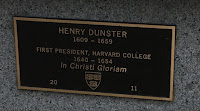
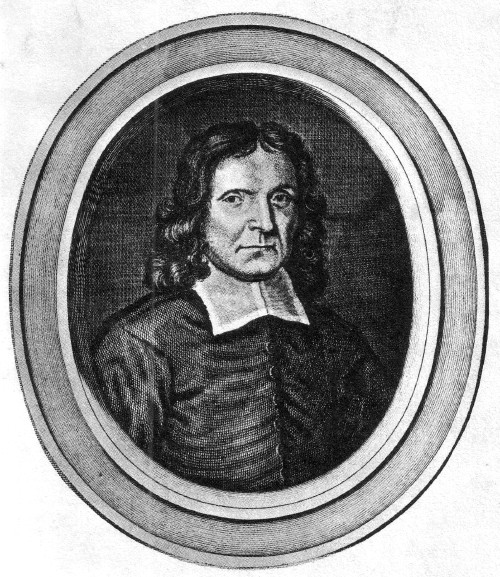
Henry Dunster

TL;DR -- Henry Dunster is the 1st Head of Harvard, coming in not long after Nathaniel Eaton's tenure was ended. Dunster had fallings out with the Puritans, as well. 

--

We have been adding Heads of Harvard to a list while taking an initial look at each with respect to time and affiliations, including family and New England. Our research started with a recent one, comparatively, and we have done a few more. But, we missed the first one and are correcting that oversight with this post. As mentioned, we mostly are using links, in our posts, to Wikipedia and WikiTree for the first pass and will be diving deeply into the term of each along with our review of U.S. history from the time of the revolution until the time that the frontiers were mostly settled. That get us from 250 years ago (plus or minus a few years) to the early part of the 20th century.  

Well, our list of heads is in our post titled History of Harvard. We were adding numbers to show where there are still gaps and noticed that we ought to include #1, Henry Dunster to anchor the list. Dunster held the position from 1640 to 1654. He took over after Nathaniel Eaton found himself facing the first American cancel culture. We need to discuss that and will, at some point. 

Dunster came over in 1640 after teaching for a time. He earned his bachelor's and master's degree from Magdalene College, Cambridge. Dunster experienced some controversy in conflict with Puritan views which led to him leaving the position in 1654. 

Henry Dunster (WikiTree - Dunster-36) requires a little work on his Profile. But, that there is a lack of interest in researching seems apparent for some of these profiles (we have only looked at a small set of the total). 

We will get back to his term as we look at a few more profiles and establish a framework for our study. We started this review with Count Rumford's contribution as a key item. However, going back before the U.S. Revolution will require more concern about English culture and its influences.  

Remarks: Modified: 12/15/2021

12/15/2021 -- Added the TL;DR line.  

Friday, December 10, 2021

U.S. and Harvard, I

TL;DR -- Looking at Harvard goes from 1636 to now, and one could think about the before times as well as what's next. Our interest is partly personal due to having connections over the toto of the life of the country and the school. Too, though, the U.S. might have started on the coast, but it has filled in a huge continent (or part of it) over these centuries. It was a mere 200 years ago, when the carving of the middle was the vogue and had everyone's attention. Well, not, as most who left the busyness of the east coast became unknowns out here. The recent Head's life motivated this review which is intended to be a usual affair as we go along. BTW, us is the US and its folks. 

--

Having started to look at Harvard and its ties to the U.S. (which is us, the people - not just the brainy who need to be fed and told how to move one foot in front of the other -- as the embodiment of that notion of Winthrop quoting the Bible about humanity needing a 'light' or two, whether on a hill or not is immaterial, though we love lighthouses and gaslights) that we all live in and try to know, from several perspectives, it appeared useful to consider the 32 Heads of Harvard over the almost 400 years of its existence. 32? The official count is 29, however we added three. Two of these were in an interim position, for more than a year. So, they count. Then, we have the first one who is mentioned already in this blog. 

Note: There is a note that John Winthrop served as acting Head on two different occasions. So, the count would be 33 Heads. Winthrop is a descendant of the original Governor and taught Count Rumford in his youth. Other acting presidents are listed (Presidents of Harvard). 

See this post, History of Harvard, for the list which has a few names on it as of now. Of course, an early one was James Bryant Conant. It was a New Yorker article that got our attention, so we went to look at New England and family ties. From that, it was easy picking from various areas. For example, an important time is when Count Rumford funded Harvard's efforts at becoming more secular. John Thornton Kirkland was there at the time, but we have other names to run down. It seems like the Pearce family was more involved with setting up the technical focus for the institution.  

While doing this work, our principal modes of information are Wikipedia and WikiTree, both of which we support via editing and usage. But, we go to other sources, to boot. Right now, we look for and find New England connections, where we expect that later folks may have tenuous links in comparison with those from the early ages who would have had closer ties. 

In fact, our last two Heads were related, with Samuel Willard being the great-grandfather of Joseph Willard. We have been picking people by name and noticed the two Willards. Will there be others who relate more closely than New England cousin? As well, we expect to follow threads especially as we consider the frontier. Too, Harvard ties will hit all over the place and ought to be interesting for several reasons. 

One of these is U.S. history as it relates to its future. We have been dealing with the frontier for two years now (U.S. Interior) with respect to families. Many were new arrivals; lots of patriots were 1st or 2nd generation in their family. New England patriots were mostly the fifth generation. 

Presidents of Harvard

However, our net will be cast wide. The U.S. has many aspects of its history that never got attention. Part of this was technology. However, part of the oversight is due to the ruling mindset. The internet will allow more freedom. Actually, it'll allow more effective means for research. We already see that with the genealogical and historical approaches with family data. That is both good and bad. 

But, like with brainstorming, we look at things in order to get sufficient material to make those assessments that are necessary for maintaining society and sanity. What follows might seem wide-spread, or too unfocused, but it is not. Rather, it represents a mere scratch on the surface. Digging deeper? That is always a choice for which decision theory, hopefully, will be helpful. 

So, this post is motivated by noticing that Nathan Pusey was the next Head after Conant who was a descendant of Roger Conant of Cape Ann and Salem. It looked like Pusey's heritage was principally from Pennsylvania and the south. Then, the family moved west. Pusey was born in Iowa. His extended family was scattered around in that area west of the Mississippi. 

When did the family arrive? On a closer look, we can see that his paternal ancestors were with William Penn in the late 1600s. Some have done genealogical work on Pusey's; we will be looking into this further at some point. We had noticed that some of the Heads have very slim information about them, as if there is some popularity aspect that determines interest. 

Well, all of these Heads will be important, as we step through the many generations. Fortunately, we have family involved with Harvard, as well as in-laws and friends. So, personal motivation will help fill in the historic look. 

Let's consider this little tie. Pusey taught at the Riverdale School in New York City early in his career. He is mentioned in the 'Notable staff' section. Looking at the 'Notable alumni' section brought up several names that are of interest. President JFKennedy and his brother, RFK, are on the list. The school started in 1907, so the names are fairly contemporary. Others of a wide variety are Ratan Tata, Carly Simon, Cesar Romero, Steven Mnuchin, and others. 

But, so was Lawrence Ferlinghetti an attendee of the school. He is well-known for his literary work and his book store in San Francisco (City Lights Bookstore). Given our focus of late, what caught the eye was that his wife was the granddaughter of Edmund Kirby-Smith. Families went south and then west. Some came in and went west, like Pusey's. And, when west, there was the huge U.S. Interior involved which took over 100 years for a frontier experience to not be the norm. 

His folks were from Connecticut, but Kirby-Smith was born in Florida. After attending a military academy in Virginia, he went to West Point and served in several military campaigns. With the start of the Civil War, he was a superior officer. By the time of Bull Run, where he was wounded, he had held several positions of General Officer. After the war, he had several positions, ending up as professor of mathematics and botany. 

According to WikiTree (Smith-39301), his tree is fairly well filled in with lots of Connecticut connections. However, there are Massachusetts connections, as well, including Essex County. This is an example of a New England family from the north going south. Many had done so much earlier. 

One might wonder about the Harvard association as it seems fairly weak. But, it is not, just like the reference to West Point is there constantly when we look at the military history. Harvard is part of that long-arm of New England which threads heavily from one coast to the next across the large middle. And, then, of course, U.S.ers were very much active overseas from the beginning. 

Lots of things to look at and ponder. 

Remarks: Modified: 12/11/2021

12/11/2021 -- Add image for our portal (to truth).  
Nathan Pusey

TL;DR -- Continuing with the look at the Heads of Harvard, we chose the one who succeeded James Bryant Conant in the role. Conant started the testing focus. Pusey continued the work. Pusey also was of the time of the student unrest which grew faster than anyone expected. His decisions as Head may have not been popular. We look at Pusey and his heritage. Is he an example of being cancelled? 

--

There is a lot of motivation for this review, as there have been thirty-two Heads of Harvard if one considers that a couple were not counted as they were considered interim for a few years plus we have the first one who was run out on a rail, so to speak. Those not counted were Samuel Willard and Eliphalet Pearson, both of whom we have looked at, briefly. We have noticed that some of these folks are ignored as seen by sparsity of their information on Wikipedia and WikiTree. This can be corrected. But, too, we can discuss the 'cancel' culture which is really nothing new (witch hunts, for instance, and their hangings). 

We picked Nathan Pusey due to his name which we have seen in the New England milieu. Nathan does have a WikiTree profile (Pusey-1124) which is very sparse. Even his wife's heritage is an empty bucket. However, from the Wikipedia profile, we see that a great-uncle of Nathan was William Henry Mills Pusey (WikiTree: Pusey-111). 

William's WikiTree profile has information about his paternal ancestry which would then be the same as that of Nathan's. The Pusey family came into PA in the early 1700s. William was born in PA but went to IA after being admitted into the bar in PA. Nathan was born in Council Bluffs, IA. So, this was a great find for several reasons which will be explained, over time. Meanwhile, this task is very finite; albeit, once we organize the material, there will no end to showing how the 'lights' of New England are transcendental yet very much pertaining to the U.S. and its history and future. 

Nathan was admitted to Harvard. It would be interesting to trace his Harvard roots, as at that time, there was a New England focus with regard to admission. In his term as Head, Nathan continued what Conant started which emphasized testing to allow a broader mix of students to obtain admission. Nathan was the Head who succeeded Conant (see History of Harvard). 

Nathan's time at Harvard coincided with the rise of up rest in the 60s. He was not a fan of student advocacy. So, his life and times need further elucidation from the perspective of Harvard and the 400+ years of the U.S.  

Remarks: Modified: 12/11/2021

12/10/2021 --  Working in a way to provide views that extend the primary look at the Head into related areas. Is Pusey an example of being cancelled? There is not much written on him. We have only looked at a few Heads, so far. Analysis awaits completing a larger set of these looks. So, another post was motivated: U.S. and Harvard, I

12/11/2021 -- Added link to History of Harvard.

Monday, December 6, 2021

The Willards

 TL;DR -- Samuel and Joseph Willard were kin while both being Heads of Harvard. Samuel was first and the great-grandfather of Joseph. With these few samples so far, we can look for Harvard to illustrate its role in the unfolding of the U.S. which is one of our chief themes.  

--

So far in our look at the History of Harvard, we have considered four. Today, we pick two who are related:  Samuel Willard and Joseph Willard who are descendants of Simon Willard, an early entrant. 

  • Samuel is the great-grandfather of Joseph and served as an acting Head of Harvard from 1701 to 1707. Hence, Samuel is of the second (first born here) generation. Samuel's father was a founder of Concord, MA with Rev. Bulkeley. Samuel served as Head after Increase Mather and before John Leverett. There are New England stories to consider, such as Samuel's Puritan church being used for Anglican services on order of Gov. Andros. 
  • Joseph was Head of Harvard from 1781 to 1804 and came into his duties before the end of the conflict with jolly old England. In his term, he introduced a dress code and was the first to offer the Commencement Address in English. Joseph Willard descended from Simon Willard through his mother, too. 
One would expect the earlier Heads to have a New England background (see Heads of Harvard). Or New World. Samuel is the earliest that we have considered, so far. 

 Remarks: Modified: 12/11/2021

12/10/2021 -- Added image for our portal (to truth).  

12/11/2021 -- Added link to Heads of Harvard.

Thursday, December 2, 2021

U. S. Interior

TL; DR -- Before, we talked of the 100th, 200th, 250th, 300th, and 400th coming forward from Cape Ann. Where the 250th deals with the U. S. start. The 400th involved New England and more. Now, we can talk 400 years ago, 200 years ago, and now. 400? The forebears crossed the sea. 200? The waves of immigrants crossed the prairie and other areas of the U. S. interior. Now? We are all sailing the seas of the cyber and virtual and more due to the computationally-framed new world. 

--

In the latest issue of Gardner's Beacon, which was Vol. XI, No. 1, we mentioned one of our continuing subjects: U. S. Interior. In part, the subject of the U. S. interiors deals with history, however we add in the family aspect with the same intent as groups focused upon historical and genealogical topics (say, the NEHGS). We have called the period of over hundred years in which the interior expanded to be the Frontier Century

While browsing today, we ran across a map that looked interesting which is given below. However, let's take a moment for reflection. The map was in a collection of other images related to why the U. S. has been successful, in the world, which is a debatable subject. There was no attribution, so we used the facilities of Google's image search to find the source for the map. It showed several similar maps, however PInterest had the map and pointed to where it got the map. So, that was nice to see. 

The site is run for teachers. Here is the map which provides a timeline for acquisition as well as some indication of the geography. We have had several posts on this subject which are list below (such as, All that Louisiana brought, which is first on the list).  


The map also was used at a Quiz site. Doing this exercise made us aware of a Wikipedia page that looks at the "Territorial evolution of the United States" and provides an animated map. This reminds us of the Virginia map showing its extent over the first few decades.  

List of posts dealing with the western expansion (as we call it). Part of the discussion and work will be taken by concerns for our relationships with the American Indian
  • All that Louisiana brought (Nov 2020) -- The brown area picked up by Jefferson which included St. Louis. 
  • Sam Dunn (Nov 2021) -- A look at the interior by a Londoner in 1794. 
  • State of Missouri (Jun 2021) -- On the right edge of the brown area which was the HQ, so to speak, of those who were surveying, who were early arrivers (fur trading), or who were just passing through. 
  • Michigan, 200 years ago (Aug 2021) -- The light green area on the right includes the colonies and areas that are close. However, things, such as borders, were still being settled there in the early 1800s giving a chance to practice carving the land in a big-time way. 
  • Rendezvous (Apr 2021) -- The dark green area to the left includes the mountainous regions of the northwest (the real one, not the area around Ohio). 
  • New Spain (Feb 2021) -- Covered most of the region west of the Mississippi. This map includes the major rivers which helped carve the land. Coronado was in the middle of the brown region in the 1540s. 
  • Pre-Civil War, San Antonio TX to San Diego CA (Mar 2021) -- Cutting across the lower part of the U. S. in the early days. Again, for the hearty. 
  • Carving the land (Jul 2021) -- As mentioned, St. Louis was an early sight where the surveyors got started on the great middle. The post includes a color-coded map with discussion. 
  • Department of Interior in MO (Jun 2021) -- One of the earliest departments of the new government. Following the Boone family into MO might be of interest for several reasons. 
  • 3 Trails (Sep 2019) -- St. Louis might have been where the paperwork was shuffled, but those heading west converged on the area around Gardner Junction KS which is west of Independence MO for some time. This is in the middle brown section. 
  • Trails West (Mar 2016) -- The Gold Rush (left coast) was later. While it saw a substantial bit of travel by water (around the Cape or split with a ground jaunt across Panama), there were many who went by the trails. The Bostonian went around and sailed from Jul 1849 to Jan 1850. After a jaunt to New Zealand, it returned and shipwrecked along the OR coast. 
  • Paper Trails (Jun 2021) -- One can follow the Post Offices through time (see maps by year). Looking at the treads related to the points, one can get a sense of the eventual railroads  as well as the modern highway system. 
  • St. Louis MO to San Francisco CA (Jun 2021) -- About eight rough days for the hearty traveler. Post also shows the progress of the establishment of the railroad in three maps. 
  • Jedediah Strong Smith (Jul 2018) -- He mapped out the CA Interstate system on foot and horseback. 
  • Trapper, Trader, Rancher (May 2021) -- The Bent family out of New England eventually got to St. Louis. The father was a surveyor and agent for the government. The son was in MO, KS, CO, OK, and TX (using modern state labels throughout to save the fingers). 
  • Rivers and more (Feb 2021) -- The Mississippi and its feeders cover a lot of the brown and light green areas. In fact, water from eastern PA (and NY) go down to the middle of the country. In the dark green of the upper left, waters come down to the Missouri river. 
  • Oregon or bust (Sep 2021) -- Gardiner OR was founded where a ship of New England ownership wrecked. People went out by the wagon trains. Or, they came in from the Pacific after a long voyage. 
  • New France (Feb 2021) -- The area covered was in the upper U. S. as well as in Canada. 
  • Scholars, in general (Aug 2020) -- Papers and maps on the divides that run north to south along the western edge. 
In conclusion, New England influence by family or other parties is our interest. We can see a good reminder with respect to the founding of Lawrence, KS and the University of Kansas
    To set the stage, let's do a quote. This is from Chapter 1 in which Cordley quotes from Whittier's poem, "Song of the Kansas Emigrant:"
      We cross the prairie as of old
      The fathers crossed the sea,
      To make the West, as they the East,
      The homestead of the free.
So, as the early ones "crossed the sea" 400 years ago, we saw the later ones crossing the prairie, the river, the mountains, and the valleys 200 years ago. 

Nowadays? Flyover country or by car (1300 miles from San Antonio TX to San Diego CA, by Interstate, 22 hours). 

BTW, one other focus is technology, especially computationally framed reality. So, now we are going to be sailing the seas of the cyber and virtual? 

Remarks: Modified: 12/03/2021

12/02/2021 --