Tuesday, February 16, 2021

Gathering of the trappers

TL;DR -- Paintings by Remington and Jackson give a good flavor of the times. 

---

There were several ways to start this post, however using Remington is very much apropos. Picked this photo up from the page about Jedediah Strong Smith on the Legends of America site. We got to Jedediah through articles by Judge Thompson in Dr. Frank's The Massachusetts Magazine where the Judge wrote of his journey out west (over land, to the left coast, and back) in the early days. However, he was in a later time than that of the mountain men who were associated with the fur trade.  


We had not paid attention, but a movie (The Revenant, only saw the ads and read a few brief reviews) was showing in the 2015 timeframe. A little later, while we were trying to identify places that have Gardner in the name, we came across Gardner River that flows out of the Yellowstone Park area in Wyoming merges into the Yellowstone River in Montana. The namesake of the river, a little eddy along the river, and a town turned out to be Johnson Gardner. He was of the cohort of Jedediah. The movie is about an event in the life of Hugh Glass. He had a comrade named John S. Gardner who was killed in the same incident as Hugh was injured in. 

These guys were working for Gen. Ashley of the Rocky Mountain Fur Company. Ashley, himself, was out of Virginia and went west before the Lewis & Clark journey. Lewis & Clark were of the official world. We hear of mountain men and expect them to be roughed individuals. But, an added aura is the realm in which they were roaming. The American west. The painting above depicts these individuals coming to a rendezvous which, it turns out, was something that the General got started. 

This next two paintings are from W. H. Jackson: a rendezvous and view of a wagon train. These are meant to show some of the cultural context as well as the scope/scale of what we need to do. Paintings can be seen in the Eye for History publication of the National Park Service. 


As we look at these, we can not help but think of the "flyover country" discussions that were never resolved. 

So, let's end this post and look at what is coming up in the next few posts. We will look further at this fur company, in the context of the long reach of New England. Notice that where W. H. Jackson was born is way upper New York and close to Vermont. To us, that implies the possible links to Massachusetts, perhaps even Essex. Ann's great-grands went out to that area for a while. But, we have another puzzle where the lineage is along that border, and the family names are right out of Essex County (and Nantucket). No end to the work to be done. 

Too, though, we will look again at rivers and their sources. The Yellowstone area is interesting in this sense as it spawns a number of waterways. There are many ways that rivers come into the picture. But, too, as we work details related to events and people and their families, we will be aware of earlier takes on the matter, both the historical and the informal looks. 

Remarks: Modified: 03/08/2021

02/27/2021 --  Looked at the rivers of Yellowstone and New Spain. Added the TL;DR line. 


Monday, February 15, 2021

Rivers and more

TL;DR -- Further look at the Mississippi and the portage area in Wisconsin that links the Fox River with the Wisconsin River. 

---

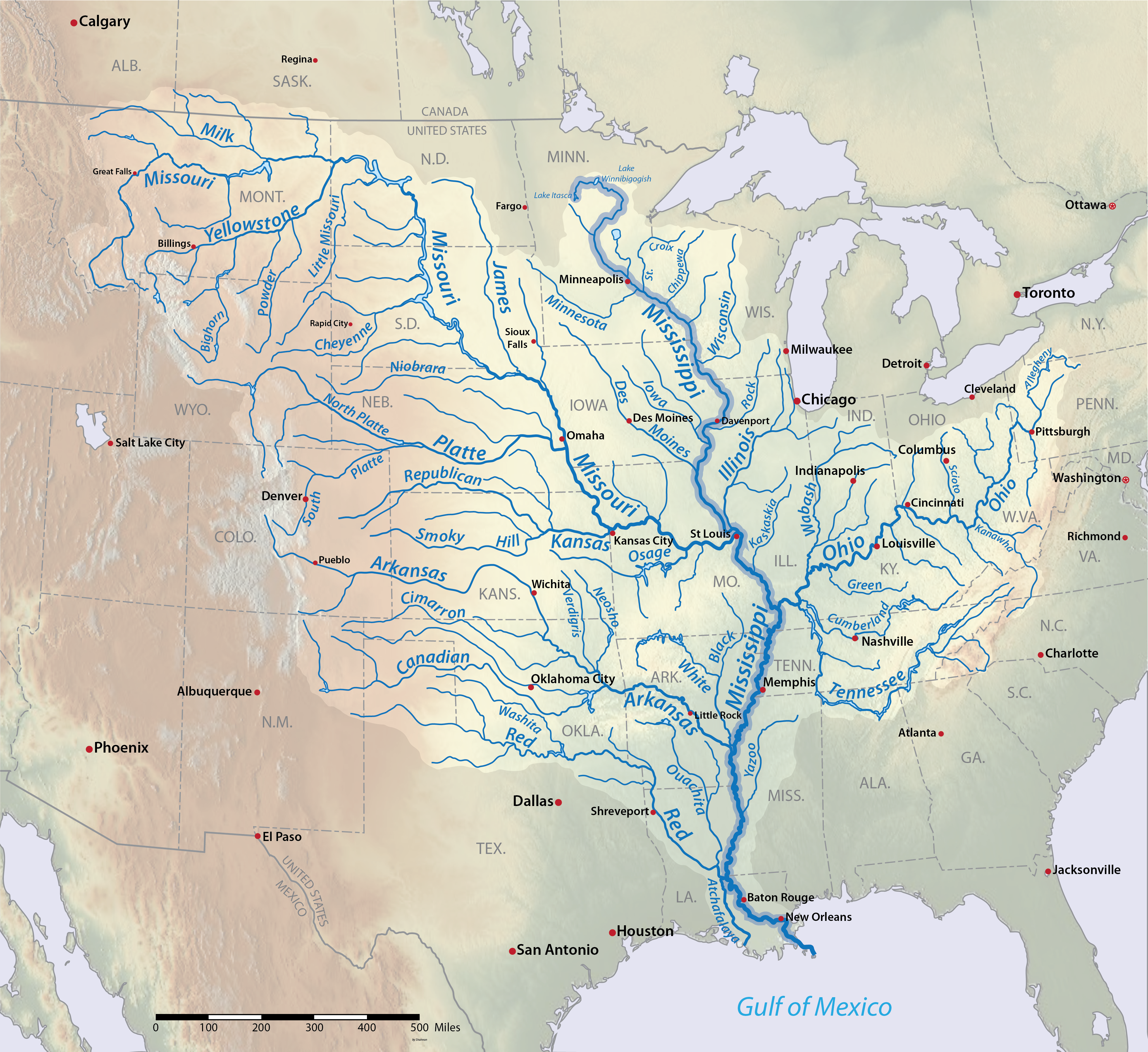
As mentioned before, rivers facilitate travel, however they are also barriers to movement. People moving west out of the east coast traversed large chunks of land as well as crossed over major rivers: All that Louisiana brought. That post looked at the Mississippi watershed which covers almost the whole of the continent, as the river came to the U.S. from the area of New France. Getting familiar with specifics reminded us that we need to look at the other colonies. There were New France, New Spain, New Netherland, and New Sweden. The last two were short-lived, albeit the effects of that effort remain visible until today. It was England, France, and Spain who continued in their conflicts for another century plus. 

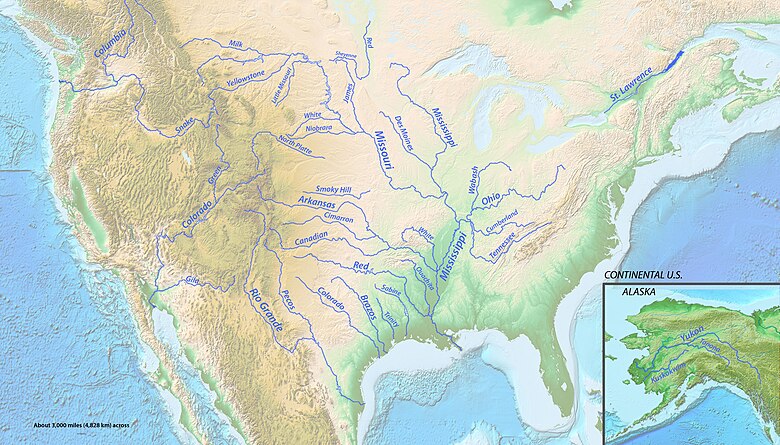
Before getting to the theme of the post, let's use a better image from Wikipedia that shows the major tributaries of the most major of the water systems in the U.S. This post deals with an area in the north central of this map (that is, to the upper right of the heavy blue line). Later, we will back up and update an earlier post about the Gardner River which is in the upper left (Yellowstone area). To be complete, we have to look at the other major systems in the west that do not drain into the Mississippi (Columbia, Rio Grande, Colorado, and few smaller systems in the west, plus Texas and its rivers - Pecos and all). 

Mississippi River

So, the theme continues to be about rivers. The Wisconsin and the Fox rivers are so close in Wisconsin (see upper center part of the above map, to the right - the Wisconsin is shown) that a portage was established way back in the 1600s (of course, known way before the Europeans arrived at the scene) that allowed travelers (their original location was the St. Lawrence area) to use the Great Lakes to get to the Fox River (via Lake Michigan) and over to the Wisconsin River so as to get to the Mississippi and venture south toward the Gulf of Mexico. That party traveled down past the Missouri River to the Arkansas River which are both carriers of water from the Rockies. 

What was interesting to learn was the height differences from Lake Michigan to the Mississippi Valley plus the short distance of the portage which was less than three miles. The graphic depicts the elevation of the locks that were established to allow transportation to use the route. Prior to that, there would have been manpower in movement of the vehicle as well as other portages in order to bypass rough areas. Albeit, none of that would have been too strenuous in normal conditions, compared to what was coming for travelers as they got past the area of the plains. 

Fox-Wisconsin Waterway

These early travelers (Joliet and Marquette) were French with American Indian guides and turned around at the Arkansas as they saw evidence of Spanish culture. On their return journey, they blew by the Ohio (different culture - we'll get to it as a main waterway from New England) and took the Illinois River back east. They had a bit of a longer portage to get to Chicago and Lake Michigan, however the going was easier. Just for comparison, here is the waterway that was developed later to allow and maintain water traffic from Chicago to the Mississippi River. 

Illinois Waterway

Notice the elevation changes. Chicago is 597' more or less above sea level. Grafton, IL is 435'. At its confluence with the Ohio River, a little further south, the Mississippi River is at 315'. This is a low spot as going west would have had one climbing to the Rockies and beyond, over a long bit of terrain. Lewis & Clark paddled their way up. Later, ingenuous people had flat-bottom boats with power. However, even those could not handle the rough water.  

In the context of these waterways, the later trekkers would have seen these as a barrier which would differ by the time of the year and the weather. Spring runoff in this area can be quite large. It was not too long ago that we saw a huge flood cross the landscape from a large snow melt in the Rockies to the Mississippi along the Missouri River that took months as it went from state to state. When it finally arrived, in an area, everything within the flood plain was under water. There would be no concept of the flash flood unless one was looking at upstream penetration in tributaries as the water rose. Usually, flooding is a downstream affair. But, there can be back up given the right conditions. 

So, in those early times, none of this would have been known. One service that would have been established later was a ferry. The Massachusetts group that went to Lawrence, KS went over the Wakarusa River after they left the Gardner, KS area. Later, there was a ferry put in at that location between Kansas City and the Lawrence area. Imagine a wagon train, though, with each wagon awaiting the back and forth. Gives "all in a day's work" a whole new meaning; rather, it's a forgotten one. 

Remarks: Modified: 11/29/2022

02/16/2021 --  Got to love Wikipedia. This post lists rivers of the U.S. by length. The Missouri tops the Mississippi by a 100+ miles. It's due to those twists and turns in the mountains of the west. Also, for each river, it shows where it drains. Note that six major rivers flow into the Mississippi. Then, each of these has many rivers flowing into it. So, the Mississippi system is huge. 


See also, list of longest rivers by state. For each state, there is a link to the list of all rivers with a map of the river. Again, Wikipedia, and its volunteers, are a marvel of the age. 

The USGS has a nice map that allows attention to details

02/18/2021 -- Our post on trappers shows a W. H. Jackson painting of wagons crossing the South Platte. This was risky. Notice that extra oxen were used. However, in shallow spots, a ferry would be difficult to manage, too. 

11/29/2022 -- Refresh the elevation view of the Illinois Waterway. 

Other new attempts

TL;DR -- There were other countries in the area: Sweden, Netherlands. 

---

New Netherland (c 1684)
We started with New England for obvious reasons and recently decided to look at other colonies since our focus, in part, is the total of the North American continent. New France was brought into the picture due to its geography and its role in many conflicts. Also, it did the early studies of the Mississippi region. However, when the Louisiana Purchase expanded the western regions of the new U.S., it was Spain with whom we did the deal. We do need to look at New Spain which covered a lot of area, so we will look at that in the next post. 

Before we go into some details of New Spain, there were two other close colonial attempts. These were New Netherland and New Sweden

New Sweden

The former is better known having left behind whole areas that are part of our modern culture, such as New York. The map shown at the right is noted to be fairly accurate given when it was drawn up. The earliest Dutch settlement was in 1613. After the arrival of the English, it wasn't long before New Netherland was being encroached upon from the north by the settlers. 

Later, in 1638, there was a Swedish colony established in Fort Christina on the Delaware River. This was the first of several countries who tried to make a foothold (Finns and Germans). 

New Sweden was principally in the Delaware Valley. Mapped out in 1637, there was a build up of settlers until were several town and hundreds of residents. The area was taken back by the Dutch in 1655. The English got New Netherland in 1674. 

As we will see in the  next post, New England picked up a large part of eastern New France with New Spain getting the larger portion of the west that we saw again in the Louisiana deal. 

Remarks: Modified: 08/14/2021

02/27/2021 -- Looked at New Spain. Added the TL;DR line. 

08/14/2021 -- Started a New England look as Weymouth is next year (2022). After that, the locale of our focus, Gloucester/Cape Ann. Coming soon will be a continuing series on slavery and associated topics, such as the Quakers, abolitionists, Civil War, and more emphasis on the relationships with the American Indians. Plus, point to world events through those 400 years; the U.S. was not in isolation. 

Friday, February 12, 2021

New France

TL;DR -- French-Indian War? Which one? New France? We find out more about this colonial effort by France that covered a larger area than New England. 

---

Our research focus started in Essex County as Thomas Gardner was a central figure. From there, we branched to Massachusetts and surrounding areas as people moved west and south (to us, families include collateral relationships whether by blood or marriage). For instance, families from Ipswich were out in Ipswich Canada early on (puzzling, at first). Too, there were pioneers who went out to southwest Connecticut and then New Jersey. Then we got to follow families to the southern New England and then out west. Finally, we started to take a look at the groups that came in later, prior to the Revolution, and expanded our scope to "All things Gardner" somewhat. Then, we looked at families post the Revolution both in New England and across the U.S. The western expansion got a lot of our attention due to the long reach of New England throughout the States. Looking at these families led to considering events prior to the Civil War and after. 

All the while, we kept ourselves to looking at English culture in the various forms here while staying within an adage for researchers here to not look over there (let's the Brits handle things). Well, that didn't last long, as we saw with the Magna Carta celebration in 2015 that groups in the U.S. were a main motivator for getting celebrations going and sustained. The ABA sponsored placement of a memorial at Runnymede. 

We never looked closely at conflicts in terms of parties and motivations. Except, we did look closely at the years going back between Cape Ann and King John's time, we saw lots of conflict. Much of this was cousin quibbling. 

As well, Dr. Frank noted that the leaders of the U.S. Revolution had been trained by the Crown by their involvement with the French-Indian war. Then, later, we were reminded of the Queen Anne war, basically through reading about the Pamphlet War. There is always research being done, however continuing improvements in technology will facilitate lots of work that was not possible before. Examples abound which will be included in our bibliography. 

Reading of the Queen Anne war got us looking at the particulars of what went on. English-French ties are ancient, way before William I's incursion. Too, though, we started to look at the history of different areas of the U.S. where families of English heritage were moving. And, that got us reminded of other cultures. Of course, we had already discovered that there were Gardner descendants who were of American Indian heritage. The cultures that were here prior to Europe will be the basis for presentations as we go back that fill in the pieces related to events and people. This is an example (Wikipedia is probably the best curator of disparate information and views on the planet; do you support it?).

These are separated out by centuries. We have already mentioned some. Such as, Joseph Gardner being killed in the King Philips's war. He, and Ann Downey, had no progeny so they will get special attention

But, conflict here, in the early days, also was going on in Europe. We have mentioned Spanish influences a time or two. But, there was one huge absence. Fortunately, we don't have to venture far to find a connection. New Hampshire was considered part of New France at one time. We have not paid attention to that much, seeing it mainly as where Rev Stephen Bachiler went to get away from Winthrop and friends. 

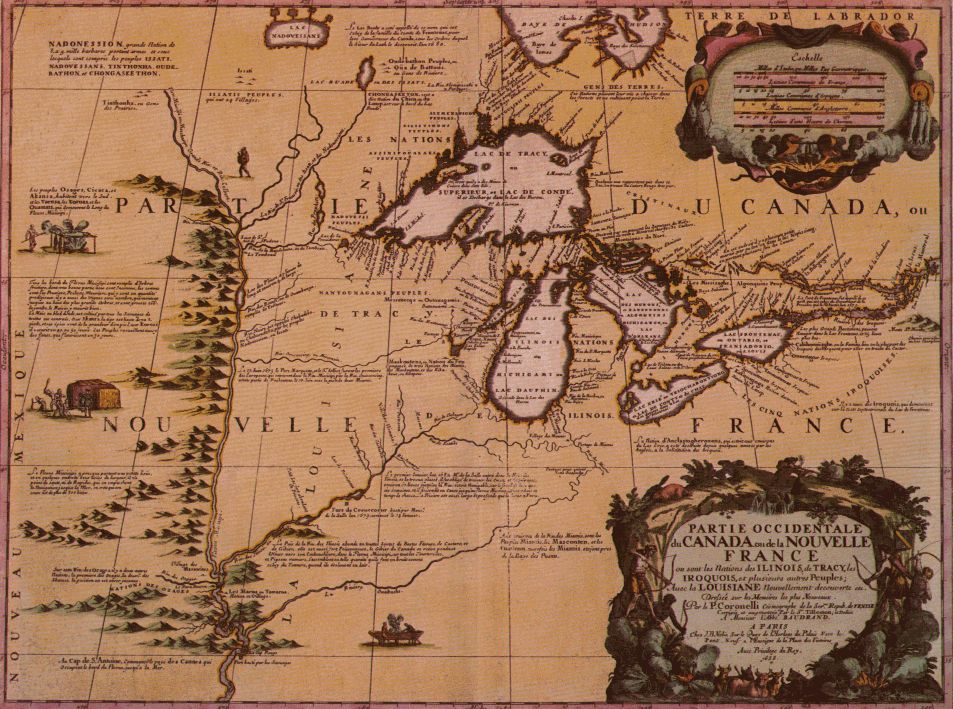
So, let's correct that. First, let's use a 1681 map from Joliet's and Marquette's journey out west in 1673. That was one year prior to Thomas Gardner's death. We just looked at that, briefly, noting that they went from upper Lake Michigan to Green Bay to the Fox River and down to the Mississippi. We will have a post soon on that and an update about Gardner River further west. This map shows the Arkansas River where they turned around as they started to see evidence of Spaniards being around and about. 

Map of Joliet's and Marquette's tour, 1673

This next map, we love. It's from 1688, and shows how huge New France was compared to New England, both north and south. Of course, upper New England was more populated in certain areas. We will look at that. However, that this was mapped out so early is astounding. However, the left coast is not in the picture at this point in time (claimed by the Spanish). 

Early view of New France

Now, these maps are from the latter part of the 17th Century. Things really changed the next century which as 100 years before the Louisiana Purchase which we looked at last year in terms of how people moved. 

We mentioned that we have many generations to look at. The 5th generation bore the brunt of the Revolution. The 4th was there, leading. The 6th was there as a transition. After that, New England mostly was maritime which we have looked at. Now, we can look at the landlubbers which we started to do from the perspective of D.A.R. with its 250th celebration of the Revolution coming up. D.A.R. itself dates from the latter part of the 19th Century. 

We are going to look very closely at the 150 years from the Revolution back to the Cape Ann times (upcoming 400th). And, given now the broad sweep across the continent, there is a lot that can be done. 

Not only can we consider families and their genealogy, we can look at generations and their times. The main boon of the internet (the reason for its existence) is knowledge sharing. So, we will see more research and reports from such, many taking avenues that are creative and unexpected. There are media issues for which we have a technology focus, to boot. 

But, stories of the characters of those times, generation by generation, will be something to look forward to. 

Remarks: Modified: 02/27/2021

02/27/2021 -- Further on the western rivers (and the Missouri River). Changed to using American Indian. Put in the TL;DR line. Looked at New Spain


Tuesday, February 9, 2021

Mississippi and Fox Rivers

TL;DR -- With a portage of a mere two plus miles, a route was shown from the Great Lakes (ultimately the Atlantic to the east) to New Orleans. Example of the importance of waterways to both migration (barrier) and commerce (traffic way). 

--

Going back before the Revolution is necessary if we are to have the proper view. So, we are approaching 250 years from the U.S. start and are past 400 from the Plymouth arrival. That gives us an additional 150 years to look at which will be four to six generations. 

We have covered many topics about lots of areas of the country, especially looking at the theme of western expansion that started after the expedition of Lewis & Clark in 1804. Their venture from the east coast was along the normal route that we usually considered where people traveled from the east down the Ohio River to the Mississippi. Then, they could go south to several points or backtrack up the Mississippi to the Missouri River and then head west. At the area now that is Kansas City, they could  go by foot or stay on the river up to Nebraska. If going by foot (of any of the animals involved), the goings were over one of the 3 Trails. If getting off the river in Nebraska, they headed west and met those on the Oregon Trail from Kansas. However, if one wanted to go further north, one could use the Missouri River to Montana. 

For a timeframe, we have looked at the period after 1804. But, we knew that there was activity before then. Long before, it turns out. Our research had us looking at families that came west either from the north as described above or from the south where they followed Boone's route. That is, if they were heading for the middle part of the country. If they were going to the south, there were other routes. In particular, we were following a family that came west from North Carolina (part of the family from Virginia and parts north) to Tennessee. Then, there was movement across Tennessee to Missouri and then Texas and back to Arkansas. That is where we found that the History of Arkansas is as old as that of Massachusetts in terms of exploration. Just like Kansas was visited from the southwest (out of Taos) in the sixteenth century where Coronado was not far from the Gardner Junction area, De Soto came up the Mississippi to a point near southern Missouri. This was in the mid-sixteenth century (1541). So, that area already had its 400 and is not far from a 500.    

A Spaniard made it up to where Missouri and Arkansas now meet a hundred years before the Mayflower. And, he saw the Arkansas River that has water from the Rockies, assuming that some water might have made the entire journey as there are sufficient rains for replacement plus lots of dry areas where the river disappears underground. A little later, travelers from New France came to the same area from the northeast. 


This map has south to north oriented as left to right with the Gulf of Mexico on the left coast. It was Spanish territory. Whereas the travelers were French. The two didn't mix at the time. On this map, the Arkansas is the first river from the left heading up at an angle from the main line. The next one that is  above the line (Mississippi River) is the Missouri River. Notice, the mappers blew right by the Ohio which goes all the way back to the western part of Pennsylvania. Proceeding on to the right, they show the Illinois branching off from the bottom of the line. Finally, the Wisconsin is shown toward the right.

The travelers came west via the Wisconsin River, went south, and then went back via the Illinois River where there was a portage needed to get to the Chicago area. Okay, that was nice to know that this looksee was one year (1673) before Thomas' death. Given the issues between England and France which bubbled out a little later, one wonders how much interchange there may have been between these two groups (New England and New France). Would any type of incidental exposure even have been documented?  

We have to ask, have we been looking too much at New England? What's the modern concept, echo chamber? There's a reason to ask, as we find all of the time that some things are seen differently and that this difference can be seen in reports. One related to Oregon is still pending further study. Now, we can deal with events not seen earlier due to the lack of communication in the prior times. With the internet and digitization of data, we can actually do some matching up now that was not possible before. A big concern is provenance of the new data (see posts related to Margaret's parents, as an example). 

The U.S. consisted of several pieces tied together. Joliet and Marquette (1673, see Reminiscent history of the Ozark Region, pp 16,17are the names of the men who came out of Canada from the northern shore of Lake Huron where they had arrived via Lake Erie from the St. Lawrence area. We were just looking at the early phases of the French-Indian Wars from the side of New England, so we'll go back and consider the other side(s). 

Anyway, going a little south along the western shore of Lake Michigan, J & M got to the Green Bay, WI area and picked up the Fox River. This is where it gets interesting, in that an earlier post looked at Gardner River in Wyoming which in Yellowstone. There, we find a little split where one flow goes to the Yellowstone River, then the Missouri River and then the Mississippi River. A little bit away (crow-fly measure), the Snake River starts and empties a watershed for water that heads west. Wyoming also has flows that go south to the Great Salt Lake or head east to the Platte River which eventually gets to the Missouri way past where the Yellowstone comes. 

Crow-fly? We will look at that in a later post. On the other hand, near where the Fox River ends in WI in one location, it is a mere two, to three miles, from the Wisconsin River which is a tributary of the Mississippi River. The map shows the two rivers and has the area marked where they almost converge. The site is now Portage, WI. 

This means that one could leave upper New York as did the party that left Massachusetts with Lawrence, KS as their destination in the 1854. After getting to New York and Lake Erie, they boated to the Chicago area through the Great Lakes (Cordley only mentions Lake Erie, but they would have gone through Lake Huron, as well, and then down Lake Michigan). Then, they got to the Illinois River which got them to St. Louis, MO; from there, they took the Missouri River to Kansas City and got themselves down to Overland Park. The party proceeded on foot to Lawrence by way of Gardner's Junction and founded the town and the University of Kansas. This was part of the Free State effort prior to the Civil War. Col. T. W. Higginson was out there a little earlier and but had to go overland through Iowa the rebels had the river closed down. 

Now, we are putting this view of the Mississippi that showed it and its tributaries to be barriers as well as enablers to movement.  

As we were researching, we ran across several articles and papers. This paper is from a college in Michigan and represents some of the type of research and reporting that the TGS, Inc. wants to support. 
What's not to like, the paper mentions MerryMount

A further topic will be the North American fur trade. Also, we will relook at the area where there is the split in the west (almost Idaho where there is a small separation between the starts of flow back to the Mississippi versus to one going west to the Columbia River. While we do that, we will look at the explorations of Yellowstone starting with the unofficial ones back in the time of Jedediah Strong Smith, through the times of gold explorations, then looking at the official surveys which were later in the 1800s, and then consider the time of the designation of the area being a National Park. 

Remarks: Modified: 02/27/2021

02/10/2021 -- Added links. Improved some of the verbiage. Brought in map drawn in Marquette's time. 

02/13/2021 -- We will look at New France in more detail. About time. 

02/16/2021 -- We mentioned the fur trade. Consider our post on the Gathering of the trappers which is a title taken from a W. H. Jackson painting. In particular, we look at General W. H. Ashley and his crew of trappers out of St. Louis, MO. W. H.? William Henry. Must have been popular (some message there/). 

02/27/2021 -- Further on the western rivers (and the Missouri River). Put in the TL;DR line. 


Sunday, February 7, 2021

Super Bowl

TL;DR -- Mahomes of KC has early American cousins. 

---

Today's game. This is an example of a whole new industry that has exploded way beyond expectations. If we didn't have the virus as a factor, Super Bowl LV would have been even more spectacular than the one last year. Will there ever be partying like we were seeing before? We have the playoff games and then two weeks to build the hype. Then, the game starts. The half-time entertainment works or does not; some might say that it has been the latter, for the most part. Then, the game gets over with it's usual split into two parties. Someone has to win. 

The last post was a continuation of the American Cousin series which will be even more open-ended due to all sorts of factors. Along with looking at descendants of Thomas and Margaret, we want to look more closely at collateral families. Those are usually blood, however we will consider the in-laws, too. That is due to our interest in American History. 

This post is motivated by NEHGS. In their blog, they discussed the ancestry of the Kansas City Chiefs' quarterback, Patrick Mahomes (Super Bowl surprise). This chart has a line that starts from Thomas Gleason (d 1686, Cambridge, MA) and Susannah Page and a line from Michael Bacon (d 1648, Dedham, MA) and Alice. 

Mahomes-chart.jpg

The surprise might be that Patrick is related to three Presidents: Colidge through Michael Bacon; Hayes and Bush through Thomas Gleason. In looking at these, we see lots of cousins. So, we will pursue that. Meanwhile, we will collect examples of these types of relationships within various industries as we started with the Wikipedia page (fortunately, there is a history: en.wikipedia.org/w/index.php?title=Thomas_Gardner_(planter)). 

Remarks: Modified: 02/09/2021

02/09/2021 -- Mahomes seemed befuddled. Lingering effects from a concussion? KC lost.    

Friday, February 5, 2021

American cousins

TL;DR -- We have Brit cousins. However, we have many American cousins, too. Some of these are closer than others. Keeps the research going. 

--

Until of late, we have ignored the British cousins but will have this theme more to the fore in our research. One reason for this is that when we got started, there was an adage: Americans worry about stuff over here; let the Brits take care of things on their side. Meaning, we had enough worries trying to iron out genealogical/historical issues here without venturing further. On the other hand, no one really followed that adage (we did as we had enough to do). So, we're opening the door. 

We have looked, somewhat, at American cousins, mostly from the view of descendants of Thomas and Margaret. In particular, we intended the scope to bring in collateral families (and have somewhat). 

As we read and find potential New Englanders, we mostly look to see if their heritage is described somewhere. Today, we're adding William H. Macy, about whom we read in the WSJ. He will be on the list of descendants, via son Richard (several times). This link is to his father's profile on WikiTree (William Hall Macy, Sr.). We'll look into WHM further as we have time. We have not added him yet, but we are looking at the pedigree of William C. Coleman who has lots of evidence pointing to early New England.  

As well as those of the Thomas Gardner family, we have been asked to research members of other Gardner families some of whom were mentioned by Dr Frank in  his books. Some of these have already been mentioned in posts. After looking at a few, we will mention two other persons with a Gardner in their tree. 

  • Henry D. Gardiner -- he and his brother owned several ships one of whom wrecked off the Oregon coast. This is an open area of research (Historic puzzles, The Gardiner that was) since the interpretations of what happened seem to differ. 
  • Gardiners Island -- Lion was here early but spent more time at the lower part of Cape Cod. We want to learn more of the provenance of a painting that bears strong resemblance to family members. 
  • Gardner River -- southern family who was out west during those early times of the country. 
  • Privileged or not -- family of Silvester who is a descendant of George Gardiner of Rhode Island as was Henry D. Gardiner. 
  • Malcolm H. Gardner -- he was head of a Holstein association dealing with diary farming. 
There are several studies going on, but taking two actors can show an example. Sometimes, we look at Famous kin; but, we are leery since we have seen some discrepancies. 
  • Kyra Sedgwick -- her grandfather (Robert Minturn Sedgwick) was a descendant of Thomas and Margaret Gardner, via son George who was the father of Samuel and the grandfather of Hannah through his mother. George was of the Gardner Memorial book. Kyra is also a descendant of Lion Gardner
  • Kevin Bacon -- spouse of Kyra; he is descendant of a Thomas Gardiner who married Susan Elton in Philadelphia in 1748. This Thomas was not on our list that was an extension of the one started by Dr Frank in his 1907 book. The list was updated in 1933 in Gardner's Memorial.  
Kyra has been added to the list of descendants via George. We will continue to research others as we have time. 

Remarks: Modified: 02/27/2021

02/27/2021 -- Added the TD;LR line.