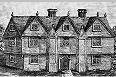
Monday, December 24, 2012

No shadow over Thomas

I'm researching for the next Beacon issue which will have a brief timeline of the lives of Thomas and Margaret (it does a grand sweep of their times and after all the way to today). Hopefully, it'll point to areas where we'll focus effort in the future in order to expand upon the theme so as to leave the proper legacy.

I can thank Rev. Felt for phrasing some thought (read today) that I've had for three years in regard to Thomas (see Backbone series). That is, Felt gave me the proper concept to use. You see, how is it that there is such a lack of information? How can all of the written literature be so sparse in regard to his life over all of this time (from the beginning down to recent publications)? Even Anderson, et al, (Great Migrations) seems to write begrudgingly.

The below image is taken from Thornton's (1854) The Landing at Cape which tries to document the experience at Cape Ann (which has a bunch of unknowns). This book references Thomas only once as the plantation overseer, with Tylly, at Cape Ann. And, it is in the beginning, as in, pre-Conant. Other than that, there is nothing (based upon quick scan - so I may have missed something - the issue would remain, even so).

---

Aside and disclosure: The wife of the blogger is a direct descendant of Thomas and Margaret, however she is also descendant of Conant and others of the old and new planters. One might say that I'm continuing Dr. Frank A.'s argument about the injustice, in general. We'll get to that in the Beacon issue.

---

Felt writing
about Conant
Felt is talking about Roger's continuing displeasure at his treatment. But, the dear guy ought to have considered his treatment of Thomas and Margaret (he got the house!). The image quotes that Roger "retained a conviction of the great injustice done to him, even in his old age, and he could not refrain from reference to the neglect and ingratitude" referring to Endicott's arrival.

Notice that Felt says that "the new charter cast a shade upon Conant" which implies his followers (Balch, Palfray, Woodbury, Trask). A 1999 talk on the old planters of Beverly (we'll use this in the Beacon issue) said just that: Conant and his followers. These people worried that they might have been enslaved with the change in the power structure. It was so troublesome that Craddock had to address their worries, explicitly. Too, they were given the land in Beverly in order to bolster their spirits, so to speak.

And, old Thomas? Cool as a cucumber (as I've said, a guy who was effective, knew himself, and was the chief manifest'er of what was to become the American -- you think that London, et al, liked this?).

Now, none, nor any incident, that I can see, cast a shadow over Thomas. References to him imply dignity, respect, and more. On the other hand, he was ignored in writings, perhaps to put him in his place, as if that could happen.

Too, Thomas' stance was of the true American that we were to see develop over the succeeding centuries. One attribute of that stance was to be distant from the Churches (yes, plural -- ah, we can go on about that ad infinitum, but won't). Thomas was no follower; his blood and pedigree prevented that.

Now, too, his sympathy toward the Quaker thought, and the fact that his last wife was of that faith and that some of his sons were, to boot, talk of a mind that encompasses the shebang (put it this way: the every man view with both breadth and depth -- the latter, of course, meaning all classes -- those higher casting a shadow over the lower - hey, only those that you allow can cast a shadow over you). Yes, the Quakers were forward thinking and exhibited more than any a spirit of inclusiveness and peace (we'll have to get back to John Goff's take on King Philip -- we overlook, too much, our mistreatment of the American Indians - starting with whom? Endicott?).

However, we do not to want steal thunder from Gardner's Beacon. These topics all deserve careful study so that going forward we can have the proper view and respect for this UNKNOWN couple. As it says: honor thy father and thy mother (albeit transitively if necessary).

Remarks:

10/13/2014 -- Tabula raza, and more, will be of concern.

03/28/2014 -- See Vol. IV, No. 1 for a discussion of the movement from Cape Ann to Salem.

11/06/2013 -- While working on the next Beacon issue, I ran across some books. The one by Staloff was timely; imagine, I was wondering why the backbone series? Has the talented set ever allowed the lessors to have some semblance of a good life? Oh, you say yes? Winthrop, et al, were against this from the beginning. The stalwart of what could be (or could have been)? Thomas Gardner, of course.

09/09/2013 -- Forgot to update this earlier. But, the post related to Gardner's Beacon, Vol. II, No. 6, discusses that Thomas had no shadow over him as was feared by some old planters (would Dr. Frank, today, still want to include Thomas in the group?).

06/15/2013 -- John Farmer wrote that Thomas was from Scotland. Origins are, and will be, a focus.

03/02/2013 -- This may have appeared in another post, or Beacon. However, we'll repeat the thing here. When Thomas took the freeman oath, that is, that year, he was voted to the General Court with Hathorne (see above, another great-grandfather) who was a swashbuckler. It is interesting that Thomas, after that, kept a more local focus. There may be many reasons. But, getting up close with the clamorous ones may not have fit his mindset. You see. Throughout history, certain people get written about. Yet, in any situation, there are teeming amounts of more people who are not in the spotlight. Now, do you think that not having attention diminishes your being? If you say yes, let's have a little discussion. Of course, we would have to define, up front, whose attention. Social media comes to mind; frivolous content that invokes brain altering reactions (say what? -- I'm happy that I'm not susceptible, being too many decades old, long-in-tooth, if you would) to those who participate. So, back to Thomas and William. You see. John Endicott knew Thomas. John picked on poor Mary Dyer and others. William probably did similar deeds. Thomas? There are not bad tales. Too, and this is a big too, he deigned to be involved with people who were outcasts, namely the Quakers, as were his sons. Now, the sons left. Thomas was right there in Salem, of major stature in the phenomenal sense. Actually, his recoil (my take which can be explained) from the politicking tells a lot; it has a lot of meaning, not unlike George (the first Prez) stepping down even though he was adulated sufficiently for people to want him to be sovereign (thank you, George - for showing us that term limits ought to be part of the deal - professional politicians? say again?).

02/10/2013 -- Having finished a book on the 1692 events and doing a post on the subject, I can add to this look at Thomas. I've mentioned that he didn't queue right up to join the church and that he was recognized by Endicott. As well, he married a Quaker without any repercussions that we know of. Of course, his sons left the area due to the Puritanical (hypocritical) mindset.

01/01/2013 -- David Goss' talk at the 1999 Essex Society of Genealogists gives a perspective that also motivates. See the TGS bibliography.

12/25/2012 -- John Endicott knew Thomas to be exemplary (though, not military).

12/24/2012 -- We'll also point to academic studies, such as that shown in the image (Essex Institute and Johns Hopkins University). It says, don't look at the character (ah, John White? uncle? who needs enemies with family like that?) but consider the place as not appropriate (no aspersions meant for the lovely Cape and its environs).

Modified: 04/23/2021

Friday, December 21, 2012

Old Planters, Massachusetts

As suggested in the Wikipedia article, Old Planters (Massachusetts), there are many types of old planters. In the case of New England, this Wikipedia article needs to be expanded to include many other places, such as Boston.

Earlier, we mentioned Old Planters with the context of a reunion at Beverly. Too, we broached the subject while asking about the history of the area, essentially Essex county. Research, to date, seems to indicate that a recap of mentions of Thomas from early times on might be an appropriate undertaking.

---

For this post, we'll make use of what might be the first publication of the Old Planters Society that was active during the early part of the 20th century. The book is on-line (archive.orgGoogle Docs): The Alliance between Pilgrim and Puritan in Massachusetts, 1900, Thomas Wentworth Higginson, Salem, MA.

The book contains an address by Thomas, the President, to the Society in which he looks at cooperative efforts, and the influence thereof, between parties who ventured over. These parties would not have been so inclined to such behavior across the pond. In essence, the coming over brought forth means to establish a new society, albeit troubled in many ways. The topic will arise again, in regard to Thomas' and Margaret's lives, so we'll leave it at those few words.

---

The real interest, at this point, is the summary of the Society which was instituted in 1899 (our task will be to pull together a more full history). Evidently written by Dr. Frank, the summary explicitly mentions Thomas. One thing in vogue then (many references which will be collected) was to cure the oversight of many people who were in the parties. That is, the historically covered people shadow the reality of the others (always has been the case - but, changes, such as we see with technology, indicate that this will not be so much so in the future).

See page 13; it says that "injustice" was done to some planters. It also uses sympathy which is not the intent here; rather, the focus is to establish a more full interpretation that removes the oversights, or, at least, explains their longevity.

---

The book has the Constitution of the Society. Article III, Sect. 1. defines an old planter as follows: lineally descended from, in the male or female line, a proprietor, a planter, or other settler in New England prior to the transfer of the Charter of the Massachusetts Bay Company from England to New England, in 1630.

---

The book lists the Officers and Members of the Society. Higginson was President. The VP was Dr. Frank. The following list is taken from the members' list and includes those who have Thomas on their application.
Some of the others may also be descendants (marked as **, we'll scrutinize the list, at some point) as they may only be listing a primary ancestor and not considering supplemental applications via other ancestors.

Remarks:

01/18/2025 --  Pageant of Salem is an exmple of the events from 1924. It provides a good view of the thinking at that time. Now, 100 years later, we know more since we have digitized copies of old documents coming on line. See this post: 250th and more

03/13/2023 -- See "New not old planter" post with regard to research findings. Thomas and Margaret have children registered in England until 1633. 

01/12/2019 -- Col. Higginson supported Kansas as a free state.

01/06/2019 -- At the 300th, there was a Pageant of Salem represented. In Volumes III and IV of The Gardner Annals, we printed the Table of Contents for all issues of The Massachusetts Magazine which last printed in January of 1918.

11/26/2016 -- In the next issue of The Gardner Annals, we will look at the editors, such as Lucie. M. Gardner. She was the sister of Dr. Frank.


04/02/2016 -- Last summer, we went through The Massachusetts Magazine (Vols I thru XI) versions that are available on-line. "Old Planters" was a regular section.

01/08/2013 -- Added a forum to facilitate discussion, etc.

01/01/2013 -- David Goss' talk at the 1999 Essex Society of Genealogists gives a perspective that also motivates. See the TGS bibliography.

12/25/2012 -- John Endicott knew Thomas to be exemplary (though, not military).

12/24/2012 -- Thomas, unlike Conant, was not overshadowed in the world of being. We'll spend some time characterizing this fact and what it means to reasonable folks. 

Modified: 01/18/2025

Wednesday, December 19, 2012

Aunts, Uncles, Cousins

1675: December 19 - Captain Joseph Gardner, who set out from his home on the present site of the Essex Institute, is killed. (pg 28, Chronicles of Old Salem, F.D. Robotti).

On that day, the colonists lost a lot of officers. The Great Swamp Fight was an engagement in the King Philip war. At this particular fight, 220 colonists were killed or wounded. John Goff and Julianne Jennings wrote about King Philip and the conditions that led to the war, earlier this year. As we noted, the Gardners, and others, had peaceful relations with the American Indian population on Nantucket.

---

Looking at family history, and genealogy, can by transitivity be seen as obeying the 5th Commandment. In a more full sense, that would include all of the children of a couple. Many folk do not have progeny who are here now that would remember them. So, we'll be sure to start that, perhaps as a meme.

So, given the honoring of those without issue, we would have the aunts and uncles. Perhaps, by extensions, cousins without issue would be remembered, too.

Finally, friends of the family deserve attention, as we show below, with one example.

---

Gardner's Beacon featured Joseph and his bride, Ann Downing, in the Valentine's issue. The couple lived in a great house that they received as a gift from her parents, Emanuel and Lucie (Winthrop) Downing. Joseph and Ann did not have issue.

When he died, Joseph left a widow, Ann. As the Beacon issue noted, Ann was very well educated. Yet, she, and her house, are now mostly known as having been associated with Gov. Bradstreet. It's interesting to note that Ann, prior to her second marriage, presented Simon with what was essentially a pre-nup. Was this the first of its kind on this continent?

---

We have mentioned many times the fact that Thomas and Margaret have been written out of history (my take, personally -- various motives will, eventually, be conjectured for this). The tone of the current post is remembrance. One friend of the family is John Tylly who came over with Thomas and Margaret to Cape Ann. John was a co-leader. He was killed in 1636, as an early casualty of conflicts with the American Indian population.

---

Genes and memes seem to be topics of increasing attention nowadays. Perhaps, the interest might be cyclic, such as the up rise in publications at century markings. Around the 300th anniversary of colonial times (plus or minus, of course), books on family and genealogy came into vogue and appeared in droves. Any large library has several thousand of these. We are coming up on the 400th anniversary. It'll be interesting to see how celebrations of the event unfolds.

Memes (to be discussed further) will be one key thing, IMHO.

Remarks:

12/23/2020 -- One might say, friends, too: Charles Alcott Flagg.  

06/25/2019 -- We have a few more examples of the forgotten. Of late, there was Lt. Benjamin West who was killed at Bunker Hill and forgotten. Prior to that, we were trying to count the number of lost graves in Essex County. Then, we have the travelers out west, such as Jedediah Strong Smith, except he did post some reports back east by courier. There were many lost a sea over the years.

01/18/2019 -- Add to the image index on our new site: TGsoc.org

03/11/2014 -- anceSTORY mentions that what is referred to as the Governor Bradstreet house (Simon's will says that he had a pre-agreement with Ann prior to marriage) has another story than suggested by Perley (and a study of Essex Registry of Deeds). Need to check this out.

12/24/2012 -- Thomas, unlike Conant, was not overshadowed in the world of being. We'll spend some time characterizing this fact and what it means to reasonable folks.

12/22/2012-- We need to differentiate between Old Planters of Beverly (see The Old Planters of Beverly in Massachusetts, 1930, Alice Gertrude Lapham, The Riverside Press) and the Old Planters of Massachusetts. One could even talk, Old Planters of New England.

Modified: 04/23/2021


Friday, December 14, 2012

Summary, 2012

The blog got its start on September 25, 2010. We're a little late with a two-year look back (see Posts of Interest - 2011), however it might be appropriate to review some of the statistics over the period. Before today, there were 75 posts. These have generated six categories, the largest of which is Descendants who have mostly been of earlier times. Perhaps next year, we can feature some recent descendants.
Past 30 days                                All time                           
The image shows two lists which contain the most-read posts which can also be taken to be the most popular.

  • Of late (left column), the How many wives? subject has been of interest. Some say that there were three. The post explains why we say that there were two. 
  • Since the beginning (right column), there have been two popular posts. Historical genealogy tells the story of the demise of Richard III and the involvement of a Gardner. Gardners and Gardners is an ongoing effort to identify all of the Gardner families, say before 1700, and their relationships. 

From time to time, we will do a snapshot like this so that we can show interest by time. Based on the above, Gardners and Gardners post might be the most popular as it is on both lists.

There were 13 posts in 2010 over a three month period. Last year (2011), there were 38 posts. So far this year (2012), we've had 25.

Recaps: 2018, 2017 (missing), 2016201520142013, 2012, 2011.

Remarks:

12/15/2018 -- Added in link to recaps from the beginning.

02/26/2013 --  See Wikipedia for a discussion about William Gardner whose page has been deleted. 

Modified: 12/15/2018

Tuesday, November 27, 2012

What we know

Context: Gardner Questions and Answers plus the Gardner FAQ

Note (02/27/2024): See Current status

Note (03/20/2023) -- See these posts for an update: Square one?; Old, and new, planter. This post will be updated along with the FAQ.

Note (06/24/2019) -- given that this is seven years old and that we know more (see Remarks, this date, below), this post ought to be updated.

--- original post ---   [see comment in bold, and square brackets]

We'll start with Dr. Frank's work and the Great Migration sketch (including a wiki counterpart) as part of the foundation. From there, we'll build a sketch that has support. From this, we'll start to fill in the pieces in a reasonable fashion. Where things are conjectural, of course, this will be noted.

Aside: All progress comes from testing hypotheses [we will look at what was assumed; and, see the alternatives, and build a new view with support] which are framed from a good basis. Too, there is always the mainstream. That off the mainstream is not, by necessity, quackery. Of course, the smell test is useful when other means don't exist for proper analysis.

We'll summarize the Dr. Frank and Great Migration material, as one task. [both of these had one Thomas; let's track how this story came to be through the centuries.] However, to set the tone of the overarching guideline, please consider the following as a list of key items.
  • - [A] Thomas [Gardner] was put in charge as Overseer of the Cape Ann venture, at least, that part related to planting on the new soil. [Which Thomas Gardner?] This implies several things, such as that he was known to Rev. John White and the Dorchester Company, that he had a good character, that he capable of carrying out the plan, and a number of other things. We'll expand upon these as we go along with our efforts to describe Thomas as the quintessential American, albeit a little early for his times. 
  • - [So a Thomas was here] Thomas was referred to as 'Mr' in a London meeting in 1629 which, again, suggests several things, such as that he came from a good family, that he was educated, that he had social stature (but we could bet that he had a large physical stature and a character that was bigger than life), and a lot more. We'll collect more information about this and what it might mean. 
  • - Thomas brought his wife and family which means that he was committed. [At that time, there would have been three boys] Of the Cape Ann crew (old planters), he and Margaret were the exception. And, their resolve is proven by their children and their descendants. Of course, collecting information about this is an on-going effort. Another committed individual was John Balch who brought his wife. Many Balchs are descendants of Thomas through his daughter, Sarah. 
  • - Thomas became a freeman later than he could have which implies several things, such as that he was effective in his own manner during the period before he signed up, that he decided to join in order to participate in a larger scope and to take care of things that needed to be done for the community, that he compromised for the well-being of his children and more. 
  • - (07/12/2015) See Remarks, this date, on project exploring records found in Sherborne, Dorset regarding the marriage of Thomas Gardiner and Margaret Frier (and more). 
In short, we're talking about a story that ought to have wide interest if done properly.

That Thomas was above history is a known fact. What we want to capture is the spirit of the remarkable pair who survived troubling times and who left a definite legacy that needs to be studied and documented. Lessons from their, meaning Thomas' and Margaret's, lives are applicable in today's society in ways that we have not even begun to address.

Taking on the task of introducing history to Thomas is one task of the Thomas Gardner Society. That was one motivation behind the Backbone series.

Remarks:

02/27/2024 -- Add link at top to latest status post. 

03/20/2023 -- Put the notice about coming updates at the top. 

03/13/2023 -- See "New not old planter" post with regard to research findings. Thomas and Margaret have children registered in England until 1633. 

06/24/2019 -- We have started to update the FAQ and will be renovating our sites. With the 400th coming up, plus several years of research accomplished, it is time to pull together a cohesive view some of which will be printed. There is a very long ToDo list that will be published and updated so that others can help us with our tasks. Focus will be on content related to Thomas Gardner, Cape Ann, subsequent events, and much more; plus, we will keep configuration issues in mind which deal with the continual concerns related to technology and information presentation.

09/25/2018 -- Recently the Profile for Thomas Gardner on WikiTree changed to only have the two wives. This was due to research and discussion to which Gardner Research contributed. Earlier, there was a post that summarized the issue and accomplishment: Margaret, anew. Thanks are extended to all who made this update possible. The Profile is managed by the Puritan Great Migration Project sponsored by the NEHGS, publisher of the Great Migration books. So, Sherborne, as John said (see this page for images of documents).

07/12/2015 -- Okay, turtle speed. But, we get there. Announcing a new project: Sherborne, Dorset. No doubt, it is about time. When finished with the data collection and analysis, we will present the strongest story (the prerogative of the family) that the facts, and abductive reasoning, will support. As such, we hope to demonstrate some very much needed research viewpoints.

04/07/2015 -- We have more questions than answers (research raises both).

03/12/2015 -- What we know implies that there are things that we do not know (so, we'll cover both; albeit, unknown unknowns lurk).

03/03/2015 -- The 1933 book is on-line. See Zouch Phoenix.

09/29/2014 -- As of this past week, we know that a couple, Thomas Gardner and Margaret Friar, married in Sherborne, Dorset in 1617.

03/28/2014 -- See Vol. IV, No. 1 for a discussion of the movement from Cape Ann to Salem.

11/13/2013 --  Phippen would be part of the slate fill.

11/06/2013 -- While working on the next Beacon issue, I ran across some books. The one by Staloff was timely; imagine, I was wondering why the backbone series? Has the talented set ever allowed the lessors to have some semblance of a good life? Oh, you say yes? Winthrop, et al, were against this from the beginning. The stalwart of what could be (or could have been)? Thomas Gardner, of course.

01/24/2013 -- We know a whole lot. We ought to map the unknowns to what we know. Then, unknown unknowns will start to fall out. Sound like fun?

12/24/2012 -- Thomas, unlike Conant, was not overshadowed in the world of being. We'll spend some time characterizing this fact and what it means to reasonable folks.

11/27/2012 -- We need to tell the negative tales too, such as Rev. John's disrespect of those who put their lives and well-being on the line and more. The Maypole allusion grates several ways. Poor Thomas had to deal with three Johns: White, Endicott, and Winthrop. 

Modified: 02/17/2024

Monday, November 26, 2012

How many wives?

This post continues the discussion about the wives of Thomas (see About Margaret). Were there two or three?

As mentioned in the prior post, Dr. Frank wrote that Thomas had two wives (as did Savage). Of course, he was writing 100 years ago (Savage even further back), and, surely, there has to be more information at this point about the matter. The question then becomes, given the current state, can we really know?

Or, to put it another way, was Dr. Frank wrong? That has not been shown, in our opinion.

Let's look at a couple of studies that are of interest. There are, of course, more of these which we expect to get to, in time. Too, we might add as a preface, some of the needed information is awaiting us in the old country. So, that means that we'll need to look into what genealogical studies might have been done in England about Thomas.

---

The fact is that we're dealing with events that are long past and about which we have little information, at this time, for various reasons. Many views have been expressed about the relationships between the Gardner families (or see Savage) that came here. Too, one sees various proposals that have come to fore.

The modern study, mentioned below, does not broach the subject of origins at all.

---

In regard to genealogy in general, just in the past week I've run across scores of books that have been outdated yet are being quoted. It is very easy for misinformation to be propagated via web pages. Our intent is to have material that can be considered reasonable and supportable.

---

Now, for starters, let's put two studies together, side by side, and make a few comments. Then, we'll rephrase our current position, until there is further information.

TAG 30:156 plus Great Migration material
This image brings together material from The American Genealogist and from the The Great Migration Begins. The former had an article in 1953 that was written by George E. McCracken and that was titled "The Salem Gardners: Comments and Clues."  Topics covered in the article include origin, Margaret, Seeth, the first wife of Thomas the son, the wives of George (very long), The Salem Quakers, the Flight to Connecticut, and the Salem Shattucks. The latter is a recent book in which Thomas has six pages written by Robert Charles Anderson  and published by the NEHGS.   

---

So, if we take the TAG article first, it goes a lot into areas that needed some study. The section on Margaret is small. The author, essentially, agrees with Dr. Frank about two wives. However, we don't know Margaret's family name. What I note is the author's insistence that these studies would greatly benefit from looking further into the collateral families. That being said, the work of Dr. Frank is phenomenal and greatly appreciated. 

---

Now, the Anderson study is looking, potentially, at 1000s of families and doing this with an eye to being correct. The best way to do that is to only use sourced material. Did Anderson make an exception in this case? I would like to consider further his hypothesis and proof after seeing the material that he is quoting. 

I don't buy the church reference. Thomas did not become a freeman until 1637. That is more than a decade after coming over. How could this be? Basically, we would suggest that he was able to get by using his own mode until his sons were older. And, he and Margaret could have easily done this together. Then, he would have had (deign to join) to be more of a "conformist" (to the puritanical thought and behavior) so as to not handicap their futures. From what we can see looking back, Thomas' and Margaret's children did well. 

Aside: There is no record of a first wive's death or of another marriage. We basically know about Thomas and Damaris, who was a widow in 1641, through his will. Hence, the conjectures abound.  

That Thomas married a Quaker tells us much about his character, especially in comparison to some. We'll forgo that analysis for a time. In any case, Thomas would have had to be in the church, and active, to be a freeman. He was shown on the rolls early; but, was he regular in attendance? In the case of Margaret, just picture a women dragging a bunch of kids to the Sunday service. Again, did she need that?  

There seems to be something there to look at in this regard. In fact, it's a story (or many stories) waiting to be told. 

By the way, the above is not a criticism. The Great Migration work has been really helpful and takes the right tact in the case of unknowns, or little knowns. That is, if you don't have something definitive, then just punt it down the road. But, this work does not relieve families of their duties to honor their fathers and mothers. 

---

Which then brings up the family and efforts of Thomas' descendants. I can see someone taking TAG 30:156 and the Great Migration work further. It may be that there is a lot more information available that needs to be looked at and digested. This is so especially with the booming cloud'd informational sources which cause more stuff to appear all the time. 

In the meantime, though, we say two wives. But, then, it could be three. You know it does not matter, right now. For anyone doing Gardner genealogy, the use of either has no impact on the tree unless one wants to branch out with the first (and/or second) wife. 

It is nice that the Shattuck family has their information filled in.  

Remarks:

04/04/2025 -- David T. Gardner has been exercisting Grok with prompts and reports finding documents that support his claim about Wyllym Gardynyr (see King Slayer Court blog). ... We have begun to incorporate changes into the structure and context of the blog. See Restart, somewhat

08/28/2018 -- After some discussion, we settled that we had Margaret's folks, her baptism record, the marriage announcement, and baptism of their kids, prior to them leaving Sherborne. So, we have the post "Margaret, anew" which updates "How many wives?" Now, the question moves to whether or not we have the right couple (Children with what wife?Further discussion).

08/01/2018 -- The past few days, I have been on WikiTree. We are looking at settling issues for the profile of Thomas (and his spouses): Gardner-159. These profiles are being set up and maintained by the Puritan Great Migration. Expect an update blog post within the next day or so. Notice the recent comments (the 'unknown' is because I juggle many email accounts and was in the wrong one - it's not that I'm old).

07/12/2015 -- We mention abductive approaches (my career was spent in advanced computing - software and modelling, essentially). Please refer, at least, to C.S. Peirce's (we mentioned him in an earlier post - Benjamin Peirce) work in the area. [Love it: From Ugly Duckling to Swan]

07/12/2015 -- Okay, turtle speed. But, we get there. Announcing a new project: Sherborne, Dorset. No doubt, it is about time. When finished with the data collection and analysis, we will present the strongest story (the prerogative of the family) that the facts, and abductive reasoning, will support. As such, we hope to demonstrate some very much needed research viewpoints.

05/05/2015 -- The Winthrop Society has Margaret as second wife. They allow submittal of additions and corrections concerning early arrivals.

10/13/2014 -- Tabula raza, and more, will be of concern.

10/03/2014 -- Notice that McCracken mentions Felt, Dr. Frank A., and Moriarty and that he mentions we need to know more. Now, why was this record missed? Well, for one, it is rather smudgy. That it was found can be attributed to the digital age and people using newer tools. Too, to have found this, one would have had to page through lots of paper. Of course, indexing helps with that, assuming that those who do the transcription that led to the indexing were careful. One has to ask, though. Were researchers blind (many senses meant - to be updated)?

09/28/2014 -- A week ago, the record for the marriage of Thomas Gardner and Margaret Friar was discovered in Sherborne by John Cook of Minneapolis, Dorset files. This sets a type of focus. Looks as if some transcription work might be in order.

01/08/2014 -- We added Earlier Settlers of Nantucket to our Bibliography. It's interesting to see the Folger stories of the early Gardners. ... In another place, we saw both Richard and John being described as well-educated. From whence that education? The parents? If you say no, you're not very much insightful about human nature. A child's first teacher is the mother, then the father. So, if Richard and John were Quaker, well-educated, and good citizens of their community, the mother deserves a lot of credit. Now, who was she? In Hinchman's book, Margaret is noted as the mother. We'll have to look to see the source for that. If it does come down as family history, then one would think that the children would have known their mothers. In any case, Margaret, or whomever it was, needs to have recognition as being early-Quaker (definitely, before Fox made his splash upon history).
Anderson's Great Migration

12/31/2013 -- The arguments against three continue. Anderson, in his write up of Gardner, has Richard's death as 1724 (see image). This information was picked up from TAG, yes, but the death year applies to Richard's wife. Richard died in 1688.

11/13/2013 --  Phippen would be part of the slate fill.

08/22/2013 -- The start of a look at what was what in early Salem (and New England) as far as Gardners is concerned. --- Also, added a caption to the image (which will be standard henceforth - plus edit of existing posts to make sure that images are clearly marked).

11/28/2012 -- It becomes even more curious as Lemuel Shattuck suggests, in his Memorials (via Google), that Damaris and Thomas got married after 1641 (no indication of it being long afterward). By the way, I found this book by reading TAG 30:156's other sections. McCracken mentions Lemuel who I had not run across before. Aside: the amount of digitized work has expanded almost without bounds of late which gives me hope that we can find out more about Thomas and Margaret (yes, I'm talking UK books, to boot).

11/27/2012 -- Let's itemize what we know (including use of the Great Migration sketches), re-iterate some basics, and the proceed constructively.

11/27/2012 -- One thing that I've noticed while pursuing information is that some sites assign a rating to what they have. Usually, it's a simple integer. However, we could get a little more precise. Perhaps, modern material can have a certitude of 1.0, but how could one obtain something other than the high 90s for older information? And, information from 400 years ago will be highly variable. Yet, one could classify the material and then rate within that. Complicated? The one thing that we would hope would be that later studies raise the rating rather than lower it. But, then, that is not necessarily the fact.  

Modified: 04/04/2025


Sunday, November 18, 2012

Black death

We always look back and wonder about the motivations behind picking up from a known situation and venturing, whole heartily, into something new. Much has been written about the religious and political factors which we'll get to at some point.

---

And, there are reasons for looking back as we can try to discover origins of Thomas and Margaret. As an aside, that Thomas was referred to as Mr. Gardner at a meeting in London (ca 1629 -- see Hubbard or Perley, for the exact year) speaks much.

---

R.H. Britnell
The Commercialisation of English Society, 1000-1500
The economic influence will be important, to boot. And, there is much to look at in this regard. Britnell in his The Commercialisation of English Society, 1000-1500 (Manchester Medieval Studies, 1996, Manchester University Press ND) takes a deep look at this 500-year period. Toward the latter part, workers were allowed to move between cities (as opposed to the law that forbade movement - consequences were dire - if caught outside one's parish, one could get whipped, lose an ear, or be executed).

One reason for moving might have been to join a group of free men, according to Britnell. On seeing that, I thought of my remark about Thomas not needing to join. There is a lot to discuss there.

---

However, a real factor that is not talked about much, and there were outbreaks in the 1600s and 1700s, was the black death. Britnell's table shows the size of the English economy at three different times. What stands out is the drop in population between 1300 and 1470. A lot of this was from the plague.

A plague in Weymouth, England says that the plague entered England in 1348 through its port and killed up to fifty percent of the population. By the way, 1470 would be about the time of the start of Thomas' grandfather's life.

Any look back that connects us to Thomas' or Margaret's ancestry, and any of the other 1000s of immigrants, would run into its influence on the populace.

Remarks: Modified: 04/04/2025

03/27/2019 -- This is a topic covered under the subject of General Crisis

04/04/2025 -- David T. Gardner has been exercisting Grok with prompts and reports finding documents that support his claim about Wyllym Gardynyr (see King Slayer Court blog). ... We have begun to incorporate changes into the structure and context of the blog. See Restart, somewhat