Showing posts sorted by date for query long reach. Sort by relevance Show all posts

Saturday, January 17, 2026

Small world, technology

TL;DR -- Again, the holiday issue in 2025 of The Economist has an article that is apropos to our research. This one has a focus on "El Segundo" which is a town known to us for several reasons. Anyone going into or out of LAX flies over the town. It was a technology town for WWII and before and somewhat after. For a time, it was derelict until efforts at the real side of technology came to town with a new motto: Bits to atoms. Or is it atoms to bits? In any case, we'll feature the location regularly for a while as we take the focus from that Valley up north which is so famous. 

--

This is the fourth series.  So far, we have looked at science, literature, and economics. Two of these were motivated by the holiday issue of The Economist this year. This post picks up the thread of technology which has been our focus for a while which became more visible with the release of GenAI/LLM (or AI/ML) three years ago. So, we will pause the usual focus and move the looking glass at culture and technology which is imperative. 

Motivated, again, by this article: America’s fight back against China starts in Los Angeles—in flip-flops to be found in The Economist. 

El Segundo? Of California? Los Angeles area? Near LAX? Gosh, it's about time that we mention the place. As we have had lots of posts on DTLA (Downtown Los Angeles) where we find a neighborhood with the name of Bunker Hill West where the U.S. and its 250th have a long history. And, it is technology focus that got our interest shifted. 

Though, it could have been the SoCal beach culture that was the focus. We are talking about a place that is north of the more known beaches (say, those mentioned in song by the Beach Boys, Redondo Beach). Too, it's north of Long Beach. But south of the LaLa land up north starting with Venice up to Malibu. Lots of history to cover.  

The new kids on the block have an adage that is important to our discussion of technology: Bits to atoms. This is interesting as a good meaning deals with grounding the work of making digital twins with something real, in the world. Turning the concept around, atoms-to-bits is interesting too in the sense of how to come of with the digital twin (MRI, CT_Scan, ...) and knowing the essential differences that ensue in order to not get lost (which seems, many times, to be of concern with the present situations with AI/ML). 

Example: MRI

In other words, physics and mathematics come to fore and get attention. 

--- 

Both of us have family history in the area, going back to before WWI. The technology focus will include firms in the El Segundo/Hawthorne area. Some say that the area is blue collar. The major industry were oil (Chevron) and aerospace (Douglas), and computers (Silicon Beach). As said, LAX is right there. But, Defense work was a prime contributor, too, over the years. 

In terms of culture, Hawthorne is named for cousin, Nathaniel, who is also important to New England's reach. That will be a topic of a future post. Prior to WWI, the area was agricultural. By the time of WWII, the technology focus grew abound. And, looking at such ought to give us pause with respect to recent manias, but that's an old topic still under discussion with respect to the future focus that we ought to take. 

Finally, stepping back to the time of New Spain and Mexico, this land was part of Rancho Sausal Redondo. Formed earlier by the new Mexican government, it was granted to the Avila family in 1837. 

Remarks: Modified: 01/17/2026

01/17/2026 -- Brought in the comment from WikiTree. Also, here is a record from the Pacific Coast Architecture Database on Rancho Sausal Redondo, Los Angeles County, CA (1837). 

Tuesday, December 16, 2025

Welsh poems

TL;DR -- After a long list of caveats which are not complete, we push a link to Dave T Gardner's post on Welsh poems that are pertinent to his work on Gardiner history. Our interest deals with the topic of "All things Gardner" and the emergence of a vogue of advance software that needs attention.  

--

Caveats, first (this is without links; but everything mentioned here has been covered, at least for starters; I'll get back and put in links. In the below, I'll use LLM to refer to the systems to be described further with respect to the pros and cons.): 
  • Prolog: This work of David T Gardner is being enabled via computation which is effective when done right. Can we say that yet? Well, we don't have to wait as the work has decades behind it. What's new is that this thing that everyone else calls AI (and I call it AIn't, for various reasons) allows years of effort that accumulated progressive means to culminate in potential that we dreamed of. DTG has given himself a couple of years to establish provenance in a manner that bears scrutiny. We'll help him do that. In the meantime, read this as you would an overview that borders upon truth yet it is not a mere reach of the imagination. The following is John's take on the matter. 
  • 1 --- there ain't no critter in the computer in terms of something that Ma Nature dreamt up or that is there latently and has been waiting to emerge. As in, Musk joked of summoning the demons which bears on metaphysics (more below). But, we can describe this phenomenon to a large extent now that there are many examples (from ChatGPT to Gemini to others) to observe, test, measure, and whatever. Good old science is the key here, and it will be beyond physics. 
  • 2 --- we are witnessing computational prowess of an unprecented nature with regard to size and extent. Yet, we knew all of this stuff before, either individually or collectively. In most cases, the tone and meaning of things changed as one would expect. But, language alterings that happend dynamically do not offer that new species of life will emerge. 
  • 3 --- hence, we have to get used to mathematics. Now, we can use the computer to do this. Need to. And, one example is Wolfram's Mathematica system which has brought in GenAI/LLM as a service (not all, but a good representative set). As we go through the steps to validate DTG's work, we will learn new things and require that models change. That's okay. 
  • 4 --- model-based reasoning is old hat, now, almost as old as computing itself. What, you might ask? Well, one of the prime modes for modeling is from the '50s and coincides with the AI emergence out of efforts of mathematicians at a Dartmouth meeting and after. Lisp is what I am referring to and is my preferred language, albeit we ought to have kept the Lisp machine to help balance the quant mode of the Nvidias and other of the world caught in that illusion. 
  • 5 --- quantum to be brought up with respect to #4? Okay, that's fair game. People are quantum processors and have been from the getgo. Wait, teleology? Yes, I must mention that psychology and philosophy are to be brought into the discussion. Expect more on this. It's already there (I've been at this for decades). So table this til later. 
  • 6 --- as I need to mention KBE which I worked in after starting in KBS. There is not anything new now. We looked at this stuff decades ago. What has changed is what people refer to as the effects of handling "scale". I say that a lot of it is crap and do so with affection for all things computing since the facilities will help us be better humans. Local? Some here that mentioned now. Well, I have said that all along. 
  • 7 --- truth engineering has been in the wings for decades and now can be discussed in a context that grounds the work and evaluation techniques. Before, it was a piece of my brain as conditioned with decades of Lisp starting before the Lisp machine but have years in that environment. And, truth is a local deal. Truth is not about power. What is truth? It's funny, Gemini has had discussions with me on this matter and never barfed. Mostly, I have traces. 
  • 8 --- but, there is no anthropomorphizing intended here; mainly, I'll address these GenAI/LLMs and whatever else crops up with labels. So, Claude has already been used all over the place in reference to that system. DTG used Grok (earlier this year; got burned; stopped; discussed; and we restarted with provenance as the focus). 
  • 9 --- lots more will be added, but here's the gist of the post. 
  • 10 --- ...  
Today, DTG put out some poems that he found and that were written in Welsh. The LLM was helpful in getting the digitized versions translated after it provided support for the OCR step. That's a brief comment. The point is that there is a large amount of stuff to look at. This seemed appealing for many reasons, not the least of which is that it's poetry. By people. 


There will be more commentary, both on the content of the study and on the technological issues. Hopefully, we can bring computationalism into line with what is required for progress as a whole. Some of that might be the subject of psychology and philosophy. We'll start with Kant's Prolgeomena which he wrote after getting incongruent criticism after he published his Critique of Pure Reason. 

Remarks: Modified: 01/03/2026

12/18/2025 -- With respect to the poems, consider them as not verified for the time being. With respect to AIn't in any use, all bets are off without more work related to equilibrium, stability, maturity of presentation, and such other things that we associate with people. Sorry, folks, for bringing the message -- remember, this is a crucial time with respect to technology, especially computing. 

01/03/2026 -- Changed the URL for King Slayer's Court. 


Thursday, November 13, 2025

Charlotte (Coffin) Gardner

TL;DR -- On FB, I saw an article that reminded us that the author had created a related blog which contains very good articles. On browsing, we ran into Charlotte (Coffin) Gardner. She kept a journal on her 3-year voyage with her husband and son. Along the line, she mentions New Englanad folks and natives as well keeps record of their progress along the continents to the Cape and back up. Names overlap our earlier research. So, we will recoup the interest level. 

---

An article today on Facebook got me to looking at the articles of Melissa Berry on her blog. Here is an example article in American-Archives. The topic is a wive who went on a three-year voyage with her husband from New England around Cape Horn and up to San Francisco and Washington State. 

These links point to pertinent material about Charlotte and to a Journal that she kept during the voyage. She is a descendant of John son of Thomas and Margaret. Her husband is a descendant of Richard, brother of John. 

One thing that is of interest would be to use Google's map to follow her on the voyage. The next link goes to a view of the western hemisphere with a location marked.  

There were many stops mentioned in the book. Here are three Wikipedia articles. We will have more. In addition, Charlotte marks her location on a regular basis as the above Google map shows. 

In the articles and in the blog, there are many names mentioned lots of which are familiar from our studies of New England with some being kin of various sorts. Too, we have a theme of the long reach of New England which our posts on Bunker Hill West which is in Downtown Los Angeles show. 

A few years ago, we did posts on the barque, Bostonian, that was owned by Hentry Gardner and his brother. In that material, we learned a little bit about the nautical ways after spending lots of time looking a movements across the middle of the vast area of the U.S. The Bostonian wrecked in 1850 along the Oregon coast. The pilot was noted as Capt. Boyling. 

Charlotte, in her blog, mentions Capt. Boyling which got our attention. So, as well as studying her Journal, we will pick up our study of the barque, Bostonian. Again, here are a few related postts. 

Several themes were mentioned here. What this represents is that the 250th has lots of open research pending. But, in general, here is no end to the study of  New England.    

Remarks: Modified: 11/13/2025

11/13/2025 --

Friday, October 3, 2025

Bunker Hill West - 1873

TL;DR -- Today we saw an old photo of a sketch which shows part of Bunker Hill West in the 1870s. That's early enough to be before lots of the changes introduced over the long span of US history. The English culture took over in 1847 from that of New Spain. And so, the area has lots of offer with respect to our interest in the long reach of New England. 

-- 

Here we go with a post on LA, again. Yesterday, as we looked at New France and New Spain, we mentioned Bunker Hill West. In the early days, the hill overlooked bustling LA. Then, people built upon the hill. They tunneled under it to start to build on the other side. It was partly lowered starting in the 1960s. Now long after, the skyscrapers started to appear with the first one right by the Library which is about as old as the LA City Hall. 

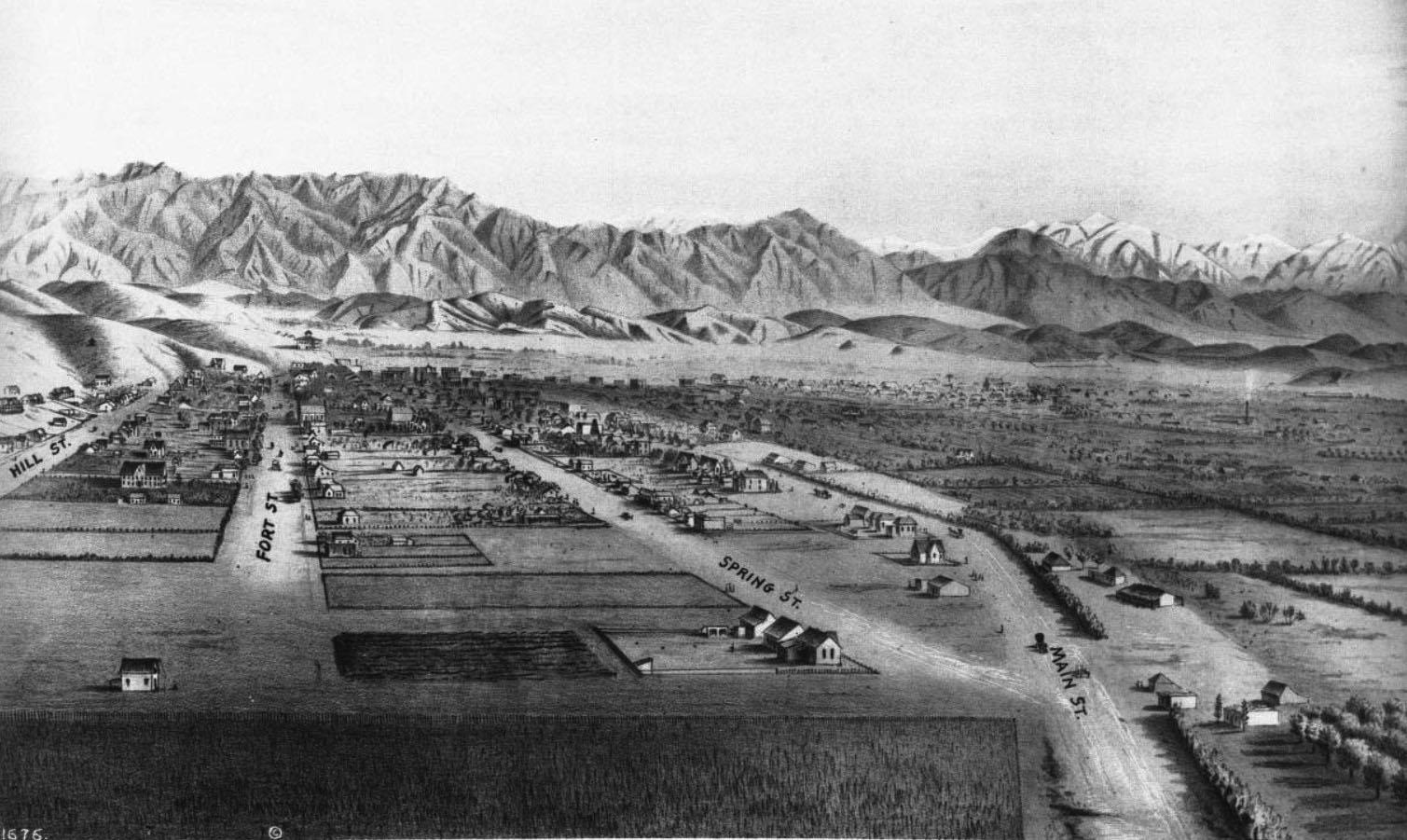
This pointer is to a search on Los Angeles within our blog. There may be Bunker Hill posts that did not come up on the list. In any case, the below photo which is courtesy of the Water and Power Organization of Los Angeles, CA is from a sketch near what is now 9th Street looking north. To orient the view, the well-known City Hall is between Spring and Main Streets (shown converging here) eight blocks north above 1st Street. 

To the middle below the foothills is where one would find The Cathedral of the Angeles, not built yet. The train station is north of that. 

Of interest today are the hills on the left. If one follows the Fort Street line (left of Spring Street) up toward the hills to north, there is a building standing above the city. That was Fort Moore. Going to the left, one can see parts of Bunker Hill West. 

Prior posts had some information about the history of development of the hill. Today, we wanted to show a view indicating that there was a hill of size. According to Wikipedia, the elevation was up to 200 feet above Los Angeles. Naturally, there are higher hills including the massive 14k-foot  mountain within a morning's drive seen on the upper right. 

The Bunker Hill represents history, pre-US and post the events of 250 years ago. In this area, the culture changed several times in a manner that is representative of the changes in the US. The current stature of Bunker Hill is obvious in the photos of LA. The majority of the skyscrapers have their footing on the scraped down and leveled heights of the hill. 

---

Caption of the photo: (ca. 1873)* – Panoramic sketch looking north toward downtown Los Angeles showing mostly undeveloped land.  At lower-right can be seen the junction of Main and Spring streets at a point where 9th Street will one day intersect.  Hill Street and Fort Street (later Broadway) are on the left.  The Verdugo Hills and snow-capped San Gabriel Mountains can be seen in the distance. Photo of a lithograph, courtesy of the California Historical Society. 


DTLA, 1873 

We are fortunate to have original photos, sketches, and paintings of the area. One hopes that these photos with provenance continue to be available in the age of mimic and copy in a manner that does not preserve the truth of the matter. 

But, that's a technology matter to be discussed further with an actionable focus. 

Remarks: Modified: 12/23/2025

10/11/2025 - Water and Power has a whole page of photos from Bunker Hill West from the 1930s onward, including many areas compared with photos from then and now. 

12/23/2025 -- More on the Butterfield stage as representing the U.S. government's concern for handling Overland Mail. There has been lots of research about the trail from St. Louis MO to San Francisco CA. 

Thursday, October 2, 2025

New France

TL;DR -- Nutfield Genealogy motivated this post with their post. Amazing maps has been in our sight for a long while. The one we saw today is about New France which has not had the attention that is needed. So, we correct that. 

---

When we started, our focus was New England. Then, we got into New Spain due to the California influence. We mentioned New France and probably ought to have looked further since we ran into it many times. One theme/meme that will continue is the long reach of New England. Also, all things Gardner is on the plate. Technology? What happened in 2025? AI is everywhere with mature voices with mathematical knowledge finally weighing. We'll take part in that discussion and the followup work. Another theme? The 250th U.S. as represented by D.A.R./S.A.R. and those of the other sides (loyalists, for example). 

Lots and lots of things to do, but here is a list of subjects which suggest future work.  

  • Using Cape Ann, we learned about the commercial influence of the Dorchester Company. There seemed to be agreement about the events such as the 1623 overwintering, the 1624 arrival of the settlers, John Endicott's arrival, and then John Winthrop who disliked Salem and sailed off to Boston. In 2014, we found records in Dorset, UK. In 2023, a researcher went through all of the known records to find Gardner references. Pending is going through that and posing means to get the story in line with what we know and can know. See, Why is 2024 quiet? 
  • President Jefferson dealt with Spain with regard to the Louisiana Territory. We can use Missouri as the focus for several reasons. Our research was focused in the middle of the country, with St. Louis being somewhat of a gateway, though there was movement both along the north and the south. Speaking of the south, regular coach traffic occurred between St. Louis and San Francisco. 
  • We have to mention that the coach that ran across lower Arizona into California stopped in Los Angeles in the area now known as DTLA. We found out that a hill had been named after the battle site in Boston, Bunker Hill, which battle was part of the period of over a year noted as the Siege of Boston. Named Bunker Hill West, the area now hosts the skyscrapers associated with the LA skyline. Those bringing in the traffic from St. Louis and points east were of New England. That route met up with traffic from the lower part of Texas. And, in LA, there was serious New England influence. But, New Spain, too, was there earlier, leaving many place names of Spanish origin. 
  • We looked at rivers, extensively which brings up a notion (below). Gardner River got attention a few years ago. But, the Ohio, Missouri and Mississippi Rivers will be featured with respect to travel to and in the central and west parts of the U.S. 

Today, we saw a share by another blog (Nutfield Genealogy) that got our attention. It showed the extent of New France which is far beyond what we consider when discussing the French-Indian affair or the Revolutionary War. This map comes from Amazing Maps which can be accessed through various social media. Using FB (Meta), one can access this map. 

We had written several years ago about the French being down in the Arkansas area at the same time that Thomas Gardner and others were founding New England which was a little bit of land shown in grey on the right. The blue shows the wanderings of the French. One tales recalls that a crew had crossed the Great Lakes to the area of nowadays Wisconsin, portaged down to a river than ran into the Mississippi. When they got to where the Arkansas River (out of the Rockies) met the Mississippi, the Frenchmen started to see the Native Americans with artifacts from Spain. They were not far from nowadays New Orleans at that time. 

Too, up in the northwest, later, there was disagreement amongst the travelers then, trappers and mountain men, about where the U.S. and Canada split. This was not settled until the 1840s. Those representing Canada's rights were of New France. 

Remarks: Modified: 10/02/2025

10/02/2025 - 

Sunday, August 31, 2025

Map and territory

TL;DR -- Concrete isn't something thought about with computers, except we know of one software package that used the name. But, we need to use concrete language and examples to hone intelligent approaches toward something that represents maturity. How to do that? We expect that New England and the US over time have plenty of examples. Real people doing real thngs. That will continue to be the case even as we see technology continue to expand and play havoc with stability, if we  let it. 

--

Last year, we had a post (Three weeks) that looked at early travel across pieces of the U.S. This was in the vein of our recent report on Knox's movement of tons of cannons from Fort Ticonderoga to Boston. His crew had to go two directions across New York and Massachusetts during winter months. And, this feat was accomplished during the time of the Siege of Boston which was part of the American Revolution that occurred 250 years ago. 

So, we are dealing with historic events which are of time and space. As a reminder, 100 years ago or so, Albert Einstein proposed a model of space and time that was confirmed and has been at the core of our model of the physical world. For the most part, that focus deals with cosmology though the science of physics has its quantum theory that has to deal with Einstein's equations of relativity. We can ignore all of the technical details and focus on some local events (explained below). 

The considerations technically handled by Einstein apply across the board which is part of the complexity of life. Another bit of adjustment, though, came with computing. We have written a lot about that and will continue. Of late (the past three years), lots and lots of attention (perhaps, too much) has been put upon GenAI/LLM. "AI" has been around since the '50s. The "Gen" part is 21st Century as is "LLM" which is the latest approach to handling language for input, control of the computer, and specifying output. 

For instance, there are ChatGPT (OpenAI) and Gemini (Google) and many others. We have sampled a few of these but kept it brief. Why? The approach is heavily dependent upon using resources by design. This did not have to be. There have been more efficient methods demonstrated. From our experience, there was not much new offered by this approach as we will see, eventually. 

Right now, consider this post and its graphics: Deadly consequences. In this post, there is an appealing image with respect to our work. The first reaction concerns what can be learned. Did someone do new research and find a gem? Nope, in looking at the image with a critical eye, things pop out. The raft is wrong. Some of the horses are badly modeled. How many errors are there? 

The point is that with this type of bad output, people can be fooled. On FB, one of the groups dealing with early LA (where our interest is DTLA and its Bunker Hill neighborhood) has had many images that were obviously fake but not identified as such. One rule needed? Anything done by algorithm needs to be identified with respect to what we need for verifying provenance. 

Note: Bunker Hill west in DTLA was named for the Bostonian mound of much fame. But, our interest is in the long reach of New England where LA provides us lots of examples. We like Bunker Hill since from the time of New Spain/Mexico to now, New England had a heavy influence. Several generations of buildings are represented in this area that pertain to a proper study of the history of the U.S. 

So, now to the point of the post. This image I put together for the "Three weeks" post. The gist of the matter is that a group traveling along the Sante Fe trail across Kansas would have taken three weeks to go from Indpendence MO to Fort Larnerd KS with the grind of daily travel.


Now, we will discuss each of the pieces of this image in terms of map and territory. Nowadays, advanced computing likes to demonstrate its prowess in modeling nature. Then, if that model is good, the computer can control something in the world. Take autopilot. This software can take off and land a plane. Now remember, involved is a lot more involved with this. We use "map" for the digital model in the computer and "territory" applies to the outside world. So, a control item on the wing of a plane would have means to feed back to the computer about its status and then take instructions from the computer to make some movement, say for a turn. 
 
The recent visible demonstration of this is the auto-car that can drive itself. Some do not even have a steering wheel. In the case that human input is needed, it can be handled by interfaces common with computer games, such as joy sticks. 

There is something called the map-territory problem (Wikipedia; John's Truth Engineering site). In the auto-car, too much reliance on interpolation between points on the computer could result in it not knowing the proper position of the car. There are many ways to discuss this, but, in general, when people are dealing with "smart" systems, it is very easy to forget where some data originates. Handling critical conditions in the world would put more emphasis on the local condition. But, what if a person is not there or incapitated? 

That is why the discussion is always in scope. Fortunately, most software development processes run through these types of things and determine how to handle, before the fact. People in the world do this but also have to think on their feet. The computer cannot do that, in general, despite the claims that we hear. Some reports might come from someone who does not know that they're engaging in a fallacy. It's not so much a matter of "truth" as it is of verification and all that such entails. 

John also has a site that discusses complex systems and the computational problems faced with these. It's called "7 'oops 7" and considers map-territory from a different angle which relates to abstraction and generalization. Frankly, this site pertains to GenAI/LLM's problems more than truth engineering given the present situation.  

---

Now, let's look at the top, middle and botttom of the image. All images are from Google maps with annotations. 
  • Top - The blue line represents a current bit of highways from the Kansas City area to Fort Larnerd. The post on KC provides another map and details This follows the Sante Fe Trail which went from the KC area to Sante Fe NM and was followed by thousands of wagon trains going in both directions. Too, the travelers could have come from the east coast or from overseas. Many came though St. Louis MO. This blue line represent three weeks of hard, daily travel. Even at this point, one still had hundreds of miles to go to get to Santa Fe. The modern trip planner says that one might expect to spend about 5 hours doing this journey. 
    • The topic? In this time, there was no map beyond hand-written sketches. There were models. The guides and wagon masters knew the route. Choices had to be made during the travel. As we know, weather changes and can do so drastically. Many water ways had to be forded. Along part of some trails, there were ferries that were basically flat barges that could carry weight across the water. 
    • With respect to territory, as well, energy was expended by people and their animals to do the traveling. After hours of travel, one had to set up camp for the night, feed ones self, handle maintenance task related to the living or the inanimate. Most wagon trains had guides and hunters who could acquire game for food if such was available. But, in those hundreds of miles along the blue line, the territory changed drastically. In terms of gear, wheels broke. One thing about crossing a water way, many times there was a need to tear the wagon down, cross the waters (bringing the gear in the wagon - several trips) and then put things back together in order to continue. One modern term related to this is logistics. We see semis running down the road touting their expertise and efficiency.  
  • Bottom - The blue line this time shows the trip from St. Louis MO to San Francisco CA. Quite a jaunt? The modern estimate is 39 hours as it is mostly on higher speed Interstates. But, this was also several weeks of travel covering a larger territory as the vehicles were stage coaches. We will be looking further at this line as there were several others. But, this one was three weeks from St Louis to DTLA. We mentioned Bunker Hill west above. The stage line came into LA in that area, where people could tidy themselves and such. Then, the trip continued up the coast to SF. At that point, there was then a return trip covering the same territory. 
  • Middle - The two images set up the condition of three weeks of constant travel across the US. The slower on never left one State. The faster one went from the middle of the country to the coast. That's pointed out with the red lines on the left. The trail to Fort Larnerd was three weeks of grind and danger. The STL to LA to SF trip was no joke either. We will go into that later. Passengers bounced on hard springs, the carriage was open to the weather (unlike the modern car), and people had to keep hold of their belongings which could go flying out the window. The horses and drivers were doing the work. 
    • Again, the territory reigns here. The drivers need to know their way which is a map issue. In many cases, the coaches even traveled at night as the trails were marked. Yet, there was nothing like modern pavement. Too, even KS has hills, creeks, and rivers. This is more pronounced with the western route across the country which had to pass through mountain passes which are more benign than one would have found in CO (which even today has many areas closed over the winter season). 
    • We added in the black line which crosses the waters back to the source of New England's population at the time of its start. We can speak of two ways to go. A cruise line of a modern type can travel that route in a week. Mind you, back in the 1600s, this could be months even if only a few generally. But, nowadays, in three weeks, one could take three of these trips. Granted, modern travel brings in more interesting issues of map-territory. Mainly, the cabin crew would know where the ship was and its heading. Passengers would have to know the "lay of the land" of the ship in order to get around and enjoy the cruise.  
This was to emphasize the reality of the ordeals of our ancestors which we can easily forget about with the ease of life brought by technology. But again, someone keeps those technical efficiencies going. That's a map-territory issue, as well. The purpose for this post is to explain why we are using the TGS, Inc. framework to discuss technology and its issues. Well, the map-territory mismatches are prime examples and can be used to explain how problems arise. 

Take vibe coding or prompt engineering. The human has the maps (knowledge) and, for the most part, the territory. Robotics with change this dynamic but has its own issues which we'll get to. The interchange by language or other input is part of the system. But, the computer has no notion of the territory in other than the "map" sense, using the word loosely. In fact, with respect to coding, there are issues of how pulling together fragments from the past being coupled with tests as the evaluation scheme can do more than a gross approximation. 

Frankly, I see this with increasing frequency as GenAI/LLM's influence grows. Take website. They look good. The semantics is way off, to say the least. The hard partt? There is no one to talk to about this and the interchange with people has been cut off with bots being asked to take over. I see it operationally, as well, as logic is not quite up to snuff as it was released using other than mature and quality-fluent methods. 

One final bit would be to add in aerospace to the middle image. Where the cruise takes days, a modern jet of capacity can traverse the spanse in part of a day. One can expect that a good airplane could go one way in the morning and return in the afternoon (notice we're talking NY to London which can range around 7 to 8 hours plus or minus two or three hours - fuzzy math - Zadeh's, so being serious). Then consider the map-territory issues of flying which again range widely with respect to the crew and the passengers. 

This example uses something real in the context of Kant's emphasis on experience for knowing. Human life is full of real territory examples and the map examples prior to GenAI//LLM. The computer has been complicating things with that accelerating in the past three years. Concrete examples are going to be important. Meaning, in part, that some of our work now will be to explain errors that crop up and to use examples to explain. 

That is, appealing to "black box" issues cannot be taken at face value. That is a copout. I see lots of discussion now about the mathematics of GenAI/LLM with some of it ex post facto. That means that people have taken the initiative to build an analyzer to do comparative analysis after the fact. Some of this is very encouraging as this could have been done before.

You will hear me argue that the past three years would not have happened had the "knowledge" processing work been allowed to continue. And, my example will be KBE and its contributions to engineering. At the same time, there were many other examples. These, incorporated into the model framework, will settle down that which is fueling the hype so that we can get real work done. 

Remarks: Modified: 08/31/2025

08/31/2025 -


Saturday, August 16, 2025

American rivers, flow

TL;DR -- We saw a graphic while browsing that was not attributed. So, we went looking and found something similar. It shows the comparative flow of the major rivers. The Ohio River stands out as does the Mississippi River which it feeds. Rivers in the southwest are drier by nature. But. they have lots of people drawing off of them. 

--

Rivers are a favorite subject. We enjoy them many ways. Some are famous. Others seem to have disappeared. An example is the Arkansas River that comes out of the Rockies of CO and crosses several US States before joining the Mississippi in AR. Along the way though, if one searches for the river it seems to have disappeared. But, the flow went underground and reemerges sufficiently to support barge traffic from Tulsa, OK to New Orleans, LA. 

On the other hand, the mighty Colorado River comes out of another part of the Rockies in CO and heads down to the Gulf of California. But, along the way, it is dammed (for Lakes) and tapped for people and crops. By the time it gets to Mexico, it is a small portion of itself. 

Those are two western examples. Looking east, the Mississippi gets a large flow from the Ohio River after it has joined with the Missouri River near St. Louis, MO. Lewis & Clark was on both. They took the Ohio down to the Mississippi, then ventured north to travel up the Missouri River, to its source. In doing so, they also looked at some of the rivers of the northwestern part of the US.

What motivated this post was seeing a graphic and looking to see its source. We show the graphic below. At the same time, we looked at some of our earlier posts as they presented graphics too. Let's list a few of these and then add in a new graphic. Each post has a graphic with respect to US rivers. 

  • Continental divides (Feb 2025) -- we think of the Divide that we cross as we travel east-west in the western part of the U.S. But, there are other divides. 
  • New Missouri (Aug 2022) -- when one compares the upper Mississippi to the Missouri, the question about naming comes up. This was really the Missouri River which contributes more water from a longer route. Whereas the flow from the north is shorter and looks larger. 
  • East meets West (Jun 2022) -- the Gardner River flooded and got our interest. It flows through what is known as Gardiner, MT. The map shows all of the watershed of the continental U.S. 
  • Research notes: Rivers (Feb 2021) -- looks at some western rivers (Yellowstone, Gardner, ...) in an area where water goes either east or west.  
  • Rivers and more (Feb 2021) -- looks at the Mississippi and one link from the west to the east via the Fox River.  
  • How great? (Feb 2023) -- looks at a couple of elevation maps of the U.S. This is to put the below material into perspective.  

We started really looking at rivers during the time of the pandemic. We were doing a lot of research which involved families who came west after the time of the U.S. start. This relates to the 250th anniversary of the birth of the Nation. Then, as we researched, more and more information became pertinent. This work precipitated our use of Frontier century and Lost generation. 

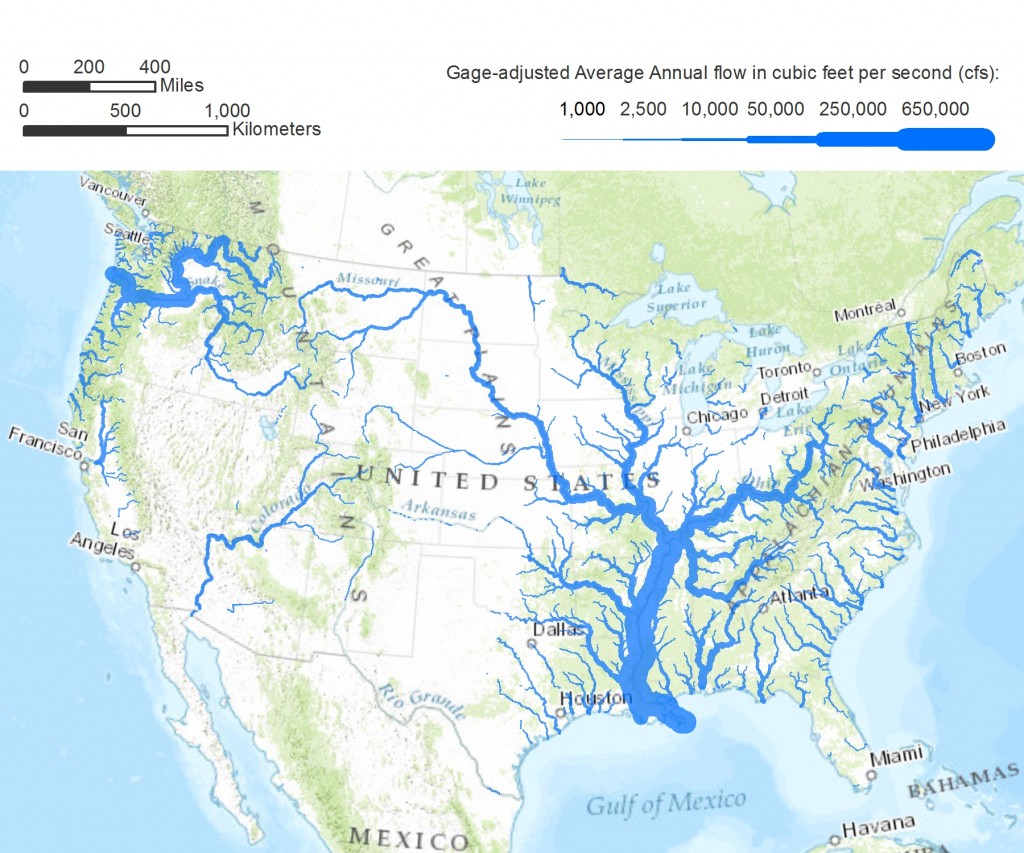
First, let's put up the graphic which shows the comparative flow of watersheds that reach a certain rate of flow. Some of these show up with a light color since the flow is reduced severely as the water makes its way out of the mountains to the shore. 

American rivers
Pacific Institute

In the middle, one sees the long reach of New England with the Ohio coming down to the Mississippi. So, stepping back, one can see the importance of the use of the Ohio in movement to the west. Wagons were brought west, moved north on the Mississippi, and then went up the Missouri. At that point, the wagons went west by land with rivers to cross. That shows rivers in two roles: means of motion; barrier to progress. We looked at the second one in our look at the New England party that left Boston and journeyed to Lawrence KS for two reasons: define a State; start a University. 

Remarks: Modified: 01/03/2026

01/03/2026 - Corrected a typo or two. 


Sunday, June 1, 2025

2021, time of the pandemic, II

TL;DR -- Continuation of the pandemic theme from before. We look at posts from the remainder of 2021 and at the themes covered which are of a wide variety. 

--
Part 2 of 2 (Part 1). 

In 2020, restrictions changed our activity. Like most, we did computer work over the time of the pandemic but had been doing such work anyway. What was different was the focus. 

We looked more at local issues. But, we had anyway (to wit, our post of Flyover country). By 2021, we were rolling along and did more posts. Part 1 looks at those from Jan through Jun. Now, we'll pick up with posts from Jul through Dec.

The 250th came more into focus. We also spent a little time looking at S.A.R. which is the sons version of what the daughters did with D.A.R. But, AI started to come into focus after almost a decade of making headway (according to some views - the jury is still out) and claiming attention: Jeopardy win; Go win; modeling complicated lab work (Google had several of these); ... 

But, we had a post (Carving the land) which was motivated by our study of the activities out of St. Louis which was a hub for land management of the U.S and its west.  At the same time, Gloucester was approaching its 400th. We had an interest in that as the Dorchester crew came into that area in 1623. But, the great northwest? Michigan was approaching its 200th. 

Another twist was diving into the history of Harvard starting with an introduction to James Bryan Conant. He was a chemist and professor. He had wanted the Rumford chair. But, ended up in Europe and came back to become a Head of Harvard. At the same time, we decided that the long reach of New England was a theme of interest, as we had settled on All Things Gardner (22 Aug 1485) with respect to the many families with the name. 

Oh yes, AI was proposed for genealogy work. Again, that is an ongoing bit of study. But, we started to look at the genealogy of Harvard Heads. Many were of old New England families. D.A.R. found an interest in the 400th as well by starting work on identifying Patriot to Passenger (in this case, Mayflower) families. We took on Cape Ann to Patriot. 

Houses? While looking at the Dudley family, we got into houses of note. There were two in New Hampshire of interest. Both were built by relatives of descendants of Thomas and Margaret. One is now associated with the Society of Cincinatti. That brings up the other side of a coin. We honor the Loyalists of the family. Count Rumford mentioned above was a Loyalist who found success in Europe and left money to Harvard. 

The technology focus became more prominent. IEEE had an article: How dumb is AI? A few years later, we saw a general amount of interest. One observaton? Humans degradate themselves to make technology look good. Yes. Expect to see that theme periodically. 

A photo of the grandmother Dr. Frank (and 2nd great of Ann and her siblings) was found. We got that published. Generations? An eternal topic. Looking at this, we can say that the Revolution (250th now in progress) was done by the 5th generation. More on these. 

We picked up Dr. Frank's series on the Siege of Boston that were published in The Massachusetts Magazine, with issues four times a year for a decade. He started the series with Col. John Glover of Marble head. One of his vessels was the first vessel of the U.S. Navy. 

We continued our interest in rivers, as we mentioned in Part 1. The trails and railroads are always of interest, as well. But, jumping to technology now, we looked at John's favorite site dealing with the mathematics of physics. It was of the old style until a few years ago. The old stuff is still there and serves as the basis for the new. 

Aside, we are seeing lots of websites being done using new methods. Our prediction is that this method is not as stable as claimed and so have failures that are hugely visible and that will have negative repercussions. But, other than be aware, we have to wait and see. 

Why? If one looks at the whole campus of techies, there is no solution yet. Experiments have become a mainstay of life. But, take a plane, experiment types of these are not used to carry passengers. 

Remarks: Modified: 06/01/2025

06/01/2025 - 

Thursday, April 24, 2025

Taming GenAI/LLM

TL;DR -- After watching the reactions, responses, choices and ramifications of choices over the past two years, we will step up to what we had determined when we first saw GenAI/LLM. 

---

We have had a lot of posts on GenAI/LMM over the past two years. Looking at papers, comments and such, in the environment of discussions across the board, there seems to be several patterns emerging depicting the evolution and adaptation in response to the phenomena. 

Looking at this huge variety of opinion can be fun and sometimes interesting, but it also is a huge time waster. After all, GenAI/LLM are known wasters of energy (the real stuff that comes with a cost of using up natural resources). We need more than that. 

Okay, let's start to look at the issues needing attention. Immediately, that puts us on an imperative search as several are pending. Fortunately, we can use a modern book for a basis, from 1986, as it looked at the issues of mathematics and its child, computing, with a thorough sweep across time. 

But, Kant was left out but can be reintroduced while we expand our series related to these themes. Earlier, we looked at one translator, Paul Carus, who came to the U.S. (a common theme for us in all endeavors, as New England has (and has had) a long reach. 

Follow our series as we expand concurrently along the themes of meaning in the senses of man/machine and of being: Taming GenAI/LLM. 

---

Addendum: Rather than add in via "Remarks", here are three posts from today that represent changes in the general knowledge plus decisions related to the future. 

Remarks: Modified: 04/24/2025

04/24/2025 -- 

Friday, February 21, 2025

U.S., 1820

TL;DR -- New France has always been on the mind from school days. Later, we found that the officer corps of the generation (5th) that drove the Revolution had been trained by the English Crown during the French & Indian affair. The Revolution is coming up for commeration of its 250th. For the 400th, northern New England started these in 2020. Coming up will be Salem MA - 2026. Some of our themes will continue to be rivers, carving the interior, and more. 

--

During the Covid times, we had time to do a lot of research, some of it related to families who came into (or passed through) the middle part of the country after the Lewis & Clark trip and report plus there was study of simultaneous activities in other than the New England part of the country. Mountain men, like Jedediah Strong Smith, were exploring. He went west through St. Louis which became a hub of activity. Jediediah got through the Mojave Desert and arrived in the Los Angeles area where the Spaniards took notice. After that he went up to northern California and was headed back to New England when he met his demise in the area now known as Kansas. 

See these posts as examples: State Missouri, 1821; U.S. Interior; and New Spain. There are posts covering later times before and after the Civil War: St Louis MO to San Francisco CA; Trapper, trader, rancher; and Old L.A. and the U.S. Our focus is across the board and 400 years: Boone, himself; Two different times; and, even, Josiah Willard Gibbs. That last one deals with serious early reserach in thermodynamics that got the attention of Maxwell, Planck and countless others. 

----

We have followed a Space in Quora that deals with Spain, including people and events related to New Spain's ventures on the American continents. And, we have a particular interest in California with family involved with New England's long reach across the interior. Too, the writer of the post lived (and worked, studied) in CA, including dwelling on the Bunker Hill area of DTLA for a while.  

Today, we saw this map in a post on Quora (next section) which got our attention. The Adams-Onis Treaty was signed under the adminstration of John Quincy Adams (kin - see Mary Gardner Boylston) and represents the increase in activity that followed the Revolution which is coming up this year for recognition. 

Frankly, we like the map as it represents one of the views of the time. Also, we already have noted that New Spain (see New Spain span) has not gotten the attention that we saw with New France. So, we will be paying more attention, starting with the left coast side of things. 

--- post in Quora Space -- 

In the post, which is an answer to a Quora question (Who founded Los Angeles and in what year did California become a state?), there are interesting historic details including photos. The Quora Space has been a good resource. Our post is to recognize its importance. 

---

And, we have two views to balance: the 250th - Lexington/Concord imminent; the 400th - Salem is next year - 1626 - Massey's Cove. 

We would like to point to more information on New Spain in those same times. 

---

We will get back to this topic after more review of those early years of the U.S. For completion, we cannot ignore the great state of Texas (Juneteenth; Pre-Civil War, San Antonio TX to San Diego CA). This map is from a couple of decades later which is pre-Civil war. 

U.S. Territorial Acquisitions

Other topics will include the U.S. Interior and Carving the land. 

Remarks: Modified: 02/21/2025

02/21/2025 -- 

Friday, September 27, 2024

Past and present

TL;DR -- The 250th of the U.S. will allow lots of research to get some air, as the attention goes to the history of the country. We will follow that thread several ways, including a deep look at technology of computing with respect all aspects that we know, to date. We can compare different areas. One of these one-up looks will be NYC and LA, in order by age. LA is comparatively a youngster. The dynamisms of the two difer quit a bit, too. 

--

Some locations kept good records via photographs of their change through time. At the same time, we have temporal issues such as Los Angeles being younger than New York City. Then we have technology bringing in abilities that can be pinpointed in time. For instance, we know that Gardner, the photographer, was active during the Civil War. We posted several photos from his era, including one from Lawrence, KS. We called the post with the photo "Frontier century" (April 2021); its themes were several: the great expansion in the middle after the revolution (deed done primarily by the 5th generation); families being lost in time as they escaped the heavy hand of documentation; and modern efforts at recovering evidence of their existence). 

We will continue to focus on the middle of the country but have, of late, been looking at Los Angeles and its Bunker Hill (west, we call it) that mainly appeared in the late 1800s and went away a century later to be replaced by high-climbing things that cast a long shadow. We have had lots of photos of the LA area and can be more intimate as we find older photos to match up with something recent. 

LA and NY City
across time

In this photo, the left side shows part of the train yard in LA at two different times. Reminder, LA was Old Spain and Mexico until the latter part of the 1830s. LA claims a start in the early 1780s which is associated with New Spain. The area settled is known, now, as Down Town LA (we'll use DTLA). A church built in the area in 1784 later burned. At that site, the Old Plaza Church (still standing) was built built in 1814.  

On the right of the photo, we have snaps of NYC's Manhattan starting with a photo from 1876. This an old area and was part of the colonies prior to the U.S. Revolution. With the 250th of that event coming up, we will have time to cover stories about all areas of the U.S. 

One of our themes will deal with the long reach (Mirror building; Settlements, temporary and otherwise; NEHGS events) of New England. There will be others, such as technology. 

Before moving on, we know that NY City has tall builidngs. Lots of them. The tallest now is the One World Trade Center at almost 1,800 feet. Wikipedia has a list of buildings taller than 600 feet (110 buildings). 

In DTLA, the tallest building is only 1,100 feet). The LA City Hall is 454 feet (it's shown on the left in photo) and is the 42nd largest building. The smallest (53rd in the Wikipedia list) stands at 352 feet. 

We mentioned Bunker Hill west. It got its name, of course, from the site of a Revolutionary battle. We will be looking more at that area in DTLA as it represents changes over time, as influx of population changes the dynamics of a location. With a great collection of photos from different periods, we find people taking photos from that same area and focus of direction. 

Related to Bunker Hill west is this one that show 101 early on and then later. In the meantime, St. Vibiana's was closed as a church (became an event's center) and moved up the hill from Main Street to the summit. Parts of that area had been lowered early. Houses and dirt were taken away to have proper foundation for buildings. One story to look at is the Central Library which experienced two fires by arson. During the time of recovery, maneuverings got the building limit raised from that related to the height of the City Center. So, the first one went up to cast a shadow over the library. The library sold its "air rights" as one means to fund getting back to its work. They had to replace $Ms in burnt books, for instance. 

LA Central Libray with its
"twin" (to the right)
U.S. Bank Tower

On the list of tallest, the "library tower" now is #2. 

Reminder: with respect to photos (such as we see from Water and Power Associates of CA), provenance needs to have special attention, always. How all of this influence from Gen AI plays out will be a thing to watch. The ease with which fakes can be generated will make the problems more diffficult to resolve, albeit there are known ways to attempt to obtain stable and safe environments. Technology will provide the means many times for its managment; a key choice concerns human involvement. Yes, we humans can handle the complexity. Unfortunately, we could have known more; that is to be discussed.  

Remarks: Modified: 09/27/2024

09/27/2024 --  

Saturday, March 30, 2024

Judy Garland

TL;DR -- Bunker Hill West has a lot of history that we must not forget. Fortunately, a few Facebook groups are helping by providing period photos. One of these showed Judy Garland in 1939 working in her flower shop in LA. The photo was from the time that she was filming her famous movie. Her mother thought that she ought to have a Plan B.   

--

For the most part, we will be looking at LA, in particular Bunker Hill West. I saw a photo recently that showed Bunker Hill in the late 1800s and recently from nearly the same view and will use it in a future post. The theme is the long reach of New England using the west coast as a focus as we look at families that went west leaving traces across the country. 

As is obvious the culture in the west differs from that of New England, many ways. There are huge similarities, too, which we can discuss. The 400ths might have shown up, but coming up shortly will be the 250th of the U.S. Western settlements started as colonials moved away from the coast. The interior had major activity early on, where St. Louis became the organizing point for bringing points west into the fold. 

Photos became almost regular around the time of the Civil War. What one is seeing now on social media is old photos being uploaded. FB has innumerable groups whose main meme is that. We have mentioned California many times. Several sites showing photos are covering the west coast. And, as mentioned, many times, new photos of the same view, or taken near by, allow us to consider the history. 

We will look at San Francisco, as well, including the Presidio. That goes with our interest in New Spain. 

Now, to Judy Garland (Wikipedia, WikiTree) who was a household name, at one time. She was born in Minnesota which came out of the Northwest Territory. And, she has a southern New England pedigree. See the WikiTree information on her. 

As we go forward, given the 400th and technology's support for research, we can use Judy's pedigree to help study northern and southern New England's relationships. Some of our earlier posts have started to address that topic. Many are about families from the north and the south meeting as they transitioned west through generations after the Revolution. 

According to FamousKin, Judy is related to the Gilman/Ladd (and Dudley) family of Massachusetts and New Hampshire. But, the tie-in is prior to the migration. The site used Alan Ladd, the actor, as the focus. 

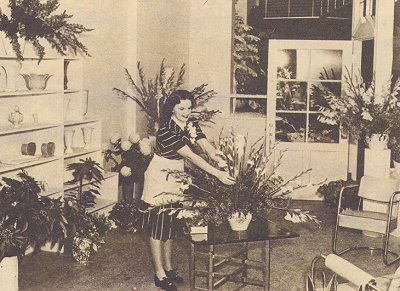
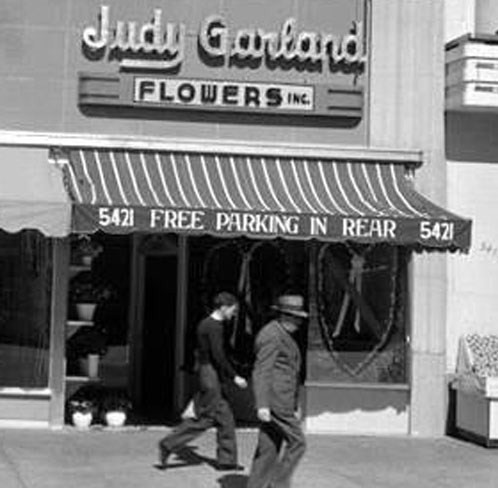
What caught our eye on FB was Judy working in a flower shop. The photo was on a FB page devoted to Relics of  LA which we have referenced before. There, also, is a florist's site that has a post titled Did you know that Judy Garland was a florist? She worked in her shop during the time that she was filming the Wizard of OZ.  


Her shop was on Wilshire Blvd; she started it when she was 15 years old. As she became more involved with entertainment, her florist activities went to naught. 

She is a good example for Women's History month. Her mother got her involved with flowers as a Plan B in case entertainment didn't work out. 

May 16, 1939:

Quote - Judy Garland News and Events: The photo and caption above appeared in the papers throughout most of 1939 and into early 1940, promoting Judy and her alleged business, “Judy Garland Flowers,” supposedly opened by Judy and her mom, Ethel.  The photos were all posed and shot by an MGM studio photographer, possibly on January 22, 1939.  Obviously, Judy was too busy at the studio to spend any real-time arranging flowers at the shop’s location on 5421 Wilshire Blvd. in Los Angeles.  The location was eventually turned into a bakery.  The building was torn down in the 1980s and a Staples store now occupies the space.

Remarks: Modified: 03/30/2024

03/30/2024 --  

Tuesday, February 20, 2024

Alta California

TL;DR -- As our initial focus was New England, New France came into focus early. But, after the start of the U.S. and the beginnings of the movement to the west, New Spain became the theme of research. Our early looks at this were about Los Angeles and San Francisco around the start of the 20th century.  As we step back in time, Portola's efforts come into view with interesting history to consider. We can start by considering the 1776 beginning of the Mission San Francisco de Asis. 
 
---

We had mentioned Spain in earlier posts while discussing the times before the Cape Ann expedition. Several countries were fishing along the eastern seaboard. It was being more efficient in providing products from the yearly fishing efforts that precipiated the colony focus. 

Our first reference to New Spain was with our look at Jedediah Strong Smith's journey from the east coast through St. Louis, in the 1820s, out to the west coast. Our post on Jedediah covered his wanderings which are of note. Hence, he has been mentioned many times. With respect to Spain, Jedediah went south and west through the Mojave Desert, in summer. His appearance in the LA area was a surprise. Luckily, Jedediah was able to talk his way to freedom and continued up north and then back toward the east. He met his demise in the wesern area of Kansas. 

In the time of the pandemic and its isolation, we spent a lot of time researching the middle of the country. Okay. That was part of the Louisiana Purchase. Both France and Spain had been involved in the exploration of the area. We had looked at New France first, as it was the other side of the conflict before the Revolutionary War. Many use the French-Indian Affair. The friction was between France and its Native Indian allies and England via New England; as well, there was conflict in Europe and at sea.  

As we start to look at folks who had ventured all the way to the west coast, we realized that we needed to look at New Spain more closely. For instance, Coronado was close to where I am in 1541. In Texas and in the southwest, New Spain was the principal colonizer. California sites have been given lots of attention in the blog of late. There are several reasons for this. We're looking at the long reach of New England. And, John went to school and worked in both Los Angeles and San Francisco. 

Of late, he has been look at Bunker Hill West which is part of the downtown LA area where we can see changes over several periods, such as the early arrival, the mansion period, commercial focus, and the modern status of high-rise island in a sea of sprawl. The web is offering lots of incentive to research by allowing systematic publication of photos across time. As well, the social media spaces (such as Facebook) are providing means for like minds to compare findings. 

We will continue with the themes of California as it allowed the start of the series and will expand into all of the regions where New England families settled over the past 250 years. Part of this effort is looking at the rivers and waterways that supported the development of areas. 

Now, today's theme ventures back up north. Last year, we did several posts on San Francisco, some of which dealt with the impact of the major quake from the early 1900s. We actually looked at the region in our early days due to tracking the history of a barque Bostonian that had been built and used by a Gardiner for whom a town is named in Oregon. We learned a lot from that exercise which generated more questions than answers. 

Along that line, the Bostonian was in San Franciso at least two times. But, that brought up other visitors to the area, such as Judge Thompson who helped establish Montana as a State. He was there around the time of the Civil War. Later, we see the railroad coming into play with faster and more reliable transportation across the wide expanse of the country. 

But, let's step back, again. As we can look at the establishment of the San Francisco region by New Spain. Facebook has a group with the title, Alta California, which follows Portola's expedition up the coast.  Portola's group built missions and forts. Of the later, we have the Presidio of San Francisco which we have mentioned several times. 

Of the former, this photo is of the Mission San Francisco (St. Francis) de Asis. A mass was celebrated on 9 Oct 1776 for the laying of the cornerstone for this mission. 
 
Mission, St. Francis, Assisi
in San Francisco, CA

This post is cursory as it skims over a lot of history with regard to Spain's explorations and colonizations. We will begin a series with a closer look at California's start. 

Remarks: Modified: 02/20/2024

02/20/2024 --  


Friday, February 9, 2024

Current status


TL;DR -- Two major things happened last year. Both dealt with technology. One had to do with the future as it might be influenced by computing. The other had to do with the influence of the computer on the past in terms of records. Then, we have all sorts of other themes at hand to consider. 

--

This post has the purpose to get the current status of the Thomas Gardner Society, Inc. on the table. There were two major things that happened last year. Then, we reacted to another change in the on-line environment. 

Caveat: This will replace the "In summary" post of last spring. 

First, the two things, as in order with respect to our focus, of note last year were: 

  • We became aware of the xNN/LLM maneuvering in late January and did a post on Febuary 1: ChaptGPT. Prior to that time, we had taken a hands-off approach to AI for reasons that are documented in later posts last year and before (actually). We knew that there was money involved with big names getting into action. But, it's a mess, folks, which we intend to bring to the fore as our major project. Let's table that for a bit. Too, there was the 400th of Gloucester last year (next bullet). Then, there is the upcoming 250th as noted by D.A.R. and S.A.R. which we spend a lot of time supporting. With respect to our research, see our category of the "Long reach of New England" which as been a theme for almost a decade. It got more attention when we considered that those on the Oregon Trail (some of them) had passed by the foot of Mount Oread which hosts the University of Kansas. And, that there had been a major effort on the part of New England to keep Kansas slave-free. Col. T. W. Higginson was out here. So was John Brown; we just had a post on his armed conflict with some people of out the south who were using Missouri as a staging ground for creating havoc with pioneers. Stay tuned on that. The other theme can be found after the next bullet.   
  • Okay, we were getting ready to write about Margaret Fryer the wife of Thomas Gardner. This was due to the fact that the 400th was collecting stories. And, our research had been effective is getting Margaret on the map. Anderson, and friends, had dissed her, essentially. But, then. We ventured to WikiTree which has been our research vehicle (for many reasons) and saw that someone had gone through the digital files of Sherborne, Dorset and found records for about all of the kids of Thomas and Margaret. Except, we might add, for Sarah who was known to have been born here in Salem in the mid-1630s. And, we saw that the WikiTree folks had split Thomas into two people. The one Thomas was the husband of Margaret. The other is an unknown. To us, we see these ones as the same. Thomas was here and went back. Hubbard suggested that. And, he was of the time and talked to the principals. Whatever turns out to be the fact, we'll adapt. But, right now, Thomas was at Cape Ann. Nothing really shows otherwise. But, how did we miss this? See the first bullet. Besides putting ChatGPT through its hallucinatory paces, we looked at others. Frankly, Bard of Google excels. We'll explain. The gist of the matter is that we can research from Salem to now. And, origins? Full of open issues which it is time for us to tackle. 
Another theme had been the west coast, principally San Francisco as we were looking at the quake and the aftereffects. But, Los Angeles got into the mix due to seeing that Butterfield (and others) had stopped in the Bunker Hill area to reprovision for further effort going north to San Francisco. Arriving there, they turned around and headed back to St. Louis by a long, arduous route. But, lots and lots of photos from various times started to crop up which made this theme even more important. 

This is cursory by purpose, as we'll have this research as a regular theme from now on. 

So, origins, for the most part, were not followed closely by us. We had concentrated on the generations from Thomas and Margaret until now. There are reaons for this. One dealt with the fact that research in the Old World was ongoing and best handled there. We, over here, have our own axes to grind. 

That was okay until now. We are henceforth taking origins to be a regular feature of our work. 

Remarks: Modified: 07/12/2024

02/13/2024 --  Added image. 

07/14/2024 -- Why is 2024 so quiet? 

Saturday, January 27, 2024

Longhunter

TL;DR -- Boone was there, in the times of the French-Indian affair, the Revolution, and after. He was of a type that can be known as longhunter. They wandered and brought back information. And, turned around and led people west. This post is of the 250th theme. We are about two years away from that celebatory event. 

---

Four years ago, COVID became a reality. There had been little glimpses earlier. People were talking about an illness in China. We came home from a regional jaunt and heard, on the news, that people had been identified in the area where we had bee as being diagnosed with the disease. Okay, not long after, there was the respite put into  place. Rather, it was lockdown with rules put into place which went on for a few months. 

We had already been supporting history and genealogy work. Some of this had the flavor of finding paths taken by families as they went west. Or, from our perspective, as they came west. Earlier, we had seen entry into flyover country from several directions. The Ohio River ran from PA down to MO. But, it was Daniel Boone (see post Boone himself and search results - Boone) who figured in a large way. He was involved in the Revolution. Prior to that, though, he had explored westward our of the southern states. 

As we had noted, our focus was on the coast for a long while as we caught up with the 400 years that had passed by. Dr. Frank's work was a launching point bot from the family research and The Massachusetts Magazine which printed for eleven years and was discontinued when the Spanish Flu hit as well as WWI came about. But, we had done some work with families who went west. See Flyover Country, for one. As an aside, we are considering how to update Dr. Frank's work with respect to recent findings brought to us by technology. 

Fortunately, about the time of the pandemic, we were getting more inquires with regard to people coming west. Here are some examples (these posts are not in chronological order): Jedediah Strong Smith; Judge Thompson; Col. T. W. Higginson; and St. Louis as the site of the partitioning efforts. Too, though, we tracked several families that followed Boone west. He, BTW, ended up in MO with his son coming further into KS. 
Boone, wandering

Now, let's look at Boone and what he represented. He was a longhunter. These guys went out on their jaunts for months at a time. And, during that period, they were self-sufficient. When they returned, they brought back information and some artifacts, such a pelts. 

We are talking about the area, for the most part, that was east of the Mississippi River. There were explorers out further west, some from the Candian regions. Jedediah was out in California in the 1830, by foot both his and his steeds. He passed through St. Louis on his way. Later on, as we know, two massive killing periods happened out west: beaver; buffalo. 

The numbers of venturers was small. But, where Boone was, a Cherokee chief by 1769 was complaing about the influx of the long hunters. Mainly, they were noisy. And, other stories abound. 

But, getting to our interests, we are finally concentrating on Tennessee. It is a huge state. All together, it touches nine states. Its northern neighbor, Kentucky, touches seven states. We follow families who went west through both of those areas. Too, their border was a dividing line during the U.S. Civil War. We have not discussed that topic in detail, yet, but intend to at some point. Since we're in KS, there is a pre-civil-war history involved with families in the area. 


Back to the longhunters, they are similar in spirit to those who sailed the seas as we saw with New England. We had an earlier post (Final migration) that quoted authors on the subject. There were many trails west, as the railroads later showed us. Jedediah, in CA, had travels that map out the current highway system. Culturally, we would point the travels of the Native Americans over their long time on the continent. 

Other types of early travelers have been touched upon during our research. About a century before the area depicted in the Flower Moon movie, a mission was established in SE KS to aid the Osage and, eventually, other tribes brought into the area. Several local sites were the local for negotiations and treaty agreements. 

Back east, the history goes back 400 years. In the interior, we are talking the long reach of New England over a 250-year period. A lot of families arrived later; but, many carry the history int heir genes over the entire period. Both require attention. So, there's no end to research. 

Lately, we have had a focus on CA, for several reasons. Some of the interest has to do with family being there early. But, we have seen lots of older photos being brought to the fore. Recently, we did a post about a photo taken in downtown LA in the 1880s. We have one from this week to add. But, the area of the photo was where Butterfield had his stage coming into the area prior to going up to San Francisco. His first arrival was in the 1850s. Change is on theme. Some things remain. Many, most do not. 

Society needs its adventurers. Of late, there are new types that we will be discussing. Despite that, we still need the old ways for many reasons. 

---

Example? Technology has developed a thrust and lust for the virtual. That theme needs constant attention for several reasons. One deals with the respect for the land and the people involved across all of the time frames that will be associated with the U.S. and its history. 

Now, AI and even AIn't? History can be retold in more interesting ways using technology. Yet, the truth of the matter remains an open issue that hopefully we'll be able to address more fully if we determine the necessity as we ought. 

Remarks: Modified: 01/27/2024

01/27/2024 --