Showing posts sorted by relevance for query "siege of boston". Sort by date Show all posts

Thursday, October 23, 2025

Siege of Boston, I


TL;DR -- We will do a series on the Siege in the next few months. It dragged on for almost a year. 

---

For those who have not heard of the 250th of the U.S., we are in the first year of the Revolution as it started in the Boston area in Spring of 1775. Usually, people talk of 1776, but that is for the signing of the Declaration of Independence in July which is when the 250th year will end and when we start the 251st year. 

Of the remembrance of a long war. It started before 1775. Then, Cornwallis surrendered in the fall of 1781. However, hostilities continued and the treaty was not signed until 1783. We have lots of material to cover, related to families personally. 

For this post, we will do a few looks at the Siege of Boston. Today, let's look at a few past posts on the subject. These are in order that they appeared in the blog with the year of posting noted. 
At this time, in late October, we have five months before the Siege ended. April was a long while ago. People were coping and organizing. 

Remarks: Modified: 10/23/2025

10/23/2025 - 


Sunday, May 18, 2025

Bunker Hill, I

TL;DR -- We're in the time of the Siege of Boston with the Bunker Hill incident on the horizon. But, the Siege went on until March of 1776. So, we have a few more items to look at prior to the hubbub of the Declaration of Independence whose inspiration was, in part, brought by kin from almost 100 years prior.  

---

Siege of Boston

The first thing to remember is that we are at the 250th of the Siege of Boston. Earlier, we looked at an event that led up to this: Lexington and Concord. This start of the turmoil on April 19th attracted support of able-bodied men in the area, except for Salem troops under the command of Col. Pickering (Where was Salem?).  

In our research, we ran into the battle of Bunker Hill (17 Jun 1775) early on through reference to Col. Thomas Gardner who was killed in that conflict. His 25th Continental Regiment was involved in several engagements. 

This brings up Dr. Gardner's look at the Regimental history through a series of articles that appeared in each of the issues of The Massachusetts Magazine. In the first article, he discusses the Siege of Boston and notes that the revolutionaries were not solely rebels. Many officers had served the Crown in early conflicts. 

The Siege was almost a year, going to March of 1776. We have time to look further with respect to our themes. 

---

Los Angeles (LA) of California (CA) has a neighborhood that is called Bunker Hill west. We have had several posts on the area which represents the history of LA from the time of Spanish rule to the current age of skyscrapers that have populated Bunker Hill West area. Early English involvement the area was in the 1830s. After that, many New Englanders showed up in the area. We have been researching this influx and have reported on some families. 

A stage line came into LA from Arizona (AZ) that was part of a freight/mail business with an eastern terminal at St Louis of Missouri (MO). Pre-Civil-War activity on the line followed a tight schedule and was supported by stops along the way through several current States, including Texas (TX). The area in LA where the line had their stop and supporting businesses, such as those that provided horses, stage maintenance, and more, was at the bottom of Bunker Hill West. 

The Butterfield Express, and many other Express companies, were New England in origin. Of interest is that many of these are still in existence. 

---

The Revolutionary War started in 1776 and went until 1783. So, we will have several years to look at this history in all aspects including families and their genealogies. So, let's remember Rev. John Wise of Ipswich, MA who was seen, almost 100 years later, as the inspiration for the document normally associated with the War, the Declaration of Independence. The Col. Gardner mentioned above was related to Rev. John through their Gardner lineage. Both are kin. 
 
Remarks: Modified: 12/13/2025

12/13/2025 - More on Bunker Hill, per usual. 

Sunday, June 22, 2025

Bunker Hill, II

TL;DR -- The Siege of Boston continues until March of next year. This past week, there was an effort by the British to dislodge the patriots (or provincials as known in London) which didn't work. We will have to look at what the next nine months entailed for both sides, in MA and elsewhere. Speaking of which, "Bunker Hill" has been used a lot in naming over the 250 years. We compare the MA one with that area in DTLA with the name, again. But, will look at some others, ,worldwide. 

--

Right now, we are in the period that was associated with the Battle of Bunker Hill with a main skirmish happening on 17 Jun 1775 with the first piece of the action happening at the locale of Lexington & Concord in Apr of 1775. Bunker Hill Day is a regular holiday in Boston on Jun 17th. 

At this time, in 1775, the British were still surrounded. The Siege of Boston continued. The next day of commeration will be the Evacuation of Boston that happened on 17 Mar 1776. 

As we mentioned, the Massachusetts Magazine had an article on the troops that participated in this Siege with some information about the officers. There was an article in every issue, 1911 to 1918. 

And so, we will look at events and people over the coming years as the 250th lookback unfolds. 

----

May we change gears? Bunker Hill is a little over 100 feet high and is in the Charlestown neighborhood. There is a monument for the event on Breed's Hill which has a lower elevation and where most of the activity took place.

At the time of the Battle, the British owned the waters as Boston was across the Charles River from where the Battle took place. The whole affair is quite strongly resident in the American mind. In fact, Bunker Hill has been used as a name in many places. We will look again at Bunker Hill West which is in Los Angeles and about which we have had several posts. Today, we look at the lay of the land. 

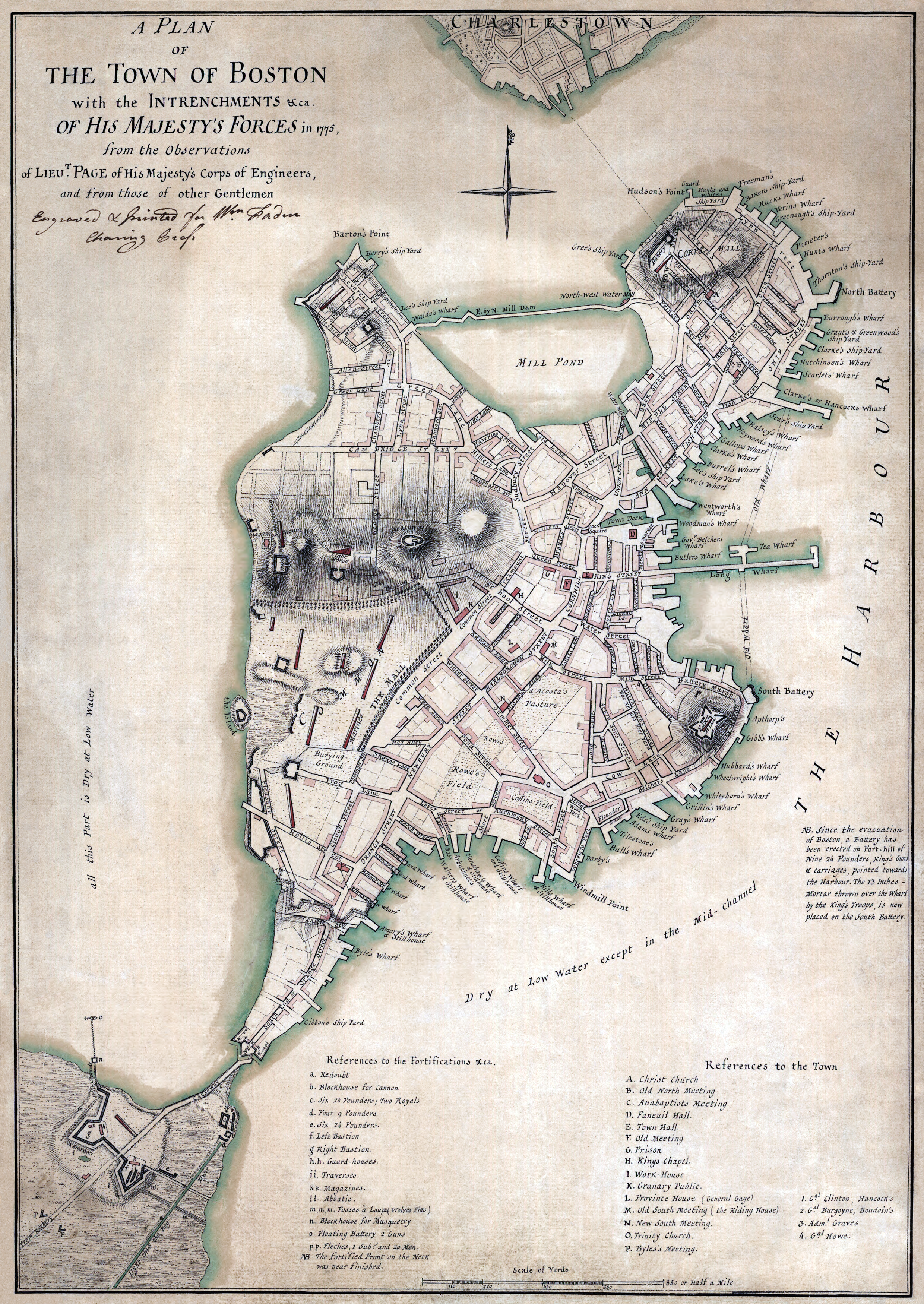
But first, here is a London map of the situation in 1775. 

Printed Aug 1775, London

Before transitioning to the west coast, we have to mention the last surviving veteran of the incident: Ralph Farnham (1756-1860). He is of the upper part of Massachusetts now known as Maine and is cuz as are many. We will look at him, again, as the whole of the Maine experience needs more attention partly due to the case of the southern entity, Boston, was more prevalent in historical accountings. 

---
 
Now, Bunker Hill West? The name has been used in many places: the Wikipedia list. Notice that Los Angeles is on the top of the list. Our interest was first brought to the area as this is where the stage coach route from St. Louis arrived after an arduous trip down into Texas, across the souther border (wandering into Mexico), and then ending in Los Angeles. That was not the terminus, as with some refreshment of resources, the stage line then carried passengers and freight up to San Francisco. Where, the process started again on the way back to St. Louis. 

Mind you, folks, there are several things to consider: logistics (compared to the Pony Express, this was much more of an intricate maneuver; we are talking pre-Civil War however some of the western States had been defined (such as Missouri in 1820 - added along with Maine to balance the north-south  issues; in terms of Bunker Hill in DTLA (Downtown Los Angeles), though, the terrain was entirely different as we will be pointing out. 

The lowest point in DTLA was about 59 feet. The hightest was the hills to the west with Bunker Hill (BHW) topping 350 feet. DTLA is many miles from the ocean. In terms of survival, being in a sheltered, inland cove with fresh water from the mountains would be more appealing than the environment now associated with being encrusted by salty waters. 

In the latter part of last century (post the 1950s), there was an effort to knock BHW down which seems to have been successful. They flattened the basis for the high rises that rose and that are now photogenic against the background of Nature's display of mountains. 

Here is an example. I marked three things. 1) On the right, the line points to where City Hall pokes its head up proudly. This 1937 building was the limit for heights until later in the 1900s. We can be more specific. There are early photos from Bunker Hill showing the top of the spire of the City Hall. 

Now is the time to mention one other thing. In the center, the tannish (round) building behind the white (square) one was the first building to penetrate the old limit. The developers used the opportunity of the LA Library having experienced arson and selling its airspace to get funds to recover as a means to start the trend that gave us the high-rise look. 


So, speaking of the Central Library, they recovered physically and bought replacement books. But, there was another instance of arson later. To me, on any of these photos, I look for the bank building and figure out where the library is nestled (having spent many hours there; across the street; the base of the bank building is on higher ground along the elevation of BHW). 

2) and 3) These have to do with old DTLA from the time of New Spain onward. In the middle, the text says that if we jump (or fly like superman) over the buildings we would find the Old Plaza Church. Several of our posts have photos of this building from various time periods. Yes, it was there when Butterfield came in with his stage line. In terms of the beauty of DTLA, the Train Station which is a remarkable example of SoCal architecture is across the street. 

So, now we can consider another church. Not far from the Old Plaza Church and the City Hall is the structure that was St. Vibiana, a Catholic cathedral. That old building dates from the 1870s which is new from the west coast view point (reminder for those looking from the east). An earthquake caused some damage but not enough to destroy the building. It now is an event center of some note. 

The cathedral was moved to the left side of the photo where US 101 and the 10s intersect. We can figure out the lingo, but the area has been visited by tourists with many photos extant. This view shows the extent of the high-rise area. And, the larger buildings are clustered there at BHW. 

---

There are early photos (1870s) showing that people started to try to tunnel from the getgo. Several tunnels were completed with many still operational. As well, there were steps put up for people having to go up to the buildings on the BHW or over to the other side. And, the Angel Flight configuration of a rail car exploited the arrival of electrical power. Fortunately, through many periods of reconfiguration such as the scraping down the elevation, people saved the old mechanism which is now more of a tourist event rather than operational. 
 
---

What's next for looking at the namesakes of Bunker Hill? 

Remarks: Modified: 12/23/2025

12/23/2025 -- More on the Butterfield stage as representing the U.S. government's concern for handling Overland Mail. There has been lots of research about the trail from St. Louis MO to San Francisco CA. 
Thursday, September 18, 2025

Southern campaign

TL;DR -- Lexington & Concord got things going in the spring of 1775. Hence, we have the 250th started this year. The Siege of Boston was still going on (would be until March of 1776). By 1778, the Brit strategy was to go south and perhaps find friendly folks. The events of "Southern theatre" run by General Nathanael Greene starting early in 1781 helped settle that issue. Lord Cornwallis surrendered to General George Washington in October of 1781. The 1783 date aligns with the signing of the Peace Treaty. 

---

As expected, the looking back over 250 years to the Revolution can be a daily thing. We are still in the Siege of Boston which started in the Spring at Lexington & Concord, included the Battle of Bunker Hill and other skirmishes, and will go until March. We wrote recently about Henry Knox bringing cannons from Fort Ticonderoga to an area outside of Boston where the Patriot troops were not visible to the British in Boston. This period will end with the British leaving Boston and going to New York. After not finding success in that area, the focus of the conflice went south. There were still events in the north, but the whole focus changed.

This is where General Nathanael Greene comes in. He had been Quartermaster General for several years. In 1781, General Washington put NG in charge of the war in the south. We got involved with studying this by doing research about the southern troops. In the north, there had been regular militias. As Dr. Frank noted, the leadership had been trained by serving the Crown in the French & Indian affairs. 

Lord Cornwallis had hoped that the southern portion of the country would be more amenable to staying loyal to the Crown. That is something to consider as we review over the next few years.  


Called the Southern theatre (or campaign), this series of battles started in 1778 which was two years after the Declaration of Independence and three years after the first shot was fired in 1775. Having started in early1781, NG won and lost battles. Yet, the War of Revolution was over by October of 1781. The year of 1783 is used since that is when the peace treaty was signed. Between 1781, there may have been continuing conflict, but the main focus was forming the country. 

There is a lot of ground to cover, such as a look at the timeline of the Southern theatre and consider of how what particular areas had a major role in the conflicts and their outcome. 

---

One theme will be Loyalists and what happend to them. For example, see this post -- Henry Gardner, the Loyalist. He left his property in control of an agent in Salem and went north where he had a reputation of being fair, and friendly, with American prisoners. He came back after the war and resumed his life and business. 

Remarks: Modified: 09/18/2025

09/18/2025 - 

Sunday, November 9, 2025

400ths, in Massachusetts

TL;DR -- As the Siege of Boston continues its slow course, we can look at other areas which need more attention. Such as, the celebrations of the Massachusetts start will go until 2073. 

--

Of late, GenAI/LLM has gotten our atttention. That will continue under the theme of technology as we look at the mathematical underpinnings of phenomena (multiple variants) as well as get into the psychology and human interest aspects of the big chimera which we termed by buckets'o'bits (replacing AIn't which was misunderstood). We see a serious map/territory problem. 

But let's get back to history of both a family and regional nature. 

200 years ago, New England was still in the Siege of Boston stage which started back in April. Winter ws setting in. Washington had arrived in July. In September, he sent Arnold north on an attempt to make some headway in Quebec. Knox, in November, took his men to get artillery and supplies from Fort Ticonderoga. We have yet to see the Declaration of Independence.

Some reading material:
  • Wikipedia, per usual, has a marvelout collection of information: Siege of Boston. This post has a good overview with secondary material. 
  • An example is the post on Knox's effort: Noble train of artillery.  
The 200th of the Siege continues until March of next year. That gives us four more months to learn about the events and to appreciate the efforts of the colonials who got the U.S.A. started.

For instance, once the artillery arrived, in March, Dorchester Heights was fortified. 

---

While we have paused to reflect on the 250th, we need to remind about the 400th anniversaries that will go on for a while. This post provides a list of the towns and villages that will be celebration. For instance, Salem is on the list for next year (2026). Cape Ann (Gloucester) had theirs in 2023. Before that, the Mayflower arrival was celebrated in 2020. Here is the timeline for celebrations. 

Timeline of Settlement

These go on until 2073. In 2026, Beverly (one of the places known as the birthplace of the U.S. Navy) shares the same settlement year as Salem. 

 Remarks: Modified: 11/09/2025

11/09/2025 --


Wednesday, August 27, 2025

St. Michael's, Trenton, NJ

TL;DR -- We mentioned General Washington and General Knox, earlier. One night and day versus several months of daily ordeal. Now, we can tied these together and continue our look at the 250th and remind everyone that we will be doing this work until 2033. Even then, conflicts with the Brits and US will be there for several decades. 

--

A few posts back, we referenced indirectly the area of Trenton, NJ while noting a major event related to the Siege of Boston - which was still going on until March of 1776. The theme was looking a little closer at Knox's transfer of cannons from Fort Ticonderoga to Boston in the fall/winter months of 1775.  

Cannons from Ticonderoga -- My comment: 

We hear of Washington crossing a frozen river to surprise drunken soldiers. 

This is way more significant in many ways. From the fact of Ethan Allen (sells furniture) to the long trek of Knox and his crew on a frozen lake and then across western MA to a little hill outside of Boston.

The prelude to the 250th celebration started earlier this past spring. We have had regular posts and expect them to be continual the long period of remembrance until peace returned (1783 - to be celebrated in 2033). Our focus has been Massachusetts with Lexington & Concord starting things out and then with posts on local happenings. 

We had expected to cover the whole of the colonial span, especially since most of the activity was outside of Massachusetts after the British moved out of Boston. One thing that we will look at will be the contributions of General Nathanael Greene's troops. He died young. His papers were finally organized in the 20th Century and published in the 1970s. 

---

Today, we look at some of the area in Trenton, NJ where George Washington's troops tangled with the Hessians. We will use a focus on the St. Michael's Episcopal Church, site of some of the fighting.

William Trent, namesake of Trenton, was a member. The Church has a project to get a stone made for Mr. Trent. Another member was David Brearley who is buried in the cemetery. 

The David Brearley Heritage Foundation (Friends of Old St.Michaels Trenton) is organization with this mission: 

... act as the umbrella for the transformation of the St. Michael’s facility into a community educational hub promoting a knowledge of our shared past, New Jersey’s role in the U.S. Constitution, as well as a renewed faith in the role of religion in society.

This post is a brief introduction. We will look further at the history of the Church and at details related to its involvement in the American Revolution.  

The cross at the upper left is St. Michael’s ... 

Quote from their material: 

St. Michael’s saw many different faces of the Revolution. The Continental and British armies occupied the church. The Hessians, the German mercenaries who fought with the British army, used the church as a barracks and stable, and stored their artillery in the church yard while they occupied Trenton. When George Washington and the Continental army surprised the Hessians on December 26, 1776, some of the fighting of the Battle of Trenton happened in St. Michael’s church yard. There was hand to hand combat with swords, muskets, and bayonets on church grounds. Later in the war, the church was used by George Washington’s Continental Army as a hospital.

---

And so, we have over seven more years to tell the tales overlooked by history which usually has little focus on local details that are of the type that get overlooked for many reasons. Those reasons? We will discuss that as well as we deal with technology and knowledge, in particular advanced computational systems. 

Not to belabor the point, but there were conflicts for the new country over several decades beyond 1783, of which that of 1812 is on the radar of most Americans. We can leap over that bit of growing pains and also start to research the growing affinity between the two countries of cousins. 

Remarks: Modified: 08/26/2025

08/26/2025 - As we go along, we will relook at the crossings. There were several. And, Knox was part of this operation, as well. We'll use Wikipedia's article. In that first winter, Washington had to overcome several problems related to operational effectiveness. Southern troops arrived on the scene and helped attain victory. Future president James Monroe was a participant. 


Thursday, July 31, 2025

Cannons from Ticonderoga

TL;DR -- George Washington took control of the Revolutionary Army on 3 Jul 1775. He spent 11 months in the Boston area. Henry Knox convinced Washington that he could bring cannons from Fort Ticonderoga which Ethan Allan had captured earlier in the year. Knox succeeded, and the cannons were placed on a hill overlooking the British encampment which resulted in the evacuation of Boston.  

--- 

Early, in our research, we saw a reference in Joseph Felt's book on Ipswich to cannons from Fort Ticonderoga being used at Boston during the Revolutionary War. This British fort has been captured by the Green Mountain Boys of Ethan Allen. 

Traversing winter landscape
in New England pulling cannons
(took months)

Yesterday's look at George Washington's role during the Siege of Boston got us to look further. Below, we summarize what happened and provided links to further research. 
  • Washington Takes Command of the Continental Army - Massachusetts History's overview. 
  • Henry Knox Trail - this page shows commemorative markers along the route taken by Knox. 
  • The Knox Trail - report by the Hudson River Valley History organization about the 1926/7 effort by the States of New York and Massachusetts which provided the map below. 
  • The guns of Ticonderoga - gives an overview of the event, with the consequence of the British rmoving their huge force and ships. 
  • Dragging cannon from Fort Ticonderoga to Boston, 1775 - letter from Knox to Washington written along the way. 
  • Henry Knox Cannon Trail - there are two Revolutionary War Routes in the Hudson River Valley covered in the page. The second is the Washington-Rochambeau Revolutionary Route related to northern events in the war during which the French joined in the fray. After success in the north, the majority of the focus was the south.  

There's a lot more to look at. But, the cannons had arrived by March, later than expected. Once they were in place, the British commander opted for them to leave. But, looking at the size of the equipment available to the British, one is amazed by the success of the maneuver. 
  • On the night of March 4, the cannons were moved into position on Dorchester Heights, overlooking the city and the harbor. On March 5, when British General William Howe learned what the colonists had done, he exclaimed that “these fellows have done more work in one night than I could make my army do in three months.” On March 6, 1776, he gave the order to prepare for evacuation. On Saint Patrick’s Day 1776, 120 ships carried 9,000 British soldiers, 1,200 dependents, and 1,100 Loyalists out of Boston. On the deck of one ship, the merchant George Erving told other Loyalists, “Gentlemen, not one of you will ever see that place again.”
Remarks: Modified: 08/26/2025

08/01/2025 - Edit typos; changed Felt's book from Salem to Ipswich; added image of the cannons being pulled by oxen, horse, and men. 

08/17/2025 -- Spelling change: Massassachusetts to Massachusetts - I'll blame it on repeating characters forming repetition of a group of characters ;>). Though I have the writing assist turned off. Errors let the world know that the typist was human. Being a touch typist, there is always some delta difference twixt what the mind thinks and then imagines and then what the fingers do and finally how the magic of input from keystroke to blips on the screen for the eyeballs to see as empirical evidence. 

08/26/2025 -- Turns out that a church in Trenton, NJ was site of some of the fighting: St. Michael's. We did a post on that today. 

Wednesday, July 30, 2025

George Washington in Boston

TL;DR -- George Washington was in Boston MA for eleven months in 1775/6. He was joined by Martha during the latter part of that period. Siege of Boston? That was the event. 

--

We are still in the time of the Siege of Boston, in 1775. It started back in the spring months and continued into 1776 when the British were evacuated. The day is celebrated in Boston on March 17 which is St. Patrick's Day, too. 

This post will consider the time that George Washington spent in Boston during those 11 months. For one thing, we could look at the houses that he occupied. 
  • Wadsworth House - This is the house of Benjamin Wadsworth who was 8th Head of Harvard. 
  • Longfellow House - This larger house had been occupied by the troops of Col. John Glover, but Washington moved in 16 Jul 1775. He and some senior officers lived there. Many came to visit Washington and conduct business such as Gen. Nathanael Greene who later would be given a lot of responsibility. Martha joined him in December of 1775. 
  • Christ Church Cambridge - George and Martha attended a service on New Year's Eve of 1775. The church was closed and its organ melted down to make bullets. 
There are many others that we can report on as we get into details of the Revolution. 


-----

Let's step back a two decades. Washington was involved, as a young man, with the French Indian affair. This New England report provides some commentary on the period: The French and Indian War: A New York Perspective.  

Earlier, we had a post about Lord Fairfax who was related to Washington. 

Remarks: Modified: 07/31/2025

07/30/2025 - 

Monday, September 15, 2025

Constitution week

TL;DR -- We're still in the period of the Siege of Boston. It's time to leap forward to an event in 1789 which is 14 years later. The signing of the Constitution. 

--

Coming soon is Constitution week. This ought to be better known throughout the U.S. Given that we are in the 250th of the Siege of Boston, we will pay more attention to this day and what it celebrates.
  • Constitution week - "This celebration of the Constitution was started by the Daughters of the American Revolution. In 1955, DAR petitioned Congress to set aside September 17-23 annually to be dedicated for the observance of Constitution Week. The resolution was later adopted by the U.S. Congress and signed into public law on August 2, 1956, by President Dwight D. Eisenhower." 
  • Constitution Day - "Written in 1787, ratified in 1788, and in operation since 1789, the United States Constitution is the world's longest surviving written charter of government. Its first three words—"We the People"—affirm that the government of the United States exists to serve its citizens. For over two centuries the Constitution has remained in force because its framers wisely separated and balanced governmental powers to safeguard the interests of majority rule and minority rights, of liberty and equality, and of the federal and state governments. Since 1789 the Constitution has evolved through amendments to meet the changing needs of a nation now profoundly different from the 18th-century world in which its creators lived."  
  • Constitution of the United States -- "The Constitution of the United States is the supreme law of the United States of America.[3] It superseded the Articles of Confederation, the nation's first constitution, on March 4, 1789. Originally including seven articles, the Constitution defined the foundational structure of the federal government."

Scene at the Signing of the Constitution of the United States

Remarks: Modified: 09/15/2025

09/15/2025 - 

Wednesday, September 10, 2025

General Nathanael Greene

TL;DR -- To follow up on a Meta (FB) post, we provide a little more information. Several libraries have the thirteen volumes of his Papers. The General was at the Siege of Boston and was, at a later time, responsible for funds and materials. 

---

This post is about General Nathanael Greene of Rhode Island. Yesterday, we published a post with some information about the General on Meta (formerly FB). 

Today, we provide a little more information about the General and the thirteen volumes of his papers that was "Published for the Rhode Island Historical Society [by] University of North Carolina Press" starting in 1976. 

  • The American Battlefield Trust provides a short biography on the General. 
  • Archive org has more information on the publication of his Papers. 
  • The General was of old New England heritage (WikiTree; Wikipedia) with his ancestors founding Warwick, RI. 

With the progress computing technology came improvements for library functions. As mentioned, we have already perused Vols I through VI. We expect to see the rest soon. 

Here is an example of a library that has all 13 volumes. 

Remarks: Modified: 10/23/2025

09/14/2025 - Spent glorious time at Watson Library, first visit in a few decades. The whole collection is hardbound. Some references will need updating as some material formerly in Vol VII can be found in Vol X, and so forth. Also, we'll combine this with some D.A.R. research which didn't go far enough. Greene's material will help fill in missing pieces for a lot of families looking to prove an ancestor's service. In this sense, folks. Officers? Known. The enlisted and lower ranks? Not so much. Typical. The internet? Will allow a great bit of equity to come forth. So, that'll be our technology reference as we continue this work. ... So many lessons to be learned from this series. Thank you to whomever responsible. We'll look at that, too. 

09/17/2025 - A couple of years ago, on doing some research, I ran into this snippet. And, this weekend finally got to see the pages and the whole of the series (thirteen volumes). Will report more after assessing these details. 

As mentioned elsewhere, this is a snippet. The pages
are correct but are in Vol. X. The 1976 release
only had the 1st six volumes. The remaining appeared
over the years until the 2020s. 
So, we can get to work and understand the role of
the General and those troops/families that
supported his efforts. 

Why the delay? Being a new publication and with copyright laws (for everyone but GenAI/LLM vendors, it seems), I was not able to read online. And, there was no service that was easily accessible (hint). The first place I went only had the first six volumes. So, I went to another, with fingers crossed that someone had not checked out any of the volumes. But, it was about time for me to get back to the library after doing research on the internet probably 80% of the time. Yes, for 20 years, watching the internet both evolve and devolve. We will discuss which of the sides of that coin was greater (meaning, it's unbalanced). 

10/23/2025 - Colonel Nathanael Greene was at the Siege of Boston with soon-to-be General Washington. Too, he was the Quartermaster General and responsible for funds and material to support the Revolution. Also, he got the 1783 surrender of Cornwallis at Yorktown, VA. So, his contributions are worthy of more attention than received so far. But, that's getting ahead of ourselves. 

Wednesday, May 23, 2018

Review of TGA, Vol. IV, No. 1

We had our first print of the TGA, last year, when we did Volumes I and II (in black and white) with the first three Volumes of Gardner's Beacon.

We are finalizing the latest issue of The Gardner Annals which will be Volume IV, Number 1. As soon as we are done with that, we will prepare to print Volumes III and IV of the TGA.   We will do the next printing in color. Too, if there is interest, we can reprint Vols I and II in color.

As a reminder, the following is the Table of Contents for TGA, Vol III. With TGA Vol III and Vol IV, we will include issues from Volumes IV through VII of Gardner's Beacon.

In Vol. IV, we carry forward two of the articles. "Thomas Gardner and the Tudors" is an extension of "Bosworth and Gardners" which is being done by David T. Gardner of the Pennsylvania family. Then, we look at the remainder of the volumes of The Massachusetts Magazine that was published by Dr. Frank and friends from 1908 to 1918. A new subject article looks at a correction made to The Essex Genealogist which led to several articles from Gardner Research. Finally, we briefly look at current research that will be published in future issues: a continuation of the "Flyover country" work about the lonely grave of a Mayflower descendant out west (who cares? when there is partying going on back in Plymouth?), then we take a look at the founders of The Atlantic which started in Boston, of course, we look further at the Magna Carta, and take some time to refresh what is known about Nathaniel Eaton which the proviso that we will get the record filled out further (he is an ancestor of Dr. Frank).

In terms of The Massachusetts Magazine, for which we will publish the Table of Contents the remaining issues, here are some particulars to be dealt with.
  • Dr. Frank gathered old and new friends in order to do this publication. The old timers were from the era of the Civil War: Thomas Wentworth Higginson, F. B. Sanborn, and F. M. Thompson. Dr. Frank had an article in every one of the issues and did his pieces on those regiments at the Siege of Boston.  
  • Dr. Frank's sister, Lucie, helped edit and contributed articles. Of note is that she picked up the work of Sidney Perley who retired. Then, she reported on the groups that were meeting, such as the Old Planters Society. 
  • There were several other contributors. From reading these, we learned of Count Rumford, traversals out west (bleeding Kansas - Higginson and further west - F. M. Thompson). Too, we read of a friend of Ethan Allen who was here during the American Revolution (J. Hector St. John). And, we now know the Brit (R.A. Douglas-Lithgow, M.D. LLD) who wrote the History of Nantucket.    
  • We pondered about the demise of the magazine which was popular. No doubt, the Spanish flu pandemic of 1918 was a factor.  
From looking at magazines of the time, we learned about the dialog (yes) related to various parts of U.S. history that ought to be known. And, we found out about the Lyceum movement of the early 1800s. The impact was seen even out in Kansas (1890s). We will take time to look at various attempts, such as the Spirit of '76 that was adopted by S.A.R. yet failed.

Gardner research interests are varied. One of these would be doing the first five or so generations for each of the children. Now, how to get that further along?

Remarks: Modified: 09/30/2018

06/18/2018 -- The Gardner Annals, Volume IV, Number 1,  published. Contents: The Massachusetts Magazine,  updating an article in the Essex Genealogist, Gardner and the Tudors, and Pending Research: Pseudo-wall, The Atlantic, Nathaniel Eaton. 

09/30/2018 -- The print version is at the printers.

Sunday, March 17, 2024

Boston first

TL;DR -- The 17th of March is associated with St. Patrick with green rivers, too much food, and parades. That same day in 1776 was when the Brits left Boston. The story is that they believed that the colonials had brought in firepower sufficient to be effective. We mention something that happened a few years later in Russia. Why? What's to believe? 

---

The Nutfield Genealogy blog noted that this day of St. Patrick's was when the British were run out of Boston: March 17th in Boston ~ Evacuation Day or Saint Patrick's Day? Hence, it is featured yearly. 

The post reports that a fake fort had been assembled on a hill overlooking the town. That motivated the evacuation. The departure of the British forces occurred on 17 March 1776. 

For us, we like to point to the series on the Siege of Boston that Dr. Frank published in The Massachusetts Magazine. 

Potemkin
Now, a historic follow on? The Russian field marshal, Grigory Potemkin, was to show a region to Catherine the Great. This was in an area with which we have become more familiar of late. The tale told is that fake villages were set up along the route that she was to be taken. "Potemkin village" came to be. How much of this is fictional has been researched. 

But, Catherine's journey to the Crimea was in 1787. So, the fakery of the colonals preceeded that of the Russians. 

The topic? Now, we have witnessed several years of another type of fakery (AIn't's output). This deals with technology and its perils which we will be discussing further. 

Now, taking another view of things here. What we are dealing with is computational systems using sophisiticated mathematics in new ways with unexpected results. None of this is magical in origins. Rather, some choices were made with immature minds that impacted all of us. Major tsk on that. In the meantime, we can control the situations involved to some extent. Human nature, on the other hand, fortunately is not merely endless St. Pat's Day frolicking. 

Remarks: Modified: 03/16/2026

03/16/2026 --  Refreshed the Wikipedia image of Potemkin. Wait, this might apply to AIn't? What of the wannabe Irish? 

Monday, September 30, 2019

Nathaniel Knapp

We want to continue with Dr. Frank's line so that we can show a filled in tree with collateral families handled as we would like to see. Earlier, we looked at his mother, Marion Wallace Woods. A related line of research is looking at Dr. Frank's two wives.

Nathaniel's daughter, Rebecca, married Simon Stacy Gardner and was an ancestor of Dr. Frank. Also, Nathaniel Knapp was a descendant of Nathaniel Eaton, first head of Harvard. Nathaniel Eaton will be the subject of a lot more study, and discussion.

In his monographs on the Siege of Boston, Dr. Frank mentioned that the officers of the Revolution got their experience fighting for the King in the French-Indian War. One battle was the Siege of Louisbourg that occurred in present day Cape Breton Islands.

Nathaniel Knapp was of Newbury and served in that battle. His diary from the time was published later. It starts on March 27, 1758. It would be interesting to match these entries with other sources. For instance, in late September and early October, as we are now, he mentions Admirals Boscawen, Wolfe, and Hardy.

The Diary goes until July 14th of the next year. On the 13th, he was on his way from Boston where they arrived on the 12th to Newbury and stopped to spend the night with his uncle, John Knapp. They got to Newbury on the 14th and had roast lamb.

Need to go back through this and do a little indexing. He mentions the Isle of Shoals and other landmarks. Some of the activities could bear a closer look.

---

The above mentions that Nathaniel spent the night with his uncle, John, so I went looking for that person. That brought up an issue.

Turns out that there is some research to do with this family. With regard to the Eaton pedigree, there was a child named Benoni Eaton Knapp, baptized in 1744, so that is a very early reference to Nathaniel Eaton who was Benoni's father. As well, the mention of Nathaniel Eaton in this book points to Anna Eaton as daughter of Benoni.

But, there are two views to look at further.
  • 1896 Book, Ould Newbury: Historical and Biographical Sketches by John James Currier -- this source says that the son of Nathaniel who was Nathaniel, too, was at Louisbourg. 
  • 1909 Book, Knapp Family in America by Arthur Mason Knapp -- Nathaniel Knapp on page 13. Has a son Nathaniel (see page 20). The Knapp book says that the elder Nathaniel was at Louisbourg. The elder Nathaniel had a brother, John. But, the elder Nathaniel also had an uncle, John, son of Isaac (page 9). 
I looked, WikiTree doesn't have this information. So, we'll look further. Unfortunately, Dr. Frank does not have much information about this family. Methinks that he didn't want to open the door to Nathaniel Eaton (who was the laughing stock of Harvard and others - at the time - we'll get back to that).

Remarks: Modified: 10/10/2021

10/10/2021 -- The Count features in our history of Harvard (a special project dedicated to Nathaniel Eaton). 

Thursday, October 2, 2025

New France

TL;DR -- Nutfield Genealogy motivated this post with their post. Amazing maps has been in our sight for a long while. The one we saw today is about New France which has not had the attention that is needed. So, we correct that. 

---

When we started, our focus was New England. Then, we got into New Spain due to the California influence. We mentioned New France and probably ought to have looked further since we ran into it many times. One theme/meme that will continue is the long reach of New England. Also, all things Gardner is on the plate. Technology? What happened in 2025? AI is everywhere with mature voices with mathematical knowledge finally weighing. We'll take part in that discussion and the followup work. Another theme? The 250th U.S. as represented by D.A.R./S.A.R. and those of the other sides (loyalists, for example). 

Lots and lots of things to do, but here is a list of subjects which suggest future work.  

  • Using Cape Ann, we learned about the commercial influence of the Dorchester Company. There seemed to be agreement about the events such as the 1623 overwintering, the 1624 arrival of the settlers, John Endicott's arrival, and then John Winthrop who disliked Salem and sailed off to Boston. In 2014, we found records in Dorset, UK. In 2023, a researcher went through all of the known records to find Gardner references. Pending is going through that and posing means to get the story in line with what we know and can know. See, Why is 2024 quiet? 
  • President Jefferson dealt with Spain with regard to the Louisiana Territory. We can use Missouri as the focus for several reasons. Our research was focused in the middle of the country, with St. Louis being somewhat of a gateway, though there was movement both along the north and the south. Speaking of the south, regular coach traffic occurred between St. Louis and San Francisco. 
  • We have to mention that the coach that ran across lower Arizona into California stopped in Los Angeles in the area now known as DTLA. We found out that a hill had been named after the battle site in Boston, Bunker Hill, which battle was part of the period of over a year noted as the Siege of Boston. Named Bunker Hill West, the area now hosts the skyscrapers associated with the LA skyline. Those bringing in the traffic from St. Louis and points east were of New England. That route met up with traffic from the lower part of Texas. And, in LA, there was serious New England influence. But, New Spain, too, was there earlier, leaving many place names of Spanish origin. 
  • We looked at rivers, extensively which brings up a notion (below). Gardner River got attention a few years ago. But, the Ohio, Missouri and Mississippi Rivers will be featured with respect to travel to and in the central and west parts of the U.S. 

Today, we saw a share by another blog (Nutfield Genealogy) that got our attention. It showed the extent of New France which is far beyond what we consider when discussing the French-Indian affair or the Revolutionary War. This map comes from Amazing Maps which can be accessed through various social media. Using FB (Meta), one can access this map. 

We had written several years ago about the French being down in the Arkansas area at the same time that Thomas Gardner and others were founding New England which was a little bit of land shown in grey on the right. The blue shows the wanderings of the French. One tales recalls that a crew had crossed the Great Lakes to the area of nowadays Wisconsin, portaged down to a river than ran into the Mississippi. When they got to where the Arkansas River (out of the Rockies) met the Mississippi, the Frenchmen started to see the Native Americans with artifacts from Spain. They were not far from nowadays New Orleans at that time. 

Too, up in the northwest, later, there was disagreement amongst the travelers then, trappers and mountain men, about where the U.S. and Canada split. This was not settled until the 1840s. Those representing Canada's rights were of New France. 

Remarks: Modified: 10/02/2025

10/02/2025 - 

Sunday, January 14, 2018

Last issue of The Massachusetts Magazine

While researching for the next issue (IV) of the TGA in which we will look at Volumes VI through XI of The Massachusetts Magazine, we were reminded that the last issue of this periodical was 100 years ago, this month (January 1918). This effort by Dr. Frank and friends ran for ten years. We looked at Volumes I through V in the last TGA issue (Vol III). These two will be printed under one cover in the spring of this year.

Frontispiece and counts by volume
So, how to look back at the effort and bring the TMM forward? As I read the articles, I have two things in mind. This was an American effort, as in the participants were, for the most part, of families who were involved with the development of the country, from the beginning. An example is Col. Higginson, His family is pre-Winthrop's arrival in 1630. Too, Gardner and Higginson go way back. Dr. Frank's publisher was Higginson.

The image shows the page count by volumes for the TMM. Volume I was published in 1908. For the most part, the issues were quarterly. In each issue, Dr. Frank presented material related to a regiment that was at the Siege of Boston. Lucie, his sister, carried on Sidney Perley's work for several issues. Judge Thompson presented several articles on his western adventure as a youth, not long after the trek of Lewis and Clark.

As one looks at the TOC of each issue (see this post for a listing - TMM, Vol. I and II which starts a series that provides links to archive.org's digitized issues), one sees that things get sparse about five years in. After our initial introductory look at each issue, which is about done (TGA Vols III and IV), we will start to do a deeper dive into the material. A lot of the topics are still apropos. And, looking at the TMM got me to look at other periodicals, such as The Atlantic (still publishing, albeit they moved from Boston to DC). Also, other topics, such as the Lyceum, came to the attention.

Remarks: Modified: 06/04/2018

01/20/2018 -- As we go through the remaining volumes (VI through XI), we are accumulating more material for additional research and publication. In 1917, the culmination of the discussion about Europe was the U.S. conscription and the initiation of U.S. troop involvement in Europe.

In the October issue of the TMM, in 1914, there was a report on the attitude about Europe. New England favored the Allies. The majority of the respondents to the survey of the Literary Digest were neutral. The survey was of editors of newspapers in the U.S.

Prior to that year, there had been many articles provided by older gents, such as Col. Higginson, F.B. Sanborn and F.M. Thompson who were veterans of the U.S. Civil war. Judge Thompson wrote a series on his western jaunt. Now that we have gone through the entire Table of Contents (all issues) with a quick read, we can get into the depth of the articles and study how they pertain to our interest in research. We intend to publish the digitized pages in future TGA issues.

02/11/2018 -- The Spanish flu would have been a contributing factor to the demise of The Massachusetts Magazine. The flu was first observed in Kansas in March of 1918, however it was in Massachusetts by summer.

02/16/2018 -- Our first post on The Massachusetts Magazine was May 28, 2014. Since then, we have published a copy of the Table of Contents for each issue and have reviewed all of the issues. The first five volumes were summarized in The Gardner Annals (Vol. III), We will have a similar look at the last six volumes in the next issue of The Gardner Annals. TGA Vol III and Vol IV are expected to print in the spring of 2018.

06/04/2018 -- The absence of the magazine was felt.

Sunday, June 1, 2025

2021, time of the pandemic, II

TL;DR -- Continuation of the pandemic theme from before. We look at posts from the remainder of 2021 and at the themes covered which are of a wide variety. 

--
Part 2 of 2 (Part 1). 

In 2020, restrictions changed our activity. Like most, we did computer work over the time of the pandemic but had been doing such work anyway. What was different was the focus. 

We looked more at local issues. But, we had anyway (to wit, our post of Flyover country). By 2021, we were rolling along and did more posts. Part 1 looks at those from Jan through Jun. Now, we'll pick up with posts from Jul through Dec.

The 250th came more into focus. We also spent a little time looking at S.A.R. which is the sons version of what the daughters did with D.A.R. But, AI started to come into focus after almost a decade of making headway (according to some views - the jury is still out) and claiming attention: Jeopardy win; Go win; modeling complicated lab work (Google had several of these); ... 

But, we had a post (Carving the land) which was motivated by our study of the activities out of St. Louis which was a hub for land management of the U.S and its west.  At the same time, Gloucester was approaching its 400th. We had an interest in that as the Dorchester crew came into that area in 1623. But, the great northwest? Michigan was approaching its 200th. 

Another twist was diving into the history of Harvard starting with an introduction to James Bryan Conant. He was a chemist and professor. He had wanted the Rumford chair. But, ended up in Europe and came back to become a Head of Harvard. At the same time, we decided that the long reach of New England was a theme of interest, as we had settled on All Things Gardner (22 Aug 1485) with respect to the many families with the name. 

Oh yes, AI was proposed for genealogy work. Again, that is an ongoing bit of study. But, we started to look at the genealogy of Harvard Heads. Many were of old New England families. D.A.R. found an interest in the 400th as well by starting work on identifying Patriot to Passenger (in this case, Mayflower) families. We took on Cape Ann to Patriot. 

Houses? While looking at the Dudley family, we got into houses of note. There were two in New Hampshire of interest. Both were built by relatives of descendants of Thomas and Margaret. One is now associated with the Society of Cincinatti. That brings up the other side of a coin. We honor the Loyalists of the family. Count Rumford mentioned above was a Loyalist who found success in Europe and left money to Harvard. 

The technology focus became more prominent. IEEE had an article: How dumb is AI? A few years later, we saw a general amount of interest. One observaton? Humans degradate themselves to make technology look good. Yes. Expect to see that theme periodically. 

A photo of the grandmother Dr. Frank (and 2nd great of Ann and her siblings) was found. We got that published. Generations? An eternal topic. Looking at this, we can say that the Revolution (250th now in progress) was done by the 5th generation. More on these. 

We picked up Dr. Frank's series on the Siege of Boston that were published in The Massachusetts Magazine, with issues four times a year for a decade. He started the series with Col. John Glover of Marble head. One of his vessels was the first vessel of the U.S. Navy. 

We continued our interest in rivers, as we mentioned in Part 1. The trails and railroads are always of interest, as well. But, jumping to technology now, we looked at John's favorite site dealing with the mathematics of physics. It was of the old style until a few years ago. The old stuff is still there and serves as the basis for the new. 

Aside, we are seeing lots of websites being done using new methods. Our prediction is that this method is not as stable as claimed and so have failures that are hugely visible and that will have negative repercussions. But, other than be aware, we have to wait and see. 

Why? If one looks at the whole campus of techies, there is no solution yet. Experiments have become a mainstay of life. But, take a plane, experiment types of these are not used to carry passengers. 

Remarks: Modified: 06/01/2025

06/01/2025 - 

Saturday, May 8, 2021

Caleb Haskell's diary

TL;DR -- Cuz Caleb out of Newburyport was an early responder having heard a preacher talk hell and firestone (whatever). Several volunteers were out of Essex County MA, but other regions contributed, to boot. The group, lead by Benedict Arnold, went up the Kennebec (in late fall, for God's sake) to Quebec. Caleb diary'ed during the events which encompassed about a year of time. So, we look at that and related material as we continue on setting the basis for the U.S. emergence and its voluminous enveloping of land from the Atlantic to the Pacific. All along, people and their families were involved.  

--

What got our attention was a tweet on a history page saying that, on 5 May 1775, Caleb Haskell started his diary which ran for a year. He was under the command of Ezra Lunt who is related. Also, Benedict Arnold was the main lead. So, before going into that, we'll look at some of the context of our recent work which deals with New England families within the timeline of the U.S. and allows us to look at related subjects that have been of interest while at the same time keeping Essex County MA in the picture. Of late, we have been looking at the movements to the west as they pertain to the long reach of New England. Too, though, we need to consider the influence of Europe on the early U.S. especially those folks who came from England. That is much later in the 19th century where money needed for investment came in  (with the usual perils of capitalists losing). One consequence was that the population ran up by millions per year for a while as we can see with the U.S. Census. 

Backing up, though, let's look  to the Revolution. Dr. Frank mentioned that the French-Indian affair helped train the local folks sufficiently to pull off the rebellion against the King and his Crown. That affair dealt with a conflict with the neighbors. To give an idea of the scope, we can use this map to show the relative sizes of New France (blue), the principal belligerent, and New Spain. 

French-Indian War era

It was in this conflict where Nathaniel Knapp (ancestor of Dr. Frank) wrote his diary while engaged in the Louisbourg Expedition. We have to mention that Nathaniel was from Newbury while Caleb was of Newburyport. Both of these areas are full of relatives which is another recurrent theme.  

Other parallels abound. For instance, we have looked at rivers, such as the Ohio River, which serve as waterways but are huge barriers, too. In regard to the waterway, traveling either direction can be a problem. It's interesting that the group that Caleb was with tried to navigate up the Kennebec River from Maine up to Quebec. 

Caleb's diary - A REVOLUTIONARY SOLDIER'S RECORD BEFORE BOSTON
AND WITH ARNOLD's QUEBEC EXPEDITION

One wonders of the timing as they did this in late fall. One goal was to attack Quebec City which was tried on New Year's eve. This map shows the route of the group. The caption from Wikipedia is as follows -- Detail of a 1795 map, overlaid with Arnold's expedition route: *A: Cambridge *B: Newburyport *C: Fort Western *D: Fort Halifax *E: Great Carrying Place *F: Height of land *G: Lake Mégantic. 

Arnold's route

The expedition did not work as planned. However, Caleb made it back to Essex County and is buried there. One wonders if he wrote this after the fact given all of the troubles encountered. We know how difficult it was to record anything, especially in the uncertain conditions such as Arnold's group faced. And, such material being preserved for later publication would have been somewhat remarkable, even miraculous.

MS&S: Caleb Haskell vol 7, pg 433. 

Where Caleb is buried, there is a plaque with lots  of names of relatives: Caleb Haskell, Jr. We need to look more closely at how Caleb relates; too, Ezra Lunt (MS&S, vol 10, pg 46) needs a little study. 

One hundred years later, we will see the U.S. being invaded, somewhat, by multitudes. Lots to look at. 

Remarks: Modified: 05/10/2021

05/08/2021 -- Caleb was in Ezra's unit at the Siege of Boston. Their chaplain was Rev. Samuel Spring. Evidently, Ezra did not go north but stayed in the MA area.  


Tuesday, July 1, 2025

Rev. John Wise

TL;DR -- Everyone talks of the 250th. Wait a moment. That's a year away. And so, let's use the coming days to look at the Revolution in new ways that represent the marvels of the modern times.While, at the same time, look to the idiciocies that potentially loom and recognize them for what they are. We suggests a focal of the human variety. Aside: in 2026, we have the 400th of what became Salem. 

--

Now, we are a few days prior to the commeration of the signing of the Declaration of Independence. Lots has been written and said about that event. Some people have been mentioned (too many to list). Many (most) were not. Even Dr. Frank's look at the Siege of Boston only mentions the officers. 

And, at the same time, we are approaching one year to the 1776 event's celebration. Meanwhile, we can use this year to dig in. Sometimes, we'll dive deeply. Mostly, we expect to mention pending research items that would keep us busy for a very long time. 

So, this week's look back is from the timeframe of 249 years having elapsed. The 250th, then, is next year. What else is associated with 2026? Well, 100 years ago, Salem celebrated its 300th. You see, the country was too new to do the 200th. Besides, the War of 1812 had just ended. "Manifest destiny" was beginning to bloom. All of that is already on the list. The next year, we will specifically deal with the Revolution and the 365 days leading up to the big split on paper. 

Given the times, Salem MA sponsored a pageant which was a play about the early days leading up to the establishment of the Naumkeag settlement. Cape Ann has been mentioned a lot here; since last year, we are in a new era there as digital records indicate that some of the information might have been other than correct. Typical. 

Anyway, the Pageant of Salem was performed in the towns of Essex County and elsewhere. Of note, most of the characters were played by descendants. We can look at that closer. Too, many of those of the time of the 300th were descendants, too, of participants in the Revolution (both sides - warning, we also look at Loyalists - say, Count Rumford who gave money to Harvard so that that provincial institute could modernize - needless to say, Rumford and later Gibbs will again get time in the spotlight this year). 

Recently, we looked at a Roxbury (muddy waters, whatever, Suffolk County) family who married into a family at Ipswich (Essex County) or was it the other way: Gardner married Wise. In this case, Abigail Gardner was the sister of Mary Gardner Boylston. They were both grand aunts of a causalty (Col. Thomas Gardner) of Bunker Hill which we just looked at. 

---

Abigail married Rev. John Wise. Who is this guy? Well, large male. Harvard graduate. As we see, Reverend. Was in an area of what was/is known as Ipswich. That little place on the waters even produced seagoing vessels. The American spirit, so to speak. 

But, this is about John. He has lots of tales about him. One dealt with his early years when he was out with a hunting party. They ran into some Native Americans so as the potential for violence rose. But, John's party negotiated a wrestling match with John being chosen. The tale notes that the Reverend-to-be won and did so by throwing his opponent several feet in a remarkable feat of strength. 

Ipswich MA
One can just imagine this guy. Not like John Adams who fled the farm to be a lawyer. Nope, Rev John was involved with physical labor all of this life. And, he was noted to be an inspiration of the Declaration of Independence. The image is about the 1689 event where the colonials rebelled against taxes. Mind you, from 1620 until later in the 1640s, the colonials were more or less here and living freely. We will look at what led up to this event. Why? When the Patriots were getting hot-headed (again, a cousin, Samuel of the beer), someone published a pamphlet written by Rev. John decades prior.  

We need more types like Rev. Wise, especially in the age with the digital illusions grasp people psychologically and wreck havocs on lives that way. And, let's count the other ways of mischief. Don't doubt that we can do this. Well, that needs to be our technology focus which will go forward with our arguing the importance of psychology and other studies that deal with humans. 

---

Aside: We have waited a whole for this: in 2026, we have the 400th of Conant's moving from Cape Ann to Naumkeag which became Salem: Massey's Cove. 

Remarks: Modified: 07/01/2025

07/01/2025 -