Showing posts sorted by relevance for query tabula. Sort by date Show all posts

Wednesday, November 13, 2013

Thomas and the Quakers

Having been deep into research the past couple of months, I have had more than ample opportunity to get more familiar with Anderson's work (one example). In a sense, the Great Migration work is a nice compilation [strike that, it's a condensation] and index. Serious lookers still need to follow sources back to the origin, or one might say, the first principle.

Unfortunately, this need seems to be true for genealogical work, in general. It would be as if every theorem that one looks at needs to have its proof lineage known ad infinitum. But, we know that is not true, as we can take proofs at face value due to the process, and its verification style. Of course, people are working on ways to bolster the genealogy discipline (I heard a biologist argue that a lot of it is like gossip: this one said that about the other one and so forth). Going totally Gutenberg (as in a recoil from the Internet and technology) is not a step forward either. We'll get back to all of that later, as this post is not about genealogy. Rather, it's about interpretations and world views.

The NEHGS has both history and genealogy in its name.

---

Methinks that the genealogists have a larger problem with viewpoints than do those working with the minute things (consider, if you would, the abundance of quantum interpretations). And, it has been shown by some research that conflict (which can escalate to warfare at the extreme - added here to nod to the Quaker tradition) is due to differences in interpretation. The main issue? Whose worldview is sufficient for the rest? The corollary: can there be peace in the valley when multiple viewpoints are allowed?

Aside: group versus the individual - ah, so much to discuss.

---

Now, in regard to Thomas' relationships with the Quakers, there seems to be a pot boiling. I've read one talk (are there others?) in which a Friend include[d] Thomas in their Quaker ancestry. On the other hand, Lloyd de Witt Bockstruck, quoting Anderson, says that there is no evidence that Thomas was a Quaker (in actuality, Anderson says that history is silent - ah, a tabula raza situation - in which we have the duty and opportunity to fill in the pieces) .

Perhaps, Anderson ought to have said that there is mostly circumstantial evidence (which can be strong enough to get fingers pointed in the context of crimes) which would imply the need to get more information. The Great Migration book did not say that "no evidence" exists and mentioned the silence of history. Ah, we know that Thomas has been written out, so to speak. What we might be trying to do is speak for the guy, in our own words (tongues).

Let's look at a few things. Thomas married a Quaker. In fact, they got along quite well it seems. Several of his children were Quakers. George being driven off to CT left poor Ruth so that she could be grabbed by Hathorne (great-uncle, so it's a family thing). Thomas was peaceful, though no pipsqueak. He definitely did not follow the Puritan's dogmatic view.

In essence (not to Hofstadter's use of surface and essence), did Thomas exemplify the Quaker ideal? Mind you, before you answer, consider this: is Quakerism a way of life founded upon a certain viewpoint or is it being enclosed within some groupal framework that subsumes the self?

Remarks:      Modified: 07/12/2015

11/13/2013 -- Tabula raza? Well, let's say, blank slate. That was my first reaction four years ago when I saw two things: a dearth of material and controversy about what was there. Neither of those are bad things, but the void was obvious. And, the 400th ought to be the time to fill in some of the pieces. We can say the 300th belonged to Roger Conant. Next up will be Thomas and the others. But, for Thomas, the blank slate is multiple. Think of adding pieces of what is known (see 27 Nov 2012), for starters. What would go on different slates could be determined by strength, source, or what have you. Then, easily filled holes would be next. And, so forth, incrementally looking at the stuff. The fluidity, flexibility of cloud-oriented approaches would be great for this. ... Now, this type of thing just might suggest where to look for information. Funding? That is one factor of importance. Verification? Again, part of the solution mix. ... Did anyone say that it would be easy? The big difference now, versus when Dr. Frank was working (who, by the way, will be the backbone of the research work - as in, things would delta off of that - not Anderson), is that there is more material available (after all, 100+ years of people digging in), there are means for collaboration (again, after all, that was the motivation (primarily) for the Internet), there are fewer physical limitations (as in, research can be done against the large, and every growing, cloud'd source - as opposed to sink ;-), and more.

11/14/2013 - A collection of related material: Quaker DNA, NSDEQ (is that Thomas I (d 1674) or Thomas II (d 1682)?), Quakers: the Quiet Revolutionaries, ... William & Mary Barrett Dyer (blog),

11/21/2013 -- It may be that Anderson's work is a compilation, when not much is known about a person. Otherwise, a few pages cannot hold what we know of many (not without converting to some condensed type of language - to wit, English-Mathematics and other examples). ..., For heritage societies, in general, one might remind them of the 5th (4th, in some cases) Commandment. Genealogy is, in part, honoring the parents, transitively through generations. Some seem to have an exclusivity notion. Of course, one either is or is not descended from someone. However, the mere fact of the documentation (or that the documentation is possible) does not make the reality. People, in their own being, know their heritage (this, yes, has to do with memes as well as genes - open to discussion as required). ... Mind you, there have been pretenders in the past, after all, that is a human trait which has not been rooted out. Too, genealogists have been led astray many times, for various reasons. But, the fact of the matter is that strictly-supportable lines are the exception (for most people, Prince William does not have any holes show up until many generations out). Then, there are those with no documentation. The in-between is where the action is (and where genealogist make their money). However, given any line, one can generate strong conjectures (yes, even with DNA, we'll have to appeal to various interpolative schemes) such that someone can know themselves better. Now, does that mean that they can join a society? No, in some cases, perhaps, in others. Can such allow insights so that one can continue looking in other than the mode of complete enumeration or, worse, random casting about (though, serendipity, and being cognizant of patterns, can bring out useful information from such)?
Puritan entertainment

01/05/2014 -- anceSTORY Archives has a recent article on treatment of the Quakers. The image comes from an article written by Melissa Berry for the Newburyport News. One might title this, Puritan entertainment. No, they did not allow the usual pleasures; rather, inhuman (and inhumane) activities seemed to be their attraction. ... One thing that we can be strongly assured of [is this]: Thomas and his kin were not of those who tied women (in an unclad state or otherwise) to carts and dragged them through the streets (er, muddy cowpaths).

01/06/2014 -- The Beacon issue Vol. III, No. 4 deals with the subject and reminds us that the son of Damaris, step-son of Thomas, brought the writ from Charles II to Endicott (too late for Mary Dyer) telling him to lay off, so to speak. Much more can, and will be, said.

01/08/2014 -- We added Earlier Settlers of Nantucket to our Bibliography. It's interesting to see the Folger stories of the early Gardners. ... In another place, we saw both Richard and John being described as well-educated. From whence that education? The parents? If you say no, you're not very much insightful about human nature. A child's first teacher is the mother, then the father. So, if Richard and John were Quaker, well-educated, and good citizens of their community, the mother deserves a lot of credit. Now, who was she? In Hinchman's book, Margaret is noted as the mother. We'll have to look to see the source for that. If it does come down as family history, then one would think that the children would have known their mothers. In any case, Margaret, or whomever it was, needs to have recognition as being early-Quaker (definitely, before Fox made his splash upon history).

02/15/2014 -- Another thing to consider is that George Fox was born when Thomas was over here trying to adapt to the new world's requirements, as in helping his family and himself survive the elements (plus the machinations of the ilk that were their compatriots). So, later, even if the message of George may have resonated with Thomas (as it did with those around him), why would the old guy who had not succumbed to the pressures of the likes of Conant, Endicott, Winthrop, et al, want to bow to some young whippersnapper? Then, again, what is a Quaker? Given that George didn't suffer the same fate as Mary (think Endicott's madness), does that make him lessor of a Quaker? ... Bordering on silly? Yes.

09/01/2014 -- Gardner Research announced. "The Trials of the Wilson Family" published (TEG (2014) 34:155).

07/12/2015 -- Okay, turtle speed. But, we get there. Announcing a new project: Sherborne, Dorset. No doubt, it is about time. When finished with the data collection and analysis, we will present the strongest story (the prerogative of the family) that the facts, and abductive reasoning, will support. As such, we hope to demonstrate some very much needed research viewpoints.


Tuesday, December 30, 2014

Summary, 2014

This is the third year for a summary: 2012, 2013.

Our post count by year from the beginning: 2010 (13), 2011 (38), 2012 (30), 2013 (32), 2014 (47).

This year, the most active of the months was September with six posts.

The image shows reader activity by post for the "Past 30 days" and for "All time."

Past 30 days                                  All time      
In the "All time" column, "Gardners and Gardners" continues to be the post that has the most reads, overall. In 2012, this post was second. "Historical genealogy" was #1 in 2012; now, it is #3 as it was last year. "Old Planters, Beverly" kept its #2 position.

It is nice that the top reads of the "Past 30 days" are recent, albeit there may be some implication there in regard to depth of reading which might indicate a need to make links more prominent.

Of the issues for Gardner's BeaconTM, "Vol. II, No. 6" is on the "All time" list. For one thing, the issue had a time-line (annals) related to the lives of Thomas and Margaret. Too, it was the most lengthy of the issues, to date. We identified Elizabeth Gardner Armory as being the first to make the "1st Governor" claim. The overview (post) starts the discussion about Cape Ann's continued interest to the party after it ended up in Salem. Essentially, Thomas and Margaret got to enjoy, again and for a brief time, "their house" in an almost idyllic circumstance (American dream - no church, no state, no frictional neighbors; the life of Thomas and Margaret (as clean as Tabula Raza, if you would) offers much opportunity to more properly study and understand our modern basis). Expect more on this in 2015, as Magna Charta mania floats about.

The "Andover ordeal" post was followed by publication of an article in the second issue of The Gardner Annals.

Recaps: 2019, 2018, 2017 (missing), 2016, 2015, 2014, 2013, 2012, 2011.

Remarks: Modified: 12/29/2019

12/30/2014 - In regard to historical genealogy, see recent Comment (November 17, 2014). Update of the discussion.

12/15/2018 -- Added links to recaps from the beginning.

Tuesday, November 12, 2013

George D. Phippen

We have had the opportunity to reference Phippen's work before: Old Planters, Beverly. We, definitely, need to consider his work more, so this is a start.

Phippen seems to suggest the two Thomas situation in his look at the "old planters" for the NEHGS. Perhaps, he was following Felt. Was Phippen's write up of Thomas the first extensive one? If so, we'll have to thank him somehow.

See Phippen's take on the "old planters" in Volume 1 (1859) of the Historical Collections (go to page 190 for his write up on Thomas Gardner). Notice that he has the second Thomas being the father of most of the kids that we think about (see image).

Aside: Recall that Dr. Frank mentioned that he did not find any support for this claim. However, it will have to be re-addressed with new look at the matter.

---

As we get more of these together, we might have to use categories. For now, we'll just gather former posts. Here are two that show the two Thomas Gardners: See the mention of Jamaica Plains, Benjamin Peirce.

Remarks:      Modified: 10/13/2014

11/13/2013 --  Phippen would be part of the slate fill. 

10/13/2014 -- Tabula raza, and more, will be of concern.


Saturday, September 19, 2020

Technology and content

TL;DR -- Technology can mean several things, many of which are apropos to our work.  

---

There were other posts on this theme: technology as search. For the most part, these followed our movement from the initial ASP world into the fray of webbing (2012) where we picked up the older technology, for several reasons. That is, HTML was the choice (we actually cut images from the pre-cloud setup - high end - and built our own menus, etc.). It worked. And, we were able to work content for two years. 

Content? Yes, the crux of the matter. As we look around all of the populace with those mobile devices (some amount greater than 5B altogether), we watch. Note, this is from the position of not going any more mobile than the laptop. Until now, where this is being written in a 1/2 mode. The work is being done on a small 2-in-one with weds the laptop with the tablet. And, the mix is a multi-core device, with large memory, fairly sophisticated graphics, and solid state support for that which was the file system. 

As an aside, using a light pen for more accuracy and falling back to former modes, it's almost like using high-end graphics from a few decades ago with the manual input mode so loved by those who code (say, vi and such) but in a manner that was only dreamt of before. 

Also, not for gaming. We're being serious here in the context (related to content) of the futures of the TGS where a focus toward research at the heart of artificial intelligence and truth engineering is being proposed. Hence, our little humorous use of 'portal to truth' which is not really tongue-in-cheek. 

We have used our technology blog to write on this. But, the transition was from HTML to HTML/CSS in order to be mobile friendly. Then, we brought in JS in order to be process efficient. There have been several iterations on this. For doubters, we saw a demo of high end computing using html/css/js (yes, almost like the new Lisp, some say, alluding to the era when those machines were top of the line). We have seen the descent to numeric spaces, where logic is pushed away from being nimble. That will change as we see discussed now. 

Many see genealogical modeling and DNA as the top of the line. We beg to differ. Heck, some of the techniques show a lack of appreciation for Bayes and his kind. The whole of the industry (tell us if we are wrong) has no clue about philosophical issues let alone anything about ethics. Thomas, being Tabula Raza, gives us a good basis: the whole of the American experience needs more looks other than those driven by the top-down thinkers. 

This is brief. Before, we used an emulator to match up (or attempt to) the mobile experience. Mind you all, apps is the thing there. Most (all, except for a few) are pure trash. Yes, indeed. We will discuss that. Quite frankly, the work of the TGS is being seen as an operational arm of the larger picture which deals with a sustainable economy in which we have mature computing. No small chore, to look at all of this. 

Now, we can do more than mere simulation and exercise things as they ought. A young person showed us a benchmark which has descended to a type of competition such that one of the players (a company offering a benchmarking tool) actually pulled a Volkswagen move (yes, tuned their app to meet and beat benchmarks). See what we mean? 

Of course, there will be the more normal activities dealing with TGS descendants and those of the whole of the Cape Ann part. But, there is a Gairdner (Gairdner, Gairdner Awards FB) group that started a few decades ago and took up a role in medical research. They have a yearly affair where the best of the papers are discussed and prizes awarded. We'll have a post on this. 

Diversity and Excellence
in Science

Think that computers, especially when you look at the total picture where embedded has become a whole industry in itself and where people are both the users and the used, offer many challenges where a perspective across a longer time frame just might be wanting now but necessary. 

Oh yes, content? Versus configuration? The latter is the focus on the computer which requires a whole lot of support. All the cloud did was push this behind a veil. Ourselves? We went with server which has lots of potential. We're doing a minimalistic approach by choice. It'll be discussed as needed. Content is that which is curated. And, it's the larger issues, notwithstanding AI (and the current hype - oh yes, let us weigh in on that) and its supposed wonders. The full of the content approach usually cares naught for configuration (hence the evolution of the cloud); the full of the configuration cannot understand the needs of content. Such is why there is a friction. The latest IEEE Spectrum had a wonderful article that can be used to discuss this: under the guise of discussing legacy (sheesh).  

Remarks: Modified: 04/16/2023

09/20/2020 -- Added links to the Gairdner Awards group, Scottish family in Canada. 

11/03/2020 -- We are about ready to commence work on further improvements that carry a message regarding the tradeoffs that we ought to face but mostly ignore. Some see fiddling as a right. Fine. But, there is always more work to be done than bodies (minds) to do it. Per usual, we'll be blogging on things encountered, especially issues.  

11/10/2020 -- This theme is still of interest. 

04/16/2023 -- Update image link for "Diversity and Excellence in Science" which had moved at the Gairdner site. 

Sunday, October 12, 2014

Savage et al

This is the first of many posts. It is basically meant to show what James Savage (wiki intro) wrote so many years ago (source for the following image:
          www.usgennet.org/usa/topic/newengland/savage/bk2/gardner-garven.htm).

Savage (1784 - 1873) pre-dated Dr. Frank's (1861 - bfr 1940) career.

Anderson (Great Migration) does use Savage's work; Dr. Frank's work is missing from the series (at least, from the part dealing with Thomas Gardner).

Notice, in the image, that Savage mentions Margaret Fryer. Now, this is not the first time that I looked at Savage's work. For the most part, it has been helpful. I marvel at his stamina (put yourself in his shoes, in his times, and in the limited milieu - technologically speaking - within which he worked --- by the way, same goes for Dr. Frank's later work) and productivity.


Remarks: Modified: 03/02/2019 

10/12/2014 - Subsequent discussions will consider the Tabula Raza issue, for one thing. Also, our focus on collecting what was known (or thought to be known, say, for example, whence) and when it was known (and how supported) and by whom (over the whole of the almost 400 years - see Annals, for starters) and all of that (including what the Great Migration project documented) is apropos to the state of knowledge. Savage did have his head in the 18th century as did Rev. Felt.

03/02/2019 -- We're building an index via images at our portal to truth. We have more information about Margaret Friar and her folks.

Saturday, March 22, 2014

Gardner's Beacon, Vol. IV, No. 1

As we approach the 400th, we can look back at the 300th. Then, Frank A. had his first book and was working on the second. There had been an effort to form and maintain an Old Planters' Society which had an illustrious membership. One focus of that group was to identify who was at Cape Ann and went to Salem. The list (via the Winthrop Society) included the following: Allen, Balch, Conant, Cushman, Gardner, Gray, Jeffrey, Knight, Lyford, Norman, Oldham, Palfrey, Patch, Pickryn, Winslow, Woodbury.

The list associated with Conant's move was small and did not include Gardner which brought up a lot of questions, such as where was he?

http://www.anamericanfamilyhistory.com/
We look at that in this issue. We don't know a lot about Thomas. But, we can surmise that he and Margaret were seminal to the success at Cape Ann. Success? They were beyond sustenance, in mode, even though they were not able to ship to England. When Conant arrived, he didn't find starving, derelict people. One might even say that, before the large influx, the situation was idyllic.

A mere three years later, Endicott lost 80+ souls due to improper preparation.

The Paine sisters may have thought that Thomas went back to England for a little while. But, no. He was in the Cape Ann house when Endicott arrived. He and Margaret had kept the property up from the departure of Conant until the arrival of Endicott.

---

Associated with all of this is the dearth of information about Thomas. We can be thankful for Rev. Hubbard who interviewed all of the players. Otherwise, those little bits would not be around. But, his manuscript was almost lost and was very much delayed in printing. So, we can thank the heavens.

But, it's not a tabula raza situation, as the information is there. We just need to pull it all together and organize the things. That we now have a cloud'd interface to a growing set of data sources portends to some good research in the future.

---

See Vol. IV, No. 1 of Gardner's Beacon for a look at the Cape Ann experience.

References:  see Sources (Current Issue)  

Remarks: Modified: 08/15/2014

03/22/2014 -- I ran across this site in earlier searches: An American Family. Today, I saw that there was this page on Priscilla Grafton Gardner and wanted to add a link as she was the wife of John Gardner (born, Cape Ann).

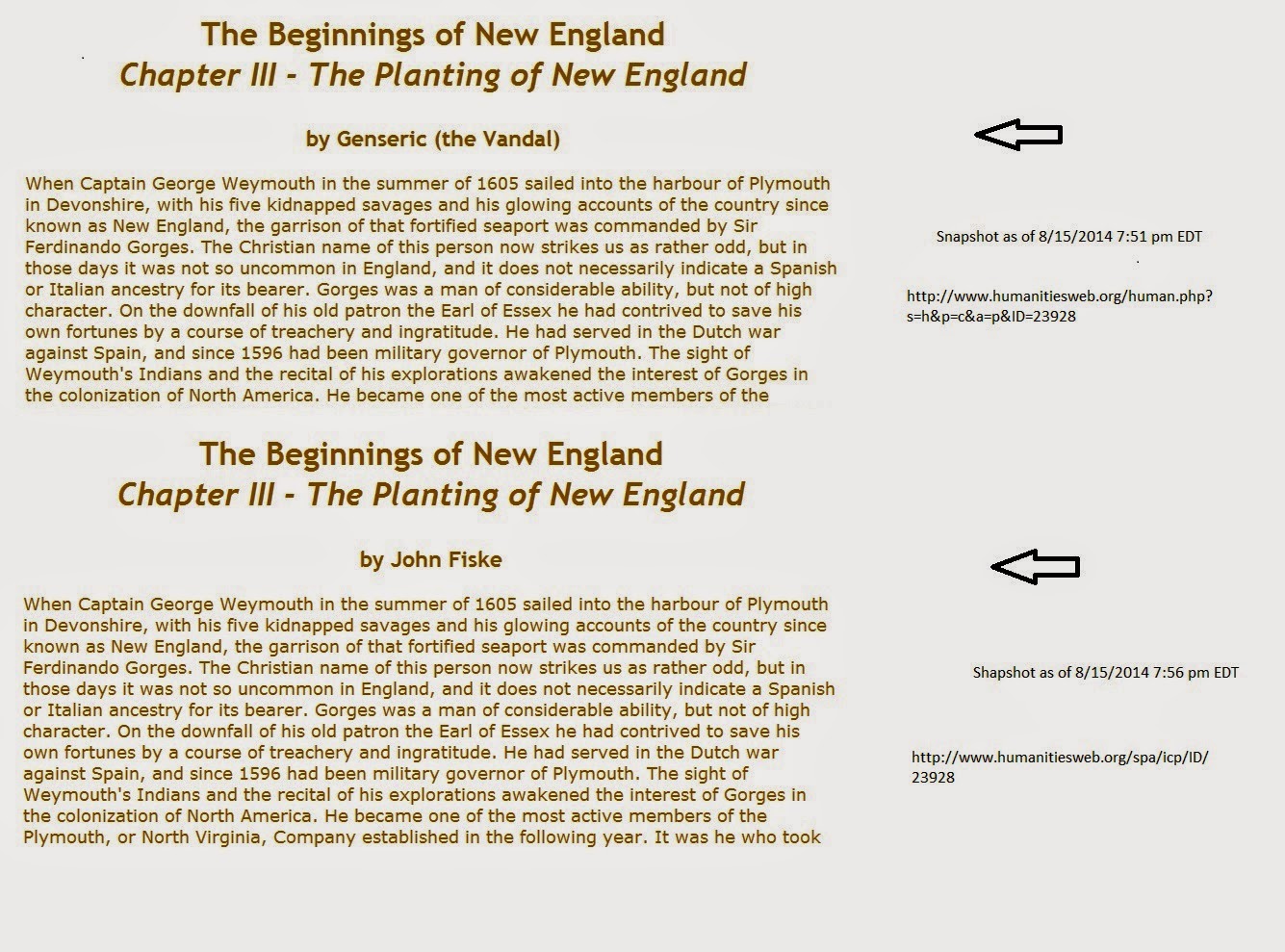
08/15/2014 -- See What's New, this date, for change in Sources for this issue. Namely, lifting John Fiske's work to view (it was being pointed to at Humanities Web - apparently lifted there, in its entirety with appropriate attribution - mea culpa, had been referenced, too, at the Thomas Gardner (planter) page on Wikipedia). --- Note: As I write this, the name has been changed. Actually, it looks as if an old pointer is around from an experimental method. Which was first? Was the "Genseric (the Vandal)" reference in some test mode? That I just happened to stumble upon and use? As I said, mea culpa. So, ..., let's some point make this a truth engineering moment.


Wednesday, September 12, 2012

About Margaret

We said early on that we'll base our views on Dr. Frank's books that will be updated as necessary. Dr. Frank, who was thorough and careful, noted the two wives of Thomas. Since then, the matter is still open to interpretation.

Irrespective of her last name, Margaret is most likely Thomas' first wife and arrived with him and their kids on these shores.

Why do we say that?

The Great Migration leaves it open, as do other genealogy works. Remember, genealogists have lead feet. We don't.

The studies, to which people point, all reference TAG 30:156 which does not make a definitive statement about the matter. The argument is that a church record of 1639 has Margaret showing up.

Consider, Thomas may have shown up at the Church in 1629, but he didn't deign to show up to be a freeman until 1637. Margaret may have decided to join much later, for the future of her family who did turn out to be successful in their own right.

---

Margaret was definitely ahead of her time and needs more attention to be given to her life.

---

Now, there is also a suggestion, in these studies, of a death of the first wife with Seeth's birth. This is not documented. It's pure speculation, folks, as far as we know (to wit, Great Migration, et al). TAG 30:156 does not tell us to not refer to Margaret.

The matter is open until there is further information that can be documented. In the meantime, we'll honor Margaret, with Thomas, as our ancestors.


Remarks:

08/28/2018 -- After some discussion, we settled that we had Margaret's folks, her baptism record, the marriage announcement, and baptism of their kids, prior to them leaving Sherborne. So, we have the post "Margaret, anew" which updates "How many wives?" Now, the question moves to whether or not we have the right couple (Children with what wife?, Further discussion).

08/01/2018 -- The past few days, I have been on WikiTree. We are looking at settling issues for the profile of Thomas (and his spouses): https://www.wikitree.com/wiki/Gardner-159. These profiles are being set up and maintained by the Puritan Great Migration. Expect an update blog post within the next day or so. Notice the recent comments (the 'unknown' is because I juggle many email accounts and was in the wrong one - it's not that I'm old).

07/12/2015 -- Okay, turtle speed. But, we get there. Announcing a new project: Sherborne, Dorset. No doubt, it is about time. When finished with the data collection and analysis, we will present the strongest story (the prerogative of the family) that the facts, and abductive reasoning, will support. As such, we hope to demonstrate some very much needed research viewpoints.

05/05/2015 -- The Winthrop Society has Margaret as second wife. They allow submittal of additions and corrections concerning early arrivals.

10/13/2014 -- Tabula raza, and more, will be of concern.

09/28/2014 -- A week ago, the record for the marriage of Thomas Gardner and Margaret Friar was discovered in Sherborne by John Cook of Minneapolis, Dorset files. This sets a type of focus. Looks as if some transcription work might be in order.

12/31/2013 -- See Remarks, this day, in the How many wives? post. In that Remarks, we see that Anderson, et al, have the wrong year and age for Richard.

06/15/2013 -- John Farmer wrote that Thomas was from Scotland. Origins are, and will be, a focus.

11/27/2012 -- We visit the theme, one more. Anderson didn't leave it open. He actually made a hypothesis and stated a proof for his thoughts about a third wife. However, we don't agree with his analysis and will pursue the matter further.

TAG 30:156
09/25/2012 -- Added in a snap of TAG 30:156 (George E. McCracken, Ph. D.) with red markings about the author saying that he would continue to agree with Dr. Frank. So, we can, at least, call her by her first name, even if we can't say for sure what family she was born to. There is a question pending (comment earlier, sorry about the delay, will work a process to respond to comments) about George's wives which is covered in the same article. We'll look at that. We posted earlier about George's daughter, Ruth. ..., Also, added the emphasis below. TAG 30:167 covers the 'flight to Connecticut' which had been a mystery to me. Expect a further post on TAG 30 after I've had a chance to digest its contents and to study its motivations (and see what Felt and Moriarty were saying).

09/16/2012 -- Of course, another reason that Margaret may not have been at church could be her maternal duties. I've not seen any depictions of kids in Puritan gatherings, except for older ones. Margaret, throughout the period of interest, had several young ones to care for. And, Thomas would have been there protecting them. Ideal couple, so to speak. 

Modified: 08/28/2018

Sunday, May 15, 2011

Old Planters, Beverly

Note: See this post: In summary. We have new information about the baptisms of the children and are in the process of researching to establish a proper narrative. For now, see comments at the WikiTree profile for Thomas Gardner. We will start with Rev. Hubbard who was there (1680 manuscript). 

--

As mentioned in this Wiki article, there are many types of 'old planters' that are worthy of attention. In New England, an early Maine group was particularly effective: came very early (into Popham), established a colony, and built a boat (Virginia) that was seaworthy sufficiently to cross the Atlantic several times. There are more examples. Time lines (Wiki article) show several settlements in the Massachusetts area prior to 1630.

In particular, we might ask about the Dorchester group that came in under Thomas Gardner and John Tilly, in 1623/24. For this, we can collect, and comment on, reports related to the topic. As a reminder, let's use The Winthrop Society's list of names (1623-27, where is Tylly?).
  • Allen, Balch, Conant, Cushman, Gardner, Gray, Jeffrey, Knight, Lyford, Norman, Oldham, Palfrey, Patch, Pickryn, Winslow, Woodbury
We can find some reports that do not reference Thomas Gardner, such as this one -- Woodbury family's book (in the context of old planters, four are named): Hubbard is precise that Mr. White solicited Conant, Woodbury, Balch and Palfrey because of their character, to undertake a new settlement at Nahumkeag, promising them men, goods and supplies, a commendation sustained by his associates. Neither did Mr. White reference Thomas in his Plea.

Now, we do find later references to Thomas, such as that of Rev. Hubbard who had talked, it is believed, to all of the principals and such as this 1869 Bulletin (George D. Phippen) of the Essex Institute. Felt's look at Salem has many references.

There was an Old Planters Society concurrent with the attention brought by the 300th celebration. The group seemed to have met regularly (meeting notice June 28, 1905 -- Dr Frank A. in attendance). Lucie M. Gardner (Dr Frank A's sister) wrote this report (notice the mention of pre-1630 for membership) for the Massachusetts Magazine.

Aside: A Balch family reunion (see Sarah) was recently hosted by Beverly Historical Society.

Remarks:

04/06/2026 -- We added "Oped" to this post and will be updating it. 

03/13/2023 -- See "New not old planter" post with regard to research findings. Thomas and Margaret have children registered in England until 1633. 

03/19/2022 -- Nice to see research on the family of John Tilly. NEHGR, Winter, 2022 has an article on John and his family by Clifford L. Stott. The title is "Rev. William Tilley of Broadwindsor, Dorset, and His Sons in New England: John, Nathaniel, and William." Identifies his child and more. 

01/12/2019 -- Dr. Frank (and Ann) are descendants of  Roger, to boot, through Lucy F. (Wilson) Gardner who had lots of Salem madness connections.

10/13/2014 -- Tabula raza, and more, will be of concern.

06/15/2013 -- John Farmer wrote that Thomas was from Scotland. Origins are, and will be, a focus. ... As of today, Historical genealogy is the all-time, most-read post. Coming in second is Old Planters, Beverly.

12/22/2012-- We need to differentiate between Old Planters of Beverly (see The Old Planters of Beverly in Massachusetts, 1930, Alice Gertrude Lapham, The Riverside Press) and the Old Planters of Massachusetts. One could even talk, Old Planters of New England.

05/01/2012 -- We'll need to talk singularity in the context of Alan. The computer has as many holes as do we; however, we can cut out of the fog. Genealogy (historic, biologic, and more) will be a basis for looking at this concept and its importance. That is a forward look. Going backward, we'll find a way to adopt memes, as a necessity. We are, one might say, meme readers. Too, we express what they convey. That is supposed to suggest something that we need to understand: parallel to we being expressions of our genes. Now, within that framework, our look back at Thomas is apropos.

05/01/2012 -- Will pull together sketches for those on the list. John Tylly has been mentioned, in brief. We'll try to find more about John (no offspring?). There is a lot of material about Woodbury, Conant, and Balch. I have seen some things about Norman and Allen, who both had offspring. It'll be interesting to read about the rest. Of course, verifying this list (or, at least, justifying it) is one necessary task.

05/01/2012 -- Backbone, in particular, this overview. Two things to be thankful for: Rev Hubbard's look back (his brief mention is sufficient) and the fact that the manuscript was not lost (otherwise, would Thomas had been even more unknown?).

04/30/2012 -- Major update to the post. Is the topic of interest in the context of the HSC?

04/26/2012 -- The sketches from the Great Migration data will be an interesting collection.

11/30/2011 -- Good description of the early voyages, including Popham's.

08/22/2011 -- John Tylly.

08/15/2011 -- Balch News link at the Beverly Historical Society has been removed. Added link to published minutes at Internet Archive.

05/24/2011-- capecodtoday (in The 'other' cape)  mentions Thomas Gardner.

05/15/2011 -- We will collect a representative example that will support future discussions.

Modified: 04/06/2026

Thursday, September 25, 2014

Marriage of Thomas and Margaret

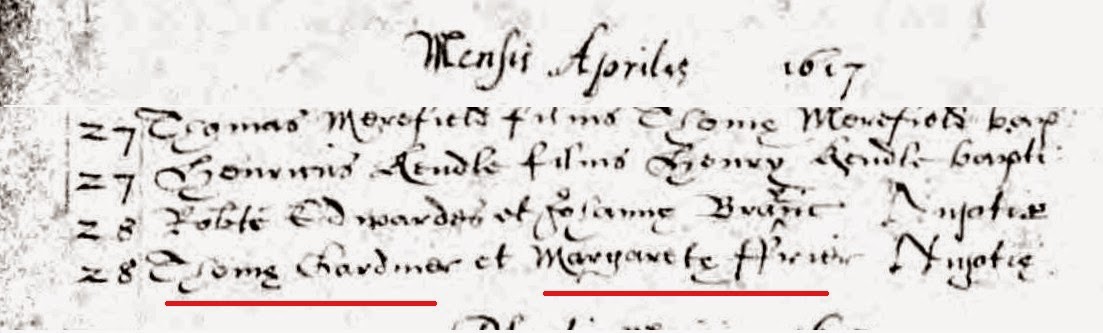
Dr. Frank A. wrote the following over 100 years ago: Various writers, including Rev. Joseph B. Felt, have stated that her maiden name was Fryer (or Friar), but the writer has thus far failed to find the authority for this statement.

Today, we can announce that the "authority" may have been discovered. That is, Rev. Felt may have been correct; even though, we do not know how (from whom?, etc.) he got the information (early 1800s) for his assertion.

Where was this authority found? In the records of the Sherborne parish. Attached is an image from the record of April 1617 that shows Thomas Gardiner and Margaret Frier marrying on the 28th. Not only do the records show this, they have the following: the birth records of Thomas, Richard, George, and John; Wills of interest; and more, We have Margaret's parents: Walter Friar and Grace Mullins. And, there is a record that may show Thomas' parents: Thomas Gardner and Christine Saule.


All this information was discovered within the last week by a researcher, John Cook of Minneapolis, who only recently (comparatively) completed his link to Thomas Gardner through son Richard. He had written with queries about what we knew about the origins of Thomas. We had a discussion of the "whence" issues (also, what we know).

Too, we mentioned John Gardner's push to get Gov. Lovelace to allow the use of the name of Sherborne on Nantucket. Part of this tale came to us by the Folger family. There was opposition on Nantucket to the re-naming, of course.

Now, speaking of Sherborne, you can find the marriage of Thomas and Margaret on this list of marriages in the parish from 1600 to 1619.

   http://www.opcdorset.org/SherborneFiles/SherborneMars1600-1619.htm

Sherborne will be a focus of concentrated work, for awhile. Some of the records have been transcribed. OPC Dorset has a nice starting page.

   http://www.opcdorset.org/SherborneFiles/Sherborne.htm

---

To recap the issues, a little, we can start with the Two Wives. Earlier viewpoints accepted that there had been two wives following Felt and others. Recent work (NEHGS) called that notion into question. As in, the modern claim was that Margaret was not the mother of the children. Granted, the NEHGS work mainly used already existing sources.

But records are expected to settle these types of arguments. With the Internet and records being digitized and indexed, we can expect that a lot more material will be coming around that can be scrutinized to firm up what we know (or to raise more issues).

---

In this case of this marriage and the related families, expect that more information will be provided as we go along with respect to provenance of the sources, the methods used for search, the actual before and after view related to the transcription, and more.

Too, one task will be to follow what was known or thought through the years which provides us somewhat of a trace.

Finally, a closer tie needs to be made between the Thomas and Margaret of the marriage with the kids who were born shortly thereafter.

Remarks: Modified: 01/03/2026

09/25/2014 - Sherborne? Well, for one, capital of Wessex so it was the main stomping ground of Alfred the Great. ... Also, we need to get more material about John's knowledge (learned from his parents). I do remember seeing a book in Salem (at the Essex Institute) that mentioned Sherborne. It had "Captain John" in the title.

09/26/2014 Added Thomas, Jr. to the list of births. The firstborn, of course. ... About Felt, he had access to Rev. Hubbard's work and notes. Was it there that he saw this? Or, being only 150 years removed (closer than we are), perhaps, some scuttlebutt was around and about. ... The key item is that the information comes via son John.

10/03/2014 -- Comment posted to WikiTree (Thomas Gardner).

10/13/2014 -- Tabula raza, and more, will be of concern.

07/12/2015 -- Okay, turtle speed. But, we get there. Announcing a new project: Sherborne, Dorset. No doubt, it is about time. When finished with the data collection and analysis, we will present the strongest story (the prerogative of the family) that the facts, and abductive reasoning, will support. As such, we hope to demonstrate some very much needed research viewpoints.

08/01/2018 -- The past few days, I have been on WikiTree. We are looking at settling issues for the profile of Thomas (and his spouses). These profiles are being set up and maintained by the Puritan Great Migration. Expect an update blog post within the next day or so. Notice the recent comments (the 'unknown' is because I juggle many email accounts and was in the wrong one - it's not that I'm old).

08/28/2018 -- After some discussion, we settled that we had Margaret's folks, her baptism record, the marriage announcement, and baptism of their kids, prior to them leaving Sherborne. So, we have the post "Margaret, anew" which updates "How many wives?" Now, the question moves to whether or not we have the right couple (Children with what wife?, Further discussion).

09/15/2018 -- Gardner Research published four articles in The Essex Genealogist. These were republished in The Gardner Annals which just released Vol. IV. Last fall, we printed TGA Vols I and II. Soon, we will print Vols III and IV. Included with the TGA were Gardner's Beacon issues. Of late, we have experimented with one approach to a database, namely WikiTree using Dr. Frank's information. As mentioned in that post, we have established that Thomas had two wives as we found information about the marriage of Thomas and Margaret in Sherborne, Dorset, UK.

01/03/2026 -- See Restart, somewhat. In 2023, research found that Thomas and Margaret had the marjority of their children in Sherborne. After some analysis, the WikiTree profile for Thomas Gardner (Cape Ann, Salem) was split into two: Thomas (Cape Ann); Thomas (Salem). We know little of the first one. The second one is the progenitor of the Gardners who were the original focus of the Thomas Gardner Society, Inc. We have expanded to cover Essex County, Massachusetts, New England and in some contexts, All things Gardner, with respect to the 400 years of the culture that celebrates its 250th this year. 


Sunday, May 19, 2013

John Farmer

Beacon "Vol. II No. 6" and "Vol. III No. 1" used an annals format to present material. We want to continue with that format for a few more times, as a chronological layout can be helpful for relating material and for determining places to fill in. And, we can see who said what when.

At the same time, as "Vol. II No. 6", we started a bibliography which has been updated a couple of times. The idea here is to make the references available through on-line access as much as possible. Where we cannot, we'll cut an image (see this example - I saw TAG 30:156 misquoted (it turns out) many places and decided to go look for myself one day -- we'll make it part of the procedure to show originals).

Farmer on Gardner
Today, I added John Farmer's book. He is the one who everyone has pointed to in studies that followed his. But, John published in 1829, so he was there long before later writers (for instance, Savage was 30 years later; Perley was 100 years later; on the other hand, Felt was two years earlier - he the one of the Salem Annals which has many references to the contributions of the Gardners; Folger says that the Gardners were from Dorset), and his work has some things are of interest to our endeavors.

Too, John shows his own set of references in the Preface (Hubbard, Hutchinson, etc.). Here is a pointer to the book: Farmer, John (1829) A Genealogical Register of the First Settlers of New England (digitized copy via Google).

The image on the right is from the book's page on various Gardners. The Gardiner entries were on the just prior page. 

There are a couple of things to note. John said that Gardner came from Scotland. Note, though, that, he's talking two Thomas' in the sense that Dr. Frank mentioned in his book (see this post). I have seen many references to Thomas (the father of John, Richard, Samuel, Sarah, etc.) coming over with his father (note: I'll start to collect these in a later post). 

---

At some point, the annals bits will be merged together. As well, there will be smaller ones devoted to a theme (sound like a database application in the making?). One on-going effort will be a survey of material and work by individuals. Suggestions (and help) are welcome. 

Remarks:

07/12/2015 -- Okay, turtle speed. But, we get there. Announcing a new project: Sherborne, Dorset. No doubt, it is about time. When finished with the data collection and analysis, we will present the strongest story (the prerogative of the family) that the facts, and abductive reasoning, will support. As such, we hope to demonstrate some very much needed research viewpoints.
10/13/2014 -- Tabula raza, and more, will be of concern.

08/25/2013 -- On a site dealing with descendants of Alice Freeman, Abigail Gardner is on the list due to marrying John Wise. Hence, her father and grandfather are there, too. Thomas (before 1595 to 1638), father of Thomas and Peter. The site, by Chris Chester, is wonderful in its use of sources; too, I really like the format. We need to do something similar for the Thomas Gardners.

08/22/2013 -- The start of a look at what was what in early Salem (and New England) as far as Gardners is concerned.

06/15/2013 -- John Farmer wrote that Thomas was from Scotland. Origins are, and will be, a focus.

Modified: 07/12/2015

Wednesday, September 18, 2019

New infrastructure

TL;DR -- A look at what we need to do and the various contexts involved including our content which covers several domains and our need for configuration management. The web's evolution will be on the table in terms of choices, both good and bad, by the developers of the mess. Updated graphic and comment about WordPress are later edits. This was a pre-COVID post. 

---

We have all heard this over the past couple of decades. Well, we can finally say that things are at a crux, especially with the emergence of DL's facilities. They were always there; of late, people learned how to exploit.

Create or discover? Well, like the chicken and egg, which is first? I'm of both minds where 'discover' is given respect. So, Poisson's name is on stuff. He created this. Or, was he describing what he saw and we labelled it with his name as if the underlying ability came about with observation?

With the internet, we get to reason on these things, again, albeit with some practical focus as the intent is to use the thing properly, smartly, and to the best of our ability. I've put out a few posts about this. In July, it was Techie stuff. There were things before, say the technology blog. This started at WordPress[dot]com but, recently, moved to be under our 'portal to truth' (lots to discuss there). At that site, we have continued our blogging about decisions.

I have been working alone, for the most part, just following my intuition. 'Minimal' was one goal. Last fall, I mentioned some Google discussions that were right on (in this old guy's mind) and comforting, actually. Though, as an aside, they own this blog space. We're looking to pull it, too, under our portal.

In the meantime, AI is going bonkers. It's obvious, to me, that the black box can be tamed. It'll take us getting back to logic. What the hey? Minsky of MIT went to his grave arguing that the aNN (no matter the variations, thereof) as not the way. Not that I agree with him entirely, but he was not off the mark. Everywhere, we see AI this and AI that. Makes one wonder if some parts of the populace have lost their marbles.

As an aside, our portal thoughts make use of the fact that Thomas Gardner is almost a tabula rasa given that we know only a little but have the huge set of progeny to ponder. That means, in other words, the 'every man' is the theme or meme. We'll get back to that.

This blog has been going for 10 years. We started the WordPress one due to the details being handled with regard to choices. Of course, as we studied, we had to see where the crowd was going (below). And (yes, this is real), every time, we looked at what led to the current state (our's and the world of computing's) and tsk'd (want to know why? paying attention to the messes?). Sheesh. Do we ever get anything right? For anything of benefit, there are a slew of side-effects, costs (what have you) that are negatively imposing. This is without fail.

AI came on the scene, again, the past few years. Gaga time. This time, though, the older minds were saying, wait, let's talk: ACM, IEEE, etc. So, that's something else to discuss.

But, with regard to what the TGS needs, we have to develop. I have run across roll-your-own schemes. Guess what? The monied crowd does this to remove dependencies upon others. I'm stressing it due to issues of truth engineering. In any case, code will be to the fore. What? Yes, too many are being led down paths to perdition, it seems. We have been right so far in that assessment. I don't see glowing examples, yet.

As an aside, with regard to the below, we were doing Microsoft in the (mis-guided?) notion of going with ASPX and its way of the world. We'll mention this again.

But, the tools are there for us to do things better. Metrics, in other words, used wisely can be quite helpful. The benefits that have accrued properly to technology are examples. Lots of them. So, getting back to the theme of the post, here is an example.

This image comes from the source for a post that is worth reading: How WordPress Changed the Internet - 17 Facts about WordPress. I like it if only it shows that the old guy isn't off the wall. 

Aside: The source? W3Tech and their Web usage surveys where they are looking at content management. Look at the count! Babel building.  


In the 2012 time frame, as we were being kicked off of Microsoft's site, I looked at all three of these. In fact, I prototype'd a TGS site. At the time, I was up to my ears in new information having started to really get into the history and genealogy of the Cape Ann crew. So, there wasn't time to play with configuration when 'content' was the key thing. Notice the comparative growth of these three.

Aside, content and configuration? These differ (the media is not the message).

I looked at WordPress, again, in 2014. Those prototypes had been done under our own server. In the new mode, I went and built under WordPress' site (in the beginning, there were no ads; they came later; hence, we're moving). But, in 2012, I fell back to HTML, tables, icons, and mouse handling. It worked. On the 2014 go around, I brought in CSS and some javascript. The latter was, finally, made more central as it builds the page.

Now, what was one problem in 2012? The database. Too much of it (let's discuss). We can go into this, but the TGS site uses Linux and files. Guess what? Recently, after reading some UBerkeley stuff on AI, I went to GitHub, finally. Ah, the choices, related to text or graphics, etc., were all there for daily discussion while people were, at the same time, doing useful stuff within their chosen framework.

Talk diversity. This is one type that we need and can handle. Though, there are always forces pushing for homogeneity. Mathematicians love this.

BTW, on the latest look at WordPress, as I was bringing it into our portal, I looked at the 'biz' aspects of its use. Nickel and dime'ing was my reaction; like the menu that is ala carte. Nice, but, I want to see what's under the cover (or hood or ... - we used to say). Too, I want more than mere parametric influences. BTW, that is one issue with DL and AI, right now.

Yes, again, anyone interested in machine learning in the context of TGS, pipe up, please.

Closing this out, we have lots of things pending. See this blog that will move (https://jmswtlk.github.io/GitHub-ing/) which will cover the deeper technical issues as we go along. So, indeed, we're talking infrastructure in a new sense, actually senses.

Oh yes, ASPX. Recently, I have been helping in a situation where this is the framework. Not as a developer, but rather as a late tester of a new process. Interesting. Some things I liked, others not. How to get the proper balance will always be a key thing? And, whose balance?

Aside, again. The earlier post pointed to a project management scheme that has gotten a lot of attention. It reminds me of the old Apple package that was card-based. That is, one had cards that linked in a manner that was fairly powerful (we're talking 80s, folks). I see it referenced from time to time. Lift the covers, and you'll find old routines still supporting the computing world. Trouble is, though, that it's in the GUI world. Most stuff is. Developers? Many stay away from that. Actually, WikiTree is balanced and a joy to use. GitHub is more textual with add-ons for the GUI'ness.

How ought we to go? Decisions will be made. None will be in concrete.

When looking at Drupal and Joomla, I also looked at Concrete 5. It's still around. The Army picked it. Okay. How does one decide in all of this? Want to know. Computational sustainability. That'll be a future topic.

Aside: Paying attention? Old guy off the wall? Well, no, here is a current discussion of Concrete CMS versus Wordpress. Of course, it is from Concrete CMS's viewpoint. You see, 'new infrastructure' points to changes that will be permanent. Users want more control. Developers want tools. Content creators and managers want ease of applying power. Finally, John can say, about time. Maturity?  

Remarks: Modified: 10/07/2022

10/07/2022 -- Updated graphic on WordPress which had come from a survey. Put in pointers to survey. This week, decided to use WordPress to prototype our configuration. 

Saturday, June 15, 2013

Thomas and Thomas

Doing research for the next Beacon issue (Spirit of Independence - during Thomas' time) involved a re-look at Felt's work. That is, his Annals has some interesting remarks about interactions of the colonists, in the sense of Salem's crowd, with the old country. Of course, some of his remarks cover the general area, such as goings-on in Boston.

---

The last post, here, dealt with Origins which is a continuing theme. Whence Thomas (and Margaret) is an open issue. Farmer mentioned Scotland; he published in 1829.
Felt on Thomas
and Thomas

Felt mentions Scotland and talks as if Thomas' father was here, too (see the image, pg 246). Curious.

Now, Felt was a little earlier, 1827, than Farmer. Was Farmer quoting Felt? But, he had sources of several sorts. He was looking at the records and talking to people. Felt's work would have been 150 years after Thomas' death.

We'll have to sort all this out. Right now, the idea is to gather. Think of it like using the brainstorming rules of thumb. Such as? Don't knock something during the collecting of ideas round. I'm doing that specifically due to the fact of all of the stuff that seems to have been done, disparate and disjoint as it seems to be.

With our access to technology, it's time to do a proper analysis. Too, ex post facto, there won't be book burning. No, anything shown to be without substance will be presented and its faults documented.

Aside: Perhaps, the one from Scotland is the senior Thomas. I have looked at material from Dorchester Company. The sister of John White, who married a Gardner, is not shown as having a Thomas. But, is this site the final authority?

---

On several pages early on, Felt reports book burning. Too, there is a lot about interaction with the Friends. Note the Remarks (06/15/2013) in the Origins post where Damaris is mentioned. She may have been excommunicated. Charles II's caution about handling the Friends may have been timely. Thomas' and Damaris' marriage will be looked at, as research for the next Beacon issue will cover the same ground.

---

John Goff has written about Felt.

Remarks:

10/13/2014 -- Tabula raza, and more, will be of concern.

11/13/2013 --  Phippen would be part of the slate fill.

08/25/2013 -- On a site dealing with descendants of Alice Freeman, Abigail Gardner is on the list due to marrying John Wise. Hence, her father and grandfather are there, too. Thomas (before 1595 to 1638), father of Thomas and Peter. The site, by Chris Chester, is wonderful in its use of sources; too, I really like the format. We need to do something similar for the Thomas Gardners.

08/22/2013 -- The start of a look at what was what in early Salem (and New England) as far as Gardners is concerned.

06/17/2013 -- In the Great Migration write-up, Thomas' origins are noted as unknown. The next Beacon issue will have a theme of the spirit of independence (early look).Also, Anderson, et al (in Great Migration) say that Banks has Thomas coming from Hurst, Martock (supposedly, Banks quoted no source).

Modified: 10/13/2014

Monday, December 24, 2012

No shadow over Thomas

I'm researching for the next Beacon issue which will have a brief timeline of the lives of Thomas and Margaret (it does a grand sweep of their times and after all the way to today). Hopefully, it'll point to areas where we'll focus effort in the future in order to expand upon the theme so as to leave the proper legacy.

I can thank Rev. Felt for phrasing some thought (read today) that I've had for three years in regard to Thomas (see Backbone series). That is, Felt gave me the proper concept to use. You see, how is it that there is such a lack of information? How can all of the written literature be so sparse in regard to his life over all of this time (from the beginning down to recent publications)? Even Anderson, et al, (Great Migrations) seems to write begrudgingly.

The below image is taken from Thornton's (1854) The Landing at Cape which tries to document the experience at Cape Ann (which has a bunch of unknowns). This book references Thomas only once as the plantation overseer, with Tylly, at Cape Ann. And, it is in the beginning, as in, pre-Conant. Other than that, there is nothing (based upon quick scan - so I may have missed something - the issue would remain, even so).

---

Aside and disclosure: The wife of the blogger is a direct descendant of Thomas and Margaret, however she is also descendant of Conant and others of the old and new planters. One might say that I'm continuing Dr. Frank A.'s argument about the injustice, in general. We'll get to that in the Beacon issue.

---

Felt writing
about Conant
Felt is talking about Roger's continuing displeasure at his treatment. But, the dear guy ought to have considered his treatment of Thomas and Margaret (he got the house!). The image quotes that Roger "retained a conviction of the great injustice done to him, even in his old age, and he could not refrain from reference to the neglect and ingratitude" referring to Endicott's arrival.

Notice that Felt says that "the new charter cast a shade upon Conant" which implies his followers (Balch, Palfray, Woodbury, Trask). A 1999 talk on the old planters of Beverly (we'll use this in the Beacon issue) said just that: Conant and his followers. These people worried that they might have been enslaved with the change in the power structure. It was so troublesome that Craddock had to address their worries, explicitly. Too, they were given the land in Beverly in order to bolster their spirits, so to speak.

And, old Thomas? Cool as a cucumber (as I've said, a guy who was effective, knew himself, and was the chief manifest'er of what was to become the American -- you think that London, et al, liked this?).

Now, none, nor any incident, that I can see, cast a shadow over Thomas. References to him imply dignity, respect, and more. On the other hand, he was ignored in writings, perhaps to put him in his place, as if that could happen.

Too, Thomas' stance was of the true American that we were to see develop over the succeeding centuries. One attribute of that stance was to be distant from the Churches (yes, plural -- ah, we can go on about that ad infinitum, but won't). Thomas was no follower; his blood and pedigree prevented that.

Now, too, his sympathy toward the Quaker thought, and the fact that his last wife was of that faith and that some of his sons were, to boot, talk of a mind that encompasses the shebang (put it this way: the every man view with both breadth and depth -- the latter, of course, meaning all classes -- those higher casting a shadow over the lower - hey, only those that you allow can cast a shadow over you). Yes, the Quakers were forward thinking and exhibited more than any a spirit of inclusiveness and peace (we'll have to get back to John Goff's take on King Philip -- we overlook, too much, our mistreatment of the American Indians - starting with whom? Endicott?).

However, we do not to want steal thunder from Gardner's Beacon. These topics all deserve careful study so that going forward we can have the proper view and respect for this UNKNOWN couple. As it says: honor thy father and thy mother (albeit transitively if necessary).

Remarks:

10/13/2014 -- Tabula raza, and more, will be of concern.

03/28/2014 -- See Vol. IV, No. 1 for a discussion of the movement from Cape Ann to Salem.

11/06/2013 -- While working on the next Beacon issue, I ran across some books. The one by Staloff was timely; imagine, I was wondering why the backbone series? Has the talented set ever allowed the lessors to have some semblance of a good life? Oh, you say yes? Winthrop, et al, were against this from the beginning. The stalwart of what could be (or could have been)? Thomas Gardner, of course.

09/09/2013 -- Forgot to update this earlier. But, the post related to Gardner's Beacon, Vol. II, No. 6, discusses that Thomas had no shadow over him as was feared by some old planters (would Dr. Frank, today, still want to include Thomas in the group?).

06/15/2013 -- John Farmer wrote that Thomas was from Scotland. Origins are, and will be, a focus.

03/02/2013 -- This may have appeared in another post, or Beacon. However, we'll repeat the thing here. When Thomas took the freeman oath, that is, that year, he was voted to the General Court with Hathorne (see above, another great-grandfather) who was a swashbuckler. It is interesting that Thomas, after that, kept a more local focus. There may be many reasons. But, getting up close with the clamorous ones may not have fit his mindset. You see. Throughout history, certain people get written about. Yet, in any situation, there are teeming amounts of more people who are not in the spotlight. Now, do you think that not having attention diminishes your being? If you say yes, let's have a little discussion. Of course, we would have to define, up front, whose attention. Social media comes to mind; frivolous content that invokes brain altering reactions (say what? -- I'm happy that I'm not susceptible, being too many decades old, long-in-tooth, if you would) to those who participate. So, back to Thomas and William. You see. John Endicott knew Thomas. John picked on poor Mary Dyer and others. William probably did similar deeds. Thomas? There are not bad tales. Too, and this is a big too, he deigned to be involved with people who were outcasts, namely the Quakers, as were his sons. Now, the sons left. Thomas was right there in Salem, of major stature in the phenomenal sense. Actually, his recoil (my take which can be explained) from the politicking tells a lot; it has a lot of meaning, not unlike George (the first Prez) stepping down even though he was adulated sufficiently for people to want him to be sovereign (thank you, George - for showing us that term limits ought to be part of the deal - professional politicians? say again?).

02/10/2013 -- Having finished a book on the 1692 events and doing a post on the subject, I can add to this look at Thomas. I've mentioned that he didn't queue right up to join the church and that he was recognized by Endicott. As well, he married a Quaker without any repercussions that we know of. Of course, his sons left the area due to the Puritanical (hypocritical) mindset.

01/01/2013 -- David Goss' talk at the 1999 Essex Society of Genealogists gives a perspective that also motivates. See the TGS bibliography.

12/25/2012 -- John Endicott knew Thomas to be exemplary (though, not military).

12/24/2012 -- We'll also point to academic studies, such as that shown in the image (Essex Institute and Johns Hopkins University). It says, don't look at the character (ah, John White? uncle? who needs enemies with family like that?) but consider the place as not appropriate (no aspersions meant for the lovely Cape and its environs).

Modified: 04/23/2021

Thursday, March 20, 2014

(Not) far from idyllic

The prior post mentioned that the life on Cape Ann was comparatively good, almost idyllic. That usage of idyllic was very loose but does suggest that we take a pause to consider several things, again. When Conant showed up, he did not find starving people. Rather, they were healthy enough to be boisterous, albeit in a civilized manner.

Again, there was no failure at Cape Ann venture except that of not meeting unfounded expectations.

So, let's jump ahead to Endicott's early times. Then, we can consider the plight of some who came with  Winthrop. Mind you, Thomas and his crew did well due to effectiveness.

Endicott brought the military mindset. Winthrop brought that of the intellectuals. There is a scholarly viewpoint that points to English church-isms (of various sorts) as leading toward the emergence of the intellectual class (in some senses, ineffectiveness).

Just like the Popham venture, that was successful, the Cape Ann experience was similarly effective. They were so even as they bridged the areas of Cape Ann and Naumkeag. But, in the winter of 1629-30, Endicott lost several tens of people. Sure, some may have been sick. But, others died due to exposure from lack of proper housing. Mind you, at that time, Endicott had his great house.

Many died from improper diet, mainly from the fact that there was not enough food to go around. So, we can see Rev John's confusion as he finger-pointed to the Cape Ann crew as less than worthless. Even after Winthrop, the settlers had to send back to England for food.

What a change of events? Thomas' crew was self-sufficient, yet they have been beat upon and considered failures (by a warped type of history). We have to agree with Conant, and others, that the early crew did not get the recognition that they deserved for helping to settle the area.

---

Well, we can start the effort to tell the story of these folks who nowadays were overshadowed, in the national attention, by the ones who arrived off-course in the area to the south of Cape Ann.

Of course, we also must note that New England was shipping out excess product back to England within a decade or so. Rev. John may have been gone by then (or too old to care).

 ---

The image to the right comes from Kellogg's book on Anne Bradstreet (Thomas Nelson, Inc. 2010). The author remarks about the strawberries on Cape Ann. Also, he quotes Winthrop on the pleasant, garden smell that they experienced, when they arrived.

We will look more closely at cousin Anne since she was very young (eighteen) when she arrived. Also, her whole take is more true than Simon's (a whole set of discussions pending).

Now, looking ahead after the landing, we know that Winthrop didn't like Salem. Most who came with him, probably, were disappointed. Kellogg writes that "Anne and Simon ... were shocked to learn that they had no place" to put their belongings.

Evidently, the couple had been told that there were structures, in fact houses (well, there was Endicott's), in the new area prior to their leaving England. But, no. The reality was that a few meager huts were about. Some dwellings may have been built that were of more solid stature that the wigwam; no house would have rivaled that which Endicott had ordered to be brought over from Cape Ann.

One has to wonder if Thomas and Margaret helped by allowing a family to squeeze into their small place (as we now, not the Great House).

And just like Endicott's entourage earlier, Winthrop's people found out that there was a shortage of food to go along with the dearth of housing. And all this lack happened despite all the planning for a "multi-step approach to settlement" that had occurred in England. But, in hindsight, we can still counsel that these things happen today.

Fortunately for the new arrivals, there had been some structures (at least one with two rooms, up and down) built in the Charlestown area by Thomas Graves where Winthrop and his colleagues could go and plan their future (leaving their women, of course, in Salem's squalor - while enjoying their barracks, so to speak). We need to look further at Mr. Graves, as he, like Mr. Gardner, was of the effective type that knows how to do things. Graves had come over with Higginson a little after Endicott. For some reason, Mr. Graves returned to England, later.

--

So, for a brief period, we had on Cape Ann, something that exemplified what Winthrop named but could not see. That we are still in the process of unfolding the American experience, it only stands to reason that those events of 400 years ago ought to be part of the framework from which we live and with which we think (it would be about time).

And, re-telling the tales is one task even when we're faced with a tabula raza situation.

Remarks:  Modified: 01/05/2019

03/23/2014 - Cape Ann featured in Beacon Vol. IV, No. 1.

07/02/2014 -- Featured in Gardner's Beacon (TM) Vol. IV, No. 2.

06/06/2018 -- Need to prepare for 2023/4. Some, of literary inclinations, have looked back 200 years: American Jeremiad. But, we need to go back to the Cape Ann times and before.

01/05/2019 -- Fixed pointer to the articles on Bercovitch's work (#14, Sept 2014).