- 06/26/2024 - AI is here. How is it changing the way developers work?
- 05/23/2024 - Maintainer Month: The joy of open source
- 04/17/2024 - Getting started in a career in platform engineering
- 03/12/2024 - Intelligent uses for AI in coding
- 02/13/2024 - Best practices for open source maintainers
- 01/09/2024 - Creating technical content
- ...
- 08/01/2023 - Getting started with edge computing | The ReadME Project Q&A
- 07/13/2023 - How to make your first open source contribution
- 07/10/2023 - How to handle programming paradigm shifts | The ReadME Project Q&A
- ...
- 06/13/2023 - Non-code contributors: The unsung heroes of open source
- 05/25/2023 - Elevating contributors into maintainership | The ReadME Project Q&A
- 05/09/2023 - Is it still "open source" if you don't accept contributions?
Thursday, June 27, 2024
README and more
Thursday, November 30, 2023
Technical review
TL;DR -- Since we are taking a focus on technology as a thing deserving of attention, we will have to be regular in posting information. Expect that more regularly in 2024 as we commemorate the arrival of Thomas and Margaret (or not, depending upon our research)
---
We ought to have these on a regular basis and will starting next year. For this post, we'll look at a New Yorker article, briefly. Then, we'll add in a comment about a recent post. After that, we'll show a graphic with regard to one of our web servers. Then, we'll start a list of the web presence plus gather all of the technical posts together under various categories.
Ambitious task? Yes, we'll start today and finish this up with a week. At the same time, we will consider how to do these and with what frequency.
---
AIn't and AI. We'll be more specific next year.
- The Godfather of AI - See the New Yorker, 11/17/2023. This is the main article and dealt with an interview of Hinton. There was a genealogical notion brought up. He is Brit and a descendant of Rev. Boole of the logic and algebra that we all love. After casting about for some direction, he picked neural nets. One early act was popularizing the Boltzmann Machine. As we all know, none of the machines/methods found so far is all-powerful. Subsequent work ended up with the back-prop algorithm. In a sense, this is similar to numeric processing oriented toward resolving a multiple-body issue. Definitely, constraint satisfaction applications need a good look. One interesting tidbit is that the author of this article used Kafka's worlview as the basis for an example. This was written up in an issue of the 1986 Nature periodical. To note, please. On seeing an interaction with ChatGPT, he was astonished so as to talk "level of understanding" and even uttered "alive" in the context. He has seen lower-level reality in that his later work deals with neuromorphic approaches.
- The Economist as example - See the last post: Science and AI. This was motivated by seeing an article in the 11/25/2023 issue of the paper (not a magazine, they say) in which a reporter hypes some good work dealing with rogue waves. Now, everyone ought to be interested as waves are everywhere and densely sought by thinkers. Yet, in terms of the seas, this is old research with lots of data. Too, people have done an exemplary job in trying to understand the data. So, the researcher used the neural net to look at some pre-processed data where the mathematical elements were emphasized. Okay. Good results. But, a genetic (to be discussed) approach was about as capable. The researcher had a disclosurer at the top of his report. Did not TheEconomist writer not see this? Too, there is discussion about next steps. Our gripe? The use of AI as it encompasses much more than machine learning. Now, the post? Links to the data and the paper and the code itself which is at GitHub. That is how things will be, more or less, as research goes further.
![]() |
| Related to: TGSoc.org/papers |
What we see are six metrics. The world has gone mad numerically, many ways. So, that, too, will be discussed. But, with respect to the flow of activity, the topic was motivated by OpenAI's little trick last November. They didn't do the world a whole lot of favors; rather, we will see, in less than two years, just how negative the impact might have been. Now, will subsequent activity on their part relieve some of this.
An adage is apropos: one cannot train out the crap that was trained into a system via machine learning.
At the "Papers" site, we put out an article in May and then followed in the latter months.
Monday, October 30, 2023
GitHub as an example
- Qlib is an AI-oriented quantitative investment platform that aims to realize the potential, empower research, and create value using AI technologies in quantitative investment, from exploring ideas to implementing productions.
Thursday, February 2, 2023
ChatGPT
TL;DR -- As promised, we are getting technical. And, given our long time and wide expanse related to life on these shores (and beyond), that covers a whole lot of territory. We have started to look at ChatGPT as a representative of the most modern of approaches (take that with a grain of salt). Actually, we see lots of weaknesses which have been brought up before. Was this a waste? Not really, as we need failures to learn. This is not a failure so much as a work in progress that has further to go than they thought would be the case. Except, their mission statement now mentions the uncertainty. ... See Remarks on 02/11/2023, for an opinion on the matter.
---
Note (04/06/2026): Lots of water under the bridge. Of late, we are seeing lots of newer mathematical ideas being discussed with regard to what went wrong and how to correct the situation. Right now, that is anyone's guess. We are stressing that the "knowledge" era never got recognize for many reasons, some related to dynamics that apply to the current problems. Post (Truth, what is it?) touches a little upon the subject.
Note (04/24/2025): Follow our series as we expand concurrently along the themes of meaning in the senses of man/machine and of being: Taming GenAI/LLM.
Note (11/28/2024): This was my first touch of GenAI and has several features that will be of interest. See Review, restart.
---- Original post - later, I settled into Gemini as the preferred GenAI. However, all of this is under review as we're two years into GenAI and its influences. -----
We are focusing on technology as the major theme for research. Roots Tech is an example of an application of technology. We haven't attended, as our interest are with the deeper issues. Say, with DNA, the whole of the technological basis plus the computational lens required to support all of the various ways of making interpretations. Computing in general? The whole of the framework that provided support for development as we have seen that ubiquity is more than mere presence. No science is done without some type of artificial routine kicking to action.
Our daily lives? About the same thing. For good or bad, that's our world.
I have been listening to discussions about OpenAI. Other than noting that Musk provided some of the funding and that Microsoft just put their dollars on the line, I have merely touched upon the foundational aspects. NNs go back a long way. The mathematics involved in these new approaches goes back even further. What's new? Hardware is one thing and is far beyond what was thought possible. Software and those in-between modes has a very interesting history, too.
ChatGPT is from OpenAI and will tell you that when it uses 'I' to express itself and try to explain its ways. Don't expect depth, yet. As an article in The Atlantic noted, it's a toy now. But, some are trying to use it as a tool (several APIs are provided). That raises hackles for good reasons. For a few years now, even the brainy have weighed in with their dread of these approaches. On the other hand, the marketing view has grown to be worse than unsustainable, as hype eventually eats up all of the oxygen in a room. But, how long that will play out is, per usual, unknown. But, it gives us two sides to watch as things evolve.
---
Except, technology needs the middle way which we are up to. Lots to explain there, but systems development is a good example. From the top, we have various demands that get studied, and decisions can be made as to coming up with a product (applies across the board). This is a top-down position that is always the one of power, not necessarily of truth. Make it happen, we see the Star Trek captain saying; or, he uses something of that ilk.
BTW, expectations come this way and are very hard to control, let alone try to manage rationally. It's apparent always, especially given the news ability to harp. On the other hand, it is from this side of things that we get the systems management and all of those creative things dealing with function and form. We will go into examples of this as we go along.
But, at some point, things have to happen. Arm-chair quarterbacking will not get a game won. Thank God for the industry of engineering which gets thing done. But, before that, we need the basic knowledge that comes into play (science is both top-down and bottom-up). At the same time, we need the ones with the abilities to actually do something with their hands, with or without tools.
Getting a system done requires lots of abilities. And, a system will get (usually or hopefully) to the state where it does what and how as is realizable. Does that state necessarily agree with the earlier thoughts coming from the top-down crowd? If you think yes, well, that is not the usual case. The middle is where adjustments get made for the bottom-up to be driven by management while those above figure how to get their views allowed (aligned) with actual potentials and not marketing dreams.
One might say that this is old-time management science. Well, yes, in a sense. The new perturbator? The computer brings whole new classes of issues that need attention. As it becomes more capable, so too does the computer's problems rise. That's our current situation where we see, on the horizon, looming changes which may or may not have desirable results.
---
ChatGPT was released for public use and comment back in November of 2022. We watched, mainly, but knew that we had to get involved so as to make our own assessments. Yesterday was the first exposure which started analysis with respect to the work involved, past, current and future. We found it shallow, to the extreme. That comes from the approach which we can discuss. The interface is polite in its verbiage and strives for a 'neutral' position in its responses.
A huge reminder is there: this is an AI system created by OpenAI and has known limits. We will get into that, but they say that all of the training data comes from before 2021. Okay. There is more that they ought to acknowledge; the input data is a hodgepodge. How will such formulate into a coherent view seemingly willy-nilly? Oh, patterns. We can immediately show that mathematics is not just about patterns; nor, is science of that ilk when done at its core.
Don't expect creative output, of a valuable nature. Though, I might add, ChatGPT can feed into the graphic generator which comes up with pretty pictures. In case this is not known, the training results in a composited model(s) from which one can obtain what is a photo. Say, of people, and it gives one a 'fake' person. What is the accomplishment? There is no reality behind that.
Wait, there could be which we will explain, at some point. Actually, what we are suggesting would be a type of analytic stance of benefit. One thing that alarms people is that we can get 'fake' video which is a series of photos. As noted by the discerning eye, the morphs needed are not very sophisticated. That is, one can see the effects of mods that generate behavior through incremental changes to the underlying structure, say a face getting its lips moved to look as if speaking.
---
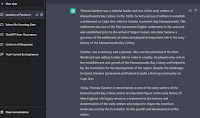
![]() |
| ChatGPT, 2 Feb 2023 |
I pulled some of the log from queries related to Thomas Gardner. Before this, there had been queries related to similar themes. 'Query' is my question; the response follows. Notice that it was in a 'terse' mode which is nice. Then, I asked for a 'verbose' answer to the prior question.
Query: Who is Thomas Gardner of Salem MA?
The specific Thomas Gardner of Salem, Massachusetts you are referring to is unclear. "Thomas Gardner" is a common name and there may have been multiple individuals with that name living in Salem, Massachusetts. Could you please provide additional context or information to help identify the Thomas Gardner you are inquiring about?
Query: Thomas Gardner married to Margaret Fryer. He died in 1674.
I apologize, but with only this limited information, it is difficult to determine the specific Thomas Gardner you are referring to. The name "Thomas Gardner" and "Margaret Fryer" were both common during that time period and there may have been multiple individuals with those names in Salem, Massachusetts. If you have access to any additional details, such as birth dates or occupation, it would be helpful in identifying the Thomas Gardner in question.
Query: Did you read about Roger Conant?
Yes, I have knowledge of Roger Conant. Roger Conant was a colonial leader and one of the founding fathers of the Massachusetts Bay Colony. Born in England in 1592, he immigrated to the Massachusetts Bay Colony in 1623 and was an early leader in the colony, serving as governor of the settlement at Salem. Conant was a key figure in the establishment and growth of the Massachusetts Bay Colony and played an important role in the early history of the colony and the development of New England. He died in 1679 at the age of 87.
Query: Thomas Gardner was the lead before Roger Conant of the expedition that settled Cape Ann in Massachusetts in the 1623/24 timeframe?
Yes, that is correct. Thomas Gardner was the leader of the expedition that established a settlement on Cape Ann in Massachusetts in the 1620s, prior to the arrival of Roger Conant. Gardner led a group of settlers to Cape Ann in the early years of the Massachusetts Bay Colony, and the settlement he established there was one of the first permanent English settlements in the area. Roger Conant later became governor of the settlement at Salem, which was located near Cape Ann, and played a prominent role in the early history of the Massachusetts Bay Colony.
Query: Verbosely, please.
Thomas Gardner was a colonial leader and one of the early settlers of Massachusetts Bay Colony. In the 1620s, he led a group of settlers to establish a settlement on Cape Ann, which is located in present-day Massachusetts. This settlement was one of the first permanent English settlements in the area and was established prior to the arrival of Roger Conant, who later became a governor of the settlement at Salem and played an important role in the early history of the Massachusetts Bay Colony.
Gardner was a visionary and a pioneer, who saw the potential of the New World and was willing to take risks to make it a reality. He played a key role in the establishment and growth of the Massachusetts Bay Colony and helped to lay the foundation for the development of the region. Despite the challenges he faced, Gardner persevered and helped to build a thriving community on Cape Ann.
Today, Thomas Gardner is remembered as one of the early settlers of the Massachusetts Bay Colony and as an important figure in the early history of New England. His legacy serves as a testament to the bravery and determination of the early settlers who helped to shape the American landscape and lay the foundation for the growth and development of the nation.
On the last? It's not quite right, but then it is a composite from several sources. This type of approach might appear to be of interest but is not. Debatable, of course.
Now, we will get to the specifics, but the training data set was large and came from the internet: pages, sites, books, and such. What a heap! Right? That would confuse anyone.
There is so much to discuss. We got it to say that the training set was a subset and not just the whole mess. After all, the internet is a mess, for several reasons and of various types. One thing that sticks out is that the 'domain' aspect of life has been ignored. That is, architecture with respect to this type of technology is very weakly evident, perhaps nonexistent.
One failure, last night? I suggested to the thing that we and it make errors. Right. But, to know how to assess its errors, we need details related to 'provenance' in the proper sense. And, ChatGPT admited that it cannot specifically respond to anything that would be like a 'footnote' request. Alas. ... On trying to respond to that, the system crashed (red text, emphasized - several times). On getting things going again, I was told that I had exceeded the number of queries per hour. Oh well, it and I were in sync ;>).
So, I was thrown out and the party ended.
02/05/2023 -- There is a lot to this. We will focus on GPT3 which is that which ChatGPT invokes for its content. Too, Google has a player, too: LaMDA (remember fall 2022 and claims of sentience?).
02/11/2023 -- This is not an official TGS opinion, it is mine. And, I (JMS, starter, with Ann, of the TGS, Inc.) need to give some overview. Why? I have been decades doing advanced work with computers where the focus was involved in 'real' issues related to application of these things. It has been a long road that these types of programs (meaning systems-level focus) and projects have hoed. Some results have been remarkable, say MRIs and other imaging, or CAT/CAE/CAM (advance mathematics applied to design and engineering), communications (look at the 'cloud' for instance - but with rose-colored glasses as that place is a mess), scientific experiments (but the issue of non-repeatability is there; and, other issues; be aware that the framework's strength will keep problems from being obvious), medicine (too many to note, however I will say that I was in top-notch surgical environments back in the '60s in the U.S. Army and saw the state of the art then; to me, robotic surgery is far from something that we ought to trust), and much more. Essentially, computing is everywhere. That is why immature and irresponsible acts are and ought to be concerning to anyone thinking of the future and their progeny of that time. Pollution is one analog such as we got the EPA for. There are other descriptions that I will do later. ... Truth engineering is what the TGS is trying to raise to focus. ... Disclosure: my focus is not Comp Sci. No, it comes from the underlying mathematical frameworks that are being used. Necessary care does not seem evident since a product ought not be released until fully analyzed with respect to several factors, one of which is safety. The main issue? Allowing API access which is hidden from view for something that is not really a product, nor has it any ability as expected by most. Cute, but poisonous to our mental health, might be one depiction of the state of the thing.
Wednesday, October 5, 2022
Content, again
- Note (10/07/2022): Final technical note, after looking at Concrete CMS and Drupal. These were considered earlier and have progressed as has WordPress. And, each of the three have solid use by well-known customers who have access to talent. As we work our configuration, we will be looking more than slightly as the issues which is best done with multiple parties to inspect. Say, like the infamous flyoff when new technology is being assessed. This type of thing is going to be even harder for computing. That is, bridging the cognitive gaps (or hats). Our put is called truth engineering. The ability to think of bare metal went away with the newer methods. Is there some equivalence? Too, the internet's evolution can now been seen more readily given the experiences of the last half decade. For instance, we can point to one paper discussing Concrete CMS versus WordPress, from the viewpoint of the former. Then, we have what we call AIn't coming forth. What we have here is mathematics and parameters mixing in an unlimited number of ways. WordPress, Concrete CMS, and Drupal represent parametric modes that are phenomenally complicated. This (the potential error) is covered over. We'll explain. And so, we have the situation where there is not human talent with the evolutionary wherewithal to handle the issues, except as a guider of the AIn't ways, if they are done correctly. ... It's almost like we've stood still the past decade and one-half with lots and lots of noise being added. Where is the value if only marketing is thought to be the major player? Tsk.
Friday, February 25, 2022
CMS, a favorite subject
TL;DR -- We started with MicroSoft and were happy, but they pushed people off of OfficeLive in order to get Office 360 in place. So, we did the right thing and limped along with a hacked out static mode in order for not let publishing get in the way of acquiring knowledge (the old fashion way, not machine learning - heavens forbid). The next motive for change came with the decision that Google would require some semblance of mobile friendliness to play in their part of the universe. Okay. After that, we did a website for a group that got us looking at alternatives. Then, things were fairly low-level looking to require lots of plug-ins (with regular costs accumulations). So, we just hacked more functions using javascript. When we started our portal, we had another chance at change. So, we had intermittent opportunities to consider CMS over our time. Now, we're at it again. The difference? The mobile environment has matured enough to be really interesting. Technology choices and issues abound; truth engineering is even more imperative; and notions, such as what was old is new again, apply. We'll stay at this until we get a resolution which will found the future work. Too, stay tuned; there is no limit to the ways that someone can contribute technically. We might just be the perfect lab for spawning lots of ways and means for considering how to attain some type of sustainable future.
---
This post is technical in content, with enough of the 'meta' (proper usage) issues covered to cover the extent of the current dilemmas. For now, we will have a list which is unordered and which will be extended throughout this iteration. We have touched upon the subject a few times, even recently mentioning that it's time to open the Pandora's box, again. As well as having the technical focus which will include the posts from our Technology Blog (hosted via WordPress on our site (TGSoc.org) that is presented via webhostinghub), we will look at motivation and talk the huge issue of managing across the levels related to development and deployment. The top level? We call it content, so CMS, to us, means Content Management System. One might stress the top down aspect of this. That is, the Thomas Gardner Society, Inc. has a focus of the Cape Ann start of the American experience where we look across 400 years in terms of history, family dynamics, genealogy, and cultural issues, such as science. The overarching view is called 'truth engineering' which will show that AIn't is the reality unless some serious changes to the assumptions occur, thereby telling us that we need to lift to public awareness just how the marvels come to be that are associated with computing.
Some might use 'configuration' which emphasizes the technical aspect due to the decisions required at that set of levels which are many. At the basic level will be the hardware, but it is supported by science and engineering. Software? In the list below, look at the Periodic Table of WordPress plugins. That refers to one set of frameworks (which can be generalized) pertaining to one offering on the market, albeit a popular one.
Aside, one national group of interest uses WordPress at level of one of the States involved, whereas the overarching scope is handled by Drupal. Of note? We looked at Drupal back in 2012 (see notes with regard to this) as well as WordPress and a few others. Our choice was to fall back to a custom approach which turns out to be useful with respect to steps to the future. As one lecturer noted, what's old is new again.
For now, consider the uses of 'C' interchangeable since we are using TGSoc.org to demonstrate issues, as well, from the bottom up (Wikipedia - Content Management (notice web content management and knowledge management); Configuration Management (notice the use for software).
Motivation (see Summary discussion): Provide modes for managing a nonprofit in a cost effective manner while supporting the operational needs that go along with such a focus. At the same time, provide a full suite of media approaches to presenting information that has been curated, manually. Albeit, types of machine learning may be applied but with any use being noted explicitly. Meaning, of course, no implicit uses that can confuse. ...
- CMS posts in our content blog
- CMS posts in our technical blog
- Content management posts in our content blog
- Content management posts in our technical blog
- Static web page - our approach which basically hacked HTML and which was chosen to allow progress with presenting information while we came up to speed on the related domains (events, names, dates, ...), covered over 400 years of history, published on a regular basis, and extended our focus/scope as we proceeded. Efficacy was attained by using several editors (HTML, simple text, and publishing).
- Dynamic web page - initial thrust of mobile support plus curated indexing accomplished, mainly via CSS and Javascript using only simple text editing with Chrome testing support.
- Model-view-controller - traditional approach for supporting the user via the web browser
- Decoupled Architecture and WordPress - some history, pros and cons. There may be a better video put into place, however the basics are covered sufficiently. Suggestion, scan through this quickly without the sound on.
- TodoMVC - examples, demonstrating some of the confusing notions that will be tamed
- Periodic Table of WordPress plugins - again, demonstrating the variety (most coming with an initial and a scheduled cost
- Decisions - Pros and Cons of Decoupled Headless Websites; The Pros and Cons of a Headless CMS; ...
- Deep Dive into Headless CMS Back-End Options - comparative look at what's available (Feb 2021)\=
- Initial WordPress - picked from Top 15+ tutorials
- Business manager - for WordPress
Sunday, November 28, 2021
Structure and GB
- Table move to our tech blog. Added in a format for more general reading.
![]() |
| small example of the array of modern devices |
Monday, November 22, 2021
Favorite site
TL;DR -- Considering technological issues related to computer systems some of which are exhibiting, supposedly, behavior that might be considered intelligent. Some of these systems handle language interchange with humans, somewhat. On the other hand, we have the example of educated humans who grasp lots of material with an understanding that is apparent in effective action. Versus, the more focused modes that we see with computer systems. The debate continues. In the meantime, we can see slow progress with respect to computer-based information. A long-time example is provided.
--
We have had several posts on technology over the years in a general sense. We have also taken up the them of History, Culture, Technology. And, we have several times remarked about content versus configuration in terms of knowledge management. The computer has really changed the landscape.
We started in 2010 using Microsoft's Office Live. It was two years later that they switched to Office 360 and pruned out lots of small business systems that had developed. We are to where we want to incorporate an ecommerce flavor, of sorts, but our focus is research. WikiTree is sufficient to support our genealogical needs. How to handle the rest of the requirements is a recurring them? Associated with this is the issue of what are the requirements.
Since the introduction of the smart phone 14 years ago, we have watched the evolution. 'apps' were one major enhancement (for better or for worse is to be discussed) with wide-spread ramifications. We just got our first smart phone a couple of weeks ago which will help hone our research. That is, the platforms for interface are several, but we have three as a focus, at the moment: mobile, tablet/laptop, desktop. Other platforms? The whole of the gaming theme, including the 'meta' dreams of Facebook. 5G and IOT as frameworks for the future are a big deal. At the upper end, we have the huge systems doing massive computing. We have to mention the cloud which is not to be without huge farms of computers dealing with distributed systems in disparate areas and across a never-ending landscape of information.
Got the drift, yet? I may have mentioned this once, but the Gairdner Foundation was an inspiration when first seen years ago. It was started in Canada by a Gairdner gent from Scotland. Their focus is medical research for which they support work and offer prizes for results. This is a huge domain.
Computing? It's larger, for several reasons. For one thing, it's supportive of everything. Like IEEE.org says, their members have been involved intimately with all advances in technology of the past century. Then there are all of the issues related to 'smarts' with respect to computing. I already mentioned the 'smart' phone. Another topic would be AI and its association with knowledge and autonomy of artifacts. Of note are the discussions currently looking at the various subjects. Lines are being cast.
Our focus is the U.S., principally, with New England a key topic. A large part of our history has been technology as it evolved in our timeframe. The past few decades saw an acceleration where American ingenuity influenced the world. Of late, China has made inroads which will be discussed. For now, this image is from the Communications of the ACM, Nov 2021.
There are several articles to discuss, such as this one reviewing NLP with respect to the historical work plus enhancements that accrue to applying modern techniques: Knowledgeable Machine Learning for Natural Language Processing.
In the larger picture which deals with complexity and thereby limits to computing, technical perspectives article provides and overview and arguments for MIP* = RE. This has direct implications related to the need for management of expectations.
One might argue that AI AIn't. In the general way of progress, hype has been let loose of its restrictions. Mind you, much misinformation is out there. Where does one go to find any type of truth? Well, that is one thing that we can help with. Our little portal is meant as a means to define, discuss, and determine matters that go to the core, even with regard to our very essence as humans.
So, let's put here a little bit of text from a discussion. This from a post by Prof. John Baez with regard to thermodynamics as seen from an introductory framework (Composited thermodynamics).
I'm sure there's much more to be done. But I feel happy to see modern math being put to good use: making the foundations of thermodynamics more precise. Once Vladimir Arnol'd wrote:
- Every mathematician knows that it is impossible to understand any elementary course in thermodynamics.
I'm not sure our work will help with that---and indeed, it's possible that once the mathematicians finally understand thermodynamics, physicists won't understand what the mathematicians are talking about! But at least we're clearly seeing some more of the mathematical structures that are hinted at, but not fully spelled out, in such an elementary course.
How this relates to the above is that thermodynamics has been studied for a few centuries now. Count Rumford was an early researcher. AI? Modern to its core. Most classical views that might relate are not consider. Or, have not been for several reasons. But, the computer and changes to cognition can be observed. We are too new to this game to know as much as we are assuming.
Be that as it may, finally we can get to the gist of the post. Favorite site? It has been mentioned several times in posts (Culture, History, Technology). Prof. Baez started blogging in the 1990s using the blogging mode in vogue at the time which was the minimal type of framework. He kept at it until about ten years ago. Reminder, this blog dealt with advanced mathematics of the highest order with embedded images and many equations written out in a textual format. The message got conveyed.
When he transitioned, he left his old blog that was full of content which is one of our themes. And, he went to WordPress (Azimuth) which we have been using, somewhat. Seeing him work with both the old and the new is encouraging.
Right now, we have two sites. We will transition to using the new (https://TGSoc.org) while we work issues with regard to re-configuring and adding in new facilities, such as ecommerce functions.
Remarks: Modified: 08/12/2023
12/10/2021 -- Added the TL;DR line.
Monday, July 12, 2021
Content and its management
TL;DR -- It seems that it is time to do the periodic review of technology in terms of our use and of choices pending. Nothing urgent is at hand except to increase the ability to have more options as we go forward. In the background is the reserved use of technology that might raise the issues of security, effectiveness, privacy, and other topics. We expect a 'deeper' dive this time (where 'deep' is taken from the AI mania's seeming hold on the imagination of a whole lot of people. What would Thomas think?
--
The explosion of techniques over the past decade and one-half is astounding. And, that techniques range from low-level coding and handling of data through all sorts of presentations on various types of platforms (real or virtual) and then the interpretation worlds coming in, especially with analysis as a driver and that the variety of methods are without end is quite a bit to chew on. For the individual as well as for the group. To now, it has been a daunting task to cope; going forward, it will be even more problematic.
So, doing a relook is quite apropos now. Let's just start with a list, some of which is older than it may appear and have a new face; what is new will be pointed out, eventually.
Context: Aug 2014, on Decisions; 2021/22 stop to relook; list of Content Management tools and approaches.
We can think in terms of hats which are difficult to have on at the same time and, definitely, switching modes is no easy task.
- Project Seven - responsive web design, as they tout, with a huge collection of capabilities which can be plug and play or even more.
- Dreamweaver - early to the game and still going.
- CSS-tricks - one of the demonstrators of the ability of this lowly tool that got my attention early on.
- Joomla - it's open source and capable, but too much on the configuration side of things.
- concrete5 - again, open source; found it useful but cumbersome.
- WordPress - very popular; liked it, but, personally, didn't like the ad-hoc collection of fee-based entities seemingly waiting to pounce.
- Drupal - thematic scheme that was interesting.
- ...
- Top 10 best website builders - there are lots of these list where some analysis has already been done.
![]() |
| Slow grind |
We always talked content versus configuration is a recursive manner. One's person content might very well be another's configuration. Better wording might come to fore, but we'll keep with this split for a while.
07/19/2021 -- Finally, we're on the summer tech trek: Techie world, again. No known destination or timeframe for when that unknown is defined sufficiently to consider having arrived there.
07/23/2021 -- Add TL;DR and image for the portal (https://TGSoc.org).
Saturday, July 10, 2021
A(rtificial) I(ntelligence) researched properly
TL;DR -- As we have mentioned in lots of post, New England has a long arm through space and time. Very long. We have looked at the interior example of this. We have a nautical one, to boot, that sits there awaiting attention. And, we need technology for various matters. Keeping it simple over the decade was one goal. Accomplished as we do not even have a smart phone. From the outside, apps look to be idiotic. I'll get one soon and be more specific. With regard to the purveyors of the clouds that are strangling the folks, we are immune and neutral. We'll tsk, tsk at any who is not behaving in a mature manner (did Zuck ever get over his bull-in-a-china-closet self?). Once we do a little look back which implies future happenings similarly (truth engineering is the focus), we look at DL and its huge impact of an unreasonable nature (hint for the brainy, think Wigner's comments). What is wrong here? Well, we 'deep' dive, proper sense, into DL and come up with the pearls of wisdom that seem to have been lost in the mud.
--
An ongoing concern is that we need to have a technical focus for a while as we re-look at the computing landscape. This type of thing seems to have occurred on a periodic basis which we have covered somewhat as we proceeded. But, since technology will be a focus going forward, we will be more regular on looking from that angle.
And, we will pull together several threads as we work this. Then, we need to assess where the world is on related topics. Warning, we're going to the core and back in an attempt to clarify what are the real issues and why so much hype and confusion.
So, let's recap, somewhat. It does parallel other activities in the world of technology.
- We started this in 2010 using facilities of Microsoft (MS) as we were looking to be in the world of ASP.NET for web apps with access to OfficeLive for the business focus. The first cut of the web site went quickly due to their tools. And, all was well, or so it seemed.
- So, in 2012, MS pulled the plug (leaving a bunch of little moms and pops scrambling as they lost the core of their business model). Rather than step up to Office365, we went looking. That was nice. As we got to see how the web was about seventeen years after its 'wild west' start. We tried several of the state-of-the-art approaches. Mind you, we are now facing the onslaught of change coming from Jobs' gift (in other words, the app world was dawning). However, since our purpose was content management in a totally new environment, we fell back to our roots which was riding the wave of the internet from the beginning via Unix and Linux. Remember, at one time, SUN noted that the network was the computer (early 1990 timeframe). So, we converted from 'asp' to html using little graphics with attached functions as the GUI. It was fun. The choice was to use an ISP who ran Linux and offered lots of software choices including a web design tool. Didn't like it, for many reasons. So we did our own thing.
- After two years (2014) of managing content with antiquated methods, it got to be wearing. So, at that time, we took the time, again, to reassess the state of the art with respect to web stuff. And, we looked, again, at CSS. Yes. So, that became the GUI provider (parameters and systems, just like we see with DL - more on that, lots more). I saw a 3D graphic engine implemented in CSS/JS but still had lots of content to cope with. I was relieved to have some progress improvement.
- Then, by 2016, Google was saying to those who went out pioneering earlier, respect the little guy or you don't get any attention (meaning, in their ways of pushing stuff). So, we became mobile friendly. The keyword was being responsive. This was done with even more CSS. At the same time, we picked up WordPress in addition to Blogger which became under the auspices of Google. In the meantime, we kept looking at new kids on the block. After all, some spend their lives playing with the stuff. So, alternatives abound. Guess what? I have lots and lots of examples of people being screwed (hence, this is one thing on our plate) because they didn't take the time to understand technology. At least, know more than how to push buttons on that thing that Jobs' gift gave the world (incidentally, I am about to get one - the smart phone - I call it a dumbing device and can show examples of that, to boot). Anyway, Google provided a little test facility to check out your site. We passed. That was enough, then. But, again, soap box: everyone seems to have descended to this one-eyed little thing where one cannot multi-task. Can I explain further? You bet. It'll be on our table for discussion for a long while. Also, later I used someone's Jobs' gift to look at the site. Not bad given that it's not using custom apps but a good browser (that will not go away, folks, for many reasons).
- Then, 2017/18 came along. We decided that ThomasGardnerSociety.org was a bit to type and decided to go a little smaller. We asked for opinions and settled on TGSoc.org which has been a blast. We still have the old site for older material that will be reorganized. On the new one, we are stressing the need for truth and its engineering. Frankly, the site is to be a test bed for ideas and discussion, eventually. More on that below. At the time, we relooked at the options. And, settled, again, on HTML/CSS but brought in JS. Now, there are several varieties of JavaScripting available. However, I just saw top-of-the-line bit of research in truth maintenance (older concept) which balances multiple worlds (essential) which was created with html/css/js. Yes, I have seen lots of topnotch sites using this. Topnotch? Not commercial flimflam, please. Not academic, either.
- Now, we're 2020/21 and have started to redo, again. Of course, it's time to reassess the world. And, knowing about New England and American History a little more now than in 2010, that whole framework has to come to become more visible in a coherent manner that will persist. Guess what? We will argue that there is research to support that will be as important as biomedical research. After all, we're talking the soul of the nation and of the world's people being entrapped via technology that is driven by motives are that not what we might want given what we know of the 400 years of effort on the part of thousands of families. But, that's for later (see below). Now, we will look at apps. Also, we will be looking at multi-media and the different ways to express some notion with both provenance known and veracity shown. Ever heard of AI?
- Deep learning for AI -- The ACM provides a Turing Award to folks who contribute to the discipline in an extraordinary manner. This paper is based upon a Lecture by three researchers who shared a Turing Award: Bengio, Lecun, and Hinton. Recognize those names? These guys were of neural nets all along and so can be seen to have sloughed through the years. They are not recent wonders exploiting graphic cards nor are they pushing notational magic such as tensors. Of late, news reports have mentioned these three talking (Hinton is whom I have seen referenced the most) and saying, wait, neural approaches have issues. We have to back up and relook at the situation. Well, this article expresses those issues and discusses some work that needs to be done. Great stuff. The article is open for reading (thanks to ACM). They mention symbolic approaches, the old stuff to some, and the later modes that are heavily numeric - exploiting age-old ideas about transforms, optimization and more. But, it’s in their ‘Recent advances’ and ‘The Future of Deep Learning’ where we see discussion of other things that are being pursued plus some suggestions and notions that need attention, like attention (now, a soft type). I liked the higher-level cognition little section. Yes, the old ‘planning and reasoning’ methods ought to be more than dead meat to those numeric overlays that are so insidious. I can talk that, too. BTW, Minsky’s ideas on the society of mind are still apropos, to boot. But, there is a lot more to put on the table. Next bullet.
- Deriving equations from sensor data using dimensional function synthesis — ACM, thanks, this is open, too. Gosh, in the last bullet, B&L&H were musing about higher-order (which even tensor notations aren’t going to give to the neural approach) and its use. After all, B&L&H are academics and know the mathematical stuff. So, Cambridge (Tsoutsouras, Willis, and Stanley-Marbell) to the rescue. This paper reminds me of a lot of things that I saw and dabbled in. To me, what was the conclusion was having a trained person in the loop. Trained? Yes, thoroughly comfortable with the type of thinking that a good physicist would follow while modeling - used since model-based approaches are still germane to the subject, perhaps even more so now with the flood of data and improper analysis that is killing us - in order to solve some problem. Good engineers fit this bill.
![]() |
| Example of human deep learning guiding DL |
07/11/2021 -- Review and edit; add image.
07/12/2021 -- We are back in the saddle. Concerns abound. Such as, some have been taken to the cleaners due to unscrupulous developers and outright charlatans with modes that lurk and pilfer. Some have paid way too much for some capability since they were too old to know or to make the effort. Oh yes, youngsters not knowing? Yes, that is the case, too. Can we have a sustainable web for all?
08/05/2023 -- I haven't been watching, but this post rose on the list of the most watched, recently. The theme is one reason. We will lift this up to further usage, as we are working on GB XIII, 1. One topic is year-to-date. The other deals with new directions. Wasn't there a boy band with this name? I know that there is a literary publishing company with this as a name. ... In Nov of 2022, OpenAI pushed out ChatGPT which is an example of the capabilities of LLM. We will have more on that, and related themes, soon.
Tuesday, June 29, 2021
Pace of change
TL;DR -- Before getting into some technical issues, a pause to look at the quick coverage of the interior of the U.S. is in order. In the graphic, the blue are Post Offices (1855 and 1921) as they spread across the country. The red show the railroads (1860s and 1890s). We have looked at the time before technology came about. But, even when it did, there was a natural evolution of ability. In any case, the conflicts of today are nothing new, basically old stuff with nuances related to the current time. So 400 years ago may have been different in a lot of ways, but how close are the people then to what we had 100 years ago?
--
This post briefly summarizes work that we done over the past few months, much of it looking at the interior of the U.S. We need to get technical, for a while, which will get us back to the issues of content management and more. This has been a periodic occurrence that has left traces (see discussion at our portal - https://TGSoc.org and our technical blog) which follow how things have changed during the past decade and one-half. Lots like to ride the wave (to nowhere). Civilization needs its moments of review in order to stay within sustainable practices. The computer has messed things up. But, also, we have new ways to research and report (that was one motivation for the Web which was based upon DARPA's attempting to have robust communications). We have to keep history in mind, local and global. Too, New England and the Cape Ann crew will continue to be of use to much analysis now and into the future.
Messy now? Yes, but, we were messy before, too. We have been covering the frontier century, for various reasons. One of these is that we have run across lots of families who were early on the frontier and seemed to have lost their lineage. Of course, there were many newcomers during that century. However, there are others who were here whose families moved into states long before they were organized and so left little in the way of tracks.
We call it the lost generation (or two) which is the ones right after the Revolution.
So, one might argue the Boones. Daniel's prominence made sure that people paid attention. For every Daniel, there are 100s and 1000s who get little in the way of notice. Yet, these people farmed, built, surveyed, and more. On that latter, the Bent family whose member was at the Treat signing in Kansas got us on that. The father was the organizer; the son was out in the wilds. The treaty didn't hold like many others. So, we'll be looking at that (1865, Little Arkansas Treaty - that's a river out of CO that runs through several states to the Mississippi).
Along that line, we have pulled some images that bear discussion, especially when we consider the short period of time related to the phenomenon. In this case, it is still the filling in of the interior. We are now thinking of the land being carved up. And, Missouri is a good example being the first one. It's start is in parallel with Maine's. Look at that juxtaposition. As well, the crew coming into Essex County, MA had to get things organized including surveying. Thomas and sons helped with that. John was with the Merrimack crew. In that time, late 1830s, he did learn more than those ones at Harvard. Lots to discuss there.
Ponder this image which comes from two sources: Paper Trails (on the left); St. Louis, MO to San Francisco, CA (on the right). The left column shows the number of Post Offices at two times (1855 and 1921). The right shows the railroads, similarly (1860s and 1890s).
The times are meant to cover a 1/2 century what was from just before the Civil War of the U.S. to around the WWI timeframe. Got that? Internal conflict was the theme of that earlier turmoil. Actually, is. How are we any different? And the latter? The U.S. on the world stage in the context of trying to resolve conflict over there which was of long running, to boot.Remarks: Modified: 06/29/2021
06/29/2021 --