Showing posts sorted by relevance for query domesday. Sort by date Show all posts

Monday, May 23, 2011

Tidbits of English History

Since Thomas and Margaret came from England, as did many of the collateral families, we ought to collect some links related to English history. Some may have more comments than others. At some point, a bibliography will appear.
  • Domesday Book -- see related blog for more on the topic. Essentially, this relates to an effort to bring things into account. It was problematic then and is even more so now (and, that refers to more than the issues faced by the U. S. Census). By the way, William's effort showed that the Church (of England, still under the Pope, but remote) had more land than did the King. Aside: Could that not be indicative of how afar Christianity went from the teachings of Christ?
  • Accountability -- that is, for Coats of Arms, etc., there had to be some control, and review, that was regular. So, Henry VIII started what is known as the visitation. Seems that claims about heralds, etc. were easily counterfeited.
  • Towton - the day that changed English history. 
  • Persecutions both ways; no wonder people wanted to flee. Some carried the insanity over to here (we'll name names, at some point -- Thomas was not an instigator of things like this).
These are interesting to the themes of the blog, for many reasons, so expect some posts on these types of things from time to time.

Remarks:

06/04/2019 -- Added link to image on the 'Battle of Towton' page on Wikipedia.

12/15/2018 -- Added image here and to image scroll: TGSoc.org.

07/20/2013 -- Interesting work, and related database, at PASE.uk, including a database built upon the Domesday Book (can identify old families).

11/05/2012 -- Domesday book and beyond: Three Essays in the early History of England (google.com, archive.org).

05/12/2012 -- Changed Doomsday to Domesday (yank fat fingering). Well, for some, being fingered to pay more money is 'doomsday' awaiting.

08/15/2011 -- Changed some wiki pointers; added one list item. Need to remember to use the 'public' wiki site.

Modified: 06/04/2019

Monday, April 15, 2024

Bluebells in Dorset

TL;DR -- Today, we look at the southwest, in particular, Dorset. Motivation? Bluebells. And, look at St.Aldhelm's influence on schools in the region. 

---

Yesterday, we looked at the other end of the country: Bamford UK. We were motivated by a photo. And, having ventured into the region via the internet, we looked around and found our old friend, the Domesday Book. With respect to that, we saw that William I spent time up there. At the same time, we noted local families that relate. So from that, we looked to include views of the UK areas as we roam, virtually for now as well as report little tidbits that pertain to our work. 

Well, Microsoft pushed this photo. It was supposedly of the bluebells of Dorset UK. We have to look further at that. Lots of photos have been taken, but we found one that had been published by a local school. So, let's look at that. 

Bluebells in the countryside,
Minterne Magna, Dorset, England, UK

This area is near Sherborne, the town of Thomas and Margaret. We have looked at the area before after reading on Folger's report that John Gardner had said that his father told him that they had been from Sherborne. That post is from 2010. But, we were new and accumulating information more than trying to do analysis. The tide has turned. Folger used "Nantucket tradition" as they knew on the island. 

Skip forward four years, and a record relatred to the marriage of Thomas and Margaret had been found. Last year, further research brought forth to light the birth records of most of the kids. That find brings back to fore a major conundrum. We knew of this. Dr. Frank thought not. So, we'll try to help research further. Lots of the historical recordings seem to be wrong. 

For us? We'll say that Thomas came over, perhaps more than once. So, it's one gent. In the meantime, we will work on the progeny as we had already started: Descendants. Too, we will go over the waters and research. In the meantime, we'll explore via the internet which is an unexpected gift that came out of research. At the same time, we will weigh in on technology and its misuse (AIn't, for example). 

---

Okay, earlier we noticed this school: Sherborne School (private). It was founded in the time of the Wessex realm by St. Aldhelm. The school lost patronage or whatever was the reason and ceased to be. Then, in 1550, King Edward VI brought it back to life. In modern times, George and Elizabeth visited to help them celebrate their 400th. It is now a boarding school affiliated with the Church of England. 

We will be back to look at St. Aldhelm and his cohorts later. 

For now, we mentioned another school: The Gryphon School (State). This is a much later school which came out of a merger. However, one of the three schools was affiliated with the old days: St Aldhelm's Church of England Modern School, Sherborne. This school had started in 1877. The amalgamation (as noted in the UK) was in 1992. 

Note: Bluebells are UK flowers. Some places in the world have them but not to the same extent. The plant is Hyacinthoides non-scripta. It's cousin, the common hyacinth of our spring and of the Dutch market is oriental.  

Remarks: Modified: 04/15/2024

04/15/2024 --  

Sunday, April 14, 2024

Bamford UK

TL;DR -- A photo pulled one into research which got back to an old theme of William I's time which is way back. So be it, as we're looking at origins, more thoroughly. 

-- 

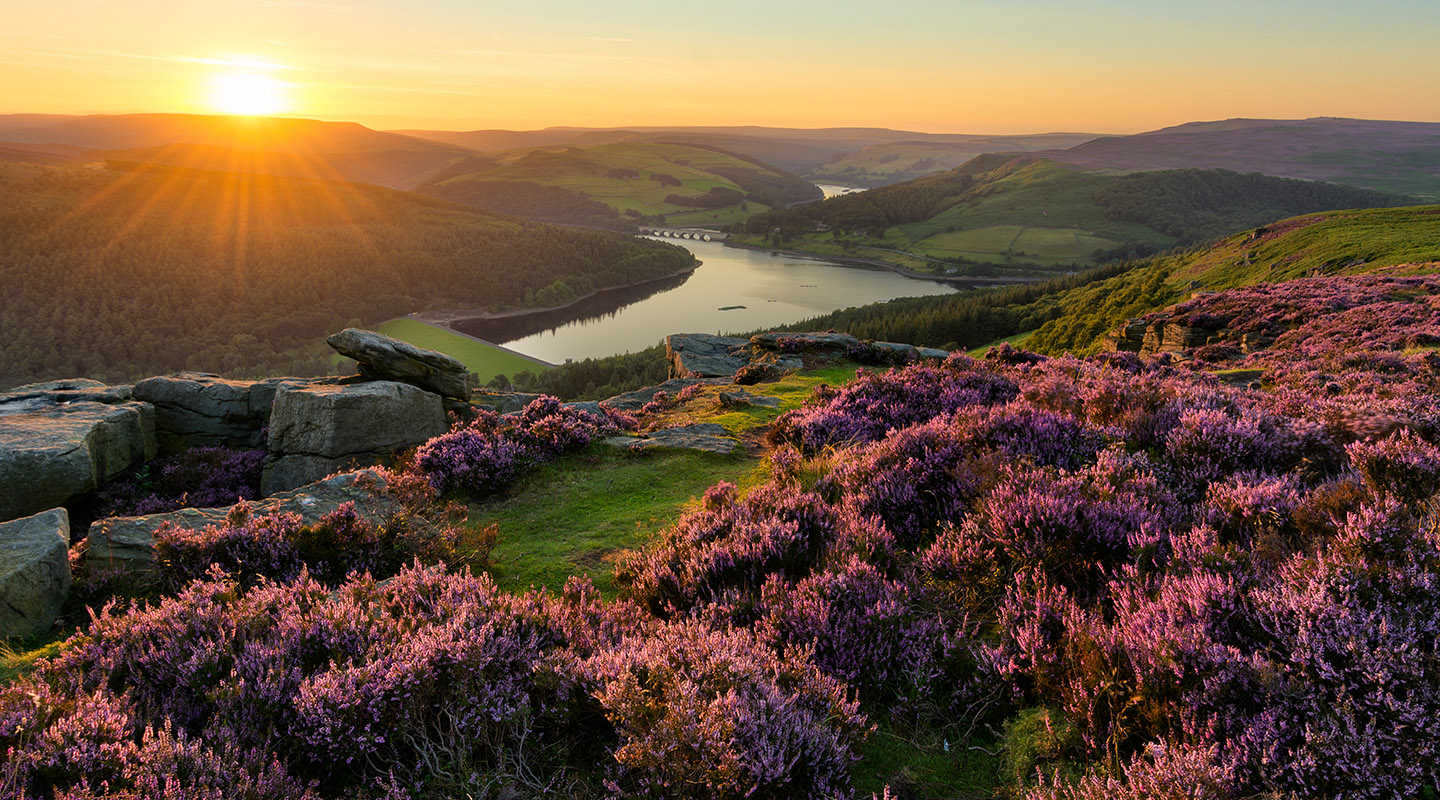
One of the irritants of the new way fostered by the errant release of TCPIP is a provider who pushes out photos for whatever reason. Usually, they don't say. Thankfully, I have mine filtered down to landscapes. So, it seems to be a game of: do you like this place? Loaded question. Well, after a few years, the thing has learned to not include people in the scene. And, location choice has been honed. 

Today was a charmer for several reasons. It was titled "Bamford UK" which looked to be north. So, I went to Wikipedia, first. The content was rather staid as I suppose we expect from an older English culture.

Bamford UK

What caught my attention was that the place had been included in the book of William I when he surveyed the land in order to rule better; one impact of this was the distribute his supporters across the land. Eventually, through his progeny, that came to include Scotland, Wales, and Ireland. And, too, we will have to look at the impact on the Continent. 

But, the main name was on the lists that I see of ancestors. Okay, what of the area? Well, Wikipedia, again, was ready to answer: Derbyshire Domesday Book - tenants. Of course, "in chief" is added as this was a land look not head count, specifically. Then, it was Banford. 

Again, lots of familiar names. We have addressed this effort of William before. This recent find is significant as recent events have changed our focus. We are no long only looking on the Americas. Now, we want to look at origins, in more depth, about which topic we have had lots of posts. 

Note, we know that Thomas Gardner was from Dorset which is in the southwest. But, there are lots of families in trees when going back that far, many of whom are from the north. And, we might like the beach. But, the northern mountains demand a little more attention. 

Remarks: Modified: 04/14/2024

04/14/2024 --  

Tuesday, July 21, 2020

Murrey and blue

TL;DR -- We found a new blog, today. 'new' in that it's less old than our own. We expect good things to be read at murrey and blue. Of course, this note being done later, we can fix an oversight: somehow, we forgot to mention William Marshal (without whom we would (might well) be speaking French - having lost the language of King Alfred the Great).

---

We had a question recently about motives for people coming to New England, early on. We, more or less, have liked the overview given by the author of Albion's Seed which we first read in 2016 while first exploring all of the ways that New Englanders continued to move after their arrival. We can map out the movement through time. For Virginia, one can see a map that shows the extent of its reach plus the counties defined at the time from the beginning. The expansion was west, at one point, with a limit of the Rockies and points west later on. But, we know that there were eventual constraints, with  West Virginia being one of these.

In Albion's Seed, early New England (Thomas Gardner et al) were reconnaissance. The real deal started with Winthrop who represented on pathway of which were were three more. After the Revolution (coming up 250 years ago), the expansion started in earnest. However, there were facilitating changes, such as the establishment of the Cumberland Pass through which we had people going west. There is a lot to look at. In the case of one family, we found a hanging of an abolitionist minister out in Texas before the major conflict that split the country in the mid-1800s. Three years ago, we looked at the experiences of Col. T. W. Higginson a little further north. There have been conflict and turmoils continually throughout the U.S. history and before.

On FB, recently, we saw a post from the Richard III society. We have had posts about him as it involved the long War of the Roses whose aftermath was of importance. Too, his body was found and re-interned which brought Richard III's life back to attention which got several posts here. Too, other blogs came into existence. One of these is "Murrey and blue." 'Murrey' describes a color that comes from the mulberry fruit.

The post asked: What really happened in 1385, when the Earl of Stafford’s son and heir was killed on a Yorkshire road ...? It was the first time that we read this blog which covers the subject well with illustrations. A name caught our eye: John Holand. The family was familiar for several reasons.

As an aside, it was nice to see history covered, as the whole of the themes related to this was muddied by the Game of Thrones playing loose. We can say that the media, such as blogs, that are coming to fore will allow a more full look at history in ways not possible before technology got off the ground. And this 'murreyandblue' blog gets into detail that is quite refreshing.

Back to the theme, John's father was Henry Holand of a Lancastrian family. Henry married Anne of York. His territory included Dorset which got us to look at the Domesday Book of this region. One of our goals is to keep a long view of history as we proceed with learning more about Thomas, Margaret and others of the Cape Ann venture. So, we expect that we will be looking further at this blog and its cohorts as we pursue our studies further.

There is another view of motivation: The Great Puritan Migration. I like this blog, however, I don't know that we can assume that Thomas and Margaret came here for religious reasons. We had a post dealing with Origins - motivations. One thing looked at were the beheadings associated with the War of the Roses.

Another good one is that from the New England Historical Society. There are a lot more blogs to look at.

Postnote: Back in Holand's ancestry one will find several characters from the time of King John and the MC. We have had posts on those topics. One name to bring forward beyond the interest that has been shown in literature and the arts? William Marshal.

Remarks: Modified: 07/22/2020

07/22/2020 -- Added an image and a TL;DR.

Thursday, November 11, 2010

RD example, using gateway

We have seen that genealogy can involve a large number of families and individuals. That is, Thomas Gardner of Salem has thousands (100s of) descendants that could be named. So, one on-going exercise might be to look at the disparate trees that come from research by various families and try to merge these.

D.A.R. has a project that is along this line where threads, from the member to the patriot, are documented at each generation. Then, these ought to establish a tree that has some strength when joined together.

Our problem is that we have to go back before the time of the American Revolution which is the focus of D.A.R. For instance, in Dr. Frank A's tree, there is an ancestor who was at Bunker Hill, 1775 -- Thomas Gardner descendant of Thomas Gardner of Roxbury. What is the relationship between the Salem and Roxbury families? As well, there are many other patriots in the D.A.R database who are documented.

Now, if we could start with a database, like the D. A. R. one, then it might be a little easier. Then, assuming that the different families have done a good job going back from the D.A.R information, we could attempt the a merge, with caution. Some other groups seem to offer this type of possibility, such as the descendants of Newbury founders.

For several reasons, trees that have some RD link seem to be more full and better documented. But, too, having the RD list makes it easier as then the work is just going back to the gateways. Which, with a D. A. R. basis, one is only talking about 100 years or so to fill in.

In this post, we look at a couple of trees that show convergence to a royal gateway for a Thomas descendant. There are many more that we hope to itemize in a separate post.

In this case, the individual is Charles Francis Adams, Jr. (b 1835 - Civil War General) who is a descendant of Thomas Gardner of Salem through his son, Richard. Charles' maternal great-grandfather is Nathaniel Gorham, Jr (of course, also a Thomas descendant), who was a signer of the U.S. Constitution. One of Charles' paternal grandfathers is John Quincy Adams, the 6th U.S. President.

Now, let's look at two of the many trees that have Charles in them. And, remember, each family only expands to the extent necessary for their work (it is rare to find a fully developed tree; is one goal here to get all of Thomas' descendants to 1900, for example?).

One tree is from the Dowling family which shows Elizabeth Coytmore as great-grandmother of John Quincy, the forebear of the President. Elizabeth is on the gateway list maintained by the Brookfield Ancestor Project.

Who is Elizabeth? She descends from Edward III of England. We will look for further information on her.

However, another tree (01/03/2013 - removed link as database is gone) expands the mother's side more and shows Myles Standish, who is also on some gateway lists. Myles is well-known from all the Thanksgiving stories in which he features.

Remarks:

09/09/2021 -- We have been working with the team at WikiTree on several themes. One deals with Gateways and uses Magna Carta Barons as a focus. For each Gateway, a particular path is followed and brought up to date. See Trail Tracks. 

07/20/2013 -- Interesting work, and related database, at PASE.uk, including a database built upon the Domesday Book (can identify old families).

01/06/2013 -- Ten years ago, The Atlantic had a nice article on Humphry's work. I ran across his site in the last couple of years, at some point, so it was nice to run across the article.

01/03/2013 -- One of the rootsweb databases disappeared which is good as it demonstrates the need to consider persistence (both short and the longer term).

04/30/2012 -- We see, in the tree examples, two of the early Thomases (of Salem and of Roxbury). That was not planned, but it is of interest for a couple of reasons. Many have these two related to each other; another view says not. After a couple of years of experience now, these types of nuances become more apparent.

01/14/2011 -- Improve the discussion of a ratcheted method where attempts at closing a gap (more extrapolation than not) would have a stronger basis. Added links.

11/23/2010 -- Necessary studies include prosopography. Charlemagne features so heavily in the royal trees due to the amount of sponsored work related to identifying his descendants.

Modified: 09/09/2021