Tuesday, June 5, 2018

Gardner's Beacon, Vol VIII, No 1

This issue of Gardner's Beacon briefly looks two major events of the past four hundred years. We are just past Memorial Day with the 4th of July coming up. The respective wars were one hundred and fifty and two hundred and forty years ago. Given that Memorial Day has broadened in scope, one might expect it to become a major holiday celebrating more than the start of the summer months. It is natural that Thanksgiving will continue to be of interest.

But, we are facing the start of a long line of celebrations. A century ago, people honored the 300th: Pageant of Salem (1913). Charles Dawes was there in 1926.

The 400th of the Mayflower events is coming up in 2020; already activities have started to commemorate the lives of those who came over, prior to their trip west. Cape Ann will be recognized in 2023 and 2024. However, there were several other occurrences that will lead to celebration: Roger's arrival (1625), then John's entry (1627/8), and Rev. Higginson (1629). It was the last who was the ancestor of Col. Thomas Higginson who is known for his work with The Massachusetts Magazine and the Old Planters Society, among other things.

When 2030 comes around (Great Migration), there will be events at many locations for many years (Timeline of settlements).

---

The print of The Gardner Annals, Vols III and IV, is in final preparation. We will report on the status.

Included with the TGA volumes will be Gardner's Beacon issues from Vols IV through VII. The issue will cover the remaining volumes of The Massachusetts Magazine, report on a change made via an article in The Essex Genealogist, and present further material from David T. Gardner. Too, we will look at a few of the Gardner Research projects.

---

See Vol. VIII, No. 1 of Gardner's Beacon for a review of research to date. Sources.

Remarks: Modified: 06/06/2018

06/06/2018 --

Sunday, June 3, 2018

What is the American?

Back in December, I was reading a book review and noticed reference to 'martial law' being imposed in Virginia. The punishment was quite extreme, however we know that even the Puritans up north were well capable of meting out harsh treatment.

Recall that Virginia is New England (south) and is very much of interest. One might argue about different world views, however the same little island was the source for these people. Yes, we are talking the same people. And, they had the first Thanksgiving down there.

Too, there are lots of other parallels that we can look at. Northern families went south and west. The big conflict (still apropos, today) caught up many families and ought to be in our sight.

So, we have central themes to explore. As I have been reading The Massachusetts Magazine (have been through most of the issues - we will cover all articles and republish through time), themes/memes related to other issues came forth.

For instance, a 2011 book (Foster, Thomas A: New Men: Manliness in early America) quoted J.Hector St. John De Crevecoeur (who was written about by F.B. Sanborn):
  • What then, is the American, this new man? He is an American, who, leaving behind him all his ancient prejudices and manners, receives new ones from the new mode of life he has embraced.
Foster's book looks at both Virginia and the north. The former was military in scope from the beginning. We know of the Mayflower passenger and crew. Cape Ann was commercial. But, this is a topic that ought to, and will, get more attention.

BTW, Hector came over here as a young man, with introductions, and went to various locales during the time of the conflict with England. His essays are very much of interest.

----
An example of an American would be F. B. Sanborn. He was remembered in The Massachusetts Magazine, Volume X, No. 4.


---

There was never 'martial law' in the north that I have found. Rather, the north had the notion of liberty. In 1868, John Ward Dean published A Memoir of the Rev. Nathaniel Ward, A.M. He dedicated the book to Samuel Gardner Drake. Who was Nathaniel (besides a brother of an ancestor)? He wrote (compiled) The Body of Liberties (1641). This is a 'bill of rights' over 100 years prior to the Philly's crowd prancing around.

---

In regard to the Memoir, who was John and Samuel? Samuel Gardner Drake was an antiquarian in Boston. Also, Samuel was one of the founders of the NEHGS. His parents were Simeon Drake and Love Muchamore Tuck. Where did Gardner come from? Love's brother, Samuel Jones Tuck (of Boston), married Judith Gardner (of Nantucket) daughter of Uriah Gardner (b 1716) and Judith Bunker (d 1789). So, Judith was a descendant of Thomas and Margaret.

John was of Maine (History of the Dudley family, Librarian of the New England Genealogical Library) and was a member of the NEHGS. John has an extensive list of books on-line (UPenn). John is a descendant of Nathaniel Ward through a granddaughter, Mary, who married Benjamin Woodbridge. Mary was daughter of son, John (1609-1693).

---

This post was introductory covering a lot of territory. Before ending, here are a few items related to Samuel's namesakes. His first name came from his mother's brother. His middle name came from his uncle's wife.

Samuel's uncle: Samuel Jones Tuck - findagrave (we like this effort and try to support it); Tuck book, Love #100, Samuel #99.

Samuel's aunt: Judith Gardner's tree (Manning - we know, rootsweb had a major outage - months - so, how to correct for that?), notice major Nantucket, and Quaker, families 

I will experiment with this type of thing that would be a footnote for an ahnentafel (NEHGR reference - 2016). Over the past few years, I have collected thousands of these for the tree (with auxillary families) that I built by hand. Not only do they need to be organized to support other research, we need to check consistency twixt these things through time. Yes, lots of work.

Remarks: Modified: 01/06/2019

06/04/2018 -- Add in the remembrance of F.B. that was in TMM, Vol. X, No. 4.

06/06/2018 -- Need to prepare for 2023/4. Some, of literary inclinations, have looked back 200 years: American Jeremiad. But, we need to go back to the Cape Ann times and before.


Wednesday, May 23, 2018

Review of TGA, Vol. IV, No. 1

We had our first print of the TGA, last year, when we did Volumes I and II (in black and white) with the first three Volumes of Gardner's Beacon.

We are finalizing the latest issue of The Gardner Annals which will be Volume IV, Number 1. As soon as we are done with that, we will prepare to print Volumes III and IV of the TGA.   We will do the next printing in color. Too, if there is interest, we can reprint Vols I and II in color.

As a reminder, the following is the Table of Contents for TGA, Vol III. With TGA Vol III and Vol IV, we will include issues from Volumes IV through VII of Gardner's Beacon.

In Vol. IV, we carry forward two of the articles. "Thomas Gardner and the Tudors" is an extension of "Bosworth and Gardners" which is being done by David T. Gardner of the Pennsylvania family. Then, we look at the remainder of the volumes of The Massachusetts Magazine that was published by Dr. Frank and friends from 1908 to 1918. A new subject article looks at a correction made to The Essex Genealogist which led to several articles from Gardner Research. Finally, we briefly look at current research that will be published in future issues: a continuation of the "Flyover country" work about the lonely grave of a Mayflower descendant out west (who cares? when there is partying going on back in Plymouth?), then we take a look at the founders of The Atlantic which started in Boston, of course, we look further at the Magna Carta, and take some time to refresh what is known about Nathaniel Eaton which the proviso that we will get the record filled out further (he is an ancestor of Dr. Frank).

In terms of The Massachusetts Magazine, for which we will publish the Table of Contents the remaining issues, here are some particulars to be dealt with.
  • Dr. Frank gathered old and new friends in order to do this publication. The old timers were from the era of the Civil War: Thomas Wentworth Higginson, F. B. Sanborn, and F. M. Thompson. Dr. Frank had an article in every one of the issues and did his pieces on those regiments at the Siege of Boston.  
  • Dr. Frank's sister, Lucie, helped edit and contributed articles. Of note is that she picked up the work of Sidney Perley who retired. Then, she reported on the groups that were meeting, such as the Old Planters Society. 
  • There were several other contributors. From reading these, we learned of Count Rumford, traversals out west (bleeding Kansas - Higginson and further west - F. M. Thompson). Too, we read of a friend of Ethan Allen who was here during the American Revolution (J. Hector St. John). And, we now know the Brit (R.A. Douglas-Lithgow, M.D. LLD) who wrote the History of Nantucket.    
  • We pondered about the demise of the magazine which was popular. No doubt, the Spanish flu pandemic of 1918 was a factor.  
From looking at magazines of the time, we learned about the dialog (yes) related to various parts of U.S. history that ought to be known. And, we found out about the Lyceum movement of the early 1800s. The impact was seen even out in Kansas (1890s). We will take time to look at various attempts, such as the Spirit of '76 that was adopted by S.A.R. yet failed.

Gardner research interests are varied. One of these would be doing the first five or so generations for each of the children. Now, how to get that further along?

Remarks: Modified: 09/30/2018

06/18/2018 -- The Gardner Annals, Volume IV, Number 1,  published. Contents: The Massachusetts Magazine,  updating an article in the Essex Genealogist, Gardner and the Tudors, and Pending Research: Pseudo-wall, The Atlantic, Nathaniel Eaton. 

09/30/2018 -- The print version is at the printers.

Monday, May 21, 2018

1907 chart

Dr. Frank took the time to fill in his ancestral chart using a approach patented by Rev. F.W. Bailey. So, we have an early 1900s analog of a printout from one of the modern apps. And, it is in his hand. I checked what he had against what I found out in my research. We agree. I just have access to more information, due to technology.

Nowadays, we can work from our desk whereas he had to travel and thumb through documents, many times. We have access to books that were being written in his time, albeit many of these are not worth much. Alas. Dr. Frank may have known several of these authors and have known their results. But, his efforts were contained to work in New England. The 1907 book dealt mainly with the family of Samuel.

Note: See "person list" for names in the 1907 book compared to those in the 1933 book (Gardner Memorial).

These are the main pages of the book that Dr. Frank filled in. Following are the ahnentafels for his Gardner grandparents. We will prepare these for his mother's side.
Cover of book
Gardner 
Woods

Again, one reason for starting with Dr. Frank was to leverage off of his work. In his 1907 book, we had the children and grandchildren for the other children of Thomas and Margaret. We really need something that pulls together the first three or four generations.

I propose using The Gardner Annals. We will be printing Volumes III and IV, soon. There is still time to offer something. An ahnentafel is easy to write.

Aside, Dr. Frank does include Anna Eaton. So, he knew. This subject will be further researched. That is, Dr. Frank and his cousins being descendant of Nathaniel Eaton. Yes, a story that needs a relook. Looks like fun.

It might be of interest to know that we intend to cover the Sir Christopher Gardner story, to boot.

Remarks: Modified: 03/14/2019

09/07/2018 -- Finally got around to filling in Dr. Frank's tree, using WikiTree. His Gardner line is fairly complete, in terms of data entry. Starting to fill in his Woods (maternal) line using Dr. Frank's handwritten notes. The focus now for this work is having nodes (profiles) in place and linked. Then, we'll add bios, etc., plus verify sources (as in, this will be the 'bible' of his lineage - we fill in sources as we go - to be extended later with further research by Gardner Research). Finding interesting stuff: Dr. Frank is a descendant of Demaris, too, the last wife of Thomas. 

03/14/2019 -- On WikiTree, added information about Dr. Frank's first wife: Caroline Louisa Read who was the daughter of John Franklin Read and Caroline Louisa Chase. Changed burial for Pauline Gardner Donnell, his daughter, to Newcastle, ME.

Tuesday, April 24, 2018

NEHGS as mentor

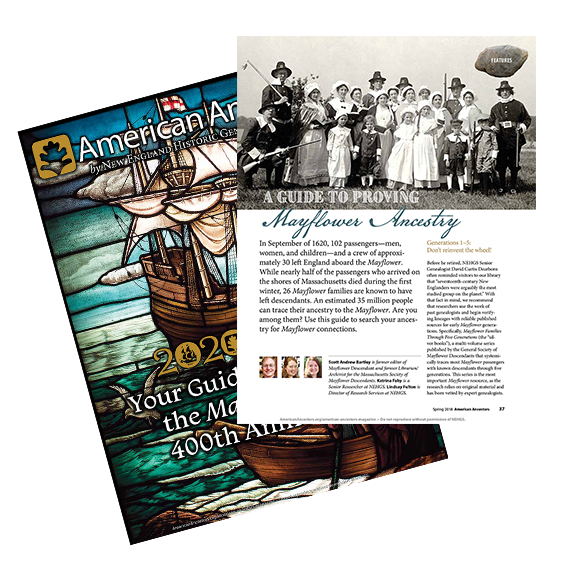
I have been reviewing the Spring 2018 issue of NEHGS' American Ancestor and was given a much needed shot in the arm. The topic deals with the upcoming celebrations of the 400th of Mayflower event which are centered around 2020. Frankly, the scope was quite good, and we can look forward to more of this over the next couple of years and beyond.

Can't wait for all of the settlements to have their party: Timeline of settlements (from Weymouth (1622) to Worcester (1673). And, after. Of course, the list is incomplete (Wikipedia requires continual editorial help).

So, why a shot in the arm? Well, I'm in my 10th year of this work which I have done independently, but I already knew research, mathematics, and computing (which gives the particular bent of my posts). Of course, I started with ancestry[.]com but was off of it soon due to a remark by a D.A.R. registrar. Never looked back. Rather than research other options, I started my own format (works for me) and have millions of items to organize. As I have worked applications (a good exercise and test) to lineage groups (including GSMD), I got the chance to hone the material. As well, I did Dr. Frank's line which I have in ahnentafel (sourced) form (his two paternal grandparents - BB Gardner and LF Wilson).

Along that line, I just looked at a genealogy chart handwritten by Dr. Frank in 1907 (thereabouts). His father's line agrees with what I documented. However, I have more. I noticed that some Mayflower people are now mentioning John Billington (see NEHGS, above). I get to bring up Nathaniel Eaton (friend of John Harvard and first head of his school). And, I have a lot of material including a paper written by a member of The Eaton Families Association. The next TGA (print of Vol III and Vol IV) will include an article on this.

Essentially, Dr. Frank did not expand this tree, publicly. I can see why given what I have read out of Harvard. But, the whole story bears significance of some turmoils now. Just as the 200th of the western expansion pre-dated the major conflict twixt the north and the south, the 400th had lots to tell us about the U.S. and what it might be about. But, just in himself, Nathaniel is interesting (holder of several degrees, including M.D. and Ph.D); his Catholic leanings may have played a large part in his treatment, especially that which might be termed propaganda.

I have done the genealogy of enough now to have covered New England and Virginia and its environs. That leads to things that we ought to be doing. We need an effort to publish the first five generations from Thomas and Margaret. I finally got a chance to look at the Silver Books. Too, we need to go back and re-look. David T. Gardner, from a Pennyslvania Gardner family, has looked at how he might relate to Thomas. See King's Slayer Court. This was the first part that was published in TGA Vol. III. This and the next part will be in the print version (before summer 2018). BTW, mentioning propaganda, David has found some interesting Tudor material (interpretation will always an issue - like the ad, what's in your wallet? - how do you see this is not something to leave totally to experts). Thomas is almost a tabla rasa from what I have seen.

Yet, there is a lot that ought to be collected and organized. That is one task; as well, weighing in with a proper view ought to be more easily done when is little negative influence (such as, Endicott hanging Mary - no last name is needed).

So, we can watch the NEGHS over the next couple of years and learn a whole lot.

Too, we can look at the particulars that Thomas and Margaret bring to bear. Has that sort of thing not waited long enough for some attention?

Remarks: Modified: 01/10/2022

12/30/2018 -- The 400ths will be one theme next year. 

01/10/2022 -- Changed the NEHGS image which disappeared. This year, it's Weymouth's turn. 

Saturday, March 31, 2018

Spirit of '76

In the next TGA, we will provide the Table of Contents from all of the issues of The Massachusetts Magazine. While researching this publication, we found other magazines of the time, some of which are still being published (we will add Harper's Bazaar to the list). In many cases, there were members of the extended families involved. The last issue of the TMM was in 1918. 

I just became aware that an aunt (in-law) had a copy of a book in which Dr. Frank published some of his ancestry. The year was 1907 which was when he published the first book on Thomas Gardner, Planter.

The book was published by F. W. Bailey, who authored several books. He also worked out a format for a book that could be a keepsake. Upon looking up F. W. Bailey, I found that he had advertised in the Spirit of '76.
Ad in issue of October of 1903

What was the Spirit of '76? It was a magazine started, in New York, in 1894. It published until 1906; there are digitized copies of the issues which published monthly. This is the banner for the magazine.
Banner of the Spirit of '76
Its scope included the "history of the American People from the landing of the Pilgrims to the present time." Of note is that it was the voice for several organizations including S.A.R., but the finances were never quite right. D.A.R. started its The American Heritage about the same time and published until 2001. On browsing several issues, the Spirit of '76 covered the same material as did the magazine started by Dr. Frank and friends.

Cover from 1903.

So, expect more on this. Let's end with a little from an article in the Oct of 1903 issue.

Lots to discuss, but the topic very much applies today. Some information about the periodical is available in the book by W.E. Davies titled Patriotism on Parade: The Story of Veterans' and hereditary organizations, published by Harvard in 1955. 

Yearly, in D.C., the Hereditary Society Community, which is a collection of societies whose theme is herediatary, meets over a two week period. We will have more on that. 

Remarks: Modified: 05/21/2018

04/03/2018 -- We will be looking more closely at "The Spirit of '76" as a magazine (its time, format, and operational issues) and as a repository of information; as well, we will look further at the work of F.W. Bailey who compiled works on the early marriage of Connecticut and Worcester, MA.

In his 1st Volume of Massachusetts marriages - Worcester (1897), F.W. appended a two-page ad about his work and the ancestral record: Special Word and Greeting. Some families submitted their books to the Library of Congress.

F.W.'s page on George Washington (TSo76 -1898).

History. Looking at the magazines of 1890s and their illustrations, one's mind goes to the linotype: Linotype machine, The Year That Defined American Journalism: 1897 ... Personally, I remember the Linotype in use plus the early days of Phototypesetting through the days and versions of desktop publishing as it evolved. I might add, not as a printer, but as content provider, editor, and worry wart on getting the thing out on deadline.

05/21/2018 -- The information from the 1907 and the 2010 sources agree. We can now fill in Dr. Frank's maternal information: 1907 chart.

Sunday, February 11, 2018

Ground zero

Last time, we mentioned that January 1918 was the last publication of The Massachusetts Magazine. For possible contributing factors, we mentioned WWI as the United States was sending troops to Europe by the summer of 1918. Armistice followed that same year.

Coverage of flu cases, 1918
Another factor was that some of the earlier contributors aged or passed away: Col. Thomas Higginson, F.B. Sanborn, and others. Dr. Frank had collected editors and contributors from the ranks of Civil War veterans and various New England Illuminati.

Given the recent reminder, we must add the Spanish Flu. It was first observed in Kansas (Fort Riley) in March 1918. The map is from the Stanford University article on the pandemic (page has stale links, to be resolved). Not long after, the virus was seen at Camp Devens which is outside of Boston and was established in 1917.

This was the pandemic where we see rows and rows of cots with sick soldiers. During this time, medical personnel would have been extremely busy.

The base was named for Civil War general, Charles Bevens, who was involved in several battles in Virginia.

Remarks: Modified: 07/29/2022

03/04/2018 -- NIH, in 2004, published an article by JM Barry (The site of origin of the 1918 influenza pandemic and its public health implications) who had researched and written about the flu pandemic in 1918. JM points to Dr. Loring Miner as having observed cases in Haskell County in January and February of 1918. By March, the flu heavily hit Fort Riley. Haskell County is southwest of Dodge City and is named for Dudley C. Haskell (descendant of Miriam Gardner) who had moved to Lawrence, KS with his family in 1855. Dudley was the namesake of Haskell Indian Nations University.

04/04/2020 -- A video with a good overview of the times and situations: 1918 Spanish Flu documentary.

07/29/2022 -- Noted that Dudley is a descendant of Thomas and Margaret Gardner through their daughter, Miriam.