Showing posts sorted by date for query configuration. Sort by relevance Show all posts

Saturday, February 14, 2026

Hype, 1600s

TL;DR -- Anne Dudley Bradstreet is well known, as is her husband Simon Bradstreet. We can use her experience to consider hype over the centuries to the present, as we find now with technology. In Anne's case, she showed up on the Winthrop fleet in 1630 and found out that the colonial life in New England was not what she had told about (or experienced) in England prior to her departure. When she died after enduring several decades in New England, her husband moved into and lived in the house of his new wife which house had a history back to Cape Ann and which house came to bear his name. 

Anne Bradstreet
--

Hype? As old as mankind. Let's look at an example. 

Many know of Anne Bradstreet. She was a Dudley and came over with her husband, Simon. We have had lots of posts about the couple. There will be more as we start to explore a theme related to technology. So, please continue past this reflection on how we can learn from past times beyond the generalized view of the historical records. 

Simon and Anne came over with Winthrop in the 1630 fleet. Simon was heavily involved in the guidance of the development of New England and Massachusetts. So, they lived in Boston as well as Essex County. When Anne died in 1672, they were in North Andover. 

Subsequently, Simon married the widow of Capt Joseph Gardner, son of Thomas Gardner who is the subject of our research and namesake of the organization. Joseph had died in a military conflict with a local tribe of Native Americans. 

At that time, Ann Downing Gardner was living in the Salem house given to her and Joseph by her parents. We featured Joseph and Ann in a February 2012 post in which we mentioned that Ann had Simon sign a "what was essentially a pre-nup. Was this the first of its kind on this continent?" We also featured The Downings in 2022. Her brother is the namesake of Downing Street in London. 

Also, we have looked at houses. The Downing house was an extension of the original house brought by the Cape Ann crew. Our post on the 1st Year has images that show the progression in house technology over those decades in the 1600s. Ann Downing's family's house became known as the Bradstreet's Salem Mansion. 

Anne Bradstreet's
comments, 1630

That earlier post looked at what was available in those early years. Anne Bradstreet provided us a description of her first view of Salem, which gets us to the gist of the post. They arrived with more than could be handled in 1630 as they had been promised that there was a house ready for them. At the time, there was one house of substance which had been brought by the 1623/24 crew and assembled at Cape Ann. Later John Endicott had the house brought to Salem. The Downings did some renovation. 

What Anne saw, largely, would have been huts. Their configuration would have been a modified wigwam with the interesting addition of a stone fireplace which would have provided more structure.   

English wigwam
The Governor's Faire Mansion was the house that the Cape Ann crew put together which later was moved and then extended to the "mansion" that Ann and Joseph enjoyed until she became a widow and married Simon Bradstreet. 
Governor's Faire Mansion
Great House (Cape Ann)


Winthrop was feated in this "Faire Mansion" when he arrived with his fleet. Some of the party went to Cape Ann to pick strawberries. So, Anne would have seen the future. 

We will look further into the technology of the time as points in contrast to discuss modern variants of age-old issues. That is, we have the 250th of the U.S. But, we really need to understand better the colonial period from the perspective of the real people who lived through the involved periods and sent their DNA down to the present time. 

Remarks: Modified: 02/14/2026

02/14/2026 -- 


Wednesday, December 10, 2025

Bespoke software

TL;DR --We have slowly been working on our portal in a bespoke manner. Ten years ago, there was lots of attention on the web in understanding HTML/CSS/JavaScript with examples provided by those who had the time and interest. At the same time, development in machine learning lead to thoughts of autocode (as in the machine doing the coding). Now, we witness countless offers for robotic development of software. Something is wrong.We will look at this, over time, since it's not of prime concern. Yet. Besides we will see shakeouts of methods which is normal for progress. Too, we have lots of pending work to do. One that is high on the list is getting regular attention to the date of the death (29 Dec 1674) of Thomas Gardner (Salem planter). 

---

Want an example? Our Gardner's Gate or portal. We have used the phrase a few times but intend to use it more. Our first reference was this post in January of 2020: Gardner's Gate. In that post, we mentioned a few of the types of research that we were doing. At that time, we may have had some notion of the coming technology interest but did not mention the subject. 

Guess what? A month later, we were informed that a city that we had visited had cases of confirmed COVID. Life changed, then, for a while, as everyone adapted to the new regime brought by the pandemic. For us, we got into research that was more involved (the US interior). One particular problem took us almost two years to resolve; but, we stuck to it and accomplished the necessary feats. 

A little before, we had started the portal (https://TGSoc.org). That was in 2017. In doing so, we took advantage of some earlier work. But, we took a "bespoke" path and will continue. 

Why mention this? Well, algorithms, computing, and such has been John's work in advanced computational systems. The TGS main blog started in the Microsoft world due to the influence of ASP.NET. There were jumblings in that world in 2012 to which we adapted by leaving the Microsoft realm and going over to a Linux server. By the time of the portal, we had a strategy (somewhat). We needed resources and continual involvement, but there were other factors controlling time. 

For one thing, research came first. We have been doing issues of Gardner's Beacon and printed several releases of The Gardner Annals. There were meetings and research for other groups. But, as John worked the bespoke issues, he kept notes and published some of them (we intend to organize links to this material -- see Devlog). 

Too, some organzational work became more involved taking time and energy. But, we kept the TGS, Inc. fires going. Until COVID came along and changed things. Eventually, those constraints went away; people started to get their lives back. 

But, the underpinnings of technology were changing. We'll detail our views and experiences. But, GenAI/LLM appeared three years ago. Our first experience was with ChatGPT after which we settled with Bard/Gemini. It wasn't much later that we had looked at the problems with finding algebraic solutions (Technology and its influence).

Sometime later, interest in what's known as "vibing" to some came to be; too, using LLM  as a tag, people began to develop methods that allowed the facilities to assist in development (co-pilot in some cases; in others, there is more autonomy). We will discuss this from the framework of maturity and dependable/stable computing. 

So, bespoke will be spoken in our world. 

---

Again, research? Thomas Gardner died 29 Dec 1674 (post written 3 Jan 2019). One of our research topics was, where is he and his remains? That topic will be mentioned yearly henceforth. We will put a page on this at our portal in the coming months. 


Notice in the ChatGPT session (link above), we brought in information about Thomas that had been thought right for a couple centuries now. Not long afterwards, we learned that during our absence from WikiTree, they had been analyzing newly-digitized documents from Sherborne, Dorset, UK. Adjusting to that new information is on our plate - Gardner Research. 

Remarks: Modified: 12/13/2025

12/10/2025 -- Some edits of typos and adding new information such as a graphic. 

12/13/2025 -- We started with Microsoft's Office on-line and its developer's tools. The intent was to carry on with the ASP.NET approach (I liked C#), even though my early web work was in Unix, for the most part. Office 365 came along; that was our first instance of seeing companies falter as they learned that their processes no long worked. What did we do? Surveyed the alternatives. Picked a Linux server. And, fell back to HTML where buttons were captured by image and the behaviour was coded using CSS. That worked. The next step was to covert to Javascript. That continues. The issue was content versus configuration and continues (AIn't notwithstanding - map/territory issues will be discussed) Our focus was content and still is except the AIn't emergence changes things. So, bespoke? We're putting out a new issue of Gardner's Beacon (Vol. XV, No. 1) and will be starting to redo our analysis. We'll report regularly as we go along. As we will stop and discuss choices in the vein of engineering tradeoff analysis. 


Friday, September 5, 2025

Fifteen years ago

TL;DR -- We started in 2010 with our website. The blog came about in Sept of that year. As we learned about history and genealogy, we custom built our website in a minimal fashion in order to spend more time on the domain knowledge. Time and technology has changed. The need for bespoke modes has not and will again be recognized. So, we'll continue down our nonAI approach. Pending research deals with origins. We touch upon the subject and our plan for the future. 

-- 

With the new world of computing being pushed upon us, mainly from the GenAI/LLM incursion on our thoughts in November of 2022 and the ramifications associated with its arrival, we are reorganizing our information. In fifteen years, we have ventured down many paths, made some discoveries, but found more questions than answers. We'll briefly look at origins and son John, because he and Richard were of Nantucket which kept good records.  

Our first post was on 25 Sep 2010 (Welcome). At the time, we had been using Blogger (later purchased by Google) for three years. According to our What's New page, our site was started in September of 2010. This was our first report on that page: 

09/01/2010 -- A blog will be started soon. Questions to ponder will be one topic, such as where was Thomas between 1626 and 1637 (freeman status)? Where is Thomas now (in terms of remains - or, at least, the stones of Abel, etc.) since pavement was put in over the old Gardner burial ground?

Just from the questions, one can see that we had already started to research. The Whereabouts of Thomas became a regular theme and is a now a meme of lost graves. But, number of wives was up there too. This we made progress on thanks to the internet and the appearance of digitized documents from Sherborne, Dorset, UK. 

Our site, originally, was on Microsoft's service of the time which we had for a couple of years. One reason for the choice was to use C# of Asp Net. MS provided their users with a nice tool for creating and managing the information related to small business. We liked that. But, MS decided to move to what became Microsoft 365. 

We decided to drop back to Linux given John's Unix background. But, it was clear. Given how much we needed to learn and organize, we had to spend lots of time on information (domain knowledge). There was little time for development and fiddling with the architecture or actions of the site. So, John snapped little graphics from the Microsoft site and use them in a new page where positioning was handled by the table facilities plus a little CSS. We are documenting this bit of activity (see "Requirement" on this page - technology and practice). Then, as we got better organized, we brought in JS to add actions to our site. 

Again, more time was spent above the floor of configuration and use for knowledge processing with the below the floor technology being done hurriedly. For a HTML editor, we used Sea Monkey. For JS and some HTML and CSS, we just picked up the file with Notepad. Testing was clumbsy in the beginning. But, Google's Chrome's support for the developer's needs improved through time. Once we got into the Google Development session, we were reminded of the full-blown workbench for the developer. 

However, that overload can interfere with proper focus on the knowledge involved. It's a case of hats with each dealing with some domain (technical or conceptual or ...), and the juggling of hats can be fun but eat a lot of time and energy. We'll be back on this topic due to LLM's (and its companions) influence on the environment of computing and on people's and user's understanding of such.  

 ---

On 13 Oct 2010, we mentioned the Folger family. Earlier that year, we had been in Salem, MA and saw a book on John, son of Thomas and Margaret. We have had several posts on John, such as this one: John Gardner and the Merrimack River. Here we asked the question: was John better off with the mathematicians who were doing the survey than his cohorts in Harvard learning about the number of angels on a pinhead? Or partying as we see higher-education affording the opportunity for youngster, many times for the first time. That type of question is as true now as it was then. 

So, we will look at John and the Folgers, primarily due to John's emphasis on the use of Sherborne on the Island of Nantucket. There is a reference to John saying that he heard of it from his father. For starters, here are two pertinent pages. 
As we go along, we will discuss a new format and how to structure it. AIn't is apropriate until we hear of substantive movement in the realizations from research. At the same time, we will lay out the basis for the current hype plus explain a working approach of which there will be many proposed over the coming years. 

Post note: Cannot let this post go without mentioning the 15 years of change. Quite frankly, we miss some of the sites that we saw in the 2010 timeframe that represented research by Gardner families over the years. Some sites are still there. Many are not. As we try to build a comprehensive database of Gardner information, we will attempt to disciover some of the older sites through services like the wayback machine (Intenet archive which we have used a lot). At the same time, we have to bring in the modern and futuristic modes being talked about and done. Quite frankly, maturity seems lacking in a lot of these approaches. But, that's a side issue. At regular points, we'll review our progress and trace the pros/cons. Right now, we see no reason to not continue with the bespoke approach. Anyone who wants to touch code can help. Tools? We have minimal but that can change. Vibe coding? Prompts? Some of that is reasonable. But, people are the core of interpretation and judgment. Not machines. Yet.  

PS (sort of thing): With the huge Rorschach Test thrown upon us about three years ago (Nov 2022) and the ramifications seen and potentially realized, I never went with the offer of LLM's enticement of  purty prose. Nope. Actually, except for spelling, these posts will not be checked except by human editors without tools other than pen (real or imaginary). Too, we retain the right to update grammar, et al, as time pases. All edits will be noted within remarks as we have been doing from the beginning. ... People are going to be the focus.   

Remarks: Modified: 09/06/2025

09/06/2025 - Spelling correction. PS added. 

Sunday, June 22, 2025

Bunker Hill, II

TL;DR -- The Siege of Boston continues until March of next year. This past week, there was an effort by the British to dislodge the patriots (or provincials as known in London) which didn't work. We will have to look at what the next nine months entailed for both sides, in MA and elsewhere. Speaking of which, "Bunker Hill" has been used a lot in naming over the 250 years. We compare the MA one with that area in DTLA with the name, again. But, will look at some others, ,worldwide. 

--

Right now, we are in the period that was associated with the Battle of Bunker Hill with a main skirmish happening on 17 Jun 1775 with the first piece of the action happening at the locale of Lexington & Concord in Apr of 1775. Bunker Hill Day is a regular holiday in Boston on Jun 17th. 

At this time, in 1775, the British were still surrounded. The Siege of Boston continued. The next day of commeration will be the Evacuation of Boston that happened on 17 Mar 1776. 

As we mentioned, the Massachusetts Magazine had an article on the troops that participated in this Siege with some information about the officers. There was an article in every issue, 1911 to 1918. 

And so, we will look at events and people over the coming years as the 250th lookback unfolds. 

----

May we change gears? Bunker Hill is a little over 100 feet high and is in the Charlestown neighborhood. There is a monument for the event on Breed's Hill which has a lower elevation and where most of the activity took place.

At the time of the Battle, the British owned the waters as Boston was across the Charles River from where the Battle took place. The whole affair is quite strongly resident in the American mind. In fact, Bunker Hill has been used as a name in many places. We will look again at Bunker Hill West which is in Los Angeles and about which we have had several posts. Today, we look at the lay of the land. 

But first, here is a London map of the situation in 1775. 

Printed Aug 1775, London

Before transitioning to the west coast, we have to mention the last surviving veteran of the incident: Ralph Farnham (1756-1860). He is of the upper part of Massachusetts now known as Maine and is cuz as are many. We will look at him, again, as the whole of the Maine experience needs more attention partly due to the case of the southern entity, Boston, was more prevalent in historical accountings. 

---
 
Now, Bunker Hill West? The name has been used in many places: the Wikipedia list. Notice that Los Angeles is on the top of the list. Our interest was first brought to the area as this is where the stage coach route from St. Louis arrived after an arduous trip down into Texas, across the souther border (wandering into Mexico), and then ending in Los Angeles. That was not the terminus, as with some refreshment of resources, the stage line then carried passengers and freight up to San Francisco. Where, the process started again on the way back to St. Louis. 

Mind you, folks, there are several things to consider: logistics (compared to the Pony Express, this was much more of an intricate maneuver; we are talking pre-Civil War however some of the western States had been defined (such as Missouri in 1820 - added along with Maine to balance the north-south  issues; in terms of Bunker Hill in DTLA (Downtown Los Angeles), though, the terrain was entirely different as we will be pointing out. 

The lowest point in DTLA was about 59 feet. The hightest was the hills to the west with Bunker Hill (BHW) topping 350 feet. DTLA is many miles from the ocean. In terms of survival, being in a sheltered, inland cove with fresh water from the mountains would be more appealing than the environment now associated with being encrusted by salty waters. 

In the latter part of last century (post the 1950s), there was an effort to knock BHW down which seems to have been successful. They flattened the basis for the high rises that rose and that are now photogenic against the background of Nature's display of mountains. 

Here is an example. I marked three things. 1) On the right, the line points to where City Hall pokes its head up proudly. This 1937 building was the limit for heights until later in the 1900s. We can be more specific. There are early photos from Bunker Hill showing the top of the spire of the City Hall. 

Now is the time to mention one other thing. In the center, the tannish (round) building behind the white (square) one was the first building to penetrate the old limit. The developers used the opportunity of the LA Library having experienced arson and selling its airspace to get funds to recover as a means to start the trend that gave us the high-rise look. 


So, speaking of the Central Library, they recovered physically and bought replacement books. But, there was another instance of arson later. To me, on any of these photos, I look for the bank building and figure out where the library is nestled (having spent many hours there; across the street; the base of the bank building is on higher ground along the elevation of BHW). 

2) and 3) These have to do with old DTLA from the time of New Spain onward. In the middle, the text says that if we jump (or fly like superman) over the buildings we would find the Old Plaza Church. Several of our posts have photos of this building from various time periods. Yes, it was there when Butterfield came in with his stage line. In terms of the beauty of DTLA, the Train Station which is a remarkable example of SoCal architecture is across the street. 

So, now we can consider another church. Not far from the Old Plaza Church and the City Hall is the structure that was St. Vibiana, a Catholic cathedral. That old building dates from the 1870s which is new from the west coast view point (reminder for those looking from the east). An earthquake caused some damage but not enough to destroy the building. It now is an event center of some note. 

The cathedral was moved to the left side of the photo where US 101 and the 10s intersect. We can figure out the lingo, but the area has been visited by tourists with many photos extant. This view shows the extent of the high-rise area. And, the larger buildings are clustered there at BHW. 

---

There are early photos (1870s) showing that people started to try to tunnel from the getgo. Several tunnels were completed with many still operational. As well, there were steps put up for people having to go up to the buildings on the BHW or over to the other side. And, the Angel Flight configuration of a rail car exploited the arrival of electrical power. Fortunately, through many periods of reconfiguration such as the scraping down the elevation, people saved the old mechanism which is now more of a tourist event rather than operational. 
 
---

What's next for looking at the namesakes of Bunker Hill? 

Remarks: Modified: 12/23/2025

12/23/2025 -- More on the Butterfield stage as representing the U.S. government's concern for handling Overland Mail. There has been lots of research about the trail from St. Louis MO to San Francisco CA. 

Tuesday, September 17, 2024

HD Thoreau, Minnesota

TL;DR -- One persistent theme will be Native Americans and the future of the U.S. We will start a series in New England and follow its long arm across the country. Too, we look at Concord which brings up Thoreau and his friend, Emerson. The latter has appeared here more than once; let's take time to know more about HD. 

--

One obvious theme that the TGS must pursue is nature versus technology. It has been a theme of increasing complexity over the past two decades. Though lots of subjects pertain to this theme, we merely touch upon a couple of major aspects in this post. One in particular will be "intelligence" as it has been associated with life (not with buckets of bits or whatever configuration we might conceive). 

Last time, we mentioned one of the native tribes (Nipmuc) of the New England region where the European culture of the U.S. got its start some 400 years ago. Although there are tribes over the entire continent, we will start in New England and learn about Native American culture with respect to the U.S., its past and its future. 

In the map shown in the prior post, the region of the Nipmuc tribe included an area called Concord where the English settled. We have several families under study who were associated with the middle and western parts of Massachusetts. We'll pick HDT who was friends with our cousin (Ralph Waldo Emerson) who spent his years after his father died in the environs of Harvard. RW Emerson has been mentioned in several posts. 

Today, we consider Henry David Thoreau (Wikipedia, WikiTree). HD was influenced by RW's little tract on Nature. Two of our favorite sources provide the full text of this RW take on matters: Transcendental web; archive[.]org   

Venturing further, we can quote a Harvard study published during the time of HD's 200th memorial. The study found this quote of HD, who BTW was a graduate of the Institution. 

Instead of helping Harvard, he said, men should consider giving money to their towns to preserve and protect a huckleberry patch.

The “commercial spirit” of the day, he said, rested on a love of wealth that made people selfish and greedy. The world would be a better place, he said, if people “made riches the means and not the end of existence.”

For the most part, HD was in New England. Later, in poor health, he ventured out to Minnesota to look for a better climate in which to live. He had struggled with TB. During his time in the St. Paul region (1861 timeframe), HDT was impressed. 

To be brief, we provide links to material on DT and his life. 
  • HDT's Final Journey: Minnesota - Mayo took note of HDT. They provide this quote: “For my part, I could easily do without the post-office. I think that there are very few important communications made through it. To speak critically, I never received more than one or two letters in my life — I wrote this some years ago — that were worth the postage.” 
  • Thoreau and the Minnesota River - being a naturalist, HD would have wandered under the MN skies. 
  • The Life of HDT - one bit of activity by HD was forming a school with his brother. HD had taught at Harvard and wanted to spread the good joy of learning. We will be looking at this type of thing in depth, as New England, from its start, emphasized universal education. 
Information on his supporters.
Samuel Hoar (Wikipedia, WikiTree) 
Nathan Brooks (Papers, WikiTree)
John Keyes (Autobio, WikiTree - brother George)
R. W. Emerson (our post)

----

Back to Harvard, we see that they recently performed an experiment with GenAI and classwork. The topic was Physics so that provides a wonderful grounding affect due to the empirical nature of the study. Reminder, back in HD's time, this field of study would have been (actually, was) known as Natural Philosophy. 
  • Professor tailors AI tutor for Physics - one encouraging result is that this effort followed the theme of increasing human insight using the tool of the artificial tutor. Test results indicate that those in the study who used the AI mode scored better. There is a lot to look at, but this work has to consider psychological and social factors with respect to the tutor experience. 
Remarks: Modified: 09/17/2024

09/17/2024 --  

Thursday, August 29, 2024

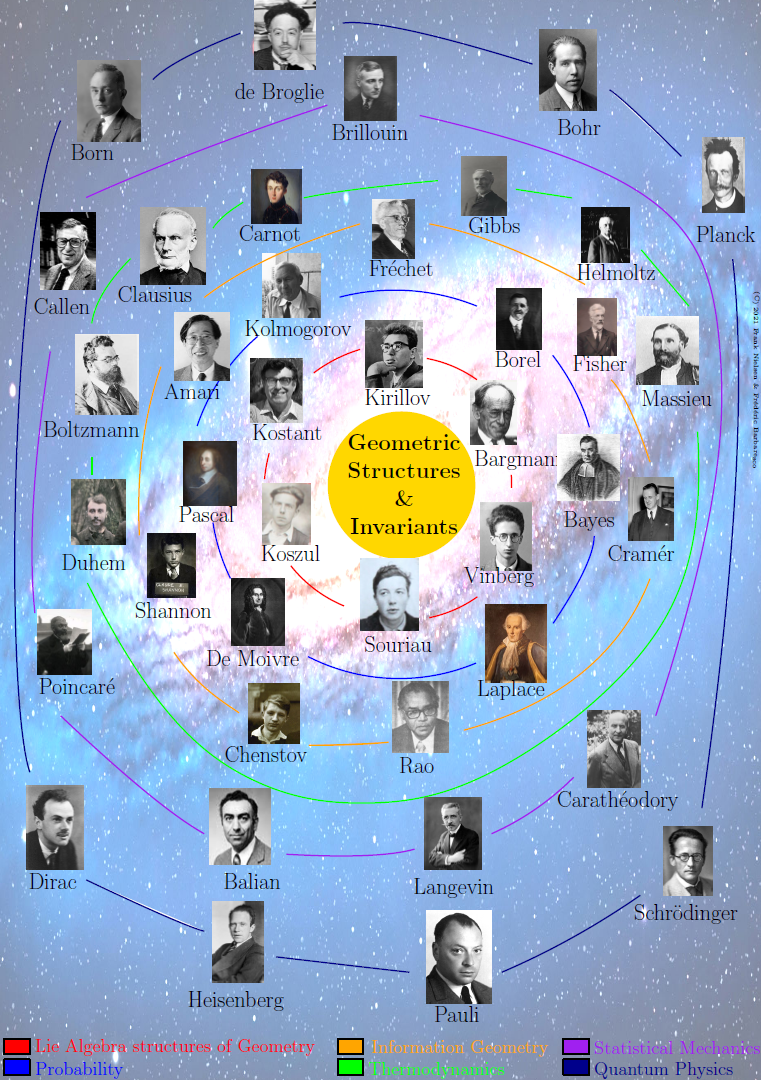
Geometric Science of Information

TL;DR -- Two basic pieces of mathematics are algebra and geometry. There are others. But, the geometry folks have met over the years and are presenting what they know in a manner that needs attention. Hence, we'll look at that before going on to general modeling. 

-- 

We write of technology. But, we have to look at mathematics, as well. From several senses, as it is the basis for parts of STEM and has operational use as well as being involved with the more esoteric notions.

Of late, I have been reading of the Geometry of Information. In terms of knowledge, one thinks about logic or machine learning which has many aspects. But, core to our being are two facilities that we use of many others. I stress these two due to the topics related to things going awry when the understanding is insufficient to prevent misuse or creation of lures that lead to disaster. 

For instance, when ChatGPT was looked at by an elderly AI person, he said: train wreck waiting to happen. We have written of GenAI (the overview concep) a lot this past year, including examples of using the systems. And, we talked about our leaning toward Gemini. 

But, we are going to be more specific about mathematics as we look at knowledge systems (from the '80s) as being of importance for trying to balance the potential harm of machine learning with human considerations about their future. Our theme will be (like we read in a DOD paper) that humans (and their intuition) are the focus, and the artificial is a tool to be applied by humans. Of course, that is hard to see given the configuration that provides us a bully (another one - we have had those forever) that is a know-it-all or wants to be (wannabe). 

Okay, we will do this on a regular basis. Let's leave with an image from the GSI folks. 

Remarks: Modified: 12/28/2024

12/28/2024 --  Updated link for the GSI image. Need to add link for Josiah Willard Gibbs who, after Planck, got our interest in the history of thermodynamics as it paralleled mathematical discoveries. One might also say, his work culminated in the modern computational morass. 


Monday, August 5, 2024

Memory - present, past

TL;DR -- The cloud and such? What's the use? Science was an early motivation for the research and engineering. We're at a crossroad, somewhat. So, posts on technology themes will be a regular occurrence. 

---

Technology is the theme as it has given us a universal memory machine, somewhat. That is, computing and its cloud and the related trackers provide a seemingly endless memory. That digital ocean was one of the things used to train GenAI (ChatGPT, &c). Back in 2015, we had a post (Web/cloud presence) that brought up the choice for us all, ought what we do be forgotten? 

At that time, the cloud was 10 years old (we date it from GSA's decision that the US Government could use the emerging resource). We found out the other day, that Microsoft's cloud is used in the work of 85% of the US Departments. What comes to mind? Single point of failure, for one thing. 

Technology brings changes to which we have to adapt. That neverending affair can be a little offsetting. We do have choices in the matter which will be discussed on a regular basis. 

Today, let's look at keeping something that has value. 

The context is Physics and its rewards. The technology is a blog that quit adding new material a few years ago: Lady Science. There were two contributors from 2014 (see Archive - of their Monthly Issue). The first of these was titled "Delivery Room Drama" (17 Oct 2014). The last issue of a post was 8 Oct 2021. On browsing the site, we thought that it's good that this material is still around dealing with the topics of women, history and science. Some of the earlier posts were oriented toward art. One of the writers went back to school to learn the history of science. 

And, the blog got attention. Fortunately, it's archived at the Library of Congress. After a pause to look at our interest, we will discuss how we found this blog. 

---

So, our technology focus will make use of this material. Too, we like to do some comparisons related to time. In 2014 (see posts from that year), we were working in this blog plus our website which was hosted by a site using Linux as the OS. We started with blogger in 2010 which was picked up by Google. Having started our site with Microsoft, we moved when they went to Office365. After researching content vs configuration, we went with custom development. We have blogged about the technical aspects on the necessary choices and will organize a better summary review at some point. As, right now,we're looking at the future of software from several angles. We can all see the edges fraying. How did this happen? Can we recover without too much pain? Lots off questions. 

--- 

Also, we have paid attention to women and science in posts. See post on the daughter (Geertruida de Haas-Lorentz) of Hendrik Lorentz. We discovered her through the experiment of Einstein that she gave to a museum which represented the facility of small experiments. 

Today, in LinkedIn, we saw a post of The Nobel Prize group about the 1912 marriage of (Margrethe Nørland Bohr) of Neils Bohr. She was actively involved in his research and writing, but that work is not mentioned by the group. A comment provided this post: Crafting Quantum Theory: Margrethe Bohr and the Labor of Theoretical Physics. Their son got a Nobel Prize for his work on the nucleus. 

This blog represents several things. It's content will be apropos to the continuing discussions of STEM and its uses. Too, though, the structure of the content and the approach to the subjects are remarkable. As well, we like how it was designed for several reasons. Which of the various subjects to be addressed will be first is unknown. We're bringing the blog to awareness, in general. 

---

Our new project deals with a redux on AI along several fronts which deals with the timely problems that will emerge soon enough. 

Remarks: Modified: 08/05/2024

08/05/2024 --    

Friday, July 12, 2024

Gardner Beacon, Issues

TL;DR -- Before we publish GB XIV, 1 and 2, we take a look at the fourteen years of Gardner Beacon issues. Some of the PDF files have been republished with links. That effort will continue until they are all updated. 

--

Yes, we are in our fourteenth year with our first issue being in May of 2011. One thing to notice is that the blog has "Gazette" in the name. We were leaning toward that but changed to "Beacon" for several reasons, one of these does point back to Winthrop's sermon in which he used the "City on the hill" phrase. 

We have an Index from the beginning. For every issue (using GB I, 1), we had the blog post (above link) and a PDF (with a link to a print version) at our Heritage site. For the first four issues, we had a Sources file which gave some sense of the provenance of the material. Two years ago, we started to redo the PDF to include links to the material being discussed.   

At the same time, we created a mobile-friendly version of the issue using WordPress which was an improvement on the HTML/CSS experiment that we did earlier. This happened when Google announced that they would not link in their search results to sites that were noncompliant. This was the 2015 timeframe. 

Since then, we went with a more adaptable method using HTML/CSS/Javascript as we see with the portal (TGSoc.org) which was quite interesting in terms of doing custom sites. The trend has started toward the look-alike type that has become so prevalent. There is a lot to discuss about using these, but let's put that off, for a while. As the topic will be important in the near future as the world shakes out the influence of technological changes that came about with no seeming forethought. 

Now, before going on to  GB XIV, 1, this table shows the list of issues where we are tracking the conversion of the issue to the PDF with links. The exercise allows us to review the past fourteen years in terms of content through time. 

-----

Curation will be more important in the future than it ever was. The following effort allows us to go to all of the issues and link to material that can be considered source. 

         Track updates to GB issues, Published  

Since 2022, we have published with WordPress

Vol. XII, No. 1; Vol. XII, No. 2; Vol. XII, No. 3
Vol. XIII. No. 1; Vol. XIII, No. 2; 

--------------

After we complete this exercise, we will go back and determine where we need to publish a correct due to the change in status of the information. That is, what impact does finding the records of births of the children in Sherborne, Dorset, UK have on the issues? We expect that we'll include a link to an error-correcting blog post that will be availabe with lists of contents and indeces. 

Remarks: Modified: 07/13/2024

07/13/2024 -- One issue relates to starting the new blog in WP. In the focus on content, a couple of configuration steps were not completed. One of these dealt with comments. That was no problem for two years. GenAI's general emergence in 2024, as 2023 was a period of getting familiar with the phenomenon, allowed easier programming, such as hacking out comments. The comments accumulated by the 1000s, slowly down response. That stream has stopped; all existing comments were deleted. Hence, response is now as expected. Comments can be sent to: jmswtlk@tgsoc. org. 

Saturday, April 13, 2024

On data and types

TL;DR -- Recent events in computing have many worried or concerned. Some are running after the opportunity for new ways of being mean-spirited and domineering. A little word of magic might be "transform" which has been touted many ways. Of course, this goes into the mathematics. We can shed a new light on the issues but have to go back further than the 20 years of the mess making. We go back to 1837. That is how old many of these ideas are. Over time, we'll come forward with a proper history of computing and its enabler based upon mathematics. 

--

In the 21st century, we have had over 200 years of experience of data on individuals in the U.S. Why we use the U.S. is due to the historical aspect of this discussion. Now, people have been tracked all over the place. Russia (Czar on down) has been good at this. Their novelists told the tale. Tolstoy may have acted like a peasant (serf), but he was none. And, we have information on his life and activity, some of it given to us by the man himself. No doubt, there are lots of the peasant class who never got any attention. 

So it went across the whole world.  The U.S. started their systems from the getgo, 400 years ago. In some towns, at least the birth, marriage, and death were recorded for a person. Many have less information or none. Some have more, including books about their lives. Other places did similar recording. But, the U.S. is unique for several reasons to discuss. 

For now, let's remind ourselves that data handling involves technology. The colonial U.S. used pen and paper. Some of those records have been digitized which is not of interest until there is an effort at transcription and labelling. Sometime in  the 19th century, there was a change. We found a way to print records; too, the typewriter came to be. Both of these increased the quality of the record, somewhat. Though, such an evaluation would require us to discuss content versus configuration. There have been some posts on that, but a more full exploration of the topic is on our to-do list. 

Sometime in the 20th century, the computer came to be. GIGO (garbage in; garbage out) was coined to account for how willy-nilly use of the technology did not contribute to quality. The data industry got better at handling errors (of many types to discuss); however, abilities of the artificial elements outran our capacity for pursing quality and pushed us toward a lackadaisical approach. We are now paying the price. 

What the 21st century just brought must be linked back to the mobile device that came into existence in 2008 which represents what can be called "edge" computing that we'll hear more about as time goes on. Not only was data accumulation increased, there was no way to do the proper deed of curating nor was there any inkling of desire to recognize the coming problem. In 2022, things changed when a focus on machine learning (ML) reared its head. ML is mathematics in action. Below, we will briefly touch upon one huge issue. 

First, though, that little system (let's use ChatGPT - and call it CG) hit the airways and the cloud (which we'll go into in depth), millions signed up. Myself, I was not aware of the event and the reactions for two months for many reasons. One of these is that this stuff is old hat (below), and I made my peace with the technology decades ago. But, when I did become aware, I looked back and forward and sideways. The first was refreshing my memory of the long trek of technology; the second was considering all of the possible ramifications, most of which would turn out to be unintended consequences of an other than positive nature. 

However, insightful people saw immediately that this was toy stuff. Too, it was more for entertainment and gaming. Folks in the real world of metrics and accomplishments of notable scope saw the surface nature. Myself, in terms stated above, we saw more configuration than content even though the purveyours of the mess touted that they had assorted hundreds of millions of parameters in their effort at having the machine learn. 

That statement goes along with what people think of in terms of power (omnipotent) and knowledge (omniscient) and a few more. Why was that a choice? It turns out that studies show that removing the "crap" (so now, we have CICO) is not possible given the current state of computing. And, in terms of complexity, most likely never. 

So, we get to the gist, immediately. People have been solving problems from the getgo. Where was the user respected and given proper control beyond the playing around aspect of "prompt engineering' which would not converge to any "truth" of value. 

We will address all of this again. But, let's go back a few years. A huge player touted that they went with "transforms" and accomplished remarkable results. Sure, like the "fakery" of several types. That is not a new concept. I have written that several times. This is old math. 

------

So, let's step back a couple hundred years. Oh yes, think of what was going on in the U.S. at the time. We have lots of posts about events on these shores and the people involved. In the west, Jedediah Strong Smith had been out west for a while having crossed the continent by foot and horse (and water, at times). He was about to meet his demise in KS on his way back. 

There's a lot more. We will look at a book (below) which is a summary of the collection by the Bourbaki writers who used a common pseudonym. These were books that covered mathematics from an axiomatic basis while developing what might be called a standard view. We are skipping around more detail while we focus on the mathematics largely behind the CG and its peers. 

The author, quoted by Bourbaki, in 1837 writes about the growing interest in transforms as they showed promise. There are many names to mention, however the techniques of Fourier which we will look at later are an example. Now, he says that anyone using the techniques can generalize and obtain new truths. Too, he uses the metaphor of adding "a stone to the structure" which very much applies to what we are seeing. 

We will go into the AIn't part, regularly. But, as a reminder, there is no creativity involved except on the part of the human. There ain't no creature in the box. There is something, oh yes. Superb mathematics which was not possible before the computing. 

Overview of Bourbaki's work
In this sense, we need to review the claims. All of the methods are of old age. They were very difficult to grasp and never easy to handle by manual computation even with a sophisticated slide rule. Early computing spent a lot of time to learn how to approach the use using methods that are called numeric processing. Algorithms are the name of the game. And, these were never simple. 

Note, too, that the author (Chasles) addresses the issue of being confounded by the results. Remember last year's discussions about black box and lack of understanding. Well, that state of confusion was a contrivance, mostly unexpected. In some cases, we could look for actual intentions to have this effect. 

This year, 2024, has been encouraging in terms of people recognizing the problems and trying to figure out how to go forward. We'll be putting our hat in the ring there.  

Now, who is the author? Michel Floréal Chasles was a French mathematician. He might seem to have been obscure, but in the U.S., he was recognized for his work. He lived from 1793 to 1880. His name is enscribed on the Eiffel Tower. 

Remarks: Modified: 11/13/2024

04/14/2024 --  So, in the post, I mentioned some good news. But now, bad news? The IEEE Spectrum gloated about perplexity.ai. So, I had to go look. And, my first two tests failed. That is, the thing pulled from the appropriate sources. It was too creative or something else in the output. ... My suggestion to you guys doing this stuff: some of us would prefer that your give us some summary without the embellishments (as your approach is not creative) with footnotes. In fact, the footnote ought to be the phrases that fed into the summary. Oh, cannot be done? Then, let's go back to the drawing board. This old guy has time and knows how to do this. It's related to my work on truth engineering.  
I'm referring to a context sensitive encyclopedic approach. That is, without the "omni" aspect that seems to excite the younger crowd. Want to know the real "Omni"? We can talk that. ... Some of my grief is that the thing is following what might be misguided text, anyway. The hope would be that enough sources would be good enough to pull toward something useful. Or, do curating before hand, as many are saying (the older xNN experts). ... 

11/13/2024 -- Moved image. 

Sunday, March 24, 2024

Geertruida de Haas-Lorentz

TL;DR -- Running through links on a topic can lead to interesting finds. By a circuitous route, we ran into a colleague of Einstein who lived in the Netherlands and several other finds. Their work showed that inexpensive experiments can do the job. A related post continues our discussion on content versus configuration. 

-- 

Technology is our interest, and it's without limit. Today, we were researching relativity as it applies to some of the modern turmoils. Mainly, this is to set a basis for future discussion and work. In his book on the Evolution of Physics which he wrote with Infeld, Einstein discussed the rise of the modern views, from the perspective of the 1930s. 

One thing stressed was the importance of knowledge and the means for obtaining and managiing such. That applies across the board and usually was a human endeavor. Now, we have other wrinkles coming into sight. These are not new which we will go into. 

But, on reading material, I ran into the old topic of content versus configuration. Or, vice versa, as it's a two-way street. In fact, the TGS work has been important in following the ins and outs of technology as the web and its use became more sophisticated. Mentioning acquisition of knowledge? Mostly, that seems to be associated with the artificial. But, no, people need to  learn to. 

So, there was a hit on a search for a algorithm that pointed to a website (HyperPhysics) managed at Georgia State. The site uses Java and Javascript to provide demonstrations of algorithms related to research in Physics. It has a goal of providing information of a technial nature to teachs of High School Physics. The Georgia site also links to HyperMath which of the same approach. Both of them are great. 

Another link goes to Physics World which is all modern and mostly reporting. However, the articles are a great collection. One of them motivated this post. 

Given that this is Women's History Month, we wanted to feature Geertruida de Haas-Lorentz who provided an experiment to a French museum. It had been done by her husband and Einstein in 1915 and showed a connection between magnetism and "angular-momentum of electrons" using a simple device. Geertruida herself did experiments that tested Einstein's proposals about Brownian motion. 

Her father was the Nobel Prize winner for his theoretical work that supported Einstein's relativity research. 

This was Einstein's only experiment as his work was theoretical (and cultural). 

Back to content and configuration: old (This week's finds ...); new (Azimuth). 

Remarks: Modified: 03/24/2024

03/24/2024 --  

Friday, March 15, 2024

Questions and such

TL;DR -- Bridging across 400+ years will continue to be of importance. So, our quest will be an ongoing process. Technology? The next two years will provide more of a view to the issues. Right now, we can only intimate. In reality, hype abounds. AIn't adopters will be in for a reckoning. 

-- 

It was a year ago, when we found out about the new information about Thomas and Margaret that was available via digitization of records in Sherbourne, Dorset, UK from 400 years ago. WikiTree used the opportunity to split out their Profile of Thomas into two people: one was at Cape Ann who is unknown, essentially; the other is the one who married Margaret Frier. 

The work and discussion had been done while I was distracted by what became to be known at GenAI. There are several blogs on this. But, we're at the stage to move on and do it right. Not that what had been done before was done wrongly. So, tsk, guy, at WikiTree who passes judgment. We'll take it from here with respect to these two gentlemen or one (our choice - until we really know).

On the first (AIn't), look at the series here under my name: True State of AI Tools, 2024. We started this last year after assessing what OpenAI's toy/tool brought. The jury is still out: those who don't know, let's discuss rationally; those who are on the bandwagon, just be aware of the faults that shake the foundation (oh yes, let's to go Einstein's introduction of the mathematics of Relativity to do this, General, that is - and then come forward to the current nonsense).

On the second (Cape Ann, &c - btw, that's what was used in the time of Levi-Civita), how will the research and change proceed? Well, we got started in 2009 but formalized the effort in 2010. By 2012, it was obvious that there were all sorts of opinions, worthy of note (okay?, we'll discuss - we do not like the top-down dominance that seems to appear - more later). So, this happened. 

  • What we know - notice, November of 2012. What took so long? Well, search in this blog on Content and Configuration. I was dealing with new content related to history and people. This was after transitioning my brain from technology, especially advanced computing. And, configuration? I used CMS; later, I pointed to GitHub (with Co-Pilot, is even better of a foild for discussion) as an example. Two hats? Okay. One person's content might be another's configuration. And, so forth. Science and engineering are full of examples. 
So, switching to the 1st, a monolith of knowledge? Nope. The whole framework is idiotic. We'll show this, eventually, if we live long enough. Too, GenAI? Purty pictures. Read about the difficulty of doing something real, as I show with the knowledge-based engineering work that actually bumpled up against the world successfully by meeting constraints intelligently. And, the word salad? Oh yes, perfect grammar, perhaps. But. meaningless. Anyone finding meaning is demonstrating what the Gesalt view was about. 

Going on. Later, we figured that we had enough and started the following using a different format at Google's Blogger. Posts are meant to be conversational through time. Pages (see our Page map) are static. We did this page. Both the post and the page have been annotated with respect to the current topic of needed changes. 
  • Frequently asked questions - notice, later. We did not know a lot, even then. But, we thought that we ought to organize this into questions. These might be reworked to have a good set of questions. However, they'll each be updated. 
So, we have started the work. One thing was to add an opinion category, OpEd. One thing that we noticed over the past decade plus. When we started, the internet was still somewhat open which allowed satisfying queries to be made and tweaked to obtain some semblance of an answer. Now It's been trashed. So, that will slow things down. 

Before now, we also saw lots of site with reseach done earlier. Lots of that disappeared. We had collected lots of links over the years and need to prune these out. But, for some, trying to see what happened will be of use As, that was not work to be wasted. If the stuff is available elsewhere, we want to be cognizant of the work. 

Remarks: Modified: 03/15/2024

03/15/2024 --  


Saturday, January 13, 2024

Ten years ago

TL;DR -- We will start with marking by category, put in a header about the coming changes, figure some reasonable modification to apply, and get them into place. At the same time, we will reconfigure with technology updates in mind. 

---

Ten years ago, we were four years into this medium exercising our reading intake. Sometimes this was via expressing opinion (see this post in December of 2023 - Opinions count?) which is everywhere. Papers have the OpEd (we added this category) for a purpose. Other times, we were reporting results that we had no reason to doubt. Thanks to the good work of Bob Dunlop we know more about Thomas and Margaret and the family than was known before. 

To recap, we have been using this post (In Summary) as a reminder that our websites will be updated and that we'll keep using the blogs for information with respect to what we know (our first post on What we know was in November of 2012). In the next few weeks, we will have more information on what needs to be changed. In terms of some of the OpEd type, we'll put in a header with respect to the status as we will keep the information for future reference. 


One thing that we noticed when we started is that there was a lot about Thomas Gardner on the web which was 19 years old at the time. One could see the different generations (web evolving) of these. So, from the start, we captured URLs and, as one would expect, is a huge collection. One a recent review, many of these have disappeared or merely moved. This is the same problem as we get generally and which there have been solution attempts. One example if archive.org who also provides access to on-line books. In terms ot we pages, one can see the page. But, links are not pointing to active sites. 

As an aside, many have gone from static pages to a wholely database approach. That goes back to an old argument of compute or store. Remember, we have a technology focus. It is becomeing clear that we have to know the history. Some things under the covers are old. Perhaps, we would use many if talking the infrastructure that is reliable. Be that as it may, there is a use of the static page. Our sites use this method with some database facilities, like WordPress. This discussion comes under Content versus Configuration which we will continue with the focus having a priority on Content though we dabble with Configuration. 

Back to the subject, notice in March of 2014, we had some OpEd posts dealing with Cape Ann. Some of those may have been conjectures based upon the work done so far. At the time, the basis was minimal which was offputting. By this time, the internet was changing too. Search parameters had been altered by those who provide such (user input to these changes was minimal - let's talk requirement - the current uproar will get that back on the table). 

An interesting twist is with the LLM (xNN), we can work with a coPilot to reconfigure the site. Or not. Basically, my attempt would be to sandbox changes or try enhancements. Then, the sites would be redone manually. Why? I'm more custom than not. There is too much on the web where mutal admiration societies build monolithic sites that go against the dreams of people in general. And, one huge aspect of that is the American dream whatever that might mean. With respect to our view, the 400 years of effort by some families still here has to have some meaning. And, quite frankly, that has been visible to me since I started this. 

The redo of Dr. Frank's work is an example. We'll not throw stones as some on WikiTree might. Actually, I don't see that genealogy by itself is of much use. We need history plus a whole lot of science to come to bear and that means more than genetics. Look at our technology writeups for some notion of the issues at hand. 

So, we'll be using the OpEd category. First, when we identify pages that need to be updated, we'll put it in the category with a header. Then, as we dive further into the research, we will start a new series of pages. BTW, going back to set a proper basis will include an errata listing for Gardner's Beacon and The Gardner Annals. 

So, we will be doing this all year. Right now, let's see what is involved and get some notion of the changes needed. 

BTW, it was in September of 2014 that we did this post: Marriage of Thomas and Margaret. It's our most-read post and note OpEd. However, the images involved had been indexed. Only the first few of the sons were mentioned. We were waiting for further transcription and indexing, and time ran away. There is always more to do than can be done. So, the 2023 surprise was quite nice, actually. 

Our position (OpEd): Thomas was here. Rev. Hubbard didn't mention that he was referring to other than the one of Salem. We'll reconfigure here and expect further work to fill in the pieces. Or not. 

Aside: Over this 10 year period, we did not ignore AI or AIn't. In a sense, there is much ado about not much. Weeding out the hype will leave how much edible stuff? Do we know that a priori? 

Remarks: Modified: 01/13/2024

01/13/2024 -- 

Monday, December 4, 2023

AI not solely ML

TL;DR -- AI is more than ML. For one thing, people need to be included. A bucket-of-bits oracle never was the goal for reasonable folks. 

-- 

AI was pirated by the machine learning people. Forget AGI. AI is good enough if we remember that "intelligence" is more than we have seen represented on the planet. 

    Artificial intelligence, not solely machine learning

Too forward thinking? Nope. We will get to discussing "truth engineering" at some point. ML optimizes without caring. 

Engineeing and economics go hand in hand. 

---

Aside: After posting the above article, there was a comment from Tomek which touts being an "AI" company. Will look into this further, but Tomek Venture came up with "whois" as well as several others who have Tomek as a name. With respect to the extension ".ai", Wikipedia is a good source. Have not been paying attention, though I did run into this earlier), ".ai" has been a popular extension, since 2009, for its possible association with "AI" the subject of the above article. Tomek is leveraging on that with an automated interface. Perhaps, will look at it further. Otherwise, doing a survey of this type of activity would be more beneficial as it's going to get more prevalent. GitHub's pilot is an example of enablers. To think, in 2012, I was looking at coding manually. Still will. See Content vs configuration. For now, AI, of all sorts digital, arises from buckets-of-bits whose latest magical behavior with respect to text processing has no intent behind it. We're talking a "stochastic parrot" (in the words of some) and similar. That does not mean that meaning may not formulate from the mix, whether good or bad. But, reasoning as enlightenment liked to tout? Not. On the other hand, knowledge-based approaches do a better approximation, with a good example being knowlege-based engineering (KBE).  

Remarks: Modified: 12/30/2023

12/30/2023 -- Added image. 


Thursday, November 30, 2023

Technical review

TL;DR -- Since we are taking a focus on technology as a thing deserving of attention, we will have to be regular in posting information. Expect that more regularly in 2024 as we commemorate the arrival of Thomas and Margaret (or not, depending upon our research)

---

We ought to have these on a regular basis and will starting next year. For this post, we'll look at a New Yorker article, briefly. Then, we'll add in a comment about a recent post. After that, we'll show a graphic with regard to one of our web servers. Then, we'll start a list of the web presence plus gather all of the technical posts together under various categories. 

Ambitious task? Yes, we'll start today and finish this up with a week. At the same time, we will consider how to do these and with what frequency. 

---

AIn't and AI. We'll be more specific next year. 

  • The Godfather of AI - See the New Yorker, 11/17/2023. This is the main article and dealt with an interview of Hinton. There was a genealogical notion brought up. He is Brit and a descendant of Rev. Boole of the logic and algebra that we all love. After casting about for some direction, he picked neural nets. One early act was popularizing the Boltzmann Machine. As we all know, none of the machines/methods found so far is all-powerful. Subsequent work ended up with the back-prop algorithm. In a sense, this is similar to numeric processing oriented toward resolving a multiple-body issue. Definitely, constraint satisfaction applications need a good look. One interesting tidbit is that the author of this article used Kafka's worlview as the basis for an example. This was written up in an issue of the 1986 Nature periodical. To note, please. On seeing an interaction with ChatGPT, he was astonished so as to talk "level of understanding" and even uttered "alive" in the context. He has seen lower-level reality in that his later work deals with neuromorphic approaches. 
  • The Economist as example - See the last post: Science and AI. This was motivated by seeing an article in the 11/25/2023 issue of the paper (not a magazine, they say) in which a reporter hypes some good work dealing with rogue waves. Now, everyone ought to be interested as waves are everywhere and densely sought by thinkers. Yet, in terms of the seas, this is old research with lots of data. Too, people have done an exemplary job in trying to understand the data. So, the researcher used the neural net to look at some pre-processed data where the mathematical elements were emphasized. Okay. Good results. But, a genetic (to be discussed) approach was about as capable. The researcher had a disclosurer at the top of his report. Did not TheEconomist writer not see this? Too, there is discussion about next steps. Our gripe? The use of AI as it encompasses much more than machine learning. Now, the post? Links to the data and the paper and the code itself which is at GitHub. That is how things will be, more or less, as research goes further. 
---

In some cases, we can use the facilities provided by the servers: Google; WordPress; Quora; FB. But, for our server, we use a Linux-based shared server. We think of it as balancing reliance on the cloud. Lots to discuss there. 

Related to: TGSoc.org/papers

What we see are six metrics. The world has gone mad numerically, many ways. So, that, too, will be discussed. But, with respect to the flow of activity, the topic was motivated by OpenAI's little trick last November. They didn't do the world a whole lot of favors; rather, we will see, in less than two years, just how negative the impact might have been. Now, will subsequent activity on their part relieve some of this. 

An adage is apropos: one cannot train out the crap that was trained into a system via machine learning. 

At the "Papers" site, we put out an article in May and then followed in the latter months. 

---

Aside: John retired as a Technical Fellow having worked in advanced computing systems most of his career. As such, he dwelt in the space between applications and the underlying technology, principally with regard to data management (early data science) and computational mathematics (in the space of engineering support). When he says, buckets of bits, it's with experience. Knowledge and intelligence? Those were themes in the advanced crowd all during the evolution of computing as we know it now. Or, actually, as we do not know it. Think black boxes and their mysteries? They were created by us. To quote an author who is aware of our work: demon of our own designs. 

---

Punting down the road, we have this blog. Plus there are two on WordPress. Then, our website is hosted on Web Hosting Hub. We started with Microsoft's Open Office (need to find the specific name) and moved when MS pulled the plug. That choice dropped the support for many small businesses who had tried to leverage that capability for their on-line needs. See this search: Configuration. You see, this is paired with "Content" or absence of it (which is very much the case in lots of web stuff). The timeframe was 2012 which was two years after we started. At our portal (to truth), we detail our research with respect to rolling our own. At the time, we were astonished by the amount of work done by those who have the time with permutations without end being made available. Interesting. 

Permutations? Sure, group theory comes to mind. It'll be in the background as we proceed. One problem with AIn't? There is no AI. We're talking sophisticated mathematics in action. So, let's raise that level to where we can get the general populace on board with the future. After all, leaving these things to wizard's is problematic. Did we not all learn that over the past two decades? 

Remarks: Modified: 11/30/2023

11/30/2023 --