Saturday, October 27, 2012

Gardner's Beacon, Vol. II, No. 5

Salem's reputation is always of interest, but it is even more so at this time of the year. We stop to take a look at the events related to witch trials, from the perspective of those who were there and whose descendants, in these current times, are spread far and wide.

---

In the issue, we look at how some descendants have worked to establish Memorials in the area. For instance, the TerCentenary Memorial, put into place in 1997, was re-opened in September of this year after being closed from some refurbishment. The dedication ceremony was attended by members of The Associated Daughters of Early American Witches (ADEAW). The group was founded in 1987 for those women who directly descend from someone who was accused during that time. Those accused were both women and men.

---

John Goff writes about his preservation efforts for the Pioneer Village in Salem which was built for the 300th anniversary of the founding. See Vol. II, No 4 for a look at Dow's work. George Francis Dow included a replica of the Great House (Cape Ann) that was moved to Salem by Endicott in the village (Pioneer Village) put together for the 300th anniversary of Salem around 1930.

John also did preservation work in the area of the Corwin House (2009, google.com, amazon.com) which is of interest to the theme of this issue. This house is one of the few remaining artifacts that can be associated with the period. In his book, John describes nicely the area of Naumkeag (later Salem), before the advent of the English planters in order to establish the fact of long time occupation. In fact, the area was frequently used by the American Indians for catching and handling seafood. John's book looks at the families who were involved with the house or who lived in the immediate area.

We will look further at what we can learn from John's book. He makes a brief mention of Rev. John White. As well, John wants us to better understand the American Indian frameworks (see King Philip, for example) in order to improve our appreciation.

---

The current issue also takes a look at the fact that current descendants may have a mixture of lines, basically being an offspring from those who were in most of the roles that were played out during the unfolding of the mania. That, of course, includes those who were critical from the beginning and who were of sufficient authority to speak out (unfortunately, the Court did not listen), as well as those who were accused and, even, those with official duties. So, we ought to consider the types of roles played and what they might mean. Many of those who were jurors later apologized, deeply. And, there was official cleansing of those accused, albeit for some not until the 20th century. Finally, we always must remember those executed and the meaning of their lives.

---

See Vol. II, No. 5 of Gardner's Beacon for these considerations of the events of 1692, at Salem and its surrounds.

References: See References, Vol. I., No. 4, Goff ... Salem's Witch House: A Touchstone to Antiquity ... , Linder ... Salem Witchcraft Trials, 1692 ...,   

Remarks:

09/19/2018 -- Pulling together the posts related to the witch trials for future discussion. 

10/30/2013 -- I am in the process of reading Katherine Howe's book, The Physick Book of Deliverance Dane. Dane, as in being related to Francis, of course. I wondered if there would be motivating material for a Beacon issue (we did have 1692 as a theme in 2011 and 2012 - we'll do a post on this subject sometime other that the Halloween period). It is an interesting plot, especially the balancing of the characters, and their interactions, in two time periods is nice. The description that Katherine provides of little Dorcas Good in the underground cell surely depicts the poor, young thing's misery and shows Katherine's grasping of the horror. One wonders, from some of the modern views and comments, if people really understand the dire situation. Too, the main hypothesis might have some truth, in a slightly altered construction. You see, science has not shown as much light on human matters as some might think. But, then, for any knowledge that we have gained, we have also seen that the unknowns do not diminish. It's just that we get better able to cover (as in, remove from awareness) the holes in which lurk the demons.

09/03/2013 -- Boosted up the font on the image caption after reading of Rev. Francis Dane's extended family and their ordeals.

02/10/2013 -- Fan-in from the turmoil of all types of ancestors.

01/26/2013 -- Updated this post to add reference to Sarah Solart Poole Good and her four-year old daughter, Dorothy. The tot was imprisoned and interrogated by the idiot elders. Sarah was one of those who were executed.

10/29/2012 -- See Afterthoughts & Modifications.

10/29/2012 -- Imagine a meeting.

Modified: 09/19/2018

Wednesday, October 24, 2012

Who am I?


--- Who am I? --

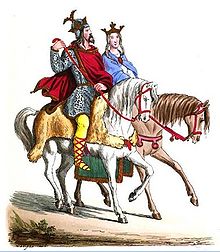
I was the eldest daughter of a ruler who wanted to establish relationships with another country. So, my father married me off at the young age of 12 to someone old enough to be my grandfather. When this guy died, his son married me despite the fact that people didn't like it and talked about us. But, the son died in a few years, too. So, I was left alone with no husband or children. By then, I was still a young teenager. My father put me into a convent for protection. However, I met this dashing young gentleman, who didn't have my pedigree but had my heart, with whom I eloped. Our marriage made my father furious, of course. He tried to track us down, but my husband was clever enough for us to avoid my father's thugs. We even made it to another country so that we could appeal to someone with higher authority. We found support which forced my father to accept our marriage. But, my father gave my husband the worse part of his realm to govern. Nevertheless, we were able to find success and happiness. That part of my father's realm became the best part. With my husband, I had three sons, but I didn't get to see them grow. I died in my 26th year. Needless to say, my sons did me proud so that I have not been forgotten.

Do you know who I am?

---


While researching for an issue of Gardner's Beacon and looking backward at historical events (after all, genealogy and history are intimately tied -- yes, those seduced by abstraction may complain, yet they have had their say for eons and might need to broaden their mindset), I ran across several tales about remarkable women that seemed to have a common theme that carried down through time. Some might say that things are still the same. But, looking at the 1692 time frame, I wondered what reception these women, from history, would have found in Salem Village, or any of the colonial sites.

---

So, the above might be thought of as the first of a series. We'll allow one character to talk about herself and to ask us: Who am I? (nod to the show, Who do you think that you are?).

---
For the Beacon, one instrumental book was written by John Goff, the Salem Preservationist: Salem's Witch House: A Touchstone to Antiquity (Google's digitization). John writes about the area, in particular, that around the Corwin House. Also, I like his description of the families involved with, and event related to, the house. Naturally, those facts touched upon are broadly of interest.

Remarks:

02/10/2013 -- Brought in the image from Wikipedia.

02/10/2013 -- There are many stories like this one. The answer? Judith of Flanders. She married two Wessex Kings, father and son, without issue. Then, she married Baldwin. One of their descendants was consort of William I.

10/27/2012 -- Still looking at options on how to present this type of query and to obtain/manage responses.

Modified: 02/10/2013

1692 theme, again

Working on the next issue of Gardner's Beacon (Vol.II, No. 5) with a seasonal theme. We had a similar issue last year (Vol. I, No.4).

The topic never seems to dry up and continues to be of interest. Of course, why just look at the thing around the spooky day? We ought to address the role of women in England's history, and in its colonies, at any time.

So, we can try to fill in missing information about Margaret, even is it's a sketchy addition. A start would be to gather together all of the views that have come forth in the past 200 years, or so, into one place.

While we will consider Thomas' female descendants, looking at women in collateral families will offer a lot of pertinent topics to discuss.

Remarks:

04/ 29/2014 -- Aftermaths.

10/30/2013 -- I am in the process of reading Katherine Howe's book, The Physick Book of Deliverance Dane. Dane, as in being related to Francis, of course. I wondered if there would be motivating material for a Beacon issue (we did have 1692 as a theme in 2011 and 2012). It is an interesting plot, especially the balancing of the characters, and their interactions, in two time periods is nice. The description that Katherine provides of little Dorcas Good in the underground cell surely depicts the poor, young thing's misery and shows Katherine's grasping of the horror. One wonders, from some of the modern views and comments, if people really understand the dire situation. Too, the main hypothesis might have some truth, in a slightly altered construction. You see, science has not shown as much light on human matters as some might think. But, then, for any knowledge that we have gained, we have also seen that the unknowns do not diminish. It's just that we get better able to cover (as in, remove from awareness) the holes in which lurk the demons.

09/04/2013 -- Again, the scene is built as follows. Those who came over are from the 10th to 13th generations back (for the most part) for someone alive now. By the time of 1692, lots of the earlier arrivals had passed on. So, that left the second generation (again, for the most part) as the elders. Now, taking a cohort mix (generational cut) round or about 1692 would give us someone on the current person's tree who would have about three generations living (including the level of their own cohorts). So, we would see siblings/cousins, parents/aunts/uncles, and the greats. In other words, it's a composite person that is built from that cohort mix (meaning, of course, that being on the tree implies ancestry) for which we can identify relationships blood (including 1/2 blood), in-law, and even friends. What Marjorie's chart does is to take someone who is in the mix and look at extended relationships. Now, consider what we would have if we did that for a large part of the composite mix. Would it not be an interesting view?

02/10/2013 -- Fan-in from the turmoil of all types of ancestors.

10/27/2012 -- We will have a comment by John Goff, the Salem Preservationist, about his book: Salem's Witch House: A Touchstone to Antiquity (Google's digitization).

10/24/2012 -- First of a series, Who am I?

Modified: 04/29/2014

Wednesday, September 12, 2012

About Margaret

We said early on that we'll base our views on Dr. Frank's books that will be updated as necessary. Dr. Frank, who was thorough and careful, noted the two wives of Thomas. Since then, the matter is still open to interpretation.

Irrespective of her last name, Margaret is most likely Thomas' first wife and arrived with him and their kids on these shores.

Why do we say that?

The Great Migration leaves it open, as do other genealogy works. Remember, genealogists have lead feet. We don't.

The studies, to which people point, all reference TAG 30:156 which does not make a definitive statement about the matter. The argument is that a church record of 1639 has Margaret showing up.

Consider, Thomas may have shown up at the Church in 1629, but he didn't deign to show up to be a freeman until 1637. Margaret may have decided to join much later, for the future of her family who did turn out to be successful in their own right.

---

Margaret was definitely ahead of her time and needs more attention to be given to her life.

---

Now, there is also a suggestion, in these studies, of a death of the first wife with Seeth's birth. This is not documented. It's pure speculation, folks, as far as we know (to wit, Great Migration, et al). TAG 30:156 does not tell us to not refer to Margaret.

The matter is open until there is further information that can be documented. In the meantime, we'll honor Margaret, with Thomas, as our ancestors.


Remarks:

08/28/2018 -- After some discussion, we settled that we had Margaret's folks, her baptism record, the marriage announcement, and baptism of their kids, prior to them leaving Sherborne. So, we have the post "Margaret, anew" which updates "How many wives?" Now, the question moves to whether or not we have the right couple (Children with what wife?, Further discussion).

08/01/2018 -- The past few days, I have been on WikiTree. We are looking at settling issues for the profile of Thomas (and his spouses): https://www.wikitree.com/wiki/Gardner-159. These profiles are being set up and maintained by the Puritan Great Migration. Expect an update blog post within the next day or so. Notice the recent comments (the 'unknown' is because I juggle many email accounts and was in the wrong one - it's not that I'm old).

07/12/2015 -- Okay, turtle speed. But, we get there. Announcing a new project: Sherborne, Dorset. No doubt, it is about time. When finished with the data collection and analysis, we will present the strongest story (the prerogative of the family) that the facts, and abductive reasoning, will support. As such, we hope to demonstrate some very much needed research viewpoints.

05/05/2015 -- The Winthrop Society has Margaret as second wife. They allow submittal of additions and corrections concerning early arrivals.

10/13/2014 -- Tabula raza, and more, will be of concern.

09/28/2014 -- A week ago, the record for the marriage of Thomas Gardner and Margaret Friar was discovered in Sherborne by John Cook of Minneapolis, Dorset files. This sets a type of focus. Looks as if some transcription work might be in order.

12/31/2013 -- See Remarks, this day, in the How many wives? post. In that Remarks, we see that Anderson, et al, have the wrong year and age for Richard.

06/15/2013 -- John Farmer wrote that Thomas was from Scotland. Origins are, and will be, a focus.

11/27/2012 -- We visit the theme, one more. Anderson didn't leave it open. He actually made a hypothesis and stated a proof for his thoughts about a third wife. However, we don't agree with his analysis and will pursue the matter further.

TAG 30:156
09/25/2012 -- Added in a snap of TAG 30:156 (George E. McCracken, Ph. D.) with red markings about the author saying that he would continue to agree with Dr. Frank. So, we can, at least, call her by her first name, even if we can't say for sure what family she was born to. There is a question pending (comment earlier, sorry about the delay, will work a process to respond to comments) about George's wives which is covered in the same article. We'll look at that. We posted earlier about George's daughter, Ruth. ..., Also, added the emphasis below. TAG 30:167 covers the 'flight to Connecticut' which had been a mystery to me. Expect a further post on TAG 30 after I've had a chance to digest its contents and to study its motivations (and see what Felt and Moriarty were saying).

09/16/2012 -- Of course, another reason that Margaret may not have been at church could be her maternal duties. I've not seen any depictions of kids in Puritan gatherings, except for older ones. Margaret, throughout the period of interest, had several young ones to care for. And, Thomas would have been there protecting them. Ideal couple, so to speak. 

Modified: 08/28/2018

Tuesday, September 11, 2012

Gardner's Beacon, Vol. II, No. 4

One goal of the Thomas Gardner Society will be to collect, and hopefully organize, material that references, even if indirectly, the lives and time of Thomas and Margaret and to construct a coherent view for future generations. However sketchy this material might be in the beginning, future research can help flesh out the story. The works of Dr. Frank A. Gardner, and prior work, by others, establish the basis. Gardner's Beacon, and its corresponding blog, has tasks related to supporting this theme. Another approach would be support for scholarly papers.

---

We have our first guest article written by John Goff who is an architect and who has been very active in preservation efforts across New England, principally Salem. He is a Thomas descendant. John provides technical commentary on the Gardner-Pingree house (see earlier post) whose construction represents the amount of wealth that had been attained by the Gardners.

Image from Conant book
---

As we look back, there can be obvious differences of opinion about what information means, especially, if it's scanty. Scholarship would suggest to look at all sides of the issue. There are several examples.

The house built on Cape Ann, called the Governor's Faire House (GFH) by Rev.Higginson, is a good example. Earlier (Thomas' (note comparison to a house in the Pilgrim area) or Margaret's house), we used an image provided in the 1887 book by the Conant family (pg 104). The house had been moved by Endicott from Cape Ann to Salem. That means that many would have seen it and could describe what they saw to an artist.

Photo by John Goff
Salem Preservation, Inc. 
In 1930, Dow, et al, built the Salem Pioneer Village so that people could see how things were 300 years before. We have the 400th look back coming up. The image on the right (photo by John Goff, Salem Preservation, Inc.) shows how Dow conceived the building. It does not match up with what the Conant book said. Of course, any information about dimensions may have been hard to find. Yet, one could imagine that the ship(s) may have carried material for a house, as depicted by Conant. There would not have been enough time, even with tools, for even the house of Dow to be built, given the small size of the crew plus the fact that they had to get themselves settled, fed, and a whole lot of other important things.

What did Dow go on to make his re-creation? John Goff mentions that the GFH towers over the other houses which are mostly either diminutive English timber frame cottages or English wigwams built with bent-sapling frames.

---

See Vol. II, No. 4 of Gardner's Beacon which considers some of the houses that have been associated with the Gardner family over the years.This issue on houses was interesting; our coverage of the topic ought not be thought of as complete, by any means.
References: Conant -- History and genealogy ..., Dow - Every Day Life ..., Fischer - Albion's Seed ..., Stone & Fickett - Every Day Life ...

Remarks:

03/09/2019 -- Added in image to build an index at our portal to truth.

01/25/2013 -- By the way, we're going to document this more thoroughly on Wikipedia - Great House (Cape Ann). We have John Goff's expertise available to assist us. This house was the first of its kind in New England.
10/27/2012 -- See Great House (Cape Ann) on Wikipedia. As Higginson said, it was two-storied with a high-pitched roof. The image from Conant's book, and from the letter by C.M. Endicott, shows three-stories. The house underwent major alterations in 1792 which was before the sketches were done. Unfortunately, no sketch exists from earlier times.

10/24/2012 -- John Goff (Salem's Witch House ..., pg 24) writes: After his arrival downtown in 1628, Endicott ruled that the old Thomas Gardner "Governor's House" from Cape Ann (built about 1623) be dismantled, moved by sea from Cape Ann to Naumkeag and be re-erected in earliest Salem to serve as a new Governor's House here. It stood north of the old shawmut on what is now Washington Street.

09/12/2012 -- It was said that we're not done with houses. Fischer notes, in Albion's Seed, that the lean-to was found in Kent, England in the 17th century, though not many have survived. Despite its usefulness in New England, evidently the 'seed' for this type of house came over with those whose background was from the Kent area.

09/11/2012 -- The Stone & Fickett book has the younger student in mind and provides classroom exercise. Ought something similar be done for later students?

Modified: 03/09/2019

Friday, August 31, 2012

Written out of history

Foreword (or forewarn): This is one of the backbone series. The post is motivated by thoughts related to material used for the coming Gardner's Beacon issue, which will be on houses from the early start.

---

The effort at learning about Thomas and Margaret is about three years old. The main issue seemed to be that not much was known in the sense of mentions, in the writings, being sketchy, at best. That is, even though Thomas led the group into Cape Ann, not much was recorded. Mention of his effort came later with an early 18th century publication by Rev. Hubbard (saved from a fire, thank God for that!). John White mostly denigrated the crew (ah, we can write a bunch about that). What we hear about is the arrival of Conant (and Lyford), the move to what became Salem, and then post-Endicott times.

This message was apparent in retrospectives by several families, such as Woodbury, Trask, and more. The site for the John Balch house was a reminder. That is, on the write-up of this house, nothing is mentioned of Sarah, Thomas' and Margaret's oldest daughter. John's son came to Cape Ann with the party. As well, Sarah was born at Cape Ann (pre-Endicott Massachusetts). Sarah married Benjamin Balch. John Sr. gave the couple the house. Hence, I'll refer to it as Sarah's house.

Actually, the Beverly oversight (wake up!) is more appalling when you consider that John's wife came with him to Cape Ann. She and Margaret represented the females. And, they went through all of the same crap (perhaps more than) as did the men.

Also, we find this: When the company was recalled to England, the Balches, Roger Conant, John Woodbury, Peter Palfry, and others stayed in Massachusetts and moved south to Naumkeg, now Salem, in 1626.

Four families are mentioned here. Trask was left out. The 'others' would have included the Gardners. That story needs to be told; it's part of our task list. The Paine sisters, Thomas descendants, wondered if the family had gone back to England for some period of time. Had that been so, Woodbury, who did go back and forth, might have mentioned this. However, the Woodbury lookback doesn't mention Gardner, at all.

Too, Thomas' kids would have said something about going back. John, the Magistrate, would have known. So, too, would have his older siblings.

We ought to try to document the fact that, after the group moved, someone would have gone back and forth between Cape Ann and Salem. What is it? 17 miles or so? Look, the house was nice enough for Endicott to want it moved.

Too, and this is a big TOO, the group was NOT unsuccessful. Did Conant report that he found starving people? On the contrary, they were bolsterous enough to want to tangle with Standish and his crew. They had their food sources, dwellings (however meager), and themselves (true independent souls of the American which was to be).

What the group did not achieve was the capitalistic dream (and John White's, to boot) that, essentially, tries to get something for nothing. Yes, folks. The success of the model requires an unending supply of hapless exploitees. So, Cape Ann's little group was not able to ship back produce or seafood. But, they fed themselves.

In fact, that Thomas and Margaret got their nine kids to adulthood is evidence enough. They were very good parents. And, each of their kids was a healthy, and effective, adult.

---

Another topic deals with the regime, and regimen, imposed upon the freedom-loving people. We all know the stories. But, Thomas' life, as a focus of study, will allow a re-look.

In 1637, when Thomas deigned (yes, used purposefully) to get himself drummed into the group mindset -- freeman's oath -- he did it for his kids. His boys were adults and needed the social involvement. You see. That is a long time after the 1626 move. Thomas had class, abilities, and showed self-reliance long before Emerson wrote about it.

It's telling that Thomas was made Deputy to the General Court, with Major Hawthorne, in the year when he took the oath. People wanted his involvement since he was an elder by action and more. For some reason, post 1637, his effort was local to Salem and the area. We can, and might, speculate about why this was so.

Again: Not a descendant. Objective third-party. However, married to one who has a whole slew of these folks in the ancestral tree.

Remarks:

06/25/2019 -- We have a few more examples of the forgotten (early on, we had Aunts, Uncles, Cousins). Of late, there was Lt. Benjamin West who was killed at Bunker Hill and forgotten. Prior to that, we were trying to count the number of lost graves in Essex County. Then, we have the travelers out west, such as Jedediah Strong Smith, except he did post some reports back east by courier. There were many lost a sea over the years.

07/12/2015 -- Of course, when Roger brought his people to Salem, Thomas was not there. Why? He and Margaret kept the Cape Ann house. Of course, when John Endicott came over, he saw Mr. Gardner in his nice house. John said, that is mine. Take it over to Salem. So, by splitting his time (Salem is not that far), Thomas had an idyllic time with his wife and kids; too, he had time to get himself and his family settled in the new realm.

07/12/2015 -- Okay, turtle speed. But, we get there. Announcing a new project: Sherborne, Dorset. No doubt, it is about time. When finished with the data collection and analysis, we will present the strongest story (the prerogative of the family) that the facts, and abductive reasoning, will support. As such, we hope to demonstrate some very much needed research viewpoints. ... This is a case of two Quakers being ignored.

10/13/2014 -- Tabula raza, and more, will be of concern.

07/17/2014 -- The book about the Invisibles (the unsung heroes) offers another viewpoint. Of course, it is set in the modern context. But, we all know that history covers only a fraction of reality. What we see now is that technology will allow us suitable ways to go back and fill in the blank slates.

11/13/2013 --  Phippen would be part of the slate fill.

11/06/2013 -- While working on the next Beacon issue, I ran across some books. The one by Staloff was timely; imagine, I was wondering why the backbone series? Has the talented set ever allowed the lessors to have some semblance of a good life? Oh, you say yes? Winthrop, et al, were against this from the beginning. The stalwart of what could be (or could have been)? Thomas Gardner, of course.

09/09/2013 -- Forgot to update this earlier. But, the post related to Gardner's Beacon, Vol. II, No. 6, discusses that Thomas had no shadow over him as was feared by some old planters (would Dr. Frank, today, still want to include Thomas in the group?).

06/15/2013 -- John Farmer wrote that Thomas was from Scotland. Origins are, and will be, a focus.

02/10/2013 -- Having finished a book on the 1692 events and doing a post on the subject, I can add to this look at Thomas. I've mentioned that he didn't queue right up to join the church and that he was recognized by Endicott. As well, he married a Quaker without any repercussions that we know of. Of course, his sons left the area due to the Puritanical (hypocritical) mindset.

01/01/2013 -- David Goss' talk at the 1999 Essex Society of Genealogists gives a perspective that also motivates. See the TGS bibliography.

12/24/2012 -- Thomas, unlike Conant, was not overshadowed in the world of being. We'll spend some time characterizing this fact and what it means to reasonable folks.

12/22/2012-- We need to differentiate between Old Planters of Beverly (see The Old Planters of Beverly in Massachusetts, 1930, Alice Gertrude Lapham, The Riverside Press) and the Old Planters of Massachusetts. One could even talk, Old Planters of New England.

12/19/2012 -- Sarah married Benjamin, son of John.

11/27/2012 -- Let's itemize what we know, re-iterate some basics, and the proceed constructively.

10/28/2012 -- September issue had a theme of houses.

09/13/2012 -- About Margaret. We'll honor her as the ancestor, with Thomas, of the Gardner family.

09/01/2012 -- Vol. II, No. 4 of Gardner's Beacon deals with houses.

Modified: 06/25/2019

Wednesday, August 8, 2012

King Philip, Joseph and Ann

August 12 is the 334th anniversary of Wampanoag King Philip's death (execution). The war with King Philip was a major event in New England in the latter part of the 17th century.

John Goff (a Thomas descendant and president of Salem Preservation Inc.) co-authors an article with Julianne Jennings (Strong Woman) that looks at the time and some of the facts.

       On the anniversary of Wampanoag King Philip's death 
       New England’s Second Colonial Armed Conflict: King Philip’s War Remembered 

The two authors ask some interesting what-if questions, such as: what would New England (and the rest of the continent) be like if there had been more peaceful relations between those who migrated here and those already in residence, the American Indians? As we all know from stories of the Pilgrims, things started off peaceful enough.

We know that Thomas and his children had good relations with the American Indians. We mentioned, earlier, John's (son of Thomas) effort on Nantucket.

---

The authors also remind us that American Indians, even those who surrendered, were sold, into slavery, to plantations in Bermuda (and the Caribbean). That may not seem to be in character and definitely not something to be proud of.

But, we know from history that the Puritans were not without fault, to say the least, in some of their dealings. Quakers and their children got this same type of treatment.

---

We featured Joseph (son of Thomas) and Ann in the February issue of Gardner's Beacon. Joseph and Ann had a house in Salem that had a long and interesting history. Unfortunately, it did not stand the test of time (however, its usefulness has been documented - coming issue on houses). The Joseph and Ann house was built by her father, Emanuel Downing, and had a remarkable structure for the time. Joseph, a captain in the militia, was a casualty in the Great Swamp Fight leaving Ann a widow. She later married Simon Bradstreet after having him sign a pre-nup. Her father, as a lawyer, trained his daughter well. The house became, then, known as Governor Bradstreet's house (such is the way of the world).

Remarks:

02/23/2022 -- Updated PDF for Gardner's Beacon, Vol. II, No. 1 to have links to sources. 

04/23/2021 -- Fixed link to John Goff's and Julianne Jennings' article. 

02/27/2021 -- Changed to using American Indian. 

01/12/2019 -- The article written by Julianne and John is missing. So, pulled one from Indian Country Today. 

12/19/2012 -- Changed article pointer to go to the Salem Gazette.

10/28/2012 -- September issue had a theme of houses.

08/14/2012 -- Drawn and quartered, after the swamp fight.

Modified: 02/23/2022