Saturday, January 10, 2026

Small world, literature

TL;DR -- The Economist does a double issue each year right before the Holidays. This year, one of the extra articles dealt with Jane Austen. We saw that her birth was 250 years ago in December. We want to pay attention to the Old Country and thought to do it various ways. This is an example of one method. 

---

The U.S. has a 250th this year which really started in the spring of last year with the Lexington/Concord conflict. We have posted on that theme for a few years. Now, we are approaching date of the Declaration of Independence and started a series, in the last post, based upon events in people's lives. We want to continue that theme. 

The Economist's Holiday double-issue had a piece on Jane Austen who was borrn in 1775. The article looked at her publications and compared the economic realities of her characters with a chart depicting a fictional annual income: How Jane Austen revealed the economic basis of society. Never having read anything of Jane, the article reminded me of the ties that were across the water which were somewhat severed by the split that followed the Revolution. That points to possible stories about families and histories of locations of interest to the New England colony. 

Too, I am reading (again, as I first went through the novel years ago) Irving Stone's "Those who love" which is a novel about Abigail and John Adams. Abigail was of Quincy heritage; we will look at her later. John was cousin of Samuel (of the beer) and a farm kid who got into Harvard. Later, he became a lawyer. And, we know him also as the 2nd President of the U.S. Stone's handling of characters and conversations does very well in protraying the times and ordeals experienced by those there. 

Ignoring that until later, we have had several posts on generations. For instance, we wrote earlier that the 5th generation did the Revolution with leadership being provided by the 4th. John and Abigail were of the 5th. And, their son, John Quincy Adams, is, like Jane, a member of the 6th generation. So, we can pay attention to this generation's existence over the beginning and early years of the U.S. 

By the way, the 8th generation was the core of the U.S. Civil War. We mention this as there are threads from the beginning (the 400th) by the entries during the colonial period to the major, internal conflict. 

Getting back to the 250th, the internet/web will allow publication of information from families and other sources that were never pulled together into something cohesive. Of course, technology now will be more of a hindrance and asset for several reasons. But, provenance as a keything will help and will definitely be necessary. 

Remarks: Modified: 01/10/2026

01/10/2026 --
 

Friday, January 9, 2026

Small world, science

TL;DR -- The U.S. is at its 250ths in 2026 with the festivities and lookbacks starting in 2025. That was the time of the Declaration of Independence. The conflicts started the prior year and continued until 1783 giving us now several years to use to study specifics. While, we might add, dancing around the mischief to be expected from wide-spread use of this AI/ML thingee. And also, looking at going-ons in France related to Independence and science. 

---

We have been posting on the 250th for a few years with lots happening in 2025: Gardner's Beacon, Vol XV, No 2. This year, we see the thing that brings fireworks. What was that? Well, as we go along, we will pull forward associations with history and genealogy plus ties to science. 

We will introduce Rev. John Wise, inspiration for The Declaration of Independence. At the same time, we need to remind everyone of the extent of the conflicts. We will be addressing that mostly in the context of General Nathanael Greene and his Southern Campaign

All along, we have mentioned the 400ths and stressed the three major cultures: Spain; France; and the English. The first and last have been covered a lot. With the events of the 250th being followed by similar activity in France, we will be more regular in bringing in that cultural influence. 

Again, all of our activity will be influenced by history, genealogy (implying family, extended family, regions, and more), and science (starting with computational aspects which are now at the core of information and knowledge). 

---

One thing that we can do is bring into focus the U.S. contributions over the years. Let's take thermodynamics which is a core subject, too. We have addressed several persons: Count Rumford; and Josiah Willard Gibbs. Both are kin. The former, as a Loyalist, made his name in Europe where he went when things got hot here. But, he sent back money to Harvard. We will look at that further. The latter is a descendant of Thomas Gardner and is known for his mathematical contributions. We will mention him more.

For example, there is someone to know: Lazare Carnot. He was a French Army officer with a cool head. In the heat of their revolution, he was there and influential: French Directory. This topic will be of interest later. Now, let's look at his son: Nicolas LĂ©onard Sadi Carnot. His work in thermodynamics was only recognized posthumously. In this sense, he is like Galois who was  misunderstood during his time. Carnot probably needs more credit than we have seen; that is one of our goals - namely, research and report on this. 

In another venue, we are setting up a series of articles that will tie all of these notions together as we can use the time of the U.S. Revolution as the control and basis. Say, a classical view of substance. Then, we will come forward to the time of those in the boom era of Levi-Civita and Planck. Oh yes, do we need to mention Einstein? 

Too, we will bring in New Spain and the other major contributors to what became the U.S. 

Remarks: Modified: 01/10/2026

01/10/2026 --  Reminder: Jane Austen was born 250 years ago. Same generation as John Quincy Adams. 
 

Saturday, January 3, 2026

Themes that persist

TL;DR -- The past few years have seen lots of changes. These will be handled in a more categorical manner with respect to our mission and the research that supports such. 

---

In late 2024, we posted a summary of the situation: Restart, somewhat. One theme dealt with the 2023 impact of GenAI/LLM. Another dealt with research that found that Thomas and Margaret had the marjority of their children in Sherborne. After some analysis, the WikiTree profile for Thomas Gardner (Cape Ann, Salem) was split into two: Thomas (Cape Ann); Thomas (Salem). We know little of the first one. The second one is the progenitor of the Gardners who were the original focus of the Thomas Gardner Society, Inc. We have expanded to cover Essex County, Massachusetts, New England and in some contexts, All things Gardner, with respect to the 400 years of the culture that celebrates its 250th this year. 

So, some reorganization of information will be forthcoming. On the other hand, there will be a broader scope which is expected to emerge in 2026, at least from a cursory sense. In any case, we will be paying more attention to Origins than we had before.

Also, the post "Renovation, plus" gives some perspective of the mix of themes and how they interrelate.  

Remarks: Modified: 01/03/2026

01/03/2026 -- 


Tuesday, December 30, 2025

Gardner's Beacon, Vol XV, No 2

This issue of Gardner's Beacon continues our interest in regular presentation of ongoing work as well as reviews of common interests. ...

Topics:

Annual review, 
by quarters

...

GB XV, 2 (PDF w/links)


GB XV, 2  

See Vol. XV, No. 2 (point to 1 for now) of Gardner's Beacon for links to Sources.

Remarks: Modified: 01/03/2026

01/02,03/2026 --  Updated with full content. 


Saturday, December 20, 2025

Overland mail

TL;DR -- Bunker Hill West was on our sights early as we looked at the progress of New England's influence into the west coast. We noted that a coach company had facilities there and that the journey for some arriving had started in St. Louis and was going up to San Francisco. That route was covered in both directions. There is a group that has been documenting the company and its involvement. One of the investors was of a Gardner family. We went to look for information about him which we will report. This post is an introduction to Overland Mail as an initiative of the U.S. government starting early. 

--- 

As earlier posts mentioned, we used the isolation of the COVID times to pay more attention to the interior of the country. We got started with the naval activities, such as coastal attempts at colonies, fishing in the waters over here every year with the expectation of going back with some dried fish, and more. Too, the naval history of New England is rich prior to the Revolution which is facing its 250th lookback and after with the proliferation of companies related to shipping. 

In those earlier times, western movement didn't go much beyond New York. Though, early on, locations like Ipswich MA sponsored migration as best they could. Except, there were the wanderers even prior to the Revolution. Northern movement down to the area of Arkansas was going on about the same time that northern New England was getting its start. Even the west saw Europeans coming into the area even before Lewis & Clark's venture. 

Once the U.S. was born, it took a generation for activity in the west to reach a level of interest with St. Louis MO as a focus area. Much of the western traffic moved through that area, partly due its proximity to where the Ohio river joined up with the Mississippi. But, there was naval access to the west coast, as well before the Gold Rush of California. Some of this was due to Hawaii being a stopover point for sailing the Pacific. We intend to look further into that theme.

But, with land movement, we can map out areas and time frames. Jedediah Strong Smith was a focus due to his going out west through St. Louis (1820s when MO became a State) and then his extensive journeying in the west, including a stint in the LA area when it was still under Spanish rule. 

It was about then that we bcause aware of the St. Louis to San Francisco (LA_SF) coach route. Our focus was mostly about LA due to it being a stopover on the trail going to  San Francisco. The image shows DTLA in 1900 which a view toward what became known as Bunker Hill West which was named by a displaced New Englander. 

1900 scene, of Bunker Hill West
where Overland Trail coaches
came in, for relief of passengers
and sources (horses)

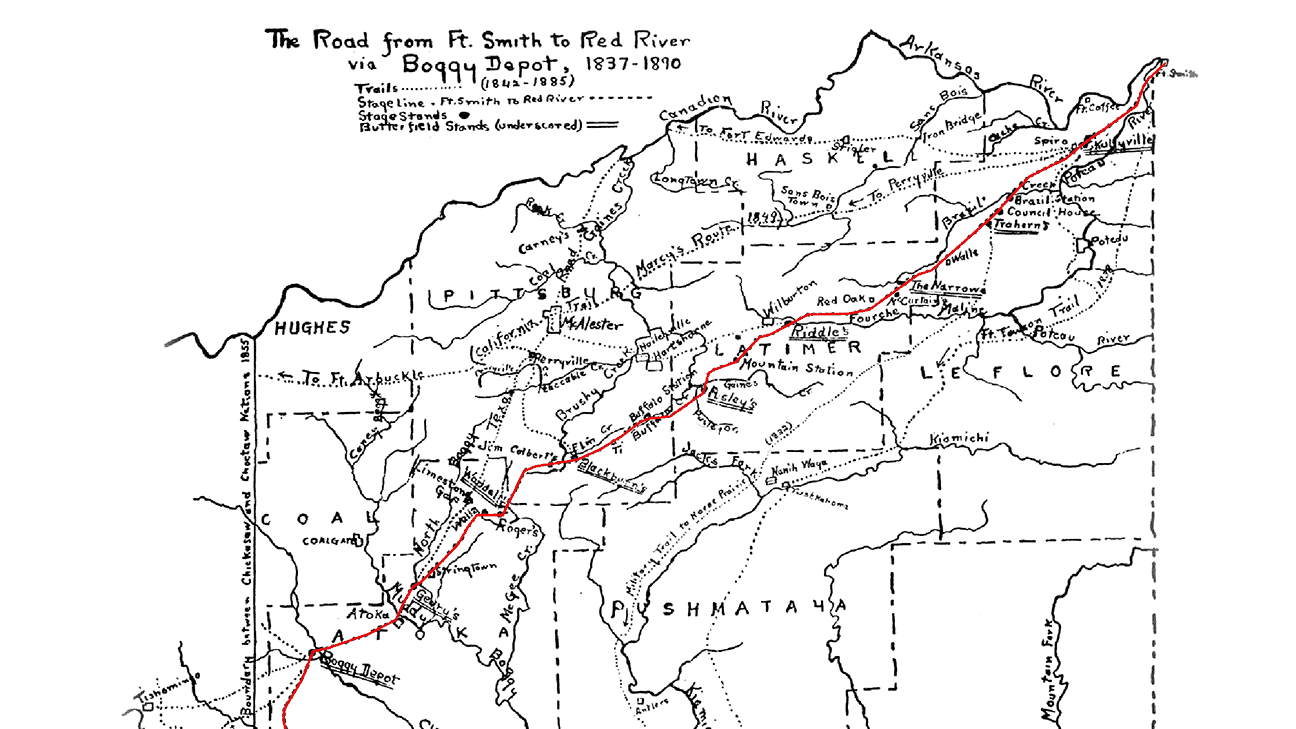
Recently, we noticed that there have been more publications on a website on the subject with information related to the LA_SF jaunt. More information has also been provided about the TX to SF part of the trip. Now, the eastern portion has better coverage is getting attention: Missouri, Arkansas, and Oklahoma (with respect to the Overland Mail). For instance, AR is mountainous. One thing passenger were requied to do was get out and walk with the coach as it was slowly moved through the hilly areas. 

States in the area. Kansas had a lot of east west traffic. One research provided lots of information and commentary on that state's support for Overland Mail  (as it is seen in KS). That is now the name of this activity which denotes the main purpose plus the involvement with the U.S. government. St. Louis had heavy activity as the country was divided and sold throughout the west. 

Other states involved were TX, NM and AZ in the south. We will be looking at other views on Overland Mail as the Pony Express came to be for that specific purpose and ran across the northern states.  

People? The group devoted to the history and preservation of the Overland Mail route (that is associated with Butterfield - who never put his name on the venture) (The Historic Butterfield Overland Trail in Arizona) has done remarkable research. We are fortunate in that area. One of their latest ventures is to identify the employees who saw to it that the coach made it from MO to northern CA. The infrastructure was astoundingly complicated. 

In terms of comparison, we have a post that shows how the 21 days (3 weeks) of one way of this journey compared to other situation. For instance, the same amount of time was taken for a portion of the trip by wagon train from Independence MO (across KS and NM) to Sante Fe NM. Fort Lanerd KS is on the trail and 3 weeks away from the start. 

We made contact with the Butterfield group. There was a query. One of the investors was named James V P Gardner. Who was he? On a quick look, we identified one resource from the late 1800s that suggested that he was from a New England family. James V P Gardner (son of Daniel (6) - James Van der Poel Gardner -- as descendant of George of Rhode Island) would be a cousin of the Gardiner for whom the city in Maine was named. Too, he would have been related to the Gardiner who owned the ship that wrecked off the coast of Oregon in 1850. 

We will post what we know about James V P Gardner as a preliminary report from which we will build something adequate to serve as a truthful basis for information about him. 

The information from TGS, Inc. efforts is being provided now with the caveat that we need to look further into sound/solid provenance of the sources that are used. Bringing in another factor? Technology of late has seen itself contributing more to disinformation than to information. The theme is on our watchlist and is (will be) an actual focus for the TGS, Inc. at all levels. 

John likes to use this example: From the top, we have folks of huge cachet for whom History has lots ot say; getting modern, we have the top-level offices of the G-Suite (military) and the C-Suite (the industrial/commercial part of the activity); then the huge middle management realm; down to the workers and users of whatever the economy is about in terms of keeping the modern life viable. At each level, there is no one truth that can be said to be accurate from top to bottom. Or from bottom to top. 

The computer has both helped and hindered attempts at briding the gaps. Of late, things have been more problematic than necessary for various reasons. John jokes about buckets'o'bits and their misleading clouds, though many are working to make things more stable and sustainable. We all can help. 

So, with respect to our research and reports, we will keep the "shining light on the hill" (Winthrop) in mind. Too, our site will be "bespoke" for many reasons with the goal of providing a "portal to truth" which notion comes from the mid-2010s as we incorporated in order to organize future efforts.  

About sources? We have them. For Gardner Beacon issues over the fifteen volumes, we started with a Bibliography and Source page. However, we started to provide links from the issues to posts from this blog. However, we are looking into a better organization of our several blogs for proper curation of sources. 

Note 1: The information about J V P Gardner and his life looks good, even though we need to check the provenance of the pedigree. There are many extant documents that will support this work. This Note will be updated when the post about J VP Gardner is published. 

Note 2: The following photo is more apropos being from the correct period. The Bella Union Hotel had roots back to the 1830s. The Wikipedia page has some of the history. 

This is east of Temple and Main Streets. Temple runs up into Bunker Hill West. 

Remarks: Modified: 12/23/2025

12/23/2025 --


Tuesday, December 16, 2025

Welsh poems

TL;DR -- After a long list of caveats which are not complete, we push a link to Dave T Gardner's post on Welsh poems that are pertinent to his work on Gardiner history. Our interest deals with the topic of "All things Gardner" and the emergence of a vogue of advance software that needs attention.  

--

Caveats, first (this is without links; but everything mentioned here has been covered, at least for starters; I'll get back and put in links. In the below, I'll use LLM to refer to the systems to be described further with respect to the pros and cons.): 
  • Prolog: This work of David T Gardner is being enabled via computation which is effective when done right. Can we say that yet? Well, we don't have to wait as the work has decades behind it. What's new is that this thing that everyone else calls AI (and I call it AIn't, for various reasons) allows years of effort that accumulated progressive means to culminate in potential that we dreamed of. DTG has given himself a couple of years to establish provenance in a manner that bears scrutiny. We'll help him do that. In the meantime, read this as you would an overview that borders upon truth yet it is not a mere reach of the imagination. The following is John's take on the matter. 
  • 1 --- there ain't no critter in the computer in terms of something that Ma Nature dreamt up or that is there latently and has been waiting to emerge. As in, Musk joked of summoning the demons which bears on metaphysics (more below). But, we can describe this phenomenon to a large extent now that there are many examples (from ChatGPT to Gemini to others) to observe, test, measure, and whatever. Good old science is the key here, and it will be beyond physics. 
  • 2 --- we are witnessing computational prowess of an unprecented nature with regard to size and extent. Yet, we knew all of this stuff before, either individually or collectively. In most cases, the tone and meaning of things changed as one would expect. But, language alterings that happend dynamically do not offer that new species of life will emerge. 
  • 3 --- hence, we have to get used to mathematics. Now, we can use the computer to do this. Need to. And, one example is Wolfram's Mathematica system which has brought in GenAI/LLM as a service (not all, but a good representative set). As we go through the steps to validate DTG's work, we will learn new things and require that models change. That's okay. 
  • 4 --- model-based reasoning is old hat, now, almost as old as computing itself. What, you might ask? Well, one of the prime modes for modeling is from the '50s and coincides with the AI emergence out of efforts of mathematicians at a Dartmouth meeting and after. Lisp is what I am referring to and is my preferred language, albeit we ought to have kept the Lisp machine to help balance the quant mode of the Nvidias and other of the world caught in that illusion. 
  • 5 --- quantum to be brought up with respect to #4? Okay, that's fair game. People are quantum processors and have been from the getgo. Wait, teleology? Yes, I must mention that psychology and philosophy are to be brought into the discussion. Expect more on this. It's already there (I've been at this for decades). So table this til later. 
  • 6 --- as I need to mention KBE which I worked in after starting in KBS. There is not anything new now. We looked at this stuff decades ago. What has changed is what people refer to as the effects of handling "scale". I say that a lot of it is crap and do so with affection for all things computing since the facilities will help us be better humans. Local? Some here that mentioned now. Well, I have said that all along. 
  • 7 --- truth engineering has been in the wings for decades and now can be discussed in a context that grounds the work and evaluation techniques. Before, it was a piece of my brain as conditioned with decades of Lisp starting before the Lisp machine but have years in that environment. And, truth is a local deal. Truth is not about power. What is truth? It's funny, Gemini has had discussions with me on this matter and never barfed. Mostly, I have traces. 
  • 8 --- but, there is no anthropomorphizing intended here; mainly, I'll address these GenAI/LLMs and whatever else crops up with labels. So, Claude has already been used all over the place in reference to that system. DTG used Grok (earlier this year; got burned; stopped; discussed; and we restarted with provenance as the focus). 
  • 9 --- lots more will be added, but here's the gist of the post. 
  • 10 --- ...  
Today, DTG put out some poems that he found and that were written in Welsh. The LLM was helpful in getting the digitized versions translated after it provided support for the OCR step. That's a brief comment. The point is that there is a large amount of stuff to look at. This seemed appealing for many reasons, not the least of which is that it's poetry. By people. 


There will be more commentary, both on the content of the study and on the technological issues. Hopefully, we can bring computationalism into line with what is required for progress as a whole. Some of that might be the subject of psychology and philosophy. We'll start with Kant's Prolgeomena which he wrote after getting incongruent criticism after he published his Critique of Pure Reason

Remarks: Modified: 01/03/2026

12/18/2025 -- With respect to the poems, consider them as not verified for the time being. With respect to AIn't in any use, all bets are off without more work related to equilibrium, stability, maturity of presentation, and such other things that we associate with people. Sorry, folks, for bringing the message -- remember, this is a crucial time with respect to technology, especially computing. 

01/03/2026 -- Changed the URL for King Slayer's Court. 


Saturday, December 13, 2025

Gardner's Beacon, Vol XV, No 1

This issue of Gardner's Beacon continues our interest in regular presentation of ongoing work as well as reviews of common interests. ...

Topics:

Activity, 2025
250th, 400th of the U.S. 
Technology

...

GB XV, 1 (PDF w/links)


GB XV, 1  

See Vol. XV, No. 1 of Gardner's Beacon for links to Sources.

Note: Our software is bespoke and will remain so until some serious discussion takes place (computers, philosophy, science, and more -- what we really need for truth engineering). HTML/CSS/Javascrpit is the basis with two blogging editors plus the following: Sea Monkey's Composer (html); Microsoft's Notepad (html, css, and javascript); Chrome developer's tools (mainly, at this point, for execution for debugging -- I have access to the development environment). So far, I have avoided co-pilots and Gemini's insistence that it's smarter than I am. People, this easy-peasy software development is creating a slippery slope to hell or, at least, perdition. I have logs and comments along this trek of TGS, Inc. (from 2010 with changes in 2012, 2014 and after with many updates pending time and effort). Mark my words as I slough along. 

Remarks: Modified: 12/14/2025

12/14/2025 --  1st release.