Monday, November 26, 2012

How many wives?

This post continues the discussion about the wives of Thomas (see About Margaret). Were there two or three?

As mentioned in the prior post, Dr. Frank wrote that Thomas had two wives (as did Savage). Of course, he was writing 100 years ago (Savage even further back), and, surely, there has to be more information at this point about the matter. The question then becomes, given the current state, can we really know?

Or, to put it another way, was Dr. Frank wrong? That has not been shown, in our opinion.

Let's look at a couple of studies that are of interest. There are, of course, more of these which we expect to get to, in time. Too, we might add as a preface, some of the needed information is awaiting us in the old country. So, that means that we'll need to look into what genealogical studies might have been done in England about Thomas.

---

The fact is that we're dealing with events that are long past and about which we have little information, at this time, for various reasons. Many views have been expressed about the relationships between the Gardner families (or see Savage) that came here. Too, one sees various proposals that have come to fore.

The modern study, mentioned below, does not broach the subject of origins at all.

---

In regard to genealogy in general, just in the past week I've run across scores of books that have been outdated yet are being quoted. It is very easy for misinformation to be propagated via web pages. Our intent is to have material that can be considered reasonable and supportable.

---

Now, for starters, let's put two studies together, side by side, and make a few comments. Then, we'll rephrase our current position, until there is further information.

TAG 30:156 plus Great Migration material
This image brings together material from The American Genealogist and from the The Great Migration Begins. The former had an article in 1953 that was written by George E. McCracken and that was titled "The Salem Gardners: Comments and Clues."  Topics covered in the article include origin, Margaret, Seeth, the first wife of Thomas the son, the wives of George (very long), The Salem Quakers, the Flight to Connecticut, and the Salem Shattucks. The latter is a recent book in which Thomas has six pages written by Robert Charles Anderson  and published by the NEHGS.   

---

So, if we take the TAG article first, it goes a lot into areas that needed some study. The section on Margaret is small. The author, essentially, agrees with Dr. Frank about two wives. However, we don't know Margaret's family name. What I note is the author's insistence that these studies would greatly benefit from looking further into the collateral families. That being said, the work of Dr. Frank is phenomenal and greatly appreciated. 

---

Now, the Anderson study is looking, potentially, at 1000s of families and doing this with an eye to being correct. The best way to do that is to only use sourced material. Did Anderson make an exception in this case? I would like to consider further his hypothesis and proof after seeing the material that he is quoting. 

I don't buy the church reference. Thomas did not become a freeman until 1637. That is more than a decade after coming over. How could this be? Basically, we would suggest that he was able to get by using his own mode until his sons were older. And, he and Margaret could have easily done this together. Then, he would have had (deign to join) to be more of a "conformist" (to the puritanical thought and behavior) so as to not handicap their futures. From what we can see looking back, Thomas' and Margaret's children did well. 

Aside: There is no record of a first wive's death or of another marriage. We basically know about Thomas and Damaris, who was a widow in 1641, through his will. Hence, the conjectures abound.  

That Thomas married a Quaker tells us much about his character, especially in comparison to some. We'll forgo that analysis for a time. In any case, Thomas would have had to be in the church, and active, to be a freeman. He was shown on the rolls early; but, was he regular in attendance? In the case of Margaret, just picture a women dragging a bunch of kids to the Sunday service. Again, did she need that?  

There seems to be something there to look at in this regard. In fact, it's a story (or many stories) waiting to be told. 

By the way, the above is not a criticism. The Great Migration work has been really helpful and takes the right tact in the case of unknowns, or little knowns. That is, if you don't have something definitive, then just punt it down the road. But, this work does not relieve families of their duties to honor their fathers and mothers. 

---

Which then brings up the family and efforts of Thomas' descendants. I can see someone taking TAG 30:156 and the Great Migration work further. It may be that there is a lot more information available that needs to be looked at and digested. This is so especially with the booming cloud'd informational sources which cause more stuff to appear all the time. 

In the meantime, though, we say two wives. But, then, it could be three. You know it does not matter, right now. For anyone doing Gardner genealogy, the use of either has no impact on the tree unless one wants to branch out with the first (and/or second) wife. 

It is nice that the Shattuck family has their information filled in.  

Remarks:

04/04/2025 -- David T. Gardner has been exercisting Grok with prompts and reports finding documents that support his claim about Wyllym Gardynyr (see King Slayer Court blog). ... We have begun to incorporate changes into the structure and context of the blog. See Restart, somewhat

08/28/2018 -- After some discussion, we settled that we had Margaret's folks, her baptism record, the marriage announcement, and baptism of their kids, prior to them leaving Sherborne. So, we have the post "Margaret, anew" which updates "How many wives?" Now, the question moves to whether or not we have the right couple (Children with what wife?Further discussion).

08/01/2018 -- The past few days, I have been on WikiTree. We are looking at settling issues for the profile of Thomas (and his spouses): Gardner-159. These profiles are being set up and maintained by the Puritan Great Migration. Expect an update blog post within the next day or so. Notice the recent comments (the 'unknown' is because I juggle many email accounts and was in the wrong one - it's not that I'm old).

07/12/2015 -- We mention abductive approaches (my career was spent in advanced computing - software and modelling, essentially). Please refer, at least, to C.S. Peirce's (we mentioned him in an earlier post - Benjamin Peirce) work in the area. [Love it: From Ugly Duckling to Swan]

07/12/2015 -- Okay, turtle speed. But, we get there. Announcing a new project: Sherborne, Dorset. No doubt, it is about time. When finished with the data collection and analysis, we will present the strongest story (the prerogative of the family) that the facts, and abductive reasoning, will support. As such, we hope to demonstrate some very much needed research viewpoints.

05/05/2015 -- The Winthrop Society has Margaret as second wife. They allow submittal of additions and corrections concerning early arrivals.

10/13/2014 -- Tabula raza, and more, will be of concern.

10/03/2014 -- Notice that McCracken mentions Felt, Dr. Frank A., and Moriarty and that he mentions we need to know more. Now, why was this record missed? Well, for one, it is rather smudgy. That it was found can be attributed to the digital age and people using newer tools. Too, to have found this, one would have had to page through lots of paper. Of course, indexing helps with that, assuming that those who do the transcription that led to the indexing were careful. One has to ask, though. Were researchers blind (many senses meant - to be updated)?

09/28/2014 -- A week ago, the record for the marriage of Thomas Gardner and Margaret Friar was discovered in Sherborne by John Cook of Minneapolis, Dorset files. This sets a type of focus. Looks as if some transcription work might be in order.

01/08/2014 -- We added Earlier Settlers of Nantucket to our Bibliography. It's interesting to see the Folger stories of the early Gardners. ... In another place, we saw both Richard and John being described as well-educated. From whence that education? The parents? If you say no, you're not very much insightful about human nature. A child's first teacher is the mother, then the father. So, if Richard and John were Quaker, well-educated, and good citizens of their community, the mother deserves a lot of credit. Now, who was she? In Hinchman's book, Margaret is noted as the mother. We'll have to look to see the source for that. If it does come down as family history, then one would think that the children would have known their mothers. In any case, Margaret, or whomever it was, needs to have recognition as being early-Quaker (definitely, before Fox made his splash upon history).
Anderson's Great Migration

12/31/2013 -- The arguments against three continue. Anderson, in his write up of Gardner, has Richard's death as 1724 (see image). This information was picked up from TAG, yes, but the death year applies to Richard's wife. Richard died in 1688.

11/13/2013 --  Phippen would be part of the slate fill.

08/22/2013 -- The start of a look at what was what in early Salem (and New England) as far as Gardners is concerned. --- Also, added a caption to the image (which will be standard henceforth - plus edit of existing posts to make sure that images are clearly marked).

11/28/2012 -- It becomes even more curious as Lemuel Shattuck suggests, in his Memorials (via Google), that Damaris and Thomas got married after 1641 (no indication of it being long afterward). By the way, I found this book by reading TAG 30:156's other sections. McCracken mentions Lemuel who I had not run across before. Aside: the amount of digitized work has expanded almost without bounds of late which gives me hope that we can find out more about Thomas and Margaret (yes, I'm talking UK books, to boot).

11/27/2012 -- Let's itemize what we know (including use of the Great Migration sketches), re-iterate some basics, and the proceed constructively.

11/27/2012 -- One thing that I've noticed while pursuing information is that some sites assign a rating to what they have. Usually, it's a simple integer. However, we could get a little more precise. Perhaps, modern material can have a certitude of 1.0, but how could one obtain something other than the high 90s for older information? And, information from 400 years ago will be highly variable. Yet, one could classify the material and then rate within that. Complicated? The one thing that we would hope would be that later studies raise the rating rather than lower it. But, then, that is not necessarily the fact.  

Modified: 04/04/2025


Sunday, November 18, 2012

Black death

We always look back and wonder about the motivations behind picking up from a known situation and venturing, whole heartily, into something new. Much has been written about the religious and political factors which we'll get to at some point.

---

And, there are reasons for looking back as we can try to discover origins of Thomas and Margaret. As an aside, that Thomas was referred to as Mr. Gardner at a meeting in London (ca 1629 -- see Hubbard or Perley, for the exact year) speaks much.

---

R.H. Britnell
The Commercialisation of English Society, 1000-1500
The economic influence will be important, to boot. And, there is much to look at in this regard. Britnell in his The Commercialisation of English Society, 1000-1500 (Manchester Medieval Studies, 1996, Manchester University Press ND) takes a deep look at this 500-year period. Toward the latter part, workers were allowed to move between cities (as opposed to the law that forbade movement - consequences were dire - if caught outside one's parish, one could get whipped, lose an ear, or be executed).

One reason for moving might have been to join a group of free men, according to Britnell. On seeing that, I thought of my remark about Thomas not needing to join. There is a lot to discuss there.

---

However, a real factor that is not talked about much, and there were outbreaks in the 1600s and 1700s, was the black death. Britnell's table shows the size of the English economy at three different times. What stands out is the drop in population between 1300 and 1470. A lot of this was from the plague.

A plague in Weymouth, England says that the plague entered England in 1348 through its port and killed up to fifty percent of the population. By the way, 1470 would be about the time of the start of Thomas' grandfather's life.

Any look back that connects us to Thomas' or Margaret's ancestry, and any of the other 1000s of immigrants, would run into its influence on the populace.

Remarks: Modified: 04/04/2025

03/27/2019 -- This is a topic covered under the subject of General Crisis

04/04/2025 -- David T. Gardner has been exercisting Grok with prompts and reports finding documents that support his claim about Wyllym Gardynyr (see King Slayer Court blog). ... We have begun to incorporate changes into the structure and context of the blog. See Restart, somewhat

Monday, October 29, 2012

Afterthoughts & Modifications

As with any publishing, there needs to be a way to make changes to Gardner's Beacon issues after the release. Several are pending, but we're starting with the recent release and its counterpart from 2011. Entries will be separate, with a header. But, they will be in reverse order.

See, Afterthoughts & Modifications at the Beacon site.
  • Vol. II, No. 6 -- Following changes incorporated into a 2nd Edition on Dec. 30, 2012: Page 1, change 1592 to 1492. (Before 1623/24), Son, Richard, was born in 1621. Page 2 (1623/24), Thomas, George, and Richard came with their parents. Page 3 (1630), Winthrop went southwest rather than west. (1635), remove that Richard was born in 1632. Page 5 (1935), change to John Lowell Gardner II. (1999 New entry), On March 20, David Goss talked to the ESOG about the old planters who received land in Beverly. Thomas Gardner was not in that group see (Discussion).
    ... 
    This Annals view is sketchy, at this point, and not complete. It will be filled in (and edited) so as to provide a sound point of reference.
  • Vol. II, No.5 -- In regard to the 1992 exoneration, it should read that, in that year, the Massachusetts House of Representatives issued "a resolution honoring those who died" during the time of the trials. In 2001, Governor Jane Smith signed an exoneration for the remaining five: Bridget Bishop, Susannah Martin, Alice Parker, Wilmot Redd and Margaret Scott. Others had been exonerated,earlier.
  • ...
  • Vol. I, No. 4 -- Where there is reference to Giles Corey's sons (2nd page, 1st column, last paragraph), it ought to have been his sons-in-laws (and his daughters). 
  • ...

Remarks:

02/12/2019 -- Gardner's Beacon is now in its ninth volume (last issue, Vol. VIII, No. 2). As well, we have a new site at which we'll work at new ideas for presentation: TGSoc.org. On the Publications page, we will provide an additional facility for handling submissions of Comment & Criticism. This was a section in Dr. Frank's The Massachusetts Magazine. The Gardner Annals is now in its fifth volume. We have had two print releases, so far: Vols I & II and Vols III & IV which included issues of Gardner's Beacon, Vols I thru III and Vols IV thru VII, respectively.

08/15/2014 -- See Source Change, Vol. IV, No 1. Issue of references: Genseric (the Vandal) or John Fiske (we know the latter is the author - the question arises: why lift this whole book to a particular site when archive.org has a perfectly good digital copy that is free to read? is it not obvious that duplicates, such as this, can cause some problems to come to fore?).

03/27/2014 -- While reviewing the site, I found a couple of misspeaks in Vol. I, No. 3.

12/30/2012 -- More corrections added. Set up for, and publish, the 2nd edition. 

Modified: 02/12/2019

Sunday, October 28, 2012

Imagine a meeting

In the context of the last Beacon (Vol. II, No. 5) which considered the roles involved with the unfolding of the events of 1692 in Salem, the point was that many, who are alive now, have a mixture of ancestors who would have been, collectively, in all of the roles. So, then, one might think of calling a family meeting to discuss what was going on, in their heads, at that time.

This type of gathering could not have happened at that time. The 'family' is a larger collection, having been built up through time. And, it's the insulation of the years, and generations, that allows our viewpoint and creates the fan-in of influence from several converging family lines.

---

Victim 
(poor little dear)
Bullies
At the meeting, we would not invite the accused or executed to sit at the table. They are those who bore the consequences. We'll let them observe, quietly. Not that those who were accused are a small group.

For a modern individual's tree, the accused group could contain tens of people, with more than a handful having paid the ultimate price. Some of the families might be like the following list: Aslet, Ayer, Barker, Bradbury, Bradstreet, Clements, Dane, Dutch, Hawkes, Hooper, Howe, Jackson, Johnson, Lord, Marston, Osgood, Parker, Perkins, Pratt, Solart, Wardwell, Wilson, Wright.

---

01/26/2013 -- Reading Frances Hill caused me to re-look at this page. It's obvious that we need to mention Sarah Solart Poole Good who was an aunt and who needs special mention due to the ordeal of her young daughter, Dorothy, who was less than five years old and who was seriously abused by the elders that she had the misfortune to live under. (see Wikipedia: SarahDorothy)

---

We want to talk to those who felt that they had to mete out the consequences.

What about the accusers? That's a whole different issue.

---

What we want to do is gather together those who were responsible  for damaging lives plus those who were very much vocal in opposition to what ensued. Perhaps, some understanding might come forth. Plenty has been written about the subject, including several well-known literary pieces.

---

By the way, a modern collective viewpoint would not have been possible at the time that Nathaniel was considering the role of his ancestor and possible invitees.

Invitees? Suppose that we took a cut across a tree at a certain generation (plus or minus) of that time. Tree? Yes, starting with a modern person, such as yourself, you have your parents, then their parents, and so forth (a power of two). We can pick any generation and collect the people who were alive then. We would select a number of young adults (which would be large group given how far back we are talking). For each of these young adults, we could consider a relationship with the person who [would] be invited to the meeting. Remember, these young adults, being on the tree, are great-grandparents of the current person who is anchoring the tree and that they were alive during those times.

Hence, that young adult would have parents and grand-parents. As well, there would be aunts and uncles and cousins (usual affair, with siblings of parent and niece/nephew of the parent). The prior generation for this young adult (or these young adults) would have 'great' attached to it with the usual meaning (great-grandparent or great-aunt or great-uncle). Now, great-cousin, of course, would be the cousin of the parent.

The Invitee list, shown below, is an example of what could come off of a modern tree.

---

02/01/2013 -- Aside: As far back as are these times of turmoil, everyone has over a thousand ancestors in the mix. So, having a large fan-in from all of these players is not unusual. Being able to document the fact is where the issues arise.

---

The table is not meant to be complete or considered as such. Rather it is to illustrate a point and to facilitate the look backs that will be coming. Too, it shows the mixtures that are possible and that are of interest.

Invitee Relationship
Role
John Hathorne Great-uncle Judge
Jonathan Corwin Uncle Judge
George Corwin Cousin Sheriff
Cotton Mather Cousin Supporting minister
Deodat Lawson In-law Supporting minister
John Dane Grandfather Juror
Joseph Eveleth Grandfather Juror
Henry Herrick Great-grandfather Juror
Nicholas Noyes Uncle Officiating minister
Thomas Perkins Cousin Juror

The following were critical
of (opposed to) the proceedings

Francis Dane Great-uncle Critical minister
Elizabeth Hathorne Grandmother Critical laity
Israel Porter Grandfather Critical laity
John Wise Grandfather Critical minister

What  a mix! We see plenty who sat in judgment. Too, there are those who provided the rationale, usually with the devil as a central theme. Then, we have four who were anti-trial, God bless their souls.

There are many other mixtures that it would be interesting to hear about.

In this case, it is nice to see the opposition set, that was quite vocal, yet ineffective sometimes (not in all cases, as there were successful attempts to save the accused). There are many ways to look at these types of mixtures; but, each time that there is a re-look, it's not hard to find parallels with today's problems.

Perhaps, that is part of the eternal fascination with Salem of 1692. Looking at this event speaks some type of truth.

Remarks:

10/10/2018 -- Pulling together the posts related to the witch trials for future discussion.

05/16/2015 -- anceSTORY's article on Mary Perkins Bradbury.

10/31/2014 -- Gardner Research: "The Trials of the Wilson Family" (also, TEG (2014) 34:155).

10/30/2013 -- I am in the process of reading Katherine Howe's book, The Physick Book of Deliverance Dane. Dane, as in being related to Francis, of course. I wondered if there would be motivating material for a Beacon issue (we did have 1692 as a theme in 2011 and 2012). It is an interesting plot, especially the balancing of the characters, and their interactions, in two time periods is nice. The description that Katherine provides of little Dorcas Good in the underground cell surely depicts the poor, young thing's misery and shows Katherine's grasping of the horror. One wonders, from some of the modern views and comments, if people really understand the dire situation. Too, the main hypothesis might have some truth, in a slightly altered construction. You see, science has not shown as much light on human matters as some might think. But, then, for any knowledge that we have gained, we have also seen that the unknowns do not diminish. It's just that we get better able to cover (as in, remove from awareness) the holes in which lurk the demons.

09/04/2013 -- Again, the scene is built as follows. Those who came over are from the 10th to 13th generations back (for the most part) for someone alive now. By the time of 1692, lots of the earlier arrivals had passed on. So, that left the second generation (again, for the most part) as the elders. Now, taking a cohort mix (generational cut) round or about 1692 would give us someone on the current person's tree who would have about three generations living (including the level of their own cohorts). So, we would see siblings/cousins, parents/aunts/uncles, and the greats. In other words, it's a composite person that is built from that cohort mix (meaning, of course, that being on the tree implies ancestry) for which we can identify relationships blood (including 1/2 blood), in-law, and even friends. What Marjorie's chart does is to take someone who is in the mix and look at extended relationships. Now, consider what we would have if we did that for a large part of the composite mix. Would it not be an interesting view?

09/03/2013 -- Boosted up the font on the image caption after reading of Rev. Francis Dane's extended family and their ordeals.

06/10/2013 -- Having spent some time collecting text-oriented media (books, etc.), decided to see what video has to offer. After all, that technology is the core of many new formats for socializing. Well, there is a lot of organizing to do of this information (and other media, to boot). For instance, there are many educational items, going back to the early years of filming (tape based). Then, we have the more recent. After running across this little thing by Lady Gaga, had to put a link here for future reference. She does, after all, have French Canadian roots, meaning ties to these times, albeit in a locale a little distant from the mad milieu. Then, one can find a copy of Kirstie Alley's movie on youtube. So, media, examples, and good context ought to be the task.

02/10/2013 -- Fan-in from the turmoil of all types of ancestors.

02/01/2013 -- Hill's book is a great resource for the newcomer. There was some history to discuss prior to the event, and she lays things out in an almost chronological framework. Not sure that I agree with her assessments in a few areas, but that's to be discussed later. Turns out that here may be some associations (primarily, in-law) with the accusers in the above context of a meeting but haven't seen any as ancestors, as of yet. It's interesting that Gen. Israel Putnam was a son of Joseph who sided with Israel Porter who is mentioned a few times as voicing opposition.

01/26/2013 -- Special mention of Sarah Good and her daughter, Dorothy (toddler).

11/14/2012 -- Throughout history, witch hunt occurs so much that we can consider it to be a meme (we'll get back to that theme).

11/12/2012 -- Added in the names of some of the families of the accused as family members would have experienced the turmoils, too; also, friends would have felt an impact. It's hard to image this type of thing in our generally peaceful times, at least domestically. Yet, we see 'witch hunt' used quite a bit nowadays. The image shows one harmless victim being harassed along the road to trial or to jail.

Modified: 10/10/2018

Saturday, October 27, 2012

Gardner's Beacon, Vol. II, No. 5

Salem's reputation is always of interest, but it is even more so at this time of the year. We stop to take a look at the events related to witch trials, from the perspective of those who were there and whose descendants, in these current times, are spread far and wide.

---

In the issue, we look at how some descendants have worked to establish Memorials in the area. For instance, the TerCentenary Memorial, put into place in 1997, was re-opened in September of this year after being closed from some refurbishment. The dedication ceremony was attended by members of The Associated Daughters of Early American Witches (ADEAW). The group was founded in 1987 for those women who directly descend from someone who was accused during that time. Those accused were both women and men.

---

John Goff writes about his preservation efforts for the Pioneer Village in Salem which was built for the 300th anniversary of the founding. See Vol. II, No 4 for a look at Dow's work. George Francis Dow included a replica of the Great House (Cape Ann) that was moved to Salem by Endicott in the village (Pioneer Village) put together for the 300th anniversary of Salem around 1930.

John also did preservation work in the area of the Corwin House (2009, google.com, amazon.com) which is of interest to the theme of this issue. This house is one of the few remaining artifacts that can be associated with the period. In his book, John describes nicely the area of Naumkeag (later Salem), before the advent of the English planters in order to establish the fact of long time occupation. In fact, the area was frequently used by the American Indians for catching and handling seafood. John's book looks at the families who were involved with the house or who lived in the immediate area.

We will look further at what we can learn from John's book. He makes a brief mention of Rev. John White. As well, John wants us to better understand the American Indian frameworks (see King Philip, for example) in order to improve our appreciation.

---

The current issue also takes a look at the fact that current descendants may have a mixture of lines, basically being an offspring from those who were in most of the roles that were played out during the unfolding of the mania. That, of course, includes those who were critical from the beginning and who were of sufficient authority to speak out (unfortunately, the Court did not listen), as well as those who were accused and, even, those with official duties. So, we ought to consider the types of roles played and what they might mean. Many of those who were jurors later apologized, deeply. And, there was official cleansing of those accused, albeit for some not until the 20th century. Finally, we always must remember those executed and the meaning of their lives.

---

See Vol. II, No. 5 of Gardner's Beacon for these considerations of the events of 1692, at Salem and its surrounds.

References: See References, Vol. I., No. 4, Goff ... Salem's Witch House: A Touchstone to Antiquity ... , Linder ... Salem Witchcraft Trials, 1692 ...,   

Remarks:

09/19/2018 -- Pulling together the posts related to the witch trials for future discussion. 

10/30/2013 -- I am in the process of reading Katherine Howe's book, The Physick Book of Deliverance Dane. Dane, as in being related to Francis, of course. I wondered if there would be motivating material for a Beacon issue (we did have 1692 as a theme in 2011 and 2012 - we'll do a post on this subject sometime other that the Halloween period). It is an interesting plot, especially the balancing of the characters, and their interactions, in two time periods is nice. The description that Katherine provides of little Dorcas Good in the underground cell surely depicts the poor, young thing's misery and shows Katherine's grasping of the horror. One wonders, from some of the modern views and comments, if people really understand the dire situation. Too, the main hypothesis might have some truth, in a slightly altered construction. You see, science has not shown as much light on human matters as some might think. But, then, for any knowledge that we have gained, we have also seen that the unknowns do not diminish. It's just that we get better able to cover (as in, remove from awareness) the holes in which lurk the demons.

09/03/2013 -- Boosted up the font on the image caption after reading of Rev. Francis Dane's extended family and their ordeals.

02/10/2013 -- Fan-in from the turmoil of all types of ancestors.

01/26/2013 -- Updated this post to add reference to Sarah Solart Poole Good and her four-year old daughter, Dorothy. The tot was imprisoned and interrogated by the idiot elders. Sarah was one of those who were executed.

10/29/2012 -- See Afterthoughts & Modifications.

10/29/2012 -- Imagine a meeting.

Modified: 09/19/2018

Wednesday, October 24, 2012

Who am I?


--- Who am I? --

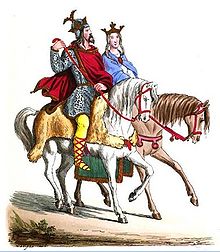
I was the eldest daughter of a ruler who wanted to establish relationships with another country. So, my father married me off at the young age of 12 to someone old enough to be my grandfather. When this guy died, his son married me despite the fact that people didn't like it and talked about us. But, the son died in a few years, too. So, I was left alone with no husband or children. By then, I was still a young teenager. My father put me into a convent for protection. However, I met this dashing young gentleman, who didn't have my pedigree but had my heart, with whom I eloped. Our marriage made my father furious, of course. He tried to track us down, but my husband was clever enough for us to avoid my father's thugs. We even made it to another country so that we could appeal to someone with higher authority. We found support which forced my father to accept our marriage. But, my father gave my husband the worse part of his realm to govern. Nevertheless, we were able to find success and happiness. That part of my father's realm became the best part. With my husband, I had three sons, but I didn't get to see them grow. I died in my 26th year. Needless to say, my sons did me proud so that I have not been forgotten.

Do you know who I am?

---


While researching for an issue of Gardner's Beacon and looking backward at historical events (after all, genealogy and history are intimately tied -- yes, those seduced by abstraction may complain, yet they have had their say for eons and might need to broaden their mindset), I ran across several tales about remarkable women that seemed to have a common theme that carried down through time. Some might say that things are still the same. But, looking at the 1692 time frame, I wondered what reception these women, from history, would have found in Salem Village, or any of the colonial sites.

---

So, the above might be thought of as the first of a series. We'll allow one character to talk about herself and to ask us: Who am I? (nod to the show, Who do you think that you are?).

---
For the Beacon, one instrumental book was written by John Goff, the Salem Preservationist: Salem's Witch House: A Touchstone to Antiquity (Google's digitization). John writes about the area, in particular, that around the Corwin House. Also, I like his description of the families involved with, and event related to, the house. Naturally, those facts touched upon are broadly of interest.

Remarks:

02/10/2013 -- Brought in the image from Wikipedia.

02/10/2013 -- There are many stories like this one. The answer? Judith of Flanders. She married two Wessex Kings, father and son, without issue. Then, she married Baldwin. One of their descendants was consort of William I.

10/27/2012 -- Still looking at options on how to present this type of query and to obtain/manage responses.

Modified: 02/10/2013

1692 theme, again

Working on the next issue of Gardner's Beacon (Vol.II, No. 5) with a seasonal theme. We had a similar issue last year (Vol. I, No.4).

The topic never seems to dry up and continues to be of interest. Of course, why just look at the thing around the spooky day? We ought to address the role of women in England's history, and in its colonies, at any time.

So, we can try to fill in missing information about Margaret, even is it's a sketchy addition. A start would be to gather together all of the views that have come forth in the past 200 years, or so, into one place.

While we will consider Thomas' female descendants, looking at women in collateral families will offer a lot of pertinent topics to discuss.

Remarks:

04/ 29/2014 -- Aftermaths.

10/30/2013 -- I am in the process of reading Katherine Howe's book, The Physick Book of Deliverance Dane. Dane, as in being related to Francis, of course. I wondered if there would be motivating material for a Beacon issue (we did have 1692 as a theme in 2011 and 2012). It is an interesting plot, especially the balancing of the characters, and their interactions, in two time periods is nice. The description that Katherine provides of little Dorcas Good in the underground cell surely depicts the poor, young thing's misery and shows Katherine's grasping of the horror. One wonders, from some of the modern views and comments, if people really understand the dire situation. Too, the main hypothesis might have some truth, in a slightly altered construction. You see, science has not shown as much light on human matters as some might think. But, then, for any knowledge that we have gained, we have also seen that the unknowns do not diminish. It's just that we get better able to cover (as in, remove from awareness) the holes in which lurk the demons.

09/04/2013 -- Again, the scene is built as follows. Those who came over are from the 10th to 13th generations back (for the most part) for someone alive now. By the time of 1692, lots of the earlier arrivals had passed on. So, that left the second generation (again, for the most part) as the elders. Now, taking a cohort mix (generational cut) round or about 1692 would give us someone on the current person's tree who would have about three generations living (including the level of their own cohorts). So, we would see siblings/cousins, parents/aunts/uncles, and the greats. In other words, it's a composite person that is built from that cohort mix (meaning, of course, that being on the tree implies ancestry) for which we can identify relationships blood (including 1/2 blood), in-law, and even friends. What Marjorie's chart does is to take someone who is in the mix and look at extended relationships. Now, consider what we would have if we did that for a large part of the composite mix. Would it not be an interesting view?

02/10/2013 -- Fan-in from the turmoil of all types of ancestors.

10/27/2012 -- We will have a comment by John Goff, the Salem Preservationist, about his book: Salem's Witch House: A Touchstone to Antiquity (Google's digitization).

10/24/2012 -- First of a series, Who am I?

Modified: 04/29/2014