![]() |
| Considering the historical distinction between coder and programmer. |
Remarks: Modified: 03/08/2025
![]() |
| Considering the historical distinction between coder and programmer. |
Remarks: Modified: 03/08/2025
TL;DR -- Old company, IBM, has entered the AI world with a code-sharing effort. This is an example of recent technology changes.
---
IBM got wise and decided to open up machine learning with a code focus. We have mentioned GitHub a time or two. This post is meant to bring this effort to attention, as we will be paying attention. They have tens of thousands of companies signed up.
So, let's start with an image an a link.
![]() |
| IBM's new User Camp related to the Granite approach |
This is for code sharing which we may get into. Basically, our focus is analytic, for now.
Remarks: Modified: 08/30/2024
TL;DR -- Two basic pieces of mathematics are algebra and geometry. There are others. But, the geometry folks have met over the years and are presenting what they know in a manner that needs attention. Hence, we'll look at that before going on to general modeling.
--
We write of technology. But, we have to look at mathematics, as well. From several senses, as it is the basis for parts of STEM and has operational use as well as being involved with the more esoteric notions.
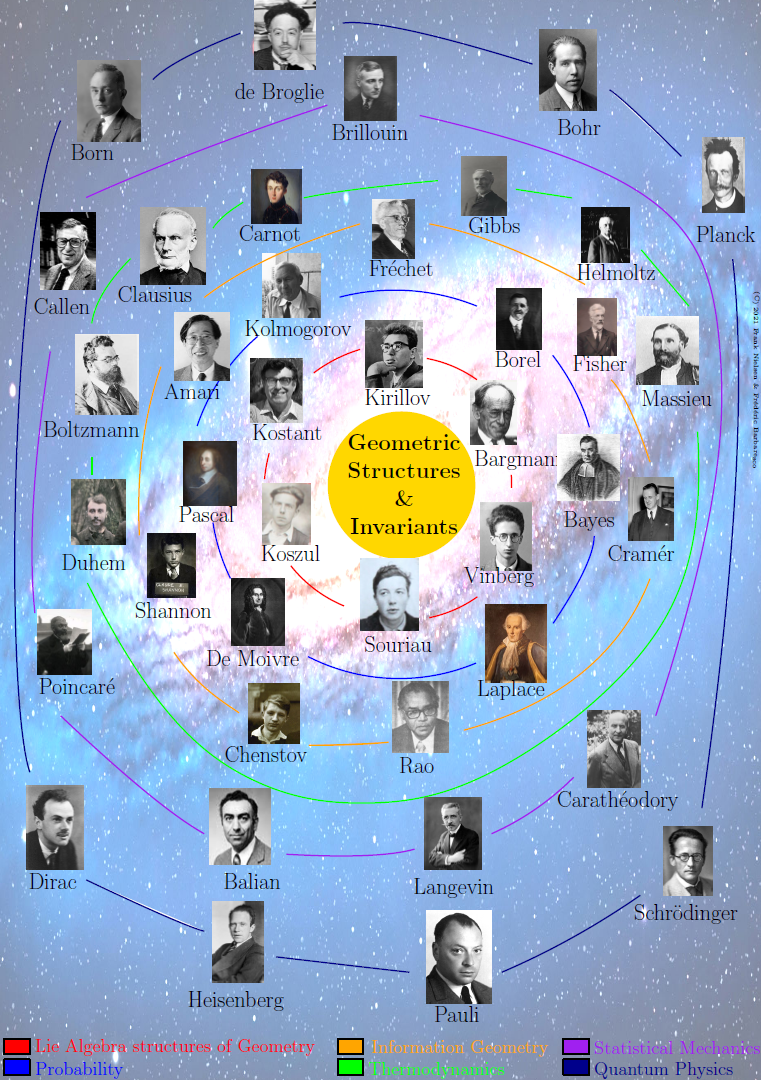
Of late, I have been reading of the Geometry of Information. In terms of knowledge, one thinks about logic or machine learning which has many aspects. But, core to our being are two facilities that we use of many others. I stress these two due to the topics related to things going awry when the understanding is insufficient to prevent misuse or creation of lures that lead to disaster.
For instance, when ChatGPT was looked at by an elderly AI person, he said: train wreck waiting to happen. We have written of GenAI (the overview concep) a lot this past year, including examples of using the systems. And, we talked about our leaning toward Gemini.But, we are going to be more specific about mathematics as we look at knowledge systems (from the '80s) as being of importance for trying to balance the potential harm of machine learning with human considerations about their future. Our theme will be (like we read in a DOD paper) that humans (and their intuition) are the focus, and the artificial is a tool to be applied by humans. Of course, that is hard to see given the configuration that provides us a bully (another one - we have had those forever) that is a know-it-all or wants to be (wannabe).
Okay, we will do this on a regular basis. Let's leave with an image from the GSI folks.
TL;DR -- After doing an extensive sweep of the internet (information universe), especially with respect to technical details, one can ask, whom to trust? GenAI, over time, will make the problem worse. So,our technology focus fits within that scheme of things. Where do we go from here?
--
There has not been a post since early August as busy with an assessment of technolgy with respect to computing and the GenAI that has been becoming more prominent on the landscape throughout the year.
My activity has been reviewing the past two decades which saw the internet bloom and had machine learning come back with a vengeance once Job's gift got out and was replicated by other players.
In particular, I have been concenttrating on database management changes plus the newer modes of accomplishing functionality.
A post on Quora somewhat summarizes the current viewpoint (worldview, educated opinion) that I have which stresses that technology is now suitable for a regular focus as it runs throughout our lives introducting changes that many times have not been beneficial.
This is the question/answer: As Oracle's CTO, what emerging AI and machine learning advancements are poised to revolutionize enterprise data management in the next decade? The questions was asked by Larry Ellison in his role as CTO of Oracle.
I created this post for the answer which starts a series of stick diagrams that will be improved later.
Another bit of activity involves a project that will experiment with a new technique for handling economic resources thereby removing some of the downsides of the ca-pital-sino which will be sandboxed, eventuall.
Remarks: Modified: 08/22/2024
TL;DR -- We take modern travel for granted. To wit, the Delta recoil from the Microsoft fail just a week ago. Now, we can look at the details, and ought to. As well, let's ponder three weeks of travel back in the good old days.
--
Having just written on Los Angeles and then finding more information on the California Trail to which travelers on the Oregon Trail switched if they were headed to the Great State of California. Per usual, everywhere we look in the US, we seek out connections to New England.
A recent focus on Bunker Hill West brought to fore lots of information about people from the east coast and their activities on the left coast. For the record, this area in downtown LA is where we now find the skyscrapers. But, under many of those are destroyed records of, at least, two cultural developments. Fortunately, there is an association in LA that has photos and records about the different eras and areas.
That will be a regular theme along with technology which comes into play due to the potential for mischief. Already, we have seen photos that seem to have been generated by methods other than a human with photoshop or the like. We're not paying close attention, yet, as there are plenty of photos for study from the repositories that are available.
On the other hand, tales of people abound and mostly are not known. Technology, you see, can be a boon as it will help document the past better than we have ever seen.
Case in point, in the graphic on the left, I made the connection between a middle piece of the US with a Gardner name. It was on the Oregon/California and Santa Fe Trails. At the same time, I knew of Butterfield for a long while but only paid attention of late as the researching of New England's diaspora came to be aided by technology. Butterfield's stage line went from St Louis MO down through TX into NM and AZ and onto CA and arrived in LA after three weeks. From there, it was another week plus to SF. Nowadays, that is a little more than a five-hour drive.
In the graphic below, the bottom middle view has two lines in red on the left. Both represent three weeks. Nowadays, that's not so long. But, if you worked 21 days without a break, you would feel it.
The shorter line goes back to the top of the graphic which is the route from Independence Mo to Ft Larned KS. Nowadays, that's less than a five-hour drive. Earlier, we had a tale of the founders of Lawrence KS, including women, from Massassachuets who traversed that same route in 1854. The trip was to found the town and the University at Lawrence. Most returned to New England after the al fresco meeting leaving a hearty crew to carry on with the settlement.
And, it was in the summer. They only had to do one fording of a river which is not large (the Wakarusa). Now, following the route to Santa Fe through Ft Larned has lots of these.
Now, on the right, one sees a line from Boston to London. Three weeks. When on things of that time span, what could one do? Well, that voyage took a bit of time in the past. But, nowadays, a week is sufficient for a modern cruise liner to make the trip. So, three weeks would be three trips from Boston to London, a return trip, and then back to London. Let's say after that, one would spend 7 hours or so flying back to New England. We need to think of other examples.
As the modern analysis show, One can drive the same route from St. Louis MO to San Franciscso CA in about 39 hours. Most of that would be on the U.S. Interstate system. I have driven that a lot.
That brings up another three weeks. This Butterfield route tied in with one from San Antonio TX. From there to El Paso took about the same amount of time. See, Pre-Civil War, San Antonio to San Diego (2021). This was a combination of two routes.
Now, the top part of the image is of a wagon train pulled mostly by oxen. In the bottom part is of a coach pulled by horses. Consider the logistic for this, as horses needed to be replaced and cared for while they recovered for their next trip. People had to be fed, and other supplies would have been essential.
Supposedly, this is a photo of a Butterfield stage arriving in LA. On the first trip. a report rode the whole way. We need to find that article. See this post: Mirror Building (2023).