Showing posts with label OpEd. Show all posts

Saturday, February 14, 2026

Hype, 1600s

TL;DR -- Anne Dudley Bradstreet is well known, as is her husband Simon Bradstreet. We can use her experience to consider hype over the centuries to the present, as we find now with technology. In Anne's case, she showed up on the Winthrop fleet in 1630 and found out that the colonial life in New England was not what she had told about (or experienced) in England prior to her departure. When she died after enduring several decades in New England, her husband moved into and lived in the house of his new wife which house had a history back to Cape Ann and which house came to bear his name. 

Anne Bradstreet
--

Hype? As old as mankind. Let's look at an example. 

Many know of Anne Bradstreet. She was a Dudley and came over with her husband, Simon. We have had lots of posts about the couple. There will be more as we start to explore a theme related to technology. So, please continue past this reflection on how we can learn from past times beyond the generalized view of the historical records. 

Simon and Anne came over with Winthrop in the 1630 fleet. Simon was heavily involved in the guidance of the development of New England and Massachusetts. So, they lived in Boston as well as Essex County. When Anne died in 1672, they were in North Andover. 

Subsequently, Simon married the widow of Capt Joseph Gardner, son of Thomas Gardner who is the subject of our research and namesake of the organization. Joseph had died in a military conflict with a local tribe of Native Americans. 

At that time, Ann Downing Gardner was living in the Salem house given to her and Joseph by her parents. We featured Joseph and Ann in a February 2012 post in which we mentioned that Ann had Simon sign a "what was essentially a pre-nup. Was this the first of its kind on this continent?" We also featured The Downings in 2022. Her brother is the namesake of Downing Street in London. 

Also, we have looked at houses. The Downing house was an extension of the original house brought by the Cape Ann crew. Our post on the 1st Year has images that show the progression in house technology over those decades in the 1600s. Ann Downing's family's house became known as the Bradstreet's Salem Mansion. 

Anne Bradstreet's
comments, 1630

That earlier post looked at what was available in those early years. Anne Bradstreet provided us a description of her first view of Salem, which gets us to the gist of the post. They arrived with more than could be handled in 1630 as they had been promised that there was a house ready for them. At the time, there was one house of substance which had been brought by the 1623/24 crew and assembled at Cape Ann. Later John Endicott had the house brought to Salem. The Downings did some renovation. 

What Anne saw, largely, would have been huts. Their configuration would have been a modified wigwam with the interesting addition of a stone fireplace which would have provided more structure.   

English wigwam
The Governor's Faire Mansion was the house that the Cape Ann crew put together which later was moved and then extended to the "mansion" that Ann and Joseph enjoyed until she became a widow and married Simon Bradstreet. 
Governor's Faire Mansion
Great House (Cape Ann)


Winthrop was feated in this "Faire Mansion" when he arrived with his fleet. Some of the party went to Cape Ann to pick strawberries. So, Anne would have seen the future. 

We will look further into the technology of the time as points in contrast to discuss modern variants of age-old issues. That is, we have the 250th of the U.S. But, we really need to understand better the colonial period from the perspective of the real people who lived through the involved periods and sent their DNA down to the present time. 

Remarks: Modified: 02/14/2026

02/14/2026 -- 


Wednesday, November 13, 2024

Miscellany

TL;DR -- We will have several of these. We bring back a couple of images and point to several themes, one of which is technology. 

--

Just updated this image at a 2014 post (Status and focus). 

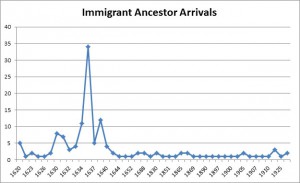
Arrival of immigrants
by year, Plymouth context

The image had moved around over the years. This was our fourth year of doing the blog for the Thomas Gardner Society, Inc. 

About this time, there were new attempts at what is called machine learning (touted as AI, known as GenAI) for several reasons. One was that the web was 20 years old or so. This caused lots of data to accumulate for both good and bad reasons. It was also 2 years after MicroSoft decided to move to the cloud pushing people off (see post (2012) thomasgardnersociety.org). In 2017, we moved the portal (to truth) to TGSoc.org to ease typing. 

Back to the image, it was used in a post (Vita Brevis, NEHGS, 2014) about what years the colonial ancestors of a group of people arrived. Another image relates to the length of the 5th generation of the Mayflower folks. When did it start and end? See the post (2019): About genearations

How long is a generation?

Finally, something about technology. The latest ACM Comm had an article on the problem of science that results from computer science not doing its job. This has to do with supporting needs of properties such as repeatability and such. The situation is dire and noway solved by GenAI which is more of a contributor to noise than not. But, we'll get into that as it's on the plate for the TGS to tackle problems of this sort. 

We have been at this blogging since 2010 and have collected a lot of data. So, with technology in mind, we need to reorganize everything. While we do that, we'll bring in changes with respect to two Thomas Gardners as suggested by the folks at WikiTree. While, at the same time, expecting that the two were one gentleman which we will discuss. 

Note our new Category: OpEd

Remarks: Modified: 11/13/2024

11/13/2024 -- 


Tuesday, July 16, 2024

OpEd, again, plus Salem

TL;DR -- We have two changes to explain and process. One deals with the Thomases.The other is about technology. But, we also will catch up with Salem and its 400th preparations. Then, OpEd as an interim device to keep coherence? We'll look at that. 

--

Recently, we looked at the status. Two changes were noted: 1) a new question arose - were there two Thomas Gardners?; 2) technology has become more interesting due to GenAI and will be a continuing focus for us into the future. 

Also, we looked at 2024 in which Chelsea has its 400th, then 2025 where Qunicy is the celebrant, and then 2026 with respect to Roger Conant moving the crew over to Salem. The first two towns are not in Essex County but in the Boston area and consists of lots of families. As mentoned, we will look at all towns with those in the County of Cape Ann getting special attention. 

Salem? We have written a lot about that coming event. For example, we had a post in Pageant of Salem (6 Jun 2018) which had family members playing their ancestors during the time of the 300th. The play was performed in several areas. Dr. Frank was one of the participants. We mentioned that the celebration was not long after the outbreak of Spanish Flu which dampened things a little. 

Sound familiar? We're not not past Covid with many issues (such as vacine, potential for yearly outbreaks, and more) still being discussed. 

We will pull together the posts about the Salem commerations and mark them as the first step of a restructuring. Mark with what? For starters, we will put those posts in the "OpEd" category (30 Dec 2023). We were reviewing the year. One thing that we marvelled about was the gall of releasing GenAI which was premature in so many ways. Right now, there seems to be potential raging. But, there will be a downturn from this hype, including reactions on the ca-pital-sino that is over 40K. 

You know, there is an adage that when one is getting tips on stock from those that are in the daily life, then a downturn is on the horizon. Okay, we had a major downturn in 2008 (thereabouts) which we saw up close. Since then, there have been several drops, but frankly we have going on 20 years of the "bull" side of things. 

A headline today touted at a GenAI era stock trading program is making lots of money. And, it's on the web/cloud for people to use. Remember crypto (of recent vintage - the bank failure)? This is similar. We also saw a pop last year of the stock of a company that was not worth the evaluation that accompanied the rise in its stock. The pop was due to gaming. We can go into detail, but it's the gist of matter that applies here. 

We will touch upon all aspects of computing and its value to our lives including specifics of advanced systems which is where we spent out life's energy. Along with that, we'll emphasize the mathematics that is involved. One good area to focus on would be machine learning

-----

Again, OpEd? What's that about? See Current Status (9 Feb 2024). Well, one might talk about fact and fancy. Or in betweeen? Okay, the binary logic is not how real life works. The computer's limits many times come from ignoring that basic truism of life. 

So, measurements, tolerances, evaluations, and such? Yes, all are appropriate. If we assume the two Thomases (pre-1635 and post-1635), we can look at either or both or not at all in our work. If you go back, we said long ago that we didn't know much. See What we know? (22 Nov 2012). 

Too, we found the marriage notice in 2014. So, we have been following the right path. Now, we need to go back through the whole of it and separate out the "fanciful" (even Dr. Frank's stuff prior to 1635) and collect them into a historical view. 

Salem's first fort (1629)
Then, the rest will be what carries to the next decision point. 

Oh yes, terms? We have conjectures and hypotheses that we will document. Too, what is a proof? That's an important issue related to technology as well as to humans and their lives. So, tackling the topics fits well within our mission. 

---

A focus on Salem (Learn about Salem's History - 400th Salem).  We'll get into this more as we go along, but these are links related to our research. 
This is "OpEd" just to include it in the list of earlier posts so that we can collect all of the posts which need some revision. That revision might be a foreward, explaining the situation. 

Remarks: Modified: 07/16/2024

07/16/2024 --    


Thursday, July 11, 2024

Next two years

TL;DR -- The next two years have major historic connections. One is of the old country. The later is the start of the new one. 

---

Two things, with more later. On Quora, I was reading a comment by a Berkeley grad (see first bullet) and thought so use this post from 2015. 
  • Vicissitude and life's puzzles (June 2015) -- I had gone to a talk by Douglas Richardson. This post had a  link to his site. Today, it didn't work. Okay, that's going to be a common thing on the web along with the intentional (many times) introduction of mis(dis)information. So, I go looking for information on DR. Turns out that Wikipedia has a page (Note: Wikipedia, being human curated, is going to serve a savior role for some time). So, in our post, I changed the link for DR to his page on Wikipedia. Too, I was reminded that he was a Berkeley graduate. 
With respect to this, the Magna Charta involvement by Henry III will be celebrated next year. More on that later. 
  • The 250th of the U.S. (list of posts) -- We have had several posts.    
D.A.R. has been involved for almost a decade in the planning. One action was to have a committee that helped get difficult applications documented. That work got us to realize that there is something needing study on a continual basis: America's Lost Generation. We have seen a lot of this type of thing. Fortunately, we have found the committee's help to be of great value to Ann's work. 

Remarks: Modified: 07/11/2024

07/11/2024 --


Thursday, May 30, 2024

US History, details

TL;DR -- The first photo show several things that are of interest. We only mention a few. Like, the beginning of Sunset Blvd that goes out from near Union Station to the beach. Too, curators continue to provide photos of areas of LA during differnt periods. LA can conserve. It does (has) not, lots of times. 

---

We will keep to a detailed view of history. Mainly, we look for forgotten stuff. So, let's get back to a couple of examples. One deals with real life and real estate. The other is real but pretains to bits which we now deal with in mountains upon mountains. 

Okay, we have written of Bunker Hill West. Our latest post, Old LA and the US, looked at an area near Union Station. In one photo, City Hall was visible. It's from the late 1920s and is a reference point. Another looks at a Church that started in the 1700s and was rebuilt in 1861: La Iglesia de Nuestra Señora la Reina de los Ángeles. It is still there. So, LA can conserve. 

This photo was taken in the 1950s as the freeway was worked. You can see the Union Station and the Church. Another landmark? Sunset Boulevard starts there. In this photo, near the Church. 

1950s, highway work
near Union Station, LA in CA

If we went along that freeway for abit, we would get to Bunker Hill West. Let's look at a photo of the area where we can see buildings that were there in the 1950s, the same time of the highway work. 

This is along 2nd Street looking
eastward. Notice the top 
of City Hall. 

This is the way that DTLA looked a few years ago. Toward the right, one can see the City Hall tower. 2nd and Hope would be a couple of blocks north of where the group of buildings are to the left,  US101 runs just north of that area almost parallel with the streets, such as 2nd. 

View along 
Olive street

This Google Earth link goes to the view of OneWilshire which is the visible to the left of Olive as it is on Grand. 


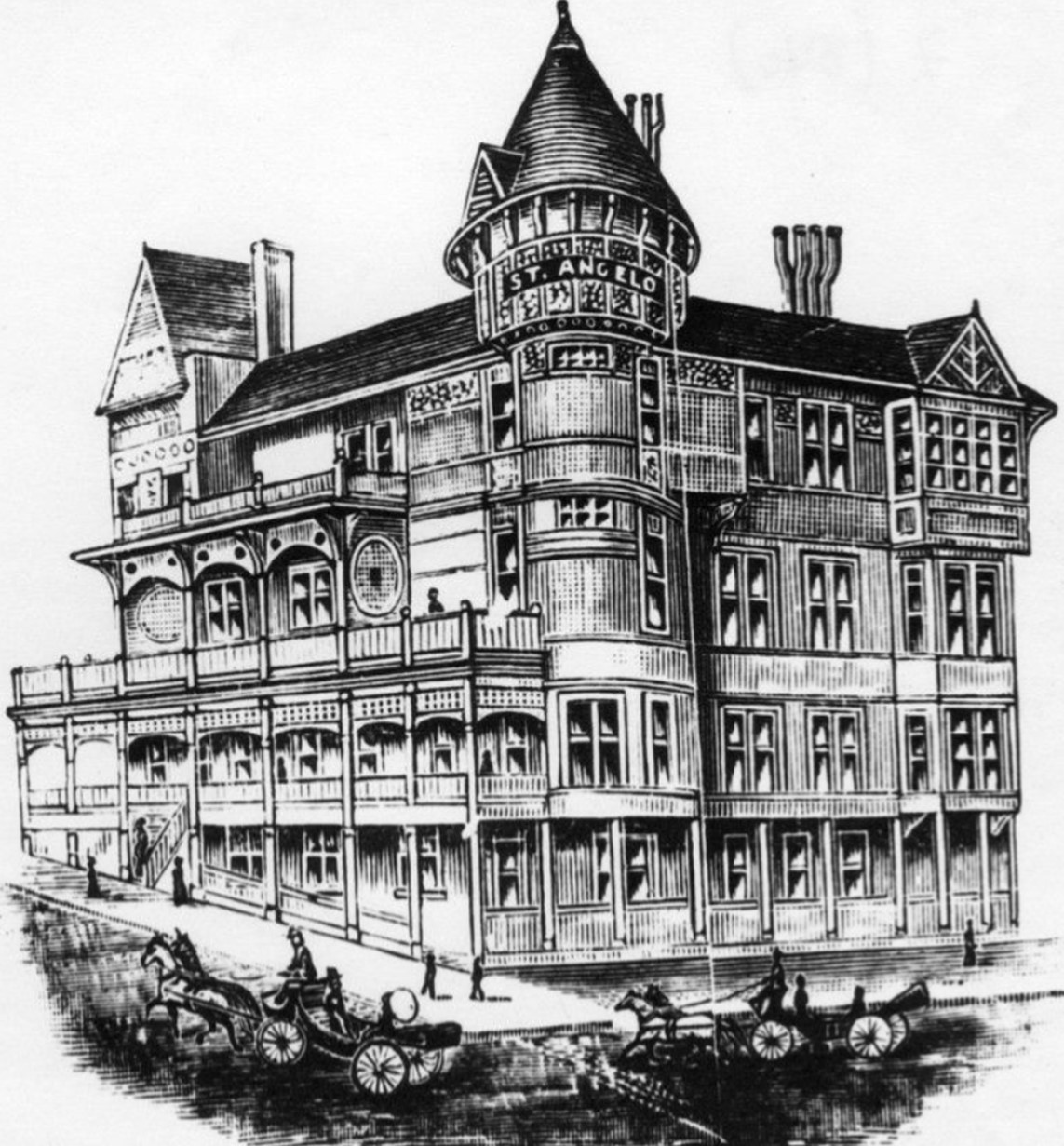
The Google Earth is shown as lots of good information is now available through this medium that represents progress from the efforts of people along all sorts of domains of talent. We cannot go back, but we can find descriptions about the great buildings of Bunker Hill West. An example is Angelo Hotel (sketch) which was on Grand near Temple St. Many are working on this. 

Hopefully, curators will keep those silly, make-believe products of GenAI at bay and reduce the negative influences that are awaiting to happen. 

---

The above represents lots of remarkable work. We cannot name them all. But, an important one was covered in the latest IEEE Spectrum. There is a good story of the beginning of TCP/IP. If that isn't familiar, then the article will add in some detail. Too, we ought to know these events that left their markings. 

Just like we will remember the mischief let loose by Open AI in late 2022. Lots to discuss there. 

The 2022 IEEE Medal of Honor recipient envisioned the
               network of networks that became the Internet.

Remarks: Modified: 05/30/2024

05/30/2024 --

Friday, February 9, 2024

Current status


TL;DR -- Two major things happened last year. Both dealt with technology. One had to do with the future as it might be influenced by computing. The other had to do with the influence of the computer on the past in terms of records. Then, we have all sorts of other themes at hand to consider. 

--

This post has the purpose to get the current status of the Thomas Gardner Society, Inc. on the table. There were two major things that happened last year. Then, we reacted to another change in the on-line environment. 

Caveat: This will replace the "In summary" post of last spring. 

First, the two things, as in order with respect to our focus, of note last year were: 

  • We became aware of the xNN/LLM maneuvering in late January and did a post on Febuary 1: ChaptGPT. Prior to that time, we had taken a hands-off approach to AI for reasons that are documented in later posts last year and before (actually). We knew that there was money involved with big names getting into action. But, it's a mess, folks, which we intend to bring to the fore as our major project. Let's table that for a bit. Too, there was the 400th of Gloucester last year (next bullet). Then, there is the upcoming 250th as noted by D.A.R. and S.A.R. which we spend a lot of time supporting. With respect to our research, see our category of the "Long reach of New England" which as been a theme for almost a decade. It got more attention when we considered that those on the Oregon Trail (some of them) had passed by the foot of Mount Oread which hosts the University of Kansas. And, that there had been a major effort on the part of New England to keep Kansas slave-free. Col. T. W. Higginson was out here. So was John Brown; we just had a post on his armed conflict with some people of out the south who were using Missouri as a staging ground for creating havoc with pioneers. Stay tuned on that. The other theme can be found after the next bullet.   
  • Okay, we were getting ready to write about Margaret Fryer the wife of Thomas Gardner. This was due to the fact that the 400th was collecting stories. And, our research had been effective is getting Margaret on the map. Anderson, and friends, had dissed her, essentially. But, then. We ventured to WikiTree which has been our research vehicle (for many reasons) and saw that someone had gone through the digital files of Sherborne, Dorset and found records for about all of the kids of Thomas and Margaret. Except, we might add, for Sarah who was known to have been born here in Salem in the mid-1630s. And, we saw that the WikiTree folks had split Thomas into two people. The one Thomas was the husband of Margaret. The other is an unknown. To us, we see these ones as the same. Thomas was here and went back. Hubbard suggested that. And, he was of the time and talked to the principals. Whatever turns out to be the fact, we'll adapt. But, right now, Thomas was at Cape Ann. Nothing really shows otherwise. But, how did we miss this? See the first bullet. Besides putting ChatGPT through its hallucinatory paces, we looked at others. Frankly, Bard of Google excels. We'll explain. The gist of the matter is that we can research from Salem to now. And, origins? Full of open issues which it is time for us to tackle. 
Another theme had been the west coast, principally San Francisco as we were looking at the quake and the aftereffects. But, Los Angeles got into the mix due to seeing that Butterfield (and others) had stopped in the Bunker Hill area to reprovision for further effort going north to San Francisco. Arriving there, they turned around and headed back to St. Louis by a long, arduous route. But, lots and lots of photos from various times started to crop up which made this theme even more important. 

This is cursory by purpose, as we'll have this research as a regular theme from now on. 

So, origins, for the most part, were not followed closely by us. We had concentrated on the generations from Thomas and Margaret until now. There are reaons for this. One dealt with the fact that research in the Old World was ongoing and best handled there. We, over here, have our own axes to grind. 

That was okay until now. We are henceforth taking origins to be a regular feature of our work. 

Remarks: Modified: 07/12/2024

02/13/2024 --  Added image. 

07/14/2024 -- Why is 2024 so quiet? 

Saturday, December 30, 2023

Opinions count?

TL;DR -- We are going through our blog posts and marking those with opinions expressed as OpEd. This does not include instances where there were sources, however they might be considered after new data became available recently. Lots to do and discuss. 

--

This post is two pronged. First, we consider OpEd types of posts that have appeared here over the years. As we identify these, we'll put them into a special category (OpEd). Then, on the other hand, we will be updating the FAQ plus all of the other posts that might need to change. ... Notice that the post "The Old Planters Society" comes up in this list.


So, on looking at our OpEd collection, there are none with "new data" generated on the fly. So, we did nto discombulate anything. Our posts are purely reactionary with respect to the lack of data and wondering why (thinking out loud type of thing). 

Aside: This is apropos since we need to identify sources for things being stated with some certainty. The OpEds were not. Though, one might claim tongue-in-cheek. Okay? Juxtapose time. We have just had a year of almost countless "generative" modes pushing out "fakery" without end. It took us (humanity) a while to figure out the issues. Some, anyway, as the debate continues. Those who provide the means for the mischief are doubling down on their position, even though many, this year, have gone to Washington, DC begging (almost) for bureaucratic oversight and control. This little exercise of ours will be used for philosophical discuss (down below).

Let's start with a keyword search, as shown by these bullets. 

  1. Backbone - https://thomasgardnerofsalem.blogspot.com/search?q=backbone; you know, we already had a category for this - so, it's OpEd, too. 
  2. Now, Cape Ann is not an OpEd, since it was following prior knowledge. https://thomasgardnerofsalem.blogspot.com/search?q=cape+ann
  3. Forgotten is in a minor part; much of this does consider those left out of the equation. https://thomasgardnerofsalem.blogspot.com/search?q=forgotten So, we added OpEd where appropriate. 
  4. Planters is a core notion. https://thomasgardnerofsalem.blogspot.com/search?q=planters 
  5. ... 
  6. We'll continue. 
-------

With respect to "fakery" and such, we have a recent post about AI not being solely ML. It is the ML --> AI shift that is partly to blame for the messy situation. We can explain and will over time. 

What does this mean for the TGS, Inc. work? Like many would agree with, there have been tremendous changes in the internet over the past 2+ decades. Lots of this can be tracked and discussed. Too, during our decade of doing this work, we have seen old sites disappear and new ones appear. Not many of these were consistent. Even WikiTree has its problems. All of this goes back to humans and their ways. 

Computers replacing us? Fact or fiction? Notice, and opinion is not fiction. It's another type of cognitive state. Computers are going to help us discuss how we are. That is one huge potential benefit, since it can be considered objective. But, not, folks. We (people doing technical work) have been at this long enough to know that there's no "truthful" state involved with computational systems. If anything, truth is engineered. So, we'll discuss that. 

------

Aside: all good computer systems allow us to follow changes. Wikipedia does this. I can go back to the beginning of any page and watch the changes over the years. WikiTree adopted the same thing but scaled down. Here, we have used Remarks to note changes. And, with regard to the OpEd assignments as well as the subsequent changes that come about as we settle issues, we'll do modifications in a logged manner. ... At the same time, we will be picking up links for older research efforts so that we can describe the changes over time. Lots to discuss. 

Remarks: Modified: 01/13/2024

01/13/2024 -- Added image. 


Thursday, December 8, 2022

1623 to 2023

TL;DR -- It has been twelve years since we began our effort. The 400th is now showing on the horizon. It's time to stop, reassess, and prepare for the future. Definitely, we can compare what we know and how versus the comparable periods in the past. At the same time, the 500th and its requirements can be considered. As, a 100-years focus for a project has come forth as necessary for us to do technology correctly. That is one focus that we adopted. 

---   

In Massachusetts, Gloucester is starting their 400th in a mere 22 days. Can you believe it? Here is a link to the stories that they have been collecting at their site (www.gloucesterma400.org). 

When we started this work a decade ago, we had a lot to learn which entailed reading, on-line, in libraries, general books and articles, plus visiting places to get acquainted. Along the line, we have posted here plus put out the Gardner's Beacon and The Gardner Annals. And, we have corresponded with lots of people. We have two websites and several blogs. We wrote on existing topics (Charles Olson, Worcester born and of Gloucester by choice) and ventured into other areas, such as technology

Back then, our timeline started with 1624 as that is what Dr. Frank used in his books following work being done in England. Since then, there has been other work done that added more flavor. A crew stayed over for the winter of 1623/24 with an arrival the next spring of another group of ships (one of which was the Zouch Phenix). Thomas Gardner is mentioned as being on a passenger list, however there are arguments that claim no such list existed. Margaret Gardner was noted for not being the mother of the children mentioned by Dr. Frank. That was clarified further. 

We have more tools now, such as WikiTree's support for genealogy. But, we saw lots of other work and must gather these to create a view of the knowns as of this time, the 400th. We can remind ourselves that the 200th was coincident with the start of the new country, U.S. In that regard, we have been setting up means to know how New England's influence has evolved over the whole period since the colony started and from the beginning of the country that we know. That involves knowing more about the interior and its history. 

But, as we came through the years, things stood out so as to allow us to categorize. We will get into that further. But, let's mention some that will have continuing attention with a little commentary. 

  • What we know -- We wrote on this, first, in 2012. It precipitated the creation of a FAQ.  We will continue that effort and keep this collection up to date. 
  • What's new - This was an early effort and has been through several changes. One aspect that will be continued is the Recent finds overview. 
  • Gardner's Beacon - We started with a PDF and a web page and have started to convert over to a database driven by one of the known platforms while keeping control via our own rented virtual server. The Gardner Annals has incorporated issues of Gardner's Beacon in a printed format. But, other approaches are being explored as we look for a good way to go toward the future. In any case, we will balance various media yet keep the printed variety present for several reason, such as support for research and its necessity for handling provenance. 
  • Long reach of New England - This entails keeping aware of the many ways that life and changed over the periods since Cape Ann and the later Revolution. Not only must we consider the vast interior and its lure, but the scope is international as well. 
  • But, Cape Ann and specifics - From details of Rev. John White to the families and their descendants (John Goff), there will be research to be done. Our interest runs from providing funding to coordinating presentation and analysis of results. 
  • The Massachusetts Magazine -- Dr. Frank and friends published this periodical for over a decade which was to be the official voice of the Old Planters Society. Here are a few links to posts related to the Old Planters: Old Planters, Beverly (2011); Old Planters, Massachusetts (2012); "Old" in New England (2021). 
Needless to say, for the 300th, there was a lot of effort put into genealogical research and publication. As said, the 200th was overshadowed by concerns for getting the U.S. going properly. The 400th will be about history and bringing information into a better mode for continued work down the pike, which implies 100 years plus (we will cover this under technology, in contexts such as discussing content versus configuration). 

We are using 1624 as our date while being cognizant of the overwintering party. But, we have other commemorations that will ensue, such as the arrival of Roger Conant (1625) and the movement to Naumkeag/Salem (1626) with parallel efforts applied to the other locations where collateral families were involved early on (say, Ipswich).  

Remarks: Modified: 12/20/2022

12/20/2022 -- Gloucester is preparing for the kickoff of 2023. 

Theirs is the first commemoration in Essex County, MA. Which is our original focus, like this: Cape Ann (Glouceser), Salem, Essex County, Massachusetts, New England. 


Tuesday, March 29, 2022

Who's on first?

 TL;DR -- So, 1st governor? That has been mentioned. Today, we find another view brought into the mix after a decade of research. We really appreciate this addition. 

--

We have several themes involved with the work of Gardner Research. One of these motivates the post. But, let's look at another one first. It has to do with the families at Cape Ann some of whom moved over to the area that became Salem. Some went back, such as John Tilley who was featured in a recent NEHGR article. A little later, of the first class at Harvard, the majority went back. Some not to return such as George Downing. With regard to Harvard, we had people coming over just to attend. 

Our interest is to find the Cape Ann families and their modern offspring. Say, like this view of the signers of one of the documents related to the Revolution (see Different Scopes). To that we would add some material about Loyalists. In one of these posts (see Two Houses), we match up the two sides, one of which was a Founder of the Society of Cincinnati.   

Okay, let's go to the other theme after listing a few posts that we have had related to Cape Ann. 

Now, the new theme? 1st Governor. Of what? Well, the role would apply to New England, of the north, principally that which got Massachusetts going. And, it dealt with families here. In fact, with regard to  Cape Ann, Gardner was thrown into the mix in a discussion amongst members of the extended collection of Winthrops, Bradfords, Endicotts, and others, such as Cabot, Conant, and Crowninshield. There is no order implied in this listing. 

With respect to research, this would involve George's offspring (early son) though the writer of their book was an offspring of Samuel. To date, we have covered a lot of material in the past decade with a stack of research still to do. 

Including, and relates to the new theme, the Dorchester CompanyFrances Rose-Troup left the results of her research. There has been some since that time. The issue of Thomas and Margaret has been settled. And, we have 400 years of data to look at. So too, supporting SAR/DAR's 250th, we have the 5th generations's revolution to look at, say, Cape Ann to Patriot. Then, we have the 200th which is of the frontier and the huge interior that was carved to pieces; the 100th would look at the continual influx of newbies plus events such as the Spanish flu

So, the theme of today? We earlier had commented at a post of the Streets of Salem blog dealing with Gloucester (Enduring Gloucester) and what went down there, and when. Per usual, our focus was on what happened here. That is due to an adage saw earlier that said that Yanks ought to deal with the stuff over here (say, yeah, Massachusetts records) and the Brits would take care of their side. As well, for a long while, the people here self-governed. We'll get more in that, with the occasional meddling of a Governor sent over say, the bickering families of Nantucket (see John's visit to New York), taxes (see John Wise's jailing), and more (blogs for all of these).  

This year, there was mention of the 'real' first governor, as in being appointed over there. The commenter (David Cuckson had written a book on the subject). He mentioned Sir Walter Erle (WikipediaWikiTree) as having the role as appointed by Rev. John White, himself, about whom we have had several posts, since one sister married a Thomas Gardner and another married into a family that came over here. 

We appreciate now getting another view established that was not given proper attention.  

Remarks: Modified: 03/25/2022

03/24/2022 --

Sunday, May 30, 2021

Enduring Gloucester

TL;DR -- The 400th is coming up for Cape Ann. The strain of the virus has muted lots of activity. Part of this motivated a broader view that looks across the centuries (400th, 300th, 250th, 200th, 100th) with respect to families and individuals. Lots of questions have been asked over the years. Good answers are wanting yet. One fact is that Gloucester is a core subject now and into the future. 

--

Before Covid came around, planning was going great guns as 2023 approached. The "Enduring Gloucester" website reported on this activity and mused about Cape Ann history. 

In 2020, the Plymouth festivities were quite constrained compared to the planning that that occurred. 2021 has been fairly muted so far. However, as we look forward, our thoughts are to look across the broad spectrum of years so as to tell tales that can carry forward with some support. Broad spectrum? Yes, our focus is on the 400th, 300th, 250th, 200th, and the 100th. That is embrace the whole of the experience.

Here are the contexts for each: 400th (Cape Ann); 300th (need to pull this out; it would have been only a few years post the Salem Village mania), 250th (DAR/SAR provide the proper framework with this); 200th (the western expansion dominates, but a whole lot was going on with the industrial revolution); 100th (those who cared sought to fill in the pieces; one example was the Old Planter's Society). Now, we are doing this again with technology as an assistance.

So, we are starting a concentrated effort that will continue until 2023 and, then, beyond. One hundred years ago, Dr. Frank started The Massachusetts Magazine. Using the web, we will have something similar. One of our tasks is to document Thomas and Margaret better. Another is to look at the work done over the years and keep the information available accompanied with an objective summary. That is, the "What we know now?" will be a theme/meme now and in the future. 

Along that line, here are two of many attempts: What we know (Nov 2012); Gardner FAQ (Mar 2015). As mentioned, there are a lot more which we will organize.

In the mean time, here are some of the external sources that we will reference.

1907 Postcard - Celebrating Cape Ann Settlement

  • The Settlement of Cape Ann: What is the Real Story? -- Mary Ellen Lepionka is researching the Cape experience. We used her post to comment on two of our posts.
    • Diversion, Gloucester - Charles Olson (Sep 2014) -- Olson was a poet who adopted and moved to live in Gloucester. He wrote about the Cape Ann experience which got our attention. As well, he is remembered in Gloucester and is mentioned in material related to the history.

      Cape Ann, Retrospective (Apr 2016)  -- after a lot of research, we got to where we saw Thomas and Margaret staying in Cape Ann with the house as Roger went to what became the Salem area (Massey's Cove).

  • Rev John White MA (1574/5-1648) --  this site documents the life of Rev John White including listing his sister who married a Thomas Gardner who apparently came over to Cape Ann and went back. At that same site, there is a link to this post "Members of the Dorchester Company 1624-1626" which gives the names and some information about all of the investors. So, the information is very pertinent. We have started to look at names and relationships. For instance, Roger Conant had an uncle who was involved. 

Gardner Research will carry the load in reviewing reports from others as well as doing original research which would include funding scholarly studies and writings.

Remarks: Modified: 07/14/2024

08/09/2021 --  Gloucester's clock has 509 days to 2023.  

03/27/2022 -- A recent article was about the Gloucester summer home of the family of T.S. Eliot (Wikipedia, WikiTree). T. S. had an extensive New England heritage as did his friend, Ezra Pound

07/14/2024 -- See updated comment: Why is 2024 quiet?


Friday, October 30, 2020

Margaret Friar, WikiTree

TL;DR -- We are taking a closer look at Margaret's family. 

---

Note (02/02/2025): Added the OpEd category. See posts from Feb of 2023 with regard to new information and plans for altering the database and site. 

---

In this title, we used Friar as that is how it is written in Sherborne, Dorset, England records. Other spellings have been Fryer and Frier. In the below, we describe why we can identify the parents of Margaret Friar, wife of Thomas Gardner, as Walter Friar and Grace Mullins. Also, there is a current effort to learn more about Margaret's family

This post is along the line of  a relook at Margaret that we did a couple of years ago. This time, we are going to identify some specifics that have been collected on WikiTree in order to update Margaret's Profile there. A Great Migration project has been working to ensure that Profiles match up with the NEHGS book series (by R. C. Anderson), including recently determined material which are listed below. 
Friar records

This list is part of an effort to support coordination and discussion (Editing Margaret's past) while the changes are being done. As a reminder, in his profile of Thomas Gardner, Anderson had three wives with the first one (Unknown) being the mother of the children, a second one named Margaret Unknown there briefly, as Demaris was the last wife. What work of supporters of Gardner Research have shown is that there were two wives with Margaret being the first and the mother of the children. 

There will be more updates with respect to this work as simultaneously we are updating Thomas' profile  (Coordinating coming edits of the Thomas Gardner page) so as to have a good one going forward that is acceptable.  

There are a few things that motivate this change, beyond the necessity to close up the deal. These are listed below. The notice of the Thomas and Margaret marriage record was written in 2014. At the same time, some of the other records were noted. Since then, there has been a lot more scrutiny and discussion which was under the auspices of WikiTree. So we have records from which to report on the activity over these few years.  
  • we have a marriage of a Thomas Gardner and a Margaret Friar (appropriate timeframe - Felt was the furthest back printed source that we saw)
  • before that, we have a birth of a Margaret Friar, same area
  • then, we have a Will of a Walter Friar mentioning his daughter Margaret (before the marriage), too, he mentions his son Thomas - there is a daughter Grace - is the wife mentioned? if not, did she die?
  • then, we have a marriage of a Walter Friar and a Grace Mullins, same area, appropriate timeframe
  • then, coming this way, we have births of boys (Thomas, George, Richard, John) with a father of Thomas Gardner.
  • later, the family is not in the records
  • then, we see that Savage has a Thomas Frier/Friar as a brother, "perhaps", of Margaret, wife of Thomas Gardner.
There's more. And, we are actively reviewing records in order to identify the births of Walter and Grace. 

Remarks: Modified: 02/02/2025

10/31/2020 -- Added images for our portal. 

02/02/2025 -- Updated with new information about Thomas and Margaret and their family with respect to Seth being born here. The others kids not. Was Thomas here more than once? 

Wednesday, September 9, 2020

WWTD?

TL;DR -- What would Thomas do?
 
---

At the five year mark, we were reviewing the work done so far, especially with respect to technology's influence on how one works, what one can do, what means are there to present information, and so forth. With 'what?' as the chief component of the query. We gathered some thoughts in this post (WDTT?) which was a copy of WWJD, somewhat. Using Thomas for discussing the old and the new, and for setting some notion of understanding, technology was a proper focus (it touches everything).

We have had a few posts with this theme (latest one, Technology as imperative; search on technology). We have a technology blog which has been lagging of late but will be back in business soon. What does technology deal with?

Think back to Thomas' time and, then, think of today. Huge differences, though we the same people, more or less. As the above look was 'what' which is a common theme, technology demands that we look at 'how' in detail of varying sorts depending upon the mode and role. That is one focus of ours, since we want to contribute to the related spaces in an interesting way. How is this? We'll get to that.

Oh yes, that will bring up 'why?' and similar queries. So, this theme will recur, albeit the technology blog and the our portal will cover the more specific issues. 

Remarks: Modified: 04/05/2025

09/26/2020 -- Add image for the portal (TGSoc.org). 

04/05/2025 -- Add "OpEd" label. Will explain. 

Wednesday, June 3, 2020

Modes and protocols

We are about three months into a new world. A young guy, weeks ago and before the reality really set in, mused that our world had changed, in ways that we could not yet see. Since then, in that milieu, protocols have been put into place that are somewhat onerous.

Like everything human, 'knee jerk' comes into play. Lots of this really is just the effect of that old mode of playing against the average. So, there cannot be smoothness until things are ground down like peanut butter which then can spread everywhere in equally. Except, that would be the 'smooth' type, whereas the nutty type would have its lumps. But, we don't handle those well.

Look closely, and you'll see that the higher order, say medicine, might put people through the paces in terms of the gauntlet needed for access and completion, yet, day to day, it's peanut butter.

Want an example? I was put under the 'scope' today in terms of the new mode's emphasis on one's temperature for rating go or no go. Too high, go away; within the limit, go forward. So, I score almost 2 degrees (F, of course, we're talking this side of the pond with celebration of independence coming up soon) higher than my normal which is still above normal but below the upper threshold.

As an aside, if we take some number as the average, there will be those who are above and below this number. How the spread goes is of importance. People argue these points; unfortunately, with the computer's prowess, one sees 'knee jerk' adoptions of modes, where a deeper look might suggest caution. Want a parallel here? Two things: Bayes and genealogy, Benjamin Peirce (consider his son, Charles Sanders Peirce - about whom we will hear more in the future).

So, we have the notion that there is an average about which we can make decisions; the most recent example of this is the quick assessment of people with respect to their being under the influence of some viral infection while making decisions that could have impacts beyond those seen by the 'mode' definers.

Okay, was there some decision today that was deleterious? Nope. The contributing factor was my having waited outside an office (new protocol) in heat approaching three digits (in the shade). I said, let's wait a few minutes. Retest. The number was a couple of digits lower which is the norm for myself and others that I know. Cool cats? At the same time, I pointed to another spot and said, measure there. A digit higher. Yes. The forehead was picked for various reasons, mostly due to  maximizing operational ease. However, what of those whose temperatures are above normal, by nature?

And, remove the attention from the screening now being done and consider all of those types of things from which decisions are made. We've made a mess, actually. But, those things will be discussed, in time. Just like, I might add, we will be back to Olson (see Diversion, Gloucester -- Charles Olson).

More immediately, if one surveys all that goes on under the name of genealogy and history, one can see lots of areas where further discussion might just be warranted. On a search, I saw one paper that brought Bayes to the fore. There will be more. But, professionals, are you really doing all that you can and ought to? BTW, vanity genealogy  might be making some people some money, however we definitely need to rise above that age-old dynamic.

We, at the Thomas Gardner Society, Inc., want to see these types of things discussed. Computing (and its muddy cloud) are more than a mess. The future will necessitate that these issues be regularly addressed.

Remarks: Modified: 06/03/2020

06/03/2020 --

Sunday, March 1, 2020

Families at Cape Ann

Note (03/14/2023) -- See this post: New not old planter

---

The post "Families at HSBG" looks at one of the cemeteries in Salem, MA and considers the burials in the perspective of family internments being scattered across several cemeteries. The idea is to bring these folks together into modern-media modes so that we can see the story. After a few of these studies have been done, we can discuss how to continue.

But, something comes to mind? Is there some comprehensive, coherent look at the families that were at Cape Ann? In particular, who was there early on? We have had some general looks so far: Cape Ann, Retrospective, et al. These were brief themes, dealing with specifics such as the living conditions, the house, the first year, and such.

At our portal, we have started little snippets related to this: https://www.tgsoc.org. There was one attempt at listing who was there when Roger Conant led some over to the area that became Salem (Old Planters):
  • Allen, Balch, Conant, Cushman, Gardner, Gray, Jeffrey, Knight, Lyford, Norman, Oldham, Palfrey, Patch, Pickryn, Winslow, Woodbury. 
We looked at the Old Planters Society that was started by Col. T.W. Higginson and Frank A. Gardner, MD.

But, our interest here would be families. And, we might use Endicott's arrival as the cut point, for instance.  The Old Planters Society used the time before Winthrop and the area outside of Plymouth. Besides those from Plymouth, how many families were at Cape Ann, early? It looks like Margaret was with Thomas. Frances Rose-Troup also mentioned that there were two Thomas (father and son). The elder one returned to England. How many wives came? We know that Agnes Balch came with her husband.

And the view would be other than this -- The Making of an American Thinking Class: Intellectuals and Intelligentsia. No, we are looking at the doers. Early on, my thought would have been "backbone" which is an important contributing factor to any endeavor.

This look is another iteration however with more of a focus. It seemed like a good time to relook at what's available to see what we might have missed before. We found two books that we not noticed before. Each has a little about the early time before the Naumkeag move.
Both mention Thomas Fryer (1860 -- pgs 69, 110, 203; 1892 -- pgs 26, 44, 90) who is thought to be the brother of Margaret. Of course, it has only been recently where we established good grounds for matching up Thomas and Margaret. That is, we started in 2010; we resolved the Margaret issues for ourselves in 2018 (actually 2014, but it took a while to settle in).

Besides books, there are many sites with information that needs to be considered. One example is a look at Roger Conant's contribution through street names in Beverly, MA. Then, we ran into a write up about Rev. John White who is not an uncle: John White, Patriarch of Dorchester. This post provided a good overview of the Cape Ann effort.

Again, we will be identify families and what happened. Example: John Tilly. But, too, we will summarize information for families such as that of Sarah (Gardner) Balch (February of 2011).

Remarks: Modified: 03/14/2023

03/01/2020 -- Image for the index added.

03/19/2022 -- Nice to see research on the family of John Tilly. NEHGR, Winter, 2022 has an article on John and his family by Clifford L. Stott. The title is "Rev. William Tilley of Broadwindsor, Dorset, and His Sons in New England: John, Nathaniel, and William." Identifies his child and more. 

03/04/2023 -- Thomas Gardner and Margaret Fryer and kids got here after 1630. So, not at Cape Ann. That is, the early sons. However, we can still do Cape Ann families as two of the daughters married sons of Cape Ann families, Conant and Balch. Plus, Ann as several of these families in her lineage. 

Thursday, December 12, 2019

Houses of Salem

Houses of Salem? There are many. Some have put these into periods. We'll start with what's called 'Period One' and venture around a little. We'll be at this, for a while, so stay tuned.

What precipitated this little journey was an article posted on the Stanford University site. It was titled: The Salem Houses of William "Old Billy" Gray. The author was a descendant who missed a chance to see one of the houses of his ancestors while he was in the area as a student back in the '60s.

And, the principal focus of the article was the area of Essex Street in Salem, near where the PEM is now. Having been following Sidney Perley's work the past couple of years, we have to compare notes with the information that the Stanford author used. Sidney roamed the archives, walked about the area, drew up maps, and left very good records for us to study.

But, first, how did we get to Old Billy? Well, looking a Loyalists was the key. After we looked at Abigail Gardiner, we went looking for other Gardner Loyalists. Abigail had been painted by Copley. Well, we found a good example of Loyalists: Henry and Weld Gardner. Old Billy had dealt with this family. The Grays were in several of the  towns in the area (William Gray of Salem and Samuel Gray of Medford) and were of note (Our First Men). Billy was quite successful as a ship owner and lost business due to the Revolution (see Gardner-Pingree house as an example - this was the following conflict - War of 1812).

The Old Billy article had a map from 1780. Sidney drew one up from records for the time period of 1700. We provide a snap of those maps below. The great thing about Sidney's look is that he tells us what the records say about each of the lots.

Now, this look is cursory as we will be digging deeper. Just as we mentioned that the Gray family was spread around, so too was Downing. Turns out that Emmanuel sold land to John Porter. It's in Danvers and known as the Porter-Bradstreet homestead. This Bradstreet is of a later time (Revolution), so this all pulls together.

John Porter is an ancestor of Dr. Frank. John had two daughters marry sons of William Hathorne. A granddaughter of William married a grandson of Thomas and Margaret. Sarah (Porter) Gardner and her husband were buried near Thomas in the Gardner Burial plot. Harmony Grove has their stone, but it's unclear what happened to the bodies. That was work being done late last year and earlier this year.

As said, we'll dive into this more. This area of little Essex County is just full of stories waiting to be told. Such as? A lonely grave in the west having a remains of a descendant of John and William (as in, Porter and Hathorne, respectively). That is, a cousin of Dr. Frank (and Ann). Too, though, he's a descendant of Alden and has a granddaughter who married someone from the Brewster line (one of his daughters is already in the database of members of MF).

However, seems that those (or some types of) western-moving people get dissed. I'm sorry, but we are facing a situation that needs attention (yes you, Mayflower people and NEHGS). As if, someone has to pay $1000 or so for a genealogist. We did this work (and a whole bunch more) pro-bono.

Let's get intellectual, too: Genealogy and Bayes. This is one of many examples.

As said, everywhere we look, there is something to dive into. So, we have no lack of work to do.

Remarks: Modified: 04/05/2025

12/25/2019 -- Found out about the Lost New England blog, today (Gardner-Pingree House).

04/05/2025 -- Add "OpEd" label. Will explain. 

Monday, June 24, 2019

Renovation, plus

We are in the process of getting the next issue of Gardner's Beacon (Vol. IX, No. 2) ready which will review our 10 years of research activity and look to the future. Along that line, the Gardner FAQ is being updated. Plus, we are going back through posts to get the themes back into coherency.

Note: We have a link (see menu, right side) to the WikiTree profile of Thomas Gardner of Salem. This profile is owned by the Great Migration team and is based upon Anderson's series of books plus research after the fact. See Margaret's profile (as 1st wife of Thomas) for recent discussions and changes that stemmed from reviewing Sherborne records.
  • In 2011, early on, we were newbies having just started this type of research. After some time getting acquainted with the people and events, we took notice of houses as these were a common theme through the years. Thomas' house seemed like a nice topic. Of course, later, we had to consider it to be Margaret's house. But, then, Roger came along. Finally, John took it from Cape Ann to Salem. Some of the original wood is believed to still be in some current structures. Another theme seemed to recur. It dealt with being forgotten (Written out of history). Looking at what has been written, the first mention of Thomas was by Rev Hubbard who was a contemporary. Of course, he was mentioned in records as we learned from Rev. Felt's review of such. But, there were (have been) many tales told.  
  • Back in 2012, we started the What we know post as we read material and received queries pertaining to our research. Why this approach? Having gone through several exercises where we successfully did applications for heritage societies, we had learned 'source' requirements. For issues related to Thomas, there seemed to be more questions than answers as we followed previous work. The attempt at documenting the known state of the matter moved, somewhat, to the FAQ (2015) in an attempt to get the material available in one place with links to discussions and sources. 
  • By 2015, we had received queries (Answering questions) with regard to about all of the Gardner families that were involved with the colonial experience. At the time, the notion of "All Things Gardner" came up. Dr. Frank wrote of some families in both of his books (About us/Gardners and Gardners). We started a list of other families in a blog post (Gardners and Gardners - one of our most-read posts) that we heard from or read about. There have been many suggestions about possible relationships between these families. 
  • With respect to different views, we will be offering an overview across the board. That is, we will provide links to different sites that are in scope. Too, we will cover stories from the past. As an example, we have found a Thomas/Margaret marriage record. Rev. Felt mentioned this way back in the early 1800s, yet he was ignored. Why is that? One aspect of this will be a timeline of these views. BTW, the 'annals' scroll at our Portal to truth is a first attempt at just that.
  • Looking ahead, we have been thinking of the 400th for a while. It was nice reading about the activities related to the 300th (Salem pageant). We think that some momento for Thomas and Margaret is in order this time around. Frankly, building a good web presence for the couple as well as documented research seems to be a good start.  
As we work the next few weeks, there will be renovations done. Hence, we make a little request for pardon. Part of the work will be laying out a longer-term view, including the ToDos, that will help the TGS, Inc. set up for the next decade of work.


Remarks: Modified: 01/03/2026

06/25/2019 - Added in the bullet about houses and who was here or not. Our research has helped us get a coherent story together. But, there are plenty questions remaining to have some consideration, such as Whence. Surely less involved would be getting the first five generations (starting with the first two) documented. We would include collateral families as we tried to show with Dr. Frank's line (WikiTree Profile).

01/03/2026 -- See post, Themes that persist


Saturday, April 6, 2019

The 1st year

Note: Gloucester has started its 400th planning.

---

A continuing theme will be the History of New England. Attempts at this theme were done early on. We will review those attempts. All through the years, there have been other look backs. What needs to be done is to develop a personal view. This will take time and effort and research.

We are now fifteen generations, or so, past Thomas' and Margaret's time in New England. Our modern life is far removed from what they saw on arrival. We want to look further at their lives from the beginning here as well as before. We can start a look back since we know more about Margaret. Since Cape Ann is the focus early, we will look at it time and again.

As an aside, let's see the remarks of Anne Bradstreet who came over several years later with the Winthrop fleet.
    "They were shocked," we see. Before leaving England, they were told that there would be a house ready for them. What did they find? They would have to share living quarters. We look at those quarters, below. 

    Not only was there lack of housing, later on there were too many people. As the report notes, eighty people had died in the winter of 1629-30. For the early crew, we have not heard that there were deaths.

    In comparison, the Popham crew (1607)went into Maine and lost no one over the winter. In fact, they also built a sea-going vessel. They gave up the colony since the leader had a death in the family, and no one wanted to take his place.  
So, what was it like that first winter and the next few years? We know that Thomas brought a house with him. We have written of this earlier. See Wikipedia (Great House - Cape Ann). Unfortunately, it was moved from Cape Ann to Salem by John Endicott. He hosted John Winthrop there when that party arrived on the Arabella. Also, Winthrop remarked about the house, as did Higginson, earlier.

This left photo shows a replica based upon study of material from that era. It was built for the 300th anniversary by George Francis Dow. It was two stories. John Goff wrote of the house as he looked into the details of Pioneer Village.

Most of the material for the house was brought with the crew. One expert remarked that the house had been built to move. After Endicott had it moved to Salem, it had an interesting history, ending up as part of another building in Salem.

Later, the house was extended with another floor added. The image on the right was drawn from memory and given us by the Conant family as they had lived in the house after Roger came into Cape Ann. One might say that this event was the first transfer of power, from Thomas to Roger. Later, we know that John took over.

Where did Thomas and Margaret go? First, consider everyone else was living in a wigwam. Houses were being built, but there was an issue of material as well as skilled labor. We see in the records that carpenters, for instance, were well received where ever they went.

The Bigelow family site has a couple of renditions that we can reference. The left photo shows the framework for the wigwam. Note that we are looking at a later rendition. When Thomas and Margaret arrived, the structure would have been more crude, not unlike we would see with a camping site today. There was a door on one end with the fireplace on the other.

Prior wigwam's might has only allowed for a small fire. We will be looking at weather, for instance. We know that several winters were quite extreme (General crisis) during the early New England period. For instance, the Thames froze in 1620. Several  years were very cool which inhibited farming.

The right photo shows the wigwam covered with rush. Some might have tried to use canvas. We know that a good weave of the rush would prevent water from getting in. Insulation would be a problem, though. And, heavy snow could be a contributor to collapse as well as leakage through melt.

Finally, on the left is an interior view from the Pioneer Village exhibit. The wigwam could have been considered cozy with a fire going, however the walls would shake with the wind.

After a snow fall, one would be hoping that there was no too much of a drift into the wigwam or along the access.These thoughts are apropos given that we are just past a snowy winter.

The re-look at history ought to take a bit of time. We can think about how to present this material. Right now, there are blog posts. Too, there is the index by image at our portal. But, the media choices today are quite wide. In every period that we look, we will try to find all of the material that may pertain that has been collected by other researchers. So, one benefit we expect to provide is a site where correct and pertinent material is accessible through time.

Remarks: Modified: 02/14/2026

08/11/2020 -- We have used categories in the post. We also have used pages which allow some structure. Then, we have the other media to consider. One thing is definite, we will have lists of important topics. On these, we will find Origins and Motivations.

12/18/2022 -- Site with the wigwam image disappeared. So, grabbed a copy from the web's memory. 

02/14/2026 -- Did post on "hype" of early New England. With respect to technology's recurring theme which we all need to wade through.